

Once in a Blue Moon Academia (OBMA), a self-funded non-profit platform since 2021, enacts academic activism across financial collapse (DHFL and crony-capitalist markets), ecological catastrophe, neoliberal political economy, far-right authoritarianism, institutionalized education, proprietary knowledge, and epistemic monism, expanding into an interconnected praxis of Ecotopians of Alternity against climate denial and green-capitalist delay; Seize Dalal Street and Moneyless Commons against stock-market mystification and the sorcery of money; Partyless Communes, Democratic (Un)Freedom, and Bhagat Singh’s Socialist India against electoral autocracy and domesticated radicalism; না-ইস্কুল / Nice School, Counter-Academiocracy, and Copyleft Writers’ Forum against banking-model schooling, metricized universities, and enclosed authorship; and Anekānta and Derozio and Young Bengal for many-sided knowing and sceptical, anti-foundational pedagogy—together prefiguring commons, decentralization, and bahujana sukhaya, bahujanahitaya ca rather than mere reform.
THE ART OF RESISTANCE
Posted on: 18/09/2021 (IST 11: 15 hrs) Updated on: 22/09/2o23 (GMT 13.32 hrs) Posted On 19th September, 2021 DOI: 10.13140/RG.2.2.27687.68002 License: CC BY 4.0 DEBAPRASAD BANDYOPADHYAY AKHAR BANDYOPADHYAY “Suffering comes from three quarters: from our own body, which is destined to decay and dissolution, and cannot even dispense with anxiety and pain as danger-signals; fromContinue reading “THE ART OF RESISTANCE”
CONVERGENCE TO PRAXIS: AN INTERNATIONAL JOURNAL ON SUFFERINGS: OBJECTIVES AND DESCRIPTION
This journal tries to demolish the administrative boundaries of academic disciplinary technology by amalgamating all the so-called “subjects” by condemning the objectification, subjectification and subjection. It strives to reach the vanishing point of theory and praxis. Thus, instead of so-called “inter-disciplinary studies”, it emphasizes on the convergence of earthian knowledges and praxiologies. The journal attemptsContinue reading “CONVERGENCE TO PRAXIS: AN INTERNATIONAL JOURNAL ON SUFFERINGS: OBJECTIVES AND DESCRIPTION”
“False”(?!) allegations on the collusion among the BJP, Dawood-Mirchi and the DHFL: A Letter to the BJP President
The article refutes allegations of collusion between the BJP, Dawood Ibrahim, Iqbal Mirchi, and DHFL, claiming they are politically motivated and intended to tarnish the BJP’s image. It argues that these accusations are unfounded and part of a smear campaign. The author defends the BJP, suggesting that the party has no links to these figures or the alleged financial scandal.
Once in a Blue Moon Academia (OBMA): MOA
1. Name of the CommunityThe name of the Society shall be “Once In A Blue Moon Academia”, hereinafter referred to as “OBMA.” 2. Objects of the Society 2.1.To promote and protect human and animal rights in all parts of the world; to study and disseminate knowledge on international human rights issues and the convergences ofContinue reading “Once in a Blue Moon Academia (OBMA): MOA”
Is it “Gen Z” Enough? The Limits of Generational Categories
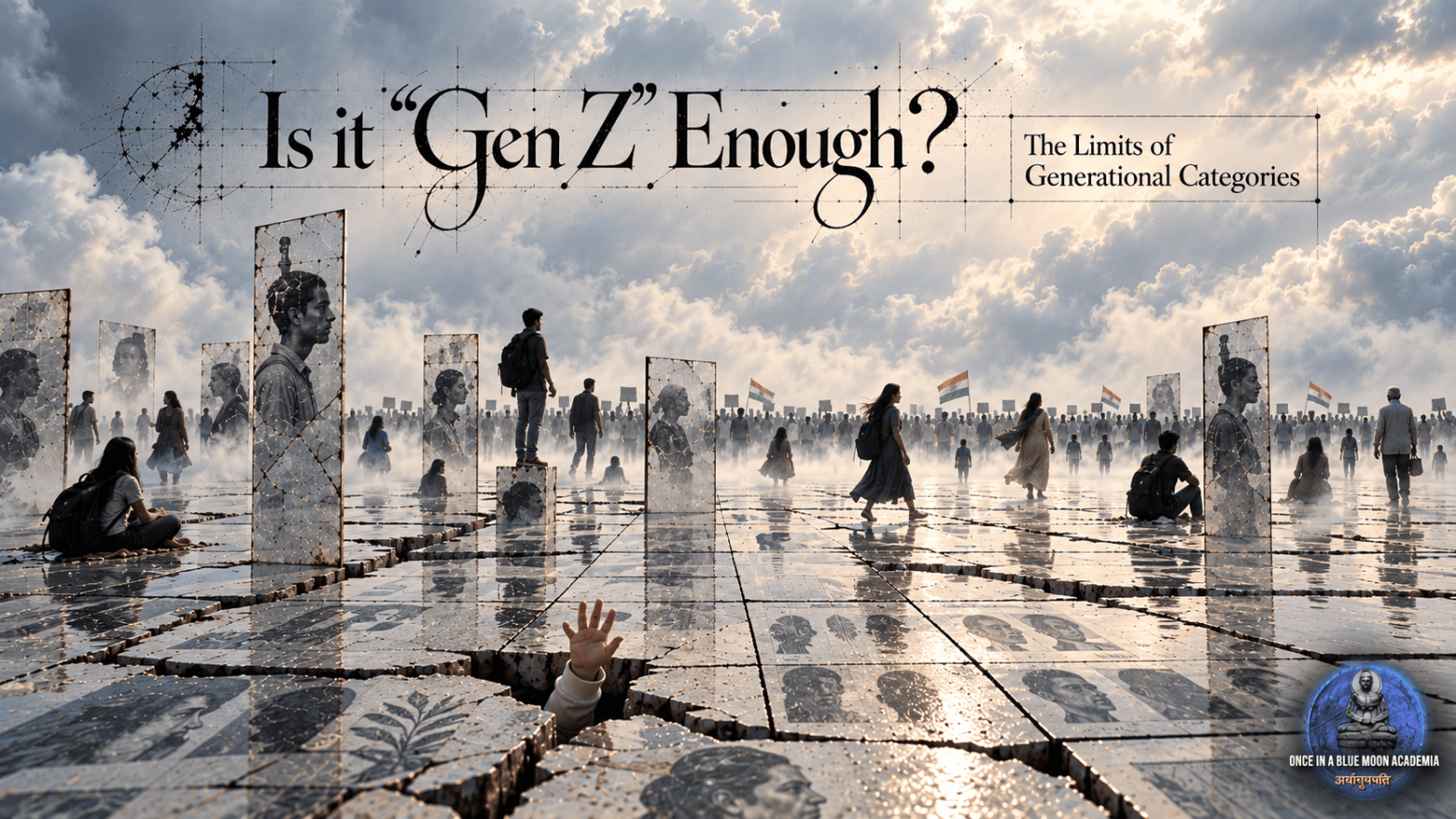
Generational labels function as a historically specific technology for ordering persons; the classification itself, not the cohorts it names, requires analysis. Drawing on Foucault’s archaeological and genealogical methods, the article traces the grid’s descent through state registration, demography, journalism, marketing and consultancy, showing how it imposes discrete essences on a continuum of births, scales disciplinary seriation to the population, generates looping effects, and recodes structural antagonisms as conflicts between age cohorts. The 2026 Indian mobilisation, branded a “Gen Z” uprising, serves as the principal test case: its composition, demands and alliances exceed any single cohort, demonstrating the non-contemporaneity of the contemporaneous. The Yayati–Babur circuit names the patriarchal mechanism that sustains this reduction. Within the same mobilisation the slogans of the dominant are echoed by the street; the echoing, read through Bhabha’s mimicry and Guha’s prose of counter-insurgency, opens a Third Space in which the national cry is made to carry a demand the apparatus refuses to hear. A parallel episode during Durga Puja in West Bengal—attacks on Left bookstalls resisted by student cadres of comparable age—further shows that shared birth years explain neither the violence nor the defence. The article rejects “mental age” as an alternative scale and proposes instead the plurality of temporalities that run through every subject and every movement.
The Crony Chakravyūha: Auditing the Adani-BJP Collusion
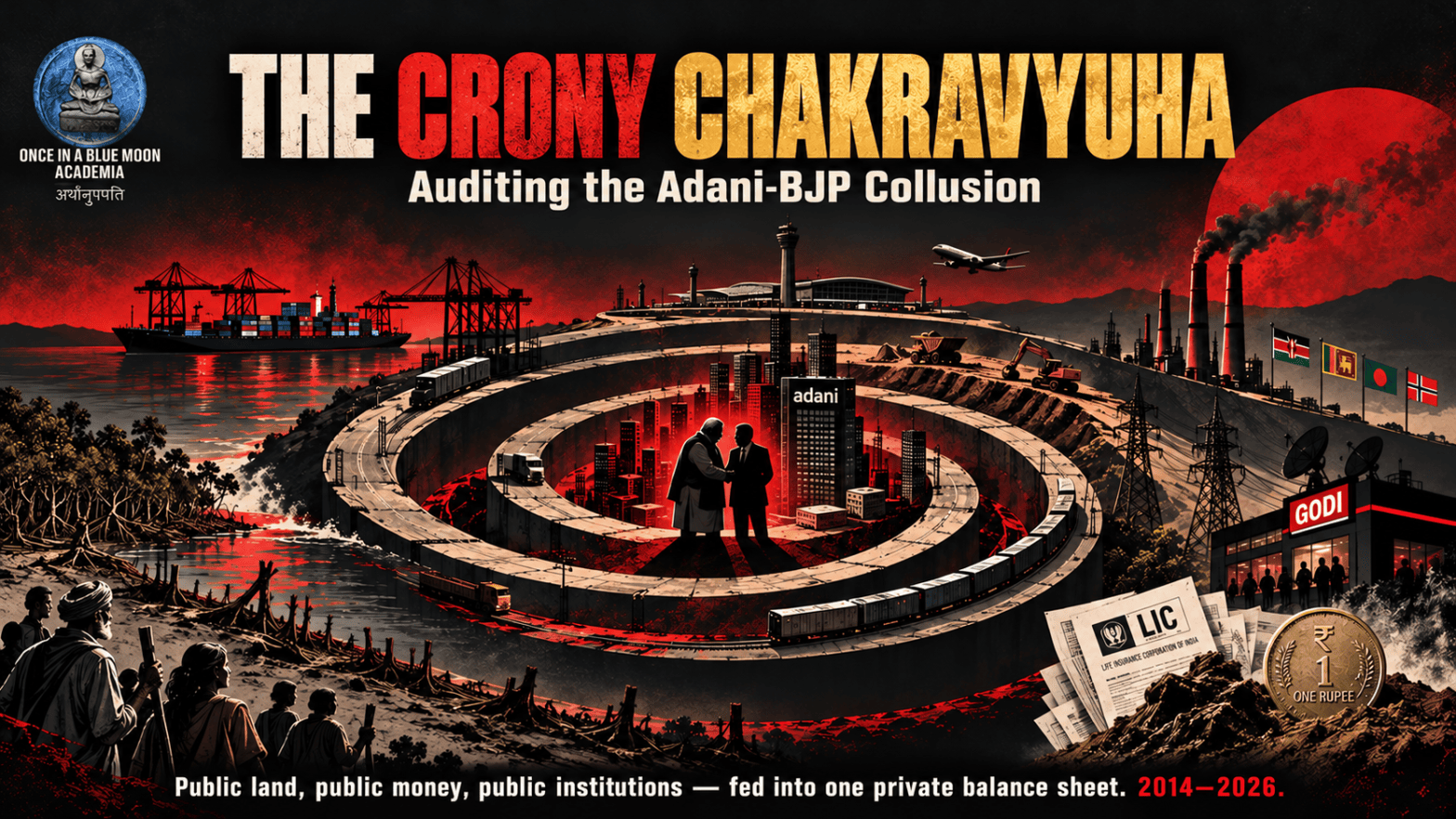
Between 2014 and 2026 one private citizen, Gautam Adani, came to control major shares of India’s ports, airports, coal, thermal and solar power, transmission, smart meters, city gas, cement, roads, water, defence, data centres, Asia’s largest informal settlement, a national television network and a news agency, while the BJP government and BJP-ruled states cleared his path through one-rupee land at Mundra and Pirpainti, rules rewritten before tenders that delivered coal blocks and all six airports he bid for, agency raids that preceded the Mumbai airport, NDTV and Coastal Energen takeovers, the 2020 farm laws that lifted stock limits after Adani lobbying, public money that arrived when private lenders fled, and foreign contracts that followed the Prime Minister’s tours. The record assembled here — from the Hindenburg and OCCRP exposés cleared by SEBI on a technicality, to the 2024 US bribery indictment that ended in 2026 after an India–US trade deal, a $10 billion pledge and the hiring of President Trump’s lawyer, a $275 million OFAC penalty for Iranian gas, a reported $3.9 billion LIC plan, the Mundra heroin route, the destruction of Hasdeo, Godda, Bhagalpur, the Galilee Basin, the coasts of Kutch and Kerala, the proposed Great Nicobar project, and the files the same formation has kept closed — shows public land, public money, public regulators, public forests and public diplomacy systematically feeding one private balance sheet whose profits return as political power. This is not merely crony capitalism at the margin of a market economy. It is a crony chakravyūha: a closed spiral, built and defended by the BJP, in which every turn makes the next easier and escape harder for everyone caught inside it.
Dissent, Dynamics and Domination: India’s Protest Movements (2014-26)
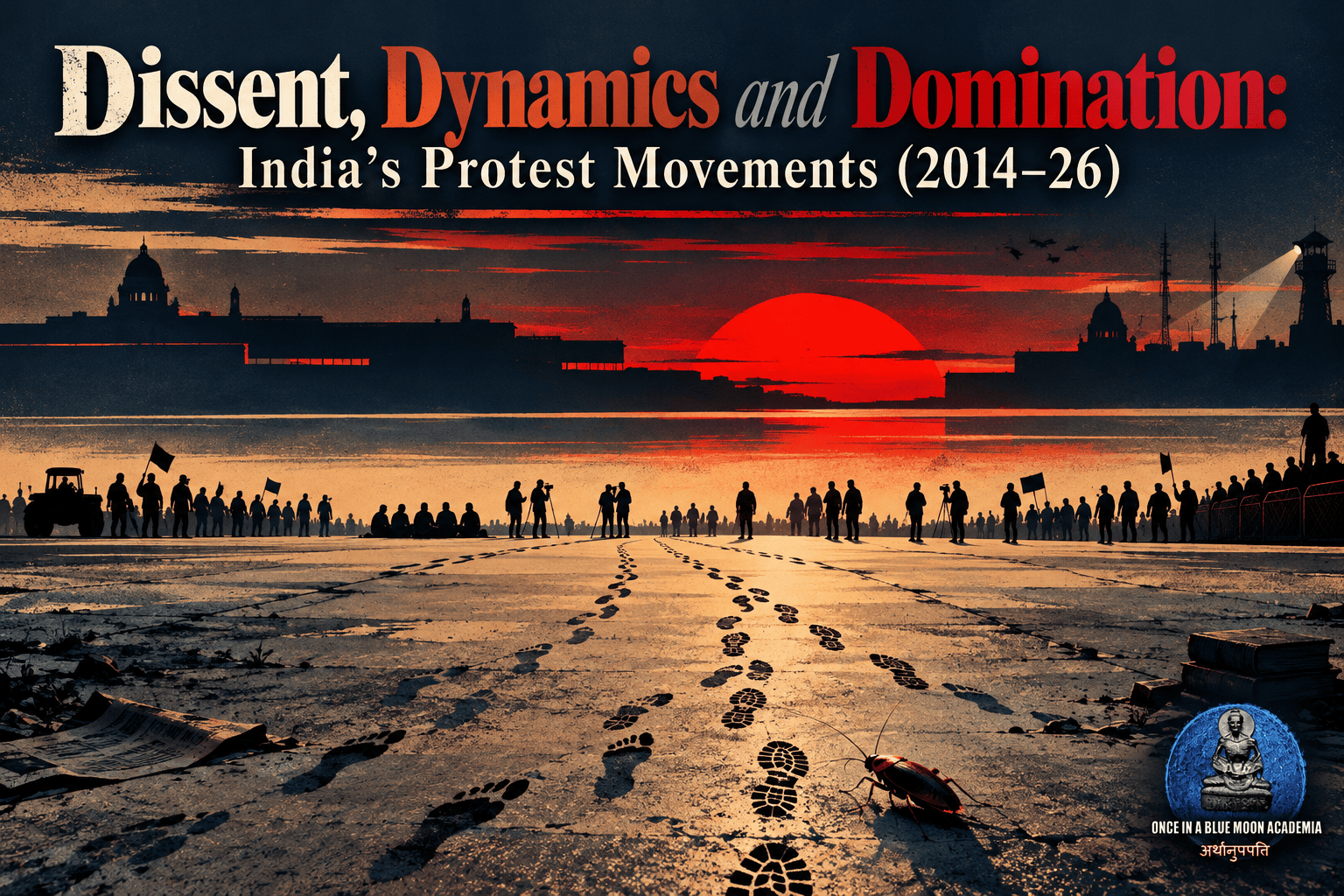
Between May 2014 and October 2026, India’s BJP-led National Democratic Alliance confronted an almost unbroken sequence of protest and resistance—from the 2015 land-ordinance agitation and the 2020–21 farmers’ siege of Delhi to the 2026 youth-led Cockroach Janta Party (CJP) rising—under conditions of sustained political domination rather than the successful production of consent. This article maps the ecology of that dissent: the movements themselves; a counter-public of non-Godi and crowdfunded media; satirists and stand-up comedians deploying hasya and vyanga against the regime’s bhayanaka and vibhatsya; organic intellectuals of political and civil society; dissenting advocates and judges; and watchdog NGOs. It documents the repertoire of domination deployed against them—imprisonment without trial, preventive detention, financial and regulatory strangulation, blocking, SLAPP litigation, career reprisals, threats, vigilante violence, surveillance, state violence and assassination by non-state actors—and reads the CJP against this longer inheritance through Gramsci’s account of hegemony and organic intellectuals, Partha Chatterjee’s distinction between civil and political society, Habermas’s concept of legitimation crisis, Ranajit Guha’s dominance without hegemony, and Ambedkar’s warning against bhakti in politics. The CJP’s speed and visibility rest on more than a decade of prior investigation, litigation and protest. Its demand for the resignation of named officeholders addresses persons rather than the paradigm or the chair; under a regime that has already closed ordinary channels and made the power to guarantee life the underside of the power to expose marked populations to the sovereign mark, the absorption of a name is the state’s work, not the movement’s. The article treats the CJP as a genuine opening for a new constituency whose unarmed presence has already forced the repressive and ideological apparatuses into public view. The further task is to keep the energy released by that showing from being returned, through the regime’s mechanisms of absorption and attribution, to the chairs that still decide who is to be made live and who is to be marked.
The Street Army: Bajrang Dal
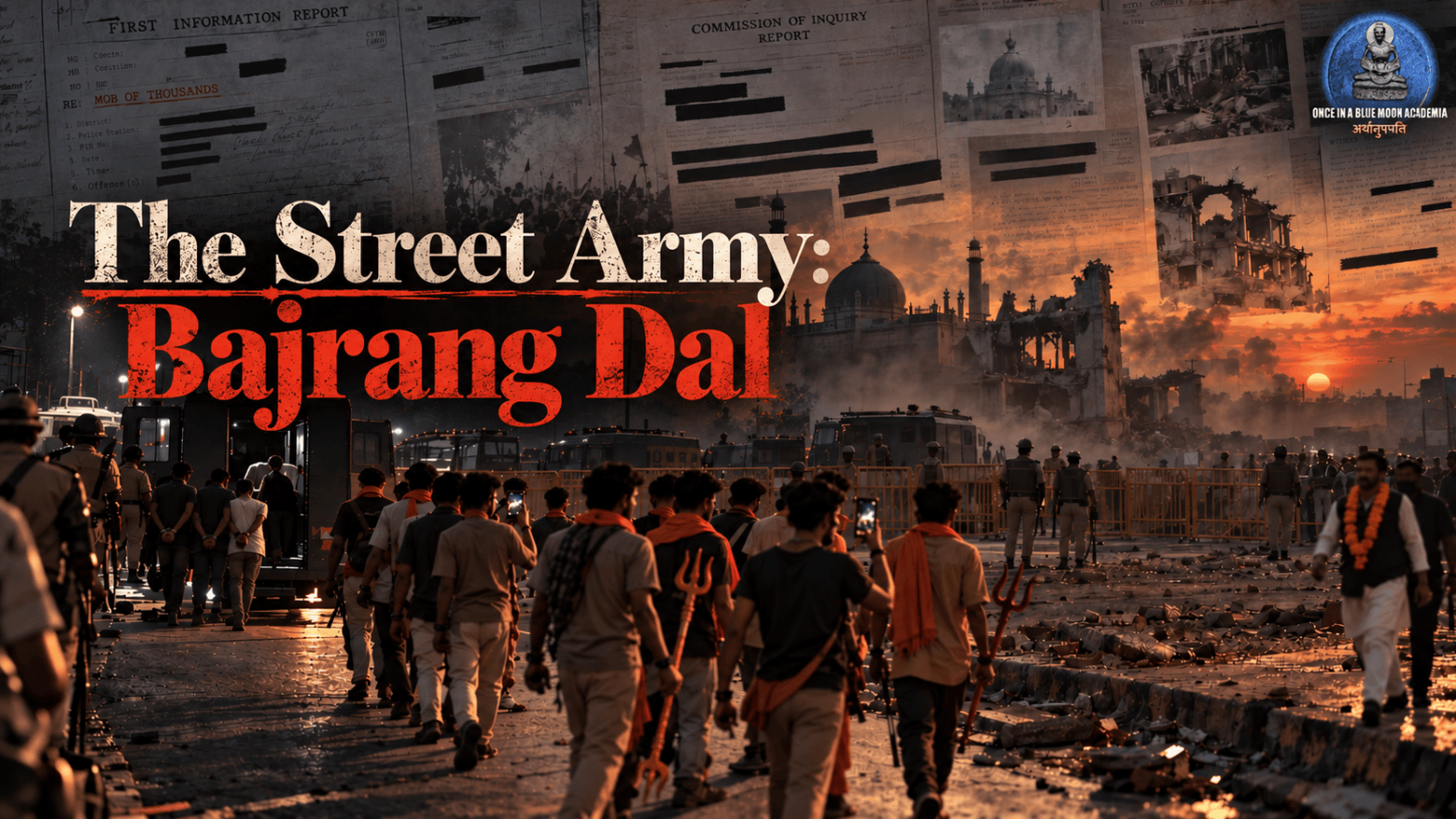
The official Indian record of Bajrang Dal and Sangh Parivar violence does not cohere on its own terms: it counts its dead by the dozen in cow-protection attacks while securing convictions by the handful, files named killers as anonymous mobs of thousands, convicts the gang-rapists of a pregnant woman and then releases them to garlands, and constitutes commissions only to bury their findings. This dossier reads that systematic incoherence as the evidence itself. The Bajrang Dal was manufactured by the RSS in 1984–86 as a deniable youth militia for the Ayodhya campaign; it has since operated, with BJP-supplied licence, as a cadre street-army whose repertoire—gau-raksha lynching, moral policing, anti-Christian violence, processions-as-detonators, and filmed humiliation—runs from the Babri demolition through Kandhamal, Gujarat 2002 (including Naroda Patiya and Bilkis Bano), the post-2014 lynching years (Akhlaq, Pehlu Khan, Tabrez Ansari), Nuh 2023, and Kathua. The same architecture converts authored atrocity into unprosecutable events through non-registration, reclassification, dilution, attrition, and inversion, while routing unemployed young men from shakha to Bajrang Dal, Sri Ram Sene, and Hindu Raksha Dal. In 2026 the machine applied direct state terrorism—mass preventive detention, blackouts, and site denotification—against the non-violent Cockroach Janta Party protest at Jantar Mantar, while a self-identified Hindutva affiliate’s filmed confession of assault received delayed process and restored liberty. The licence is not the absence of a finding; it is the finding. The record is the charge.
An Open Appeal to India’s Security Forces: Stand with Democratic Dissent
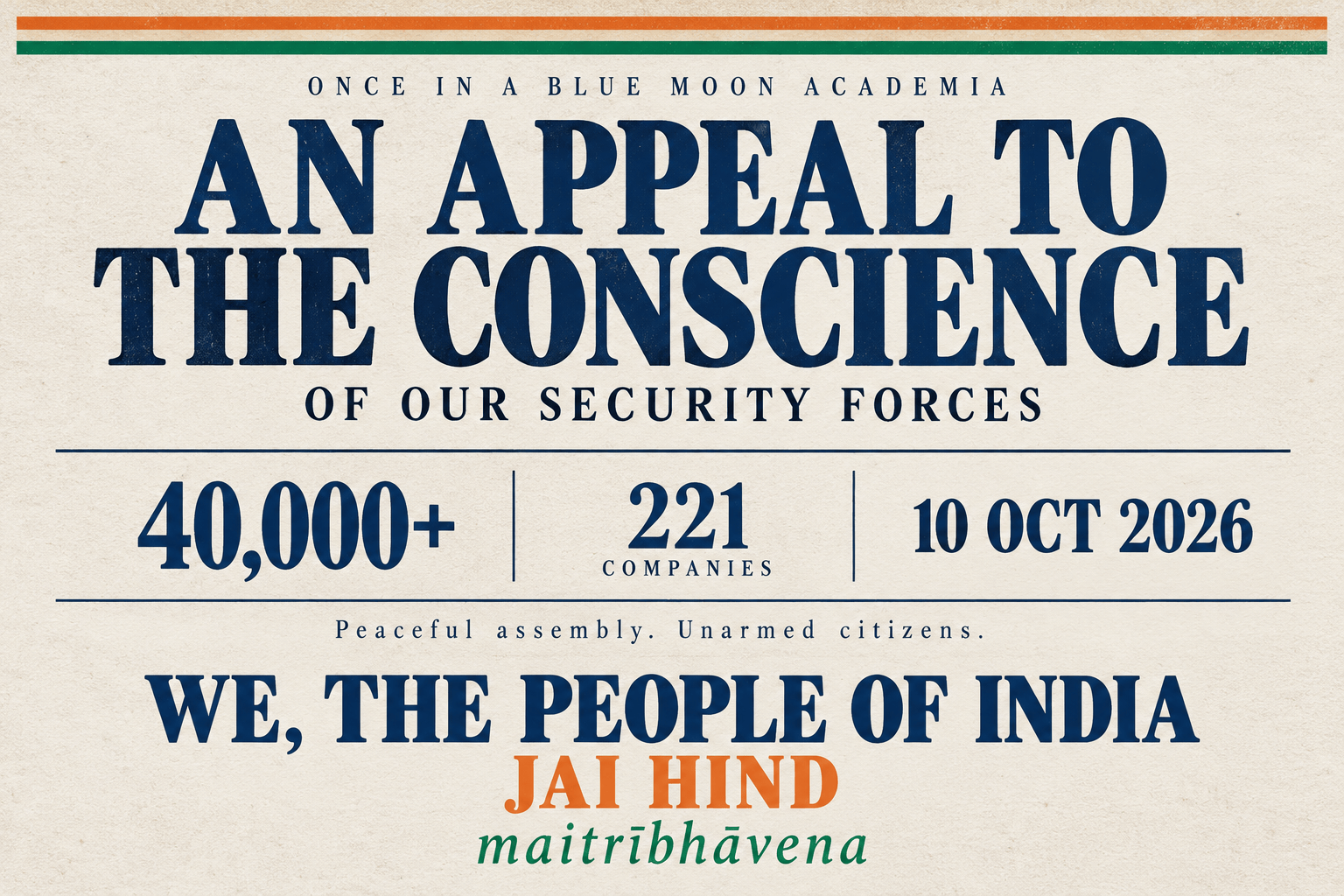
On 10 October 2026, as unarmed citizens, students and opposition voices gather at Jantar Mantar in peaceful civil disobedience, the State has assembled more than 40,000 Delhi Police and Central Armed Police Forces personnel, detention centres, facial-recognition cameras and metro closures against them. Once in a Blue Moon Academia appeals to those in uniform, not as adversaries but as fellow citizens, to let conscience precede command, to refuse the police state the last word, and to stand with the constitutional right to dissent.
A Glimpse into Saffron Fascism: The RSS and the Sangh
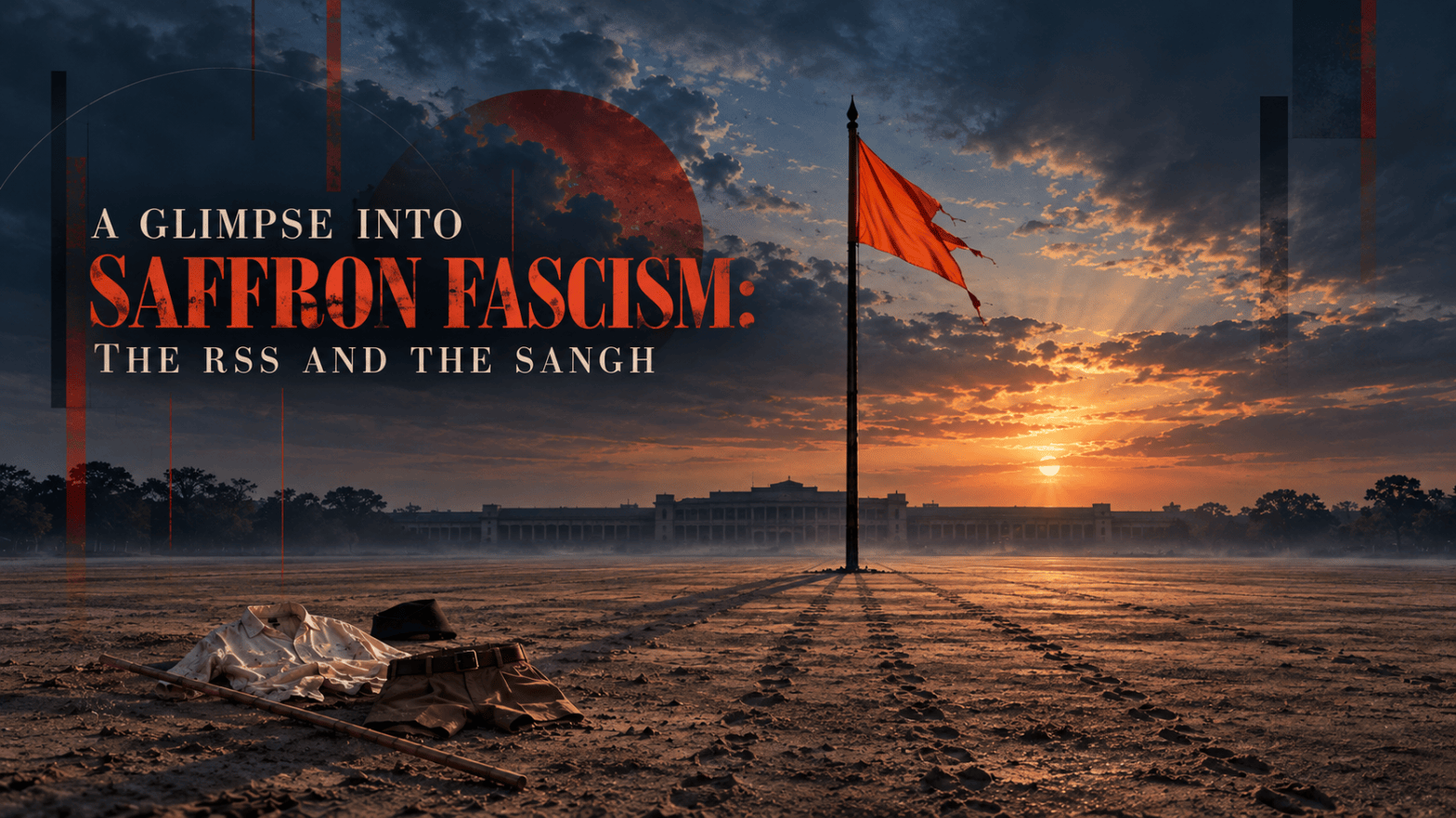
This exposé treats the Rashtriya Swayamsevak Sangh (RSS) and its Sangh Parivar not as mere faith but as a political technology: a durable and unregistered apparatus for manufacturing majoritarian-theocratic consent, disciplining populations and capturing the state. Scaffolded by Althusser, Gramsci, Foucault and Durkheim, it follows the organisation from its 1925 founding and abstention from the freedom struggle through Golwalkar’s programme of subordination without citizen’s rights, the semitisation of a colonial umbrella-term, “Hinduism,” into a pasteurised monolith, and the Akhand Bharat imagi-nation in which Partition is a wound and “go to Pakistan” a confession that the map is a poster. It tracks the saturation of civil society by more than fifty affiliates, the money without a ledger, the drills and the arms, the gendered order of Durga and Sita, the caste contract Meghwanshi watched fail at his own kitchen, and the documented violence against Muslims, Christians, Dalits and women, made costless by a reproducible impunity loop and extended, on paper, through the CAA, the NRC and the voter-roll revision. As a whole, this work adds the insider record of those who left, a sourced Register of the Dead and Harmed with the legal status of every case as it stood on 2 October 2026, and the questions the Sangh has never answered. It demands that the RSS, thrice banned and never reformed, be proscribed and its enforcement wings dissolved. The centenary count, more than 83,000 daily shakhas in 2025, claimed to be rising toward 89,000 in 2026, is taken not as tribute but as a confession of scale.
Ātmadīpa: The Non-Schooling Praxeogogy
Ātmadīpa is a non-school and a praxeo-gogy: not a greener exam-machine but a commons in which a people learns to inhabit a watershed in the polycrisis — lamp and island unto itself, and in the same motion a support to others. Head, hand and heart are taught as one and never ranked; the institution is deschooled. It resists the sale of learning, the capture of the curriculum, and the credential that pretends to be knowing. Its fields are the crafts of home-as-habitat — food, water, shelter, care, dissent, grief — held free at the point of use, federated without a headquarters, open-licensed, unfinished on purpose. Kindle your own lamp. Its only use is to light the road everyone walks.
OBMA: Our Constitution for a Living Commons
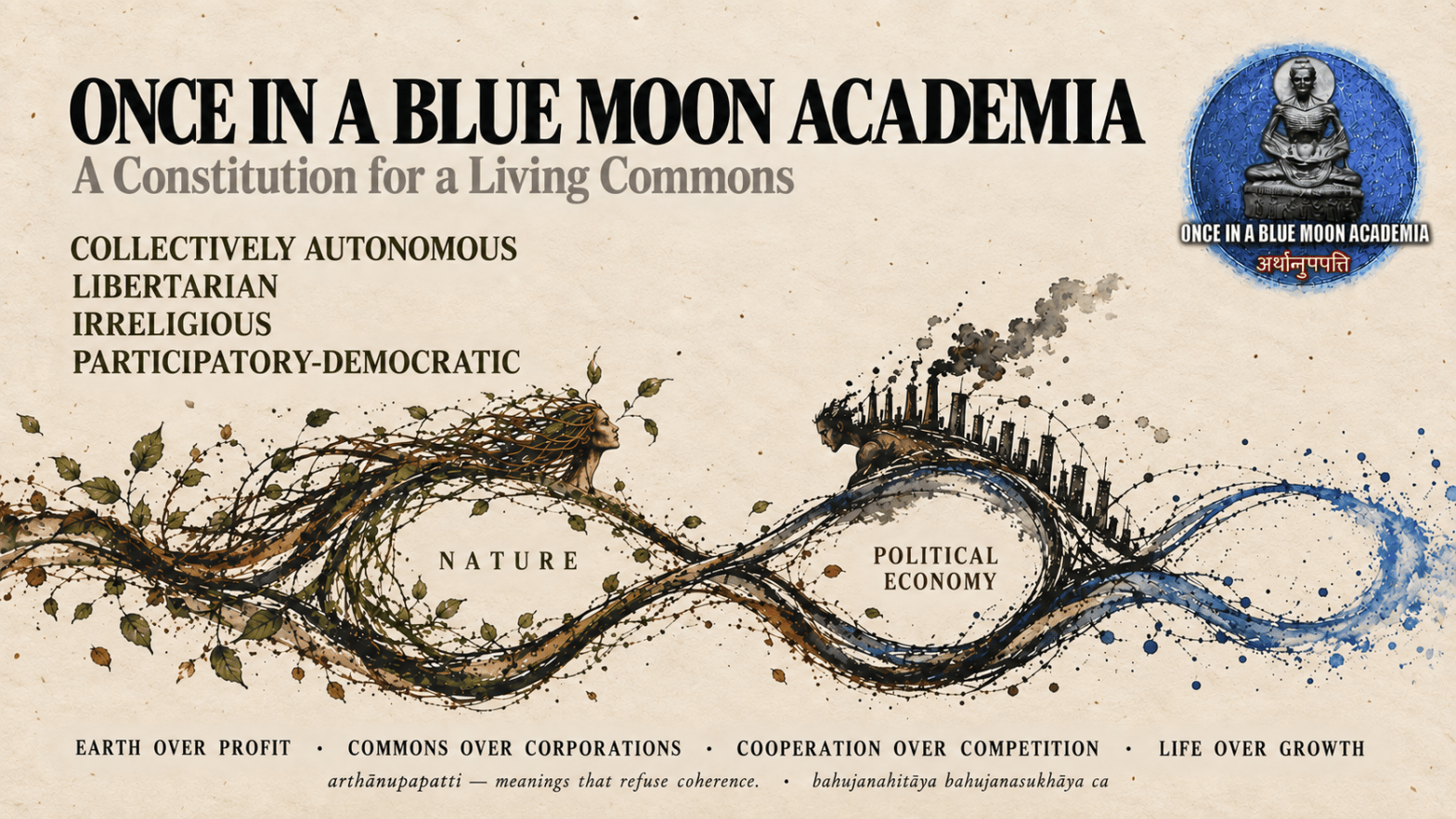
Once in a Blue Moon Academia (OBMA)’s Constitution does not found a state, church, company, political party, NGO or university; it binds a self-regulating commons of inquiry and action to the Earthian Charter and turns that Charter into praxis. It names OBMA as Earthlings among other-than-human life, seated in Baranagar on the Ganga but organised by watershed rather than nation, and it sets two inseparable goals: to expose the failing world economy and to act from the fact of ecological collapse. Fifteen Charter commitments become binding duties—Earth first; food, cloth and shelter instead of “growth”; decentralised power; refusal of extractive wealth; a moneyless commons; occupation of speculative finance; partyless communes; irreligious public form; deschooling beyond academiocracy; community health and justice; law that vanishes toward self-rule; no veto; no chase for office; total disarmament—while care, emancipatory praxis, equity and mutual aid are guaranteed to all who take part. Power stays small, open and reversible: an Assembly and circles, recallable stewards, no founder’s chair, an open ledger and a funding screen that rejects coal, arms, big finance and branded philanthropy. Knowledge is copyleft and fee-less; learning returns to place as a non-school; harm is recorded and defended, including the memory of financial fraud; capture is treated as the main danger, and the commons may dissolve rather than become a brand.
Money Taken, Votes Taken, SLAPPed: A DHFL Retrospective
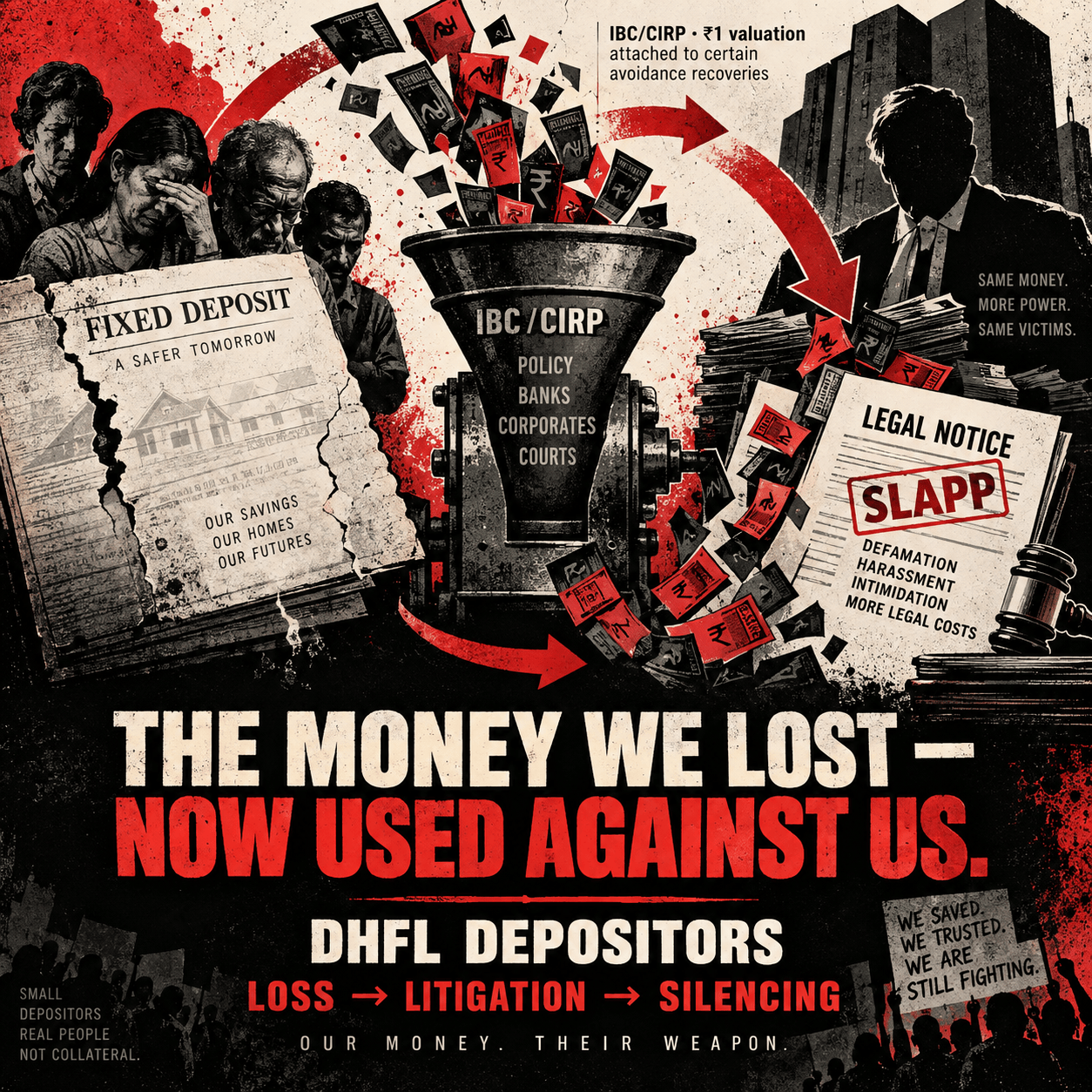
On 24 September 2026 we write in the light of The Indian Express report: two Election Commissioners of India objected fourteen times to roll changes, Form 6 and control of the voter database, while the Election Commission of India still called every decision unanimous. We have watched the same grammar inside the DHFL CoC. A vote is manufactured, dissent is filed away, and the person on the line is told the count is final. Depositors recovered 23 percent; Oaktree’s stronger bid was set aside; Ajay Piramal took fraud-recovery claims estimated at ₹45,000 crore for ₹1. Multiple RTIs produced no figure for CIRP costs. Then Piramal Capital sued us for ₹100 crore — a SLAPP of defamation and contempt against research and RTIs. Money taken. Votes taken. Then the summons.
The Goonda Returns: How a Category Became a Statute (Again!)
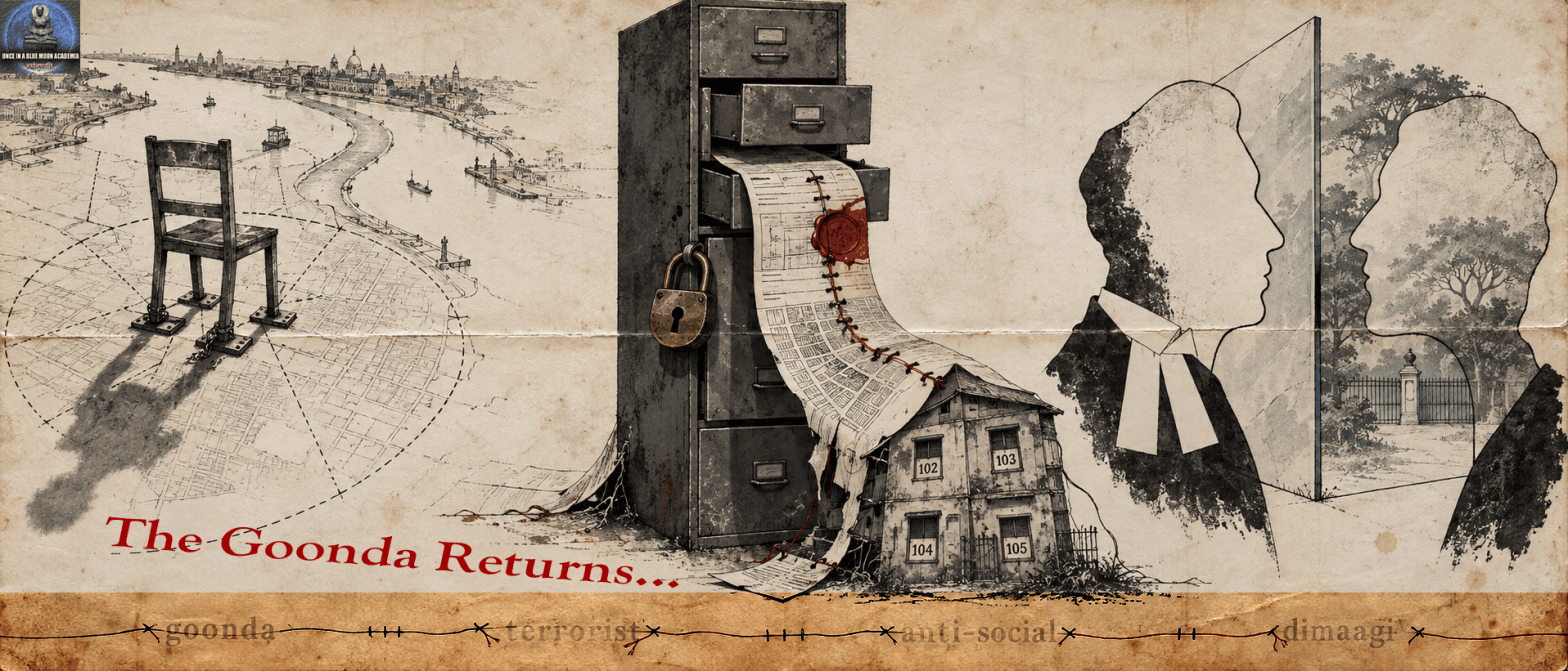
On 13 July 2026 West Bengal’s new BJP government announced that the Public Safety and Control of Anti-Social Activities Act (gunḍā-damana) and the Maintenance of Public Order (Amendment) Act were in force. The first allows twelve months’ charge-free detention of anyone a magistrate or commissioner deems a reputational “goonda,” criminalises harbouring the externed, and permits year-long district banishment. The second lets a Claims Commission attach and auction the property of alleged rioters and of protest organisers, financiers, instigators and logistical supporters, up to twice assessed damage. A High Court bench later treated the Public Safety instrument as still awaiting assent; the government had already declared midnight commencement. The article reads both statutes as Bengal’s own colonial archive reprinted — Regulation III of 1818, Rowlatt 1919, the Goondas Act 1923, the 1929 Safety Bill against which Bhagat Singh timed the Assembly bombs — and as a Foucaultian status crime. Against ICCPR Articles 9, 12, 14, 15, 19, 21–22, General Comment 35 and CCPR/C/IND/CO/4 (2024), the design fails at every limb; India’s 1979 Article 9 declaration does not shelter what Article 22 never required. The same circuit is the impunity loop mapped in OBMA’s DHFL and bulldozer work. A coda tests damana against daṇḍanīti, sets ADR affidavits inside the definition, and reads anyonya-pratibimba, Barthesian myth, and the July naming of Forward Bloc as goonda as a category that cannot close. It ends with a protocol: document the order, litigate the interior, internationalise now, count who is named, protect the harbourer. The goonda of the file is not the person. The second file is the remaining procedure.

