
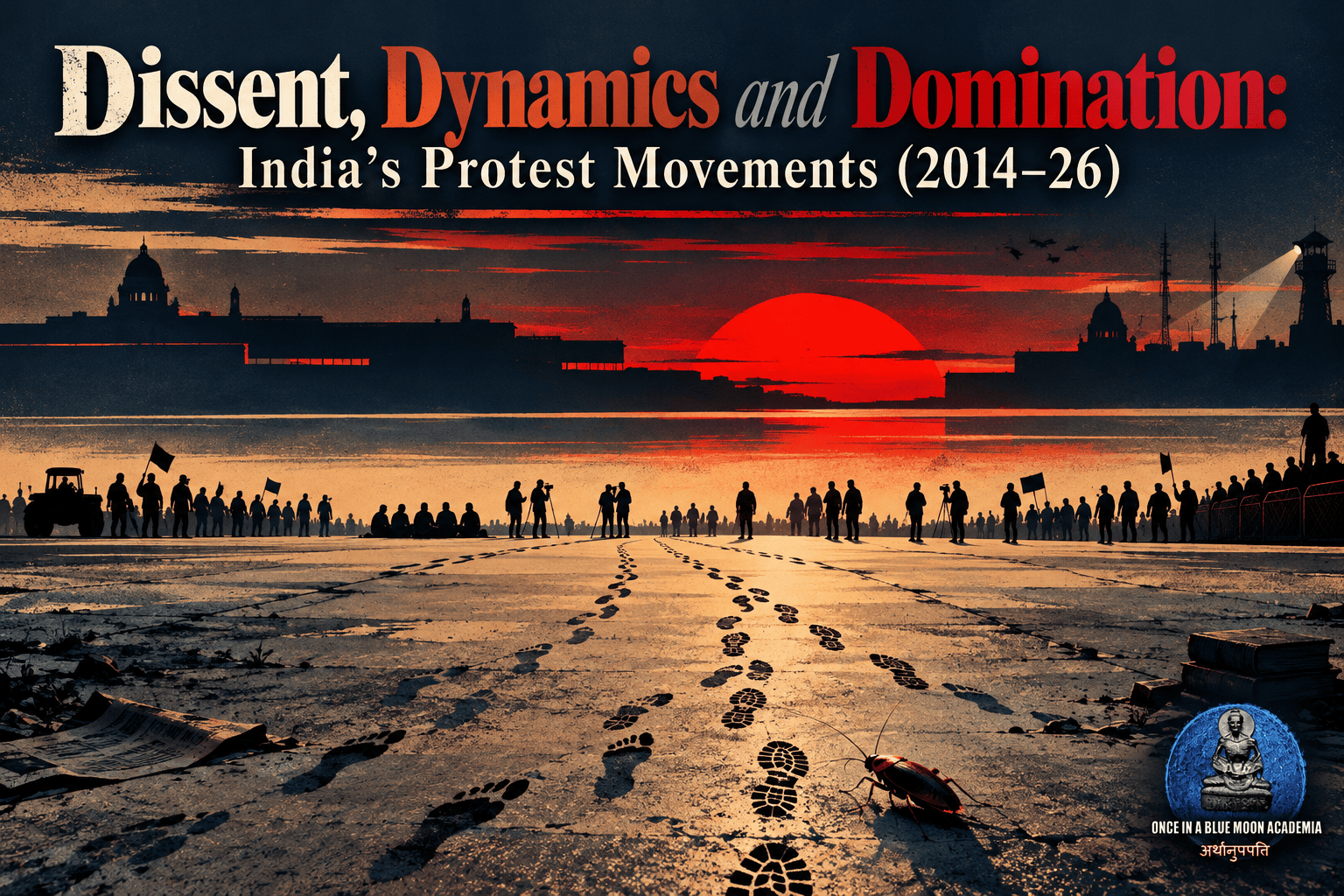
Between May 2014 and October 2026, India’s BJP-led National Democratic Alliance confronted an almost unbroken sequence of protest and resistance—from the 2015 land-ordinance agitation and the 2020–21 farmers’ siege of Delhi to the 2026 youth-led Cockroach Janta Party (CJP) rising—under conditions of sustained political domination rather than the successful production of consent. This article maps the ecology of that dissent: the movements themselves; a counter-public of non-Godi and crowdfunded media; satirists and stand-up comedians deploying hasya and vyanga against the regime’s bhayanaka and vibhatsya; organic intellectuals of political and civil society; dissenting advocates and judges; and watchdog NGOs. It documents the repertoire of domination deployed against them—imprisonment without trial, preventive detention, financial and regulatory strangulation, blocking, SLAPP litigation, career reprisals, threats, vigilante violence, surveillance, state violence and assassination by non-state actors—and reads the CJP against this longer inheritance through Gramsci’s account of hegemony and organic intellectuals, Partha Chatterjee’s distinction between civil and political society, Habermas’s concept of legitimation crisis, Ranajit Guha’s dominance without hegemony, and Ambedkar’s warning against bhakti in politics. The CJP’s speed and visibility rest on more than a decade of prior investigation, litigation and protest. Its demand for the resignation of named officeholders addresses persons rather than the paradigm or the chair; under a regime that has already closed ordinary channels and made the power to guarantee life the underside of the power to expose marked populations to the sovereign mark, the absorption of a name is the state’s work, not the movement’s. The article treats the CJP as a genuine opening for a new constituency whose unarmed presence has already forced the repressive and ideological apparatuses into public view. The further task is to keep the energy released by that showing from being returned, through the regime’s mechanisms of absorption and attribution, to the chairs that still decide who is to be made live and who is to be marked.
Category Archives: News Channel
An Open Appeal to India’s Security Forces: Stand with Democratic Dissent
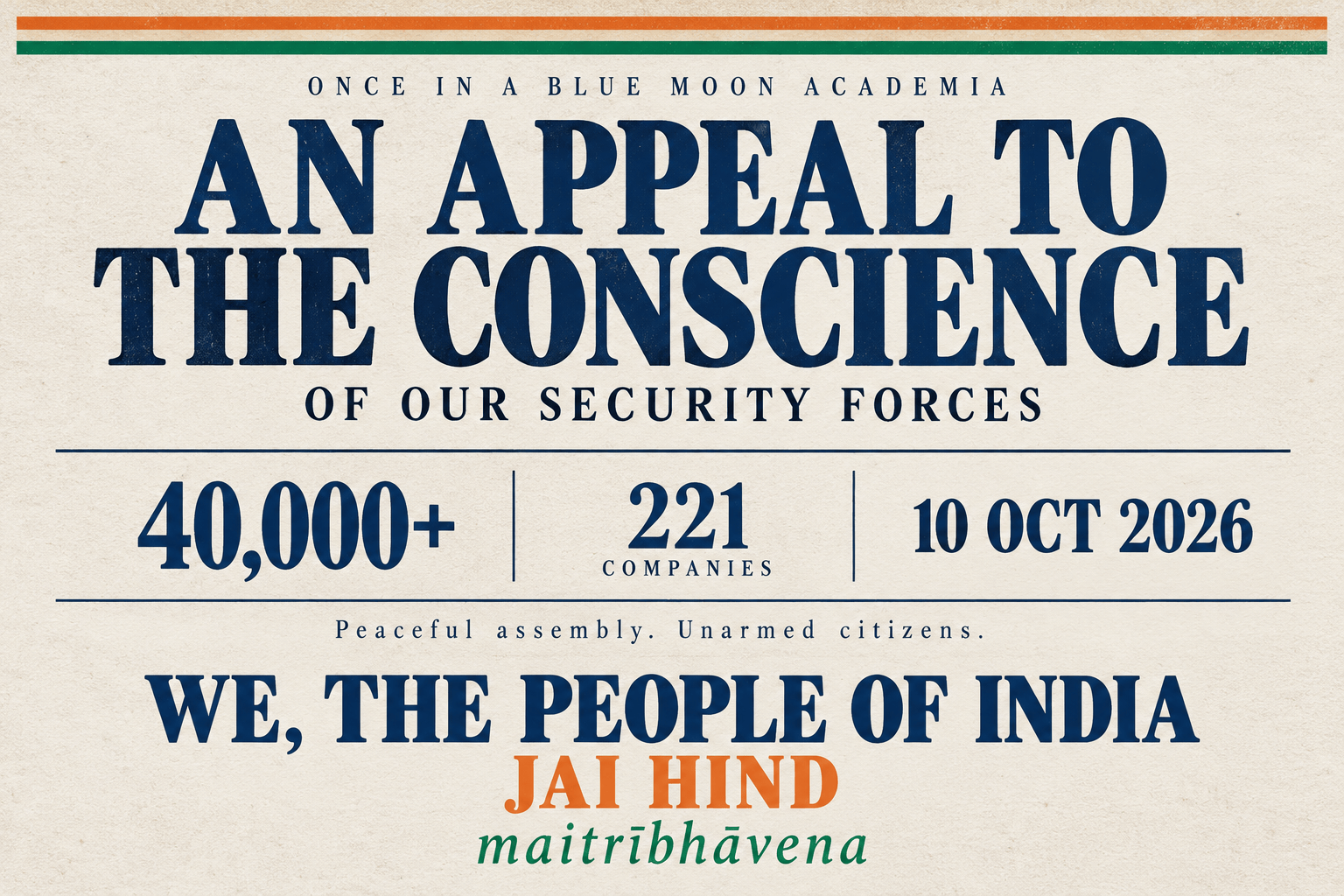
On 10 October 2026, as unarmed citizens, students and opposition voices gather at Jantar Mantar in peaceful civil disobedience, the State has assembled more than 40,000 Delhi Police and Central Armed Police Forces personnel, detention centres, facial-recognition cameras and metro closures against them. Once in a Blue Moon Academia appeals to those in uniform, not as adversaries but as fellow citizens, to let conscience precede command, to refuse the police state the last word, and to stand with the constitutional right to dissent.
The Goonda Returns: How a Category Became a Statute (Again!)
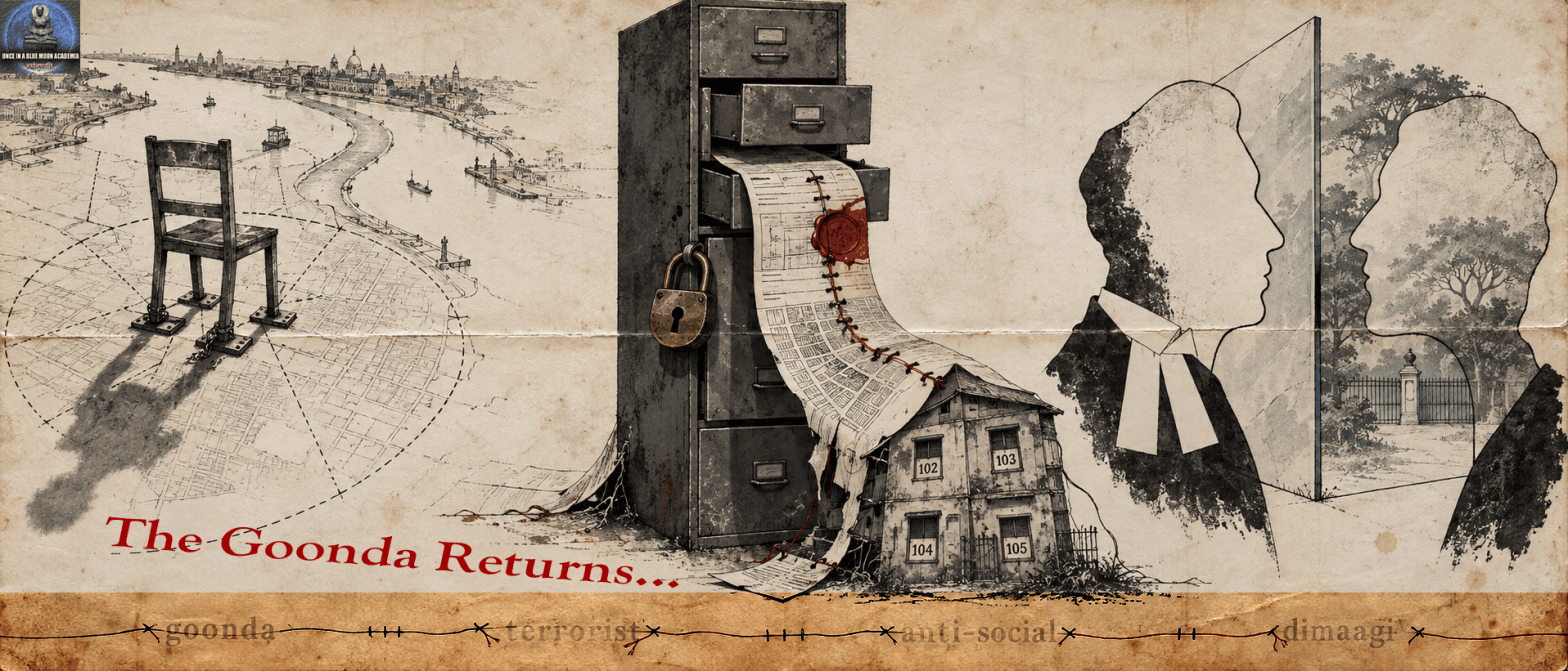
On 13 July 2026 West Bengal’s new BJP government announced that the Public Safety and Control of Anti-Social Activities Act (gunḍā-damana) and the Maintenance of Public Order (Amendment) Act were in force. The first allows twelve months’ charge-free detention of anyone a magistrate or commissioner deems a reputational “goonda,” criminalises harbouring the externed, and permits year-long district banishment. The second lets a Claims Commission attach and auction the property of alleged rioters and of protest organisers, financiers, instigators and logistical supporters, up to twice assessed damage. A High Court bench later treated the Public Safety instrument as still awaiting assent; the government had already declared midnight commencement. The article reads both statutes as Bengal’s own colonial archive reprinted — Regulation III of 1818, Rowlatt 1919, the Goondas Act 1923, the 1929 Safety Bill against which Bhagat Singh timed the Assembly bombs — and as a Foucaultian status crime. Against ICCPR Articles 9, 12, 14, 15, 19, 21–22, General Comment 35 and CCPR/C/IND/CO/4 (2024), the design fails at every limb; India’s 1979 Article 9 declaration does not shelter what Article 22 never required. The same circuit is the impunity loop mapped in OBMA’s DHFL and bulldozer work. A coda tests damana against daṇḍanīti, sets ADR affidavits inside the definition, and reads anyonya-pratibimba, Barthesian myth, and the July naming of Forward Bloc as goonda as a category that cannot close. It ends with a protocol: document the order, litigate the interior, internationalise now, count who is named, protect the harbourer. The goonda of the file is not the person. The second file is the remaining procedure.
The Man and the Monolith: A Dossier on Mohan Bhagwat
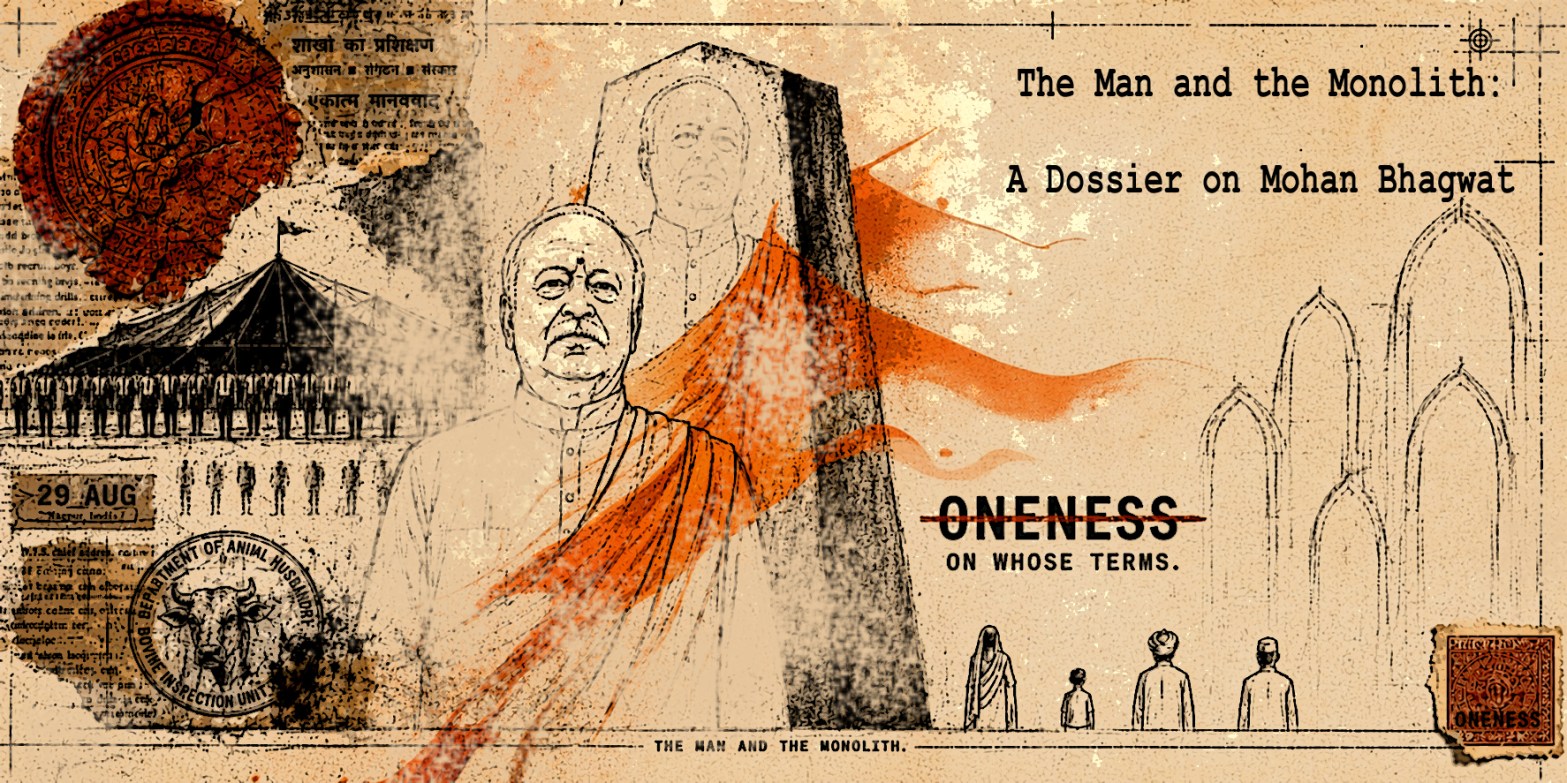
This dossier is a committed forensic case against Mohan Madhukar Bhagwat, sixth Sarsanghchalak of the Rashtriya Swayamsevak Sangh since 2009 and its executive from 2000 to 2009: a lifer raised in a three-generation Sangh household, produced by the organisation’s sealed ladder, and now the living editor of an ideology whose founding texts — Savarkar’s membership test, Golwalkar’s denial of minority citizenship and praise of a Nazi purge as a “lesson,” Moonje’s 1931 pilgrimage to Mussolini — he does not disown so much as copy-edit for export as “oneness.” It holds the line the Sangh most wants critics to overstep: no invented personal conviction from Gujarat 2002, no fake-doctorate smear, no claim that a USCIRF recommendation or a Canadian petition is already law; the charge that survives is custody of a majoritarian machine — unregistered at the centre, banned three times by the republic, radiating through the BJP and the Parivar — restated in Bhagwat’s own dated speech as eliminative absorption (“everyone is Hindu”), relocation of blame (2013, 2015, 2019, 2025), and centenary reputation-work. That work arrived in New York in August 2026 as “Universal Oneness” at Madison Square Garden and walked into a revolt that includes Hindus who refuse to let Hindutva speak in their name. The monolith calls itself oneness. The dossier refuses the name.
Ahimsa Before Arms: an Open Letter and Dossier to the Soldiers, Sailors, and Airmen of India
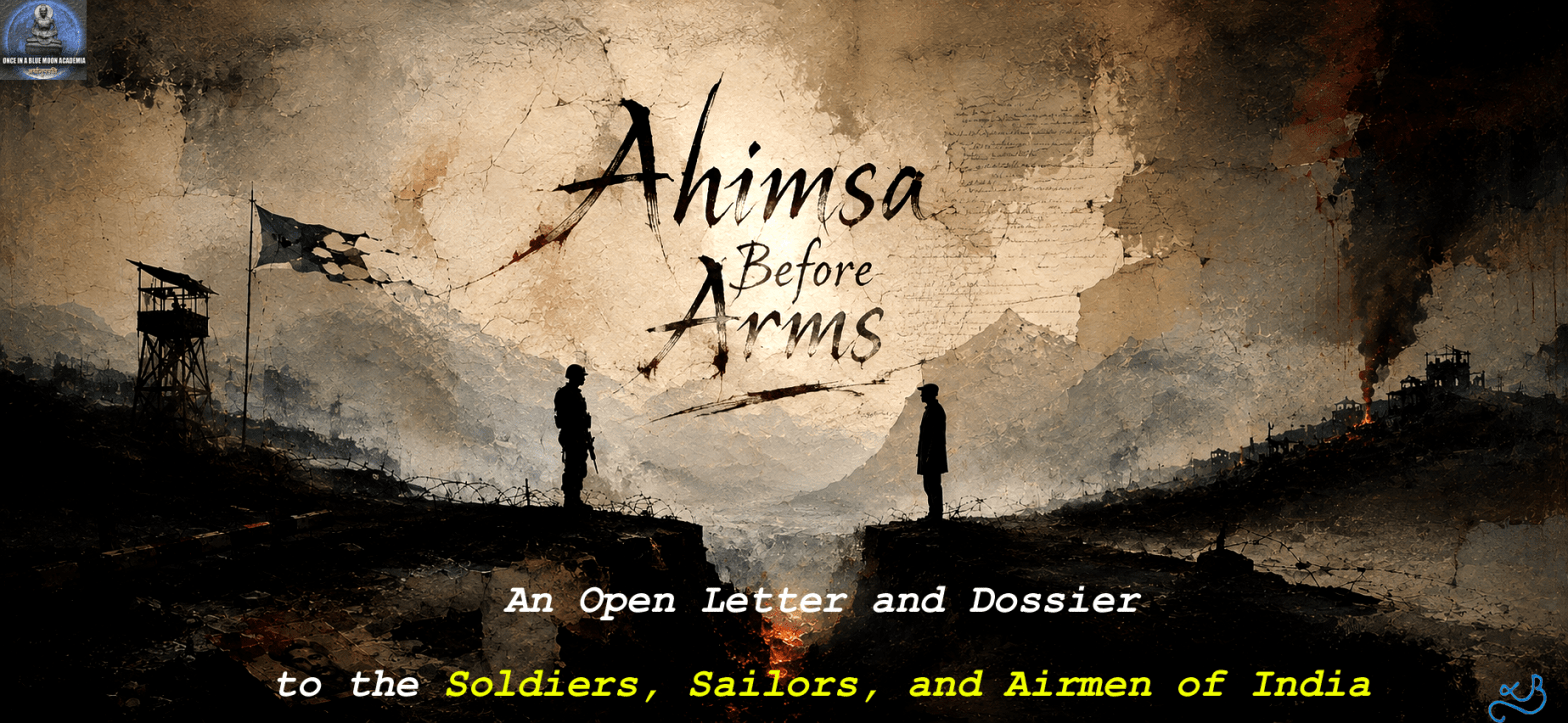
Addressed to the men and women in the uniform of the Indian Republic — not to generals, procurement officers, or politicians, but to the person with the rifle, the aircraft, the border watch, and the internal-security beat — this open letter and dossier is written from ahimsa: hard, active non-violence that refuses the destruction of truth. From parliamentary records, CAG reports, RTIs, courts, former Governors and Army Chiefs, the National War Memorial, investigative and strategic sources, SIPRI and budget data, and OBMA’s research, it maps institutional betrayal under the BJP–NDA regime(s): a suppressed Army Chief’s memoir; electoral use of Pulwama and Pahalgam martyrs; Model Code violations; Agnipath’s contract labour; disability-pension cuts after the 2016 strikes and the 2026 tax on valour; AFGIS/AGIF losses in DHFL; defective INSAS and ammunition; Chinese occupation and cartographic lies; Operation Sindoor’s fog and later war-memorial names; Siachen’s nationalism industry; Taliban engagement and the asymmetric terror label; CAPF subordination and the 2026 Act overriding the Supreme Court; veterans at Jantar Mantar; Rafale opacity; a ₹6,81,210-crore budget that still cannot issue reliable boots; and war-profiteering that turns the soldier into a line item. Linked to Prahar, Rang De Basanti, War Chhod Na Yaar, and Jai Ho, and closed by the Russell–Einstein question, it asks the citizen in uniform for viveka — not rebellion, but truth known, paid forward, and refused as the next campaign poster’s raw material.
Azadi, or Democratic Unfreedom? A Video Message from OBMA

This video asks what “Azadi” (freedom) means in India today, and whether the formal existence of democracy can coexist with a lived condition of democratic unfreedom. Tracing the period from 2014 to 2026, it examines the erosion of civil liberties, institutional accountability, democratic participation, ecological security, and economic justice, before asking what genuine freedom might require: the Right to Reject, the Right to Recall, a partyless democracy, and an ecological politics rooted in Oikos — our shared home.
The Rajnath Singh Dossier: Resign, Raksha Mantri!
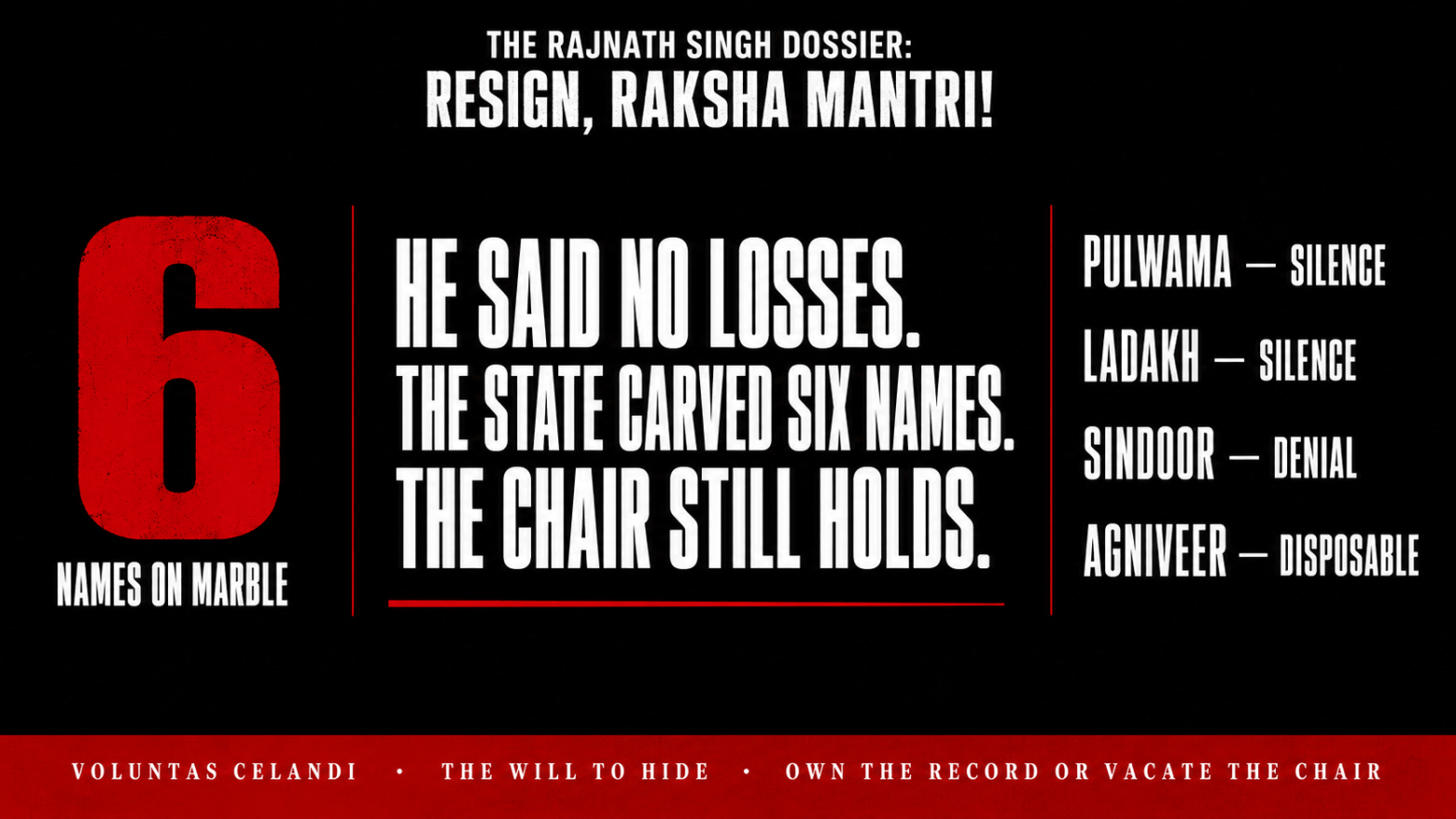
This citizens’ charge-sheet records Rajnath Singh’s institutional tenure as Home Minister (2014–2019) and Defence Minister (2019–present) through the state’s own certified contradictions: the intelligence and convoy-security collapse that killed forty CRPF personnel at Pulwama on his watch; the selective silence on lost patrolling access in Eastern Ladakh; the Pahalgam attack of 22 April 2025 and the retaliatory Operation Sindoor; the categorical parliamentary denial of any soldier losses on 28 July 2025, followed thirteen months later by the state’s compelled disclosure of six names chiselled onto the National War Memorial; the parallel refusal to admit aircraft attrition until the Chief of Defence Staff conceded it abroad; the conversion of the soldier into a four-year disposable contract under Agnipath; the political shielding of opacity around Rafale; and the quiet advance of dynasty inside a party that campaigns against it. Built exclusively from Hansard, the National War Memorial’s Roll of Honour, Ministry of Defence clarifications and on-record statements of constitutional functionaries, the pattern that emerges is voluntas celandi—the will to hide—operating at the very site of memory, semantic truncation that leaves dual realities permanently open, and the systematic manufacture of impunity upstream of every demand for accountability. The minimum grammar of ministerial responsibility therefore requires the holder of the chair to step down; because the institutional machine is constructed so that no minister of this regime need ever activate that grammar, the deeper structural demand remains the constitutional Right to Recall and the Right to Reject.
The Shah Dossier: Resign, Union Home Minister!

This citizens’ charge-sheet documents twenty-one instances of foreclosed accountability, institutional failure and the systematic manufacture of impunity under Amit Shah as Union Home Minister — from the Gujarat encounter cases and the tadipaar externment, through surveillance, financial opacity, the architecture of control in Kashmir, CAA–NRC and electoral machinery, to security collapses in Manipur, Pahalgam and on the China border, culminating in the use of brutal and repressive force against unarmed students at Jantar Mantar. It demands his resignation and the democratic rights of recall and reject.
Parliament Without Debate: India’s Hollowed-Out “Democracy” (2014-26)
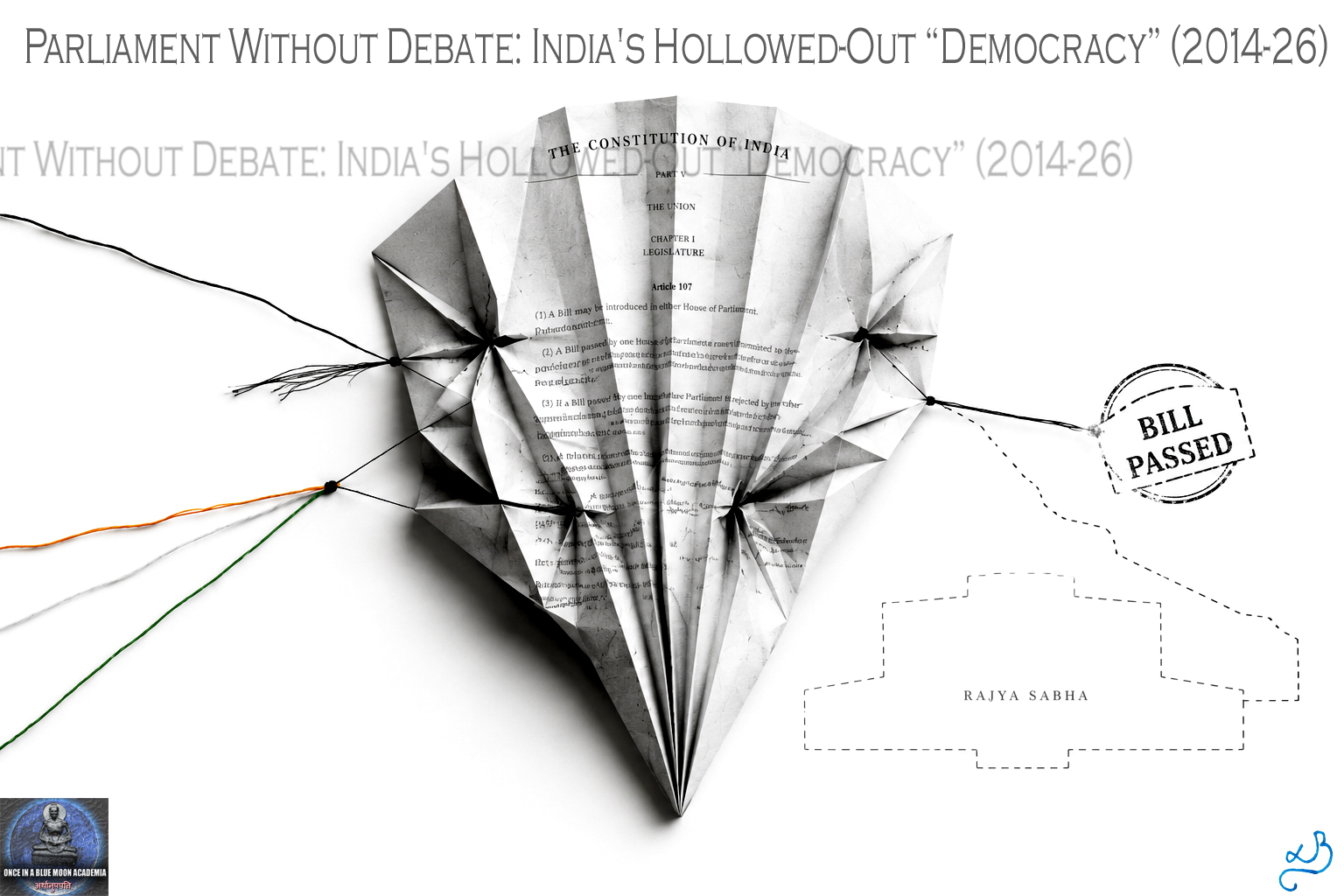
This damning audit of India’s parliamentary law-making from 2014–2026 across the 16th to 18th Lok Sabhas exposes a relentless executive assault on democratic norms. Drawing from official Bulletins, PRS data, PIB releases, and law reports, it reveals roughly 390–410 bills rammed through both Houses, with at least seven major non-fiscal laws cynically certified as money bills—concentrated in 2016–2019 when the government lacked Rajya Sabha majority—to sideline the Upper House. Deliberation has collapsed: committee referrals plummeted from 71% to 16%, over 90% of bills passed without recorded votes, four-fifths of the Union budget guillotined, and shameful records of seven to eight bills bulldozed in a single sitting while the Opposition was suspended or boycotting. Four major legislative retreats were forced extra-parliamentarily under street and electoral pressure, while a churn regime of hasty laws—led by the Insolvency and Bankruptcy Code with six frantic amendments, five via ordinance—sees statutes perpetually patched by executive fiat. This is no healthy democracy but a clear strategy of procedural fungibility: the bypass tool shifts with parliamentary numbers, yet the core preference for rubber-stamp ratification remains unchanged—findings that align with damning verdicts from V-Dem, Freedom House, EIU, RSF, and CIVICUS. Since 2024, partial corrections have come only from vigilant voters and mass protests, not from the broken institutions meant to prevent such executive aggrandizement within a hollow electoral shell. The fight to reclaim Parliament is urgent.
The Ballot You Could Not Read: SIR and DHFL CoC

In this essay, Once in a Blue Moon Academia draws a structural parallel between two opaque state-orchestrated processes — the 2020–21 RBI-appointed Committee of Creditors (CoC) resolution of DHFL, which extinguished over ₹4,100 crore of elderly depositors’ savings through an unverifiable electronic ballot they could neither download nor retain, and the 2025–26 Special Intensive Revision (SIR) of electoral rolls that deleted nearly 91 lakh names in West Bengal ahead of the Assembly elections. Both exemplify “managed consent”: the meticulous preservation of democratic and procedural rituals while systematically withdrawing verifiability, accessibility, and meaningful agency. Invoking Mīmāṃsā pramāṇas (anupalabdhi and arthāpatti) alongside statutory adverse inference, the essay demonstrates how the sustained withholding of records — despite official claims of transparency — itself constitutes proof of the postulated theft. Dedicated to the UN Special Rapporteurs behind Communication AL IND 8/2026, it frames these as twin installations of a singular “government of registers” that renders citizens legible while keeping the State’s decisive mechanisms illegible, urging the lawful opening of black boxes and the simple demand: show the records.

