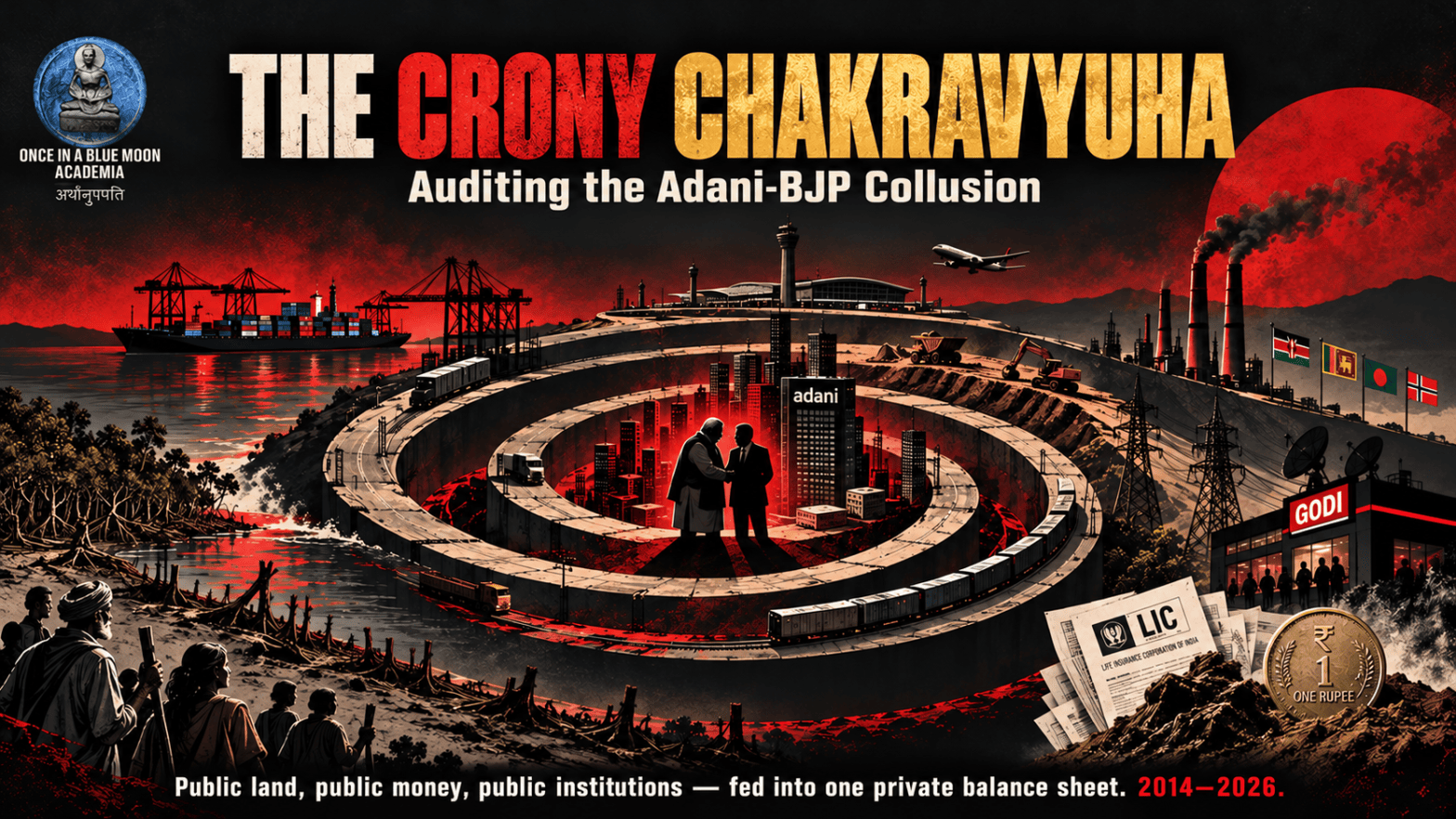
Between 2014 and 2026 one private citizen, Gautam Adani, came to control major shares of India’s ports, airports, coal, thermal and solar power, transmission, smart meters, city gas, cement, roads, water, defence, data centres, Asia’s largest informal settlement, a national television network and a news agency, while the BJP government and BJP-ruled states cleared his path through one-rupee land at Mundra and Pirpainti, rules rewritten before tenders that delivered coal blocks and all six airports he bid for, agency raids that preceded the Mumbai airport, NDTV and Coastal Energen takeovers, the 2020 farm laws that lifted stock limits after Adani lobbying, public money that arrived when private lenders fled, and foreign contracts that followed the Prime Minister’s tours. The record assembled here — from the Hindenburg and OCCRP exposés cleared by SEBI on a technicality, to the 2024 US bribery indictment that ended in 2026 after an India–US trade deal, a $10 billion pledge and the hiring of President Trump’s lawyer, a $275 million OFAC penalty for Iranian gas, a reported $3.9 billion LIC plan, the Mundra heroin route, the destruction of Hasdeo, Godda, Bhagalpur, the Galilee Basin, the coasts of Kutch and Kerala, the proposed Great Nicobar project, and the files the same formation has kept closed — shows public land, public money, public regulators, public forests and public diplomacy systematically feeding one private balance sheet whose profits return as political power. This is not merely crony capitalism at the margin of a market economy. It is a crony chakravyūha: a closed spiral, built and defended by the BJP, in which every turn makes the next easier and escape harder for everyone caught inside it.
Category Archives: Ecosophy
OBMA’s initiative “Ecotopians of Alternity” (EOA) responds to the contemporary crises of the natural environment, crises that expose the deepened hyper-separation of human beings from the natural world and/or other-than-human life forms. EOA underscores how the Global South disproportionately bears the burden of a so-called first-world consumerist lifestyle, alongside a debt-ridden developmental paradigm that enslaves minds, bodies, and ecologies. Rather than the term ecology, EOA activists adopt the concept of ecosophy—coined by the Norwegian philosopher Arne Næss—to signify the interrelated and (w)holistic nature of today’s polycrisis, encompassing environmental, social, political, and psychological dimensions. In place of extractivist modernity/coloniality, EOA envisions localized, small-scale, decentralized, low-energy societies—ecological utopias or ecotopias—as the ideals to be cherished and pursued.
Ātmadīpa: The Non-Schooling Praxeogogy
Ātmadīpa is a non-school and a praxeo-gogy: not a greener exam-machine but a commons in which a people learns to inhabit a watershed in the polycrisis — lamp and island unto itself, and in the same motion a support to others. Head, hand and heart are taught as one and never ranked; the institution is deschooled. It resists the sale of learning, the capture of the curriculum, and the credential that pretends to be knowing. Its fields are the crafts of home-as-habitat — food, water, shelter, care, dissent, grief — held free at the point of use, federated without a headquarters, open-licensed, unfinished on purpose. Kindle your own lamp. Its only use is to light the road everyone walks.
Maoists Without Mao: The Misnomer of Indian ‘Maoism’
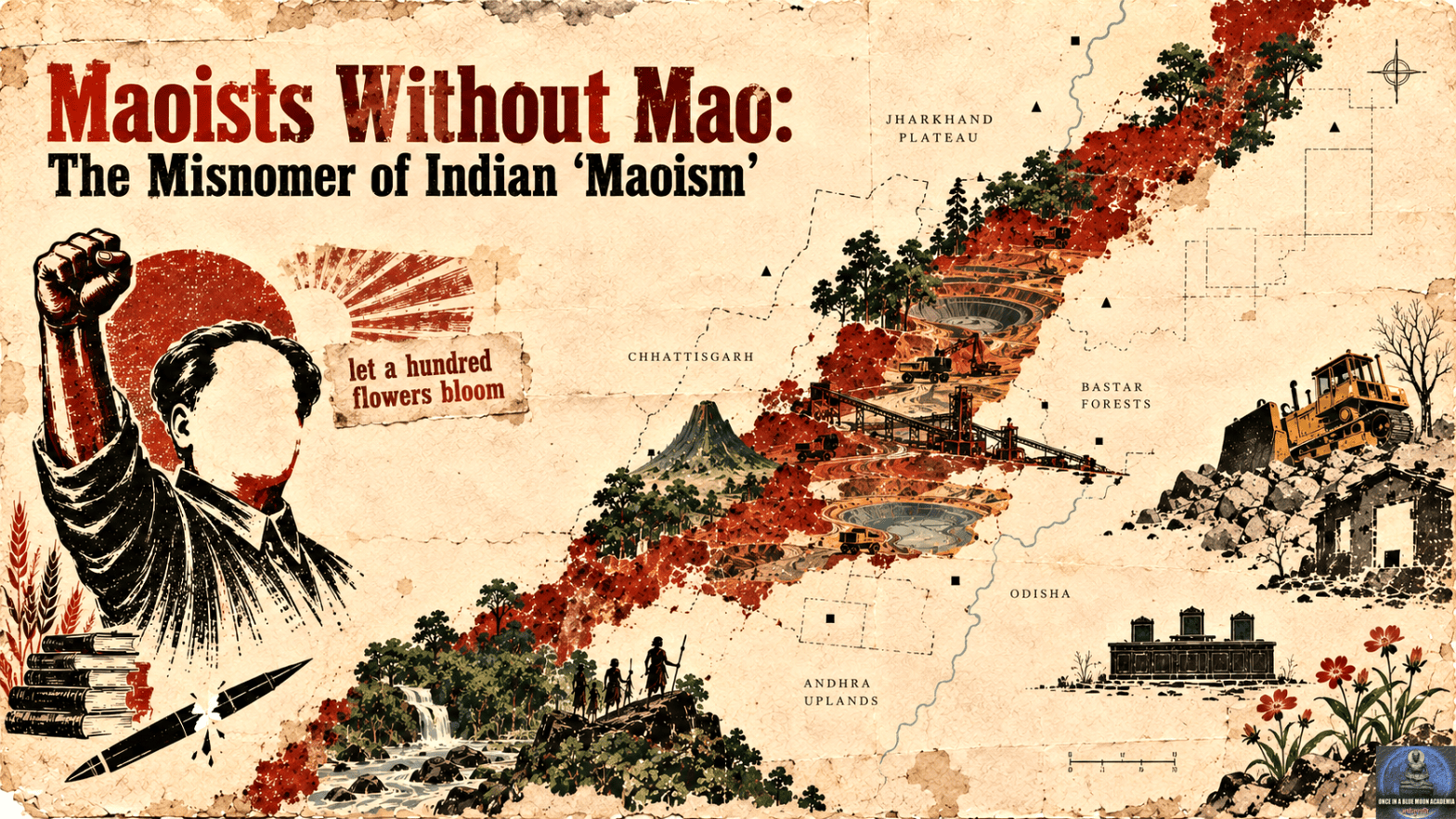
India’s so-called Naxalite–CPI (Maoist) “insurgency”, declared “effectively finished” around 2026, is called “Maoist” by the state, the press, and the movement itself; this article treats that name as a misnomer that does ideological work. It reconstructs Mao’s actual method — concrete analysis in On Practice and On Contradiction, the gun-and-pen doctrine of Yan’an, sinification rather than imported catechism, self-reliant base areas, a restless Confucian–classical substratum, and the brief Hundred Flowers opening toward a plural field of standpoints later formalised, in another idiom, as overdetermination by Althusser — and shows that the Indian movement kept the words and dropped the grammar: iconolatry (“China’s Chairman is India’s Chairman”), MLM as a frozen universal system, Gutian-condemned annihilationist militarism, and a parasitic levy-and-loot economy on a mineral frontier that is not the feudal countryside the doctrine presupposes. The name was decided; the referent would not coincide with Mao. Mapping the Red Corridor onto bauxite, iron, coal, chromite and uranium, and walking Bastar, Kalinganagar, Niyamgiri and Jadugoda through Marx, Sanyal and Levien on primitive accumulation and the need economy, it argues that “Maoist” functions as a security brand affixed to Adivasi resistance to ecological dispossession, while Foucault’s warning about people’s courts is inverted in bulldozer (in)justice. What remains is a compound the doctrine cannot cover: a frontier defence of jal–jangal–zameen, a Blanquist core, the armed edge of the governed. The brand erases the dispossessed subject the conflict was about.
“RUPP Tera Mastana”: Shell Parties and Simulacra
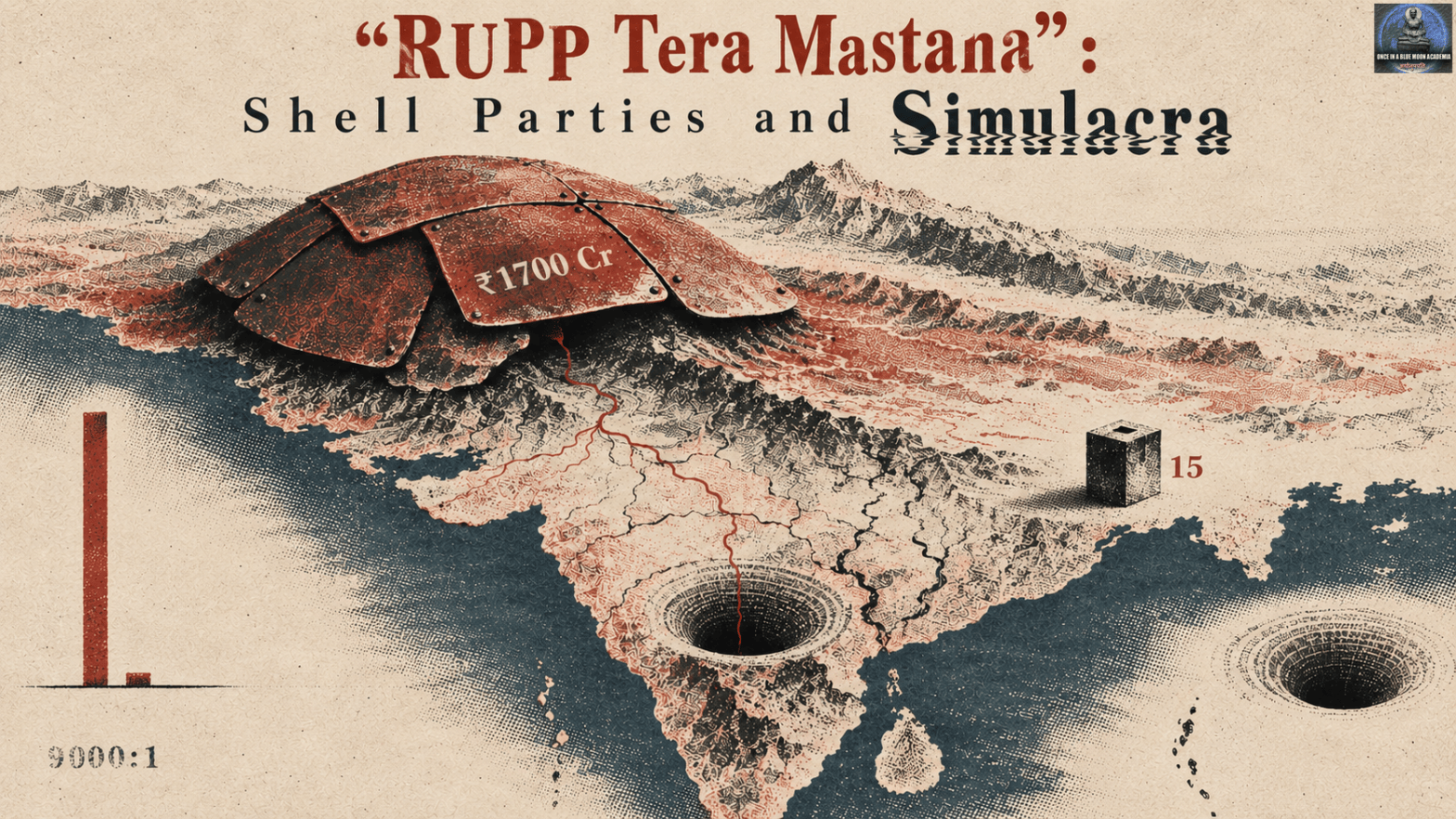
This article argues that a growing subclass of Indian parties is not janaseva (public service) but a fiscal enterprise—the party as limited company—whose tax and registration privileges are harvested whether or not it fights an election. The 2025 BBC News Hindi investigation of six Gujarat Registered Unrecognised Political Parties (RUPPs) is the entry: about ₹1,700 crore in FY 2023–24 donations against fifteen Lok Sabha candidates. From that mismatch it names the shell party, analogue of the shell company: a valid, vacant recipient whose use is fiscal (or, as with the NCPI merger of twenty TMC MPs, parliamentary). A four-provision interlock—RPA 1951 §29A; Income Tax Act §§13A, 80GGB, 80GGC; Companies Act §182—run in reverse, turns taxable income into a deduction plus cash after commission. The same lawful opacity is set beside electoral bonds and their afterlife in trusts, PM CARES as an un-askable receptacle, Tenth Schedule “mergers” that launder benches, and, as ED allegation not verdict, the DHFL–RKW–Mirchi–Dawood chain beside ₹27.5 crore declared to the BJP. Letterheads out-raised every national party except the ruling one. Read as Baudrillard’s simulacrum and Habermas’s legitimation crisis—including the public charge of vote chori—the register simulates pluralism while hollowing representation. Reform only reshapes the shell. Equal to the climate polycrisis is a bioregional, moneyless, partyless commons.
Reading ‘Vande Mātaram’ Across Registers: Text, Myth, Ritual
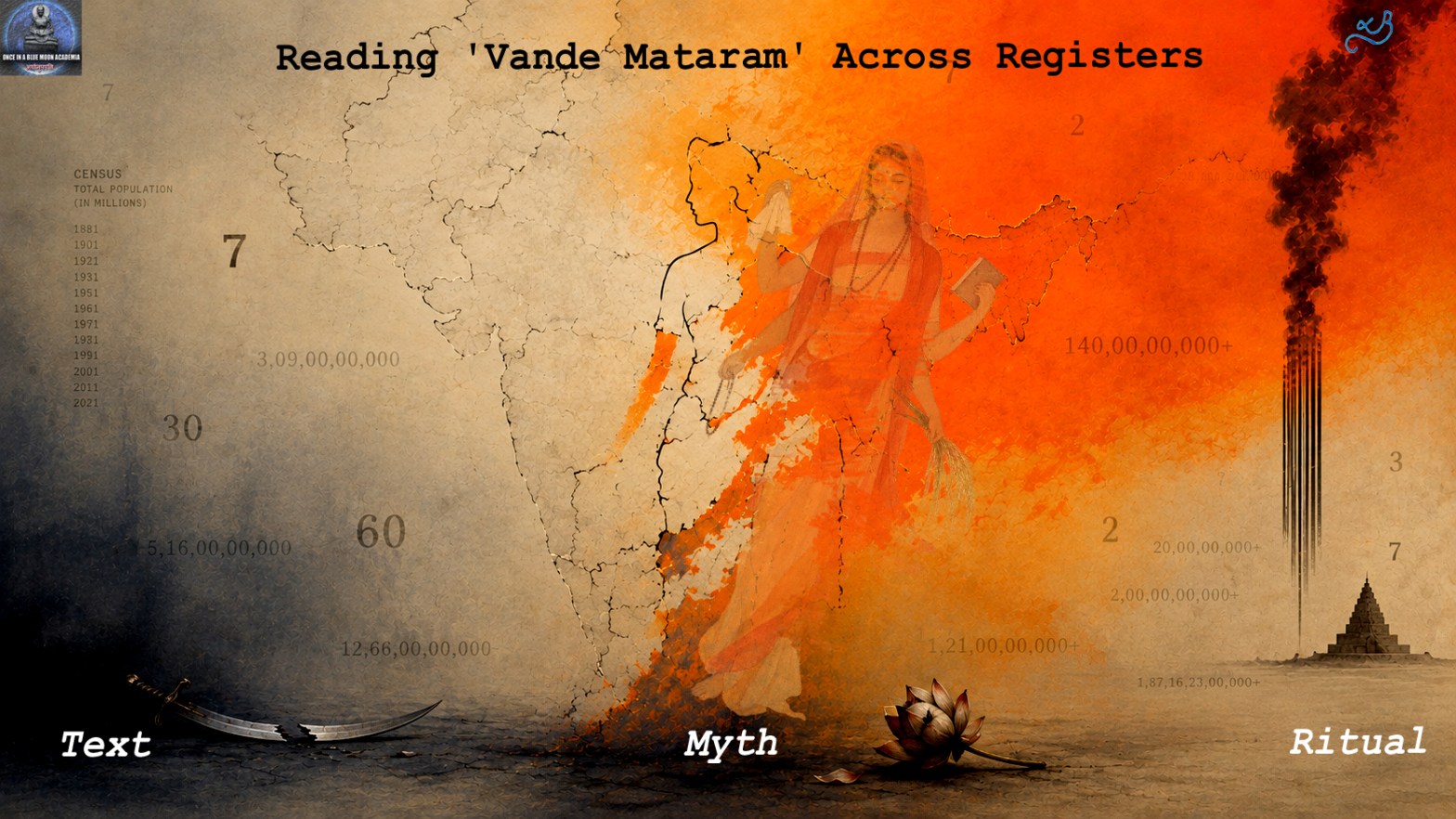
This “reading” traces Vande Mātaram’s discursive transformation(s) from a specifically Bengali hymn into an unstable national emblem and, finally, a ritualised test of belonging. It begins with the demographic hinge of saptakoṭi/dvisaptakoṭi—seven crore throats and fourteen crore arms—corresponding to the Bengal Presidency, not India, and follows its mutation from Bankim’s fixed text to the 1905 inflation of thirty crore, the Republic’s excision of the number-bearing and goddess-identifying stanzas in 1937–50, and the later dissolution into unbounded koṭi-koṭi. Across page, stage, state and popular transmission, the essay asks what happens when a countable provincial people becomes an infinite, unauditable mass. It reads the hymn through the genesis of Ānandamaṭha, Tagore’s counter-discourse of neśā, the colonial genealogy of mātṛbhūmi/mātṛbhāṣā, and the “(M)Other-Tongue” mechanism that manufactures Others. The stanza-by-stanza appendix tests the hymn’s claims of water, fertility, beauty, knowledge, feminine strength and sustaining earth against ecological depletion, educational precarity, demographic violence and extractive concentration, exposing a structure in which the signifier survives while the referent is hollowed out. The blurred number, singular vande, and 2026 penalisation of disruption converge as political ritual: citizen becomes chorus, dissent filial betrayal. The argument is not that singing is illegitimate, but that compelled, unexamined singing surrenders the critical freedom citizenship requires; to decline the chant is not to refuse the country, but to refuse a mistranslation, a miscount, a manufactured Mother, and the disappearance of the historically located citizen into an infinite chorus.
Azadi, or Democratic Unfreedom? A Video Message from OBMA

This video asks what “Azadi” (freedom) means in India today, and whether the formal existence of democracy can coexist with a lived condition of democratic unfreedom. Tracing the period from 2014 to 2026, it examines the erosion of civil liberties, institutional accountability, democratic participation, ecological security, and economic justice, before asking what genuine freedom might require: the Right to Reject, the Right to Recall, a partyless democracy, and an ecological politics rooted in Oikos — our shared home.
A Solidarity Statement for Sonam Wangchuk, Satyagrahi of the Anthropocene
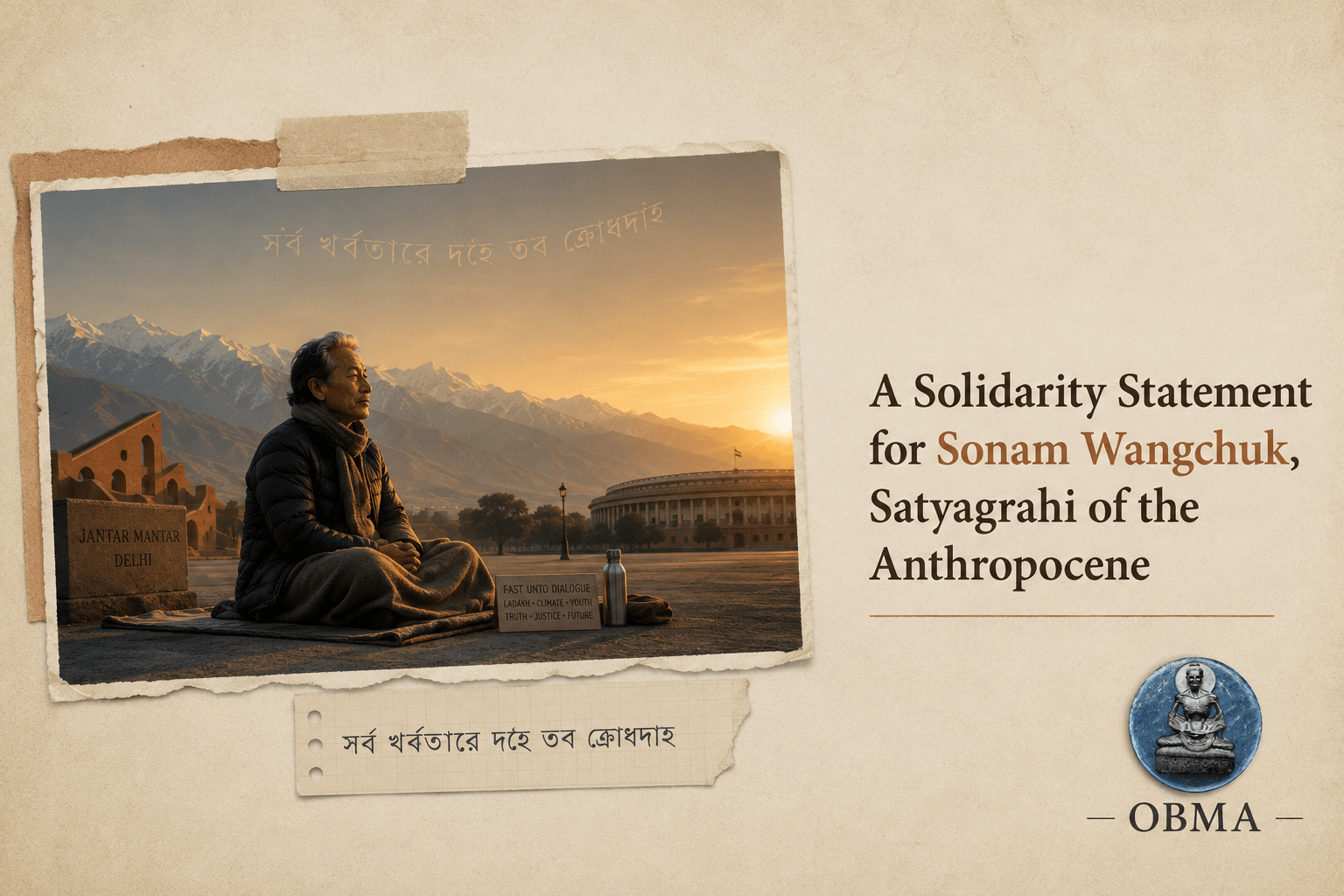
On the 17th day of his indefinite hunger strike at Jantar Mantar, Sonam Wangchuk continues his non-violent resistance for justice, dialogue, and ecological protection of Ladakh. Echoing Jatin Das’s 1929 martyrdom and G.D. Agarwal’s sacrifice for the Ganga, Wangchuk’s ātmaśakti exposes the Indian state’s moral deafness and hypocrisy in the face of genuine satyagraha. Invoking Tagore’s fiery Bhairava hymn — “sarva kharvatāre dahe tava krodhadāha” — this post calls for solidarity with a man who has become the moral centre of a republic that has abandoned its conscience.
Damn the Dams!
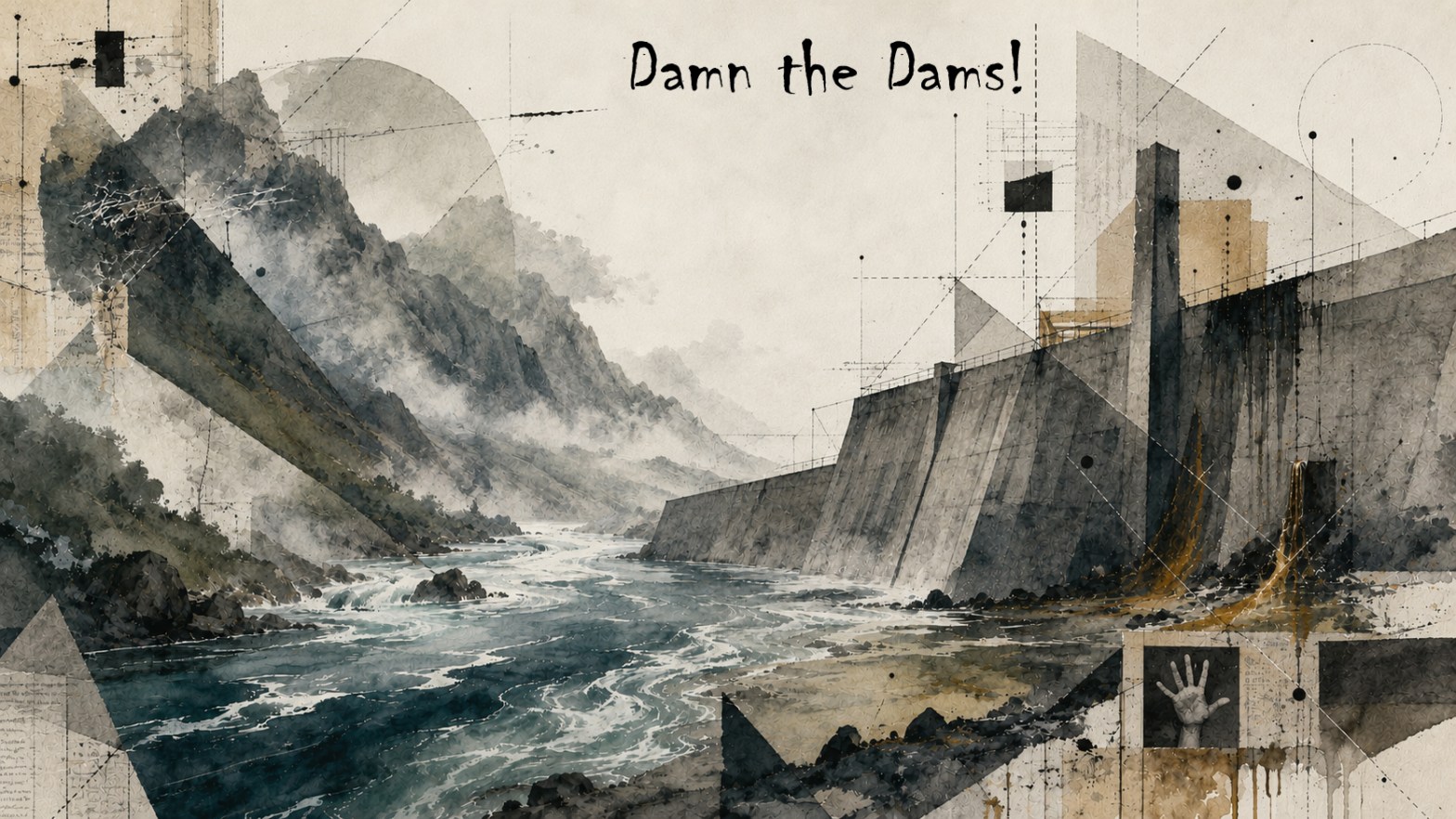
This paper critically examines the political ecology of mega dams and hydroelectric power through historical, scientific, and activist lenses, exposing the profound environmental, geological, and social costs that often eclipse their touted benefits. From Lenin’s GOELRO electrification drive and Nehru’s “temples of modern India” to the suppressed warnings of scientists Meghnad Saha and Kapil Bhattacharya, the analysis reveals how hydraulic nationalism has repeatedly silenced ecological knowledge, leading to reservoir-induced seismicity (as in Koyna), catastrophic siltation, landslides, and dam failures. Drawing on cases like the Tehri Dam, Farakka Barrage, Vaiont, and Banqiao disasters, alongside Gandhian resistance by Sundarlal Bahuguna, Baba Amte, and the Narmada Bachao Andolan, and cultural critiques in Tagore’s Muktadhara and Tarkovsky’s Stalker, the author argues for a fundamental reevaluation prioritizing river integrity, democratic consent, and geological realism over technocratic hubris. In an era of climate change, the paper calls for letting rivers flow as essential to ecological justice and human survival.
The Aeroplane’s Gaze: Mountain, Market and Martyrs
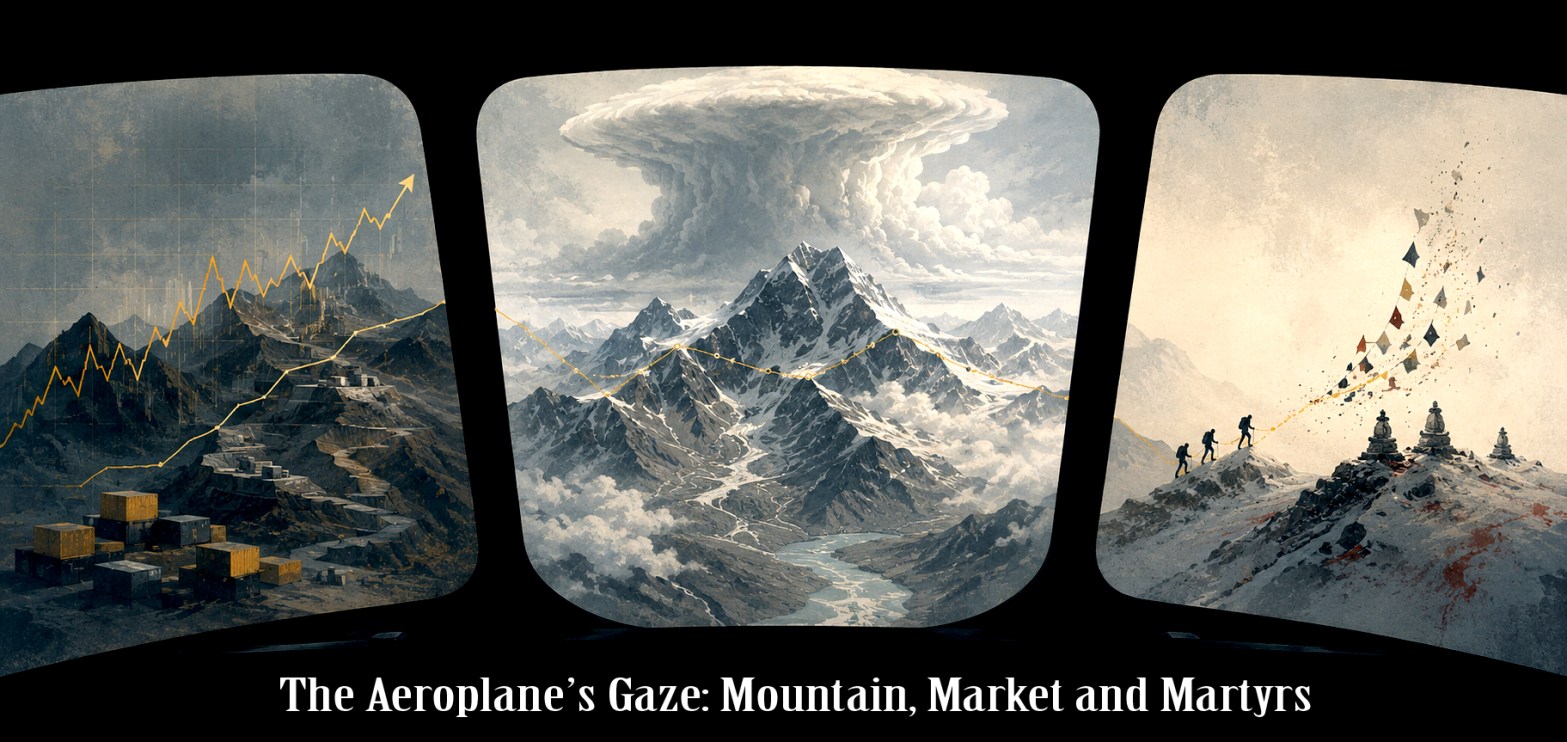
In this climate horror narrative with a positional paper disrupting the narrative flow, the author weaves personal flights over a rapidly thawing Himalaya with a critique of the “Three Ms”—Mountaineering, Market, and Martyrs—to expose how post-1990 commercialization has transformed high-altitude climbing into a neoliberal experience economy that commodifies risk, normalizes preventable deaths, and externalizes massive ecological waste onto fragile ecosystems. Drawing on observed glacial retreat, shrinking snowlines, data from Everest expeditions (e.g., 2019’s 877 summits and 11 deaths; 2025 permit hikes and ongoing congestion), the Chhanda Gayen case study, and corporate sponsorship spectacles, the analysis reveals how market logic—sunk-cost pressures, sponsorship demands for novelty, and regulatory filters—produces economic fatalism and “regulatory martyrdom” while generating symbolic capital from sacrifice and legacy trash (tens of tons of plastic, human waste, and gear). Framed by Tagorean imagery, Kalidasa’s metaphors, and Heideggerian reflections, the work culminates in a call to dismantle these structures, positioning the author’s embodied witness—flying through turbulent “intentioned” clouds—as a reversal from being-towards-death to death-towards-being, urging emancipation through corporeal awareness amid capitalism’s atmospheric and terrestrial violence.
The “Secular” State Paradox: the Erosion of Constitutional Secularism in Contemporary India
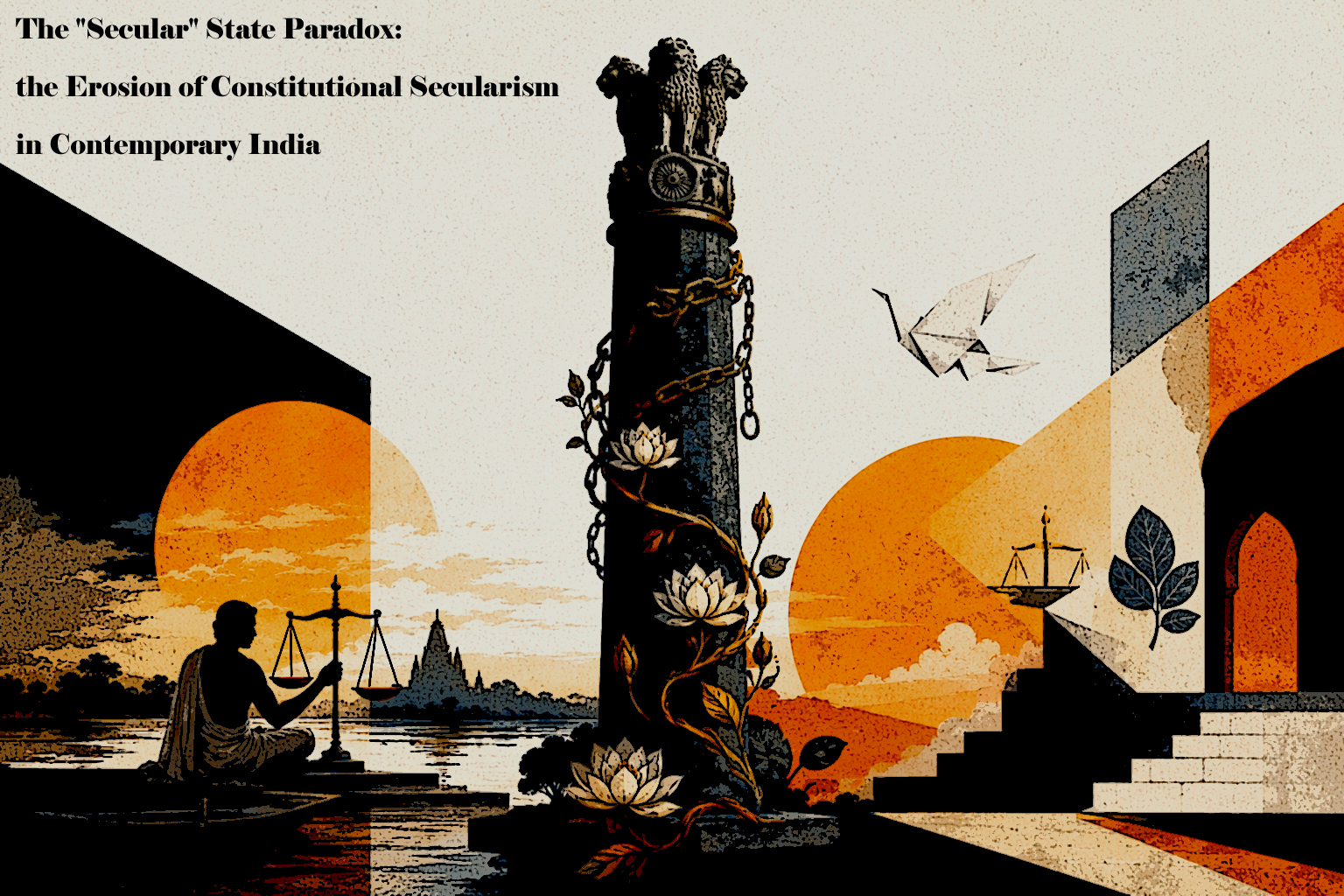
Since 2019, Prime Minister Narendra Modi has systematically blurred India’s constitutional separation between the state and religion—a doctrine central to India’s secular democracy since 1950. This article documents seven major constitutional violations spanning religious ceremony participation (Ram Mandir consecration, January 2024; Central Vista Parliament inauguration, May 2023), executive-judicial merger (Ganesha Puja at CJI DY Chandrachud’s residence, September 2024), selective state support for Hindu rituals over Muslim prayer practices (Red Road Yoga Day vs. namaz bans, June 2024), misappropriation of state security apparatus for personal religious acts (Z+ protection for sacred baths), documented abdication of constitutional duty during a national security crisis (Bear Grylls shoot during Pulwama attack, February 2019), and ecological destruction for religious symbolism (Yamuna “beautification” project). Each violation contradicts established constitutional convention (the Rajendra Prasad precedent of 1951), invokes specific legal provisions (Articles 14, 15(1), 25, 36, 44, 48-A, 50, 51-A(h), 60, 75), and collectively demonstrates how the “impunity loop”—where executive overreach faces no judicial reckoning—has eroded India’s foundational secular guarantee. The Central Vista Parliament consecration is particularly egregious: by permanently installing a religious symbol (the Sengol, representing divine-right monarchy) in the Speaker’s chair and framing Parliament as a Hindu “temple,” Modi has transformed the highest legislative chamber itself into a site of state-sponsored Hindu nationalism. Drawing from Supreme Court jurisprudence on basic features (Kesavananda Bharati), Article 32 remedies, separation of powers doctrine, and administrative law, this article argues that these violations constitute not individual transgressions but a systematic architecture of “selective secularism” that transforms Hindu nationalism into state policy while marginalizing minority rights. The article traces the “impunity loop” mechanism—how each violation normalizes the next through institutional passivity (judicial silence), doctrinal innovation (the “24/7 duty” doctrine that abolishes answerability), and intellectual capture (reframing Hindu nationalist practices as “secular culture” while suppressing minority religious expression). The absence of Supreme Court intervention despite clear constitutional grounds, combined with parliament’s majority-government control and investigative agency capture, has created conditions where constitutional limits have become advisory. The article concludes that India’s secular Constitution remains intact on paper while its practice converges toward Hindu nationalist theocracy, raising urgent questions about whether institutional actors can recover their constitutional commitment before the basic feature of secularism is irreversibly eroded.

