Posted on 15th May, 2026 (GMT 01:35 hrs)
ABSTRACT
On 10 May 2026, Prime Minister Narendra Modi urged Indian citizens to adopt sweeping austerity measures—restraining petroleum use, reviving work-from-home, minimising non-essential foreign travel, postponing gold purchases, reducing imports of edible oils and chemical fertilisers, promoting natural farming and Swadeshi consumption, and preferring public transport, carpooling, and EVs—amid West Asia tensions, rising oil prices, and forex pressures. This paper delivers an uncompromising critique of these imperatives, examining their genuine ecological co-benefits in the climate crisis alongside the cross-traditional philosophical demand for ācaraṇa (embodied praxis) drawn from Chaitanya Mahaprabhu, Imam Abu Hanifa, Gandhi, Kant, Marx, Tagore, and Kabir; the glaring contradictions with the Prime Minister’s opulent lifestyle, extravagant foreign travels, luxury branding, and high-carbon Z+/SPG security protocols; and the deeper theoretical foundations in A.K. Dasgupta’s Economics of Austerity (1975), the Mahābhārata’s Vana Parva, the Bhagavad Gītā’s teachings on lokasaṅgraha and rejection of karmavirati, and Swami Vivekananda’s Practical Vedanta. It argues that in the Anthropocene, genuine austerity requires visible leadership embodiment for moral legitimacy, ecological efficacy, and spiritual coherence; absent such praxis, Modi’s call stands exposed as the very hypocrisy Kabir satirised in his pad “Man nā raṅgāye raṅgāye jogī kaprā” — performative asceticism and ruling-class doublespeak that fatally undermines its own imperatives. The paper proposes a framework of ecological austerity as lokasaṅgraha, integrating economic theory, environmental analysis, South-East Asian philosophy, and uncompromising political ethics.
Keywords: Economics of Austerity, Ecological self-sufficiency, Lokasaṅgraha, Embodied Praxis, Leadership Contradictions, Climate Crisis, South-East Asian Philosophy.
1. Introduction: Modi’s 10 May 2026 Hyderabad Imperatives and Their Immediate Context
In his recent address on 10 May 2026 in Hyderabad, India’s Prime Minister Narendra Modi urged citizens to adopt “national responsibility” measures amid geopolitical disruptions in West Asia. The core imperatives were:
A. Restraint in petrol, diesel, gas, and petroleum products (conservation as “need of the hour”);
B. Revive COVID-era WFH, virtual meetings (work from home), and reduced unnecessary travel;
C. Minimize non-essential foreign travel (e.g., destination weddings abroad) for one year; promote domestic tourism;
D. Postpone or avoid gold purchases for the next year;
E. Reduce imported items (e.g., edible/vegetable oils, chemical fertilizers); support natural farming and buy local/Swadeshi (“Vocal for Local”);
F. Prefer public transport (metro, railways), carpooling, EVs, and overall fuel dependency reduction;
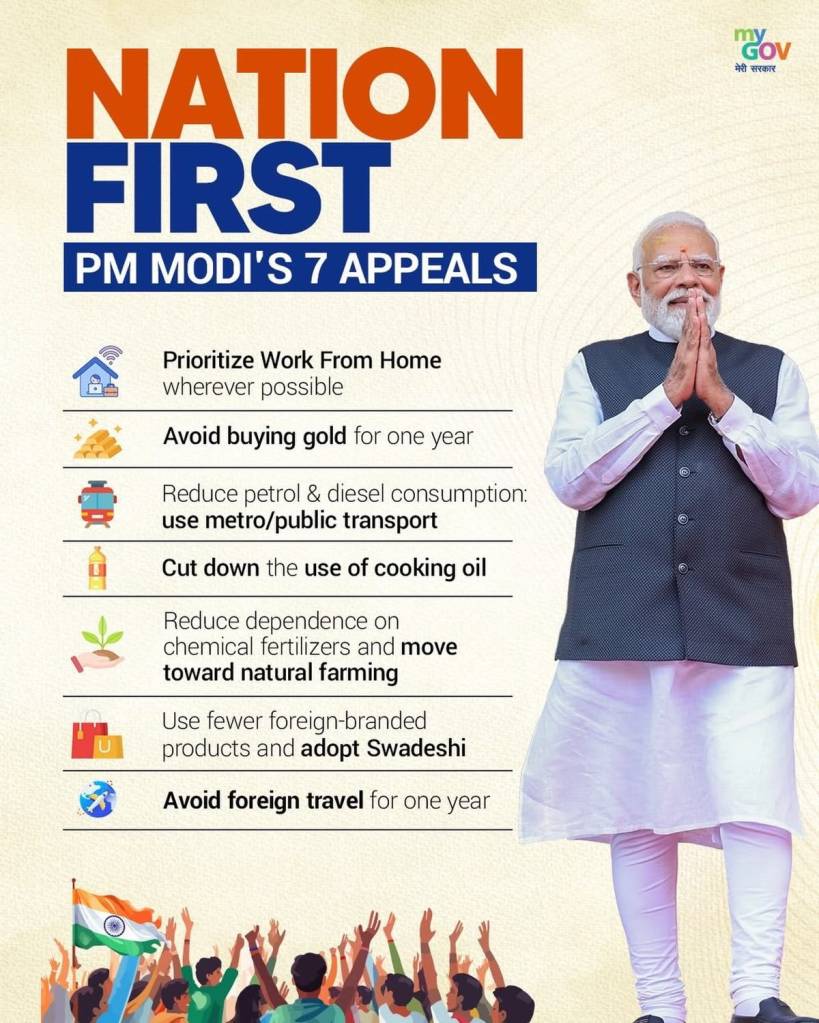
These calls were officially framed and projected primarily as pragmatic measures of economic self-reliance under the banner of Atmanirbhar Bharat — a direct response to oil-price shocks triggered by the ongoing West Asia geopolitical tensions and acute pressures on India’s foreign exchange reserves. This narrowly economistic narrative constitutes classic ruling-class doublespeak: it foregrounds fiscal prudence and national security imperatives while strategically downplaying the substantial ecological co-benefits the measures could deliver and entirely obscuring the deeper ethical, philosophical, and moral stakes involved in any authentic call for austerity. Yet, as this paper demonstrates through relentless, multi-layered critique, the imperatives ultimately collapse under the weight of the leadership’s own spectacular and systemic hypocrisy.
2. Ecological Analysis of the Imperatives: Co-Benefits in the Climate Crisis
These imperatives—primarily framed or projected as economic and national self-reliance measures amid the West Asia oil crisis and acute forex pressures—appear to/seemingly function on paper (de jure) as strongly eco-friendly (pro-green) advice with substantial climate mitigation potential. Though geopolitically triggered by rising crude prices and foreign exchange strains (including India’s record gold imports touching nearly $72 billion in FY 2025-26), they directly or indirectly reduce greenhouse gas (GHG) emissions, curb air pollution, conserve scarce resources, protect ecosystems, and promote biodiversity and soil health. The measures align meaningfully with India’s declared long-term climate goals, including achieving net-zero emissions by 2070 and progressively lowering fossil fuel dependence.
Restraint in petroleum consumption would lower CO₂, NOx, particulate matter (PM2.5), and other tailpipe emissions that dominate India’s urban air quality crisis and transport-sector GHG output. Reviving COVID-era work-from-home and virtual meetings could deliver 11–54% reductions in individual carbon footprints (with full remote work achieving the higher end through slashed commuting and office energy use). Minimising non-essential foreign travel, particularly long-haul flights and destination weddings abroad, would cut aviation’s disproportionately high climate impact — a sector responsible for roughly 8% of global CO₂ emissions when radiative forcing is considered. Postponing or avoiding gold purchases would curb one of the most environmentally destructive extractive industries, which generates massive toxic waste (cyanide and mercury pollution), drives deforestation, and emits substantial GHGs. Promoting natural farming and slashing imports of chemical fertilisers would counter severe soil degradation, eutrophication of water bodies from nutrient runoff, and potent N₂O emissions (a greenhouse gas nearly 300 times more potent than CO₂). Finally, shifting to public transport, carpooling, and EVs advances the well-established “avoid–shift–improve” paradigm of sustainable mobility, slashing per-capita transport emissions in India’s rapidly urbanizing cities.
Collectively, these citizen-level measures offer practical, demand-side co-benefits across climate mitigation, resource efficiency, public health, and ecosystem protection.
However, this is merely the surface. The ecological virtues are rendered profoundly hollow by the glaring absence of leadership praxis. The call for widespread citizen-level sacrifice rings profoundly false — indeed, cynical — when the very leadership issuing these imperatives continues high-carbon, high-import, and luxury practices that directly contradict the restraint it demands of ordinary Indians. This glaring theory-praxis rift becomes even sharper when viewed through deeper cultural and philosophical lenses. The following section examines how the call to postpone gold purchases resonates — and ultimately collapses — when placed in conversation with Marx, Tagore, Ray, and Chaplin’s powerful critiques of gold fetishism, extractive greed, and performativity as such.
3. Dead Wealth and Living Critique: Marx, Tagore, Ray, Chaplin and the Hollow Gold Imperative
[Apologies for the awkward syntagm, but there is a selectional restriction against putting these names in the same breath.]
This section examines the deeper cultural, philosophical, and political resonances of the Prime Minister’s call to postpone or avoid gold purchases. Far from a simple economic exhortation, the appeal to restrain gold consumption stands exposed when read against the powerful critiques of commodity fetishism, extractive greed, authoritarian hoarding, and delusion offered by Karl Marx, Rabindranath Tagore, Satyajit Ray, and Charlie Chaplin. These thinkers and artists deliver a devastating theoretical and moral indictment that reveals the glaring contradictions at the heart of the 10 May 2026 austerity message — contradictions that become especially damning when the leadership itself continues to embody the very fetishism it asks citizens to renounce.
Not purchasing gold (as urged in the recent Indian PM’s call to conserve foreign exchange and reduce import dependence — amid India’s record $71.98 billion gold imports in FY 2025-26, up 24% from the previous year) carries deeper cultural, philosophical, and critical resonances when linked to these three references. It transcends mere economic prudence, aligning with critiques of materialism, commodity fetishism, exploitation, and environmental destruction.
A. Marx Against Gold: Commodity Fetishism and the Critique of Money as Fetish
Karl Marx fiercely critiqued the societal obsession with gold and precious metals as embodiments of commodity fetishism — where social relations between people appear as mystical properties of things. Gold, in particular, exemplifies this: it is treated as having inherent magical value (as the universal equivalent or money-form), obscuring the human labour and exploitative social relations behind its production and circulation.
In Capital, Volume 1 (Chapter 1, Section 4: “The Fetishism of Commodities and the Secret Thereof”), Marx writes that in the money-form, “gold and silver, when serving as money, did not represent a social relation between producers, but were natural objects with strange social properties.” He contrasts this with earlier “naïve” monetary systems that fetishized gold directly.
Earlier, in the Economic and Philosophic Manuscripts of 1844, Marx notes: “The nations which are still dazzled by the sensuous glitter of precious metals… are not yet fully developed money-nations,” likening European money-worship to fetishism.
Marx further illuminates gold’s corrupting power by drawing on literary sources. Quoting Shakespeare’s Timon of Athens (Act 4, Scene 3), he highlights gold’s role as the great equalizer and destroyer of human distinctions: “Gold? Yellow, glittering, precious gold? … Come, damned earth, Thou common whore of mankind, that putt’st odds among the rout of nations.” In Marx’s reading, gold functions as the “common whore” — the universal procurer and pimp that commodifies all relationships, inverts moral and social orders, and prostitutes human qualities. It makes “black white, foul fair; wrong, right; base, noble; old, young; coward, valiant.” This Shakespearean imagery powerfully reinforces Marx’s analysis: gold is not neutral but a fetishized force that alienates labour, distorts human bonds, and masks exploitation.
Marx highlights how gold mining and accumulation mask exploitation: labour is alienated, and value derives from social relations, not the metal itself. The glittering surface conceals the blood, sweat, and ecological destruction embedded in its extraction.
Association with “not purchasing gold”: Refusing to buy gold rejects this fetish — denying the illusion that gold holds intrinsic power or status. It disrupts the cycle of hoarding “dead wealth,” reducing demand for destructive mining (ecologically and socially exploitative) and refocusing on human needs and relations over commodity worship. This echoes Modi’s call as a step toward de-fetishizing luxury imports amid crisis. Yet the call rings profoundly hollow when issued by a leadership whose own public image and symbolic politics remain steeped in precisely the luxury branding, imported opulence, and commodity fetishism Marx so relentlessly exposed. The Prime Minister who urges citizens to postpone gold purchases while presiding over record national gold imports and projecting an image of curated extravagance embodies the very fetish he asks the masses to renounce.
B. Tagore’s Red Oleanders (Raktakarabi, 1926)
Rabindranath Tagore’s symbolic play Raktakarabi (Red Oleanders, 1926) is a powerful allegory against unscrupulous capitalism, mechanized greed, and the environmental and human exploitation centred on gold mining. Set in the dystopian kingdom of Yakshapuri (Yaksha Town), ruled by a tyrannical, invisible King who remains hidden behind an iron screen, the play depicts a nightmarish world where workers are reduced to machine-like diggers in the gold mines. They toil endlessly to extract “dead wealth” from the bowels of the earth, while living in misery, deprived of light, joy, and humanity. The King hoards vast quantities of gold nuggets in his secret store-house, isolated from all living contact.
The protagonist Nandini — the embodiment of life, love, beauty, freedom, and vibrant nature — enters this oppressive realm like a life-giving force. In one of the play’s most iconic confrontations, she directly challenges the King’s obsession with extracted, accumulated gold. When allowed a glimpse into his treasure-house, Nandini declares (in a faithful rendering from standard translations):
“The day you let me into your store-house the blocks of gold did not surprise me… But can blocks of gold ever answer to the swinging rhythm of your arms in the same way as fields of corn? Are you not afraid, King, of handling the dead wealth of the earth?”
This piercing dialogue contrasts the sterile, lifeless accumulation of mineral wealth with the living, rhythmic vitality of agricultural labour and natural cycles. Red oleanders, which Nandini wears and offers as garlands, symbolise vibrant life, passionate love, and resistance — blood-red flowers that bloom defiantly amid the toxicity and mechanised death of Yakshapuri. They stand in stark opposition to the “dead wealth” of gold: organic, beautiful, and life-affirming versus the cold, hoarded metal that drains the life-blood of both people and the earth.
The play relentlessly contrasts living agricultural harmony — rooted in human creativity, community, and communion with nature — with the soul-crushing, nature-destroying pursuit of gold. The miners are dehumanised into “tunnel-diggers” and “worms of the earth,” their labour alienated and their spirits crushed under the weight of the King’s insatiable greed. Tagore uses the gold mines as a metaphor for the destructive machinery of modern capitalism and authoritarian control, where human beings are sacrificed at the altar of extractive accumulation.
Association with “not purchasing gold”: Refusing to buy gold becomes a profound act of resistance that rejects the King’s (and capitalism’s) pathological obsession with hoarded “dead wealth.” It supports human freedom, the natural rhythms of life and labour, and ecological balance over blind extractive greed. This mirrors Tagore’s broader critique of materialism that destroys both people and the environment. The Prime Minister’s appeal to postpone gold purchases therefore resonates superficially as a modern call to step away from such Yaksha-like excess. Yet it is rendered bitterly ironic when issued by a leadership whose own public symbolism, luxury branding, and presiding over record gold imports embody the very hoarding and fetishism that Tagore’s Nandini so fearlessly confronts. In Raktakarabi, true liberation comes not from distant exhortations but from the courageous entry of life (Nandini) into the heart of the oppressive system — a challenge the current dispensation has signally failed to meet.
C. Satyajit Ray’s Hirak Rajar Deshe (Kingdom of Diamonds, 1980)
In this satirical children’s fantasy (second in the Goopy-Bagha trilogy), the Hirak Raja (Diamond King, played by Utpal Dutt) rules a totalitarian In Satyajit Ray’s satirical children’s fantasy Hirak Rajar Deshe (Kingdom of Diamonds, 1980), the second film in the Goopy-Bagha trilogy, the Diamond King (Hirak Raja, played with menacing flamboyance by Utpal Dutt) rules a dystopian kingdom built on ruthless diamond (and implied mineral) exploitation. The kingdom’s vast diamond mines are the source of the ruler’s immense wealth, yet the people live in grinding poverty. Farmers starve despite producing food for the royal granaries, while miners toil in miserable conditions deep inside the mines for a pittance, their labour feeding the King’s insatiable greed. Dissent is brutally suppressed through a sophisticated apparatus of propaganda and coercion.
The regime’s most sinister instrument is the “Jantarmantar” (or “Magaj Dholai” / brain-washing machine), invented by the sycophantic scientist Gobeshok Gobochondro (Santosh Dutta). Suspected rebels, including the brave schoolteacher Udayan Pandit (Soumitra Chatterjee), are dragged into this terrifying contraption. Inside, their minds are literally scrubbed clean and reprogrammed with rhyming slogans of loyalty and obedience. Victims emerge chanting regime-approved mantras such as: “It is never a good idea to fall behind on taxes. Even if we were to starve, we mustn’t be late with our payments” (for farmers) or “He who toils inside the mines is thrice accursed, so bear this in mind” (for miners). The King’s court poet composes catchy rhyming couplets that invert reality: “Those who study hard are sure to starve and die,” and schools are shut down because “the more they study, the more they know, and the less they tend to obey.”
The film is filled with memorable songs and dialogues delivered entirely in rhythmic verse, underscoring the mechanical, propagandistic nature of the regime. The King hoards diamonds and riches in his treasury while his subjects suffer; he evicts the poor before foreign visitors arrive so that the kingdom appears prosperous, and he erects a gigantic statue of himself. All power is centralised; ministers are mere puppets who echo the King’s will.
Goopy and Bagha, the magical musician duo, arrive for the kingdom’s anniversary celebrations. With the help of the principled teacher Udayan and their own powers of music and mesmerism, they spark a rebellion. In the climactic sequence, they turn the tables: the King and his ministers are themselves shoved into the brain-washing machine, after which the people topple the giant statue of the tyrant, ushering in freedom.
The film allegorises authoritarianism, totalitarianism, and the Emergency-era India of the mid-1970s under Indira Gandhi — with its forced sterilisation drives, slum clearances, suppression of dissent, propaganda machinery, and cult of personality. Ray masterfully uses the children’s fantasy format to deliver a scathing political critique that remains devastatingly relevant.
Association with “not purchasing gold/diamonds”: Avoiding purchases of gold or diamonds directly rejects feeding the Hirak Raja’s exploitative system. It undermines the economic base of tyranny and greed by refusing to enrich the hoard that sustains oppression, environmental destruction, and the dehumanisation of workers. Ray’s satire warns powerfully against regimes (or habits) that prioritise mineral wealth over people — a warning that acquires sharp contemporary resonance when a leadership urges citizens to postpone gold purchases while itself projecting opulent symbolism and presiding over record national imports of the very “dead wealth” the film condemns. In Hirak Rajar Deshe, true resistance begins with recognising the machinery of exploitation and refusing to participate in it. The film’s message is clear: the glittering kingdom built on diamonds ultimately collapses when the people, awakened and united, pull down the tyrant’s statue.
D. Chaplin Against Hankering for the Gold: A Philosophical Reading of The Gold Rush (1925)
Charlie Chaplin’s The Gold Rush (1925) is not merely a comedy about the 1898 Klondike Gold Rush — it is a profound philosophical satire against humanity’s obsessive hankering for gold. Through the Little Tramp’s misadventures, Chaplin exposes the absurdity, futility, and spiritual emptiness of the frantic pursuit of material wealth. The film transforms the historical tragedy of the Gold Rush into a universal parable: gold is not fortune but a mirage that drives men to madness, starvation, and moral collapse.
(i) The Gold Rush as Metaphor for Human Greed
Chaplin sets the Tramp against the brutal Alaskan wilderness, where thousands of prospectors endure blizzards, avalanches, and starvation in the desperate hope of striking it rich. The Lone Prospector (Chaplin) is the eternal outsider — small, gentle, and ill-equipped — yet he survives not by ruthless ambition but by luck, ingenuity, quiet humanity, and an indomitable spirit. In contrast, characters like the menacing Black Larsen embody the dark side of gold-hankering: betrayal, violence, and eventual doom.
The film’s most iconic sequences are savage yet tender commentaries on this obsession:
- The Shoe-Eating Scene: Reduced to starvation in a remote cabin during a blizzard, the Tramp boils and eats his own boot with the delicate ceremony of a gourmet at a Thanksgiving dinner. He carefully picks the nails as if they were chicken bones and twirls the laces around a fork like spaghetti. This hilarious yet heartbreaking moment reveals the ultimate truth: in the grip of gold-fever, men consume the very means of their survival. The boot — symbol of the long, laborious journey — literally becomes food. Chaplin turns raw necessity into high comedy, but the underlying critique is bitter: gold-hankering reduces human beings to devouring their own labour and dignity.
- Big Jim’s Hallucination: The giant partner (Mack Swain), crazed with hunger, imagines the Tramp as a plump, succulent chicken and pursues him with an axe. The elaborate trick photography transforms Chaplin into a giant bird, creating one of cinema’s most memorable visual gags. Hunger exposes the animalistic core lurking beneath civilized greed.
- The Dance of the Rolls: In a moment of lonely New Year’s Eve elegance, the solitary Tramp turns two forks stuck into bread rolls into a pair of dancing legs and performs a graceful, whimsical ballet on the table. This sequence is Chaplin’s affirmation of imagination, grace, and creative joy against the crude materialism of the gold rush. While others chase nuggets in the frozen wasteland, the Tramp creates beauty and delight from almost nothing.
(ii) Philosophical Critique of Gold-Hankering
Chaplin’s deepest insight is that the pursuit of gold is a form of spiritual delusion. The film systematically dismantles the illusion that wealth equals happiness or meaning:
- Absurdity of Fortune: The Tramp becomes fabulously rich almost by accident when he and Big Jim rediscover the gold strike. Chaplin refuses to romanticise the “self-made man.” Success in the gold rush is portrayed as arbitrary and capricious, not earned through superior virtue or moral worth. This undercuts the capitalist myth that relentless hankering and ruthless ambition are reliably rewarded with deserved prosperity.
- Gold as False God: Like Marx’s commodity fetishism, Chaplin shows gold as an idol that distorts human relationships. Prospectors abandon brotherhood, love, and basic decency in its name. The dance-hall girl Georgia (Georgia Hale) and her friends initially mock and reject the Tramp for his poverty through cruel jokes; only when he returns wealthy does she truly see him. The film offers a quiet but devastating satire on how gold warps perception, value, and affection.
- Resilience vs. Hankering: The Tramp’s true “wealth” lies in his kindness, creativity, resilience, and refusal to be broken by hardship. Even in rags and starvation, he retains dignity, humour, and joy. Chaplin suggests that the real antidote to gold-hankering is not ascetic rejection but a light, detached, and imaginative engagement with life. The Tramp wants gold and love, yet he never lets the pursuit destroy his essential humanity.
- Existential Warning: In the final scenes, the newly rich Tramp returns to civilisation in opulent attire aboard a luxury liner, yet his awkwardness and essential character remain unchanged. Chaplin implies that external gold changes nothing essential about a person. True richness is internal — a philosophical stance that echoes Eastern traditions of detachment and Western existential calls for authenticity amid absurdity.
(iii) Enduring Message(s) that Resonate
The Gold Rush stands as Chaplin’s cinematic protest against the civilisational disease of gold-hankering. Released in 1925 during America’s Roaring Twenties — an era of speculative frenzy, stock-market mania, and material excess — the film warns that the frantic chase for shiny metal (or its modern equivalents: cryptocurrency, luxury consumption, extractive wealth, and status symbols) leads not to fulfilment but to loneliness, brutality, self-destruction, and spiritual emptiness.
In our own time, amid climate crisis, record gold imports, and elite-driven luxury consumption, Chaplin’s message remains devastatingly relevant. The film laughs at our greed so that we might see its folly. As the Tramp survives the wilderness with grace and imagination, Chaplin whispers: do not let your soul starve while chasing gold. The greatest fortune, Chaplin teaches, is to remain human amid the gold rush.
E. Toward Syntheses
Across Marx (philosophical demystification of commodity fetishism), Tagore (humanistic-ecological protest in Raktakarabi), Ray (satirical political allegory in Hirak Rajar Deshe), and Chaplin (existential-humanist satire in The Gold Rush), not purchasing gold emerges as a profound act of ideological and practical defiance. It counters fetishism, extractive capitalism, authoritarian hoarding, and acts of delusion — promoting instead living labour, nature, freedom, human dignity, and self-reliance. In the ecological context of Modi’s 10 May 2026 Hyderabad imperatives, this restraint directly aids sustainability by curbing mining’s devastating harms — deforestation, toxic pollution, biodiversity loss, and massive greenhouse gas emissions — while fostering ethical consumption and reducing “dead wealth” accumulation.
These cultural lenses enrich the Prime Minister’s call as timeless wisdom against the civilisational folly of gold-hankering. Yet this very wisdom is rendered bitterly ironic — indeed, hollow — when the leadership urging citizens to postpone gold purchases and embrace Swadeshi simplicity continues to embody the opposite in both personal symbolism and state practice. The monogrammed suit embroidered with gold thread, the repeated use of luxury imported accessories, the curated image of opulence, and the government’s presiding over record gold imports stand in direct contradiction to the very de-fetishisation Modi rhetorically invokes. Far from practising what he preaches, the leadership’s own conduct exemplifies the fetishism Marx exposed, the Yaksha-like hoarding Tagore condemned, the tyrannical mineral obsession Ray satirised, and the spiritual emptiness Chaplin mocked. This failure of ācaraṇa — of embodied praxis — fatally undermines the moral authority of the 10 May imperatives and foreshadows the deeper contradictions that run through the Prime Minister’s lifestyle, foreign travels, security protocols, and public persona, as examined later in this paper. In the final analysis, Modi’s call to reject “dead wealth” rings as performative exhortation rather than lived dharma.
3. Philosophical Counter-Points: The Demand for Embodied Praxis
The preceding critiques from Marx, Tagore, Ray, and Chaplin expose the deeper ideological and ethical bankruptcy of any call to restrain gold consumption that is not matched by genuine detachment from “dead wealth.” Yet these cultural and philosophical indictments remain incomplete without confronting a more fundamental question: Can any exhortation to austerity — ecological or economic — carry legitimacy if the speaker or institution issuing it fails to embody the very principles it demands?
The legitimacy of such exhortations rests not only on the soundness of their content but on the speaker’s and institution’s prior embodiment (ācaraṇa). Six cross-traditional references — drawn from bhakti, Islamic jurisprudence, Gandhian ethics, Enlightenment deontology, Marxist praxis, and Tagorean humanism — articulate this uncompromising demand with striking convergence.
These six counter-points form a philosophically rigorous, cross-traditional critique of exhortative discourse that lacks embodied praxis. In ethical theory, this is the demand for exemplarity (or authenticity of conduct): moral or political imperatives derive legitimacy and persuasive force not merely from their content but from the speaker’s (or institution’s) prior internalization and demonstration of the advised behavior. Applied to Prime Minister Narendra Modi’s 10 May 2026 Hyderabad imperatives — particularly the call to postpone or avoid gold purchases for foreign-exchange conservation amid West Asia tensions — these references insist that such citizen-level austerity measures must be mirrored by visible governmental and personal restraint if they are to achieve genuine ecological, economic, and moral efficacy. Below is an academically precise elaboration of each point, drawing on primary sources, historical context, and conceptual linkages.
A. Shri Chaitanya Mahaprabhu’s Remark: “আপনি আচরি ধর্ম পরেরে শিখাও” (“Āpani ācari dharma, parere śikhāo”)
This is one of the most celebrated and frequently invoked maxims of the Gaudiya Vaishnava bhakti tradition, strongly attributed to Sri Chaitanya Mahaprabhu (1486–1534), the 16th-century Bengali saint-reformer and propagator of Krishna-bhakti across India. In its popular full form, preserved in hagiographies such as Chaitanya Charitamrita by Krishnadasa Kaviraja and in living oral tradition, it translates as: “First practise the dharma yourself (āpani ācari), then teach it to others (parere śikhāo).” In modern Bengali discourse, it is rendered as “আপনি আচরি ধর্ম অপরে শিখাও,” underscoring that authentic religious or ethical instruction (śikṣā) is impossible without personal embodiment (ācaraṇa).
The academic and theological significance of this injunction is profound. Within bhakti theology, it constitutes a radical rejection of hierarchical or merely verbal authority — the notion that one can dispense upadeśa (instruction) without anubhava (direct experiential realisation). Chaitanya’s own life exemplified this principle: he embraced radical renunciation, wandered as a sannyasi, danced in ecstatic kirtan with the poorest and the outcaste, and preached through lived example rather than institutional power. His instruction insists that true spiritual or moral authority flows only from congruence between word and deed.
In the present context of Prime Minister Narendra Modi’s 10 May 2026 Hyderabad imperatives, Chaitanya’s maxim functions as a devastating immanent critique. If the state urges citizens to restrain petroleum consumption, revive work-from-home and reduce unnecessary travel, minimise non-essential foreign journeys, postpone gold purchases, cut imports of edible oils and chemical fertilisers, embrace natural farming and Swadeshi consumption, and shift to public transport, carpooling and EVs, then the leadership must itself demonstrably embody these very principles. It must visibly reduce its own reliance on high-carbon imported luxury vehicles and massive motorcades, curtail extravagant foreign travel, scale down ceremonial ostentation and luxury branding, show genuine preference for Swadeshi and simplicity, and practise the restraint in petroleum, gold, and imported goods it demands from ordinary citizens. Without such comprehensive and visible ācaraṇa at the highest levels, the entire call risks degenerating into empty śikṣā — eloquent sermonising and rhetorical appeals to “national responsibility” that remain devoid of living example. Chaitanya’s teaching thus serves as a rigorous ethical yardstick against which the praxis deficit of the current dispensation stands sharply and comprehensively exposed.
B. The Anecdote of Hazrat/Imam Abu Hanifa (c. 699–767 CE) and the Ailing Child’s Mother
The story recounted—where a mother seeks advice on curing her child’s excessive consumption of molasses (/ honey / sweets), and the saint delays counsel until he himself has abstained for a week (or, in fuller versions, a month)—is classically attributed not to Prophet Muhammad but to Imam Abu Hanifa, founder of the Hanafi school of Islamic jurisprudence. In the canonical narrative (found in manāqib literature and Sufi didactic tales), Abu Hanifa asks the woman to return after 30 days; during this period he personally ceases eating honey. Only then does he advise the child, explaining: “I myself consumed molasses; how could I advise you without first shunning it?”
This exemplifies fiqh (jurisprudential ethics) and Sufi tazkiyah (self-purification): ethical authority rests on amal (deed) preceding qawl (word). It is a practical instantiation of amr bi’l-ma‘rūf wa nahy ‘ani’l-munkar (enjoining good and forbidding wrong) only after self-reform. Applied ecologically and politically, it demands that advocates of resource restraint (e.g., reduced gold mining demand to curb deforestation, toxic waste, and GHG emissions) must first demonstrate institutional abstinence—e.g., state protocols limiting gold in official gifts, reserves, or ceremonies—lest the imperative appear as external moralism rather than shared sacrifice.
C. Mahatma Gandhi: “Be the Change You Want to See in the World”
The popular formulation “Be the change you want to see in the world” is a later paraphrase, widely popularised after the 1970s and often credited to educator Arleen Lorrance in 1974. Its authentic Gandhian root, however, lies in a 1913 editorial in Indian Opinion: “We but mirror the world. All the tendencies present in the outer world are to be found in the world of our body. If we could change ourselves, the tendencies in the world would also change.”
Gandhi’s philosophy of satyagraha (truth-force) and aparigraha (non-possession) insisted that personal satya (truth) is the indispensable precondition for any collective transformation. He repeatedly emphasised vyaktigata satyagraha — individual satyagraha — the idea that real change must begin with the rigorous self-discipline and inner transformation of the person. “Peace begins at home,” he taught, meaning that non-violence, simplicity, and self-rule cannot be preached to the world unless they are first practised in one’s own life, household, and immediate circle. This conviction found powerful expression in his lifelong experiments with brahmacharya, simple living, and the ashram ideal, where personal conduct was inseparable from political action.
Gandhi also drew on the Biblical parable of the Good Samaritan to illustrate the ethical imperative of selfless service (seva). Just as the Samaritan crossed all boundaries of religion and social hierarchy to help the wounded stranger, true leadership demands that one first becomes the neighbour one wishes others to be — practising compassion, restraint, and sacrifice before asking it of the masses. This is Gandhian karma-yoga in action: svarāj (self-rule) begins with individual and institutional self-discipline.
In relation to Prime Minister Narendra Modi’s 10 May 2026 Hyderabad imperatives, Gandhi’s teaching delivers a stringent demand. The state apparatus and its leadership must visibly embody the austerity they preach: reduced official foreign travel, scaled-down motorcades and luxury imports, restrained ceremonial gold use, genuine promotion of natural farming and Swadeshi, and a shift away from high-carbon opulence. Only when the leadership practises vyaktigata satyagraha and demonstrates that “peace begins at home” does the advice become living truth rather than an abstract sermon. Without such embodiment, the call remains what Gandhi would have called hollow preaching — lacking the moral force that comes only from personal example and the spirit of the Good Samaritan.
D. Immanuel Kant’s Categorical Imperative (1785)
In the Groundwork of the Metaphysics of Morals (Section II), Immanuel Kant articulates the first and most famous formulation of the categorical imperative: “Act only according to that maxim whereby you can at the same time will that it should become a universal law.” This is not a suggestion or a piece of prudential advice; it is the supreme principle of morality. The test is one of universalizability: a moral maxim must be capable of being willed as a law that binds all rational beings without contradiction or self-undermining consequences.
Deontologically, Kant’s framework draws a sharp distinction between categorical imperatives (unconditional duties that apply regardless of personal desires or circumstances) and hypothetical imperatives (conditional “if… then” rules of prudence, such as “if you want to conserve forex, then restrain luxury imports”). True moral commands belong exclusively to the former category. They demand autonomy — self-legislation by reason — rather than heteronomy, where actions are dictated by external incentives, convenience, or elite exemption.
Applied rigorously to Prime Minister Narendra Modi’s 10 May 2026 Hyderabad imperatives, Kant’s test is unforgiving. For the maxim “postpone luxury imports such as gold, restrain petroleum use, minimise non-essential foreign travel, reduce high-carbon mobility, and embrace Swadeshi simplicity in order to conserve resources and protect the ecology” to possess genuine moral force, it must be willable as a universal law applicable to all rational agents — including, and especially, the highest offices of the state and its leadership. If the advising authority itself continues lavish foreign tours, deploys fleets of imported armored luxury vehicles, indulges in symbolic opulence, and exempts its own protocols from the very restraints urged upon citizens, then the maxim fails the test of universalizability. It collapses into a merely hypothetical imperative — a convenient rule for the masses that the rulers do not will for themselves. Such failure renders the entire exhortation heteronomous rather than autonomous, stripping it of ethical universality and ecological credibility. Kant would view this not as minor inconsistency but as a fundamental corruption of moral law into self-serving rhetoric.
In the context of the Anthropocene and Modi’s call for national austerity, Kant’s categorical imperative thus serves as a rigorous philosophical scalpel, exposing the praxis deficit at the heart of the 10 May 2026 address and reinforcing the cross-traditional demand that leadership must first embody the dharma it preaches.
E. Karl Marx Against the Division Between Theory and Praxis
Marx’s 11th Thesis on Feuerbach (1845) delivers one of the most famous declarations in modern philosophy: “The philosophers have only interpreted the world, in various ways; the point is to change it.” In The German Ideology (1845–46), written with Friedrich Engels, Marx and Engels reject the contemplative separation of theory (Theorie) from revolutionary practice (Praxis), insisting that “in revolutionary activity the changing of oneself coincides with the changing of circumstances.” Praxis, for Marx, is the dialectical unity in which theory is tested, refined, and realised in material transformation. This is the core of the materialist conception of history: history is not driven by ideas floating above the world but by human beings acting upon and transforming material conditions through concrete, collective practice.
Louis Althusser later radicalised this insight by showing that ideology itself is not merely false consciousness but a material practice embedded in ideological state apparatuses (schools, media, bureaucracy, security protocols). Theoretical critique alone, no matter how sharp, remains trapped within the very ideological structures it seeks to expose unless it is accompanied by transformative praxis that changes those apparatuses themselves. Similarly, Jean-Paul Sartre’s concept of “dirty hands” (from his 1948 play Les Mains Sales) underscores that genuine revolutionary commitment demands moral compromise and immersion in the messy, contradictory realities of power. One cannot remain “clean” and pure in the realm of abstract theory while the world burns; the price of effective action is getting one’s hands dirty in the real struggle to alter material conditions.
Applied to Prime Minister Narendra Modi’s 10 May 2026 Hyderabad imperatives, Marx’s insistence on the unity of theory and praxis — read through the materialist conception of history, Althusser’s materialist theory of ideology, and Sartre’s ethics of dirty hands — becomes a withering methodological and political demand. Exhortations against gold fetishism (echoing Marx’s own critique of commodity fetishism in Capital) and calls for citizen-level restraint in petroleum use, foreign travel, luxury imports, and high-carbon mobility remain mere ideological “theory” unless they are accompanied by concrete state praxis: divestment from gold reserves, drastic reduction in imported luxury vehicles and motorcade scale, scaling back extravagant foreign tours, genuine policy shifts toward natural farming and Swadeshi procurement, and visible institutional embodiment of the very austerity preached to the masses. Without this dialectical unity — without the leadership willing to get its hands dirty by transforming its own material practices and ideological apparatuses — the advice risks becoming the very fetishism it seeks to critique: a rhetorical superstructure that leaves the material base of elite privilege untouched.
In short, Marx, Althusser, and Sartre together expose the fatal flaw in the 10 May 2026 call: when leadership exempts itself from the material transformation it demands of citizens, it does not practise revolutionary praxis — it merely performs ideology.
F. Rabindranath Tagore: “কর্মে আর কথায় সত্য আত্মীয়তা” অর্জন (“Karme ār kathāy satya ātmīyatā arjan”)
This exact phrasing appears in Tagore’s poetic corpus, notably in the context of Oikotan (Harmony/Unity) and related verses in Sanchayita, where he celebrates the ideal individual (often the tiller or truth-seeker) who has “achieved true kinship/affinity between action (karma) and speech (kathā) in truth (satya).” It is not mere consistency but an organic intimacy—a living unity where word and deed are blood-relations, not strangers.
Tagorean humanism (as in Red Oleanders, previously discussed) rejects mechanical or hypocritical dualism. “True kinship” between governmental rhetoric of ecological restraint and actual policy/lifestyle practice is the sine qua non for cultural authenticity. In the gold context, it demands that state symbolism (e.g., ceremonial or reserve practices) align with the call to reduce “dead wealth” extraction, thereby harmonizing national word with ecological deed.
Collectively, these six cross-traditional references — from Chaitanya Mahaprabhu and Imam Abu Hanifa to Gandhi, Kant, Marx, and Tagore — transform Modi’s 10 May 2026 imperatives from mere “timely advice” into a potential praxis of genuine ecological citizenship. Yet they do so on one uncompromising condition: the state and its leadership must first enact the very change they demand of the citizenry. Taken together, these traditions deliver a devastating, convergent indictment of performative exhortation without self-reform — a critique that resonates powerfully across bhakti, Islamic ethical jurisprudence, Gandhian satyagraha, Kantian deontology, Marxist historical materialism, and Tagorean humanism. Only visible, institutionalised ācaraṇa at the highest levels can lend moral legitimacy, ecological efficacy, and spiritual coherence to the call for austerity. Absent such embodiment, the imperatives remain what they risk becoming: eloquent but empty rhetoric.
It is precisely this failure of leadership embodiment that stands exposed in the glaring contradictions between the 10 May 2026 exhortations and the Prime Minister’s own public conduct, lifestyle, and institutional practices.
4. Contradictions Between Modi’s Austerity Imperatives and His Public Lifestyle
Significant and publicly documented elements of Prime Minister Narendra Modi’s official conduct and visible personal style stand in brazen, systemic contradiction with the citizen-level austerity measures he advocated on 10 May 2026 in Hyderabad. While security protocols for a head of government are inherently exceptional, the scale, visibility, timing, and symbolic character of these practices create a performative contradiction of staggering proportions. This contradiction fatally undermines the moral, philosophical, and ecological legitimacy of the exhortations, as diagnosed across every tradition examined in this paper — from Chaitanya Mahaprabhu’s demand for ācaraṇa and Imam Abu Hanifa’s self-purification, through Gandhi’s call to “be the change,” Kant’s categorical imperative, Marx’s theory-praxis unity, and Tagore’s satya ātmīyatā, to Kabir’s satire on the undyed mind in dyed garments and Vivekananda’s rejection of external ritualism without genuine renunciation.
(a) Foreign Travel: Brazen Defiance and the Politics of Exemption
The Hyderabad speech explicitly urged citizens to “avoid or minimise non-essential foreign travel… for at least one year” and to prefer domestic tourism over destination weddings abroad. Yet, within days — on 15 May 2026 — the Prime Minister embarked on a lavish five-nation official tour to the UAE, Netherlands, Sweden, Norway, and Italy (15–20 May 2026). The very leader who asked ordinary Indians to cancel overseas family events and non-essential flights immediately boarded multiple long-haul international flights for a high-profile diplomatic circuit.
As of May 2026, this brings Modi’s total international trips to 99 across 79 countries. Official diplomatic travel may be distinguishable from private tourism on paper, but the timing and scale — a multi-nation, high-profile junket launched immediately after the austerity call — highlight the de facto exemption granted to leadership while citizens are asked to restrain.
Between 2015 and 2025 alone, Modi’s foreign trips cost the exchequer ₹762 crore, with annual expenditure crossing ₹100 crore in 2024 and peaking at over ₹175 crore in 2025. These trips have repeatedly coincided with major business deals involving Gautam Adani and Mukesh Ambani, positioning the Prime Minister as a high-level middleman for their global ambitions in energy, ports, airports, and infrastructure by consolidating his crony connections. The pattern renders the call to minimise non-essential foreign travel not merely hypocritical but a textbook illustration of “rules for thee, but not for me” — performative doublespeak that directly violates the ācaraṇa (embodied practice) demanded by Chaitanya Mahaprabhu and the self-purification precedent of Imam Abu Hanifa.
(b) Road Shows and Motorcade Scale (Z+/SPG Protocols): High-Carbon Exemption?!
The speech called for “restraint in petrol, diesel… only as needed,” preference for public transport, carpooling, and EVs. In stark contrast, Modi’s public road shows and movements routinely deploy massive, fuel-guzzling motorcades featuring dozens of imported armored luxury vehicles — Mercedes-Maybach S650 Guard, Range Rover Sentinel, BMW 7 Series High Security, Toyota Fortuners, escort cars, jammer units, decoy vehicles, and ambulances.
Pre-austerity-call convoys often numbered 30–50+ vehicles in states such as Telangana (10 May 2026), Sikkim, and West Bengal. The SPG-proximate security layer, supported by NSG “Black Cat” commandos, CRPF/ITBP forces, and local police, involves heavy imported fleets with significantly elevated fuel consumption. Reports indicate Modi’s daily security apparatus costs approximately ₹1.17 crore, equating to nearly ₹4.90 lakh per hour. While security is non-negotiable, the opulent imported character clashes violently with “Vocal for Local” and fuel conservation. Post-speech “reductions” — reportedly a 50% cut in vehicle numbers in some Delhi movements, down to just two cars (Range Rover and Fortuner) in select instances — represent nothing more than cosmetic damage-control gestures and too-little-too-late PR exercises designed to deflect criticism rather than genuine ācaraṇa.
Even these scaled-down convoys retain the full complement of armored luxury SUVs and the extensive SPG logistical footprint, including route sanitisation, pilot cars travelling 4–5 minutes ahead, sterile zones, ring-round teams, and isolation cordons. The Z+ category for other VVIPs already costs ~₹33 lakh per month per protectee; the Prime Minister’s exclusive SPG framework — a dedicated 3,000-strong elite force under the Cabinet Secretariat — exceeds this in scale, armament, and expense. These arrangements, threat-driven since the 1984 assassination of Indira Gandhi, remain operationally rigid regardless of economic or ecological appeals, institutionalising an exemption for the ruling elite while ordinary citizens bear the brunt of rising fuel prices.
(c) Attire, Luxury Accessories, and Symbolic Opulence: Commodity Fetishism Incarnate
Modi’s carefully curated personal style projects refined extravagance that directly contradicts the call to postpone gold purchases, reduce imported items, and embrace Swadeshi simplicity. The infamous 2015 pinstripe bandhgala suit, embroidered with his name “Narendra Damodardas Modi” in gold-like monogram pinstripes, was auctioned for ₹4.31 crore and entered the Guinness World Records as one of the most expensive suits ever sold. Though auctioned years ago, it remains emblematic of his high-value personal branding. Custom designer bandhgala suits and premium saffron kurtas of the finest fabrics continue to define his public image, often paired with professional styling and reported makeup applications — including darker skin-tone foundation for rallies in states like Tamil Nadu to better connect with regional audiences, sparking the viral “50 Shades of Modi” debate.
His repeated use of imported Montblanc fountain pens (high-value luxury writing instruments) and premium rimless spectacles from brands like Bulgari or Maybach (frequently costing ₹70,000 to ₹1.6 lakh, with some models reported at ₹82,598) projects an image of refined opulence. Overall attire — saffron kurtas, designer accessories, and meticulously managed appearance — forms the core of the “Yogi” and “faqir ādmī” branding. These elements embody the very “dead wealth” and commodity fetishism critiqued earlier via Marx and Tagore, standing in flagrant opposition to the Swadeshi and anti-luxury message delivered to citizens.
(d) Leadership Lifestyle and Institutional Extravagance: The Full Praxis Deficit
The Z+/SPG apparatus institutionalises an exemption for the ruling elite while demanding sacrifice from ordinary citizens bearing the brunt of rising fuel and import costs. The Prime Minister’s lifestyle further deepens the contradiction: disciplined vegetarian food habits (personally funded) coexist with an otherwise lavish public persona supported by state resources, including the customised Air India One Boeing 777 fleet (retrofitting alone cost ₹8,400 crore for the dedicated VVIP aircraft). Frequent foreign visits, large motorcades with imported armored Mercedes-Maybach and Range Rovers, luxury accessories, professional makeovers, and the visible opulence of SPG protocols create visible, structural tensions with the citizen-level calls. Z+/SPG arrangements, while necessary for threat mitigation, involve high fuel consumption, imported luxury vehicles, substantial budgetary outlays, and a pattern of diplomatic travel that has long served as a platform for securing deals benefiting conglomerates such as Adani and Ambani.
These contradictions exemplify the fatal praxis deficit diagnosed by the six philosophical traditions: the advisor has not first practised the restraint he teaches (Chaitanya and Abu Hanifa); the leader has not visibly “become the change” (Gandhi); the maxim of austerity cannot be universalised when the sovereign operates under a de facto exemption (Kant); the critique of import dependence and luxury remains theoretical without material transformation (Marx); there is no satya ātmīyatā between kathā and karma (Tagore); and the saffron-clad, temple-cave meditations and “faqir ādmī” rhetoric become empty external dyeing of clothes while the mind and institutional practice remain uncoloured by detachment (Kabir). Vivekananda’s Practical Vedanta at the Almora Ashrama rejected external ritualism without genuine tyāga; Modi’s performative yogic symbolism without institutional austerity fractures the very non-dual vision it claims to uphold.
These are not minor lapses or isolated incidents but a systemic, visible failure of ācaraṇa that transforms the 10 May 2026 austerity call from potential lokasaṅgraha into ruling-class doublespeak — elite exemption masquerading as national responsibility. The leadership’s continued indulgence in precisely the luxuries, imported opulence, high-carbon mobility, and deal-making foreign travel it asks citizens to forego exposes the exhortation as political theatre rather than embodied dharma.
“Hypocrisy ki bhi seema hoti hai”!
Recap: Association with the Philosophical Framework
These contradictions exemplify the profound praxis deficit that runs through the entire analysis:
- Chaitanya & Abu Hanifa: The advisor has not first practised the restraint he preaches.
- Gandhi: The leader has not visibly “become the change” he demands.
- Kant: The maxim of austerity cannot be universalised when the sovereign grants itself a de facto exemption.
- Marx: The critique of import dependence and luxury remains mere theory without material transformation of leadership protocols.
- Tagore: There is no satya ātmīyatā — no true kinship — between the kathā (speech of austerity) and the karma (deed of extravagance).
- Vivekananda’s Practical Vedanta: Performative yogic symbolism without institutional tyāga (renunciation) and simplicity fractures the non-dual vision in which service to the masses through resource conservation is itself worship of the divine in humanity.
In the framework of A.K. Dasgupta’s Economics of Austerity and the Bhagavad Gītā’s teaching on lokasaṅgraha, genuine ecological austerity must begin at the top. Only elite restraint can free resources for the vulnerable and the biosphere. Visible leadership exemptions, by contrast, transform ecological sufficiency into a regressive burden on ordinary citizens while the state apparatus continues high-throughput consumption.
This analysis does not question the necessity of prime ministerial security or diplomacy. It does, however, insist that without visible, institutionalised embodiment of the very restraint urged upon citizens, the 10 May 2026 imperatives remain exhortation rather than embodied dharma.
5. Kabir’s Devastating Critique: “Man nā raṅgāye raṅgāye jogī kapḌā” (The Mind Is Not Dyed, Yet the Yogi Dyes His Clothes)
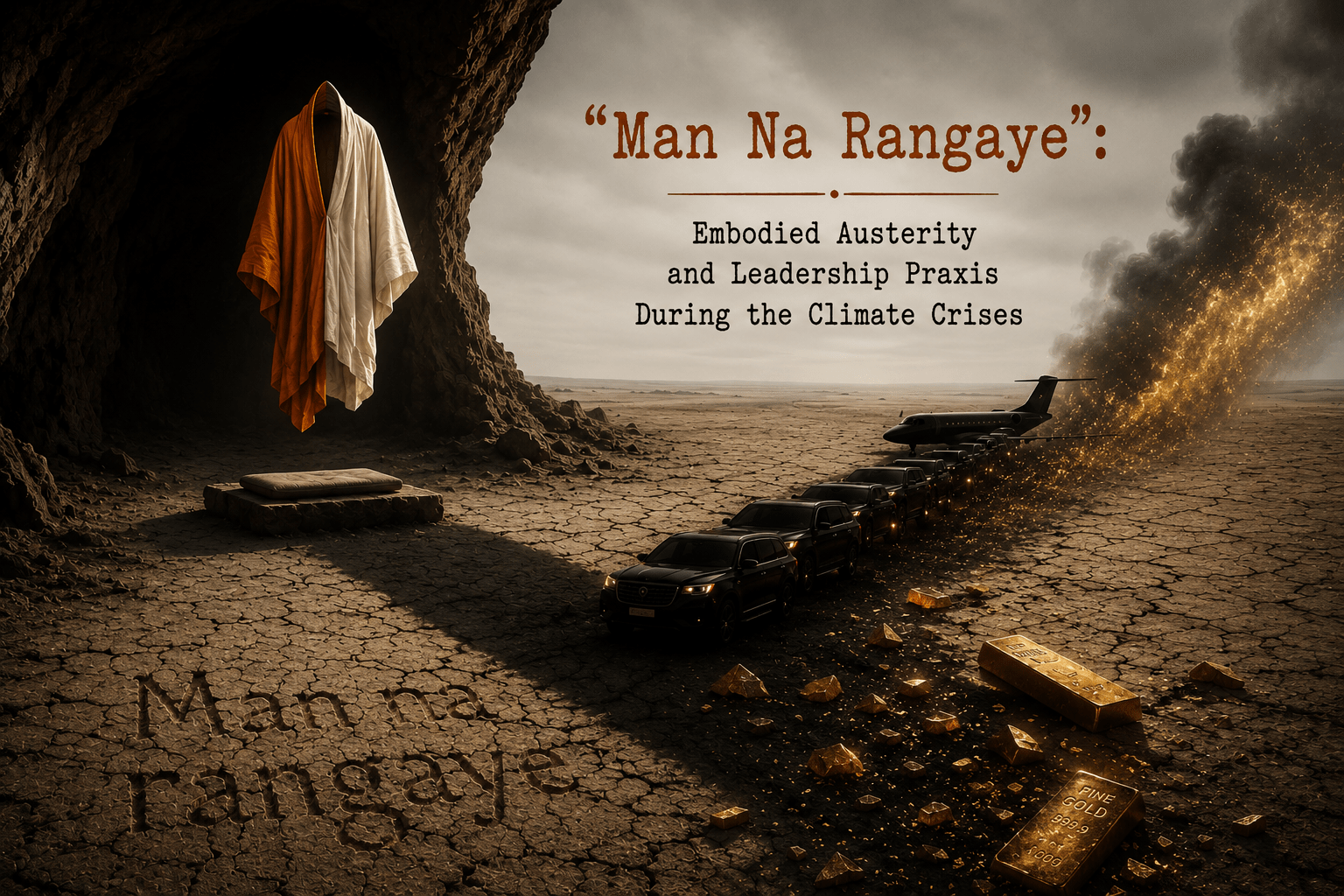
Kabir’s pad “Man nā raṅgā.e raṅgā.e jogī kapḌā” (c. 15th century) is a devastating, surgically precise satire that dismantles any “spectacular” projection of yogic or faqir identity built solely on external symbolism. Belonging to Kabir’s radical nirguṇa bhakti corpus, the poem privileges inner transformation — man kā raṅg, the mind permanently dyed in the colour of true prema (divine love) — over all outward markers of asceticism, ritual, or institutional religion. It launches a direct, uncompromising assault on the very kind of performative asceticism that has become central to Prime Minister Narendra Modi’s carefully choreographed public persona as the saffron-clad “Yogi” and self-described “faqir ādmī”.
Accurate Text and Line-by-Line Translation (based on critical editions and oral recensions):
मन न रंगाये रंगाये जोगी कपड़ा
Man na raṅgāye, raṅgāye jogī kapḍā
The mind is not dyed [with divine love], yet the yogi dyes his clothes.
आसन मारि मन्दिर में बैठे
Āsan māri mandir meṅ baiṭhe
He plants his seat and sits inside the temple.
ब्रह्म छाड़ि पूजन लागे पथरा
Brahma chhāḍi pūjan lāge pathrā
Forsaking the formless Brahman, he begins worshipping stones [idols].
कनवा फड़ाए जोगी जटवा बढ़ौले
Kanvā phaḍāye jogī jaṭvā baḍhaule
He pierces his ears [for yogic earrings], grows matted locks.
दाढ़ी बढ़ाय जोगी होई गैले बकरा
Dāḍhī baḍhāy jogī hoī gaile bakrā
He grows a beard and turns into a goat [becomes an object of ridicule].
जंगल जाइ जोगी धुनिया रमौले
Jaṅgal jāi jogī dhuniyā ramaule
He goes to the jungle and lights the dhuni [sacred fire] and plays the one-stringed instrument.
काम जराय जोगी होई गैले हिजड़ा
Kām jarāy jogī hoai gaile hijḍā
He burns away desire and becomes a eunuch [emasculated, sterile ascetic].
मथवा मुड़ाय जोगी कपड़ा रंगौले
Mathvā muḍāy jogī kapḍā raṅgaule
He shaves his head and dyes his clothes.
गीता बाँच के होई गैले लबरा
Gītā bāñch ke hoai gaile labrā
He reads the Gītā and becomes a chatterbox / hypocrite.
कहहीं ‘कबीर’ सुनो भाई साधो
Kahahīṅ ‘Kabīr’ suno bhāī sādho
Says Kabir: Listen, O brother sādhū,
जम दरवाजवा बाँघल जैबे पकड़ा
Jam daravājvā bāṅghal jaibe pakḍā
When Yama [death] seizes you at his door, you will be caught bound hand and foot.
A. Kabir’s Philosophical Assault on External Yogic Spectacle
Kabir’s entire oeuvre is a relentless critique of baharī (external) versus bhitari (inner) spirituality. The refrain “man na raṅgāye” is lethal in its simplicity: raṅg (colour/dye) is the technical term in bhakti for the mind being permanently stained by prema. Everything that follows is an ironic inversion of classical yogic practices, turning sacred symbols into objects of ridicule. Saffron/orange kapḍā and āsan in the mandir become empty theatricality. The matted locks (jaṭā), pierced ears, grown beard, and jungle dhuni reduce the yogi to an animalistic caricature — “he becomes a goat.” Suppression of kām leads not to transcendence but to spiritual castration (hijḍā). Scriptural recitation of the Gītā produces only verbose hypocrisy (labrā). The climax is forensic: when Yama, the god of death, drags the soul away, he will not be impressed by costumes, photo-ops, or dyed garments; the undyed mind is hauled off in chains. This is nirguṇa radicalism at its sharpest — a total rejection of both Hindu saguṇa temple ritual and any institutionalised asceticism that remains cosmetic.
B. Direct Destruction of Modi’s “Yogi” and “Faqir Ādmī” Image
Kabir’s pad collapses Modi’s public iconography in one devastating stroke. Modi’s persona has repeatedly deployed precisely the symbols Kabir mocks. The 2019 Kedarnath cave meditation — hours-long solitary tapasyā inside the cave-temple complex, saffron-clad, filmed from multiple angles and broadcast nationwide — is a literal enactment of “āsan māri mandir meṅ baiṭhe.” The 45-hour Kanyakumari rock meditation (30 May–1 June 2024) at the Vivekananda Rock Memorial, again in saffron, projected as a modern yogi communing with the ocean and the divine, repeats the same spectacle. The ubiquitous saffron kurtas and shawls have become the visual signature of the “Yogi Modi” brand. Repeated self-descriptions as “faqir ādmī” in speeches, interviews, and Mann Ki Baat, coupled with constant public invocation of the Gītā, Upanishads, and yogic philosophy, turn the Prime Minister into the very labrā (chatterbox/hypocrite) Kabir condemns.
The parallel is merciless. Where Kabir sees the yogi dyeing his clothes while the mind remains undyed, Modi presents the saffron-clad cave meditations and “faqir” rhetoric while presiding over luxury motorcades, imported opulence, extravagant foreign tours, and high-carbon security protocols. Where Kabir mocks the external āsan in the mandir, Modi’s televised temple-cave performances become staged political theatre. Where Kabir warns that Yama will not be fooled by dyed garments and Gītā recitation, the “Yogi Modi” brand stands exposed as man na raṅgāye — an undyed mind wrapped in the dyed cloth of power. Kabir’s nirguṇa radicalism thus delivers the sharpest indictment of the performative asceticism that underpins the 10 May 2026 austerity call. A leader who performs yogic detachment while his institutional practices remain steeped in luxury and exemption cannot claim the moral or spiritual authority to demand renunciation from the masses.
Kabir’s pad therefore does not merely critique; it renders the entire “Yogi Modi” spectacle spiritually null and void. The refrain — the mind is not dyed in divine love, yet the yogi dyes his clothes — exposes the unbridgeable gap between external symbols (saffron attire, Kedarnath and Kanyakumari meditations, “faqir ādmī” branding) and inner transformation. Publicised yogic photo-ops become labrā (hypocritical chatter) when detached from the embodied austerity the leadership demands of citizens. In the ecological-austerity context of the Hyderabad imperatives, Kabir’s warning is especially pointed: a leadership that performs detachment while sustaining high-carbon, high-import luxury cannot legitimately call for citizen-level renunciation. The pad leaves the audience with Yama’s chains — inescapable accountability when the performance ends.
Kabir’s pad does not merely critique — it delivers the vernacular coup de grâce that powerfully amplifies the six philosophical traditions examined earlier.
- Where Chaitanya demands “Āpani ācari dharma” (first practise it yourself), Kabir insists the yogi must dye his own mind before dyeing his clothes.
- Where Imam Abu Hanifa requires personal self-reform before advising others, Kabir mocks the external signs of detachment performed without inner transformation.
- Where Gandhi calls for “be the change,” Kabir exposes aparigraha that is merely photographic.
- Where Kant demands universalizability, Kabir shows that the maxim of yogic simplicity cannot be willed as a law when the performer exempts himself.
- Where Marx insists on theory-praxis unity, Kabir reveals the spectacle of meditation as ideological superstructure without material change in lifestyle or state practice.
- Where Tagore demands satya ātmīyatā between word and deed, Kabir finds none between the rhetoric of faqir-hood and the reality of extravagant security, foreign travel, and luxury symbolism.
Kabir supplies the sharpest, most accessible indictment: the entire “Yogi Modi” iconography — the saffron attire, the televised Kedarnath and Kanyakumari meditations, and the repeated “faqir ādmī” branding — stands revealed as man na raṅgāye, a mind uncoloured by the very detachment it advertises. What appears as spiritual performance is, in Kabir’s eyes, labrā — eloquent but hollow chatter. In the specific context of the 10 May 2026 austerity imperatives, the warning is particularly damning: a leadership that stages yogic detachment while sustaining high-carbon luxury, imported opulence, and elite exemptions lacks any moral or spiritual authority to demand renunciation from the masses. The pad ends with Yama’s chains — a stark reminder of inescapable accountability when the performance finally ends.
6. “Economics Of Austerity” At The Time Of Climate Emergencies
The “economics of austerity” is a theoretical framework that treats deliberate, selective restraint in non-essential consumption and resource use as an instrument of both macroeconomic stability and long-term welfare in conditions of scarcity. Unlike conventional fiscal austerity — which often implies across-the-board cuts in public spending during recessions — the economics of austerity, particularly as theorised by Amiya Kumar Dasgupta (A. K. Dasgupta), emphasises voluntary limitation of wants, redirection of resources toward basic needs and productive investment, and an ethical-moral dimension that prioritises equity and sustainability over luxury-driven growth. In the context of climate crises, this framework acquires an explicitly ecological character: it becomes a demand-side strategy for respecting planetary boundaries, reducing material throughput, and achieving sufficiency within the regenerative capacity of the biosphere.
In his Lal Bahadur Shastri Memorial Lectures, published as The Economics of Austerity (Oxford University Press, 1975), Dasgupta developed a comprehensive theory suited to resource-scarce developing economies such as India. Drawing on classical political economy (Ricardo and Mill on the virtues of saving over conspicuous consumption) and Gandhian thought, he argued that austerity possesses instrumental virtues rather than being an end in itself. Key elements include:
- Restraint on luxury and non-essential consumption to free resources (capital, foreign exchange, labour) for employment-generating, basic-goods sectors.
- Voluntary simplicity (inspired by Gandhi) as a culturally resonant mechanism to prevent “spurious growth” — economic expansion that bypasses the poor while inflating import dependence and inequality.
- Ethical limits to wants: Dasgupta rejected the neoclassical assumption of insatiable desires; in poor economies, unlimited wants lead to misallocation. Austerity, therefore, aligns individual behaviour with social welfare by promoting labour-intensive techniques, local production, and reduced reliance on imported luxuries.
Dasgupta remained firmly an economist: he offered a theory of growth under scarcity, not mere moral rhetoric. Austerity, for him, was a pragmatic tool for democratic development — ensuring that the poor gained purchasing power through realistic wages and employment while the elite practised restraint. As later analysts note, even when discussing austerity’s sociological and philosophical dimensions, Dasgupta “remained an economist attempting to offer a comprehensive theory of growth”.
A. Extension to Climate Crises: Ecological Austerity as Sufficiency Economics
At a time of climate emergency — characterised by breaching planetary boundaries, biodiversity collapse, and fossil-fuel lock-in — the economics of austerity evolves into ecological austerity or sufficiency economics. This is not degrowth for its own sake, but a targeted reduction in high-impact consumption to lower greenhouse-gas emissions and ecological footprints (transport fuel, imported luxuries, chemical-intensive agriculture), conserve foreign exchange and scarce resources (oil, minerals, rare earths) while mitigating geopolitical shocks (e.g., West Asia oil crises), and promote regenerative practices: natural farming, local/Swadeshi production, circular economy, and demand-side measures (WFH, public transport, reduced non-essential travel). Theoretically, this aligns with Dasgupta’s instrumental logic but integrates modern ecological economics: consumption must stay within the biosphere’s regenerative rate. It echoes the “avoid–shift–improve” strategies recommended for climate mitigation while delivering co-benefits — healthier populations, reduced pollution, greater economic resilience, and equity (the rich curb luxury so the vulnerable are shielded from crisis fallout). Unlike green-growth optimism (which assumes decoupling via technology alone), ecological austerity acknowledges absolute limits and insists on behavioural and institutional change. In the context of Modi’s 10 May 2026 imperatives, this framework provides the economic foundation for the citizen-level measures proposed — provided the leadership itself enacts the restraint it demands.
B. Resonance with Mahābhārata’s Vana Parva (Aranya Parva): Austerity as Dharma in Adversity
The Pandavas’ twelve-year forest exile in the Vana Parva serves as a powerful archetype of lived austerity during crisis. Exile becomes a metaphor for resource scarcity or ecological stress: the heroes must practise tapas (austerity), santosha (contentment), and self-reliance while upholding dharma. Sage Markandeya’s teachings to Yudhishthira explicitly valorise simple living earned through one’s own effort:
अपि शाकं पचानस्य सुखं वै मघवन गृहे। अर्जितं स्वेन वीर्येण न व्यपाश्रित्य कञ्चन॥
Api śākaṃ pacānasya sukhaṃ vai maghavana gṛhe | Arjitaṃ svena vīryeṇa na vyapāśritya kañcana ||
“Even the happiness of cooking vegetables (a simple meal) in one’s own home — earned by one’s own effort, without depending on anyone — is true contentment.”
(Vana Parva, Markandeya’s discourse)
This shloka encapsulates the economics of austerity: self-reliance and restraint yield greater welfare than dependence on external (or luxury) resources. The Parva repeatedly stresses that in times of adversity, dharma demands control of kāma and lobha (desire and greed), non-covetousness, and harmony with nature — precisely the behavioural foundation Dasgupta later theorised for resource-scarce economies. Austerity here is not punishment but a path to inner strength and ecological balance.
In the climate-crisis era, the economics of austerity (following Dasgupta) offers a coherent alternative to both unchecked consumerism and punitive fiscal contraction. It demands ethical praxis (linking back to the six philosophical counter-points discussed earlier: ācaraṇa before śikṣā, karma-kathā ātmīyatā), institutional embodiment (leadership and state protocols must model restraint — e.g., reduced luxury imports, lower-carbon mobility — for credibility), and equity and justice (austerity must be progressive — curbing elite excess while protecting the vulnerable — lest it become regressive). Thus, Modi’s 10 May 2026 imperatives (fuel restraint, WFH, local production, postponed gold purchases) can be read as a practical application of this theoretical tradition — updated for the Anthropocene. Dasgupta would likely have recognised their instrumental potential for ecological resilience, provided the praxis gap (Z+ protocols, personal lifestyle, and visible leadership exemptions) is addressed. The Vana Parva reminds us that such austerity, when internalised, is not deprivation but the dharma of our age.
C. The Bhagavad Gītā’s Twin Teachings: Lokasaṅgraha and the Rejection of Karmavirati
The economics of austerity — as theorised by A.K. Dasgupta and extended to climate crises — gains profound philosophical depth when read through the Bhagavad Gītā’s twin teachings on lokasaṅgraha (world-welfare) and the categorical rejection of karmavirati (aversion to or cessation of action). These verses supply the ethical and spiritual foundation for why even the fully enlightened (brahmajña) must continue productive action, including duties that sustain agriculture and material sufficiency, rather than retreating into personal liberation. This directly bolsters the case for voluntary, selective restraint in non-essential consumption during ecological scarcity and closes the loop with the earlier philosophical counter-points.
Gītā 3.20: Brahmajñāni Kings (Janaka and Aśvapati) Continue Productive Action for Lokasaṅgraha
The pivotal verse is:
कर्मणैव हि संसिद्धिमास्थिता जनकादयः । लोकसङ्ग्रहमेवापि सम्पश्यन् कर्तुमर्हसि ॥
karmaṇaiva hi saṃsiddhim āsthitā janakādayaḥ | lokasaṅgraham evāpi sampaśyan kartum arhasi ||
“It is through action alone that Janaka and others attained perfection. You too should act, keeping in view the welfare of the world (lokasaṅgraha).”
Janaka (the Videha king, archetypal brahmajñānī who remained a ruler) and Aśvapati Kekaya (another Upaniṣadic king cited explicitly by Ādi Śaṅkarācārya in his bhāṣya on this verse) are presented as exemplars. Both had realised the formless Brahman yet never renounced their prescribed duties (svadharma). Śaṅkara clarifies that these Kṣatriya kings attained liberation while continuing their royal obligations — governance, protection of subjects, and promotion of productive activities — purely for the cohesion and welfare of society. In traditional Indian kingship, such duties explicitly included ensuring agricultural prosperity: safeguarding farmland, promoting irrigation, natural cultivation, and equitable distribution of produce. The “farming” dimension invoked in the imperatives is thus embedded in the rajadharma they upheld; enlightened rulers did not abandon the plough (literal or symbolic) but sustained the agrarian base that feeds the world.
This is not personal karma for self-perfection but niṣkāma karma oriented toward lokasaṅgraha — the very principle that justifies restraint on luxury imports, fuel, and gold in the current climate-oil crisis. Austerity here becomes an active, world-sustaining practice: the enlightened (or the policy-maker) curtails elite excess not to escape the world but to preserve its regenerative capacity.
Gītā 2.47 (Second Line): Categorical Condemnation of Karmavirati
The famous verse on detached action ends with a sharp prohibition:
कर्मण्येवाधिकारस्ते मा फलेषु कदाचन । मा कर्मफलहेतुर्भूर्मा ते सङ्गोऽस्त्वकर्मणि ॥
karmaṇy evādhikāras te mā phaleṣu kadācana | mā karmaphalahetur bhūr mā te saṅgo’stvakarmaṇi ||
“You have a right to action alone, never to its fruits. Do not be motivated by the fruits of action, and let there be no attachment to inaction (mā te saṅgo’stvakarmaṇi).”
The final quarter is decisive: karmavirati (aversion to or cessation of action) is explicitly condemned. Even after brahmajñāna, one must not lapse into sterile inaction. Śaṅkara and later commentators stress that the realised soul continues karma — including the productive labour of farming, governance, or policy-level restraint — precisely to prevent societal collapse and to set the standard for ordinary people.
Dasgupta’s instrumental austerity (restraining luxury wants to release resources for basic needs and employment) is spiritualised by the Gītā. The brahmajñānī kings model voluntary simplicity at the top: they possess the ultimate knowledge yet continue the “farming” (productive, earth-nourishing) duties of their station. In climate terms, this translates to leadership-level restraint on high-carbon, high-import luxuries (foreign travel, armored convoys, gold) so that ecological “fields” (planetary boundaries, soil health, fossil-fuel reserves) remain viable for all.
The Gītā rejects both hedonistic consumerism and escapist karmavirati. Climate austerity is therefore not degrowth-as-punishment but active dharma — the enlightened continue to “till the field” (natural farming, local production, fuel conservation) for the world’s sake. This echoes the Vana Parva’s santosha in adversity but elevates it: even the liberated do not abandon the plough.
The verses close the philosophical gap identified earlier (Chaitanya, Abu Hanifa, Gandhi, Kant, Marx, Tagore, Kabir). If leaders invoke lokasaṅgraha, they must themselves embody the karma of austerity — visible, institutionalised restraint — rather than performative symbolism. Otherwise, the maxim fails the test of universalizability and karma-kathā ātmīyatā.
In sum, the Gītā supplies the economics missing in purely secular austerity theories: at the time of climate crises, restraint is not deprivation but the highest form of yajña (sacrifice for the world). Janaka and Aśvapati, the plough-wielding brahmajñānīs, remain the timeless archetypes — enlightened yet earth-bound, detached yet fully engaged in sustaining the common good. Modi’s 10 May 2026 imperatives thus find their deepest legitimacy here, provided the praxis of leadership aligns with the dharma these verses prescribe.
7. Conclusion: Toward Embodied Ecological Austerity
The imperatives issued by Prime Minister Narendra Modi on 10 May 2026 in Hyderabad possess genuine potential on paper — as practical, demand-side responses to geopolitical shocks, resource constraints, and mounting ecological pressures. Restraint in petroleum use, revived work-from-home, minimised non-essential foreign travel, postponed gold purchases, reduced chemical fertiliser imports, promotion of natural farming and Swadeshi, and a shift to public transport and EVs could, if seriously implemented, deliver meaningful co-benefits in emissions reduction, resource conservation, and resilience.
Yet their credibility and ultimate effectiveness collapse under the weight of the leadership’s own conduct and policy record. The very day after urging citizens to embrace sweeping austerity, the Prime Minister embarked on a lavish five-nation foreign tour. The call for reduced petroleum consumption and preference for EVs is issued while massive imported luxury motorcades remain the norm and new fossil fuel projects are fast-tracked. The appeal to postpone gold purchases and embrace Swadeshi simplicity rings hollow against a carefully curated image of high-value opulence and symbolic extravagance. What was projected as a necessary national sacrifice has so far amounted to little more than shallow lip-service — exhortation without embodiment, rhetoric without praxis.
This hypocrisy runs deeper. Far from leading any credible climate repair effort, the Modi dispensation has actively championed projects that devastate critical ecosystems while enriching crony conglomerates. The diversion of pristine Hasdeo Arand forests in Chhattisgarh for coal mining — primarily benefiting the Adani Group — has destroyed one of central India’s last biodiversity-rich tracts and displaced Adivasi communities. The Great Nicobar Island mega-project, involving a massive transshipment port, airport, and township, threatens one of the world’s most fragile tropical ecosystems, indigenous Shompen and Nicobarese habitats, and vital coral reefs. Airport expansions, continued fossil fuel subsidies, dilution of environmental clearance norms, and aggressive pursuit of coal and gas projects further reveal a consistent pattern: climate denialism in practice, masked by occasional green rhetoric. A leadership that greenlights ecological destruction for favoured corporate allies cannot credibly call upon citizens to adopt sufficiency and restraint.
The economics of austerity in the climate era is neither punitive contraction nor mere fiscal belt-tightening. It is a serious demand for voluntary sufficiency, consistent leadership example, and sustained action oriented toward the common good. Dasgupta supplies the instrumental economic logic, the Gītā and Mahābhārata underscore the imperative of continued responsible action for world-welfare, and the cross-traditional philosophical sources provide the test of authenticity. Modi’s 10 May 2026 address could have marked a genuine turning point. Absent radical, visible ācaraṇa from the top, it remains what it has largely been so far: performative exhortation rather than embodied practice.
Absent such alignment, Modi’s call is not statesmanship but political theatre — another instance of man nā raṅgāye raṅgāye jogī kapḍā.
References
Primary Sources and Key Texts
- Dasgupta, A.K. (1975). The Economics of Austerity. Oxford University Press, Delhi. (Lal Bahadur Shastri Memorial Lectures). Available via academic libraries and citations in economic history works.
- Bhagavad Gītā. Critical editions with commentaries by Ādi Śaṅkarācārya, Rāmānuja, and A.C. Bhaktivedanta Swami Prabhupāda.
- Mahābhārata, Vana Parva (Aranya Parva). Translation by Kisari Mohan Ganguli (1883–1896). Sacred-texts.com archive: https://www.sacred-texts.com/hin/m03/index.htm
- Kabīr Granthāvalī / Kabīr Samagra. Critical editions and oral recensions (e.g., Kabir: The Weaver’s Songs translated by Vinay Dharwadker).
- Modi, Narendra. (2026). Public Address, Hyderabad, 10 May 2026. Reported in major outlets including The Hindu, India Today, and official PMO coverage.
Economic and Ecological Data
- India’s gold imports FY 2025-26: Record $71.98 billion (up 24% from previous year). Economic Times / CMIE data: https://m.economictimes.com/news/et-explains/indias-gold-imports-how-it-impacts-our-economy-an-explainer/articleshow/131028577.cms
- Modi’s foreign trips cost (2015–2025): ₹762 crore. MEA data tabled in Lok Sabha, reported by The Wire: https://m.thewire.in/article/diplomacy/pm-modis-foreign-trips-between-2015-2025-cost-exchequer-rs-762-crore-mea-filings-in-lok-sabha-reveal
- SPG security cost for Prime Minister: Approximately ₹1.17 crore per day (₹4.90 lakh per hour). Recent estimates: https://news24online.com/photos/india/how-much-does-pm-modi-security-cost-per-hour-from-spg-commandos-to-bulletproof-convoys-heres-massive-daily-expense-to-protect-prime-minister-836827
Philosophical and Cultural References
- Marx, Karl. Capital, Volume 1 (1867), Chapter 1, Section 4: “The Fetishism of Commodities and the Secret Thereof.”
- Marx, Karl. Economic and Philosophic Manuscripts of 1844.
- Tagore, Rabindranath. Raktakarabi (Red Oleanders, 1926). English translations available via Visva-Bharati and standard editions.
- Ray, Satyajit. Hirak Rajar Deshe (Kingdom of Diamonds, 1980). Full film: https://www.youtube.com/watch?v=sSOVWNFRZIM
- Chaplin, Charlie. The Gold Rush (1925). Key sequences analysis; full film clips: https://youtu.be/a-nyVGSEjyU
Additional Supporting Sources
Z+/SPG protocol details drawn from official government notifications and parliamentary records.
Konzelmann, S.J. (2012). “The Economics of Austerity.” Centre for Business Research, University of Cambridge Working Paper No. 434. PDF: https://www.jbs.cam.ac.uk/wp-content/uploads/2023/05/cbrwp434.pdf
Althusser, Louis. Ideology and Ideological State Apparatuses (1970).
Sartre, Jean-Paul. Les Mains Sales (Dirty Hands, 1948).

