
Posted on 30th March, 2025 (GMT 07:48 hrs)
Updated on 17th September, 2026 (GMT 02:45 hrs)
ABSTRACT
Once in a Blue Moon Academia (OBMA), a self-funded non-profit platform since 2021, enacts academic activism across financial collapse (DHFL and crony-capitalist markets), ecological catastrophe, neoliberal political economy, far-right authoritarianism, institutionalized education, proprietary knowledge, and epistemic monism, expanding into an interconnected praxis of Ecotopians of Alternity against climate denial and green-capitalist delay; Seize Dalal Street and Moneyless Commons against stock-market mystification and the sorcery of money; Partyless Communes, Democratic (Un)Freedom, and Bhagat Singh’s Socialist India against electoral autocracy and domesticated radicalism; না-ইস্কুল / Nice School, Counter-Academiocracy, and Copyleft Writers’ Forum against banking-model schooling, metricized universities, and enclosed authorship; and Anekānta and Derozio and Young Bengal for many-sided knowing and sceptical, anti-foundational pedagogy—together prefiguring commons, decentralization, and bahujana sukhaya, bahujanahitaya ca rather than mere reform.
Are you curious about the broader projects and initiatives at Once in a Blue Moon Academia (OBMA)?
OBMA is active on the following social media platforms and web-platforms:
Email ID: onceinabluemoonacademia@gmail.com, contactus@onceinabluemoon2021.in
a) Websites for Publishing
WordPress: https://onceinabluemoon2021.in/
Wix: https://obmaacademia.wixsite.com/once-in-a-blue-moon
Instagram: https://www.instagram.com/obma2022/
Twitter: https://twitter.com/obma2022
Facebook Page: https://www.facebook.com/onceinabluemoon2021
Facebook Group: https://www.facebook.com/groups/1564691267737504
LinkedIn: https://www.linkedin.com/groups/13949066/
Youtube: https://youtube.com/@onceinabluemoonacademiaobm574
Blogspot: https://onceinabluemoon2021.blogspot.com/
Quora: https://debaprasadbandyopadhyaysspace.quora.com/
Mastodon: https://mastodon.social/@anekanta
Threads: https://www.threads.net/@debaprasadbandyopadhyay
Slideshare: https://www.slideshare.net/DebaprasadBandyopadhyay
b) Websites for Publicizing/Viralizing
Mouthshut: https://www.mouthshut.com/anekanta01/reviews
Hellopeter: https://www.hellopeter.com/piramal-capital-and-housing-finance-limited
Pinterest: https://in.pinterest.com/oiabm2021/
Scribd: https://www.scribd.com/user/61386126/Debaprasad-Bandyopadhyay
Flickr: https://www.flickr.com/photos/80230966@N06/
Tumblr: https://www.tumblr.com/debaprasad
Reddit: https://www.reddit.com/user/Realistic_Ad7755
c) Websites for Academic Articles
Academia.edu: https://spbu.academia.edu/DEBAPRASADBANDYOPADHYAY
Researchgate: https://www.researchgate.net/profile/Debaprasad-Bandyopadhyay
d) Petition Platforms
Change.Org: https://chng.it/d9cMzV6xV7
Campoal: https://campoal.com/peace/author/debaprasad105852625753454780106/
Go.Petition: https://www.gopetition.com/account/petitions
Avaaj: https://shorturl.at/1QYpY
OBMA encompasses the contemporary crises, fields, subject areas, and zones of activism related to the following issues:
- Ongoing Climate Crises – including anthropogenic glocal heating and the lack of coordinated, long-term grassroots climate action.
- The Catastrophic State of the World Political (Money Signifier-Based) Economy – (cf. Moneyless Society Movement, Occupy Wall Street).
- 2.1. The Rise of Far-Right Authoritarianism – fascism, religious fundamentalism, and market fundamentalism—fueling a form of pre-debt-or cannibalistic capitalism.
- The Crisis of Institutionalized Education – suggesting the need for alternatives through deschooling, unschooling, and the anti-university movements.
- The Rise of Pharma Companies – now the second-highest earners of profit—raising questions about manufactured illness, profit-driven medicine, and iatrogenesis.
- Caste-Class-Gender-Race/Ethnicity Issues – persistent and structurally embedded.
- The Lack of Disarmament – in a world driven by war-mongering power blocs, creating a sick/risk society.
Attuned to these objectives, OBMA as a generic movement has expanded or ‘branched out’ into the following platforms, pages, groups, and sub-movements:
I. CLIMATE/ECOLOGICAL ACTIVISM
Ecotopians of Alternity (EOA)
Ecotopians for Alternity (EOA) is a climate activism initiative under Once in a Blue Moon Academia (OBMA). It is committed to mobilizing climate advocates, confronting climate skepticism and denialism, challenging the deferments of green capitalism, and responding decisively to the escalating threats of anthropogenic environmental collapse. The initiative seeks to foreground the urgency of the intertwined climate and ecological crises: rising greenhouse gas emissions, accelerating mass extinctions, systemic ecosystem breakdowns, and the ecocidal consequences of the state–corporate nexus. Its central aim is to amplify critical voices, foster public engagement, and build sustained resistance against these intensifying threats.
II. FINANCE/POLITICAL ECONOMY
i. Seize Dalal Street
Seize Dalal Street, an initiative under Once in a Blue Moon Academia (OBMA), seeks to unearth, expose, and critically interrogate the chaosophical—at once irrationally and deliriously rational—logic of the stock market. Drawing inspiration from Occupy Wall Street, the initiative examines the stock exchange as a central site of power within neoliberal capitalism. It engages with the market’s layered contradictions, speculative excesses, structural paradoxes, and socio-economic implications, while questioning its role in shaping inequality, financial abstraction, and crisis production. At its core, Seize Dalal Street aims to transform the stock market from an opaque domain of technical mystification into a terrain of critical inquiry, public scrutiny, and political contestation.
ii. Moneyless Commons
Moneyless Commons, an initiative under Once in a Blue Moon Academia (OBMA), seeks to confront and displace the historically contingent yet naturalized dominance of money as a universal mediator of value—what Karl Marx evocatively described as a kind of social “sorcery” that renders the incommensurable artificially commensurable. Moving beyond both market exchange and the limited reciprocity of barter, it advances the possibility of moneyless, degrowth-oriented commons networks grounded in need, mutuality, and ecological limits. The initiative offers a sustained critique of the money-signifier in all its forms—currency, credit, financial instruments—as mechanisms that obscure qualitative differences, flatten social relations, and reproduce systemic inequities under the guise of equivalence. In doing so, it interrogates how monetary abstraction enables dispossession, commodification, and the expansion of the state–corporate nexus. Preceded and inspired by the broader Moneyless Society movement, Moneyless Commons aims to cultivate alternative infrastructures of sustenance, cooperation, and value beyond exchange, reimagining social organization through collective stewardship, shared access, and non-monetized forms of relationality.
III. ANTI-ESTABLISHMENT POLITICS
i. Partyless Communes:
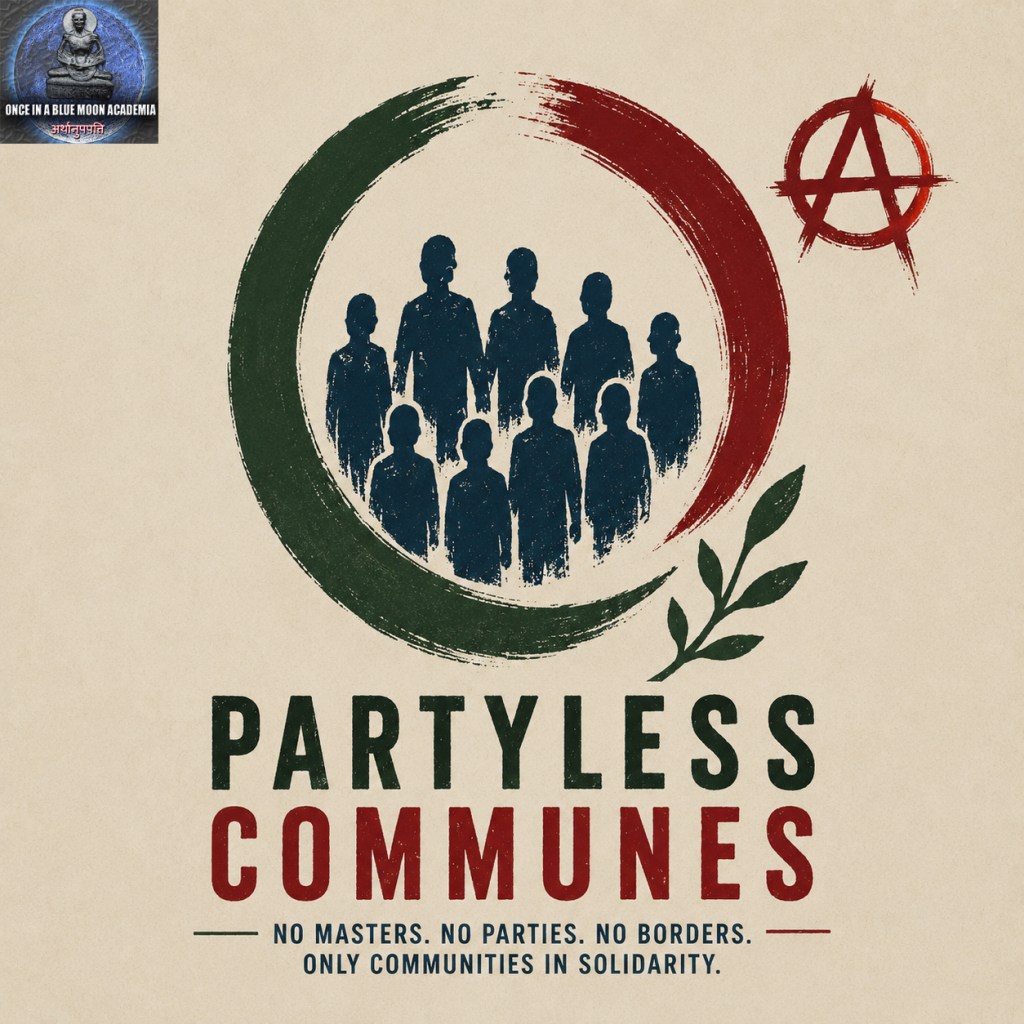
Partyless Communes, an initiative of Once in a Blue Moon Academia (OBMA), resists the reduction of politics to a flattened electoral ontology by critically interrogating political parties across the left–right–centre spectrum as regimented, quasi-corporate formations sustained by entrenched configurations of muscle and money power, where ideology often functions as façade, instrument, or weapon rather than ethical commitment. In response, it advances the idea of decentralized, commune-based living systems rooted in small-scale, cooperative, and ecologically grounded social organization. Drawing on the anarchist and radical democratic traditions of Pierre-Joseph Proudhon, Robert Owen, Mikhail Bakunin, Peter Kropotkin, Rudolf Rocker, Murray Bookchin, alongside anti-statist and participatory visions articulated by M. N. Roy, Mahatma Gandhi, Rajni Kothari, and Jayaprakash Narayan, the initiative envisions a radical ecological democracy constituted through localized councils, direct participation, and intimate, dialogic decision-making processes. It rejects centralized, institutionalized, and coercive power-relations in favor of horizontal structures of mutual aid, ethical deliberation, and collective autonomy, seeking to reimagine politics as lived, everyday praxis embedded in community, ecology, and shared responsibility rather than mediated through distant representative apparatuses.
ii. Democratic (Un)Freedom:
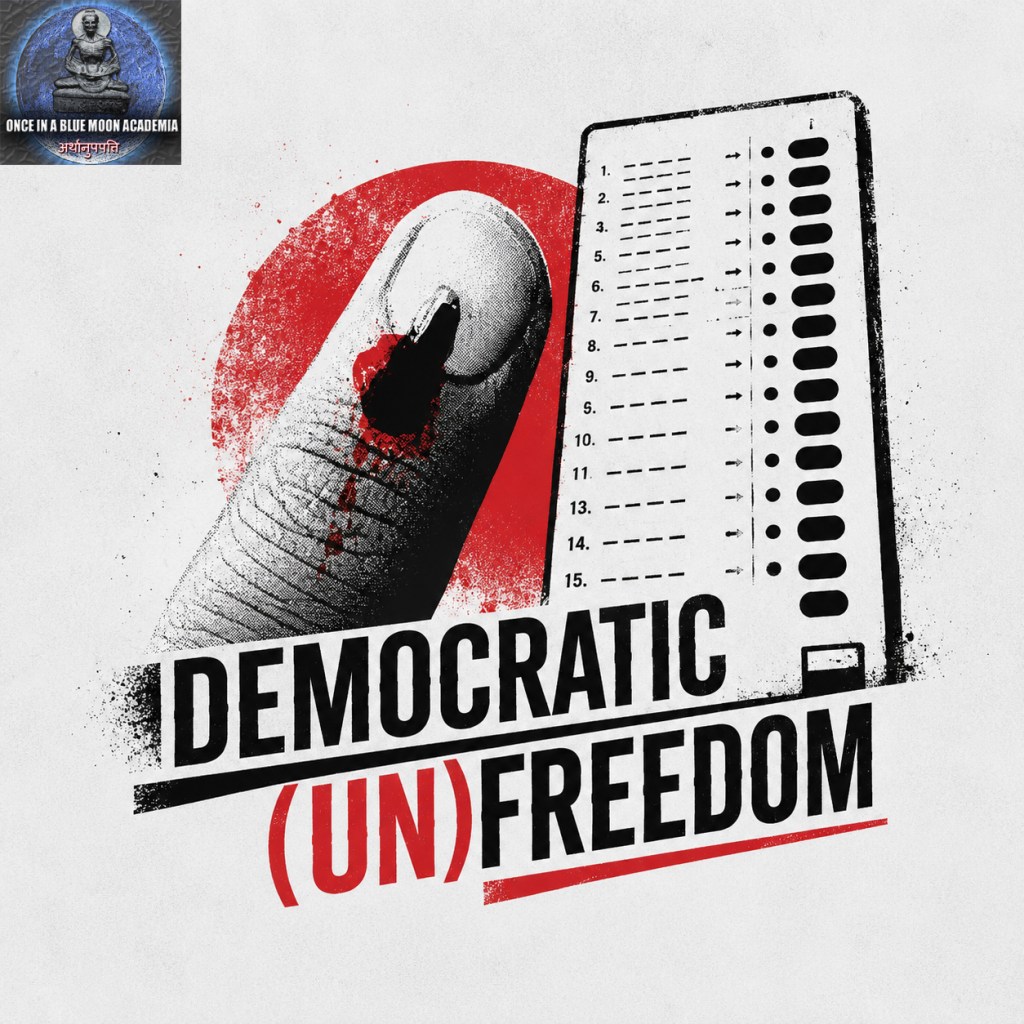
Democratic (Un)Freedom, an initiative of Once in a Blue Moon Academia (OBMA), interrogates the paradoxical condition of contemporary politics in which formal democracy persists even as substantive freedom erodes—a condition conceptually indebted to Herbert Marcuse. Operating within the intertwined terrains of post-democracy and prefigurative politics, the initiative examines how democratic forms are hollowed out by the ascendancy of private capital under neoliberalism, where participation is increasingly reduced to “dollar voting,” revolutions themselves are susceptible to funding logics, and democracy is normalized as little more than electoral autocracy. It critically engages the ways in which consent is manufactured, dissent is absorbed or commodified, and political imagination is constrained within market-compatible limits. Against this backdrop, Democratic (Un)Freedom seeks to expose the structural contradictions that allow regimes of control, inequality, and depoliticization to masquerade as democratic vitality, while simultaneously exploring prefigurative practices that reclaim democracy as a lived, collective, and materially grounded process beyond capital’s hegemony.
iii. Bhagat Singh’s Socialist India (BSSI):
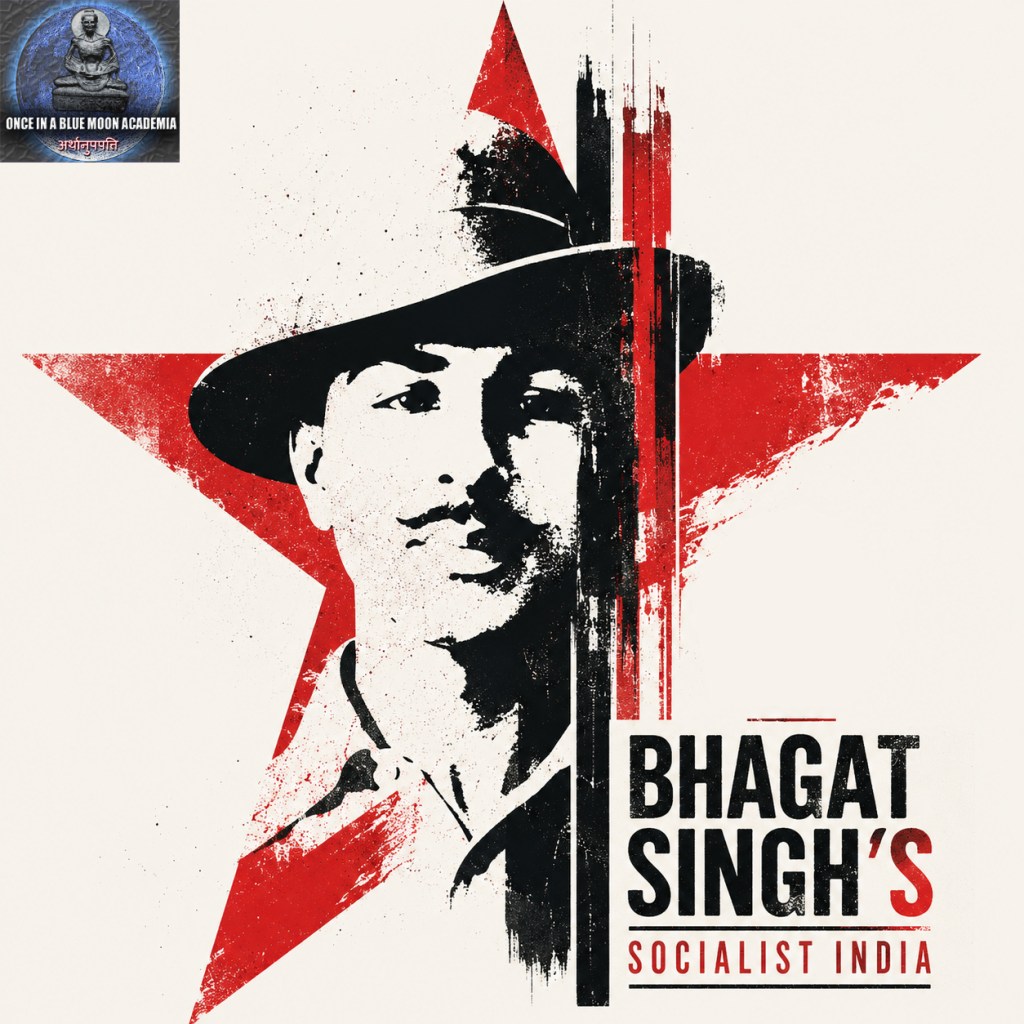
Bhagat Singh’s Socialist India (BSSI), an initiative under Once in a Blue Moon Academia (OBMA), is conceived as a critical-intellectual platform dedicated to re-engaging Bhagat Singh not as a frozen nationalist icon, but as a dynamic, dialogic, and radically unfinished political thinker. Moving beyond hagiography and statist appropriations, BSSI draws upon a hauntological sensibility—where Bhagat Singh persists as a living “spectral” presence within contemporary crises—to interrogate the conditions of capitalism, authoritarianism, and ideological capture. It foregrounds his commitments to rational critique, anti-dogmatism, atheistic inquiry, and revolutionary transformation, while resisting attempts to commodify or domesticate his legacy. By traversing the porous boundaries between theory and praxis, archive and lived experience, BSSI cultivates a mode of “withness-thinking,” engaging Bhagat Singh as a co-traveller in ongoing struggles for justice. In doing so, it envisions a socialist horizon grounded not in rigid doctrine but in critical thought, collective emancipation, and the continuous reimagining of freedom.
IV. ANTI-ACADEMIOCRACY MOVEMENT
i. না-ইস্কুল / Nice School:
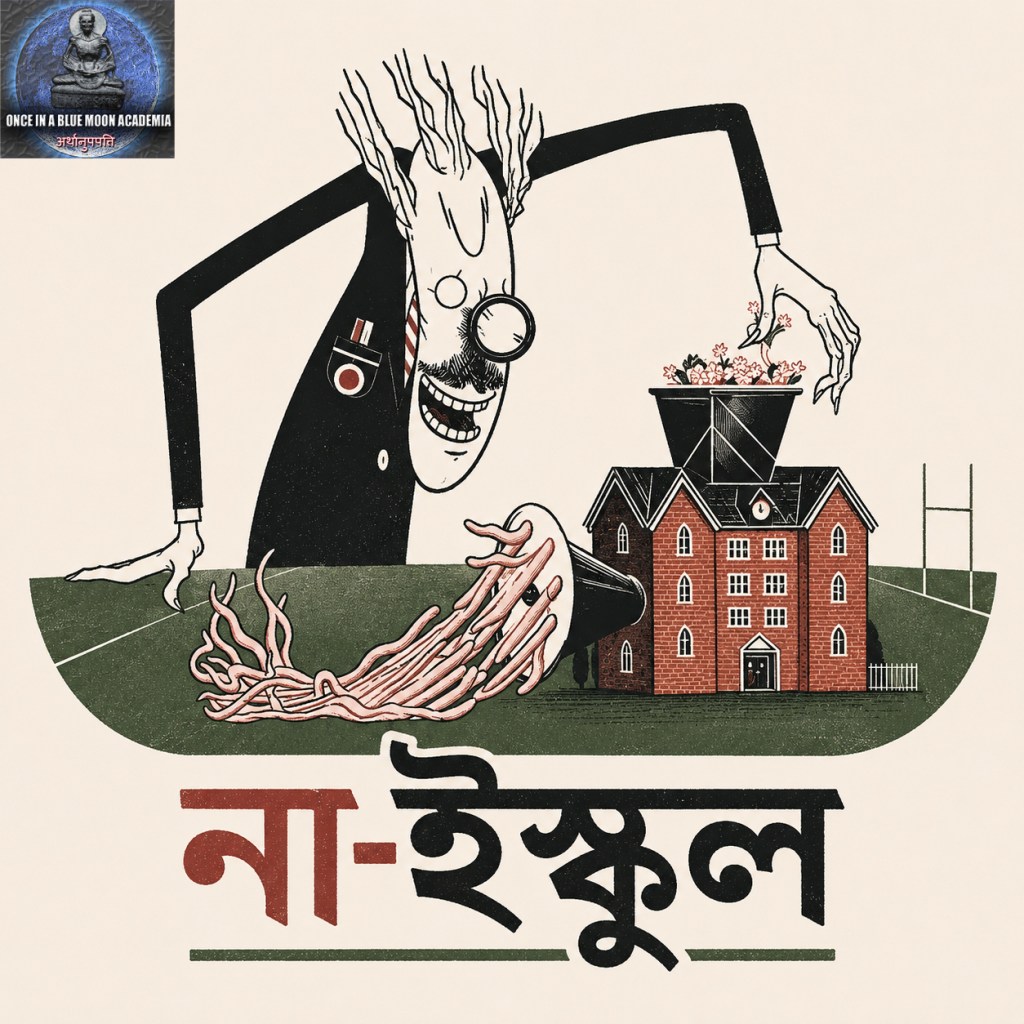
An initiative under Once in a Blue Moon Academia (OBMA), না-ইস্কুল / Nice School reimagines learning through the radical critiques of institutionalized education articulated by Paulo Freire and Ivan Illich, among others, by advancing a deschooling–unschooling ethos that resists the enclosure of knowledge within formal, credential-driven systems. It challenges the “banking model” of education, where learners are reduced to passive recipients, and instead foregrounds dialogic, experiential, and self-directed modes of inquiry rooted in everyday life. Rejecting the fetish of schooling as the sole site of learning, the initiative seeks to dissolve rigid boundaries between education and lived experience, cultivating spaces where curiosity, autonomy, and critical consciousness can flourish beyond institutional surveillance and standardization. In doing so, না-ইস্কুল envisions learning as a continuous, open-ended process embedded in community, creativity, and the freedom to question, unlearn, and reimagine knowledge itself.
ii. Counter-Academiocracy:
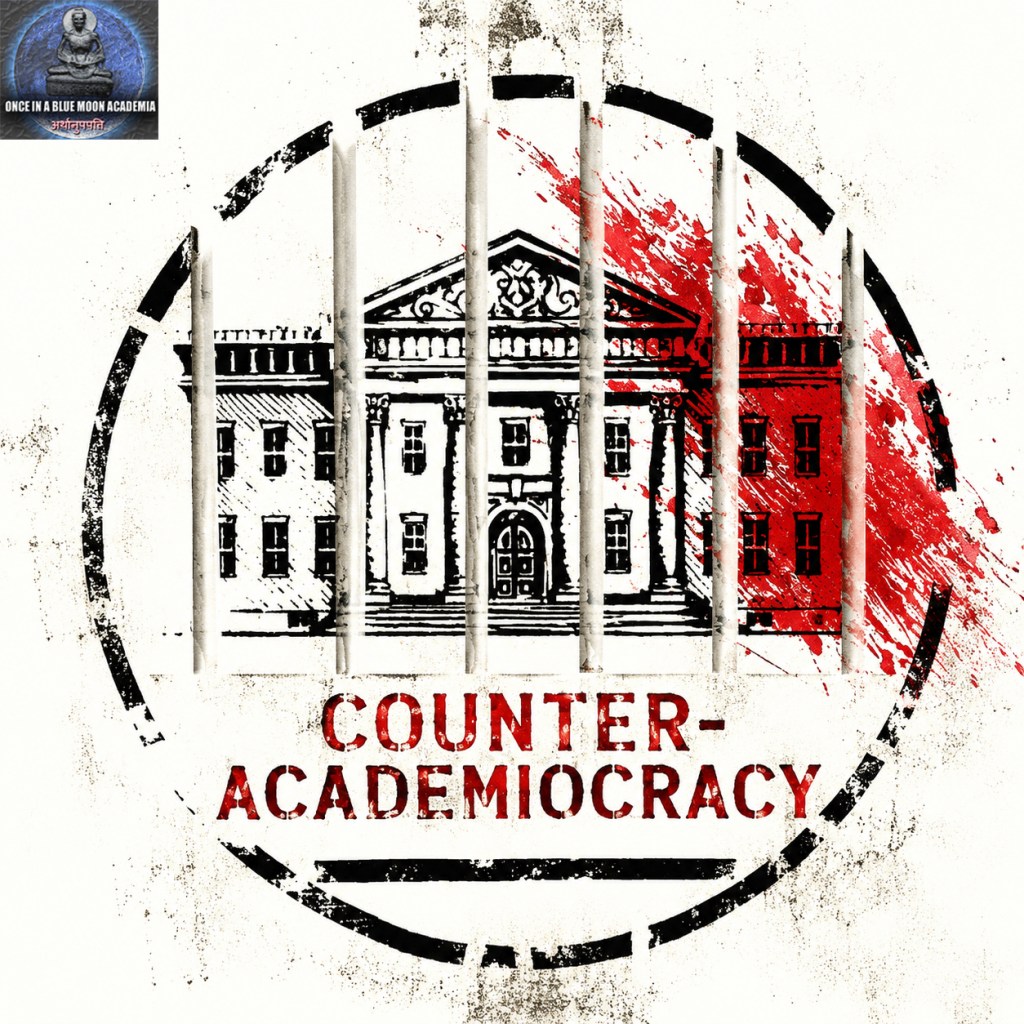
Counter-Academiocracy, another initiative of OBMA, critically interrogates and moves beyond the entrenched architectures of mainstream university-based education—what Jacques Derrida metaphorically evokes as the vigilant “eye of the university,” a site that simultaneously produces knowledge and surveils, disciplines, and legitimizes it. The very portmanteau academiocracy is mobilized here to question the fusion of academic authority with regimes of control—echoing the logics of Michel Foucault’s discipline and punish—as well as the compulsive injunction to “publish more, publish rubbish,” through which knowledge production is subsumed under metrics, quantity, and visibility. This regime not only entrenches patron–client hierarchies, regimentation, and behaviourist reward–punishment systems, but also sustains the circuits of print, electronic, and cyber-capitalism by converting thought into commodified output. Counter-Academiocracy challenges this top-down, credentialist logic that reduces learning to measurable performance and institutional validation, exposing how such structures reproduce inequality, intellectual dependency, and epistemic conformity. In contrast, it envisions a decentralized, relational, and ecological paradigm of learning grounded in an organic triad of nature, neighbours, and narratives, where knowledge emerges through mutual engagement, lived experience, and collective storytelling beyond the surveillant authority of the university. By foregrounding horizontal exchange, situated knowledges, and ethical co-learning, the initiative seeks to reclaim education as a commons—fluid, participatory, and attuned to human and ecological interdependence—displacing the coercive logics of control, competition, and commodification that define institutionalized academia.
iii. Copyleft Writers’ Forum:
Copyleft Writers’ Forum, an initiative under Once in a Blue Moon Academia (OBMA), reclaims writing as a commons by directly confronting the proprietary regimes of authorship embedded in intellectual property rights and the commodification of knowledge under print, electronic, and cyber-capitalism. Drawing from the ethos of Creative Commons and broader open-access movements, it advances a radical critique of ownership—echoing Pierre-Joseph Proudhon’s provocation that “property is theft”—to question the enclosure of ideas, texts, and creativity within legal-economic monopolies. The forum seeks to “seize the means of intellectual production” by fostering collaborative authorship, free circulation, and the right to remix, translate, adapt, and redistribute knowledge without restrictive barriers. It resists the gatekeeping hierarchies of publishing industries and academic validation systems, where value is often tied to exclusivity and market visibility, and instead nurtures a participatory, dialogic culture of writing. In doing so, Copyleft Writers’ Forum envisions literature and knowledge production as collective, evolving processes—open, accessible, and oriented toward intellectual emancipation beyond the logics of ownership, control, and commodification.
V. THE PURSUIT OF WISDOM-KEEPING (CULTURES OF EPISTEMOLOGY)
i. Anekānta
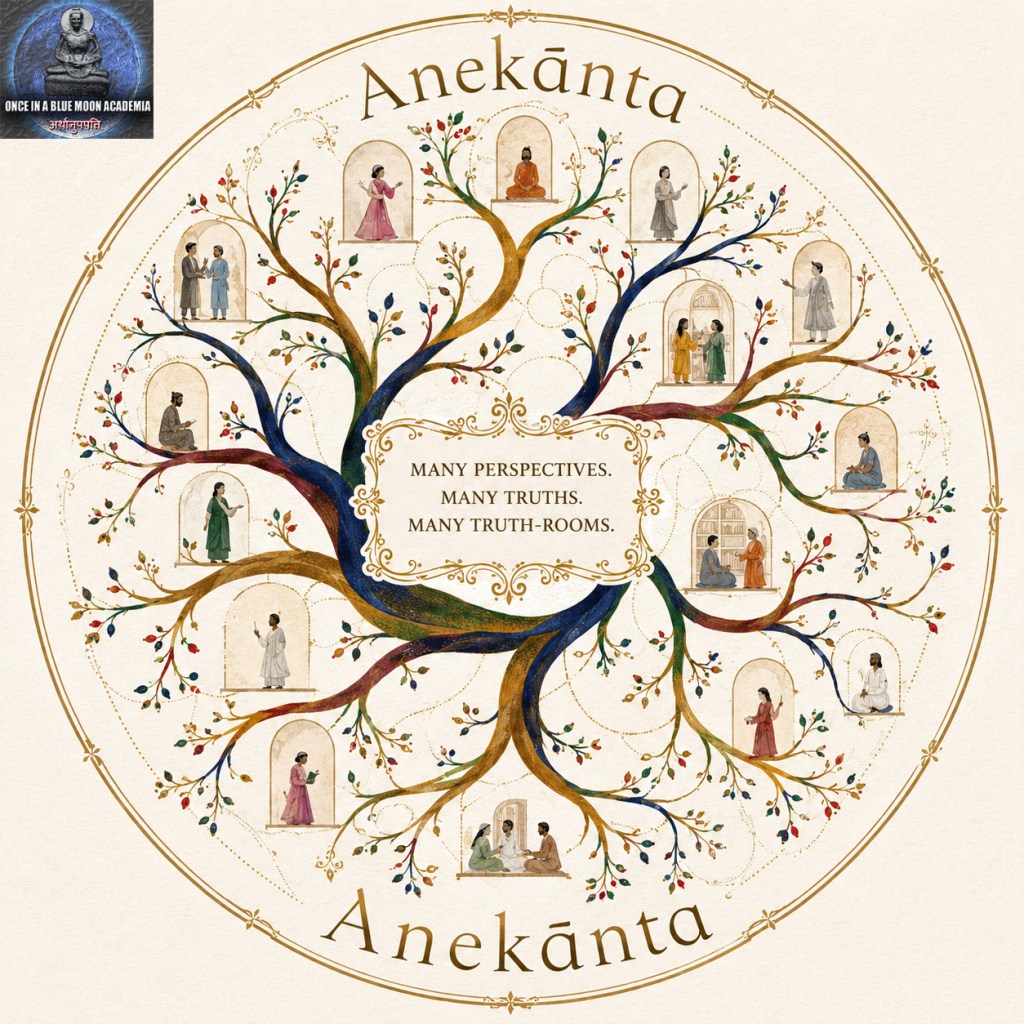
Anekānta, an initiative under Once in a Blue Moon Academia (OBMA), advances a radical culture of epistemic plurality grounded in the Jain principle of many-sidedness, reimagined for a post-classical, indeterminate world. Moving beyond the closure of binary dialogue, it cultivates polylogue—a field of intersecting voices, traditions, and methods—where heteroglossia and plural methodologies are not anomalies but constitutive of knowledge itself. Drawing from the anarchist epistemology of Paul Feyerabend and the non-absolutist logics of syādvāda and saptabhaṅgī-naya, as revisited by Kalidas Bhattacharyya and Krishnachandra Bhattacharyya, the initiative resists methodological monism and the authority of singular truth-claims. Instead, it foregrounds conditionality, perspectival multiplicity, and the co-existence of seemingly contradictory propositions within dynamic epistemic fields. Attuned to contemporary insights into indeterminacy—from quantum thought to post-structural critique—Anekānta seeks to nurture a syncretic, dialogic commons of knowing where diverse epistemic traditions encounter, contest, and co-create without subsumption. In doing so, it redefines wisdom not as possession or closure, but as an ongoing practice of openness, negotiation, and relational understanding across difference.
ii. Derozio and Young Bengal

Derozio and Young Bengal, an initiative under Once in a Blue Moon Academia (OBMA), revisits the intellectual legacy of Henry Louis Vivian Derozio and the Young Bengal as a living archive of radical thought, sceptical inquiry, and emancipatory pedagogy. Drawing on traditions of probabilism, academic scepticism, and mitigated scepticism, the initiative foregrounds an agnostic intellectual spirit that resists dogma, certainty, and foundationalist claims to absolute truth. It reclaims Derozio’s pedagogic ethos—rooted in questioning, debate, and fearless critique—as an early articulation of anti-foundationalism in the colonial-modern context, where reason was mobilized not as rigid authority but as a tool of continuous interrogation. By engaging with the radicalism of Young Bengal—its challenges to orthodoxy, hierarchy, and inherited belief systems—the initiative seeks to cultivate a culture of critical dissent and epistemic humility. In doing so, it positions scepticism not as paralysis but as generative openness, enabling thought to remain provisional, self-reflexive, and attuned to the ethical demands of freedom and intellectual autonomy.


5 Comments