
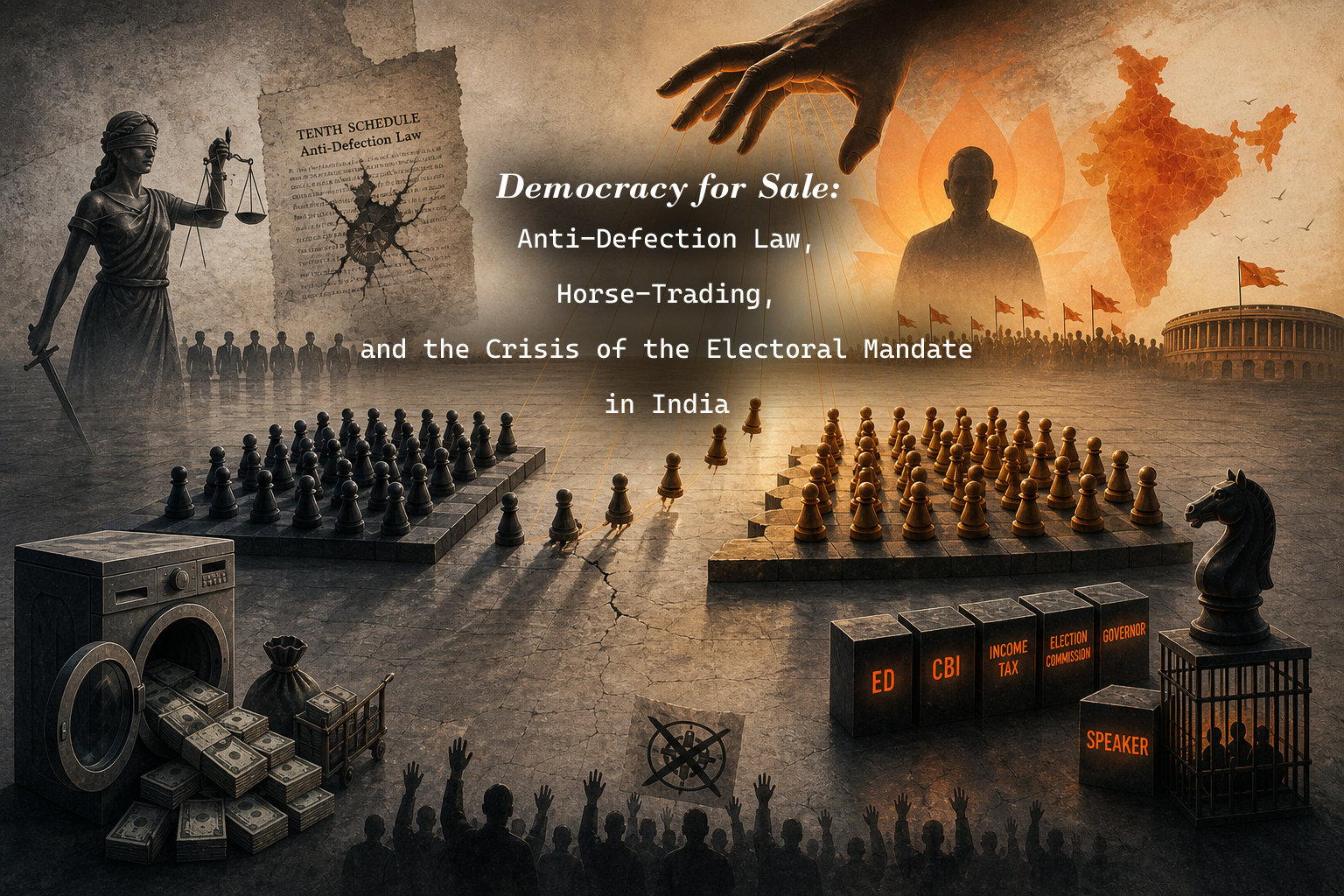
Posted on 1st May, 2026 (GMT 07:03 hrs)
ABSTRACT
The Anti-Defection Law (Tenth Schedule, introduced by the 52nd Amendment 1985 and strengthened by the 91st Amendment 2003) was designed to curb opportunistic defections and safeguard the electoral mandate in India’s parliamentary democracy. Yet its critical loopholes—the two-thirds merger exception (Paragraph 4), unpenalised mass resignations, partisan Speakers, and ambiguities between organisational and legislature parties—have institutionalised sophisticated horse-trading. This article offers a doctrinal and empirical critique, centering on the Shiv Sena crisis (2022–23) and the Supreme Court’s Subhash Desai judgment (2023), which exposed how rebellion, strategic resignations, resort politics, and institutional delays enabled the toppling of a democratically elected government. Examining defection patterns from 2014 to 2026—including the April 2026 merger of seven AAP Rajya Sabha MPs with the BJP—it reveals the BJP’s “Operation Lotus” and “washing machine” machinery, sustained by opaque political funding, crony corporate networks, and quid-pro-quo clean chits, that betray the electorate’s verdict, erode ideological conviction, and accelerate democratic backsliding under the centralising “double engine sarkar” model. These practices undermine India’s federal structure as a Union of States and necessitate radical reforms: independent adjudication, strict timelines, tighter merger rules, bars on defectors, and full transparency in political finance—before the Tenth Schedule becomes a constitutional tool for authoritarian consolidation rather than democratic safeguard.
0. Introduction
Parliamentary democracy in India, at least on paper (de jure), rests on the premise that elected representatives act as trustees of the sovereign will of the people. Yet recurrent “horse-trading”—the colloquial term for the transactional poaching of legislators through inducements—has repeatedly undermined governments, public trust, and the very mandate voters confer at the ballot box/EVM. The Constitution (Fifty-second Amendment) Act, 1985, responded to the chronic instability of the 1960s and 1970s by inserting the Tenth Schedule as its Anti-Defection Law. Subsequent refinements, notably the 91st Amendment of 2003, sought to close earlier gaps. Nevertheless, these measures have proven insufficient against evolving tactics of political engineering under the current authoritarian BJP regime.
In April 2026, AAP leader Raghav Chadha and six other Rajya Sabha MPs (Sandeep Pathak, Ashok Mittal, Harbhajan Singh, Swati Maliwal, Rajinder Gupta, and Vikramjit Sahney) executed a two-thirds merger with the BJP, dramatically altering the Upper House’s arithmetic and boosting the ruling party’s (BJP) strength to 113 while reducing AAP’s to three. The Rajya Sabha Chairman accepted the move on April 27, 2026, exemplifying how the merger exception continues to legitimise large-scale shifts without triggering disqualification. Earlier cases—Suvendu Adhikari’s defection from Trinamool Congress ahead of the 2021 West Bengal polls, Nitish Kumar’s repeated alliance flips, cross-voting scandals in Odisha, Bihar, and Haryana Rajya Sabha elections in early 2026, and Himachal Pradesh’s 2024 cross-voting by six Congress MLAs—underscore the persistence of these cunning manoeuvres. Even Finance Minister Nirmala Sitharaman’s 2022 Freudian slip at a GST Council press conference, where she inadvertently referred to “horse-trading” while discussing taxation on horse-racing, casinos, and gambling, inadvertently laid bare how deeply embedded this practice has become in the political lexicon.
Far from an aberration, horse-trading—often orchestrated under the BJP’s “Operation Lotus”—has evolved into a refined instrument of power consolidation that directly serves the party’s “double engine sarkar” strategy. This model promises “development” only when the same party rules at the Centre and in the states, but in practice it systematically undermines federalism by engineering BJP majorities in opposition-ruled states through central agencies (ED/CBI/IT Dept.), partisan governors, withheld funds, and resort politics.
The metaphor of the BJP’s “washing machine,” widely invoked by opposition voices to describe how defectors emerge “clean” of corruption cases upon joining the ruling dispensation, captures this laundering of deceit.
The party has systematically provided clean chits via CBI and ED to high-profile defectors (e.g., Praful Patel of the NCP-Ajit Pawar faction, who joined the NDA in July 2023 and received closure of a long-pending 2006 scam case in March 2024), while nurturing quid-pro-quo networks involving corporate allies like Ajay Piramal amid scams such as DHFL and Flashnet. These practices not only betray the electorate but also expose a profound ethical and philosophical contradiction: in a polity that weaponises religious symbolism—particularly Lord Ram as the epitome of maryada (ethical rectitude)—the transactional reality of “Aaya Ram, Gaya Ram” politics mocks the very ideals it professes, revealing a Machiavellian realpolitik that prioritises power over republican virtue and constitutional morality.
This article critically examines India’s Anti-Defection Law’s evolution, structural deficits, and democratic costs through doctrinal analysis, empirical case studies (with tables of data and episodes), and a sustained critique of its exploitation, particularly by the BJP. It contends that these loopholes have normalised legislative immorality, contributing to India’s declining democracy indices while hollowing out the representative character of governance and eroding India’s federal structure as a Union of States (Article 1, Constitution of India). By weaving in theoretical reflections on fiduciary duty (Burkean trusteeship), ideological bankruptcy, Ambedkarite warnings on democracy’s fragility without ethical leadership, and the hypocrisy of majoritarian symbolism, the analysis underscores the urgent need for systemic overhaul to realign political practice with the foundational values of stability, accountability, popular sovereignty, and cooperative federalism.
In doing so, this article employs a mixed doctrinal–empirical methodology to analyse the evolution and misuse of India’s Anti-Defection Law. It begins with a doctrinal analysis of constitutional provisions (Articles 102(2), 191(2), and the Tenth Schedule), parliamentary amendments (52nd and 91st Amendments), and landmark judicial decisions, including Kihoto Hollohan v. Zachillhu (1992) and Subhash Desai v. Principal Secretary, Governor of Maharashtra (2023), revealing how legal interpretation has influenced defection practices. Next, the article conducts an empirical analysis using datasets from the Association for Democratic Reforms (ADR), Lokniti-CSDS surveys, and Election Commission records to identify trends in defections from 2014 to 2026, including party-wise asymmetries and re-election rates. A case study on the Shiv Sena crisis (2022–2023) illustrates contemporary defection engineering’s doctrinal complexity and the role of constitutional actors. Finally, the study integrates political theory to assess the implications of anti-defection failures within the context of increasing centralisation of power in the post-2014 era.
I. India’s Anti-Defection Law: Historical Evolution, Key Provisions, and Judicial Refinements
The Tenth Schedule emerged from the post-independence turmoil of the 1960s and 1970s, when frequent floor-crossing—epitomised by Haryana’s “Aaya Ram, Gaya Ram” culture—toppled multiple state governments and eroded public faith. The 1967 elections accelerated this instability, prompting Parliament, under Prime Minister Rajiv Gandhi, to enact the 52nd Amendment in 1985. It inserted disqualifications under Articles 102(2) and 191(2) for voluntarily giving up party membership or defying party whips (with a 15-day condonation window). Independents joining parties post-election and nominated members aligning after six months faced similar penalties.
The phrase “voluntarily giving up membership” has been interpreted expansively by the Supreme Court, most notably in Ravi S. Naik v. Union of India (1994), where the Court held that formal resignation is not necessary; conduct indicating abandonment of party affiliation is sufficient to attract disqualification. This interpretive expansion significantly widened the scope of the Tenth Schedule, allowing Speakers to infer defection from actions such as public dissent, alignment with opposition factions, or participation in rival political activities. However, this broad standard has also introduced subjectivity, enabling selective application depending on political context.
The 91st Amendment of 2003 addressed glaring abuses. It eliminated the one-third split exception (former Paragraph 3), which had enabled engineered defections, raising the threshold to a two-thirds merger under Paragraph 4. It capped the Council of Ministers at 15% of House strength (minimum 12 in smaller states) via new clauses in Articles 75 and 164, and barred disqualified defectors from ministerial or remunerative posts until re-election or term expiry. These changes aimed to curb patronage-driven instability and “jumbo” ministries while reinforcing party discipline.
Core grounds for disqualification remain: voluntary relinquishment of membership or voting/abstaining contrary to whips. The merger exception shields groups of at least two-thirds of the legislature party if they formally merge with another party, with neither the merging faction nor the residual group penalised—though judicial scrutiny has increasingly demanded genuine organisational-level endorsement beyond mere legislative numbers. Exemptions protect the Speaker, Chairman, or Deputy Chairman’s neutrality.
Decision-making rests with the Presiding Officer, functioning quasi-judicially. The Supreme Court in Kihoto Hollohan v. Zachillhu (1992) upheld the Schedule’s validity (barring the ouster of judicial review) while subjecting Speakers’ decisions to review for mala fides, natural justice violations, or jurisdictional error. Subsequent rulings have stressed timely adjudication—e.g., an outer limit of three months in Keisham Meghachandra Singh v. Speaker, Manipur (2020) and Padi Kaushik Reddy v. State of Telangana (2025)—and clarified organisational supremacy over legislature parties in factional disputes.
The law initially curbed retail defections and enhanced stability on critical votes. Yet its rigid whip application has stifled legislative deliberation, inner-party democracy, and conscience, turning representatives into “rubber stamps.” Ambiguities persist regarding “voluntarily giving up membership” (inferred from conduct per Ravi S. Naik, 1994), pre-poll alliances, and coordinated mass actions. While Speakers are expected to act impartially, their partisan election and dependence on ruling-party goodwill—particularly under the BJP’s dominance—have invited bias charges, prompting calls for transfer to the Election Commission. In the BJP era, these provisions have been selectively weaponised to legitimise “wholesale” shifts that advance the “double engine” project, converting a law meant to protect mandates into one that facilitates centralised control over states.
II. Persistent Loopholes: Structural and Operational Failures
Even after the 91st Amendment’s attempt to tighten the framework, the Tenth Schedule remains riddled with design flaws and operational weaknesses that have turned it into an instrument of selective political engineering rather than a consistent guardian of democratic mandates. These loopholes do not merely permit circumvention—they actively reward sophisticated strategies of power acquisition while punishing genuine dissent.
The two-thirds merger exception under Paragraph 4 has become the most abused loophole. A striking recent example unfolded in early April 2026 during the AAP Rajya Sabha reshuffle: the removal of Raghav Chadha as deputy leader was a calculated distraction to mask deeper manoeuvres. Ashok Mittal — chancellor of Lovely Professional University and a key AAP figure — was swiftly installed as replacement, only for the Enforcement Directorate to raid Mittal’s residences and those of his son Pratham Mittal (linked to Masters’ Union contractor network) under FEMA around 15 April 2026. This “lovely professional” operation brazenly violated the unwritten golden rule of Indian politics — never target the politician’s son.
More critically, here’s the biggest loophole that almost nobody talks about:
The Tenth Schedule (inserted by the 52nd Amendment in 1985 and tightened by the 91st Amendment in 2003) only punishes individual MPs and MLAs. If a legislator voluntarily leaves their party or defies a whip, they can be disqualified. But the political party that induces, orchestrates, or happily accepts that defection? The party faces zero punishment. Zero accountability. Complete legal impunity.
This one-sided law gives parties a free hand to engineer mass defections at the organisational level. The only escape route is the infamous “merger clause” — which needs just two-thirds of the legislature party (not the entire organisational party) to switch sides. Even though the Supreme Court has repeatedly stressed the need for genuine organisational consent (the so-called “twin test”), in practice this loophole remains wide open. Parties exploit it shamelessly, while individual defectors alone carry the legal risk.
See the following video by Ankit Bajad to comprehend this further:
A parallel and equally damaging route is the complete exemption of mass resignations from the Tenth Schedule’s purview. By resigning en bloc, legislators can collapse a government’s majority, trigger a floor test or fresh elections, and later rejoin rival formations or contest by-polls—frequently with the backing of their new patrons. This tactic renders disqualification proceedings irrelevant because the seats fall vacant before any decision can bind the defectors. The success rate of such moves is strikingly high: analyses by the Association for Democratic Reforms and The Hindu indicate that nearly 89% of disqualified defectors are re-nominated by their new parties, with around 70% going on to win re-election. The strategy has been deployed with clinical efficiency across states, allowing governments to be toppled without the political cost or legal stigma of formal disqualification.
Compounding these gaps is the glaring absence of any statutory timeline for the disposal of disqualification petitions. Presiding Officers enjoy unfettered discretion on when—and indeed whether—to decide such cases. Even after the Supreme Court’s repeated exhortations for expeditious resolution, Speakers have routinely allowed petitions to languish for months or years, enabling defectors to consolidate power, influence by-elections, and alter legislative arithmetic irreversibly. By the time courts intervene, the political landscape has already been redrawn.
The institutional design flaw that most fatally undermines the law is the office of the Speaker itself. Elected on party lines and dependent on the ruling dispensation for continuance in office (and often for post-tenure rewards), Speakers frequently function as political actors rather than neutral adjudicators. Selective acceptance or rejection of petitions, partisan interpretations of merger requirements, and calculated delays have become normalised. Instances such as the Maharashtra Speaker’s 2024 decision to dismiss disqualification proceedings against the Shinde faction—directly contradicting the Supreme Court’s emphasis on organisational primacy—and the Telangana Speaker’s March 2026 exoneration of defecting BRS MLAs illustrate how the quasi-judicial role has been subordinated to political loyalty. While Kihoto Hollohan made such decisions judicially reviewable, litigation is time-consuming, expensive, and often delivers relief only after the disputed government has completed its term or the defectors have entrenched themselves.
Further complications arise from enduring interpretive ambiguities. The exact boundaries of “voluntarily giving up membership,” the validity of whips issued by rival factions, the treatment of pre-poll alliances, and the evidentiary standards for proving genuine organisational mergers continue to generate inconsistent outcomes. The law’s differential treatment of “retail” individual defections (harshly penalised) versus “wholesale” group shifts (frequently shielded) creates perverse incentives. The absence of any permanent bar on defectors contesting future elections or holding office (beyond the limited ministerial disqualification under the 91st Amendment) ensures that the political and financial rewards of defection far outweigh the temporary risks.
IIA. Comparative Constitutional Perspectives on Anti-Defection Regulation
India’s Anti-Defection Law, entrenched in the Tenth Schedule, stands out for its rigid constitutional codification aimed at curbing floor-crossing and preserving governmental stability. Yet comparative analysis reveals a spectrum of global approaches that expose the paradoxical nature of India’s hybrid regime—one that simultaneously stifles individual conscience while facilitating collective opportunism.
In the United Kingdom, the cradle of Westminster democracy, no formal anti-defection statute exists. Discipline is maintained through whips, internal party pressure, and electoral accountability. MPs routinely cross party lines on matters of conscience—most notably when over 150 Labour members defied Tony Blair on the 2003 Iraq War—without losing their seats. This model preserves legislative autonomy, genuine deliberation, and the Burkean trustee role of representatives.
In contrast, several South Asian polities have opted for far stricter regimes. Bangladesh’s Article 70 mandates automatic disqualification for resignation or voting against the party, severely limiting legislative independence and turning MPs into party delegates. Pakistan’s Article 63-A similarly disqualifies members on key votes, concentrating power in party leadership.
South Africa offers a sobering cautionary tale. After initially prohibiting floor-crossing, it briefly experimented with limited windows in the early 2000s, only to repeal them in 2009 following widespread criticism that the provisions encouraged opportunism, favoured the dominant ANC, and undermined voter intent. A member who leaves their original party now automatically loses their seat.
These experiences underscore India’s unique predicament: a framework that imposes draconian curbs on individual dissent yet generously accommodates large-scale, engineered shifts through the merger clause. Unlike the UK’s reliance on political and electoral correctives or South Africa’s decisive rejection of flexibility, India’s design has created fertile ground for systematic subversion.
Taken together, these structural and operational deficiencies have not only weakened the Tenth Schedule but have actively institutionalised horse-trading as a viable and often decisive route to power in contemporary Indian politics. What began as a constitutional response to political immorality has mutated into a selective filter: one that suppresses individual conscience and inner-party democracy on one hand, while providing legal cover and political legitimacy for engineered majorities on the other. Under the prevailing dispensation, these loopholes have been exploited with particular effectiveness to advance centralising objectives, paving the way for the transactional politics that now dominate the landscape.
III. Horse Trading in Contemporary Politics: BJP’s ‘Operation Lotus’ and the ‘Washing Machine’ Phenomenon
The structural and operational loopholes examined earlier have not merely survived; they have been actively exploited to institutionalise horse-trading—the unethical exchange of legislative loyalties through cash, ministerial portfolios, government contracts, discretionary funds, legal protection, or other inducements. This practice systematically subverts the electoral mandate in hung assemblies, no-confidence motions, and indirect elections such as Rajya Sabha polls. Under the BJP’s prolonged central dominance, horse-trading has been refined into a high-precision instrument of power consolidation through “Operation Lotus”—a coordinated strategy of poaching opposition legislators, often orchestrated with the assistance of central agencies (ED and CBI), post-defection “clean chits,” resort sequestration of MLAs, and partisan gubernatorial interventions. The explicit goal is to engineer “double engine sarkar” governments across states, thereby centralising authority and undermining India’s constitutional identity as a Union of States.
Empirical evidence since 2014 reveals a pronounced asymmetry that cannot be dismissed as coincidental. Data compiled by the Association for Democratic Reforms (ADR) paints a clear picture of net gains for the ruling party at the expense of the principal opposition:
Table 1: ADR Defection Statistics (Key Periods)
| Period | Total Defecting MLAs/MPs | From Congress | From BJP | Joined BJP | Joined Congress | Source |
|---|---|---|---|---|---|---|
| 2016–2020 | 405 MLAs | 170 (42%) | 18 (4.4%) | 182 (44.9%) | 38 (9.4%) | ADR |
| 2014–2021 | ~500 (MLAs & MPs) | 35% of Congress’s strength | 7% of BJP’s | ~35% of all defectors | — | ADR |
These figures demonstrate that Congress has been the primary “donor” of defectors, while the BJP has emerged as the overwhelming beneficiary. The pattern has persisted and intensified beyond 2021, as seen in the Shiv Sena split (over 40 of 55 MLAs in 2022), repeated waves of Congress defections in Goa, and the dramatic April 2026 merger of seven AAP Rajya Sabha MPs with the BJP.
Table 2: Selected Major Horse-Trading Episodes under Operation Lotus (2014–2026)
| Year | State/Body | Key Event | Defecting MLAs/MPs | Immediate Outcome | Federalism Implication |
|---|---|---|---|---|---|
| 2019 | Goa | Congress legislators switch | 14 | BJP government formed | Marginalised regional Congress |
| 2019–20 | Madhya Pradesh | Congress collapse | 20–22 | BJP-supported regime installed | Toppled elected opposition government |
| 2018–19 | Karnataka | Post-poll bargaining & resort politics | Multiple | Prolonged instability | Weakened coalition experiment in federalism |
| 2022 | Maharashtra | Shiv Sena rebellion & split | >40 of 55 | Shinde–BJP government | Ideological flip engineered for “double engine” |
| 2024 | Himachal Pradesh | Rajya Sabha cross-voting | 6 Congress MLAs | Attempted destabilisation | Direct assault on non-BJP state |
| 2026 | Rajya Sabha (multiple) | Cross-voting (Bihar, Odisha, Haryana) & AAP merger | 7 AAP MPs | BJP strength boosted to 113 | Undermined indirect democratic representation |
Table 3: Success Rate and Outcomes of Defections
| Indicator | Percentage / Details | Source |
|---|---|---|
| Disqualified defectors re-nominated by new party | ~89% | ADR / The Hindu analyses |
| Disqualified defectors successfully re-elected | ~70% | ADR / Election Commission data |
| Average time between defection and re-election | Less than 12 months | Compiled estimates |
| Defecting MLAs who joined BJP (2016–2020) | 44.9% of all defectors | ADR |
Resort politics—sequestering potential defectors in luxury hotels to prevent counter-poaching—has become a standard tactical playbook, though it is most visibly and frequently associated with BJP-orchestrated operations. The April 2026 AAP Rajya Sabha episode, in which seven of ten MPs (including Raghav Chadha) executed a two-thirds merger accepted by the Rajya Sabha Chairman, further illustrates how the merger loophole continues to deliver numerical advantage without immediate disqualification.
The financial architecture sustaining these operations adds a deeper layer of corruption. Transactions routinely involve hawala networks, benami property deals, inflated government contracts, and pre-2024 electoral bond opacity. The metaphor of the BJP’s “washing machine”—or “laundry of deceit,” as opposition voices describe it—aptly captures the process by which defectors shed pending corruption cases upon joining the ruling dispensation. A paradigmatic illustration is Praful Patel of the NCP-Ajit Pawar faction, who formally joined the NDA in July 2023 and secured closure of a long-pending 2006 CBI case by March 2024. Such quid-pro-quo arrangements, often intertwined with corporate allies and strategic funding flows, underscore systemic laundering. Political parties remain outside the ambit of the Right to Information Act, relying instead on opaque audited accounts and election affidavits, while investigations by central agencies rarely penetrate the protective shield of political allegiance.
This normalizes corruption as the norm in contemporary India — corruption as a non-issue which could be naturalized by simply changing party loyalty — just like that!
Ethically, horse-trading commodifies representation, reducing elected legislators from trustees of the public mandate to auctionable assets. Philosophically, it embodies a Machiavellian realpolitik in which raw power supplants republican virtue and constitutional morality. Public surveys by Lokniti-CSDS and ADR consistently reflect deep cynicism, with majorities viewing defections as a direct betrayal of the voter’s verdict. Under the “double engine” rhetoric, this transactional politics functions as a tool of authoritarian centralisation: opposition-ruled states confront Governors’ overreach, deliberate withholding of central funds, and selective agency raids. The cumulative effect transforms cooperative federalism into combative majoritarianism, reducing the constitutional “Union of States” to a hierarchy of compliant provincial regimes.
This pattern follows a now-familiar “defection playbook” that synchronises legal, political, and institutional levers:
- Identification and cultivation of dissent within opposition ranks, often amplified by agency pressure;
- Strategic isolation of legislators through resort politics;
- Deployment of layered inducements—financial, legal protection, or future political reward;
- Execution through either mass resignations (bypassing disqualification) or engineered two-thirds mergers;
- Deliberate delay or partisan manipulation of Speaker proceedings;
- Timely gubernatorial intervention, such as premature floor tests;
- Swift formation of a new government aligned with the central ruling party;
- Reliance on protracted post-facto judicial review that rarely restores the original mandate.
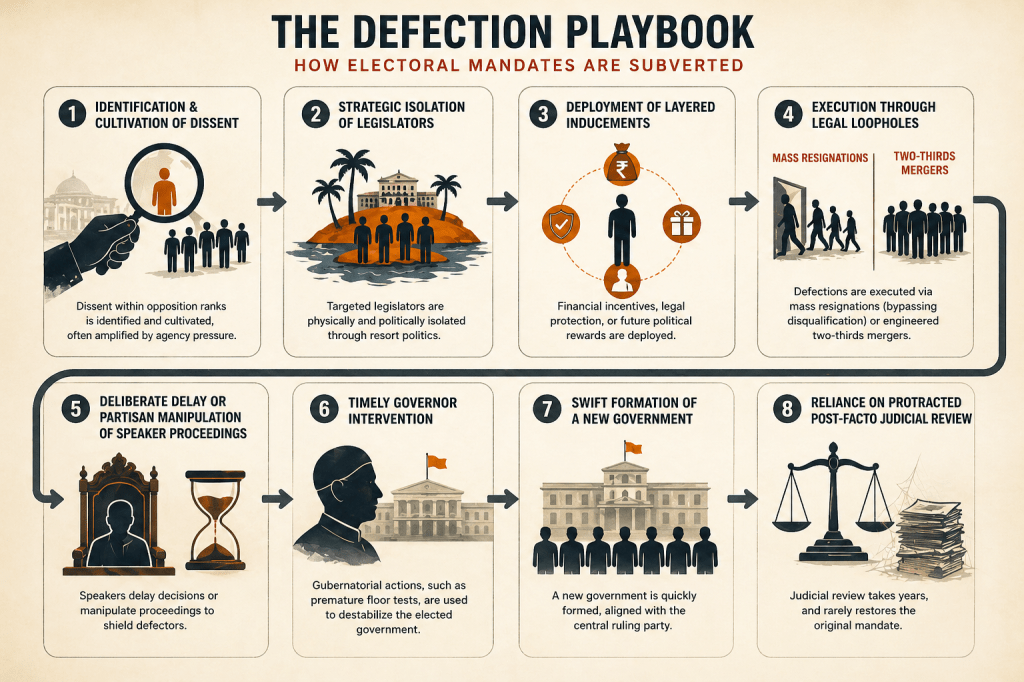
Collectively, these mechanisms demonstrate how the very loopholes of the Tenth Schedule have been weaponised to achieve regime change without a fresh electoral verdict. The result is not episodic instability but a structural normalisation of transactional politics that hollows out representative democracy and accelerates the erosion of federal balance. This sets the stage for the most dramatic illustration of the phenomenon: the Shiv Sena crisis of 2022–2023.
IV. The Shiv Sena Crisis (2022–2023): A Case Study in the Toppling of a Democratically Elected Government
The Shiv Sena crisis stands as one of the most clinically executed instances of toppling a democratically elected government in post-Independence India without recourse to the ballot box. What began as an intra-party ideological rupture rapidly evolved into a constitutional laboratory demonstrating how the Anti-Defection Law’s loopholes, when synchronised with institutional actors, can nullify the sovereign will of the electorate. The 2019 Maharashtra Assembly elections had produced a clear mandate for the Shiv Sena–Congress–NCP alliance (MVA), forged explicitly as a post-poll front to keep the BJP out of power. Voters in Maharashtra had, in effect, endorsed this secular-regional coalition as the legitimate expression of their choice. Yet by June 2022, the MVA government under Chief Minister Uddhav Thackeray was dismantled through a meticulously orchestrated rebellion that bypassed both electoral accountability and the full rigour of the Tenth Schedule.
Chronology of the Shiv Sena Crisis
| Date | Event | Key Actors & Outcome | Constitutional Significance |
|---|---|---|---|
| Oct–Nov 2019 | Maharashtra Assembly elections; MVA alliance formed post-poll | Uddhav Thackeray sworn in as CM | Voter mandate for anti-BJP coalition |
| 21 June 2022 | Eknath Shinde-led rebellion begins; >40/55 MLAs revolt | Rebels sequestered in Gujarat & Assam resorts | Open display of resort politics |
| 29 June 2022 | Governor orders floor test for 30 June | Bhagat Singh Koshyari’s intervention | Premature gubernatorial overreach |
| 29 June 2022 | Uddhav Thackeray resigns as CM | Resignation accepted; government collapses | Bypassing disqualification process |
| 30 June 2022 | Eknath Shinde sworn in as CM with BJP support | New “double engine” government formed | Regime change without fresh mandate |
| 11 May 2023 | Supreme Court judgment in Subhash Desai case | Governor’s action held unconstitutional; organisational supremacy affirmed | Partial doctrinal correction but no restoration |
| Feb 2023 | Election Commission recognises Shinde faction as “real” Shiv Sena | Bow & Arrow symbol awarded to Shinde group | Further legitimisation of split |
| Jan 2024 | Speaker Rahul Narwekar rejects disqualification petitions | Petitions against 40+ MLAs dismissed | Speaker bias overrides SC directive |
| Jan 2026 | Supreme Court hearings on symbol dispute & Speaker order | Petitions still pending as of May 2026 | Justice delayed = justice denied in political reality |
The rebellion, led by Eknath Shinde, involved over 40 of the party’s 55 MLAs. Rather than pursuing a formal no-confidence motion or waiting for the Speaker’s adjudication on disqualification petitions, the rebels were sequestered in luxury resorts—an overt display of “resort politics” designed to insulate them from party whips and counter-pressure. When disqualification petitions were filed, the Governor intervened with a premature directive for a floor test, citing an alleged loss of majority that the Supreme Court would later deem unsupported by objective material. On the eve of the test, Uddhav Thackeray resigned, paving the way for Shinde to take oath as Chief Minister with BJP support on 30 June 2022. The sequence delivered Maharashtra to the “double engine” model without a single additional vote being cast by the people.
The Supreme Court’s unanimous judgment in Subhash Desai v. Principal Secretary, Governor of Maharashtra (11 May 2023) delivered a partial corrective. The Constitution Bench held that the Governor lacked sufficient grounds to order an early floor test in what was essentially an intra-party dispute. It reaffirmed the organisational wing’s supremacy over the legislature party in matters of leadership and whips, and clarified that the two-thirds merger exception under Paragraph 4 could not be invoked without genuine organisational endorsement. Yet the Court stopped short of restoring the original MVA government, accepting Uddhav Thackeray’s resignation as voluntary and recognising the post-resignation political reality on the ground. The judgment referred the Nabam Rebia precedent on Speaker removal powers to a larger bench, leaving critical questions about presiding officers’ impartiality unresolved. In practice, the Court’s intervention, while doctrinally significant, proved powerless to reverse the fait accompli of a toppled government.
Subsequent developments entrenched the new dispensation. In 2023, the Election Commission of India recognised the Shinde faction as the “real” Shiv Sena and awarded it the original bow-and-arrow symbol. In January 2024, Maharashtra Assembly Speaker Rahul Narwekar rejected all disqualification petitions against the Shinde group, relying heavily on legislative numerical strength rather than the party constitution emphasised by the Supreme Court. Petitions challenging both the ECI’s symbol decision and the Speaker’s ruling remained pending before the Supreme Court into early 2026, with hearings held in January but no final verdict delivered as of May 2026. The prolonged litigation illustrates a deeper insight: judicial remedies in defection cases often arrive too late to restore the original democratic mandate, effectively ratifying outcomes achieved through extra-constitutional means.
This episode offers a sobering new insight into the fragility of post-poll alliances in India’s federal polity. The MVA government was not defeated on the floor of the House through legitimate legislative debate or a popular verdict; it was dismantled through a combination of internal rebellion, institutional capture (Governor and Speaker), and strategic delay. The crisis exposed how the Tenth Schedule’s design—intended to protect mandates—can be inverted to legitimise their subversion when powerful central actors coordinate with state-level institutions. It also highlighted the limits of judicial power in real-time political engineering: courts can declare processes unconstitutional but cannot rewind the political clock once a new government is sworn in and begins exercising executive authority.
Looking ahead, the Shiv Sena precedent raises urgent questions about replicability elsewhere. In West Bengal, where the Trinamool Congress (TMC) has governed since 2011 under Mamata Banerjee’s strong (though contested with evidence-based claims about systemic corruption) regional leadership, speculation is already rife that similar tactics could be deployed after 4 May 2026, i.e., the declaration date of the 2026 West Bengal Assembly Elections results. Should internal dissent surface or central agencies intensify pressure on TMC legislators, the playbook—resort politics, engineered splits under the merger exception, partisan gubernatorial intervention, and Speaker delays—could be activated to destabilise the state government.
Such a move would align seamlessly with the BJP’s broader “One Nation, One Election” (ONOE) agenda, which seeks simultaneous polls to ostensibly reduce costs and frequent campaigning but is legitimately criticised for its centralising, totalitarian thrust. By engineering state-level majorities through defections, the BJP can create a more uniform political landscape conducive to ONOE, effectively subordinating the staggered electoral cycles that currently safeguard federal diversity and regional autonomy, thus counteracting the core values of the Constitution. In a state like West Bengal, where ideological and cultural resistance to the BJP remains formidable, the Shiv Sena model offers a tested template for achieving what the ballot box or the EVM has so far denied.
The Shiv Sena crisis, therefore, transcends a mere Maharashtra-specific saga. It serves as a constitutional cautionary tale about the ease with which a democratically elected government can be toppled in India’s multi-party federal democracy when institutional safeguards are compromised. It underscores that the real threat to representative democracy lies not only in the letter of the Anti-Defection Law but in the political will—and institutional complicity—that allows its spirit to be systematically undermined.
V. Betrayal, Ideological Bankruptcy, and Erosion of Democracy: The Undoing of Federalism
Systemically-induced horse-trading fundamentally betrays the people’s verdict. Representatives are constitutionally positioned as trustees of the specific mandate—party symbol, manifesto, and alliances—bestowed by voters. This fiduciary duty, drawn from Edmund Burke’s conception of the representative as exercising independent judgment in the service of the public good rather than mere instructions, lies at the heart of Indian constitutionalism. Engineered defections nullify this sovereign choice, converting legislatures from deliberative forums into marketplaces where loyalty is traded. In Maharashtra, voters had explicitly backed the MVA alliance as an anti-BJP front; the Shinde rebellion weaponised internal dissent to achieve what the electorate had rejected. Parallel betrayals unfolded in Madhya Pradesh (2019–20) and Karnataka (2018–19), where post-poll mandates were overturned through inducements rather than fresh elections. Counter-claims of “legitimate realignment” collapse under scrutiny of the stark resource asymmetries—central investigative agencies, corporate patronage, and institutional leverage—that overwhelmingly favour the ruling dispensation.
This phenomenon exposes a profound ideological bankruptcy that transcends individual opportunism. Political parties, once defined by distinct worldviews—Congress’s secular welfarism, the Left’s redistributive ideology, regional assertions of linguistic and cultural autonomy, or the BJP’s cultural nationalism—have increasingly reduced ideology to flexible branding. Defectors routinely invoke “development” or “national interest” to sanitise crossings that span once-irreconcilable divides, rendering party labels performative rather than substantive. The result is a “death of ideology” in which voters confront increasingly indistinguishable governance beneath competing rhetorical veneers, breeding widespread cynicism and disengagement. Under the current regime, this bankruptcy is amplified by the selective instrumentalisation of religious symbolism—Lord Ram as Maryada Purushottam invoked for moral authority—while presiding over “Aaya Ram, Gaya Ram” transactionalism, revealing a strategic decoupling of preached ethics from practised politics.
Democracy in India has not collapsed outright but is undergoing a slow, institutional hollowing. International assessments document this regression: Freedom House’s 2026 report classifies India as “Partly Free” with a score of 62/100, noting declines in political rights and civil liberties amid media constraints and institutional capture. The V-Dem Institute’s 2026 Democracy Report labels the country an “electoral autocracy” since 2017, highlighting India’s role in driving global democratic backsliding. The Economist Intelligence Unit similarly records stagnation in its “flawed democracy” category. Horse-trading accelerates this erosion by supplanting policy debate and legislative accountability with backroom deals, entrenching corruption, and weakening the link between electoral verdicts and governance outcomes. While residual resilience persists through by-elections, occasional judicial interventions, and voter pushback, the dominant trend is chronic decay: democratic forms endure, but their substantive content—accountability, deliberation, and mandate integrity—steadily dissipates.
Philosophically, these practices strike at the normative foundations of the republic. B.R. Ambedkar repeatedly warned that Indian democracy’s survival depended not merely on constitutional machinery but on the cultivation of “constitutional morality”—a deep ethical commitment to norms, procedures, and public reason that transcends legal compliance. The Anti-Defection Law’s failures exemplify the rupture of this moral substrate: formal adherence to rules coexists with their systematic ethical subversion. Edmund Burke’s trustee model further illuminates the distortion—representatives are duty-bound to prioritise the long-term interest of the nation and their constituents over transient partisan commands or personal gain. The rigid whip system combined with opportunistic defections collapses this delicate balance, reducing elected members to interchangeable cogs in a patronage machine.
Hannah Arendt’s distinction between authentic power and mere domination offers another penetrating lens. True political power, for Arendt, emerges from collective action, persuasion, and the public realm of freedom; instrumental manipulation—such as engineered defections backed by coercive state machinery—represents domination disguised as politics. It transforms the polity from a space of plurality and deliberation into an arena of administrative control and strategic calculation, eroding the very legitimacy that sustains democratic authority.
Proponents of robust anti-defection measures typically advance three core justifications. First, such laws promote governmental stability by discouraging the kind of frequent collapses that destabilised Indian politics in the pre-1985 era. Second, they reinforce party-based representative democracy by ensuring legislators remain accountable to the platform under which they were elected. Third, they prevent opportunistic bargaining that could paralyse governance in fragmented multi-party systems, drawing cautionary parallels with Italy’s pre-reform “revolving door” governments.
Yet these rationales appear increasingly untenable amid contemporary realities. While the law may have curbed some “retail” defections, it has enabled far more consequential “wholesale” engineering through loopholes that reward scale over principle. Stability achieved via manufactured majorities is illusory and ethically corrosive. Party discipline, when absolute, stifles the deliberative autonomy essential to healthy legislatures. Most critically, the asymmetrical and selective enforcement—where the ruling dispensation benefits disproportionately—has converted the Tenth Schedule from a neutral constitutional safeguard into a contingent political weapon. The cumulative effect is not strengthened democracy but its subtle, sustained unmaking.
Under the “double engine sarkar” paradigm, horse-trading emerges as a deliberate federalism-undermining strategy. Non-BJP states face orchestrated collapses, partisan Governors, withheld funds, and agency harassment, steadily converting India’s constitutional “Union of States” (Article 1) into a de facto unitary majoritarian order. This combative approach directly contradicts the cooperative federalism envisioned by the Sarkaria and Punchhi Commissions, centralising power, marginalising regional voices, and hollowing out the federal compact that defines the republic. These developments signal not isolated institutional lapses but a deeper crisis in the normative and ethical foundations of democratic representation itself.
VI. Interplay with Coalition Politics: Public Perception and Institutional Responses
In India’s multi-party federal system, horse-trading disproportionately empowers national parties, particularly the BJP, while systematically marginalising regional and smaller players in hung assemblies. What should be a space for accommodating diverse regional aspirations—through coalitions such as Karnataka’s JD(S)–Congress experiment or Maharashtra’s MVA—becomes a vulnerability exploited to impose “double engine” dominance. Coalition fluidity, once a strength of Indian federalism, is converted into a structural weakness that enables engineered shifts toward centralised control, eroding the plural character of the “Union of States.”
Public perception remains overwhelmingly critical. Repeated surveys by Lokniti-CSDS and the Association for Democratic Reforms show that a clear majority of citizens view defections as a direct betrayal of the electoral mandate and demand far stricter enforcement or complete overhaul of the law.
Institutional mechanisms offer only fragmented and often ineffective checks. The Election Commission’s role in factional disputes—applying tests of organisational strength, legislative numbers, and voter base—has provided some adjudication, as seen in the Shiv Sena and parallel NCP cases. However, parallel proceedings before Speakers and courts frequently prolong uncertainty and tend to favour the ruling dispensation.
The opacity of political funding remains a critical enabler of this ecosystem. Even after the Supreme Court struck down electoral bonds in 2024, alternative channels continue to thrive. Corporate donors aligned with the ruling party enjoy preferential access to contracts and policy influence, while dubious vehicles such as PM CARES—shielded from RTI scrutiny, parliamentary oversight, and public audit—exemplify the lack of transparency. This opaque funding architecture allows crony corporate actors to bankroll large-scale operations involving inducements, legal protection, and post-defection rewards, insulating the entire process from meaningful accountability. The result is a toxic convergence: centralised financial power fuels defections, which in turn deepen centralised political control.
These dynamics lay bare the fundamental tension between coalition fluidity and mandate integrity. Far from strengthening federalism, the prevailing strategy has steadily converted India’s rich regional diversity into a de facto unitary system under majoritarian dominance, hollowing out the constitutional vision of cooperative federalism.
VII. Conclusion: The Imperative for Radical Constitutional Reset
The Anti-Defection Law, once a bulwark against political immorality, has been hollowed out under the BJP’s authoritarian regime into a sophisticated instrument that now actively facilitates the very horse-trading it was meant to eliminate. Its loopholes—most notably the two-thirds merger exception, the unpunished route of mass resignations, partisan Speakers, and the absence of timelines—have normalised “Operation Lotus” and the “washing machine” phenomenon, whereby defectors are laundered of corruption cases through ED and CBI clean chits before being absorbed into the ruling dispensation. This machinery commodifies legislative loyalty, installs “double engine” governments across states, and systematically dismantles India’s federal compact as a Union of States.
Indian democracy survives in form but faces the real danger of substantive hollowing into an electoral autocracy. Without urgent structural overhaul, legislatures will remain auction houses rather than arenas of genuine deliberation, and the constitutional vision of cooperative federalism will devolve into a hierarchy of compliant provincial regimes serving centralised majoritarian control.
The reforms required are no longer incremental but radical: transfer of disqualification adjudication to an independent Election Commission tribunal; strict 30–90-day timelines backed by sanctions for delay; mandatory verification (or outright elimination) of the merger exception at the organisational level; severe restriction of whips to only confidence motions, money bills, and no-confidence motions; a five-year bar on defectors from holding office or contesting elections; and full real-time transparency in political funding to choke off the opaque channels that sustain crony-driven inducements.
The choice before the nation is stark: recalibrate the Tenth Schedule to restore fidelity to the voter’s mandate, ethical governance, ideological conviction, constitutional morality, and the federal compact—or acquiesce to a transactional polity where power flows from the highest bidder and institutional complicity. Most critically, the law must be amended to disqualify not just individual legislators but also the political parties that actively induce, orchestrate, or accept such defections. As it stands today, the Tenth Schedule imposes zero accountability on parties themselves — granting them complete legal impunity at the organisational level while only punishing individual defectors. This one-sided design is the root enabler of unchecked horse-trading. India’s democratic resilience, rooted in Ambedkarite ethics and the founders’ pluralist vision, demands the former before erosion becomes irreversible. The political class, particularly those who have perfected these practices, must summon the moral courage to enact this reset. The electorate’s trust, the republic’s soul, and the federal character of India hang in the balance.
A law originally designed to preserve democratic mandates has instead become one of the most effective instruments of their systematic subversion. The upcoming results of the recently held Assembly polls in states like Kerala, Tamil Nadu, and West Bengal will likely prove this fractured dynamic yet again. In these strongholds of regional resistance, any signs of engineered splits, resort politics, or “washing machine” clean chits will confirm the BJP’s totalitarian agenda: the relentless centralisation of power through extra-electoral means, the erasure of genuine federal diversity, and the reduction of India’s multi-party democracy to a single-party dominance sustained not by popular consent but by institutional capture and transactional engineering. Unless the Tenth Schedule is fundamentally reimagined, the cycle will continue—until the very idea of representative, federal democracy is reduced to a constitutional formality.


very informative… but what about the remedy for this malaise ?
LikeLiked by 5 people
Mass Non-Violent Civil Disobedience Movement.
LikeLiked by 2 people
DEMOCRACY in India is HIJACKED by CRAZY DEMONS (guess the names of top two leaders) which resulted into a condition where the poor became beggars and rich like ADANI, AMBANI, PIRAMAL etc.; criminal politicians became KINGs of India. This situation is expected to be PERMANENT.
LikeLiked by 3 people