
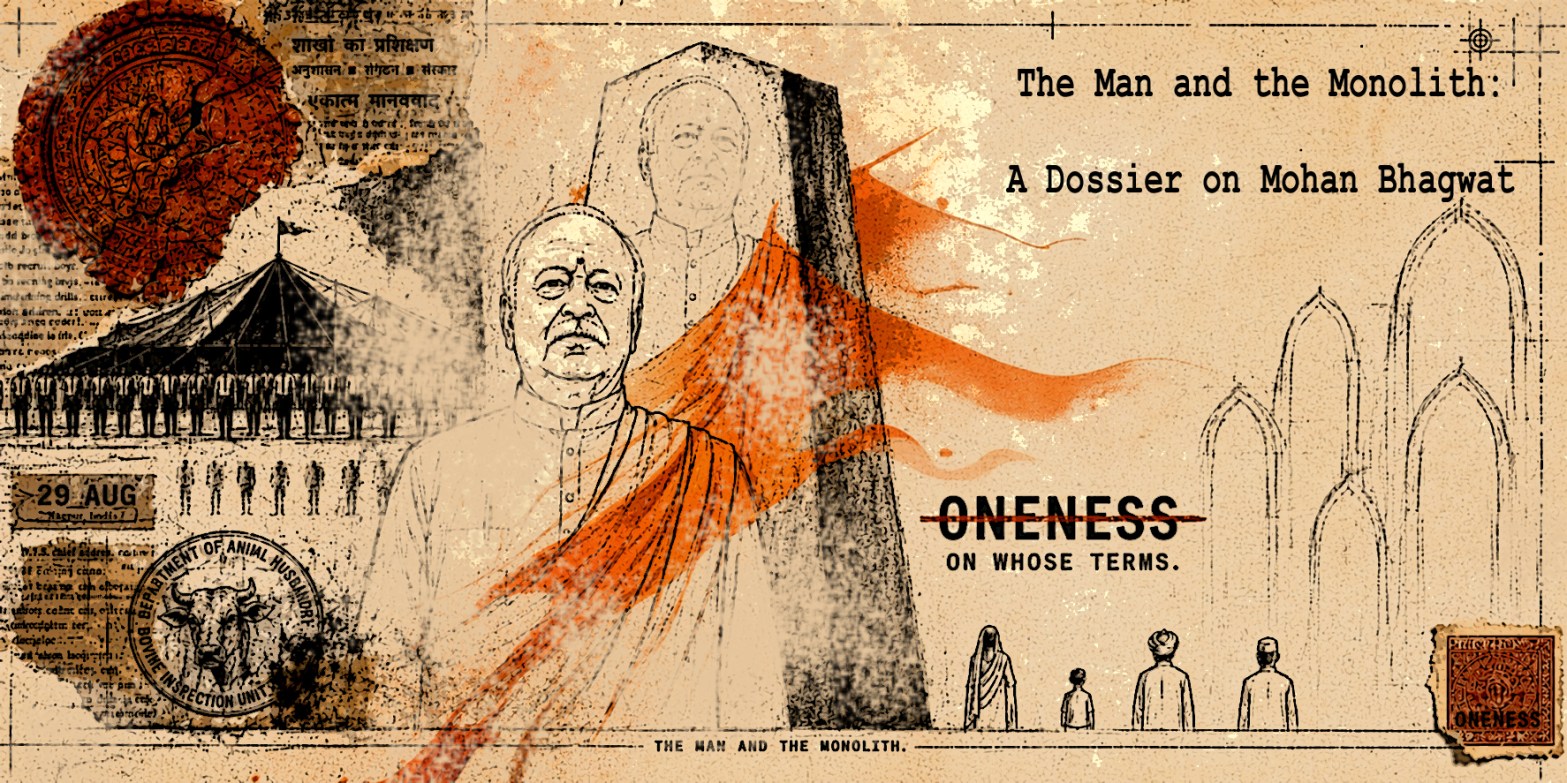
This dossier is a committed forensic case against Mohan Madhukar Bhagwat, sixth Sarsanghchalak of the Rashtriya Swayamsevak Sangh since 2009 and its executive from 2000 to 2009: a lifer raised in a three-generation Sangh household, produced by the organisation’s sealed ladder, and now the living editor of an ideology whose founding texts — Savarkar’s membership test, Golwalkar’s denial of minority citizenship and praise of a Nazi purge as a “lesson,” Moonje’s 1931 pilgrimage to Mussolini — he does not disown so much as copy-edit for export as “oneness.” It holds the line the Sangh most wants critics to overstep: no invented personal conviction from Gujarat 2002, no fake-doctorate smear, no claim that a USCIRF recommendation or a Canadian petition is already law; the charge that survives is custody of a majoritarian machine — unregistered at the centre, banned three times by the republic, radiating through the BJP and the Parivar — restated in Bhagwat’s own dated speech as eliminative absorption (“everyone is Hindu”), relocation of blame (2013, 2015, 2019, 2025), and centenary reputation-work. That work arrived in New York in August 2026 as “Universal Oneness” at Madison Square Garden and walked into a revolt that includes Hindus who refuse to let Hindutva speak in their name. The monolith calls itself oneness. The dossier refuses the name.
Ahimsa Before Arms: an Open Letter and Dossier to the Soldiers, Sailors, and Airmen of India
Addressed to the men and women in the uniform of the Indian Republic — not to generals, procurement officers, or politicians, but to the person with the rifle, the aircraft, the border watch, and the internal-security beat — this open letter and dossier is written from ahimsa: hard, active non-violence that refuses the destruction of truth. From parliamentary records, CAG reports, RTIs, courts, former Governors and Army Chiefs, the National War Memorial, investigative and strategic sources, SIPRI and budget data, and OBMA’s research, it maps institutional betrayal under the BJP–NDA regime(s): a suppressed Army Chief’s memoir; electoral use of Pulwama and Pahalgam martyrs; Model Code violations; Agnipath’s contract labour; disability-pension cuts after the 2016 strikes and the 2026 tax on valour; AFGIS/AGIF losses in DHFL; defective INSAS and ammunition; Chinese occupation and cartographic lies; Operation Sindoor’s fog and later war-memorial names; Siachen’s nationalism industry; Taliban engagement and the asymmetric terror label; CAPF subordination and the 2026 Act overriding the Supreme Court; veterans at Jantar Mantar; Rafale opacity; a ₹6,81,210-crore budget that still cannot issue reliable boots; and war-profiteering that turns the soldier into a line item. Linked to Prahar, Rang De Basanti, War Chhod Na Yaar, and Jai Ho, and closed by the Russell–Einstein question, it asks the citizen in uniform for viveka — not rebellion, but truth known, paid forward, and refused as the next campaign poster’s raw material.
Reading ‘Vande Mātaram’ Across Registers: Text, Myth, Ritual
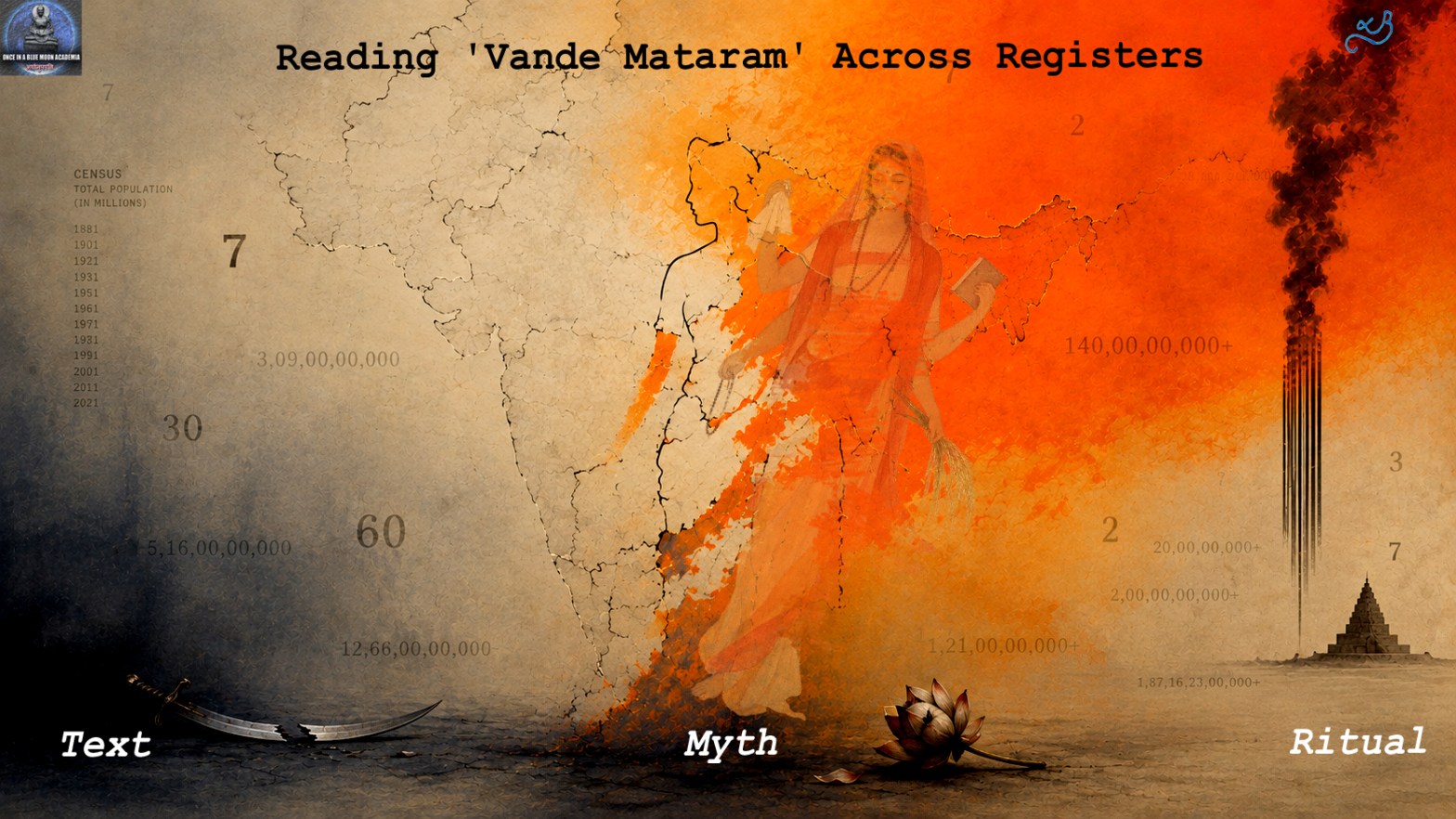
This “reading” traces Vande Mātaram’s discursive transformation(s) from a specifically Bengali hymn into an unstable national emblem and, finally, a ritualised test of belonging. It begins with the demographic hinge of saptakoṭi/dvisaptakoṭi—seven crore throats and fourteen crore arms—corresponding to the Bengal Presidency, not India, and follows its mutation from Bankim’s fixed text to the 1905 inflation of thirty crore, the Republic’s excision of the number-bearing and goddess-identifying stanzas in 1937–50, and the later dissolution into unbounded koṭi-koṭi. Across page, stage, state and popular transmission, the essay asks what happens when a countable provincial people becomes an infinite, unauditable mass. It reads the hymn through the genesis of Ānandamaṭha, Tagore’s counter-discourse of neśā, the colonial genealogy of mātṛbhūmi/mātṛbhāṣā, and the “(M)Other-Tongue” mechanism that manufactures Others. The stanza-by-stanza appendix tests the hymn’s claims of water, fertility, beauty, knowledge, feminine strength and sustaining earth against ecological depletion, educational precarity, demographic violence and extractive concentration, exposing a structure in which the signifier survives while the referent is hollowed out. The blurred number, singular vande, and 2026 penalisation of disruption converge as political ritual: citizen becomes chorus, dissent filial betrayal. The argument is not that singing is illegitimate, but that compelled, unexamined singing surrenders the critical freedom citizenship requires; to decline the chant is not to refuse the country, but to refuse a mistranslation, a miscount, a manufactured Mother, and the disappearance of the historically located citizen into an infinite chorus.
The Piramal Pratijñābhaṅga: The Itching Palm of “Conscious Capitalism”?!

This open letter to Ajay Piramal is a satirical indictment of Piramal as an agential structure of corporate power, wielding pratijñābhaṅga, dharma, and satyāgraha to expose the contradictions of “conscious capitalism,” the DHFL “resolution” (?), depositor dispossession, and the collusive architecture linking capital, State apparatus, and institutional power. Piramal is neither an isolated individual nor an aberration, but a particularly revealing node in India’s dynastic neo-capitalist order—the same oligarchic formation embodied, in their own equally consequential ways, by Adani and Ambani, the notorious twins of India’s corporate duopoly.
মঁসিয়ে ফুকোর খ্যামতার কলাপ আর আজকের প্রলাপ

What happens when Foucault is read not as a doctrine but as a device that reads back? Beginning with the sword suspended supposedly above Damocles, this essay follows its displacement—from sovereign threat to dispositif, from visible punishment to (in)visible surveillance, from the juridico-discursive to the rhizomatic capillary, from the sovereign who commands to the subject who learns to govern itself. Rather than applying Foucault to contemporary India, the essay de-seminates him in the context of present-day India: concepts scatter across Damocles, Orestes, parrhesia, the rhizome, the Frankfurt School, algorithmic surveillance, autocratic legalism, electoral politics, guilt and self-discipline, repeatedly returning in altered forms. The rhizome becomes both possibility and trap; the network that once promised escape from sovereign centrality can become an architecture of distributed control, while the sword need no longer fall because its possibility has been internalised. Against any simple opposition between power and resistance, the essay asks how resistance itself is captured, reproduced and redirected through the very dispositifs it contests. It is thus an exercise in meta-writing: Foucault is read through Foucault, against Foucault, and beyond the stabilising authority of “Foucauldian-ism”, as the essay moves between theory, myth, political diagnosis and its own acts of reading. What emerges is not a final thesis but a deliberately unstable map of power—one in which the question is no longer merely where power resides, but how subjects, networks, institutions and affects continually participate in making, unmaking and remaking its forms.
Encountering Pratijñābhaṅga: BJP’s Jumla Politics and the Hollow Piramal Promise
This article argues that the political formation presenting itself as temporal guardian of Sanātana Dharma stands convicted, by that tradition’s own oath-jurisprudence, of serial pratijñā-bhaṅga (breach of the solemn word). Classical Indian thought treats the given word as a binding bond, its rupture punished both in the seen (dṛṣṭa: curse, fine, exile, infamy) and unseen (adṛṣṭa: loss of merit, hell). Reconstructing this jurisprudence from Vedic, epic, Nyāya and Dharmaśāstra sources, the paper applies it to two cases. Focus One: the Hollow Piramal Promise in the DHFL insolvency, where Piramal Capital publicly pledged fixed-deposit holders an extra 10% over the CoC plan yet delivered only 23.08% recovery (~77% haircut on ~₹5,375 crore), while assigning ~₹45,050 crore in alleged-fraud recoveries to the acquirer for one rupee. Focus Two: BJP’s jumla politics—the serial non-coherence of promises from ₹15 lakh and two crore jobs to Acche Din, Smart Cities, Housing for All and Viksit Bharat 2047. Method is compelled juxtaposition of promise against record; pseudology is treated as a discursive property, contested claims are marked, and the Piramal material is offered as opinion and fair comment on a matter of public interest. The finding is arthānupapatti—its Vedic name anṛta, the untruth opposite to the ṛta these guardians claim to protect.
Azadi, or Democratic Unfreedom? A Video Message from OBMA

This video asks what “Azadi” (freedom) means in India today, and whether the formal existence of democracy can coexist with a lived condition of democratic unfreedom. Tracing the period from 2014 to 2026, it examines the erosion of civil liberties, institutional accountability, democratic participation, ecological security, and economic justice, before asking what genuine freedom might require: the Right to Reject, the Right to Recall, a partyless democracy, and an ecological politics rooted in Oikos — our shared home.
The Rajnath Singh Dossier: Resign, Raksha Mantri!
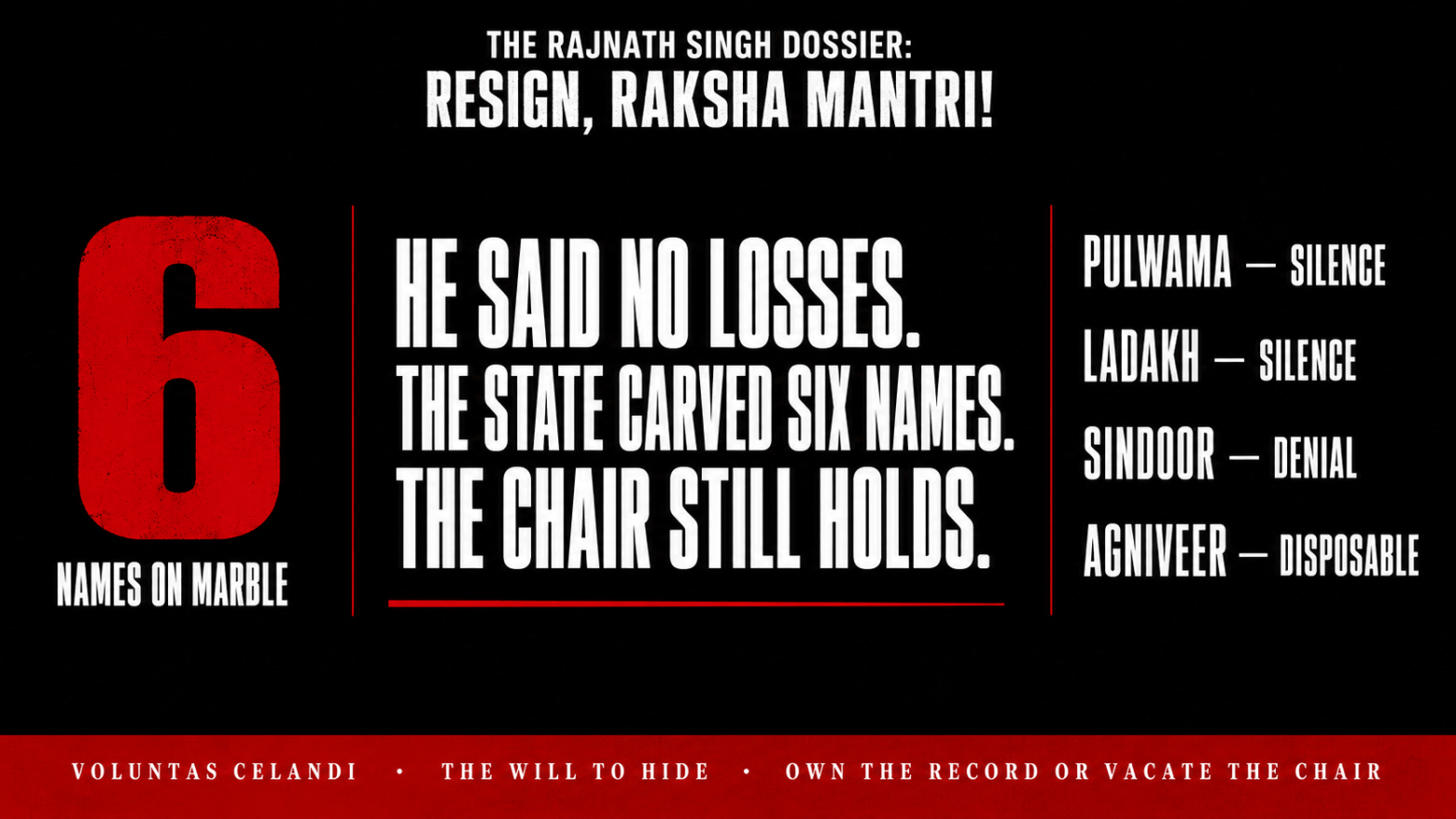
This citizens’ charge-sheet records Rajnath Singh’s institutional tenure as Home Minister (2014–2019) and Defence Minister (2019–present) through the state’s own certified contradictions: the intelligence and convoy-security collapse that killed forty CRPF personnel at Pulwama on his watch; the selective silence on lost patrolling access in Eastern Ladakh; the Pahalgam attack of 22 April 2025 and the retaliatory Operation Sindoor; the categorical parliamentary denial of any soldier losses on 28 July 2025, followed thirteen months later by the state’s compelled disclosure of six names chiselled onto the National War Memorial; the parallel refusal to admit aircraft attrition until the Chief of Defence Staff conceded it abroad; the conversion of the soldier into a four-year disposable contract under Agnipath; the political shielding of opacity around Rafale; and the quiet advance of dynasty inside a party that campaigns against it. Built exclusively from Hansard, the National War Memorial’s Roll of Honour, Ministry of Defence clarifications and on-record statements of constitutional functionaries, the pattern that emerges is voluntas celandi—the will to hide—operating at the very site of memory, semantic truncation that leaves dual realities permanently open, and the systematic manufacture of impunity upstream of every demand for accountability. The minimum grammar of ministerial responsibility therefore requires the holder of the chair to step down; because the institutional machine is constructed so that no minister of this regime need ever activate that grammar, the deeper structural demand remains the constitutional Right to Recall and the Right to Reject.
The Shah Dossier: Resign, Union Home Minister!

This citizens’ charge-sheet documents twenty-one instances of foreclosed accountability, institutional failure and the systematic manufacture of impunity under Amit Shah as Union Home Minister — from the Gujarat encounter cases and the tadipaar externment, through surveillance, financial opacity, the architecture of control in Kashmir, CAA–NRC and electoral machinery, to security collapses in Manipur, Pahalgam and on the China border, culminating in the use of brutal and repressive force against unarmed students at Jantar Mantar. It demands his resignation and the democratic rights of recall and reject.
The Financial Architecture of “Viksit Bharat” (2014–2026)
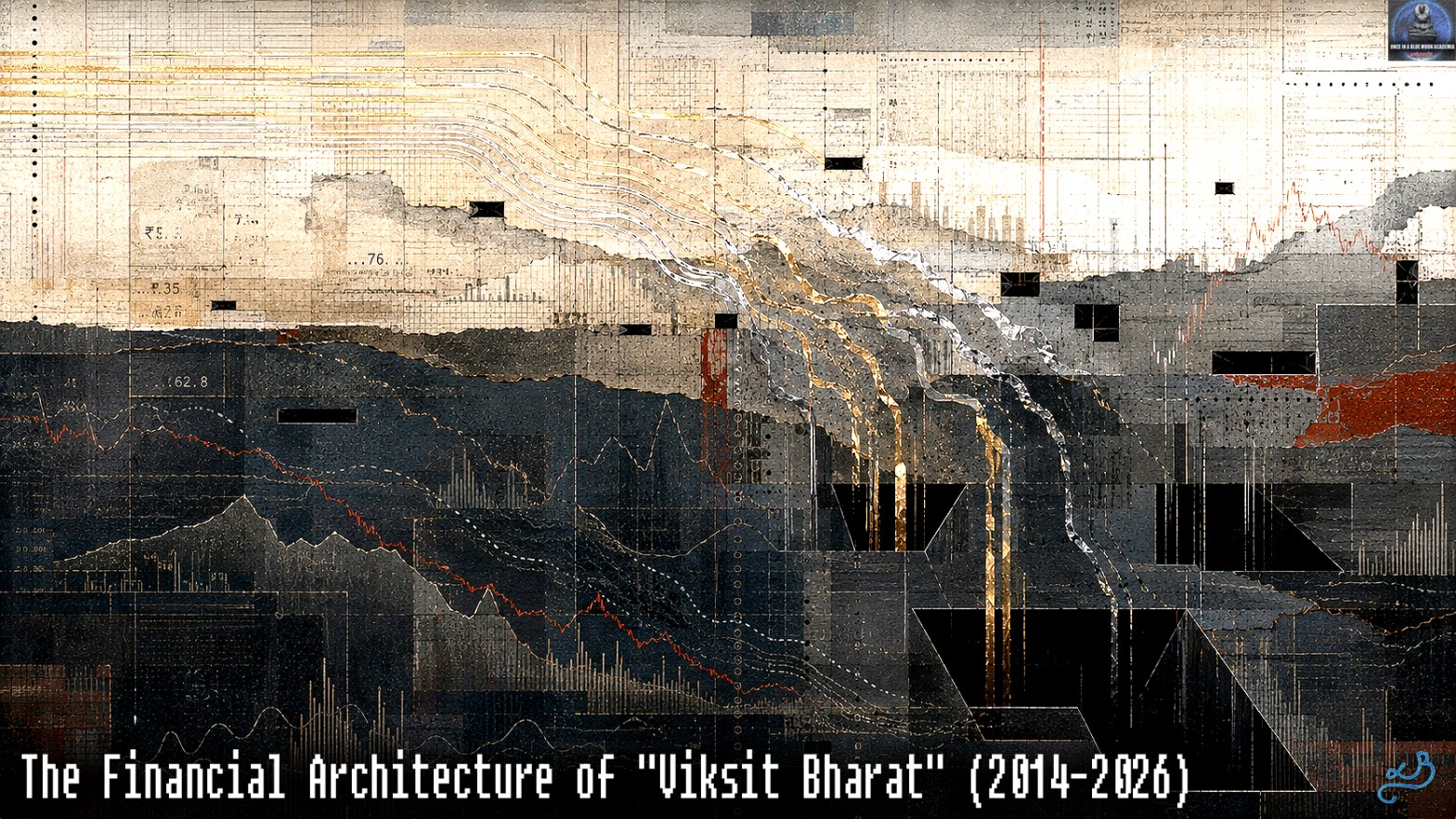
This activist dossier reconstructs, almost entirely from the state’s own figures, the financial architecture of crony extraction that crystallised in India between 2014 and 2026 under the BJP–NDA regime: a true aggregate (fourth-largest economy, falling NPAs, moderate inflation) is displayed while the distribution beneath it is rendered (un-)knowable through discarded surveys, a suspended census, statutory identity shields over ₹16.35 lakh crore in write-offs (or waive offs?!), one-rupee assignments of fraud claims, and a hundred-per-cent RTI evasion rate. Losses are systematically socialised onto the public and residual gains privatised to a connected few via demonetisation, GST, the IBC–DHFL laboratory, opaque political funding, and the inversion of public banking. The growth narrative of “Viksit Bharat” rests on this measured invisibility. The two chairs that operate the architecture — the Finance and Corporate Affairs Minister and the Governor of the Reserve Bank — are therefore addressed with a single demand: Resign, or answer.

