
A Phenomenological, Semiotic, and Psycho-Political Reading
Posted on 15th May, 2026 (GMT 05:19 hrs)
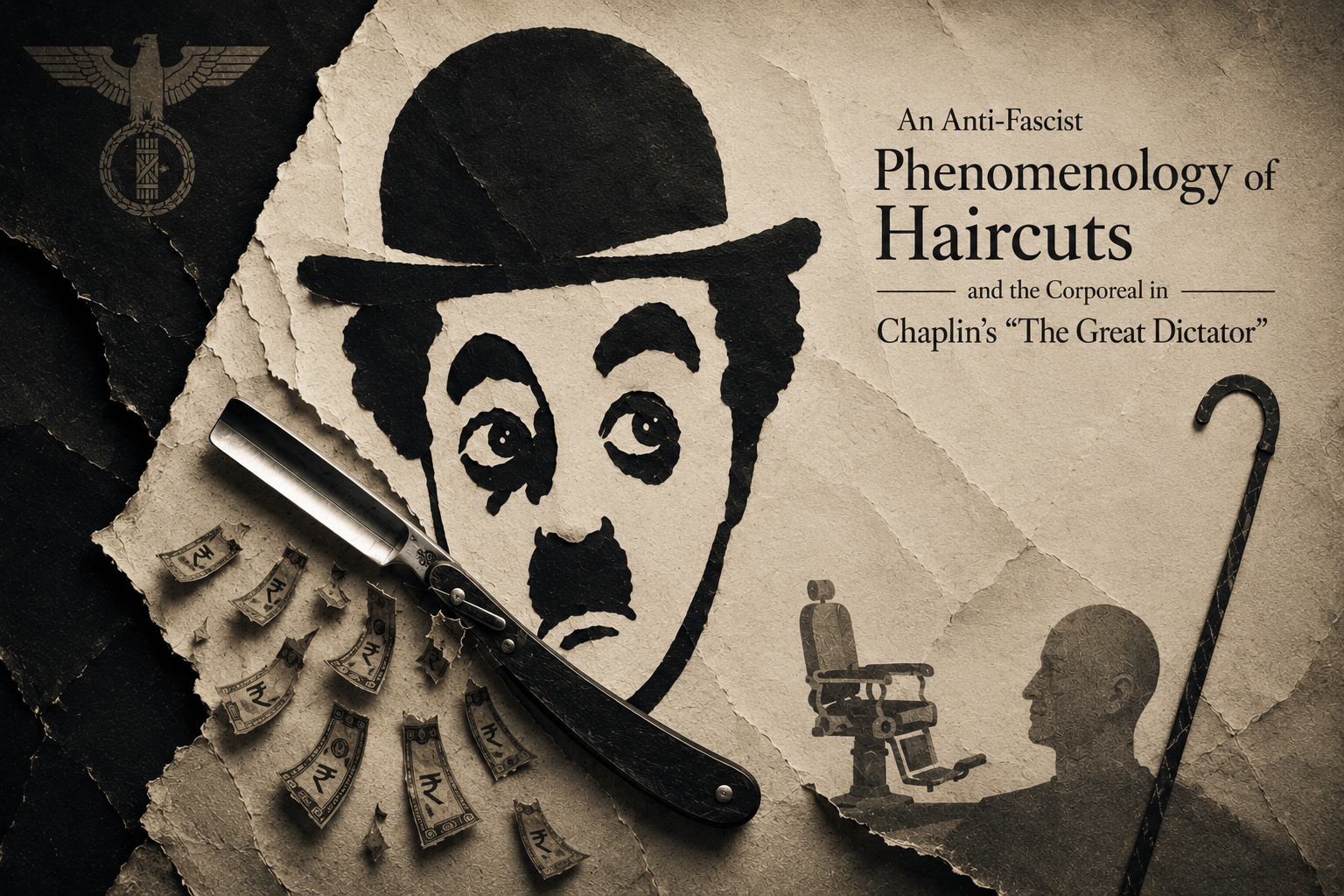
[The featured image for this article, showcasing a variant of Charles Spencer Chaplin’s portrait, draws significant inspiration from filmmaker Satyajit Ray’s sketch of the iconic figure. We owe a debt of gratitude to Ray for his evocative portrayal of Chaplin’s visage.]
ABSTRACT
Charlie Chaplin’s The Great Dictator (1940) performs a radical phenomenological dissection of fascism as a regime that disciplines the body — beginning with the head as command centre and extending to hair, moustache, and razor as instruments of masculine authority and ideological inscription. Yet the film’s subversive genius lies in how these very tools are turned against their masters: the razor that polices masculinity becomes an agent of rhythmic care and tender absurdity; the frying pan a weapon of domestic insurgency; the hand grenade and rogue artillery shell instruments of intimate, comedic sabotage. Through shaving sequences, foam-moustache laughter, and phallic banana-crushing, Chaplin reveals that fascist power depends on rigid assignment of function — and collapses the instant the ordinary body slips out of place. This corporeal grammar finds its brutal contemporary counterpart in India under BJP-RSS rule. The same razor that restores dignity in the barber’s chair reappears as the financial “haircut” in the DHFL scandal — a legally orchestrated dispossession that stripped lakhs of ordinary depositors of seventy to eighty percent of their savings to enrich crony capital. What was intimate care becomes fincide; what was artisanal attention becomes procedural theft. From the disciplined fascist head to the managed economic body, the article maps a single arc: authoritarian power inscribes itself upon surfaces both facial and financial, yet the body — whether individual or collective — retains the capacity for interruption, refusal, and reclamation. The interruption is always possible. The razor can still be turned toward care.
Hair, Head, and Hierarchies…
A Conceptual Cartography Before We Embark Upon This Journey
Charlie Chaplin’s film The Great Dictator (1940) is not merely an anti-fascist satire but a profound phenomenological, semiotic, and psycho-political anatomy of the body under command. Through recurring motifs of the head as ideological command-centre, the haircut as ritual of masculine discipline and its comic subversion, and the razor as both instrument of intimate care and potential violence, Chaplin maps how fascism inscribes itself upon the corporeal surface — rigid, hierarchical, and humourless — while the Chaplinesque body resists through improvisation, tenderness, and playful misappropriation. The polished skull of the bald customer, the rhythmic musical “shaving” of a beardless-man, the absent-minded shaving-foam moustache on Hannah’s face, and the frantic bodily sabotage of grenades and malfunctioning shells all reveal the same grammar: fascism’s demand that every object and gesture serve its assigned function is undone the moment the ordinary slips out of place.
This cinematic insight finds its savage contemporary echo in the DHFL financial “haircut” under BJP-RSS fascist rule in India — a legally sanctioned mass expropriation in which lakhs of ordinary depositors lost seventy to eighty percent of their life savings so that politically connected cronies could acquire assets at a discount. Here the razor moves from the barber’s gentle hand to the cold apparatus of crony capitalism: what was an act of artisanal care and dignity in the film becomes, in twenty-first-century India, an instrument of fincide — the financial killing of modest, middle-class lives.
The article traces a single, incisive arc: from the subversion of the fascist head and its rigidly disciplined hair in Chaplin’s The Great Dictator to the financial “haircut” and its aestheticised violence in contemporary India under BJP’s totalitarian regime. In doing so, it reveals that the body — whether facial or economic — remains the primary battlefield where authoritarian power is inscribed, normalised, and, ultimately, resisted.
Across this arc, the metaphor of the haircut unfolds its multiple, devastating semantics: from an act of intimate care and artisanal dignity in the barber’s chair to an instrument of mass expropriation and fincide in the service of crony capital.
The logic of fascism is not the logic of the syllogism. It is the logic of the wound: raw flesh and quivering membrane, pain turned visceral resonance, on the body on which it acts, and thereby, affects.
Preface: Why the Body? Why This Film?
Charlie Chaplin’s film The Great Dictator (1940) is, on its surface, the most obvious of anti-fascist satires: a Jewish barber who happens to resemble the dictator of Tomainia is mistaken for him, mounts the podium, and delivers a passionate plea for human dignity. Chaplin himself was nervous about the film’s polemicism; he famously said that had he known the full truth of the Nazi death camps, he could never have made a comedy. And yet — and this is the film’s most underanalyzed achievement — The Great Dictator is not, at its core, a film about politics in any discursive or propositional sense. It is a film about the body: about what fascism does to bodies, how bodies resist, how bodies perform and are performed upon, and how the most intimate rituals of corporeal maintenance — shaving, haircut, grooming, beautification, feeding, touching — become the precise terrain on which ideology is inscribed and subverted.
This article proceeds through the film’s sequences not chronologically but thematically, organized around a set of recurring symbolic clusters: the head and skull as locus of ideological inscription; hair, moustache, and shaving as modalities of disciplinary aesthetics and their comic inversion; domestic tools as weaponry; grooming as both fascist normalization and subaltern resistance; fascist masculinity as libidinal spectacle; and the doppelgänger structure through which the film poses its most radical epistemological question — why does nobody see the Jewish Barber for who he is?
Throughout, the article draws on phenomenology (Merleau-Ponty, Levinas), psychoanalytic and political theory (Adorno, Reich, Marcuse, Lacan, Žižek), feminist and gender critique (Butler, Mulvey, Kristeva), semiotics (Barthes, Eco), biopolitics (Foucault), and the philosophy of film (Benjamin, Deleuze). But the interpretive center of gravity always returns to the film itself — to its gestures, props, rhythms, spatial arrangements, and the extraordinary bodily intelligence of Chaplin’s performance, which constitutes, as this article argues, nothing less than an anti-fascist phenomenology: a way of knowing fascism through the body, and of undoing it through the same.
Here’s the complete film by the legendary filmmaker and actor provided below for all readers’ reference:
I. The Architecture of the Fascist Body: An Introductory Topology
Before addressing specific scenes, it is necessary to establish the film’s governing bodily topology — the spatial and semiotic organization through which fascism is rendered as a corporeal regime.
Adorno and Horkheimer, writing almost contemporaneously in Dialectic of Enlightenment (begun 1944), argued that fascism does not merely organize politics: it organizes the senses. Fascism is, in their formulation, a re-organization of bodily life under the sign of instrumental rationality driven to its totalitarian extreme: the body is to be drilled, uniformed, and deployed as a political weapon.
Walter Benjamin, in his famous epilogue to “The Work of Art in the Age of Mechanical Reproduction” (1935), argued that fascism aestheticizes politics — that it converts political life into a spectacle of the body, a theatrical display of power that substitutes aesthetic satisfaction for political emancipation. Both of these analytical frameworks are indispensable to reading The Great Dictator, but they must be supplemented by something neither Adorno nor Benjamin fully theorized: the specifically comic body — the slapstick body — as a counter-aesthetic, a form of embodied intelligence that operates not through argument but through rhythm, touch, and physical surprise.
Chaplin’s film operates on two registers simultaneously: the fascist body and the Chaplinesque body. These are not merely opposed; they are structurally inverted mirrors of each other. Where the fascist body is rigid, uniformed, drilled, and geometrically disciplined, the Chaplinesque body is fluid, improvised, vulnerable, and comedically disobedient. Where fascism aestheticizes domination, Chaplin aestheticizes resistance. Where fascism demands the face be a mask — a logo, an emblem, a racial sign — Chaplin’s face is perpetually becoming: mobile, expressive, subject to transformation and misrecognition.
The film’s most fundamental structural device — the doppelgänger — makes this opposition literal. Adenoid Hynkel, dictator of Tomainia, and the unnamed Jewish Barber (both played by Chaplin) share an identical face. This is not, as some critics have lazily assumed, merely a plot convenience. It is the film’s central philosophical proposition: that fascism and its other — democratic humanism, artisanal gentleness, domestic affection — inhabit the same body, and that the difference between them is not biological or racial but political, gestural, and habitual. The same face can be a tool of domination or of tender service. Everything depends on what that face does — and what it does to other faces.
Judith Butler’s theory of performativity, developed in Gender Trouble (1990) and extended in Bodies That Matter (1993), provides the theoretical key here: identity, including political identity, is not the expression of a pre-given essence but is constituted through repeated, citational performances. Hynkel performs fascism: his salutes, his roars, his goose-step, his toothbrush moustache are all citations of a fascist body-script, repeated until they produce the effect of fascist subjectivity. The Barber performs gentleness and service: his careful shaving movements, his tender touch, his delight in rhythm and craft produce an entirely different subjectivity from the same physiological material. The film’s final scene — the Barber mistakenly pressed into delivering a speech from Hynkel’s podium — literalizes Butler’s insight: there is no fascist essence beneath the performance, and therefore the performance can be interrupted, subverted, and replaced.
What makes The Great Dictator philosophically distinctive, however, is its insistence that this subversion occurs not at the level of discourse — not through argument or ideology — but at the level of the body itself: through shaving, grooming, cooking, touch, rhythm, slapstick. It is, in Michel Foucault’s vocabulary, a film about power/knowledge as corporeal inscription, and about the possibility of what we might call corporeal counter-inscription: the body refusing the script written upon it.
II. Frying Pans and Skull-Politics: Hannah’s Domestic Insurgency
The Kitchen as Political Frontier…?
One of the film’s most politically concentrated sequences depicts Hannah (Paulette Goddard) launching an assault on Stormtroopers from within the apartment building using kitchen utensils — most prominently, frying pans deployed as blunt instruments against the Stormtroopers’ heads. The scene appears broadly farcical, the kind of domestic comedy familiar from vaudeville. Read closely, however, it is one of the film’s most theoretically dense sequences, operating simultaneously as political allegory, gender analysis, semiotic inversion, and phenomenological argument.
The governing symbolic logic of the sequence concentrates on a single anatomical locus: the head. Hannah strikes Stormtroopers on their heads. This is not accidental. In fascist semiotics, the head is the privileged site of authority: the Führer’s head, reproduced on posters, coins, and buildings, functions as what Barthes would call a myth — a sign that has absorbed its political content so thoroughly that it appears natural, inevitable, quasi-divine. The Stormtrooper’s helmet — that gleaming, rigorously standardized cranial carapace — is the institutional extension of this logic: the head uniformed, armored, disciplined, rendered identical and interchangeable. The helmet, as protective cranial enclosure, also signifies: this head is not to be touched, not to be questioned, not to be laughed at. It is the head-as-command-center, the head-as-sovereign.
Hannah strikes that head, bare and without helmet at that point of time, with a frying pan.
The physics of slapstick — the resonant clang, the Stormtrooper’s momentary stupefaction, the comic dislocation of authority — accomplish something that political argument cannot: they desacralize the fascist head. They reveal it not as the seat of sovereign reason but as a hollow object that rings when struck. This is Foucault’s insight about “fascism in our heads” — his famous observation, in the preface to Deleuze and Guattari’s Anti-Oedipus (1977), that the primary site of fascism is not the state apparatus but the internal organization of desire, the ways in which subjects come to want domination — literalized and then physically assaulted. The frying pan breaks not merely against the Stormtrooper’s head but against the idealized fascist cranium: against the mythology of fascist authority as located in a superior head.
Hannah’s weapon is the frying pan: not the rifle, not the political manifesto, but the domestic implement. This is crucial. The frying pan belongs to the kitchen, which is the space patriarchal ideology — including fascist ideology, which was ferociously domestic in its prescriptions for femininity — assigns to women. Kinder, Küche, Kirche (children, kitchen, church): the Nazi slogan that confined women’s existence to reproductive labor, domestic labor, and spiritual submission. Hannah’s deployment of the kitchen tool as a weapon does not merely resist fascism; it inverts the fascist patriarchal logic from within its own terms. The instrument of her assigned subjection becomes the instrument of her insurgency.
This is what Homi Bhabha, following Fanon, calls mimicry: the colonized or subjugated subject adopting the tools and terms of domination and turning them back upon the dominating power. Hannah does not leave the kitchen to fight; she fights from the kitchen-space, with kitchen implements. The domestic space, which fascism assigns to women to keep them politically inert, becomes a military redoubt. The frying pan, which fascism assigns to women to keep them in their place, becomes a weapon against those who assigned it.
There is also a phenomenological dimension to this sequence that deserves attention. Maurice Merleau-Ponty, in Phenomenology of Perception (1945), argued that tools are extensions of the body: that the experienced habitual user of a tool — a carpenter’s hammer, a surgeon’s scalpel — incorporates it into their body-schema, so that they act through it rather than merely with it. Hannah, as a woman who cooks and maintains a domestic space, has embodied the frying pan. It is part of her skilled, habitual, practiced body-knowledge. When she uses it against the Stormtroopers, she is not improvising a weapon from alien material; she is redirecting an incorporated tool. Her strike is precisely calibrated because she knows this object through years of embodied practice. The Stormtrooper, by contrast, is wholly unprepared for this use of the object. His body-knowledge is organized around rifles, jackboots, and salutes. The domestic implement is outside his bodily repertoire. Hannah’s insurgency is effective precisely because it is drawn from a different embodied knowledge — the knowledge of those consigned to domestic labor — that the fascist body-script has failed to account for or militarize.
Laura Mulvey’s influential analysis of the male gaze in “Visual Pleasure and Narrative Cinema” (1975) is useful here in an inverted sense: Mulvey argued that classical Hollywood cinema positions the female body as object of the male gaze, as spectacle. Hannah, in this sequence, refuses to be spectacle. She is not looked at; she is looking, acting, striking. The camera does not linger on her body as erotic surface; it tracks her practical, purposive agency. She is a subject of the sequence, not its object. And the bodies that are rendered comic and spectacularly embarrassed are the Stormtroopers: the agents of fascist masculine authority who find themselves being beaten about the head by a woman with a frying pan.
The comedy of the sequence — and it is comedy — should not be underestimated as a political instrument. Sigmund Freud’s analysis of jokes in Jokes and Their Relation to the Unconscious (1905) established that jokes perform social work: they allow the expression of aggressive or subversive impulses that would otherwise be suppressed. The laughter provoked by Hannah’s assault on the Stormtroopers is not merely entertainment; it is a libidinal release against the fascist body, a momentary desublimation of the aggression that fascism demands be directed inward, against the self and one’s own desires, or outward against designated scapegoats. Hannah redirects that aggression against fascism itself, and the audience’s laughter marks their participation in this redirection.
The Paint-Splashed Face and Whitewashing Fascism!
This scene must be read alongside the parallel sequence in which the Jewish Barber, forced by Stormtroopers to paint “JEW” on his own shop window, splashes white paint across the face of a Stormtrooper who approaches him aggressively. The sequence operates through a different but related logic.
Where Hannah strikes the fascist head, the Barber marks it: the white paint transforms the Stormtrooper’s face into a blank, a whitewashed surface. The semiotics of whitewashing are rich and overdetermined. To whitewash is to conceal, to cover, to render illegible. The Barber, through his inadvertent act of paint-splashing, literalizes what fascism’s critics must do discursively: he whitewashes the face of fascism — reveals its blankness, its lack of genuine content, its dependence on painted-on surfaces and theatrical effect. The Stormtrooper’s face, thus marked, becomes comic: a figure of official authority rendered grotesque by a painter’s accident.
There is also a deeper semiotic dimension. The act of painting “JEW” on Jewish shopfronts was one of the signature rituals of Nazi persecution — the Kristallnacht and earlier boycott actions both involved this literal inscription of racial identity on commercial property. The Barber is being compelled to participate in his own racial stigmatization. But the paint returns: it marks the Stormtrooper instead. The fascist inscription — the racial mark — is redirected from the Jewish victim to the fascist perpetrator. This is not merely irony; it is a semiotic inversion of fascist logic. If fascism insists on marking the body of the racial Other, the film shows that mark returning to contaminate the marking body itself.
Chaplin’s use of face-marking in this sequence anticipates what later performance theory — especially the work of Diana Taylor on repertoire and embodied knowledge — would understand as the relationship between faciality and political inscription. Gilles Deleuze and Félix Guattari, in A Thousand Plateaus (1980), developed the concept of “facialization” (visagéité) to describe the process by which power inscribes itself onto the face: the face, they argued, is not given but produced by the social machine that requires faces as surfaces of recognition, identification, and control. Fascism, which depends on racial identification — on being able to read the “Jewish face,” the “Aryan face,” the “enemy face” — is a hyper-facialization machine. The Barber’s paint-splash disrupts this machine: it renders the fascist face unreadable, marked with a random blotch that makes it impossible to perform the recognitional work fascist ideology demands.
The Sequence We Were Speaking of! VIEW HERE ⤡
The Strawberry and the Hot Sauce: Alimentary Subversion…
A third scene (1 hour 46 minutes onwards) must be triangulated with the preceding two: the dinner sequence between Adenoid Hynkel (Chaplin) and Benzino Napaloni, the dictator of Bacteria (Jack Oakie). During the tense negotiation between the two dictators, there is a sequence involving food — specifically involving the substitution or transformation of one food for another, and the deployment of food as an instrument of mutual humiliation. Napaloni, in the film’s broadly farcical presentation, is a figure of Mussolini-esque bravado and competitive masculinity. Their meeting is a sustained contest of phallic self-assertion disguised as diplomatic negotiation.
The food-throwing and food-contamination that occurs between them operates as a miniaturized version of the military-industrial expansion they are ostensibly discussing. Their conversation is about armies, territories, and the invasion of Osterlich; but what actually happens in the scene is a food fight — a regression to infantile oral aggression. Herbert Marcuse, in Eros and Civilization (1955), argued that authoritarianism operates through the repression of eros and the displacement of libidinal energy into aggression and domination. The dinner scene externalizes this dynamic: stripped of their uniforms and their ceremonial contexts, Hynkel and Napaloni are revealed as infantile competitors, their “great power politics” reducible to who can humiliate whom at the dinner table.
The substitution of a mild food (strawberry cream) for a hot (spicy sauce/English Mustard) or irritating one (a detail consistent with the film’s general pattern of replacing expected sensory experiences with unexpected, disruptive ones) enacts, in microcosm, the logic of sabotage that runs through the film’s anti-fascist comedy. The military-industrial mindset — expansionist, territorial, predatory — is met not with counter-force but with misdirection: the sensory content is wrong, the expected pleasure becomes discomfort, the diplomatic performance becomes a food fight. This is the anti-fascist logic of rhythm and rhythm-disruption: the fascist body, organized around rigid ceremony and expected performance, cannot adapt when the expected is replaced by the unexpected.
The Food Fight Scene VIEW HERE ⤡
Chaplin establishes this logic from the very opening of the war. As a reluctant soldier in the Tomainian army, the Barber drops a live hand grenade down the front of his shirt. The grenade “enters” his body, causing frantic, uncontrollable itching and writhing as it moves against his skin. He dances desperately, trying to dislodge the explosive threat that has invaded his most intimate space. Later, a defective artillery shell malfunctions and begins following him across the battlefield like a malevolent companion. No matter where the Barber runs or hides, the bomb rolls after him, persistently tracking his body until it finally bursts nearby. In both sequences, the instruments of mechanised death — designed for distant, impersonal destruction — are subverted into absurdly intimate bodily intrusions. The war machine, meant to dominate and annihilate bodies, instead becomes ridiculous when forced into direct, clumsy contact with the living, improvising human body.
These early scenes establish the film’s central strategy: fascism’s rigid, over-confident machinery of violence is repeatedly undone by the unpredictable, resilient, comedic responses of the ordinary body. The same principle returns at the dinner table, where diplomatic aggression is sabotaged by swapped condiments and a descending food fight. Throughout The Great Dictator, the fascist body — drilled, armoured, and ceremonial — proves comically helpless when its expected performance is disrupted by the fluid, improvisational intelligence of the Chaplinesque body.
Just before the dinner sequence, the film performs one of its most elegant structural rhymes: the barbershop returns, transposed from the Jewish ghetto into the palace of Hynkel, its domestic function hollowed out and replaced by a purely semiotic one (1 hour 38 minutes 20 seconds onwards). The barber’s chair — that most quotidian of thrones, designed for the supine submission of the customer to the man standing above him — is now doubled, two chairs side by side, and the scene that follows is not one of grooming but of pure positional warfare. Hynkel and Napaloni, seated simultaneously, begin pulling their respective levers, each man cranking himself upward, chair rising incrementally against chair, in a mechanical pantomime of territorial escalation. The lever is no longer a lever; it is a geopolitical instrument. The inch gained is a border crossed. Neither man speaks of armies in this moment — they do not need to, because the chairs are the armies, the rising seat-height is the invasion of Osterlich, the frantic pulling of the lever is the arms race rendered as slapstick hydraulics. What Chaplin grasps, and what makes this sequence so precisely analytical beneath its farcical surface, is that the barber’s chair is already a structure of hierarchy — someone sits, someone stands, someone is served, someone serves — and that all it requires is duplication to become a diagram of international rivalry.
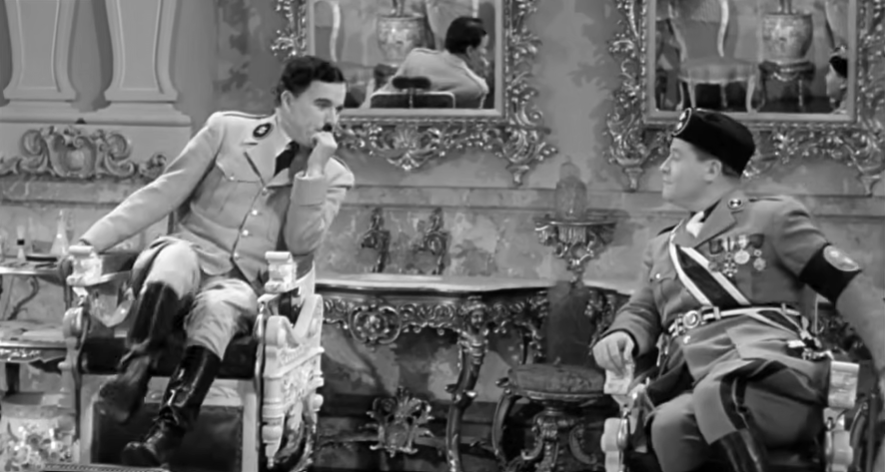
The signifier of rank here is not the medal or the uniform but the chair itself, the relic of the film’s opening world (the Jewish barber, the ghetto, the ordinary) now re-semanticized as a monument to competitive masculine ego. The chair that once held a man still beneath the razor, vulnerable, eyes closed, throat exposed, has become the instrument by which two dictators measure themselves against each other — and what they are measuring is precisely what cannot be measured, the pure surplus of dominance, the need to be higher not for any functional reason but because the other man must, by definition, be lower. That this happens in a barbershop — a space historically coded as homosocial, intimate, a site of male grooming and male talk — only deepens the psychoanalytic charge: this is where men reveal themselves when the ceremony is notionally relaxed, and what is revealed, Chaplin insists, is the infantile logic underneath the statecraft. The chair rises; the man does not.
What the key sequences — Hannah’s frying pans, the Barber’s paint splash, Hynkel and Napaloni’s alimentary combat, the hand-grenade itching episode, and the malfunctioning artillery shell that stalks the Barber — share is a common underlying structure: the sudden redirection of a material object from its assigned function toward an improvisational, subversive, and deeply comedic purpose.
The frying pan, designed for cooking, becomes a weapon against stormtroopers’ helmets. The white paint, meant to mark Jewish shops with the word “JEW,” is splashed across a stormtrooper’s face. Food at a diplomatic dinner, intended to facilitate negotiation, turns into a messy sabotage of masculine posturing. The hand grenade, engineered for distant destruction, slips inside the Barber’s shirt, forcing him into a frantic, intimate dance of itching and contortion. The artillery shell, built to fly straight and kill efficiently, malfunctions and begins obsessively following the Barber across the battlefield like a ridiculous, rolling pursuer until it finally bursts near him.
In every case, the instruments of fascist violence or control are hijacked by the living, unpredictable human body. Chaplin suggests this is the phenomenological grammar of anti-fascist resistance: not grand ideological counter-narratives, but the sudden, unexpected misappropriation of the ordinary. Fascism demands that everything remain in its rigid place and serve its assigned function — the helmet protects authority, the grenade destroys at a distance, the shell follows a straight military trajectory, food sustains diplomatic ceremony. Chaplin shows that the system collapses the moment things slip out of place: the domestic becomes martial, the weapon becomes intimate, the lethal becomes laughable. The fascist choreography of command is undone by the fluid, improvisational intelligence of the Chaplinesque body.
III. The Polished Skull: Baldness, Grooming, and the Semiotics of Masculine Authority
Now the fascist head turns its attention to the hair, the beard, and the moustache — to their presence, their strategic absence, or the anxious projection of presence where absence actually reigns. Having examined the head as a site of ideological inscription and comic desacralisation, we move from the struck skull and painted face to the disciplined surface of hair itself: the final frontier of masculine authority and its semiotic vulnerabilities.
Why a Bald Customer, after all?
In the barber-shop sequences, the Jewish Barber serves a range of customers, but one figure stands out for his anomaly: the bald customer (59 minutes 28 seconds onwards), whose head requires no cutting and who submits to the Barber’s attentions for polishing rather than trimming. The scene is brief and played for gentle comedy, but its semiotic density is considerable.
Why include a bald customer at all? The surface answer — comic variety, a different kind of grooming challenge — is insufficient. The bald head operates, in the film’s symbolic lexicon, as a limiting case that illuminates the entire structure of masculine grooming culture. Masculine identity in the West has been organized, historically and semiotically, around hair: the beard, the moustache, the carefully maintained haircut signal not merely grooming preferences but social rank, religious identity, professional status, and political allegiance. The Roman emperor’s clean-shaved face marked imperial dignity and distinguished it from the barbarian’s beard (the very word “barbarian” is related to the Latin barba, beard). The Victorian gentleman’s luxuriant whiskers signaled bourgeois prosperity and the leisure time to maintain them. The moustache, as we shall discuss extensively in relation to Hynkel, is a micro-political object of considerable complexity.
The bald head strips away all of this semiotic equipment. There is nothing to cut, nothing to shape, nothing to trim into social significance. The bald man is, in the symbolic order of masculine grooming, unwritable: his head refuses the inscription of social identity through hair-management. And yet — precisely because the hair-system has been withdrawn — the surface itself becomes the object of attention. The Barber polishes the bald pate: he brings it to a shine. The bald head becomes, under his ministrations, a fetish-object: a surface abstracted from biological function and elevated to pure aesthetic significance.
Roland Barthes, in Mythologies (1957), analyzed the face of Greta Garbo as a “concept” rather than a face — an abstracted, polished surface that cancels individuality in favor of a kind of Platonic facial essence. The polished bald head, in a more comic register, operates by similar logic: stripped of hair, stripped of the social inscription that hair permits, it becomes a pure surface — smooth, reflective, almost architectural. The Barber’s polishing action turns it, momentarily, into a mirror — a surface that reflects rather than expressing. This mirroring is not innocent. In the context of a film that is, at its center, about reflection and misrecognition (the Barber who is mistaken for the Dictator because their faces are identical), a polished reflective surface in the barber’s shop carries considerable resonance.
The Barber as Tactile Mediator
The relationship between the Barber and his clients is fundamentally a relationship of touch: intimate, skilled, and carefully bounded by professional convention. The barber’s touch is one of the few socially sanctioned forms of same-sex bodily contact between men in patriarchal cultures — and even then, it is rigorously framed as instrumental: the barber touches the client’s face not as an affective gesture but as a technical operation. Yet the intimacy is real. The barber handles the client’s head — the most symbolically charged part of the body, the seat of cognition, identity, and authority — with practiced hands, tilting, turning, lifting it as an object of skilled care.
Emmanuel Levinas, in Totality and Infinity (1961) and related texts, developed the concept of “the face” (le visage) as the primary site of ethical encounter: the Other’s face, exposed and vulnerable, calls forth a fundamental responsibility. Levinas’s face is not merely a perceptual datum but an ethical demand — it says, in its vulnerability, you shall not kill me. The barber-client relationship, in which the Barber holds the client’s vulnerable face and chin in his hands, with a razor close to the jugular, is a concentrated site of Levinasian ethical encounter. The razor could kill; the barber’s technical skill and ethical restraint are what prevent it. The barber is, in this sense, a figure of care — of the kind of intimate, skilled, responsible handling of another’s body that fascism systematically destroys.
The bald customer, requiring polishing rather than cutting, extends this logic. He does not need the razor — the most charged of the barber’s instruments — but he still requires touch: the soft cloth, the buffing action, the careful circular motion that brings his head to a shine. This is grooming at its most purely caring and least instrumentally necessary: the client doesn’t need this; he submits to it because the barbershop is a space of male bodily care, of licensed touch, of routine ritual maintenance of the masculine body. The comedy of reporting this “news” to the household — that the Barber is polishing a bald head — lies partly in the household’s genuine bemused interest: what does a barber do when there’s nothing to cut? The answer the film provides is: he continues to care, adapts his skill to the available surface, and finds a form of artisanal satisfaction in whatever the client’s body offers. This is the Barber’s fundamental disposition — a disposition directly opposed to fascism’s instrumentalization of bodies.
IV. Brahms and the Razor: The Musical Shaving Sequence
Choreographing the Intimate
The most celebrated sequence ( 56 minutes and 6 seconds onwards in the film) in the barbershop section of The Great Dictator — and one of the most formally accomplished passages in all of Chaplin’s work — is the musical shaving scene, in which the Jewish Barber shaves a lathered customer to the rhythm of Brahms’s Hungarian Dance No. 5 in F-sharp minor. The sequence’s central visual fact, easily overlooked, is that the customer is essentially already smooth — his face white with foam, the stubble beneath negligible, the razor passing over a surface that barely needs it. The Barber shaves a man who barely needs shaving. This is not incidental. It is the sequence’s secret argument.
The Ritual Without the Necessity
To shave a man who scarcely needs shaving is to perform grooming as pure act, as ceremony stripped of its practical justification. The lather covers whatever thin growth is there; what the razor removes is, functionally, almost nothing. And yet the Barber shaves with total absorption, with the concentration and musicality of a craftsman working at the absolute limit of his art. The disproportion between the occasion and the seriousness brought to it is comic — and, like all of Chaplin’s best comedy, simultaneously something more.
What is being shaved, then, if not a beard? The answer is: the face itself. The razor moves across the client’s face not to remove growth but to attend to it — to trace its surfaces, acknowledge its contours, care for the skin as a surface of singular importance. This is grooming as an act of recognition: the Barber does not process a generic male face but ministers to this face, moving across its particular topography with something closer to tenderness than efficiency.
This transforms the shaving scene into a meditation on what care looks like when it exceeds its functional occasion. A man who needs shaving badly is, in some sense, easy to shave: the need is obvious, the task is clear, the transformation is visible and measurable. A man who barely needs shaving confronts the craftsman with the question of why he is doing this at all — and the Barber’s answer, given through the language of the Hungarian Dance, is that he does it because doing it beautifully is itself the point. The act of care has become autotelic: valuable in itself, not for its outcome.
The Choice of Brahms
The choice of Brahms’s Hungarian Dance No. 5 requires extended consideration. The Hungarian Dances, composed between 1869 and 1880 and based on Hungarian Romani (csárdás) themes, occupy a complex position in European musical culture. They are simultaneously works of high German classical composition — systematic, harmonically sophisticated, formally organized — and works whose energy and melodic material derive from Romani folk tradition: improvisatory, rhythmically irregular, carnivalesque. Brahms subjected Romani tunes to his characteristic technical discipline, yet their energy survives and drives the compositions. The Hungarian Dances are hybrids: the European classical tradition in dialogue with the suppressed, marginalized musical Other within Europe.
This is politically loaded in a film about Nazism. The Roma were among the principal targets of Nazi genocide alongside Jewish people; Romani music was condemned as Entartete Kunst — degenerate art. By synchronizing the Barber’s movements to this Romani-inflected Brahms, Chaplin enacts a quiet counter-inscription: the music fascist aesthetics would condemn as degenerate becomes the soundtrack to a Jewish artisan’s most beautiful work. And crucially, he performs that work on a face that, by conventional measure, did not require it.
The Razor’s Politics
The straight razor is the sequence’s most charged object. It is both an instrument of intimate care and an instrument capable of killing. The client’s neck is exposed; his jugular is accessible; the only thing standing between the razor and a lethal act is the Barber’s skill and the ethical compact between them. This compresses into a single image everything the film wants to say about what civilization, at its best, actually is: the permanent availability of violence held permanently in check by chosen care.
Drawing on Merleau-Ponty’s account of skilled tool use in Phenomenology of Perception, one can say that as the Hungarian Dance accelerates, the Barber’s razor ceases to be a consciously managed instrument and becomes an extension of his musically-embodied body. He is no longer thinking about the razor; he is thinking through it toward the face before him. The dangerous has become the graceful; the weapon has become a wand. That this transformation happens on a face that barely needs the treatment only deepens the point: the Barber’s mastery is revealed most completely precisely where the functional justification is thinnest. He is not doing a job. He is demonstrating what the capacity for care looks like when fully realized.
Two Kinds of Submission
The client’s response moves through apprehension toward surrender. Initially, when the Barber begins responding to the music, the client stiffens — grips the armrests, registers alarm. This is not the expected form of being shaved. But as the Barber’s apparently abandoned movements prove to be perfectly precise — not a nick, not a scratch, not a hair out of place — the client’s resistance softens. He submits.
This submission is structurally different from fascist submission. Fascism demands that bodies yield through fear: one surrenders to superior force because the alternative is violence. What the Barber elicits is surrender to beauty, to skill, to rhythmic grace. Both involve the body yielding to something beyond itself. But where fascist submission is organized around annihilation — the dissolution of the individual in the uniform collective — the Barber’s submission is organized around eros: around the pleasure of skilled touch and aesthetic delight. This is the distinction Marcuse draws in Eros and Civilization between the pleasure principle as the repressed basis of human liberation and the performance principle as its fascist negation.
The particular poignancy of this in the context of a face that barely needs shaving is that the client is surrendering to something he did not, strictly speaking, need. Nobody told him his face required this attention. The Barber brought a surplus of care to a minimal occasion, and the client, despite initial resistance, allowed himself to be transformed by it. The anti-fascist argument, quietly running through the comedy, is that this is precisely what human beings need most: not the care that responds to obvious necessity, but the care that exceeds it.
The Smooth Face
The client emerges smooth. This smoothness carries the essay’s central ambivalence. Fascist aesthetics also prize the smooth body — uniformed, groomed, standardized, its irregularities ironed out. But Deleuze and Guattari’s distinction in A Thousand Plateaus between smooth and striated space is useful here: striated space is gridded and imposed; smooth space is open and responsive to what it finds. The Barber’s razor does not impose a standard template on the face before it — it attends to this particular face, moving with musical responsiveness across its singular surfaces.
More pointedly: the face was already smooth before the razor arrived. The shaving has not produced smoothness; it has consecrated it. The razor passed over a surface it did not need to transform and, in doing so, transformed it anyway — not physically but in kind, not by removing what was there but by declaring it attended-to, cared-for, seen. The smooth face at the sequence’s end is the face of a man who has been ministered to by an artist who brought his full mastery to a minimal occasion because that is what full mastery does. The political argument lives in that excess: in the insistence that care need not wait for urgent necessity to be worth performing beautifully.
The Scene, Here You Go! VIEW HERE ⤡
V. The Toothbrush Moustache: Fascist Iconography and Comic Doubling
A Brief History of the Upper Lip
The toothbrush moustache — the small, square patch of hair positioned directly beneath the nostrils, trimmed to the width of the nose or slightly narrower — is, by 1940, legible to virtually every viewer of The Great Dictator as the personal logo of Adolf Hitler. Chaplin’s decision to give Adenoid Hynkel this moustache is, on one level, a simple satirical indexing: we are meant to recognize the target. But the moustache carries a far more complex cultural history that the film implicitly activates.
It is historically documented that Hitler’s original moustache was larger — the full “Kaiser moustache” or handlebar, fashionable in early-twentieth-century Germany — and that he trimmed it to the toothbrush form during his service in the First World War, when he was required to wear a gas mask. The larger moustache interfered with the gas mask’s seal; the smaller, tighter form allowed the mask to fit properly. This origin story is extraordinarily revealing. The toothbrush moustache is literally a product of industrial warfare: it is the face standardized to fit the industrial killing apparatus. The gas mask — itself a product of chemical warfare, of the industrial-military complex’s application of modern chemistry to mass killing — requires the face to be trimmed. The face accommodates the machine; the human body is modified to fit the requirements of industrial violence.
This genealogy illuminates Hynkel’s moustache in Chaplin’s film with a new precision. The moustache is not merely a personal eccentricity or even a political logo; it is the bodily trace of industrial warfare’s inscription on the human face. It marks the face as a surface that has been disciplined to serve the military machine. And because Hitler then retained and emblematized this war-derived facial configuration — making it his personal logo, reproducing it on posters and films and coins — the moustache also marks the face as a political brand: the face that has been submitted to both military and political discipline, the face that has been made into an icon.
Chaplin’s own moustache — the Tramp’s toothbrush moustache — predates Hitler’s. Chaplin began wearing the Tramp’s moustache in the early 1910s, and it became the defining element of the Tramp character. Chaplin famously said he was reluctant to abandon the character’s signature look even when he recognized that Hitler had adopted the same facial configuration. The toothbrush moustache thus exists, in film history, in a peculiar temporal relation: it is simultaneously the mark of the comic loser-everyman-flaneur-vagabond (the Tramp) and the mark of the fascist dictator. Both are historically real; neither has priority.
The film exploits this uncanny doubling with great sophistication. Both Hynkel and the Jewish Barber wear the toothbrush moustache; this is one of the justifications for their visual resemblance, and one of the film’s most politically concentrated visual jokes. The moustache that Hitler/Hynkel has claimed as the logo of absolute authoritarian power is the same moustache worn by a Jewish barber in a Tomainian ghetto. Fascism’s claim to have monopolized this facial configuration — to have made it mean one thing only — is directly and visually contested. The moustache is a floating signifier: it does not carry a fixed meaning. It can mean the Tramp’s comic pathos or the Dictator’s murderous authority; it can belong to the Barber or the Hynkel.
This semiotic instability is, of course, precisely what fascism cannot tolerate. Eco, in “Ur-Fascism” (1995), identifies a fundamental characteristic of fascist thinking as “fear of difference” and insistence on univocal meaning: signs must mean one thing, races must be one thing, the leader’s face must signify one thing. Chaplin’s comic doubling — achieved partly through this shared moustache — performs a direct assault on this semiotic totalitarianism. The moustache means more than one thing; the face that wears it cannot be reduced to a single political valence; the body that bears this mark escapes fascist categorization.
Corporeal Branding and the Logo-Face
The moustache functions, in Hynkel’s self-presentation, as a logo in the contemporary sense: a simplified, reproducible mark that condenses brand identity into a minimal graphic form. Hynkel’s toothbrush moustache, his salute, his stiff posture, and his uniform together constitute a fascist corporate identity — a branded body that is instantly recognizable and rigorously consistent. This is what Barthes, in “The Face of Garbo,” called the face as concept: the face stripped of individual expressivity and elevated to the status of a cultural sign.
Foucault’s analysis of discipline in Discipline and Punish (1975) provides another angle: the fascist body is a docile body, one that has been subjected to a regime of training and normalization so thoroughgoing that it reproduces the norms of its own discipline without external compulsion. Hynkel’s moustache, uniform, and salute are the visible signs of a body that has been completely disciplined by the fascist apparatus — a body that no longer needs to be commanded because it has internalized command as its very shape. The moustache is not merely a stylistic choice; it is the corporeal emblem of this internalized discipline.
The comedy of Hynkel’s moustache operates precisely by calling attention to the gap between this pretension to disciplinary perfection and the biological absurdity of the body beneath. The toothbrush moustache is, as a piece of facial geometry, ridiculous: a tiny square patch of hair that achieves no aesthetic purpose, that serves neither to frame the mouth nor to warm the upper lip nor to signal sexual maturity, but simply sits there as a geometrical intrusion upon the face’s organic curves. By having Chaplin wear this moustache in dual role — as both the Dictator and the Barber — the film insists on its intrinsic absurdity. It is not a natural feature of the face; it is an imposition, a geometric marking, an act of facial discipline that, stripped of its political context and its associated iconography of power, looks merely strange.
VI. Hannah’s Makeover: Beauty as Camouflage, Camouflage as Politics
Beautification Under the Sign-age of Fascist Normativity
The sequence in which the Jewish Barber assists Hannah in a process of makeover or beautification (44 minutes onwards) — helping her to alter or enhance her appearance — operates on multiple levels simultaneously: as a tender domestic scene, as a political allegory, and as an ambivalent engagement with the politics of feminine beauty standards.
The Scene is Here, If You Care To Look! VIEW HERE ⤡
The interpretive context for this scene must begin with an analysis of fascist aesthetics of femininity. Nazi ideology constructed an ideal of Aryan womanhood that was simultaneously maternal and decoratively beautiful: the German woman was to be blonde, healthy, modest, devoted to home and family, and physically attractive in a manner that expressed racial vitality. This ideal was enforced through propaganda, through the visual culture of the Third Reich’s films and posters, and through the exclusion of Jewish, Roma, and other “non-Aryan” women from this aesthetic norm — or, more precisely, through the insistence that these women were aesthetically incapable of meeting it. Nazi propaganda routinely depicted Jewish women as physically repulsive, grotesque, deceptive — their apparent beauty, in the anti-Semitic imaginary, was a mask concealing an underlying racial degeneracy.
The Stürmer and other Nazi propaganda publications described Jewish people using a series of dehumanizing metaphors: as “termites” (Termiten) eating away at the foundations of German society, as parasites, as vermin, as infiltrators who disguise themselves as German citizens to prey on them from within. This rhetoric of disguise and infiltration — the Jewish person as the beautiful-seeming creature who is actually a destroying pest beneath — is crucial for understanding the political dimensions of Hannah’s makeover. If the fascist anti-Semitic imaginary insists that Jewish people are deceptive in their appearance — that they appear human but are actually verminous, that they appear beautiful but are actually grotesque — then Hannah’s beautification, performed by the Jewish Barber with artisanal care and genuine tenderness, directly contests this representational violence. The Barber’s aesthetic attention to Hannah produces, visually and within the film’s own symbolic economy, a figure of genuine beauty: not the standardized “Aryan” beauty of Nazi iconography, but the particular, individual, lived beauty of a woman who is cared for.
Julia Kristeva’s concept of abjection, developed in Powers of Horror (1980), is useful here. Kristeva argued that what is cast out, categorized as abject — as filthy, as not-fully-human, as occupying the boundary of the social — always threatens to return and contaminate the social order that ejected it. Nazi anti-Semitism organized its representational violence precisely around the logic of abjection: Jewish people were cast as the abject of the Aryan social body, as the filth, the parasite, the vermin that must be expelled. Hannah’s beauty — her cared-for, artisanally attended, luminously particular beauty — refuses this abjection. She is not vermin; she is a woman who can be beautiful. The Barber’s makeover is an act of counter-abjection: the restoration of the full human aesthetic presence that fascist dehumanization seeks to deny.
In the midst of this tender beautification, the Barber, absorbed in his careful work, absent-mindedly brushes a dollop of thick white shaving foam across Hannah’s cheek and upper lip — the very gesture he performs dozens of times a day on his male customers. For a few seconds, neither of them notices. When Hannah catches her reflection and sees herself with a ridiculous patch of foam on her upper lip, and the Barber realises what he has done, they both dissolve into spontaneous, helpless laughter.
This fleeting moment carries sharp semiotic force. The Barber has unconsciously performed a classic masculine grooming ritual — the application of shaving foam — on a woman’s face. In doing so, he momentarily blurs and inverts the rigid gender boundary that fascist ideology fiercely polices: masculinity as active, instrumental, and razor-wielding; femininity as passive, decorative, and to be groomed rather than grooming. The white foam, a signifier of male preparation and control, now sits comically on Hannah’s face, turning the ritual of masculine self-maintenance into an affectionate, absurd mistake. What should belong to the domain of disciplined patriarchal preparation becomes soft, messy, and playful.
Their shared laughter is a quiet act of semiotic rebellion. Where fascist normativity demands strict separation of gendered roles and bodies, this moment dissolves the boundary through tenderness and humour. The Barber and Hannah reclaim the face not as a site of ideological control or racial-gender inscription, but as a surface open to care, error, and joyful intimacy. In the heart of fascist terror, a simple slip of the hand becomes a small but luminous assertion that the body refuses to remain fully under command.
Disguise and the Politics of Misrecognition
The subsequent scene, in which Hannah’s altered appearance allows her to pass a Stormtrooper without being recognized while retrieving laundry, introduces the political function of beauty as camouflage. This is a complex moment in the film’s gender politics, and it requires careful analysis.
On one level, this scene suggests that beauty — or more precisely, a certain conformity to aesthetic norms — provides protection from fascist surveillance. The Stormtrooper does not recognize Hannah because she looks different: her altered appearance does not trigger his pattern-recognition system, which is looking for a particular kind of face, a particular kind of appearance. This is a politically acute observation about how fascist identification systems work: they operate through visual pattern-matching based on stereotyped expectations, and they can be defeated by departing from those expectations. The woman who does not look like the fascist’s mental image of “the Jewish woman” passes unrecognized.
But this safety is purchased at a price: the price of performing normative femininity, of making oneself legible within the fascist’s beauty categories. Hannah is safe not because she is not seen but because she is seen incorrectly — because her appearance is misread. She has, in a sense, entered the fascist visual economy on its own terms: she is now classifiable as a different type. This is the deeply ambivalent politics of what we might call, drawing on Butler’s Gender Trouble, parodic masquerade: the performance of normative femininity by a subject who does not (or need not) endorse its norms, using that performance as a survival technology.
There is a long history, in feminist theory and in the theory of oppressed groups, of analyzing this kind of strategic performance. Frantz Fanon, in Black Skin, White Masks (1952), analyzed the colonized subject’s adoption of the colonizer’s language, manners, and appearance as both an imposed necessity and a site of psychic violence. Hannah’s makeover occupies this ambivalent terrain: it is simultaneously an act of care and resistance (the Barber lovingly attending to her appearance), a survival technology (the new appearance protects her from the Stormtrooper), and a capitulation to fascist visual norms (she is safe because she can now pass within the fascist aesthetic system). The film does not resolve this ambivalence; it simply presents it with a kind of matter-of-fact tenderness.
Napaloni’s Wife and the Comedy of the “Comic” Female Figure
Chaplin contrasts Hannah’s make-overed figure with that of Madame Napaloni (Grace Hayle), Napaloni’s wife, who appears briefly in the diplomatic sequences. Where Hannah is slender, mobile, and aesthetically centered in the film’s visual economy as an object of affective investment, Madame Napaloni is presented as large, boisterous, and broadly comic in her physical presentation. She is, in the tradition of comic fat-suit or large-body humor, used for broad visual comedy.
It would be easy — and partially justified — to read this contrast through Mulvey’s framework: the film reserves genuine aesthetic attention for the slim, conventionally attractive Paulette Goddard (Hannah), while the large-bodied Grace Hayle (Madame Napaloni) is reduced to physical comedy. This is a form of what Kathleen Rowe Karlyn, in The Unruly Woman (1995), calls the cultural ambivalence about female bodily excess: the large female body exceeds the bounds of normative femininity and therefore becomes a site of anxiety that comedy manages by making it ridiculous.
However, there is a complicating reading. Madame Napaloni is, in the film’s power structure, one of the very few people who can control Napaloni himself — she manages and redirects his pompous masculine energy with a kind of domestic authority that is played as genuinely effective rather than merely comic. The comedy of her size operates within a broader comedic logic that ultimately deflates the masculine authority of the dictators: it is Napaloni who is made to look ridiculous in her presence, not merely she in his. The film’s treatment of Madame Napaloni is not feminist by any sophisticated standard, but it is not simply patriarchal either: she participates in the broader comedic deflation of authoritarian masculinity that is the film’s consistent project.
VII. The Banana and the Architecture of Impotence: Hynkel’s Office
Space as Power-Symptom
One of the film’s most visually striking recurring settings is Hynkel’s enormous office — a vast, cavernous chamber whose proportions dwarf its occupant. The ceiling is impossibly high; the desk is monumentally large; the floor stretches away in all directions; the room is designed to make any human figure within it appear small, isolated, and insignificant against its scale. This architectural design is historically accurate to the aesthetic priorities of totalitarian architecture: Hitler’s Reich Chancellery, designed by Albert Speer, employed precisely this strategy of gigantism, creating spaces that asserted the superhuman scale of National Socialist power by making individual human bodies appear tiny within them.
The irony — which Chaplin exploits with perfect comic precision — is that Hynkel, the intended beneficiary of this architectural self-aggrandizement, is himself made to look tiny, isolated, and absurd within the space he has designed. The room that was meant to terrify petitioners and awe diplomats instead comicalizes its own inhabitant: Hynkel sits at his enormous desk like a child at an adult table; he crosses the vast floor like a figure in a theatrical desert; his posturings and tantrums are rendered ridiculous by the space that was supposed to dignify them. The architecture of fascist power becomes a comedy of scale.
Albert Speer, describing the design principles of Nazi monumental architecture in Inside the Third Reich (1970), explicitly noted that the gigantism of Nazi buildings was intended to produce “the feeling of smallness” in visitors — to use architectural scale as a medium of political intimidation, of corporeal humiliation. Chaplin’s film appropriates this intended humiliation effect and redirects it: it is Hynkel who appears small in his own great room. The architecture of domination has become the architecture of self-exposure.
The Banana: Phallic Economy and Fascist Libido
In this enormous room, in the midst of a rage, an enraged Hynkel peels a banana and then, in a gesture of frustrated aggression, crushes it. The banana is an unmistakably phallic object, and its function in this sequence is unmistakably phallic: Hynkel’s crushing of it is a performance of self-directed phallic destruction, a symbolic act of self-castration performed at the height of his authoritarian fury. Furthermore, in another scene, while berating his propaganda minister Herring, Hynkel suddenly erupts with the word “Banana!” — spitting it out angrily as part of his frenzied, pseudo-Germanic gibberish tirade.
Wilhelm Reich, in The Mass Psychology of Fascism (1933/1946) — one of the period’s most penetrating analyses of the libidinal economy of fascism — argued that fascism draws its emotional energy from repressed sexuality: that the fascist subject’s submission to authoritarian domination is organized around a displaced sexual masochism, and that the fascist leader’s authority depends on his embodiment of a particular kind of hyper-phallic masculinity — the man who is pure will, pure aggression, pure virility. Reich’s analysis is relevant here: Hynkel’s gigantic office, his military postures, his roaring speeches, his uniform — all of these are components of a performed phallic masculinity that the banana-crushing suddenly, comically undermines.
The banana-crushing exposes the anxiety beneath the virility performance. Hynkel is not, in this moment, the hyper-phallic Führer; he is a frustrated man alone in an enormous room, crushing a piece of fruit in a rage. The phallus he destroys is not, of course, his own — it is a fruit, a comic prop — but the symbolic economy of the gesture is unmistakable. The fascist virility machine, the unbreakable will, the indomitable masculine authority — these are shown to be performances that falter, that require constant maintenance, that are vulnerable to internal sabotage when the performance is not working.
Jacques Lacan’s distinction between the penis (the biological organ) and the phallus (the signifier of power and desire in the symbolic order) is useful here. Hynkel does not lack a penis; he lacks the Phallus in its Lacanian sense — the guarantee of absolute authority, the unquestioned position in the symbolic order. The gigantic room and the monumental desk are his attempts to perform phallic authority architecturally; the banana-crushing reveals that this performance is unstable, that it depends on external props, and that without them the man inside the authoritarian persona is as fragile and as comic as anyone else.
Adorno, in The Authoritarian Personality (1950), identified the fascist personality as characterized by compensatory aggression: the person who has experienced (or fears) humiliation and powerlessness redirects that affect into authoritarian aggression against designated Others. The banana sequence gives us Hynkel’s compensatory mechanism at its most exposed: the rage that drives his authoritarianism is visible here not as strength but as frustration, not as confidence but as anxiety, not as the overflow of genuine phallic authority but as its desperate simulation.
The infantilization of this gesture is also crucial. Hynkel crushing a banana in a rage looks — and is staged to look — like a toddler’s tantrum: the impulsive, oral-aggressive response to frustration that developmental psychology identifies as characteristic of the pre-rational, pre-social infant. This infantilization of the fascist Führer is a consistent strategy of the film: Hynkel is repeatedly shown behaving not as a political or military genius but as an emotional infant, unable to manage frustration, driven by immediate aggressive impulses, incapable of the deferred gratification or the consideration of others that even ordinary adult functioning requires. Adorno and Frenkel-Brunswik’s work on the authoritarian personality is again relevant: the fascist is not at all the Nietzschean Übermensch (overman) but the emotionally stunted person who has never developed the ego-strength to manage difference and disappointment without aggression.
VIII. The Roar and the Faint: The Fascist’s “Animalistic” (?) Masculinity
Fascism as Predatory Display
Among the film’s most vivid comic sequences involving Hynkel is the scene in which he lunges, with roaring, animalistic aggression, at his female secretary (or assistant), who, overwhelmed by this display, faints (40 minutes onwards). The sequence is brief but densely packed with political and psychoanalytic content.
The theatrical grammar of the scene positions Hynkel’s body as a predatory animal’s: he roars, he lunges, he moves with sudden explosive aggression rather than the controlled, ceremonious movement appropriate to a head of state. The secretary faints — her body collapses, goes limp, falls out of consciousness — as if her organism has determined that the best response to this assault is a kind of biological withdrawal: if she cannot fight or flee, she can at least cease to be present.
The political register of this sequence is clear: Hynkel’s treatment of his female secretary is a miniaturized version of his political cum ideological project. The dictator who militarizes and terrorizes entire populations performs a version of the same domination in his private office, with the same physical grammar of aggressive display and the same expectation of submission. This continuity between the public politics of fascism and its private libidinal economy is precisely Reich’s argument: fascism is not merely a political program but an organizational form of desire, a way of structuring the relationship between dominant and dominated that reproduces itself across all scales of social life, from the state to the office, from the army to the bedroom.
The “Animalization” of the Fascist Body
Hynkel’s “animalistic” behavior — roaring, lunging, pacing, snarling — is an important element of the film’s corporeal semiotics of fascism. Chaplin does not represent fascism through the imagery of hyper-rational, coldly efficient totalitarianism that would become the dominant Cold War stereotype (exemplified by Hannah Arendt’s analysis of Eichmann’s “banality of evil”). Instead, he represents it through the imagery of animal regression: the fascist is a man who has abandoned the discipline and self-governance that distinguish the adult human subject, regressing to a pre-cultural, pre-rational mode of animal aggression.
This is consistent with the broader critique of fascism mounted by Adorno and Horkheimer in the Dialectic of Enlightenment: fascism is not the negation of Enlightenment reason but its pathological extreme, the point at which instrumental rationality, having destroyed all intrinsic values, turns back upon the human itself and begins to operate according to a logic of pure domination that is, in its effects, indistinguishable from barbarism. The civilization that promised to overcome the animal now reveals the animal it always was beneath the thin veneer of cultural rationality.
The secretary’s fainting provides a parallel corporeal argument. Her body’s response to Hynkel’s aggression is not submission in the usual sense — it is not a bow or a salute or a tactical compliance — but a withdrawal from consciousness itself. The fainting body is the body that has encountered something so far outside the normal parameters of human social exchange that it cannot process it through ordinary consciousness. In Kristeva’s vocabulary, Hynkel’s roaring lunge is an encounter with the abject — with something that violates the boundary between the human and the non-human, between the social and the pre-social — and the secretary’s body responds to this abjection with the most radical available withdrawal: unconsciousness.
The comedy of the sequence lies in this disproportionate bodily response to a performance that is, on careful analysis, purely theatrical. Hynkel does not actually harm the secretary; he roars and lunges, but he does not strike. His aggression is gestural, theatrical, intended as display rather than actual violence. The fainting is thus a response not to violence but to the spectacle of violence — to the fascist body’s theatrical self-presentation as predator. This suggests something important: that fascism’s power is primarily theatrical, primarily a matter of spectacular, performed aggression rather than its actual exercise. The populations and individuals who submit to fascism often do so not because the fascist has actually hurt them but because the performance of fascist aggression is so overwhelming, so beyond the normal parameters of social life, that the body responds to it with the same abandon of rational resistance it would show to actual physical danger.
This is, of course, why Chaplin’s comedy is such an effective anti-fascist instrument: it demystifies the performance. By showing Hynkel’s animalistic display in a comic register — by giving it a fainted secretary, a resonant banana, a too-large room — it strips the spectacle of its overwhelming quality. Once the fascist performance is seen as performance, once its theatrical grammar is legible and available for comic scrutiny, it loses the capacity to overwhelm consciousness and induce the kind of paralytic submission the secretary demonstrates. Laughter is the opposite of fainting: it is the body’s active assertion of its own irreducibility to the terror-spectacle.
Benjamin, in “The Work of Art in the Age of Mechanical Reproduction,” argued that the masses’ response to fascist spectacle was a kind of pathological aesthetic surrender — the crowds at Nuremberg were experiencing the aestheticization of their own annihilation and finding it beautiful. Chaplin’s comedy opposes to this surrender an alternative aesthetic response: laughter, which restores the laughing body to its own autonomy, to its capacity to assess and judge and maintain critical distance from what it sees.
IX. The Globe and the Double: Doppelgänger Politics and the Phenomenology of Misrecognition
Nobody Sees the Barber
The film’s most profound philosophical puzzle — which it poses without fully resolving — is the question of why nobody recognizes the Jewish Barber as Hynkel’s double. The Barber is played by the same actor (Chaplin), wearing the same moustache, displaying the same facial geometry. And yet: within the film’s diegesis, no one in the Ghetto sees the political possibility latent in this resemblance, and when the Barber is finally pressed into service as Hynkel, the fascist apparatus accepts him without demur.
The phenomenological answer to this question lies in what Merleau-Ponty’s student and interpreter Michel Henry calls the “pathetic” dimension of bodily life — the fact that the body is always and already shaped by its social situation, by the habits, postures, and affective orientations that a particular life has produced in it. The Barber’s body, despite sharing its facial geometry with Hynkel’s, is a different body: it is a body shaped by decades of artisanal work, of domestic gentleness, of modest and service-oriented existence. Its posture, its bearing, its characteristic movements, its facial expressions — all of these are organized by a different history. Hynkel’s body is organized by the history of fascist self-aggrandizement: its bearing is imperial, its gestures are theatrical, its face is a logo. The Barber’s body is organized by the history of careful service: its movements are precise and modest, its gestures are responsive rather than commanding, its face is alive with individual expressivity rather than fixed in the rigidity of the emblem.
The doppelgänger structure of the film is, at bottom, a phenomenological argument: that what matters about a person is not their biological face — not the geometry of their features, which the Barber and Hynkel share — but the habitual, embodied history that organizes that face into a living expression. The Barber and Hynkel look the same; they are not the same; and the difference is entirely in what their bodies have done and been done to over a lifetime.
This is also why nobody “sees” the Barber in a broader sense. The anti-Semitic gaze — which is a structuring feature of the world the Barber inhabits — does not see him as an individual with a specific face and a specific history; it sees him as a member of a category, a representative of “the Jew,” an instance of the racial type. The Barber is rendered invisible as a particular person by the very mechanism of racial identification that the fascist regime deploys: he is overwritten by the category. This is Fanon’s analysis in Black Skin, White Masks, transposed to the anti-Semitic context: the racially identified subject cannot appear in their singularity because they are always already seen through the filter of racial categorization.
The ethics of the face is once again relevant: genuine ethical encounter requires that we see the Other’s face in its vulnerable singularity, in its irreducible particularity. Anti-Semitism is a refusal of this encounter: a substitution of the racial category for the face, of the type for the person. The Barber’s face is not seen — genuinely, responsively, ethically seen — by anyone in the fascist world of the film. Only Hannah sees him; and she sees him because she loves him, which is to say, she is engaged with him in the kind of relationship that Levinas identifies as the paradigm of ethical encounter.
The Globe Dance and the Libidinal Structure of Fascism
No analysis of The Great Dictator would be complete without consideration of the famous globe dance sequence, in which Hynkel retrieves an inflatable globe from its stand and performs a long, sensuous, balletic sequence with it, caressing it, tossing it upward, dancing with it, finally sitting with it on his knee as if with a beloved object — before it bursts. This sequence is not within the seven scenes specified for extended analysis in this article’s brief, but its relationship to those scenes — particularly to the banana-crushing and the secretary-lunging — requires brief engagement.
The globe is the world: Hynkel’s fantasy of world domination is externalized as a tactile, sensuous, bodily relationship with an inflatable sphere. This is the libidinal structure of fascism made literally visible: the desire to possess, to touch, to control, to dance with the entire world, to hold it as an object of intimate domination. It is simultaneously grandiose and infantile — the gesture of a child with a ball, elevated to the scale of global conquest. And like the banana, it destroys itself: the globe bursts, not because of external resistance but because Hynkel handles it too roughly, because his desire overreaches the object’s capacity to sustain it. The fascist libido consumes its objects.
X. The Final Speech: Discourse Against the Body of Its Own
When the Barber mounts the podium — pressed into service as Hynkel by an error that the fascist apparatus cannot admit without undermining itself — and delivers his famous final speech, the film’s political logic reaches its most explicit articulation. This speech is, in formal terms, a rupture: it breaks the comic logic of the film entirely, abandoning diegesis, abandoning character, abandoning the strategies of embodied comic resistance that have organized the preceding ninety minutes.
The speech is commonly criticized as Chaplin’s most naive gesture: a direct, propositional, earnest appeal to universal human values that abandons the film’s comic sophistication for political speechifying. This criticism has force, but it misses something important about the speech’s function within the film’s overall argument.
Throughout the film, the Barber’s resistance to fascism has been bodily: it has been enacted through shaving, through grooming, through slapstick, through the careful, rhythmic, musicalized work of artisanal care. The film has argued, implicitly and consistently, that the body knows things that discourse cannot say — that the razor’s relationship to the face, the frying pan’s relationship to the skull, the paint’s relationship to the Stormtrooper are all forms of anti-fascist argument that bypass the discursive entirely. But at the film’s end, the Barber is placed on a podium: stripped of his tools, his barbershop, his domestic context, his embodied resistance, and required to speak.
The speech’s awkwardness — its rhetorical excess, its earnest striving for an ideal — is, in this reading, not a failure of Chaplin’s political sophistication but a formal acknowledgment of the Barber’s displacement. He is out of his element. He is a barber, not an orator. His intelligence is embodied, not discursive. When he speaks, he reaches for the only language available to him in this unfamiliar context: the language of universal humanist appeal, of the Enlightenment tradition’s most hopeful formulations. This language is, by 1940, under severe pressure from the events it cannot prevent. The speech’s naivety is the naivety of a good man in a situation his artisanal embodied knowledge has not equipped him to address.
And yet: the speech ends not with words but with music — Hannah’s face appears, the film closes with her affective response, and the words dissolve back into feeling. The discourse returns to the body. Even at its most explicitly political, the film finds its authority not in argument but in the face of a woman who has survived fascism through domestic insurgency, artisanal beauty, camouflage, and the tender care of a man whose intelligence was in his hands.
Furthermore, the speech’s apparent rhetorical excess must not be mistaken for mere naivety. On the contrary, it remains one of the most powerful, thoroughly humanitarian, and unflinchingly anti-authoritarian orations ever delivered in cinema. With incandescent moral clarity, Chaplin condemns the machinery of greed and domination, insisting that soldiers must fight not for slavery but for liberty, and that humanity must reject a world in which “machinery that gives abundance has left us in want.” The speech is fiercely pro-human, anti-technocratic, and anti-authoritarian in spirit — a ringing defence of the ordinary person’s right to dignity, creativity, and mutual happiness rather than mutual misery. It is, in every sense, the Barber’s final act of embodied resistance translated into spoken word.
Its deepest strength lies in its profound universalizability. Chaplin reaches beyond the immediate horror of fascism to articulate a vision that still resonates with urgent force today: a world governed not by leaders, machines, or ideologies, but by the living Kingdom of God that resides “within man — not in one man, nor a group of men, but in all men.” This is not abstract theology but a radical humanist declaration that every human being carries within themselves the capacity for kindness, brotherhood, and creative solidarity. The speech rejects every form of hierarchical idolatry and calls instead for a politics rooted in the simple, revolutionary truth that “we want to live by each other’s happiness — not by each other’s misery.” In doing so, it transforms the Barber from a humble artisan into an accidental prophet of democratic humanism.
The world’s reaction to this “final speech” was immediate and revealing. Nazi Germany banned The Great Dictator outright and forbade any distribution in occupied territories, recognising the speech as a direct ideological threat. In the United States, however, the final sequence provoked a more complex and polarised response. While many in the audience were deeply moved — rising in applause or sitting in stunned silence at its moral force — significant sections of the American public and political establishment reacted with anger and suspicion. Isolationists and conservative critics accused Chaplin of using the speech not merely to denounce Hitler but to criticise American capitalism and society itself, with some declaring, in effect, “He is talking about us, not Hitler!” The film’s anti-greed, anti-machinery, and pro-humanist message was seen by many as dangerously interventionist propaganda and evidence of leftist sympathies. This backlash contributed to Chaplin being dubbed a communist sympathiser, an accusation that intensified in the following years, leading to FBI surveillance and his eventual exile from the United States. Despite (and partly because of) this controversy, the speech helped turn the film into Chaplin’s greatest commercial success and established it as one of the twentieth century’s most enduring cinematic statements of anti-fascist humanism.
XI. Integration: Embodied Resistance and the Phenomenology of Anti-Fascism
The Great Dictator is not, finally, a film about fascism as an ideology. It is a film about fascism as a corporeal regime — a set of demands made upon bodies, a disciplinary aesthetic imposed on faces and hair and posture and movement, a libidinal economy that channels desire into domination and aggression, a theatrical apparatus that produces authority through spectacular display. And it is, equally, a film about the body’s capacity for resistance to this regime: through the misdirection of domestic tools, through the artisanal intelligence of careful grooming, through the rhythmic freedom of musical shaving, through the semiotic instability of a shared moustache, through the camouflage of beauty, and through the irrepressible tendency of the Chaplinesque body to find humor, grace, and human connection even in the midst of the most murderous of political orders.
The theoretical frameworks this article has brought to bear on the film — Foucault’s biopolitics, Butler’s performativity, Adorno and Horkheimer’s culture industry critique, Reich’s and Marcuse’s psychoanalytic political theory, Levinas’s ethics of the face, Deleuze and Guattari’s facialization, Barthes’s mythologies, Kristeva’s abjection, Mulvey’s visual politics, Benjamin’s aestheticization of politics — are not merely academic scaffolding. They are, each of them, attempts to theorize precisely the phenomena that Chaplin’s film addresses with incomparable concreteness and comedic precision: the inscription of political ideology on the body, the mobilization of corporeal desire in the service of domination, the possibility of using the body’s own intelligence and playfulness and capacity for care as instruments of resistance.
What Chaplin understood, and what these theoretical frameworks help us articulate, is that the primary battlefield of fascism is neither the parliament nor the battlefield but the body itself: the face in the mirror, the hair beneath the razor, the head beneath the frying pan, the globe in the dreaming, infantile hands of the dictator. And that the primary instrument of anti-fascism is not the counter-argument but the counter-body: the body that refuses the rigid choreography of command, that finds in the Hungarian Dance’s irregular rhythms an alternative to the goose-step’s metronomic violence, that discovers in the artisanal intelligence of shaving and grooming a form of care that fascism, in all its magnificently armed and uniformed barbarism, cannot produce.
The Jewish Barber is, in the end, more powerful than Adenoid Hynkel — not because he has better arguments, or more weapons, or a larger office. He is more powerful because he knows how to touch: how to handle a face with care, how to synchronize a razor to music, how to see in another person not a category or a racial mark but a vulnerable, beautiful, particular human being who deserves attention. This is what fascism cannot do, and what comedy, at its most generous and most serious, insists on: the irreducible dignity of the particular body, encountered in its singularity, attended to with skill and tenderness, made to shine.
XII. The Most Unkindest Cut of All: DHFL’s Financial Haircut, Crony Capital, and the Razor as Instrument
Preamble: “Haircut” – A Word with Two Edges
The word haircut is, like all genuinely productive metaphors, a site of profound semantic ambivalence. In its tonsorial sense — as richly dramatised across the barber-shop sequences of The Great Dictator — it designates not mere grooming but a ritual of constructing and disciplining masculinity within a fascist regime. The polished skull of the bald customer, stripped of all hair and buffed to a reflective shine, becomes a limiting case that exposes the semiotic machinery of masculine authority: hair, beard, and moustache as markers of rank, virility, and ideological allegiance. The toothbrush moustache itself functions as the ultimate geometric emblem of fascist hyper-masculinity — rigid, standardised, and militarised. The musical shaving sequence, performed with rhythmic mastery to Brahms’s Hungarian Dance even on a face that barely needs it, further reveals grooming as an act of masculine self-maintenance and control. In the fascist order, the razor is an instrument that shapes and polices the male face into conformity with authoritarian ideals of strength, uniformity, and dominance.
Yet in the Barber’s hands, this same razor becomes something radically different: an instrument of tenderness, artisanal care, and ethical attention. He holds another man’s vulnerable face — jugular exposed — not to dominate but to serve; he polishes the bald head not out of necessity but out of surplus care; he absent-mindedly applies shaving foam to Hannah’s face, triggering shared laughter that momentarily dissolves the rigid gender codes fascism fiercely polices. Thus, what fascism demands as a disciplinary ritual for producing disciplined masculine subjects, the Barber transforms into a subversive act of intimacy, playfulness, and restoration of singular human dignity.
In its financial-regulatory sense, however, haircut designates something brutally opposite: the mandatory, often coercive reduction in the value of a creditor’s claim during a debt-resolution or insolvency process. The creditor is told, in the dry language of financial restructuring, that they will receive far less than they are owed — that their investment, their life savings, their claim on the future has been trimmed, reduced, cut — so that the insolvent entity can be “resolved” and transferred to a new, politically favoured owner. The financial haircut is not performed by a careful artisan with training and ethical restraint; it is executed by a legal and institutional apparatus operating under profound asymmetry, where political proximity and crony capital decide whose savings will be sliced away and whose acquisition will be subsidised.
This semantic inversion — from the Barber’s gentle, musical, dignity-restoring razor to the cold, extractive razor of crony capitalism — lies at the heart of the article’s argument. What in Chaplin’s film is an act of intimate care and subversive joy becomes, in the DHFL scandal, an instrument of mass dispossession. The same metaphor that celebrates the face as a surface open to tenderness exposes how, under the current dispensation, the economic “face” of ordinary citizens is treated as raw material to be cut for the benefit of the powerful.
In its financial-regulatory sense, however, haircut designates something brutally opposite. In the context of the Dewan Housing Finance Corporation Limited (DHFL) scandal — one of the most catastrophic and politically instructive financial crimes in post-liberalisation India — this metaphor achieves a savage literalism. Lakhs of innocent middle-class depositors and fixed-deposit investors, many of them retirees and wage-earners who had entrusted their life savings to what rating agencies had certified as a triple-A-rated non-banking financial company, were subjected through the mechanism of India’s Insolvency and Bankruptcy Code to haircuts of devastatingly extractive proportions: losses, in many documented cases, exceeding seventy to eighty percent of their invested savings.
The barber who wielded this razor was not the careful artisan of Chaplin’s barbershop. It was the combined apparatus of regulatory failure, judicial process, crony capital acquisition, and political patronage under the BJP’s ruling dispensation — a system in which the form of legality concealed the substance of theft. The very same razor that, in the film, restores dignity through rhythmic care, tender attention, and subversive laughter becomes, in the DHFL case, the instrument of mass expropriation and fincide — the financial killing of modest, artisanal, middle-class dignity at the altar of BJP’s neoliberal, crony fascism. What Chaplin presents as an act of intimate restoration is inverted into systematic dispossession, where the life savings of ordinary citizens — the modern equivalents of the Barber — are sliced away not to affirm their faces, but to transfer wealth to politically connected acquirers.
This is why the DHFL episode must be read as a quintessential expression of fascist political economy in contemporary India. The velvet-noose authoritarianism of the ruling dispensation does not need jackboots. It operates through the aestheticized violence of “reform” and “resolution”: a legal, court-sanctioned haircut that strips ordinary citizens of their savings while subsidising crony capital. The same regime that projects a branded, groomed, hyper-masculine image of leadership presides over a financial system in which the razor of the state is turned against the vulnerable with clinical precision. The semiotic grammar remains consistent: the face (or the savings) is managed not for the benefit of the individual but for the consolidation of power. Where the Barber reclaims the face through care and laughter, the fascist apparatus reclaims wealth through the haircut. Both are acts performed upon surfaces — one with tenderness, the other with calculated predation.
The convergence reveals the deeper continuity: in both the cinematic text and contemporary India, the haircut functions as a site of aestheticized violence. Fascism, whether in its 1940 European form or its 2026 Indian velvet-noose variant, demands that every surface — facial or financial — serve its assigned function. Chaplin shows how the ordinary body can subvert that demand. The DHFL victims and the broader resistance to crony authoritarianism remind us that the same subversive possibility still exists: the refusal to accept the haircut as natural, the insistence that the razor can still be turned toward care rather than theft.
The Two Haircuts: A Satirical Stage and the Body of Capital
A satirical dramatic skit, written in the agitprop tradition, stages this double meaning with the precision of a well-honed blade:
In the skit, two characters — designated simply as X and Y — sit on a park bench under a flickering streetlamp. Y appears disfigured: his head is bald, his beard and whiskers gone, his hair entirely removed. X, peering at his transformed companion, asks whether Y has joined the RSS to shave India. The pun is immediate and cutting: the RSS, the Rashtriya Swayamsevak Sangh, the ideological parent organization of the ruling BJP, conducts its shakhas (morning assemblies) with quasi-military precision, with a uniform, with a bodily discipline that recalls precisely the fascist body-politics analyzed elsewhere in this essay. To “shave India” is to strip it bare, to remove what grows naturally, to impose an artificial geometrical discipline on an organic surface.
Y’s explanation compounds the irony. His father — a man who invested not in a chit fund, not in a Ponzi scheme, but in a triple-A-rated NBFC’s fixed deposit, trusting the institutional apparatus of credit ratings and regulatory oversight — lost seventy-seven percent of his lifetime savings through a court-sanctioned “haircut” in the DHFL resolution process. His guru, Balanandaji, has advised the entire family to donate their hair to Lord Venkateswara at Tirupati as a spiritual compensation for the financial loss — a corporeal sacrifice meant to balance a financial amputation. The body’s hair is to be given in exchange for the savings that were taken. The logic is grotesque and comic simultaneously, as agitprop demands: the only haircut available to the dispossessed is the literal one, the one that takes from the body’s surface the only capital remaining after the financial haircut has stripped everything else.
X, the sceptic, identifies the structural absurdity immediately. The paramavaishnava — the self-proclaimed devout Vaishnavite philanthropist — who acquired DHFL’s assets at what the skit describes as a fraction of their book value also has his own guruji. Two spiritual advisers, serving two clients at opposite ends of the wealth hierarchy, both praying to the same deity: one praying for restitution of losses, the other presumably praying for the continued appreciation of assets acquired through the very process that caused those losses. The deity, X observes with bitter comic precision, will almost certainly favor the super-rich. Jai Ho, Vishnu the Capitalist.
The skit’s deployment of the word baal — which in Bengali serves simultaneously as the word for hair (bodily hair, including pubic hair, with strong pejorative connotations), as a component of the names Baalaaji (Lord Venkateswara), Baalaananda (the guru), and as the word for child — creates a dense semiotic cluster that is worth unpacking. Baal as pubic hair designates the most private, most literally intimate corporeal surface: the body’s most concealed growth, the site of adult sexuality and bodily maturity. To shave baal — pubic hair — is to reduce the body to a pre-sexual, infantile surface: it is a kind of symbolic castration, a return to the condition of the child before the emergence of adult bodily autonomy. The skit suggests, with deliberately grotesque humor, that the financial haircut performs exactly this infantilization upon its victims: the depositor who has lost their savings is returned to a state of radical dependency and helplessness, stripped of the adult economic agency that their lifetime of labor had produced.
This is directly relevant to our reading of The Great Dictator. In the film, Hynkel’s crushing of the banana — the phallic self-destruction that we analyzed in Section VII — performs a similar infantilization: the fascist body, stripped of its political props, is revealed as infantile, dependent on external objects for its sense of authority and virility. The DHFL haircut performs an analogous infantilization upon its victims, but with the asymmetry entirely reversed: it is not the powerful who are infantilized but the powerless, not the acquirer but the depositor, not the Hynkel but the anonymous bystander who trusted the system and was stripped.
Regulatory Performativity and the Cosmetic Haircut
The second layer of analysis opens through a carefully documented inquiry into Bohem, a men’s grooming product line launched by Piramal Pharma Limited — the same corporate entity that, through its housing finance arm, Piramal Capital and Housing Finance Limited (presently Piramal Finance Ltd.), acquired DHFL’s assets in the IBC resolution. Bohem’s product range includes beard growth oils, hair-removal sprays, underarm roll-ons, and anti-acne face washes — a full suite of masculine grooming products positioned at the intersection of pharmaceutical credibility and consumer-care marketing.
The analysis of Bohem as a phenomenon reveals something deeply symptomatic: the products are classified, under India’s Drugs and Cosmetics Act and the Cosmetics Rules 2020, as cosmetics rather than as pharmacologically approved medicines. They lack verified CDSCO drug-registration numbers; they are not approved for any therapeutic claim; they operate under the considerably more lenient cosmetic-regulatory pathway. And yet they are marketed under the aura of a major pharmaceutical conglomerate — a company whose other divisions hold CDSCO “Written Confirmation” certificates and comply with EU Good Manufacturing Practice standards. The signifier of pharmaceutical rigor is deployed to sell products that do not meet pharmaceutical regulatory standards. The brand performs scientific credibility without undergoing scientific validation.
This is what the analysis calls regulatory performativity — a strategy in which corporate actors perform the appearance of compliance, rigor, and care without the substance of these qualities. The consumer who purchases a Bohem beard-growth oil trusting Piramal Pharma’s pharmaceutical reputation is trusting a reputation that does not technically apply to the product in question. The institutional trust built through years of legitimate pharmaceutical activity is being converted — through brand extension — into a form of trust capital that can be harvested in the consumer-grooming market without commensurate regulatory commitment.
The structural parallel with the DHFL resolution is precise and damning. In the DHFL case, the institutional trust built through India’s formal credit-rating apparatus — the triple-A certification that led Y’s father to invest his life savings — was similarly converted into a form of capital that could be harvested by the system’s insiders without commensurate protection of those whose trust financed the system. The rating agency’s credibility, like Piramal Pharma’s pharmaceutical credibility, was a signifier deployed to extract value from trusting clients. In both cases, the appearance of regulatory rigor — the AAA rating, the Pharma brand — substituted for its substance, and the asymmetry of information between the corporate actor and the consumer/depositor was the condition of possibility for this substitution.
Both narratives reveal how “the asymmetry of knowledge allows elites to convert trust into sellable capital.” This is, in the vocabulary of our film-philosophical argument, a form of facialization in reverse: where Deleuze and Guattari’s fascist facialization inscribes political identity on the body’s surface, crony-capital facialization inscribes the appearance of regulatory identity on the product’s surface — the brand as face, the pharmaceutical logo as political logo, the cosmetic certification as the mask that conceals the absence of therapeutic substance beneath.
Loss Repackaged as Renewal: The Aesthetics of Financial Violence
One of the most disturbing convergences between the financial haircut and the tonsorial metaphor lies in the ideological work performed by the language of renewal and reform. When a creditor is subjected to a financial haircut in an insolvency proceeding, the official discourse frames this not as loss but as cleansing: the balance sheet is “cleaned up,” the non-performing assets are “resolved,” the system is “reformed.” The loss is aestheticized as hygiene — as the necessary removal of what is unproductive, excessive, unhealthy. The metaphorical register is precisely tonsorial: the haircut removes what needs cutting; the result is a cleaner, more presentable entity, even if the hair that was cut belonged to someone else’s head.
This is the aestheticization of financial violence that Benjamin identified, in a different register, as the characteristic strategy of fascism. Fascism aestheticizes political violence — it converts domination into spectacle, terror into pageant, the annihilation of persons into the beauty of the crowd and the parade. The financial-regulatory apparatus that administered the DHFL resolution applies an analogous aesthetic logic: it converts the destruction of middle-class savings into the spectacle of successful insolvency resolution, into the narrative of a reformed institution, into the press release of a successful acquisition. The aesthetic of institutional hygiene — the clean balance sheet, the resolved NPA, the successfully restructured entity — performs the same function as Chaplin’s white paint splashed on the Stormtrooper’s face: it whitewashes, but in this case what is being whitewashed is not fascism but a form of crony expropriation that uses the apparatus of legal procedure to accomplish what fascism accomplishes through force.
The connection to Chaplin’s Jewish Barber is not merely metaphoric. The Barber’s barbershop, in The Great Dictator, is precisely the kind of small-scale, artisanal, middle-class enterprise that fascist economic policy targets for expropriation through the Arisierung process — the forced transfer of Jewish-owned businesses to “Aryan” ownership. The mechanism is different in post-liberalization India: not racial legislation but financial structuring, not Nuremberg Laws but IBC proceedings. But the underlying structure is the same: the state apparatus is deployed to transfer assets from one class of owners to another, and the transfer is legitimized through a legal-regulatory framework that performs the appearance of impartiality while serving the interests of those with political proximity.
The skit’s most devastating line crystallizes this: Y’s father had invested in a “triple-A-rated non-banking financial company’s fixed deposit” and lost over three-quarters of his savings to a court-ordered haircut. The triple-A rating was not merely a financial assessment; it was a moral claim, an ethical guaranty, a promise that the institutional apparatus of risk assessment had been properly applied. When that promise was broken — when it emerged that the ratings had been maintained despite the NBFC’s fundamental insolvency — the haircut that followed was not merely financial loss but a betrayal of trust that had the character of a form of violence. The father’s cardiac arrest following the haircut, the mother’s suicide — the two “capital punishments without committing any crime” that the skit names with bitter precision — are the corporeal consequences of financial violence: the body that cannot survive the destruction of its economic basis.
This is the phenomenology of economic abjection: not the abstract loss of numerical value but the destruction of the body’s capacity to sustain itself and its relationships. The financial haircut is, in the last instance, a bodily event — it happens to people who have bodies, who require food and shelter and medical care and dignity, and who experience the loss of their savings as a physical catastrophe, a somatic collapse, a death. Y’s father’s cardiac arrest is not a metaphor; it is the literal consequence of fascism-in-financial-form, of the political economy’s claim on the body.
The Barber, the Acquirer, and the Grammar of Grooming
The relationship between Chaplin’s Jewish Barber and the figure of the corporate acquirer who profits from the DHFL resolution creates, when properly theorized, a structural antithesis that illuminates both.
The Barber’s skill is in the service of his clients: he shaves, he polishes, he attends to the vulnerable surface of another person’s face with care and precision. His expertise is directed toward the other’s benefit; the razor he holds at the throat is held in trust. The corporate acquirer’s skill is in the service of accumulation: the expertise directed toward the identification of distressed assets, the structuring of acquisition bids at the maximum possible discount, the conversion of public regulatory proceedings into private enrichment. In both cases, what is operative is technical mastery over surfaces: the barber over facial surfaces, the financier over financial surfaces. But the ethical orientation of this mastery is diametrically opposed.
In The Great Dictator, the Jewish Barber is contrasted not only with Hynkel but with the entire apparatus of fascist economic dispossession. The Stormtroopers who paint “JEW” on his shop window are the most literal avatars of the Arisierung that will eventually expropriate everything he has built. The barber’s shop — his artisanal enterprise, his modest source of livelihood, his contribution to the neighborhood’s civic life — is precisely what fascism targets. The DHFL haircut operates in this same structural terrain, but through different mechanisms and different ideological legitimations.
What both share is the deployment of an asymmetric power relation under the guise of a formal, rule-governed process: the fascist Arisierung operated through “legal” transfers of property certified by Nazi law; the DHFL resolution operated through court-sanctioned IBC proceedings. In both cases, the legitimizing apparatus of formal procedure concealed the substance of expropriation. And in both cases, the dispossessed were told that the process was necessary, inevitable, cleansing — a haircut, a resolution, a reform — rather than a robbery.
The Bohem grooming line adds a final, exquisitely ironic layer to this analysis. The corporate entity that acquired DHFL’s assets — that administered the financial haircut to millions of depositors — subsequently launched a men’s grooming brand offering beard-growth oils and hair-removal products. The corporation that stripped others of their financial hair now sells products to manage your physical hair. The fincide — the financial killing of depositors’ savings — is followed by the cosmetic — the product that helps you style your appearance. The razor that took your money now has a brand identity that can help you take care of your beard. The aesthetic of grooming has fully absorbed the violence of expropriation: loss has been repackaged as renewal, the haircut has become a lifestyle product, and the grammar of crony capitalism has achieved its perfected cosmetic form.
Barthes, in Mythologies, argued that myth works precisely through this operation of naturalization: it takes a historical, political, and contingent arrangement — a structure of power and dispossession — and renders it as natural, inevitable, and universal. The DHFL haircut-to-Bohem pipeline performs exactly this mythological operation: the financial violence of the resolution is naturalized into the ordinary consumer landscape of grooming products, and the consumer who buys a Piramal Pharma beard oil has been invited to participate, unwittingly, in the aestheticization of the very apparatus of expropriation.
This is Chaplin’s deepest insight, transposed into the key of financial-political economy: the most effective form of domination is not the Stormtrooper’s boot but the grooming product on the shelf — the domestication of violence into the commodity, the aestheticization of the razor into the lifestyle brand. The Great Dictator understood this about fascism in 1940; the DHFL-Bohem continuum demonstrates that the insight remains as trenchant — and as urgently in need of the satirist’s blade — in the present moment of Indian political economy.
XIII. The Velvet Noose and the Greasepaint Dictator: Fascism’s Corporeal Performance in Contemporary India under the BJP Regime
Prologue: When Hynkel Travels to South Asia
There is a temptation, when reading The Great Dictator as a document of European fascism’s 1930s moment, to treat it as a historical object — a film about something that happened elsewhere, in another time, and has since been defeated. This temptation must be resisted. The film’s deepest philosophical contribution is not its archive of a past atrocity but its analysis of an ongoing structure — the structure of fascism as aesthetic regime, corporeal performance, libidinal economy, and authoritarian personality. These structures travel; they replicate across cultures, languages, and historical periods; they adapt to local conditions while preserving their essential grammar. And in contemporary India, under the ruling dispensation of the Bharatiya Janata Party and its ideological parent the Rashtriya Swayamsevak Sangh, that grammar is being spoken with a fluency that demands analysis in precisely the film-philosophical terms this essay has developed.
To read the political figure of Narendra Damodardas Modi through the analytical framework established in the preceding sections is not to engage in polemical hyperbole; it is to apply, with rigor and care, a set of theoretically grounded tools to a political phenomenon of urgent contemporary relevance. The corporeal semiotics of fascism — the disciplined face, the theatrical body, the groomed surface, the performance of indomitable masculinity concealing a libidinal economy of anxiety and overcompensation — are all, with extraordinary precision, instantiated in the political self-presentation of the current Indian Prime Minister. The analysis is not primarily propositional; it does not claim that Modi is Hitler or that India is Nazi Germany (such comparisons flatten historical specificity and insult the singular horror of the Shoah). It claims, rather, that the structural features of fascism as aesthetic regime, as corporeal politics, as authoritarian performance — features that Chaplin’s film anatomizes through comedy — are discernibly present in the political modality that India’s ruling dispensation has constructed and sustains.
The Body as Brand: Modi’s Corporeal Semiotic
The most immediately legible dimension of Modi’s political self-presentation is the extraordinary, systematically deployed spectacle of his body as political sign. This is not, as mainstream commentary often frames it, merely a matter of image management or political communication; it is a fully developed semiotic system in which the Prime Minister’s appearance — his attire, his grooming, his beard, his complexion as modified for specific audiences — constitutes a language through which political claims are made, identities are performed, and authority is asserted.
Modi’s relationship with clothing is, by any comparative measure, extraordinary. He has been photographed in a range of traditional Indian garments — kurtas, achkans, half-sleeves, Nehru jackets — many of them made of luxurious fabrics, some of them wearing price tags that run into tens of thousands of rupees. The most infamous single garment was the suit he wore in January 2015 when receiving United States President Barack Obama: a dark bandhgala pinstripe suit, the pinstripes of which were formed not by abstract lines but by the repeated microscopic inscription of his own full name — Narendra Damodardas Modi — woven in gold thread throughout the fabric. The suit was later auctioned and reportedly sold for ₹4.31 crore. The garment was, in the most literal sense, a branded body: a surface entirely covered with the owner’s name, rendering the boundary between person and label, between body and brand identity, entirely indiscernible. This is Barthes’s analysis of the face-as-concept — the face or body abstracted from individual expressivity and converted into pure emblem — taken to its most extravagant literal realization: a man who wears himself as his own logo.
This is precisely Hynkel’s logic. Hynkel’s uniform, his salute, his toothbrush moustache are the corporeal components of a political brand — a fascist logo inscribed in flesh and fabric. Modi’s self-monogrammed suit performs an equivalent operation in the register of democratic-capitalist spectacle: the body is the brand, the brand is the body, and the surface that is presented to the public is not the contingent, mortal, biographical person but the political emblem manufactured through meticulous aesthetic management. Butler’s analysis of performativity as citational practice — identity constituted through the repeated, ritualized performance of norms — describes precisely the logic of both Hynkel’s fascist self-presentation and Modi’s political brand-embodiment. Neither is expressing a pre-given self; both are producing a political self through the accumulated citational force of their grooming, their attire, their bodily disciplines.
The Many Faces of One Man: Grooming, Makeup, and Political Mimicry
Reports and observations by journalists, political commentators, and image analysts over many years have noted that Modi undergoes extensive grooming and preparation before major public appearances — a practice that, while not extraordinary for politicians in the contemporary media landscape, has taken on an unusual frequency, elaborateness, and political purposiveness in his case. Multiple grooming sessions per day during intensive political schedules have been noted. Modi’s appearance is not left to nature or to routine; it is actively managed as a component of political communication.
The most politically significant and most discussed instance of this bodily management concerns his beard. Modi’s beard — which has gradually lengthened and been allowed to develop a distinguished silvery-grey patina over successive years — underwent a particularly notable transformation in the period leading up to and during the 2021 West Bengal state assembly elections. The longer, flowing, greyish-white beard he displayed during this campaign — departing from the more closely cropped style he had maintained in preceding years — resonated, in ways that commentators and opposition figures pointed out explicitly, with the visual iconography of Rabindranath Tagore: Bengal’s most revered cultural figure, poet, philosopher, Nobel laureate, and — crucially — a figure whose image is woven into the cultural identity of West Bengal in a manner that transcends political alignment. The beard, in this context, was not merely a grooming choice; it was a political gesture, a corporeal citation of Tagorean cultural authority designed to claim affinity with a Bengali cultural identity that Modi’s party had historically struggled to penetrate. The beard was a mask, a prosthesis of cultural belonging, a piece of facial mimicry.
This is, in the vocabulary of our film-philosophical analysis, a precise instance of what we have been calling facialization as political inscription: the deliberate modification of the facial surface to produce a political sign. Hynkel’s toothbrush moustache, as we analyzed in Section V, was the face disciplined by military-industrial warfare into a geometric logo of fascist authority. Modi’s Tagorean beard is the face cultivated as an instrument of electoral mimicry — the appropriation of a cultural icon’s corporeal signature to claim an electoral geography. Both operations perform the conversion of the face from a site of individual expression into a site of political performance. And both depend on the same foundational logic: the body’s surface is manageable, it can be shaped and styled and made to mean, and what it means is always a function of political calculation rather than biological inevitability.
Even more striking — and more disturbing in its implications — are the documented observations, noted by Indian media and political observers across multiple election cycles, regarding the apparent modification of Modi’s skin tone when campaigning in constituencies whose demographic profile diverges significantly from the North Indian/Gujarati physiognomy most associated with his baseline political identity. During campaign appearances in Tamil Nadu, photographs and video footage have been noted in which his complexion appears considerably darker than in comparative images from other contexts — leading to widespread commentary, allegations, and social media discussion about the use of darker makeup or foundation to appear more phenotypically consonant with the Dravidian South Indian electorate, who might otherwise register the visual difference between the campaigner’s appearance and their own as a form of cultural distance. The BJP is explicit about the political significance of “connecting” with voters’ cultural identities; the allegation is that this “connection” extends, in Modi’s case, to the literal cosmetic modification of skin tone for political purposes.
Whether one treats this as documented fact or as plausible political allegation, the structural dynamic it represents — the leader’s face as a surface that can be darkened or lightened to match the political needs of a specific audience — is philosophically extraordinary. It literalizes, with almost satirical precision, the logic of the fascist face as analyzed throughout this essay. Where Hynkel’s face is a fixed logo — the toothbrush moustache and stern expression reproduced identically on every poster and propaganda film — Modi’s political-cosmetic management implies a modular face: a surface that can be adjusted, darkened, whitened, bearded or shaved, styled or restyled in response to the demands of the electoral market. This is facialization taken to its neoliberal extreme: not the fascist totalitarian face that insists on single fixed meaning, but the neoliberal brand face that can be repositioned for different market segments. The difference between these two models of political facialization is significant, but it should not conceal what they share: in both cases, the face is managed as a political instrument rather than expressed as a human presence. In both cases, what Levinas calls the ethical encounter with the Other’s face — the unguarded, vulnerable, singular face that demands moral response — is foreclosed by the prior conversion of the face into a sign.
The Architecture of Performance: Stadiums, Screens, and the 56-Inch Chest
Modi’s political performances have, from their earliest manifestations in Gujarat to their most recent instantiations at the national scale, been organized around an aesthetic of spectacular scale — the vast stadium, the enormous crowd, the multiple giant screens projecting the leader’s face simultaneously to hundreds of thousands of assembled bodies — that is structurally cognate with the aestheticization of political spectacle that Benjamin analyzed in the context of Nuremberg.
Benjamin’s argument — that fascism aestheticizes politics, converting political life into a spectacle of the body — applies with modification to Modi’s political theater. The modification is this: where Nazi spectacle aestheticized the collective body, the disciplined uniformed mass-body of the Hitler Youth and the SA, Modi’s political theater aestheticizes the individual body of the leader — his person, his image, his face, his chest measurement. The famous “56-inch chest” claim — the assertion, deployed repeatedly in political speeches and BJP propaganda, that Modi’s chest measures 56 inches, implying a masculine physicality of extraordinary dimensions — is the precise equivalent of the architectural gigantism of Hynkel’s office: a claim to bodily scale that compensates for, and conceals, a deeper anxiety about the sufficiency of the body that makes it.
Reich’s Mass Psychology of Fascism is instructive here. Reich argued that the fascist leader’s authority depends on his embodiment of an idealized masculine virility — a body of invincible strength and inexhaustible will — and that the emotional investment of the fascist mass in this idealized body is libidinal: it is desire that has been displaced from its natural objects, through the machinery of sexual repression and familial authoritarianism, onto the political leader as substitute love-object. The extraordinary devotion that Modi’s most fervent supporters display — the tears at his speeches, the willingness to accept any policy failure as attributable to enemies and any policy success as attributable to his genius, the cult of personal loyalty that treats criticism of Modi as personal insult — exhibits, with clinical precision, the characteristics of this libidinal investment. The 56-inch chest is the political body’s phallic claim, the assertion that this body is adequate to contain and direct the political will of a billion people. It is Hynkel’s banana, raised to national scale.
And it is accompanied by the same compensatory logic. Modi’s repeated assertion that he has “no family,” that he is free from ordinary biological and emotional bonds, and that his entire being is devoted solely to the nation, is further amplified by his carefully cultivated aura of the non-biological, almost divine leader — a man who transcends the mortal cycle of birth, family, and ordinary human limitations. In psychoanalytic terms, this is a classic negation that reveals precisely what it denies. To insist, compulsively and repeatedly, that one has no family, no personal needs, no biological children, no private desires, and even no ordinary biological origin, is to protest too much. It is the public performance of a freedom from the human condition that, in its very excess, betrays the deep anxiety beneath.
This claim to non-biological divinity forms a central plank of the authoritarian personality complex. The leader who must constantly proclaim his transcendence of ordinary human bonds is the leader most anxiously aware of their power. In fascist and authoritarian corporeal politics, the dictator’s body is not allowed to be merely mortal — it must be elevated into a symbolic, semi-divine entity, detached from biological vulnerability. Modi’s groomed, branded, hyper-masculine public body, combined with the narrative of ascetic renunciation and divine exceptionality, performs exactly this manoeuvre: the leader’s flesh is aestheticised into a national fetish, while any suggestion of ordinary human frailty is vigorously denied. The same logic that makes Hynkel crush the banana in frustrated rage makes Modi repeatedly disavow his own humanity — an overcompensation that only underscores the fragility it seeks to conceal.
Adorno’s framework for the authoritarian personality identifies a cluster of characteristics that illuminate this dynamic with precision: the leader who identifies with an in-group against a threatening out-group; who cannot tolerate ambiguity or complexity, demanding binary categorizations of loyalty and betrayal; who projects his own suppressed impulses onto designated enemies; who demands admiration without reciprocity; and who compensates for a fundamental insecurity about his own adequacy by constructing an image of indomitable strength and masculine authority. The political figure who claims to be biologically beyond ordinary human bonds, who wears his own name in his suit, who darkens his face for southern electorates and lengthens his beard for Bengali ones, who speaks from a 56-inch chest — this figure exhibits the authoritarian personality’s compensatory structure with a transparency that is itself a form of political vulnerability, visible to those who have the theoretical tools to see it.
Fascism Without the Jackboot?!
The BJP-RSS-Sangh ruling dispensation that has governed India since 2014 presents a specific challenge to theoretical analysis because it is, in many respects, a procedurally (un-)democratic fascism — a form of authoritarian political dominance that uses the formal mechanisms of electoral democracy (elections, parliament, the legal system) while systematically hollowing out their substantive conditions of possibility (press freedom, judicial independence, minority rights, institutional autonomy, civil society). This is what critics, including eminent constitutional scholars, former Supreme Court justices, journalists, and international democratic-freedom indices, have variously described as “competitive authoritarianism,” “electoral autocracy,” or — in the more evocative formulation of those who have experienced it from within — the velvet noose: a form of strangulation so gradual, so procedurally dressed, so invisible in its individual components that the victim barely feels it tightening until the point at which resistance has become structurally impossible.
The velvet noose is the political equivalent of the financial haircut aestheticized as reform: it performs the appearance of constitutionalism while accomplishing the substance of authoritarian consolidation. Institutions are not abolished; they are captured. The press is not nationalized; it self-censors. The judiciary is not purged; it is managed through appointments, transfers, and the cultivation of ambient anxiety about the cost of independence. Civil society organizations are not banned; they are subjected to tax raids, foreign-funding restrictions, and the chronic harassment of investigative proceedings. Minorities are not legally second-classed; they are subjected to discriminatory enforcement of existing laws and the ambient violence of organizations whose relationship to the ruling party is carefully maintained in a grey zone of plausible deniability.
Hannah Arendt’s analysis of the “banality of evil” — the insight that the most devastating political violence can be administered not by monsters but by ordinary bureaucrats faithfully executing their assigned functions within a system whose overall logic they prefer not to examine — is precisely applicable here. The velvet noose is administered not by jackbooted stormtroopers but by tax inspectors and journalists’ court cases and NGO registration cancellations and electoral bond mechanisms and the quiet reassignment of judges whose independence has proven inconvenient. Each individual action is defensible within the logic of its own jurisdiction; the cumulative effect is the systematic dismantling of the conditions of democratic accountability.
This is the contemporary instantiation of what Foucault called “fascism in our heads”: not simply the spectacular, jackbooted, openly violent fascism of the 1930s European variety, but the internalized, diffuse, capillary fascism that operates through the normalization of surveillance, the naturalization of hierarchy, the aestheticization of conformity, and the gradual erosion of the capacity to imagine political alternatives. The ruling dispensation’s aesthetic apparatus — Modi’s branded body, his stadium spectacles, his carefully modulated groomings, his televised projections of masculine invincibility — is the corporeal and theatrical dimension of this capillary power: it produces in the political subject not the terrified submission of the fascist jackboot but the more insidious surrender of the fascinated subject, the subject who watches the spectacle and finds it, against their better judgment, compelling.
Barber as Counter: The Artisanal Body Against the Administered Body
Against the backdrop of this analysis, the figure of Chaplin’s Jewish Barber acquires a new significance in the contemporary Indian political context.
The Barber makes a radical return in discourse, yet again.
The Barber is the figure who maintains his artisanal practice — who shaves faces, who polishes heads, who attends with care to the singular surface of another person’s face — in the interstices of a political order that has no space for such singularity. He is the figure of the small producer, the self-employed craftsperson, the person whose livelihood and dignity depend on the quality of his skilled labor rather than on his political proximity or his crony connections. He is also the figure whose enterprise is precisely what the DHFL financial haircut destroys when it dispossesses the depositor of the savings that were meant to sustain small, artisanal, dignified middle-class life.
The fact that nobody in the film recognizes the Barber as Hynkel’s double is, in this contemporary reading, a figure for a specific kind of political blindness: the blindness of the fascist apparatus to the humanity of those it has categorized as Other. The depositor who lost their savings in the DHFL haircut is the Barber — a person of artisanal competence and modest dignity who has been rendered invisible as an individual by the systemic logic of crony capitalism, reduced from a person with a face to a “retail creditor” in an insolvency proceeding. The apparatus does not see the face; it sees the category. It does not see the human being; it sees the claimant. And having been seen only as a claimant rather than as a person, the claimant is subjected to a haircut — financial, symbolic, bodily — that the apparatus experiences not as violence but as procedure.
XIV. Conclusion: The Corpse of the Dictator and the Possibility of Interruption
Any analysis of fascism as corporeal performance must ultimately confront the question of the fascist body’s end — the moment at which the performance is interrupted, not by comedy but by historical violence, and the body that performed invincibility is revealed, in its death or defeat, as entirely ordinary flesh. The most concentrated image of this revelation remains the desecrated corpse of Mussolini at Piazzale Loreto in Milan on 29 April 1945. Benito Mussolini — Il Duce, the fascist leader who had for two decades performed the same phallic authoritarian body analysed throughout this essay — was shot by partisans near Lake Como, together with Clara Petacci and other leading fascists. Their bodies were transported to Milan and hung upside down from the steel girder of a partly built Esso service station in the very square where, in August 1944, the regime had displayed the bodies of fifteen executed partisans. The symmetry was deliberate: the body that had displayed its victims now hung as the victim of its own victims’ retribution.
The crowd’s response was one of the most documented and theoretically significant episodes in the history of fascist political bodies: they spat on the corpse, kicked it, urinated on it, threw objects at it, and struck it. The body that had performed supreme masculine authority — barrel chest on propaganda posters, jutting jaw, fist raised in the fascist salute — now hung inverted, theatrical authority extinguished, reduced to ordinary, contemptible flesh. Kristeva’s concept of abjection illuminates the scene with particular force: Mussolini’s regime had organised its biopolitics around the abjection of its Others — Jews, communists, colonised peoples, partisans — casting them as filth to be expelled so that the fascist body politic could remain pure. At Piazzale Loreto, the crowd performed a counter-abjection: the fascist body itself was now cast out as the contaminating matter. Lacan’s reading of the death drive is equally pertinent: the physical assault was not merely aggressive but desacralising. The sacred emblem of the nation and the will to power was returned, through the most ordinary bodily functions, to profane flesh — the logo reduced to decomposing matter. This is the ultimate form of the comedy The Great Dictator had prepared us for: the revelation, through the body’s own vulnerability and finitude, that the fascist performance was always and only a performance. Beneath the uniform, the moustache, and the architecture of gigantism there was only a body — mortal, contingent, and, in the end, available to the contempt of those it had attempted to terrorise.
This scene casts its shadow forward across the entire arc of the article: from the disciplined head and its hair in The Great Dictator to the financial “haircut” (DHFL) in contemporary India under BJP-RSS rule. In Chaplin’s film, the head is the privileged site of fascist hierarchy — the struck skull beneath Hannah’s frying pan, the whitewashed face of the stormtrooper, the polished bald pate offered for ritual grooming, the toothbrush moustache as geometric emblem of hyper-masculine authority, and the razor held at the throat in rhythmic, musical care of the so-called “beardless, smooth” guy. Each sequence exposes fascism’s attempt to inscribe rigid order, uniformity, and command upon the body. And each time, the Chaplinesque body subverts that order through improvisation, tenderness, laughter, and misappropriation: the foam-moustache that dissolves rigid gender codes in shared joy, the hand-grenade that forces frantic bodily dance, the shell that obsessively follows the Barber until it bursts. The ordinary slips out of place, and the choreography of command collapses.
The same razor reappears with brutal inversion in the DHFL financial “haircut.” Lakhs of ordinary middle-class depositors — the modern equivalents of the Barber — saw their life savings subjected to devastating cuts of seventy to eighty percent through a legally sanctified process. What in the film restores dignity through artisanal attention becomes, under the velvet-noose regime, an instrument of mass dispossession and fincide — the financial killing of modest, middle-class lives — so that politically connected cronies such as Mr. Piramal could acquire assets at a heavy discount. The head that fascism polices and the savings that sustain ordinary bodies are both surfaces to be managed, cut, and subordinated for the consolidation of power.
The Barber’s face and Hynkel’s face are the same face. What separates them is not biology but practice, not nature but history. The fascist body — whether jackbooted in 1940 or velvet-gloved in 2026 — can always be interrupted. The interruption begins in the barbershop with a razor synchronized to Hungarian music. It begins with a frying pan raised against a helmet. It begins in the shared laughter over a shaving-foam moustache. It begins in the refusal of ordinary citizens to accept the financial haircut as natural or inevitable.
Chaplin’s film stages this interruption as comedy. History often stages it with less mercy. The only good fascist, as the Piazzale Loreto crowd grimly demonstrated, is ultimately a dead one — reduced to ordinary flesh. Yet what The Great Dictator ultimately teaches — and what the DHFL episode and the broader resistance to crony authoritarianism reaffirm — is that the primary battlefield is the body itself: facial or economic, individual or collective. Wherever a body refuses the script written for it by authoritarian power and reclaims the razor for care rather than predation, the performance of invincibility cracks. The fascist body is never as invincible as it claims. The human body, capable of tenderness, laughter, and subversive creative intelligence, is always stronger.
The razor can still be turned toward care. The haircut can still be refused. The interruption is always possible.
As the Barber declares in his final speech: “We want to live by each other’s happiness — not by each other’s misery.” In this world there is room for everyone, and the good earth is rich and can provide for everyone. The Kingdom of God is within human being — not in one human, nor a group of humans, but in all humans.
In the closing moments of the film, Hannah stands in the fields of Osterlich — that fragile, invaded land of refuge and tentative hope — and looks upward toward the light as the Barber’s voice reaches her.
May we, too, search for Osterliches within us, outside us — together, collectively — as the might of fascism shall fade and the human and other-than-human shall reclaim the spaces for their beings, for their corporeals.
The interruption is not only possible — it is the very grammar of our shared humanity.
References
Primary Source
Chaplin, Charles, dir. The Great Dictator. United Artists, 1940. Screenplay by Charles Chaplin. Cast: Paulette Goddard (Hannah), Jack Oakie (Benzino Napaloni), Reginald Gardiner (Schultz), Henry Daniell (Garbitsch), Billy Gilbert (Herring), Grace Hayle (Madame Napaloni), Carter DeHaven (Bacterian Ambassador), Maurice Moscovich (Mr. Jaeckel).
Theoretical and Critical Works
Adorno, Theodor W., et al. The Authoritarian Personality. Harper & Brothers, 1950.
Adorno, Theodor W., and Max Horkheimer. Dialectic of Enlightenment. Translated by John Cumming, Herder & Herder, 1972 [1947].
Arendt, Hannah. The Origins of Totalitarianism. Schocken Books, 1951.
Barthes, Roland. Mythologies. Translated by Annette Lavers, Paladin, 1972 [1957].
Benjamin, Walter. “The Work of Art in the Age of Mechanical Reproduction.” Illuminations, translated by Harry Zohn, edited by Hannah Arendt, Schocken Books, 1969 [1935], pp. 217–251.
Bhabha, Homi K. The Location of Culture. Routledge, 1994.
Butler, Judith. Gender Trouble: Feminism and the Subversion of Identity. Routledge, 1990.
Butler, Judith. Bodies That Matter: On the Discursive Limits of “Sex.” Routledge, 1993.
Deleuze, Gilles, and Félix Guattari. Anti-Oedipus: Capitalism and Schizophrenia. Translated by Robert Hurley et al., University of Minnesota Press, 1983 [1972].
Deleuze, Gilles, and Félix Guattari. A Thousand Plateaus: Capitalism and Schizophrenia. Translated by Brian Massumi, University of Minnesota Press, 1987 [1980].
Eco, Umberto. “Ur-Fascism.” The New York Review of Books, 22 June 1995.
Fanon, Frantz. Black Skin, White Masks. Translated by Charles Lam Markmann, Grove Press, 1967 [1952].
Foucault, Michel. Discipline and Punish: The Birth of the Prison. Translated by Alan Sheridan, Pantheon, 1977 [1975].
Foucault, Michel. Preface. Anti-Oedipus: Capitalism and Schizophrenia, by Gilles Deleuze and Félix Guattari, University of Minnesota Press, 1983, pp. xi–xiv.
Freud, Sigmund. Jokes and Their Relation to the Unconscious. Translated by James Strachey, Norton, 1963 [1905].
Karlyn, Kathleen Rowe. The Unruly Woman: Gender and the Genres of Laughter. University of Texas Press, 1995.
Kristeva, Julia. Powers of Horror: An Essay on Abjection. Translated by Leon S. Roudiez, Columbia University Press, 1982 [1980].
Levinas, Emmanuel. Totality and Infinity: An Essay on Exteriority. Translated by Alphonso Lingis, Duquesne University Press, 1969 [1961].
Marcuse, Herbert. Eros and Civilization: A Philosophical Inquiry into Freud. Beacon Press, 1955.
Merleau-Ponty, Maurice. Phenomenology of Perception. Translated by Colin Smith, Routledge, 1962 [1945].
Mulvey, Laura. “Visual Pleasure and Narrative Cinema.” Screen, vol. 16, no. 3, 1975, pp. 6–18.
Reich, Wilhelm. The Mass Psychology of Fascism. Translated by Vincent Carfagno, Farrar, Straus & Giroux, 1970 [1933].
Speer, Albert. Inside the Third Reich. Translated by Richard and Clara Winston, Macmillan, 1970.
Taylor, Diana. The Archive and the Repertoire: Performing Cultural Memory in the Americas. Duke University Press, 2003.
Žižek, Slavoj. The Sublime Object of Ideology. Verso, 1989.

