
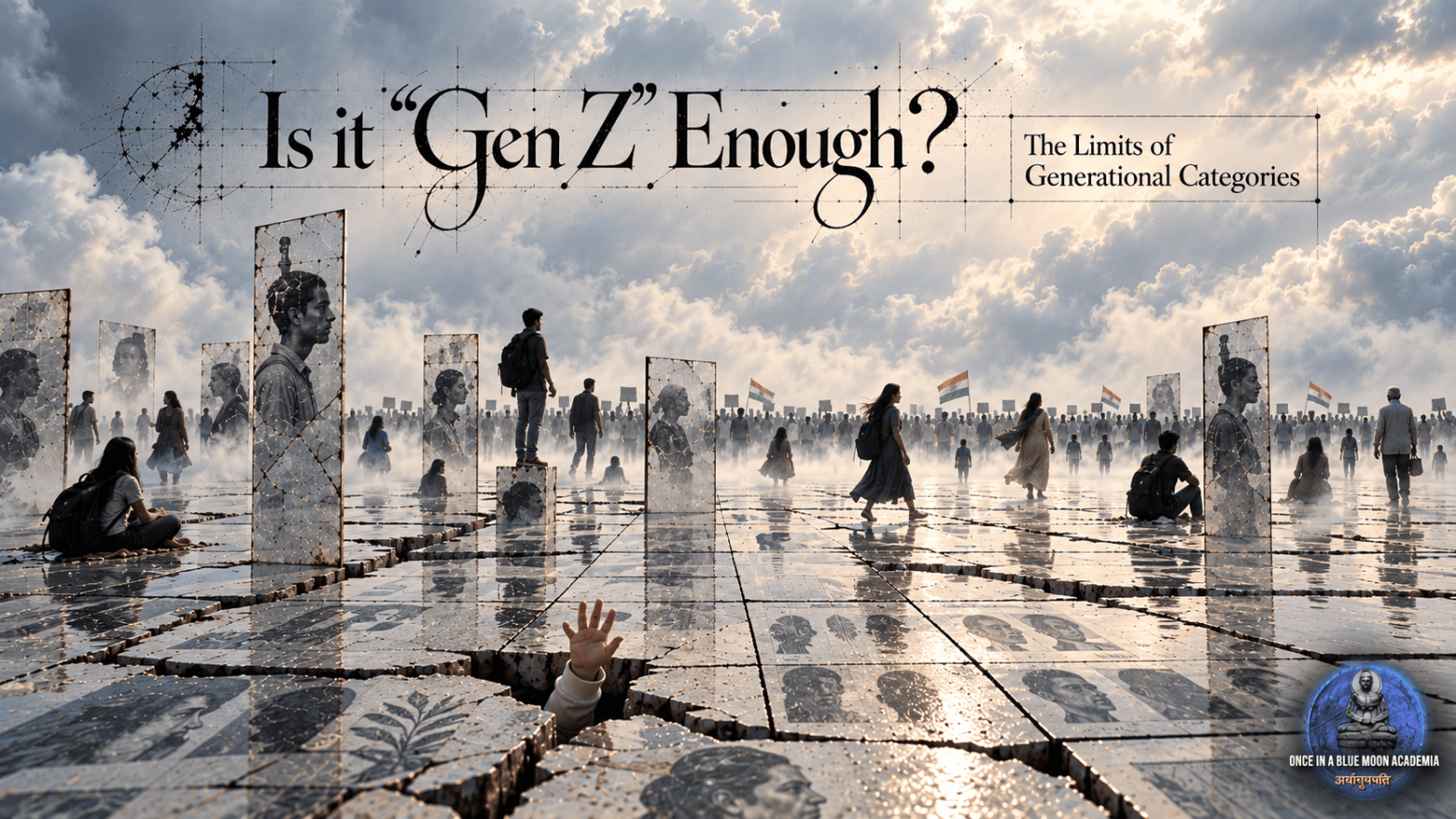
Generational labels function as a historically specific technology for ordering persons; the classification itself, not the cohorts it names, requires analysis. Drawing on Foucault’s archaeological and genealogical methods, the article traces the grid’s descent through state registration, demography, journalism, marketing and consultancy, showing how it imposes discrete essences on a continuum of births, scales disciplinary seriation to the population, generates looping effects, and recodes structural antagonisms as conflicts between age cohorts. The 2026 Indian mobilisation, branded a “Gen Z” uprising, serves as the principal test case: its composition, demands and alliances exceed any single cohort, demonstrating the non-contemporaneity of the contemporaneous. The Yayati–Babur circuit names the patriarchal mechanism that sustains this reduction. Within the same mobilisation the slogans of the dominant are echoed by the street; the echoing, read through Bhabha’s mimicry and Guha’s prose of counter-insurgency, opens a Third Space in which the national cry is made to carry a demand the apparatus refuses to hear. A parallel episode during Durga Puja in West Bengal—attacks on Left bookstalls resisted by student cadres of comparable age—further shows that shared birth years explain neither the violence nor the defence. The article rejects “mental age” as an alternative scale and proposes instead the plurality of temporalities that run through every subject and every movement.
Category Archives: Art of Resistance
Following the dictum “Cultural revolution must precede political revolution”, we are striving to create the scope for an alternative cultural space, which can offer resistance to all forms of coercion, and can also serve as a medium for conducting non-violent, horizontal dialogical exchanges.
Dissent, Dynamics and Domination: India’s Protest Movements (2014-26)

Between May 2014 and October 2026, India’s BJP-led National Democratic Alliance confronted an almost unbroken sequence of protest and resistance—from the 2015 land-ordinance agitation and the 2020–21 farmers’ siege of Delhi to the 2026 youth-led Cockroach Janta Party (CJP) rising—under conditions of sustained political domination rather than the successful production of consent. This article maps the ecology of that dissent: the movements themselves; a counter-public of non-Godi and crowdfunded media; satirists and stand-up comedians deploying hasya and vyanga against the regime’s bhayanaka and vibhatsya; organic intellectuals of political and civil society; dissenting advocates and judges; and watchdog NGOs. It documents the repertoire of domination deployed against them—imprisonment without trial, preventive detention, financial and regulatory strangulation, blocking, SLAPP litigation, career reprisals, threats, vigilante violence, surveillance, state violence and assassination by non-state actors—and reads the CJP against this longer inheritance through Gramsci’s account of hegemony and organic intellectuals, Partha Chatterjee’s distinction between civil and political society, Habermas’s concept of legitimation crisis, Ranajit Guha’s dominance without hegemony, and Ambedkar’s warning against bhakti in politics. The CJP’s speed and visibility rest on more than a decade of prior investigation, litigation and protest. Its demand for the resignation of named officeholders addresses persons rather than the paradigm or the chair; under a regime that has already closed ordinary channels and made the power to guarantee life the underside of the power to expose marked populations to the sovereign mark, the absorption of a name is the state’s work, not the movement’s. The article treats the CJP as a genuine opening for a new constituency whose unarmed presence has already forced the repressive and ideological apparatuses into public view. The further task is to keep the energy released by that showing from being returned, through the regime’s mechanisms of absorption and attribution, to the chairs that still decide who is to be made live and who is to be marked.
An Open Appeal to India’s Security Forces: Stand with Democratic Dissent
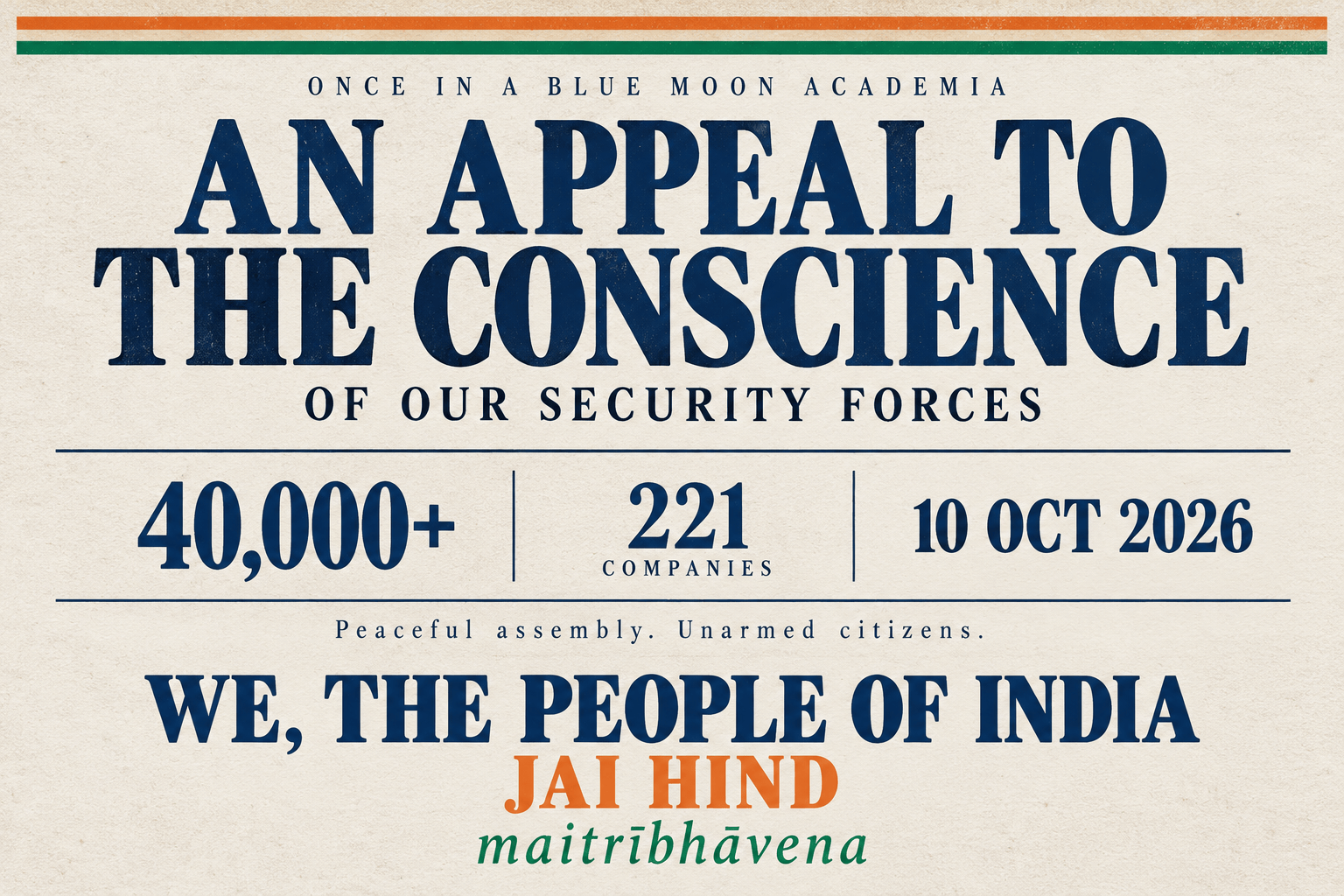
On 10 October 2026, as unarmed citizens, students and opposition voices gather at Jantar Mantar in peaceful civil disobedience, the State has assembled more than 40,000 Delhi Police and Central Armed Police Forces personnel, detention centres, facial-recognition cameras and metro closures against them. Once in a Blue Moon Academia appeals to those in uniform, not as adversaries but as fellow citizens, to let conscience precede command, to refuse the police state the last word, and to stand with the constitutional right to dissent.
Ātmadīpa: The Non-Schooling Praxeogogy

Ātmadīpa is a non-school and a praxeo-gogy: not a greener exam-machine but a commons in which a people learns to inhabit a watershed in the polycrisis — lamp and island unto itself, and in the same motion a support to others. Head, hand and heart are taught as one and never ranked; the institution is deschooled. It resists the sale of learning, the capture of the curriculum, and the credential that pretends to be knowing. Its fields are the crafts of home-as-habitat — food, water, shelter, care, dissent, grief — held free at the point of use, federated without a headquarters, open-licensed, unfinished on purpose. Kindle your own lamp. Its only use is to light the road everyone walks.
Money Taken, Votes Taken, SLAPPed: A DHFL Retrospective

On 24 September 2026 we write in the light of The Indian Express report: two Election Commissioners of India objected fourteen times to roll changes, Form 6 and control of the voter database, while the Election Commission of India still called every decision unanimous. We have watched the same grammar inside the DHFL CoC. A vote is manufactured, dissent is filed away, and the person on the line is told the count is final. Depositors recovered 23 percent; Oaktree’s stronger bid was set aside; Ajay Piramal took fraud-recovery claims estimated at ₹45,000 crore for ₹1. Multiple RTIs produced no figure for CIRP costs. Then Piramal Capital sued us for ₹100 crore — a SLAPP of defamation and contempt against research and RTIs. Money taken. Votes taken. Then the summons.
The Goonda Returns: How a Category Became a Statute (Again!)
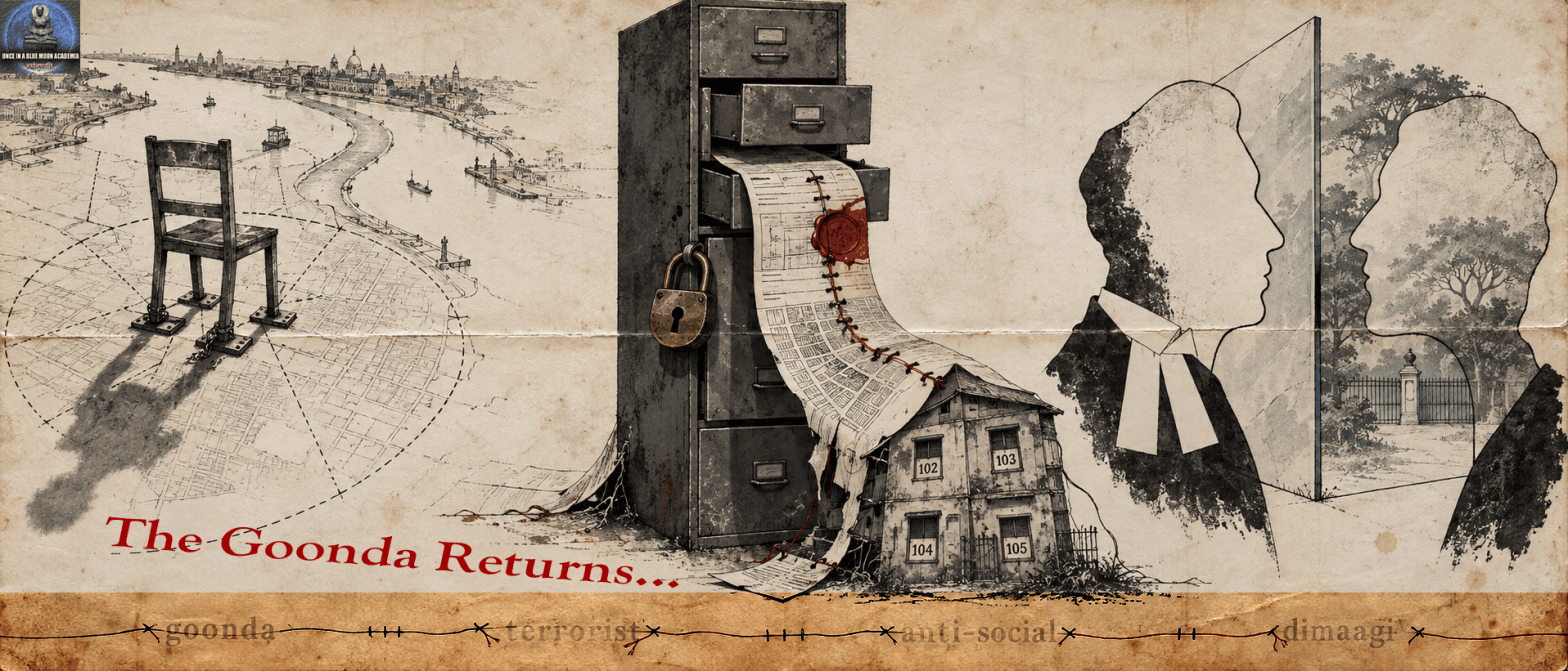
On 13 July 2026 West Bengal’s new BJP government announced that the Public Safety and Control of Anti-Social Activities Act (gunḍā-damana) and the Maintenance of Public Order (Amendment) Act were in force. The first allows twelve months’ charge-free detention of anyone a magistrate or commissioner deems a reputational “goonda,” criminalises harbouring the externed, and permits year-long district banishment. The second lets a Claims Commission attach and auction the property of alleged rioters and of protest organisers, financiers, instigators and logistical supporters, up to twice assessed damage. A High Court bench later treated the Public Safety instrument as still awaiting assent; the government had already declared midnight commencement. The article reads both statutes as Bengal’s own colonial archive reprinted — Regulation III of 1818, Rowlatt 1919, the Goondas Act 1923, the 1929 Safety Bill against which Bhagat Singh timed the Assembly bombs — and as a Foucaultian status crime. Against ICCPR Articles 9, 12, 14, 15, 19, 21–22, General Comment 35 and CCPR/C/IND/CO/4 (2024), the design fails at every limb; India’s 1979 Article 9 declaration does not shelter what Article 22 never required. The same circuit is the impunity loop mapped in OBMA’s DHFL and bulldozer work. A coda tests damana against daṇḍanīti, sets ADR affidavits inside the definition, and reads anyonya-pratibimba, Barthesian myth, and the July naming of Forward Bloc as goonda as a category that cannot close. It ends with a protocol: document the order, litigate the interior, internationalise now, count who is named, protect the harbourer. The goonda of the file is not the person. The second file is the remaining procedure.
Maoists Without Mao: The Misnomer of Indian ‘Maoism’
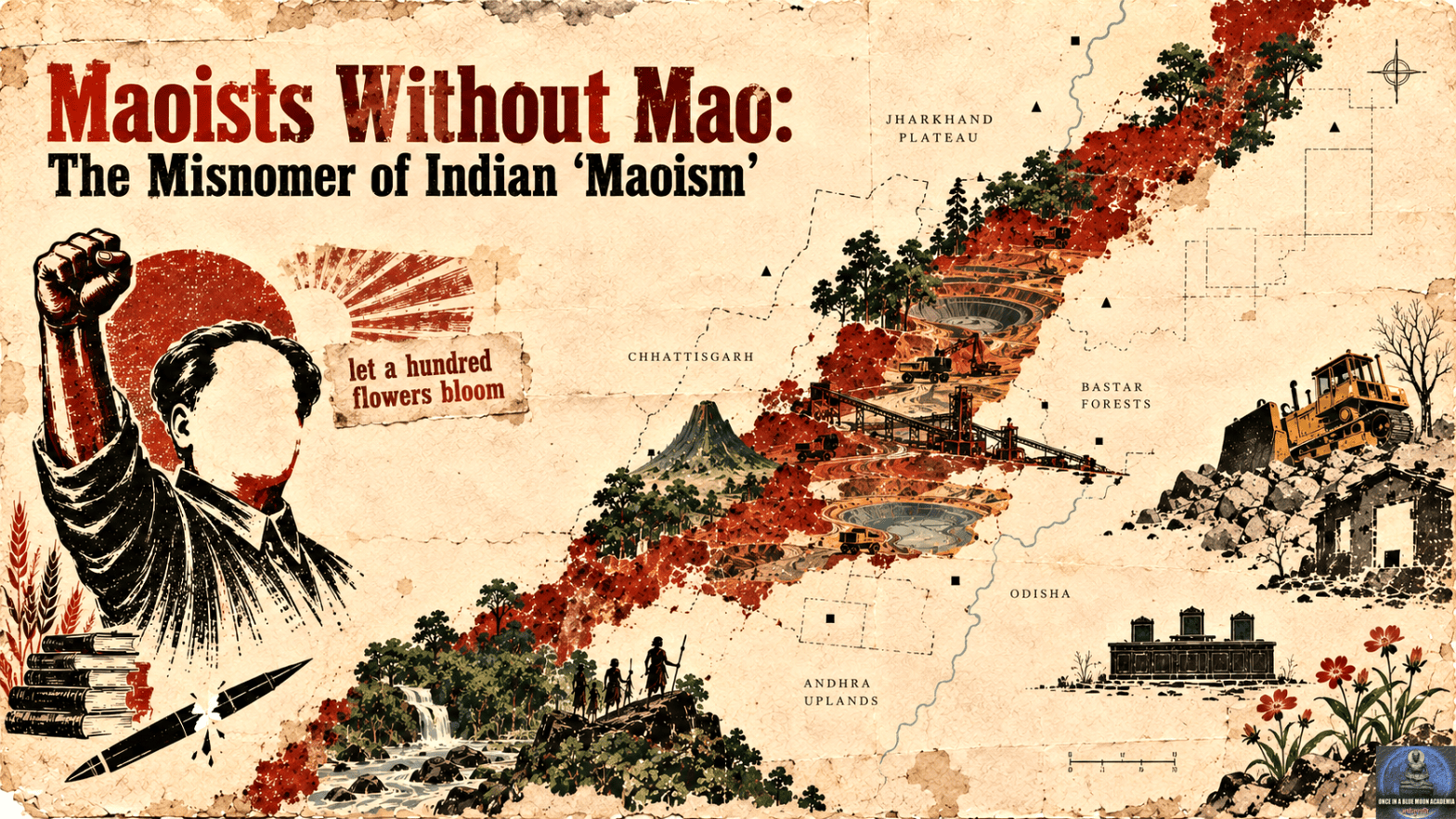
India’s so-called Naxalite–CPI (Maoist) “insurgency”, declared “effectively finished” around 2026, is called “Maoist” by the state, the press, and the movement itself; this article treats that name as a misnomer that does ideological work. It reconstructs Mao’s actual method — concrete analysis in On Practice and On Contradiction, the gun-and-pen doctrine of Yan’an, sinification rather than imported catechism, self-reliant base areas, a restless Confucian–classical substratum, and the brief Hundred Flowers opening toward a plural field of standpoints later formalised, in another idiom, as overdetermination by Althusser — and shows that the Indian movement kept the words and dropped the grammar: iconolatry (“China’s Chairman is India’s Chairman”), MLM as a frozen universal system, Gutian-condemned annihilationist militarism, and a parasitic levy-and-loot economy on a mineral frontier that is not the feudal countryside the doctrine presupposes. The name was decided; the referent would not coincide with Mao. Mapping the Red Corridor onto bauxite, iron, coal, chromite and uranium, and walking Bastar, Kalinganagar, Niyamgiri and Jadugoda through Marx, Sanyal and Levien on primitive accumulation and the need economy, it argues that “Maoist” functions as a security brand affixed to Adivasi resistance to ecological dispossession, while Foucault’s warning about people’s courts is inverted in bulldozer (in)justice. What remains is a compound the doctrine cannot cover: a frontier defence of jal–jangal–zameen, a Blanquist core, the armed edge of the governed. The brand erases the dispossessed subject the conflict was about.
খাওয়া-দাওয়ার রাজনীতি আর ইয়াং বেঙ্গল
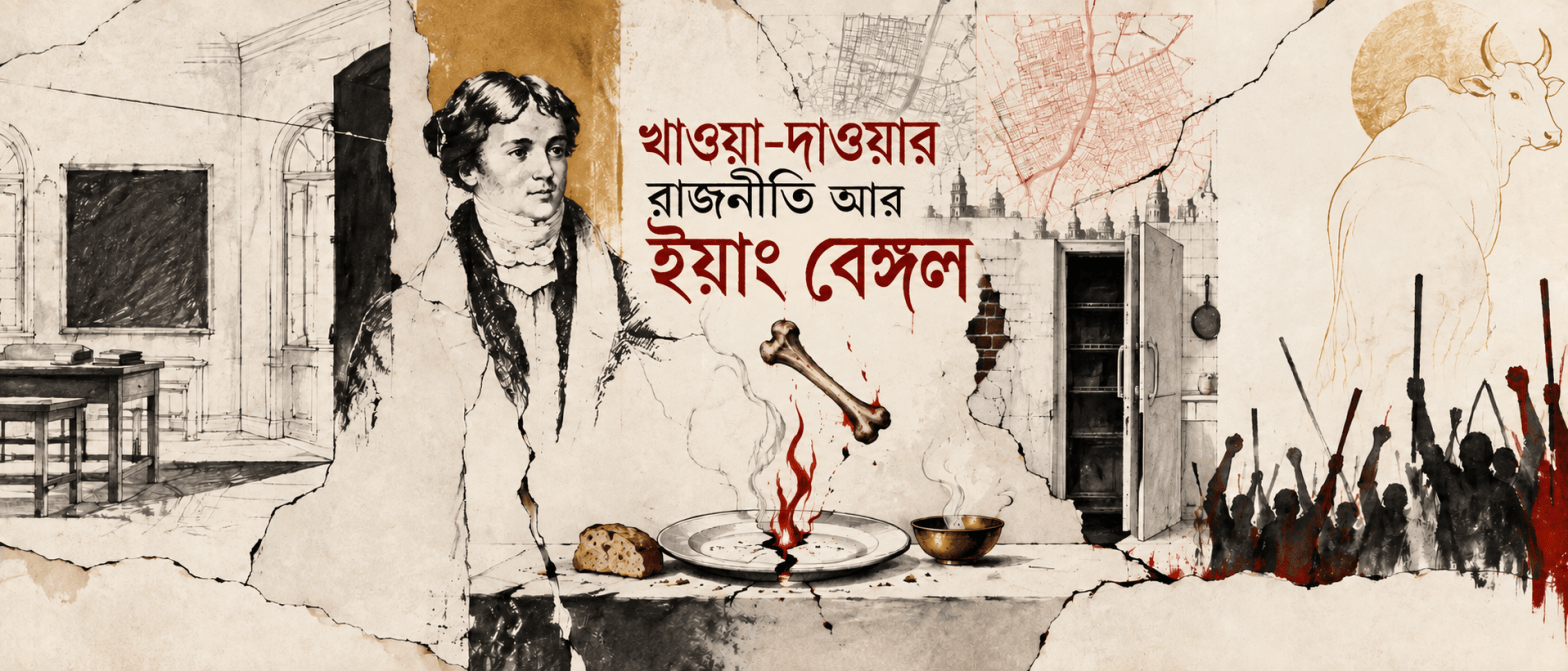
থালার ওপর রাষ্ট্র চেপে বসা-মাত্রই গেরুয়া ফ্যাসিবাদ সরাসরি রান্নাঘরে ঢুকে পড়েছে। এই লেখা সেই “ঢুকে পড়বার” খবরাখবর দেয়—গোরক্ষার নামে ব্যাপক খুনোখুনি, “সনাতন” খাদ্যবিধির জবরদস্তি, আমিষ (বিশেষত গোমাংস)-ত্যাগের জোরজুলুম, আর সেই ভয়ের রাজনীতির বিপ্রতীপে হাজির হওয়া দুশো বছর আগের ইয়াং বেঙ্গল। ডিরোজিওর ছাত্র-সহযোদ্ধারা বউবাজারের গলিতে গরুর হাড় ছুঁড়েছিলেন। প্রমাণ করে দিয়েছিলেন যে “শুদ্ধতা”-র চাপিয়ে দেওয়া নির্মাণ আদৌ কোনো যৌক্তিক নৈতিকতার মানদণ্ড নয়, স্রেফ গোঁড়াদের সীমানা আঁকার তকনিক; গরু “মা” হয়ে ওঠা আর দলিত-মুসলমানকে বাইরে ঠেলে পিষে দেওয়া সেই একই খ্যামতা-দেহের যন্তর-তন্তর-মন্তর। বাংলার রান্নাঘর (সমসত্ব বর্গ নয়) কিছুদিন আগেও ছিল বহুস্বরের পরিসর; এখন সেখানে সঙ্ঘী সেন্সরেরা উঁকি মারে ইতিউতি। লেখার পরিশিষ্টে ব্যঙ্গপত্র আর বিফ-বাফ রপ্তানির হিসেব মিলে যায়—রাতে গোমাতা, দিনে মহিষমাংসের ডলার। ডিরোজিয়ানদের সেই উঠোনে ছুঁড়ে দেওয়া গো-হাড়টা আজও তাই মাটিতে পড়েনি। ওটা প্রশ্ন। প্রশ্ন ফিরে ফিরে আসে।
The Man and the Monolith: A Dossier on Mohan Bhagwat
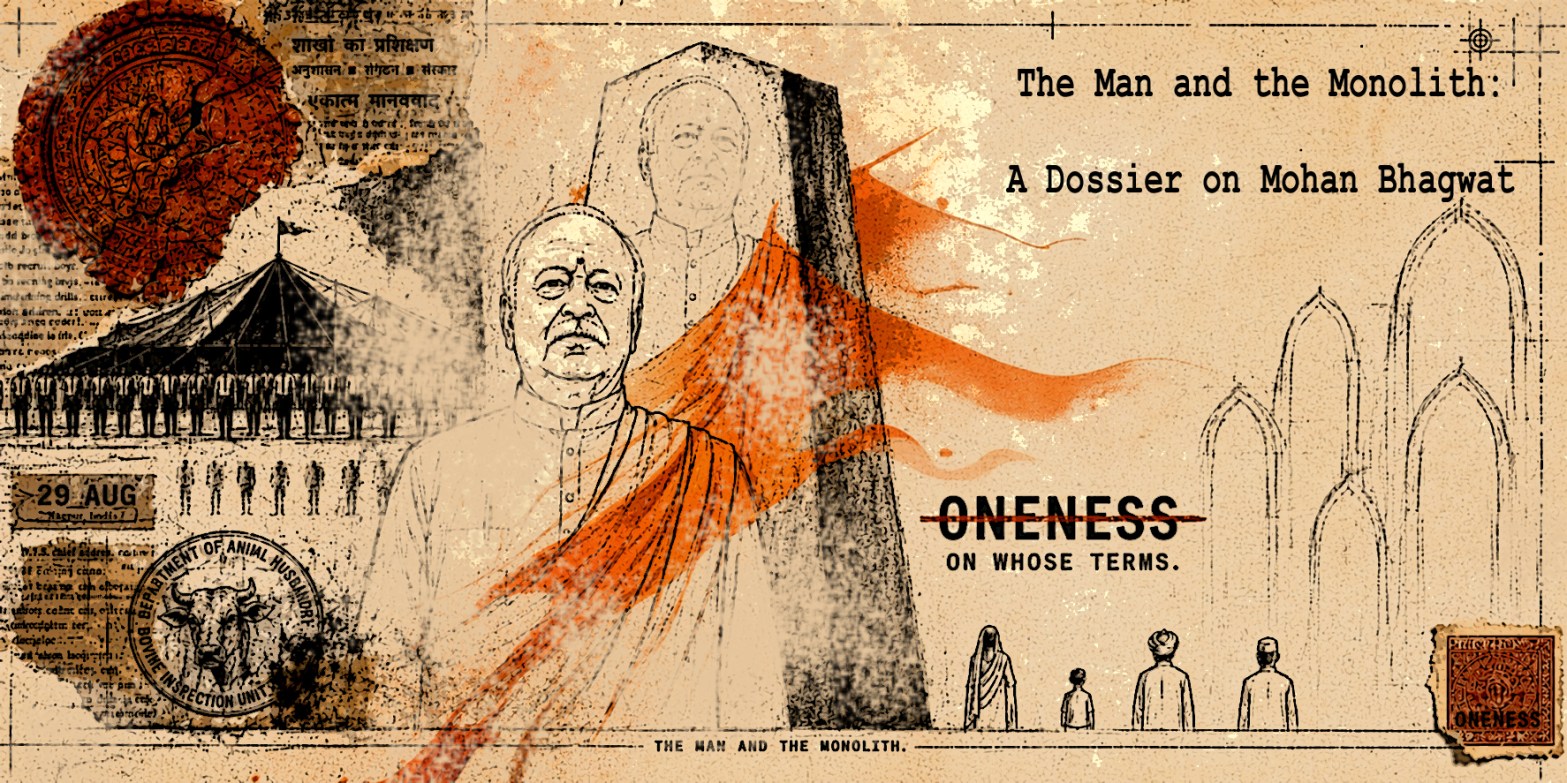
This dossier is a committed forensic case against Mohan Madhukar Bhagwat, sixth Sarsanghchalak of the Rashtriya Swayamsevak Sangh since 2009 and its executive from 2000 to 2009: a lifer raised in a three-generation Sangh household, produced by the organisation’s sealed ladder, and now the living editor of an ideology whose founding texts — Savarkar’s membership test, Golwalkar’s denial of minority citizenship and praise of a Nazi purge as a “lesson,” Moonje’s 1931 pilgrimage to Mussolini — he does not disown so much as copy-edit for export as “oneness.” It holds the line the Sangh most wants critics to overstep: no invented personal conviction from Gujarat 2002, no fake-doctorate smear, no claim that a USCIRF recommendation or a Canadian petition is already law; the charge that survives is custody of a majoritarian machine — unregistered at the centre, banned three times by the republic, radiating through the BJP and the Parivar — restated in Bhagwat’s own dated speech as eliminative absorption (“everyone is Hindu”), relocation of blame (2013, 2015, 2019, 2025), and centenary reputation-work. That work arrived in New York in August 2026 as “Universal Oneness” at Madison Square Garden and walked into a revolt that includes Hindus who refuse to let Hindutva speak in their name. The monolith calls itself oneness. The dossier refuses the name.
Ahimsa Before Arms: an Open Letter and Dossier to the Soldiers, Sailors, and Airmen of India
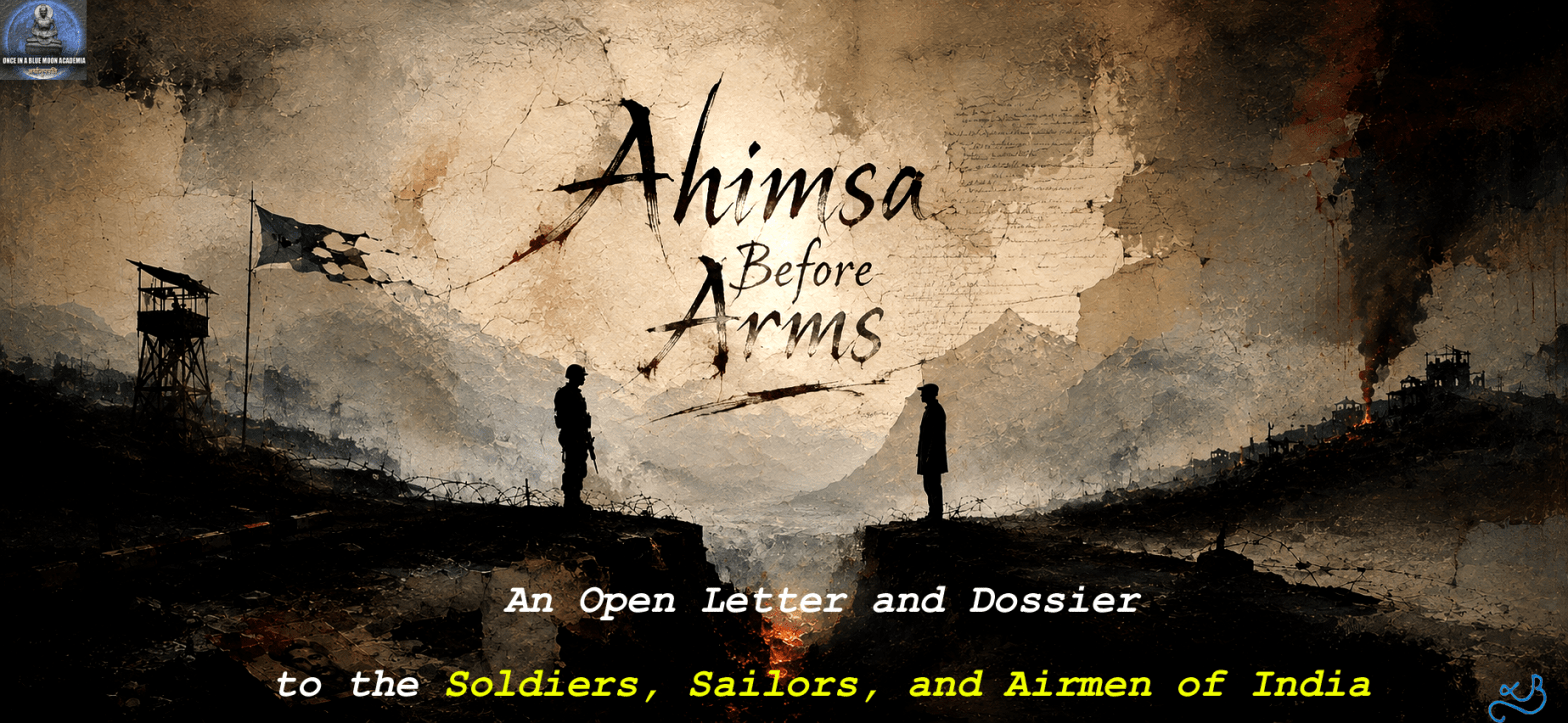
Addressed to the men and women in the uniform of the Indian Republic — not to generals, procurement officers, or politicians, but to the person with the rifle, the aircraft, the border watch, and the internal-security beat — this open letter and dossier is written from ahimsa: hard, active non-violence that refuses the destruction of truth. From parliamentary records, CAG reports, RTIs, courts, former Governors and Army Chiefs, the National War Memorial, investigative and strategic sources, SIPRI and budget data, and OBMA’s research, it maps institutional betrayal under the BJP–NDA regime(s): a suppressed Army Chief’s memoir; electoral use of Pulwama and Pahalgam martyrs; Model Code violations; Agnipath’s contract labour; disability-pension cuts after the 2016 strikes and the 2026 tax on valour; AFGIS/AGIF losses in DHFL; defective INSAS and ammunition; Chinese occupation and cartographic lies; Operation Sindoor’s fog and later war-memorial names; Siachen’s nationalism industry; Taliban engagement and the asymmetric terror label; CAPF subordination and the 2026 Act overriding the Supreme Court; veterans at Jantar Mantar; Rafale opacity; a ₹6,81,210-crore budget that still cannot issue reliable boots; and war-profiteering that turns the soldier into a line item. Linked to Prahar, Rang De Basanti, War Chhod Na Yaar, and Jai Ho, and closed by the Russell–Einstein question, it asks the citizen in uniform for viveka — not rebellion, but truth known, paid forward, and refused as the next campaign poster’s raw material.

