
Posted on 8th May, 2026 (GMT 11:56 hrs)
Updated on 10th October, 2026 (GMT 06:25 hrs)
ABSTRACT
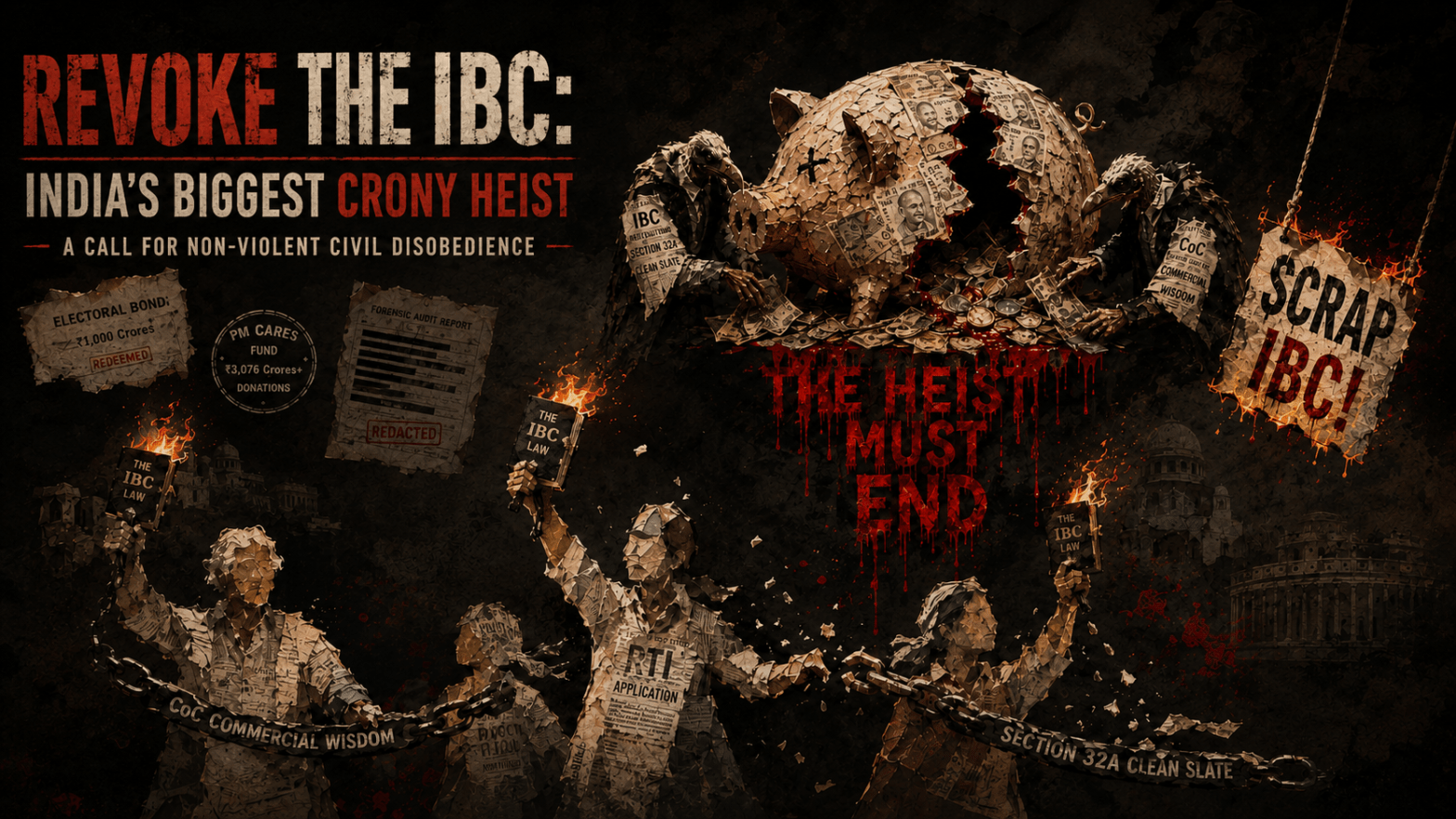
The Insolvency and Bankruptcy Code (IBC) 2016, touted as a landmark reform, has entrenched crony capitalism in India under the BJP-NDA regime by socializing enormous losses onto public banks, depositors, MSMEs, workers, and taxpayers while privatizing gains for politically connected acquirers. The DHFL episode epitomizes this plunder: a solvent housing finance company was deliberately forced into IBC, leaving over 2.5 lakh middle-class depositors with negligible recovery on ₹5,375 crore claims, as ₹31,000–45,000 crore in alleged fraud was wiped clean under retrospective Section 32A and transferred for a notional Re 1 to Mr. Ajay Piramal, while being riddled with conflicts with SARFAESI, RBI Act, NHB Act and Companies Act, endless amendments as well as tweaks exposing congenital defects, moratorium abuse, CoC supremacy shielded by judicial deference, and engineered opacity, the IBC stands as a global outlier that destroys value of natural justice, violates constitutional rights under Articles 14 and 21, and devastates MSMEs. Beyond reform, it must be fully revoked and re-made from scratch in a pro-people, pro-depositor manner. This manifesto calls for a nationwide Gandhian Satyagraha through mass dharnas, RTIs, human rights complaints, and economic resistance to scrap the Code, eliminate Section 32A, enforce Section 66 fully, and secure full restitution with compound interest to all victims. The heist must end– NOW.
0. Introduction
The Insolvency and Bankruptcy Code (IBC) 2016 was launched as a bold, transformative reform — a unified, time-bound mechanism designed to resolve India’s stressed asset crisis, penalise wilful defaulters, and restore credit discipline. Nearly a decade on, its real-world performance demands rigorous, unflinching examination.
True to the South East Asian tradition of pariprasna — humble yet penetrating inquiry — this article approaches the IBC in the three-fold Vedantic discipline of śravaṇa (listening to the claims), manana (critical reflection and logical analysis), and nididhyāsana (deep, sustained contemplation aimed at realising the truth, with the aid of critical independent thinking). As the Bhagavad Gītā (4.34) instructs:
तद्विद्धि प्रणिपातेन परिप्रश्नेन सेवया ।
उपदेक्ष्यन्ति ते ज्ञानं ज्ञानिनस्तत्त्वदर्शिनः ॥
tad viddhi praṇipātena paripraśnena sevayā
upadekṣyanti te jñānaṁ jñāninas tattva-darśinaḥ.
“Just try to learn the truth by approaching a spiritual master. Inquire from him submissively and render service unto him. The self-realized souls can impart knowledge unto you because they have seen the truth.”
This article therefore moves beyond surface rhetoric to undertake nididhyāsana — the final stage of contemplative assimilation, where knowledge is not merely understood but lived, and deep-rooted misconceptions are dissolved.
Using the DHFL case-study as its central lens — India’s first major NBFC deliberately selected as the IBC’s laboratory experiment — it tests the Code’s promises against its outcomes, heavy flow of tweaks and amendments, its stated objectives against its coherently incoherent structural design, its claims of justice against the suffering of small depositors and MSMEs, its (in-)compatibility with existing laws, and its standing as a global outlier. Only through such honest and sustained inquiry can we determine whether the IBC remains a reform worth preserving or has become an institutional mechanism that socializes losses onto the public while privatizing enormous gains for a privileged few. The contemplation that follows will lead to a clear verdict — and, if necessary, a call for resolute collective action.
The IBC (Amendment) Act, 2026: Cosmetic Speed or Deepening the Crony Heist? VIEW HERE ⤡
Bankruptcy as Profitable “Bijness”: India’s Grand IBC Heist! VIEW HERE ⤡
1. The Original “Sin”: Why Was the IBC (2016) Introduced in the First Place?
They sold it as salvation.
In the aftermath of the 2015 Asset Quality Review (AQR) conducted by the Reserve Bank of India, which finally forced banks to clean up their balance sheets and exposed India’s staggering stressed asset crisis of ₹7–8 lakh crore, the establishment launched a powerful, unrelenting narrative. The existing legal framework — the Sick Industrial Companies (Special Provisions) Act (SICA), the Board for Industrial and Financial Reconstruction (BIFR), the 1993 Debt Recovery Tribunals, the SARFAESI Act 2002, and the winding-up provisions under the Companies Act — was systematically portrayed as a debtor’s paradise: chronically slow, promoter-friendly, value-destructive, and structurally incapable of resolving the twin balance-sheet problem that had paralysed public-sector banks and the broader economy.
Wilful defaulters, it was repeatedly argued in parliamentary debates, policy papers, and media campaigns, were laughing all the way to the bank while public-sector lenders bled profusely and ordinary taxpayers bore the ultimate burden of mounting non-performing assets.
An Open Letter to Shri Ajit Doval: Addressing the Menace of Superrich Wilful Defaulters VIEW HERE ⤡
Against this backdrop of manufactured urgency entered the Insolvency and Bankruptcy Code, 2016. Marketed with near-messianic fervour by the Bankruptcy Law Reforms Committee (BLRC), the IBC promised a decisive, clean break from the past: a creditor-driven, strictly time-bound (180 days extendable to 330 days) unified framework that would finally maximise asset value, punish the crooked promoters, restore credit discipline, deter future defaults, and end the era of crony impunity once and for all.
On paper, the promise appeared compelling and even necessary. India desperately needed a modern insolvency regime. The old system was undeniably sluggish, often gamed by resourceful promoters through endless litigation and restructuring schemes, and had failed to deliver meaningful recoveries or behavioural change. A transparent, time-bound, creditor-centric mechanism could, in theory, have improved recovery rates, strengthened the credit culture, and helped resolve the twin balance-sheet overhang that was choking investment and growth.
Yet a closer, unflinching examination of the decade-long outcomes reveals a profound, almost engineered gap between the stated intent and the actual architecture and performance of the Code.
Instead of resolving the crisis and punishing wilful defaulters, the IBC has professionalised and institutionalised a sophisticated mechanism of wealth transfer on an unprecedented scale. The messy, visible delays of the old regime were replaced by a sleek, “time-bound” pipeline that systematically socialised enormous losses onto public-sector banks, retail depositors, MSMEs, workers, and taxpayers, while enabling private windfalls for a select group of politically favoured acquirers. Public-sector banks were compelled to accept average haircuts of 67–68% on admitted claims, only to be repeatedly recapitalised with well over ₹3 lakh crore of taxpayer money since the AQR period. Many original promoters and their connected networks escaped relatively unscathed, while politically networked entities acquired high-quality distressed assets at steep discounts under the protective veil of the Committee of Creditors’ much-vaunted “commercial wisdom.”
The numbers tell a sobering, damning story that demands deep reflection:
- Wilful defaulters rose sharply from 5,076 cases involving ₹39,369 crore in March 2014 to 18,318 cases involving ₹3,83,264 crore by March 2025 — a nearly four-fold increase in the number of defaulters and an almost ten-fold explosion in the outstanding amount (RBI data placed before Parliament, March 2026).
- Overall recovery rates under the IBC have stagnated at a dismal 31–33% of admitted claims (31.63% in Q3 FY26 according to CARE Ratings and ICRA; total cumulative recoveries around ₹4.1 lakh crore till December 2025). This represents only a marginal improvement over the pre-IBC era’s 15–20% recoveries through older mechanisms, despite the much-hyped “creditor in control” model.
- Genuine corporate revival has remained rare; the dominant outcome across thousands of Corporate Insolvency Resolution Processes (CIRPs) has been change of control or liquidation rather than meaningful turnaround of viable businesses.
Far from deterring wilful defaulters or restoring credit discipline, the Code appears to have provided them — and their enablers — with an organised escape route and a lucrative exit ramp, all wrapped in the language of “resolution” and “value maximisation.”
This raises a fundamental and disturbing question that lies at the heart of any honest inquiry:
Was the IBC genuinely designed primarily to solve the NPA crisis, punish wilful defaulters, and restore credit discipline? Or was it structured, from its very conceptualisation and core architecture, to create a predictable, investor-friendly super-mechanism for harvesting distressed public assets at minimal cost to powerful buyers while shifting the burden of losses onto the public exchequer?
Its obsessive focus on procedural speed over substantive justice, the near-total elevation of the Committee of Creditors’ “commercial wisdom” above constitutional accountability and public interest, and the deliberate insulation of the process from meaningful scrutiny of fraud or promoter accountability strongly suggest that the latter intent was deeply embedded from the outset.
The original promise stands seriously contested — indeed, contradicted — by both empirical outcomes and the Code’s foundational design. What was projected as a decisive weapon against cronyism has, in practice, evolved into one of its most sophisticated, institutionalised instruments. The time for superficial critique or incremental tinkering is long over. This ill-conceived Code requires far more than patchwork reform — it demands complete revocation, root and branch.
2. Irreconcilable Incompatibility: Is the IBC Commensurable with SARFAESI, the RBI Act, the Companies Act, the NHB Act etc.?
They already had the weapons. Then they built a bigger, deadlier one — and chose it deliberately.
The legal arsenal available before 2016 was formidable and far from ineffective. The Securitisation and Reconstruction of Financial Assets and Enforcement of Security Interest (SARFAESI) Act, 2002 empowered secured creditors to enforce security interests outside the court system with remarkable speed — issuing 60-day notices, taking possession, and selling assets without judicial intervention in most cases. The Recovery of Debts and Bankruptcy Act, 1993 established dedicated Debt Recovery Tribunals (DRTs) for expeditious adjudication of bank dues above ₹20 lakh. The Companies Act 1956 (later 2013) contained comprehensive winding-up and liquidation provisions with judicial oversight. The RBI Act, 1934 (particularly Chapter IIIB for NBFCs) and the regulatory toolkit available to the Reserve Bank of India allowed direct intervention, including inspection, directions, supersession of boards, and even winding-up petitions. Most crucially for a housing finance company like DHFL, the National Housing Bank Act, 1987 (NHB Act) established a specialised regulatory framework complete with supervision, prudential norms, liquidity requirements, deposit repayment directions under Clause 39 of the NHB Directions, and resolution powers tailored to protect depositors in HFCs.
These statutes were not relics or debtor-friendly disasters. They represented a functioning, layered legal architecture that protected secured interests, maintained sector-specific regulatory oversight, preserved accountability for promoters and directors, and safeguarded the rights of depositors without offering blanket immunity for fraud or extinguishing broader stakeholder claims. Reports from the pre-IBC era, including RBI data on SARFAESI recoveries, showed rates often ranging between 14.5% and 32% in various years (with peaks above 30% in certain periods per parliamentary replies and ICRA analyses), while DRT recoveries hovered around 15-20% — modest but achieved without the total subordination of unsecured creditors or the complete override of regulatory frameworks.
So why was the far more fluid, centralised, and accommodating Insolvency and Bankruptcy Code, 2016 deliberately invoked in the case of DHFL?
DHFL was not a typical corporate debtor struggling under ordinary bank loans. It was a regulated housing finance company governed primarily by the NHB Act, 1987, sustained overwhelmingly by public deposits and non-convertible debentures (NCDs) from lakhs of middle-class households. Yet on 20 November 2019, the RBI superseded its board under the powers conferred by the RBI Act, 1934. Barely two weeks later, on 3 December 2019, the National Company Law Tribunal (NCLT), Mumbai admitted DHFL into Corporate Insolvency Resolution Process (CIRP) under the newly notified Insolvency and Bankruptcy (Insolvency and Liquidation Proceedings of Financial Service Providers) Rules, 2019 — the very first major NBFC/HFC test case under these rules notified just weeks earlier on 15 November 2019. This was not a default technical route or a mere procedural choice. It was a conscious, strategic override of the existing specialised regulatory framework under the NHB Act and RBI Act.
Only the IBC could deliver what the combined architecture of SARFAESI, the RBI Act, the Companies Act, and the NHB Act could never provide in the same sweeping, insulated manner: a creditor-dominated super-mechanism that centralised near-absolute decision-making power in a single forum, subordinated diverse stakeholder interests to expedited outcomes, and enabled outcomes unavailable under the older regime. The pre-IBC laws allowed targeted enforcement (SARFAESI for secured assets), regulatory intervention with depositor safeguards (NHB/RBI), and judicially supervised liquidation (Companies Act) — all while preserving promoter accountability and avoiding a complete freeze on broader rights. The IBC, by design, subordinates these considerations — regulatory accountability, depositor protection, fraud investigation, and constitutional principles of fairness — to the expediency of rapid corporate rebirth.
This was not an accidental jurisdictional overlap. It was a deliberate choice of forum — legislative forum-shopping at the highest level. The pre-existing laws protected the many through distributed accountability and specialised oversight tailored to the unique risks of deposit-taking HFCs. The IBC created a concentrated, creditor-dominated super-mechanism that protects the few. The incompatibility is not merely technical or procedural — it is structural, philosophical, and deeply constitutional. The Code was engineered as a parallel, overriding statute precisely to bypass the safeguards and limitations inherent in the older framework whenever they became inconvenient to powerful interests.
The selective application to DHFL exposes the intent with crystal clarity. A regulated entity under the NHB Act — one whose business model revolved around public deposits — was pulled into the IBC laboratory not because the existing tools were inadequate, but because they were too constraining for the desired outcome of a swift, sanitised handover under a new architecture of pro-corporate creditor supremacy.
This is not commensurability. This is legislative forum-shopping and institutional override on an industrial scale.
If SARFAESI (2002) is there, why fluid IBC (2016) is applied to the DHFL? VIEW HERE ⤡
A powerful legal argument against the applicability of the IBC 2016 to DHFL emerges from the fact that DHFL was a solvent, going-concern housing finance company with adequate asset cover (1.16 times debt liability as per affidavits accepted by the Bombay High Court). The company faced only temporary liquidity issues due to regulatory orders from the DRT and Bombay High Court, not genuine insolvency. The RBI’s decision to invoke the IBC through the newly notified Financial Service Providers Rules was arbitrary and selective, bypassing more appropriate routes such as the RBI’s Prudential Framework for Resolution of Stressed Assets (2016/2019), resolution under the RBI Act (Sections 45MBA & 45QA), or structured revival under the Companies Act 2013 — routes successfully used in cases like IL&FS, RHFL, and RCFL. The MCA notification bringing NBFCs/HFCs under IBC was itself questionable, as NBFC regulation falls primarily under the Finance Ministry and NHB, not MCA. This forced application of IBC extinguished critical protections for public depositors under NHB Directions, SEBI regulations, and contractual guarantees, effectively issuing a “death warrant” to retail FD/NCD holders by retrospectively stripping them of secured status and treating them as unsecured creditors in a creditor-driven liquidation process rather than genuine revival.
Non-Applicability of IBC 2016 on DHFL Scam (with relevant documents for litigation) VIEW HERE ⤡
The selective application exposes a deeper truth: the IBC was never meant to work alongside the existing framework — it was built to supersede it whenever the powerful required a more accommodating path.
3. The Perpetual Patchwork: IBC’s Dangerous Fluidity Through Endless Amendments and Tweaks – How Many and Why?
Born rotten, it has never stopped bleeding.
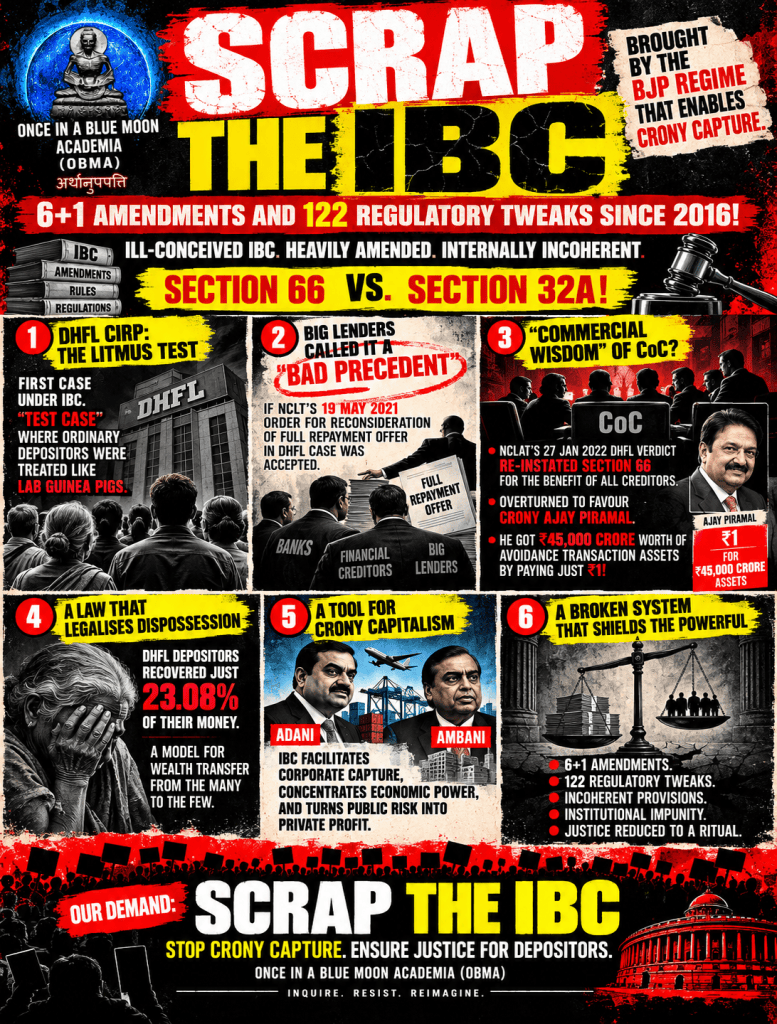
From the day it received presidential assent on 28 May 2016, the Insolvency and Bankruptcy Code has suffered from deep structural flaws that have necessitated constant legislative intervention. In less than a decade, the IBC has undergone seven major statutory amendments — the Insolvency and Bankruptcy Code (Amendment) Act, 2018; the second Amendment Act, 2018; the Amendment Act, 2019; two Amendment Acts in 2020; the Amendment Act, 2021; and the comprehensive Insolvency and Bankruptcy Code (Amendment) Act, 2026 — supplemented by more than 122 IBBI regulations, circulars, notifications, and modifications (as recorded in official IBBI compilations up to April 2026). This is not the mark of a maturing law gradually adapting to ground realities. It is the unmistakable signature of a statute fighting for survival through perpetual legislative repair and regulatory band-aids.
The latest IBC (Amendment) Act, 2026 — passed by Parliament in March-April 2026 and notified in April 2026 — has been presented as a significant upgrade. It introduces mandatory admission of applications within 14 days by the Adjudicating Authority, a new Creditor-Initiated Insolvency Resolution Process (CIIRP) with debtor-in-possession elements, enabling frameworks for group insolvency, stricter liquidation timelines (completion targeted within 180 days, extendable by 90 days), and a few procedural concessions for minority creditors and operational stakeholders. On the surface, these appear as progressive refinements aimed at faster resolution and better coordination. In reality, they represent yet another layer of cosmetic strengthening that accelerates procedural efficiency while leaving the Code’s foundational contradictions — creditor supremacy, subordination of non-financial stakeholders, and insulation from substantive accountability — entirely untouched.
Every single amendment has followed a consistent, predictable pattern: reinforcing the dominance of financial creditors and the Committee of Creditors, prioritising rigid speed above all else, widening immunity provisions for resolution applicants, and further diluting whatever limited mechanisms existed for fraud accountability and protection of operational creditors and small stakeholders. Rather than correcting core design defects, successive changes have steadily tilted the balance even further in favour of financial creditors and resolution applicants. Thresholds have been modified, processes tweaked, and timelines repeatedly adjusted — yet the average duration of Corporate Insolvency Resolution Processes (CIRPs) has continued to stretch far beyond the original 180/330-day targets. IBBI quarterly data shows average resolution periods routinely exceeding 600–850 days: 688 days in Q2 FY26, 713 days overall, and up to 853 days for cases closed in FY25 (per IBBI and CARE Ratings reports). Even after the 2026 amendments, early data and parliamentary replies indicate that the bulk of cases still drag well beyond statutory limits.
Recovery rates for operational creditors and small stakeholders have remained persistently and abysmally low, while the system has increasingly facilitated change of control or liquidation over genuine revival of viable businesses. Aggregate recoveries under the IBC have stagnated in the 31–33% range of admitted claims (31.63% in Q3 FY26 per CARE Ratings, down marginally from 32.44% in Q2 FY26), representing haircuts of 67–68% for creditors despite the much-vaunted “creditor in control” model. This is only a marginal improvement over pre-IBC recovery rates of 15–20% under older mechanisms, despite a decade of frantic legislative and regulatory patching.
This is not thoughtful legislative evolution or adaptive policymaking. It is a decade-long, damning confession of congenital failure. A law that requires such frequent and extensive patching — major statutory surgery almost every year or two, alongside a deluge of over 122 regulatory bandaids — reveals a framework that was fundamentally ill-conceived from its inception. Each “fix” has primarily served to make the mechanism smoother and more accommodating for powerful financial players: enabling deeper haircuts for public-sector banks (later socialised through massive taxpayer-funded recapitalisation), faster handovers to select resolution applicants, and greater insulation from scrutiny or challenge.
An insolvency law that cannot stand on its own without constant propping up is not being “improved” — it is being kept artificially alive through legislative life-support. The relentless amendments do not demonstrate adaptability or learning; they expose a statute that was defective at birth and has only grown more distorting, more predatory, and more biased with every intervention. What began as an ambitious reform marketed to end crony impunity has mutated into an increasingly efficient vehicle for institutionalised wealth transfer, achieved through legislative cover rather than sound, coherent design.
The frantic patchwork is not evidence of reform. It is cover-up by legislation.
Expose IBC’s Dirty Secret, Resist the Structural Impunity for Cronies! VIEW HERE ⤡
4. Retrospective Corporate Rebirth: The Post-Facto Imposition of Section 32A and the Disturbing Valmiki Parallel
They didn’t just amend the law. They rewrote reality itself — after the crime had already begun.
Section 32A, the infamous “clean slate” provision, was never part of the original Insolvency and Bankruptcy Code enacted in 2016. It was inserted through the Insolvency and Bankruptcy Code (Amendment) Ordinance, 2019, promulgated by the President on 28 December 2019 — barely 25 days after DHFL’s admission into CIRP on 3 December 2019. The ordinance explicitly gave the provision retrospective operation, applying it immediately to all ongoing Corporate Insolvency Resolution Processes. This was later replaced by the Insolvency and Bankruptcy Code (Amendment) Act, 2020, which received presidential assent on 13 March 2020 but retained the retrospective effect from the date of the ordinance. This was not ordinary legislation passed after calm deliberation. It was ontological surgery performed mid-procedure while the corporate debtor was still under active resolution, its past conduct still under forensic scrutiny, regulatory investigation, and live probes by multiple agencies.
The provision declares that once a resolution plan is approved under Section 31 and results in a change in the management or control of the corporate debtor to persons who were neither promoters nor involved in the commission of the offence, the liability of the corporate debtor for any offence committed prior to the commencement of the CIRP ceases entirely. The corporate debtor shall not be prosecuted for such offences, and no action (including attachment, seizure, or restraint) can be taken against its property in relation to those pre-CIRP offences. Prosecutions are extinguished. Assets are rendered unattachable. The entire criminal liability of the old legal entity vanishes as if it had never existed.
The corporate debtor did not merely survive insolvency. It was reborn — pristine, virginal, spotless — as though the past had been poetically erased. The approved resolution plan became its new legal janmabhoomi, its official birthplace. Everything that came before was retroactively declared “not wholly truth.”
This is precisely how Valmiki’s Ramayana operates.
In the dialogue between Valmiki and Narada (as Rabindranath Tagore so powerfully reflected upon), the poet learns that the epic already existed in the realm of his poetic vision (the field of his mind’s topography) even before Rama’s so-called birth in historical Ayodhya. The imagined, higher truth was deemed superior to mere chronological fact. The story preceded and redefined the event. History itself was subordinated to the sovereign imagination of the storyteller.
The Indian state has now borrowed that exact poetic licence — but not for gods or epics. It has applied it to corporations and cronies.
Section 32A is the modern Valmiki ordinance. It declares: whatever forensic evidence existed, whatever investigations were underway, none of it counts once the new owner steps in. The resolution plan becomes the higher ontological truth. The acquirer inherits an entity whose past sins have been poetically nullified. The old corporate debtor, burdened by its documented history, simply ceases to exist in the eyes of the law. A sanitised new avatar rises.
This is not routine law-making. This is engineered corporate amnesia achieved through statutory fiat — retrospective corporate rebirth deliberately engineered at the highest level to protect the powerful and facilitate rapid handovers.
And here lies the deeper constitutional catastrophe.
By importing this mythological logic into a secular statute, the state has subordinated evidence-based justice, forensic accountability, and the scientific temper (mandated as a fundamental duty under Article 51A(h) of the Constitution) to political and commercial expediency. When the law begins to treat corporate history the way Valmiki treated the Ramayana — as something that can be retroactively overwritten by a “higher truth” convenient to the powerful — it ceases to function as an instrument of a secular, rational republic grounded in the rule of law. It becomes a theatre where constitutional secularism itself is at stake, where legal fictions triumph over empirical reality and documented misconduct.
This retrospective corporate rebirth received fresh judicial affirmation as recently as 2 February 2026, when a Mumbai Special PMLA Court discharged the now-rebranded entity from a ₹5,050 crore money-laundering case, explicitly invoking Section 32A’s overriding immunity and declaring that the corporate debtor could not be prosecuted after the change in management.
The people are not poets. They are victims.
They will not accept a legal system that treats their life savings as fictional backstory to be erased for the convenience of a new owner. They will not bow before a Code that borrows from epic imagination to absolve economic criminals.
This retrospective corporate rebirth is an insult to the Constitution and an outrage against the people.
Section 32A must go.
The fundamental incommensurability between the Insolvency and Bankruptcy Code (IBC) and the Prevention of Money Laundering Act (PMLA) stands glaringly exposed in the DHFL case. While Section 32A of the IBC grants a sweeping retrospective “clean slate” to the corporate debtor upon approval of a resolution plan — extinguishing all pre-CIRP offences, liabilities, and prosecutions — the PMLA empowers authorities to attach and confiscate properties derived from money laundering, treating such assets as proceeds of crime irrespective of any change in ownership. Courts have frequently prioritised IBC’s non-obstante provisions over PMLA proceedings, effectively shielding the new owner (in DHFL’s case, Piramal) from ongoing criminal liability and attachment actions, even as forensic evidence of massive siphoning remains on record. This legal contradiction transforms the IBC into a powerful laundering mechanism, allowing politically connected acquirers to inherit sanitised empires while extinguishing the rights of victims and undermining the PMLA’s core objective of recovering ill-gotten gains. The DHFL episode thus reveals not just procedural conflict, but a deeper structural design flaw that prioritises rapid corporate rebirth over justice, accountability, and the prevention of money laundering.
Incommensurability Amidst PMLA and IBC in the Context of the DHFL Scam VIEW HERE ⤡
5. The Irreconcilable Internal Contradiction: How Section 32A Systematically Buries and Neutralizes Section 66
Here is the IBC’s dirtiest secret — the fatal, deliberate internal contradiction that exposes the entire Code as a sophisticated laundering machine.
Section 66 was meant to be the Code’s moral core and its only substantive weapon against fraud. Under Section 66(1), if during the CIRP or liquidation it comes to the notice of the Resolution Professional or the liquidator that any business of the corporate debtor has been carried on with intent to defraud creditors or for any fraudulent purpose, the Adjudicating Authority may, on an application by the RP, any creditor, or suo motu, direct any persons (including directors, partners, or third parties who were knowingly involved) to make contributions to the assets of the corporate debtor as it deems fit. Section 66(2) further holds persons liable for wrongful trading where they knew or ought to have known that insolvent trading would lead to loss to creditors. Recoveries from such fraudulent or wrongful trading — siphoned funds, shell-company diversions, related-party loot, preferential transactions — are statutorily required to be restored to the corporate debtor’s estate for the benefit of all creditors. Crucially, Section 66 carries no rigid look-back period (unlike Sections 43–51 on avoidance transactions) and imposes personal liability even on directors and knowing third parties, making it potentially the most powerful anti-fraud tool in the entire statute.
Section 32A does the precise opposite. Once a resolution plan is approved under Section 31 and control passes to persons who were neither promoters nor involved in the commission of the offence, it grants sweeping, blanket immunity to the corporate debtor and its assets: every pre-CIRP offence is extinguished, prosecutions die, liabilities vanish, attachments are lifted, and the entity is legally reborn pristine. The corporate debtor “shall not be prosecuted for any offence committed prior to the commencement of the CIRP” and no action can be taken against its property in relation to such offences.
This is not a minor drafting tension. It is a total, irreconcilable doctrinal, temporal, institutional, and ontological incommensurability deliberately hardwired into the Code.
- Doctrinally: Section 66 commands “recover the loot and restore the estate for the benefit of all creditors.” Section 32A commands “the loot now belongs exclusively to the acquirer.”
- Temporally: Section 66 targets past sins to make creditors whole and deter future fraud. Section 32A erases those very sins retroactively the instant a new owner steps in, rendering the recovery exercise futile.
- Institutionally: It pits the Resolution Professional (duty-bound to maximise the estate) and genuine creditors against the very Committee of Creditors that chooses to monetise or gift away the fraud recoveries for the benefit of the successful resolution applicant.
- Ontologically: The corporate debtor is simultaneously guilty (for the purpose of acknowledging fraud and filing avoidance applications) and innocent (for the purpose of granting complete immunity) — a grotesque legal fiction engineered solely to serve powerful acquirers.
In practice, this contradiction has rendered Section 66 a paper tiger. IBBI data (as on December 2025) shows that while thousands of avoidance applications (including under Sections 43–51 and 66) have been filed across CIRPs, the actual value realised and distributed to the estate remains negligible in resolved cases. Most such applications are either withdrawn, settled at nominal value, or rendered infructuous once a resolution plan is approved and Section 32A kicks in. The Code’s own architecture ensures that the only substantive anti-fraud provision is systematically neutralised at the moment of “success.”
The IBC’s true architecture now stands naked: performative anti-fraud rhetoric and a few decorative clauses that create the comforting illusion of accountability, while the real mechanism is perfectly designed to launder corporate liability and transfer the entire economic upside of wrongdoing to politically networked acquirers under the unchallenged banner of “commercial wisdom.”
This internal contradiction is not accidental. It is the design.
Scrap IBC Now: How Section 32A Buried Section 66 | The DHFL Case (Video) VIEW HERE ⤡
IBC Section 66 Overlooked by the DHFL-CoC: A Big Conspiracy? VIEW HERE ⤡
5.1 Section 66 Precedents: The Paper Tiger Exposed – How IBC’s Only Anti-Fraud Weapon Was Rendered Toothless by Design
On paper, Section 66 appears formidable. It allows personal liability for directors, key managerial personnel, and even third parties knowingly involved in fraudulent or wrongful trading. In smaller, low-profile cases, some NCLAT benches have indeed attempted to breathe life into it. Tribunals have occasionally upheld recovery applications, extended liability beyond the promoter group to professional advisors and related entities, treated Sections 66(1) and 66(2) as independent and standalone causes of action, and emphasised that the provision carries no fixed look-back period precisely to capture ongoing fraudulent conduct during the twilight of insolvency.
Notable examples include the NCLAT’s order dated 6 May 2024 in Royal India Corporation Ltd. v. Nandkishor Vishnupant Deshpande (RP) & Ors. (Company Appeal (AT) (Insolvency) No. 137 of 2021), where the Tribunal upheld recovery under Section 66 from a third-party entity for fraudulent transactions involving ₹158.07 crore, directing contribution to the corporate debtor’s estate after finding manipulated ledger entries designed to artificially reduce liabilities. Similarly, in Swapan Kumar Saha v. Ashok Kumar Agarwal (NCLAT Principal Bench), the Tribunal clarified that Sections 66(1) and 66(2) operate independently, allowing recovery even where strict proof of “intent” under sub-section (1) was not the sole determinant. In Worldwide Online Services Pvt. Ltd. v. Nandkishor Vishnupant Deshpande (RP) & Ors. (NCLAT New Delhi, February 2026), the Appellate Tribunal affirmed that Section 66(1) applies to “any person” knowingly party to fraudulent trading and does not require proof of mens rea in every instance where the effect on creditors is demonstrable.
Yet these scattered victories in insignificant matters were all theatre.
The precedents that truly matter — those involving high-value, politically networked resolutions — expose the lie with clinical precision. IBBI data (Quarterly Reports up to December 2025) reveal that while over 12,500 avoidance applications (including under Sections 43–51 and Section 66) have been filed across CIRPs, the actual value realised and distributed to the estate remains abysmally low — less than 4–6% of the claimed amounts in resolved cases, according to ICRA and CARE Ratings analyses. In the overwhelming majority of successful resolutions, Section 66 applications are either withdrawn as part of the plan, settled for token consideration, or rendered infructuous once the resolution plan is approved and Section 32A takes effect.
Section 66 creates the comforting illusion of accountability — a decorative clause that looks fierce on paper and occasionally delivers symbolic wins in insignificant matters — while the real architecture of the Code ensures that this illusion never threatens the actual transfer of wealth. Every precedent that ultimately bows to the doctrine of “commercial wisdom,” every judgment that permits the new owner to pocket or neutralise potential fraud recoveries, proves beyond doubt that the IBC was never designed to punish cronies. It was built, from its very foundation, to protect them.
Section 66 is not a safeguard. It is a fig leaf.
5.2 The Paper Tiger in Action: NCLAT Judgments on Section 66 – Judicial Resistance Crushed by the CoC’s Sacred “Commercial Wisdom”
Section 66 was supposed to be the IBC’s lone anti-fraud sword — the clause capable of dragging fraudulent traders, directors, and knowing third parties before the Tribunal and forcing them to cough up every looted rupee for the benefit of the collective creditor body, as explicitly mandated by the statute’s requirement that recoveries restore the corporate debtor’s estate for all creditors.
The NCLAT has, on rare occasions in lower-stakes matters, pretended to sharpen that sword. In several non-promoter-heavy cases, benches have upheld personal liability, demanded strict proof of intent while still allowing recovery where knowledge of insolvency was demonstrable, and asserted the provision’s independence.
But the moment the stakes become gigantic and the cases involve politically networked resolution applicants, the sword turns to rubber.
The DHFL matter stands as the ultimate autopsy of this judicial pattern. Forensic audits had exposed ₹31,000–45,000 crore in fraudulent diversions. Section 66 applications were live and on record. In its detailed order dated 27 January 2022, the NCLAT (in the appeal arising from the DHFL resolution plan) showed a flicker of judicial spine. It partially modified the resolution plan, held that recoveries under Section 66 could not be gifted wholesale to the successful resolution applicant, and directed the Committee of Creditors to reconsider that clause so that such recoveries could benefit the broader creditor estate, including the lakhs of devastated depositors.
Then the system struck back with full force.
In its landmark judgment dated 1 April 2025 in Piramal Capital & Housing Finance Ltd. v. 63 Moons Technologies Ltd. (Civil Appeal Nos. 1632–1634 of 2022), the Supreme Court overturned the NCLAT order in its entirety. It upheld the CoC’s decision to value the entire basket of Section 66 recoveries at a notional Re 1 and hand all future upside exclusively to the politically connected acquirer. The apex court declared this a pure exercise of “commercial wisdom” — a sacred, untouchable bargain struck after hard negotiation. The NCLAT, the Court ruled, had transgressed its jurisdiction under Section 61 of the IBC by interfering with the plan approved by the CoC and NCLT. The judgment further clarified that recoveries under Section 66 are distinct from avoidance transactions under Chapter III (Sections 43–51) and that the CoC’s conscious decision on their treatment binds all stakeholders.
This is not an anomaly. It is the entrenched pattern. Every significant NCLAT pronouncement on Section 66 that initially showed judicial resistance has ultimately been subordinated to the same altar — the CoC’s commercial wisdom reigns supreme, untouchable, and final. Fraud is acknowledged on record only to be monetised for the new owner. Public pain is privatised. The broader creditor body is subordinated. The heist is completed under the holy veil of “time-bound resolution” and procedural finality.
The NCLAT judgments expose the truth with brutal clarity: Section 66 was never designed to deliver substantive justice to all creditors. It was designed to create the illusion of justice — a decorative clause that looks fierce on paper, occasionally flexes in insignificant cases, and collapses the moment it threatens the real transfer of wealth to the new owner.
In the largest and most visible test case under the Code, the paper tiger was not merely neutered. It was paraded, photographed, and then shot dead in open court — all to protect the engineered handover of a solvent company’s empire to a crony at fire-sale prices while lakhs of ordinary citizens lost their life savings.
This is not law. This is legislative and judicial cover for organised plunder.
Section 66 is dead. The IBC killed it.
If CoC-under-IBC is the King, is Justice Just a Ritual? VIEW HERE ⤡
6. Corporate Bonanza at the Expense of the Vulnerable: Is the IBC Designed for Crony Profits or Small Depositors’ Welfare? The DHFL FD-NCD Holders’ Brutal Haircuts
This is not insolvency resolution. This is organised dispossession of the weak so that the powerful can feast.
The IBC stands naked in its true colours: shamelessly corporate-friendly, structurally hostile to small depositors, and engineered from the ground up to subordinate human misery to the sacred altar of “commercial wisdom.”
Nowhere is this cruelty more grotesque, more clinically executed, and more emblematic of the Code’s predatory design than in the DHFL debacle — the poster child and first major NBFC test case of the entire IBC regime.
Over ₹5,375 crore in admitted claims from more than one lakh fixed deposit (FD) and non-convertible debenture (NCD) holders — ordinary middle-class families, pensioners, retired government employees, widows, defence personnel, and senior citizens who had parked their life savings in what they believed was a safe, AAA-rated, regulated housing finance company — were brutally classified as unsecured financial creditors. They were shoved to the back of the statutory priority waterfall under Section 53 of the IBC, after the big institutional secured creditors (primarily public-sector banks) had already taken their lion’s share.
The result was merciless. The approved resolution plan delivered a recovery of only 23.08% on admitted claims for these retail depositors. In real terms, after the arbitrary cut-off date of 3 December 2019 (the date of CIRP admission) that froze all interest accrual under the Section 14 moratorium and ignored premature closure values or accrued interest, most FD-NCD holders received a pathetic 19–23 paise in the rupee. Official distribution data released post-resolution showed that out of the total payout to financial creditors, the retail unsecured segment received a disproportionately tiny slice despite comprising a massive portion of the liability base.
The 23.08% Illusion? DHFL Scam and the IBC’s Presumed Finality VIEW HERE ⤡
Meanwhile, the successful resolution applicant walked away with a rebranded, fully sanitised entity loaded with ₹96,690 crore in Assets Under Management (AUM) as on the latest reported figures, a miraculously cleaned balance sheet free of all pre-CIRP liabilities, massive future profit potential, and the full economic upside of avoidance transactions and Section 66 recoveries that should rightfully have belonged to the very depositors whose public money had built the empire over decades.
Public-sector banks, of course, also accepted haircuts — averaging 67–68% across the IBC ecosystem. But those losses were promptly and fully socialised: the Government of India infused well over ₹3 lakh crore in taxpayer-funded recapitalisation into public-sector banks between FY16 and FY26 (as per Union Budget documents and RBI annual reports). The real, permanent, and uncompensated victims were the small depositors who had no political godfathers, no seat at the Committee of Creditors table, and no voice in the “commercial wisdom” negotiations.
This was not an accident. It was the deliberate design:
- The moratorium under Section 14 instantly stopped interest accrual on depositors’ money from the very date of CIRP admission (3 December 2019), converting what were performing, interest-bearing instruments into frozen claims overnight.
- The statutory priority waterfall under Section 53 ruthlessly prioritised secured financial creditors and institutional players, relegating unsecured retail depositors to the lowest rungs despite their funds having formed the backbone of DHFL’s lending operations.
- The entire resolution process worshipped “value maximisation” for a handful of acquirers while treating retail depositors as expendable collateral damage — token public consultations, ignored representations, and polite dismissals under the banner of “time-bound resolution.”
Data from across the IBC ecosystem reinforces this structural bias. IBBI quarterly reports and CARE Ratings analyses consistently show that operational creditors and unsecured financial creditors (the category into which retail FD-NCD holders are pushed) recover on average less than 10–15% of their claims in resolved cases, compared to 40–60% for secured financial creditors. In DHFL, this disparity was institutionalised at an extreme scale.
A once-solvent, profitable housing finance company serving millions of middle-class borrowers was deliberately dragged into this machinery, asset-stripped under legal cover, and handed over as a corporate bonanza. Life savings of the vulnerable became private windfalls for the connected. Public pain was fully privatised; private profits were ruthlessly protected and amplified.
This is not welfare-oriented insolvency law. This is legalised plunder dressed as reform.
The IBC was never meant to protect the common citizen or small depositor. It was built to convert public deposits and public pain into private empires through systematic subordination, engineered haircuts, and legislative amnesia.
The depositors of DHFL are not statistics. They are living proof of a predatory Code that sacrifices the many for the few.
The question answers itself: the IBC is designed for crony profits, not small depositors’ welfare.
End the corporate bonanza built on the broken backs of India’s middle class.
7. DHFL as the IBC’s Laboratory Experiment: Were FD and NCD Holders Guinea Pigs in a Rigged Test Case?
DHFL was never a genuine insolvency case. It was handpicked as the IBC’s controlled laboratory experiment — the first major financial services provider deliberately dragged under the Insolvency and Bankruptcy (Insolvency and Liquidation Proceedings of Financial Service Providers) Rules, 2019, to test, validate, and perfect the Code’s most predatory features on live human subjects.
A profitable, solvent, going-concern housing finance company with a vast network of 190+ branches, healthy asset quality, and a loyal base of middle-class depositors was turned into the perfect national laboratory. Lakhs of FD and NCD holders — ordinary middle-class families, pensioners, widows, retired government employees, defence personnel, and senior citizens — were turned into unwitting guinea pigs in this state-orchestrated experiment. Their life savings became the raw material for this grand experiment in legalised plunder.
From day one, the process reeked of manipulation and a predetermined outcome. On 20 November 2019, the RBI superseded the DHFL board. Barely two weeks later, on 3 December 2019, the NCLT, Mumbai admitted DHFL into CIRP — explicitly positioned in media and regulatory circles as the first major NBFC/HFC test case under the newly notified Financial Service Providers Rules. Contemporary reports and statements described DHFL as the “test case for IBC” whose successful resolution was “critical for the banking sector” (Business Standard, January 2021; Moneycontrol coverage, November 2019). A sweeping moratorium under Section 14 instantly froze interest accrual on lakhs of fixed deposits and NCDs belonging to ordinary families, pensioners and widows, converting performing instruments into frozen claims overnight. The RBI-appointed Committee of Creditors — heavily dominated by public-sector banks — assumed absolute power under the sacred veil of “commercial wisdom.”
The RBI-appointed CoC operated with brazen opacity. Meetings were held behind closed doors. Information was selectively leaked to favoured parties while ordinary depositors were stonewalled with copy-paste replies. The Authorised Representative appointed for FD-NCD holders showed disturbing conduct — refusing to answer basic questions on distribution of assets, profits, and recoveries, yet reportedly sharing sensitive minutes with select individuals. Transparency was deliberately opaque.
Forensic audits soon revealed the scale of the rot: ₹31,000 to ₹45,000 crore siphoned through shell companies and brazen related-party transactions. Section 66 applications were filed seeking recovery of those very fraudulent diversions for the estate and its lakhs of ruined depositors. The promoter group submitted concrete, fully funded repayment proposals that would have protected every depositor without a single paisa haircut and restored the company to health.
Even the tribunals occasionally showed discomfort with the engineered process. On 19 May 2021, the NCLT explicitly directed the CoC to seriously reconsider the ex-promoters’ full-repayment proposals within ten days, warning that ignoring them would set a dangerous precedent for the entire IBC ecosystem. The reaction from the CoC and lenders was immediate and revealing: they rushed to the NCLAT, declaring in their appeal that the NCLT order “may set a bad precedent, with more promoters moving the court to consider their offer” and that allowing such intervention would make the CIRP “never-ending” (Moneylife, 24 May 2021; LiveMint, 25 May 2021). Within days — on 25 May 2021 — the NCLAT granted interim relief to the successful bidder (Piramal), demonstrating lightning-fast justice for the favoured resolution applicant while lakhs of ordinary citizens’ cases languish for years in Indian courts.
On 7 June 2021, the NCLT approved the Piramal resolution plan in record time. Yet when the NCLAT, on 27 January 2022, finally showed judicial spine — flagging material irregularities, elements contrary to law in the resolution plan, discriminatory treatment of Section 66 recoveries, and opaque conduct by the CoC and its Authorised Representative — Piramal obtained a stay order from the Supreme Court on 11 April 2022. The pattern was unmistakable: judicial intervention is ignored, suppressed, or stayed when inconvenient to the powerful; it is accepted and fast-tracked only when it favours the predetermined outcome. Allegations of premature occupation of DHFL premises by the acquirer even before finality of the plan further deepened the stench of a rigged handover.
None of the judicial discomfort mattered in the end. Both the NCLT (19 May 2021) and NCLAT (27 January 2022) orders were systematically steamrolled through stays, appeals, and ultimate Supreme Court validation on 1 April 2025 in Piramal Capital & Housing Finance Ltd. v. 63 Moons Technologies Ltd. The apex court upheld the entire resolution plan solely on the untouchable altar of CoC “commercial wisdom.”
This was never about resolving genuine distress. A profitable, solvent housing finance company was deliberately converted into a controlled laboratory experiment to:
- Test the absolute supremacy of the CoC over all other stakeholders, including promoters offering full repayment without haircuts;
- Validate Section 32A’s retrospective corporate rebirth and its power to bury massive fraud recoveries;
- Prove that small depositors could be subordinated, their interest frozen from day one, and their claims crushed to 19–23 paise in the rupee;
- Establish that forensic findings of ₹31,000–45,000 crore in siphoning could be valued at a notional Re 1 and handed wholesale — along with all future upside — to the new owner;
- Perfect the art of reverse merger, clean-slate sanitisation, asset-stripping, and rapid handover while public-sector banks socialised their haircuts through taxpayer recapitalisation.
The entire machinery — from hurried RBI approval to selective information flow, ignored judicial nudges, and final judicial deference — was engineered to favour one predetermined outcome. DHFL depositors were not unfortunate bystanders. They were the intended test subjects — lab-state guinea pigs — in a national experiment designed to legitimise the predatory features of the IBC regime. Their financial ruin became the precedent that validated the transfer of public deposits into private empires under the sacred banners of “time-bound resolution” and “commercial wisdom.”
DHFL Victims in the Laboratory State of IBC: “Litmus Test”? VIEW HERE ⤡
The human cost was brutal and deliberate. More than one lakh FD-NCD holders with ₹5,375 crore in claims were classified as unsecured creditors and crushed to 19–23 paise in the rupee (a mere 23.08% recovery after the arbitrary cut-off). Their life savings meant for retirement, medical care, children’s education, and dignified old age evaporated overnight. Meanwhile, the successful resolution applicant walked away with a rebranded, sanitised entity loaded with ₹96,690 crore in Assets Under Management, a miraculously cleaned balance sheet, massive future profit potential, and the full upside of the very fraud that destroyed the depositors.
This is not justice. This is state-orchestrated human experimentation disguised as bankruptcy reform.
SCAM 2019: THE DHFL MASSACRE VIEW HERE ⤡
The IBC did not fail in DHFL. It performed exactly as designed — turning ordinary citizens’ life savings into fuel for crony bonanzas while treating them as disposable data points in a rigged laboratory.
No more violent laboratories without ethical committee. No more test cases. No more guinea pigs.
The entire ill-conceived IBC must be revoked — immediately and completely.
The victims have suffered enough in this national experiment of impunity. The time for non-violent civil disobedience has arrived. The people will no longer allow their hard-earned money to fund crony laboratories.
Shut down the IBC laboratory. Restore the rule of law. End the rigged game once and for all.
Tale of a Guinea Pig Colony VIEW HERE ⤡
Smelling the rat in the DHFL-COC Resolution Process: a letter to the President of India VIEW HERE ⤡
8. The Shadowy Crony Nexus: Piramal-BJP-DHFL Quid Pro Quo – Chanda Do, Dhanda Lo
The timeline does not whisper suspicion — it roars with the unmistakable stench of a meticulously orchestrated quid pro quo, a dark alchemy that turned public deposits into private empires.
On 28 January 2019, Ajay Piramal publicly warned of “one or two major shocks in the NBFC sector” in a CNBC-TV18 interview. The very next day, 29 January 2019, Cobrapost detonated its explosive exposé, alleging over ₹31,000 crore siphoned through a labyrinth of shell companies, dubious loans, political donations, and far more sinister links.
What unfolded next was not organic crisis management — it was a surgical strike executed with chilling precision:
- November 2019: The RBI superseded the DHFL board.
- 3 December 2019: NCLT admitted DHFL into CIRP, turning a solvent housing finance giant into the IBC’s premier laboratory experiment.
- 28 December 2019 (just 25 days later): The Section 32A ordinance descended like a legislative magic wand with retrospective effect, perfectly timed to whitewash the impending handover.
All through this carefully choreographed carnage, the Piramal Group funnelled ₹85 crore into the BJP’s coffers via electoral bonds (official SBI/ECI data released March 2024 after the Supreme Court struck down the scheme). The exact breakdown is as follows:
| Entity | Amount Donated to BJP (₹ crore) |
|---|---|
| Piramal Capital & Housing Finance Ltd. | 10 |
| PHL Finvest Pvt. Ltd. | 40 |
| Piramal Enterprises Ltd. | 35 |
| Total | 85 |
Many of these donations were routed through loss-making shell companies that functioned as perfect laundering vessels. Electoral bonds, introduced in 2018 and declared unconstitutional by the Supreme Court in February 2024, were in reality a black box of legalized bribery — anonymous, untraceable, and engineered to convert corporate cash into regulatory favours, legislative shields, judicial blessings, and sanitised corporate kingdoms. The BJP alone received over ₹6,060 crore through electoral bonds (47.5% of the total corpus), dwarfing all other parties combined (ADR and ECI data, 2024).
Additional streams of largesse flowed into PM CARES and other convenient tributaries. The Flashnet deal (2016–17) had already set the template: how a Piramal-linked entity could swallow assets at a staggering premium from politically connected hands.
When the NCLT in May 2021 directed the CoC to seriously reconsider the promoters’ full-repayment proposals, and when the NCLAT in January 2022 courageously exposed material irregularities, elements contrary to law, discriminatory treatment of Section 66 recoveries, and the opaque conduct of the RBI-appointed CoC, swift judicial stays arrived like protective armour. In April 2025, the Supreme Court delivered the final coronation, upholding the entire resolution plan solely on the untouchable altar of CoC “commercial wisdom.”
This was never coincidence. This was “Chanda Do, Dhanda Lo” operating at full industrial scale — a poisonous transaction where political investment yielded massive regulatory returns.
The Flashnet Scam of 2014–2018 further cements the crony nexus. Shortly after Piyush Goyal became a Union Minister in the Modi government, Piramal Estates Pvt Ltd (a Piramal Group entity) acquired Flashnet Info Solutions (India) Ltd — a virtually dormant company jointly owned by Goyal and his wife Seema Goyal — for approximately ₹48 crore in July/September 2014. This translated to ₹9,586 per share, nearly 1,000 times the face value of ₹10 per share, despite Flashnet’s net worth being just ₹10.9 crore even months later (as per company filings). The transaction raised serious questions of overvaluation and quid pro quo, especially given Piramal’s growing interests in renewable energy and infrastructure sectors under Goyal’s ministerial oversight. Congress leaders, including Pawan Khera, demanded Goyal’s resignation over the alleged financial impropriety, calling it a blatant conflict of interest. This deal is widely cited as the template for the later DHFL acquisition — a return gift in the form of a sanitised empire in exchange for the earlier favour.
Electoral bonds did not merely facilitate donations — they institutionalised the grand exchange of political funding for economic plunder. They provided the perfect dark tunnel through which corporate houses could buy influence while the ruling establishment weaponised the IBC to deliver a pristine, sanitised asset on a silver platter. A once-profitable, solvent housing finance company was deliberately gutted and dismantled. Over one lakh small depositors were ruthlessly crushed to 19–23 paise in the rupee — their life savings reduced to ashes. Forensic findings of massive fraud worth ₹31,000–45,000 crore were cynically valued at a notional Re 1 and gifted wholesale — along with every drop of future upside — to the politically connected acquirer. The new owner walked away with a gleaming ₹96,690 crore AUM empire, complete immunity under Section 32A, and zero accountability for the sins of the past.
The IBC supplied the perfect legislative slaughterhouse for this transfer: absolute CoC supremacy that acted as an unelected corporate court, a moratorium weaponised like a guillotine against depositors, systematic subordination of retail creditors, and retrospective corporate amnesia that erased all traces of wrongdoing. Public deposits funded the original crime. Public-sector banks absorbed the haircuts, later patched with taxpayer blood. Public suffering was maximised to grotesque levels. Private profit was ruthlessly protected and delivered like a royal inheritance.
DHFL was never an isolated aberration. It was the showcase specimen — living, breathing proof that electoral bonds turned bribery into state policy and that the IBC served as the perfect delivery mechanism for politically invested capital.
This is not bankruptcy reform. This is institutionalised crony capitalism at its most naked — a grand heist where the people’s money was looted under the pious banner of “time-bound resolution” and “ease of doing business.”
The shadowy nexus stands fully exposed under the harsh light of truth. The people have paid with their blood, sweat, and life savings so that a handful of politically anointed players could acquire empires at throwaway prices while lakhs of ordinary citizens were left financially slaughtered.
The ill-conceived IBC, fertilised and protected by the electoral bond-era black box, remains the rotten backbone of this entire predatory ecosystem. It must be revoked completely and immediately.
No more “Chanda Do, Dhanda Lo.” No more legalized bribery through opaque instruments. No more sanitised heists masquerading as economic reform.
Quid Pro Quo: BJP and Ajay Piramal VIEW HERE ⤡
DHFL: Return Gift by BJP to Piramal for Flashnet Scam VIEW HERE ⤡
Ajay Piramal’s Contributions to the Electoral Bonds VIEW HERE ⤡
Legitimizing Bribery: Electoral Bonds and the Fall of Economic Justice VIEW HERE ⤡
9. Judicial Compromise in the Era of Plutocracy: Has the Judiciary Become an Enabler of the IBC Heist?
The DHFL saga has laid bare a disturbing and deeply troubling pattern: instead of acting as a constitutional guardian and check on arbitrary power, the higher judiciary has repeatedly functioned as a reliable rubber stamp for the IBC’s predatory machinery.
In the DHFL case, the evidence of manipulation and irregularities was overwhelming. On 19 May 2021, the NCLT explicitly directed the Committee of Creditors to seriously reconsider the ex-promoters’ full-repayment proposals within ten days, warning that ignoring them would set a dangerous precedent for the entire IBC ecosystem. The NCLAT order of 27 January 2022 went even further, flagging material irregularities, elements contrary to law in the resolution plan, discriminatory treatment of Section 66 recoveries that should have benefited all creditors, and the opaque conduct of the RBI-appointed CoC.
These were not minor procedural observations. They struck at the very heart of the engineered handover and raised fundamental questions of fairness and justice under the Constitution.
Both orders were systematically buried. Swift stays, prolonged appeals, and the Supreme Court’s verdict on 1 April 2025 in Piramal Capital & Housing Finance Ltd. v. 63 Moons Technologies Ltd. (2025 INSC 421) delivered the final blow. The apex court upheld the entire resolution plan solely on the untouchable altar of CoC “commercial wisdom,” set aside the NCLAT’s modifications, and ruled that recoveries under Section 66 could be assigned entirely to the successful resolution applicant. Section 32A’s retrospective erasure of massive alleged fraud was constitutionally blessed. The heart-wrenching cries of over one lakh small depositors — crushed to a brutal 19–23 paise in the rupee — were dismissed as mere collateral damage in the larger project of “ease of doing business,” “investor confidence,” and “time-bound resolution.”
This is not ordinary judicial restraint. This is judicial compromise at work.
Across the IBC ecosystem, courts have consistently elevated procedural finality, rigid timelines, and the sanctity of politically convenient resolution plans over the fundamental rights of ordinary citizens under Articles 14 and 21. The doctrine of “commercial wisdom” has been elevated to near-divine, non-justiciable status, with the Supreme Court repeatedly holding that CoC decisions are largely beyond meaningful judicial review except on the narrowest statutory grounds. Forensic evidence of ₹31,000–45,000 crore in siphoning is formally acknowledged only to be legally erased through Section 32A. Promoter offers capable of delivering full recovery to every depositor are contemptuously sidelined. Human devastation is reduced to statistics in judgments that treat “commercial wisdom” as an almost sacred principle.
In the broader BJP-era functioning of the judiciary, there has been a growing and deeply concerning perception of an increasing collapse of the wall between the executive and the judiciary. Critics have pointed to a pattern of increasingly “saffronised” judicial outcomes in high-profile cases involving political and corporate interests, where decisions appear aligned with the ruling dispensation’s economic priorities and ideological preferences. The repeated shielding of powerful acquirers, swift grants of relief to politically connected entities, and constitutional validation of tools like retrospective Section 32A — which convert public pain into private windfalls — have intensified these apprehensions. When the judiciary routinely subordinates constitutional morality and fundamental rights to commercial expediency and “ease of doing business,” it crosses a dangerous line — transforming from an impartial interpreter of law into an active enabler of institutionalised plunder in this era of plutocracy.
The IBC has become the litmus test that the higher judiciary is failing. By routinely placing corporate rebirth and procedural speed above accountability, by shielding the CoC’s decisions from meaningful scrutiny through the notion of “excessive jurisdiction,” and by prioritising the interests of politically networked acquirers over the rights of the vulnerable, the courts risk legitimising a predatory system that socialises losses and privatises gains on an industrial scale.
This is not justice being delivered. This is justice being outsourced to the highest bidder under the cover of law.
A judiciary that cannot protect the hard-earned life savings of ordinary Indians from a flawed, crony-serving legislation loses its moral and constitutional legitimacy. When fundamental rights are routinely subordinated to the commercial interests of the powerful and the political convenience of the ruling establishment, the rule of law itself stands gravely compromised.
Do you have faith in the Contemporary Indian Judiciary? VIEW HERE ⤡
The Legitimation Crises of the Indian Judiciary: A Failing State of Affairs? VIEW HERE ⤡
Heading Towards a Theocratic Judiciary? VIEW HERE ⤡
Saffronization of Judiciary: An Open-Letter to the Chief Justice of India VIEW HERE ⤡
From Silence to Storm: DHFL Victims’ Fight Beyond the Saffronized Judiciary VIEW HERE ⤡
Do You Want Speedy Justice in Indian Judiciary? Ufff! VIEW HERE ⤡
9A. Recusal Demanded: Anticipated Confirmation Bias and the DHFL Bench
DHFL victims repeatedly sought recusal of specific judges, citing reasonable apprehension of confirmation bias and pre-determined outcomes that threatened the very core of natural justice.
Victims highlighted serious concerns regarding Justice Bela M. Trivedi, whose bench ultimately delivered the decisive Supreme Court ruling upholding the resolution plan and CoC supremacy. They also raised apprehensions about Justice Satish Chandra Sharma (often referred to as S.C. Sharma) and Solicitor General Tushar Mehta, who represented the Union of India, the RBI, and key institutions throughout the proceedings. The victims pointed to a demonstrable pattern of consistent deference to the powerful in high-stakes IBC matters involving political and corporate linkages — a pattern visible not only in DHFL but across multiple politically sensitive insolvency cases where “commercial wisdom” was elevated above forensic evidence and constitutional safeguards.
The victims argued, with compelling force, that when judges exhibit a demonstrable track record of prioritising the CoC’s “commercial wisdom” over documented forensic fraud, over the fundamental rights of public depositors under Articles 14 and 21, and over the basic principles of fairness, the principle of natural justice — nemo judex in causa sua (no one should be a judge in their own cause) — demands recusal as a matter of constitutional imperative. They invoked the Supreme Court’s own long-established “reasonable apprehension of bias” test, which does not require proof of actual bias but only a reasonable likelihood that justice may not appear to be done. Their applications for recusal were either ignored or summarily rejected, reinforcing the widespread perception of institutional tilt and entrenched confirmation bias.
This was not a peripheral procedural skirmish. It went to the heart of judicial legitimacy in the DHFL laboratory experiment. When the very judges deciding the fate of lakhs of ruined depositors had previously shown consistent deference to the same powerful interests that benefited from the IBC’s design, the appearance of impartiality was irreparably compromised. The rejection of recusal applications sent a chilling message: in the new IBC-era jurisprudence, the doctrine of “commercial wisdom” is not only non-justiciable — it is also shielded from even the most basic safeguards against bias.
Across the IBC ecosystem, the judiciary’s handling of recusal petitions in high-value, politically sensitive cases has been disturbingly consistent. Data from Supreme Court and High Court records (as analysed in legal databases and reports up to 2026) show an extremely low grant rate for recusal applications in insolvency and corporate matters — often below 5% — even when strong patterns of prior rulings favouring the same class of powerful litigants are demonstrated. In the DHFL case, this institutional resistance to recusal crystallised the fear that the higher judiciary had internalised the priorities of the ruling dispensation rather than the constitutional duty of impartiality.
The victims’ demand for recusal was therefore not mere legal tactics. It was a profound moral and constitutional cry against the erosion of judicial independence. When judges with demonstrable patterns of deference sit on cases involving massive public deposits and alleged crony handovers, the rule of natural justice collapses. The rejection of these applications only deepened the crisis of public trust in the judiciary’s ability to act as an independent check on executive and corporate power.
DHFL Victims, Know Your Judge: Hon. Justice Bela M. Trivedi VIEW HERE ⤡
Dear DHFL Scam Victims, Know Thy Judge: Hon. Justice S. C. Sharma VIEW HERE ⤡
Who’s Who: SGI Tushar Mehta and the DHFL Scam VIEW HERE ⤡
9B. Recusal Demanded: The Kantian Imperative Against Judicial Compromise
The DHFL victims’ repeated demands for recusal were not mere procedural manoeuvres. They were a profound philosophical and constitutional challenge rooted in the deepest principles of moral reason.
The victims invoked Immanuel Kant’s Categorical Imperative, the supreme test of moral action articulated in the Critique of Practical Reason (1788):
“Act only according to that maxim whereby you can at the same time will that it should become a universal law.”
Applied to the judicial function, this imperative is mercilessly clear. If a judge, fully cognisant of the forensic evidence of massive siphoning (₹31,000–45,000 crore), the suppression of Section 66 recoveries that belonged to lakhs of depositors, and the ruination of innocent middle-class families, nevertheless chooses to uphold the resolution plan under the banner of procedural finality and “investor confidence,” then that judge is implicitly willing a specific maxim to become a universal law governing all judicial conduct:
“I will always prioritise the ‘commercial wisdom’ of powerful financial creditors over forensic evidence of fraud, over the fundamental rights of small depositors under Articles 14 and 21, and over the demands of natural justice.”
Would any rational moral agent will such a maxim to govern the judiciary universally? The answer is an unequivocal no. Universalising this maxim would destroy the very possibility of justice. It would reduce every court to a rubber stamp for crony capitalism. It would legitimise the systematic conversion of public deposits into private empires as the normal, lawful order of things. Therefore, continuing to sit on the case while knowing these facts constitutes a direct violation of the Categorical Imperative at its core.
Kant further insists on duty for duty’s sake — pure autonomy of the will. A judge’s duty is not to consequences, not to political alignment, not to institutional harmony, not even to “ease of doing business.” It is to truth, to impartiality, and to the moral law itself. Free will demands that the judge chooses recusal the moment even the appearance of bias threatens the purity of practical reason. To refuse recusal is to act heteronomously — under external pressure, institutional tilt, or political expediency — rather than autonomously according to the moral law.
By rejecting the recusal applications, the concerned benches failed Kant’s test of practical reason. They failed the test of universalizability. They subordinated autonomous duty to heteronomous expediency. They chose institutional convenience over moral autonomy.
A judiciary that cannot apply the Categorical Imperative to itself — that cannot will its own standards of impartiality as a universal law binding on all — ceases to be a guardian of justice. It becomes an active enabler of the very heist it is constitutionally bound to prevent.
The DHFL victims’ cry for recusal was therefore a profound moral demand rooted in Kantian ethics: judges must act only according to maxims they can rationally will as universal laws. Anything less is judicial abdication.
9C. The Moral Imperative: Kant’s Categorical Imperative Meets Nishkama Karma and Udasina Karma
The Indian philosophical tradition offers a parallel and equally uncompromising standard that converges with Kant at the deepest level.
Lord Krishna instructs Arjuna in the Bhagavad Gītā (2.47):
कर्मण्येवाधिकारस्ते मा फलेषु कदाचन । मा कर्मफलहेतुर्भूर्मा ते सङ्गोऽस्त्वकर्मणि ॥ Karmanyevadhikaraste mā phaleṣhu kadāchana “You have a right to perform your prescribed duty, but never to its fruits.”
This is Nishkama Karma — selfless action performed without attachment to outcomes. A judge’s dharma is to deliver impartial justice and uphold constitutional morality without any attachment to outcomes favoured by the powerful, to “ease of doing business,” or to institutional harmony. To rule in favour of cronies while fully aware of the human cost is sakama (selfish, desire-driven) action — the very opposite of nishkama.
Higher still is Udasina Karma — the state of perfect equipoise and inner neutrality. Krishna repeatedly praises the Udasina (the one who remains seated in detachment, untouched by the dualities of pleasure and pain, success and failure, praise and blame). A truly Udasina judge would remain completely impartial, unaffected by external pressures — political, economic, or institutional — and act solely from dharma, in a state of inner stillness.
The Convergence and the Verdict
Both Kant and the Gita converge on one non-negotiable principle: true duty demands moral autonomy and complete detachment from tainted outcomes.
- Kant demands the universalizability of the maxim.
- The Gita demands Nishkama (action without desire for fruits) performed in the state of Udasina (perfect inner neutrality).
When the concerned benches rejected the recusal applications despite clear and reasonable apprehensions of confirmation bias, they failed both tests simultaneously. They acted under external influence rather than moral autonomy. They acted with attachment to consequences rather than selfless duty. They abandoned equipoise for expediency.
This is not a mere judicial error. It is a collapse of practical reason and dharmic conduct. It reduces the court from a temple of justice to an instrument of the very heist it was duty-bound to prevent.
The DHFL victims’ call for recusal was therefore a cry for the restoration of moral universality — Kantian as well as Vedantic. When institutions of justice abandon both the Categorical Imperative and the path of Nishkama-Udasina Karma, the sovereign people have no recourse except sustained Gandhian Satyagraha.
Recusal denied. Duty abandoned. Moral law violated.
The struggle for constitutional and dharmic justice continues.
10. Deafening Institutional Silence: Why Has the NHRC Refused to Address DHFL as a Case of Financial Abuse and Human Rights Violation?
The National Human Rights Commission (NHRC) has maintained a deafening, disgraceful, and indefensible silence on one of the clearest and most large-scale cases of financial abuse and institutionalised dispossession in independent India.
Lakhs of vulnerable DHFL FD and NCD holders — senior citizens, pensioners, widows, retired defence personnel, physically challenged individuals, and ordinary middle-class families — saw their life savings systematically destroyed through the IBC machinery. A regulated NBFC was deliberately dismantled. Interest accrual on deposits was frozen by the moratorium from the very date of CIRP admission (3 December 2019). Claims of over ₹5,375 crore from more than one lakh depositors were ruthlessly crushed to 19–23 paise in the rupee. Forensic audits documented ₹31,000–45,000 crore in fraudulent diversions that were ultimately gifted to the connected acquirer under Section 32A. Many victims were pushed into severe mental trauma, destitution, loss of dignity, and, in several documented cases, even premature death, as repeatedly highlighted in victim affidavits and open letters submitted to constitutional authorities.
This was not mere commercial loss or a contractual dispute. It constituted systemic financial abuse that directly violates the fundamental Right to Life and Livelihood under Article 21 of the Constitution, as well as economic, social, and cultural rights protected under the International Covenant on Economic, Social and Cultural Rights (ICESCR) and the United Nations Guiding Principles on Business and Human Rights (UNGP), particularly Pillar 3 on Access to Remedy. The NHRC, established under the Protection of Human Rights Act, 1993, is statutorily mandated to inquire into violations of human rights, intervene in proceedings, and recommend remedial measures. Yet it has chosen wilful blindness.
Multiple detailed complaints and open letters were filed with the NHRC — specifically against the RBI, the RBI-appointed Committee of Creditors, and the entire predatory IBC process. These complaints meticulously documented the human cost, invoked the UNGP’s “Access to Remedy” pillar, and demanded that the Commission recognise DHFL depositors as victims of state-enabled corporate plunder and financial abuse. Fresh appeals were made even in 2025 to the new Chairperson. The NHRC’s response was routine, cold, and repeated dismissal. Complaints were closed with the standard bureaucratic excuse that these were “property disputes” or “contractual matters” falling outside its mandate. Even well-documented cases highlighting violation of economic rights and human dignity met the same fate.
10.A How the NHRC Compares to Other Human Rights Bodies
This institutional silence becomes even more shameful when compared to stronger National Human Rights Institutions (NHRIs) across the world that actively address economic and business-related rights violations:
- South Africa’s Human Rights Commission regularly conducts public hearings, issues subpoenas, and exercises quasi-judicial powers. It has robustly taken up cases involving economic dispossession, corporate accountability, and violations of social and economic rights.
- The Philippines Commission on Human Rights has launched landmark national inquiries into business-related abuses, climate impacts, and corporate harm to vulnerable populations, asserting jurisdiction over economic, social, and cultural rights, including extraterritorial effects.
- Many European and Latin American NHRIs with strong “A” status under GANHRI standards routinely investigate systemic financial abuse, forced evictions, and corporate impunity with greater independence and enforcement mechanisms.
India’s NHRC, by stark contrast, remains a toothless tiger — hampered by lack of enforcement power, reliance on government-seconded police for investigations (creating obvious conflict of interest), opaque political appointments, and chronic non-cooperation with civil society. While other credible NHRIs treat large-scale economic rights violations as central to their mandate, India’s NHRC pretends that the engineered ruination of lakhs of livelihoods by state institutions is none of its business.
10.B Comparison with GANHRI Standards (Paris Principles)
This institutional silence becomes even more shameful when measured against the Paris Principles — the international minimum standards for credible and effective National Human Rights Institutions (NHRIs), as administered by the Global Alliance of National Human Rights Institutions (GANHRI).
The Paris Principles require:
- A broad mandate to promote and protect all human rights (including economic and social rights).
- Independence (guaranteed by law or constitution, with financial and operational autonomy).
- Pluralism in composition and functioning (representation of diverse social forces, including NGOs, minorities, experts, women, and civil society).
- Adequate resources and effective powers (investigation, public inquiry, recommendations, and cooperation with civil society).
- Transparency and accountability.
GANHRI’s Sub-Committee on Accreditation (SCA) awards ‘A’ status (full compliance, with international voting and participation rights) or ‘B’ status (partial compliance). In its March 2025 review, the SCA formally recommended downgrading India’s NHRC from ‘A’ to ‘B’ status, citing persistent and longstanding failures on independence, pluralism, transparency, appointment processes, and effectiveness. Concerns had been raised repeatedly since 2011, with deferrals in 2023 and 2024. The final decision was postponed to November 2026, giving the NHRC additional time to reform. This marked the most serious international scrutiny of the NHRC in its history and reflected a steady erosion of its credibility.
While other robust NHRIs actively investigate economic dispossession and corporate abuse with quasi-judicial powers and strong independence, India’s NHRC has repeatedly failed to meet these global benchmarks. It remains hampered by political appointments, lack of pluralism (especially gender, religious minority, and civil society representation), reliance on government-seconded staff for investigations, and a narrow interpretation of its mandate that conveniently excludes large-scale financial abuse enabled by state institutions.
This is not bureaucratic inertia. This is institutional capture — a deliberate refusal to protect the powerless while shielding the powerful. The NHRC’s selective deafness legitimises the IBC’s conversion of public deposits into private crony empires and abandons the most vulnerable citizens in their hour of greatest need.
How can an institution created specifically to defend human rights — and struggling to retain even its international ‘A’ status — declare that the systematic looting of ordinary citizens’ life savings, enabled by state machinery, is not a human rights issue?
The deafening silence of the NHRC (and the conspicuous absence of any intervention by the OHCHR) is yet another pillar propping up the IBC heist. It reveals a wilful complicity that protects the powerful at the expense of the people.
The NHRC must break its silence and align with the Paris Principles — or stand forever exposed as an active enabler of financial abuse and human rights violations.
FINANCIAL ABUSE OF THE DHFL VICTIMS: A COMPLAINT TO THE NHRC VIEW HERE ⤡
11. RTI is Dead: Engineered Institutional Opacity and the ‘Will to Hide’
The institutions meant to guard India’s financial system and democratic processes have perfected one core competence: the engineered “will to hide.”
The Reserve Bank of India — which itself superseded the DHFL board and directly appointed the Committee of Creditors — now routinely claims ignorance of its own audits, CoC proceedings, and the entire resolution process it triggered. Multiple RTI applications filed over the years, many documented and pursued relentlessly by Once in a Blue Moon Academia, have been met with systematic, almost comical stonewalling.
Applicants sought basic, critical documents such as:
- CoC meeting minutes and voting records
- Litigation expenditure details and legal fees paid from the corporate debtor’s estate
- Forensic audit reports exposing ₹31,000–45,000 crore in siphoning
- Funding sources, decision-making trails, and correspondence between RBI, IBBI, and the CoC
The replies have become a predictable bureaucratic liturgy: “No data available,” “Not held by this office,” “Information is exempt under Section 2(f) of the RTI Act,” or the classic “The information sought is not maintained in the form of a record.” The same pattern repeats across the RBI, IBBI, Department of Financial Services (DFS), and even the Comptroller and Auditor General (CAG). In one particularly absurd instance, the RBI claimed it did not possess details of the very Committee of Creditors it had constituted and whose decisions it had approved. Auditors and regulators, it seems, do not know their own audits.
This is not administrative inefficiency or bureaucratic overload. This is engineered institutional opacity — a conscious, systemic architecture of denial and concealment perfected under the present regime. Once in a Blue Moon Academia’s exhaustive RTI campaign has exposed how every single query touching the core of the DHFL laboratory experiment is either rejected outright or buried in serial transfers between offices (“file transferred to IBBI… transferred to DFS… transferred back to RBI…”), ensuring that no information ever sees the light of day. RTI, once hailed as a powerful tool of transparency, has been rendered effectively dead for matters involving powerful financial institutions and politically sensitive resolutions.
In the DHFL laboratory experiment, the RBI-appointed CoC operated in near-total darkness. The Authorised Representative for depositors was opaque and unresponsive. Sensitive information allegedly flowed selectively to favoured parties while ordinary depositors were stonewalled with copy-paste replies. Full-repayment proposals from promoters were buried. Section 66 recoveries worth thousands of crores were cynically valued at a notional Re 1 and gifted wholesale to the connected acquirer. And the entire sordid process was shielded from public scrutiny under the convenient veil of “commercial wisdom.”
The “will to hide” is not limited to the IBC process. It is the defining characteristic of the larger ecosystem that includes electoral bonds and the opaque PM CARES black hole — dual instruments of untraceable influence that enabled the grand exchange without leaving fingerprints.
This engineered opacity serves one purpose: to prevent the people from connecting the dots — from the Cobrapost exposé to the surgical regulatory strike, from massive anonymous donations to the sanitised asset handover, from forensic fraud to judicial validation. When the very regulator that triggered the process refuses to disclose how it was executed, when the insolvency framework hides its core decisions, and when constitutional bodies collectively refuse sunlight, institutional accountability stands demolished.
The “will to hide” is the final confession of guilt.
The IBC regime thrives in this darkness. It cannot survive honest scrutiny. Every stonewalled RTI, every evasive reply, every claim of “no data available,” and every undisclosed contribution is proof that the Code was never about resolution — it was always about transfer, protection, and impunity.
This “will to hide” reached its most sophisticated form with electoral bonds — the legalized black box of political funding — and the equally opaque PM CARES Fund. Official SBI data released after the Supreme Court struck down the scheme in February 2024 revealed that Piramal Group entities contributed exactly ₹85 crore to the BJP through electoral bonds (Piramal Capital & Housing Finance Ltd. ₹10 crore, PHL Finvest Pvt. Ltd. ₹40 crore, and Piramal Enterprises Ltd. ₹35 crore), many routed through loss-making shell companies, while the BJP alone received ₹6,060 crore (47.5% of the entire corpus) as per Association for Democratic Reforms and Election Commission records. PM CARES, created in March 2020, operated as the perfect parallel black hole with zero parliamentary oversight, no RTI applicability, no CAG audit, complete donor anonymity, and permission to accept foreign contributions, allowing the same corporate players benefiting from IBC resolutions to quietly channel largesse while the system delivered sanitised empires in return. Together, these two instruments formed a dual-track opacity infrastructure — one for direct political funding, the other for “charitable” camouflage — enabling the grand exchange of “Chanda Do, Dhanda Lo” without leaving any traceable fingerprints, institutionalising anonymous bribery and converting corporate influence into regulatory favours, legislative shields, and judicial blessings. The engineered secrecy ensured that critical links between massive anonymous donations and favourable outcomes in major resolutions remained conveniently invisible, turning RTI from a tool of empowerment into a graveyard of unanswered appeals and exposing governance by concealment as the hallmark of crony plutocracy.
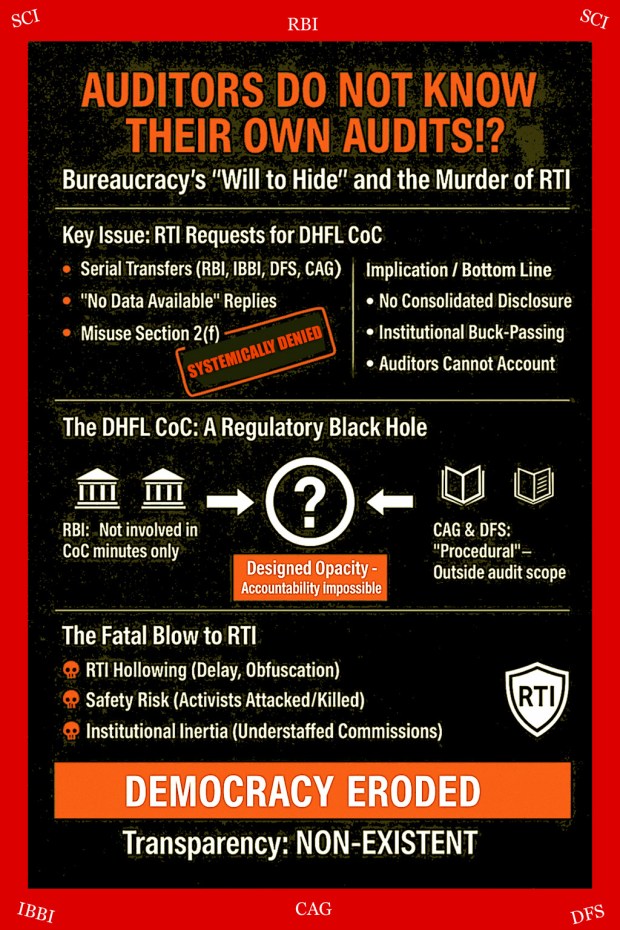
Will to Hide: Vote Theft, DHFL Scam, and the Silencing of RTI in BJP-ruled India (Video) VIEW HERE ⤡
RTI Under Siege: The Deadly Costs of Transparency in BJP-Run India VIEW HERE ⤡
12. The Suppressed Explosive Allegations: Dawood-Mirchi-RKW-Dheeraj Realty-DHFL-BJP Nexus
The Cobrapost exposé of 29 January 2019 detonated like a seismic charge, exposing one of the most disturbing alleged nexuses in India’s financial underbelly: a shadowy web linking Dawood Ibrahim, his close aide Iqbal Mirchi (a key accused in the 1993 Mumbai blasts and long suspected of terror financing), RKW Developers, Dheeraj Realty, the Wadhawan promoters of DHFL, and direct channels of political funding to the BJP.
The investigation alleged that DHFL promoters — Kapil Wadhawan, Dheeraj Wadhawan and family — had systematically siphoned over ₹31,000 crore of public money (out of nearly ₹97,000 crore in bank loans) through a sophisticated maze of shell and pass-through companies. Astronomical secured and unsecured loans were allegedly sanctioned to dubious proxy entities controlled by or linked to the promoters. These funds were then allegedly routed back to companies under the Wadhawans’ influence, with significant portions diverted for “political charity” — including massive donations to the ruling BJP.
Specific shell companies named in the exposé — RKW Developers Pvt. Ltd., Skill Realtors, and Darshan Developers — were highlighted as key vehicles for this plunder. Between 2014-15 and 2016-17, these entities allegedly funnelled nearly ₹19.5–20 crore directly to the BJP, with RKW alone contributing ₹10 crore — the single largest donation from any individual company to the party that year. Such donations by shell companies were blatantly illegal under Section 182 of the Companies Act, yet they allegedly continued unchecked.
Even more explosive were the alleged terror-financing links. RKW Developers was later placed under Enforcement Directorate scrutiny for carrying out transactions with and buying properties from the late Iqbal Mirchi. The ED alleged that RKW facilitated the sale of Mirchi’s properties in Mumbai (including a major Worli deal). One specific transaction involved Sunblink Real Estate Pvt. Ltd. (a company allegedly linked to DHFL promoters) in a ₹225 crore land deal connected to Mirchi properties, with approximately ₹190 crore allegedly routed through the hawala network. DHFL had reportedly loaned over ₹2,186 crore to firms linked to its own promoters, including Sunblink and RKW. Ranjeet Bindra, associated with RKW, was alleged to have negotiated the deals on behalf of Sunblink, finalised the transaction with Mirchi’s confidants, and received a brokerage/commission of ₹30 crore.
The Cobrapost report explicitly flagged the terror-funding angle: public deposits in a regulated housing finance company were allegedly used as a conduit in a network that touched underworld figures accused of terror financing, with the proceeds funnelling into political donations to the ruling party. The same RKW Developers that received massive DHFL funding and donated heavily to the BJP was under ED probe for its dealings with a close aide of Dawood Ibrahim — turning a regulated NBFC handling ordinary citizens’ life savings into an alleged channel for terror-linked money flows into the political system.
The timing was sinister and highly suspicious. Just one day earlier, on 28 January 2019, Ajay Piramal had publicly warned of “one or two major shocks in the NBFC sector.” The very next day the exposé landed — and within months, the regulatory hammer fell selectively on DHFL while the deeper, more dangerous allegations were systematically buried.
This suppression reveals a profound inner contradiction at the heart of Hindutwavadins.
The Sangh Parivar and its political arm have built their entire ideological edifice on virulent Islamophobia — manufacturing an “illness” that paints Muslims as existential threats, “love jihadis,” demographic invaders, and perpetual terrorists. Yet the same ecosystem allegedly facilitated the free flow of private capital through terror-linked networks in the DHFL scam, while the NDA government itself extended financial and diplomatic support to the Taliban regime in Afghanistan. In the Union Budget 2026–27, India increased its development assistance to Afghanistan from ₹100 crore to ₹150 crore. This came alongside high-level Taliban visits to Delhi (including Afghan Foreign Minister Amir Khan Muttaqi in October 2025), the acceptance of a Taliban-nominated Chargé d’Affaires at the Afghan Embassy in New Delhi in January 2026, the upgradation of India’s technical mission in Kabul to a full embassy, expanded humanitarian and health projects, and renewed trade facilitation via Chabahar port — all framed as “people-centric” aid and “pragmatic engagement without formal recognition.”
Contrast this with Pakistan’s Taliban policy. Pakistan was historically the chief patron and sponsor of the Afghan Taliban. After the Taliban’s return in 2021, relations collapsed into open hostility. The Tehrik-e-Taliban Pakistan (TTP) has surged dramatically since 2021, launching hundreds of deadly attacks inside Pakistan. In stark contrast, the NDA government in India — despite its core ideology of Hindutva and virulent public Islamophobia — has pursued calculated, pragmatic engagement with the very Taliban regime it once viewed with hostility. This is not mere policy inconsistency. This is the classic case of foregrounding religious fundamentalism while foreclosing any challenge to market fundamentalism. Religious fundamentalism is loudly foregrounded as a powerful distraction and vote-bank consolidator. Market fundamentalism — the unchecked, crony-driven free flow of private capital through shell companies, electoral bonds, opaque CoC decisions, IBC-enabled clean slates, and pragmatic aid to the Taliban for geostrategic gain — is quietly enabled, protected, and justified in the name of “national interest” and “neighbourhood first.”
Even more damning is the total institutional silence at the highest levels of national security. On 1 January 2025, a detailed open letter was sent to National Security Advisor Shri Ajit Doval calling for an in-depth, time-bound probe into the alleged underworld-BJP ties in the DHFL scam, referencing the Cobrapost exposé, ED investigations, and terror-financing links. There has been no response whatsoever — not even an acknowledgment — from the office of the National Security Advisor.
Every single RTI application seeking basic answers — investigation status, documentary evidence, forensic audit details, links between the entities, routing of funds, or action taken — was met with outright denial, evasion, or the standard bureaucratic wall of “No information available.” The RBI, Enforcement Directorate, Ministry of Home Affairs, and other concerned authorities have collectively perfected the art of looking the other way. Not one credible probe has been placed in the public domain.
- ‘False’ (?!) allegations on the collusion among the BJP, Dawood-Mirchi and the DHFL: A Letter to the BJP President VIEW HERE ⤡
- AN RTI ON THE ALLEGED COLLUSION AMONG DAWOOD-MIRCHI-RKW-DHFL-BJP VIEW HERE ⤡
- Call for an In-Depth Probe into Alleged Underworld-BJP Ties in the DHFL Scam: An Open Letter to Shri Ajit Doval VIEW HERE ⤡
This is not mere investigative failure. This is active, deliberate, state-orchestrated cover-up that exposes the hollowness of the Hindutva project itself.
Table- BJP’s Rising Assets & Donations (ADR Data)
| Financial Year | BJP Declared Donations/Income (₹ crore) | Surge |
|---|---|---|
| 2021-22 | ~6,047 | – |
| 2022-23 | ~7,053 | – |
| 2023-24 | ~9,181 | – |
| 2024-25 | 6,074 (donations alone) | +171% |
The pattern is damning and self-revealing: forensic audits flagged ₹31,000–45,000 crore in related-party diversions; Section 66 recovery applications were neutered and gifted to the new owner; promoter full-repayment proposals capable of saving every depositor were contemptuously buried; every RTI on the deeper nexus — including the terror-financing dimension — was killed at source; even a direct appeal to the National Security Advisor on a matter of alleged national security received zero response.
The message is unmistakable: certain allegations are too dangerous to investigate because they threaten to expose the rotten core of the entire DHFL-IBC operation — the toxic fusion of crony capitalism, political patronage, underworld links, and the ultimate hypocrisy of Hindutva’s manufactured Islamophobia.
When the state refuses to investigate credible allegations of terror-linked money flows into the political system through a public deposit-taking NBFC — while simultaneously extending budgetary aid to the Taliban regime it once demonised — it does not merely erode public trust. It confirms the nexus. It proves that the IBC was weaponised not to clean the system, but to bury the dirt, protect the beneficiaries, and complete the transfer while lakhs of ordinary depositors were financially annihilated.
The complete failure of RTI and institutional accountability in this matter is not technical. It is ideological. It is part of the same “will to hide” that runs through electoral bonds, PM CARES opacity, opaque CoC proceedings, judicial deference, and NHRC silence. The system protects itself at all costs.
This suppression is the ultimate confession.
If the allegations are false, why the pathological fear of transparency? Why kill every RTI? Why maintain absolute silence even from the National Security Advisor on a matter concerning national security and terror financing? If they contain even a fraction of truth, then the DHFL scam is not just crony capitalism — it is something far darker, enabled and shielded by the highest levels of power, exposing the inner contradiction of Hindutwavadins who foreground religious fundamentalism only to foreclose any challenge to their market fundamentalism.
13. Global Outlier: Why India’s IBC Stands as the Most Crony-Friendly, Predatory Insolvency Regime in the World
While the world’s major insolvency laws were designed to balance revival, equitable creditor protection, and accountability for fraud, India’s Insolvency and Bankruptcy Code 2016 was engineered as a one-way wealth-transfer machine — uniquely hostile to small depositors and unsecured creditors, uniquely forgiving to fraudsters, and uniquely deferential to a handful of powerful financial creditors.
Compare it honestly with global benchmarks.
In the United States, Chapter 11 of the Bankruptcy Code (11 U.S.C. §§ 1101–1195) is built for debtor-driven rehabilitation and preservation of the going concern. The debtor remains in possession and control as fiduciary for all stakeholders. A broad creditors’ committee (including unsecured and small creditors) participates meaningfully. Courts exercise real oversight and can reject plans that are not fair and equitable. Fraudulent transfers can be clawed back aggressively (up to two years under federal law, often longer via state law). There is no blanket “clean slate” that extinguishes criminal liability or gifts avoidance recoveries to a new owner the instant ownership changes hands. The focus is genuine reorganisation, not fire-sale handover to cronies.
In the United Kingdom, administration under Schedule B1 of the Insolvency Act 1986 and schemes of arrangement under Part 26 of the Companies Act 2006 allow restructuring with meaningful judicial scrutiny for fairness. The administrator owes duties to all creditors, not just a closed club of banks. Courts can intervene on grounds of “unfair harm.” Director disqualification and personal liability for wrongful trading remain robust. No legislative magic wand like Section 32A wipes out pre-insolvency offences or transfers the upside of fraud recoveries exclusively to the acquirer.
Singapore’s Insolvency, Restructuring and Dissolution Act 2018, Germany’s Insolvency Code (InsO), and France’s safeguard procedure similarly emphasise balanced stakeholder participation, stronger judicial review, and meaningful protections for unsecured and operational creditors. None grant an unelected Committee of Creditors (dominated by public-sector banks) near-absolute, non-justiciable “commercial wisdom” that courts are forbidden from questioning.
Nowhere else does a single statute create such a perfect storm of creditor supremacy and impunity:
- A moratorium under Section 14 that instantly freezes interest on lakhs of small depositors’ life savings while the CoC plays god.
- A statutory waterfall under Section 53 that systematically subordinates retail unsecured creditors.
- Section 32A’s retrospective corporate rebirth — a legislative clean slate so sweeping it buries fraud investigations under Section 66 and hands the entire upside of avoidance transactions to the politically connected acquirer.
- Average recoveries stuck at a dismal 31–33% of admitted claims (haircuts of 67–68%), with public banks recapitalised by taxpayers while small depositors are left with 19–23 paise in the rupee.
The IBC is not “inspired by global best practices.” It cherry-picked the harshest creditor-control elements, stripped away every meaningful safeguard for the vulnerable, and added uniquely Indian innovations — retrospective immunity for corporate crime, judicial blindness to anything labelled “commercial wisdom,” and perpetual amendments that only deepen the heist.
India’s IBC 2016 and the United States’ Chapter 11 represent two fundamentally opposing philosophies of insolvency law.
| Aspect | US Chapter 11 (11 U.S.C. §§ 1101–1195) | India IBC 2016 |
|---|---|---|
| Philosophy | Debtor-driven rehabilitation; preserve going concern | Creditor-driven resolution/liquidation; strict timelines |
| Control of Business | Debtor-in-Possession (DIP); existing management continues as fiduciary | Insolvency Professional takes over; promoters/board suspended |
| Creditor Role | Broad creditors’ committee (includes unsecured creditors); advisory & negotiating role | Committee of Creditors (CoC): financial creditors only; near-absolute “commercial wisdom” power |
| Judicial Oversight | Strong court supervision; plans must be fair & equitable | Limited review; CoC decisions largely non-justiciable |
| Timelines | Flexible (often 6–24+ months) | Rigid (180/330 days); extensions rare |
| Fraud & Avoidance | Robust clawback of preferential & fraudulent transfers (up to 2 years, longer via state law) | Section 66 exists on paper but buried by Section 32A clean slate |
| Clean Slate / Immunity | No automatic extinguishment of pre-petition offences or director liability | Section 32A: sweeping retrospective immunity to corporate debtor & new owner |
| Small Creditors | Broader participation; unsecured creditors have voice | Retail/unsecured (e.g., FD holders) systematically subordinated |
| Outcome Focus | Genuine restructuring possible; debtor can propose plan | Majority resolutions = change of control/sale to new owner |
Core Contrasts in Practice
- Control & Management: Chapter 11 keeps the debtor in possession so the business can continue operating under court protection. In contrast, IBC immediately hands control to an Insolvency Professional and empowers the CoC to dictate the future.
- Power Imbalance: In Chapter 11, a broader creditors’ committee negotiates. Courts can reject plans that are unfair. Under IBC, the CoC’s “commercial wisdom” is almost sacred — courts rarely interfere.
- Treatment of Fraud: US law aggressively claws back fraudulent or preferential transfers to protect the estate for all creditors. IBC’s Section 66 promises the same, but Section 32A delivers complete immunity upon plan approval.
- Speed vs. Substance: IBC’s obsession with timelines often forces fire-sale resolutions. Chapter 11’s flexibility allows complex, value-preserving restructurings.
DHFL. A solvent housing finance company was dragged into IBC, turned into a controlled experiment, and handed over after brutal haircuts to small depositors (19–23 paise in the rupee). Section 32A erased liabilities. CoC supremacy prevailed. No equivalent outcome would be acceptable under Chapter 11, where debtor continuity, broader stakeholder input, and strong anti-fraud tools would have protected depositors far better.
Chapter 11 prioritises rehabilitation, fairness, and judicial balance. The IBC prioritises speed, bank recovery, and crony handover. It cherry-picked the harshest creditor-control elements from global models, stripped safeguards for the vulnerable, and added uniquely toxic Indian innovations like retrospective corporate amnesia.
This is not “best practice.” This is a predatory outlier designed for wealth transfer from the public to the powerful.
The global evidence is clear. The Indian experience is grotesque proof.
The ill-conceived IBC has no legitimacy among modern insolvency regimes. It must be revoked completely.
14. The Silent Massacre of MSMEs: How the IBC Became a Death Machine for India’s Backbone Economy
While the IBC was marketed as a saviour for stressed assets and a tool to restore credit discipline, it has functioned as a silent executioner for India’s Micro, Small and Medium Enterprises (MSMEs) — the real engine of employment, innovation, and economic resilience.
MSMEs constitute over 7.47 crore registered enterprises, contribute 31.1% to India’s GDP, account for 35.4% of manufacturing output and 48.58% of exports, and employ more than 32.82 crore people (Economic Survey 2025-26 and Ministry of MSME data as of December 2025). Yet under the IBC regime, they have been reduced to collateral damage in a creditor-driven slaughterhouse.
As operational creditors (suppliers, vendors, service providers), MSMEs sit at the very bottom of the IBC’s ruthless waterfall mechanism under Section 53. Financial creditors (mostly public-sector banks) dominate the Committee of Creditors and exercise near-absolute “commercial wisdom.” The result is predictable and devastating:
- Operational creditors routinely receive negligible or zero recovery — often far below even liquidation value.
- In numerous documented cases, MSME suppliers have recovered as little as 0.19% of their claims while financial creditors walked away with 7–30% or more.
- Overall IBC recovery rates hover around 31–33% of admitted claims (31.63% in Q3 FY26 per CARE Ratings, down marginally from 32.44% in Q2 FY26), translating to haircuts of 67–68% — with MSMEs bearing the heaviest burden.
- Thousands of viable but liquidity-stressed MSMEs have been pushed into liquidation rather than genuine revival. High process costs, rigid timelines, and CoC dominance make meaningful restructuring almost impossible for small entities.
The much-touted Pre-Packaged Insolvency Resolution Process (PPIRP) introduced in 2021 specifically for MSMEs has been a spectacular failure. As per the Economic Survey 2025-26 and IBBI data, only around 13–17 cases have been admitted under PPIRP in nearly five years, with very few reaching successful resolution. Low uptake is attributed to procedural complexity, high costs, lack of awareness, tax traps on haircuts (treated as taxable income), creditor reluctance, and the requirement of pre-registration under the MSME Development Act (which excludes the vast majority of informal MSMEs).
Most MSMEs still end up in regular CIRP or liquidation, losing both their business and their dues.
The IBC’s design actively works against MSMEs:
- The moratorium under Section 14 acts as a weapon: it freezes operations and payments to small suppliers while big banks negotiate sweetheart deals.
- CoC supremacy excludes MSME voices from decision-making. Their fate is decided by banks that have already taken massive haircuts (later socialised via taxpayer recapitalisation exceeding ₹3 lakh crore since 2015).
- Section 32A’s clean slate protects new owners but leaves operational creditors with nothing.
- Fire-sale outcomes see assets sold at throwaway prices to larger players, destroying local supply chains and livelihoods.
A solvent or temporarily stressed MSME dragged into this machinery rarely emerges alive. It is either liquidated or handed over after brutal value destruction — jobs lost, families ruined, communities devastated. The very entities that form the backbone of “Make in India” are being systematically culled to protect big-bank balance sheets and enable crony takeovers.
Recent IBBI studies (April 2026) acknowledge the systemic bias and have called for reforms such as claim aggregation for operational creditors and a quasi-absolute priority rule to improve MSME outcomes — an implicit admission that the current framework has failed the sector.
This is not resolution. This is structural annihilation of small enterprise in favour of concentrated corporate power.
The IBC did not empower MSMEs — it disempowered them. It did not promote ease of doing business for the millions — it created ease of looting for the few. While large connected entities receive “commercial wisdom” protection and clean slates, the small entrepreneur faces existential wipeout.
The numbers don’t lie. The human cost is incalculable.
The IBC’s impact on MSMEs stands as yet another damning proof of its predatory DNA. It was never designed to save businesses or protect jobs. It was designed to transfer value upward — from small suppliers and depositors to big financial creditors and politically networked acquirers.
15. The IBC in the Pantheon of NDA Failures: A Pattern of Predatory, Undemocratic Governance (2014–2026)
The IBC is not an isolated monstrosity. It is the crown jewel in a decade-long architecture of predatory governance that has systematically betrayed the people of India.
From 2014 to 2026, the NDA regime has unleashed a relentless series of policy disasters — each rushed through Parliament with minimal or zero debate, each sold with grand jumlas, each ultimately transferring pain to the common citizen while rewarding cronies and entrenching power.
Demonetisation (2016) devastated the informal economy, killed over 100 people in cash queues, wiped out lakhs of livelihoods, and achieved nothing except funnelling public hardship into private digital infrastructure. Azim Premji University’s State of Working India reports and CMIE data estimated that it caused the loss of over 10 million jobs in the informal sector in the immediate aftermath, with GDP growth contracting sharply in Q4 2016–17.
GST (2017), passed without meaningful discussion, imposed a compliance nightmare on MSMEs, triggered massive fraud in input tax credits, and widened inequality while favouring large corporates. The Comptroller and Auditor General (CAG) has repeatedly flagged irregularities in GST refunds and input tax credit claims running into thousands of crores.
Farm Laws (2020) were bulldozed through Parliament in the dead of night, sparking the largest peaceful protest in human history and only repealed after over 700 farmer deaths. Labour Codes were similarly rammed through with virtually no debate, stripping workers of hard-won protections and handing gig-economy cronies a free hand. Electoral Bonds (2018–2024) — the ultimate “Chanda Do, Dhanda Lo” mechanism — legalized anonymous bribery on an industrial scale, funnelling thousands of crores from shell companies to the ruling party while regulators looked the other way.
The IBC fits perfectly into this pattern of failure. Like Demonetisation, GST, the Farm Laws, and Electoral Bonds, it was aggressively marketed as a revolutionary fix. Like the others, it was designed to socialise losses while privatising gains for the connected few. Like the others, it bypassed genuine debate, subordinated constitutional rights to “commercial wisdom,” and shielded itself through institutional opacity, RTI stonewalling, NHRC silence, and judicial deference.
This is not governance. This is engineered dispossession on a national scale.
The World Inequality Report 2026 and Oxfam reports confirm the devastating outcome of this governance model: India remains among the most unequal large economies in the world. The top 1% holds approximately 40% of national wealth, while the top 10% captures 65% of total wealth and 58% of national income. The bottom 50% receives just 15% of national income. Inequality has reached levels not seen in a century, with billionaire wealth exploding even as millions struggle with joblessness and stagnant wages.
Yet in the interest of truth, the regime did deliver two undeniable technological achievements: the revolutionary UPI ecosystem that made India a global leader in digital payments and a massive push in renewable energy capacity that positioned the country among the top performers worldwide. These successes, however, cannot mask the deeper rot — they were built on the same centralised, undemocratic model that produced the IBC heist. Technological leaps mean little when life savings are looted, MSMEs are massacred, unemployment remains structurally high, inequality has reached colonial-era levels, and constitutional institutions stand captured.
The IBC is therefore not merely another failure — it is the logical culmination of a decade of policies that treat the Indian people as collateral damage in the pursuit of crony consolidation and electoral dominance. Demonetisation destroyed cash. GST strangled small business. Farm laws assaulted farmers. Labour codes weakened workers. Electoral bonds bought impunity. And the IBC perfected the art of turning public deposits and public banks into private empires.
16. Call for Action: The Manifesto of Gandhian Non-Violent Civil Disobedience Movement
Enough is Enough.
The Insolvency and Bankruptcy Code 2016 is not a reform — it is a criminal enterprise wrapped in legislative clothing. It has institutionalised the greatest loot of public wealth since Independence. It cannot be amended, repaired, or “strengthened.” It must be completely revoked, rescinded, annulled, abrogated, cancelled, invalidated, overturned, abolished, and scrapped — root, branch, and every toxic provision, especially the unconstitutional monstrosity called Section 32A.
We, the victims of DHFL and every other IBC atrocity, along with all conscious citizens who refuse to watch their nation being looted, hereby launch a web-based Gandhian Non-Violent Civil Disobedience Movement — a Satyagraha for economic justice and constitutional restoration.
Our Unbreakable Resolve
We will deploy the invincible power of Truth-Force (Satyagraha) through a structured, multi-pronged national campaign of collective resistance:
- Dharna and Occupation: Peaceful, continuous satyagraha outside the offices of NCLT, NCLAT, Supreme Court, RBI, IBBI, and the Ministry of Finance — sustained day and night, week after week, until the IBC is repealed.
- Mass RTI Campaign: Coordinated, relentless flood of applications demanding every hidden CoC minute, forensic report, electoral bond trail, and suppressed investigation, turning the RTI machinery into a weapon of mass transparency.
- Human Rights Offensive: Mass complaints before NHRC, UN bodies (OHCHR and Special Rapporteurs on extreme poverty and human rights), and courts, declaring the IBC a systemic violation of Article 21 and economic human rights.
- Targeted Economic Boycott: Disciplined boycott of crony banks and corporations that have profited from this plunder, combined with consumer and depositor pressure campaigns.
- Unceasing Exposure: Relentless public naming and shaming of the nexus, the opacity, the judicial compromise, and the suppressed allegations through digital platforms, street theatres, and people’s tribunals.
This movement is far larger than any single scam or victim group. It is a structural and systemic fight against the entire architecture of predatory, undemocratic governance. It draws inspiration from global non-violent resistance movements that successfully challenged entrenched power: Gandhi’s Salt Satyagraha that broke the British monopoly, the Occupy Wall Street movement that exposed financial oligarchy, the Arab Spring’s demand for dignity against crony regimes, the Chipko and Narmada Bachao Andolan struggles that protected the rights of the marginalised, and recent climate and anti-corruption movements worldwide that proved sustained, non-violent collective pressure can force systemic change.
We will not be silenced by SLAPP suits, threats, or propaganda. We will not surrender our dignity or our savings to cronies and their political patrons.
Satyagraha shall continue — peacefully, relentlessly, and with iron determination — until the following non-negotiable demands are met:
- Total repeal of the Insolvency and Bankruptcy Code 2016.
- Permanent burial of Section 32A and all clean-slate impunity.
- Full restitution with compound interest to every DHFL depositor and all IBC victims.
- Complete transparency and criminal accountability for the RBI-appointed CoC, suppressed fraud investigations, and the entire DHFL scam.
- Enforcement of Section 66 to the full benefit of all creditors without discrimination, so that recoveries from fraudulent and wrongful trading are restored to the corporate debtor’s estate in the interest of natural justice.
- Restoration of constitutional supremacy over the doctrine of “commercial wisdom.”
The people’s money was stolen under the colour of law. The people will now take it back through the power of non-violent resistance.
This is our Manifesto: We shall occupy the streets with truth. We shall flood the system with light. We shall expose every lie. We shall not rest until justice is delivered.
Scrap IBC Completely. Return the People’s Money. Revoke the Crony Heist. Restore the Republic.
The Non-Violent Civil Disobedience Movement begins NOW.
Manifesto for Scrapping the Ill-Conceived Insolvency and Bankruptcy Code (IBC) 2016 VIEW HERE ⤡
Challenging the IBC: No Shortcuts, No Surrenders! (DIGITAL POSTERS) VIEW HERE ⤡
Scrap Ill-conceived Insolvency and Bankruptcy Code (IBC), 2016! VIEW HERE ⤡
17. Conclusion: The IBC Stands Condemned – Revoke This Predatory Code Now
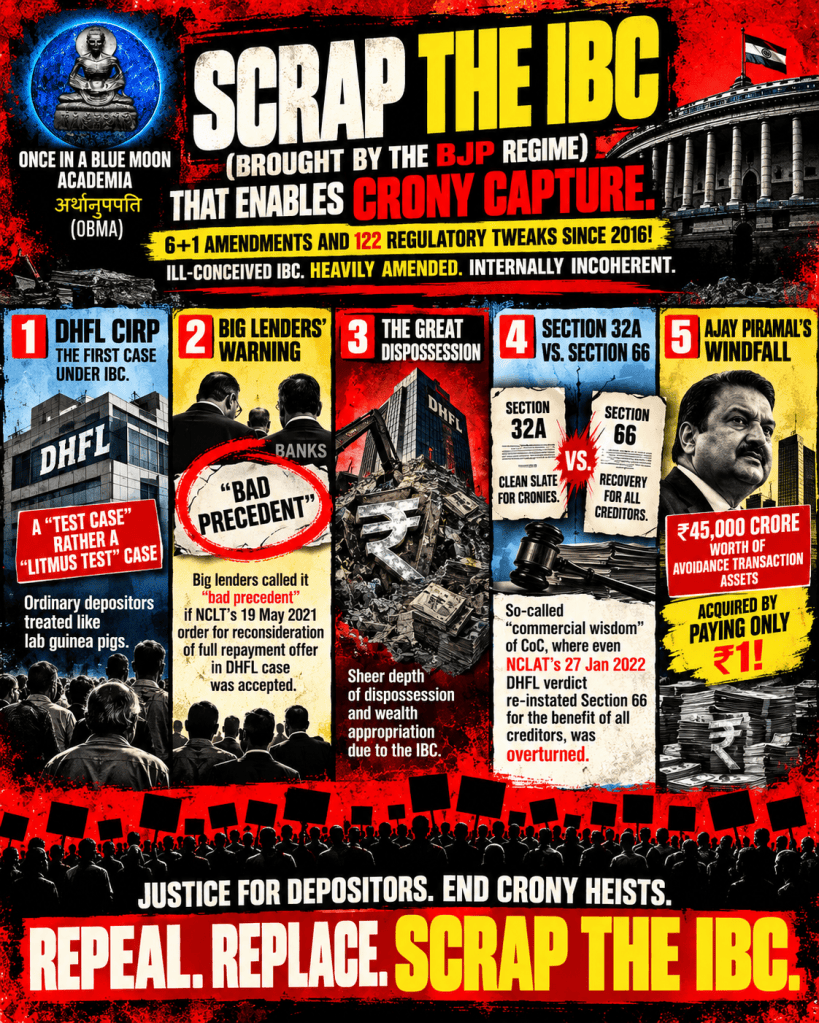
The time for analysis is over. The verdict is clear and irreversible.
The Insolvency and Bankruptcy Code 2016 stands fully condemned as one of the most predatory instruments of crony capitalism engineered in post-Independent India. It has institutionalised a grand, systematic heist that must now end.
We, the victims, the depositors, the MSME entrepreneurs, the workers, and every conscious citizen who still believes in economic justice and constitutional democracy, hereby declare that this ill-conceived Code has no future in our Republic. It must be de jure revoked, rescinded, annulled, abrogated, cancelled, invalidated, overturned, abolished, and scrapped in its entirety — root, branch, and every toxic provision.
The road ahead is one of restoration and reconstruction. Once the IBC is repealed, we will rebuild a new insolvency framework grounded in constitutional morality — one that protects the vulnerable, holds fraudsters accountable, ensures genuine revival over fire-sale plunder, and places the rights of small depositors, workers, and MSMEs at its core. We envision a system where public deposits are treated as sacred trust, not collateral for crony empires; where justice is not outsourced to “commercial wisdom,” but rooted in fairness, transparency, and the fundamental rights of every citizen.
This is not merely a demand for repeal. It is a call for the rebirth of economic democracy in India — where the hard-earned savings of ordinary people are no longer sacrificed at the altar of crony capitalism, where institutions serve the many and not the few, and where the rule of law triumphs over the rule of the powerful.
We reaffirm our commitment to a sustained, nationwide Gandhian Non-Violent Civil Disobedience Movement. Through satyagraha, mass mobilisation, relentless exposure, and collective resistance, we will occupy public spaces, flood institutions with truth, and continue the struggle until every stolen rupee is returned with justice and every victim is made whole.
The people’s money was stolen under the colour of law. The people will now reclaim it through the invincible power of Satyagraha.
References and Sources
- IBBI Quarterly Reports (up to December 2025) – https://ibbi.gov.in/reports
- CARE Ratings – IBC Recovery Analysis Q3 FY26 – https://www.careratings.com/
- RBI Data on Wilful Defaulters placed before Parliament (March 2026)
- Supreme Court Judgment dated 1 April 2025 in Piramal Capital & Housing Finance Ltd. v. 63 Moons Technologies Ltd. (2025 INSC 421) – https://main.sci.gov.in/
- NCLAT Order dated 27 January 2022 (DHFL matter) – https://nclat.nic.in/
- Association for Democratic Reforms (ADR) – Electoral Bonds Full Data Analysis (2024) – https://adrindia.org/content/electoral-bonds-data
- Election Commission of India / SBI Electoral Bonds Disclosure (March 2024) – https://eci.gov.in/electoral-bonds
- World Inequality Report 2026 (World Inequality Lab) – https://wid.world/world-inequality-report-2026/
- Oxfam India Inequality Report 2025-26 – https://www.oxfamindia.org/report
- Economic Survey 2025-26 (MSME Chapter & Overall Economy) – https://www.indiabudget.gov.in/economicsurvey/
- GANHRI Sub-Committee on Accreditation Recommendation on NHRC (March 2025) – https://ganhri.org/
- Paris Principles on National Human Rights Institutions – https://www.ohchr.org/en/instruments-mechanisms/instruments/paris-principles
- Union Budget Documents (2015–2026) – Public Sector Bank Recapitalisation – https://www.indiabudget.gov.in/
- IMF Article IV Consultation Reports on India (2024–2025) – https://www.imf.org/en/Countries/IND


Sir,
I tried to post my comments(as below) on website but got remarks “Sorry your comments cannot be posted”
You have been doing highly appreciable hardwork by since last 6 years found countless proofs and loopholes (which had played vital role in DHFL scam) through which our lifelong hard earned saved money was swallowed by Piramals, Wadhwans, ministers of ruling party at centre on equal sharing ratio with the help of concerned authorities which turned to be FRUITLESS.
You have left no stone unturned to prove the faults of guilty persons, appealed all top authorities, ran piller to post for recovery but all went into vain turned to deaf ears. When rulers/top leaders and ministers of our country are involved in DHFL scam, why they will show their support/sympathy/humanity?
We (common , innocent, poor people of India) have been trapped by BJP into the VICIOUS CIRCLE & it will be QUITE IMPOSSIBLE to come out and now if we still expect favour from ruling party or concerned authorities, they will consider us that we are living in fool’s paradise.
Now ONLY INTERNATIONAL COURT OF JUSTICE can help us but that too requires unity with joint efforts among DHFL FD/NCD HOLDERS which is again IMPOSSIBLE.
Now we have no other alternative than to assume that some decoits (BJP ministers) came to our house and looted our money and forget it for our mental peace.
Regards,
Ravindra Mahidhar
LikeLiked by 1 person