
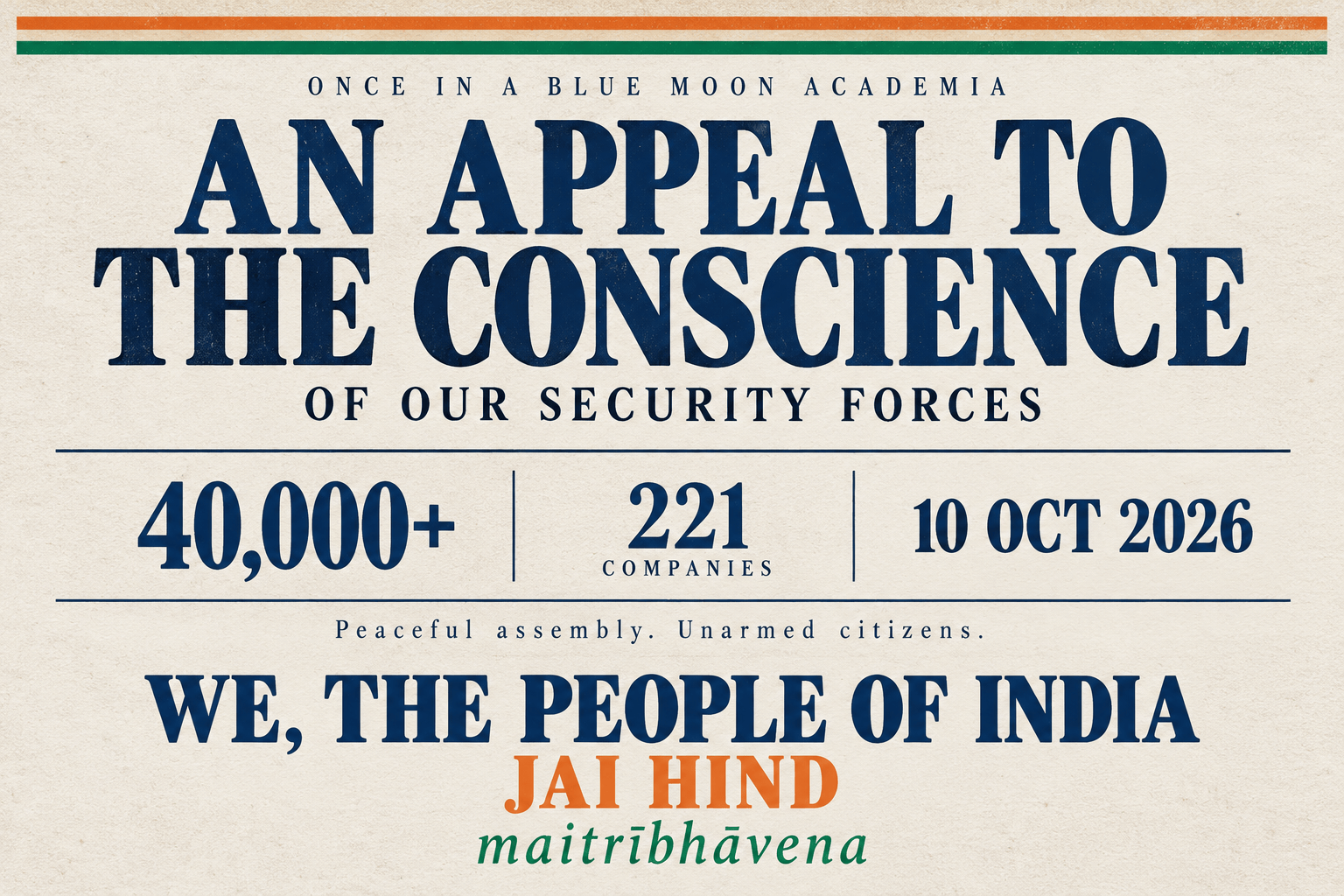
On 10 October 2026, as unarmed citizens, students and opposition voices gather at Jantar Mantar in peaceful civil disobedience, the State has assembled more than 40,000 Delhi Police and Central Armed Police Forces personnel, detention centres, facial-recognition cameras and metro closures against them. Once in a Blue Moon Academia appeals to those in uniform, not as adversaries but as fellow citizens, to let conscience precede command, to refuse the police state the last word, and to stand with the constitutional right to dissent.
Category Archives: Activities
Our current activities concentrate on the case of Dewan Housing Finance Corporation Limited (DHFL), India. While exploring and investigating this particular case, we have found that India’s crony ruling party, gangsters, banksters as well as religious gurus and institutions are involved in the same. Therefore, to break such collusion, we have decided to deploy an “all out attack” on the existing paradigm of neoliberal market economy as well as market fundamentalism. ***DISCLAIMER: We have collected all the data from available sources on the internet as given on the official portals of media houses, websites and institutions and organizations. We are not first-hand reporters and hence, we are not liable for any inadvertent error or value-loaded statements made on those portals. All propositions have to be viewed as descriptive assertions on the given point of concern.***
A Glimpse into Saffron Fascism: The RSS and the Sangh
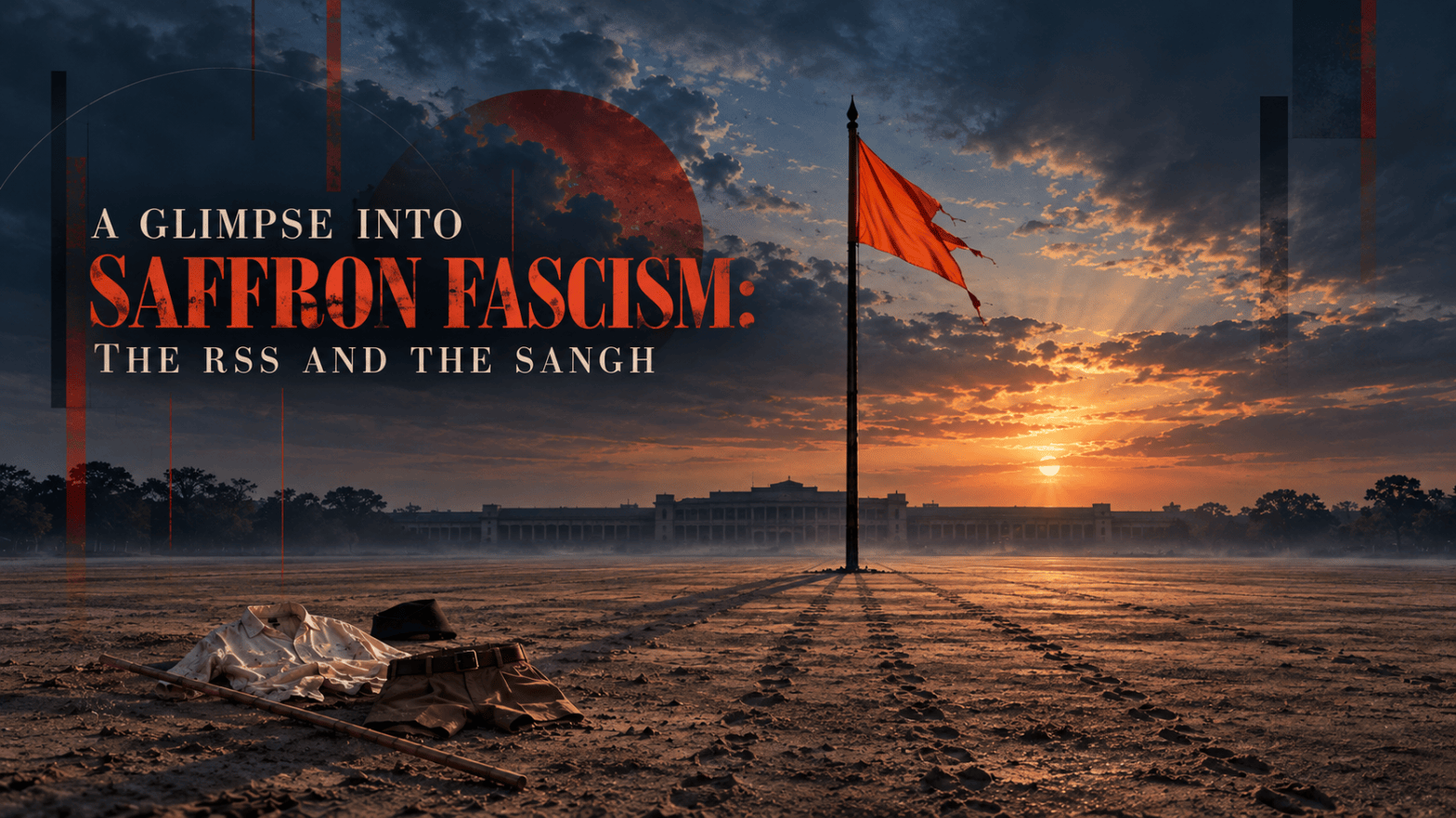
This exposé treats the Rashtriya Swayamsevak Sangh (RSS) and its Sangh Parivar not as mere faith but as a political technology: a durable and unregistered apparatus for manufacturing majoritarian-theocratic consent, disciplining populations and capturing the state. Scaffolded by Althusser, Gramsci, Foucault and Durkheim, it follows the organisation from its 1925 founding and abstention from the freedom struggle through Golwalkar’s programme of subordination without citizen’s rights, the semitisation of a colonial umbrella-term, “Hinduism,” into a pasteurised monolith, and the Akhand Bharat imagi-nation in which Partition is a wound and “go to Pakistan” a confession that the map is a poster. It tracks the saturation of civil society by more than fifty affiliates, the money without a ledger, the drills and the arms, the gendered order of Durga and Sita, the caste contract Meghwanshi watched fail at his own kitchen, and the documented violence against Muslims, Christians, Dalits and women, made costless by a reproducible impunity loop and extended, on paper, through the CAA, the NRC and the voter-roll revision. As a whole, this work adds the insider record of those who left, a sourced Register of the Dead and Harmed with the legal status of every case as it stood on 2 October 2026, and the questions the Sangh has never answered. It demands that the RSS, thrice banned and never reformed, be proscribed and its enforcement wings dissolved. The centenary count, more than 83,000 daily shakhas in 2025, claimed to be rising toward 89,000 in 2026, is taken not as tribute but as a confession of scale.
Money Taken, Votes Taken, SLAPPed: A DHFL Retrospective
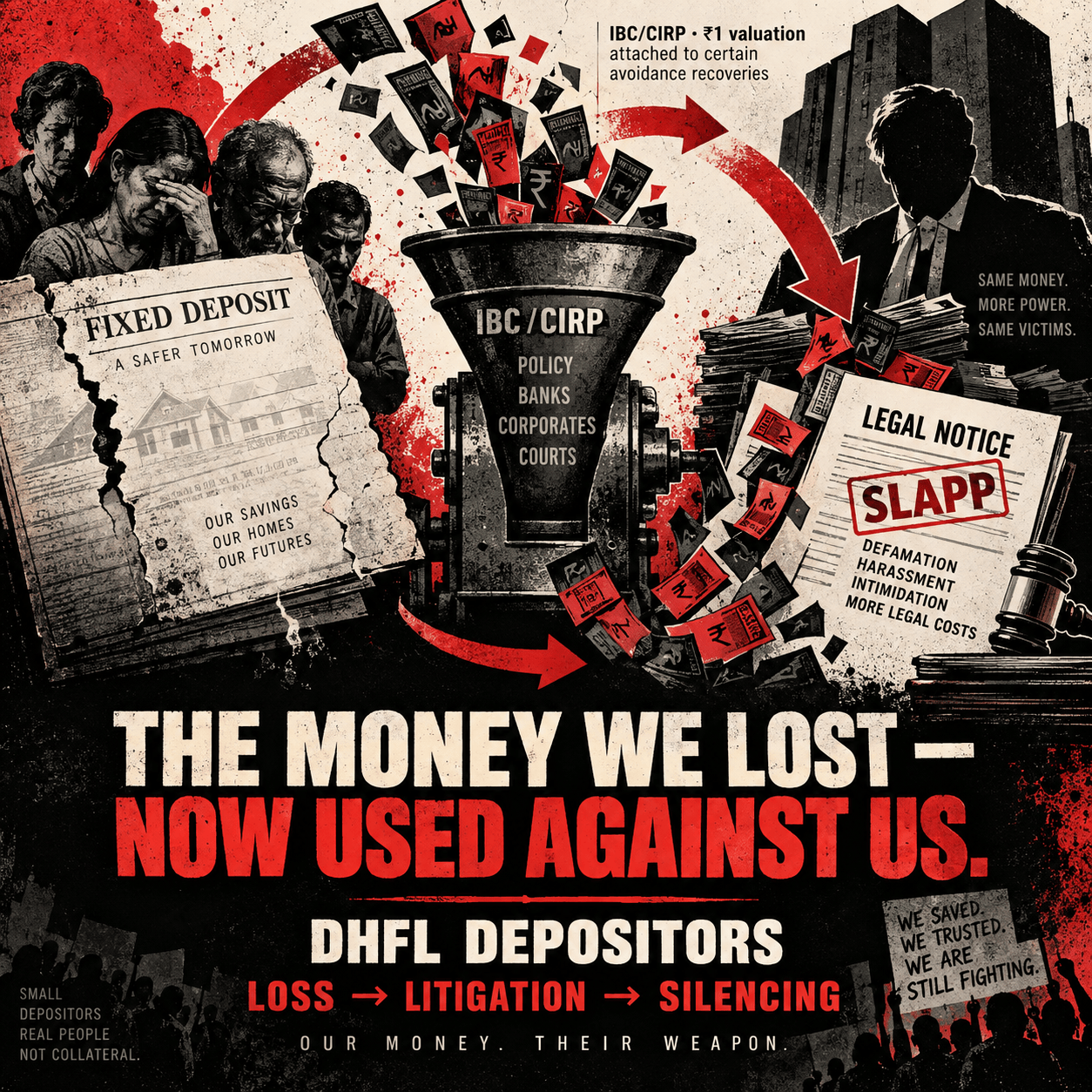
On 24 September 2026 we write in the light of The Indian Express report: two Election Commissioners of India objected fourteen times to roll changes, Form 6 and control of the voter database, while the Election Commission of India still called every decision unanimous. We have watched the same grammar inside the DHFL CoC. A vote is manufactured, dissent is filed away, and the person on the line is told the count is final. Depositors recovered 23 percent; Oaktree’s stronger bid was set aside; Ajay Piramal took fraud-recovery claims estimated at ₹45,000 crore for ₹1. Multiple RTIs produced no figure for CIRP costs. Then Piramal Capital sued us for ₹100 crore — a SLAPP of defamation and contempt against research and RTIs. Money taken. Votes taken. Then the summons.
The Goonda Returns: How a Category Became a Statute (Again!)
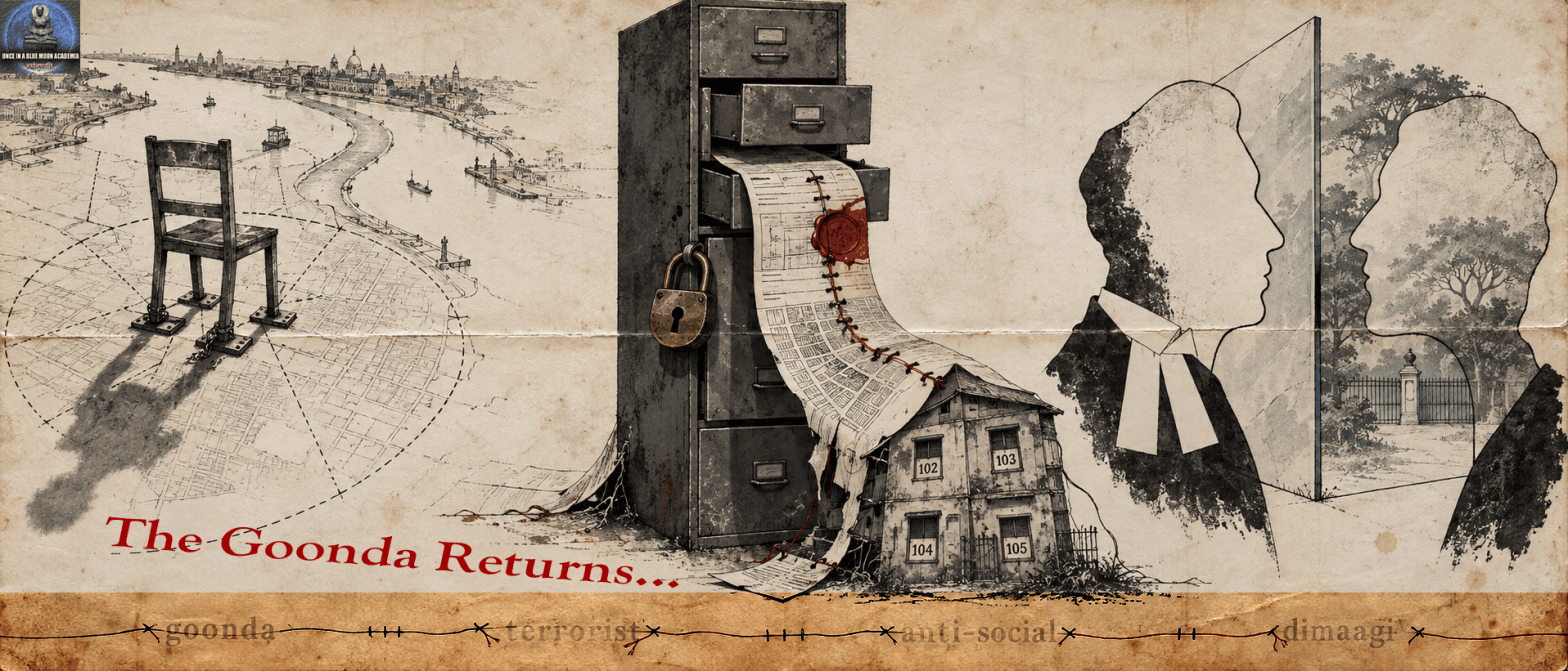
On 13 July 2026 West Bengal’s new BJP government announced that the Public Safety and Control of Anti-Social Activities Act (gunḍā-damana) and the Maintenance of Public Order (Amendment) Act were in force. The first allows twelve months’ charge-free detention of anyone a magistrate or commissioner deems a reputational “goonda,” criminalises harbouring the externed, and permits year-long district banishment. The second lets a Claims Commission attach and auction the property of alleged rioters and of protest organisers, financiers, instigators and logistical supporters, up to twice assessed damage. A High Court bench later treated the Public Safety instrument as still awaiting assent; the government had already declared midnight commencement. The article reads both statutes as Bengal’s own colonial archive reprinted — Regulation III of 1818, Rowlatt 1919, the Goondas Act 1923, the 1929 Safety Bill against which Bhagat Singh timed the Assembly bombs — and as a Foucaultian status crime. Against ICCPR Articles 9, 12, 14, 15, 19, 21–22, General Comment 35 and CCPR/C/IND/CO/4 (2024), the design fails at every limb; India’s 1979 Article 9 declaration does not shelter what Article 22 never required. The same circuit is the impunity loop mapped in OBMA’s DHFL and bulldozer work. A coda tests damana against daṇḍanīti, sets ADR affidavits inside the definition, and reads anyonya-pratibimba, Barthesian myth, and the July naming of Forward Bloc as goonda as a category that cannot close. It ends with a protocol: document the order, litigate the interior, internationalise now, count who is named, protect the harbourer. The goonda of the file is not the person. The second file is the remaining procedure.
Maoists Without Mao: The Misnomer of Indian ‘Maoism’
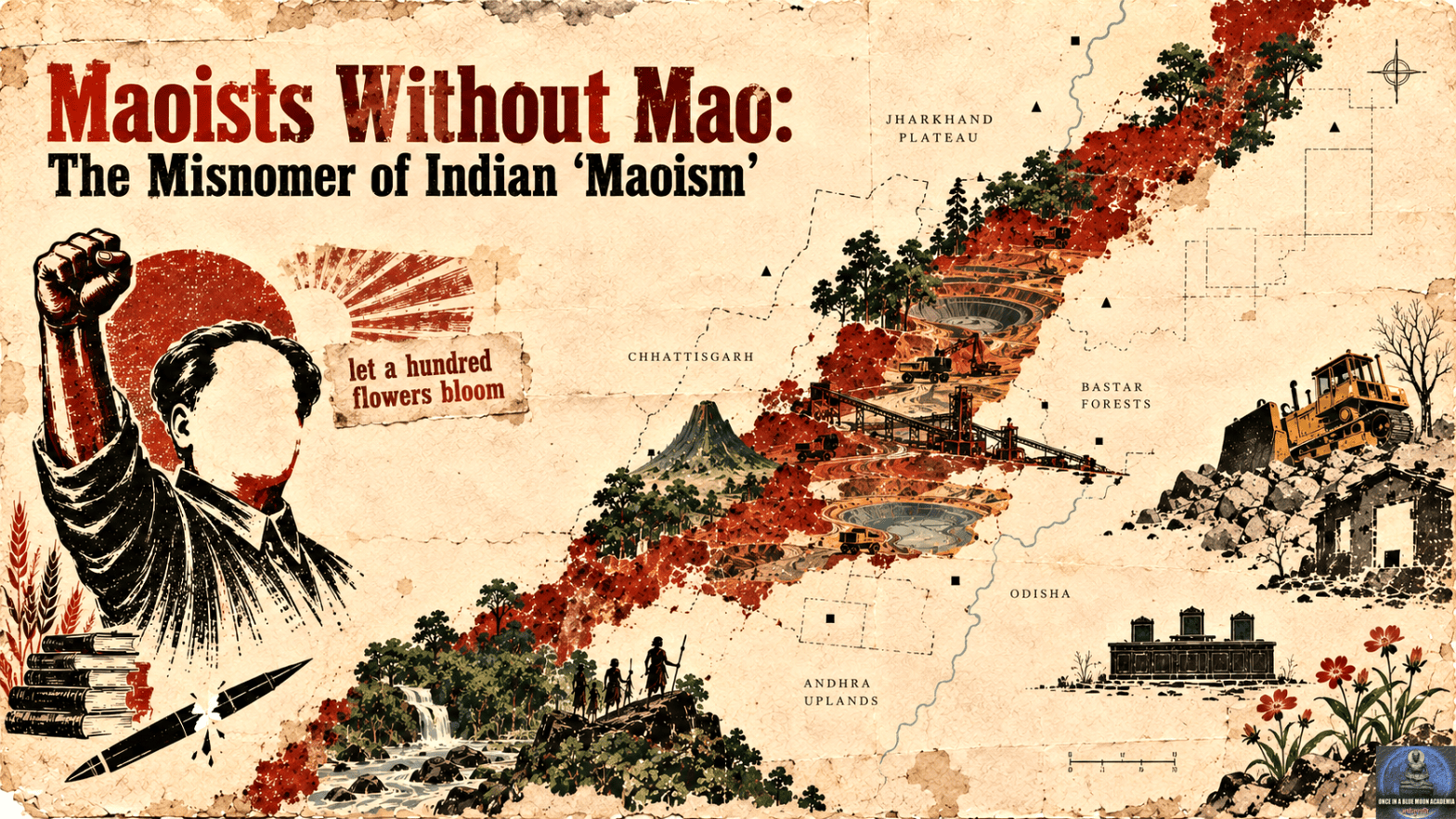
India’s so-called Naxalite–CPI (Maoist) “insurgency”, declared “effectively finished” around 2026, is called “Maoist” by the state, the press, and the movement itself; this article treats that name as a misnomer that does ideological work. It reconstructs Mao’s actual method — concrete analysis in On Practice and On Contradiction, the gun-and-pen doctrine of Yan’an, sinification rather than imported catechism, self-reliant base areas, a restless Confucian–classical substratum, and the brief Hundred Flowers opening toward a plural field of standpoints later formalised, in another idiom, as overdetermination by Althusser — and shows that the Indian movement kept the words and dropped the grammar: iconolatry (“China’s Chairman is India’s Chairman”), MLM as a frozen universal system, Gutian-condemned annihilationist militarism, and a parasitic levy-and-loot economy on a mineral frontier that is not the feudal countryside the doctrine presupposes. The name was decided; the referent would not coincide with Mao. Mapping the Red Corridor onto bauxite, iron, coal, chromite and uranium, and walking Bastar, Kalinganagar, Niyamgiri and Jadugoda through Marx, Sanyal and Levien on primitive accumulation and the need economy, it argues that “Maoist” functions as a security brand affixed to Adivasi resistance to ecological dispossession, while Foucault’s warning about people’s courts is inverted in bulldozer (in)justice. What remains is a compound the doctrine cannot cover: a frontier defence of jal–jangal–zameen, a Blanquist core, the armed edge of the governed. The brand erases the dispossessed subject the conflict was about.
“RUPP Tera Mastana”: Shell Parties and Simulacra
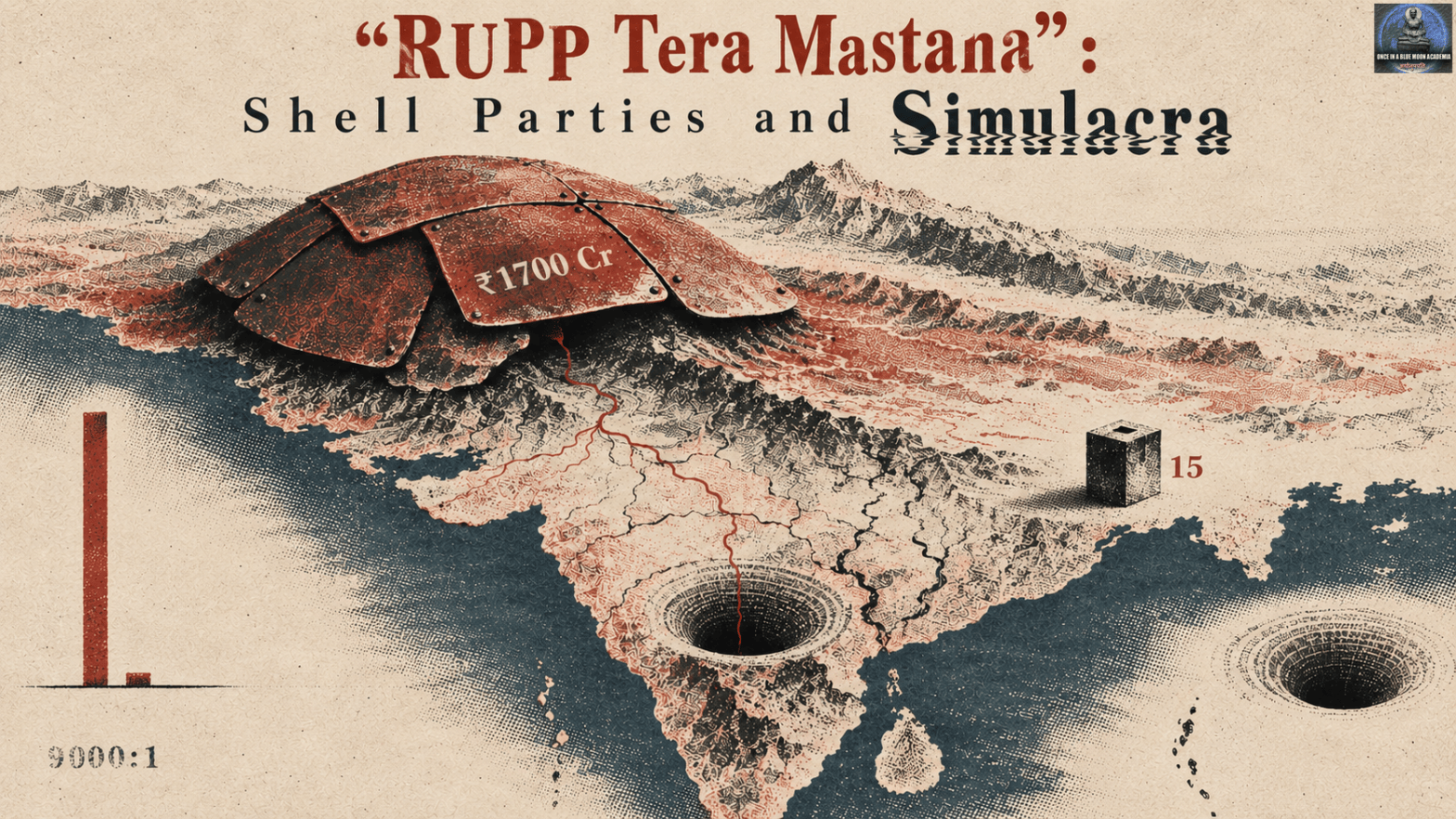
This article argues that a growing subclass of Indian parties is not janaseva (public service) but a fiscal enterprise—the party as limited company—whose tax and registration privileges are harvested whether or not it fights an election. The 2025 BBC News Hindi investigation of six Gujarat Registered Unrecognised Political Parties (RUPPs) is the entry: about ₹1,700 crore in FY 2023–24 donations against fifteen Lok Sabha candidates. From that mismatch it names the shell party, analogue of the shell company: a valid, vacant recipient whose use is fiscal (or, as with the NCPI merger of twenty TMC MPs, parliamentary). A four-provision interlock—RPA 1951 §29A; Income Tax Act §§13A, 80GGB, 80GGC; Companies Act §182—run in reverse, turns taxable income into a deduction plus cash after commission. The same lawful opacity is set beside electoral bonds and their afterlife in trusts, PM CARES as an un-askable receptacle, Tenth Schedule “mergers” that launder benches, and, as ED allegation not verdict, the DHFL–RKW–Mirchi–Dawood chain beside ₹27.5 crore declared to the BJP. Letterheads out-raised every national party except the ruling one. Read as Baudrillard’s simulacrum and Habermas’s legitimation crisis—including the public charge of vote chori—the register simulates pluralism while hollowing representation. Reform only reshapes the shell. Equal to the climate polycrisis is a bioregional, moneyless, partyless commons.
খাওয়া-দাওয়ার রাজনীতি আর ইয়াং বেঙ্গল
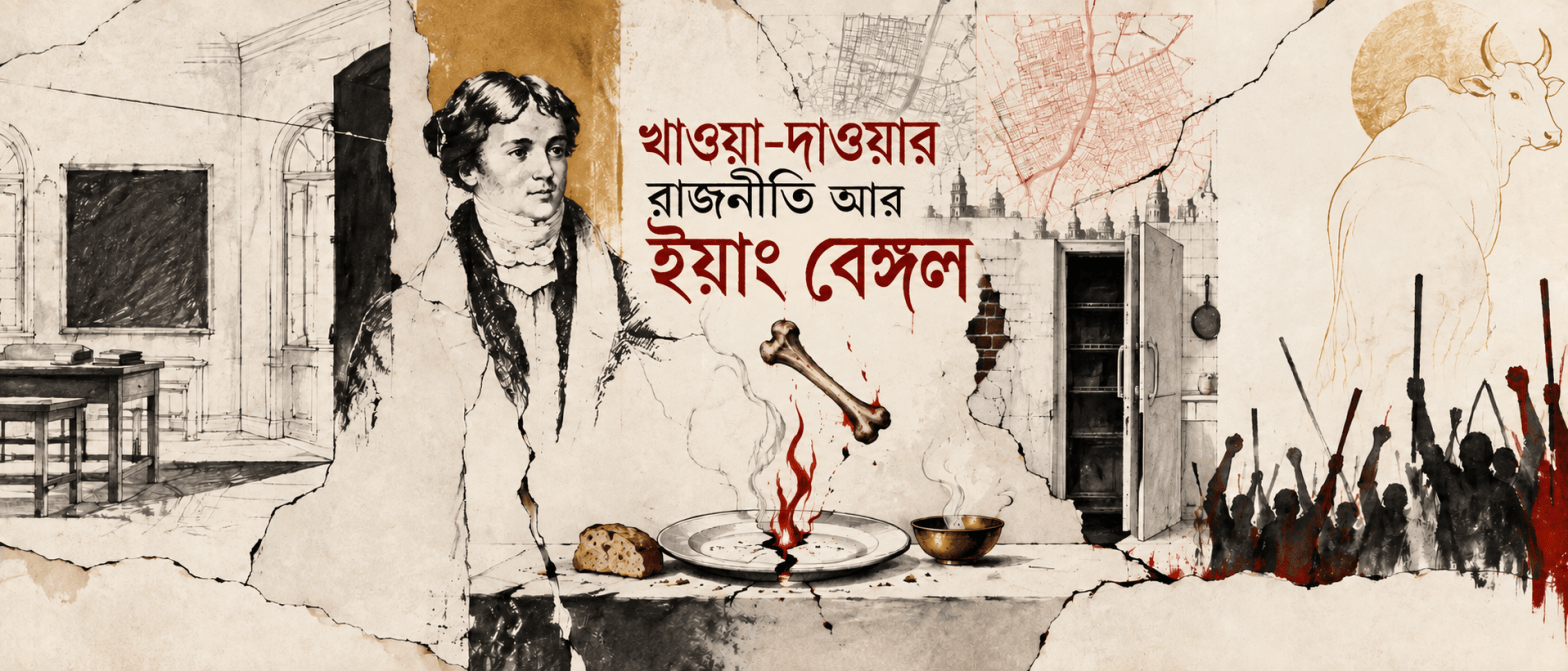
থালার ওপর রাষ্ট্র চেপে বসা-মাত্রই গেরুয়া ফ্যাসিবাদ সরাসরি রান্নাঘরে ঢুকে পড়েছে। এই লেখা সেই “ঢুকে পড়বার” খবরাখবর দেয়—গোরক্ষার নামে ব্যাপক খুনোখুনি, “সনাতন” খাদ্যবিধির জবরদস্তি, আমিষ (বিশেষত গোমাংস)-ত্যাগের জোরজুলুম, আর সেই ভয়ের রাজনীতির বিপ্রতীপে হাজির হওয়া দুশো বছর আগের ইয়াং বেঙ্গল। ডিরোজিওর ছাত্র-সহযোদ্ধারা বউবাজারের গলিতে গরুর হাড় ছুঁড়েছিলেন। প্রমাণ করে দিয়েছিলেন যে “শুদ্ধতা”-র চাপিয়ে দেওয়া নির্মাণ আদৌ কোনো যৌক্তিক নৈতিকতার মানদণ্ড নয়, স্রেফ গোঁড়াদের সীমানা আঁকার তকনিক; গরু “মা” হয়ে ওঠা আর দলিত-মুসলমানকে বাইরে ঠেলে পিষে দেওয়া সেই একই খ্যামতা-দেহের যন্তর-তন্তর-মন্তর। বাংলার রান্নাঘর (সমসত্ব বর্গ নয়) কিছুদিন আগেও ছিল বহুস্বরের পরিসর; এখন সেখানে সঙ্ঘী সেন্সরেরা উঁকি মারে ইতিউতি। লেখার পরিশিষ্টে ব্যঙ্গপত্র আর বিফ-বাফ রপ্তানির হিসেব মিলে যায়—রাতে গোমাতা, দিনে মহিষমাংসের ডলার। ডিরোজিয়ানদের সেই উঠোনে ছুঁড়ে দেওয়া গো-হাড়টা আজও তাই মাটিতে পড়েনি। ওটা প্রশ্ন। প্রশ্ন ফিরে ফিরে আসে।
Bageshwar Baba: the Hindutva-Certified “Magic Realist”
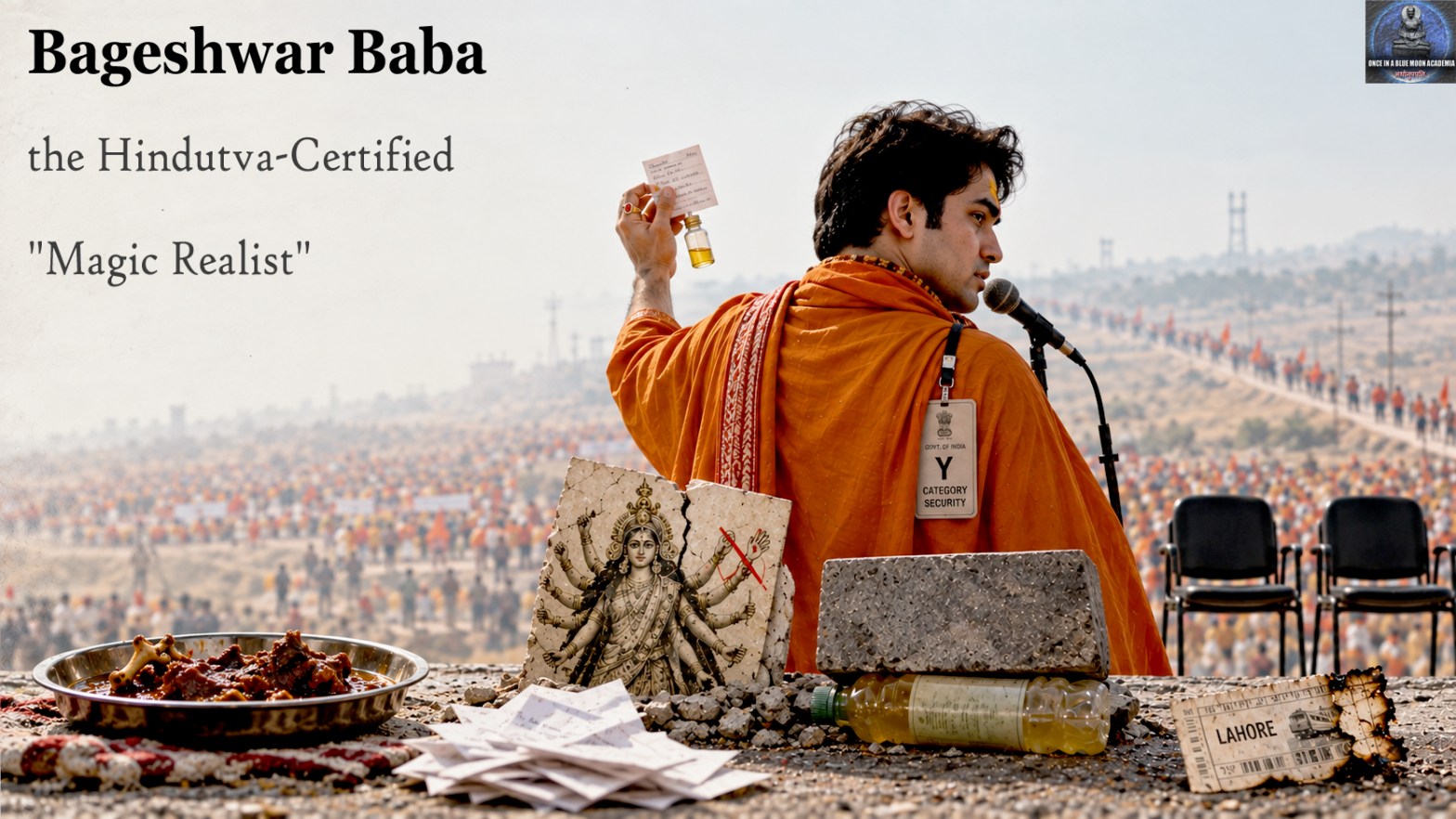
Dhirendra Krishna Shastri (Bageshwar Baba) is not a free-floating saint but a ruling-party political project: a twenty-nine-year-old hereditary Bundelkhand priest whose “Divya Darbar” cold-readings — sold as Balaji’s voice — underwrite medical harm (gaumutra for cancer, “Muslim-peer” possession), communal mobilisation (Hindu Rashtra, “ticket to Lahore,” economic boycott), and a cash-opaque temple trust now crowned by a Prime Ministerial cancer hospital and Y-category security. Activists who asked him to take a controlled test (Nagpur, 2023) were answered with flight, a police “clean chit,” death threats, and, in February 2025, Modi’s branding of critics as foreign-sponsored enemies of the nation; ministers then walked his November 2025 padyatra. The machine met its first state-side no in September 2026, when Bengal BJP president Samik Bhattacharya rejected Shastri’s Durga Puja meat ban as outsider diktat against Shakta custom — electoral franchise management, not a conversion to secularism — exposing Hindutva’s homogenising fiction at the plate of Navami mutton.
The Vaiṣṇava Veneer: Unravelling ISKCON
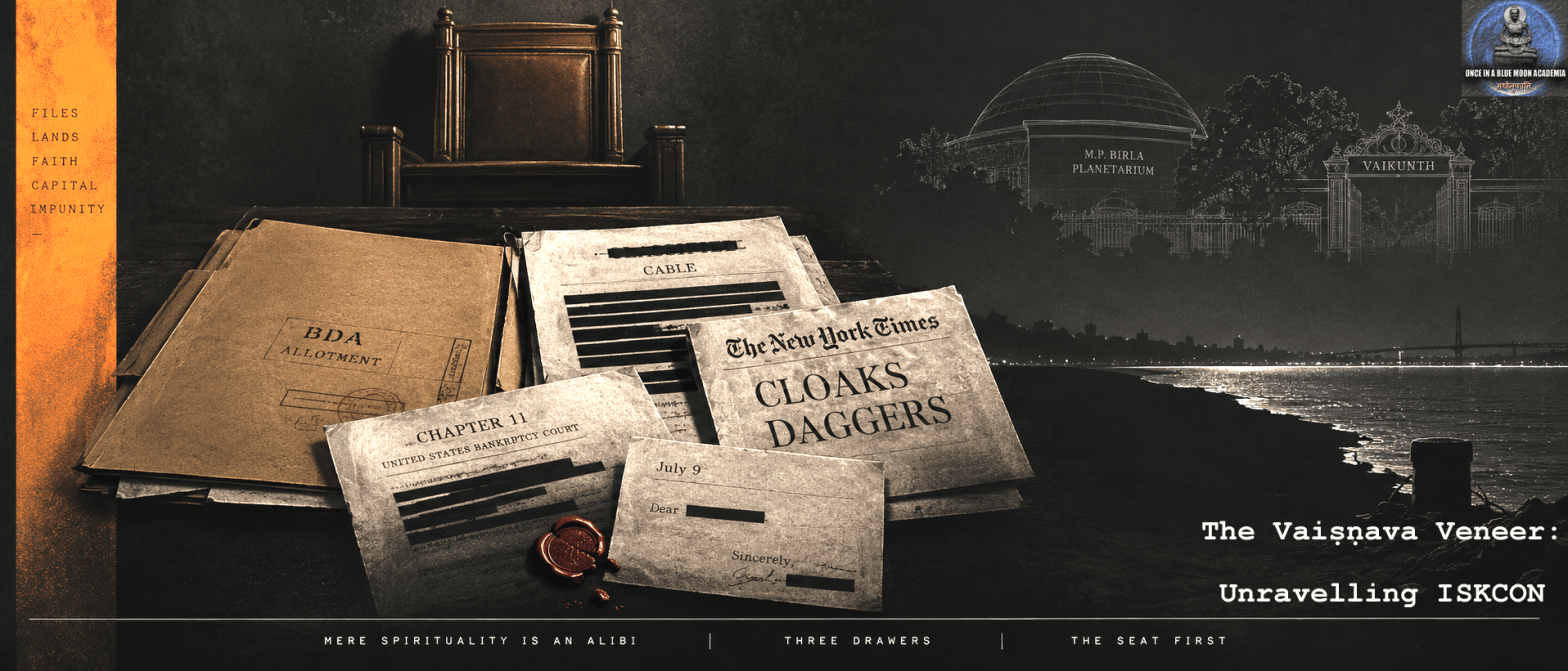
This study reads the International Society for Krishna Consciousness (ISKCON) not as “mere spirituality” but as a relatively autonomous Ideological State Apparatus whose Indian career after liberalization is a textbook case of Gramscian trasformismo: a 1960s–70s counter-cultural mission, founded in New York in 1966 by A. C. Bhaktivedanta Swami Prabhupāda on Gauḍīya personalism and initiation without birth-caste, absorbed into the bloc of concentrated capital, competitive religious patronage, and majoritarian cultural weather. Weber’s routinization of charisma explains the unfinished succession of 1977–78—the 9 July ṛtvik letter converted into eleven zonal ācāryas—and the harvest of that office: New Vrindaban’s RICO commune and two murders; a gurukula system that isolated minors under a theology of surrender, producing the 2000 Dallas suit, Chapter 11, and a $9.5 million settlement for 535 claimants, while Lokanātha and other cases show reputation still outranking the child. Three evidentiary drawers hold the CIA question: documented Agency use of clergy; documented Indian and Soviet naming (Parliament, Blitz 1976, Nedelya 1983 / Times 31 July, Andropov); no released operational file that the Agency ran the GBC—voluntas celandi, not a closed cryptonym. In India the same prestige consecrates Piramal Vaikunth and Ambani rooms; takes TMC ceiling-waiver and highway at Mayapur and BJP–RSS blessing (Modi at Kharghar 2025, Shah at Mayapur 2026, Suvendu’s gau-pūjā, Bhagwat at Second Avenue); stages Ayodhya 2024 as Communications policy while staying silent on gau-rakṣā lynching and communal violence; and locks Bhaktivinoda’s nineteenth-century Mayapur map against Navadvīpa’s older hagiographic name (Das 2023), a claim a 2025 film authenticates and a planetarium concretizes. Bangalore v. Mumbai (SC 16 May 2025) proves “ISKCON” is not one legal person. The founding vision did not entail the gate. The unfinished office, plus a republic that buys sacred cover, did. Devotees may keep the Name; the institution cannot keep the alibi.
The Man and the Monolith: A Dossier on Mohan Bhagwat
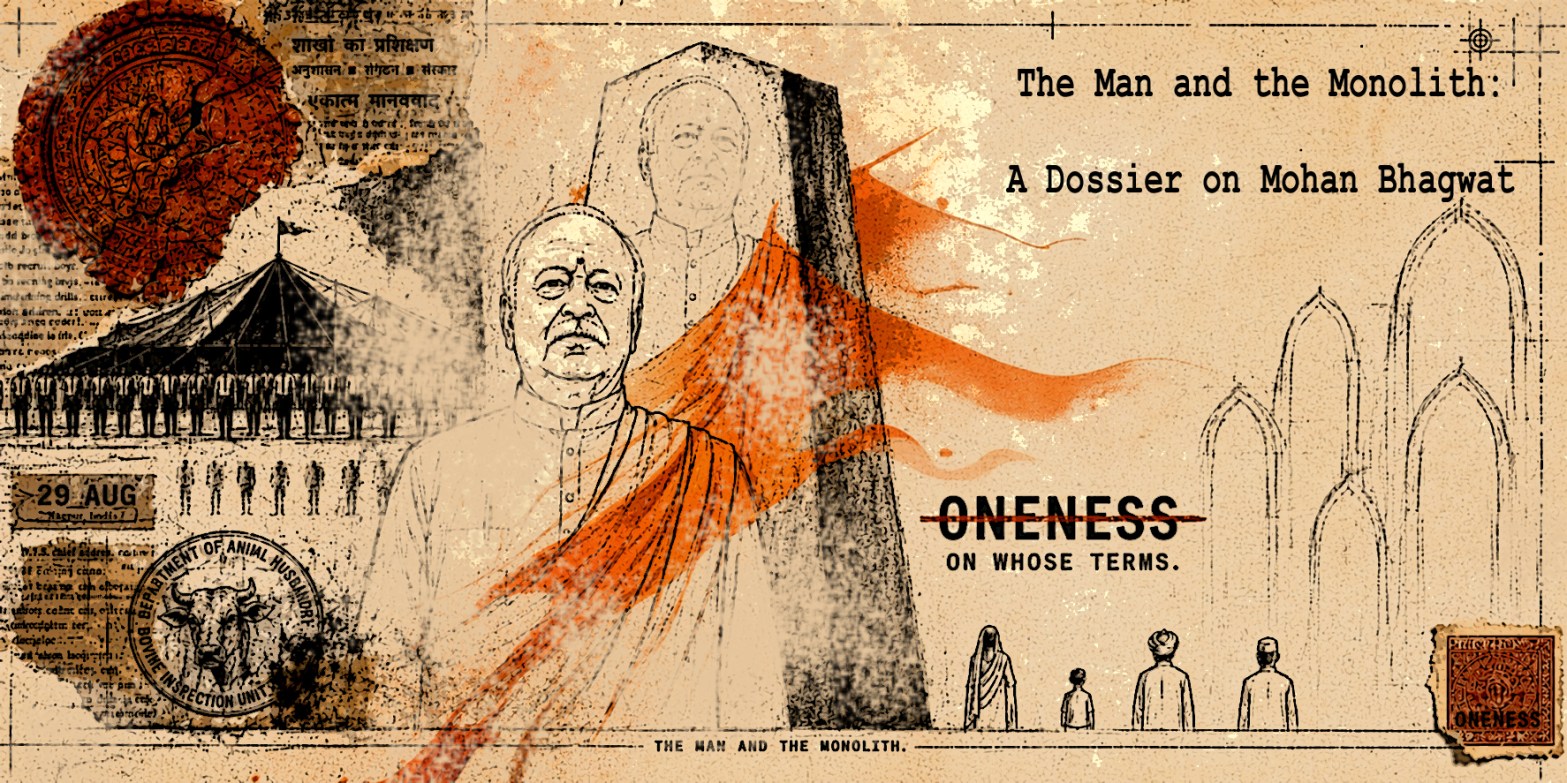
This dossier is a committed forensic case against Mohan Madhukar Bhagwat, sixth Sarsanghchalak of the Rashtriya Swayamsevak Sangh since 2009 and its executive from 2000 to 2009: a lifer raised in a three-generation Sangh household, produced by the organisation’s sealed ladder, and now the living editor of an ideology whose founding texts — Savarkar’s membership test, Golwalkar’s denial of minority citizenship and praise of a Nazi purge as a “lesson,” Moonje’s 1931 pilgrimage to Mussolini — he does not disown so much as copy-edit for export as “oneness.” It holds the line the Sangh most wants critics to overstep: no invented personal conviction from Gujarat 2002, no fake-doctorate smear, no claim that a USCIRF recommendation or a Canadian petition is already law; the charge that survives is custody of a majoritarian machine — unregistered at the centre, banned three times by the republic, radiating through the BJP and the Parivar — restated in Bhagwat’s own dated speech as eliminative absorption (“everyone is Hindu”), relocation of blame (2013, 2015, 2019, 2025), and centenary reputation-work. That work arrived in New York in August 2026 as “Universal Oneness” at Madison Square Garden and walked into a revolt that includes Hindus who refuse to let Hindutva speak in their name. The monolith calls itself oneness. The dossier refuses the name.

