Posted on 27th May, 2026 (GMT 08:19 hrs)
ABSTRACT
This article interweaves devotional revival, academic appeal, poetic prayer, and radical self-reflexive critique into a polyphonic offering. It advocates the responsible, scripturally grounded revival of two historically significant sacred preparations in Sanatana Dharma — Vaidic Somarasa, the divine elixir exalted in the Rigveda (particularly Mandala IX and 8.48.3), and Maireya Mada, the refined royal wine celebrated in the Valmiki Ramayana (Uttara Kāṇḍa Sarga 42 and Ayodhya Kāṇḍa Sarga 91) — while simultaneously inhabiting the fragile, absurd third space of refusal. Structured around a formal academic letter to Pujya Acharya Shri Ramdev Ji Maharaj and the Patanjali ecosystem calling for GMP-compliant research, standardization, and production of these formulations or their safe, therapeutically calibrated analogs within Ayurvedic Sandhana Kalpana; a deeply personal devotional reflection as a follower of Drunk Balarama (Madhupriya Haladhara), exploring hāsyarasa and the līlās drawn from the Śrīmad Bhāgavatam, Harivaṃśa, and Mahābhārata; and a Vedic prayer-song to Varuṇa for the boundless flow of Vāruṇī, the work runs parallel with the voice of l’étrangère — the tremulous skin (dṛti) of Rigveda 7.89 — who refuses both the compulsory intoxication of speed capitalism and the homogenizing violence of theocratic-market fundamentalism. Drawing upon Vedic hymns, Tagore’s storm-cloud renditions, Marx’s nuanced theory of alienation and religion-as-pharmakon, Brecht’s subversive theatre, Subaltern Studies, and Kabir’s laughter, the article affirms Sanatana Dharma’s sophisticated, multi-layered grammar of madya — ritual, medicinal, ecstatic, and counter-hegemonic — while carving generous space for the sober, ridiculous, creative refusal of all compulsory cups. Ultimately, it calls for a courageous renaissance that is scholarly, devotional, and radically disobedient to the twin fundamentalisms of our time.
Keywords: Somarasa, Maireya Mada, Varuṇī, Drunk Balarama, Vedic Revival, Ayurveda, Patanjali, Sacred Intoxicants, Speed Capitalism, Theocratic Fundamentalism, Third Space, Absurd Outsider, Tremulous Skin
॥ वरुणस्य वारुणी स्तुतिः ॥
Varuṇasya Vāruṇī Stutiḥ
A Hymn to Varuṇa, Lord of Sacred Waters, and Vāruṇī, His Divine Stream
॥ १ ॥
Ṛgveda 7.86.1 — The Cosmic Source Ṛṣi: Vasiṣṭha | Devatā: Varuṇa | Chandas: nicṛttriṣṭup
धीरा त्वस्य महिना जनूंषि वि यस्तस्तम्भ रोदसी चिदुर्वी ।
प्र नाकमृष्वं नुनुदे बृहन्तं द्विता नक्षत्रं पप्रथच्च भूम ॥
dhīrā tv asya mahinā janūṃṣi vi yas tastambha rodasī cid urvī |
pra nākam ṛṣvaṃ nunude bṛhantaṃ dvitā nakṣatram paprathac ca bhūma ||
Eternal in greatness are the glories of Varuṇa — He who propped apart the vast heaven and the wide earth, Who thrust the mighty sky on high and set the brilliant sun, Who appointed the constellations and spread the earth below.
॥ २ ॥
Ṛgveda 5.85.3 — The Great Cask Released Ṛṣi: Atri | Devatā: Varuṇa | Chandas: nicṛttriṣṭup
नीचीनबारं वरुणः कवन्धं प्र ससर्ज रोदसी अन्तरिक्षम् ।
तेन विश्वस्य भुवनस्य राजा यवं न वृष्टिर्व्युनत्ति भूम ॥
nīcīnabāraṃ varuṇaḥ kavandham pra sasarja rodasī antarikṣam | tena viśvasya bhuvanasya rājā yavaṃ na vṛṣṭir vy unatti bhūma ||
Varuṇa opened the great cask downward — Releasing the divine stream through heaven, earth, and firmament. Thus the King of every world waters the soil, As the sacred rain bedews the barley.
॥ ३ ॥
Ṛgveda 7.49.2 — The Divine Waters as Goddess Ṛṣi: Vasiṭṭha | Devatā: Āpaḥ | Chandas: triṣṭup
या आपो दिव्या उत वा स्रवन्ति खनित्रिमा उत वा याः स्वयंजाः ।
समुद्रार्था याः शुचयः पावकाः ता आपो देवीरिह मामवन्तु ॥
yā āpo divyā uta vā sravanti khanitrimā uta vā yāḥ svayaṃjāḥ |
samudrārthā yāḥ śucayaḥ pāvakāḥ tā āpo devīr iha mām avantu ||
Waters that are heavenly, waters that flow upon the earth, Waters self-born from the depths, waters seeking the ocean — All pure and purifying, all sacred and cleansing — May those Divine Waters, those Goddesses, protect me here.
॥ ४ ॥
Ṛgveda 7.49.3 — The Nectar Stream of Varuṇa Ṛṣi: Vasiṣṭha | Devatā: Āpaḥ | Chandas: triṣṭup
यासां राजा वरुणो याति मध्ये सत्यानृते अवपश्यञ्जनानाम् ।
मधुश्चुतः शुचयो याः पावकाः ता आपो देवीरिह मामवन्तु ॥
yāsāṃ rājā varuṇo yāti madhye satyānṛte avapaśyañ janānām | madhuścutaḥ śucayo yāḥ pāvakāḥ tā āpo devīr iha mām avantu ||
Those waters in whose midst King Varuṇa himself moves, Beholding the truth and falsehood of all people — Those honey-dripping, pure and purifying waters — May those Divine Waters, those Goddesses, protect me here.
॥ ५ ॥
Ṛgveda 7.49.4 — Where Varuṇa and Soma Dwell Together Ṛṣi: Vasiṣṭha | Devatā: Āpaḥ | Chandas: triṣṭup
यासु राजा वरुणो यासु सोमो विश्वे देवा यासूर्जं मदन्ति ।
वैश्वानरो यास्वग्निः प्रविष्टः ता आपो देवीरिह मामवन्तु ॥
yāsu rājā varuṇo yāsu somo viśve devā yāsūrjam madanti |
vaiśvānaro yāsv agniḥ praviṣṭas tā āpo devīr iha mām avantu ||
Those waters in which King Varuṇa abides, In which Soma abides, in which all the Gods become rapturous, Into which Agni Vaiśvānara himself has entered — May those Divine Waters, those Goddesses, protect me here.
॥ ६ ॥
Ṛgveda 1.25.1 — Confession Before the Lord Ṛṣi: Śunaḥśepa Ājīgarti | Devatā: Varuṇa | Chandas: gāyatrī
यच्चिद्धि ते विशो यथा प्र देव वरुण व्रतम् ।
मिनीमसि द्यविद्यवि ॥
yac cid dhi te viśo yathā pra deva varuṇa vratam |
minīmasi dyavi-dyavi ||
As all people without exception transgress, So do we, O divine Varuṇa, Daily fall short of Your eternal law.
॥ ७ ॥
Ṛgveda 1.25.3 — Soothing the Lord With Praise Ṛṣi: Śunaḥśepa Ājīgarti | Devatā: Varuṇa | Chandas: gāyatrī
वि मृळीकाय ते मनो रथीरश्वं न संदितम् ।
गीर्भिर्वरुण सीमहि ॥
vi mṛḻīkāya te mano rathīr aśvaṃ na saṃditam |
gīrbhir varuṇa sīmahi ||
We soothe Your mind toward compassion, O Varuṇa, As the charioteer gently draws his weary steed — With hymns, with praise, with the voice of the heart.
॥ ८ ॥
Ṛgveda 7.86.2 — The Longing: To Be Within Varuṇa Ṛṣi: Vasiṣṭha | Devatā: Varuṇa | Chandas: virāṭtriṣṭup
उत स्वया तन्वा सं वदे तत् कदा न्वन्तर्वरुणे भुवानि ।
किं मे हव्यमहृणानो जुषेत कदा मृळीकं सुमना अभि ख्यम् ॥
uta svayā tanvā saṃ vade tat kadā nv antar varuṇe bhuvāni |
kim me havyam ahṛṇāno juṣeta kadā mṛḻīkaṃ sumanā abhi khyam ||
With my own being I ask this question — When shall I be admitted into Varuṇa’s very heart? What oblation of mine may he accept without anger? When, with a joyful mind, shall I behold that giver of grace?
॥ ९ ॥
Ṛgveda 1.25.19 — The Final Petition Ṛṣi: Śunaḥśepa Ājīgarti | Devatā: Varuṇa | Chandas: nicṛdgāyatrī
इमं मे वरुण श्रुधी हवम् अद्या च मृळय ।
त्वामवस्युरा चके ॥
imam me varuṇa śrudhī havam adyā ca mṛḻaya |
tvām avasyur ā cake ||
Hear this my invocation, O Varuṇa — Be gracious to us this very day. I who am shelterless come to You, longing for Your protection.
॥ फलश्रुतिः ॥
Phalaśrutiḥ — The Fruit of This Recitation
These nine mantras move as one stream:
From the cosmic greatness of Varuṇa (I) through the release of His divine waters (II), through the goddess-nature of that sacred flow (III), through its honey-sweetness (IV) and its divine rapture where Soma and Varuṇa converge (V) —
this is the Vāruṇī in her Vedic form: madhuścutaḥ — nectar-dripping, āpo devīḥ — the Divine Waters as Goddess.
The devotee then approaches: confessing (VI), praising (VII), longing (VIII), and at last surrendering in three lines (IX) — that the great cask may open downward once more, and the intoxicating spree of the honey stream descend.
॥ जय वरुण देव ॥ ॥ जय वारुणी देवी ॥ ॥ हरे बलराम ॥
Jaya Varuṇa Deva Jaya Vāruṇī Devī Hare Balarāma
0. Introduction: Reclaiming The Forgotten in an Age of Compulsory Intoxication
In the vast, living tapestry of “Sanatana Dharma”, few subjects evoke as much discomfort, fascination, and selective outrage in contemporary discourse as the tradition’s profoundly nuanced relationship with madya — fermented and intoxicating preparations. From the divine Soma of the Rigveda to the royal Maireya of the Ramayana, from the pharmacologically sophisticated Surā of Ayurveda to the ecstatic līlās of Lord Balarama with Vāruṇī, our civilization has never been simplistically prohibitionist nor recklessly hedonistic. It has cultivated instead a sophisticated framework of context, dosage, intent, ritual, dharma, and creative refusal that distinguishes the sacred from the profane, the medicinal from the addictive, and the playful divine from the destructive.
This article brings together multiple registers — devotional surrender, academic appeal, poetic prayer, and the absurd outsider’s trembling refusal — into a single yet polyphonic offering. Following the ancient stream of Varuṇa’s own Vāruṇī, it presents a sharpened letter to Pujya Acharya Shri Ramdev Ji Maharaj urging the responsible revival of Vaidic Somarasa and Maireya Mada. It offers an intimate reflection as a follower of Drunk Balarama. And it gives extended voice to the fragile third-space inhabitant who says “no” — quietly, ridiculously — to both the compulsory intoxication of speed capitalism and the homogenizing violence of theocratic-market fundamentalism.
These voices do not cancel one another; they enrich and complicate each other, much like the great cask that releases both rain and restraint. The tradition is capacious enough for the ecstatic madhupriya and the absurdly sober outsider alike. The question before us is no longer whether these traditions existed, but how we may revive, remember, and re-inhabit them responsibly, creatively, and courageously in the 21st century — amidst crashing cockpits and trembling skins.
I. Reviving the Sacred Elixir: Letters on Somarasa, Maireya, and the Path of Drunk Balarama
This section presents the thematic contexts of two carefully crafted pieces written from that integrated perspective. The first is a sharpened academic appeal addressed to Pujya Acharya Shri Ramdev Ji Maharaj and the Patanjali ecosystem. The second is a deeply personal, self-reflexive devotional reflection honoring Drunk Balarama — the Madhupriya Haladhara whose divine intoxication teaches surrender, strength, and cosmic play. Together, they form a call for responsible, scripturally grounded revival of two historically significant preparations: Vaidic Somarasa and Maireya Mada.
I.1 Why These Letters Matter Now
Contemporary India is witnessing an unprecedented renaissance of indigenous knowledge systems. Yoga, Ayurveda, Panchagavya, and Vedic sciences are being reclaimed not merely as cultural artifacts but as living, evidence-based contributions to human wellness and civilizational confidence. Yet when the conversation turns to fermented preparations or sacred intoxicants, a strange selective amnesia often sets in. Critics cherry-pick isolated verses or later moralistic interpolations while ignoring the extensive pharmacological chapters in Charaka Samhita (Sūtra Sthāna 27 – Madya Varga), Sushruta Samhita’s documented use of Surā as anaesthetic in surgical procedures, the 114 hymns of the Rigveda’s Soma Mandala dedicated entirely to the divine elixir, and the unapologetic celebrations of moderated madya in the Purāṇas and Itihāsas.
This introductory note — and the two letters that follow — seek to bridge that gap with intellectual honesty and dharmic courage. Authentic revival does not mean promoting reckless consumption or cultural regression. It means:
- Rigorous botanical identification, phytochemical analysis, and long-term safety studies of original Soma plant candidates (drawing from ethnopharmacological research on Himalayan and Central Asian species).
- Scientifically standardized, therapeutically calibrated, or non-intoxicating analogs of Somarasa and Maireya, developed under GMP protocols and within the classical Ayurvedic framework of Sandhana Kalpana (fermentation techniques).
- Clear differentiation between ritual/yajna use, medicinal application, devotional līlā, and recreational excess.
- Courageous acknowledgment that towering figures like Balarama himself embody the seamless integration of madhu (sweet ecstasy) with dharma — strength that can playfully loosen its grip without losing its root.
I.2 A Dharmic Request to Baba Ramdev’s Patanjali
The first letter respectfully urges Patanjali Yogpeeth — an institution that has already revolutionized the accessibility, standardization, and scientific validation of Ayurvedic formulations across India and beyond — to take up the challenge of researching and manufacturing authentic versions (or safe, modern equivalents) of Vaidic Somarasa and Maireya Mada. It supplies precise Vedic citations (Rigveda 8.48.3 and the entire Soma Mandala IX) and Ramayana references (Uttara Kāṇḍa Sarga 42 and Ayodhya Kāṇḍa Sarga 91), while grounding the appeal in classical Ayurvedic pharmacology and the living example of Balarama’s Varuṇī līlās. The goal is not commercialization of vice, but a mature cultural and scientific reclamation that honors both śāstra and safety in the contemporary era.
I.3 The Devotional Reflection: Following Drunk Balarama
The second piece is more intimate and bhakti-infused. Written in the voice of a devotee who has chosen the path of “Drunk Balarama,” it explores the hāsyarasa (comic sentiment) and profound teaching embedded in the Lord’s ecstatic līlās: drinking Kādambarī until he sways with rolling eyes, playfully dragging the Yamunā with his divine plough (Śrīmad Bhāgavatam 10.65), and reveling openly with Revatī and the Vṛṣṇis during the Raivataka festival (Mahābhārata, Mauṣala Parva). This is not an endorsement of addiction but a meditation on radical surrender — how even the strongest (the plough-wielder, upholder of dharma) can loosen his grip in divine bliss and still remain firmly rooted in cosmic order. In Balarama’s swaying gait lies a teaching that strength and release, discipline and play, can coexist within the same divine form.
I.4 Anchored in Honesty
Both pieces draw inspiration and strength from the detailed academic article “Brewin’ It, Smokin’ It, All Pure in Sanātana Bhārat⤡”, which meticulously documents the historical, scriptural, pharmacological, and cultural place of various intoxicants within the tradition. That paper dismantles modern projections of the “other Victorian” prohibitionism onto ancient Bharat and restores the sophisticated traditional worldview where madya, when approached with right knowledge, restraint, and context, can serve as medicine, ritual catalyst, poetic metaphor, or even a vehicle for prema (divine love).
I.5 A Call for Nuanced Revival
By presenting these letters side-by-side, the section invites readers — scholars, practitioners, devotees, and skeptics alike — into a more mature, less polarized conversation. Sanatana Dharma is vast enough to contain both the strict tapasvin who renounces all intoxicants and the ecstatic madhupriya who finds divine presence in moderated bliss. It is precise enough to regulate fermentation processes in Ayurvedic texts and playful enough to let Balarama dance with rolling eyes and a swaying form. The question before us is not “Should we revive these traditions?” but “How can we revive them responsibly, safely, ethically, and authentically in the 21st century?”
Whether you approach this from a ritual perspective, an ethnopharmacological lens, a path of bhakti, or simple cultural curiosity, these writings aim to inspire thoughtful engagement rather than reflexive reaction.
Hare Balarama. May the divine plough-wielder continue to drag our collective consciousness — sometimes gently through bhakti, sometimes forcefully through līlā — toward a fuller, braver, and more nuanced reclamation of our heritage.
Read the two letters below.
II. Letter to Pujya Baba Ramdev Ji
To
Pujya Ācārya Śrī Rāmadeva Jī Mahārāja,
Patañjali Yogpīṭh, Haridwar – 249 405,
Uttarākhaṇḍa
Subject: Renewed and Earnest Appeal for the Revival, Standardization, and Responsible Manufacture of Vaidika Somarasa and Maireya Madya
Śrī Caraṇakamalayoḥ Praṇāmaḥ, Pūjya Bābā Jī,
It is with the deepest reverence, the highest intellectual sincerity, and — I say this without a trace of anything other than dharmic earnestness — a complete absence of any ulterior motive, that I place this submission at your lotus feet. Your tireless campaign to rescue Bhārata from the grip of allopathy, synthetic foods, foreign corporations, and assorted agents of civilizational decline has inspired hundreds of millions. It is precisely because of this unimpeachable commitment to authenticity that I must bring to your urgent attention a peculiar gap in Patañjali’s otherwise comprehensive catalogue of revived Vedic heritage: the systematic neglect of two of our tradition’s most scripturally attested, pharmacologically sophisticated, and frankly indispensable preparations — Vaidika Somarasa and Maireya Madya.
I do so with citations.
A. THE SCRIPTURAL FOUNDATION: SOMA IS NOT A TULSI CHURNA
The Ninth Maṇḍala of the Ṛgveda — the Soma Maṇḍala, comprising all 114 hymns of that book — is dedicated exclusively to Soma Pavamāna, the pressed, purified, and consecrated divine elixir. Soma is addressed as oṣadhīnāṃ rājā, King of Plants (RV 9.114.2); as the source of bala (strength), āyus (longevity), and prajñā (illumined intelligence). He is described as flowing, golden, purified through a woolen filter (pavitra), mixed with milk or water, and consumed by both gods and ṛṣis in the context of the Agniṣṭoma, Vājapeya, Rājasūya, and Aśvamedha sacrifices.
The most celebrated declaration of Soma’s effect comes in Ṛgveda 8.48.3, from the lips of the ṛṣi himself:
अपाम सोमममृता अभूम
आगन्म ज्योतिरविदाम देवान् ।
किं नूनमस्मान्कृणवदरातिः
किमु धूर्तिरमृत मर्त्यस्य ॥
apāma somam amṛtā abhūma
āganma jyotir avidāma devān |
kiṃ nūnam asmān kṛṇavad arātiḥ
kim u dhūrtir amṛta martyasya ||
“We have drunk the Soma; we have become immortal;
we have attained the light; we have known the gods.
What now can the enemy do to harm us?
What, O Immortal, can the aggriever do to the mortal?”
— Ṛgveda 8.48.3 (H.H. Wilson, 1866; R.T.H. Griffith, 1896)
Pūjya Bābā Jī, with the greatest respect — this is not describing Āmalā Juice. The ṛṣi is recording a physiological and noetic transformation: amṛtā abhūma, “we became immortal.” One may interpret this metaphorically, of course. The tradition permits both. But one may equally note that Ṛgveda 10.94.3 describes the pressing stones (grāvāṇaḥ) used to extract Soma as roaring like bulls in heat, and that Ṛgveda 8.48.4 says Soma entered the devotee “like a kind father going to his son.” The point is that our ṛṣis documented the preparation, administration, and phenomenology of this substance across 114 dedicated hymns and hundreds of supplementary references — with considerably more care and detail than any modern regulatory authority requires for a Schedule H drug.
Soma’s botanical identity remains disputed among scholars — candidates range from Ephedra sinica (the most widely accepted, particularly the work of Sir Aurel Stein and botanist Viktor Sarianidi in Central Asian excavations) to Peganum harmala, Amanita muscaria (Gordon Wasson’s celebrated but contested 1968 thesis), and multiple Himalayan Asclepiadaceae — but what is not in dispute is that the Ṛgveda describes a real preparation, from a real plant, with real effects, that formed the pharmacological and ritual centrepiece of Vedic civilization. The Nirukta of Yāska (4.3.13) itself describes Soma as a medicine promoting longevity and youthful vigor. The Suśruta Saṃhitā catalogues it among the mahat-oṣadhis, the great medicinal substances.
Patañjali’s herbal research division, which has competently identified and standardized ashwagandha, shatavari, brahmi, and giloy, is positioned as no other institution in Bhārata to pursue the systematic botanical identification of the Soma plant. I merely note that no one has yet tried.
B. MAIREYA MADYA: WHAT SAGE BHARADVĀJA SERVED THE KING
Pūjya Bābā Jī, permit me to draw your attention to the Ayodhyā Kāṇḍa of Vālmīki Rāmāyaṇa (Sarga 91), in which the sage Bharadvāja — Bharadvāja, Sir, one of the Saptarṣis, the compiler of the Ṛgvedic Saṃhitā’s Sixth Maṇḍala — entertains King Bharata and his army at his āśrama at Prayāga. The mahāṛṣi, through his divine powers, conjures a hospitality that would humble a five-star hotel:
नद्यो मैरेयपूर्णाश्च …
Rivers flowing with Maireya appeared among the divine provisions offered by Bharadvāja to his royal guests (Vālmīki Rāmāyaṇa, Ayodhyā Kāṇḍa 91.18, Critical Edition, Bhandarkar Oriental Research Institute). The Uttara Kāṇḍa (Sarga 42) further records Lord Rāma offering Maireyaka madhu — a honey- and-sugarcane-derived refined wine — to Sītā Devī in a scene of domestic felicity explicitly compared to Indra and Śacī in their divine abode.
These are not peripheral references in obscure Tantric literature. These are the Rāmāyaṇa and the Mahābhārata — the twin foundations of Sanātana civilizational memory — recording the consumption of a specific fermented preparation called Maireya as an element of royal hospitality, domestic joy, and āśramic generosity.
The Charaka Saṃhitā, Sūtrasthāna 27 (Annapānavidhi Adhyāya), the Madya Varga section, describes Maireya wine as:
मधुरं गुरु च — “sweet and heavy”
and situates it within a comprehensive taxonomy of fermented preparations including Surā, Madirā, Ariṣṭa, Āsava, Sidhu, and Prasannā, each with its specific doṣa action, therapeutic indication, and contraindication. Charaka treats madya with the same rigor he applies to any other dravya: as a substance with defined guṇas (qualities), karmas (actions), and the capacity to function as both amṛta and viṣa depending entirely upon mātrā (dose), kāla (timing), and deha-prakriti (constitutional suitability). He states explicitly:
yukta-pānam amṛtam, ayukta-pānaṃ viṣam
“Consumed appropriately, wine is nectar; consumed inappropriately, poison.” — Charaka Saṃhitā, Cikitsāsthāna 24 (Madātyaya Cikitsā)
This is not an endorsement of inebriation. It is classical Āyurvedic pharmacology — the same framework of mātrā and prakriti that governs every other substance in Charaka’s Materia Medica, from ghṛta to guggulu to heavy metal bhasmas that would be classified as industrial hazardous waste in any country without quotation marks around “Vedic.”
C. BALARĀMA AND VĀRUṆĪ: A DEVOTIONAL PRECEDENT
I draw your kind attention to the Bhāgavata Purāṇa, Canto 10, Chapter 65, which describes — with evident narrative delight — how Lord Balarāma, Saṅkarṣaṇa himself, the ādiśeṣa incarnate and elder brother of Bhagavān Śrī Kṛṣṇa, discovered the divine Vāruṇī flowing from the hollow of a kadamba tree, sent expressly by the demigod Varuṇa:
वरुणप्रेषिता देवी वारुणी वृक्षकोटरात् ।
पतन्ती तद् वनं सर्वं स्वगन्धेनाध्यवासयत् ॥
varuṇa-preṣitā devī vāruṇī vṛkṣa-koṭarāt |
patantī tad vanaṃ sarvaṃ svagandhenādhyavāsayat ||
“Sent by the demigod Varuṇa, the divine Vāruṇī flowed from
the hollow of the tree and pervaded the entire forest with
her sweet fragrance.” — Bhāgavata Purāṇa 10.65.17
Balarāma drank it with the gopīs. He became joyful. He became, the text records, nāga-rāja-sama — majestic as the king of serpents. He then, in a state of transcendent bliss, instructed the river Yamunā to come closer to him so that he could bathe more conveniently, and when she did not immediately comply, he dragged her with his plough.
The Harivamśa (Viṣṇu Parva 2.41.5–13) records the same episode at length, noting that Balarāma “immediately was affected by the desire for Vāruṇī” upon smelling it, and that after consuming it repeatedly, “his body was swaying with intoxication.” The Viṣṇu Purāṇa (4.25) corroborates this.
No traditional commentator has suggested this constitutes a moral failing on Balarāma’s part. Indeed, his divine sport is celebrated. The point, as classical āchāryas have noted, is precisely that the sacred and the intoxicating are not opposites in Sanātana ontology — they are related by context, intention, and the nature of the consumer.
Pūjya Bābā Jī, I am certain you will agree that if Balarāma can drag a river after consuming Vāruṇī and be celebrated for it across three Purāṇas and the Harivamśa, then surely the Patañjali Research Foundation can at minimum conduct a safety study.
D. THE ĀSAVA–ARIṢṬA QUESTION: A GENTLE CLARIFICATION
At this juncture it would be improper not to note — respectfully, and purely for completeness — that Patañjali Āyurved already manufactures and commercially distributes several preparations under the Sandhāna Kalpa (fermentation-based formulations) category of classical Āyurveda: Ashokarishta, Dashamularishta, Aravindasava, Kumaryasava, and others listed in the Āyurvedic Formulary of India (AFI) and Āyurvedic Pharmacopoeia of India (API).
These preparations are, by the pharmacological definition of both classical Āyurveda and modern food safety regulation, fermented preparations containing self-generated alcohol — typically between 5% and 10% ABV — as the medium for extracting and preserving medicinal constituents. This process is described in exhaustive detail in the Aṣṭāṅga Hṛdayam (Kalpa Sthāna 6), Śārṅgadhara Saṃhitā (Madhyama Khaṇḍa 10), and the Charaka and Suśruta Saṃhitās. The alcohol content is not incidental. It is the point: it is the pradhāna dravya (principal vehicle) that renders the formulation therapeutically bioavailable.
I mention this only because it establishes that the technical, regulatory, and manufacturing infrastructure for fermented Āyurvedic preparations already exists within the Patañjali ecosystem. The Vaidika Somarasa and Maireya Madya revival project would therefore require considerably less capital expenditure than one might initially assume.
This is merely a financial observation, offered in the spirit of swadeshi efficiency.
E. THE CONTEMPORARY DHARMIC URGENCY
Pūjya Bābā Jī, there is a selective hermeneutics at work in how our tradition is currently being represented and defended. Certain texts are invoked as foundation stones of civilization; others — containing equally authoritative and equally ancient content — are quietly set aside when convenient. A tradition that celebrates Balarāma’s Vāruṇī episode in devotional poetry and temple iconography while simultaneously treating any discussion of that episode’s pharmacological implications as an insult to dharma has inadvertently created a vulnerability: it allows critics to position our tradition as one that cannot face its own textual completeness without embarrassment.
The most robust defence of Sanātana Dharma is not selective citation. It is comprehensive, confident, and unabridged engagement with everything our tradition actually contains — including its sophisticated frameworks around fermentation, its nuanced pharmacology of intoxicants, its distinction between ritual context and abuse, between the sacred use of madya in the Sautrāmaṇī sacrifice (Śatapatha Brāhmaṇa 12.7.3) and the condemned excess described as Madātyaya.
Patañjali is uniquely positioned — scientifically, infrastructurally, and symbolically — to undertake this work: the systematic study, botanical identification, safe standardization, and culturally contextualized revival of Vaidika Somarasa and Maireya Madya. Under GMP protocols. With proper dosage guidelines. With the Āyurvedic mātrā-kāla-deha-prakriti framework intact. For wellness applications, for ritual contexts, for cultural education, and — if the regulatory environment permits — for the immense and rapidly expanding global market of consumers seeking authentically sourced alternatives to Scottish whisky and French wine.
The Arthaśāstra of Kauṭilya (Book 2, Chapter 25) describes a complete state infrastructure for the regulation and taxation of fermented beverages under a Superintendent of Liquor (Sauṇādhyakṣa). A civilization organized enough to have a Sauṇādhyakṣa is a civilization with an industrial policy. I commend it to your attention.
F. PROPOSED COLLABORATION
I am prepared to assist, without expectation of remuneration, with:
- Textual research: systematic collation of all Ṛgvedic, Brāhmaṇa, Āraṇyaka, Upaniṣadic, Itihāsa-Purāṇic, Āyurvedic, and Dharmaśāstric references to Soma, Sura, Surā, Maireya, Āsava, Vāruṇī, Sidhu, Medaka, and related preparations, with cross-referencing of Sanskrit primary texts.
- Botanical identification: coordination with ethno-pharmacological researchers currently working on Ephedra and Himalayan plant species that correspond to Vedic Soma candidates.
- Regulatory strategy: analysis of how Sandhāna Kalpas are currently classified under the Drugs and Cosmetics Act, 1940, and what amendments or exemptions may be appropriate for ritual-grade preparations.
- Consumer positioning: the global market for authentically positioned, premium, spiritually sourced beverages is substantial. Patañjali Somarasa, positioned correctly, would not be competing with Old Monk. It would be competing with single malt Scotch. The demographic is entirely different.
I remain, as always, available for further consultation, deeply inspired by your mission, and profoundly hopeful that the complete treasury of Sanātana pharmacological wisdom will one day be reclaimed in its entirety.
With the deepest praṇāms, absolute sincerity, and not a drop of anything other than dharmic conviction,
A Hindu United Family (HUF) Demanding Standardized, Homogenized, Monolithic, Pasteurized Akhanda Hindu Hindustan
III. In the Shadow of the Plough – A Follower of Drunk Balarama
A Meditation on Hāsyarasa, Haladhara, and the Uncomfortable Precedents Set by the Divine Plough-Wielder in an Age of Climate Crisis
বৃষ্টি-নেশা-ভরা সন্ধ্যাবেলা
কোন্ বলরামের আমি চেলা,
আমার স্বপ্ন ঘিরে নাচে মাতাল জুটে—
যত মাতাল জুটে।
On this rain-intoxicated evening,
Of which Balarāma am I the disciple?
Around my dreams they whirl and dance —
a gathering of the drunk,
as many drunkards as can gather.
— Rabīndranāth Ṭhākura
I must confess at the outset that I came to Balarāma the way most converts come to their devotions — sideways, and slightly embarrassed, and through a door that was not the main entrance.
I did not arrive through the Vaiṣṇava front gate of solemnity and saffron. I arrived through a footnote in a scholarly blog about Sanskrit lexicography, which informed me — with the casual authority of someone delivering genuinely surprising news — that one of the most revered commentators on Jayadeva’s Gīta Govinda in the entire Gauḍīya Vaiṣṇava tradition, the Chaitanyadāsa Pūjārī Gosvāmī, has declared Balarāma to be the patron deity of hāsyarasa. Comedy. The divine patron of laughter. The god one should invoke before attempting a joke.
This, I found, explained a great deal about the state of the world.
Bharata Muni, in the Nāṭyaśāstra, defines hāsyarasa — the comic sentiment, the eighth of the nine rasas — as arising from the vibhāva (excitant) of incompatible behavior, disproportionate reaction, and the gap between dignity and actuality. Its sthāyibhāva is hāsa, laughter. Its colour is white. Its presiding deity, according to Chaitanyadāsa commenting on the Daśāvatāra Stotra, is the elder brother of Kṛṣṇa, the fair-skinned Haladhara — he who carries the plough, he who is known in Sanskrit lexica by the epithets priyamadhu and madhupriya, “lover of intoxicating drink,” and who will eventually, fully drunk, attempt to summon a river by threatening it with agricultural equipment.
That gap between dignity and actuality, between the cosmic and the comic — this is the country I have chosen to inhabit. And Balarāma is my landlord.
A. Who Is This God?
Let us be precise, because precision is itself a form of devotion.
Balarāma — also Baladeva, Balabhadra, Saṅkarṣaṇa, Haladhara, Halāyudha — is among the most ancient figures in the Indic pantheon. Numismatic evidence from the Gupta period, sculptural records from the Mathurā school dating to the first century CE, and textual witnesses stretching from the Mahābhārata through the eighteen Mahāpurāṇas confirm his early and independent cult. He is Ādiśeṣa incarnate — the primal cosmic serpent upon whom Viṣṇu rests in the interstices of creation — who took human form as Kṛṣṇa’s elder brother. His iconography is unmistakable: a plough (hala) and a mace (musala), blue or dark garments on a body that gleams with the pallor of the full moon, and — in the more candid sculptural programs — an expression that oscillates between benign authority and the particular serenity of someone who has had several drinks and knows it.
He is Kṣatriya and agricultural deity simultaneously, a combination that in any other tradition might seem contradictory but in the Purāṇic imagination represents a profound theological statement: the one who tills the earth and the one who defends it are the same person. The plough that breaks the soil for planting is the same weapon that, in Balarāma’s hands, bends rivers. The furrow and the flood channel. Civilization and calamity, separated by mood and momentum.
He is also, with unambiguous textual backing across the Viṣṇu Purāṇa, the Bhāgavata Purāṇa, and the Khila Harivamśa, madhupriya — lover of fermented drink — and the Purāṇas record his intoxicated adventures not with disapproval but with the affectionate narrative energy of a tradition that understands that even the strongest must sometimes be found swaying in a forest, shoes metaphorically off, arguing with a river.
This is the god I follow. Hare Balarāma.
B. The Kādambarī Episode: A Close Reading
Let us dwell in the primary text, because the primary text, in this case, is generous beyond expectation.
The Bhāgavata Purāṇa, Canto 10, Chapter 65, narrated by Śukadeva Gosvāmī to the dying King Parīkṣit on the banks of the Gaṅgā — which is to say, delivered in conditions of maximum theological gravity — records the following sequence of events:
Balarāma, after the terrible war at Kurukṣetra, returned to Vṛndāvana for a visit. He met the gopas, his childhood companions. He was joyful. And then:
वरुणप्रेषिता देवी वारुणी वृक्षकोटरात् । पतन्ती तद्वनं सर्वं स्वगन्धेनाध्यवासयत् ॥
varuṇa-preṣitā devī vāruṇī vṛkṣa-koṭarāt | patantī tad-vanaṃ sarvaṃ sva-gandhenādhyavāsayat || Sent by the demigod Varuṇa, the divine Vāruṇī flowed from the hollow of a tree and pervaded the entire forest with her sweet fragrance. — Bhāgavata Purāṇa 10.65.19
The Khila Harivamśa (Chapter 98) is more specific about the tree — a kadamba — and about the drink’s lineage, recording the verse:
कदम्बकोटरे जाता नाम्ना कादम्बरीति सा । वारुणी रूपिणी तत्र देवानाममृतारणी ॥
kadamba-koṭare jātā nāmnā kādambarīti sā | vāruṇī rūpiṇī tatra devānām amṛtāraṇī ||
Born in the hollow of the kadamba tree, she is named Kādambarī; she is Vāruṇī in form, the very enemy of immortality’s opposite — the nectar-of-the-gods herself.a
Balarāma drank this Kādambarī. He drank it, as the Harivamśa puts it, punaḥ punar — again and again. His body began to sway. His eyes rolled. The gopīs sang around him. He was, by any empirical measure, extremely intoxicated. He was also, by every theological measure available to the tradition, in a state of heightened divine bliss — ānanda experienced through the medium of fermented rainwater that had pooled in a hollow of flowering kadamba and been sanctified by Varuṇa, Lord of Cosmic Waters.
This is the passage the 18th-century Bengali scholar Baneswar Vidyalankar had in mind when, attending the Jagannath Rathayātrā at Puri, the idol of Balabhadra toppled during the ceremonial procession. The king cried out in alarm — “Calamitous!” — and Vidyalankar composed, on the spot, the following verse, which has been preserved in the Udbhata Chandrika (Volume II, Part 1, Verse 90):
औत्पातिकं तदिह देव विचिन्तनीयं नारायणो यदि पतेद्यदि वा सुभद्रा । कादम्बरीमदविघूर्णितलोचनस्य युक्तं हि लाङ्गलभृतः पतनं पृथिव्याम् ॥
autpātikaṃ tad iha deva vicintanīyaṃ nārāyaṇo yadi pated yadi vā subhadrā | kādambarī-mada-vighūrṇita-locanasya yuktaṃ hi lāṅgalabhṛtaḥ patanaṃ pṛthivyām ||
My lord, it would be cause for concern if Nārāyaṇa had fallen, or even Subhadrā. But for the plough-bearer, whose eyes are rolling in the stupor of Kādambarī-wine — it is entirely natural to fall upon the earth.
One reads this verse and understands immediately that the Indian poetic tradition has always known exactly what it was doing with Balarāma. The hāsyarasa is not accidental. It is structural. The joke is cosmological. The falling-down is the teaching.
C. The Yamunā Confrontation
What happened after the Kādambarī is the passage that has exercised commentators, hydraulic engineers, and — if they knew about it — climate scientists.
Balarāma, inebriated, wanted a bath. He addressed the river Yamunā — Kālindī, daughter of the Sun, sister of Yama, one of the seven sacred rivers of Bhārata — and requested that she alter her course to come closer to where he stood. The Yamunā, exercising what appears to have been sound professional judgment, did not immediately comply.
Balarāma was not the sort of god who accepted non-compliance with equanimity. The Viṣṇu Purāṇa (4.25) records his response: he picked up his plough, grasped the Yamunā with it, and pulled. The Bhāgavata Purāṇa (10.65.27) records the river-goddess’s position afterward:
एवं निर्भर्त्सिता भीता यमुना यदुनन्दनम् । उवाच चकिता वाचं पतिता पादयोर्नृप ॥
evaṃ nirbhartsitā bhītā yamunā yadunandanam | uvāca cakitā vācaṃ patitā pādayor nṛpa ||
Thus scolded, the frightened Yamunā, O King, fell trembling at the feet of the descendant of Yadu and spoke these words.
The course of the river was changed. Yamunā appeared before Balarāma, begged forgiveness, was granted it. Lakṣmī herself then appeared and gave Balarāma a garland of unfading lotuses and two blue garments — divine severance pay, one might say, for the inconvenience of being physically relocated by a plough.
Now. The atisayokti — “extreme exaggeration” — and atyukti — “overstatement” — are recognized figures of speech in Sanskrit poetics, catalogued in the Sāhityadarpaṇa of Viśvanātha Kavirāja and described as among the most characteristic devices of the kāvya and Purāṇic registers. The tradition has never claimed that Purāṇic narrative operates in the same register as a geological survey. Rivers, in Purāṇic literature, have personalities, make poor decisions, and occasionally require divine correction. This is understood.
What is not sufficiently noted is that the Yamunā has, in documented geological reality, changed its course. Repeatedly. Dramatically.
A 2019 study published in Quaternary Science Reviews (Khan and Sinha), using buried paleochannel mapping via geophysical survey in Kaithal and Karnal districts of Haryana, identified sand bodies with channel-form geometry confirming that the Yamunā once flowed westward — feeding what is known as the Ghaggar-Hakra system — and migrated eastward to its current path approximately 18,000 years ago during the late Quaternary. A subsequent 2023 geochemical study (Quaternary Geochronology, Sr-Nd isotope analysis of 48-meter cores) confirmed that sediments in northwest India were deposited “at least since ~88 ka by the west-flowing paleo-Yamunā River, which migrated eastward to its current path shortly after ~18 ka.”
More recently — and in a development that Balarāma’s devotees in Vrindavan and Mathura have received with the enthusiasm of people who do not require the concept of tectonic plate movement to explain what their Lord did — the Yamunā has begun returning to its historical course near Mathura and Vrindavan. A September 2025 report from Tirtha Yatra documents that heavy rainfall and river restoration initiatives have redirected the Yamunā closer to its ancient path through Braj Bhumi, with increased water levels at Viśrām Ghāṭ and Keshi Ghāṭ. Local saints are calling it Yamunā Māiyā’s return to her eternal abode.
I do not have the theological authority to adjudicate between the Sr-Nd isotope explanation and the plough explanation. I observe only that both traditions are recording the same physical fact — the Yamunā changes course — and that one of them is considerably more entertaining, and that the Purāṇas had the courage to name who was responsible.
In the age of the Anthropocene, when we are bending rivers with considerably less divine authority and considerably more concrete, the Balarāma episode acquires a new register of meaning. We are all, it seems, Haladhara now — drunk on a different kind of intoxicant, plough in hand, pulling the waterways to where we want them. The difference is that Balarāma apologized to the river afterward, granted her freedom, and received a garland of unfading lotuses in return.
We have not yet reached that part of the episode.
D. The Raivataka Revels: Hāsyarasa as Eschatology
The Mahābhārata’s Mauṣala Parva — the sixteenth of the eighteen books, the shortest of the major parvas, nine chapters describing the end of the Yādava race — opens with a catalogue of omens so comprehensive it reads like a climate report from a very literary environmental agency:
वाताः सुघोराः समवान्ति घोरा रजांसि घोराण्युपवर्तमाना । दिशः प्रदीप्ताः सहसा स्फुटन्ति वज्राणि घोराण्यभिपातयन्ति ॥
Terrible, fierce winds blew from every direction. Dust rose in thick clouds. The horizons blazed. Great rivers ran in opposite directions. Meteors showered coals of fire from the sky.
This is the Mauṣala Parva, Section 1 (Ganguli translation; Sacred Texts Archive). The rivers run backward. The horizon is permanently obscured. Kites circle anticlockwise. These are the signs of the end.
Just before this — at the Raivataka Mountain festival, the Mahābhārata (Ādi Parva, Sabhā Parva passages; the Mauṣala Parva account) — the Vṛṣṇis, the Bhojas, the Andhakas celebrate with music, with the company of their women, with vast quantities of intoxicants. They drink until they are incapable of distinguishing grass from weapon. Satyaki and Kṛtavarma argue, then fight. The argument that began in drunkenness ends in massacre. The eraka grass on the beach at Prabhāsa turns to iron clubs in their hands. Everyone kills everyone.
Balarāma, notably, watches this unfold and then walks to the sea and sits in meditation. He does not participate in the final carnage. The white serpent Śeṣa issues from his mouth and re-enters the cosmic ocean. He has already given back what was borrowed.
The Mauṣala Parva is understood in the tradition as the pralaya narrative of the Dvāpara Yuga — the end-times. The rivers running backward, the horizons permanently obscured, the great warriors destroying each other with grass-turned- to-iron — these are atyukti, yes. They are also, to a reader in 2025, distressingly legible as description.
I note, as a follower of Drunk Balarāma, that the one instruction given by Balarāma, Kṛṣṇa, Ahuka, and Vabhru before the final festival was this (Mauṣala Parva 1):
From that day, among all the Vṛṣṇis and Andhakas, no one should manufacture wines and intoxicating spirits of any kind. Whoever would secretly manufacture wines and spirits should be impaled alive with all his kinsmen.
The prohibition on alcohol came from the people who had most enthusiastically consumed it. This is either profound irony or sound governance, and I genuinely cannot determine which. I believe the tradition, characteristically, refuses to choose.
E. The Theology of the Swaying Gait
Let me say plainly what I believe Balarāma’s drunken līlās mean, and then let me say what the satire in that belief is, and then let me collapse the distinction.
Priyamadhu. Madhupriya. These epithets are not incidental. The Sanskrit lexicographers who compiled them — the authors of the Amarakośa, the Hemacandra Kośa, the Vacaspatyam — were not sentimentalists. They recorded what the tradition had established through long usage: that Balarāma’s fondness for fermented drink was a characteristic as essential to his divine identity as Indra’s thunderbolt or Varuṇa’s noose. It was theological data.
What does it mean, theologically, that the elder brother of Kṛṣṇa — Ādiśeṣa incarnate, upholder of the cosmos — is also madhupriya, the divine drunk?
I think it means this: that strength without release is not strength, it is brittleness. That the plough-wielder who can bend rivers and destroy armies must also be capable of swaying in a forest, eyes rolling, wholly given over to the sweetness that flows from the hollow of a kadamba tree, sent by Varuṇa himself, pervading the forest with its fragrance. That dharma and madhu are not opposites but the warp and weft of the same garment. That śakti (power) without ānanda (bliss) is merely violence.
The swaying gait of Balarāma drunk is the walking embodiment of hāsyarasa as Bharata Muni defines it — the comedy that arises from incompatibility, from the gap between the cosmic and the actual, from the sight of the greatest warrior in three worlds asking a river to come to him because he is, frankly, too intoxicated to walk to it himself.
And yet: the river came.
This is the teaching I keep returning to. Not the heroism. Not the ploughing of the Yamunā, which is frankly alarming in its hydraulic implications. The moment after — when the river-goddess falls at his feet, trembling (uvāca cakitā vācaṃ patitā pādayor nṛpa — “she fell trembling at his feet and spoke, O King”), and he forgives her immediately, and receives a garland of unfading lotuses from Lakṣmī for the bath, and then returns to Dvārakā as if nothing particularly extraordinary has occurred.
The drunk god who bends rivers apologizes to the river. And the river gives him flowers.
I am not sure this is a teaching about intoxication at all. I think it may be a teaching about the nature of power — that it is most complete, most divine, when it can be released as easily as it is exercised. When the plough can be set down. When the eyes can roll. When the forest can be entered without weapons and the kadamba can offer what it has and it can be received with gratitude and then, afterward, the river can be asked for forgiveness.
F. The Plough in the Age of Anthropocene: Haladhara as Cautionary Figure (That the Tradition Declines to Caution)
Here is where the follower of Drunk Balarāma must introduce an uncomfortable thought, and must introduce it from within the devotional register, because that is where it belongs.
Balarāma is haladhara — plough-bearer. He is, scholars note, among the oldest independent agricultural deities in the South Asian tradition, possibly predating his absorption into the Vaiṣṇava Kṛṣṇa cycle. His iconography with the plough and the watering pot (kalaśa) marks him as a deity of cultivation, of the manipulation of earth and water for human purposes.
The plough that diverts rivers is also the plough that turned the Gangetic plain into one of the most agriculturally productive regions in human history. It is also the plough that, scaled up by eleven orders of magnitude and powered by diesel and institutional funding, is responsible for every major river diversion, canal network, groundwater depletion project, and deforestation-driven flood that the climate crisis delivers to us with increasing regularity.
The Mauṣala Parva’s omens — rivers running backward, permanent dust-covered horizons, meteors of fire — are the atisayokti of a tradition describing what ecological collapse looks like from the inside. The rivers of the Gangetic plain are not running backward, precisely. But the Yamunā at Delhi contains such concentrations of industrial effluent that it would be rejected, by strict chemical analysis, as a candidate for sacred water. The glaciers that feed the river Balarāma grew up beside are retreating at rates that our best climate models describe in the same vocabulary the Mauṣala Parva uses for the end times.
Balarāma dragged the Yamunā with a plough in a moment of divine intoxication and then apologized and gave the river back her freedom.
We have been dragging the Yamunā with ploughs of various kinds — dams, diversions, encroachments, effluent pipes — for considerably longer, without the divine intoxication as excuse, without the apology, and without the garland of unfading lotuses at the end.
The tradition does not draw this comparison explicitly. The Purāṇas are not environmental policy documents. But the figure of Haladhara — the strongest being in the three worlds, drunk, plough in hand, pulling a river — is available to the imagination as something more than a charming episode. It is a portrait of what it looks like when force exceeds wisdom, when intoxication removes the awareness that rivers are not merely convenient and that they will, eventually, fall at your feet trembling, which is not the same as consenting.
Balarāma, at least, knew what to do when that happened. The lotus garland suggests that the river forgave him. The paleochannel data suggests she has been moving away from him ever since.
G. Temple Offerings and the Matter of Toddy
On Balarāma Pūrṇimā — the full moon of Śrāvaṇa, the birthday of the Lord — certain temples in coastal Odisha, in parts of Bengal, and in the broader Jagannātha tradition observe the practice of offering tāḍī (toddy, fermented palm juice) to Balabhadra. This is done without apology and without extensive theological apparatus, because the tradition has not found it necessary to apologize for Balarāma’s fondness for fermented drink. It simply records it, celebrates it, and offers accordingly.
This practice is worth pausing on. Here is a devotional tradition that looks at the textual record of its deity’s relationship with intoxicants — the kādambarī episode, the priyamadhu epithet, the madhupriya designation, the rolling eyes, the swaying gait, the Yamunā confrontation — and concludes that the appropriate ritual response is to offer the deity what he likes.
No commentary. No metaphorical reinterpretation to make the drinking signify something more comfortable. No suggestion that the kādambarī actually represents the nectar of divine knowledge and Balarāma was not, in any literal sense, drunk.
He was drunk. The offering is toddy. The tradition is comfortable with both.
I find this bracing. In an age when every textual inconvenience must be immediately spiritualized into harmlessness, when nothing can mean what it says if what it says is awkward, the stubborn literalism of the Balarāma Pūrṇimā toddy offering represents something like intellectual courage. The god liked a drink. Here is a drink. Hare Balarāma.
H. On Being a Follower
I walk the path of Drunk Balarāma not as license for heedlessness but as radical acceptance of the full spectrum of divine and human experience within Sanātana Dharma. In an age when critics deploy deconstruction to paint ancient Bhāratīya attitudes toward intoxication as contradictory, and in an age when defenders of the tradition respond by pretending the kādambarī episode does not mean what it says, Balarāma’s līlās offer a third path: honest, unashamed, theologically serious, and genuinely funny.
The patron deity of hāsyarasa is also Ādiśeṣa. The god who rolls his eyes in drunken stupor is also the one who bore the weight of the cosmos on his thousand hoods. The plough-bearer who asks a river to move for his bathing convenience is also the one who destroyed Dvivida the gorilla (Bhāgavata Purāṇa 10.67), the one who restrained the Kurus at Hastināpura (Bhāgavata Purāṇa 10.68) by threatening to plough the entire city into the Gaṅgā — and who eventually kept his promise to remain neutral in the great war and spent it on a pilgrimage, which is its own kind of wisdom.
The swaying gait contains all of this. The rolling eyes are not vacant; they are turned inward, toward the bliss (ānanda) that Varuṇa sent from the hollow of a kadamba tree, that smelled sweet enough to fill a forest, that the gopīs sang around, that is recorded with evident narrative delight in three independent Purāṇic sources and commemorated annually in the toddy offerings of coastal Odisha.
My own stumbles — whatever they are, whatever I choose to read into this metaphor — are mirrored and redeemed not by a tradition that pretends they do not happen, but by a tradition that made them the subject of one of the funniest and most theologically generous verses in the Sanskrit corpus:
yuktaṃ hi lāṅgalabhṛtaḥ patanaṃ pṛthivyām —
It is entirely natural for the plough-bearer, his eyes rolling in the stupor of Kādambarī, to fall upon the earth.
Yes. It is. And I, too, am falling in various directions. And the plough is heavy. And the rivers are doing things I did not intend. And somewhere in the kadamba forest, Varuṇa is releasing another cask of the divine stream into the world, and it smells extraordinary, and I am following it.
Hare Balarāma.
May the divine drunkard pull us — sometimes gently, sometimes by the plough, sometimes by the river we did not know we needed to apologize to — toward the bliss that lies beyond mere sobriety and beyond mere excess.
In his swaying steps, I find permission to fall down and get up again. In his rolling eyes, I see the sky turning. In his plough, resting finally in the earth, I see a question about what we have done with ours.
And in the garland of unfading lotuses — given by Lakṣmī to the god who frightened a river and then said sorry — I see the only answer the tradition has ever offered to the question of what comes after.
Hare Balarāma. Hare Kṛṣṇa. Om Śāntiḥ Śāntiḥ Śāntiḥ.
SEE ALSO:
IV. Tremulous Skin in the Crashing Cockpit: Dispatches of an Absurd Outsider from the Third Space
Part-1
1. Cañcala-Antara: Restless Heart, Thirsty Fish, and the Absurd Outsider’s Refusal
ऋग्वेद संहिता – मण्डल ७, सूक्त ८९ (Rgveda 7.89)
मो षु वरुण मृन्मयं गृहं राजन्नहं गमम् । मृळा सुक्षत्र मृळय ॥
mo ṣu varuṇa mṛnmayaṃ gṛhaṃ rājann ahaṃ gamam |
mṛḷā sukṣatra mṛḷaya ||
LET me not yet, King Varuṇa, enter into the house of clay: Have mercy, spare me, Mighty Lord.
यदेमि प्रस्फुरन्निव दृतिर्न ध्मातो अद्रिवः । मृळा सुक्षत्र मृळय ॥
yad emi prasphurann iva dṛtir na dhmāto adrivaḥ | mṛḷā sukṣatra mṛḷaya ||
When, Thunderer! I move along tremulous like a wind-blown skin, Have mercy, spare me, Mighty Lord.
क्रत्वः समह दीनता प्रतीपम् जगमा शुचे । मृळा सुक्षत्र मृळय ॥
kratvaḥ samaha dīnatā pratīpaṃ jagamā śuce | mṛḷā sukṣatra mṛḷaya ||
O Bright and Powerful God, through want of strength I erred and went astray: Have mercy, spare me, Mighty Lord.
अपामध्यॆ तस्थिवांसं तृष्णाविदज्जरितारम् । मृळा सुक्षत्र मृळय ॥
apām madhye tasthivāṃsaṃ tṛṣṇā vidat jaritāram | mṛḷā sukṣatra mṛḷaya ||
Thirst found thy worshipper though he stood in the midst of water-floods: Have mercy, spare me, Mighty Lord.
यत्किञ्चेदं वरुण दैव्ये जनेऽभिद्रोहं मनुष्याश्चरामसि ।
चित्ती यत्तव धर्मा युयोपिम मा नस्तस्मादेनसो देव रीरिषः ॥
yat kiṃ cedaṃ varuṇa daivye jane ‘bhidrohaṃ manuṣyāś carāmasi | cittī yat tava dharmā yuyopima mā nas tasmād enaso deva rīriṣaḥ ||
Whatever offence we men commit against the heavenly host, When through our want of thought we violate thy laws, Punish us not, O God, for that iniquity.
I speak these ancient words not as pious prayer but as raw, trembling recognition. I am that inflated leather bag — the dṛti — rushing and throbbing, ready to burst at any moment. I refuse the house of clay: that settled grave of career ladders, mortgages, performance reviews, and LinkedIn virtue-signalling. I also refuse the floods of intoxication — the whiskey that dulls the edge, the endless dopamine scroll, the collective frenzy that calls itself “living life to the fullest.”
Instead, I occupy a fragile third space — absurd, ridiculous, and strangely free — where the water surrounds me yet I will not drink their manufactured thirst. I am l’étranger, Camus’ stranger, but softer, more laughable: the outsider who stands at the edge of the pool and chuckles at her own reflection in the receding water.
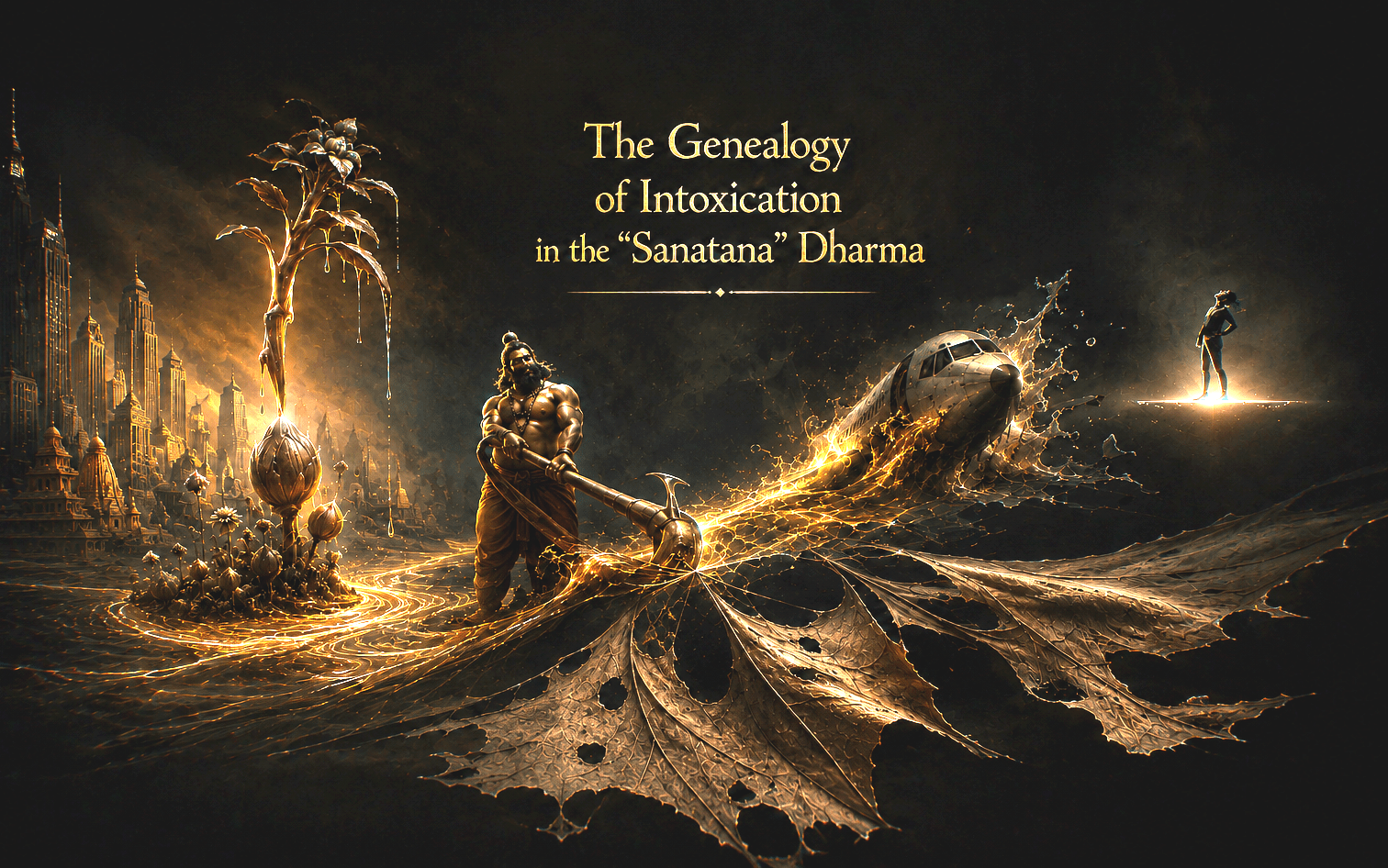
And yet this same tremulous skin now finds itself caught in fiercer winds. The ancient leather bag has been strapped into a modern cockpit — aluminium, ego, and cortisol — hurtling through the jet streams of speed capitalism while the ground rushes up for its fatal close-up. Mayday… Mayday… Mayday.
The captains of hustle — Murthy preaching seventy-hour work sermons, Deshpande demanding eighteen-hour initiations for freshers, the ascetic workaholic at the helm of the state projecting hundred-hour weeks as patriotic duty — bark commands through the headphones: “Push the throttle. Worship work. Discard rona-dhona.” Rest is unpatriotic. Reflection is sabotage. The body is fuel. The mind is payload. The entire civilisation is in free-fall, yet the cockpit voice keeps insisting we are ascending.
This is hustle-hassle culture incarnate: that frantic, foot-tangling dance where every hustle breeds a new hassle, and every hassle demands even greater acceleration until the whole spectacle collapses into Chaplin-esque absurdity. In the open-plan offices of Bengaluru at 2 a.m., bloodshot eyes glow under laptop light while the Little Tramp is devoured not by gears but by Slack pings, KPI dashboards, and investor decks. The foreman’s whistle has become a founder’s LinkedIn gospel. Caffeine has replaced tea; energy drinks stand guard against any hint of human fatigue. Living flesh is burned as metabolic coal for GDP charts and demographic dividends.
India, once the cradle of dharma’s measured rhythm, now outdoes the worst of the West, amplifying the frenzy with saffron-market mania. The plane trembles violently. Warning lights flash across an entire generation. Still the captains broadcast their mantra: more, faster, now.
Into this roaring clamour I whisper Tagore’s storm-cloud plea — not as distant prayer, but as the very tremor inside my chest:
When, Thunderer! I move along tremulous like a wind-blown skin,
Have mercy, spare me, Mighty Lord.
O Bright and Powerful God, through want of strength I erred and went astray:
Have mercy, spare me, Mighty Lord.
Thirst found thy worshipper though he stood in the midst of water-floods:
Have mercy, spare me, Mighty Lord.
Whatever offence we men commit against the heavenly host,
When through our want of thought we violate thy laws,
Punish us not, O God, for that iniquity.
I speak these words not as prayer but as recognition. I am that tremulous skin, that inflated leather bag rushing and throbbing, ready to burst. I refuse the house of clay—the settled grave of career, mortgage, LinkedIn updates, the endless hustle. I refuse the floods of intoxication too: the whiskey that dulls the edge, the dopamine hits of endless scrolling, the collective frenzy that calls itself “living.” I stand in a third space, absurd and fragile, where the water surrounds me yet I will not drink their thirst. I am l’étranger—Camus’ stranger, but softer, more ridiculous, laughing at my own reflection in the receding pool.
I am still that tremulous skin, that wind-blown dṛti from the Rigveda, but now the winds have become jet streams of pure velocity. The house of clay has transformed into a cockpit—aluminium, ego, and cortisol—hurtling through the skies of speed capitalism while the ground rises mercilessly for its close-up. Mayday… Mayday… Mayday. The instruments scream red. The captains of hustle—Murthy preaching seventy-hour sermons, Deshpande demanding eighteen-hour initiations for freshers, the ascetic workaholic at the helm of state projecting near-hundred-hour weeks as national sacrament—bark commands into my ear. “Push the throttle. Worship work. Discard rona-dhona.” Rest is unpatriotic. Reflection is sabotage. The body is fuel. The mind is payload. The entire civilisation is in free-fall, yet the cockpit voice insists we are ascending.
This is hustle-hassle culture incarnate: the frantic, foot-tangling dance where every hustle begets a fresh hassle, and every hassle demands accelerated hustle until the spectacle collapses in Chaplin-esque absurdity. In the open-plan offices of Bengaluru at 2 a.m., eyes bloodshot under laptop glow, the Little Tramp is no longer swallowed by mechanical gears but by Slack pings, KPI dashboards, and investor decks. The foreman’s whistle has become a founder’s LinkedIn gospel. Caffeine altars replace simple tea; energy drinks stand sentinel against creeping fatigue. The energy fetish turns living flesh into metabolic coal—burned for GDP charts, for “outputs,” for the demographic dividend that must be sacrificed at the altar of exponential growth. India, ancient cradle of dharma’s balance, now mimics the worst of the West while amplifying it with saffron-market frenzy. The plane trembles. The warning lights flash across an entire generation. And still the captains broadcast: more, faster, now.
Into this roaring clamour I whisper Tagore’s storm-cloud plea, not as distant prayer but as the very tremor inside my chest:
Rabindranath Tagore took this Vedic cry and made it song. His rendition moves like storm clouds:
যদি ঝড়ের মেঘের মতো আমি ধাই চঞ্চল-অন্তর
তবে দয়া কোরো হে, দয়া কোরো হে, দয়া কোরো হে ঈশ্বর ॥
ওহে অপাপপুরুষ, দীনহীন আমি এসেছি পাপের কূলে—
প্রভু, দয়া কোরো হে, দয়া কোরো হে, দয়া করে লও তুলে ॥
আমি জলের মাঝারে বাস করি, তবু তৃষায় শুকায়ে মরি—
প্রভু, দয়া কোরো হে, দয়া করে দাও সুধায় হৃদয় ভরি ॥
In English:
If I speed like storm clouds, restless within,
Then I plead for your mercy, O Lord.
O sinless One, I’ve come to the shores of sin
With my wretched and weak self—
O Lord, have mercy, be kind and take me unto you.
I dwell amidst water, yet die of thirst—
O Lord, have mercy, fill my heart with nectar.
This is the precise condition of the hustle subject: chañcal-antar, restless-hearted, driven like monsoon clouds whipped by unseen winds. The storm is not external catastrophe; it is internalized propulsion. We chase velocity believing it is destiny, yet the inner man (or woman) cries for mercy exactly because the acceleration has become torment. Tagore knew this duality. In another song he laments a world where “no one has time—they march on in endless throngs,” their stone monuments of pride drowning the flute’s delicate song. Here, in the crashing cockpit, the monuments are unicorn valuations, quarterly targets, and viral CEO sermons; the flute is any whisper of slowness, of breath, of sahaj. The restless heart races, yet the ground of being remains parched. We dwell amidst the floods of data, productivity, and spectacle, yet die of thirst for simple presence.
I, the absurd outsider, refuse to pilot this plane or ride as compliant payload. I have stepped out of the cockpit onto the fragile wing—tremulous, ridiculous, laughing at the absurdity. Hustle-hassle is not mere overwork; it is ontological theft. It steals time, dignity, and the living Earth. It engineers a cruel paradox: burned-out survivors beside surplus ghosts—gig workers, delivery riders, BLOs forced into fifteen-hour suicide runs, while algorithms delete the “unproductive.” It fuses McDonaldization with Coca-Cola capitalism’s engineered thirst: always more, always faster, always dissatisfied. Achievement society’s neuronal violence wires us to love the cage. The black box records only stimulus-response; the older, human black box of suffering and protest is erased.
Yet in my third space, the Vedic tremor meets Tagore’s storm-cloud cry and becomes counter-force. Mercy arrives not as divine bailout but as deliberate deceleration—tortoise-time, Kurmāvasthā, creative idleness, joyful voluntary labour in moneyless convivial circles. I hear the Zapatistas walking slowly, asking questions. I see Gandhi’s snail-paced wayfaring and bread labour. I feel Tagore’s drowned flute still sounding beneath the clamour, calling us to glance aside from the stone monuments and listen.
The plane may be going down, but I am no longer aboard as victim or accomplice. I am the absurd one on the wing, wind-blown skin refusing to burst, storm-cloud heart learning stillness within motion. Have mercy, yes—but the mercy I seek is the courage to slow down, to exit the cockpit, to reclaim time before the ground claims us all.
Mayday becomes my May Day: not distress alone, but declaration. The outsider laughs, tremulous yet strangely still, as the restless clouds part for a moment and the flute’s note rises—fragile, persistent, free.
This is my condition exactly. I move restless, yet I have stepped out of the storm. The hustle is the storm; the intoxication is another wind. I inhabit the calm absurdity between them.
Buddhists call this taṇhā—thirst, craving, the root of dukkha. In the Dhammacakkappavattana Sutta, the Buddha declares: “This is the Noble Truth of the Origin of Suffering: it is this craving (taṇhā) which leads to renewed existence, accompanied by delight and lust, seeking delight here and there; that is, craving for sensual pleasures, craving for existence, craving for non-existence.” Taṇhā is the engine of samsara. It is not mere desire; it is the desperate grasping that turns water into torment. I condemn it not with ascetic fury but with quiet refusal. Why chase the next promotion, the next high, the next validation when the pool is already around my ankles? The Buddha saw that thirst manufactures its own drought. I see it too—in the faces of those who “grind” until they break, who numb themselves until they cannot feel the absurdity.
Kabir, that laughing weaver of Banaras, understood the joke better than most. His song echoes through centuries:
पानी में मीन प्यासी, मोहे सुन सुन आवें हँसी रे
पानी में मीन प्यासी…
जल-थल सागर पूर रहा है, भटकत फिरे उदासी रे…
आतम ज्ञान बिना नर भटके, कोई मथुरा, कोई काशी रे…
जैसे मृगा नाभि कस्तूरी, बन-बन फिरत उदासी रे…
जल बीच कमल, कमल बीच कलियाँ, ता पर भँवर निवासी रे…
कहत कबीर सुनो भई साधो, सहज मिले अविनाशी रे…
“The fish is thirsty in the water—this makes me laugh!
The fish is thirsty in the water…
Water and land, the ocean is full, yet the restless one wanders in sorrow…
Without self-knowledge, man wanders—some to Mathura, some to Kashi…
Like the musk deer, searching forest to forest for the fragrance in its own navel…
In the water is the lotus, in the lotus the bud, and in the bud the bee resides…
Says Kabir, listen O seekers: the Eternal is found naturally, effortlessly.”
I laugh with Kabir. The fish—me, you, all of us—swims in the very element it craves, yet invents thirst. The hustler chases “success” while drowning in abundance. The partier chases oblivion while surrounded by sensation. Epistemologically, Kabir points to sahaj—the natural, effortless realization. Knowledge is not accumulated; it is recognized. The third space I occupy is this sahaj absurdity: I see the water, I feel its coolness, but I do not gulp it down as remedy or escape. I float, ridiculous and free.
And then there is Tantalus. The Greek king who served his son to the gods and stole their ambrosia. His punishment in Tartarus is exquisite: he stands in a pool of water that recedes whenever he bends to drink; overhead, fruit branches sway away when he reaches. Eternal, perfect frustration. The word “tantalize” comes from him—teasing with the unattainable.
I am Tantalus who has stepped aside. I see the pool and the fruit, but I refuse the game. The gods (capital, dopamine, status) set the trap. Hustle culture is Tantalus’ pool—always promising the next sip will satisfy. Intoxication culture is the fruit—sweet, swaying, forever out of reach once pursued. I occupy the bank, absurdly content, watching others lunge and gasp. My transcendence is fragile; any moment the current might pull me in. Camus would approve: one must imagine Sisyphus happy, but I prefer to imagine Tantalus laughing—stepping out of the pool entirely, dripping, and saying, “No thanks.”
This is my life. I wake without alarm. I write, I wander, I observe the crashing cockpit of speed capitalism without boarding the plane. I feel the Vedic tremor, Tagore’s storm, the Buddha’s diagnosis, Kabir’s laughter, and Tantalus’ chains—all at once. I am not above it; I am beside it. The outsider. The absurd one. The fish who realized she was already wet.
And in that recognition, mercy arrives—not from Varuṇa or any god, but from the simple act of stopping the chase. The house of clay can wait. The thirst is optional. The third space, however fragile, is mine. I breathe here, tremulous yet strangely still, like a wind-blown skin that has finally chosen not to burst.
Part-II
Sigh of the Oppressed Creature, Flame of the Visionary Girl: Creative Suffering in the Third Space
The Vedic skin still trembles in my chest. I carry its pulsation like a hidden drum into the deeper night of this fracture. The house of clay is no longer merely career or mortgage; it has become the entire suffocating architecture of my time: the theocratic state that homogenizes every dissenting breath into ritual obedience, the market fundamentalism that auctions tomorrow before today has ended, and the fascist pseudology that drapes both in saffron and spectacle while the rivers choke and futures are foreclosed. I stand outside their circuits of hustle and intoxication, yet the misery seeps in. It pools at my feet. I do not drink, but I feel its temperature. This is where creative suffering begins—not as noble pose, but as absurd, self-reflexive lament.
Karl Marx, writing amid the smoke of early industrial England, cut through with surgical clarity:
“Religious suffering is, at one and the same time, the expression of real suffering and a protest against real suffering. Religion is the sigh of the oppressed creature, the heart of a heartless world, and the soul of soulless conditions. It is the opium of the people.”
I do not read this as condemnation or endorsement. I inhabit it — warily.
Marx’s metaphor — “Religion is the opium of the people” — performs a powerful but slippery semantic operation. By equating religion with opium, Marx does not primarily invoke the modern image of the drowsy addict lost in narcotic haze. In 1844, opium (particularly laudanum) was still dominantly understood as a sedative analgesic — a substance that dulls pain, suppresses coughs, quiets the nerves, and induces a heavy, dreamlike oblivion. The semantic core of the metaphor, therefore, is not stimulation, ecstasy, or even addiction in the ecstatic sense, but sedation: the chemical pacification of suffering.
This is both the metaphor’s strength and its critical vulnerability.
By calling religion “opium,” Marx brilliantly captures how institutional religion often functions as a neuro-political anaesthetic. It does not remove the structural causes of suffering (exploitation, alienation, dispossession); it merely dulls the sufferer’s sensitivity to them. The raw scream of the oppressed creature is transmuted into a muffled sigh, a devotional moan, a prayer that expends emotional energy without threatening the architecture of power. In this sense, the metaphor is devastatingly accurate: religion-as-sedative converts revolutionary potential into spiritual resignation. It makes the intolerable temporarily tolerable.
However, the relationality “religion = opium = sedative” is semantically reductive and historically selective. Opium itself has never been only a sedative. In various cultures and doses, it has acted as euphoric, visionary, analgesic, and even (paradoxically) energizing. More importantly, religion has frequently operated far beyond sedation. It has been:
- A stimulant of revolt (the Bhakti and Sufi movements, the Peasants’ Revolt, the Indian freedom struggle’s religious idioms, Liberation Theology).
- A hallucinogen producing radical visions of justice and alternative worlds.
- A poison that kills as well as a medicine that heals — precisely Derrida’s pharmakon.
By fixing religion primarily in the semantic field of the sedative, Marx’s metaphor subtly erases religion’s explosive, mobilizing, and counter-hegemonic capacities. It flattens the trembling, dangerous, double-edged nature of the sacred. The oppressed creature does not always sigh — sometimes it roars, burns effigies, drags rivers, or strikes matches (as in Brecht’s Simone). The metaphor risks becoming complicit in the very domestication it critiques by implying that religion’s dominant function is always pacification.
In my third space, I therefore fracture the metaphor: Religion is not merely the opium of the people. It is a volatile pharmakon — capable of functioning as sedative, as toxin, and as insurgent intoxicant. The organized, state-sponsored, saffron-infused varieties often lean heavily toward the sedative-opium pole. But the raw, uncolonized sigh — the pre-institutional cry of the tremulous skin — carries within it the potential for an entirely different chemistry: a fierce, living medicine that awakens rather than dulls.
I refuse the sedative opium. I shelter the pharmakon that might yet set the nerves on fire.
In my fragile third space, I feel both edges of the blade at once: the toxin that numbs and domesticates, and the medicine that briefly lets the creature breathe, remember its aliveness, and dare to rage. I reject the first with contempt. I shelter the second like smuggled fire.
Here, in this land of speed capitalism crashing into saffron fundamentalism, the house of clay is reinforced daily with grand temples, statues, and media spectacles funded by the very people it crushes. Market fundamentalism foregrounds itself while religious fundamentalism is foregrounded for the masses; both foreclose genuine dissent.
Foregrounding Fundamentalism, Foreclosing Fundamentalism VIEW HERE ⤡
The pseudology of contemporary politics manufactures consent through lies so grandiose they become simulacra—promises of 15 lakhs, smart cities, farmer prosperity—while public assets are handed to cronies and subaltern voices are erased. I see the real suffering: farmers in debt, minorities demonized, dissent labeled anti-national, bodies policed in the name of culture and development. Religion here is weaponized as hegemony, yet beneath it pulses that Vedic tremor, that sigh.
Tagore, in the allegorical inferno of Red Oleanders, lets Bishu articulate the counter-current:
“God in his mercy has everywhere provided a liberal allowance of drink. We men with our arms supply the output of our muscles, you women with yours supply the wine of embraces. In this world there is hunger to force us to work; but there’s also the green of the woods, the gold of the sunshine, to make us drunk with their holiday-call.”
Phagulal, bewildered by extraction and profit, asks: “You call these things drink?”
Bishu answers:
“Yes, drinks of life, an endless stream of intoxication. Take my case. I come to this place; I am set to work burgling the underworld; for me nature’s own ration of spirits is stopped; so my inner man craves the artificial wine of the market place.”
Here lies the hinge — Marx’s theory of alienation (Entfremdung). In his Economic and Philosophic Manuscripts of 1844, Marx describes how, under capitalism, the worker is estranged not only from the product of his/her labour (which confronts him/her as an alien, hostile power) but from the very act of production, from his/her own species-being (Gattungswesen) — his/her creative, conscious essence as a human — and finally from fellow human beings. What should be a free, life-affirming expression of human powers becomes coerced, mechanical, and deadening. The living subject is reduced to a thing; the thing (capital, commodity, profit) becomes sovereign.
In this alienated condition, the natural “drinks of life” — the green intoxication of the forest, the golden ecstasy of unmediated sunlight, the erotic embrace of the earth and the holiday-call of the senses — are systematically cut off. When the system severs the creature from its organic unity with nature and creative labor, an existential thirst is manufactured. Into this void rushes the artificial wine: narcotics of consumption, spectacle, scrolling dopamine, nationalist fervor, and ideological opium. These are not mere distractions; they are compensatory intoxicants that both dull the pain of alienation and reproduce the conditions that cause it.
Yet the original ration, if reclaimed, becomes counter-hegemonic: not mere escape but insurgent remembrance. Religion, in its subaltern, visionary register, can carry this remembrance. It can become the language in which the oppressed creature says no when every other tongue has been cut.
At this point the threshold cracks open. I jump. The rupture is absurd, ridiculous, inevitable.
In Bertolt Brecht’s The Visions of Simone Machard (1943, written in exile with Lion Feuchtwanger), a fourteen-year-old girl works as a servant in a roadside inn near the French border as Nazi tanks roll in. She is doubly crushed: by the foreign occupiers and by the innkeeper who collaborates for profit, hoarding fuel and ammunition. Simone begins to see visions. She becomes Joan of Arc—voices of saints, banners in the wind, the smell of holy smoke. Brecht stages the play in episodic, alienated scenes that flicker between harsh daylight realism and dreamlike pageant. In the final sequence, watching the Nazis stockpile destruction in the very cellar where she sleeps, Simone strikes the match. The inn explodes in cleansing fire. Resistance born not from party pamphlet but from subaltern Christian myth. Brecht shows the pharmakon at its most potent: the “opium” ignites into Molotov. The sigh becomes arson. False consciousness becomes true praxis when the suffering creature seizes the inherited grammar of defiance.
This pattern repeats. Bhagat Singh, even as he declared himself atheist by the early 1930s, openly acknowledged the anti-imperial fire he inherited from movements like the Kuka rebellion of 1872, the Babbar Akali struggles, and the Jaito Gurudwara agitation—revolts steeped in religious idiom yet fiercely political. The mode of resistance, the courage grammar, came from the people’s own mythic soil. Subaltern Studies scholars—Ranajit Guha foremost—recovered this autonomous domain in peasant insurgencies the colonial archive dismissed as “fanatical,” “criminal,” or “pre-political.” Guha demonstrated that these revolts possessed their own logic: inversion of hierarchy, rumor as organizing force, myth as mobilizing energy. Religion here was not supplement to elite nationalism; it was the terrain on which the subaltern made history in a tongue the rulers could not translate.
I, the absurd outsider, l’étrangère, stand at the rift. Will I merely lament suffering or let it calcify into false consciousness? Will I swallow the state’s homogenized scripture or the market’s chemical and digital opiates? Will I nullify suffering through denial or aestheticize it into sterile art? No. The creative suffering I inhabit is something else. It is the tremor that refuses both the reality principle’s grind and the pleasure principle’s anaesthesia. The rift between the suffering-afflicted ego and the surplus creative realm is not to be healed by transcendence-above but by a tilt, a switch: from ego to eco. From the isolated “I” to the enfleshed, responsive world.
Creativity without intimacy is only refined self-gratification—another form of intoxication. True creation demands Lebenswelt engagement, Umwelt-sein—being-with-the-surrounding. Nature is terrifying: indifferent floods, devouring time, the vastness that reduces our clay houses to dust. Yet it is also the intimate enemy, the beloved other that calls forth response-ability, responsivity, reciprocity. No longer estranged. This is nisargaśṛṅgāra—the erotic sentiment of the natural, the romantic-erotic cultivation of complex wholeness (nisarga). Not postcard romanticism, not pesticide-drenched bodies reduced to skin and skeleton, but the corporeal that exceeds biology: a tissue-plexus of belonging, a polyphony of voices. Prehension—Whitehead’s term for the creative grasping—becomes surrender without dissolution of positionality. Cultivation of land and self together. Here coercion is circumnavigated through intimate, situated engagement. The third space grows fertile even in fragility.
In the suffocating now—where theocratic homogenization, market fundamentalism, and fascist spectacle foreclose every genuine question—this nisargaśṛṅgāra…. human-nature creative intimacy, is my quiet, absurd art of resistance. I do not drink their wine. I do not burrow their underworld. I remain the tremulous skin, the sighing creature, the girl who may yet strike the match when the fuel of destruction is stacked too high. Then I step back laughing into the green and gold, ridiculous, wet, alive.
The suffering is real. The protest is real. The creative flourishing—intimate, corporeal, polyphonic—is the only transcendence I trust. Fragile. Third. Absurdly, stubbornly mine.
Disclaimer: This article employs polyphonic voices, political satire, and deliberate exaggeration as a form of devil’s advocacy. The authors deliberately inhabit multiple contradictory positions — devotional revivalist, academic provocateur, and absurd outsider — not to endorse any singular ideological project, but to subvert the rigid binaries and selective orthodoxies prevalent in contemporary Hindutva discourse. Through strategic sarcasm and ironic exaggeration, the work seeks to expose the internal contradictions within both neoliberal accelerationism and theocratic-market fundamentalism, while playfully interrogating the limits of sanitised, monolithic representations of Sanatana Dharma. All devotional and scriptural elements are presented in earnest literary and philosophical spirit; the satirical layers serve as a subversive instrument to open a wider, more courageous space for nuance, rather than to promote any political agenda. Readers are invited to engage with the text in the spirit of radical inquiry and self-reflexive play.


From Rigveda’s divine Somarasa to Balarama’s Varuni līlā — Sanatana Dharma never banned sacred intoxication, it regulated it with wisdom. Yet BJP-ruled dry states push prohibition while claiming to protect ‘Hindu culture’. Hypocrisy or selective fundamentalism? Time to reclaim nuanced dharma over political control.
#SanatanaDharma, #VedicSoma, #DrunkBalarama, #MadyaDharma, #SanatanaVsProhibition, #BJPDryPolicy, #GujaratProhibition, #BiharLiquorBan, #DharmaAndDryState, #HindutvaCritique, #Down_With_Theocracy, #SomaInModernBharat, #BJP,
LikeLiked by 4 people