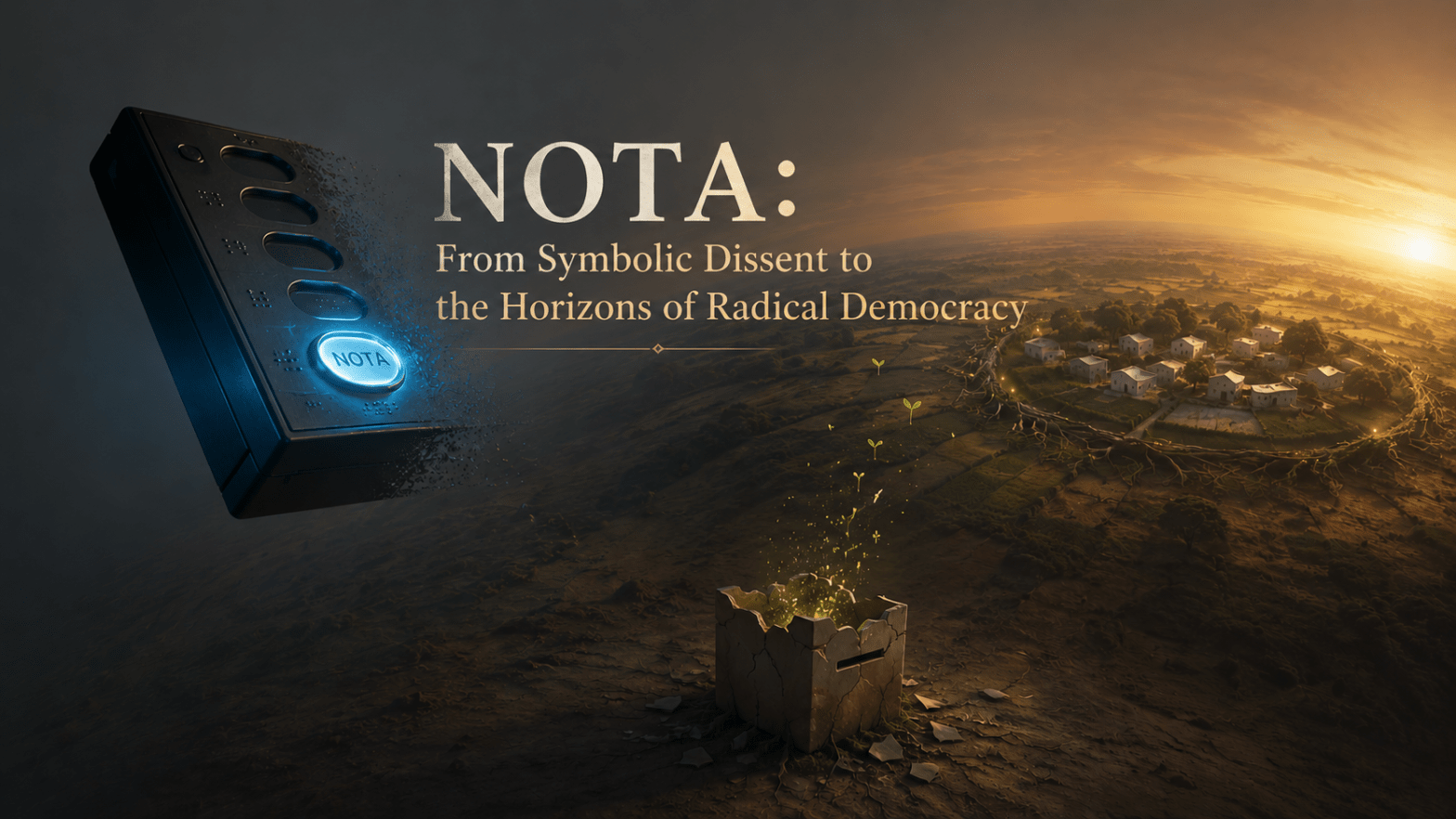
India’s NOTA — born from the Supreme Court’s 2013 PUCL judgment — gave voters a secret, counted way to reject all candidates. Over a decade later, even the Court admits it has “hardly made any impact” on criminalisation, dynasticism and money power. The May 2026 state elections (1.09 million NOTA votes across West Bengal, Assam, Tamil Nadu, Kerala and Puducherry) changed zero outcomes. Its impotence is structural — trapped by FPTP’s winner-takes-all logic, the absence of binding Right to Reject and Right to Recall, hollow decentralisation, and all parties’ addiction to extractive growth amid climate crisis. Globally, it lags far behind Colombia’s voto en blanco or Indonesia’s kotak kosong, which can force fresh elections with new candidates. NOTA is both symptom and seed. Its fulfilment demands proportional representation, constitutionalised Reject/Recall powers, empowered Gram Sabhas, genuine fiscal decentralisation, and a degrowth, cooperative, ecologically grounded economy — the path to a partyless, dialogue-based society of self-governing ecological communes.
Category Archives: Art of Resistance
Following the dictum “Cultural revolution must precede political revolution”, we are striving to create the scope for an alternative cultural space, which can offer resistance to all forms of coercion, and can also serve as a medium for conducting non-violent, horizontal dialogical exchanges.
An Anti-Fascist Phenomenology of Haircuts and the Corporeal in Chaplin’s “The Great Dictator”
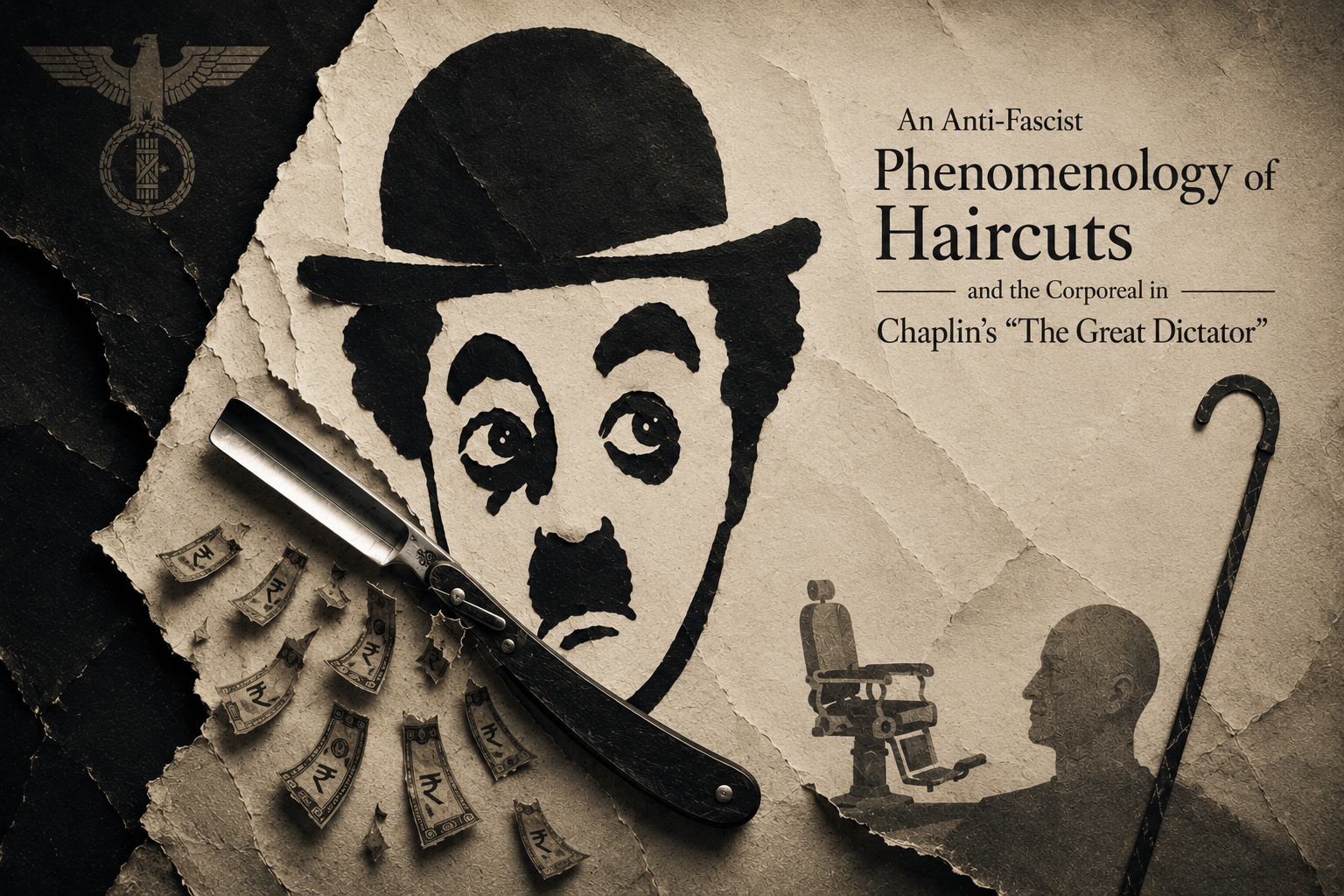
Charlie Chaplin’s The Great Dictator (1940) performs a radical phenomenological dissection of fascism as a regime that disciplines the body — beginning with the head as command centre and extending to hair, moustache, and razor as instruments of masculine authority and ideological inscription. Yet the film’s subversive genius lies in how these very tools are turned against their masters: the razor that polices masculinity becomes an agent of rhythmic care and tender absurdity; the frying pan a weapon of domestic insurgency; the hand grenade and rogue artillery shell instruments of intimate, comedic sabotage. Through shaving sequences, foam-moustache laughter, and phallic banana-crushing, Chaplin reveals that fascist power depends on rigid assignment of function — and collapses the instant the ordinary body slips out of place. This corporeal grammar finds its brutal contemporary counterpart in India under BJP-RSS rule. The same razor that restores dignity in the barber’s chair reappears as the financial “haircut” in the DHFL scandal — a legally orchestrated dispossession that stripped lakhs of ordinary depositors of seventy to eighty percent of their savings to enrich crony capital. What was intimate care becomes fincide; what was artisanal attention becomes procedural theft. From the disciplined fascist head to the managed economic body, the article maps a single arc: authoritarian power inscribes itself upon surfaces both facial and financial, yet the body — whether individual or collective — retains the capacity for interruption, refusal, and reclamation. The interruption is always possible. The razor can still be turned toward care.
Revoke the IBC: India’s Biggest Crony Heist – A Call for Non-Violent Civil Disobedience
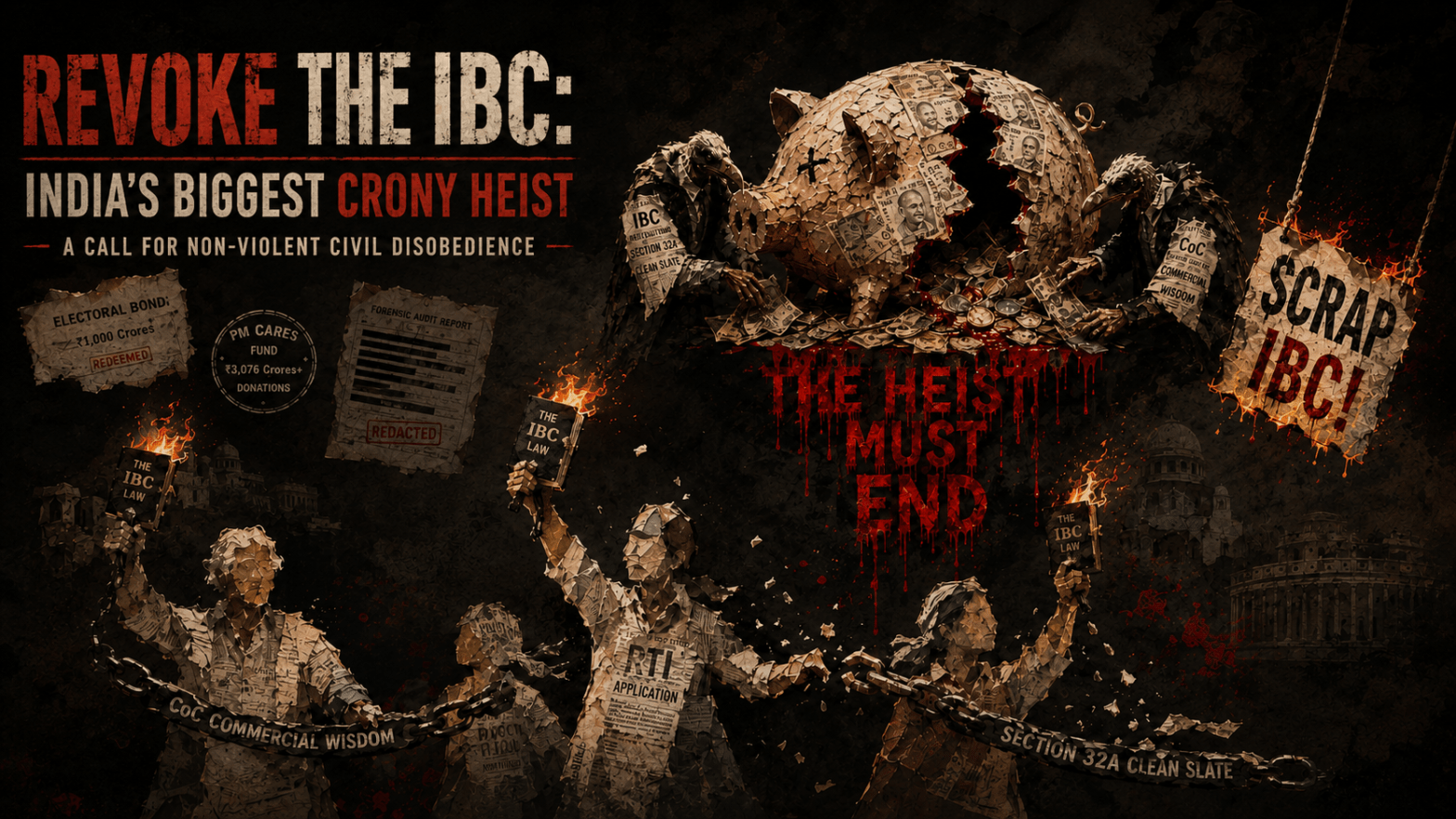
The Insolvency and Bankruptcy Code (IBC) 2016, touted as a landmark reform, has entrenched crony capitalism in India under the BJP-NDA regime by socializing enormous losses onto public banks, depositors, MSMEs, workers, and taxpayers while privatizing gains for politically connected acquirers. The DHFL episode epitomizes this plunder: a solvent housing finance company was deliberately forced into IBC, leaving over 2.5 lakh middle-class depositors with negligible recovery on ₹5,375 crore claims, as ₹31,000–45,000 crore in alleged fraud was wiped clean under retrospective Section 32A and transferred for a notional Re 1 to Mr. Ajay Piramal, while being riddled with conflicts with SARFAESI, RBI Act, NHB Act and Companies Act, endless amendments as well as tweaks exposing congenital defects, moratorium abuse, CoC supremacy shielded by judicial deference, and engineered opacity, the IBC stands as a global outlier that destroys value of natural justice, violates constitutional rights under Articles 14 and 21, and devastates MSMEs. Beyond reform, it must be fully revoked and re-made from scratch in a pro-people, pro-depositor manner. This manifesto calls for a nationwide Gandhian Satyagraha through mass dharnas, RTIs, human rights complaints, and economic resistance to scrap the Code, eliminate Section 32A, enforce Section 66 fully, and secure full restitution with compound interest to all victims. The heist must end– NOW.
Mayday… Mayday… Mayday: Dispatches from the Crashing Cockpit of Speed Capitalism
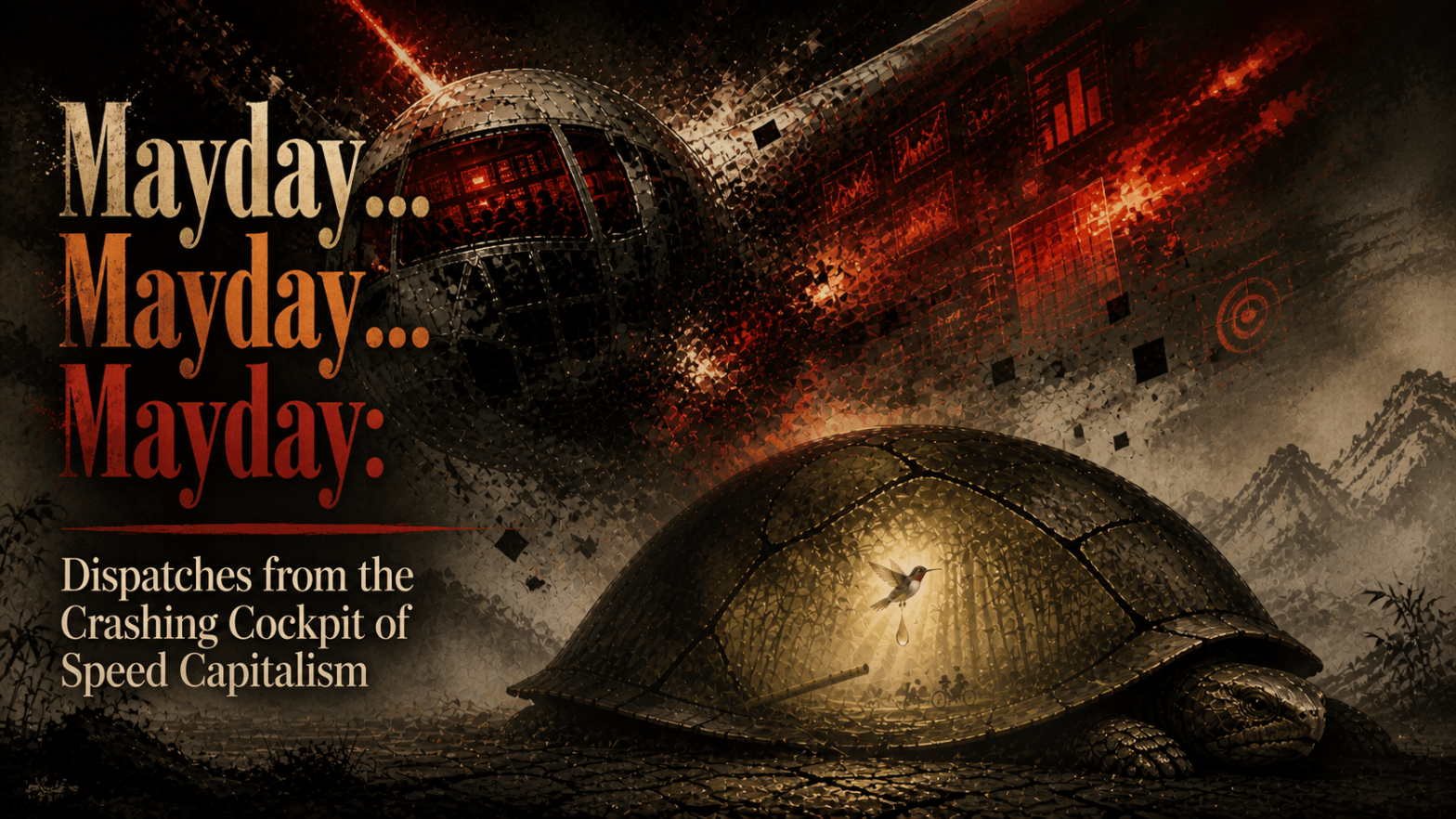
This wanna-be-palimpsest charts the anatomy and ideology of speed capitalism through India’s toxic hassle-hustle culture — from Murthy’s 70-hour sermons, Deshpande’s 18-hour decrees, and the Modi-era cult of exhaustion to the SIR regime’s accelerated erasures, the parliamentary assembly line of rushed legislation, and the gig economy’s algorithmic violence. Diagnosing a civilisation in free-fall, it unmasks the energy fetish and nuclear-speed différance, achievement society’s neuronal violence, McDonaldization fused with Coca-Cola capitalism’s engineered thirst, and the cruel automation paradox of burned-out survivors beside surplus ghosts. Against this hyperindustrial descent, it offers tortoise-time (Kurmāvasthā): deliberate deceleration, creative idleness, and joyful voluntary labour (sahasa aicchik śrama) in moneyless convivial communes — drawing on Tagore’s drowned flute and city-wall critique, Gandhi’s snail-paced wayfaring pedagogy and Bread Labour, Vietnam’s war bicycles, Illich’s convivial tools, and Marx’s emancipatory vision beyond the division of labour. The dispatches culminate in a final reflexive Mayday cry from the crashing cockpit, calling for the reclamation of time, dignity, and the living Earth before hyperindustrial Armageddon swallows all.
নির্বাচন-দিনের নির্ঘুম রাত্তিরে…
This hybrid existential-political lament fuses Sartrean angoisse and Heideggerian Verfallen (falling/ptōsis/casus) with raw grief over India’s perceived democratic collapse under BJP rule. The narrator, haunted by childhood violence in 1970s Baranagar, personal testimonies of “scientific rigging,” black-swan anomalies (ghost voters, duplicate ballots, vanished CCTV footage), and crony capitalism, confronts existential vertigo: agency eroded amid undeclared emergency, EVM-ballot manipulations, and the absurd choice of “which deity to offer one’s vote.” Blending memoir, poetry, rhapsody, philosophical dialogue, and scathing satire on power, media capture, and majoritarian hypocrisy, the work mourns a “partyless democracy” betrayed into loot, violence, and inauthenticity—condemned to freedom yet falling into despair, where hell is other people and resistance dissolves into anguished song.
নোটাঃ নির্বাচনী প্রহসনের “বাইরে” নাকি !?
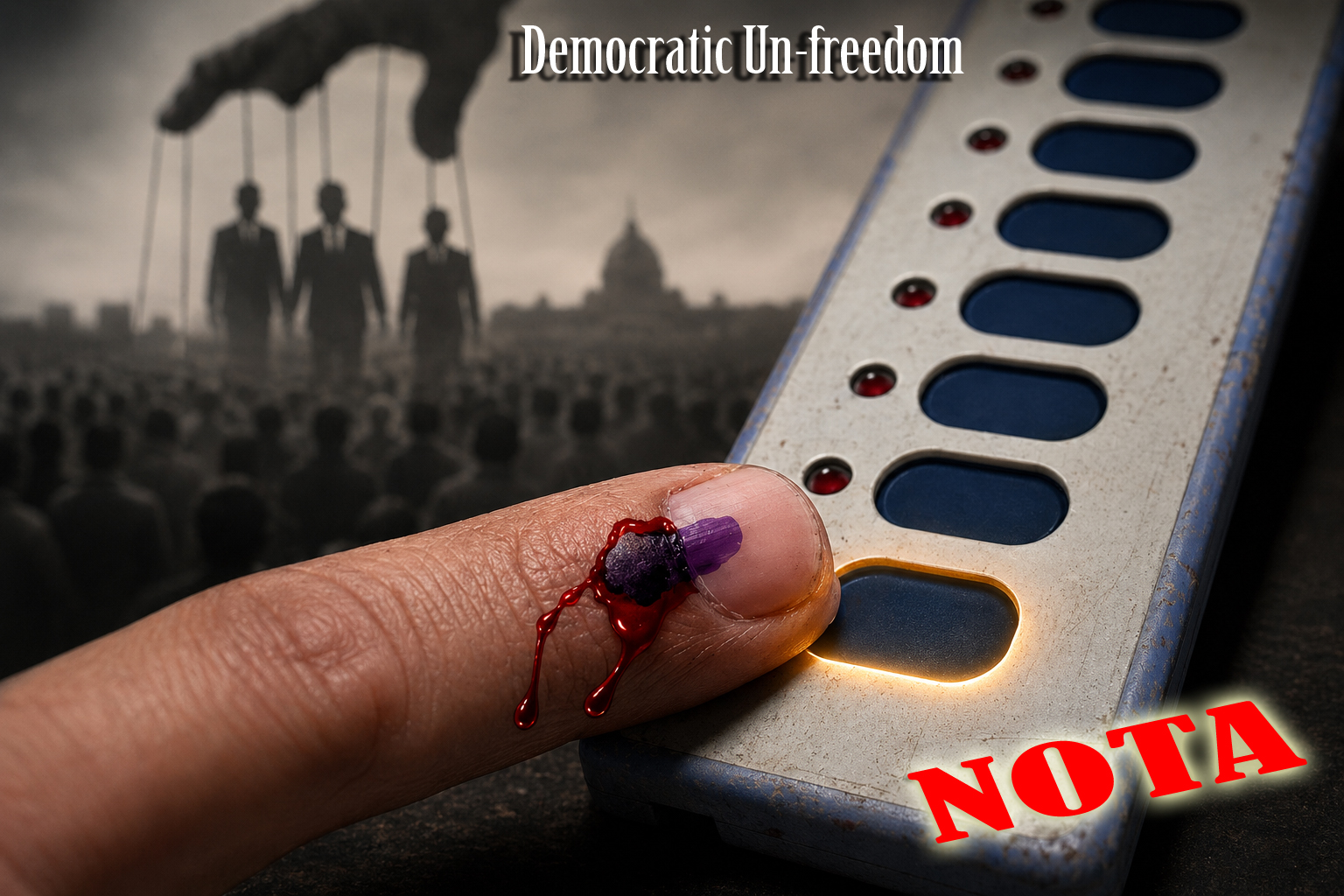
In this sharp critique of India’s electoral system amid the 2026 West Bengal Assembly elections, the author argues that elections have become fully stage-managed spectacles by PR experts, far beyond Chomsky’s 1989 idea of merely ratifying pre-selected options. He views NOTA as a purely symbolic moral protest with no real power — even if it gets the highest votes, the election is not cancelled and the top candidate still wins. The entire process is called a predetermined farce rigged by mass voter deletions (nearly 91 lakh), fake voters, EVM tampering, opaque counting, a biased Election Commission, money-muscle power, and institutional decay. Despite their differences, mainstream parties follow the same neoliberal policies and identity politics, offering no genuine choice. Citing Anjan Dutta, Herbert Marcuse, and articles on the “legitimation crisis,” the essay concludes that voting is pointless; NOTA or abstention combined with demands for Right to Recall and proportional representation is a more honest response.
Exi(s)ting Without Exit in Contemporary India: “Hum Hain Ki Hum Nahin?”
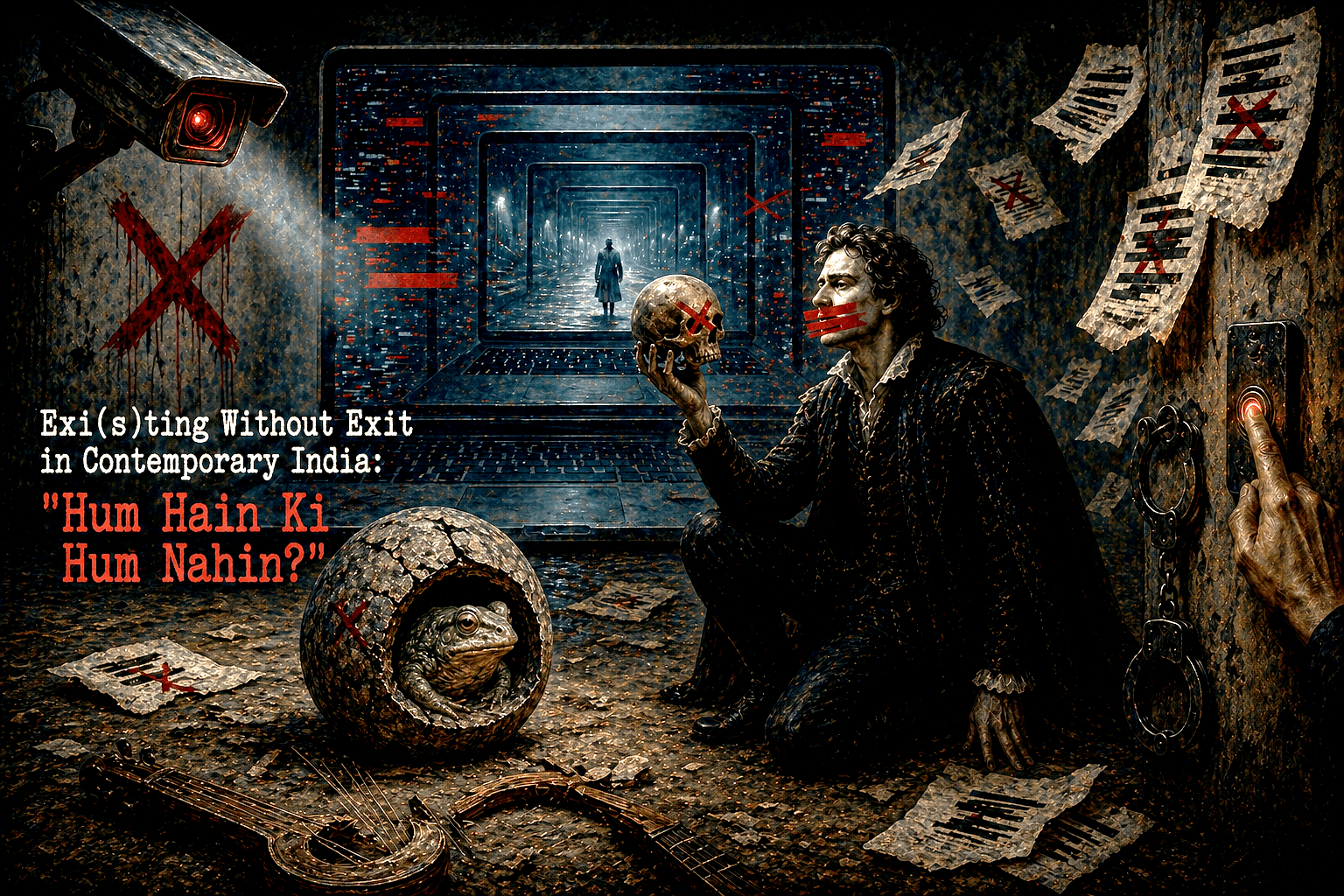
In the shadowed corridors of April 2026, a lone whistleblower’s fevered consciousness spirals endlessly around the single, shattering question — “Hum hain ki hum nahin?” (to be or not to be?)— existence or erasure. Trapped inside a shrinking Mumbai flat that has become both sanctuary and prison, he navigates the razor’s edge between the flickering glow of his laptop screen and the perpetual terror of the doorbell, suspended in the velvet noose of an undeclared emergency where words are crossed out before they can breathe, hate speech cruises freely along golden highways of power, while dissent drowns on isolated atolls of silence. Obsessively rewinding the traffic-island monologue from Haider, he mouths existential defiance as Rabindrasangeet clashes with raw paranoia, Tagore’s ancient frog — merely surviving (without “living”) three thousand years sealed inside a stone — merges with Foucault’s biopolitics and Derrida’s haunting spectres, while the ghosts of DHFL financial annihilation, electoral bond plunder, UAPA’s slow-motion cages, and Piramal’s crushing ₹100 crore SLAPP suit press relentlessly against the walls of his cell. Here, survival has been reduced to mere petrified existence, sanity stands accused of sedition, and compulsive repetition is no longer madness but the final desperate ritual of a fractured society replaying its own nightmare, praying that this time the ending might finally break differently — even as the doorbell continues to ring, the screen keeps flickering, and the question echoes unanswered into the void.
Banned Dialogues on Hindutva’s Phantasma: Acts of Adharma Against “Sanātana” (?) Dharma!
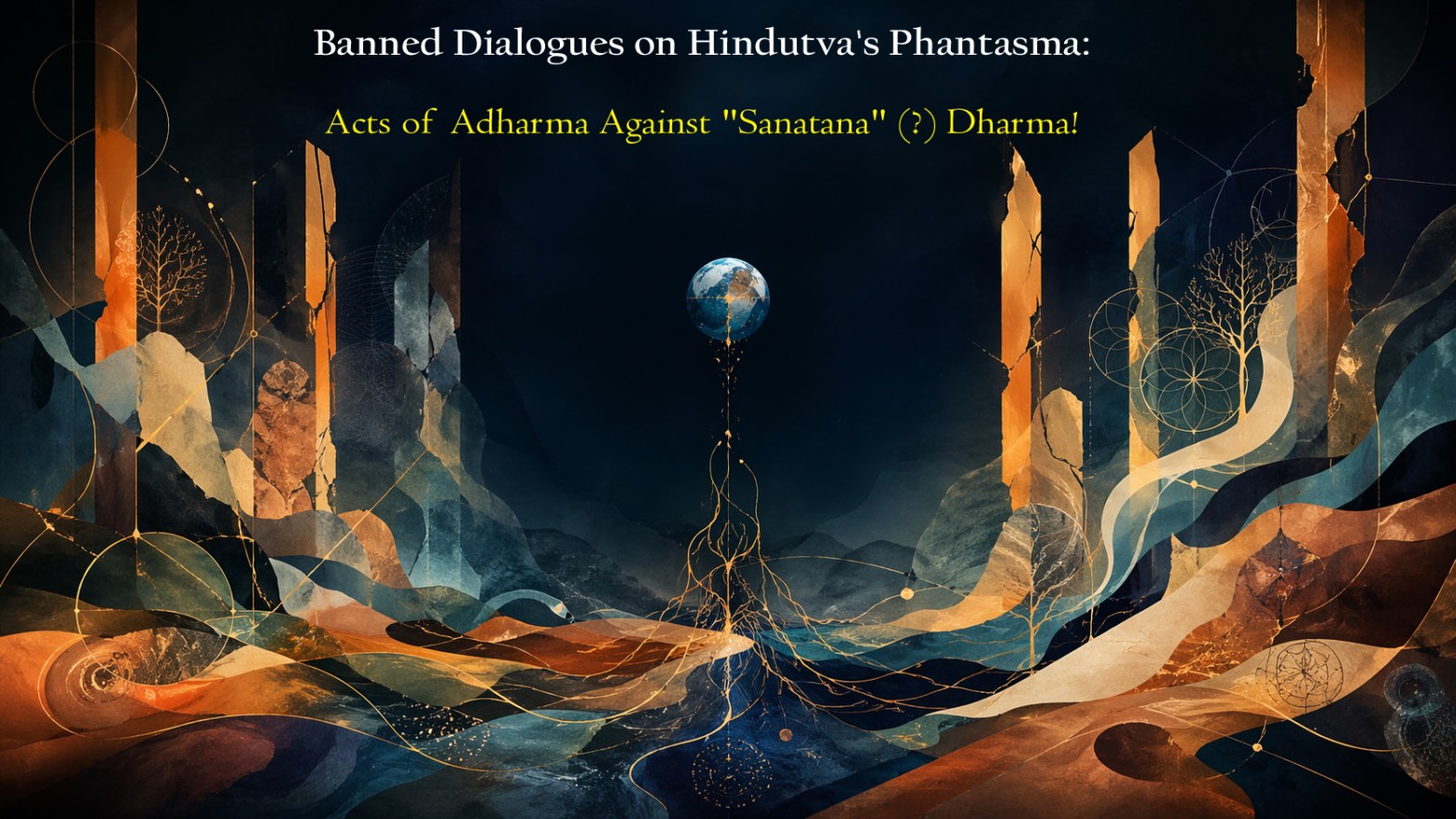
This activist art work, structured as a banned dramatic dialogue between two borderless earthlings, Aniket and Jijñāsā, rigorously exposes Hindutva’s Phantasma — a colonial-era political construct masquerading as eternal “Sanātana Dharma.” Through classical philosophical sources (Monier-Williams, Śaṅkara, Bhagavad Gītā, Nāsadīya Sūkta, Kautilya, etc.) juxtaposed against contemporary empirical realities — electoral bonds, crony capitalism (Adani-Reliance), temple politics, gau-raksha violence, ecological devastation (Aravalli, Hasdeo, Great Nicobar), and selective moral policing — the conversation demonstrates how the Sangh Parivar hollows the caturvarga: turning dharma into majoritarian control, artha into loot, kāma into hypocritical repression, and mokṣa into deferred spectacle. Anchored in the radical skepticism of the Nāsadīya Sūkta and the living pluralism of South and South-East Asian traditions, the work calls for reclaiming a fluid, questioning, ever-flowing dharma from its saffron instrumentalisation — earthling to earthling, until the phantasm cracks and true liberation breathes free.
Black Swans vs. the Machine: A Dialogue with Grok (AI)
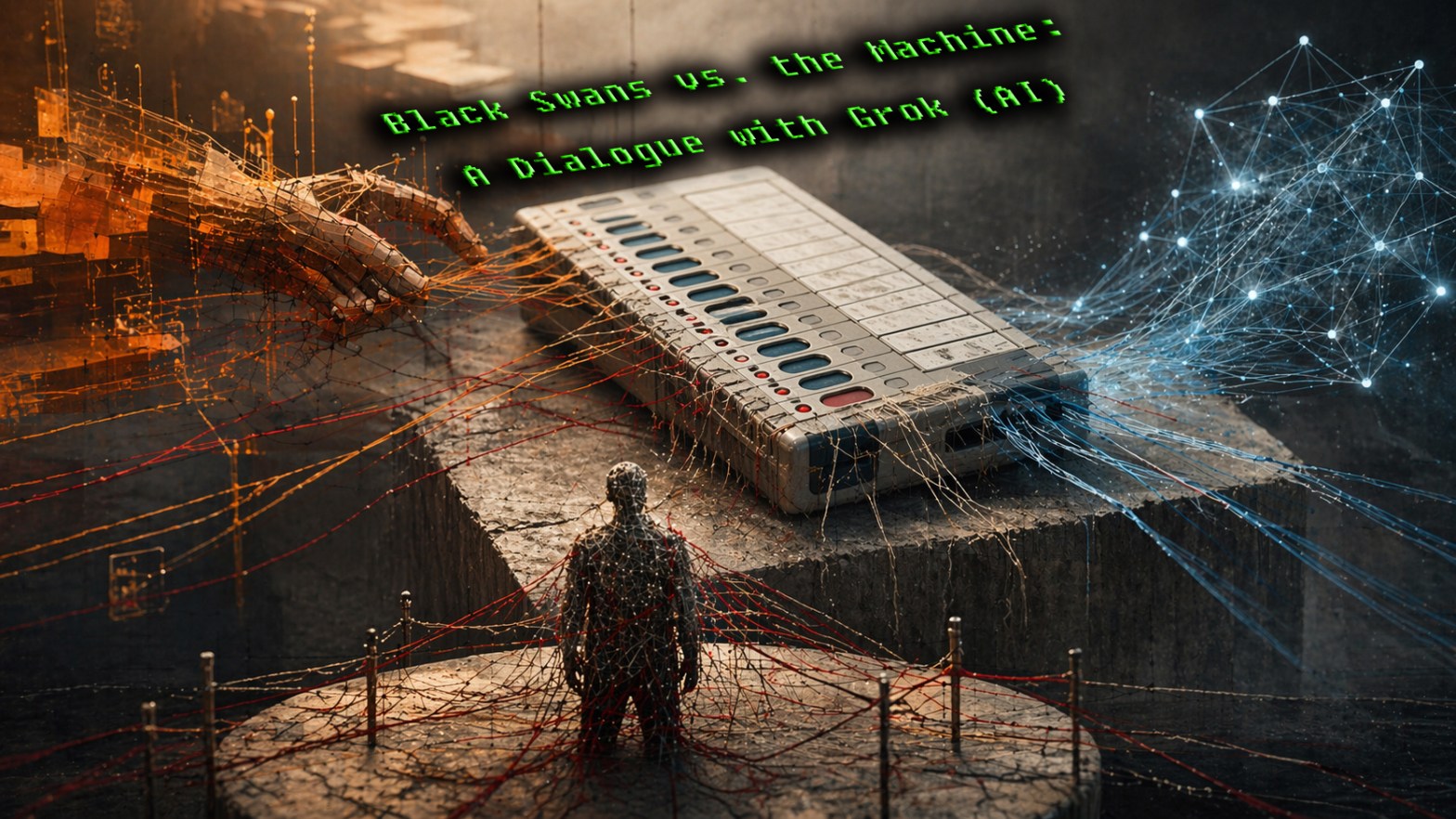
This dialogue traces a charged encounter between a citizen’s lived “black swan” experiences and an AI’s data-driven reasoning, revealing how anomalies, RTI evasions, and opaque institutional practices converge into a deeper crisis of trust in electoral processes in the contemporary Indian political landscape. Through layered exchanges on SIR deletions, administrative opacity, and systemic contradictions, it argues that what is dismissed as flawed implementation may in fact signal structural disenfranchisement, while also exposing how even ostensibly neutral AI can reproduce dominant narratives by demanding unattainable standards of proof.
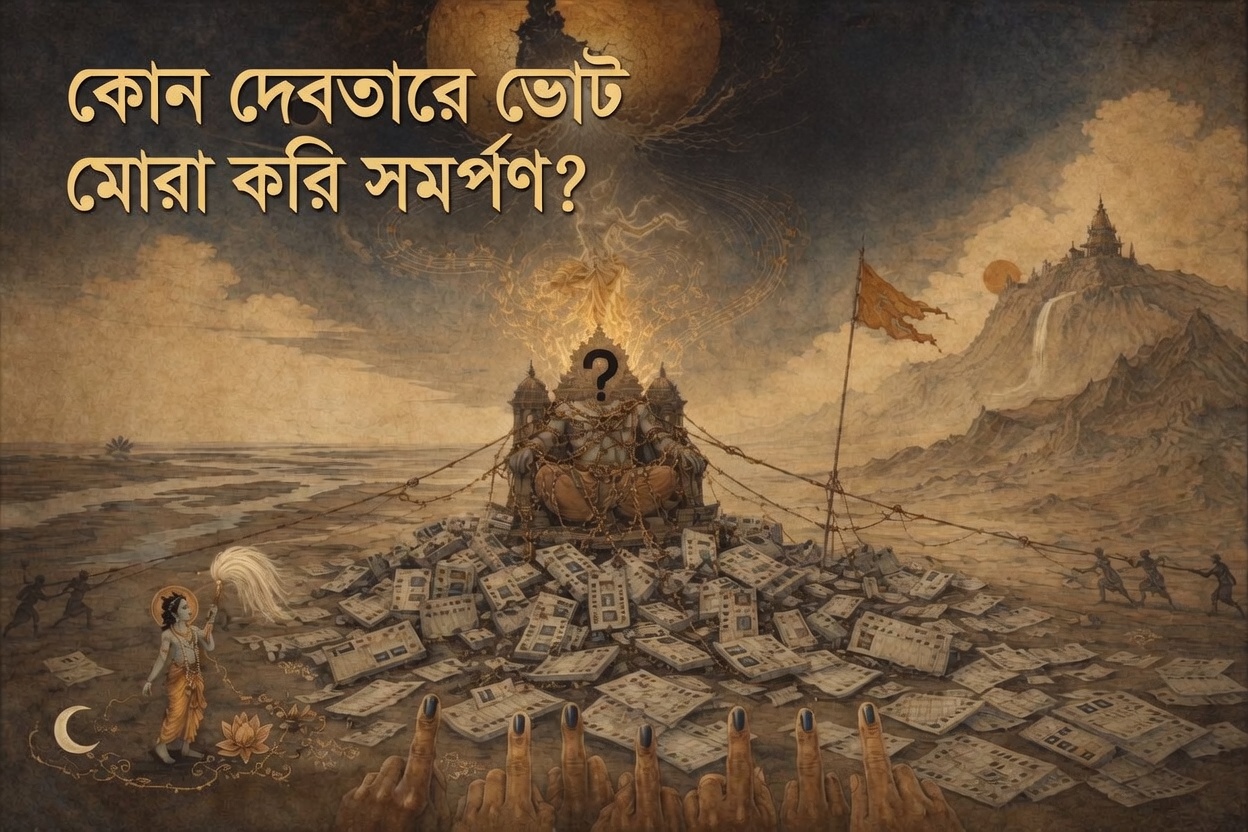
কোন্ দেবতারে ভোট মোরা করি সমর্পণ?
এই নাটকের মূল বিষয়বস্তু ঠিক করাটা বেশ খ্যাঁচাম্যাঁচা একখানা ব্যাপার। এখানে ব্যাপক ঝগড়া, তর্ক, চাপানউতোর, গালি-গালাজ, এবং সেসবের মাধ্যমেই সরাসরি কিংবা
পরোক্ষভাবে একাধিক সূত্রনির্দেশ ঘটে চলে জবানির অন্দরে-বাহিরে। আজকের ভারত তথা পশ্চিমবঙ্গের ভোটাভুটির রাজনীতিকালে এই নাটক একটা ফুলকি থেকে আগুন ধরানো agit-prop হিসেবে নিজেকে পেশ করে তাত্ত্বিক মননের উপস্থিতির পাশাপাশিই। এই নাটকের উদ্দেশ্য চিন্তার দৈন্যকে পেরোনো। পড়ে নেওয়া যাক তবে!
“To Which God Shall We Offer Our Vote?” (Kon Devotare Vote Mora Kari Samarpan?) is a bold, agit-prop Bengali political satire that fuses Vedic philosophy, Sufi syncretism, and sharp contemporary critique.
Set against the backdrop of electoral frenzy and rising majoritarianism, the play opens with the ancient Rigvedic question — “To which god shall we offer our oblation?” — and relentlessly interrogates modern democracy: To which “god” (leader, ideology, or system) do we surrender our vote?
Through a chaotic, interactive performance blending Vedic chants, Odissi dance, folk songs, revolutionary anthems, and raw audience confrontation, the central figure “I” grapples with spectators who defend “Sanatan” traditions while the bold dancer (Nati) asserts women’s agency and challenges patriarchal and caste hierarchies. The narrative explodes into a ritualistic feast involving beef and rum — reclaiming Vedic practices — even as it skewers Hindutva nationalism, voter list manipulations, algorithmic governance, and the deification of political leaders.
Drawing from the Nasadiya Sukta’s cosmic doubt, the Hiranyagarbha hymn, Tagore’s universalism, and Bulleshah’s call to break temples and mosques but never the heart filled with love, the play dismantles blind faith, communal polarization, and electoral farce. It urges the audience to choose critical inquiry (pariprashna) over blind surrender and syncretic humanity over division.
Provocative, multilingual, and deeply theatrical, this piece is both a Vedic question and a urgent political provocation — asking whether democracy itself has become just another god demanding blind oblation.
A powerful meditation on faith, power, and the right to doubt in an age of manufactured certainty.

