
Rivers, Resistance, and the Political Ecology of Hydraulic Power
Posted on 23rd June, 2026 (GMT 08:38 hrs)
ABSTRACT
This paper critically examines the political ecology of mega dams and hydroelectric power through historical, scientific, and activist lenses, exposing the profound environmental, geological, and social costs that often eclipse their touted benefits. From Lenin’s GOELRO electrification drive and Nehru’s “temples of modern India” to the suppressed warnings of scientists Meghnad Saha and Kapil Bhattacharya, the analysis reveals how hydraulic nationalism has repeatedly silenced ecological knowledge, leading to reservoir-induced seismicity (as in Koyna), catastrophic siltation, landslides, and dam failures. Drawing on cases like the Tehri Dam, Farakka Barrage, Vaiont, and Banqiao disasters, alongside Gandhian resistance by Sundarlal Bahuguna, Baba Amte, and the Narmada Bachao Andolan, and cultural critiques in Tagore’s Muktadhara and Tarkovsky’s Stalker, the author argues for a fundamental reevaluation prioritizing river integrity, democratic consent, and geological realism over technocratic hubris. In an era of climate change, the paper calls for letting rivers flow as essential to ecological justice and human survival.
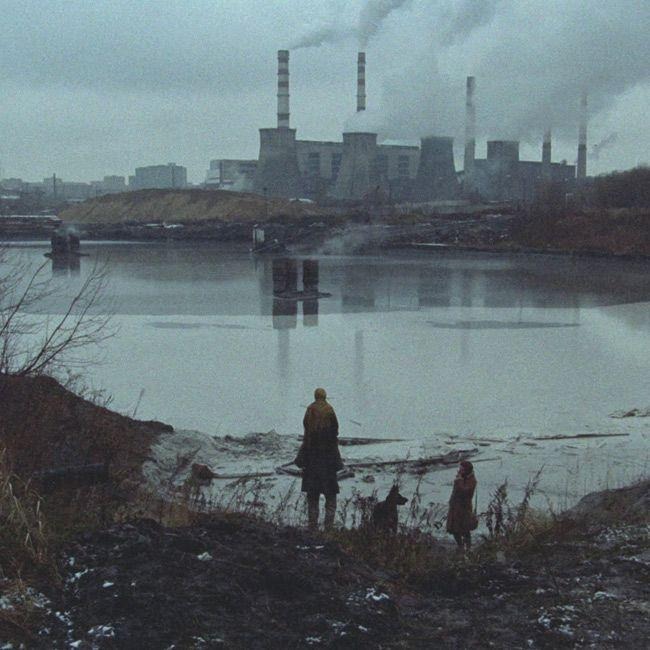
A desolate industrial waterscape from the film Stalker (1979), directed by Andrei Tarkovsky — a cinematic meditation on technological ruin, poisoned landscapes, and the aftermath of industrial modernity.
1. Introduction
Hydroelectricity, harnessed through the construction of dams, has long been heralded as a cornerstone of modern energy production, offering a renewable alternative to fossil fuels. Its proponents emphasize its role in generating clean power, controlling floods, and supporting irrigation, thereby fostering economic development and energy security. However, the deployment of mega dams—large-scale structures that impound vast quantities of water—comes with profound environmental, social, and geological costs that often outweigh these benefits, particularly in vulnerable ecosystems and communities. This paper examines the pros and cons of hydroelectricity, with a focus on mega dams, through a hybrid interplay of activist and academic lenses that prioritize regeneration, equity, geological safety, and ecological integrity.
On the positive side, hydroelectric power is renewable and sustainable, relying on the natural water cycle replenished by rainfall and snowmelt. It produces low greenhouse gas emissions during operation, with a median intensity of 24 gCO₂-eq/kWh over its life cycle, far below that of natural gas at 490 gCO₂-eq/kWh. Hydropower plants are highly efficient, with energy conversion rates up to 90%, and provide reliable baseload power that can be adjusted quickly to meet demand fluctuations. They also offer ancillary benefits like flood control, irrigation, and recreational opportunities, contributing to water management in arid regions.
Yet, the cons are stark and multifaceted. Environmentally, mega dams disrupt river ecosystems by altering water flow, temperature, and sediment transport, leading to biodiversity loss. Reservoirs flood vast areas, submerging forests, wetlands, and habitats, which can result in the extinction of species and the release of methane from decaying organic matter. Socially, dams displace indigenous and local communities, erasing cultural heritage and livelihoods. Geologically, they trigger reservoir-induced seismicity, landslides, and long-term sedimentation crises that threaten dam integrity and downstream populations. As Meghnad Saha and Kapil Bhattacharya forewarned decades before these disasters materialized, the cumulative impacts of mega dams demand a rigorous reevaluation.
2. Lenin’s Plan for Hydro-Electricity and the Goal of Industrialization
In the early 20th century, Vladimir Lenin envisioned hydroelectricity as a pivotal force in the Soviet Union’s industrialization. The GOELRO plan (State Commission for the Electrification of Russia), approved in 1920, aimed to electrify the nation through a network of thermal, hydropower, and combined heat and power stations. Lenin famously declared, “Communism is Soviet power plus the electrification of the whole country,” viewing hydropower as essential for transforming Russia from a peasant-based economy to an industrial powerhouse.
The plan projected the construction of 30 district power plants, including 10 hydroelectric facilities, with a total capacity of 1.75 gigawatts. By 1935, it exceeded expectations, building 40 power stations. Stations like the Volkhov and Dnieper became icons of modernization. However, this rapid push overlooked long-term environmental costs, such as ecosystem disruption and mass displacement, foreshadowing the broader pitfalls of mega-scale hydro projects pursued in the name of industrial ideology.
Doesn’t capitalism and state socialism (=state capitalism) start to mirror each other when it comes to the question of industrialization by obliviating ecological entitlements?
3. The Aftermath of Shooting Tarkovsky’s Classic Movie, “Stalker” (1979)
Andrei Tarkovsky’s 1979 film Stalker was filmed in toxic locations around Tallinn, Estonia, including abandoned hydroelectric plants damaged during World War II and the Jägala River, downstream from a chemical plant. The production exposed the crew to hazardous chemicals, leading to the lung cancer deaths of Tarkovsky, lead actor Anatoly Solonitsyn, and Tarkovsky’s wife Larisa Tarkovskaya. The abandoned hydro site, with its decaying infrastructure and toxic runoff, symbolized environmental neglect, mirroring the film’s themes of desolation.
The film’s connection to Tarkovsky’s final work, Sacrifice (1986), is poignant. Its closing dialogue, “Why is it so, papa?” uttered by a child, evokes innocence amid catastrophe, paralleling the premature deaths from the Stalker shoot and underscoring the human cost of environmental degradation tied to mega hydro projects.
4.A. Nehru Called Mega Dams ‘Temples of India’
Jawaharlal Nehru, India’s first Prime Minister, famously dubbed mega dams the “temples of modern India” during the inauguration of the Bhakra Nangal Dam in 1953, viewing them as symbols of progress essential for irrigation, power generation, and flood control. At the Bhakra Dam dedication in 1963, he declared: “This dam has been built with the unrelenting toil of man for the benefit of mankind and therefore is worthy of worship.”
Nehru took a personal interest in the Bhakra Dam, visiting the site 13 times to oversee progress. Completed in 1963, the dam irrigates over 10 million acres and generates 1,500 MW of power. This vision extended to Nagarjuna Sagar and Hirakud. However, Nehru’s reverence for dams systematically silenced dissenting scientific voices—most notably Meghnad Saha and Kapil Bhattacharya—setting a dangerous precedent where technocratic nationalism overrode expert hydrological caution.
4.B. Meghnad Saha: Scientist, Legislator, and the First Systematic Critic of India’s Dam Mania
Meghnad Saha (1893–1956), renowned worldwide for the Saha Ionization Equation that transformed astrophysics, was simultaneously one of independent India’s most formidable public intellectuals. His interventions on river planning, flood management, and dam policy represent one of the earliest and most rigorous scientific critiques of India’s hydraulic nationalism. Yet his warnings—empirically grounded, institutionally articulated, and politically courageous—were systematically marginalized in the rush to build what Nehru called the ‘temples of modern India.’
Saha’s concern with rivers was not incidental. Born in Seoratali, Dhaka, in what was then Bengal, he was intimately familiar with the cyclical violence of floods and droughts that shaped agrarian life across the river delta. This biographical rooting gave his scientific thinking a moral urgency that distinguished him from technocrats who viewed rivers as abstract engineering problems.
Between 1922 and 1950, Saha published a sustained body of analysis on Bengal’s flooding crisis in journals, committees, and popular science platforms—most prominently through the journal Science and Culture, which he founded in 1935. His argument was consistent and damning: mega dams were not solutions to flooding but often its amplifiers, because they ignored the systemic ecology of river basins.
His analysis of the Damodar River—one of the most flood-prone rivers in India, known as the ‘sorrow of Bengal’—was especially trenchant. Saha demonstrated that flooding in the Damodar basin was not primarily a dam problem but a sediment and embankment problem. Railway embankments constructed by the British had fundamentally altered drainage patterns, trapping monsoon runoff in agricultural lowlands. Any large dam upstream, he argued, would become a sediment trap, silting up within decades and eventually worsening downstream flooding through reservoir releases during storm events.
Saha argued that the engineering community’s faith in large dams rested on a category error: confusing the control of peak discharge with the management of river systems. A dam could regulate a flood wave—but it could not restore the ecological balance that embankments, deforestation, and unplanned agriculture had already destroyed.
Crucially, Saha was not opposed to hydropower or water management per se. He was opposed to unilateral, single-purpose dam construction that served industrial interests at the expense of agriculture, navigation, and downstream ecology. Influenced profoundly by the Tennessee Valley Authority (TVA) in the United States, which he studied closely during visits abroad, Saha advocated multipurpose river valley development: integrated planning that combined hydropower with irrigation scheduling, navigation improvements, afforestation of catchment areas, and flood forecasting systems.
4.C. The Damodar Valley Corporation: Vision Betrayed
Saha’s most consequential institutional intervention came through his role in shaping the Damodar Valley Corporation (DVC). In 1943, following catastrophic floods in Bengal, the Bengal government constituted a technical committee on the Damodar—and Saha became one of its most influential voices. He prepared detailed memoranda advocating for a system of eight dams across the Damodar and its tributaries, coupled with channel improvement and afforestation—a model directly inspired by the TVA’s watershed-wide approach.
His original scheme envisioned a network of smaller, coordinated structures that would collectively manage flow, recharge groundwater, support irrigation during dry seasons, and prevent the catastrophic peak releases that single large dams tend to produce. This was ecologically sophisticated planning well ahead of its time.
What was built, however, was a travesty of that vision. Only four dams—Tilaiya, Konar, Maithon, and Panchet—were constructed, without the channel improvements or afforestation programmes Saha had specified. The result was precisely what he had feared: the dams provided partial flood attenuation during normal monsoons but failed catastrophically during extreme events (the 2000 floods, when the DVC released water during a high-rainfall period and inundated Bengal’s plains, vindicated Saha’s structural critique half a century after his death).
In a letter to a colleague in the early 1950s, Saha reportedly lamented that the DVC had been built by engineers who understood structures but not rivers—men who could calculate the stress on a concrete wall but not the cumulative logic of silt, seasonality, and social ecology.
4.D. Saha in Parliament: The Right to Differ as a Legislative Act
Meghnad Saha was elected to the Lok Sabha in 1952 as an independent candidate from the North-West Calcutta constituency—one of the few distinguished scientists to enter the Indian legislature directly. This gave his critique of dam policy a new platform. On the floor of the Parliament, Saha repeatedly questioned the assumptions underlying large dam projects, demanding transparency in cost-benefit analyses, independent seismic assessments, and provisions for displaced communities.
He was particularly critical of the National Planning Commission’s tendency to treat river valley projects as investment priorities divorced from ecological feasibility. He argued that the Planning Commission’s framework was dominated by economists and engineers who lacked training in hydrology, geomorphology, and ecology—and that this disciplinary blindness was being institutionalized into India’s development apparatus.
His speeches drew on data, international comparisons, and field observations. They also drew contempt from the ruling establishment, which regarded his interventions as obstructionist. Within the dominant developmentalist consensus of the Nehruvian era, insisting on ecological limits and hydrological realism was tantamount to opposing modernity itself.
Saha’s journal Science and Culture became a crucial vehicle for disseminating his critiques beyond Parliament. Through its pages, he published analyses of flood data, comparisons of dam performance internationally, critiques of silting projections, and proposals for river basin governance. The journal attracted contributions from hydrologists, geographers, and planners, thereby creating a counter-public sphere in which scientific dissent from official dam policy could be articulated.
This was not merely academic publication. In the context of 1940s–1950s India, where the state controlled much of the media and where engineering institutions were closely tied to the planning apparatus, Science and Culture functioned as an independent epistemic space—a place where data could challenge doctrine.
4.E. The Intellectual Legacy: Saha as a Proto-Ecologist
Viewed from the vantage of 21st-century political ecology and environmental science, Saha’s positions appear remarkably prescient. His insistence on basin-wide management anticipates the concept of Integrated Water Resources Management (IWRM). His critique of sediment dynamics prefigures the extensive literature on reservoir siltation that now threatens the economic viability of India’s largest dams. His call for coordinated afforestation as a precondition for effective flood management anticipates the science of ecosystem-based adaptation.
Yet his legacy remains institutionally unacknowledged. Indian engineering curricula do not teach his river analyses; Indian planning documents do not cite his DVC critiques; Indian environmental discourse rarely invokes his name. The erasure of Saha from the history of Indian environmentalism is not accidental: it reflects the discomfort that a scientific giant’s rejection of dominant infrastructure ideology creates for the narrative of progressive developmentalism.
Meghnad Saha died of a heart attack in February 1956, on his way to the Planning Commission offices in New Delhi—still fighting, at the very end, for a rational and ecologically grounded approach to India’s rivers.
4.F. Kapil Bhattacharya: Dissent, Dam and Criminalization – An Engineer Against the State
Kapil Bhattacharya, a senior engineer and former Chief Engineer in the Irrigation Department of the Government of West Bengal, stands as one of the earliest and most systematically erased critics of postcolonial India’s dam-centric developmental imagination. At a time when large hydraulic projects were being aggressively promoted as symbols of sovereignty, modernization, and national pride, Bhattacharya’s opposition to the Farakka Barrage represented a rare instance of institutional dissent grounded in empirical hydrology rather than ideological reflex.
His opposition must be understood in its full historical context. The Farakka Barrage project was conceived in the early 1950s and formally proposed by the Central Water and Power Commission in 1961. It was presented as a solution to the progressive silting of the Hooghly River and the consequent decline of Calcutta Port—one of the most strategically and economically vital nodes of post-colonial India. The project commanded near-universal support among India’s political class, bureaucracy, and mainstream engineering community. To oppose it was, in every practical sense, to stand alone.
4.G. The 1961 Report: Hydrology Against Hubris
In his prescient 1961 technical report, Silting of Calcutta Port, Bhattacharya warned with forensic precision that the Farakka Barrage would fundamentally disrupt the Ganges–Bhagirathi–Hooghly river system. Contrary to official claims that the barrage would rejuvenate the Hooghly by increasing freshwater flow and flushing accumulated silt, Bhattacharya demonstrated—using sediment-flow analysis, seasonal discharge data, and river morphology—that the project’s core hydraulic assumptions were fatally flawed.
His technical argument rested on three interlocking points. First, the Ganges’ dry-season discharge was insufficient: during the lean months of January to May, the river carried barely half the volume of water that the barrage’s design assumed would be available for diversion. Second, any diversion at Farakka during the monsoon—when flows were adequate—would be counterproductive, as the Hooghly was self-flushing during high flows and needed no engineering assistance. And third, the critical lean season, when the Hooghly most needed flushing, was precisely when the Ganges had the least to give. The barrage would therefore operate as a sediment trap during the season it was designed to help, depositing silt at the head of the diversion canal and progressively choking the very waterway it was supposed to revive.
Bhattacharya’s critique was not merely technical but conceptual. He argued that the barrage’s design assumed a stable and sufficient dry-season flow in the Ganges—an assumption he identified as hydrologically untenable. With barely half the required discharge available during the non-monsoon months, the barrage, he warned, would operate not as a regulator but as a sediment trap, accelerating siltation precisely when flushing was most needed.
In one of his most damning formulations, Bhattacharya described the project as “a fraud on the public”—a structure whose promised benefits were mathematically and ecologically impossible to deliver. He further argued that the project would destabilize the entire morphology of the lower Ganges plain: by reducing downstream flows, it would lower water tables, increase salinity ingress in coastal Bengal, destroy the Sundarbans’ freshwater gradient, and devastate fisheries across a vast delta region.
These warnings proved devastatingly accurate. The Farakka Barrage, made operational in 1975, reduced downstream flows into what is now Bangladesh, triggering severe environmental consequences: salinity intrusion, destruction of fisheries, degradation of agricultural land, and prolonged diplomatic tensions. Simultaneously, upstream regions—especially Bihar—began experiencing recurrent and intensified flooding, as sediment accumulation and backwater effects raised riverbeds and destabilized embankments.
Yet Bhattacharya’s fate reveals something even more troubling than technical failure: the political economy of silencing inconvenient knowledge. His opposition emerged during a period of heightened India–Pakistan tensions, when transboundary water issues were deeply entangled with national security anxieties. Instead of engaging with his evidence, sections of the political establishment and media weaponized nationalism to delegitimize his critique.
Prominent outlets such as Anandabazar Patrika portrayed Bhattacharya not as a conscientious engineer but as a traitor undermining national interests, branding him a “Pakistani spy.” This accusation—absurd in its content yet lethal in its effect—served as a disciplinary mechanism. Scientific dissent was recoded as political subversion; hydrological caution was reframed as enemy collaboration. Isolated, vilified, and institutionally unsupported, Bhattacharya was ultimately forced to resign from his government position, marking a chilling precedent: that expert opposition to mega-infrastructure could result not in debate but in professional annihilation.
5. Bhattacharya and Saha: Parallel Trajectories of Suppressed Science
The parallels between Meghnad Saha and Kapil Bhattacharya are striking and historically significant. Both were Bengali scientists of exceptional competence who applied rigorous quantitative methods to questions of river management. Both arrived at conclusions fundamentally at odds with the official consensus. Both were marginalized—Saha through institutional neglect and political dismissal, Bhattacharya through active persecution and forced resignation. And both have been largely absent from the canonical histories of Indian science, planning, and environmental thought.
This parallel erasure is not coincidental. It reflects the structural incompatibility between evidence-based dissent and the political economy of hydraulic nationalism. The Indian developmental state, in its formative decades, required unanimity behind its flagship projects. Scientists who generated inconvenient data were not merely ignored; they were actively discredited, ensuring that the epistemic ecosystem remained hospitable only to engineering optimism and hostile to ecological realism.
The Bhattacharya episode in particular exposes a recurring pattern in postcolonial developmentalism. Mega dams and barrages were elevated beyond scrutiny, shielded by the rhetoric of so-called “nation-building”. To question them was to question the nation itself. This logic persists. From the Narmada to the Teesta, from Farakka to contemporary river-linking projects, dissenting scientists, activists, and local communities continue to be accused of being ‘anti-national,’ ‘foreign-funded,’ or ‘anti-development.’ Bhattacharya’s persecution thus appears not as an aberration but as an early template for the governance of dissent in hydraulic regimes.
6. Vindication Without Justice
Today, as Bihar faces annual floods of devastating intensity, as siltation continues to cripple river systems, and as downstream regions bear the ecological costs of upstream interventions, Bhattacharya’s warnings stand tragically vindicated. Yet vindication without accountability is hollow. His professional destruction was never acknowledged as an injustice; his analysis was never rehabilitated into official planning discourse.
Kapil Bhattacharya’s story is therefore not just a footnote in the history of Farakka but a case study in epistemic violence—the systematic suppression of knowledge that threatens dominant infrastructural imaginaries. The greatest disasters of mega dams are not only ecological and human, but intellectual—born of the silencing of those who tried to prevent them.
To question a dam in postcolonial India was never merely to question a structure of concrete. It was to question an entire developmental imagination that equated dissent with obstruction, rivers with resources, and scientific caution with betrayal. Meghnad Saha and Kapil Bhattacharya understood—long before the disasters unfolded—that the greatest danger of hydraulic nationalism lay not only in what it built, but in what it systematically refused to hear. Their warnings remain unfinished conversations with the present.
7. The Geological Hazards of Mega Dams: When Mountains Crack and Rivers Rebel
7A. The Earth Beneath the Concrete: A Neglected Dimension
Discussions of mega dam hazards have historically privileged ecological displacement, social disruption, and hydrological imbalance. The geological dimension—the behaviour of the Earth’s crust, slopes, and substrata under the weight, pressure, and seepage of impounded water—has received far less public attention, despite representing some of the most catastrophic and irreversible risks that large dams generate. This section addresses that gap, drawing on documented case studies, seismological research, and the specific geological contexts of India’s dam-dense regions.
7B. Reservoir-Induced Seismicity (RIS): When Dams Trigger Earthquakes
Reservoir-Induced Seismicity (RIS) refers to earthquakes caused or triggered by the impoundment of large water bodies behind dams. The mechanism is well-established: the mass of reservoir water (often hundreds of millions of tonnes) imposes a vertical load on underlying rock formations, while reservoir seepage increases pore water pressure in subsurface fault systems, reducing the effective stress that keeps fault planes locked. The result is the reactivation or activation of fault systems that might otherwise have remained dormant for geological timescales.
This is not a theoretical risk. RIS is one of the most thoroughly documented geohazards in dam science, with over 100 confirmed cases globally. The magnitude of triggered earthquakes has ranged from minor tremors to events exceeding M 6.0—strong enough to cause significant structural damage and loss of life.
7C. The Koyna Earthquake, 1967: India’s Wake-Up Call That Was Ignored
The most devastating case of RIS in Indian history—and one of the most significant globally—occurred on 11 December 1967 at Koyna, Maharashtra. The Koyna Dam, a masonry gravity dam on the Koyna River, had been filling its reservoir since 1962. On that December evening, an earthquake of magnitude 6.3 struck the reservoir zone, killing approximately 180 people, injuring over 1,500, and rendering tens of thousands homeless.
Geological analysis established beyond reasonable doubt that the earthquake was triggered by reservoir impoundment. The Koyna region had no significant seismic history prior to dam construction; seismic activity began precisely as the reservoir filled and intensified as water levels rose. The Deccan Traps basalt formation beneath the dam was found to contain pre-existing fracture systems that were reactivated by pore pressure changes induced by the reservoir.
The Koyna case is particularly instructive because the dam itself was not on a known active fault. The assumption that geological stability in the absence of historically recorded seismic activity is sufficient assurance for dam construction was catastrophically falsified. Even ‘geologically stable’ regions can harbour latent fault systems activated by reservoir loading.
What is most damning is that the Koyna earthquake did not fundamentally alter India’s dam-building calculus. The state responded with engineering retrofits and seismic monitoring but continued the large dam programme unabated. Meghnad Saha, who had warned of geological inadequacy in dam assessments a decade earlier, was no longer alive to witness the vindication of his caution. The institutional response to Koyna was precisely what Saha had critiqued: engineering fixes applied to structural problems, rather than systematic rethinking of where and how dams should be built.
7D. The Tehri Dam: Seismic Hubris in the Himalayan Arc
If Koyna represents RIS risk in the Deccan Plateau’s ancient crystalline formations, the Tehri Dam in Uttarakhand represents an even more acute geological gamble in one of the world’s most seismically active mountain systems. The Tehri Dam, at 261 metres the highest dam in India and among the highest earthfill dams in the world, sits within the Himalayan Seismic Zone—a region of ongoing continental collision between the Indian and Eurasian plates, where large earthquakes are not rare historical events but periodic geological certainties.
The dam is located near the Main Central Thrust (MCT) and the Main Boundary Thrust (MBT)—two of the Himalayas’ major tectonic lineaments, capable of generating earthquakes above M 8.0. The 1991 Uttarkashi earthquake (M 6.8) and the 1999 Chamoli earthquake (M 6.8) struck within the dam’s geological neighbourhood, killing hundreds and demonstrating the region’s ongoing tectonic restlessness. Sundarlal Bahuguna’s repeated warnings about seismic vulnerability were not the intuitions of a layperson: they were grounded in the geological literature and supported by independent seismologists who testified that the dam’s design underestimated probable maximum ground motion.
The specific hazard of an earthfill dam in a seismic zone is acute. Unlike concrete gravity dams, which can sustain significant shaking if properly designed, rockfill and earthfill embankments are vulnerable to liquefaction—the sudden loss of shear strength in saturated soils and unconsolidated fill material when subjected to seismic vibration. A catastrophic failure of the Tehri Dam would release approximately 2.6 billion cubic metres of water, a wave that could reach Haridwar within hours and inundate vast areas of the Uttarakhand and Uttar Pradesh plains.
Official risk assessments have consistently downplayed this scenario. Independent seismologists, however, have repeatedly warned that the dam’s design basis earthquake—the seismic event used to certify its structural safety—may be significantly underestimated for the region’s true seismic potential.
8. Landslides and Slope Instability: Reservoirs as Triggers of Mass Wasting
The filling of large reservoirs radically alters the mechanical stability of surrounding slopes. Three mechanisms are central: first, reservoir water saturates valley-wall materials, increasing their weight and reducing the friction that prevents downslope movement; second, the cyclic fluctuation of reservoir levels—raising and then rapidly lowering water—subjects slope materials to repeated wetting and drying cycles that progressively weaken cohesion; and third, wave action and seepage erode the toe of slopes, removing the support that prevents upper slope failure.
8A. The Vaiont Disaster, 1963: The World’s Most Lethal Dam-Related Landslide
The catastrophic landslide into the Vaiont Reservoir in Italy on 9 October 1963 remains the most devastating dam-related geological disaster in recorded history. An estimated 270 million cubic metres of rock and earth slid into the reservoir at speeds approaching 30 metres per second. The displaced water generated a wave 250 metres high that overtopped the dam—a technically intact structure—and destroyed the downstream town of Longarone, killing approximately 2,000 people within minutes.
Geological investigations had identified the potential for slope instability before the disaster. A smaller landslide had occurred in 1960. The engineering response was to continue filling the reservoir while monitoring—a decision that proved fatally complacent. The Vaiont disaster is now canonical in geotechnical engineering as a case study in the failure to integrate geological risk into operational dam management.
Its relevance to India’s Himalayan and northeastern dam proposals is direct. The Himalayas are geologically young mountains, characterized by steep slopes, deeply weathered rock masses, active tectonic fracturing, and high rainfall. Landslide frequency in Himalayan river basins is among the highest in the world. The impoundment of reservoirs in such terrain introduces Vaiont-type risks at multiple sites across the dam cascade.
8B. Landslides and Reservoir Seiches in the Himalayan Arc
A specific hazard unique to Himalayan mega-dam reservoirs is the seiche—a standing wave set in motion when a landslide or earthquake rapidly displaces reservoir water. In a narrow, gorge-flanked Himalayan reservoir, a large rockfall can generate waves capable of overtopping the dam structure, with or without causing structural failure. The 2000 Yigong landslide in Tibet, which temporarily dammed the Yigong Tsangpo and caused catastrophic downstream flooding when the natural dam failed, illustrates the scale of mass wasting events that Himalayan slopes routinely produce.
India’s northeastern states—Arunachal Pradesh, Sikkim, and Manipur—are among the world’s most landslide-prone regions, yet they are also the target of the most ambitious new hydropower development programmes. The geological contradiction has rarely been acknowledged in official project assessments.
9. Sedimentation and Structural Longevity: The Silent Crisis
Every dam is, from the moment of its construction, dying. Rivers carry sediment—silt, sand, and gravel—that accumulates in reservoirs, progressively reducing storage capacity. This process of siltation is irreversible with current technology; no dam operator can fully excavate decades of accumulated sediment. The question is not whether a reservoir will silt up, but how quickly, and with what consequences.
Saha’s critique of the Damodar Valley dams included precisely this concern. High-sediment rivers like the Damodar, the Mahanadi, and virtually all Himalayan rivers carry enormous silt loads. Reservoirs in these basins can lose significant fractions of their designed storage capacity within two to three decades of operation. The Ukai Reservoir on the Tapi River in Gujarat lost 24% of its live storage capacity within 25 years of commissioning. The Bhakra Reservoir—Nehru’s showpiece—has accumulated silt at rates exceeding initial projections, with ongoing studies suggesting accelerated loss of capacity.
The structural implications of siltation are rarely discussed in public. As reservoirs fill with sediment, the weight distribution on the dam structure changes. Silt consolidation can create differential pressures on dam foundations. In earthfill dams, sediment consolidation can alter seepage patterns, with potentially destabilizing effects on embankment integrity. The long-term structural safety of aging dams under advancing siltation is a geotechnical question that Indian dam operators are ill-equipped to answer, partly because systematic monitoring of many dams is inadequate.
10. Dam Failure: The Catastrophic Endpoint of Geological Neglect
When geological hazards—seismic loading, slope failure, siltation-induced pressure changes, or foundation seepage—are inadequately assessed or monitored, the ultimate risk is dam failure: the sudden, uncontrolled release of reservoir water. The consequences of large dam failure are uniquely catastrophic because of the concentration of stored energy: a 100-metre dam holding a large reservoir contains water pressure equivalent to a continuous explosive force that, once released, cannot be stopped.
10A. The Banqiao Disaster, 1975: History’s Deadliest Dam Failure
The failure of the Banqiao Dam and the Shimantan Dam in Henan Province, China, in August 1975 following Typhoon Nina remains the deadliest dam disaster in history. The cascade failure of 62 dams killed between 85,000 and 240,000 people—estimates vary widely due to the Chinese government’s suppression of information. The structural failures were attributed to extreme rainfall far exceeding the dams’ design basis, a factor that climate change is now making increasingly probable for dams designed under historical precipitation regimes.
10B. India’s Dam Safety Crisis: A Structural Emergency
India has approximately 5,745 large dams, the third-largest stock in the world. Of these, an estimated 1,000 are over 50 years old, and many hundreds are over 100 years old—built during the colonial era to standards that would not meet current engineering requirements. The Central Water Commission’s own assessments have identified hundreds of dams with structural deficiencies requiring urgent remediation. The Dam Safety Act, passed only in 2021 after decades of institutional neglect, acknowledges the severity of the problem but lacks the institutional capacity and funding to address it comprehensively.
The geological dimension compounds this structural vulnerability. India’s dam-dense regions—the Himalayan arc, the Western Ghats, the Deccan Plateau, and the northeastern states—all represent distinct geological regimes with specific hazard profiles: seismic risk in the Himalayas and Koyna belt, landslide risk in the northeastern mountains, and deep weathering and laterization in the peninsular basement. Most existing dams were constructed without the benefit of modern probabilistic seismic hazard assessments, three-dimensional geological modelling, or long-term sedimentation monitoring.
11. Climate Change as a Force Multiplier for Geological Dam Risk
Climate change is fundamentally altering the risk calculus for mega dams. The hydrological assumptions embedded in dam design—including probable maximum precipitation, design flood discharge, and reservoir operation rules—were calibrated against historical climatic conditions that no longer hold. The accelerating frequency and intensity of extreme rainfall events in India (documented across the Western Ghats, the Gangetic plain, and the northeastern states) means that dams designed to withstand the ‘100-year flood’ are increasingly likely to face events exceeding their design parameters.
The interaction between intensified rainfall and geological hazards is particularly dangerous. Heavier rainfall increases hillslope saturation, accelerating landslides into reservoirs. It raises reservoir levels more rapidly, reducing the time available for controlled release and increasing the risk of overtopping. And it loads foundations with pore pressure increases that can trigger seismic reactivation. Climate change does not merely increase hydrological stress on dams; it amplifies every geological hazard that dams face.
Meghnad Saha, writing in an era when climate change was not yet a scientific framework, nonetheless articulated the core vulnerability: that India’s rivers are not stable, predictable systems that can be engineered into permanent submission. They are dynamic, sediment-laden, ecologically complex systems whose behaviour is inherently variable and whose long-term trends are shaped by forces—tectonic, climatic, and ecological—that lie far beyond any dam’s ability to control.
12. What Geological Hazard Assessment Requires: The Missing Institutional Framework
The comprehensive geological hazard assessment that India’s mega dam programme has never had would require, at minimum: probabilistic seismic hazard analysis (PSHA) accounting for reservoir-induced seismicity; slope stability modelling of all reservoir margins using three-dimensional geological data; quantitative sedimentation monitoring with updated predictions of reservoir life; regular structural safety reviews by independent bodies with geotechnical expertise; dam break inundation mapping for all downstream populations; and systematic integration of these assessments into dam operation rules and infrastructure planning.
None of these requirements has been systematically met for India’s existing dam stock. The Dam Safety Act of 2021 creates a framework for some of these functions, but its implementation remains nascent, underfunded, and politically constrained. The fundamental problem identified by Saha and Bhattacharya—that Indian hydraulic infrastructure planning prioritizes construction over long-term ecological, hydrological, and geological management—has not been resolved. It has merely been deferred.
13. Sundarlal Bahuguna and Baba Amte: Gandhian Resistance to the Tyranny of Mega Dams
13A. Sundarlal Bahuguna: Seismic Hubris and the Betrayal of the Himalayas
Sundarlal Bahuguna, a lifelong Gandhian and a central figure of the Chipko movement, opposed the Tehri Dam from the early 1970s until its completion in 2004. His resistance was rooted in a profound understanding of the Himalayas as a living, fragile geological system, not a passive site for engineering conquest. Bahuguna warned that constructing one of the world’s highest dams in an active seismic zone was an act of hydrological and geological arrogance. He repeatedly emphasized that the Tehri Dam sat near the Main Central Thrust, a major fault line, making the project vulnerable to earthquakes and catastrophic failure—warnings that geological science fully supports.
Beyond seismic risk, Bahuguna highlighted the human and cultural devastation wrought by the dam: the displacement of over 100,000 people, the submergence of Tehri town, the erasure of sacred sites, and the destruction of springs and forests that sustained Himalayan livelihoods. Between 1995 and 1996, he undertook prolonged hunger strikes—one lasting 45 days, another 74 days—forcing Prime Ministers P.V. Narasimha Rao and H.D. Deve Gowda to promise reviews. These assurances proved largely performative.
13B. Baba Amte: Drowning with the Displaced
Baba Amte joined the Narmada Bachao Andolan (NBA) in the late 1980s, lending it ethical authority and global visibility. In his 1989 work Cry, O Beloved Narmada, Amte framed the river not as a resource but as a living civilizational artery. In 1990, he moved to a village slated for submergence, declaring he would drown with it if the waters rose. His activism helped force the World Bank to withdraw funding from the Sardar Sarovar Project—a landmark in global development accountability.
Together, Bahuguna and Amte embodied a Gandhian critique of modern technics: not anti-science but anti-arrogance; not anti-development but anti-destruction. Their legacy poses a still-unanswered question: What kind of development requires silencing engineers, fasting saints, displaced villagers, and drowned rivers?
13C. “Narmada Bachao”: River, Resistance, and the Rewriting of Development
The Narmada Bachao Andolan (NBA), founded in 1985, represents one of the most sustained, sophisticated, and globally influential movements against mega-development projects in the postcolonial world. Emerging in opposition to the Narmada Valley Development Project—involving over 30 large dams—the NBA challenged not only a set of dams but the entire epistemology of dam-led development. The movement threatened to displace over a million people, predominantly Adivasis and small farmers, and submerge approximately 40,000 hectares of forests.
At the heart of the NBA stood Medha Patkar, whose leadership fused rigorous policy critique with Gandhian mass mobilization. The 1989 Harsud rally, attended by nearly 60,000 people, demonstrated that those slated for displacement were not passive beneficiaries but active political agents. In 1993, sustained pressure led the World Bank to withdraw from the Sardar Sarovar Project—confirmed by the independent Morse Commission as a project with grossly inadequate rehabilitation and flawed environmental assessments.
The NBA’s theoretical legacy lies in its insistence that development must be judged not by output metrics but by its relationship to life, place, and consent. The Narmada struggle exposed development as displacement—a civilizational logic that equates progress with concrete and sacrifice with inevitability. In the genealogy of anti-dam movements, from Meghnad Saha to Kapil Bhattacharya to Bahuguna to Baba Amte, the NBA marks the moment when dissent became organized, transnational, and intellectually unignorable.
14. The Peculiar Cases of Ayodhya Hill and Turga Hydro-Electric Projects
The Turga Pumped Storage Project (TPSP), located in the Ayodhya Hills of West Bengal’s Purulia district, exemplifies debt-dependent development with its 1,000 MW capacity funded by a ¥29.442 billion loan from JICA. Similarly, the nearby Purulia Pumped Storage Project (PPSP), operational since 2008 with 900 MW capacity, was financed by Japanese loans totaling around ₹2,953 crore. Both operate on a closed-loop system: coal-generated electricity pumps water uphill during off-peak hours; water flows back through turbines at peak demand.
The ecological violence is stark. The PPSP required the felling of approximately 3.5 million trees across 373 hectares of dense forest in the Ajodhya Hills, leading to a 10% decline in regional forest cover between 2000 and 2005. Indigenous Santhal communities face displacement from 36 villages. Economically, the projects’ round-trip efficiency of only 70–80% means they consume more electricity than they generate, with annual costs (₹5,819.5 crore) exceeding benefits (₹872.7 crore) by sixfold. This is precisely the ‘technocratic violence’ that Meghnad Saha and Kapil Bhattacharya warned against: infrastructure whose costs are distributed to the most vulnerable while benefits accrue elsewhere.
Geologically, the Ajodhya Hills are part of the Chhotanagpur Plateau—ancient Precambrian basement rock that, while tectonically stable compared to the Himalayas, is not without fracture systems. The large excavations required for the upper and lower reservoirs of pumped storage projects can destabilize existing joints and lineaments in crystalline basement rock, with poorly understood long-term implications for slope stability. This geological dimension has received virtually no attention in the official project assessments.
15. Harappa–Mohenjo-Daro Dam Dispute and the Paradox of Simultaneous Flood and Drought
The speculative yet persistently resurfacing debate around hydraulic intervention near Mohenjo-Daro opens a critical window into the longue durée of hydro-politics in the subcontinent. The Indus Valley Civilization was deeply entangled in large-scale water management whose ecological consequences may have been catastrophic. Palaeo-hydrological studies suggest the plausibility of simultaneous flooding and drought within the same basin—interventions protecting urban centres may have intensified upstream flooding while depriving downstream regions of nutrient-rich silt.
The Vedic–Purāṇic figure of Purandar—Indra the destroyer of Vr̥tra, the serpent-dam that holds back waters—offers a mytho-historical counterpoint. When Indra smashes Vr̥tra, the waters are released and the land restored to fertility. The myth does not celebrate dam-building as triumph but dam-destruction as ethical necessity—a civilizational memory warning against hydraulic enclosure. From Vr̥tra to Farakka, the logic of obstruction—concrete justifications in the name of order and development producing floods upstream, drought downstream, and ecological death—persists across millennia.
16. Siddhartha Gautama’s Protest Against the Dam on the Rohini River
Siddhartha Gautama intervened in a water-sharing dispute over the Rohini River between the Sakya and Koliya clans, advocating peace amid escalating tensions over irrigation rights during a drought. As a member of the Sakya assembly, he opposed military action—a stance that led to his exile. In B.R. Ambedkar’s The Buddha and His Dhamma (1957), this event is portrayed as a political act of principled dissent, framing his renunciation as a consequence of refusing to sanction the weaponization of water.
Comparisons with modern disputes are instructive. India’s April 2025 suspension of the Indus Waters Treaty following the Pahalgam attack echoes ancient Rohini tensions by weaponizing water geopolitically. The Farakka Barrage’s reduction of Ganges flows into Bangladesh mirrors Rohini’s irrigation conflicts at a transboundary scale. And India’s upstream dams on the Teesta have reduced flows affecting 10 million people in Bangladesh. In each case, dam infrastructure has transformed shared rivers into instruments of division—precisely the outcome Siddhartha Gautama recognized and resisted at the Rohini.
17. Analyzing Muktadhara (The Waterfall): Blurring the Divide Between Fact and Fiction
Rabindranath Tagore’s 1922 play Muktadhara allegorically critiques colonialism and mechanization through a dam blocking a sacred waterfall. The dam, engineered by the zealous Bibhuti over 25 years, blocks the flow to the downstream region of Shivtarai, rendering its people dependent and vulnerable to famine. Bibhuti’s declaration—“The gods gave them water. To me, they gave power”—precisely captures the epistemic hubris that Meghnad Saha and Kapil Bhattacharya spent their careers opposing: the engineer’s conviction that technical mastery over rivers supersedes ecological, social, and democratic knowledge.
Dhananjay Bairagi, the wandering ascetic, is the play’s moral compass—the Gandhian poet-rebel who prioritizes ethical freedom over material power, whose songs and satyagraha against river blockage echo the real-world struggles of Bahuguna, Baba Amte, and the NBA. Crown Prince Abhijit’s altruistic sacrifice—opening the Nandi Pass and releasing the dammed waters, dying in the subsequent flood—evokes Leonard Cohen’s Anthem: “There is a crack, a crack in everything / That’s how the light gets in.” Abhijit finds the crack in the dam’s perfection, allowing nature’s light to pierce tyranny.
Muktadhara remains a clarion call against dams of the mind and earth—whether ancient Rohini barriers or modern megaprojects. Read alongside the geological hazards catalogued in this paper, the seismic zone that Bahuguna warned about, the hydrological fraud that Bhattacharya documented, and the basin management that Saha proposed, Tagore’s eco-drama acquires renewed urgency: the waterfall must flow, lest we dam our shared humanity.
18. Conclusion: Rivers, Science, Democracy, and the Unfinished Reckoning
The history of mega dams in India and the world is inseparable from the history of silenced science. Meghnad Saha—astrophysicist, parliamentarian, and proto-ecologist—spent the last decade of his life warning that India’s hydraulic nationalism was building on hydrological sand. Kapil Bhattacharya—chief engineer, careful empiricist, and institutional dissident—demonstrated with mathematical precision that the Farakka Barrage was a fraud on the public, and paid for that demonstration with his career and reputation. Both men were right. Both men were punished for being right.
The geological hazards documented in this paper—reservoir-induced seismicity, slope instability and landslides, accelerating siltation, the amplifying effects of climate change—represent not hypothetical future risks but present realities that demand urgent and honest institutional response. India’s aging dam stock, its seismically active mountain frontiers, and its accelerating climate vulnerability constitute a geological emergency that the political culture of hydraulic nationalism is structurally incapable of confronting.
The movements of Bahuguna, Baba Amte, Medha Patkar, and the Narmada Bachao Andolan were not obstructions to development. They were, in the fullest sense, expressions of democratic and scientific reason—insisting that development must be judged not by the height of its dams but by the quality of the knowledge on which it rests, the consent of those it affects, and the ecological integrity it preserves.
The rivers of the subcontinent—Ganga, Narmada, Teesta, Damodar, Brahmaputra—carry within their currents not only water and sediment but the accumulated warnings of those who understood them: the physicist who left his laboratory to testify in Parliament; the engineer who called a national project a fraud and lost everything; the saints who fasted by riverbanks; the Adivasi women who stood before rising waters; and the poet who wrote, a century ago, that blocked rivers bring ruin.
Let them flow. For when rivers are dammed, it is not only water that stagnates—it is knowledge, justice, and life itself.
References
Meghnad Saha and Damodar Valley Development
- Roy, P. K., & Mazumdar, A. (2007). “Study on hydrology and drought in the flood region of Damodar River Basin.” Journal of Geological Society of India, 69(5), 1011–1019. https://www.researchgate.net/publication/277818494
- Saha, S. K. (1979). “River-basin planning in the Damodar Valley of India.” Geographical Review, 69(3), 273–287. https://link.springer.com/article/10.1007/s002540050145
- Lahiri-Dutt, K. (2006). “Negotiating water management in the Damodar Valley.” WEPA Water Environmental Partnership in Asia. https://wepa-db.net/archive/pdf/0612sympo/paper/Kuntala_Lahiri-Dutt.pdf
- News18. (2023, July 7). “Opinion | DVC at 75: Has India’s Tennessee Valley dream gone astray?” https://www.news18.com/opinion/opinion-dvc-at-75-has-indias-tennessee-valley-dream-gone-astray-8279047.html
- Chatterjee, S., & Gupta, J. (Eds.). (1993). Meghnad Saha in Parliament. The Asiatic Society.
- Pandey, B. B., et al. (2013). “Performance of D.V.C. in Flood Moderation of Lower Damodar River, India and Emergent Risk of Flood.” Eastern Geographer, Vol. XIX, No. 1. https://www.researchgate.net/publication/277818494_Performance_of_DVC_in_Flood_Moderation_of_Lower_Damodar_River_India_and_Emergent_Risk_of_Flood
- Ghosh, S., et al. (2016). “Dam-induced changes in flood hydrology and flood frequency of tropical river: a study in Damodar River of West Bengal, India.” Arabian Journal of Geosciences, Springer Nature Link. https://link.springer.com/article/10.1007/s12517-015-2046-6
Kapil Bhattacharya and Farakka Barrage
- Scroll.in. (2016, September 1). “Over 50 years ago, Bengal’s chief engineer predicted that the Farakka dam would flood Bihar.” https://scroll.in/article/815066/over-50-years-ago-bengals-chief-engineer-predicted-that-the-farakka-dam-would-flood-bihar
- TFIPost. (2019, October 23). “Farakka barrage: One historic stupidity that made Bihar a target of both floods and famine.” https://tfipost.com/2019/10/farakka-barrage-one-historic-stupidity-that-made-bihar-a-target-of-both-floods-and-famine/
- The TrickyScribe. (2018, May 4). “Farakka Barrage Archives.” https://thetrickyscribe.com/tag/farakka-barrage/
- SANDRP. (2015, March 13). “Lessons from Farakka as we plan more barrages on Ganga.” https://sandrp.in/2014/11/25/lessons-from-farakka-as-we-plan-more-barrages-on-ganga/
- Dialogue Earth / ORF Online. (2021, January 2). “Farakka barrage, engineers and hydropolitics.” https://www.orfonline.org/research/farakka-barrage-engineers-and-hydropolitics
- The Business Standard. (2019, October 2). “Farakka now boomerangs on India.” https://www.tbsnews.net/environment/farakka-now-boomerangs-india
- Mainstream Weekly. (2024, October 5). “Controversy over Bengal Floods Revives Concerns on Role of Dams.” https://www.mainstreamweekly.net/article15102.html
Koyna Earthquake and Reservoir-Induced Seismicity (RIS)
- ScienceDirect. (2025, April 15). “Revisiting the reservoir-triggered seismicity of Koyna India using near-source seismological observations and relationship with reservoir water level changes.” https://www.sciencedirect.com/science/article/abs/pii/S0040195125001295
- Anantam IAS. (2026, April 30). “Koyna Dam: Maharashtra’s Largest Hydroelectric Project and Seismic Lessons.” https://anantamias.com/koyna-dam/
- SleepyClasses. (2024, October 18). “Koyna Dam: Lessons from India’s First Reservoir-Induced Seismicity.” https://sleepyclasses.com/koyna-dam/
- Dalvoy.com. (2026, January 4). “Reservoir Induced Seismicity: Koyna Earthquake (UPSC Mains GEOLOGY-PAPER-II 2014).” https://www.dalvoy.com/en/upsc/mains/previous-years/2014/geology-paper-ii/reservoir-induced-seismicity-koyna-earthquake
- Catchings, R. D., et al. (2015). “Structure of the Koyna-Warna Seismic Zone, Maharashtra, India: A possible model for large induced earthquakes elsewhere.” Journal of Geophysical Research: Solid Earth, 120. https://agupubs.onlinelibrary.wiley.com/doi/full/10.1002/2014jb011695
- USGS. “Structure of the Koyna-Warna Seismic Zone, Maharashtra, India.” https://pubs.usgs.gov/publication/70180071
- Wikipedia. (2025, December 21). “1967 Koynanagar earthquake.” https://en.wikipedia.org/wiki/1967_Koynanagar_earthquake
Tehri Dam and Himalayan Seismic Risks
- Garden Design and Landscape Architecture. “Tehri Dam failure could destroy architecture and landscape.” https://www.gardenvisit.com/blog/tehri-dam/
- Bharatpedia. “Tehri Dam.” https://en.bharatpedia.org/wiki/Tehri_Dam
- Global Nonviolent Action Database. (2008). “Indian villagers protest Tehri Dam construction, 2001-2002.” https://nvdatabase.swarthmore.edu/content/indian-villagers-protest-tehri-dam-construction-2001-2002
- Anantam IAS. (2026, March 26). “Tehri Dam: Location, River, Height & Significance.” https://anantamias.com/tehri-dam/
- Down to Earth. (2024, December 11). “Is the Tehri dam safe?” https://www.downtoearth.org.in/coverage/is-the-tehri-dam-safe-21842
- ScienceDirect. (2003, April 7). “The seismic hazard at Tehri dam.” https://www.sciencedirect.com/science/article/abs/pii/004019519390274N
- SlideShare. (2024, August 4). “Tehri dam ppt.” https://www.slideshare.net/slideshow/tehri-dam-ppt-64260195/64260195
- Scientific American. (2024, February 20). “The Impending Dam Disaster in the Himalayas.” https://www.scientificamerican.com/article/the-impending-dam-disaster-in-the-himalayas/
- ResearchGate. (2014, December 1). “Socio-Economic and Physical Impact of Tehri Dam: A Geographical Review.” https://www.researchgate.net/publication/310586442_SOCIO-ECONOMIC_AND_PHYSICAL_IMPACT_OF_TEHRI_DAM_A_GEOGRAPHICAL_REVIEW
- University of Roorkee Study (cited in Down to Earth). Analysis of Himalayan geological stability and seismic risk assessment.
Sundarlal Bahuguna and Chipko Movement
- Kishwar, Madhu. (1995). “A Himalayan Catastrophe: the Controversial Tehri Dam in the Himalayas.” Economic and Political Weekly.
- Sharma, Mukul. (2009). “Passages from Nature to Nationalism: Sunderlal Bahuguna and Tehri Dam Opposition in Garhwal.” Economic and Political Weekly, Vol. XLIV, No. 8.
Narmada Bachao Andolan, Medha Patkar, and Baba Amte
- Global Nonviolent Action Database. “Narmada Bachao Andolan (NBA) forces end of World Bank funding of Sardar Sarovar dam, India, 1985-1993.” https://nvdatabase.swarthmore.edu/content/narmada-bachao-andolan-nba-forces-end-world-bank-funding-sardar-sarovar-dam-india-1985-1993
- Wikipedia. (2006, January 20). “Narmada Bachao Andolan.” https://en.wikipedia.org/wiki/Narmada_Bachao_andolan
- Medha Patkar – Wikipedia. (2026, May 11). https://en.wikipedia.org/wiki/Medha_Patkar
- Britannica. (2026, May 11). “Medha Patkar: Indian Social Activist.” https://www.britannica.com/biography/Medha-Patkar
- Goldman Environmental Prize. “Medha Patkar.” https://www.goldmanprize.org/recipient/medha-patkar/
- Testbook. “Narmada Bachao Andolan UPSC Notes.” https://testbook.com/ias-preparation/narmada-bachao-andolan-nba
- PolSci Institute. (2025, December 14). “Narmada Bachao Andolan: Medha Patkar’s Fight for Environmental and Social Justice.” https://polsci.institute/gandhi-contemporary-world/narmada-bachao-andolan-medha-patkar/
- IJARIIT (International Journal of Advance Research, Ideas and Innovations in Technology). “Narmada Bachao Andolan.” https://www.ijariit.com/manuscripts/v3i5/V3I5-1283.pdf
- Unacademy. (2022, March 7). “Karnataka PSC: Narmada Bachao Andalon, History.” https://unacademy.com/content/karnataka-psc/study-material/history/narmada-bachao-andalon/
Baba Amte
- Wikipedia. “Baba Amte.” https://en.wikipedia.org/wiki/Baba_Amte
- Britannica. (2012, May 29). “Baba Amte: Indian Lawyer and Social Activist.” https://www.britannica.com/biography/Baba-Amte
- Cultural India. “Baba Amte: Indian Social Worker and Activist.” https://www.culturalindia.net/reformers/baba-amte.html
- BYJUS IAS Prep. “Baba Amte.” https://byjus.com/free-ias-prep/baba-amte/
- Sakal Relief Fund. (2024, July 16). “Baba Amte’s Contribution to Society.” https://www.sakalrelieffund.com/blog/baba-amtes-contribution-to-the-society/
- Right Livelihood Award. “Narmada Bachao Andolan / Medha Patkar, Baba Amte.” https://rightlivelihood.org/the-change-makers/find-a-laureate/medha-patkar-and-baba-amte-narmada-bachao-andolan/
- The Indian Blog. (2024, November 15). “Who Was Baba Amte?” https://indianblog.co.in/who-was-baba-amte/
- Ganeshi IAS Academy. (2018, December 26). “Baba Amte: Indian Social Worker and Activist.” https://ganeshiasacademy.wordpress.com/2018/12/26/baba-amte-indian-social-worker-and-activist-who-worked-for-the-empowerment-of-poor/
- Testbook. “Baba Amte Biography: Know About His Social Work & Contributions!” https://testbook.com/mpsc-preparation/baba-amte-indian-social-worker
- The IAS Hub. (2025, October 28). “Baba Amte’s Death Anniversary 2025.” https://theiashub.com/upsc/baba-amtes-death-anniversary-2025/
Rabindranath Tagore’s Muktadhara
- FixQuotes. (2025, August 21). “Muktadhara by Rabindranath Tagore – Nature and Modernity (Play).” https://fixquotes.com/works/muktadhara/
- IPL.org. (2021, February 18). “Analysis Of The Waterfall By Rabindranath Tagore.” https://www.ipl.org/essay/Analysis-Of-The-Waterfall-By-Rabindranath-Tagore-F3JMYWHESJFR
- The Daily Star. (2011, August 5). “A unique telling of Muktadhara.” https://www.thedailystar.net/news-detail-197335
- RGentertainment. “Muktadhara: A play of Gurudev (Rabindra Nath Tagore).” http://rguptamanoranjan.blogspot.com/2011/04/muktadhara-play-of-gurudevrabindra-nath.html
- Indian Culture. “Muktadhara by Rabindranath Tagore.” https://indianculture.gov.in/node/2821633
- Comparative Indian Drama. “Rabindranath Tagore: Theory and Plays: Post Office/Muktadhara/Rakta Karabi/Chitra.” https://ebooks.inflibnet.ac.in/engp09/chapter/rabindranath-tagore-theory-and-plays-post-office-muktadhara-rakta-karabi-chitra/
- Open the Magazine. (2019, May 30). “Re-reading Tagore to Become Human.” https://openthemagazine.com/cover-stories/freedom-issue-2018/essay-freedom-issue-2018/re-reading-tagore-to-become-human
- Scribd. “Muktadhara Tagore Play PDF.” https://www.scribd.com/doc/316708091/muktadhara-tagore-play-pdf
- StudoCu. (2025, December 20). “Muktadhara (The Waterfall) Notes: Themes & Critical Analysis.” https://www.studocu.com/in/document/university-of-delhi/vac-ecology-and-literature/muktadhara-the-waterfall-notes-themes-critical-analysis/149320196
- StudoCu. (2025, June 9). “Rabindranath Tagore – Lecture Notes on The Waterfall’s Themes and Symbolism.” https://www.studocu.com/en-us/document/creighton-university/ba-honours-english/rabindranath-tagore-lecture-notes-on-the-waterfalls-themes-and-symbolism/129911572
Vaiont Dam Disaster (1963)
- Wikipedia. “Vajont Dam.” https://en.wikipedia.org/wiki/Vajont_Dam
- Association of State Dam Safety Officials (ASDSO). (2019). “Vajont Dam (Italy, 1963) | ASDSO Dam Failures and Lessons Learned.” https://damfailures.org/case-study/vajont-dam-italy-1963
- Environment & Society Portal. (2011). “Expecting Disaster: The 1963 Landslide of the Vajont Dam.” https://www.environmentandsociety.org/arcadia/expecting-disaster-1963-landslide-vajont-dam
- U.S. Army. (2023, October 20). “Remembering the Vajont Dam disaster 60 years later.” https://www.army.mil/article/270673/remembering_the_vajont_dam_disaster_60_years_later
- Britannica. “Vaiont Dam.” https://www.britannica.com/topic/Vaiont-Dam
- AGU Blogosphere – The Landslide Blog. (2010, October 21). “The Vaiont (Vajont) Landslide of 1963.” https://blogs.agu.org/landslideblog/2008/12/11/the-vaiont-vajont-landslide-of-1963/
- Servizio Nazionale – Protezione Civile (Italian National Service). “Vajont Landslide.” https://servizio-nazionale.protezionecivile.gov.it/en/pagina-base/vajont-landslide/
- InTrieste. (2025, October 10). “The Vajont Dam Disaster: 62 Years Later, A Tragedy That Still Haunts Italy.” https://intrieste.com/2025/10/10/the-vajont-dam-disaster-61-years-later-a-tragedy-that-still-haunts-italy/
Banqiao Dam Failure (1975) and Typhoon Nina
- Wikipedia. (2026, January 31). “1975 Banqiao Dam failure.” https://en.wikipedia.org/wiki/1975_Banqiao_Dam_failure
- Britannica. (2026, May 4). “Typhoon Nina–Banqiao dam failure.” https://www.britannica.com/event/Typhoon-Nina-Banqiao-dam-failure
- Weather Underground. “The Deadliest Weather-Related Catastrophe You Probably Never Heard Of.” https://www.wunderground.com/cat6/deadliest-weather-related-catastrophe-you-probably-never-heard
- The Chemical Engineer. (2025, August 5). “The Forgotten and the Dammed: The Hidden Risks Behind the World’s Water and Waste Reservoirs.” https://www.thechemicalengineer.com/features/the-forgotten-and-the-dammed-the-hidden-risks-behind-the-worlds-water-and-waste-reservoirs/
- Journal of Hydrometeorology. (2017, February 1). “Typhoon Nina and the August 1975 Flood over Central China.” Volume 18, Issue 2. https://journals.ametsoc.org/view/journals/hydr/18/2/jhm-d-16-0152_1.xml
- ASDSO. “Dam Failure Case Study: Banqiao Dam (China, 1975).” https://damsafety.org/reference/dam-failure-case-study-banqiao-dam-china-1975
- Wikipedia. (2026, January 31). “Typhoon Nina (1975).” https://en.wikipedia.org/wiki/Typhoon_Nina_(1975)
- Medium. (2023, August 17). “Banqiao Dam Failure 1975.” https://medium.com/@juniorhsieh0921/banqiao-dam-failure-1975-c83d611e6226
Lenin’s GOELRO Plan
- ResearchGate. “The GOELRO plan for the electrification of Russia, 1920.” https://www.researchgate.net/figure/The-GOELRO-plan-for-the-electrification-of-Russia-1920_fig1_317048408
- Grokipedia. “GOELRO.” https://grokipedia.com/page/GOELRO
- Beorn’s Beehive. “Plan GOELRO – Lenin’s revolutionary plan for the electrification of the USSR.” https://stanislavs.org/plan-goelro-lenins-revolutionary-plan-for-the-electrification-of-the-ussr/
- Wikipedia. (2025, December 22). “GOELRO.” https://en.wikipedia.org/wiki/GOELRO
- Seventeen Moments in Soviet History. “Electrification of the Countryside.” https://soviethistory.msu.edu/1921/electrification-campaign/
- Seventeen Moments in Soviet History. “Communism is Soviet Power + Electrification of the Whole Country (December 22, 1920).” https://soviethistory.msu.edu/1921/electrification-campaign/communism-is-soviet-power-electrification-of-the-whole-country/
- Power Magazine. “The Russian Power Revolution.” https://www.powermag.com/the-russian-power-revolution/
- Marxists Internet Archive. “Integrated Economic Plan.” https://www.marxists.org/archive/lenin/works/1921/feb/21.htm
- Peoples Democracy. (2024). “Remembering Lenin: Electricity, Logic and Science.” https://www.peoplesdemocracy.in/2024/1027_pd/remembering-lenin-electricity-logic-and-science
Hydropower and Environmental Impacts
- International Hydropower Association. (n.d.). “Hydropower’s carbon footprint.” https://www.hydropower.org/factsheets/greenhouse-gas-emissions
- IPCC. (2011). Special report on renewable energy sources and climate change mitigation. (O. Edenhofer et al., Eds.). Cambridge University Press.
Tarkovsky’s Stalker and Dam Production Hazards
- Dangerous Minds. (n.d.). “The one movie so hazardous it began killing the cast.” https://dangerousminds.net/movies/stalker-the-film-so-hazardous-it-began-killing-the-cast-pic/
- Tarkovsky, A. (1979). Stalker [Film]. Mosfilm.
Additional Academic and Policy Sources
- SANDRP (South Asia Network on Dams, Rivers and People). Various articles on dam impacts in India. https://sandrp.in/
- Central Water Commission (CWC). (2021). Dam Safety Act. Government of India.
- World Commission on Dams. (2000). Dams and Development: A New Framework for Decision-Making. Earthscan Publishers.

