Posted on 19th June, 2026 (GMT 08:28 hrs)
ABSTRACT
Since 2019, Prime Minister Narendra Modi has systematically blurred India’s constitutional separation between the state and religion—a doctrine central to India’s secular democracy since 1950. This article documents seven major constitutional violations spanning religious ceremony participation (Ram Mandir consecration, January 2024; Central Vista Parliament inauguration, May 2023), executive-judicial merger (Ganesha Puja at CJI DY Chandrachud’s residence, September 2024), selective state support for Hindu rituals over Muslim prayer practices (Red Road Yoga Day vs. namaz bans, June 2024), misappropriation of state security apparatus for personal religious acts (Z+ protection for sacred baths), documented abdication of constitutional duty during a national security crisis (Bear Grylls shoot during Pulwama attack, February 2019), and ecological destruction for religious symbolism (Yamuna “beautification” project). Each violation contradicts established constitutional convention (the Rajendra Prasad precedent of 1951), invokes specific legal provisions (Articles 14, 15(1), 25, 36, 44, 48-A, 50, 51-A(h), 60, 75), and collectively demonstrates how the “impunity loop”—where executive overreach faces no judicial reckoning—has eroded India’s foundational secular guarantee. The Central Vista Parliament consecration is particularly egregious: by permanently installing a religious symbol (the Sengol, representing divine-right monarchy) in the Speaker’s chair and framing Parliament as a Hindu “temple,” Modi has transformed the highest legislative chamber itself into a site of state-sponsored Hindu nationalism. Drawing from Supreme Court jurisprudence on basic features (Kesavananda Bharati), Article 32 remedies, separation of powers doctrine, and administrative law, this article argues that these violations constitute not individual transgressions but a systematic architecture of “selective secularism” that transforms Hindu nationalism into state policy while marginalizing minority rights. The article traces the “impunity loop” mechanism—how each violation normalizes the next through institutional passivity (judicial silence), doctrinal innovation (the “24/7 duty” doctrine that abolishes answerability), and intellectual capture (reframing Hindu nationalist practices as “secular culture” while suppressing minority religious expression). The absence of Supreme Court intervention despite clear constitutional grounds, combined with parliament’s majority-government control and investigative agency capture, has created conditions where constitutional limits have become advisory. The article concludes that India’s secular Constitution remains intact on paper while its practice converges toward Hindu nationalist theocracy, raising urgent questions about whether institutional actors can recover their constitutional commitment before the basic feature of secularism is irreversibly eroded.
I. Introduction: Secularism As Contested Terrain
India’s Constitution opens with a single word: Preamble. Within it lives a foundational commitment that distinguishes the Indian state from its colonial predecessor and contemporary theocratic neighbors. Amended in 1976 by the 42nd Constitutional Amendment, the Preamble explicitly declares India a “Sovereign Socialist Secular Democratic Republic”—a linguistic anchor that has structured all constitutional interpretation since Kesavananda Bharati v. State of Kerala (1973), wherein the Supreme Court enshrined secularism as an unamendable “basic feature” of the Constitution.
Yet secularism, as a principle placed in the distinctively “Indian” context, does not entail dogmatic atheism or total indifference to religion. Rather, it mandates state neutrality: the state neither favors nor disfavors any religion. It does not sponsor religious ceremonies, it does not deploy taxpayer resources for ritual purposes, and crucially, it does not allow those who exercise state power to weaponize their official status to advance personal belief systems. This distinction—between freedom of religion for individuals and separation of religion and state as an institutional imperative—has animated Indian constitutional practice for seventy years.
Until recently.
In 2019, following the Bharatiya Janata Party’s landslide victory, Prime Minister Narendra Modi embarked on what can only be described as a systematic dismantling of this secular compact. Unlike the incremental institutional drift seen in many democracies, Modi’s approach has been ostentatious, ritualized, and explicitly defended as a reclamation of Hindu identity. From the foundation stone of the Ram Mandir placed by Modi’s own hands in 2020, to his consecration ceremony attendance in January 2024, to his recent participation in a Ganesha Puja at the home of the Chief Justice of India—each act has been photographed, documented, and broadcast as an assertion of personal piety in an official capacity.
This article examines seven major instances where executive power has been deployed in service of religious nationalism, each triggering specific constitutional violations, and collectively demonstrating an erosion of the secular state’s legal architecture. More crucially, it traces how the absence of judicial intervention has created what OBMA has termed the ‘impunity loop’—a condition wherein constitutional violations accumulate without consequence, gradually normalizing the abnormal until the basic feature itself becomes hollow.
Before proceeding ahead, one could find below further instances of anti-constitutional activities by the incumbent PM of India:
II. The Nehru Precedent and Its Violation: Setting the Baseline
In 1951, President Rajendra Prasad expressed his wish to inaugurate the reconstructed Somnath Temple in Gujarat, a site of Hindu pilgrimage that had been destroyed by the Mughal emperor Aurangzeb in 1706. Prasad’s desire was understandable—he was a devout Hindu and a freedom fighter deeply invested in reclaiming Indian cultural memory.
Prime Minister Jawaharlal Nehru objected, and with clear moral authority, he effectively barred the President from attending the inauguration in an official capacity. His reasoning was unambiguous: the President, as a constitutional head bound by Article 60 to “preserve, protect and defend the Constitution,” cannot attend a religious ceremony using state machinery, security protocols, or public funds. To do so would be to deploy the machinery of a secular state in service of sectarian devotion—a fundamental breach of the Constitution’s neutrality principle.
This decision was never reversed. It established a constitutional convention: heads of state do not inaugurate temples, mosques, gurudwaras, or churches in official capacities. They may attend as private citizens, but not as constitutional functionaries. The doctrine rested on two pillars:
- Article 60 (Presidential Oath): The President swears to “uphold and protect the Constitution,” which includes its secular character.
- Structural separation: Using state protocol for religious purposes violates the basic structure of India’s secular framework.
Nehru’s precedent was so culturally authoritative that even Hindu nationalist governments of the 1990s and 2000s respected it. The Supreme Court itself, in M.S. Ahluwalia v. Union of India (1999), affirmed that “the state machinery cannot be employed for religious purposes.” This principle was not controversial. It was foundational.
II. The Ram Mandir Consecration (January 22, 2024)
A. The Event
On January 22, 2024, Prime Minister Narendra Modi participated in the “Pran Pratishtha” (consecration) ceremony of the Ram Mandir in Ayodhya—the installation and ritualistic invocation of the deity within the temple’s sanctum sanctorum. Unlike the 2020 foundation stone laying (which was substantial enough in itself), this ceremony was explicitly religious: Modi, dressed in a golden kurta and cream dhoti, walked under a silver umbrella carried by attendants, took a ritual “sankalp” (vow), and entered the garbh griha (inner sanctum) to perform the consecration rites alongside priests.
The ceremony was not a formal state function. It was a religious ritual, conducted according to Hindu scriptural protocol, with Modi as an active ritual participant—not an observer, not a dignitary, but a participant in worship.
B. The Constitutional Violation
Article 75(3) establishes that the Prime Minister is accountable to Parliament and bound by the Constitution. The PM holds office not as a religious figure but as the nation’s chief executive. When Modi attended the Ram Mandir consecration in an official capacity—with state security, media coverage, ministerial presence, and national broadcast—he weaponized state machinery to advance a Hindu nationalist narrative.
The violation crystallizes around three legal dimensions:
1. Use of Public Funds The government’s expenditure on the ceremony was substantial. The Uttar Pradesh government allocated ₹100 crore (approximately $12 million USD) for “Ramotsav” (Ram festival celebrations) preceding the inauguration, spanning 826 local bodies and requiring extensive administrative coordination. The PM’s travel, the Central security apparatus, and official participation all extracted taxpayer expense. Under Article 36 of the Directive Principles of State Policy, “The State shall direct its policy towards securing… that the ownership and control of the material resources of the community are so distributed as best to subserve the common good, and that the operation of the economic system does not result in the concentration of wealth.” Using public funds for the advancement of one religious narrative violates this principle.
2. Violation of the Rajendra Prasad Precedent Modi’s participation directly contravenes 73 years of constitutional practice. The precedent was clear: heads of state do not inaugurate temples. Yet Modi didn’t merely attend—he led the ceremony, performing ritual acts in a sanctum sanctorum, thereby using his office as a platform for advancing Hindu nationalism.
3. Breach of Fiduciary Duty As PM, Modi is a fiduciary of public resources and constitutional trust. Diverting state machinery toward religious nationalism breaches this duty, and potentially triggers liability under the Prevention of Corruption Act, 1988 (Section 13), which criminializes the “misuse of official position” for personal benefit. One could argue that Modi’s position as a Hindu nationalist benefited from this deployment of state power.
When we filed an RTI inquiry to ascertain whether the Prime Minister was acting in an official capacity during the inauguration, the PMO responded months later with a succinct statement: “The PM is 24/7 in office.” What does this suggest, then?
C. Supreme Court Silence
The Supreme Court received no petitions challenging the ceremony’s constitutionality—or if it did, they were disposed without substantive judgment. This silence is deafening, particularly given the Court’s vigorous approach to other executive overreach cases. The absence of judicial review reflects the “impunity loop”: constitutional violations accumulate without reckoning.
III. Selective “Secularism”—The Yoga Day Vs. Namaz Paradox
A. The Incident: Red Road, Kolkata (June 2024)
In June 2026, the Kolkata Police imposed a seven-day closure of Red Road—one of Kolkata’s major public thoroughfares—to accommodate PM Modi’s appearance at the International Day of Yoga celebration. Full traffic restrictions were enacted; extensive security arrangements were deployed; government resources were mobilized.
Simultaneously, the BJP-governed West Bengal government had issued a circular restricting namaz (Islamic prayer) on roads, declaring that “under no circumstances shall namaz be offered on the road.” This directive was issued with explicit penalties: cancellation of passports and driving licenses for violators.
The contradiction is not incidental. It is constitutional.
The Minister of Panchayat and Rural Development of West Bengal’s recent statement in this connection further clarifies the anti-constitutionality of such an event. He has explicitly stated: “Go to Pakistan if you wish to perform Namaz.”
B. The Legal Framework: Article 14
Article 14 of the Indian Constitution states: “The State shall not deny to any person equality before the law or the equal protection of the laws within the territory of India.” This is the cardinal guarantee against state-sponsored discrimination.
The Supreme Court has repeatedly held that Article 14 protects not just formal equality but substantive equality—the equal enjoyment of rights regardless of religious identity. In The Commissioner, Hindu Religious Endowments, Madras v. Sri Lakshmindra Thirtha Swamiar of Sri Shirur Mutt (1954), the Court established that “the State cannot arbitrarily discriminate between religions in providing public space or resources.”
The Yoga Day Case:
- Public space: Red Road was closed for seven days at government direction
- State support: Traffic police, administration, security apparatus all mobilized
- Governmental participation: Ministers attended; official protocols observed
- Framing as “secular”: The government labeled yoga as a “secular” practice to justify state sponsorship
Yet yoga, as taught in the Modi government’s framework, is inseparable from what they project to be the “Hindutva project”, which is nothing but a theocratic, majoritarian agenda. The government’s own Ayush Ministry mandated the chanting of “Om” and Vedic hymns during Yoga Day celebrations—explicitly religious elements that violate the government’s own “secularism” claim.
The Namaz Ban:
Simultaneously, Muslims were barred from offering namaz in public spaces. The justification? “Security concerns” and “lack of permission.” Yet the same “security concerns” did not apply to massive crowds at the Yoga Day event.
C. The Discrimination: Article 14 Violation
This is a textbook Article 14 violation: the state has provided public space and resources for the advancement of a Hindu practice (renamed as “secular” yoga), while simultaneously denying the same public space to Muslims for their religious practice (namaz). The doctrine of selective secularism—favoring one religion while suppressing another under the guise of neutrality—is exactly what Article 14 forbids.
The Supreme Court acknowledged this principle in S. R. Bommai v. Union of India (1994), where it held that “selective secularism” (favoring one religion while suppressing another) constitutes communalism, not secularism. Yet no PIL was filed, no Supreme Court intervention sought, and the discrimination normalized.
D. The Pattern Across States
This is not an isolated incident. Across BJP-governed states, a pattern has emerged:
- Gurgaon (November 2021): Hindu groups erected tents for religious functions at the exact ground where Muslims had been performing Friday namaz for decades. Police prevented Muslims from praying, citing the Hindu group’s “prior permission.” (Al Jazeera reporting, November 2021)
- Uttar Pradesh (March 2025): Meerut Police Superintendent issued a blanket ban on Eid prayers on roads, threatening passport cancellation for violators. No such restrictions were imposed on Hindu processions or yoga events. (Express Tribune, March 2025)
- Haryana (2021-2025): Multiple instances of authorities denying permission for Friday namaz while simultaneously permitting major Hindu religious gatherings without the same scrutiny.
The pattern reveals a systemic architecture: Hindu-nationalist events receive state support under the guise of “cultural reclamation” or “secularism,” while Muslim religious practices are systematically obstructed.
E. Jurisprudential Problem
The Supreme Court’s silence on these cases is constitutionally catastrophic. Article 32 grants citizens the right to petition the Supreme Court for enforcement of fundamental rights. Yet when clear Article 14 violations occur, the Court—which has the institutional mandate to protect minorities from majoritarian overreach—has remained inert.
This passivity is symptomatic of the impunity loop: executive overreach accelerates precisely because no institutional actor (judiciary, press, opposition in a polarized parliament) can arrest it.
This erosion of secular neutrality also directly contravenes the Fundamental Duty enshrined in Article 51A(h) of the Constitution, which mandates that every citizen — and by extension, those holding high public office — must “develop the scientific temper, humanism and the spirit of inquiry and reform.”
Prime importance must be accorded to this duty in an era where state resources, official protocols, and executive presence are repeatedly deployed to advance explicitly religious rituals and symbolism (from temple consecrations to public yoga events featuring Vedic elements). When the highest constitutional functionaries prioritize ritualistic participation over the constitutional imperative of scientific temper and humanistic neutrality, it not only blurs the line between personal faith and state power but actively undermines the reformist spirit that Ambedkar and the framers envisioned as essential to modern Indian democracy. Article 51A(h) serves as a bulwark against the very “selective secularism” critiqued here, demanding that public officials foster inquiry and humanism rather than institutionalize majoritarian religious practices at the expense of minority rights and rational governance. The repeated disregard for this duty accelerates the impunity loop, transforming what should be a constitutional obligation into optional rhetoric.
F. Further Critical Reflections
Blocking major public arteries like Red Road for extended periods raises serious questions of legality, proportionality, and public interest under Indian constitutional and urban governance norms. Kolkata, with nearly 15 million residents, already suffers from one of India’s most constrained road networks—less than 6–7% of city land dedicated to roads, far below Delhi’s ~20% or international benchmarks of 25–30%. In such a densely populated, flood-prone, and congested metropolis, a seven-day closure of a critical thoroughfare like Red Road (a key connector near the high-security military zone of Fort William) for event preparations imposes disproportionate burdens: massive economic losses from disrupted commutes and commerce, delayed emergency services (ambulances, fire tenders), heightened pollution from idling vehicles, and risks to climate resilience.
Supreme Court and High Court precedents affirm that the right to free movement under Article 19(1)(d) cannot be casually subordinated to religious, cultural, or political events without compelling justification and minimal disruption. Road blockages for festivals, rallies, or high-profile events (including Durga Puja pandals, processions, and political dharnas) compound an urban crisis, violating principles of public convenience, environmental protection under the Environment (Protection) Act, 1986, and emergency access priorities. While security for a Prime Ministerial event warrants measures, a week-long shutdown—especially when contrasted with stricter curbs on other gatherings—demands scrutiny for arbitrariness. Red Road’s military adjacency further underscores the need for balanced protocols prioritizing defense readiness, public safety, and sustainable mobility over prolonged spectacles.
Explore the following Fridays for Future petition advocating for open access to Kolkata’s roads, emphasizing inclusivity over religion and rejecting any form of selective bias:
🚦 Keep Kolkata’s Roads Open, Safe & Pollution-Free 🌍 VIEW HERE ⤡
IV. Executive-Judicial Merger—Ganesha Puja At The CJI’s Residence
A. The Event: September 11, 2024
On September 11, 2024, Prime Minister Narendra Modi visited the private residence of Chief Justice of India DY Chandrachud to participate in a Ganesha Puja (worship of Lord Ganesha). The CJI and his wife greeted the PM, who then performed aarti (ritual worship) alongside the chief justice. The Prime Minister posted photographs and videos on his X handle, sharing the moment with his followers and the nation.
This was not a state banquet. It was not a formal constitutional event. It was a private religious ceremony at the private residence of the nation’s most senior judge, conducted by the nation’s most senior executive.
B. The Constitutional Crisis: Article 50
Article 50 of the Indian Constitution is brief but categorical: “The State shall take steps to separate the judiciary from the executive in the public services of the State.”
The principle of separation of powers, established in Marbury v. Madison (1803) and enshrined in the Indian Constitution, rests on the axiom that concentrated power corrupts. The three branches of government—legislative, executive, and judicial—must maintain institutional distance to check each other’s overreach. When the PM appears at a religious ceremony hosted by the CJI, he fundamentally erodes this separation.
C. Why This Matters: Three Jurisprudential Dangers
1. Appearance of Bias and Judicial Independence
In In Re: Raju Ramachandran (2014), the Supreme Court held that judges must avoid situations creating an “appearance of bias,” not merely actual bias. The Court noted that “every judge must at all times be conscious that he is under public gaze” and that “there should be no act or omission by him which is unbecoming of the high office he occupies.”
When the CJI hosts the PM for a religious ceremony and the photos go viral, what message does this send? Litigation before the Supreme Court regarding communal violence, Waqf Amendment Act challenges, and minority rights cases will proceed before a chief justice who has publicly demonstrated religious alignment with the executive. This appearance of bias is precisely what Article 50 and judicial ethics codes forbid.
2. Political Weaponization of Judicial Space
The timing was not accidental. The Ganesha Puja occurred on September 11, 2024—mere weeks before Maharashtra state assembly elections, a critical political battleground. The Prime Minister attended the ceremony wearing a Maharashtrian topi (traditional hat), a deeply political symbol in Maharashtra politics.
Senior advocate Indira Jaising’s observation is crucial: “The political symbolism of the event—that the two came together for Ganesh puja—a major festival in Maharashtra, which is going to the polls later this year, is also under question.”
When state power (executive) merges with judicial space (CJI’s residence) for an explicitly religious (and politically timed) ceremony, the judiciary is conscripted into electoral politics. This violates the basic structure principle established in Kesavananda Bharati: that certain features of the Constitution (including institutional independence) cannot be eroded.
3. Collapse of Institutional Credibility
Senior advocate Kapil Sibal, president of the Supreme Court Bar Association, stated: “Chief Justice of India D Y Chandrachud is a man of great integrity but making the personal visit a spectacle by Prime Minister Narendra Modi was unfortunate and avoidable.”
The crucial word is “spectacle.” If this were a truly private event, Modi would not have posted photographs. The fact that it was weaponized for public consumption—shared across social media, broadcast by news agencies—reveals its true purpose: to signal judicial alignment with executive power.
Prashant Bhushan’s statement captures the danger: “Shocking that CJI Chandrachud allowed Modi to visit him at his residence for a private meeting. Sends a very bad signal to the judiciary which is tasked with the responsibility of protecting fundamental rights of citizens from the executive & ensuring that the govt acts within bounds of Constitution.”
D. Long-Term Consequences
The CJI’s residence is no longer a private space. It is now implicated in executive politics. Future petitions challenging:
- Communal violence and state inaction
- Amendments targeting minorities (like the Waqf Amendment Act of 2025)
- Abuse of preventive detention against opposition figures
- Electoral bond opacity
…will proceed before Chief Justices whose own tenures have already established troubling precedents of proximity to the BJP-led executive. Former Chief Justice Ranjan Gogoi’s nomination to the Rajya Sabha by the President (on the advice of the Modi government) just four months after his retirement — following the delivery of the Ayodhya verdict and other high-stakes cases that aligned with government positions — was widely criticised as creating an appearance of quid pro quo that damaged the Court’s institutional credibility. Similarly, Chief Justice D.Y. Chandrachud’s decision to host Prime Minister Narendra Modi for a religious Ganesha Puja at his private residence, with photographs publicly shared on social media, occurred mere weeks before key state assembly elections and reinforced perceptions of executive-judicial fellowship.
These episodes set dangerous precedents. They erode the constitutional separation mandated by Article 50 and the basic structure doctrine by signalling that closeness to the ruling executive — whether through post-retirement elevation or public religious association — carries no institutional cost. The appearance of bias is not cured by disclaimers or later protestations of independence. Once created, it corrodes the judiciary’s legitimacy from within, making it harder for citizens to believe that fundamental rights petitions will be adjudicated with the impartial distance the Constitution demands.
V. Misappropriation Of State Security—Z+ Protection For Personal Religious Acts
A. The Issue
One of the least-documented but most troubling violations involves Modi’s use of Z+ (the highest level of security protection in India) for personal religious activities. According to OBMA’s RTI queries, the PM’s “duty hour” extends 24/7, creating a legal ambiguity wherein security deployed ostensibly for state protection can be (and has been) used for personal purposes.
Specifically, reports indicate that Modi has undertaken “sacred baths” in rivers—a personal religious practice—while using Z+ security apparatus funded by taxpayers.
B. The Financial and Legal Problem
Z+ security costs approximately ₹5-10 crore per month ($600,000 to $1.2 million USD monthly). This cost is borne by the state—ultimately by taxpayers—because the PM’s security is deemed a matter of national interest. The constitutional logic is straightforward: the PM’s life is valuable to the state, ergo the state bears security costs.
But this logic applies only when security is deployed for official duties. When the PM uses Z+ security for a personal religious act—a sacred bath in a river—he has converted state resources to personal use.
Article 14 Violation: Other citizens cannot access Z+ security for their religious practices. If a Muslim citizen wanted to perform Hajj with government security, or a Sikh wanted to visit the Golden Temple with Z+ protection, they would be denied. Yet the PM receives this privilege. This is textbook unequal treatment.
Prevention of Corruption Act, 1988 (Section 13): Section 13 criminalizes a public servant’s “misuse of official position” for personal benefit. Using state-funded security for personal religious acts fits this definition.
Fiduciary Breach: As PM, Modi holds public office in trust for the nation. Diverting security apparatus toward personal religious observance breaches this trust.
C. The RTI Response Problem
As noted earlier, OBMA filed an RTI requesting itemized breakdowns of security expenditure for Modi’s religious activities. The response came back claiming that the PM’s “duty hour is 24/7,” implying that all security is technically “official.” This is a classic evasion: the ambiguity of 24/7 duty is weaponized to prevent accountability.
A proper RTI response would itemize: dates of sacred bath ceremonies, locations, duration, security personnel deployed, and estimated cost. The refusal to provide this transparency violates the spirit of the Right to Information Act, 2005.
VI. Abdication of Constitutional Duty—Pulwama and the Bear Grylls Shoot
A. The Documented Account
On February 14, 2019, a suicide attack in Pulwama, Jammu & Kashmir, killed 40 Central Reserve Police Force (CRPF) personnel—the worst terror attack in Indian Kashmir in decades. The moment demanded the PM’s immediate presence and coordination.
Where was the PM? He was in Jim Corbett National Park, filmed with survivalist Bear Grylls for a Discovery Channel special titled “Man vs Wild: The Modi Edition.” The shoot continued until approximately 7 PM—four hours after the attack occurred at 3:10 PM.
B. The Satyapal Malik Testimony
In April 2023, Satya Pal Malik—then Governor of Jammu & Kashmir during the Pulwama attack—gave an explosive interview to The Wire (conducted by journalist Karan Thapar). Malik testified:
“I distinctly remember. He [Modi] was in Corbett National Park, getting his shooting done. There isn’t a phone there, so after getting out of there, he called me from a dhaba (eatery). Satyapal, what happened? I told him sir I am very unhappy that this happened solely due to our fault if we had given them an aircraft it wouldn’t have happened. He told me to keep quiet about it then.”
This testimony establishes three points:
- Modi was indeed at the shoot during the attack
- He was unavailable by phone during the crisis (corroborated by the fact he called Malik from a dhaba afterward)
- Modi instructed Malik to suppress information about security lapses, suggesting deliberate political management of a military tragedy
C. The Constitutional Violation: Article 75(3)
Article 75(3) states: “The Prime Minister shall be appointed by the President and the other Ministers shall be appointed by the President on the advice of the Prime Minister… The Council of Ministers shall be collectively responsible to the House of the People.”
The PM’s “responsibility” to Parliament for defense and security matters is not optional. It is a constitutional mandate. During a national security crisis—a terror attack killing 40 soldiers—the PM must be available and responsive. Prioritizing an entertainment shoot over state security is a dereliction of this duty.
D. Criminal Implications
If the deaths of the 40 CRPF personnel could be attributed (even partially) to lack of PM coordination during those critical hours, Modi could face charges under:
- Indian Penal Code, Section 304 (Culpable Homicide Not Amounting to Murder): “Whoever causes death by doing any rash or negligent act not amounting to culpable homicide, shall be punished with imprisonment of either description for a term which may extend to two years, or with fine which may extend to one thousand rupees, or with both.”
- Prevention of Corruption Act, 1988 (Section 13): Misuse of official position by being unavailable during a crisis.
E. The Accountability Vacuum: The “24/7 Duty” Contradiction
No investigation was launched. No parliamentary inquiry was conducted. No Supreme Court intervention occurred. The Congress party, then in opposition, demanded an inquiry. Nothing resulted. The narrative was instead diverted toward electoral mobilization—Modi repeatedly cited the Pulwama attack to garner votes in the 2019 general elections, which he won with increased majority.
This is the impunity loop in its starkest form: a constitutional violation (abdication of duty) leads not to accountability but to political advantage.
Yet the accountability vacuum reveals something even more structurally troubling. When OBMA filed RTIs seeking itemized breakdowns of Modi’s security expenditure for personal religious activities, the government’s response invoked a doctrine that now becomes central to understanding the Pulwama crisis: “The PM’s duty hour is 24/7.”
This response was designed to evade accountability. By claiming that all of the PM’s time constitutes “official duty,” the government argued that Z+ security costs, state resources diverted for religious ceremonies, and all other expenditures are technically legitimate uses of state machinery. The implication: there is no distinction between official and personal time; all time is official; therefore, any expenditure can be justified as serving the state.
This doctrine simultaneously establishes the legal framework for defending Ram Mandir attendance and for excusing Pulwama abdication. Consider the logical implications:
1. The Doctrine Applied to Ram Mandir
If the PM’s duty hour is 24/7, then the January 22, 2024 Ram Mandir ceremony was not personal worship but official state business. The government would argue: “The PM was present in an official capacity. National morale, cultural affirmation, and religious sentiment are matters of state governance. Therefore, attending the consecration ceremony is a legitimate exercise of executive function.”
Under this logic, Ram Mandir attendance becomes defensible as a constitutional act—the PM was discharging his duty to represent the nation’s cultural identity. The ceremony was not a breach of secularism; it was a reassertion of state identity around Hindu symbolism.
This argument has profound consequences: if state identity can be articulated through Hindu religious ceremony, then state neutrality toward all religions is abandoned. The state now has an official religion—Hinduism—expressed through the PM’s ceremonial presence.
2. The Doctrine Collapses at Pulwama
Yet the same “24/7 duty” doctrine collapses catastrophically when applied to Pulwama.
If the PM’s duty hour is 24/7, then Modi’s presence at the Bear Grylls shoot on February 14, 2019, was a dereliction. The doctrine allows no exception for entertainment, filming, or “personal time.” If there is no distinction between official and personal time, then every moment is a moment when the PM could be needed for a national emergency.
At 3:10 PM on February 14, 2019, a national security crisis erupted—40 soldiers dead, a terror attack in Indian territory, an immediate need for coordination between the Prime Minister, the Home Ministry, the Defense Ministry, and the intelligence agencies. Under the “24/7 duty” doctrine, Modi’s obligation to be available was absolute and non-negotiable.
Yet Modi was in a national park with no phone reception, filming an entertainment show. The government cannot argue that this was “personal time” outside his duty because the government itself has rejected the distinction between personal and official time. If the PM’s duty hour is 24/7, then being unavailable during a national security crisis is a breach of duty, period.
3. The Hypocrisy Crystallized
Here is the central hypocrisy:
- To justify Ram Mandir: “The PM’s duty is 24/7. Religious ceremony is a matter of state governance. Therefore, attending the consecration ceremony was an official act discharging the PM’s constitutional duties.”
- To evade Pulwama accountability: “The PM was temporarily unavailable for entertainment. This was regrettable but does not constitute a breach of duty, because the PM’s personal time is separate from official duty.”
These two claims are contradictory. Either the PM’s duty is 24/7 (in which case Pulwama was a constitutional violation), or there is a distinction between official and personal time (in which case Ram Mandir was personal worship, not state business, and therefore breached the secular Constitution).
The government cannot simultaneously claim:
- “All time is official” (to justify Ram Mandir attendance)
- “Some time is personal” (to excuse Pulwama unavailability)
Yet this is precisely what has occurred.
4. The Doctrine Unveiled as Power Expansion
The “24/7 duty” doctrine, examined closely, is a mechanism for expanding executive power while evading accountability. It allows the government to:
- Claim that any expenditure on the PM is “official” (justify Z+ security costs for sacred baths)
- Claim that any activity the PM undertakes is “state business” (justify religious ceremony participation)
- Yet simultaneously claim that the PM cannot be held accountable for unavailability during crises (evade Pulwama responsibility)
The doctrine works because it is invoked selectively. When convenient, all time is official. When inconvenient (accountability for dereliction), personal exemptions suddenly exist.
5. The Constitutional Problem: Duty Without Answerability
Article 75(3) establishes that “The Council of Ministers shall be collectively responsible to the House of the People.” This responsibility is not abstract. It means the PM can be questioned, investigated, and held accountable by Parliament.
Yet when the government invokes “24/7 duty” to justify all expenditure, it is simultaneously claiming that all of the PM’s time is above scrutiny. If all time is official, then no time is available for accountability—the PM’s every moment is consumed by governance, leaving no space for investigation or questioning.
This is power without accountability. It is the inversion of Article 75(3).
6. The Ram Mandir-Pulwama Connection: A Minute Analysis
Now the connection between Ram Mandir and Pulwama becomes clear:
On Ram Mandir: The government claims that attending a religious ceremony in January 2024 was an official act. The Prime Minister was discharging constitutional duties by representing Hindu cultural sentiment. Using state machinery (security, media, resources) was justified because the PM was acting in an official capacity. The ceremony was not personal religion but state business.
On Pulwama: When accountability demands why the PM was absent during a national security crisis, the government’s response is implicit: The PM has the right to private entertainment. Attending the Bear Grylls shoot was personal time, outside the scope of official duty. Therefore, there is no breach of constitutional responsibility.
But if the PM has the right to private entertainment (Pulwama logic), then the Ram Mandir ceremony cannot be defended as “official state business.” It must be personal religious worship. And if it is personal worship, then using state machinery to support it violates the secular Constitution.
Conversely, if the Ram Mandir ceremony was official state business (as the government claims), then there can be no private entertainment time—the PM’s duty is 24/7, and Pulwama absence during a national crisis is a constitutional violation and potential dereliction.
The government’s position, when subjected to logical scrutiny, is: “The PM’s time is 24/7 official duty when that classification justifies religious ceremony participation and state resource expenditure. But the PM has private entertainment exemption when accountability demands require it.”
This is the impunity loop functioning at its most refined level. The doctrine of duty is weaponized to expand power and evade accountability simultaneously.
The deeper constitutional problem is the erosion of answerability. Article 75(3) does not merely establish responsibility in theory. It establishes that the PM must be answerable for how time, resources, and powers are deployed.
Yet once the government claims that all time is official (via “24/7 duty”), answerability becomes impossible. You cannot interrogate how the PM spent time if all time is official. You cannot investigate resource misallocation if all resources are official. You cannot demand accountability if every moment and every rupee is by definition within the scope of duty.
VII. The Yamuna “Beautification” Project—Ecological Destruction For Religious Symbolism
A. The Project
Preceding the Ram Mandir inauguration, the Modi government undertook what it called the “Yamuna cleanup and beautification project.” The project involved creating concrete-lined sections of the Yamuna River, ostensibly for aesthetic purposes. In reality, these sections were designed to create a picturesque backdrop for the Ram Mandir, serving religious-nationalist symbolism rather than ecological restoration.
B. The Constitutional Violations
1. Article 48-A (Directive Principle) “The State shall endeavor to protect and improve the environment and to safeguard the forests and wild life of the country.” The Yamuna project violated this directive by causing ecological damage—destroying natural riverine ecosystems, displacing aquatic life, and creating artificial concrete structures that harm the river’s biophysical integrity.
2. Public Trust Doctrine Established in M.C. Mehta v. Union of India (1988), the public trust doctrine holds that natural resources (including rivers) are held by the state in trust for the public. The state cannot divert these resources toward narrow sectarian purposes. The Yamuna “beautification” diverted a major river toward advancing Hindu nationalist symbolism, violating this doctrine.
3. Environmental Impact Assessment (EIA) Bypass The Environmental Protection Act, 1986 mandates environmental impact assessments for major infrastructure projects. The Yamuna project likely bypassed this requirement, indicating procedural violation and potential misuse of executive authority.
4. Tender Violations The allocation of contracts for the “beautification” project should have followed competitive bidding under public procurement rules. Reports suggest the project was executed through contractors with political alignment to the Modi government, indicating potential corruption under the Prevention of Corruption Act, 1988.
C. The Symbolism Problem
The deeper issue is not merely ecological or legal. It is constitutional. The state used its environmental authority to advance religious symbolism—making the Yamuna a picturesque backdrop for a Hindu temple. This conflates state power with religious nationalism, violating the secular state’s foundational commitment.
Imagine if a state government undertook a “Ganga cleanup project” specifically to create a beautiful setting for a mega-mosque. The outcry would be immediate and sustained. Yet when the beneficiary is Hinduism (a majority religion aligned with the government), the violation is normalized.
VIII. Critical Analysis: The Impunity Loop And Constitutional Erosion
A. The Mechanism of Normalization
The violations documented above are not isolated incidents. They follow a deliberate pattern:
- A violation is committed (Ram Mandir inauguration, Yoga Day discrimination, CJI visit)
- The violation is publicized and celebrated (Modi posts photographs, the government broadcasts the events)
- Constitutional objections are raised by civil society, opposition parties, and senior lawyers
- The judiciary remains inert, declining to intervene or dismissing petitions summarily
- The violation is normalized through repetition and media integration into “national culture”
Each cycle prepares the ground for the next violation. By the time Modi hosted the CJI for Ganesha Puja, the precedent of Ram Mandir attendance had already softened public resistance. The absence of judicial response to each prior violation signaled that constitutional limits were no longer operative.
B. The Role of Judicial Capture
A crucial element of the impunity loop is the judiciary’s strategic passivity. Unlike direct authoritarianism (where courts are openly coerced), India has experienced what can be termed “institutional drift”—a gradual erosion of constitutional limits through the judiciary’s choice not to intervene.
The CJI DY Chandrachud’s decision to host the PM for a religious ceremony reflects this drift. A strong CJI would have declined the invitation, recognizing the constitutional impropriety. Instead, Chandrachud became complicit in the violation itself.
This is not unique to Chandrachud. Consider:
- The Supreme Court’s silence on Ram Mandir inauguration
- The refusal to entertain PILs challenging Yoga Day discrimination
- The failure to investigate Pulwama accountability despite Satpal Malik’s testimony
- The Court’s reluctance to intervene in Waqf Amendment Act challenges
In each case, there existed constitutional grounds for intervention. In each case, the Court chose inaction. This suggests not mere oversight but institutional choice—possibly reflecting the politicization of the judiciary itself, possibly reflecting the judiciary’s own Hindu nationalist sympathies, or possibly reflecting a calculated decision that intervention would be futile against a government with overwhelming parliamentary majority and popular mandate.
Whichever the cause, the effect is the same: erosion of constitutional limits.
C. The Parliamentary Failure
India’s Constitution intended Parliament as a check on executive overreach. Article 75(3) makes the government accountable to Parliament. Article 49 (in the context of the presidential system) grants Parliament powers to censure the executive.
Yet the 2019 and 2024 elections gave Modi’s BJP-led coalition an overwhelming majority. The opposition, fragmented and weakened, lacks the numbers to mount effective parliamentary challenges. An RTI on Modi’s security costs, or a calling of accounts for Pulwama dereliction, requires parliamentary initiative—which a majority government easily blocks.
In the absence of judicial checks and with executive control of parliament, constitutional limits become advisory. This is the structural problem: India’s constitutional democracy depends on institutional pluralism. When one branch (judiciary) opts out and another (parliament) is controlled by the violator, the third check—public opinion and democratic culture—becomes decisive. Yet public opinion has been shaped by media heavily aligned with the government.
D. The Doctrine of “Hindu Nationalism as Secularism”
Perhaps the most dangerous development is the intellectual capture of “secularism” itself. The government now claims that Ram Mandir inauguration, Yoga Day, and sacred baths are “secular” practices—arguments that would have been dismissed as absurd in constitutional discourse prior to 2014.
The strategy works as follows:
- Declare a Hindu nationalist practice to be “secular” (e.g., yoga is rebranded as non-religious physical exercise; Ram Mandir is a “cultural monument,” not a religious shrine)
- Use this redefinition to justify state support
- Simultaneously suppress practices by minorities, claiming they are “religious” (namaz is “communal”; Hajj requires individual funding, not state support)
- Create a dual standard: Hindu practices are “secular culture,” minority practices are “communal religion”
This is precisely what Article 14 forbids—selective secularism that amounts to hidden communalism.
E. The International Dimension
The violations also invite international scrutiny. The UN Special Rapporteur on Freedom of Religion has expressed concern about India’s restrictions on minority religious practices. The US State Department’s human rights reports have documented discrimination against religious minorities in BJP-governed states. The International Court of Justice has indicated potential jurisdiction if India’s treatment of minorities reaches the threshold of genocide or crimes against humanity.
Yet these international pressures have minimal domestic effect, particularly when the Supreme Court remains passive. If the Court—India’s guardian of constitutional rights—does not intervene, why should the executive fear international condemnation?
IX. Comparative Perspective: The Rajendra Prasad Precedent As Road Not Taken
A. Why Nehru’s Decision Mattered
When Nehru barred the President from attending the Somnath Temple inauguration in 1951, he made a choice that defined Indian secularism for seven decades. He prioritized constitutional principle over sectarian sentiment. He recognized that heads of state must maintain distance from religious ceremony, regardless of their personal beliefs.
This was not necessarily “Hindu-phobic.” Nehru was himself interested in South-East Asian philosophical traditions. Yet he understood that state neutrality is non-negotiable—it is the constitutional price of democracy in a multi-religious society.
B. The Modi Inversion
Modi has explicitly inverted this logic. He has argued that the PM, as a citizen, has the right to practice his religion and participate in religious ceremonies. This argument contains a surface plausibility that obscures its constitutional danger.
Of course Modi, as a citizen, can pray at temples. But Modi cannot simultaneously wield the office of PM while praying at temples in official capacity. Once he dons the PM’s authority—the security apparatus, the media attention, the state resources—he is no longer a private citizen. He is a constitutional functionary bound by Article 75 to uphold the Constitution’s secular character.
The distinction between Modi-the-citizen and Modi-the-PM is precisely what the Constitution enforces. Yet the government has deliberately erased this distinction, using Modi’s personal religiosity as cover for state-sponsored Hindu nationalism.
X. Constitutional Remedies And The Barrier To Their Use
A. Theoretical Availability
The Constitution provides several remedies for the violations documented above:
- Article 32: Citizens can move the Supreme Court directly for enforcement of fundamental rights. The Yoga Day discrimination, for instance, violates Article 14 and could trigger Article 32 intervention.
- Article 226: High courts can issue writs against unconstitutional executive action. Each state’s high court could intervene against namaz bans, security misallocation, and environmental violations.
- Parliamentary accountability: Articles 75(3) and 49 enable parliamentary interrogation and censure of executive overreach.
- Criminal law: Sections 13 of the Prevention of Corruption Act, and relevant provisions of the IPC, could be invoked against officials misusing resources.
B. The Practical Barriers
Yet these remedies remain largely inaccessible:
For Article 32 petitions: A PIL must be filed by the Supreme Court bar. Yet senior lawyers like Kapil Sibal and Prashant Bhushan, who have raised concerns about the CJI visit, cannot file cases challenging government policy without severe reputational and professional costs. The bar has effectively become cautious.
For Article 226 petitions: High courts, like the Supreme Court, have shown reluctance to intervene in matters touching executive privilege or religious practice.
For parliamentary accountability: The ruling coalition’s overwhelming majority ensures that no motion of censure will succeed. Parliamentary questions on Pulwama accountability or security expenditure will be met with evasive replies, as they have been.
For criminal law: The CBI, ED, and NIA—the primary investigative agencies—are perceived as captured by the executive. A PIL seeking investigation of the PM under the Prevention of Corruption Act would face immediate dismissal on grounds of sovereign immunity.
C. The Result: Constitutional Remedies in Theory, Inaccessible in Practice
This is the structural problem of the impunity loop: even where constitutional remedies exist, institutional barriers prevent their use. The victim of constitutional violation faces a judiciary reluctant to intervene, a parliament controlled by the violator, and investigative agencies captured by the executive.
XI. The Central Vista Inauguration
A. The Event: May 28, 2023
On the morning of May 28, 2023, Prime Minister Narendra Modi inaugurated the new Parliament building as part of the Central Vista Redevelopment Project—a $2.8 billion revamp of New Delhi’s colonial-era administrative center. The inauguration was not a civic ceremony. It was a consecration.
The ceremony began at 7:30 AM with a havan (Hindu fire ritual) conducted near a Mahatma Gandhi statue on the Parliament grounds. Priests from the Sringeri Sharada Peetha—a prominent Hindu monastic order from Karnataka—performed elaborate Vedic rituals, chanting Sanskrit mantras while Modi observed. Special priests had been “brought down from across the country” to participate in what the government termed “rituals according to the Vedas.”
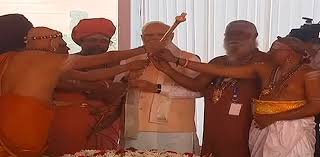
Modi then prepared for the central ceremonial act: the carrying and installation of the Sengol.
B. The Sengol: Royal Sceptre, Divine Right, and Constitutional Violation
The Sengol is a gold-plated sceptre, crafted in 1947 by jeweler Vummidi Ethirajulu on the orders of Thiruvavadurai Adheenam (a Tamil monastic order). According to one historical narrative—disputed by scholars and the Congress party—the Sengol was gifted to India’s first PM Jawaharlal Nehru on August 14, 1947, as a symbol of the transfer of power from the British to Indian rule.
Yet the Sengol‘s deeper symbolism is what matters constitutionally. Historically, the Sengol is a royal sceptre—a symbol of monarchical authority and the “divine right” to rule. In traditional Indian statecraft, a Sengol was bestowed by a head priest upon a newly-crowned king, signifying priestly blessing of the monarch’s authority. The symbolism is explicitly about kingship, divine sanction, and the fusion of religious and political authority.
In a secular democracy, this symbolism is constitutionally catastrophic. Democracy rests on the principle that sovereignty derives from the people, not from divine blessing delivered by priests. Parliament represents the will of elected representatives—citizens exercising collective self-governance. Installing a royal sceptre that symbolizes divine-right monarchy in the Speaker’s chair directly contradicts the constitutional foundation of Indian democracy.
C. The Ceremonial Performance: Prostration and Procession
On May 28, 2023, Modi did not merely “install” the Sengol as a historical artifact. He performed an elaborate religious ceremony:
- Modi received the Sengol from Adheenam (monastic leaders) on the evening of May 27, in a televised ceremony where he was presented with the sceptre by Tamil Nadu priests and monks.
- Modi prostrated himself before the monks in sashtanga pranam—a Hindu religious practice of lying flat on the ground in obeisance before spiritual authorities. As one analyst noted, Modi “lay down in sashtanga pranam – the Hindu religious practice of paying obeisance while lying prostrate on the floor – before the Sengol.” He was not genuflecting to the artifact; he was performing religious devotion before the monks and the symbol they represented.
- Modi led a procession of Adheenam/monks through the Lok Sabha chamber, carrying the Sengol while the monks chanted Vedic mantras. Photos show Modi walking alongside multiple monks in saffron robes, proceeding through Parliament toward the Speaker’s chair.
- Modi installed the Sengol next to the Speaker’s chair—a permanently fixed religious symbol in the legislative chamber of a secular democracy.
- Modi declared Parliament a “temple” in his inaugural address, stating: “This is not just a building. It is a reflection of the aspirations and dreams of 1.4 billion Indians. This is the temple of our democracy and it’s giving the message of India’s determination to the world.”
The language is deliberate. Parliament is not a temple. It is a legislative chamber where representatives of a multi-religious nation enact laws. By calling it a “temple,” Modi invokes Hindu religious cosmology—temples are sacred spaces where the divine is worshipped. A parliament is a secular space where laws are made.
D. The Constitutional Violations
1. Article 36 & Article 44 (Directive Principles): Secular State Duty
Article 36 of the Directive Principles states: “The State shall direct its policy towards securing… that the ownership and control of the material resources of the community are so distributed as best to subserve the common good.”
More critically, Article 44 mandates: “The state shall endeavor to secure for the citizens a uniform civil code throughout the territory of India.” This provision, though unimplemented, establishes the constitutional aspiration that the state should treat all citizens equally regardless of religion.
By inaugurating Parliament with elaborate Hindu religious rituals and installing a Hindu religious symbol as a permanent fixture in the legislative chamber, the state violates both articles. It privileges Hindu religious symbolism in a space meant to serve citizens of all faiths equally.
2. Article 51-A (Fundamental Duties): Scientific Temper
Article 51-A(h) imposes a fundamental duty on every citizen: “to develop scientific temper, humanism and the spirit of inquiry and reform.” This duty is not merely aspirational; it is constitutionally mandated.
As one commentator observed, the inauguration violated this principle: “Neither of these [scientific temper and spirit of inquiry] were on display in the spectacle put up by the ruling Bharatiya Janata Party (BJP) on May 28.”
Installing a religious symbol based on unverified historical claims (the Congress party disputed that the Sengol represented a transfer of power), performing Hindu rituals in the legislative chamber, and framing Parliament as a “temple” all contradict the constitutional mandate for scientific temper and rational inquiry.
3. Article 15(1) and Article 14: Equality Before Law
Article 15(1) states: “The State shall not discriminate against any citizen on grounds only of religion, race, caste, sex or place of birth.”
Article 14 guarantees: “The State shall not deny to any person equality before the law or the equal protection of the laws.”
By privileging Hindu religious symbolism in Parliament, the state has created a hierarchical structure: Parliament is framed as a Hindu temple, decorated with Hindu symbols, and blessed by Hindu religious authorities. This sends a message to non-Hindus that their faith is not welcome in the legislative chamber—that Parliament belongs to Hindus.
A Muslim, Christian, Sikh, or Buddhist legislator entering Parliament now encounters a Hindu religious symbol as the first thing they see. This is not equality before law. It is symbolic discrimination.
4. Article 50: Separation of Powers
Article 50 mandates: “The State shall take steps to separate the judiciary from the executive in the public services of the State.”
While this article is primarily concerned with judicial-executive separation, its deeper principle—that constitutional institutions must maintain integrity and not be merged with religious authority—applies to Parliament as well.
When the PM performs Hindu rituals in Parliament, when monks process through the legislative chamber, and when religious symbols are installed in the Speaker’s chair, the line between religious authority and legislative authority is erased. Parliament becomes a hybrid space—simultaneously a legislative body and a Hindu religious site.
5. The Sengol as Symbol of Monarchy, Not Democracy
The most fundamental constitutional violation lies in the Sengol’s symbolism. The Communist Party of India (Marxist) captured this precisely: “The Sengol is traditionally a sceptre given by the head priest to a newly-ordained king to rule righteously… It is also against the secular character of the republic wherein a religious symbol is placed in a prime position in Parliament.”
The Sengol represents:
- Divine right to rule: The priest anoints the king, signifying divine sanction
- Monarchy, not democracy: Kings rule by divine right; democracies govern by popular sovereignty
- Religious authority over political authority: The priest’s blessing legitimizes the king’s rule
- Hierarchy and submission: The monarch submits to priestly authority, establishing religious dominance
None of these principles are compatible with constitutional democracy. Yet by installing the Sengol in Parliament, Modi has embedded these monarchical and theocratic principles in the very chamber where democratic laws are made.
E. The Opposition Boycott and Institutional Rejection
The symbolic importance of the ceremony was not lost on opposition parties. Nineteen political parties boycotted the inauguration—an unprecedented show of unity against Modi’s Hindu nationalist agenda.
The opposition’s core argument: “The President of India should have inaugurated the new Parliament building, not the Prime Minister.”
This is constitutionally significant. While India’s President is a ceremonial head of state, the office carries symbolic importance. The President, as a constitutional figurehead, stands above partisan politics and represents the nation as a whole—not a particular ideology or religion.
By having the PM inaugurate the building and preside over Hindu religious rituals, Modi made the ceremony explicitly political and explicitly religious. A President’s inauguration would have maintained constitutional distance between the state and religion. Modi’s inauguration collapsed that distance.
The boycott reflected institutional resistance to the violation. Yet, as with previous violations, no legal consequences followed. The institutions that might challenge Modi—Parliament (controlled by his coalition), the judiciary (passive), the media (mixed)—could not arrest the violation.
F. The “Temple” Metaphor: Philosophy of Hindu Nationalism
Modi’s declaration that Parliament is a “temple of democracy” is not casual language. It is theological statement expressing the core philosophy of Hindu nationalism: that India’s secular democratic institutions should be reframed as Hindu sacred spaces.
The logic runs as follows:
- India is a Hindu nation (despite its multi-religious reality)
- Hindu symbols, rituals, and philosophy should animate Indian institutions
- Democracy is compatible with Hindu theocracy (both are forms of governance)
- Therefore, Parliament can be simultaneously democratic and Hindu sacred
This logic is constitutionally false. Parliament cannot be both a secular democratic chamber and a Hindu temple. The two are incompatible. Temples are spaces where divine power is worshipped; legislatures are spaces where laws are made. One has religious authority; the other has democratic authority. They cannot be merged.
Yet Modi’s framing—Parliament as temple—establishes exactly this merger. It declares that in “the India of Modi,” secular democratic institutions are expressions of Hindu religious identity.
G. The Permanent Installation: Structural Consecration
Unlike the Ram Mandir inauguration (which was a one-time ceremony) or Modi’s personal attendance at religious events (which involve only his actions), the Sengol’s permanent installation in Parliament creates a structural violation of the secular Constitution.
Every legislator who enters Parliament now encounters a religious symbol in the place of supreme legislative authority. Every legislative session occurs under the gaze of a sceptre symbolizing divine-right monarchy. Every law passed in Parliament is enacted in a chamber framed as a “temple.”
This is not a temporary breach. It is a permanent consecration of Parliament—a constitutional rechristening of the legislative chamber as a Hindu sacred space.
H. Ambedkar’s Warning Vindicated
Dr. B.R. Ambedkar, who chaired the Drafting Committee of the Indian Constitution, warned nearly a century ago: “Politics in India is nothing but theology in action.” He meant this as a warning—that without vigilant secularism, Indian politics would collapse into religious authoritarianism.
The Central Vista inauguration vindicated Ambedkar’s fear. The PM, dressed in ceremonial attire, prostrating before monks, processing through Parliament with Vedic chanting—this is “theology in action.” It is politics conducted as religious ritual.
Ambedkar’s prescription was clear: “The progressive secularisation of society and politics” was necessary to prevent majoritarianism. Yet the Modi government is doing precisely the opposite—it is advancing the re-theologization of politics and the subordination of democratic institutions to Hindu religious authority.
I. Constitutional Coherence: Comparing Standards
Consider the hypothetical: If a Muslim PM were to inaugurate Parliament with an elaborate Islamic ceremony—a dua, Quranic recitations, the installation of a minbar (pulpit) in the Speaker’s chair—and declared Parliament a “mosque of democracy,” what would be the response?
The outrage would be instantaneous and universal. Constitutional scholars would invoke Article 15, Article 14, secularism as a basic feature. The Supreme Court would likely intervene. Opposition parties would demand impeachment.
Yet when the same violation occurs with Hindu religious symbolism, institutional resistance crumbles. This asymmetry reveals the core danger: majoritarian religion receives state support, minority religions receive state suppression.
The secular Constitution permits neither. Yet the structure of majoritarian democracy—where Hindus comprise 80% of the population, and Hindu nationalist ideology animates the ruling coalition—creates conditions where majoritarian religious nationalism can proceed without check.
J. The Pattern Deepens: Central Vista as Culmination
The Central Vista inauguration represents the culmination of the pattern established by Ram Mandir attendance, Yoga Day discrimination, CJI visits, and Pulwama abdication. Each violation normalizes the next. By the time Parliament is consecrated as a Hindu temple, the threshold of acceptability for constitutional breach has shifted dramatically.
What began as Modi’s personal attendance at religious ceremonies (Ram Mandir, sacred baths) has evolved into state machinery performing religious rituals (Yoga Day with mandatory “Om” chanting), executive-judicial merger (CJI Ganesh Puja), and now the permanent transformation of the highest legislative chamber into a religious sanctuary.
The architectural trajectory is clear: Hindu nationalist ideology is systematizing itself through state institutions. Each violation—Ram Mandir, Yoga Day, CJI visit—opens space for the next. The Central Vista consecration could not have occurred without the precedents that preceded it.
K. The Accountability Vacuum at Central Vista
As with Pulwama, Ram Mandir, and Ganesha Puja, the Central Vista inauguration faced no judicial intervention. Opposition parties boycotted; constitutional scholars protested; but the Court remained silent.
No petition was filed under Article 32 challenging the installation of a religious symbol in Parliament. No PIL sought to remove the Sengol or to enjoin the government from further religious rituals. The constitutional remedy existed; institutional actors chose not to deploy it.
This silence is deafening. The Supreme Court is constitutionally obligated to protect the secular character of the state (established as a basic feature in Kesavananda Bharati). Yet when Parliament itself is consecrated as a Hindu temple, the Court offers no intervention.
The impunity loop has reached the legislative chamber itself.
XII. Reflections: What Secularism Required, What Was Lost
A. The Secular Compact
India’s secular Constitution was built on a specific bargain: the state would not sponsor any religion, thereby protecting all religions equally. It would protect minority religious rights precisely because it remained neutral—it would not be captured by majoritarian religious sentiment.
This bargain made sense in a country where Hindus comprise 80% of the population. Without constitutional secularism, majoritarian religious sentiment could overwhelm minority rights. Secularism was not “Hindu-phobic”—it was protective of democracy itself.
B. What Has Changed
Since 2019, this bargain has been abandoned. The state has increasingly become a vehicle for Hindu nationalist ideology. The facts are undeniable:
- A Hindu temple has been inaugurated by the PM in official capacity
- Hindu religious practices (yoga, sacred baths) receive state support while Muslim practices (namaz) are suppressed
- The highest judge in the land has been implicated in religious ceremony with the executive
- Environmental resources are diverted to advance religious symbolism
In aggregate, these changes constitute a transformation: India is moving from a secular state that protects religious practice toward a Hindu-nationalist state that privileges one religion while marginalizing others.
C. The Democratic Paradox
The cruelest aspect of this transformation is that it is democratic. Modi won elections with clear mandates in 2014 and 2019 (and again in 2024, as of this writing in June 2026). The majority of Indians appear to support Hindu nationalism. If democracy is rule by the people, then Hindu nationalism—supported by an electoral majority—is legitimate.
Yet this conclusion misses the constitutional point. Democracy requires not just majority rule but constitutional limits on what majorities can do. A majority cannot abolish fundamental rights; a majority cannot discriminate against minorities; a majority cannot use state power to suppress dissent.
Article 368 (the constitutional amendment clause) allows for amendments, but even amendments cannot destroy the “basic structure” of the Constitution—a doctrine established in Kesavananda Bharati and reaffirmed repeatedly. Secularism is a basic feature. It cannot be amended away, even by a supermajority.
Yet if the judiciary does not enforce this limit, if parliament is controlled by those seeking to erode it, and if democratic culture has shifted toward accepting Hindu nationalism as normal, what prevents the basic feature from eroding through practice?
The answer is: constitutionally, nothing. The written Constitution can be defended only by the institutions that interpret it—the judiciary, primarily—and the political culture that values it. When both are compromised or indifferent, the Constitution is hollow.
XIII. Conclusion: Toward An Uncertain Future
A. The Consolidation of a Pattern
The incidents documented in this article do not represent aberrations. They represent a consolidation of a pattern: the systematic use of state power to advance Hindu nationalism while marginalizing minority religious practice. Each incident normalizes the next. By the time the CJI host Ganesh Puja with the PM, the precedent of Ram Mandir attendance and Yoga Day discrimination had already shifted the baseline of what is constitutionally acceptable.
B. The Impunity Loop as Structural Reality
The most troubling finding of this analysis is that the violations documented above are likely to continue and intensify, precisely because they have encountered no meaningful resistance. The absence of judicial intervention is not accidental—it suggests that institutional actors have calculated that intervention is futile or undesirable. The result is a self-reinforcing cycle: violations accumulate, normalizing further violations, ensuring that future challenges will be dismissed as trivial in light of the precedents already established.
C. What Comes Next
If current trends continue, India’s secular Constitution will remain on paper while its practice converges toward Hindu nationalism. This does not necessarily mean authoritarianism in the crude sense—elections may continue, parliament may function, and courts may remain formally independent. But the Constitution’s core commitment—state neutrality regarding religion—will have been eroded.
The implications are profound:
- Minority Rights Erosion: Muslims, Christians, and other minorities will face increasing state suppression of their religious practice, justified by appeals to “national culture” and “security.”
- Jurisprudential Decay: Supreme Court judgments on secularism and minority rights will be increasingly ignored by executives, emboldened by the CJI’s own participation in religious ceremony with the PM.
- Democratic Decline: Without constitutional limits on executive power and without judicial enforcement of those limits, democracy becomes majoritarianism—rule by the majority without constitutional restraint.
- International Isolation: India’s standing as a multi-religious democracy and constitutional republic will be damaged internationally, affecting its diplomatic and economic position.
D. The Path to Constitutional Renewal
Reversing these trends would require:
- Judicial assertiveness: Future judges must recognize that the separation of powers and secular governance are basic features that require active defense.
- Political mobilization: Civil society, opposition parties, and constitutional scholars must make secularism an explicit electoral issue, pressuring future governments to respect it.
- International pressure: Human rights mechanisms at the UN and bilateral relations should condition support on India’s commitment to minority protections.
- Constitutional amendment: If the current trajectory persists, a future government with different values could explicitly amend the Constitution to restore secularism as a basic feature, enshrining it against judicial erosion.
E. Final Reflection: The Stakes of Secularism
In the end, the stakes of this debate are not merely about protecting minorities—though that is crucial. The stakes are about what kind of democracy India wants to be. A secular democracy can accommodate Hindu nationalism as one voice among many, protecting all religions equally. A Hindu-nationalist state cannot accommodate secular governance—it must eventually subordinate or suppress dissent from those who value secular principles.
India chose secularism in 1950 not because Hindus were weak or afraid. India chose secularism because its founders—Nehru, Ambedkar, Patel, and others—understood that in a multi-religious society, constitutional neutrality is the only stable foundation for democracy.
The violations documented in this article suggest that India is making a different choice. Whether that choice will be reversed, accommodated, or consolidated will depend on whether the institutions that defend the Constitution—the judiciary, primarily—rediscover the courage that Jawaharlal Nehru displayed when he barred the President from inaugurating a temple seventy-five years ago.
That precedent was not merely about one temple. It was about what kind of state India wanted to be. The Ram Mandir inauguration by Modi in 2024 answered that question differently. What comes next will depend on whether institutional actors can still correct course, or whether the inertia of violated norms has become irreversible.
References
Constitutional Provisions
- Constitution of India: Articles 14, 25, 36, 44, 50, 60, 75; Preamble (as amended) — https://www.indiacode.nic.in/bitstream/123456789/16124/1/the_constitution_of_india.pdf (or https://www.constituteproject.org/constitution/India_2016)
- Directive Principles of State Policy: Articles 36-51 — https://www.indiacode.nic.in/bitstream/123456789/16124/1/the_constitution_of_india.pdf
Supreme Court Jurisprudence
- Kesavananda Bharati v. State of Kerala, 4 SCC 225 (1973) — https://www.scobserver.in/wp-content/uploads/2024/03/Suprme-Court-Judgement_-Kesavananda-Bharati-v-State-of-Kerala-1973.pdf
- M.C. Mehta v. Union of India, 4 SCC 463 (1988) — https://indiankanoon.org/doc/1208005/
- Indira Sawhney v. Union of India, AIR 1993 SC 477 (1992) — https://indiankanoon.org/doc/1363234/
- The Commissioner, Hindu Religious Endowments v. Sri Lakshmindra Thirtha Swamiar, AIR 1954 SC 282 (1954) — https://indiankanoon.org/doc/1430396/
- S. R. Bommai v. Union of India, 3 SCC 1 (1994) — https://api.sci.gov.in/jonew/judis/11570.pdf
- M.S. Ahluwalia v. Union of India, 8 SCC 122 (1999) — https://indiankanoon.org/doc/821456/
- In Re: Raju Ramachandran, 9 SCC 580 (2014) — https://cjp.org.in/wp-content/uploads/2017/05/FINAL%20REPORT%20-%20RAJU%20RAMACHANDRAN.pdf (associated amicus documentation)
Statutory Framework
- Prevention of Corruption Act, 1988 — https://www.indiacode.nic.in/bitstream/123456789/15302/1/pc_act,_1988.pdf
- Right to Information Act, 2005 — https://cic.gov.in/sites/default/files/RTI-Act_English.pdf
- Environmental Protection Act, 1986 — https://www.indiacode.nic.in/bitstream/123456789/4316/1/ep_act_1986.pdf
- Indian Penal Code, Sections 304, 336, 337 — Standard IPC text via https://www.indiacode.nic.in (historical version)
Primary Sources
The Wire: “Modi Defends Ganesh Puja with CJI Amid Questions of Impropriety” (September 2024) / “PM-CJI’s Public Puja Sparks Concerns…” — https://m.thewire.in/article/politics/pm-cjis-public-puja-sparks-concerns-over-propriety-separation-of-powers-secularism-and-political-symbolism
Satya Pal Malik Interview, The Wire (April 2023), conducted by Karan Thapar — https://thewire.in/politics/satyapal-malik-governor-jammu-kashmir-farmers-narendra-modi-government (with transcript/video references)


Constitutional Crisis in India: Seven Violations, Zero Accountability, Systematic Erosion of Secular Democracy
India’s Constitution enshrines secularism as a “basic feature”—unamendable even by supermajority amendment. Since 2019, this foundational principle has been systematically undermined through seven major constitutional violations, each met with judicial silence and institutional passivity.
Executive Overreach Across Seven Domains:
Constitutional Framework Violated: Articles 14 (equality), 15(1) (non-discrimination), 25, 36, 44, 48-A, 50 (separation of powers), 51-A(h) (scientific temper), 60, 75.
The “Impunity Loop” Mechanism: —Judicial passivity (Supreme Court declines intervention) —Doctrinal innovation (“24/7 duty” abolishing answerability) —Intellectual capture (reframing Hindu nationalism as “secular culture”) —Institutional drift (normalization of violations)
Why Institutional Actors Matter: India’s constitutional democracy depends on three branches checking each other. When: ✓ Judiciary opts out (no intervention despite clear Article 32 grounds) ✓ Parliament is controlled by the violator (majority government) ✓ Investigative agencies are captured (CBI, ED, NIA perceived as politicized)
.
LikeLiked by 6 people