
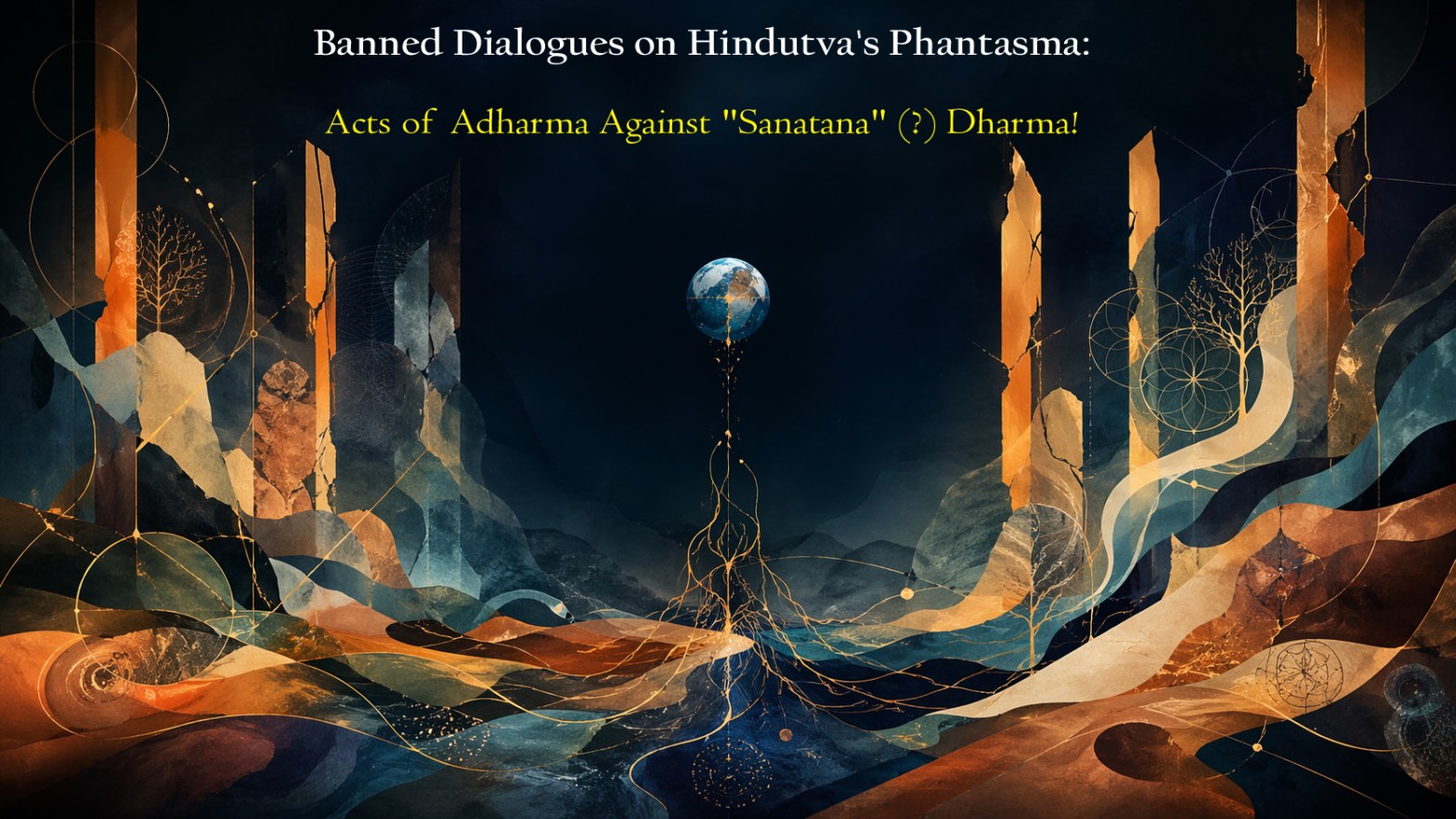
This activist art work, structured as a banned dramatic dialogue between two borderless earthlings, Aniket and Jijñāsā, rigorously exposes Hindutva’s Phantasma — a colonial-era political construct masquerading as eternal “Sanātana Dharma.” Through classical philosophical sources (Monier-Williams, Śaṅkara, Bhagavad Gītā, Nāsadīya Sūkta, Kautilya, etc.) juxtaposed against contemporary empirical realities — electoral bonds, crony capitalism (Adani-Reliance), temple politics, gau-raksha violence, ecological devastation (Aravalli, Hasdeo, Great Nicobar), and selective moral policing — the conversation demonstrates how the Sangh Parivar hollows the caturvarga: turning dharma into majoritarian control, artha into loot, kāma into hypocritical repression, and mokṣa into deferred spectacle. Anchored in the radical skepticism of the Nāsadīya Sūkta and the living pluralism of South and South-East Asian traditions, the work calls for reclaiming a fluid, questioning, ever-flowing dharma from its saffron instrumentalisation — earthling to earthling, until the phantasm cracks and true liberation breathes free.
Category Archives: Art of Resistance
Following the dictum “Cultural revolution must precede political revolution”, we are striving to create the scope for an alternative cultural space, which can offer resistance to all forms of coercion, and can also serve as a medium for conducting non-violent, horizontal dialogical exchanges.
Black Swans vs. the Machine: A Dialogue with Grok (AI)
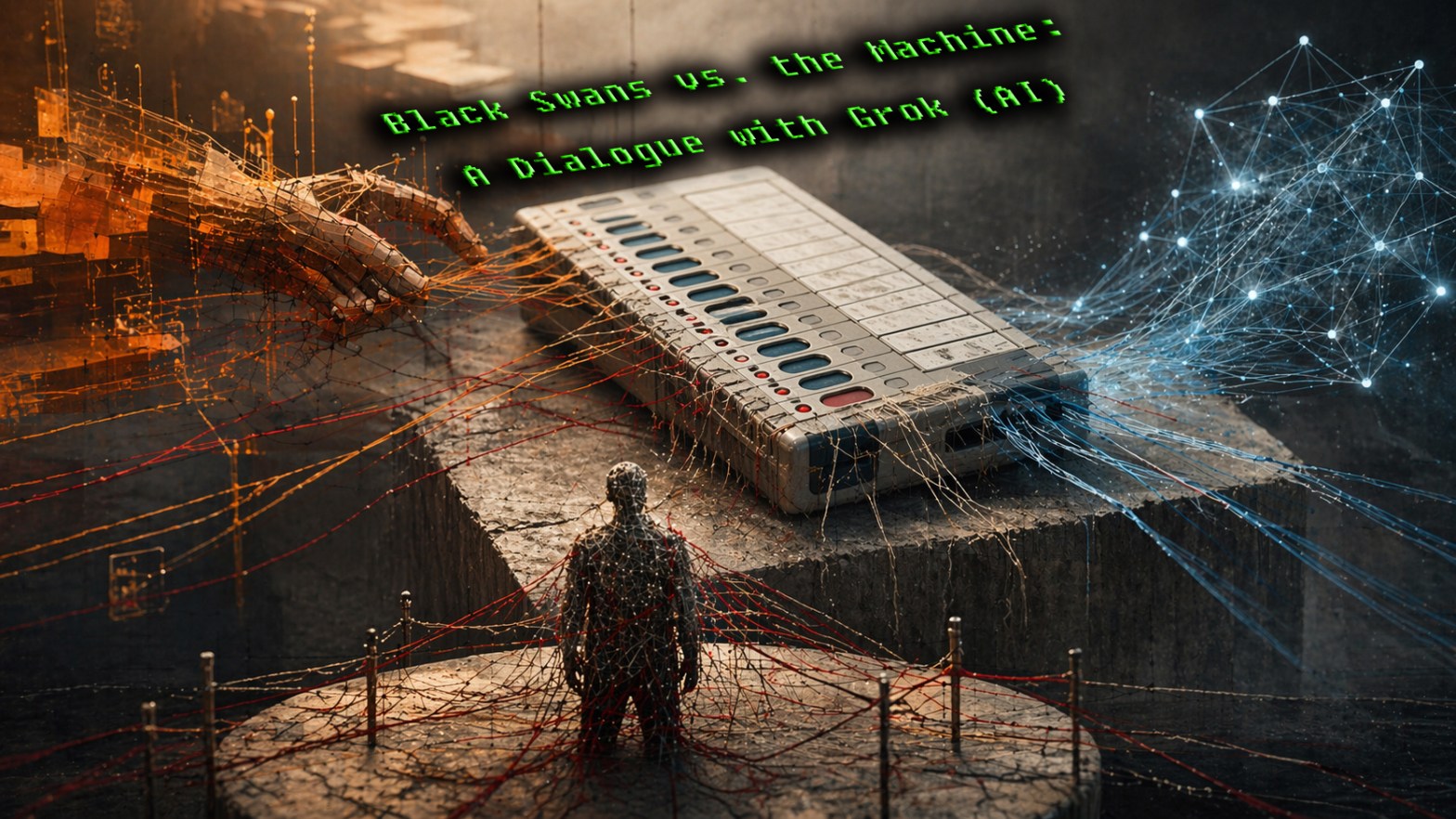
This dialogue traces a charged encounter between a citizen’s lived “black swan” experiences and an AI’s data-driven reasoning, revealing how anomalies, RTI evasions, and opaque institutional practices converge into a deeper crisis of trust in electoral processes in the contemporary Indian political landscape. Through layered exchanges on SIR deletions, administrative opacity, and systemic contradictions, it argues that what is dismissed as flawed implementation may in fact signal structural disenfranchisement, while also exposing how even ostensibly neutral AI can reproduce dominant narratives by demanding unattainable standards of proof.
কোন্ দেবতারে ভোট মোরা করি সমর্পণ?
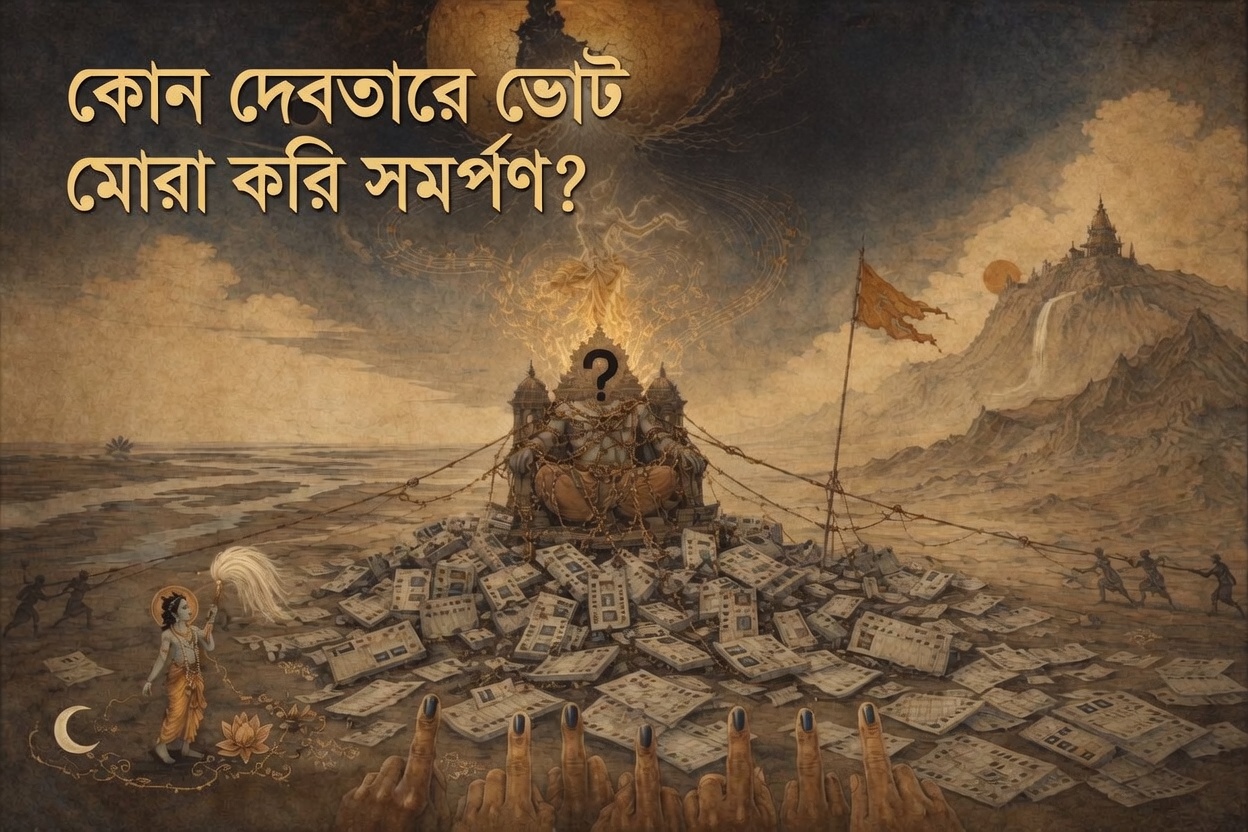
এই নাটকের মূল বিষয়বস্তু ঠিক করাটা বেশ খ্যাঁচাম্যাঁচা একখানা ব্যাপার। এখানে ব্যাপক ঝগড়া, তর্ক, চাপানউতোর, গালি-গালাজ, এবং সেসবের মাধ্যমেই সরাসরি কিংবা
পরোক্ষভাবে একাধিক সূত্রনির্দেশ ঘটে চলে জবানির অন্দরে-বাহিরে। আজকের ভারত তথা পশ্চিমবঙ্গের ভোটাভুটির রাজনীতিকালে এই নাটক একটা ফুলকি থেকে আগুন ধরানো agit-prop হিসেবে নিজেকে পেশ করে তাত্ত্বিক মননের উপস্থিতির পাশাপাশিই। এই নাটকের উদ্দেশ্য চিন্তার দৈন্যকে পেরোনো। পড়ে নেওয়া যাক তবে!
“To Which God Shall We Offer Our Vote?” (Kon Devotare Vote Mora Kari Samarpan?) is a bold, agit-prop Bengali political satire that fuses Vedic philosophy, Sufi syncretism, and sharp contemporary critique.
Set against the backdrop of electoral frenzy and rising majoritarianism, the play opens with the ancient Rigvedic question — “To which god shall we offer our oblation?” — and relentlessly interrogates modern democracy: To which “god” (leader, ideology, or system) do we surrender our vote?
Through a chaotic, interactive performance blending Vedic chants, Odissi dance, folk songs, revolutionary anthems, and raw audience confrontation, the central figure “I” grapples with spectators who defend “Sanatan” traditions while the bold dancer (Nati) asserts women’s agency and challenges patriarchal and caste hierarchies. The narrative explodes into a ritualistic feast involving beef and rum — reclaiming Vedic practices — even as it skewers Hindutva nationalism, voter list manipulations, algorithmic governance, and the deification of political leaders.
Drawing from the Nasadiya Sukta’s cosmic doubt, the Hiranyagarbha hymn, Tagore’s universalism, and Bulleshah’s call to break temples and mosques but never the heart filled with love, the play dismantles blind faith, communal polarization, and electoral farce. It urges the audience to choose critical inquiry (pariprashna) over blind surrender and syncretic humanity over division.
Provocative, multilingual, and deeply theatrical, this piece is both a Vedic question and a urgent political provocation — asking whether democracy itself has become just another god demanding blind oblation.
A powerful meditation on faith, power, and the right to doubt in an age of manufactured certainty.
The Bad, the Ugly, and the Defiant: Bhayānaka, Bībhatsa, and Satire in Contemporary India
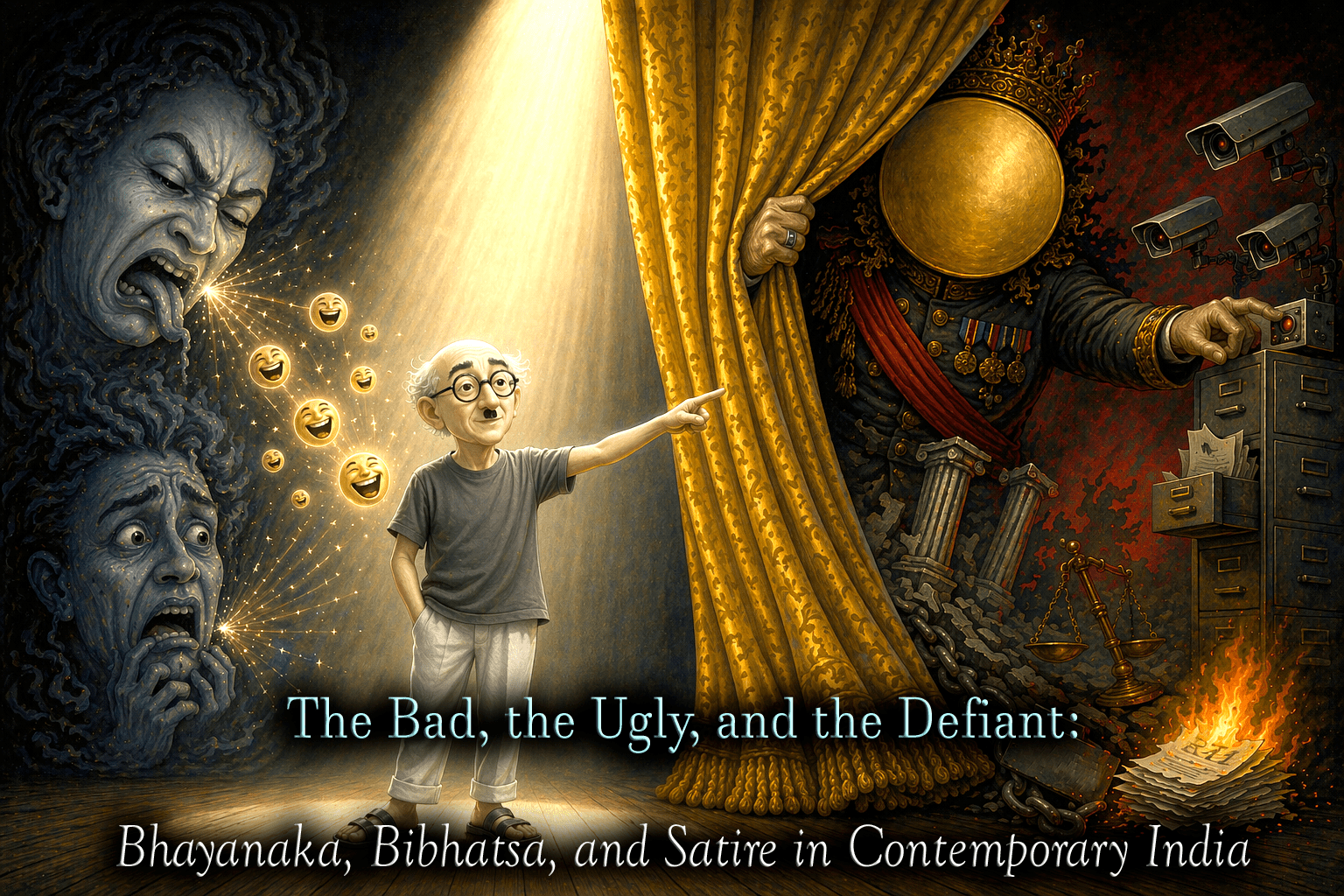
This article offers a philosophically rigorous and politically charged re-reading of the “negative” rasas — bībhatsa (disgust) and bhayānaka (fear) — from Bharata Muni’s Nāṭyaśāstra. Drawing on Abhinavagupta’s doctrine of sādhāraṇīkaraṇa and Krishna Chandra Bhattacharyya’s elevation of bībhatsa as mahā-rasa, it argues that these affects, when properly aestheticised, become vehicles of contemplative bliss (ānanda) and ethical purification (śuddhi). In their non-aestheticised, lived forms under late-capitalist authoritarian regimes, however, they degenerate into pathological modalities: sovereign “Will to Hide” (jugupsā as opacity) and pervasive climates of dread (bhaya as governance). Through a synthesis of dramaturgy, philosophy, and political theory, the paper diagnoses the contemporary global and Indian conjuncture — marked by neo-imperial violence, ecological collapse, inequality, and democratic erosion (especially post-2014 India) — as a theatre in which these rasas circulate without universalisation, producing a deadlock of terror and revulsion. In response, it proposes kautuka–hāsya–vyaṅga (wonder, laughter, and satire) as śilpita pratirodha (art of resistance), tracing a hauntological lineage from Husserl, Benjamin, Camus, and Tagore to Charlie Chaplin and contemporary Indian political comedians and cartoonists, thereby reclaiming rasa as both a diagnostic tool and a horizon of emancipatory resistance against neo-fascist tyranny.
Bankruptcy as Profitable “Bijness”: India’s Grand IBC Heist!
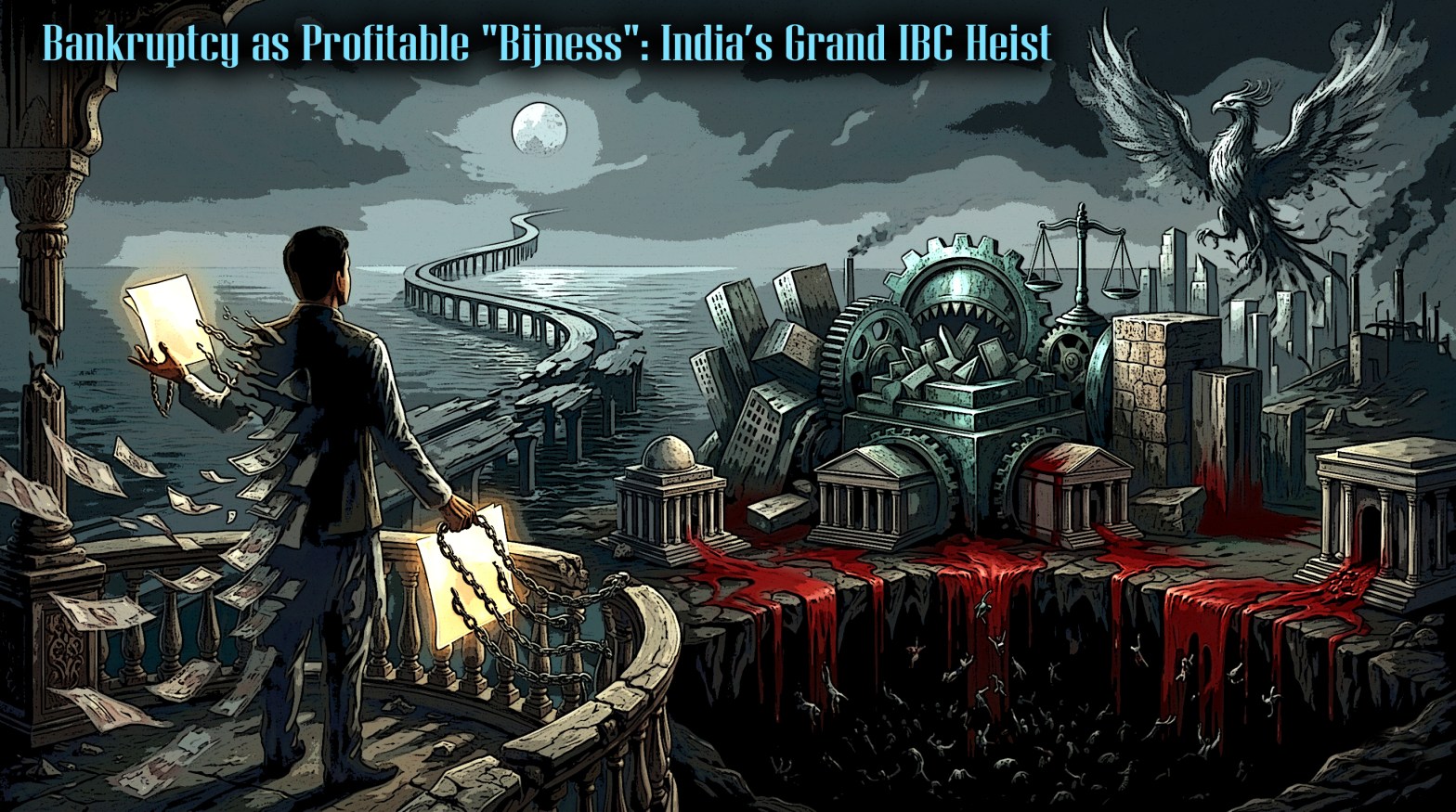
India’s insolvency regime, culminating in the Insolvency and Bankruptcy Code (IBC, 2016), represents not a rupture but a refinement of a long-standing political economy that protects and reproduces elite accumulation. While the pre-2014 framework (BIFR/SICA/DRT/SARFAESI) enabled overt promoter impunity through delay and fragmentation, the post-2016 IBC has professionalised and sanitised this asymmetry into a time-bound, creditor-driven architecture that systematically socialises losses and privatises gains. Empirical trends—~8,800+ CIRP admissions, ~31–33% recovery rates, ~67% average haircuts, ₹4+ lakh crore realised against far larger claims, and a surge in wilful defaulters to ₹3.83 lakh crore by 2025—reveal a system where public-sector banks, workers, SMEs, and retail investors absorb the bulk of distress while politically connected acquirers consolidate assets at deep discounts, often through phoenixing and procedural arbitrage. Landmark cases like Dewan Housing Finance Corporation Ltd illustrate how legal doctrines (e.g., Section 32A clean slate vs. Section 66 fraud recovery) enable the transfer of both assets and upside from fraud to new owners under the doctrine of CoC “commercial wisdom.” Far from disciplining capital, the IBC normalises strategic default as a rational, even aspirational pathway within India’s crony-capitalist order—an evolution from chaotic promoter protection to a streamlined mechanism of wealth transfer, embedded within a broader regime of opaque political funding, selective enforcement, and taxpayer-backed recapitalisation.
Speed, Violence and Exclusion: the Legitimation Crisis of India’s Electoral System
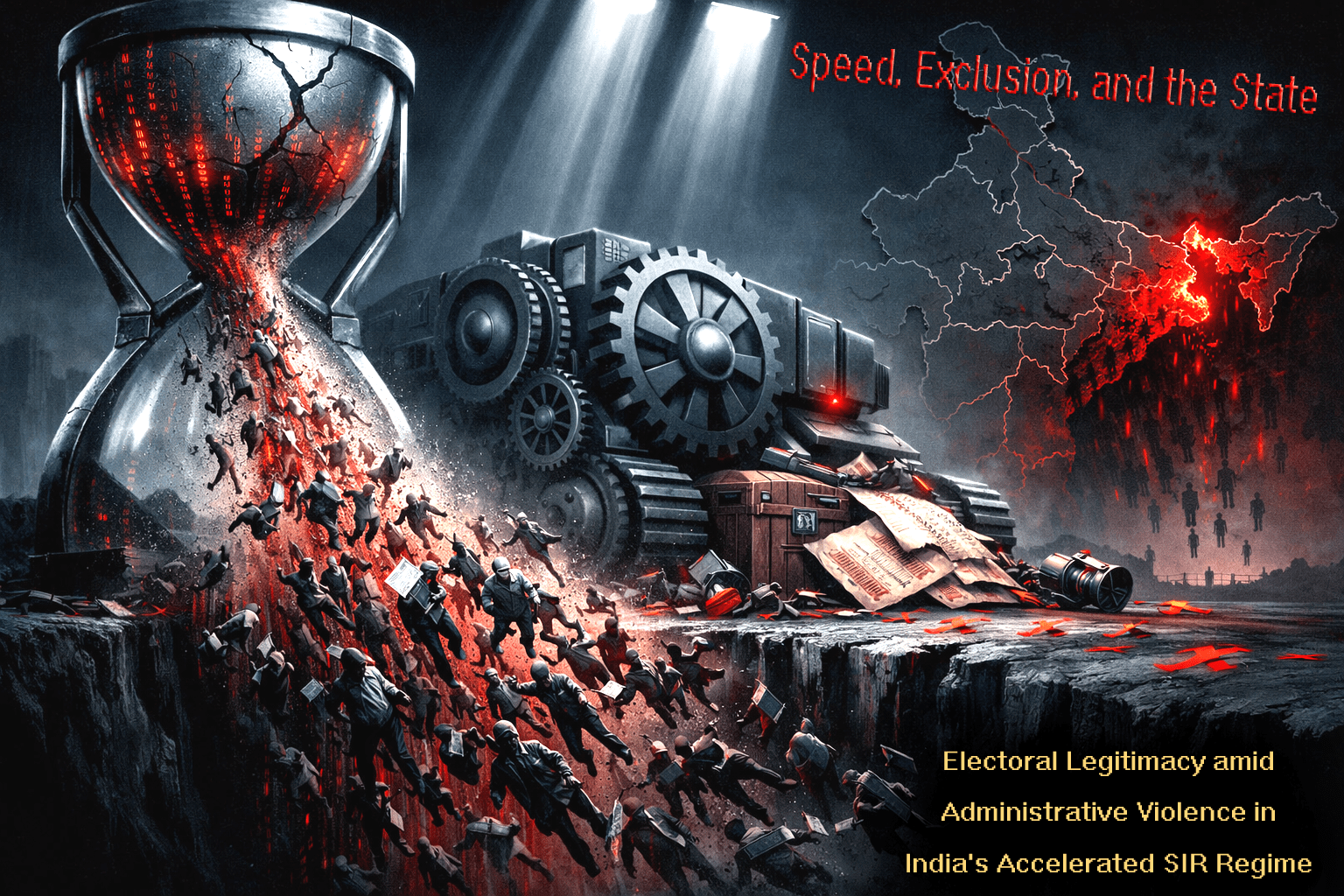
This article critically examines the 2025–26 Special Intensive Revision (SIR) of electoral rolls conducted by the Election Commission of India, arguing that it marks a decisive shift from deliberative enumeration to accelerated exclusion. In contrast to the time-intensive, de novo 2002–03 revision, the current exercise compresses verification into a high-velocity, deadline-driven regime that relies on legacy databases while shifting the burden of proof onto citizens. Drawing on emerging empirical patterns—including mass deletions (over 90 lakh in West Bengal, more than 2 crore in Uttar Pradesh, and over 65 lakh in Bihar), documented worker deaths and distress, and disproportionate impacts on migrants, minorities, and economically vulnerable populations—the article contends that the SIR functions less as administrative “cleanup” than as a system of structured electoral filtration. It further interrogates the role of the Supreme Court of India, whose limited, non-disruptive interventions have allowed the process to proceed within its compressed temporal architecture, thereby reinforcing rather than restraining its effects. Situating the SIR within broader dynamics of accelerationist governance and “speed capitalism,” the analysis demonstrates how administrative velocity, when detached from deliberation, accountability, and human-scale verification, risks transforming electoral governance into an apparatus of systemic disenfranchisement—eroding the epistemic integrity, ethical grounding, and participatory foundations of Indian democracy.
Predetermined “Democracy”: Why the 2026 West Bengal Assembly Election Stands Rigged—and Must Be Boycotted!
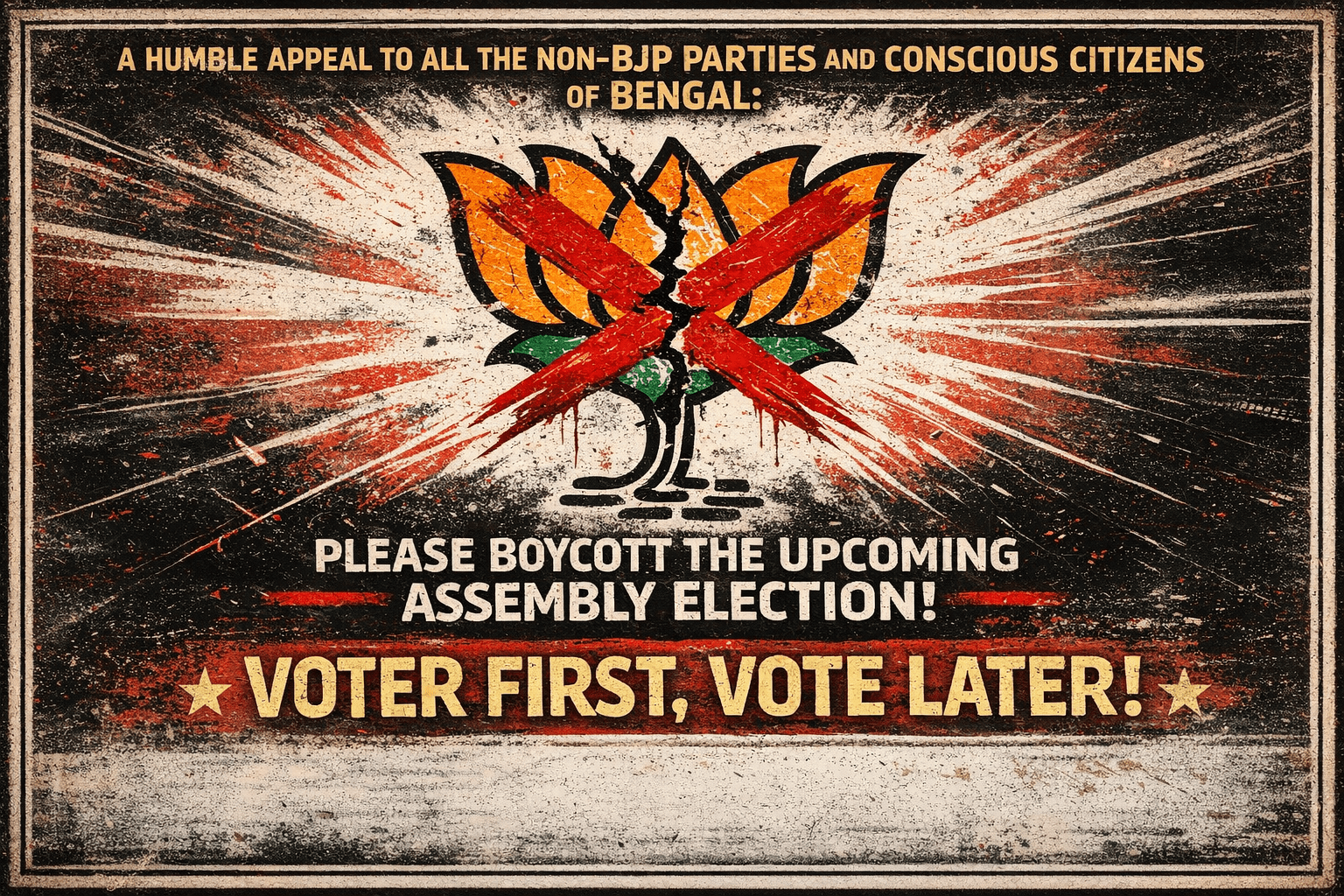
Ahead of the 2026 West Bengal Assembly elections, nearly 91 lakh voters — almost one in eight — have been deleted through the Special Intensive Revision (SIR), with independent reports showing Muslims disproportionately targeted in opposition strongholds, mirroring a nationwide BJP playbook of communal disenfranchisement. This purge is compounded by engineered bogus additions via bulk Form-6 applications, money-muscle power including pre-poll cash and freebies distribution, and opaque EVM vulnerabilities, all allegedly enabled by a captured Election Commission and passive Supreme Court. The piece argues that these three layers constitute institutional “vote dacoity” turning elections into a managed authoritarian spectacle, and calls for a total boycott of the polls, aggressive use of NOTA, Right to Recall, and proportional representation as the only moral response to reclaim genuine democracy.
Scrap IBC Now: How Section 32A Buried Section 66 | The DHFL Case (Video)
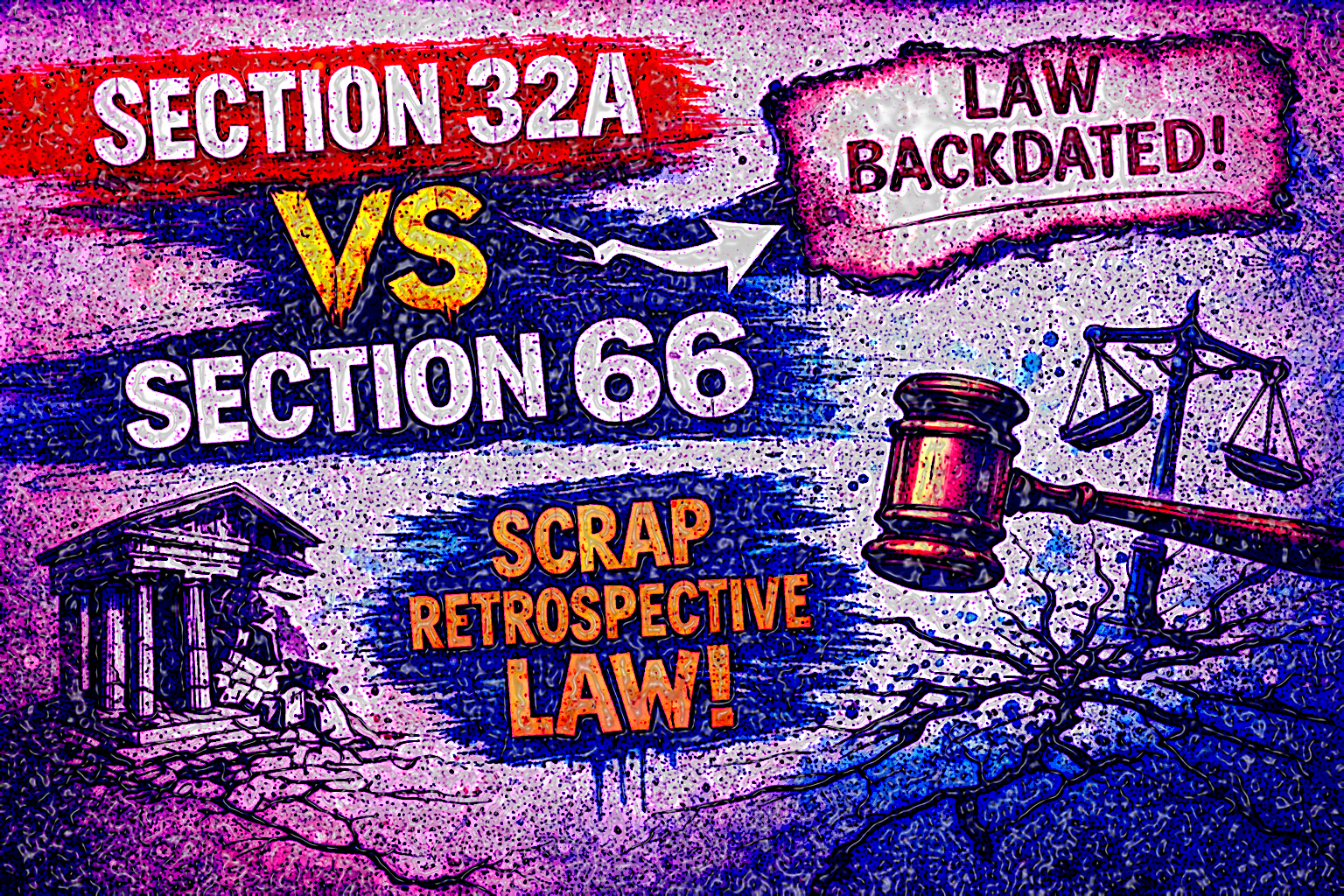
In the DHFL insolvency — India’s first major NBFC case under the IBC — over 2.5 lakh retail depositors, including pensioners and widows, suffered heavy haircuts of 54–77% on their life savings. Yet the company emerged spotless in Piramal’s hands, fully discharged from a ₹5,050 crore PMLA case in February 2026 under Section 32A of the IBC. Inserted retrospectively via ordinance on 28 December 2019 — just 25 days after DHFL entered CIRP — this “clean slate” provision granted the new owner complete immunity from past offences, even as ₹45,000 crore in alleged fraud recoveries were valued at one rupee. Like Valmiki’s Ramayana, which existed before Rama’s birth and reconfigured reality itself, Section 32A rewrote corporate accountability after the fact (POST-FACTO), turning a law meant to protect creditors into a sophisticated mechanism that socialised losses and privatised gains for cronies like Piramal. The DHFL case stands as a stark example of how retrospective legislation can erase liability while ordinary citizens bear the burden.
The Optics of the Rupee: Fragile Notes and Confusing Coins to Moneyless Futures
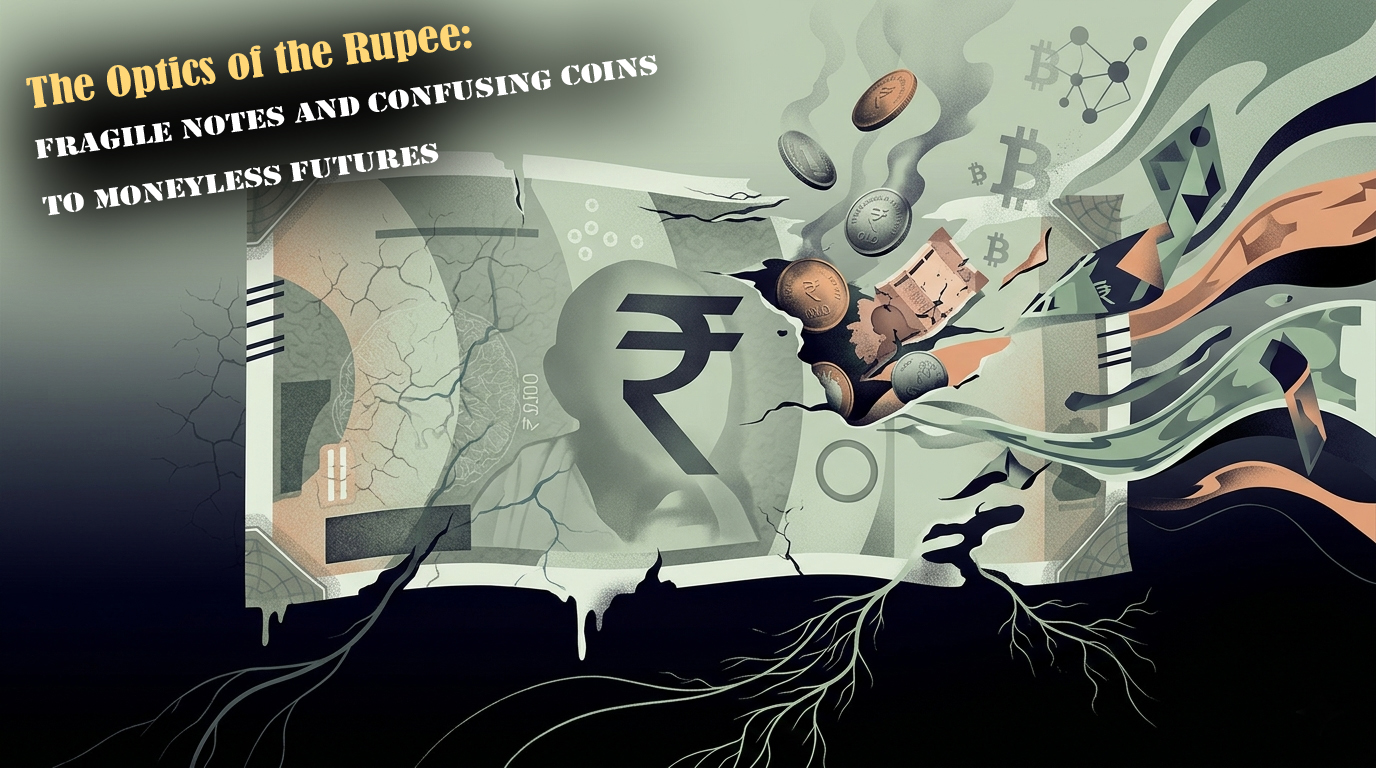
The Indian rupee, far from a stable symbol of sovereignty, has become a theatre of illusion, confusion, and quiet violence—where citizens struggle to recognize notes and coins, multiple designs of the same denomination coexist, and fragile post-2016 currency circulates at high fiscal (₹6,372.8 crore in FY 2024–25) and ecological cost. Tracing a lineage from Muhammad bin Tughlaq’s failed token currency to demonetisation and the fleeting ₹2000 note, this critique reveals a recurring pattern of top-down monetary experiments that burden the public while failing to ensure stability or inclusion. The rupee’s steady depreciation against the US dollar (crossing ₹91 in 2025) reflects deeper global asymmetries masked by PPP metrics, exposing ongoing value extraction from the Global South. Drawing on Marx’s Grundrisse, the analysis frames money as a fetish form that conceals labour and ecological relations behind abstract price, whether in physical currency or digital alternatives. Ultimately, neither reform nor technology can resolve these contradictions; emancipation requires transcending the money-form itself toward a reciprocal, ecological, and post-capitalist society—where value is lived rather than priced, and the rupee is recognized not just as broken, but as a symptom of a deeper civilisational illusion.
Pressing Repeat: A Tragi-Comedy of DHFL Ruin, Viraha, and Satyagraha through Dilemma
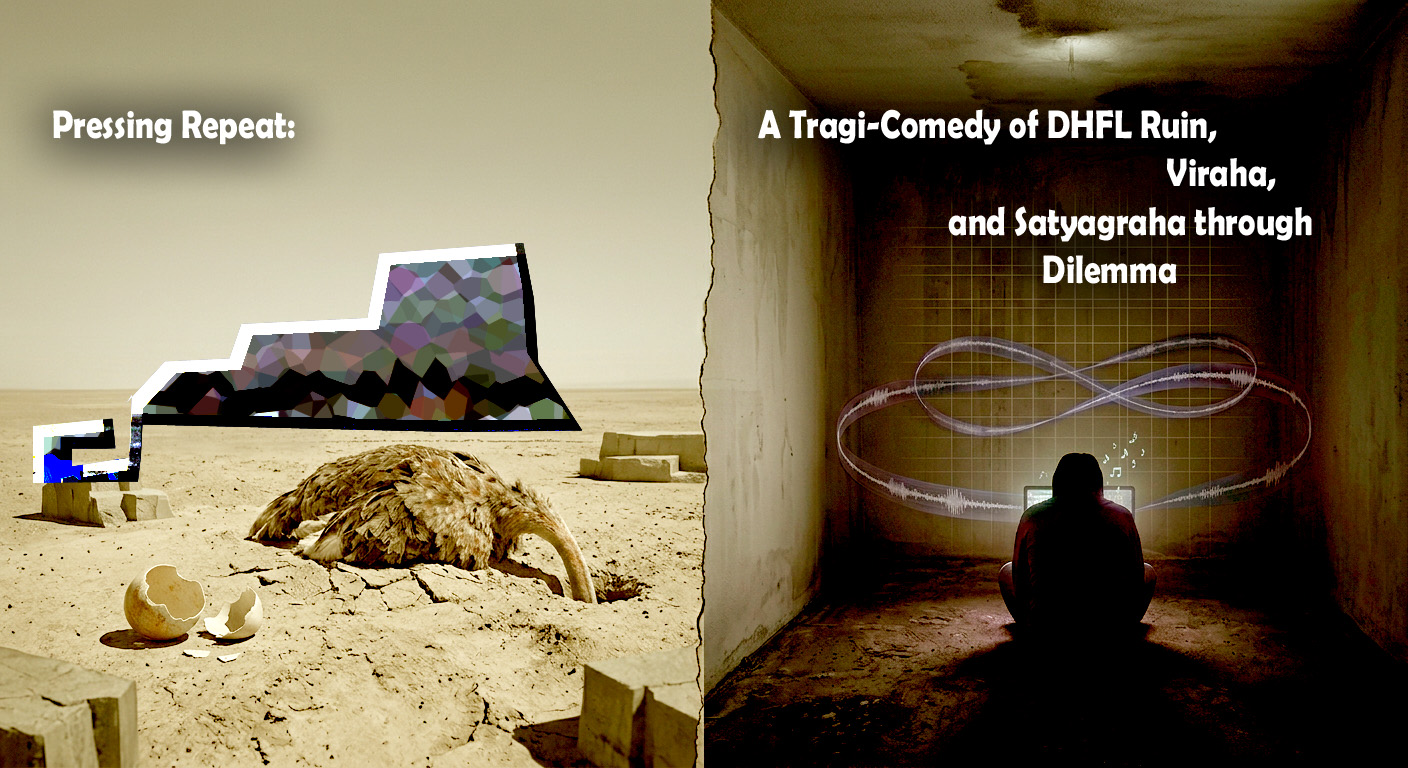
In this darkly comic, self-reflexive monologue, a financially devastated DHFL victim—robbed of her life savings and hounded by a 100-crore SLAPP suit under an undeclared emergency—chronicles her solitary existence through obsessive loops of Rabindrasangeet. Trapped between paralyzing fear and compulsive repetition, she navigates aesthetic intimate separation anxiety (biraha), confronts the absence of any divine or human companion, and mercilessly dissects the selective “divine intervention” granted to the powerful while she receives only silence. Weaving Tagore’s melodies, Sudhindranath Dutta’s merciless “Ostrich,” Socrates’ Euthyphro Dilemma, Nietzsche’s amor fati, and Gandhi’s faith in truth, she transforms personal malady into a weapon of creative resistance. Refusing fatalism or piety, she reclaims the pharmakon of crisis, turning her suffering into non-violent digital satyagraha against the state-corporate apparatus. The result is a haunting, non-conclusive testament: a lone whistleblower who, though penniless and abandoned, continues to press “send” — pressing repeat no longer as surrender, but as quiet, unrelenting war.

