
Posted on 23rd June, 2026 (GMT 07:15 hrs)
ABSTRACT
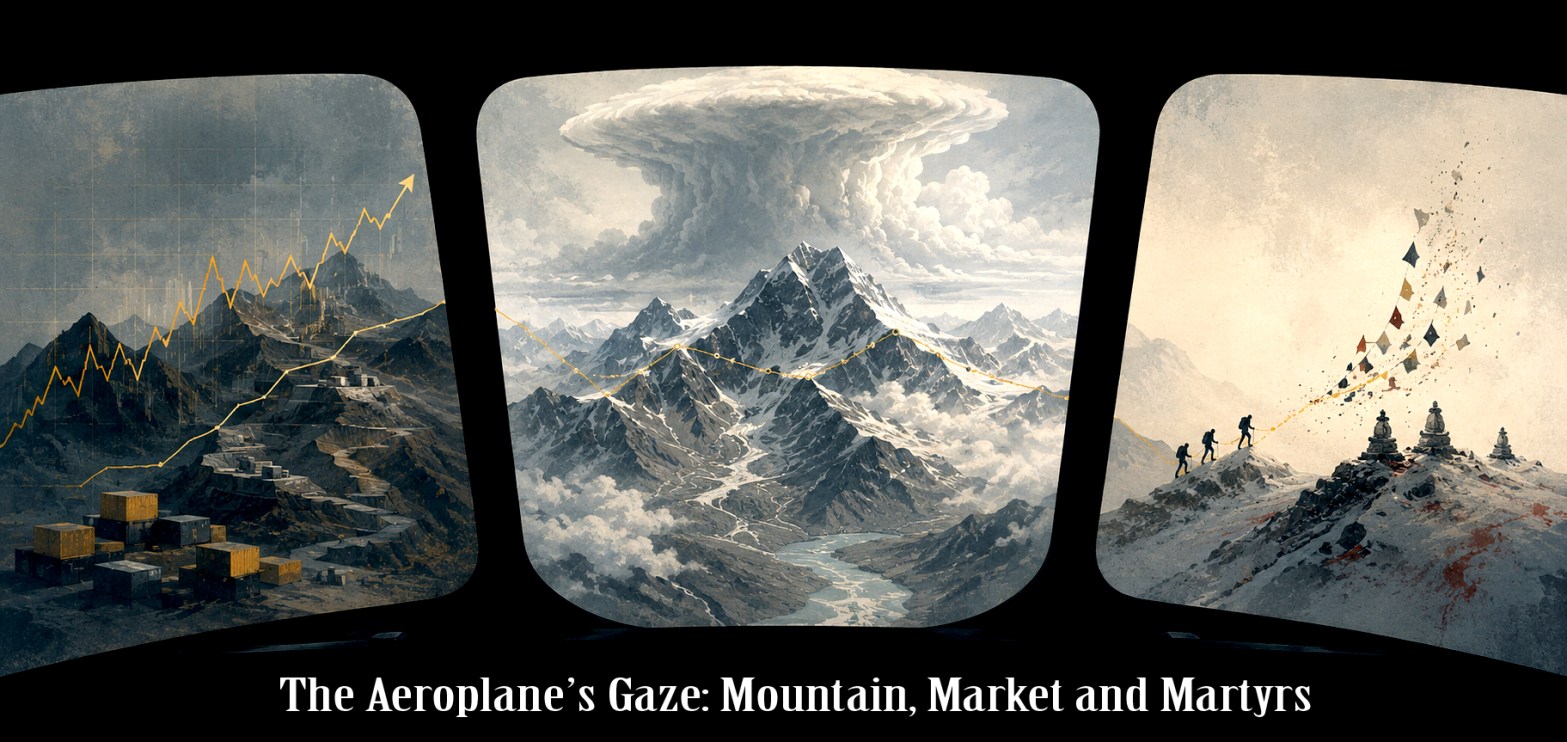
In this climate horror narrative with a positional paper disrupting the narrative flow, the author weaves personal flights over a rapidly thawing Himalaya with a critique of the “Three Ms”—Mountaineering, Market, and Martyrs—to expose how post-1990 commercialization has transformed high-altitude climbing into a neoliberal experience economy that commodifies risk, normalizes preventable deaths, and externalizes massive ecological waste onto fragile ecosystems. Drawing on observed glacial retreat, shrinking snowlines, data from Everest expeditions (e.g., 2019’s 877 summits and 11 deaths; 2025 permit hikes and ongoing congestion), the Chhanda Gayen case study, and corporate sponsorship spectacles, the analysis reveals how market logic—sunk-cost pressures, sponsorship demands for novelty, and regulatory filters—produces economic fatalism and “regulatory martyrdom” while generating symbolic capital from sacrifice and legacy trash (tens of tons of plastic, human waste, and gear). Framed by Tagorean imagery, Kalidasa’s metaphors, and Heideggerian reflections, the work culminates in a call to dismantle these structures, positioning the author’s embodied witness—flying through turbulent “intentioned” clouds—as a reversal from being-towards-death to death-towards-being, urging emancipation through corporeal awareness amid capitalism’s atmospheric and terrestrial violence.
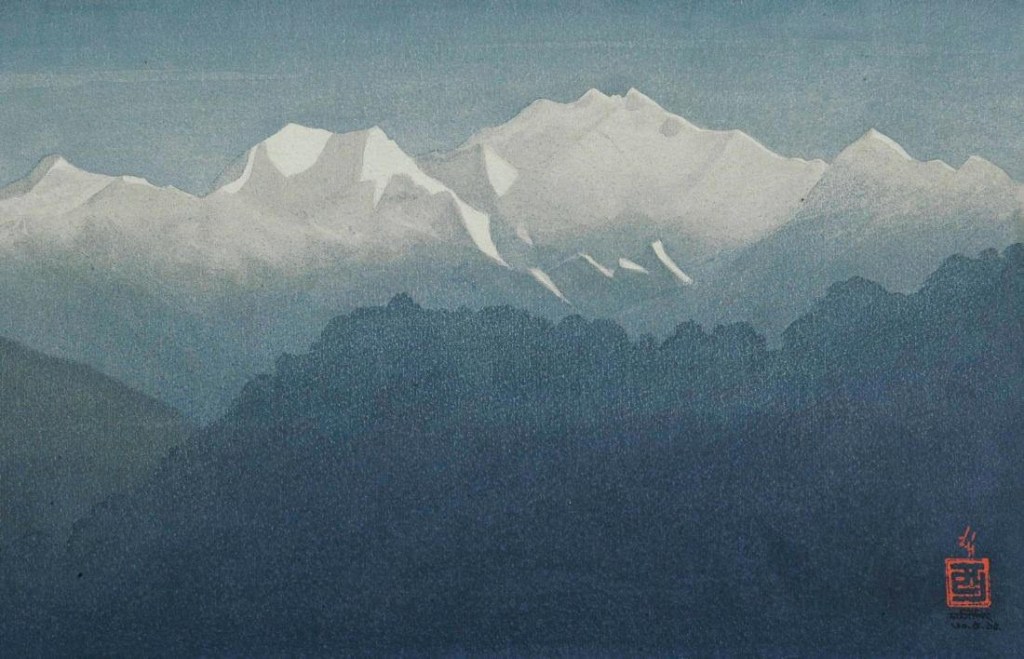
Painting: “Himalayan Landscape”, Gaganendranath Tagore
I. Flying from Kolkata to Delhi in December
I am flying from Kolkata to Delhi in December, suspended above the subcontinent in a fuselage humming with fossil fuel and ethanol. I am a government servant, a habitual consumer of these hasty passages, my journey funded by taxpayers. As I drift in and out of sleep, the jagged spine of the Himalaya pierces the cloud cover beneath me.
There is very little snow left.
Only ragged, exhausted patches clinging to hard rock. Winter has come, yet the ice is absent. Shock coils through me.
This absence is not incidental. It is a visible symptom of anthropogenic global heating. Decades of “scientific” observation confirm (and deny!) what I now witness from above: retreating glaciers, disappearing snowlines, and disrupted seasonal rhythms. The Himalaya—the so-called Third Pole—has become a site where climate crisis manifests with visceral immediacy. No longer an abstract statistic, the mountain is now a stage where ecological fragility collides with financial ambitions of “growth”, “development”….
Kalidasa’s Meghadūtam drifts into my thoughts. He described a maiden with śikharidāsana—“pointed teeth.” Horror, at first. But Abanindranath Tagore clarifies: her teeth are white like snowflakes. Fragile. Delicate. Beautiful?
The metaphor collapses into the Himalaya itself: grandeur entwined with crafted vulnerability.
My reverie is broken by a fellow passenger, eyes fixed on his laptop:
“Oh, what a place for mining.”
Rage surges through me. No. Nature’s wealth is not a corporate free gift. Preservation is not negotiable. Almost involuntarily, I speak aloud—perhaps to myself:
“I love mountaineering. I want to climb, to touch, to feel the peak—not to conquer for profit, but to experience the pulse of the earth.”
I repeat it, childlike, defiant: I will climb. To the Top. The Top. The Top.
Beneath us, the Himalaya is already desecrated, profanized—non-biodegradable waste scattered across sacred slopes, a material archive of conspicuous consumption. Above us, the sky feels heavy, poisoned, enclosed—an atmosphere shaped by the violence of anthropos.
Rabindranath Tagore surfaces unbidden:
“No deliverance bideth anywhere this day;
even the heavens do bind like unto a prison-house,
wherefore the stifled breeze waxeth heavy with poisonous breath…”
Outside the window, a colossal cumulonimbus cloud rises—dark, muscular, crowned with an anvil top. A living architecture of instability.
I ask my mountaineer friends what is happening. They show me photographs spanning decades. The evidence is unmistakable: glaciers shrinking, snow vanishing, becoming lakes. Even the Amarnath Shiva-linga now requires artificial reconstruction. Warming temperatures and relentless human interference have broken cycles of accumulation and melt.
“Why?” they ask.
“Anthropogenic heating,” I answer. “Fossil fuels. Extraction. Market illogic.”
Later, at the Royal Palace of Indian Statistics, I raise these concerns. I am met with laughter and denial. Remote-sensing images glow on their screens—not of loss, but of mineral potential. Nature as a resource. Climate collapse is questioned and discussions deferred. I am dismissed as mad, marginal—a third-world observer, a non-collaborator.
I return to the climbers.
“How does sponsorship shape your decisions?” I ask.
They hesitate to respond effectively. Expeditions are expensive. Sponsorship is survival. To secure future funding, climbers attempt multiple peaks in a single push—often despite exhaustion, narrowing weather windows, and deteriorating conditions. Risk is no longer personal; it is commodified. Martyrdom syndrome?
I think of Chhanda Gayen, the first civilian woman from the state of West Bengal, India, to summit Everest. In May 2014, she was claimed by an avalanche descending Kanchenjunga. Ambition, sponsorship pressure, nature’s frenzy, and market “sentiment” collided in her death.
Her story crystallizes what I call the Three Ms: Mountaineering. Market. Martyrs.
The market demands engineered spectacles.
The climber pays with risk.
The mountain bears the scars.
I plan to write a research paper—The Three Ms—but a deeper question presses upon me: What is the role of the academiocratic scholar in this system of ambition, commerce, and climate collapse?
Now I strive to write the paper as a merchant of the institutionalized, funded, organized scientific domain… the knowledge-industry!
The Three Ms: Mountaineering, Market, and Martyrs
[A POSITIONAL PAPER]
Abstract
This analysis examines contemporary high-altitude mountaineering through the framework of a proposed triad: Mountaineering, Market, and Martyrs, i.e., the three “M”s. Post-1990 commercialization, combined with 2025 regulatory changes and Himalayan case data, shows the activity has shifted from a skill-based pursuit into a market-driven experience economy. Death is not random but socially constructed, symbolically repurposed, and economically functional. Three theses emerge: economic fatalism, the consumption of sacrifice, and regulatory martyrdom. Market logic systematically generates risk, normalizes loss, sustains economic hierarchies under claims of safety and sustainability, and externalizes massive waste burdens—plastic, human excreta, gear—onto fragile ecosystems.
1. Introduction: From Ascent to Apparatus
Mountaineering once blended exploration, science, and bodily discipline. Over three decades it has integrated into the high-altitude experience economy within the dictates of adventure tourism. The Himalaya—Everest, Kanchenjunga, Ladakh, and Himachal Pradesh—now operate as extractive zones where risk, endurance, mortality, and waste generate exchange value. This paper links the shift to neoliberal commodification, performative risk, the political economy of sacrifice, and unchecked consumption externalities. The core argument stands: the system no longer tolerates death or environmental degradation; it structurally depends on both for narrative construction, marketability, and simulated myth.
The problem-question arises here:
What structural mechanisms allow the high-altitude mountaineering industry to externalize the human and ecological costs of commodified ascent—turning preventable fatalities and accumulating waste into acceptable byproducts of profit—while sustaining the illusion of individual heroism and sustainable adventure tourism?
2. Mountaineering: From Specialized Practice to Mass Phenomenon
Guided expeditions, fixed ropes, supplemental oxygen, and outsourced logistics have reduced technical barriers and raised participant volumes. In 2019 the Nepal side of the Himalayas recorded 877 summits alongside 11 reported deaths, many tied to congestion. Psychological drivers center on grit, resilience, and identity: climbers convert endurance into narrative capital, framing retreat as personal shortfall rather than “sovereign rational choice”. Technology improves odds unevenly, widening survival gaps by economic capacity. Risk is performed, not merely managed, aligning with neoliberal self-entrepreneurship.
3. Market: The Commodification of High Altitude
By 2025, adventure tourism is positioned as a growth sector in Nepal, Sikkim, Arunachal Pradesh, Ladakh, Uttarakhand and Himachal Pradesh. Mountains function as revenue assets measured in permits, foreign exchange, and media reach. Nepal raised the Everest spring permit fee from USD 11,000 to USD 15,000 (a 36% increase, effective September 2025). Climber numbers stayed near 700–800 summits on the Nepal side in 2025, showing price hikes did not deter participation. Higher fees amplify sunk-cost pressure: expeditions often total USD 30,000–100,000+, turning retreat into financial loss. Sponsorship favours novelty—speed records, double summits, “firsts”—compressing decisions into narrow weather windows. The mountain becomes the stage; the climber, sale-brated content.
4. Environmental “Externalities”? Waste as Commodity Byproduct
The surge in participant numbers directly scales waste production in a consumption-driven model. Trekkers and climbers generate ~4.6 tons of solid waste per day during peak seasons in the Everest region. Annual human excreta exceeds 5,400–14 tons, contaminating water sources and spreading disease risks downstream. Plastic dominates: microplastics (primarily polyester from gear/clothing) appear in nearly all snow and stream samples above 5,000 m, with concentrations linked to synthetic materials used in such mass expeditions. Overall legacy waste on Everest is estimated at 40–50 tons, including oxygen cylinders, ropes, tents, food packaging, and batteries. Cleanup data quantifies the trend: Sagarmatha Pollution Control Committee (SPCC) removed 77–85 tons in 2024 (including ~28 tons of human waste); Nepal Army added 11 tons; Project Care collected 5 tons in 2025. A failed 2014–2025 deposit scheme ($4,000 refundable for 8 kg brought down) was scrapped in late 2025 due to no tangible reduction. The 2025–2029 Everest Cleaning Action Plan acknowledges plastic creeping higher with traffic surges, yet treats symptoms via periodic campaigns rather than curbing commercialization that incentivizes volume over restraint.
5. Martyrs: The Social Construction of Death
The martyrdom effect converts suffering and fatality into amplified symbolic meaning. Deaths enhance the perceived authenticity of routes, expeditions, and corporate sponsors, transforming loss into value. Through memorials, posthumous awards, and peak renamings—such as Goutam Parvat (named after Goutam Ghosh, who died on Everest in 2016)—fatalities are reframed as patriotic or heroic sacrifice.
Corporate branding deepens this dynamic. In 2013, Standard Chartered’s “Breeze” mobile banking expedition sent climbers Horacio Galanti (Canada) and Horacio Cunietti (Argentina) to conduct the world’s highest banking transactions, including the first stock trade of 50 SC shares at Everest Base Camp (5,364 m) and further transactions at Camp 4 (8,000 m). Promoted under the slogan “Above & Beyond” and tied to the brand promise “Here for good,” the campaign claimed that “banking can be a Breeze even on the highest mountain on earth,” while publicizing debris-cleanup contributions as environmental partnership. Corporate involvement was thus reframed as heroic co-ascent, obscuring structural causes of risk.
In the death zone, the pursuit of records accelerates the search for symbolic immortality. Overcrowding in 2019 produced queue-based fatalities; similar structural pressures persisted into 2025 despite lower overall numbers (five deaths on Everest that season).
6. Economic Fatalism and the Production of Martyrs
Market incentives reward visible extremity over prudence. Sponsorship and media exposure scale with perceived risk, generating economic fatalism: climbers internalize mortality as a structural possibility of career advancement. Within the spectacle economy of high-altitude mountaineering, fatalities are not aberrations but convertible events. Death is narrativized, aestheticized, and circulated—brands leverage tragedy for authenticity while audiences consume sanitized heroism.
Banksters allegedly involved with entities like Standard Chartered exemplify the convergence of risk, spectacle, and reputational laundering. Despite major fines for sanctions breaches and anti–money laundering failures, allegations of facilitating illicit financial flows, and a multibillion-dollar investor settlement, the bank underwrote the 2013 “Breeze” Everest expedition. Marketed under “Above & Beyond” and “Here for good,” the campaign staged record-setting banking transactions at extreme altitude—symbolically converting alpine risk into brand elevation.
The structural relevance is clear: institutions implicated in money laundering and high-risk financial flows sponsor high-risk mountaineering spectacles to launder reputational capital. The mountain becomes a theatre of moral ascent, where altitude performs ethical purification. In this alignment, climbers—and potentially their deaths—are embedded within circuits of brand valorization. Risk is not incidental; it is economically formatted.
New regulations and escalating permit fees do not dissolve this logic. They function as market filters—raising barriers while leaving incentive structures intact. Only those backed by substantial capital or willing to assume amplified risk proceed. The outcome is not systemic safety but stratified exposure: a regime in which mortality remains possible, narratively productive, and economically absorbable. This is regulatory martyrdom.
7. Hassle Culture and Bottlenecked Death
Commercialization replaced technical mastery with hassle and hustle culture: fixed schedules, congested routes, and record-chasing under financial deadlines to reach the summits. The 1996 disaster (15 deaths) exposed commercial overrides of judgment. In 2019, traffic jams contributed to exhaustion deaths including Indians Nihal Bagwan (27, dehydration and fatigue), Kalpana Dash (49), and Anjali Kulkarni (54). These cases illustrate how limited weather windows and overcrowding turn survival into a lottery in the casino economy.
8. Case Study: Chhanda Gayen and the Two-Peaks Imperative (Data Set)
Chhanda Gayen’s 2014 death on Yalung Kang (Kanchenjunga West, 8,505 m) quantifies market coercion. In 2013 she completed an Everest–Lhotse traverse in 22 hours, establishing her sponsorship brand. On 18 May 2014 she summited Kanchenjunga Main (8,586 m). Despite exhaustion and worsening weather, she continued to Yalung Kang with Sherpas Dawa Wangchu and Mingma Temba to secure the double-summit novelty required for ongoing funding. An avalanche on 20 May killed all three. As a civilian climber reliant on family debt (no institutional backing), a single summit lacked sufficient exchange value; only escalation delivered continued relevance. The incident dataset—successful prior traverse, immediate post-summit continuation, triple fatality—demonstrates how sponsorship logic displaces safety calculus.
9. From Sport to Sacrificial Economy
Mountaineering, market logic, and martyrdom converge in a sacrificial economy: risk is privatized to the climber, profit accrues to operators and sponsors, and loss is symbolically recuperated as national-istic or brand capital. Waste is the ultimate externality—privatized consumption (gear, packaging, single-use plastics) produces collective degradation, with cleanup costs shifted to local communities, governments, and periodic campaigns. The climbers’ bodies become the intersection of aspiration, pride, corporate spectacle, and ecological sacrifice.
10. Conclusion
The contemporary mountaineering apparatus manufactures the limits it claims to test. By incentivizing extremity, aestheticizing mortality, monetizing sacrifice, and externalizing waste (e.g., 40–50 tons legacy trash on Everest, annual human waste in the tens of tons, pervasive microplastics), it sustains steady martyr production and ecosystem strain. Data from 2019 (877 summits, 11 deaths), 2025 (USD 15,000 permit, sustained high volumes, ongoing congestion, failed deposit scheme), and cleanup metrics (77–85 tons removed in 2024) confirm the pattern. Ethical reform demands dismantling—not individual ambition but—the market structures that convert mortality and environmental integrity into tradable value. Until then, the mountain remains not only a site of ascent and altar, but a rising non-biodegradable garbage dump.
I stumble. I pause. This paper can’t be written– it remains unfinished.
Techno-scientific observation is not enough. Theory must meet lived praxis. Peaks vanish not only due to melting ice, but because of the GDP fetish.
I stare at the cumulonimbus cloud again and whisper: I will climb. I will record. I will bear witness.
II. Flying North to South: A Climate Horror
In the month of September, I am now flying from Ladakh to Delhi.
The Himalaya recedes beneath us—stripped, skeletal, no longer sublime. The sky darkens unnaturally. I see it first as a stain, then as a structure: a dark, mushroom-shaped mass swelling upward. A cumulonimbus cloud. An anvil top. Cumulonimbus incus.
It does not look like weather. It looks like intention.
The plane enters the cloud.
Turbulence—violent, vertical. The aircraft is thrown upward, then dropped. Again. Gravity loses its manners. People scream. Not metaphorically—howling.
My son grips my hand. We are facing death.
Heidegger intrudes: Sein-zum-Tode—being-towards-death.
But this is no abstraction. This is metal screaming against air. This is mastery dissolving inside a cloud.
I ask silently: if Heidegger spoke of being-towards-death, might there also be a reversal—death-towards-being?
The turbulence eases. The pilot’s voice arrives: calm, unreal. We survive.
Below us: flooded plains—Himachal, Punjab. Rivers have lost obedience. This is not disaster. This is repercussion.
The cloud was not an exception. It was a symptom of a deeper disease we mostly hesitate to name: capitalism.
We burn fuel to flee landscapes melting because of fuel. We narrate climate collapse as the future while trembling inside it—now. Right now. We are within it.
I do not let go of my son’s hand.
Because I know now:
The sky remembers.
The mountains remember.
And the clouds are learning how to strike back.
Afterword: Death-Towards-Being
Abandoned by the academiocracy and by a world that has learned to practice violence as routine, I now wander the Himalayas, the third pole, as a third presence from the world of the third (as the World Bank says!)—neither insider nor exile—seeking a path of emancipation for my wounded body. I encounter many sages along the way, some genuine, others commercially rehearsing holiness, and I confront them all. Yet no borrowed wisdom sustains me.
What gradually reveals itself is not a doctrine but my own body—docile, scarred, breathing—as a threshold where inside and outside overlap. This corporeal fragility becomes my only reliable terrain, the site where abandonment is transmuted into awareness. Here, emancipation does not arrive as transcendence but as a reversal: not being-towards-death, but death-towards-being—a mode of existence in which finitude no longer negates life but reopens it.
See Also:
Acknowledgement: AKHAR BANDYOPADHYAY ⤡

