
An Activist Documentation of the Systematic Dispossession of the Other 98% under the BJP–NDA Regime (2014–2026)
Posted on 26th July, 2026 (GMT 07:40 hrs)
Updated on 9th October, 2026 (GMT 05:11 hrs)
There are decades where nothing happens; and there are weeks where decades happen. In India, between 2014 and 2026, the decades happened quietly — in write-off ledgers no one reads, in surveys quietly discarded, in one-rupee assignments of fraud claims, in the fine print of a Code re-legislated almost every year.
ABSTRACT
This activist dossier reconstructs, almost entirely from the state’s own figures, the financial architecture of crony extraction that crystallised in India between 2014 and 2026 under the BJP–NDA regime: a true aggregate (fourth-largest economy, falling NPAs, moderate inflation) is displayed while the distribution beneath it is rendered (un-)knowable through discarded surveys, a suspended census, statutory identity shields over ₹16.35 lakh crore in write-offs (or waive offs?!), one-rupee assignments of fraud claims, and a hundred-per-cent RTI evasion rate. Losses are systematically socialised onto the public and residual gains privatised to a connected few via demonetisation, GST, the IBC–DHFL laboratory, opaque political funding, and the inversion of public banking. The growth narrative of “Viksit Bharat” rests on this measured invisibility. The two chairs that operate the architecture — the Finance and Corporate Affairs Minister and the Governor of the Reserve Bank — are therefore addressed with a single demand: Resign, or answer.
Keywords: extraction economy; aggregate governance; GDP fetish; demonetisation; GST; wilful default; IBC; DHFL; electoral bonds; crony capitalism; statistical opacity; the other 98%; undeclared financial emergency; India 2014–2026
How to Read This Dossier: A Short Guide
The argument moves in four movements, each flowing into the next:
- I — The Aggregate and Its Shadow (§1–4). The numbers the state displays, and what they conceal or manipulate: external debt, the fourth-largest-economy claim, the parallel indices of hunger and inequality, and the concentration of wealth in relation to the other 98%.
- II — The Instruments of Extraction (§5–10). The specific policy acts — demonetisation, GST, inflation and the Dearness Allowance shield, wilful-default write-offs, opaque funding, and the crony/dynastic accumulation those instruments financed.
- III — The Machinery of Impunity (§11–14). The legal-institutional apparatus that processes the loss: the IBC and DHFL, the gatekeepers who failed, the securities-market casino economy, and the inversion of public-sector banking through rapid disinvestment.
- IV — Outliers and Conclusion (§15–16). The shadow economy that the whole system depends on not counting; the undeclared financial emergency; and the demand for resignation addressed to the two chairs, coupled right to reject and right to recall demands.
A note on method and honesty follows immediately. Where a popular claim does not survive verification — and several do not — we say so plainly and relocate the argument to firmer ground. This is not concession; it is armour. As §16 explains, the principal defence of an opaque state is the error of its critics. We decline to supply that defence.
A Note on Method: Documentation as Weapon
Three principles govern every page:
Build from the state’s own record. The overwhelming majority of what follows derives from parliamentary replies, Comptroller and Auditor General findings, Reserve Bank of India and IBBI publications, budget documents, judicial and tribunal orders, Election Commission filings, and Right to Information responses. An argument built from the government’s own arithmetic is the argument the government cannot contest without contesting itself. Where we rely on third-party research (the World Inequality Lab, ADR, Oxfam, The Economist) we attribute it; where a claim is contested, we record the rebuttal.
Primarily concede what is supposed to be true; attack what it means or alters or suppresses. India is advertised/projected to be the fourth-largest economy. Inflation perhaps was lower after 2014. The central bank perhaps bought gold rather than selling it. Denying these hands the state a one-line refutation and taints everything accurate standing beside the error. We therefore initially concede each apparently “true” aggregate and direct the entire critical charge at the distribution it conceals and the machinery that keeps it concealed.
Name the office, instantiate the act, expose the record. This is an activist document. It does not hide behind the passive voice. It names Goutam Adani and Mukesh Ambani and Ajay Piramal; it names demonetisation and the popcorn slab and the one-rupee assignment; it addresses the Finance Minister and the Governor by their chairs. But it names them as office-holders answerable for documented conduct — not as private persons — because that is both the honest frame and the one no defamation action can dislodge.
The intervention is not revelation but arrangement. Almost nothing here is secret. The power of the dossier is to force into a single frame the terms the apparatus keeps apart: the fourth rank beside the hundred-and-second; the ₹1 assignment beside the 76.92% haircut; the austerity sermon beside the chartered jet.
MOVEMENT I
The Aggregate and Its Shadow
The numbers the state displays — and the distribution it has ceased to measure.
1. The Debt Trajectory: The $762.8 Billion Burden and the Architecture of Dependence
The post-2014 order rests on a single numerical boast — size — and the first duty of this dossier is to ask what that size has been financed by. The answer is debt, and debt of a new order of magnitude: an external liability that has surged by two-thirds in twelve years, a per-person burden imposed on citizens who never signed for it, and a domestic debt that has climbed from the lowest base in three decades. This is not the debt of developmental necessity. It is the debt of predation — what we call pre-debt-ory capitalism, in which the terms of borrowing are set in advance to discipline the many and enrich the few.
1.1 The Debt Explosion: $457 billion to $762.8 billion
The figures are exact, and they are the state’s own. India’s total external debt — public and private, owed to non-residents — stood at USD 457.5 billion when this regime took office in 2014. By end-March 2026 it had reached USD 762.8 billion, a rise of USD 26.3 billion in a single year over the USD 736.5 billion of end-March 2025, and a surge of roughly 67 per cent across the regime’s tenure (RBI data, released 29 June 2026). The acceleration is unmistakably post-2014. From 1947 to 2013, across sixty-six years, the stock rose to USD 427 billion. The present regime added almost as much again — some USD 335 billion — in under a fifth of the time.
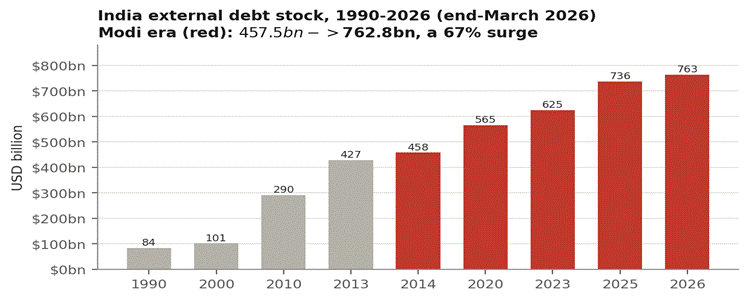
Figure 1.1. External debt stock, 1990–2026 (USD bn, end-March 2026). Under this regime (red), $457.5bn → $762.8bn. Source: RBI; DEA; World Bank.
And the headline understates the borrowing. The RBI itself concedes that of the USD 26.3 billion annual rise, USD 24.6 billion was a mere valuation effect — the dollar strengthening against a falling rupee, yen, euro and SDR. Strip that accounting mirage away and the real increase in external liabilities over the year was USD 51.0 billion — nearly double the advertised figure. The Finance Minister’s repeated insistence that “the rupee is not falling, the dollar is getting stronger” is a ridiculous rhetorical inversion that converts a domestic currency depreciation into a global inevitability; it does not alter the arithmetic. The state books a currency illusion as if it were restraint; the underlying appetite for foreign debt is twice what the headline admits.
Moreover, debt stocks, valuation effects and the very ratios the government cites are themselves in a state of flux — kṣaṇika, anicca — continuously revised by exchange-rate movements, methodological shifts and delayed disclosures. What is presented today as a stable, manageable external position is already a moving target; by the time the next official release appears, the numbers will have shifted again. The claim of prudence rests on a snapshot that refuses to stay still.
1.2 The Composition: private, volatile, and dollar-shackled
The composition is where the predation shows. The RBI’s own March 2026 data records that the outstanding debt of the general government fell over the year, while non-government borrowing rose — the state stepping back precisely as private corporates loaded up. Non-financial corporations now hold the single largest share at 36.4 per cent, deposit-taking corporations 26.5 per cent, the general government down to 22.0 per cent. Official concessional creditors — the World Bank, ADB, bilateral aid — have collapsed from around a fifth of the stock in 2014 to little over a tenth. Their place is taken by volatile, market-based liabilities: commercial borrowings, non-resident deposits, short-term trade credit. And 55.5 per cent of the whole is dollar-denominated — which is exactly why a strengthening dollar can add USD 24.6 billion to the burden in a year without a single fresh loan. Post-2014 liberalisation of external commercial borrowings, with lax oversight, did not fund public investment; it funded the leveraged expansion of conglomerates — Adani ports, Ambani refineries — whose gains are private and whose risks, when leverage falters, are socialised onto the public-sector banks and ultimately the exchequer.
1.3 The per-person burden: US$520 for every Indian
Spread across a population of roughly 1.46 billion, that USD 762.8 billion works out to about US$520 of external debt for every Indian — every pensioner, every daily-wage worker, every newborn. It is a division-average, not a bill each household literally holds; but that is precisely the point. The debt was contracted by the state and by leveraged conglomerates in the name of a nation whose poorest will service it — through inflation, through a falling rupee that mechanically inflates the dollar-denominated majority, and through the welfare spending foregone to reassure creditors — while never having touched the capital it raised.
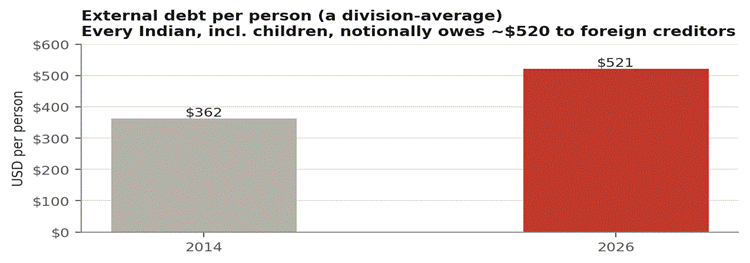
Figure 1.2. External debt per person (approx.). ~US$520 owed by every Indian by March 2026 — the debt rising faster than the population.
1.4 The domestic debt, and one honest qualification
Total government debt tells the same story from inside. Central-government liabilities rose from roughly ₹53.1 lakh crore (2014) to approximately ₹185 lakh crore (FY25 estimate) — more than three and a half times. General government debt, Centre and states, rose from 67.1 per cent of GDP in 2014 — the lowest point in three decades — to a COVID peak of 88.4 per cent in 2020, settling near 82–84 per cent since. The IMF’s 2025 Article IV consultation warns this could breach 100 per cent of GDP under plausible shocks.
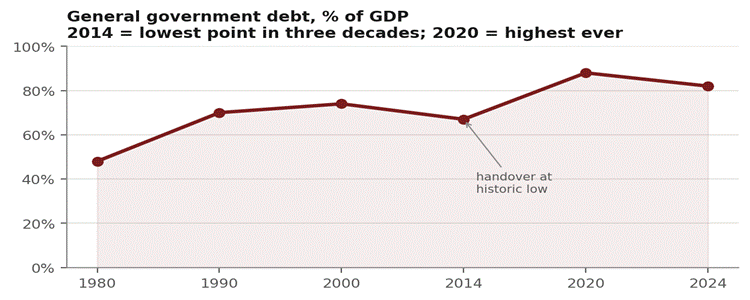
Figure 1.3. General government debt as % of GDP. Office was transferred at the lowest point in three decades; the line has climbed ever since.
One qualification must be stated plainly, because our credibility depends on it. As a bare ratio, external debt to GDP remains low by global standards — 20.8 per cent at end-March 2026. But note what the state does not advertise: that ratio rose this financial year, up from 19.8 per cent, and the short-term-debt-to-reserves ratio climbed to 21.6 per cent from 20.1 — near-term repayment pressure rising against the buffers. Even where the ratio has drifted down in earlier years, it did so only because GDP is measured in inflating rupees while the absolute stock climbed relentlessly. A ratio that stays “manageable” while the absolute stock surges two-thirds, while government retreats and private volatile debt fills the gap, while 55 per cent sits in a foreign currency — that is not prudence, it is a veneer painted over structural bloat. The orthodox metric is itself the instrument of concealment: it reassures precisely by averaging away the sectoral leverage, the currency mismatch and the shock-sensitivity underneath. We do not surrender the ratio to the state; we name it for what it is.
1.5 World Bank–IMF capture: the pre-debt-or capitalist apparatus
This is not, in 2026, a story of the World Bank as India’s biggest creditor — multilateral debt is a small, shrinking share, and to claim otherwise is to be refuted in a line. Éric Toussaint’s indictment of the Bank as a “never-ending coup d’état” was never about who lends the most. It is about the Bank–IMF apparatus as an instrument of governance — conditionality, the Washington Consensus template, debt as a disciplinary device that enforces neoliberal priorities over social and ecological ones without firing a shot.
India’s hinge is 1991: the balance-of-payments crisis, the physically pledged gold, the structural-adjustment facility, and the liberalisation that followed — the moment emergency became permanent policy. What we witness after 2014 is not the origin but the maturation of that debt-disciplined order: discipline now operating through dollar-denominated market exposure, ratings and yields that coerce pro-creditor policy, rather than through overt IMF conditions. This is the pre-debt-or condition — predation written into the terms in advance, and into the anticipatory restraint the terms impose. In Lazzarato’s phrase, it manufactures the indebted subject; in Toussaint’s, it is odious debt as a suction pump, transferring today’s gains upward and tomorrow’s liabilities downward. Sovereignty is eroded not by a foreign master but by domestic oligarchic capture wearing the mask of “market integration.” It is a never-ending coup — and in India it wears the tricolour.
$762.8 billion owed abroad. US$520 on every Indian head. A real yearly rise of $51 billion masked to $26 billion by a currency effect. Government retreating while private volatile debt surges. And the state answers with a single ratio — and calls it prudence.
2. The GDP Illusion and the Pseudology of “Fourth-Largest Economy”
The central political claim of the post-2014 order is a single number: India is now the world’s fourth-largest economy. The claim is true. That is precisely why it functions as pseudology — the deception is not in the number but in what is smuggled in beside it, and in the manufacture of the growth story wrapped around it.
2.1 The claim, conceded — and its two hairline cracks
India’s nominal GDP reached about USD 4.187 trillion in 2025, edging past Japan’s USD 4.186 trillion; the government’s own year-end review confirmed the ranking. To deny it is to be refuted from IMF data in one line and to forfeit the reader. We concede it without reservation — and then we note that the pedestal is cracked. The crossover margin was roughly USD 0.6 billion on a USD 4.19 trillion base: about 0.01 per cent, well inside the noise of estimation. And it arrived a year ahead of the IMF’s own prior projection largely because the Japanese yen weakened, not because India accelerated. A national-greatness claim that turns on a bilateral exchange-rate wobble is not an achievement; it is a floating signifier dressed as destiny.
2.2 The number is manufactured — and the state knows it
Behind the ranking sits a growth story the state’s own auditors will not fully certify. In its 2025 Article IV report the International Monetary Fund assigned India’s national-accounts data a “C” grade — the second-lowest on an A-to-D scale, meaning shortcomings that “somewhat hamper surveillance” — and did so for the second consecutive year. The IMF flagged specifics: a GDP deflator skewed by low wholesale prices (India deflates nominal output with a Wholesale Price Index that barely captures services, the largest sector, mechanically inflating “real” growth), large and erratic historical revisions, and major discrepancies between GDP measured by activity and GDP measured by expenditure. These are not fringe complaints. They are the Fund’s formal assessment.
The Finance Minister’s response is itself an exhibit in pseudology. On 3 December 2025 Nirmala Sitharaman dismissed the entire debate as “very ill-informed,” insisting the “C” grade was only about the old 2011-12 base year and that “IMF did not question India’s growth numbers.” The deflection works by narrowing the charge: the base year is real, but it is not the whole finding, which also indicts the deflator and the activity-expenditure gap. And the timing convicts the spin — the government has hurried a new base-year series (2022-23) into effect from February 2026, precisely to lift the rating, an implicit admission that the old series was inadequate even as the minister called saying so “ill-informed.” Days after the downgrade, the NSO released an 8.2 per cent quarterly growth figure; as one parliamentarian noted, it was “ironic” to trumpet 8.2 per cent growth in the same week the Fund graded the accounts that produce it a “C.”
Independent economists go further than the Fund. Arvind Subramanian, this government’s own former Chief Economic Adviser, argued in 2019 that the 2015 methodology change overstated growth by about 2.5 percentage points a year over 2011–17 — real growth nearer 4.5 than 7 per cent. In late 2025 the economist Arun Kumar, with former Chief Statistician Pronab Sen, contended India’s real growth may be as low as 2.5–3 per cent, not the headline 8. The corroborating divergences are hard to wave away: record-low foreign direct investment, stagnant manufacturing employment, and a persistent mismatch between listed-company revenues and reported GDP growth all point the same way — that the official series may systematically overstate economic health. [Class C — contested, attributed]
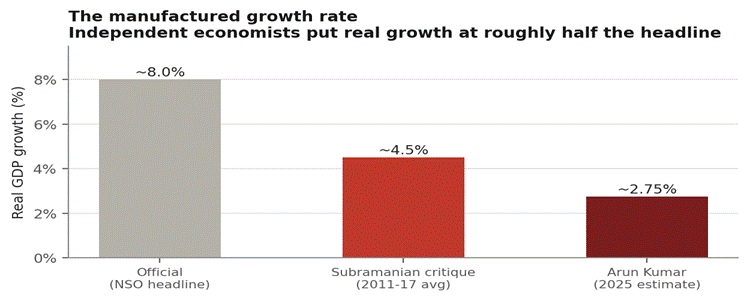
Figure 2.1. The headline versus the sceptics. Independent estimates (contested; different methods and periods) put real growth at roughly half the official figure. Sources: NSO; Subramanian (2019); Arun Kumar (2025).
State the honest boundary, because it makes the charge sharper, not weaker: the IMF did not declare India’s growth fake, and few doubt India is growing. The pseudology is not that the number is invented — it is that a government whose accounts were graded “C” twice running, whose deflator is a known distortion, and whose own former adviser alleges a 2.5-point inflation, presents the resulting figure to its people as unimpeachable proof of arrival, and brands the doubters “ill-informed.”
2.3 What GDP counts, and what it erases by design
Even a perfectly measured GDP would be the wrong instrument for the claim built on it. GDP is the market value of final output — an accountancy of monetised transactions, never built to measure welfare, a caution its own architect Simon Kuznets issued to the United States Congress in 1934. It banks as positive the felling of forests, the mining of aquifers, construction regardless of who is displaced, speculative finance, and security spending. It does not subtract the depletion of soil, water and biodiversity; it does not count the unpaid domestic and care labour overwhelmingly performed by women (an erased economy worth an estimated 30–40 per cent of GDP); it is silent on who receives the output, and on whether the activity heals or harms. So the number can climb while malnutrition climbs, while precarity climbs, while the water table falls. In a country where health commands barely 2.6 per cent of GDP in public spending and education around 3.6, and where close to 80 per cent of workers labour without formal protection, the aggregate is not a photograph of economic life. It is an epistemic boundary drawn around what the state wishes counted — and, as the shadow-economy chapter will show, around what it needs left uncounted.
2.4 The denominator, and the census that no longer exists
Divide the same output by the people and the pedestal collapses. On nominal GDP per capita India ranks roughly 146th of 194 (~USD 2,818) — below the world average, the lowest among the BRICS, fourth even within South Asia behind the Maldives, Sri Lanka and Bhutan. Japan’s per-capita income is about 11.8 times India’s. Purchasing-power adjustment offers no rescue: per-capita PPP output near USD 12,101 places India around 126th–130th. “Fourth-largest economy” is, in plain terms, an artefact of having 1.46 billion people — a demographic sum mistaken for a per-person achievement.
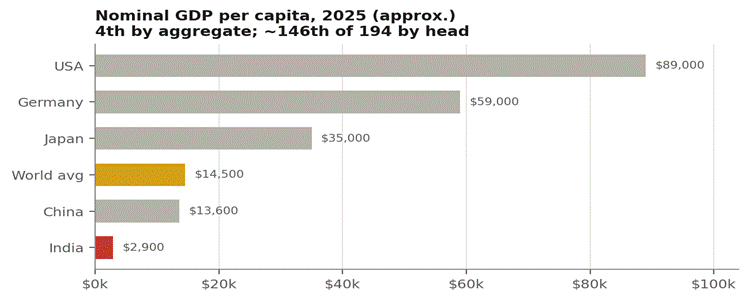
Figure 2.2. Fourth by aggregate; roughly 146th by head. Same country, same year, same dataset.
And the denominator itself is now a fiction of extrapolation. India’s decennial census — unbroken since 1881, conducted even through famine, war and Partition — has been suspended: the last enumeration was 2011, and the 2021 round stands postponed indefinitely. Every per-capita figure the state publishes therefore divides a numerator its own accounts earn a “C” for against a population it has not actually counted for fifteen years. Numerator contested, denominator unmeasured, ranking proclaimed with total confidence. That single sentence is the GDP illusion entire.
2.5 The ideological function: manufacturing arrival
The relentless invocation of “fourth / fifth / sixth largest” does political work. It converts the scale of monetised throughput into an emblem of national arrival — vishwaguru, Viksit Bharat, the ₹5-trillion dream — a second-order myth resting on a true first-order fact. This is the heart of both the growth-fetish and the GDP-fetish: the elevation of aggregate expansion itself into the supreme public good, irrespective of what is expanded, who captures the gains, and what is destroyed in the process. It licenses the state to speak the language of prosperity while the distribution it has stopped measuring speaks the opposite: the top one per cent holding roughly 40 per cent of the nation’s wealth and taking about 23 per cent of its income, both at or above colonial-era peaks (§3). Growth is pursued at the direct cost of people, livelihoods and ecologies — displaced communities, precarious and informal work, collapsing groundwater, poisoned air and vanishing commons — yet these losses are rendered invisible precisely because the metric never registers them. The pseudology consists in offering the size of the aggregate as evidence about the condition of the people — two quantities the metric was engineered never to connect, presented by the state precisely so that they never are.
Fourth by aggregate. 146th by head. Growth graded “C” twice by the IMF, and half the headline by independent economists. No official income statistics. No census since 2011. And the minister calls the doubters “ill-informed.”
3. The Parallel Ledger: How Indians Actually Live
Beside the league table of aggregate output stands a second ledger — of hunger, health, work, air, freedom and safety. Section 2 showed the fourth-largest economy dissolving under its own per-capita denominator; this section reads across the widest possible battery of independent measures and finds the same verdict repeated in every register. The two ledgers move in opposite directions, and the contrast is the whole argument.
3.1 The battery of indices: near the bottom, almost everywhere
Take the most recent editions, one after another. On press freedom, Reporters Without Borders ranked India 157th of 180 in 2026 — a six-place fall from 151 the year before, deep in the “very serious” band; RSF describes an “unofficial state of emergency” for the media since 2014, “highly concentrated media ownership,” and India as “one of the world’s most dangerous countries” for journalists, two to three killed for their work most years. On hunger, the Global Hunger Index 2025 placed India 102nd of 123, score 25.8, “serious.” On human development, the UNDP’s HDI sits India around 130th of 193. The World Happiness Report ranks it near 116th of 147. The World Economic Forum’s Global Gender Gap Index 2025 ranks it 131st of 148 — among the very worst in the world for economic and health parity between women and men. The Global Peace Index puts it near 115th of 163. And on the environment, India ranks near the very bottom — 176th of 180 on the Environmental Performance Index. [Class A/B — verify each rank and year against the primary report]
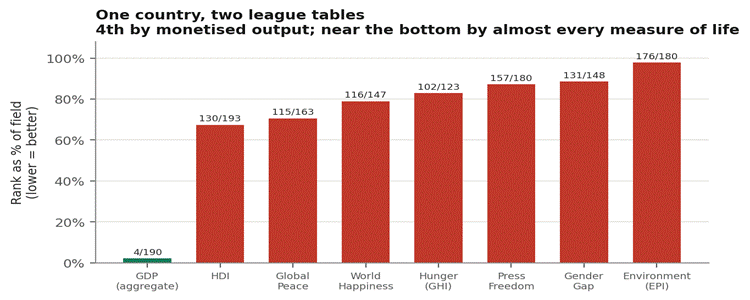
Figure 3.1. One country, two league tables. Rank shown as a percentage of the field (lower is better); the green bar is aggregate GDP, the red bars are how people live. Verify each rank and edition before republication.
Two measures deserve their own line because they indict the very things the state boasts of. On corruption, Transparency International’s 2025 index scores India just 39 out of 100 — rank 91 of 182, still below the global average of 42, a decade of “na khaunga, na khane dunga” notwithstanding. And on air, IQAir’s World Air Quality Report 2025 ranks India the sixth-most-polluted country on earth, national average PM2.5 at 48.9 µg/m³ — nearly ten times the WHO safe limit — with 66 of the world’s 100 most-polluted cities inside India, and New Delhi the most polluted capital on the planet for the eighth year running. The growth is measured in rupees; the cost is measured in the lungs of children.
And on democracy itself, the classifications have shifted from adjective to indictment: the Economist Intelligence Unit files India as a “flawed democracy,” while V-Dem has for years categorised it as an “electoral autocracy.” The country that calls itself “the mother of democracy” is, on the independent scholarship, no longer counted a full one. [Class B — attributed]
3.2 The body keeps the score: hunger, anaemia, work
Indices are abstractions; bodies are not. The single most damning fact in this dossier is that hidden hunger worsened during the years of the “rising economy.” Between the National Family Health Survey (NFHS)’s fourth and fifth rounds (2015-16 to 2019-21), anaemia among women aged 15–49 rose from 53 to 57 per cent, and among children under five from 58.6 to 67.1 per cent — two children in three, an eight-point deterioration in five years, even as the same survey recorded rising consumption of iron-rich foods, so that the reversal defies its usual explanations. Child stunting remains at 35.5 per cent and wasting above 19 per cent — among the highest wasting rates in the world. This is India’s own data, tested in India’s own households; it cannot be dismissed as a foreign NGO’s bias. [Class A — NFHS-5, MoHFW]
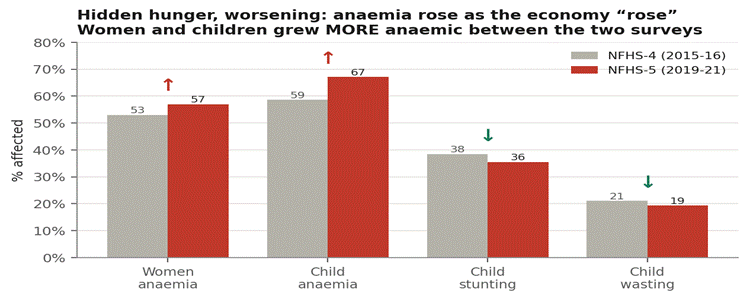
Figure 3.2. Anaemia rose while GDP rose. NFHS-4 vs NFHS-5, India’s own survey. Stunting and wasting eased slightly; anaemia — the marker of hidden hunger — went the wrong way.
Work tells the same story of a demographic dividend curdling into a demographic emergency. The ILO’s India Employment Report 2024 found that the young make up almost 83 per cent of India’s unemployed, and that the share of the jobless who are educated (secondary or above) nearly doubled from 35 per cent (2000) to 66 per cent (2022) — the better-educated, the more likely to be idle. Around ninety per cent of workers remain in informal jobs without contract or protection; women’s labour-force participation, at roughly 33 per cent, runs about 2.3 times below men’s; and the share of youth not in education, employment or training is the highest in South Asia. A country cannot be “arriving” while its educated young queue outside a labour market that has no room for them. [Class B — ILO/IHD 2024]
3.3 The concentration beneath it
Section 2 has already named the apex figure — the top one per cent holding about 40 per cent of national wealth and taking 23 per cent of income. Two findings not yet stated complete it. First, the trajectory: on the World Inequality Lab’s long series, the top-percentile income and wealth shares for 2022-23 are the highest since the income-tax record began in 1922, surpassing even the colonial-era peak — the “Billionaire Raj” is now measurably more unequal than the British Raj. Second, the stasis: the gap between richest and poorest stayed broadly unchanged across 2014-2024, so the entire decade of “fourth-largest economy” ascent delivered no distributional gain whatever — while Forbes-tracked billionaire wealth grew over 280 per cent in real terms against 27.8 per cent for national income. Where in 1980 much of India sat in the global middle 40 per cent, today almost all are in the global bottom half. India rose in the ranking of aggregates while Indians fell in the distribution of persons. We use “the other 98%” as an avowedly political banner, anchored to the hard fact that the bottom 90 per cent together hold less wealth than the top 1 per cent alone; we never present “98%” as a decimal statistic, because a fabricated number is exactly the error an adversary needs.
3.4 The state’s rejection, answered
The government’s standard reply is to shoot the messenger: the Global Hunger Index is a “flawed measure” by “European NGOs”; RSF is funded by foundations with “anti-India” leanings; the indices are “ideologically skewed” with “opaque methodologies.” We record the objection — and answer it once, decisively. The methodological complaints attach to perception-based or weighting-based indices. They cannot touch the measurements drawn from India’s own instruments: the 57 per cent of women and 67 per cent of children the NFHS found anaemic; the 35.5 per cent of children the NFHS found stunted; the 48.9 µg/m³ the monitors record in India’s own air; the 83 per cent youth share of joblessness in India’s own labour data. When the metric is a foreign scorecard the state cries bias; when the metric is a child’s measured height, or haemoglobin, or the air of Delhi, there is no foreign scorecard to blame. A height cannot be rebased. A lung cannot be re-weighted.
An economy can sit high in the league table of total money and near the bottom in the league table of human life — hungrier, more anaemic, less free, more polluted, more idle at the bottom while more concentrated at the top. That is not a paradox to be explained away. It is a description of who the growth was for.
MOVEMENT II
The Instruments of Extraction
The specific acts — two shocks, a shield, a semantic machine — and the accumulation they financed.
4. Demonetisation: The Self-Inflicted Wound
If the debt and GDP chapters describe the architecture, demonetisation is the moment the architecture first showed its indifference to the people it governed. On the night of 8 November 2016, the Prime Minister voided ₹15.44 lakh crore — ₹500 and ₹1,000 notes, 86 per cent of the currency in circulation — in a televised address, effective within hours. The stated objectives were four: to extinguish black money held as cash, to destroy counterfeit currency, to choke terror financing, and to force digitalisation.
4.1 Judged by its own promises — total failure
Every objective failed, and the failure is documented by the Reserve Bank’s own annual report.
- Black money. 99.3 per cent of the voided notes — ₹15.3 lakh crore of ₹15.44 lakh crore — came back into the banking system. If black money were held as cash, it would not have returned. The government had estimated some ₹3–5 lakh crore would never come back; almost all of it did. The premise was simply wrong.
- Counterfeit currency. The RBI put the face value of detected fake high-value notes at a minuscule ₹41 crore — against ₹15.44 lakh crore destroyed to catch it. Worse, by the government’s own later Parliament replies, the post-demonetisation ₹500 and ₹2,000 notes went on to account for over half of counterfeit notes subsequently detected.
- Digitalisation. Currency in circulation not only recovered but exceeded its pre-demonetisation level within a couple of years — the cash economy the note ban was meant to shrink grew back larger.
- The cost of the exercise itself. The RBI’s note-printing bill more than doubled, from ₹3,421 crore (2015–16) to ₹7,965 crore (2016–17), and the central bank’s dividend to the government was roughly halved. The state paid to destroy its own currency, then paid again to reprint it.
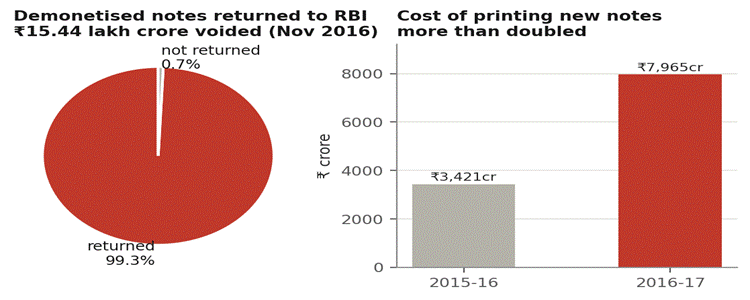
Figure 4.1. Demonetisation by its own metrics: 99.3% of voided notes returned; printing costs doubled. Source: RBI Annual Reports 2016–17 and 2017–18.
The exercise was also sold as a decisive strike against terror financing. Yet the same period saw the unfolding of the DHFL scam, in which RKW Developers — a Wadhawan-group firm that had donated ₹10 crore to the BJP in 2014–15 (part of roughly ₹19.5–20 crore from linked companies) — stood at the centre of an Enforcement Directorate probe into property transactions with Iqbal Mirchi, the late Dawood Ibrahim aide and 1993 Mumbai blasts accused. ED investigations further linked DHFL loans of over ₹2,000 crore routed through shell entities to Sunblink Real Estate, which had acquired Mirchi’s properties; the agency described portions of these flows as proceeds of crime potentially used for terror financing. The ruling party’s acceptance of donations from a company under active investigation for facilitating deals with a designated terror-linked figure exposed the gap between the rhetoric of “surgical” disruption of terror funding and the actual circuits of money and influence that remained undisturbed.
4.2 The human toll and the growth shock
The costs fell, as they always do in this architecture, downward. Serpentine queues formed at banks; scores of deaths were reported in the weeks that followed, linked to the cash chaos. The informal economy — which runs on cash and employs the overwhelming majority — contracted sharply; small traders, daily-wage workers, farmers at harvest and the cash-dependent poor bore the shock. Combined with a chaotic GST rollout months later, demonetisation dragged measured growth to a multi-year low. A former Finance Ministry adviser called it “a colossal blunder”; the Centre for Policy Alternatives judged the economy could have been on a higher trajectory without it.
An instrument that missed all four of its stated targets, cost more than it recovered, killed in the queues, and shrank the livelihoods of the poorest — decided by executive fiat, overnight, with no deliberation. This is the template: shock from above, pain below, no accountability after.
5. The Goods and Services Tax: One Nation, Forty-Five Rates
Sold as “one nation, one tax, one market,” the GST of July 2017 delivered the opposite: a labyrinth of arbitrary rates, coercive and uneven implementation, and a structural squeeze on both the states and the ordinary consumer — stacked on top of every other tax the citizen already pays.
5.1 The maze of slabs
The GST launched with five headline slabs — 0, 5, 12, 18 and 28 per cent — plus a compensation cess and a clutch of special rates for gold, diamonds and jewellery. Once the cesses and non-standard rates are counted, analysts have documented close to forty-five distinct effective rates. The same toothpaste, the same namkeen, the same footwear could be taxed differently on trivial distinctions of packaging, branding or price point. The complexity was not incidental; it created endless classification disputes, mis-classification, litigation, evasion and — crucially — discretionary power in the hands of officials.
5.2 The popcorn that broke the pretence
The absurdity acquired a national symbol in December 2024, when the Council confirmed three different rates for one snack: 5 per cent on loose salted popcorn, 12 per cent on pre-packaged branded salted popcorn, and 18 per cent on caramel popcorn, reclassified as sugar confectionery. Paratha was taxed differently from roti; a cream bun differently from a plain one. The meme war that followed was not frivolous — it was the public grasping, correctly, that a tax justified as “simple” had become a machine for arbitrary classification.
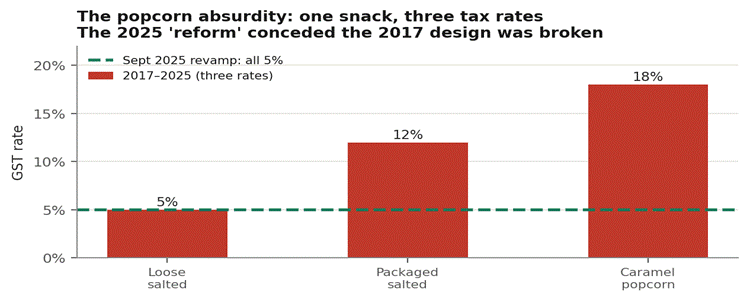
Figure 5.1. One snack, three tax rates — until the 2025 revamp folded all popcorn into 5%, tacitly admitting the original design was broken.
5.3 The 2025 revamp is a confession
On 22 September 2025 the Council collapsed the structure toward three rates — 5 per cent (merit), 18 per cent (standard), and a 40 per cent demerit rate for sin and luxury goods — and scrapped the compensation cess for most goods. This was presented as “next-generation reform.” It is more honestly read as an admission: the design introduced in 2017, defended for eight years, was flawed from the start. A structure re-legislated because it never worked is not a reform; it is a confession, and the eight years of arbitrary extraction in between are not refunded.
5.4 The regressive burden, stacked and disparate
Two structural injuries survive the revamp. First, GST is an indirect, consumption tax: it falls hardest, as a share of income, on the poor, who spend most of what they earn — and it sits on top of income tax, fuel taxes, cesses, surcharges, tolls and state levies, an accumulated stack the citizen pays through at every transaction. Gross GST collections reached a record ₹22.08 lakh crore in FY25, monthly collections routinely crossing ₹1.9–2.4 lakh crore — a formidable extraction from consumption, precisely as real wages stagnated.
Second, the burden is disparate across the federation. More than two-thirds of many states’ own tax revenue now depends on GST, yet the design centralised rate-setting and, when the compensation guarantee lapsed after June 2022 and the cess was wound down, left fiscally-stressed states exposed. The GST both squeezed the consumer from below and hollowed the states from within — a double centralisation of fiscal power dressed as tax simplicity.
A tax sold as simple that produced forty-five rates and a caramel-popcorn tribunal; re-cut in 2025 in tacit admission of failure; regressive on the poor, stacked over every other levy, and corrosive of the states’ fiscal autonomy. The simplicity was always the marketing; the extraction was always the point.
6. Inflation and the Indexed Minority
Retail inflation is back at an 18-month high. In June 2026 the official CPI stood at 4.38 per cent. Food inflation ran at 5.32 per cent. Ginger rose 50.41 per cent and tomatoes 31.92 per cent in that single month. These are not abstract percentages. They are the difference between a full market basket and a thin handful of vegetables for anyone whose income is not protected by statute.
The new 2024-base CPI reduced the weight of food and beverages from 45.86 per cent to roughly 36.5–36.8 per cent. When vegetables spike, the lower weight softens the official headline. Reweighting is standard practice; the direction of the change conveniently dampens the component that hurts the majority most.
Compounding continues underneath every monthly print. At a sustained 4–5 per cent rate the general price level roughly doubles in 14–15 years. A fixed sum of money buys steadily less. Layer on repeated food spikes and a rupee trading near successive record lows against the dollar (around 96.5–96.8 in late July 2026 after touching ~96.8–96.9 in May), and every imported energy and fertiliser input becomes more expensive in local currency. Those costs feed straight into transport, farming and retail food prices.
The lived test is simple. In 2012 a ₹500 note still bought a full local-market basket — onions, tomatoes, potatoes, greens, some fruit or dal — with change remaining. Today the same note buys far less. That is the arithmetic of persistent positive inflation, repeated food-price surges and a weakening currency meeting wages that are not indexed for the majority.
Dearness Allowance exists because the government itself knows inflation erodes purchasing power. In January 2026 DA was raised to 60 per cent of basic pay for central government employees and pensioners. The formula tracks the 12-month average of the All-India CPI for Industrial Workers. Coverage is limited: roughly 50.46 lakh central employees and 68.27 lakh pensioners. Expand the circle to state staff, PSUs and the organised formal sector and the protected group remains a minority. The remaining roughly ninety per cent — informal workers, daily-wage labourers, small vendors, agricultural workers, some forty crore people — have no automatic compensation. When food prices jump or the rupee falls, they absorb the full loss. Even this shield is discretionary: three DA instalments were frozen in 2020–21 with no arrears paid for the eighteen frozen months.
Table 6.1. Current pressures (June 2026)
| Indicator | Value | Significance |
|---|---|---|
| Headline CPI | 4.38 % | 18-month high |
| Food inflation | 5.32 % | Running ahead of headline |
| Tomato | +31.92 % | Sharp vegetable spike |
| Ginger | +50.41 % | Extreme single-item rise |
| Food weight (new CPI) | ~36.5–36.8 % (from 45.86 %) | Softens headline on food spikes |
| Recent WPI spike (May) | 9.68 % (fuel +30 %, crude +61 %) | War-related energy shock |
Table 6.2. Who is protected
| Group | Approximate size | Protection | Outcome when prices rise |
|---|---|---|---|
| Central employees | 50.46 lakh | Statutory DA (60 %) | Real income defended |
| Central pensioners | 68.27 lakh | Dearness Relief | Real income defended |
| Broader formal sector | Organised minority | Partial / parallel | Partially cushioned |
| Informal majority | ~40 crore | None | Full absorption |
Table 6.3. The ₹500 note test
| Year | Typical local purchasing power of ₹500 | Relative to 2012 |
|---|---|---|
| 2012 | Full vegetable and basic basket + change | Baseline |
| 2026 | Thin handful of vegetables | Substantially eroded |
The same macroeconomic environment produces two different outcomes. One India’s purchasing power is defended by formula. The other India’s purchasing power continues to collapse — visible every time a fixed sum of money buys less at the local market. Inflation has not been abolished. It has been rendered statistically softer in the headline while remaining relentless for the unprotected majority. The state indexes those who serve it and externalises the cost onto everyone else.
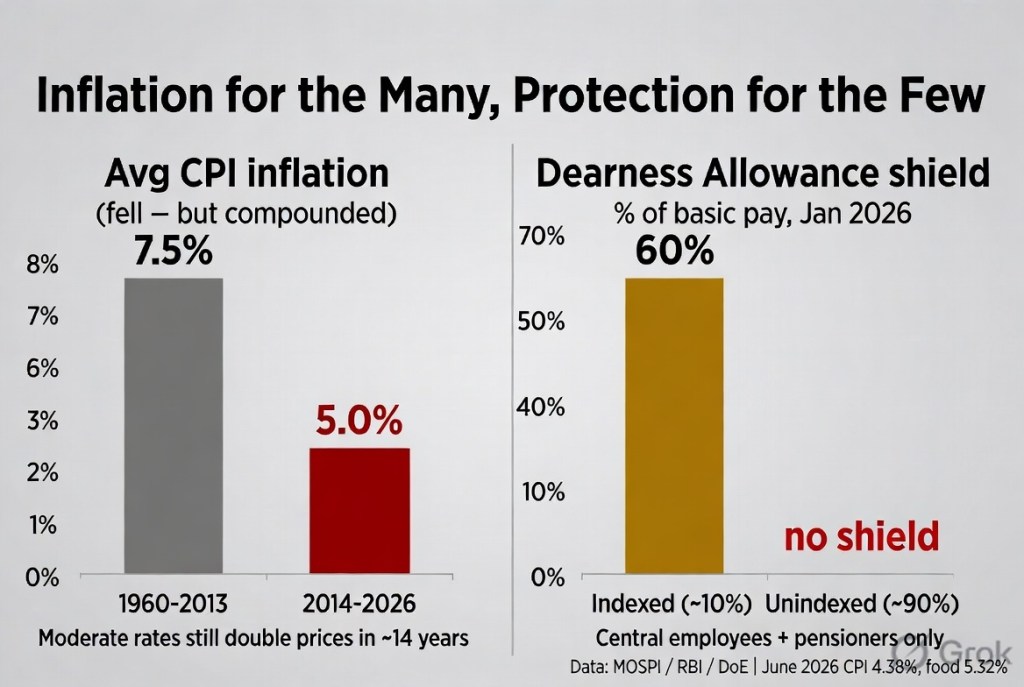
The pandemic years themselves brought elevated prices and the deliberate freeze of three Dearness Allowance instalments (2020–21), with no arrears paid for the eighteen frozen months. What followed was not stabilisation for ordinary households. Global energy shocks — first the 2022 Ukraine war that pushed Indian CPI toward 6.7 per cent, then the 2026 West Asia conflict that drove wholesale inflation to 9.68 per cent in May (fuel and power +30 per cent, crude +61 per cent) — repeatedly transmitted into domestic fuel, fertiliser and food costs. By June 2026 retail inflation had climbed back to an 18-month high of 4.38 per cent, with food at 5.32 per cent and extreme single-item spikes (ginger +50.41 per cent, tomatoes +31.92 per cent). The rupee simultaneously slid to successive record lows near 96.5–96.8 against the dollar, amplifying every imported input. For the indexed minority the formula continued to adjust. For the unindexed majority — the roughly ninety per cent without statutory protection — post-COVID inflation has meant repeated real-income hits, thinner market baskets from the same notes, and no automatic compensation when external shocks arrive. The state’s own employees were shielded; the rest absorbed the full volatility.
The state indexes those who serve it and lets the market erode the incomes of the “common” whose detriment Article 39(c) names. So-called low inflation is painless only for the protected tenth. Most Indians are not in that tenth.
7. ‘Hypocrisy Ki Bhi Seema Hoti Hai‘: Austerity for the Masses, Continuity for the Apex
In May 2026, amid an energy-price shock from the Iran conflict, the Prime Minister of India publicly urged citizens to buy no gold for a year, to curb non-essential foreign travel, to carpool and use public transport, and to reduce edible-oil use. The context was real — the rupee near ₹95 to the dollar, gold and silver imports surging, the two metals near 11 per cent of the import bill. The hypocrisy was equally real.
7.1 The same asset, two moral charges
While citizens were repeatedly told that gold is a wasteful, unproductive drain on the economy, the Reserve Bank was quietly accumulating and securing it. Holdings reached 880.52 tonnes by March 2026 — more than 270 tonnes added since 2017 — with roughly 77 per cent now repatriated to domestic vaults and gold’s share of foreign-exchange reserves driven up to 16.7 per cent. The identical asset is celebrated as “strategic diversification” and “reserve strength” when the state piles it up; the same asset is labelled wasteful and discouraged when an ordinary citizen — who has no Dearness Allowance, no inflation-linked salary, and for whom a small quantity of gold is often the only accessible store of value against relentlessly rising prices — buys a wedding bangle or a few grams of savings.
The state moved its own gold backing from roughly 9.3 per cent to 16.7 per cent while continuing to lecture the unindexed majority to abandon their sole hedge. One India is permitted, even encouraged, to fortify itself against inflation and currency risk with physical gold. The other India is told that the same act is irrational and against the national interest. That is not policy consistency. It is a naked double standard: the powerful protect their balance sheet; the unprotected are told to surrender theirs.
7.2 Iconography without instruments
What was announced was not austerity but its spectacular imagery. No duty change, no quota, no legislation accompanied the appeal — only civic duty and patriotism. Austerity proper binds the fiscal authority; this bound only the household conscience. The macro drivers — crude prices, capital flows, the outward remittances of the affluent, structural import dependence — went untouched, while responsibility for the external gap was transferred to the wedding jeweller. Because the sacrifice was requested rather than legislated, non-compliance became unpatriotic rather than unlawful.
The contrast in mobility is starker still. The citizen is asked to forgo foreign travel while holding a passport ranked near 80th globally. Executive mobility is publicly funded and partly unaccounted: parliamentary replies record over ₹2,021 crore on chartered flights, aircraft maintenance and hotline facilities for the Prime Minister’s foreign visits (June 2014–December 2018), with VVIP aircraft maintenance rising to ₹420 crore by 2018–19 — and a Parliamentary Standing Committee that deplored the Ministry’s “lackadaisical approach” in even furnishing the invoices. The personal register — chartered long-haul aircraft, a wardrobe far exceeding ordinary standards, accessories reported in lakhs — is not illegal. It is funded, directly or indirectly, by the same public resources whose scarcity is the reason the masses are lectured on thrift.
An order that prescribes thrift as civic duty for the majority while preserving high-end consumption, mobility and display as the natural prerogative of the apex is not managing a crisis. It is performing one — downward.
8. The Lexicon of Superrich Forgiveness: Wilful Default and the “Write-Off” Machine
Here the extraction is at its most naked, and its most linguistic. A specialised vocabulary has been engineered to convert a broken promise by the powerful into a routine accounting entry — while the honest word for forgiveness is reserved exclusively for the poor.
8.1 The magnitudes
Scheduled commercial banks wrote off approximately ₹16.35 lakh crore between FY15 and FY24. On these written-off accounts, recovery has remained stubbornly meagre — typically 13–16 per cent. In plain terms, of every ₹100 declared written off, roughly ₹84–87 is never recovered. The taxpayer ultimately absorbs the loss through capital infusions into public-sector banks.
As of March 2024 there were 2,664 unique corporate wilful defaulters (excluding individuals and overseas entities) owing on the order of ₹1.96 lakh crore. The top fifty alone accounted for ₹87,295 crore. Section 45E of the RBI Act continues to treat the detailed identities of many such borrowers as confidential, shielding them from public scrutiny even after classification.
Table 8.1. The scale of the write-off machine (FY15–FY24)
| Item | Amount / Rate | Meaning |
|---|---|---|
| Total written off | ₹16.35 lakh crore | Removed from active books |
| Typical recovery on written-off accounts | 13–16 % | ₹84–87 of every ₹100 permanently lost |
| Corporate wilful defaulters (Mar 2024) | 2,664 borrowers | Owing ≈ ₹1.96 lakh crore |
| Top 50 wilful defaulters | ₹87,295 crore | Concentrated among large accounts |
| Declared Fugitive Economic Offenders (total dues) | ≈ ₹58,082 crore | Only ~3.6 % of the decade’s write-offs |
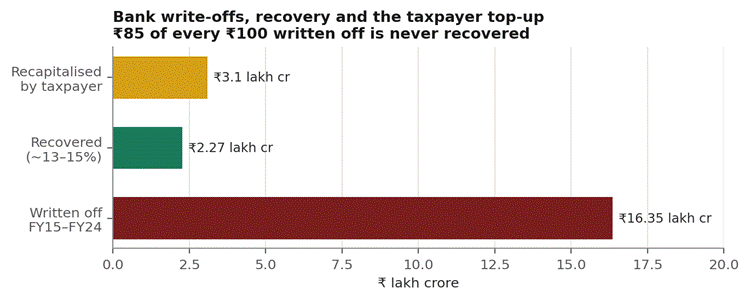
Figure 8.1. Write-offs, recovery and the taxpayer top-up. Sources: RBI/CIC disclosures; parliamentary replies.
8.2 The semantic ladder — Orwellian doublespeak in action
“Non-performing asset” de-moralises the act through grammar. A deliberate refusal to repay becomes an asset that somehow failed to perform — an agentless misfortune. The loan “turned bad.” No one is required to say the borrower broke his word.
“Write-off” performs the deeper concealment. Technically it means removal from the active books after full provisioning; the legal liability is said to survive. In practice, with recovery stuck at 13–16 per cent, the overwhelming majority of the amount is simply never returned. The hyphenated term therefore functions as forgiveness while pretending to be mere accounting hygiene. It cleanses the NPA ratio, delivers a tax benefit to the bank, sustains the polite fiction of “continuing recovery efforts,” and — protected by Section 45E — keeps the principal beneficiaries largely unnameable.
“Waiver” is the only honest word for the economic act, and its distribution is the entire argument. It is reserved for agricultural debt relief — small in aggregate relative to the corporate numbers, morally loaded, and endlessly attacked as “fiscal indiscipline” and “populism.” The vastly larger forgiveness extended to wilful corporate defaulters is never called a waiver. It is “technical,” “prudential,” “regulatory,” a “write-off.” The identical economic outcome — the permanent transfer of loss from the borrower to the public — carries opposite moral charges solely according to the class of the beneficiary. This is class politics compressed into vocabulary. One word is allowed for the powerful; the other is policed for the poor.
8.3 The fugitives — the visible fraction of the system
A handful of names became the public spectacle: Vijay Mallya (Kingfisher), Nirav Modi and Mehul Choksi (PNB fraud), the Sandesara brothers, Jatin Mehta and a few others. Their combined declared dues as Fugitive Economic Offenders stand at around ₹58,082 crore — roughly 3.6 per cent of the ₹16.35 lakh crore written off over the decade. They are pursued, named, and turned into cautionary tales.
Yet the structural fact is the domestic wilful defaulter who never flees. Classified, provisioned, written off, and dissolved into an anonymised aggregate, these accounts require no dramatic exit. Flight is necessary only for those charged with a highly visible, nameable fraud. For the far larger volume of wilful default among the rich, the write-off machine plus the statutory shield of Section 45E makes departure unnecessary. The liability is quietly retired from the books; the recovery rate stays meagre; the identities remain protected.
₹16.35 lakh crore processed through the language of “write-off,” with only a small fraction recovered, and the principal beneficiaries of the largest accounts largely shielded by statute. ₹58,082 crore owed by the named fugitives, chased across continents. The 3.6 per cent is the theatre. The remaining 96-plus per cent — processed, provisioned, and linguistically laundered — is the system.
Even the theatre itself reveals the limits of the system’s will. INTERPOL Red Notices have been issued in several of these cases, Indian agencies (CBI, ED) have filed dossiers, FEOA declarations have been obtained, and assets have been attached. Yet years pass. Mallya’s extradition, approved in the UK, remains unexecuted through successive legal challenges. Nirav Modi’s avenues have been narrowed, yet final handover is still entangled in residual processes. Choksi’s Belgian proceedings continue to stretch. Host-country courts examine prison conditions, human-rights claims, and dual-criminality arguments; each appeal buys more time. Indian intelligence and investigative agencies generate the paperwork and the diplomatic pressure, but the physical return of these high-profile figures remains slow, partial, and heavily dependent on foreign judicial timelines over which India has limited control. The spectacle of pursuit is real; the swift, decisive recovery of either persons or the bulk of the money is not.
The Orwellian achievement is complete: the same act of non-repayment is called a scandal when a farmer receives a modest waiver and a technical necessity when a large corporate wilful defaulter’s account is written off. One is fiscal irresponsibility. The other is banking prudence. The vocabulary does the political work that open acknowledgement of class power never could. The named fugitives absorb the public anger; the far larger, domestic, anonymised write-offs proceed in the quiet of accountancy.
₹16.35 lakh crore forgiven and the beneficiaries shielded by statute; ₹58,082 crore owed by named fugitives, pursued across four continents. The 3.6 per cent is the spectacle. The shielded remainder is the system.
9. The Money Behind the Power: Electoral Bonds, PM CARES, and the Party That Grew Rich
The extraction has a political circuit. The same decade that extinguished public claims saw the ruling party’s own coffers swell through instruments built for opacity — several since struck down as unconstitutional.
9.1 Electoral bonds: anonymity struck down?!
The Electoral Bond Scheme, introduced in 2018, created a legal channel for unlimited, anonymous corporate donations to political parties. Bonds were purchased exclusively from the State Bank of India in fixed denominations. The purchaser’s identity was hidden from the public and from the receiving party; only SBI held the unique identification numbers and the audit trail. Parties deposited the bonds into their accounts and received the funds without any contemporaneous obligation to disclose the source. Amendments to the Income Tax Act, the Representation of the People Act and the Companies Act removed previous limits on corporate donations and the requirement to report contributions above ₹20,000 when made through bonds. The design was deliberate: opacity by statute.
In February 2024 the Supreme Court struck the entire scheme down as unconstitutional. It held that the blanket anonymity violated the voter’s right to information under Article 19(1)(a) and that the removal of donation limits and disclosure requirements was arbitrary. The Court ordered SBI to disclose the data. What emerged was a clear picture of concentrated funding and suspicious linkages.
Across the life of the scheme the BJP received the single largest share — roughly half or more of the total value encashed by all parties in the major disclosure windows (figures in the range of ₹6,000–8,000+ crore depending on the exact period analysed). Other parties received far smaller slices. Large corporate donors included firms that subsequently secured major government contracts, licences or clearances, and firms that were simultaneously under investigation by the Enforcement Directorate, Income Tax Department or CBI. In multiple documented cases, bond purchases occurred after raids or notices. Loss-making companies and entities with negligible declared profits still channelled hundreds of crores, the bulk of which went to the ruling party. The anonymity that the scheme guaranteed had prevented any contemporaneous public or regulatory scrutiny of exactly these donor-to-benefit patterns. Only judicial compulsion forced the data into the open; the data then self-convicted the instrument.
The mechanism was therefore a closed circuit: corporate money moved through an opaque SBI window, arrived at party accounts without a public name attached, and the political beneficiary of the largest flows was the party in power at the Centre. Crony relationships that would have been visible under ordinary disclosure rules remained invisible until the Court intervened.
Yet the surgical removal of the scheme produced no further accountability. No one who designed it, legislated the accompanying amendments, administered it through SBI, or sat at the receiving end of the largest anonymous flows was criminalised or held personally responsible for the constitutional violations or for the patterns of apparent quid-pro-quo the disclosures revealed. The instrument was declared dead. The patient — the political funding system that had been allowed to operate under cover of statutory anonymity — walked away largely intact. Surgery successful. Patient dead.
9.2 PM CARES: the fund outside the law
The PM CARES Fund, created in March 2020 at the onset of the COVID-19 crisis, occupies a carefully engineered legal void. It is registered as a public charitable trust. Its trustees are the Prime Minister (ex-officio chair) and the Union ministers of Home, Defence and Finance. It uses the national emblem, operates from a gov.in domain, was actively solicited from public-sector undertakings through CSR routes, from government employees, and from the general public with the full weight of official messaging. Yet the same fund has been declared not a “public authority” under the Right to Information Act, is not subject to audit by the Comptroller and Auditor General, and has been ruled off-limits for parliamentary questions on the explicit ground that it is not a government fund.
This is opacity constructed as an institution. The fund wields the state’s symbols, the state’s outreach machinery, and the state’s moral authority to raise money, while simultaneously disclaiming every statutory mechanism of public accountability that normally attaches to the use of those symbols. RTI applications are rejected because it is not a public authority. CAG audit is refused because the money does not flow through the Consolidated Fund. Parliamentary questions are disallowed because the PMO classifies it as outside the government’s concern. Private auditors examine the accounts; the detailed books remain largely shielded from independent public scrutiny.
The design is deliberate. Existing instruments such as the Prime Minister’s National Relief Fund already existed. Creating a parallel vehicle allowed the concentration of large voluntary and CSR inflows — thousands of crores in the early years — under a structure that borrowed the prestige of the state while escaping its transparency obligations. Courts have largely accepted the formal characterisation of a private trust. The practical result is a fund that looks and speaks like an arm of the state when it collects, and like a private entity when it is asked to account.
A fund that can mobilise the national emblem, the machinery of government, and the contributions of public-sector units, yet remains outside RTI, outside CAG audit, and outside parliamentary questioning, is not an accident of legal drafting. It is the institutionalisation of opacity: the state’s reach without the state’s answerability.
9.3 The party that grew rich
ADR analyses of Election Commission filings track the ascent: BJP declared income of ~₹970 crore in 2014–15 rose to ~₹4,340 crore in 2023–24 and ₹6,769 crore in 2024–25 — roughly 85 per cent of the combined income of all six national parties. Recent filings place cash and bank deposits in the ₹7,000–10,000 crore range.
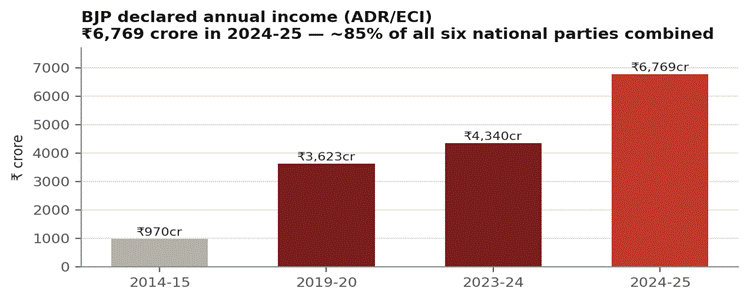
Figure 9.1. BJP declared annual income (ADR/ECI). In 2024–25 the party took ~85% of all six national parties’ combined income.
And the darker threads are on the record: investigative reporting has documented that RKW Developers and related entities — beneficial ownership linked to the family of fugitive Iqbal Mirchi — feature in the DHFL money trail, with the ED attaching Mirchi-linked assets under the PMLA. Layered shell structures and cross-border entities recur across both the large NPA cases and certain funding channels. The circuit closes: the same establishment that writes the rules, runs the process and clears the acquirer is the establishment that receives the acquirer’s money.
When the rule-writer, the referee and the donee are one establishment, the plain description of the arrangement is cronyism — public losses socialised, private gains privatised, and the ledger that would prove it kept dark by design.
10. Nepo-Capitalism: Dynastic Wealth and the Affiliated Conglomerates
The transfers documented so far had beneficiaries. Three concurrent movements are visible in the record: the ruling party’s resources expanded; the personal and family assets of a cohort of its office-holders expanded; and a small number of conglomerates ascended on the back of infrastructure, energy and resource concessions.
10.1 The dynastic cohort
ADR analyses of re-elected MPs’ affidavits show sharp asset growth over the period. Specific lineages illustrate it. The family of the Road Transport Minister, Nitin Gadkari — the principal political driver of the ethanol-blending programme — saw entities in the ethanol value chain (CIAN Agro linked to Nikhil Gadkari; Manas Agro linked to Sarang Gadkari) grow as national blending mandates accelerated. Anurag Thakur, son of a former chief minister, held successive Union portfolios. Jay Shah, son of the Home Minister, rose rapidly through cricket administration to the top of the BCCI and then the ICC. We state the temporal coincidence and the documented affiliations; we assert no crime a court has not found. The pattern — political office and family fortune rising together — is the point.
10.2 The chosen crony conglomerates
The post-2014 concentration is not abstract. It is a concrete list of assets, contracts, policy interfaces and resolution outcomes.
Adani Group
- Airports: Acquired the six major privatised airports (Ahmedabad, Lucknow, Mangaluru, Jaipur, Guwahati, Thiruvananthapuram) under the 2019–20 privatisation. Eligibility criteria on prior airport experience and net worth were structured in a manner that permitted entry despite the group having zero prior airport operating history. Later additions include operational control/expansion around Mumbai and the greenfield Navi Mumbai International Airport. Passenger throughput across the portfolio has exceeded 95 million annually.
- Ports & Logistics: Adani Ports & SEZ controls Mundra (India’s largest private port), Krishnapatnam and a network of roughly 15 domestic ports plus international assets (Australia, Sri Lanka, Israel, Tanzania). Cargo volumes have crossed 500 million tonnes. SEZs and logistics corridors are attached to these ports.
- Power & Energy: Adani Power (thermal capacity, long-term PPAs notably with BJP-ruled states), Adani Green Energy (operational renewable capacity expanded to ~19.3 GW by FY26, large battery storage at Khavda), Adani Energy Solutions (transmission), Adani Total Gas. Coal mining and trading linkages remain central.
- Other: Ambuja Cements / ACC (after Holcim acquisition), data centres, roads (including Ganga Expressway stretches), defence/aerospace manufacturing ambitions, media (NDTV stake).
- Wealth: Gautam Adani’s personal net worth moved from low single-digit billions pre-2014 to peaks above USD 100–150 billion, still in the USD 85–89 billion range in mid-2026 readings. Group market capitalisation of listed entities has repeatedly exceeded USD 150–200 billion at peaks.
Reliance Industries (Mukesh Ambani)
- Telecom / Digital: Reliance Jio — aggressive spectrum acquisitions across multiple auctions (including large 4G and 5G holdings, 26 GHz band). Policy interfaces on spectrum pricing, deferred payments, data and interconnect rules repeatedly shaped the playing field. Jio Platforms is the digital holding vehicle.
- Retail: Reliance Retail — India’s largest retailer by revenue, built through organic expansion and dozens of acquisitions.
- Petrochemicals & Refining: Jamnagar complex — world’s largest single-location refining and petrochemical facility (Oil-to-Chemicals / O2C). Still the cash engine that funds the rest of the group.
- Other: Green energy ambitions, media (JioStar after Viacom18–Disney Star combination), digital platforms, and downstream consumer businesses.
- The group’s combined scale has been estimated in analyses (including The Economist) as approaching ~4% of GDP in revenue terms at peaks, with a large share of listed non-financial capital expenditure.
Piramal Group
- DHFL acquisition (the clearest single transaction): Under the IBC, Piramal Capital & Housing Finance emerged as the successful resolution applicant. Total consideration paid by Piramal was approximately ₹34,250 crore (cash + NCDs). Creditors overall recovered around ₹38,000 crore (including existing cash in DHFL). Retail fixed-deposit holders took extremely deep haircuts — recovery in the range of ~23% of claims in key categories, or haircuts of 65–77% depending on the tranche. Critically, potential recoveries from avoidance/fraudulent transactions estimated at approximately ₹45,000 crore were ascribed a notional value of ₹1 in the resolution plan. This meant the upside from those recoveries largely accrued to the new owner rather than to the original creditors and depositors. Section 32A of the IBC then provided a clean slate, extinguishing the corporate debtor’s prior liability for offences. The Supreme Court later dealt with challenges to this structure; the core plan stood with directions for fresh consideration of the avoidance proceeds allocation.
- Flashnet (2014): Shortly after Piyush Goyal became a minister, the company owned by Goyal and his wife (Flashnet Info Solutions) was sold to a Piramal Group entity for ~₹48 crore — a large multiple of face value. Timing, valuation and disclosure questions were raised; both sides denied impropriety.
- Political funding: Piramal entities purchased electoral bonds of roughly ₹85–88 crore (2019–2022), encashed by the BJP, and contributed ₹25 crore to PM CARES in 2020.
- Current businesses: Piramal Pharma, Piramal Finance (the restructured DHFL platform, now with AUM approaching ₹1 lakh crore), real estate and related financial services.
World Inequality Lab data place the top 1% share of national wealth at approximately 40% and the top 1% share of national income at ~22–23% in recent years — historical highs. The bottom half holds a small and stagnant share. Article 39(c) of the Directive Principles requires the state to prevent the concentration of wealth and means of production to the common detriment. The list above — airports, ports, power plants, spectrum, the DHFL book with its ₹45,000 crore ascribed at ₹1, and the accompanying political proximity — is the concrete occupation of those commanding heights by a narrow set of groups.
This is not diffusion of opportunity. It is the re-concentration of public assets, future cash flows and regulatory advantage into a few hands, while retail depositors, small creditors and the broader distribution of wealth and income absorb the opposite side of the ledger.
Party assets, dynastic assets and a duopoly’s assets rose in the same decade that public claims were extinguished. These are not three coincidences. They are one architecture, viewed from the side of its beneficiaries.
11. The Mask and the Market: Aid to Taliban Afghanistan and the Instrumentality of Hatred
One chapter exposes the machine’s cynicism most cleanly. Domestically the dispensation builds political capital on the systematic amplification of Hindu-majoritarian antipathy — “love jihad,” CAA, NRC, NPR, demographic panic, the continuous disciplining of Muslim citizens through law, policing, and street-level mobilisation, mob lynching etc. Externally it funds and engages the Taliban emirate it would never tolerate rhetorically at home.
India’s pre-2021 development assistance to Afghanistan exceeded USD 3 billion. After the Taliban takeover in August 2021 the budgetary allocations did not stop. They continued: ₹200 crore in 2022–23, figures in the ₹100–200 crore range in subsequent years, ₹100 crore in 2025–26, and ₹150 crore in the 2026–27 Union Budget. Humanitarian consignments of food, medicines and medical equipment have been repeated. Diplomatic engagement has deepened: the Taliban’s Acting Foreign Minister Amir Khan Muttaqi visited New Delhi in October 2025; a Taliban-nominated chargé d’affaires took charge at the Afghan Embassy in New Delhi by January 2026; India’s mission in Kabul was upgraded. The relationship has moved from purely technical humanitarian contact toward structured political and developmental engagement — still without formal recognition, but unmistakably pragmatic.
The argument is not that the Indian state funds an Islamist emirate. That charge is both rebuttable and ethically ugly, because it would require opposing humanitarian relief to a population facing starvation and collapse. The argument is instrumentality. Were the domestic antipathy a sincere civilisational conviction, it would constrain external policy in the same way it constrains domestic policy. It does not. The same 2026–27 Budget that raised the Afghan allocation halved the allocation to Bangladesh — from ₹120 crore to ₹60 crore — on transparently diplomatic and strategic grounds after the political transition in Dhaka. Two Muslim-majority neighbours, opposite budgetary directions, criteria that are strategic and geopolitical rather than religious.
Religious fundamentalism is the mobilising mask. Market calculation, regional influence, countering Pakistan and China, access and optics are the face beneath. The domestic population is fed a continuous diet of polarisation — love jihad, demographic threat, the Muslim as internal enemy — precisely so that the continuity of elite strategic and economic engagement abroad proceeds largely unexamined. Hatred is retailed at home as electoral fuel; the real economy of concessions and pragmatic statecraft continues abroad.
A conviction calibrated so precisely to the electoral calendar and the strategic map is not a conviction. It is an instrument. The double standard is the point: the same ideology that is used to discipline and polarise citizens inside the territory is quietly suspended when strategic interest demands engagement with an emirate that embodies, in far more extreme form, the very religious politics the domestic discourse claims to abhor. The mask is for the domestic audience. The market and the map decide the rest.
MOVEMENT III
The Machinery of Impunity
The legal-institutional apparatus that processes the loss into law — and the gatekeepers who let it.
12. The Laboratory: The Insolvency and Bankruptcy Code and the DHFL Heist
If the write-off machine (§8) launders large-scale default linguistically, the Insolvency and Bankruptcy Code, 2016 launders it legally. The resolution of Dewan Housing Finance Corporation Limited (DHFL) is the clearest single demonstration in the public record. The founders and core members of the Once in a Blue Moon Academia (OBMA) collective are themselves DHFL fixed-deposit holders and therefore direct victims of the process described below. That interest is disclosed as a reason for stricter evidentiary standards, not for silence.
12.1 Congenital defect, not accidental failure
The Code was presented as a time-bound, creditor-in-control resolution framework. On the government’s own data it fails its own metrics: recovery has remained stagnant in the 31–33 per cent range of admitted claims; average resolution timelines have run to roughly 688 days per quarter and 853 days for FY2025 closures, against a statutory outer limit of 330 days. The defects are structural. The near-unreviewable “commercial wisdom” of the Committee of Creditors (crystallised in the Supreme Court’s Essar Steel judgment of 2019) leaves little room for judicial correction of outcomes that systematically disadvantage smaller, unsecured creditors. An internal contradiction runs through the statute: Section 66 permits clawback of fraudulent and preferential transactions, while Section 32A grants a retrospective clean slate to the successful acquirer, extinguishing the corporate debtor’s prior liability for offences once the plan is approved and control changes hands.
The frequency of legislative and regulatory intervention is itself diagnostic. The Code has undergone six to seven major amendment Acts in under a decade, accompanied by well over a hundred regulatory changes and circulars (commonly placed in the range of 122). A statute that must be re-legislated and re-regulated almost every year is not maturing; it is confessing design failure. Crucially, financial service providers were brought inside the Code not by parliamentary amendment but by the Section 227 Rules notified in November 2019 — delegated legislation that received no parliamentary debate.
12.2 DHFL as inaugural trial / “test case”
When Parliament enacted the Code in 2016, financial service providers were expressly excluded. The November 2019 Rules admitted them by executive notification. On 20 November 2019 the Reserve Bank of India superseded DHFL’s board. DHFL thereby became, in the language of the Insolvency and Bankruptcy Board of India itself, the first financial service provider resolved under the Code. The state selected a collapse of approximately ₹90,000 crore, involving more than one lakh mostly elderly deposit and debenture holders, as the live inaugural trial of an untested mechanism introduced without parliamentary debate. “Test case” is description, not rhetoric.
12.3 The sequence, each step on the record
| Date | Event | What it did |
|---|---|---|
| Nov 2019 | Section 227 FSP Rules notified | Financial firms pulled inside the Code by executive rule that Parliament never debated |
| 20 Nov 2019 | RBI supersedes DHFL board | DHFL becomes the first financial service provider resolved under the Code |
| 28 Dec 2019 | Section 32A enters by ordinance | 25 days into the process — a retrospective clean slate for whoever acquires the company |
| During CIRP | Forensic audit; multiple Section 66 applications | Approximately ₹45,000 crore in avoidance/fraud claims identified; later ascribed a notional value of ₹1 to the acquirer |
| 19 May 2021 | NCLT directs higher offer be placed before CoC | Ex-promoter’s higher-value proposal ordered to a vote |
| 25 May 2021 | NCLAT issues quick stay | Stays the NCLT direction that the higher offer be considered by the CoC |
| 7 Jun 2021 | Piramal plan approved by NCLT | Approved without the higher offer having been voted upon |
| 27 Jan 2022 | NCLAT ruling | Describes aspects of the process as discriminatory, illegal and full of material irregularities |
| Prolonged proceedings | Small depositors’ challenges | Innocent fixed-deposit holders faced extended court timelines while their claims were effectively subordinated |
| 1 Apr 2025 | Supreme Court approves the plan | 93.65% CoC vote upheld; the plan becomes final law |
| 2 Feb 2026 | PMLA court discharge | The resurrected entity discharged from a ~₹5,050 crore money-laundering case, citing Section 32A |
The contrast in judicial speed is instructive. A stay protecting the exclusion of a higher competing offer was obtained within days in May 2021. The claims and challenges of ordinary fixed-deposit holders — many of them elderly citizens whose life savings were locked in DHFL — were stretched across years until the Supreme Court’s final approval on 1 April 2025. Those claims were, in substance, disregarded in the distribution waterfall that the “commercial wisdom” of the Committee of Creditors and the clean-slate protection of Section 32A produced.
The DHFL resolution therefore stands as the laboratory demonstration of the Code’s design: financial firms introduced by executive rule rather than parliamentary statute; a retrospective immunity provision inserted within weeks of the first case; potential recoveries of roughly ₹45,000 crore ascribed a value of ₹1; a higher competing offer stayed and never voted upon; and small, unsecured depositors left with deep haircuts while the acquirer received a cleansed entity. The outcomes are not aberrations. They are the expected values of the statute as written and repeatedly amended.
12.4 The savers pay
Retail depositors recovered 23.08 per cent of ₹5,375 crore in admitted claims — a haircut of 76.92 per cent, three rupees in every four, on money placed in a AAA-rated deposit. The subjects — pensioners, widows, retired servicemen — did not consent to being the first trial of financial-firm insolvency; there was no control condition; the outcome was made irreversible by design; and, by the mechanism of estate-funding inversion, their own assets financed the process that dispossessed them. They were not outvoted in the Committee of Creditors; they were structured outside it — constitutive exclusion.
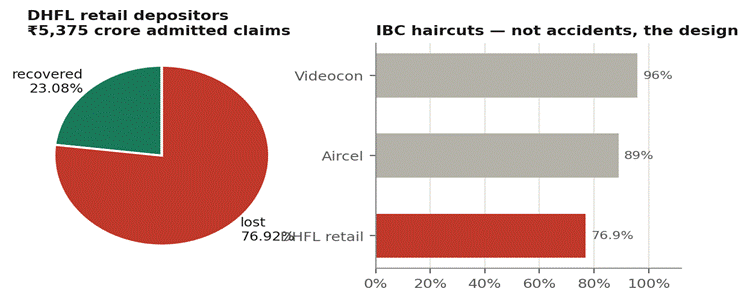
Figure 12.1. The DHFL retail outcome, in the comparative pattern of haircuts under the Code.
The comparative record confirms it is design, not accident: Videocon ~96 per cent, Aircel ~89 per cent, alongside DHFL’s 76.92 per cent. And the ex-promoter’s higher offer for the depositors, ordered before the Committee on 19 May 2021, was simply never put to a vote — a tribunal order disobeyed, a better outcome for victims buried.
This is not a law that failed. It is a law working exactly as built: public risk socialised, private reward privatised, and the victims structured out of the room where their fate was decided.
12. A. The Gatekeepers Who Failed — and the Ledger That Vanished
Every safeguard that should have caught DHFL was present. Each failed, and several have now been found by tribunals to have failed — which converts allegation into record.
Auditors and rating agencies
Statutory auditors issued unqualified opinions across the years in which tens of thousands of crores were allegedly diverted through shell entities. This is no longer allegation: the National Financial Reporting Authority investigated, recorded serious misconduct across five DHFL branch audits, debarred chartered accountants and imposed penalties (December 2023 and June 2024). CARE and Brickwork held DHFL’s debentures at AAA — the highest safety grade — until effectively the day of default. On 31 July 2025 the Chandigarh State Consumer Disputes Redressal Commission held the debenture trustee and both rating agencies liable for deficiency in service, finding the agencies in “flagrant violation” of their duties under the SEBI (Credit Rating Agencies) Regulations, 1999. The structural mechanism is the issuer-pays model — the rated entity pays its rater — which is why “AAA until the cliff” recurs, from IL&FS to DHFL. One investor, Jyoti Khemka, brought that case and won; every other depositor can bring the same claim.
The purest specimen: a committee whose spending cannot be stated
The Reserve Bank constituted the Committee of Creditors. Asked under RTI what that Committee spent — counsel, advisers, litigation reserves, sources of funding — the RBI replied that the information was “provided to Nodal Department”; the IBBI replied that no such data was maintained; the CAG passed the query in a circle. The sum obscured is estimated above ₹100 crore, drawn indirectly from the estate of the depositors who lost 77 per cent. Across fourteen RTI applications to more than twelve authorities — serial jurisdictional transfer, mechanical refusals that “wh-questions” are not “information,” blanket assertions of non-maintenance for records legally required to exist — the evasion rate is one hundred per cent.
A regulator that constitutes a body, funds it from the estate of the affected, and then disclaims knowledge of what that body spent, is the reductio of the entire architecture: appointment without answerability; expenditure without a producible ledger. A hundred-per-cent evasion rate is itself the finding.
14. The Casino Economy: The Securities Exchange as Chaosophic Machinery
The market under the post-2014 order presents itself as rational price discovery while functioning as a machine that manufactures the small speculator and then harvests him.
14.1 The deterritorialised aggregate
Notional derivatives turnover runs at roughly 350 times the cash market from which it is nominally derived; India is the world’s largest derivatives market by volume while ranking fifth by capitalisation. Read through Guattari’s chaosophy, it is a machinic assemblage of options upon indices upon baskets resting on a vanishing substrate. Proprietary and high-frequency firms — about sixty per cent of derivatives turnover — navigate the microsecond field through co-location. Of roughly 9.6 million individual traders, about 91 per cent lost money in FY25, aggregate retail losses exceeding ₹1 lakh crore. Derivatives being zero-sum, those losses are, net of fees and taxes, someone’s gains.
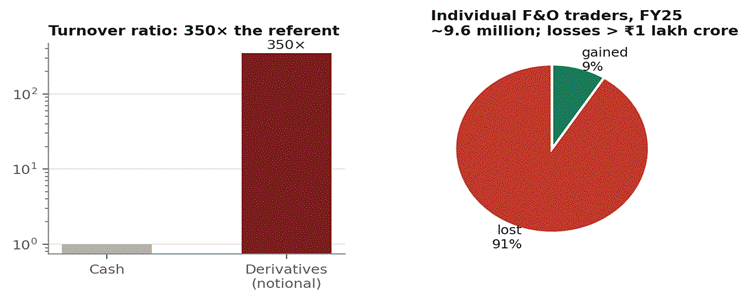
Figure 14.1. A market at 350× its referent, in which nine of ten individual participants lose. Source: SEBI.
14.2 Ruptures within the irrationally rational domain
The scandals form a continuum of information advantage, algorithmic speed, regulatory proximity and political-market entanglement. They reveal the National Stock Exchange not as a neutral mirror of the real economy but as a chaosophical apparatus that produces a symbolic order in which retail hope is systematically farmed while a handful of participants — and political narratives — extract value from volatility.
Event 1 — The Himalayan yogi and the co-location architecture (2010–2016, SEBI order February 2022) Chitra Ramkrishna, Managing Director and Chief Executive Officer of the NSE from 2013 to 2016, took material institutional decisions — including the appointment of Anand Subramanian as Group Operating Officer — on the counsel of an unnamed “Himalayan yogi” (also referred to as “Siddha Purusha” or “Sironmani”) whom she claimed never to have met. SEBI’s February 2022 order recorded that she shared confidential internal information — financial plans, dividend scenarios, business strategies, employee appraisals — with this figure. Parallel to this governance collapse ran the co-location architecture of 2010–2014. Select brokers received preferential, lower-latency data feeds. The advantage was measured in microseconds; the effect was front-running by latency. Retail and ordinary institutional order flow became the feedstock.
Event 2 — Accountability by identity (Delhi High Court, July 2026) In July 2026 the Delhi High Court held that the NSE performs a “public duty” and that its chief executive is a “public servant” under the Prevention of Corruption Act, clearing the path for corruption proceedings against Chitra Ramkrishna in the co-location matter. The same jurisdiction has held that Insolvency Professionals are not public servants. Accountability is calibrated by the institutional identity of the party to be held accountable.
Event 3 — The regulator and the appearance of conflict (August 2024 – May 2025) In August 2024 allegations were levelled against then SEBI Chairperson Madhabi Puri Buch concerning possible conflicts of interest and related-party linkages (drawing in part on a Hindenburg Research report). The allegations were denied. In May 2025 the Lokpal dismissed the complaints for want of evidence. The structural problem remains: a regulator drawn from and frequently returning to the circuit it supervises produces a permanent appearance of conflict even when individual charges fail.
Event 4 — The machine exposed (SEBI interim order, July 2025) In July 2025 SEBI issued an interim order against the Jane Street Group, alleging index manipulation on the NSE (principally Bank Nifty and Nifty options around expiry). Unlawful gains were quantified at ₹4,843 crore and ordered impounded. When this single participant’s access was restricted, NSE derivatives turnover fell 20–26 per cent. One sophisticated proprietary operation was capable of moving the index and extracting billions while the other side of the book absorbed the losses.
Event 5 — The 2024 political-market episode (May–June 2024) In the run-up to the June 2024 general election results, public investment advice from senior political figures (including references to statements associated with former ministers and amplified on platforms linked to corporate interests) urged retail investors to buy into the market ahead of 4 June. Optimistic exit polls released around 1 June projected a decisive BJP majority and triggered a sharp pre-result rally. When the actual results delivered only 240 seats for the BJP — short of a single-party majority — the market suffered a steep crash. Contemporary estimates placed the one-day wealth destruction in excess of ₹30 lakh crore, hitting large numbers of small investors. The market recovered sharply in subsequent sessions. Opposition leaders, including Rahul Gandhi, described the sequence as a stock-market scam engineered through political messaging and exit-poll hype; demands were made for a Joint Parliamentary Committee probe. No formal SEBI finding of criminal manipulation of that specific political-narrative episode has been recorded, but the sequence stands as a stark illustration of how political signalling, media amplification and retail FOMO can be mobilised to move markets — and how ordinary participants absorb the downside when the narrative fails.
Other patterns, 2014–2026 Beyond the headline cases, the period has seen repeated pump-and-dump schemes in small- and mid-cap stocks (SEBI has issued multiple orders barring entities and impounding gains), continued fallout and delayed accountability in the co-location investigation, and the broader structural dominance of proprietary and algorithmic flow in the derivatives segment. Retail participation has been aggressively cultivated while the information and speed advantages have remained concentrated.
The chaosophical market These events are successive revelations of the same structure. The exchange does not reflect the real economy of production and livelihoods. It produces a symbolic order in which volatility is the necessary condition of the few’s profit and is simultaneously marketed to the many as the ladder of aspiration. Political narratives, exit-poll theatre, co-location latency, algorithmic index moves and regulatory proximity all feed the same machine. Retail capital is the continuous feedstock. When one large participant is removed, turnover collapses. When political messaging inflates expectations and then collides with reality, wealth is destroyed in a single session. The market farms hope. It requires the continuous influx of retail money and the continuous generation of volatility. It presents itself as everyone’s ladder while functioning as a precision instrument for those with proximity to the matching engine, the data feed, the political narrative, and the regulatory perimeter.
#Seize_Dalal_Street
15. From Nationalisation to Resolution Capitalism: The Inversion of Public Banking
The machinery has a history, and the contrast indicts the present.
In 1969 fourteen major commercial banks were nationalised; six more followed in 1980. The declared purpose was to break private concentration of credit and place banking at the service of agriculture, small industry and the neglected regions. Branch expansion and priority-sector lending were the instruments. The direction of travel was public ownership of credit for developmental ends.
The post-2014 logic inverted that direction.
An Asset Quality Review in 2015 forced recognition of hidden bad loans. What followed was not recovery from the large corporate defaulters. Scheduled commercial banks wrote off approximately ₹16.35 lakh crore between FY15 and FY24; the bulk fell on public-sector banks. Between 2015 and 2021 the Union injected more than ₹3 lakh crore of taxpayer money to recapitalise those banks. Gross NPAs were brought down to historic lows near 2.15–2.5 per cent by 2025–26 largely by writing the loans off the books and topping up capital from the exchequer — not by making the defaulters repay.
At the same time the state accelerated the transfer of public assets outward. Disinvestment receipts from 2014–15 onward total well over ₹4 lakh crore. The peak years were 2017–18 (approximately ₹1 lakh crore) and 2018–19 (approximately ₹85,000 crore). Strategic privatisation included the complete sale of Air India to the Tata group. Parallel to the large stake sales, a series of loss-making or non-viable central public-sector enterprises were closed, liquidated or wound up — among them Hindustan Cables, Hindustan Photo Films, Scooters India, units of Indian Drugs & Pharmaceuticals, Bharat Pumps & Compressors, and others concentrated especially between 2015 and 2021. Large support packages were simultaneously extended to surviving but stressed entities such as BSNL and MTNL.
The sequence is the design. Public banks absorb the losses of private default through write-offs. The taxpayer recapitalises them. Disinvestment and privatisation then move ownership and assets toward concentrated private hands. The nationalisation project sought to place credit at the service of social priority. Resolution capitalism places the public balance sheet at the service of the concentrated few: losses socialised, cleaned-up entities and residual public assets delivered upward. The direction of travel is the whole argument.
MOVEMENT IV
Marginalized Outliers and Conclusion
What the whole system depends on not counting — and the demand that follows.
16. The Shadow Extraction Economy: What GDP Depends on Not Counting
Beneath the official economy runs a vast shadow that the aggregate systematically erases — and the erasure is not an oversight. It is a condition of the growth story itself.
Five interlocking circuits dominate the extraction.
Satta (numbers gambling) operates with house edges commonly estimated at 40–50 per cent, drawn overwhelmingly from working-class and lower-middle-class players. Cricket-dominated sports betting and illegal online platforms turn over sums placed by multiple studies in the range of USD 100 billion annually (and growing at high double-digit rates in recent estimates), braided with match- and spot-fixing networks. Hawala continues to move large trust-based flows — routinely estimated in the low-to-mid lakh-crore range annually — outside formal banking. Chit funds and informal rotating savings serve tens of millions of households as both credit and savings vehicles. And state lotteries, the legal counterpart, extract effective house edges that in many systems leave only 60–70 per cent (or less after commissions and taxes) returning as prizes, while the residual is recorded as legitimate government revenue. The state’s own lottery is therefore a higher-extraction instrument than many of the criminalised forms it polices.
A 2025 MIMIC-model estimate by Mujtaba Ahmed places India’s shadow economy at approximately 41 per cent of GDP (around ₹1,076 lakh crore in the study’s 2022 framing). Other contemporary estimates of the broader informal/illicit complex remain in the high-30s to low-40s per cent range. Official nominal GDP in the recent period has been cited in the ₹320–340 lakh crore band. The shadow is therefore not a marginal residual; it is a structural parallel economy whose scale rivals or exceeds major formal sectors.
The systems are class-differentiated with precision. The poor and the working class face the highest extraction rates and the greatest criminalisation. The same functional activities — gambling, informal credit, trust-based transfer — when licensed, taxed, or operated by the state, become revenue and are counted inside the growth narrative. Raids fall on the low-edge street systems; the high-edge state lottery is celebrated as legitimate fiscal contribution.
Official GDP is therefore not a neutral photograph of economic activity. It is an epistemic boundary. Including the shadow circuits at realistic scale would force measured growth rates downward and would reveal the volume of continuous wealth transfer from the bottom toward organised operators and their political and enforcement protectors. The boundary protects the growth rate, conceals the distributional extraction, and enables selective criminalisation: the poor’s systems are policed as “crime”; the state’s higher-edge extraction is counted as progress.
The GDP fetish does not merely ignore the shadow economy. It depends on that ignorance. What is counted, what is criminalised, and what is celebrated are three political decisions — and all three are made in the direction that sustains the official growth story while leaving the underlying extraction intact. The boundary of “the economy” is not a technical fact. It is a political artefact.
17. Conclusion: The Undeclared Financial Emergency
The evidence converges on a single structural conclusion. Between 2014 and 2026 the Indian state did not merely preside over inequality; it constructed and legitimised an architecture of extraction. In each domain the same logic appears: socialise the loss, privatise the residual, and manage the political consequences through the measured invisibility of the transfer.
The state advertises a falling external-debt ratio while general government debt climbs from its lowest base in thirty years. It displays a true aggregate — fourth-largest economy — whose distribution it has ceased to measure and whose denominator it has ceased to count. It reports low inflation that is compensated only for the indexed tenth. It voided 86 per cent of the currency to catch a black-money hoard that did not exist, and reprinted it at doubled cost. It built a tax of forty-five rates and a caramel-popcorn tribunal, then re-cut it in tacit confession. It renames elite forgiveness until it resembles hygiene while reserving the honest word for the poor. It ran an untested statutory experiment on a lakh of elderly depositors and cannot say what the committee spent. It funds the emirate it demonises at home. It hosts a casino in which nine of ten small players lose. It socialises bank losses onto the taxpayer and delivers the cleaned assets upward.
Present-day India is under an undeclared financial emergency. No Article 360 proclamation has issued; the emergency is operational, not constitutional. It is managed through concealment rather than declaration — and it is inseparable from a parallel crisis of knowledge: data opacity, data paucity, data denial, and the attrition of the institutions that once made the state legible to its people.
When the state’s own statistical machinery is compromised — surveys discarded, commissioners resigned, the census suspended, RTIs met with a hundred-per-cent wall — the question becomes unavoidable: on whom can the other 98 per cent depend for the truth about their own condition? Not, in its present state, the official apparatus. The dossier therefore ends where the political task begins. The growth narrative must be refused. The extraction architecture is not an aberration of the post-2014 period. It is its organising principle.
18. The Demands: Address the Chair
A system is run by the offices that hold it in place. We therefore make our demand not of abstractions but of chairs — and we are precise about why each chair, and about the boundary of the charge.
18.1 The Finance and Corporate Affairs Minister
The Ministry of Corporate Affairs writes and administers the Insolvency and Bankruptcy Code and appoints the IBBI — the regulator whose own data condemns the Code. The Ministry of Finance oversees the Reserve Bank, the write-off apparatus, the GST architecture and the fiscal design documented throughout this dossier. Both portfolios are held by one office-holder, Nirmala Sitharaman. That is not a diffusion of responsibility; it is a concentration of it. She has repeatedly cited cumulative IBC recoveries as vindication while the Parliamentary Standing Committee on Finance’s own 28th Report (December 2025) records the haircuts and delays that refute the claim. Ministerial responsibility is the entire premise of Cabinet government. Own the record, or vacate the chair.
18.2 The Governor of the Reserve Bank of India
The Reserve Bank, under the authority of its Governor, drove the DHFL sequence: it assumed regulation of housing finance companies in August 2019, superseded DHFL’s board on 20 November 2019, appointed the Administrator, and constituted the Committee of Creditors that refused to place a higher offer before itself and cannot account for a single rupee of its own expenditure. When RTIs seek that ledger — counsel, advisers, litigation reserves paid from the estate of a lakh of depositors who lost 77 per cent — the Bank answers only by pointing elsewhere. The Governor’s office stands in the same line of institutional responsibility as the dual ministries. Own the process the Bank itself initiated, or explain why the regulator that placed public savings into the insolvency machine now maintains “no data” on what that machine spent.
18.3 The boundary of the charge, and the architect
We are explicit, once and clearly. We address the office and its documented public conduct, not the private person. We do not impugn anyone’s academic credentials; the critique on conduct is documented and sufficient, and the credential slur is a distracting gift to the adversary. Any characterisation of an office-holder as an instrument of private interests is advanced as fair comment on public conduct, never as a finding of fact a court has made. And of the architect — the late Arun Jaitley, who piloted the Code through Parliament in 2016 and died in August 2019 as DHFL collapsed into the machine he built — we say only this: a law is not sacred because its author is dead. It is judged by what it does. This one buried ₹45,050 crore of fraud claims for one rupee.
SCRAP THE IBC. REPLACE IT — by an Act of Parliament, debated and voted — with a depositor-first resolution law in which small savers are paid before financial creditors, fraud clawbacks flow to the defrauded and never to the acquirer, every plan is reviewable against Article 14, and every rupee a resolution committee spends is published.
QUESTION THE CHAIR. RESIGN, THE FINANCE AND CORPORATE AFFAIRS MINISTER. ANSWER, THE GOVERNOR OF THE RESERVE BANK — OR RESIGN.
Add the democratic instruments the present architecture systematically disables:
Right to Reject. Every candidate, every party, and every major policy instrument that directly transfers public risk or public assets must be subject to a binding negative vote. The electorate must be able to refuse not only a person but a design — an insolvency code that structures small savers out of the room, a write-off regime that shields the beneficiaries by statute, a tax architecture that extracts from the bottom while the top is indexed. Without the power to reject the instrument itself, periodic elections become a ritual that leaves the extraction machinery untouched.
Right to Recall. Any office-holder who presides over documented opacity — “no data maintained,” hundred-per-cent RTI evasion, one-rupee assignments of tens of thousands of crores in fraud claims, or the socialisation of private default onto the public balance sheet — must be subject to mid-term recall by the same constituency that placed them. Ministerial and regulatory responsibility cannot be a five-year immunity. When the chair answers only with silence or deflection, the people must retain the power to vacate it before the next scheduled election.
Why these two rights now. The architecture described in this dossier does not survive ordinary electoral competition alone. It survives by rendering the distribution invisible, by converting legal instruments into irreversible transfers, and by insulating the office-holders who operate those instruments from continuous accountability. Right to Reject attacks the permanence of the bad law. Right to Recall attacks the permanence of the unaccountable chair. Together they convert the demand “Resign, or answer” from a moral appeal into a structural possibility. Without them, the other 98 per cent remain permanent spectators of their own dispossession.
18.4 What you can do
- DHFL depositors and NCD holders: the Khemka precedent (31 July 2025) is yours — consumer-commission claims against the trustee and the rating agencies are live, inexpensive, and have already succeeded once.
- File RTIs on committee expenditure, avoidance applications and audit reports. A hundred-per-cent evasion rate is itself evidence — collect it.
- Write to your MP with two questions: why did financial firms enter the Insolvency Code by executive notification and not by an Act of Parliament? And why was the NCLT’s order of 19 May 2021 to weigh a higher offer for depositors simply ignored?
- Circulate this. Print it, paste it, translate it. It is free to reproduce under CC BY 4.0.
The aggregates are at a time true and unreal. The distributions are worse than the aggregates suggest. And the instruments by which the distributions might be known have been — in specific, documented instances — delayed, discarded, defunded, shielded by statute, left uncounted, or answered with the reply that no such record is maintained. Refuse the number. Reclaim the ledger.
UPDATE (05.09.2026):
Prime Minister Modi’s late-August and early-September celebration of 7.8 per cent Q1 FY 2026–27 growth—a “herculean feat,” a nation “filled with joy,” “doomsayers were doomed and India bloomed… yet again”—is not a rebuttal of this dossier. It is the architecture speaking in the first person. Concede the print, as this document concedes the fourth-largest-economy claim: the National Statistical Office released 7.8 per cent real and 10.3 per cent nominal. Then ask what the state has smuggled in beside it. The same voice that credits “140 crore Indians” and “the success of reforms” tells those Indians not to buy gold, not to holiday abroad, not to marry overseas. That is not the speech of arrival. It is the speech of an extraction order that needs the aggregate to look like destiny and the household to practise austerity. The number arrives on a rebasing that cut last year’s nominal base by several lakh crore—enough for former finance secretary Subhash Chandra Garg and others to argue that a like-for-like reading is a fraction of the headline—while the implied deflator sits below both CPI and wholesale inflation, and the IMF’s C-grade on national accounts remains unlifted. Private consumption’s share of nominal GDP fell even as passenger cars and two-wheelers (formal, leveraged, affluent) were paraded as proof that the other 98 per cent had bloomed. Investment’s 11.9 per cent jump is real on a spreadsheet and still thick with public capex, inventory and valuation. To call sceptics merchants of “falsehood” is not argument. It is the last instrument this architecture always reaches for: measured invisibility, then moral blackmail.
Nothing in the financial structure reconstructed here has bloomed. External debt, already the regime’s defining liability in these pages, stood at USD 762.8 billion by end-March 2026 and USD 765.5 billion by end-December 2025 on the subsequent official series—private-dominated, dollar-shackled, still US$520 on every unconsulted head. Public liabilities have more than tripled since 2014; write-offs remain identity-shielded; the IBC still processes haircuts for the connected and residuals for the public; the census is still uncounted; official income statistics are still absent. Viksit Bharat is the brand name of that gap: fourth by aggregate, 146th by head, colonial-era concentration at the top, informal work for nine in ten, educated youth as the majority of the jobless. Atmanirbhar recited over a book of external commercial borrowings is not self-reliance. It is pre-debt-or capitalism with a festive caption. A “fastest-growing major economy” that must ration gold, weddings and foreign travel is not a developed nation in rehearsal. It is an undeclared financial emergency with better lighting. The podium has raised its voice. The two chairs that operate the books have not answered. Resign, or answer. The decimal does not retire the demand.
Now we gently move on to what needs to be said, uttered, exposed.
TWO SHEETS. THIRTEEN PAIRS. THE LATEST LEDGER, SIDE BY SIDE.
On 31 August, the Prime Minister called 7.8% Q1 growth a “herculean feat.” “Doomsayers were doomed and India bloomed.”
The same season, he told the public: do not buy gold. Do not marry abroad.
Below is not a leak. It is what the State and the indexes have already published — and never print on the same page.
WEALTH & INCOME
World Inequality Report 2026: the top 1% take 22.6% of national income and hold 40.1% of wealth — the highest since tax records began in 1922, above the colonial peak.
The top 10% take 58% of income and 65% of wealth.
The bottom 50% take 15% of income and hold 6.4% of wealth.
You must out-earn nine Indians in ten just to reach the average.
Article 39(c) still unanswered.
POVERTY & HUNGER
Extreme poverty is advertised at 2.3–5.3% against a line the State helps draw.
Nearly 80 crore still (supposedly) get free grain every month.
GHI 2025: 102nd of 123, score 25.8 — “serious.”
Child wasting: 18.7%, among the worst on earth.
NFHS: roughly one child in three is still short or underweight.
A growth rate can be rebased.
A child’s height cannot.
WORK
Official unemployment: 3.1% (usual status, 2025).
Youth unemployment: 9.9%+ on the same measure, much higher week-to-week.
Regular salaried work: only 23.6%.
About 90% of workers remain informal and unorganized — some 40 crore with no DA, no indexation, while central staff sit at ~60% DA.
One hour in a week counts as “employed.”
The queue is defined away.
WRITE-OFF
Banks wrote off ₹16.35 lakh crore (FY15–FY24).
About ₹85 of every ₹100 never comes back.
Section 45E hides the names.
Farmer debt forgiven (really?!) = “waiver,” a freebie.
Tycoon debt forgiven = “write-off,” prudential, unnamed.
DHFL: ₹45,050 crore of fraud claims assigned for ₹1.
Nearly one lakh fixed depositors recovered 23%, lost 77%.
That is not resolution.
It is upward transfer with a legal caption.
CRONY CIRCUIT
Corporate tax cut (2019): about ₹1.45 lakh crore a year.
Salaried individuals now pay more direct tax than the whole corporate sector.
States were promised 41% of central taxes; they get ~30% because cess sits outside the pool.
CAG: ₹3.69 lakh crore of cess never reached its funds.
And 91% of 9.6 million retail F&O traders lost money in a year.
The casino is counted inside GDP. The depositor is not.
ENVIRONMENT-ECOLOGY-NATURE
EPI 2026: 176th of 177 countries — second from last, last in South Asia.
Fastest-growing large economy on the podium.
Near the floor on air and ecosystems.
Throughput with a flag.
THE METHOD
IMF still grades India’s national accounts C.
Last census: 2011.
No official income survey.
Write-off names sealed.
RTIs on DHFL: 100% evasion.
Fourth-largest economy; ~146th by head.
Every left-hand fact is true.
Every right-hand fact is true.
Governing is the art of keeping them in different rooms.
Read them two at a time.
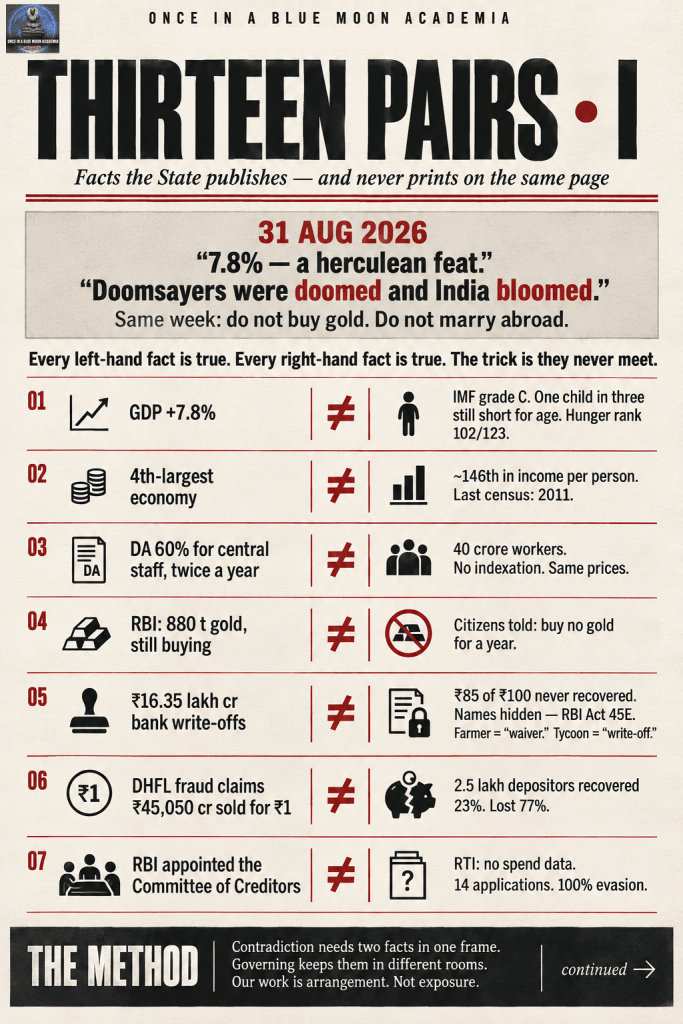
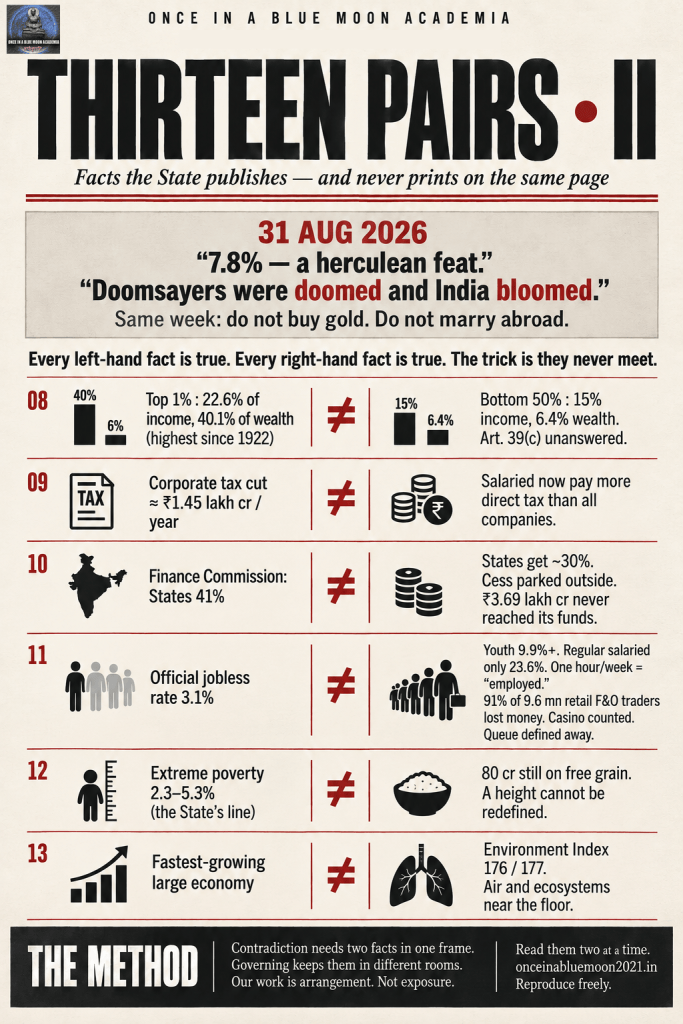
References
Primary — official
Reserve Bank of India, Annual Reports 2016–17 and 2017–18 (demonetisation); Handbook of Statistics on the Indian Economy; Financial Stability Reports; External Debt statements and Half-Yearly Reserve Management reports; Insolvency and Bankruptcy Board of India, quarterly statistics and newsletters (December 2025); Comptroller and Auditor General of India, reports on cess transfers; Ministry of Finance, Union Budget documents 2016–17 through 2026–27; Press Information Bureau / Ministry of Finance data on NPAs, write-offs, recapitalisation and GST collections; Lok Sabha and Rajya Sabha replies as cited in loco; Parliamentary Standing Committee on Finance, 28th Report on the IBC (December 2025); Parliamentary Standing Committee on External Affairs, report on VVIP visit expenditure; National Financial Reporting Authority orders (December 2023, June 2024); SEBI orders (February 2022; July 2025); NITI Aayog, National Multidimensional Poverty Index reviews; CBIC Notification No. 02/2025 (GST cess removal).
Primary — judicial
Association for Democratic Reforms v. Union of India (Electoral Bonds), Supreme Court, February 2024; Committee of Creditors of Essar Steel v. Satish Kumar Gupta (2019); Property Owners Association v. State of Maharashtra (nine-judge bench, 5 November 2024); NCLAT order of 27 January 2022 (DHFL); Supreme Court order of 1 April 2025 (DHFL); Chandigarh State Consumer Disputes Redressal Commission, Jyoti Khemka (31 July 2025); Delhi High Court (July 2026) on the NSE and the Prevention of Corruption Act; Lokpal order (May 2025).
Primary — Right to Information
OBMA dossier of fourteen applications to twelve-plus authorities, 2021–2025, catalogued at onceinabluemoon2021.in; RBI / Credit Information Companies wilful-defaulter disclosures (2024).
Secondary — research and civil society
Association for Democratic Reforms, analyses of party income and MP affidavits (2024–26); World Inequality Report 2026 (Chancel, Gómez-Carrera, Moshrif, Piketty); Bharti, Chancel, Piketty & Somanchi (2024), “The Rise of the Billionaire Raj”; Oxfam India inequality supplements; Subramanian (2019), India’s GDP Mis-estimation, Harvard CID, with the EAC-PM and Economic Survey 2019–20 rebuttals; World Bank, Poverty and Equity Brief: India (Spring 2025); UNDP, Human Development Report 2025; Global Hunger Index 2025 (Concern Worldwide & Welthungerhilfe); World Happiness Report 2026; WEF Global Gender Gap Report 2025; Transparency International CPI; Reporters Without Borders; The Economist, Crony-Capitalism Index (2023); Hindenburg Research (2024); Carnegie Endowment, India’s Statistical System.
Theoretical
Éric Toussaint, The World Bank: A Never-Ending Coup d’État (2007/2008); Félix Guattari, Chaosmosis (1992); Maurizio Lazzarato, The Making of the Indebted Man (2012); Simon Kuznets, National Income 1929–1932 (1934); Stiglitz, Sen & Fitoussi (2009); Karl Polanyi, The Great Transformation (1944); Marilyn Waring, If Women Counted (1988); Kumārila Bhaṭṭa, Ślokavārttika, on anupalabdhi and arthāpatti.


3 Comments