Bankruptcy as Profitable “Bijness”: India’s Grand IBC Heist!
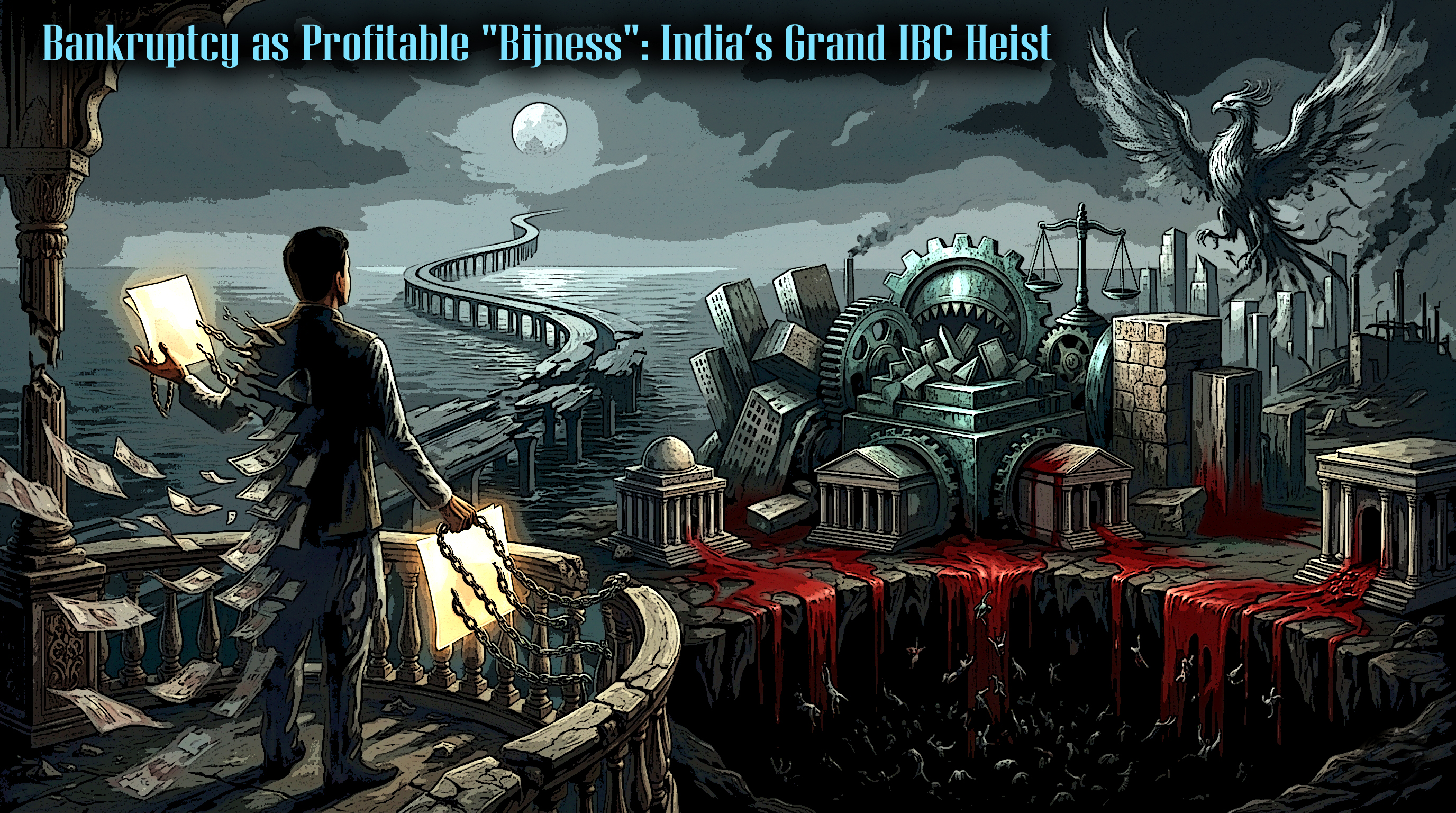
India’s insolvency regime, culminating in the Insolvency and Bankruptcy Code (IBC, 2016), represents not a rupture but a refinement of a long-standing political economy that protects and reproduces elite accumulation. While the pre-2014 framework (BIFR/SICA/DRT/SARFAESI) enabled overt promoter impunity through delay and fragmentation, the post-2016 IBC has professionalised and sanitised this asymmetry into a time-bound, creditor-driven architecture that systematically socialises losses and privatises gains. Empirical trends—~8,800+ CIRP admissions, ~31–33% recovery rates, ~67% average haircuts, ₹4+ lakh crore realised against far larger claims, and a surge in wilful defaulters to ₹3.83 lakh crore by 2025—reveal a system where public-sector banks, workers, SMEs, and retail investors absorb the bulk of distress while politically connected acquirers consolidate assets at deep discounts, often through phoenixing and procedural arbitrage. Landmark cases like Dewan Housing Finance Corporation Ltd illustrate how legal doctrines (e.g., Section 32A clean slate vs. Section 66 fraud recovery) enable the transfer of both assets and upside from fraud to new owners under the doctrine of CoC “commercial wisdom.” Far from disciplining capital, the IBC normalises strategic default as a rational, even aspirational pathway within India’s crony-capitalist order—an evolution from chaotic promoter protection to a streamlined mechanism of wealth transfer, embedded within a broader regime of opaque political funding, selective enforcement, and taxpayer-backed recapitalisation.
