
Twenty-One Charges/Allegations Against the Tadipaar Home Minister — and One Demand: RESIGN
Posted on 3rd August, 2026 (GMT 09:35 hrs)
Updated on 7th August 2026 (GMT 21.30 hrs)
ABSTRACT
This citizens’ charge-sheet documents twenty-one instances of foreclosed accountability, institutional failure and the systematic manufacture of impunity under Amit Shah as Union Home Minister — from the Gujarat encounter cases and the tadipaar externment, through surveillance, financial opacity, the architecture of control in Kashmir, CAA–NRC and electoral machinery, to security collapses in Manipur, Pahalgam and on the China border, culminating in the use of brutal and repressive force against unarmed students at Jantar Mantar. It demands his resignation and the democratic rights of recall and reject.
DISCLAIMER: This dossier addresses Amit Shah exclusively in his public capacity as the Union Home Minister of India — the institutional chair he occupies, the powers vested in that office, the record of decisions taken under its authority, and the patterns of accountability (or its foreclosure) that attach to the position. It does not target, impugn, or comment upon Amit Shah in any private, personal, or individual capacity outside the exercise of public power and ministerial responsibility.
In these times of rebellion—when courageous youth protests, student movements and popular resistance rise against a rotten establishment and its arrogant towers of oppression across India—we place this dossier.
Following our earlier calls for the resignation of the Finance Minister and Corporate Affairs Minister, and of the Governor of the Reserve Bank of India (see: Finance Minister, Corporate Affairs Minister: Resign. Scrap IBC and The Financial Architecture of Viksit Bharat, 2014–2026), we now turn to the Union Home Minister. The same pattern of foreclosed accountability, institutional capture and impunity runs through every ministry. This is the next activist-citizens’ charge-sheet.
PREAMBLE
This is not a verdict. It is a citizens’ charge-sheet the courts were never permitted to complete. We do not conclusively declare Amit Shah a convicted criminal — no court has entered such a conviction, because the institutional machinery that would try a man of his power has, at successive turns, been systematically prevented from functioning. That systematic foreclosure is itself the central indictment.
What follows is twenty-one entries, each anchored in the public record: court orders, RTI replies, forensic reports, parliamentary answers, hospital certificates, police diaries, the man’s own recorded words, and the documented injuries of students. Throughout, we (explicitly and implicitly) separate what is proven, what is alleged and by whom, and what remains unanswered. Read them in sequence. They converge on a single demand, one of resignation, of recall and rejection.
A note on method: Where a claim is an allegation, its source is named and its unproven status is marked. Where Shah held no operational command, that is stated. The case is built on the record, not on invective — because power of this magnitude yields only to what cannot be denied or litigated into silence. We call the pattern by its name: manufactured impunity upstream of every courtroom.
Amit Shah, as Union Home Minister, functions as the deus ex machina of the BJP regime: the indispensable operator who appears at every critical juncture to (supposedly) resolve, suppress, or reconfigure the political field — whether by engineering institutional outcomes, centralising coercive power, or ensuring that accountability itself is rendered unreachable. He is not merely a minister of the Home portfolio; he is the regime’s principal architect of control, the figure through whom power is both exercised and insulated.
PART A — THE GUJARAT FOUNDATIONS: THE ENCOUNTER STATE
1. The tadipaar — the only externed Home Minister in the Republic’s history.
In 2010, after his arrest in the Sohrabuddin Sheikh case, the Supreme Court ordered Shah to remain outside Gujarat until further orders (and subsequently for a sustained period spanning 2010–2012). The Court acted on the CBI’s apprehension that, as the state’s Home Minister, he could influence witnesses. He spent roughly three months as an undertrial in Sabarmati Jail. Sharad Pawar has publicly noted the uniqueness of the fact: India has had many Home Ministers; none other was externed from his own state by court order. The nation’s chief of internal security is a man the courts once required to leave his state to protect the integrity of an investigation. (Documented fact: Supreme Court directions of October–November 2010 and contemporaneous reporting.)
2. Sohrabuddin, Kausar Bi, Tulsiram Prajapati.
The CBI charged Shah with murder, extortion and kidnapping, describing him as the head of an extortion network involving senior Gujarat police officers. The Supreme Court observed that he was “a political person, an influential person” and transferred the trial out of Gujarat. The case then collapsed: 92 of 210 witnesses turned hostile. Senior accused were discharged; junior officers alone stood trial. The original presiding judge died mid-trial; his successor discharged Shah within weeks. Those who questioned the circumstances of the judge’s death faced contempt proceedings. (Charges framed; discharged; no subsisting criminal liability — the pattern of foreclosure is the point.)
3. Haren Pandya — the rival who “died”.
In March 2003 the former Gujarat Home Minister Haren Pandya, a known intra-party rival who had publicly fallen out with the then state leadership, was shot dead in his car. The CBI’s case was so deficient that the Gujarat High Court in 2011 acquitted every accused and delivered one of the sharpest judicial rebukes on record: the probe was “botched up and blinkered,” the investigating officers “ought to be held accountable” for their ineptitude, and the entire exercise had produced injustice and a massive waste of public resources.
A key witness in the Sohrabuddin case, Azam Khan, later testified in open court that Sohrabuddin had told him the contract for Pandya’s murder was given by D.G. Vanzara — the same senior Gujarat police officer at the heart of the encounter apparatus in which Shah was later charged. Khan stated he had given this information to the CBI in 2010; it was not recorded. Pandya’s family and several contemporary BJP leaders long maintained that the real killers remained at large and that the murder was political. The father’s repeated pleas for a fresh, independent probe were refused. The Supreme Court in 2019 restored the original convictions under the CBI’s theory of a revenge conspiracy linked to 2002, closed the door on reinvestigation, and treated the new material as insufficient.
Shah was never charged in the Pandya case. We do not assert who fired the shots or who ordered them. We record the facts that cannot be denied: a political rival of the Gujarat leadership is dead; the investigation was judicially declared wrecked; the same police machinery later charged (and discharged) in the Sohrabuddin cases surfaces in sworn testimony as the source of the contract; the questions were sealed; and no one responsible for the foreclosure of truth has ever been made to answer.
Who benefits from the permanent sealing of this file? Who ensures that every attempt to reopen it is treated as the offence?
We can try to connect the dots, right?
4. Ishrat Jahan — the sanction gate.
On 15 June 2004 a nineteen-year-old Mumbai student, Ishrat Jahan, was among four persons killed by the Gujarat Police Crime Branch on the outskirts of Ahmedabad in what the police claimed was an encounter with Lashkar-e-Taiba operatives. A metropolitan magistrate’s inquiry, a High Court-appointed Special Investigation Team, and the CBI all independently concluded that the encounter was staged: the four had been abducted, held in illegal custody, shot at close range, and weapons later planted on their bodies.
The CBI charged senior Gujarat police officers — including D.G. Vanzara, P.P. Pandey and others — with murder, conspiracy and related offences. Statements recorded under Section 164 CrPC (notably by DSP D.H. Goswami) recorded that Vanzara had told subordinates he had obtained clearance from the then Chief Minister and the then Home Minister for the elimination. Activist analysis of call-data records further suggested contact between the then Home Minister and key accused officers around the time of the killings. The CBI, however, ultimately concluded it lacked clinching evidence to name Shah as an accused and gave him a clean chit.
Shah was never charged. The case was stopped at the statutory sanction gate. The Gujarat government refused permission under Section 197 CrPC to prosecute its own officers; the Union Home Ministry later refused sanction for the implicated Intelligence Bureau officers. Without sanction, no senior official faced a trial on the merits. Officers were discharged; several were reinstated and promoted.
We do not assert that Shah ordered the killings. We record what successive independent probes established and what the institutional response achieved: a staged encounter was found; statements pointing to higher political approval entered the record; the same police machinery central to the Sohrabuddin cases was implicated; and the entire matter was extinguished by the deliberate withholding of sanction so that no senior officer — and no political superior — would ever answer in a court of law.
Who controls the sanction gate? Who ensures that findings of staged murder by multiple agencies never reach a trial on the merits?
Let’s connect the dots, yet again.
5. Snoopgate — the stalking of Mansi Soni.
In 2013 a suspended Gujarat police officer handed the CBI 267 recorded telephone conversations from 2009 and confessed his role on oath. The recordings show three wings of the Gujarat police — Intelligence, Crime Branch and Anti-Terror Squad — functioning as a private surveillance unit against a young architect, Mansi Soni: tracking her movements, logging hotels, tapping her phone, following her onto flights. The orders were oral, unwritten and illegal, issued by the then Home Minister, who is heard taking instructions from a “Saheb.” A private citizen was hunted by the state’s intelligence apparatus for a powerful man’s private interest. (Strongly documented: recordings plus sworn confession.)
6. Gujarat Files.
Journalist Rana Ayyub spent eight months undercover, secretly recording senior Gujarat police officers and bureaucrats. In Gujarat Files: Anatomy of a Cover-Up she publishes their own words alleging state complicity in the 2002 violence, the fake encounters and the Pandya murder, including off-the-record orders attributed to the then Home Minister. No mainstream publisher accepted the manuscript; she published it herself. No successful libel action has overturned the published testimony.
PART B — THE MONEY AND THE DYNASTY
7. The 16,000× company and the SLAPP against the press.
In 2017 The Wire, drawing on Registrar of Companies filings, reported that the turnover of a company owned by Shah’s son Jay rose approximately 16,000 times — from roughly ₹50,000 to over ₹80 crore — in the single year after Narendra Modi became Prime Minister and Shah became BJP president. The firm had shown negligible prior activity and was wound up shortly before demonetisation. Jay Shah denied wrongdoing and filed a ₹100-crore defamation suit; courts issued gag orders. The government’s Additional Solicitor General appeared for the “private citizen.” The underlying questions were never independently investigated; they were litigated into silence. This is the early use of strategic lawsuits against public participation (SLAPP) that later became a national pattern. (Turnover figures from RoC filings as reported; wrongdoing alleged, denied, never adjudicated on merits. The suppression is documented.)
8. The demonetisation bank
RTI replies obtained by activist Manoranjan Roy showed that the Ahmedabad District Cooperative Bank — of which Amit Shah is a long-serving director and was chairman in 2000 — collected ₹745.59 crore of demonetised notes in the five days after the 8 November 2016 announcement, the highest figure among all district cooperative banks in India and vastly higher than the apex Gujarat State Cooperative Bank’s ₹1.11 crore. Several portals published the story and then quietly withdrew it; NABARD issued a defence of the bank’s scale and KYC compliance; no independent forensic probe followed. (RTI figures documented; inference of impropriety alleged, denied, never independently investigated.)
9. The capture of the cooperative economy.
In 2021 a new Ministry of Cooperation was created and assigned to Shah. Critics contend it centralises control over the vast cooperative sector — banks, credit societies, sugar and dairy cooperatives — historically the economic base of regional and opposition politics, and the same sector from which Shah himself rose. (Portfolio assignment is factual, the rest remains to be investigated further.)
PART C — THE ARCHITECTURE OF CONTROL (AS UNION HOME MINISTER)
10. Kashmir — Article 370 and the mass detention.
On 5 August 2019 Shah, as Home Minister, moved the resolutions that abrogated Article 370 and the legislation that converted Jammu & Kashmir into two Union Territories. His ministry then oversaw one of the largest peacetime security operations in independent India: by the government’s own parliamentary figures, thousands were taken into preventive custody. Human Rights Watch recorded approximately 4,000 detentions, including some 400 elected representatives (among them three former Chief Ministers) and at least 144 minors, many held under the Public Safety Act without charge or trial. The longest internet shutdown imposed by any democracy accompanied a blanket Section 144 order. The government offered no detailed public justification; habeas corpus petitions moved at glacial speed. (Direct portfolio; detentions and blackout documented in MHA answers, HRW and Amnesty reports.)
11. CAA–NRC — “chronology,” “termites,” and the detention camps.
Shah piloted the Citizenship (Amendment) Act, 2019, which for the first time introduced religion as an explicit criterion for a pathway to Indian citizenship. He supplied both the political framing (“chronology samajhiye” — first CAA, then a nationwide NRC) and the dehumanising vocabulary, publicly describing undocumented migrants as “ghuspaithiye” (infiltrators) and “termites.” Detention centres were constructed for those who would fail the eventual verification. The peaceful protests against the law became the very mobilisations that Delhi Police, under his ministry, later criminalised. (Signature legislation; quotes and construction of centres on the public record.)
12. Pegasus and Bhima Koregaon — surveillance, and evidence a forensic firm says was planted.
In the Bhima Koregaon–Elgar Parishad case, sixteen activists, lawyers, academics and poets were incarcerated for years under the UAPA. The National Investigation Agency, which reports to the Home Ministry, ran the investigation. The U.S. digital-forensics firm Arsenal Consulting concluded that the key incriminating documents — including an alleged letter plotting the assassination of the Prime Minister — had been planted on activist Rona Wilson’s laptop by malware over a 22-month period; the files had never been created or opened by him. Arsenal described it as one of the most serious instances of evidence tampering it had examined and identified the same pattern on lawyer Surendra Gadling’s computer. Wired reported a recovery number linked to a Pune Police email domain. Separately, the Pegasus Project, Amnesty International and Citizen Lab documented targeting of activists, journalists and opposition figures with military-grade spyware sold only to governments. The government refused in Parliament to confirm or deny purchase. Eighty-four-year-old Jesuit Father Stan Swamy died in custody without bail. This apparatus is the institutional descendant of the 2009 Snoopgate operation, now operating under the Union Home Ministry. (Arsenal findings are expert forensic analysis, denied by the NIA; Pegasus targeting documented by independent investigators; state purchase remains officially unconfirmed.)
13. The machinery of the vote — SIR and “One Nation, One Election.”
The Special Intensive Revision of electoral rolls deleted roughly 65 lakh voters in Bihar and was extended to a dozen states covering approximately 51 crore electors. Civil-liberties organisations documented that those struck off were disproportionately women, migrant workers, Muslims and Dalits; the exercise’s constitutionality remains pending before the Supreme Court. Shah supplied the political doctrine — “detect, delete, deport” — and, when pressed in Parliament, replied that the SIR falls under the Election Commission’s jurisdiction. He has also announced the government’s intention to implement “One Nation, One Election” in the present term, a measure critics argue erodes federalism by synchronising the electoral calendar. (SIR is formally an ECI exercise; Shah is its chief political defender. Deletion figures documented; targeting critique advanced by PUCL and opposition parties.)
PART D — THE MINISTER WHO FAILS AND NEVER ANSWERS
14. Manipur.
Nearly twenty months of ethnic violence left hundreds dead and tens of thousands displaced. The Home Minister shielded a compromised state government and imposed President’s Rule only when it became unavoidable. Violence has continued. No acceptance of ministerial responsibility has been offered. (Core Home Ministry responsibility.)
15. Pahalgam (April 2025).
Twenty-six civilians were killed at an unguarded meadow in Baisaran whose security fell directly under the Centre’s control after the reorganisation of Jammu & Kashmir. The government itself later acknowledged “lapses.” Shah had chaired the highest-level security review a fortnight earlier. No individual or systemic accountability was fixed. (J&K security is a direct MHA responsibility; admission of lapses on record.)
16. The China border and the buried map.
The Indo-Tibetan Border Police and the Intelligence Bureau both report to the Home Minister. After the Galwan clash — twenty Indian soldiers dead — the government maintained that “no one intruded,” even as a paper presented at an IB conference (and not discussed) recorded the loss of access to 26 of 65 patrolling points in eastern Ladakh and the creation of “buffer zones” on what had been Indian-patrolled soil. The map of the actual Line of Actual Control remains classified; the citizen is forbidden to verify the extent of the loss. The minister does not merely preside over territorial contraction; he withholds the cartographic evidence. (Command of ITBP and IB is fact; patrolling-point losses documented in the officer’s paper; official “no loss” claim contested.)
17. Delhi (2020).
Delhi Police answers solely to the Union Home Minister. When the capital burned during the anti-CAA protests, the force constructed its “conspiracy” case not against those who initiated violence but against unarmed protesters, many of whom (including Umar Khalid and Sharjeel Imam) remain incarcerated years later under the UAPA without trial. (Direct command; investigative inversion documented in charge-sheets and bail orders.)
PART E — THE BLOOD ON THE STUDENTS
18. Jantar Mantar, 20 July 2026 — the ordering of force against unarmed students.
Delhi Police and the Rapid Action Force met students of the Cockroach Janata Party — protesting deaths linked to the NEET examination crisis — with batons, tear gas, mass detention and, according to both hospital medical reports and the police’s own general diary, plastic pellets. A young man received multiple pellets to the face and underwent surgery; a Delhi University student risked permanent loss of sight in one eye; a twenty-one-year-old was critically injured after the crowd was driven into a choked lane. Between sixty and one hundred and fifty unarmed protesters were hurt. The force publicly denied pellet use; a hospital certificate and the police station diary recorded the RAF firing two rounds of plastic pellets on the orders of a Delhi Police officer of DCP rank. The RAF is a central force under the Home Ministry. Officers in plain clothes, without name badges, participated in the beatings — a fact the police themselves later acknowledged. These acts, on their face, constitute cognizable offences under the Bharatiya Nyaya Sanhita (grievous hurt, endangering life, wrongful confinement). Yet no FIR names the force or the ministry that commands it; the FIRs target the protesters. The criminal process has been inverted and aimed at its victims. (Direct command; pellet use confirmed by hospital report and police diary against the public denial.)
19. Bihar — the provocation.
When Delhi’s students bled, Bihar’s students rose in solidarity and were met with lathi-charges and gas. Bihar’s police answer to the state government, not to the Union Home Minister; his own party insists that law and order is a state subject. The causal chain, however, is clear: they were on the streets protesting the Delhi crackdown ordered under his authority. He is not the commander of the Bihar baton; he is the provocation that raised it. (Command distinction stated for accuracy.)
PART F — THE ESCAPE
20. Why no court reaches him.
The record above coexists with formal legal exoneration because impunity is manufactured upstream: witnesses recant, agencies decline to appeal discharges, governments withhold sanction, forensic analysts report planted evidence, probes are described as “botched,” inconvenient stories are withdrawn, and defamation suits are filed. The apex court, applying ordinary doctrine to emptied files, converts foreclosure into finality. On the rare occasion someone attempts to reopen a closed matter, the attempt itself is treated as the offence. The court need not actively protect him; it need only function normally on a record that has already been hollowed out.
21. The empty chair.
When the House rises to demand answers for the injuries at Jantar Mantar, the Home Minister is absent. Opposition members march under the banner “Amit Shah Sadan Se Gayab Kyun?” — “Why is Amit Shah missing from the House?” — while his bills are moved by other ministers and the House is adjourned around an empty seat. Accountability is escaped not only in the courtroom but in the one chamber constitutionally designed to exact it. (Absence and slogans documented; exact attendance figures should be verified against the parliamentary record.)
WHAT WE DEMAND
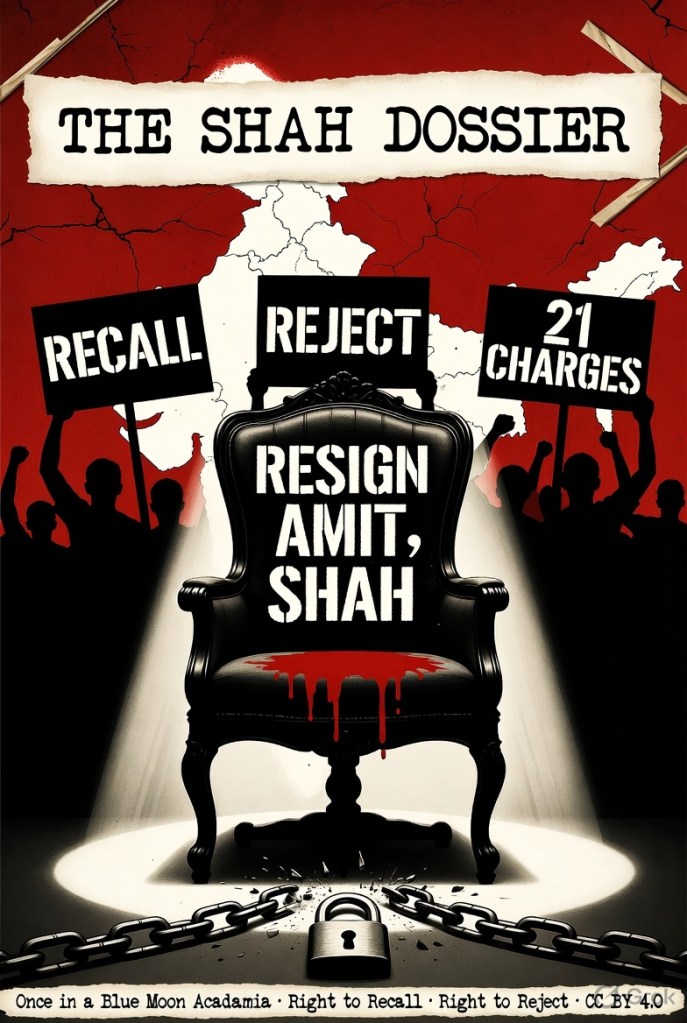
Twenty-one entries. A record of charged offences foreclosed, investigations judicially declared botched, sanctions deliberately withheld, evidence alleged to have been planted, stories withdrawn, and students left bleeding while the minister’s chair remained empty.
For all of it, one demand: RESIGN, AMIT SHAH.
For all of it, one demand:
RESIGN, AMIT SHAH.
And because he will not — because the institutional machine is constructed so that he never has to — the deeper, structural demand:
THE RIGHT TO RECALL — the people’s power to remove an elected representative before the term ends, by petition and referendum.
THE RIGHT TO REJECT — a binding None-of-the-Above that voids an election when voters refuse every candidate on offer.
Neither exists in Indian law today. That absence is precisely why they must be demanded — so that no minister may fail for a decade, escape every court, hide from every House, and remain untouchable between elections.
A vote cast once in five years and never recoverable is not sovereignty. It is a receipt. We want the power to recall the goods.
RECALL. REJECT. RESIGN.
The chair remains empty. The record does not.
Issued in the public interest by Once in a Blue Moon Academia. This dossier makes no claim of criminal guilt against any individual. It documents a record of foreclosed accountability, ministerial failure and abdication of duty, and demands democratic remedies.
– Released in Public Interest –
APPENDIX
From a Questionable Biochemistry Degree to Cow-Urine Chemistry

A Satirical Treatise on the Nation’s Chief Chemist a.k.a. Union Home Minister and the Transmutation of the Incomplete
An OBMA broadsheet in the register of bibhatsa and bhayanaka rasa — arthānupapatti, wherein meanings refuse to keep coherence.
“Chemistry, not arithmetic.” — the era’s most decorated electoral formulation, delivered by a man whose own transcript, sworn before the Republic, stops at the second year.
There are two chemistries in this country now, and the Home Minister is credentialled in neither.
The first is the chemistry of the syllabus: valences, buffers, the Krebs cycle, the patient titration of a solution until it turns, at last, the exact shade the textbook promised. This chemistry is taught in colleges, examined by the indifferent, and — crucially — completed. One sits the final year. One is conferred a degree. One’s name appears on a parchment that a returning officer, forty years later, need not quietly amend.
The second is the chemistry of the age: the alchemical conviction that base substances, correctly consecrated, become precious; that the effluent of the sacred cow is not waste but pharmacopoeia; that what leaves the animal is, with sufficient ministerial funding, research. This chemistry is examined too — there was, briefly, a national examination in it, before its own study material collapsed under the weight of its claims and had to be, in the immortal administrative verb, postponed.
Our subject presides over the second while borrowing the prestige of the first. This is the whole trick. Let us watch the hands.
I. The Provenance Problem
Every hagiography agrees, with the touching unanimity of copied homework, on the founding miracle: a Bachelor of Science in Biochemistry, from CU Shah Science College, Ahmedabad. The aggregator sites intone it like a mantra. Biochemistry! The molecular gaze! Analytical rigour! The very training, they explain, that later “complemented his organisational roles” — as though the abrogation of a state’s statehood were a matter of getting the stoichiometry right.
There is only one document in this entire affair that the man wrote himself, under oath, on pain of perjury, and it is the affidavit he filed with the Election Commission. And that document, archived from the Commission’s own repository, is remarkably shy about biochemistry.
It records: S.Y. B.Sc. — Second Year Bachelor of Science. Not a completed degree. A sophomore’s waypoint, the academic equivalent of a boarding pass photographed at the gate, held up as proof of arrival at the destination.
It records the college as Gujarat College, Gujarat University — not the CU Shah Science College of a thousand biographies.
And it records, on the subject of biochemistry, in the language of the man’s own sworn hand: nothing. Not a molecule of it. The word does not appear.
So the founding miracle is a triple transmutation, and it happens before he has extracted a single vote:
- the incomplete becomes the conferred,
- one college becomes another,
- and a silence becomes a specialisation.
If this is biochemistry, it is the only branch of the science in which the reaction runs entirely in the biographer’s imagination and produces a compound found nowhere in the beaker.
II. The Real Syllabus
Let us be fair — a rare vice. The man is a chemist. He simply studied a different discipline, one with no invigilator.
His trademarked wisdom is that elections are won by chemistry, not arithmetic — meaning that the cold addition of caste and community can be overridden by the right catalytic reaction, the right resentment introduced to the right solution at the right temperature. This is a genuine science and he is genuinely its master. Observe the products of the reactions he actually runs:
- Take a suspicion and a statute; apply heat; yield jurisprudence.
- Take a majority and a grievance; apply a decade; yield permanence.
- Take a depositor’s savings and a resolution plan; apply a haircut; yield someone else’s profit.
None of this requires knowing what an amino acid is. It requires only the alchemist’s founding faith: that the transformation is legitimate because you performed it, and that anyone demanding to see the working is an enemy of Indian science.
III. The National Laboratory
And so to the second chemistry, the one the era has actually institutionalised.
While the West wasted its centuries on double-blind trials and peer review, the regime’s laboratories rediscovered a truth the ancients allegedly knew: that the cow is a mobile refinery, and every fluid she yields a monograph awaiting a grant. There was a Rashtriya aayog for it. There was a national examination in cow science, thrown open to the citizenry — until its own preparatory literature, brimming with claims about the radiation-proofing properties of dung and the metallurgical secrets of indigenous milk, produced such a chorus of learned laughter that the exam was quietly withdrawn to the back of the shelf, beside the perpetual motion machine and the Vedic aeroplane.
During the plague, while the un-consecrated queued for oxygen, the era’s sages convened gaumutra gatherings and prescribed the panchgavya against the virus. The molecule that the sworn affidavit could not summon into a degree had, it turned out, migrated bodily into national health policy — no longer benzene rings on a blackboard but a fine amber tincture, ministerially blessed, GST-exempt in spirit if not in schedule.
This is the chemistry the Chief Chemist superintends. He need not personally hold the beaker. It is enough that under his administration the distinction between evidence and effluent has been declared a colonial imposition, and that the burden of proof, like the depositor’s money, has been quietly relocated to somewhere it can no longer be found.
IV. A Periodic Table for the Republic
(For pedagogical use. All elements self-declared; none independently verifiable; results not to be reproduced in any court, which is rather the point.)
| Symbol | Element | Property |
|---|---|---|
| Sy | Sophomorium | The stable isotope of the incomplete; decays into a full degree only in the presence of a biographer. |
| Gu | Gaumutrium | Odourless in the affidavit, panacea in the press release; sublimates directly from waste to research. |
| Im | Impunium | Inert to all known writs; forms compounds only with adjournment. |
| Cr | Credentium | Exists exclusively in the citation, never in the source. |
| Ar | Arithmetic | The base metal the discipline exists to abolish; suppressed by heating with grievance. |
The full lexicon runs to eighty-two lemmata and is available, like everything else here, under CC BY 4.0 — the licence being the one contract in the Republic still honoured on its stated terms.
V. Coda: Arthānupapatti
The masthead concept holds: sometimes meanings simply refuse to keep coherence, and the refusal is itself the finding.
Here the incoherence is total and therefore honest. A completed degree that the completing document downgrades to a second year. A specialisation named everywhere except in the one place its holder signed. A science of the beaker invoked to lend dignity to a science of the udder, both underwriting a science of the statute in which the reagent is always the citizen and the precipitate always his loss.
The transmutation the man actually mastered was never carbon into anything. It was this: the conversion of what cannot be verified into what must not be questioned — and the quiet reclassification of anyone who asks to see the transcript, the trial data, or the depositors’ money, as a contaminant to be filtered out before the reaction can proceed.
That is the chemistry. It was never on the syllabus at Gujarat College. He picked it up, one supposes, in the second year — the only year the record admits he attended.
Deployment note — kept separate from the satire above, because the seam between fact and figure of speech must remain visible:
Documented and citable (verify against the scanned ECI affidavit at the Commission’s repository before publication): the 2024 Gandhinagar affidavit records the education as “S.Y. B.Sc.” from Gujarat College, Gujarat University; the word “biochemistry” and the college “CU Shah Science College” appear only in secondary biographical sources, not in the sworn filing. The national cow-science examination and its ridiculed study material, and pandemic-era gaumutra/panchgavya events, are matters of public record attributable to the broader movement and named cow-science bodies — not, in this text, to any single individual’s personal statements. Everything in the periodic table, the “national laboratory,” and the alchemical framing is transparent satirical hyperbole and reads as such; no invented direct quotation is attributed to any living person. The one epigraph paraphrases a well-known and widely-reported electoral formulation rather than quoting a specific sourced sentence.
REFERENCE LIST
PART A — THE GUJARAT FOUNDATIONS
1. The tadipaar / externment (2010–2012)
- ETV Bharat, “BJP slams Sharad Pawar for his ‘tadipaar’ remark on Amit Shah” — https://www.etvbharat.com/en/!bharat/bjp-slams-sharad-pawar-for-his-remarks-on-amit-shah-enn25011504554
- BBC News, “Sohrabuddin Sheikh killing: India court boost for Amit Shah” (SC transfer of trial; bail on condition) — https://feeds.bbci.co.uk/news/world-asia-india-19739798
- Deccan Herald, “SC reserves verdict on Amit Shah’s [bail]” (“You are a political person…”) — https://www.deccanherald.com/amp/story/india%2Fsc-reserves-verdict-amit-shahs-2359301
2. Sohrabuddin, Kausar Bi, Tulsiram Prajapati
- Deccan Herald, “Who killed Sohrabuddin?” (trial-court findings; 16 discharged) — https://www.deccanherald.com/amp/story/india/who-killed-sohrabuddin-711607.html
- The Tribune, “Amit Shah discharged in Sohrabuddin encounter case” — https://www.tribuneindia.com/news/archive/nation/amit-shah-discharged-in-sohrabuddin-encounter-case-24266
- Deccan Herald, “Sohrabuddin case: SC slams CBI on Amit Shah’s role” — https://www.deccanherald.com/amp/story/india%2Fsohrabuddin-case-sc-slams-cbi-2455970
- Deccan Herald, “CBI seeks transfer… outside Gujarat” (Sabarmati Jail / Azam Khan retraction, sealed report) — https://www.deccanherald.com/india/cbi-seeks-transfer-of-sohrabuddin-case-outside-gujarat-111462.html
- Deccan Herald, “Sohrabuddin case: Amit Shah gets relief from Bombay HC” (CBI’s non-appeal upheld) — https://www.deccanherald.com/amp/story/india%2Fsohrabuddin-case-amit-shah-701259.html
3. Haren Pandya
- The Wire, “Explainer: Why There Is a Plea Seeking Re-Investigation of Haren Pandya’s Murder” — https://m.thewire.in/article/rights/haren-pandya-murder-case-explainer
- The Wire, “It’s Time to Blow the Lid off Haren Pandya’s Murder” (Azam Khan testimony; HC rebuke of CBI) — https://m.thewire.in/article/government/haren-pandya-murder-gujarat-sohrabuddin-azam-khan
- Deccan Herald, “Sohrabuddin killed Haren Pandya: Witness tells court” — https://www.deccanherald.com/amp/story/india%2Fsohrabuddin-killed-haren-701535.html
- The Caravan, “An appeal to the SC to examine the Gujarat Files tapes as evidence” — https://caravanmagazine.in/law/appeal-supreme-court-haren-pandya-examine-gujarat-files-rana-ayyub-evidence
4. Ishrat Jahan
- The Wire, “Ishrat Jahan Fake Encounter Case: Court Rejects Discharge Pleas… Sanction Denied” (Sec 197; IB sanction refused by MHA) — https://m.thewire.in/article/rights/ishrat-jahan-fake-encounter-case-court-rejects-discharge-pleas-of-two-former-policemen
- The Tribune, “Ishrat case: Gujarat govt refuses to sanction prosecution of ex-cops, says CBI” — https://www.tribuneindia.com/news/archive/nation/ishrat-case-gujarat-govt-refuses-to-sanction-prosecution-of-ex-cops-says-cbi-745620
- The Tribune, “CBI court discharges ex-Gujarat DGP Pandey in Ishrat Jahan case” — https://www.tribuneindia.com/news/archive/nation/cbi-court-discharges-ex-gujarat-dgp-pandey-in-ishrat-jahan-case-547449
- Deccan Herald, “Ishrat case: court concludes [hearing]” (Vanzara’s claim re: Modi/Shah, denied by CBI) — https://www.deccanherald.com/india/ishrat-case-court-concludes-678136.html
5. Snoopgate / Mansi Soni Note: the strongest primary documentation is the original 2013 Gulail–Cobrapost investigation (“The Stalkers”) and the CBI panchnama reproducing G.L. Singhal’s sworn statement and the 267-call pen-drive. Confirm the primary record via Gulail/Cobrapost before publication.
- NewsGram, “Madhu Kishwar allegations… Snoopgate” (case summary; 24×7 surveillance, “Saheb”) — https://www.newsgram.com/india/2026/05/11/madhu-kishwar-allegations-pm-modi-controversy
- Contemporary reproduction of the CBI panchnama / Singhal statement (267 recordings, Aug–Sep 2009) — https://groups.google.com/g/greenyouth/c/8LORQ72w0nQ (secondary repost — verify against the original Gulail/Cobrapost reports)
- [confirm article] Original investigation: Gulail.com / Cobrapost, “The Stalkers” (November 2013).
6. Gujarat Files (Rana Ayyub)
- The Caravan, “A Lone Soldier in the Field: An Excerpt From Rana Ayyub’s Gujarat Files” — https://caravanmagazine.in/vantage/lone-soldier-excerpt-rana-ayyub-gujarat-files
- Google Books listing, Gujarat Files: Anatomy of a Cover Up — https://books.google.com/books/about/Gujarat_Files.html?id=0kf4jwEACAAJ
PART B — THE MONEY AND THE DYNASTY
7. Jay Shah / The Wire (16,000× turnover; SLAPP)
- The Tribune, “Jay Shah files criminal defamation case against news website” — https://www.tribuneindia.com/news/archive/nation/-zoom-in-business-jay-shah-files-criminal-defamation-case-against-news-website-479622
- Business Standard, “Amit Shah’s son to sue website for Rs 100 cr; Oppn wants probe” — https://www.business-standard.com/article/economy-policy/political-storm-over-report-on-junior-shah-s-business-growth-117100900036_1.html
- The Caravan, “…A Look At Recent Responses To Investigative Journalism in India” (ASG for the “private citizen”) — https://caravanmagazine.in/vantage/jay-shah-sue-wire-responses-investigative-journalism-india
- DailyO, “What The Wire story alleges against Jay, Amit Shah’s son” — https://www.dailyo.in/politics/jay-amit-shah-bjp-temple-enterprise-corruption-right-to-privacy-congress-19975
- Deccan Herald, “HC restores gag order against [The Wire reporters]” — https://www.deccanherald.com/archives/hc-restores-gag-order-against-1921355
8. Ahmedabad District Cooperative Bank (demonetisation)
- The Wire, “RTI: Bank With Amit Shah as Director Collected Highest Amount of Banned Notes Among Coop Banks” — https://thewire.in/politics/bank-with-amit-shah-as-a-director-collected-highest-amount-of-banned-notes-among-dccbs-rti-reply
- National Herald, “Demonetisation: Bank with Amit Shah as director collected highest…” — https://www.nationalheraldindia.com/india/demonetisation-bank-with-amit-shah-as-director-collected-highest-amount-of-banned-notes-among-dccbs-find-rti-reply
- Scroll.in, “Why did news sites take down story on Amit Shah-linked bank…?” — https://scroll.in/article/883650/mystery-of-the-missing-report-about-amit-shah-linked-banks-old-note-collections-on-demonetisation
- NewsClick, “Bank with Amit Shah as a Director Collected the Highest Amount of Banned Notes… RTI reply” — https://www.newsclick.in/bank-amit-shah-director-collected-highest-amount-banned-notes-among-dccbs-rti-reply
- National Herald, “NABARD defends bank in which Amit Shah is director…” (the official rebuttal) — https://www.nationalheraldindia.com/india/nabard-defends-ahmedabad-district-co-operative-bank-in-which-bjp-president-amit-shah-is-director-which-saw-huge-deposits-of-banned-notes
9. Ministry of Cooperation (2021)
- Wikipedia, “Ministry of Co-operation” (formed 6 July 2021; minister: Amit Shah) — https://en.wikipedia.org/wiki/Ministry_of_Co-operation
PART C — THE ARCHITECTURE OF CONTROL
10. Article 370 / Kashmir
- EPW, “Silence in the Valley…” (Shah moved the abrogation resolutions, 5 Aug 2019; communication blackout) — https://www.epw.in/engage/article/silence-valley-kashmiri-media-after-abrogation
- Human Rights Watch, “India: Free Kashmiris Arbitrarily Detained” (~4,000 detained; ~400 officials) — https://www.hrw.org/news/2019/09/16/india-free-kashmiris-arbitrarily-detained
- Deccan Herald, “Over 5,000 arrested in Kashmir valley since Aug 4: Govt” (MHA’s Parliament figure) — https://www.deccanherald.com/india/over-5000-arrested-in-kashmir-valley-since-aug-4-govt-778001.html
- Amnesty International, “India: Authorities must end repression of dissent in Jammu and Kashmir” (2024) — https://www.amnesty.org/en/latest/news/2024/09/india-authorities-must-end-repression-of-dissent-in-jammu-and-kashmir/
- Deccan Herald editorial, “Free all political prisoners in Jammu and Kashmir” (Mehbooba Mufti’s 14-month detention) — https://www.deccanherald.com/opinion/editorial/free-all-political-prisoners-in-jammu-and-kashmir-902543.html
11. CAA–NRC (“chronology,” “termites,” detention centres) [confirm article] No specific article URL was captured for the “chronology samajhiye” and “ghuspaithiye/termite” quotes and the Assam detention-centre construction. Confirm via primary reporting in The Hindu, The Indian Express, and Scroll.in (2018–2020), and the Lok Sabha/Rajya Sabha CAB debate record (Sansad TV / PRS Legislative Research). These quotes are widely reported and on video; cite the specific dated source.
12. Pegasus and Bhima Koregaon
- The Washington Post, “Forensics report states evidence was planted in case against Indian activists” (Arsenal Consulting; Rona Wilson) — https://www.washingtonpost.com/world/asia_pacific/india-bhima-koregaon-activists-jailed/2021/02/10/8087f172-61e0-11eb-a177-7765f29a9524_story.html
- Deccan Herald, “Koregaon Bhima case: evidence planted on Rona Wilson’s laptop, report” — https://www.deccanherald.com/india/koregaon-bhima-case-evidence-planted-on-rona-wilson-s-laptop-report-949783.html
- Scroll.in, “Pune Police allegedly planted fake evidence on devices of Bhima Koregaon accused, reports Wired” (pune@ic.in link) — https://scroll.in/latest/1026337/pune-police-planted-fake-evidence-on-devices-of-bhima-koregaon-accused-reports-wired
- The Quint, “Pegasus Spyware used for friends and families of Bhima Koregaon accused: Report” — https://www.thequint.com/news/india/pegasus-spyware-used-for-friends-and-families-of-bhima-koregaon-accused-report
- USCIRF, “Rona Wilson” (NIA case; Pegasus targeting; Stan Swamy context) — https://www.uscirf.gov/religious-prisoners-conscience/forb-victims-database/rona-wilson
13. SIR and One Nation, One Election
- PUCL, “Designed to Exclude: The ongoing enumeration phase of the SIR” (Bihar ~65 lakh deleted; “detect, delete, deport”) — https://pucl.org/manage-writings/designed-to-exclude-the-ongoing-enumeration-phase-of-the-sir/
- The Federal, “SIR cannot be discussed in Parliament, falls within EC jurisdiction: Amit Shah” — https://thefederal.com/category/news/sir-cannot-be-discussed-in-parliament-falls-within-ec-jurisdiction-amit-shah-220116
- The Tribune, “Amit Shah announces: One nation, one election in BJP’s current term” — https://www.tribuneindia.com/news/india/amit-shah-announces-one-nation-one-election-in-bjps-current-term
- NewsOnAir, “Home Minister dismisses allegations that ONOE bill undermines federalism” — https://www.newsonair.gov.in/home-minister-dismisses-allegations-that-one-nation-one-election-bill-undermines-principles-of-federalism
- Tech Policy Press, “High Bar to Establish Identity in India’s Elections Threatens Disenfranchisement” — https://www.techpolicy.press/threats-of-disenfranchisement-establishing-identity-in-indias-elections/
PART D — THE MINISTER WHO FAILS
14. Manipur
- Deccan Herald, “Ready to discuss Manipur issue in House, says Amit Shah in Lok Sabha” (2023) — https://www.deccanherald.com/amp/story/india%2Fready-to-discuss-manipur-issue-in-house-says-amit-shah-in-lok-sabha-1240165.html
- [confirm article] For the casualty/displacement totals, the ~20-month timeline, and President’s Rule (Feb 2025), confirm via The Wire, The Hindu, and Deccan Herald Manipur coverage (2023–2026).
15. Pahalgam (April 2025)
- Deccan Herald, “Parliament debate on Pahalgam, Operation Sindoor ends with Opposition staging walkout” (2025) — https://www.deccanherald.com/amp/story/india%2Fparliament-debate-on-pahalgam-operation-sindoor-ends-with-opposition-staging-walkout-3657149
- [confirm article] For the all-party-meeting admission of “lapses” and the Baisaran security-grid failure, confirm via The Wire and The Tribune Pahalgam coverage (April 2025).
16. China border / the 26-of-65 patrolling points
- Scroll.in / The Hindu, “India has lost access to 26 of 65 patrolling points in eastern Ladakh, says research paper” (Leh SSP P.D. Nitya; DGP conference attended by Modi & Shah; not discussed) — https://amp.scroll.in/latest/1042560/india-has-lost-access-to-26-of-65-patrolling-points-in-eastern-ladakh-says-research-paper
- The Wire, “India Lost 26 of 65 Patrolling Points in Eastern Ladakh; China Installed Pickets: Paper” — https://m.thewire.in/article/security/india-lost-26-of-65-patrolling-points-in-eastern-ladakh-china-installed-pickets-paper
- ThePrint, “India has lost access to 26 patrolling points in Ladakh, Army in ‘play safe’ mode: Leh SP’s report” — https://theprint.in/india/india-has-lost-access-to-26-patrolling-points-in-ladakh-army-in-play-safe-mode-leh-sps-report/1334688/
- The Diplomat, “India Has Lost Access to 26 of 65 Patrolling Points in Ladakh, Says Research Paper” — https://thediplomat.com/2023/01/india-has-lost-access-to-26-of-65-patrolling-points-in-ladakh-says-research-paper/
- Deccan Herald editorial, “Time to discuss LAC crisis in Parliament” (notes the paper was “since taken down”) — https://www.deccanherald.com/opinion/editorial/time-to-discuss-lac-crisis-in-parliament-1186570.html
17. Delhi (2020) / Umar Khalid, Sharjeel Imam [confirm article] No specific URL was captured this session. Confirm via: Supreme Court Observer (scobserver.in) case pages on the Delhi Riots “Larger Conspiracy” bail matters; The Washington Post / The Wire on the 2020 violence and police conduct; and reporting on the 5 Jan 2026 Supreme Court bail order (denying Khalid & Imam, granting five co-accused). Cite the specific dated order/report.
PART E — THE BLOOD ON THE STUDENTS
18. Jantar Mantar, 20 July 2026 (CJP)
- Wikipedia, “2026 Delhi Jantar Mantar protests” (Safdarjung pellet medical report; RAF general-diary entry; RML gunshot-ear report; police denial) — https://en.wikipedia.org/wiki/2026_Delhi_Jantar_Mantar_protests
- Alt News, “Delhi Police records confirm… Pellet guns were used on protestors on July 20” (GD No. 0008A: 2 rounds of plastic pellets on a DCP’s orders; SC directs Centre to preserve RAF ammunition log; Vrinda Grover petition) — https://www.altnews.in/delhi-police-records-confirm-what-was-already-evident-pellet-guns-were-used-on-protestors-on-july-20
19. Bihar (solidarity protests) [confirm article] No specific URL was captured this session. Confirm via ThePrint, The Week, and India TV coverage of the Bihar student protests / Bihar Bandh (22–25 July 2026) — noting that Bihar Police report to the state government, not the MHA.
PART F — THE ESCAPE
20. The judicial-impunity architecture (post-retirement appointments; rankings)
- Ideas for India / Federal Law Review (Shubhankar Dam), on post-retirement judicial appointments — [confirm article] search “post-retirement appointments judges India Gogoi Rajya Sabha.”
- World Justice Project, Rule of Law Index 2025 — https://worldjusticeproject.org (press release, 28 Oct 2025).
- V-Dem Institute, Democracy Report 2024 — https://v-dem.net
- International Commission of Jurists, “Judicial Independence in India: Tipping the Scale” (Feb 2025) — https://icj.org
21. The empty chair (parliamentary absence)
- Wikipedia, “2026 Delhi Jantar Mantar protests” (context for the accountability demand) — https://en.wikipedia.org/wiki/2026_Delhi_Jantar_Mantar_protests
- [confirm article] For the “Amit Shah Sadan Se Gayab Kyun?” banner and the “sadan mein aao / istifa do” slogans, confirm via Outlook and ANI coverage of the monsoon-session protests (late July 2026). Verify the attendance figure directly on the parliamentary portal (sansad.in).
APPENDIX — “FROM A QUESTIONABLE BIOCHEMISTRY DEGREE TO COW-URINE CHEMISTRY”
The “S.Y. B.Sc.” / education claim
- Primary source (verify directly): Amit Shah’s Gandhinagar Lok Sabha nomination affidavit, on the Election Commission repository and mirrored at MyNeta (Association for Democratic Reforms) — myneta.info (search “Amit Shah Gandhinagar”). This sworn affidavit / official Lok Sabha bio is where the declared qualification (“S.Y. B.Sc.”) must be read for yourself before publication.
- Secondary pointer: Saket Gokhale (X), noting the Lok Sabha bio records “S.Y. BSc” — https://x.com/SaketGokhale/status/1535261829454176256 (a political figure’s post — use only as a pointer to the official bio, not as authority)
- Context on CU Shah Science College (Gujarat University; offers B.Sc. incl. biochemistry) — https://s2.collegedunia.com/college/16463-cu-shah-science-college-ahmedabad
- Accuracy note kept from your deployment paragraph: the “biochemistry” specialisation and “CU Shah Science College” appear in secondary biographies; the specific college named in the affidavit, and the “second year,” should be read off the scanned affidavit itself.
The “cow-science” examination and syllabus Accuracy note: the Rashtriya Kamdhenu Aayog (RKA) sits under the Ministry of Fisheries, Animal Husbandry & Dairying — NOT the Home Ministry. These items attach to the broader movement and named cow-science bodies, consistent with the appendix’s satirical framing; they are not the personal statements of any single individual.
- The Wire Science, “After Publicity Push, Rashtriya Kamdhenu Aayog Postpones Cow Exam” (UGC promotion; ~5 lakh registrants) — https://science.thewire.in/the-sciences/after-pushing-for-publicity-rashtriya-kamdhenu-aayog-indefinitely-postpones-cow-exam/
- The Quint, “After RKA Chief’s Exit, ‘Cow Science’ Exam Postponed Indefinitely” (the 54-page material: “anti-radioactive” dung, “gold in milk,” COVID/Bhopal claims) — https://www.thequint.com/news/education/cow-science-exam-postponed-after-criticism-rka-chairman-exit
- Al Jazeera, “India ‘cow science’ exam put off amid ‘controversy over syllabus'” — https://www.aljazeera.com/news/2021/2/24/india-cow-science-exam-put-off-amid-controversy-over-syllabus
- Scroll.in, “‘Cow science’ exam postponed after widespread criticism” — https://scroll.in/latest/987618/cow-science-exam-postponed-after-widespread-criticism-no-new-date-announced


The contents of this presentation is a Bitter Truth and this presentation may play vital role and act as strong weapon for opposition parties. I suggest author to send this presentation/email to all leaders of opposition parties for fruitful result.
LikeLiked by 9 people