This essay does not ask whether the Goods and Services Tax (GST) is well designed. That question has already been answered—by the government’s own fiscal establishment, and, since September 2025, by the government itself, which abolished two of its own slabs. It asks the graver question the concession leaves open: what kind of levy has been rewritten some nine hundred times by instruments that never passed through a legislature, whose operative text the person who must pay it cannot reconstruct from official sources, whose constitutional forum has not met for the better part of a year, whose appellate tribunal was withheld for eight years, and whose retrospective amendments are declared, after the fact, to have always been the law. The answer this essay defends is that such a levy has ceased to be a tax imposed by the authority of law within the meaning of Article 265. It has become something else: an administered price, set by the executive, published in fragments, knowable only through intermediaries, and answerable to no one who can be required to say why this rate, this date, this classification, and not another.
What the household encounters is not a statute. It is a price that arrives already decided, that may change without a reason it can locate, and that carries no accompanying account it can test. The promise was simplification; the experience has been a continuous rewriting of the terms on which ordinary life is purchased. One buys bread, medicine, insurance, or a school fee, and the levy is already inside the amount. One cannot step outside it to ask why this rate rather than another, because the reasons were never required to be published. The essay begins from that ordinary, unremarked fact—the daily encounter with a liability whose text cannot be found and whose justification need not be given—and asks what kind of power it reveals when a republic allows the most intimate of its fiscal claims to pass out of the daylight of law and into the vacancy where reasons should be.
ABSTRACT
This essay argues that India’s Goods and Services Tax (GST) has ceased to be a tax imposed by the authority of law under Article 265 and has become an administered price set by the executive—an extraction the Leader of Opposition has named, with justification, Gabbar Singh Tax. Amended some nine hundred times by notification, its operative text is no longer reconstructible by the taxpayer; its constitutional forum has not met for the better part of a year; its appellate tribunal was withheld for eight years; and its retrospective amendments are validated after the fact. The States surrendered independent taxing power for a Council whose recommendations the Supreme Court has held are not binding, a compensation guarantee inverted into a debt of the States, and a simplicity that collapsed under continuous executive rewriting. Rate changes travel by notification, Money Bill, or retrospective deeming, never requiring an elected house to defend a particular decision. The schedule is arbitrary: its differentiations answer to no published governing rule. The same method that hollowed the Insolvency and Bankruptcy Code through more than a hundred and twenty regulatory amendments and six statutes has been applied, at larger scale, to the GST. The levy is regressive, timed to electoral calendars, and accompanied by no contemporaneous statement of reasons. What was presented as a unified national tax has become a continuous, unaccountable repricing of ordinary consumption. The deepest charge is that the power to tax, reclassify, and declare that the reclassification was always the law has passed into a vacancy where reasons need not be given. The Chair that could have convened the forum, tabled the reasons, and unlocked the constitutional door has not done so. The demand is that it demit the office.
I. Two Midnights
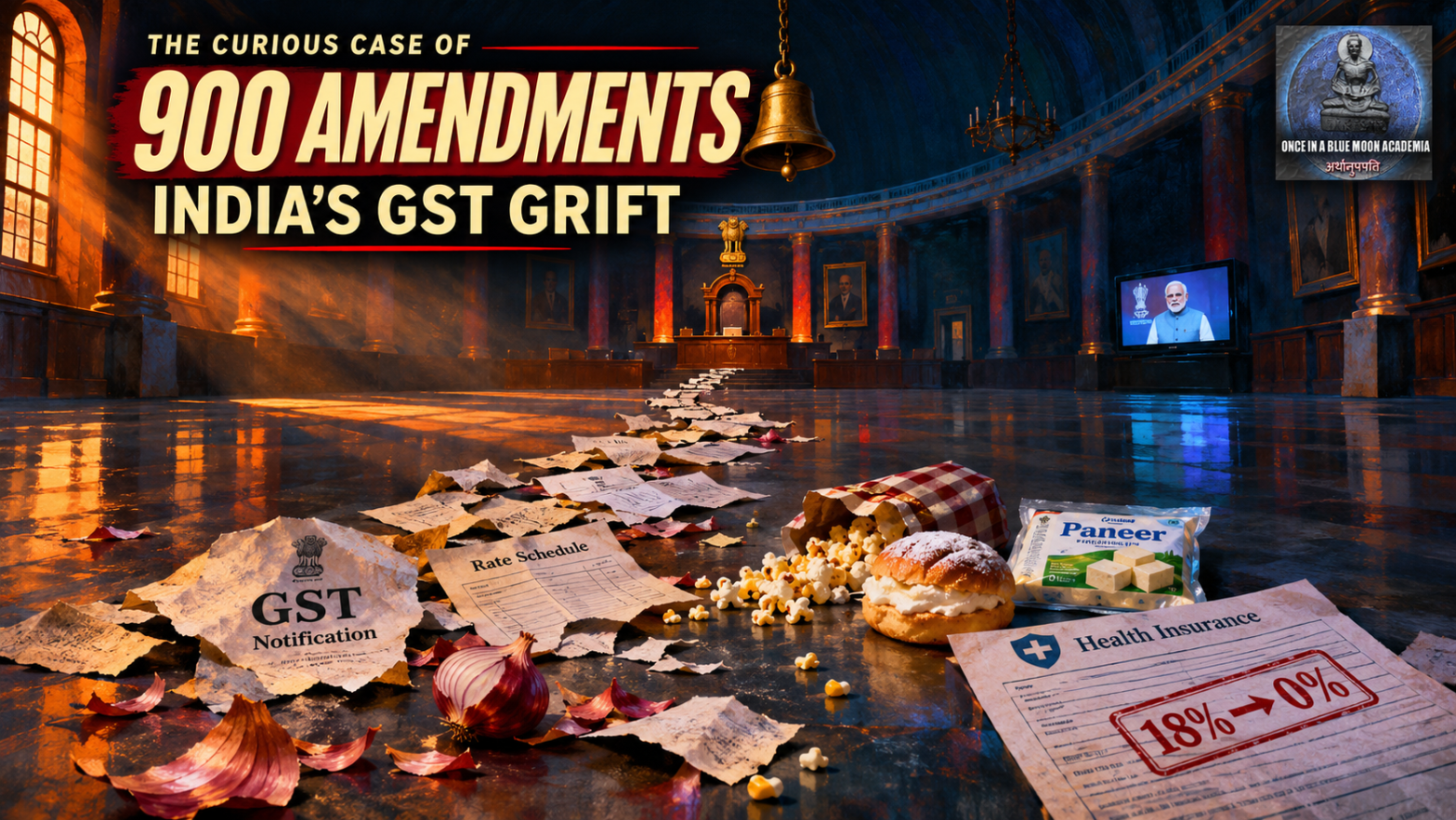
The regime that took office in 2014 has twice chosen midnight to stage an economic rupture. On the night of 8 November 2016 the Prime Minister appeared on television to announce that 86 per cent of the currency in circulation would cease to be legal tender in four hours. On the midnight of 30 June 2017 the same government convened a special session of Parliament—an occasion previously reserved for the transfer of power in 1947 and its anniversaries—to launch the Goods and Services Tax in the Central Hall, beneath the chandeliers, with a bell rung and a button pressed, the hour deliberately chosen for its resemblance to a founding moment. In both cases the state presented itself as the agent of a new beginning. In both cases the beginning was announced after dark, with the instruments of ordinary law-making already set aside.
The choice of midnight is the method made visible. A tax is an instrument of public finance. It is enacted in daylight, after debate, with notice, and its justification is left on the record so that those who will pay it can later test the claim against the costs that arrive. A spectacle is an instrument of consent. It is staged after dark, by surprise, and its justification is the feeling it produces in the watcher before the costs are known. Both of the regime’s signature economic acts were spectacles first and instruments second. Each was announced as a transformation and administered as an improvisation. In each case the improvisation was borne by those least able to contest it: the small trader, the daily-wage worker, the pensioner, and the household that discovered the new line drawn through its life only after the notification had already taken effect. The state that stages its fiscal acts at midnight is not inviting deliberation. It is manufacturing a moment in which dissent arrives too late to alter the fact. What remains, once the lights come up, is an administered change whose reasons need not be reconstructed by those who must live with it.
Demonetisation and GST are conventionally treated as separate episodes. They are better read as a single method applied twice. The method is consistent: announce a rupture with the past in the language of moral cleansing or national unity; vest the operative detail in the executive, beyond the reach of legislative deliberation; allow the costs to fall on the informal economy, which has no organised lobby and keeps no minutes; and, when the stated objective fails—as it did with demonetisation, and as the government has now effectively conceded it did with the original GST rate schedule—do not restore what was taken. Re-announce the policy as a fresh achievement. The first act destroyed the working capital of the cash economy overnight. The second, eight months later, imposed a digital compliance architecture on the survivors. The two shocks compounded on the same body: the informal sector that accounts for the overwhelming majority of employment and nearly half of output. Difference-in-differences studies later read them as successive blows rather than sequential reforms. The liquidity shock removed the medium of exchange; the tax shock then required the survivors to document, invoice, and remit in a system they had not been equipped to enter. Formalisation was the name given to the second shock. What it produced, for large numbers of the enterprises it claimed to lift, was exit.
Demonetisation was the overture. GST is the subject of this essay. The grammar is the same. What changes is only the pace at which the cost is extracted and the vocabulary in which the failure is renamed. In the first case the stated purpose was the extinction of black money; when 99.3 per cent of the notes returned, the purpose was shifted to digitisation. In the second case the stated purpose was simplicity and a unified market; when the rate schedule required nine hundred amending instruments and the average rate itself began to fall, the purpose was shifted to relief and rationalisation. In neither case was what had been taken restored. In both cases the costs were concentrated on those who could not contest the line drawn through their working capital, their inventory, or their daily purchases. The midnight staging is therefore not ornamental. It is the visible form of a method that treats the informal economy as the residual bearer of fiscal experiment, and that treats the absence of contemporaneous reasons as a feature rather than a defect. The essay that follows is an account of the second application of that method, and of the architecture that has made its continuous rewriting possible.
II. The Overture: The Grammar of Futility
Demonetisation must be stated plainly because its outcome is settled and its grammar is the grammar of everything that followed. The stated purpose was the extinction of black and counterfeit money: the Prime Minister told the nation that unaccounted wealth held as cash would be rendered worthless, and the government subsequently estimated that some ₹3 lakh crore of such wealth would never return to the banking system, a windfall for the honest exchequer.
It did not happen. When the Reserve Bank of India finished counting — a process that took it nearly two years — its 2017–18 annual report recorded that 99.3 per cent of the demonetised notes had returned: ₹15.31 lakh crore of the ₹15.41 lakh crore invalidated. Barely ₹10,720 crore failed to come back. The government had demonetised, in net effect, about ₹13,000 crore, and it had done so at a printing cost that itselfmore than doubled to ₹7,965 crore in a single year. The premise — that undeclared wealth is hoarded as currency — was false. Black money is a stock held in property, bullion and foreign exchange, not a flow trapped in banknotes, and no recall of notes can touch a stock held in other forms.
The cost was not notional. The informal sector, which transacts in cash and which accounts for close to half of national output and the overwhelming majority of employment, was deprived of its medium of exchange overnight. The Centre for Monitoring Indian Economy and subsequent academic work placed the job losses in the millions; contemporaneous reporting counted around a hundred (reported) deaths in the queues and the chaos of the first weeks, almost all of them poor. The GDP growth rate, which had been near 8 per cent, began a descent from which, by the government’s critics within the fiscal establishment, it never fully recovered. The cash-to-GDP ratio, far from falling, rose in the years that followed. Not one of the stated objectives — black money, counterfeiting, terror financing, a cashless economy — was met on its own terms.
Demonetisation is the template. A moral objective announced from a podium; the operative act vested in a sudden executive fiat with no consultation — the RBI was asked to endorse a decision already taken; the cost displaced onto the cash economy of the poor; and, when the objective failed, no apology and no restitution, only a shifting of the goalposts from black money to digitisation. Every one of these features recurs in the GST.
The continuity is not merely rhetorical. The two shocks compounded. Difference-in-differences studies of the informal sector read demonetisation and GST as successive blows to the same body — the first destroying the working capital of cash-dependent enterprise, the second imposing on the survivors a digital compliance architecture they were not equipped to meet. A tax reform launched eight months after a liquidity shock, upon an informal economy still gasping, was never going to formalise the small enterprise. It was going to break a large number of them, and it did.
III. The Promise and the Instrument
Before 1 July 2017 the taxing power was divided by design, not by accident. The Union taxed manufacture and services; the States taxed the sale of goods within their borders through Value Added Tax. Neither could enter the other’s field. That division was the fiscal substance of federalism: a State’s capacity to set its own rate, to tax or relieve according to its own priorities, and to raise revenue it did not have to request from the Centre. The largest single lever of sub-national fiscal autonomy in the Indian system was the power to tax the sale of goods.
The 101st Constitutional Amendment of 2016 dissolved that division. Article 246A conferred simultaneous power on the Union and the States to tax goods and services. Article 279A created the GST Council to recommend, in effect, a single national rate schedule. The States surrendered their independent power over the sale of goods in exchange for three promises: a seat at a Council whose decisions would be taken by consensus; a statutory guarantee of compensation for five years against any revenue shortfall below a 14 per cent growth benchmark; and the simplicity and buoyancy that a unified market was said to deliver. The exchange was presented as cooperative federalism. What was transferred was the power itself.
Later sections show what became of each promise. The consensus convention was broken by the first recorded vote in December 2019. The compensation guarantee lapsed in June 2022 and, in the interval, was converted from an obligation of the Centre into a debt of the States. The simplicity collapsed under nine hundred amending instruments. The structural point must be fixed at the outset. The States exchanged a power they held independently for a share in a power they now hold only collectively, through a Council whose recommendations the Supreme Court has since held are not binding on anyone. They gave up something enforceable for something that, when tested, turned out to bind no one. That is the exchange at the root of the GST. Every subsequent grievance is a working-out of its terms.
Arun Jaitley was the indispensable political broker of the two instruments that reordered the formal economy after 2014: the Goods and Services Tax and the Insolvency and Bankruptcy Code. As Finance Minister he chaired the overwhelming majority of the early GST Council meetings and extracted, by successive concessions, the consent of States that had resisted a national consumption tax for more than a decade. The decisive inducements were the statutory five-year compensation for revenue loss, the decision to leave petroleum products formally inside the constitutional text but outside the operative levy until the Council itself named a date, and a voting rule under which neither the Centre alone nor the States collectively could veto a proposal. Parallel to this, he piloted the IBC through Parliament, replacing a fragmented and debtor-friendly recovery regime with a time-bound process under the National Company Law Tribunal. Both measures were presented as institutional corrections—one to cascading taxes and inter-State barriers, the other to the absence of orderly exit. What they shared, and what the subsequent record has made visible, was a concentration of discretionary power in the executive that had negotiated them. The GST Council became the sole rate-setting body; the IBC placed resolution timelines and eligibility filters under a central statute administered by a regulator and a tribunal. In each case the political settlement that made the statute possible also insulated the resulting instrument from the ordinary scrutiny of a single legislature. Jaitley’s skill was to convert long-standing demands for reform into instruments whose subsequent operation would not require the same degree of inter-governmental or parliamentary consent that their passage had demanded. The consensus he extracted was real only as a temporary political settlement. The architecture it produced transferred the power to alter rates, classifications and resolution outcomes from dispersed legislatures into a smaller set of executive and quasi-judicial forums. That transfer, not the consensus that preceded it, is the lasting institutional fact. The States retained a formal seat. They lost the independent power that had made the seat necessary.
IV. Nine Hundred Amendments
The single most telling statistic about the GST is not a rate. It is a count of instruments. By a compilation current to 6 November 2022, the Central Board of Indirect Taxes and Customs had issued, since July 2017, some 907 notifications, circulars, instructions and orders amending the operative law—approximately one amending instrument every two days across five years. The figure has only grown since. One aggregator places the running total of notifications alone past fourteen hundred, though on a basis that cannot be compared without disaggregation. The precise number is less important than the pattern it reveals: a statute whose effective content is rewritten, in fragments, at a pace that no legislature could match and no taxpayer is expected to track. The law does not accumulate; it is continuously overwritten.
The number matters for what it does to the relationship between the person liable and the law. A tax is lawful, in the oldest canon of public finance and in the plain sense of Article 265, only if the person who must pay it can know what is owed. The 907-instrument compilation records that individual notifications have themselves been amended repeatedly; that the official portal offers inadequate navigational aids; and that, in consequence, the taxpayer cannot reconstruct the current operative text from official sources. The rate that applies is knowable, in practice, only through commercial consolidation services that collate, index and update what the state itself has scattered. This is the constitutional grievance in its purest form, and it is prior to any complaint about any particular rate. A tax whose current text cannot be located by the person who must pay it is not, in the relevant sense, a tax imposed by the authority of law. It is an administered price, published in fragments, knowable only through intermediaries. The state that scatters its own law and then requires the taxpayer to purchase the consolidation is not administering a statute. It is administering a market in the knowledge of the statute.
The defender of the system will say that complexity is the price of a continental economy; that any large tax is amended often; that the consolidation industry is a convenience, not a symptom. The answer is that amendment at this volume, by this instrument, with this inaccessibility, is not the ordinary maintenance of a statute. Ordinary maintenance corrects drafting error, closes an obvious gap, or adjusts a rate after deliberation. What has occurred here is the continuous rewriting of a price schedule by an authority that never has to defend any single revision on the floor of a legislature. The instrument is the notification; the forum is absent; the justification, when offered at all, is retrospective or tautological. The taxpayer is left to discover, after the fact, what the law now requires, and to pay for the discovery. The cost of knowledge has been privatised; the power to alter the liability has not.
This is not a defect of administration that better software or clearer drafting could cure. It is the mechanism. The operative law of the GST is no longer the statute that was passed, but the accumulating mass of instruments issued under it. The statute remains the formal source of authority; the notifications have become the real source of the liability. Between the two there is no requirement of public reason, no obligation to state why a good has moved from one slab to another, and no practical means for the person affected to reconstruct the chain that produced the current rate. The result is a levy that can be known only by those who can afford to buy the knowledge, and that can be altered without the cost of having to explain the alteration. That is the condition this essay indicts. The routes by which the alterations travel are the subject of the next section. What those routes have in common is that none of them requires the authority to leave a reconstructible record of why this rate, this date, this classification, and not another. The nine hundred instruments are not evidence of complexity. They are evidence of a design in which complexity is the means by which the absence of reasons is made ordinary.
V. Three Routes Out of the Legislature
The nine hundred amendments did not pass through Parliament in any meaningful sense. They travelled by three routes, each of which removes the change from deliberation, and the three together constitute the executive capture that gives this essay its title. The structure is the same one documented in the Insolvency and Bankruptcy Code (IBC). The IBC has itself been amended more than a hundred and twenty times by regulation and six times by statute (plus one more still pending), a frequency the Parliamentary Standing Committee on Finance found had caused the Code to “digress from basic design.” The GST is the larger application of the identical method: the operative content of the law is altered by instruments that never require an elected house to defend a particular decision to the people who will bear it. Both statutes remain formally on the books; both are continuously rewritten elsewhere. Both have become internally incoherent—the IBC through successive eligibility filters, haircut norms and retrospective extinguishments that no longer match its original architecture; the GST through a rate schedule whose differentiations answer to no governing rule and whose current text the taxpayer cannot reconstruct. What is presented as a statute remains formally on the books; what actually determines the liability is rewritten elsewhere, at a pace and in a form that ordinary legislative scrutiny cannot match. The three routes are not procedural details. They are the constitutional form of the levy, and they are the same form that has hollowed the IBC.
Route one: executive notification. Rate changes are effected by CBIC notification under delegated power, never by a vote. The entire restructuring of September 2025 — a nationwide repricing of the consumption basket — was operationalised by notifications 09/2025-CTR to 17/2025-CTR and 13/2025 and 14/2025-Central Tax, issued on 17 September 2025 to take effect on 22 September 2025. Five days’ notice. No debate. The schedule by which a household is taxed on everything it buys was rewritten by instruments the household’s representatives never saw.
Route two: the Money Bill. Substantive amendment of the CGST Act itself rides on the annual Finance Bill, certified by the Speaker under Article 110 as a Money Bill and therefore withdrawn from the effective scrutiny of the Rajya Sabha — the chamber in which the States are represented. Of the ten years of the levy, only 2018 and 2023 produced a standalone GST amendment Act. Every other year’s substantive change travelled inside a Finance Bill. The States, having surrendered their independent taxing power on the promise of a seat at the table, find the table’s business conducted in a chamber from which their house is structurally excluded.
Route three: retrospective validation. This is the sharpest point of identity with the IBC, and the most dangerous. When an amendment creates a new legal category, it is subsequently declared to have been merely clarificatory, and given retrospective effect — so that conduct lawful when performed becomes, by later declaration, always to have been taxable. The CGST (Amendment) Act 2023 inserted a deeming fiction treating online real-money gaming platforms as suppliers of actionable claims. In May 2026, in the Gameskraft matter, the Supreme Court held those amendments clarificatory and retrospective, and restored a show-cause notice of some ₹21,000 crore reaching back to 2017. The petitioners’ own argument names the vice exactly: the necessity of inserting a deeming fiction to make gaming companies suppliers proves that, before the fiction, they were not suppliers. A category was created and then declared to have always existed. This is the precise fiscal analogue of Section 32A of the IBC — the extinction, by a rule made afterwards, of a liability or a reliance that existed before it.
Notification removes the rate from debate. The Money Bill removes the statute from the States’ chamber. Retrospective validation removes even the past from the taxpayer’s reliance. Among the three, there is no stage at which an elected house must defend a particular decision to the people who bear it. That absence is not a defect in the GST. It is the GST’s constitutional form.
On 15 August 2021, Chief Justice of India N.V. Ramana described the state of law-making as “a sorry state of affairs.” Speaking at an Independence Day event organised by the Supreme Court Bar Association, he noted that earlier parliamentary debates had been constructive and had supplied courts with a clear picture of legislative intent; now, he said, laws were passed with “a lot of gaps” and “a lot of ambiguity,” so that “we do not know what the purpose of the law is.” The observation was made in general terms and was not directed at any single statute. It is nevertheless the judicial record of the condition under which the GST regime has operated. A tax whose operative text is altered by notification rather than by a bill that must be debated, and whose rate schedule is set in a Council whose recommendations the Supreme Court has held are not binding, is the institutional form of the absence of debate the Chief Justice described. When the purpose of a rate cannot be recovered from a legislative record because no such record was required to exist, the ambiguity he identified is not a drafting defect. It is the design.
There was, once, a reasoned proposal. On 4 December 2015 the committee headed by the Chief Economic Adviser submitted its report on possible GST rates, recommending arevenue-neutral rate of 15 to 15.5 per cent for Centre and States combined, with an express preference for the lower end; a standard rate derived from it in the range of 16.9 to 18.9 per cent; essential goods at 12 per cent; a single-rate GST in the medium term, with a two-rate structure only as a transition; and — the recommendation that reads most bitterly now — extended monitoring before any rate changes.
What was enacted eighteen months later had five slabs, a compensation cess, a 3 per cent rate for precious metals, a 0.25 per cent rate for rough stones, and a composition regime with three further rates of its own. The report of 2015 is the only document in the entire life of the levy that states a rate and gives an argument for it. Nothing issued since — not a Council minute, not a fitment recommendation, not a notification — sets out why any particular good sits in any particular slab. The reasoning ended in December 2015. Everything after is decision without ratio.
Who decides, and what they are trained to do. Three bodies stand between a commodity and its rate, and none is constituted to answer the question a rate answers. The Fitment Committee — revenue officers of the Centre and States — does the actual placing of goods in slabs; its proceedings are unpublished and it reaches the public only through a Council press release. Revenue officers are trained in classification, valuation and collection; they are not trained, and not asked, to model who bears the burden. The Council — some thirty finance ministers — records what it decided, not the analytical basis on which an item moved from twelve to eighteen; there is no fitment equivalent of a Finance Commission report or a Law Commission consultation paper, and no dissent recorded as reasoned dissent. The Union Finance Minister, as Chairperson, is the political voice of the whole. At no point in the chain from commodity to rate is there an office whose professional duty is distributional analysis, and no officeholder in the chain can be dismissed or judicially corrected for getting the distribution wrong — because none was ever charged with getting it right.
The result is not stupidity. It is a decision structure in which the question who pays, and in what proportion to what they have is nobody’s assigned business. Whim is what fills a vacancy of that kind. It is the predictable output of an institution that has abolished the office of reasons.
What a reasoned rate would have looked like. Public finance is not silent on differential commodity taxation; its criteria are a century old. Ramsey’s inverse-elasticity rule would tax inelastic goods more heavily; the schedule does not track elasticity — caramel and salted popcorn, of near-identical elasticity, were taxed at eighteen and five. Diamond and Mirrlees would not tax intermediate inputs at all; yet coal, the input to nearly the whole of Indian electricity, was moved from 5 to 18 per cent in September 2025, in the very instrument sold as relief to the common man. Atkinson and Stiglitz would make differential commodity taxation redundant where a non-linear income tax exists; India has such a tax, and used it in 2019 to cut the corporate rate to 22 per cent, while retaining an elaborately differentiated commodity tax on the population the income tax does not reach. The schedule carries more differentiation than any optimal-tax theory would justify, and its differentiation answers to none of the criteria theory supplies. That is the technical definition of arbitrariness: variation without a governing rule.
Corporate Tax vs. Direct + Indirect Taxes on the Common Public (as of November 2026; figures from Finance Act 2025/2026, CBDT provisional data, and GSTN)
Parameter
Corporate Tax (Domestic Companies)
Personal Income Tax (Individuals / Households)
GST + Other Indirect Taxes (Common Public)
Headline / Effective Rate
Concessional regime: 22% base → ~25.17% effective (flat 10% surcharge + 4% cess). Standard: 25% or 30% depending on turnover.
New regime (default): 0% up to ₹4 lakh, then 5–30%. Top marginal rate 30% (+ surcharge up to 25% + 4% cess → effective ~39% at high incomes). Old regime higher rates but with deductions.
Standard rate 18%. Reduced slabs at 5%. Special 40% on luxury/sin goods. Fuel remains outside GST (excise + State VAT).
Who Pays / Incidence
Company on its profits. Incidence can be shifted partially via pricing, but borne by capital.
Individual on salary, business, or other income. Progressive in design; narrow base (formal sector).
Final consumer on almost every purchase. Regressive: same rate regardless of income. Hits daily consumption of lower- and middle-income households hardest.
Ability to Opt Out / Avoid
Can choose concessional 22% regime; incentives, transfer pricing, and group structures available.
Limited. Salaried class has few options. Informal income largely outside the net.
None. Every purchase of goods/services is taxed at the point of consumption. Compliance costs fall on small traders who cannot easily shift them.
Collections Trend (approx.)
Strong growth; corporate tax remains a major but not dominant share of direct taxes. Net direct taxes overall ~₹23+ lakh crore range in recent years, with corporate and non-corporate both rising.
Non-corporate (personal) tax has grown and in some years approached or exceeded corporate collections, but base remains limited.
GST gross collections routinely above ₹2 lakh crore/month; annual figures in the ₹22–23+ lakh crore range. Largest single indirect instrument.
Distributional Character
Flat or lightly progressive on profits. Concessional rate explicitly designed to attract capital.
Progressive in statute; limited in practice by narrow base and exemptions.
Structurally regressive. Low-income households spend a higher share of income on taxed consumption. No equivalent of progressive slabs.
Policy Trajectory since 2019
Corporate rate cut (2019) to 22%/15% (new manufacturing). Sustained preference for lower rates on capital.
New regime expanded nil band and slabs; standard deduction raised. Some relief, but top rate unchanged.
Continuous rate changes by notification. Average effective rate has fallen from early years, but the tax remains broad-based and hard to avoid. Fuel kept outside.
The contrast in one line: Capital is offered a concessional flat rate with an exit option; labour and consumption face either progressive rates on a narrow formal base or a flat, unavoidable levy on every daily transaction. The common public pays through both the income tax on formal earnings and the GST embedded in every purchase, while the corporate sector operates under a deliberately lowered and optional regime. The difference is not only in the rate; it is in the ability to shift, avoid, or lobby the instrument itself.
The utterly arbitrary rates themselves announce the absence of a governing rule. A schedule that places essential goods at 5 per cent, ordinary consumption at 18 per cent, and selected items at 28 or 40 per cent, and that then moves the same goods between these slabs by notification with five days’ notice or none, does not express a principle of incidence, elasticity, or distribution. It expresses the power to reprice without having to state why this figure rather than another. Caramel popcorn and salted popcorn, coal as input and coal as consumption good, a health premium paid on one day and the same premium paid the next, have all been taxed at different rates with no published ground capable of sustaining the difference. The movement is not the ordinary adjustment of a statute. It is continuous, unreasoned, and unaccountable. The taxpayer who must pay the current rate cannot reconstruct, from official sources, why the previous rate applied or why it ceased to apply. The small trader who files returns against a schedule that changes faster than the returns can be reconciled absorbs the cost of the uncertainty in working capital and in penalties for mismatch. What is sold as rationalisation is experienced as harassment due to system-induced arbitrariness: not because every rate is high, but because no rate is stable, no classification is predictable, and no authority is required to leave a record that would allow the person affected to test the claim that the change was anything other than the exercise of discretion. The vacancy where reasons should be is filled by the next notification. The rates move. The reasons do not.
VII. What a ‘Thing’ Is
The comic material is irresistible, and it has done most of the public work of criticism. But laughter is a form of absolution, and a state that is merely ridiculous is not a state anyone demands reasons from. The discipline, therefore, is to let the absurdity establish a premise and then withdraw from the laughter: each instance below is a boundary at which the state was obliged to say what a thing is, and each shows the same failure — differentiation performed without any governing principle capable of sustaining it. In the Mīmāṃsaka vocabulary that is this journal’s masthead, it is vyāvṛtti without sāmānya: the stated ground — heating time, sugar content, packaging status, a detachable camera — cannot bear the weight of the conclusion drawn from it. The distinction is drawn, but the reason offered for the distinction does not reach the difference it is asked to justify. That is the epistemological core of the case.
Instance
The classificatory record
What it exposes
Roti vs paratha
Gujarat AAAR (2022): frozen parathas taxable at 18% against roti at 5%, because a paratha needs three to four minutes’ heating while a roti is ready to eat.
A tax boundary drawn by thermal state at the point of sale. GST 2.0 moved both to nil — vacating the criterion without ever repudiating it.
Malabar parotta
Kerala High Court (2024) briefly equated parotta with bread at 5%; a division bench stayed the order, restoring 18%.
Two benches of one High Court held opposite views on the taxability of a staple.
Cream bun
A plain bun bore nil GST; applying cream made it a pastry at 12–18%. Traders reported customers asking for bun and cream separately. Unified at 5% in 2025.
The tax attached not to a good but to an act of assembly on the premises. Avoidance required only deferring the assembly to the customer.
Popcorn
55th Council (Dec 2024): loose salted 5%, pre-packaged and labelled 12%, caramelised 18% (as sugar confectionery). Unified at 5% in 2025.
Three rates for one kernel, by packaging and sugar content. The most-cited single emblem of GST incoherence.
Paneer
Loose, unbranded paneer exempt; pre-packaged and labelled paneer at 5% (47th Council, July 2022).
The “pre-packaged and labelled” test of June 2022 is the generative source of most later food-classification litigation.
Pazhampori vs uniappam
A Kerala banana fritter at 18% while the comparable uniappam attracts 5%, by ingredient composition.
Regional foodways differentially burdened by a central grid built on chapter headings, not consumption function.
Drones
Personal-use drones at 28%, business-use at 5% under HSN 8806, but revenue often assessed at 18% by reclassifying them as camera equipment.
Classification by an accessory rather than principal function; three rates simultaneously arguable for one article.
The popcorn proves that no governing rule exists. The next section shows what the absence of a governing rule costs the people who cannot litigate it.
VIII. The Harassment Machine
The official story of GST is formalisation: small enterprises drawn into the tax net, digital compliance, access to credit. The evidence from the informal sector tells a harsher story of premature, forced formalisation imposed on firms that were not capability-ready, and of a compliance architecture whose costs fall most heavily on those least able to bear them.
The employment shock. Difference-in-differences work on the informal sector finds a decline in informal employment of roughly 3.7 percentage points after GST, equivalent to about 15.7 million job losses, concentrated in the most labour-intensive trades: textiles down about 5.7 per cent, retail about 6.4 per cent, leather goods about 8.3 per cent. One synthesis attributes to the cumulative shocks of demonetisation, GST and the pandemic a shave of some 4.3 per cent off GDP borne disproportionately by informal labour. These are not frictional adjustments. They are the destruction of livelihoods in the part of the economy that employs the overwhelming majority of Indians and keeps no minutes.
The compliance burden. For a micro-enterprise, GST means frequent return filing, e-invoicing, reconciliation of input credit against a supplier-populated statement, and dependence on an accountant it did not previously need. The literature is consistent: compliance costs as a proportion of turnover are sharply higher for smaller firms, and the clearest channel of distress is not the headline rate but working-capital blockage — tax paid up front and credit released late, draining the cash that a small business lives on. A trader who cannot navigate the GSTN portal, or whose supplier failed to upload an invoice, loses the input credit it has already paid for; under the Ecom Gill ruling the burden of proving the supplier’s genuineness falls on the buyer. The honest small purchaser is made the guarantor of a stranger’s compliance.
The irony at the centre. GST was sold as the architecture that would end tax evasion through an unbreakable digital trail. It has instead produced an industrial economy of fabricated invoices. The Central Board of Indirect Taxes and Customs detected ₹36,374 crore of fake input-tax-credit across 9,190 cases in 2023–24 alone; a single nationwide drive between May and December 2023 identified over 29,000 bogus firms and some ₹44,000 crore of evasion. In November 2025 one Delhi syndicate alone was found running 229 dummy firms passing ₹645 crore of fake credit, the proceeds allegedly rotated through an NGO and a political outfit. The system that harasses the genuine small trader for a mismatched invoice is routinely defeated by organised fraud operating hundreds of shell companies. Surveillance of the compliant and impunity for the syndicate are not opposite failures; they are the same design, which trusts the paper trail over the person and so rewards whoever can manufacture paper.
A 2025 investigation by BBC News Hindi into six Gujarat-based Registered Unrecognised Political Parties (RUPPs) showed that these entities received approximately ₹1,700 crore in donations in FY 2023–24 while fielding only fifteen candidates in the 2024 Lok Sabha election. One of them, the Aam Janmat Party, declared ₹620 crore—more than double the Congress’s reported income that year—yet contributed negligible electoral activity. Offices of several were found shuttered or vacant. The pattern is not isolated. Of roughly 2,858 registered parties, nearly 2,800 are RUPPs; the Election Commission later delisted hundreds for non-contestation or audit failures. The statutory architecture that makes this possible is an interlock of light-touch registration under Section 29A of the Representation of the People Act, complete income exemption under Section 13A of the Income Tax Act, 100 per cent donor deductions under Sections 80GGB and 80GGC, and the corporate contribution route under Section 182 of the Companies Act. Run in reverse, the provisions allow taxable income to be routed through a party name, converted into a deduction for the donor, and returned, net of commission, as cash or other untraceable value. The entity is juridically valid and operationally vacant. It is the political analogue of the shell company: the value lies not in what the organisation does in public but in the privileges the State attaches to its registration. The same opacity that permits a Gujarat RUPP to absorb deductible funds with almost no electoral output is the opacity that, elsewhere in the system, permits corporate contributions to travel through bonds, trusts, or related-party vehicles without a public reconstruction of the beneficial interest. In both cases the form is real; the public function it is supposed to serve is not required to be demonstrated.
And the collections rise. Through all of this, the exchange gathers more than ever. Gross GST collection reached ₹2.31 lakh crore in October 2026, the second-highest month on record, up 22.9 per cent year on year. A buoyant headline is the government’s standing answer to every criticism in this essay. It is also the proof of the criticism: a consumption tax that extracts record sums from a population whose informal half it has hollowed out is not a sign of prosperity reaching the people. It is a measure of how efficiently the state now reaches into the daily purchases of those who have the least power to refuse.
IX. The Council That Is Not a Legislature
In Union of India v. Mohit Minerals (19 May 2022) the Supreme Court held that the recommendations of the GST Council are persuasive, not binding; that legislative competence flows independently to Parliament and the States from Article 246A; and that to treat the Council’s recommendations as binding edicts would disrupt fiscal federalism, which it described as a dialogue between cooperative and uncooperative federalism. The ruling was immediately described by some as a vindication of the States. It is honoured entirely in the breach.
The Council functions in practice as a legislature whose output is executed by notification, while remaining in law a merely recommendatory body. The consequence is a closed circuit of accountability in which every actor, asked who is answerable for a rate, has a true thing to say that passes the question onward, and the conjunction of true statements leaves no one answerable at all.
Body
What it says when asked
On what footing
GST Council
“We only recommend; our recommendations do not bind Parliament or the States.”
Mohit Minerals: binding edicts would disrupt fiscal federalism.
Parliament
“We passed a Finance Bill. Rate-setting is delegated; the schedules were never before us.”
Article 110 certification; only 2018 and 2023 produced a standalone amendment Act.
Union executive
“We notified what the Council recommended. The policy choice was not ours.”
Notifications 09/2025-CTR to 17/2025-CTR, 17 September 2025.
The courts
“Rate-fitting is fiscal policy, allowed the widest latitude. We do not sit over economic choices.”
The settled deference in Article 14 challenges to taxation.
State legislatures
“We ratified a decision made elsewhere. Our base was surrendered in 2016; our guarantee lapsed in 2022.”
Article 246A; lapse of the five-year compensation guarantee with nothing to replace it.
Every actor has a true statement to make, and the conjunction produces a domain in which a levy reaching every household daily is set by no one who can be held to it. This is the impunity loop restated in fiscal terms—structurally identical to the one documented in the DHFL resolution and the bulldozer demolitions: a chain of individually lawful transfers of responsibility whose aggregate effect is that a harm occurs and no office answers for it. The rate is decided, notified, collected, and defended; the person who must pay it cannot identify the office that is required to justify it. The circuit is closed not by conspiracy but by the architecture of competence itself.
The door that was never unlocked. Article 279A(11) is not permissive. It provides that the Council shall establish a mechanism to adjudicate disputes between the Union and a State, or among States, arising out of the Council’s recommendations or their implementation. In nine years it has never been constituted. The States that dissented over compensation in 2020 had no forum; the States now losing revenue as the average rate falls have no forum; the taxpayer has no forum in which the schedule itself can be tested. The Constitution provided the door. It has not been unlocked, and unlocking it requires only that it be placed on an agenda—which is the function not of the Council collectively but of its Chairperson alone. The mandatory mechanism remains unbuilt. The recommendatory body continues to set the rates that the non-binding ruling said it could not bind. The vacancy is not an oversight. It is the condition under which the levy can be rewritten without any single office having to defend the rewriting. To the Chairperson we return in Section XIV.
X. Compensation and Its Inversion
The compensation guarantee was the consideration for which the States surrendered their independent taxing power. Its history is the history of that consideration dishonoured.
The first default came in November 2019, when the finance ministers of Rajasthan, Kerala, Delhi, Punjab and West Bengal publicly demanded the August–September dues—the first delay since rollout—and asked for a dispute-resolution mechanism that, as Section IX records, has still not been built. Then came the pandemic, and the most revealing episode in the whole federal story: the 41st Council of August 2020, at which a compensation shortfall of ₹2.35 lakh crore was split by the Centre into ₹1.10 lakh crore attributed to “GST implementation” and ₹1.25 lakh crore attributed to an “act of God.” The States were offered not compensation but two options for borrowing it themselves. Kerala, Punjab, West Bengal, Chhattisgarh and Jharkhand dissented. A statutory obligation of the Union was, by this manoeuvre, converted into a debt of the States. What had been a guarantee against revenue loss became a liability the States were invited to finance on their own account.
The political geography of that refusal is not incidental. The States that rejected the Centre’s options were overwhelmingly those governed by parties other than the one in power at the Centre. Many BJP-ruled States accepted the borrowing arrangement. The pattern reappeared in later disputes over rate rationalisation and the post-2022 landscape. When GST 2.0 was advanced in 2025, finance ministers from eight opposition-ruled States again met separately to demand a compensation mechanism for the revenue loss the rate cuts would produce. The Council proceeded without one. The slogan of so-called “double engine” government—two governments of the same party, Centre and State, supposedly delivering faster development—functions in this record as more than campaign rhetoric. It names a practical distinction: aligned governments are offered the path of least resistance; non-aligned governments are left to argue, in public, for the consideration they were promised in 2016–17. The original bargain is not enforced uniformly. It is mediated by political alignment.
The inversion was then completed. In September 2021 the compensation cess—a levy raised under the Constitution to compensate the States—was extended to 31 March 2026 not to compensate anyone but to service the back-to-back borrowings the Centre had taken on in lieu of compensating them. A tax levied for the States’ benefit was continued to repay the debt the Centre incurred by not benefiting them. In June 2022 the five-year guarantee lapsed. The States assumed full revenue risk under a destination-based model that structurally disadvantages the producing States, with no permanent equalisation mechanism to replace what they had lost. The Centre has since stated, in Parliament, that no alternative compensation framework is under consideration. The fund raised to make the States whole was redirected to service the Centre’s debt; the beneficiary was made the guarantor; and the instrument of protection became the instrument of extraction. What was surrendered in 2016 was independent taxing power. What remains is a residual claim on a pool whose size and distribution the Centre continues to shape, without the obligation that was the price of the surrender.
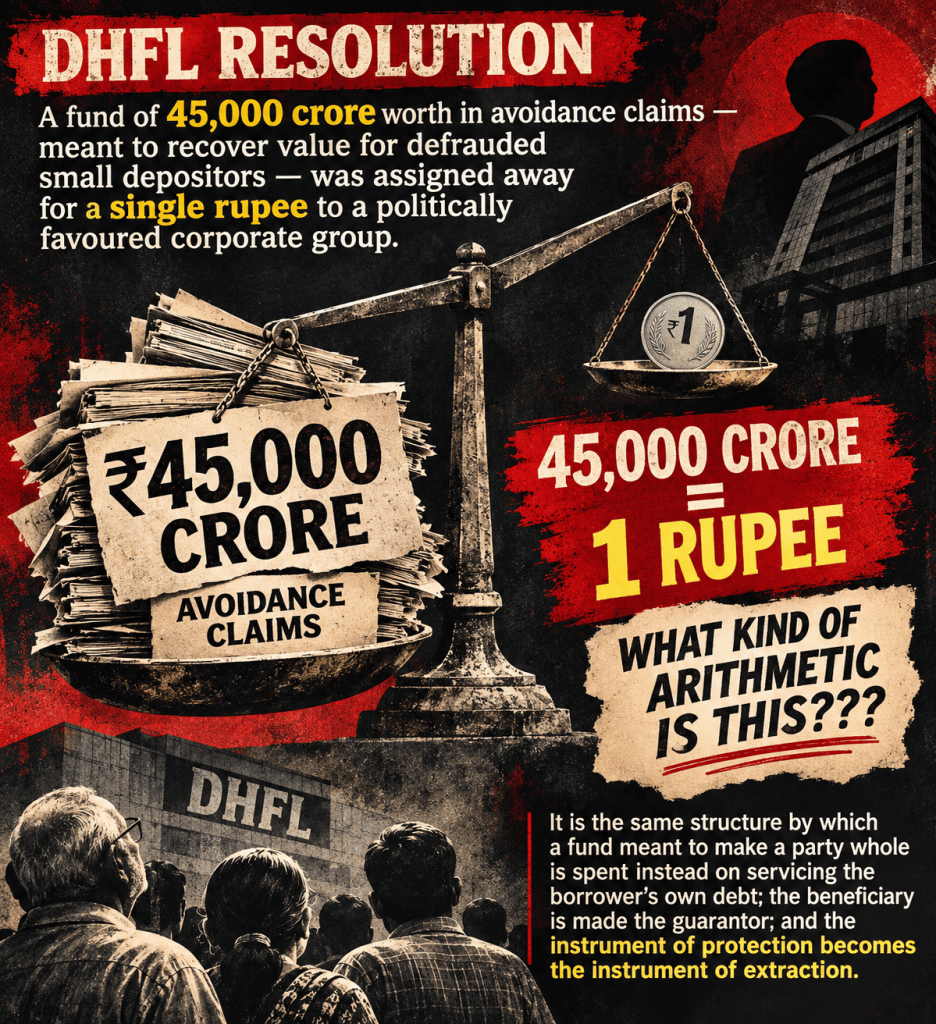
This is the estate-funding inversion in its clearest fiscal form. The fund raised to make a party whole is spent instead on servicing the borrower’s own debt; the beneficiary is made the guarantor; and the instrument of protection becomes the instrument of extraction. It is the same structure by which, in the DHFL resolution, a fund of 45k crore worth in avoidance claims meant to recover value for defrauded small depositors was assigned away for a single rupee to a politically favoured corporate group. The direction of the betrayal is identical; only the scale and the victim differ.
The concentration of benefit at the other end of the same system is not symmetrical. Rate changes under GST 2.0 reduced the tax on cement, removed the compensation cess on coal, and lowered the rate on renewable-energy equipment. Large groups with exposure across cement, power and renewables—most visibly the Adani group—stood to gain from lower input costs and improved project economics. Reliance publicly welcomed the rationalisation as a boost to consumption. These are not secret concessions. They are the public, sectoral consequences of decisions taken in a Council whose agenda is set by the Centre and whose recommendations are executed by notification. What is absent is any corresponding public reasoning that weighs those gains against the revenue loss to States that no longer have an independent rate-setting power and no longer have a compensation guarantee. The small trader and the informal enterprise, already carrying the compliance burden described earlier, receive no equivalent structural relief. The same instrument that extracts from the daily purchases of the many adjusts the cost structure of the few without a published account of the distribution.
The pattern is therefore double. Between Centre and States, the original bargain has been inverted and the residual discretion has been exercised in a manner that tracks political alignment. Between the State and the largest private concentrations of capital, the same rate schedule that extracts from the consumption of the many has repeatedly adjusted in ways that improve the cost structure of the few. Neither movement is required by the statute. Both are consistent with a system in which the power to set and reset the levy has moved out of the legislature and into an executive forum that need not publish its reasons and need not answer, in any single forum, for the distribution of the resulting costs and gains. The States surrendered independent taxing power for a share in a collective decision that has proved non-binding and non-compensatory. The largest corporate groups have not had to surrender anything. They have received, through the same notifications that reprice ordinary consumption, a reduction in the costs of the inputs on which their expansion depends. The asymmetry is not an accident of classification. It is the predictable output of a rate-setting process that has abolished the requirement to state why one set of costs is relieved and another is not.
XI. Who Pays?
In December 2019, during a Lok Sabha discussion on the sharp rise in onion prices, Finance Minister Nirmala Sitharaman was interrupted by a member who asked whether she ate the onions then being imported from Egypt. She replied that she did not eat much onion or garlic and came from a family in which these were not of much importance. The episode remains instructive. Onion is a staple whose price movements are watched by households that cannot treat it as optional. A short, sharp surge—three or four days of elevated retail prices—is frequently enough for intermediaries and holders of stocks to extract a concentrated margin of profit before the price returns toward its earlier level. The profit is realised in the interval; the household that must buy daily absorbs the cost. The same pattern of brief, high-margin extraction appears, in institutional form, in the GST rate schedule. Items move between slabs by notification, sometimes with only days of notice, and the change is presented as relief or correction without a published distributional analysis of who gains in the window between announcement and adjustment, or of who bears the compliance and cash-flow cost of the prior rate.
The distance revealed by the onion exchange is not personal dietary preference. It is the structural separation between the office that sets and resets the levy and the daily consumption on which the levy falls. Rate changes under GST have repeatedly been justified after the fact as responses to classification disputes, revenue needs or electoral calendars, yet the operative text remains fragmented and the reasons for any particular placement unpublished. The person who must pay cannot reconstruct, from official sources, why a good sat in one slab for years and then moved, any more than a household can reconstruct why the onion price spiked for three days and then subsided once the margin had been taken. In both cases the short interval is the mechanism: the spike or the rate change creates a window in which value is extracted, after which the visible price or the announced relief returns toward normal and the episode is treated as closed. The Finance Minister’s reply in 2019—that onion was not of much importance in her household—illustrates the practical condition under which such windows can be left unexamined. An office charged with the continuous administration of a consumption tax that reaches every household is not required, under the present design, to demonstrate that it has modelled the incidence of its own instruments on the goods that those households cannot avoid. The vacancy of that requirement is what the onion episode, and the nine hundred amendments that followed it, both leave visible.
The distributional charge against GST must be made with care, because its strongest version is contested and its defensible version is more than enough. The contested figure, from Oxfam’s Survival of the Richest, holds that about 64 per cent of GST is paid by the poorest half of the population while the richest tenth contributes a small fraction. That figure relates to tax collected on selected food and non-food items, not to total GST revenue, and should be cited only with that qualification. The structure of a consumption tax is inherently regressive, because the poor consume a larger share of their income than the rich and are therefore taxed on a larger share of it. Since 2020–21 the share of indirect taxes in the exchequer rose substantially while the share of direct taxes in gross tax revenue fell—a shift of the burden from income and wealth, which the rich hold, toward consumption, which the poor cannot avoid. The comparator seals the argument: in 2019 the same government cut the corporate tax rate to 22 per cent, forgoing revenue from those most able to pay, while retaining an elaborately differentiated consumption tax on those least able. The direction of the whole fiscal programme—corporate relief above, consumption extraction below—is not in dispute even where the single headline percentage is. What the onion interval and the nine hundred amendments share is the same structural fact: a short window in which value is extracted, followed by a return toward the visible normal, without a published account of who gained in the interval or who bore the prior cost. The household that must buy daily has no equivalent of the corporate option to exit the regime. It pays the rate that is notified, and it pays again for the knowledge of what the rate now is.
The same preference—extraction from what cannot be avoided rather than from what can be concealed—was already visible, on a mass platform, more than a decade earlier. In March 2014, on Satyamev Jayate (Season 2, Episode 4), Aamir Khan examined the gap between the country’s aggregate wealth and the condition of most of its citizens, linking it to corruption, black money and the limited reach of direct taxation. The episode did not offer a full incidence analysis of indirect taxes, but it placed on a mass platform the simple observation that much of the public revenue system failed to touch unaccounted wealth while everyday costs continued to be borne by ordinary households. That observation remains relevant to the later GST regime. A consumption tax whose operative rates are set by notification, whose formal text is hard to reconstruct, and whose burden falls on a population that cannot opt out of buying food, fuel or basic services, continues the same structural preference: extraction from consumption rather than from income and wealth that can be hidden or relocated. The 2014 discussion treated the problem as one of evasion and weak direct taxation. The GST record shows that the problem can also be institutionalised—by design—inside the indirect tax itself. What was then presented as a failure of enforcement has become, under the present architecture, a feature of the levy.
For fiscal federalism the sharpest figure comes from within: the former Kerala finance minister Thomas Isaac has noted that the average GST rate fell from about 15.3 per cent at rollout in 2017 to about 9.8 per cent by 2025—a hollowing-out of the tax base that, he argues, will severely erode the fiscal capacity of the States that surrendered their own revenue to enter it. The rate was set too high to begin with for the goods of the poor and is now being cut, for the goods of the comfortable, in a manner that starves the States—and, as the next section shows, on a calendar that is electoral rather than fiscal. The States that gave up independent taxing power for a share in a buoyant national levy now face a declining average rate without the compensation that was the price of the bargain.
The record of collections under GST has risen to successive highs while the corresponding return to the ordinary household has remained thin, episodic and largely short-term. A consumption tax that reaches into the daily purchases of those least able to refuse extracts resources from the same population that depends most heavily on public goods—primary health, public education, nutrition, water, sanitation and basic infrastructure. Yet the post-GST period has not produced a measurable expansion in the quality or coverage of these services proportional to the revenue gathered. Health expenditure as a share of GDP has remained low; out-of-pocket spending continues to dominate household health costs; learning outcomes in government schools have stagnated or declined on successive surveys; and the physical infrastructure that would convert revenue into lasting productive capacity—rural roads, reliable power for small enterprise, urban water systems—has advanced unevenly and often through project-mode schemes rather than through durable, locally accountable systems. What has expanded more visibly is the architecture of short-term transfers and temporary relief: free or subsidised foodgrain under successive extensions of the public distribution scheme, one-time or recurring cash transfers timed to electoral calendars, and rate cuts on selected items announced as festivals of savings. These measures blunt immediate hardship for some households, but they do not alter the underlying capacity of the state to deliver continuous services. They function as residual claims on a revenue base that has already been collected, not as evidence that the levy is financing a welfare state.
The distinction between short-term relief and long-term return is structural, not merely a matter of implementation lag. A welfare government, in the classical sense, converts progressive or at least proportional extraction into public goods that raise the permanent income and security of those who pay. The GST regime has inverted the sequence. The extraction is broad, continuous and difficult to evade at the point of consumption; the return is selective, discontinuous and politically timed. Rate reductions on insurance, food items or consumer durables appear when an election or an external shock makes them expedient, yet they arrive without restitution of earlier collections and without a published assessment of their net incidence after compliance costs and blocked input credits. Meanwhile, the informal enterprises that absorbed the compliance burden and the employment losses described earlier receive no equivalent capital, credit or infrastructure that would allow them to formalise on terms they can sustain. The result is a fiscal system that can demonstrate rising collections and occasional relief while leaving the stock of public capital—schools that teach, clinics that function, cities that do not flood—largely unchanged for the majority. In that sense the common people are not receiving a return on the tax; they are receiving intermittent offsets against a levy whose design and administration have already shifted the burden onto them. The silence on long-term service delivery is not an oversight. It is consistent with a taxing power that has been gathered into an executive which need not defend, before any single forum, either the rate it sets or the public goods it fails to build with the proceeds.
The same architecture that has dissolved independent taxing power for most goods has deliberately preserved it for the single most important commodity in the daily economy. Petrol and diesel remain outside GST by constitutional design, not by oversight. Article 279A(5), inserted by the 101st Amendment, requires the GST Council to recommend a date on which GST shall be levied on petroleum crude, high-speed diesel, motor spirit (petrol), natural gas and aviation turbine fuel. Section 9(2) of the CGST Act mirrors the exclusion until that date is notified. No such recommendation has been made. The reason is revenue. Petroleum taxation is one of the few remaining inelastic, high-yield bases still under the independent control of both the Centre (excise) and the States (VAT). For many States, VAT on petroleum products has accounted for a substantial share of own-tax revenue—often cited in the range of 15–30 per cent depending on the year and the State—while central excise on fuel has similarly formed a large and reliable component of Union indirect-tax collections. Bringing these products under GST would replace two independent levies with a single Council-determined rate (even at the highest slab plus cess), force revenue sharing, eliminate the cascading but also the independent rate flexibility both levels currently enjoy, and expose collections to the volatility of international crude prices under a destination-based system. The GST Council has considered the matter—most notably at its 45th meeting in September 2021, convened in part because of a Kerala High Court direction—and recorded that it was not the time. Finance Minister Nirmala Sitharaman has stated on multiple occasions, including after the GST 2.0 decisions of 2025, that the Centre is legally ready but that inclusion requires the States’ agreement, which has not been forthcoming. The exclusion therefore preserves, for the commodity that enters every household’s transport and every firm’s logistics, precisely the dual, non-Council taxing power that the rest of the GST architecture was designed to dissolve. It is the clearest remaining exception to the claim of a unified national tax, and it is maintained because both the Union and the States continue to prefer an independent, high-yield instrument over the discipline of a shared rate and a shared pool. What was surrendered for almost everything else was retained for the one base neither side was prepared to place under the Council’s control.
XII. GST 2.0 and the Electoral Calendar
On 15 August 2025, from the ramparts of the Red Fort, the Prime Minister announced a next-generation GST reform — nineteen days before the Council that supposedly decides such things met to consider it. The 56th Council of 3 September 2025 then adopted it: the 12 and 28 per cent slabs abolished, their contents redistributed into 5 and 18 per cent, a new 40 per cent demerit slab created, and individual life and health insurance exempted. The government promoted the result as the “GST Bachat Utsav,” a festival of savings, in its own name.
The timing is legible against a calendar that is not fiscal. The cuts, estimated to cost the Centre and States on the order of twenty billion dollars a year, arrived immediately before the Bihar assembly election and amid a punitive 50 per cent United States tariff that had made domestic demand suddenly precious. Former finance minister P. Chidambaram’s verdict was that the rationalisation was welcome but eight years too late, and that the original design ought never to have been introduced. The reform is not evidence that the system self-corrects. It is evidence that the system corrects when, and only when, an election and a trade shock make correction expedient.
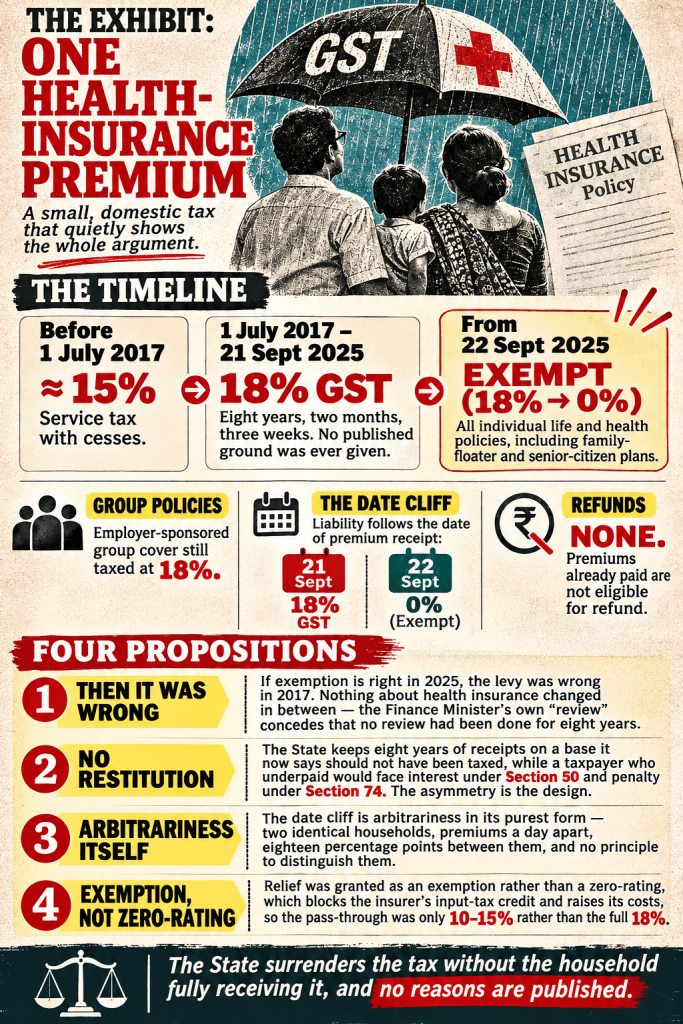
The exhibit: one health-insurance premium. No instance demonstrates the whole argument more economically than the tax on a health-insurance premium, because it is small, domestic, and repeated across tens of millions of households.
Period
Position
Before 1 July 2017
Premiums bore about 15% — service tax with cesses.
1 July 2017 – 21 Sept 2025
18% GST. Eight years, two months, three weeks. No published ground was ever given for treating health cover as a standard-rated service.
Four propositions follow. First: if exemption is right in 2025, the levy was wrong in 2017, and nothing about health insurance changed in between — the Finance Minister’s own word, “review,” concedes that no review had been done for eight years. Second: the concession carries no restitution; the State keeps eight years of receipts on a base it has now declared should not have been taxed, while a taxpayer who had underpaid across those years would face interest under Section 50 and penalty under Section 74. The asymmetry is the design. Third: the date cliff is arbitrariness in its purest form — two identical households, premiums a day apart, eighteen percentage points between them, and no principle to distinguish them. Fourth, and least noticed: the relief was granted as an exemption rather than a zero-rating, which blocks the insurer’s input-tax credit and raises its costs, so that the pass-through to the policyholder was estimated at only 10–15 per centrather than the full eighteen. The State surrenders the tax without the household fully receiving it, and whether the cheaper instrument was chosen knowingly is unknowable — because, as always, no reasons are published.
The refusal to publish reasons is not an omission. It is the operative method. A notification that moves a rate, an exemption that arrives after eight years, a compensation shortfall that is reclassified as an “act of God,” a recommendation of the GST Council that the Supreme Court has held binds no one—all of these instruments are issued without a contemporaneous statement of the grounds that would allow the person affected to test them. The statute requires the levy; it does not require the authority to show why this rate, this date, this classification, and not another. The vacancy is then filled by the political claim that the decision was taken in the public interest, a claim that cannot be falsified because the record that would falsify it was never required to exist. This is the will to hide (erit celare): not simply as the concealment of a particular fact, but the structural decision that the reasons for the exercise of power need not be reconstructible by those who must obey it. The same apparatus that registers shell parties, routes funds through trusts that answer to no audit, and converts a statutory compensation into a debt of the States operates by the same rule. What is visible is the instrument; what is withheld is the chain of decision that produced it. The taxpayer, the State, and the citizen are left to reverse-engineer intent from outcomes, while the authority that issued the instrument retains the privilege of never having to state it. The asymmetry is not accidental. It is the condition under which the continuous rewriting of the levy remains possible.
XIII. The Uncontradictory Contradictions
The regime’s economic conduct is full of contradictions that never resolve, and they never resolve for a structural reason: they are never brought into the same forum. Jurisdictional segregation is what keeps them non-contradictory. Set the paired assertions side by side — something no single tribunal is ever required to do — and the pattern makes its own argument.
The state asserts
And, at the same time
Demonetisation will extinguish black money
99.3% of the notes return; the exercise nets about ₹13,000 crore
GST 2.0 is relief to the common man (Sept 2025)
Coal moves 5% → 18% in the same instrument
Section 171: traders must pass on every rate cut, on pain of penalty
No restitution of eight years of tax on a base now conceded exempt
Section 11A: a codified power to forgive tax lawfully due
Gameskraft: retrospective creation of liability for conduct untaxed when performed
Formalisation will lift the small enterprise
~15.7 million informal jobs lost; working capital drained
The digital trail will end evasion
₹36,374 crore of fake ITC in 9,190 cases in one year
₹16.35 lakh crore of corporate loans written off in a decade
23% recovery for DHFL’s retail depositors; avoidance claims assigned for ₹1
Standing Committee (2021): IBC haircuts are unsustainable
Haircut still around 77% in September 2025
No single forum is ever obliged to hold two cells of any row at once. The Council pleads it only recommends; Parliament pleads delegation; the executive pleads the Council; the court pleads deference; the insolvency tribunal never hears the tax case and the tax tribunal never hears the insolvency case. Each contradiction survives because it is adjudicated, if at all, in a venue that sees only one of its halves. This is the impunity loop stated not as metaphor but as a fact about jurisdiction: the contradictions are uncontradictory precisely because the architecture is built so that no one has to look at both columns on the same day.
XIV. The Demand: Accountability of the Chair
May one call for the resignation of the Union Finance Minister who has held the Chair of the GST Council throughout the life of the levy? One has to. The Leader of Opposition has already legitimately named it what the record shows it to be: Gabbar Singh Tax—an extraction that arrives without notice, without published reasons, and without restitution, exacted from those who cannot refuse and administered by an authority that need not answer for the taking. The demand must be aimed with precision, or it collapses on first rebuttal. The Council sets rates by a weighted majority in which the Union commands one-third; to say the Chair “set the popcorn rate” invites the true answer that thirty ministers voted. The demand survives only when it is aimed at the failures that lie in the Chair’s own gift—the things that could have been done, or prevented, acting alone, without a single other vote.
The test is simple. For every alleged failure, ask: could the Chair have cured or prevented it acting alone? If yes, it is the Chair’s, and no invocation of Mohit Minerals or the States’ two-thirds weightage answers it. Applied honestly, the test discards the collective acts and isolates these:
Convening. The Council’s own rules require a meeting at least once a quarter. After the 55th meeting of December 2024 it did not meet until September 2025, and as this essay goes to press the 57th has yet to be convened—a cumulative silence exceeding a year against a self-imposed rule. Calling a meeting needs no vote. It needs the Chair.
The agenda. The Council Secretariat sits under the Union Finance Ministry; what reaches the table is settled at the Centre. Rate rationalisation, insurance and the compensation-cess successor were deferred, meeting after meeting, by not being tabled. An item never tabled cannot be voted down; non-tabling produces the result of defeat while incurring none of its visibility.
Reasons. Whether Fitment Committee recommendations are published, with their basis, requires no majority. Nine years of non-publication is an administrative choice taken and re-taken by one department.
The constitutional door. The mandatory mechanism under Article 279A(11) has never been established, for nine years. It would be discharged by a single agenda item.
To these, add the purely executive failures that never involved the Council at all: five days’ notice between notification and a nationwide repricing; the withholding of the GST Appellate Tribunal for eight years, so that every taxpayer in that window had a right of appeal on paper and no forum in fact; and the refusal of restitution where a levy has been conceded to be misclassified.
The move that forecloses the defence is the claim of authorship. The Union cannot claim credit when rates fall and plead the Council’s merely recommendatory character when the schedule is challenged. The reform of September 2025 was announced by the Prime Minister from the Red Fort nineteen days before the Council met, presented by the Finance Minister in the first person, and promoted as a government festival. A decision announced by the Union before the body considers it, and sold as the government’s achievement, cannot then be disowned as merely the Council’s recommendation when its incoherence is put in issue. One may have Article 279A as a shield, or the Red Fort as a platform. One may not have both.
The office of Chairperson of the GST Council is not honorific. It carries the power to convene, the power to set the agenda, and the mandatory duty under Article 279A(11)—each exercisable alone. Over nine years the agenda power has been used to keep rationalisation, insurance and compensation off the table for years at a time; the convening power has lain unused for a cumulative period beyond a year; and the constitutional duty has not been exercised at all. This essay does not allege that the Chair set any particular rate. It alleges the narrower and graver thing: that the officeholder charged with keeping the constitutional forum alive has not kept it alive, and has simultaneously claimed authorship of its output from a public platform. The first is a failure of duty; the second forecloses the defence. On that record the office has not been discharged. The continuous rewriting of the levy, the inversion of the compensation guarantee, the nine hundred instruments whose reasons were never required to exist, and the silence of the forum that was meant to deliberate them, are not the work of an impersonal system. They are the record of an office that possessed the power to convene, to table, to publish, and to unlock the constitutional door, and that used that power instead to keep the vacancy open. The demand is not personal. It is the minimum that the architecture itself requires if the vacancy is to be treated as a failure rather than a design.
The Chair of the GST Council has not discharged the office it holds; the demand is that it demit it.
The Chair must resign. Silence in the face of that demand would not refute the argument. It would confirm it.
XV. The Ground That Cannot Bear the Conclusion
The stated ground cannot sustain the conclusion drawn from it. That is the defect that runs through the whole of the GST as this essay has described it. The ground given for taxing caramel popcorn differently from salted popcorn cannot bear the difference. The ground given for taxing a health premium at eighteen per cent for eight years cannot bear the levy, which is why it was abandoned without a word of justification for either the imposition or its end. The ground given for the compensation cess cannot bear its continuance to service the Centre’s own debt. And the ground on which the entire schedule rests—that it is a tax imposed by the authority of law—cannot bear the weight of nine hundred executive amendments, an operative text the payer cannot find, a forum that does not meet, a tribunal withheld for eight years, and a power to declare that today’s reclassification was always the law.
The futility is the demonetisation futility, returned in a slower form. Demonetisation was sold as the extinction of black money and delivered the return of 99.3 per cent of the notes, the death of some in the queues, and the hollowing of the cash economy of the poor. GST was sold as One Nation, One Tax and delivered five slabs and a cess, nine hundred amendments, fifteen million lost informal livelihoods, a fake-invoice economy in the tens of thousands of crore, and record collections drawn from the daily purchases of those with the least power to refuse. The Insolvency and Bankruptcy Code was sold as orderly exit and delivered haircuts that the Standing Committee itself called unsustainable, avoidance claims assigned for a single rupee, and a resolution architecture that has concentrated discretion in the same executive that negotiated it. In each case the moral premise failed, the cost fell on the ordinary citizen or the small creditor, and the failure was met not with restitution but with re-announcement. That is the method. It is the same method applied to currency, to tax, and to insolvency. The BJP-NDA regime that staged the first two at midnight has administered all three as continuous improvisation whose reasons need not be reconstructed by those who bear the cost.
The deepest charge is not that the rates are wrong, nor even that the burden is regressive, grave as that is. It is that the power to tax, the power to reclassify, and the power to declare that the reclassification was always the law have been gathered into an executive of the BJP-NDA regime that need defend no single exercise of any of them before an elected house or an open court. This is arbitrariness in its purest and most structural form: a levy whose differentiations answer to no published rule of incidence, elasticity or distribution, yet which is rewritten by notification and then retrospectively declared to have always been the law. A levy so held is no longer, in the sense Article 265 requires, a tax imposed by the authority of law. It has become an administered price—set by the executive, published in fragments, knowable only through intermediaries, and answerable to no one. Oxfam’s Survival of the Richest recorded that roughly 64 per cent of GST on selected items is paid by the poorest half of the population; even with that figure qualified, the structure remains: the toiling majority and the other 98 per cent bear a consumption tax they cannot refuse, while the corporate rate was cut to 22 per cent. Micro and small industries absorb the compliance costs, the working-capital blockage and the job losses; the informal economy that employs most Indians is hollowed while collections rise. GST, under this regime, functions as an instrument of further appropriation and dispossession: it extracts from those least able to contest the rate, concentrates the residual discretion in the executive, and returns neither restitution nor durable public goods. The same concentration of discretion that allowed the IBC to extinguish liabilities after the fact has allowed the GST to rewrite rates before the fact and to validate the rewriting afterwards. The laughter the popcorn provokes is real, and it is a trap; beneath it is the quieter fact that a republic has let the most intimate of its powers over its citizens pass out of the daylight of law and into the vacancy where reasons should be. The Chair that could have convened the forum, tabled the reasons, and unlocked the constitutional door has not done so. The demand is that it demit the office. Silence is not a defence. It is the final confirmation of the design.
Report on the Revenue Neutral Rate and Structure of Rates for the Goods and Services Tax (GST), Committee headed by Chief Economic Adviser Arvind Subramanian, 4 December 2015, Ministry of Finance, https://pib.gov.in/newsite/PrintRelease.aspx?relid=132885
Constitution of India, Articles 246A, 279A, 265 (as amended by the Constitution (One Hundred and First Amendment) Act, 2016)
Central Goods and Services Tax Act, 2017 (as amended), including relevant sections on notifications, retrospective amendments, and appellate provisions
Parliamentary Standing Committee on Finance, reports on the Insolvency and Bankruptcy Code (various), Lok Sabha Secretariat
Oxfam, Survival of the Richest: The India Story, 2023, Oxfam India / Oxfam International
Centre for Monitoring Indian Economy (CMIE), employment and informal-sector data following demonetisation and GST (reported studies)
GST Network (GSTN), monthly and annual collection statistics
Finance Acts and CBDT provisional collection data (various years), Ministry of Finance, Government of India
Annexure — Register of GST Council Meetings, 2016–2026
Updated and critically annotated as of November 2026. Figures and outcomes drawn from official Council listings, secondary compilations, and contemporaneous reporting. Primary minutes at gstcouncil.gov.in remain the authority for any specific decision. The distribution itself is evidence: dense meetings around rollout, progressive thinning thereafter, and long silences that track political convenience rather than fiscal necessity.
Fifty-seven meetings have now been held across more than nine years. The 57th met on 8 October 2026 in New Delhi after repeated postponements (originally scheduled for 12 September, then 7 October). The pattern remains: twenty-two meetings crowded into the eighteen months around rollout, then a progressive thinning. Frequency has tracked electoral and political calendars more closely than continuous fiscal need. The quarterly rule the Council set for itself has been observed only intermittently.
#
Date
Venue
Recorded significance
1–13
Sept 2016 – Mar 2017
New Delhi (and Udaipur, 10th)
Pre-rollout architecture: model Acts, fitment principles, compensation Bill, rules.
14
18–19 May 2017
Srinagar
The five-slab schedule (nil/5/12/18/28) settled.
15–18
Jun 2017
New Delhi
Last-mile preparations before commencement.
19
17 Jul 2017
Video conference
First post-rollout meeting, 16 days in; cess mechanism operationalised.
21
9 Sep 2017
Hyderabad
Cess on cigarettes raised to restore pre-GST incidence.
22
6 Oct 2017
New Delhi
AC restaurants 18→12%; composition threshold ₹75L→₹1cr; quarterly returns for small firms.
23
10 Nov 2017
Guwahati
~178 items moved out of 28% — the largest single admission of fitment failure.
The popcorn meeting: tripartite popcorn classification; insurance GoM deferred again.
56
3–4 Sep 2025
New Delhi
GST 2.0: two-tier 5%/18%; 12% & 28% abolished; 40% demerit slab; insurance exempted; GSTAT timetable set. Announced by the Prime Minister from the Red Fort nineteen days earlier.
57
8 Oct 2026
New Delhi
Process reforms (no major rate changes): removal of arrest powers under Section 69, higher prosecution threshold, faster/automated refunds, expanded ITC relief in specified cases, simplified registration. Held after more than a year since the 56th and after multiple postponements.
Critical note. The official record confirms the early density around rollout and the later thinning. The long gap between the 55th (December 2024) and the 56th (September 2025), and the further delay before the 57th, occurred against the Council’s own quarterly rule. Rate decisions of the largest magnitude (GST 2.0) were announced from a public platform before the Council met. The 57th, when it finally convened, shifted focus to process and compliance rather than to the distributional or federal questions left open by the rate cuts. The minutes remain the primary authority; secondary compilations and contemporaneous reporting have been used only to identify the pattern the official calendar itself displays. Frequency has not tracked fiscal necessity. It has tracked the convenience of the Chair.