
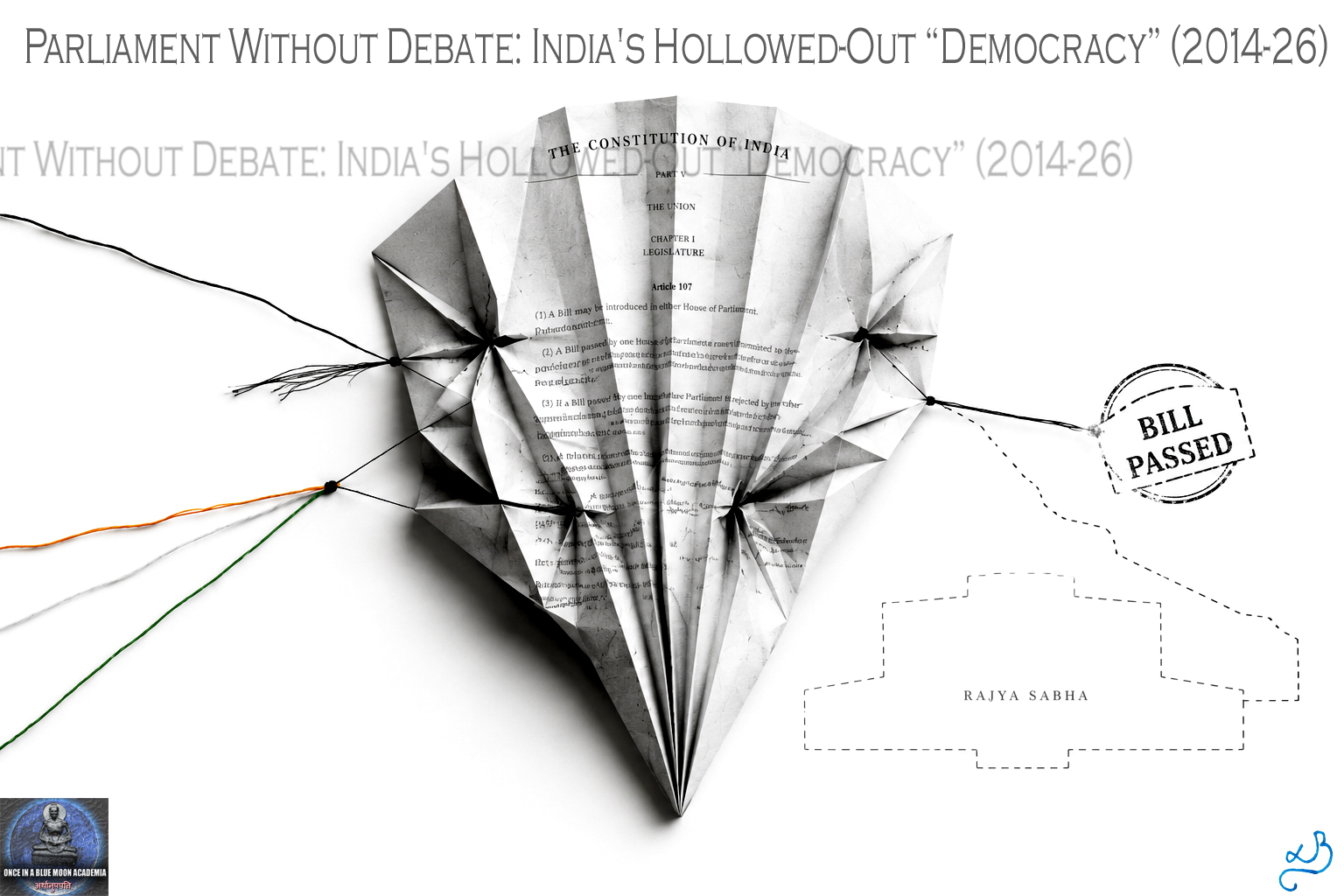
Legislating Without Deliberation: A Procedural Audit of Executive Dominance in Indian Law-Making under the BJP-NDA Rule
Posted on 21st July, 2026 (GMT 02:15 hrs)
ABSTRACT
This damning audit of India’s parliamentary law-making from 2014–2026 across the 16th to 18th Lok Sabhas exposes a relentless executive assault on democratic norms. Drawing from official Bulletins, PRS data, PIB releases, and law reports, it reveals roughly 390–410 bills rammed through both Houses, with at least seven major non-fiscal laws cynically certified as money bills—concentrated in 2016–2019 when the government lacked Rajya Sabha majority—to sideline the Upper House. Deliberation has collapsed: committee referrals plummeted from 71% to 16%, over 90% of bills passed without recorded votes, four-fifths of the Union budget guillotined, and shameful records of seven to eight bills bulldozed in a single sitting while the Opposition was suspended or boycotting. Four major legislative retreats were forced extra-parliamentarily under street and electoral pressure, while a churn regime of hasty laws—led by the Insolvency and Bankruptcy Code with six frantic amendments, five via ordinance—sees statutes perpetually patched by executive fiat. This is no healthy democracy but a clear strategy of procedural fungibility: the bypass tool shifts with parliamentary numbers, yet the core preference for rubber-stamp ratification remains unchanged—findings that align with damning verdicts from V-Dem, Freedom House, EIU, RSF, and CIVICUS. Since 2024, partial corrections have come only from vigilant voters and mass protests, not from the broken institutions meant to prevent such executive aggrandizement within a hollow electoral shell. The fight to reclaim Parliament is urgent.
Keywords: Indian Parliament; deliberative democracy; Article 110; money bills; legislative churn; executive aggrandisement; democratic backsliding; ordinance raj; Insolvency and Bankruptcy Code; impunity loop; V-Dem; guillotine.
I. Introduction
India presents comparative political science with a genuine paradox. Between 2014 and 2026 it conducted the largest electoral exercises in human history, transferred power “peacefully” (?) at the state level dozens of times, was reduced from single-party majority to coalition dependence at the 2024 general election, and — in April 2026 — saw a government constitutional amendment defeated on the floor of the Lok Sabha. Over the same twelve years, its national legislature referred a historic low of bills to committee scrutiny, passed more than nine in ten laws without a recorded vote, approved roughly four-fifths of all public expenditure without any discussion, rewrote its entire criminal jurisprudence in front of benches emptied by the largest mass suspension in its history, and set its all-time throughput records — seven bills in 214 minutes; eight in under four hours — on consecutive days when the Opposition was physically absent. The electoral organ of Indian democracy is (thought to be/believed to be) demonstrably vigorous; the deliberative organ is demonstrably atrophied. How both facts can be simultaneously true, and what the combination should be called, is the subject of this long article.
The inquiry is organized around seven questions of the kind a citizen — rather than a specialist — would ask, and answers them with the precision the record permits:
(1) How many bills were proposed between 2014 and 2026, and what did they contain?
(2) How many were accepted by both Houses of Parliament?
(3) How many were certified as money bills, with the effect of bypassing the Rajya Sabha?
(4) How many were passed without meaningful debate?
(5) How many enacted laws or pending measures were revoked or withdrawn under public and parliamentary pressure?
(6) What are the records for bills passed in a single day, arranged in descending order?
(7) Which Acts and Codes were amended most frequently, and why? Two of these questions (3 and 4) have no official answer by design — there is no register of abusive money bill certifications because that definitional question is pending before a seven-judge Constitution Bench, and Parliament records floor time, not deliberative quality — and part of this article’s method is to be explicit about how such questions can nonetheless be answered defensibly.
The article’s central analytical claim is what it terms procedural fungibility. The twelve-year record divides into three phases that track Upper House arithmetic exactly:
a bypass phase (2014–2019), when a Rajya Sabha minority was answered with 45 ordinances and the money bill device;
a compression phase (2019–2024), when command of both Houses made the bypass unnecessary and the technique became speed itself — committee referral switched off, floor time rationed in minutes, suspension substituted for persuasion;
and a coalition-constrained phase (2024–present), in which Joint Parliamentary Committees, division votes and even a floor defeat have reappeared, not from conviction but from necessity.
Across all three phases the constant is the treatment of Parliament as a notarising rather than deliberating body; only the instrument changes. Block one bypass and the system routes around it, because the underlying preference — legislation as ratification — is unchanged. This is the legislative face of what OBMA’s prior work has theorised as the impunity loop: procedural shortcuts that carry no institutional cost are repeated, compound, and become the baseline against which the next shortcut is measured. The claim aligns with, and supplies granular parliamentary evidence for, the executive-aggrandisement literature — Khaitan’s account of the Indian constitution being killed “with a thousand cuts” and Levitsky and Ziblatt’s observation that contemporary democracies are hollowed with laws rather than tanks — while extending it to 2026 data those accounts predate.
The article makes three contributions. Empirically, it assembles — apparently for the first time in one place — a complete session-by-session chronology of all 38 sessions from June 2014 through the Budget Session of 2026, including the newly released 2026 statistics (the defeat of the Constitution (131st Amendment) Bill by 298–230; the 77% budget guillotine; the failed resolution to remove the Speaker) that materially complicate the backsliding narrative. Methodologically, it develops a register method for questions that official statistics refuse to answer: where no authoritative count exists, it constructs a documented register of verified instances with explicit inclusion criteria and marked incompleteness, rather than a spurious single number. Analytically, it joins the internal record to the external one, showing that the international index ecosystem’s divided verdict on India — the EIU’s “flawed democracy” at rank 41 against V-Dem’s “electoral autocracy” at rank 105 — is not a contradiction but a measurement, from two angles, of precisely the gap between electoral and deliberative performance that the domestic registers document.
The article proceeds as follows. Section II specifies sources, operational definitions, verification rules and limitations, including a positionality disclosure. Section III presents the aggregate statistics, and Section IV the full session-by-session chronology. Sections V through IX present the five thematic registers: money bills, minimal deliberation, retreats, single-day throughput, and statutory churn. Section X synthesises the procedural anatomy; Section XI confronts the international assessments and the government’s campaign against them; Section XII, the Critical Conclusion, returns to the seven questions and to the question behind them — whether any of this is the sign of a healthy democracy — followed by references.
This is not merely a story of procedural shortcuts. It is the documented record of the BJP-NDA’s systematic dismantling of parliamentary democracy in India. Under Narendra Modi’s leadership, the world’s largest democracy was reduced to a rubber-stamp legislature where debate was treated as an inconvenience, the Opposition as an enemy to be suspended or silenced, and Parliament itself as little more than a ceremonial stage for executive fiat. From the cynical misuse of money bills to bulldoze non-fiscal laws, from the largest mass suspensions in parliamentary history to the routine guillotining of the Union budget, the BJP-NDA regime perfected a model of authoritarian governance dressed in electoral legitimacy.
II. Methods Deployed
A. Design and sources
The study is a documentary audit using exclusively public, primary Indian sources, ordered in a strict evidentiary hierarchy. Tier one: the Bulletins and Resumes of the Lok Sabha and Rajya Sabha, the Statistical Handbooks of the Ministry of Parliamentary Affairs, Press Information Bureau releases, the India Code consolidated statutes with amendment footnotes, and the law reports of the Supreme Court. Tier two: the session-wise and term-wise statistics of PRS Legislative Research, an independent, non-partisan research body whose data (published under CC BY 4.0) constitute the standard quantitative reference on Indian parliamentary functioning and are themselves compiled from tier-one records. Tier three: contemporaneous reporting of record (used only for events, dates and direct observations — never for characterisations), and, in Section IX only, the publications of international assessment bodies. The temporal scope runs from the first sitting of the 16th Lok Sabha (June 2014) to the end of the Budget Session 2026 (18 April 2026); the units of analysis are, by question, the bill, the session, the sitting day, and the statute.
B. The register method and operational definitions
Three of the seven questions — money bill misuse (Q3), passage without debate (Q4), and single-day throughput (Q6) — have no official statistic, in the first case because the definition is sub judice, in the others because Parliament does not compile one. For these the study constructs registers: exhaustively sourced lists of verified instances with explicit inclusion criteria, presented as documented minima rather than totals. For Q3, an instrument enters the register if it was certified under Article 110 while carrying provisions whose non-fiscal character was contested in Parliament, in litigation, or both. For Q4, in the absence of any qualitative measure, four quantitative proxies are used, all from PRS: committee-referral rates, floor time per bill (thresholds at 60 and 20 minutes), recorded-voting rates, and the budget guillotine percentage; the episode register additionally requires a documented deliberative defect (division refused, mass suspension in force, boycott, or passage “amid din” as noted in the Bulletin). For Q6, an entry requires a per-House, per-calendar-day count attested by the Bulletin or by two independent contemporaneous reports; the register is explicitly non-exhaustive. Claims that rest on a contested figure are triangulated against at least two independent sources, and every figure that is an estimate, a minimum, or partial is marked as such in text.
C. Positionality and disclosure
The compiler writes from within one of the constituencies this record affects: as a retail depositor-victim of the DHFL resolution conducted under the Insolvency and Bankruptcy Code analysed in Section IX, and as a defendant in ongoing SLAPP litigation of the class discussed in Section XI — circumstances documented in OBMA’s published DHFL corpus and disclosed here so that readers may weigh them. The methodological consequence is a deliberate austerity: every load-bearing claim in the domestic registers (Sections III–IX) rests on tier-one… the international assessments of Section XI are treated as corroboration, never as foundation. Interpretive judgments — the three-phase periodisation, the concept of procedural fungibility, the final verdict — are the compiler’s own and are flagged as such.
As an organisation that has long documented the impact of crony capitalism and institutional subversion under BJP-NDA rule, OBMA writes this audit with no pretense of neutrality. This is not a detached academic exercise. It is written from within the lived consequences of a regime that has systematically placed majoritarian power and crony interests above institutional integrity, citizen rights, and democratic procedure. The BJP-NDA’s legislative record is not a series of unfortunate procedural lapses — it is the visible expression of an authoritarian temperament that treats Parliament as an irritant and the Constitution as an inconvenience to be worked around. OBMA has consistently argued that the greatest threat to Indian democracy is not the formal end of elections, but their gradual emptying of all substantive meaning. This procedural audit provides the detailed evidence for that claim.
D. Limitations in brief
Four limitations are stated here and elaborated in the closing caveats: the money bill count is a register of documented controversial certifications pending the seven-judge bench, not an adjudicated total; all floor-time thresholds are proxies for a deliberative quality no statistic captures; the single-day register is a verified-instance list, not a census of ~1,200 sitting days; and 18th Lok Sabha data are partial, with the Winter Session 2025 metrics not yet consolidated by PRS at compilation. A fifth, interpretive limitation: comparison with the pre-2014 baseline shows difference of degree become kind, not a fall from grace — the UPA-era Parliaments guillotined entire budgets and lost over a third of scheduled time to disruption; what the post-2014 record normalised, it did not invent.
III. The Aggregate Picture: Three Lok Sabhas by the Numbers
The headline numbers first. During the 16th Lok Sabha, 133 bills were passed by both Houses and 45 ordinances were promulgated; roughly 180 government bills were introduced, and 46 bills lapsed at dissolution. During the 17th Lok Sabha, Parliament passed 221 bills — 42 budget-related (Finance and Appropriation) and 179 other bills; four bills lapsed at dissolution, the lowest ever, because almost everything introduced was passed. In the 18th Lok Sabha, 16 bills were passed and assented to in calendar 2024, with the pace continuing through 2025–26; the cumulative both-Houses total for the full 2014–2026 period is therefore on the order of 390–410 bills, of which roughly 90 were annual Finance and Appropriation instruments.
The composition of this legislation defines the era’s governing architecture: fiscal centralisation (the GST constitutional amendment and its implementing statutes; the Insolvency and Bankruptcy Code); identity and surveillance infrastructure (Aadhaar, the Criminal Procedure (Identification) Act, the Digital Personal Data Protection Act); federal restructuring (the Jammu & Kashmir Reorganisation Act, the Government of NCT of Delhi amendments); the nationalisation and renaming of criminal law (the three Sanhitas replacing the IPC, CrPC and Evidence Act); religious-civil regulation (the Muslim Women (Protection of Rights on Marriage) Act, the Citizenship (Amendment) Act, the Waqf (Amendment) Act); market deregulation (the three farm laws, later repealed, and the four labour codes, still not brought into force); and electoral-institutional redesign (electoral bonds, the CEC Appointment Act, the One Nation One Election and delimitation packages).
| Indicator | 16th LS (2014–19) | 17th LS (2019–24) | 18th LS (2024– , partial) | Source / note |
| Bills passed by both Houses | 133 | 221 (42 budget + 179 other) | 16 in 2024; ~35–40 by mid-2026 | PRS; MPA Year-End Review |
| Ordinances promulgated | 45 | ~35 | ongoing | PRS |
| Bills lapsed at dissolution | 46 | 4 (lowest ever) | — | PRS |
| Bills referred to committees | 25% | 16% | JPC route revived (Waqf, ONOE, 130th CAA) | PRS (vs 71% in 15th LS, 60% in 14th) |
| Bills passed within 2 weeks of introduction | n.a. | 58% | — | PRS 17th LS Vital Stats |
| Bills passed with <1 hour of LS discussion | 6% within 30 min | 35% (<1 hr); RS 34% | — | PRS |
| Bills passed with any recorded voting | ~9% | 9% | Waqf 2025 and 131st CAA 2026 were division-voted | PRS (excl. CAAs where mandatory) |
| Budget passed without discussion (guillotined) | 83% avg; 100% in 2018 | ~80% avg; 100% in 2023 | 77% in 2026 | PRS |
| Sittings | 331 days | 274 (fewest of any full-term LS) | — | PRS |
| MP suspensions | 25 Congress MPs (2015) et al. | 206 instances; 146 in Winter 2023 alone | sporadic | PRS |
| Deputy Speaker | elected | never elected (first time ever) | still vacant — seven years and counting | PRS; Art. 93 |
Table 1. Aggregate legislative indicators across the three NDA-era Lok Sabhas. “n.a.” = not compiled in comparable form. PRS figures exclude Appropriation/Finance Bills where noted in the original.
IV. Session-by-Session Chronology, 2014–2026
The table below records every session of Parliament from the first session of the 16th Lok Sabha to the Budget Session of 2026, with the principal legislation and the procedural events that bear on the five questions. Dates are as per the Bulletins; where a session was extended or curtailed this is noted, since 11 of the 15 sessions of the 17th Lok Sabha were adjourned ahead of schedule, costing 40 scheduled sittings.
A. 16th Lok Sabha (May 2014 – February 2019) — the ordinance-and-money-bill phase
| Session | Period | Principal legislative business | Procedural / deliberative notes |
| 1st (Budget) Session | Jun–Aug 2014 | TRAI Amendment; Constitution (99th Amendment) and NJAC Act passed with near-unanimity, seeking to replace the collegium system of judicial appointments. | NJAC struck down by the Supreme Court in October 2015 — the judiciary, not the Opposition, delivered the government’s first major legislative defeat. |
| Winter Session 2014 | Nov–Dec 2014 | Coal Mines and Insurance Laws bills blocked in Rajya Sabha, where the NDA was in a minority. | Government answered with the ordinance route: Land Acquisition (RFCTLARR Amendment) Ordinance promulgated 31 Dec 2014. The term would see 45 ordinances — the “ordinance raj” critique begins here. |
| Budget Session 2015 | Feb–May 2015 | Land Acquisition Amendment Bill passed Lok Sabha 10 Mar 2015 but stalled in Rajya Sabha; referred to a Joint Parliamentary Committee. Coal Mines and MMDR Acts passed. Finance Act 2015 carried PMLA amendments as a money bill. | Rahul Gandhi’s “suit-boot ki sarkar” intervention (20 Apr 2015). The Upper House functions, for the last sustained period in this story, as a real veto point. |
| Monsoon Session 2015 | Jul–Aug 2015 | Near-total washout over the Lalit Modi and Vyapam affairs; GST Constitution Amendment stalled. | 25 Congress MPs suspended from Lok Sabha for five days. On 31 Aug 2015 the PM announced (on radio, not in Parliament) that the twice-re-promulgated Land Ordinance would lapse — Retreat No. 1. |
| Winter Session 2015 | Nov–Dec 2015 | Juvenile Justice Act (adult trial of 16–18-year-olds, passed amid the Nirbhaya convict’s release furore); SC/ST (Prevention of Atrocities) Amendment; Arbitration and Commercial Courts laws. | GST still blocked; government publicly attacks the “indirectly elected” Rajya Sabha — the ideological ground-clearing for the money bill strategy. |
| Budget Session 2016 | Feb–May 2016 | Aadhaar (Targeted Delivery) Act passed as a money bill in March 2016 — an entire biometric identity architecture routed around the Upper House. Insolvency and Bankruptcy Code enacted. Finance Act 2016 retrospectively amended the FCRA, regularising past foreign donations to both BJP and Congress. | Rajya Sabha’s recommended amendments to the Aadhaar Bill were rejected wholesale by Lok Sabha, as Article 110 permits. Jairam Ramesh’s challenge to the Speaker’s certification begins its journey to the Supreme Court. |
| Monsoon Session 2016 | Jul–Aug 2016 | Constitution (101st Amendment) Act — GST — passed with full bicameral process, special majorities in both Houses and state ratification. | The instructive counterexample: transformative fiscal legislation could pass through the front door when the government chose to negotiate. It rarely chose to again. |
| Winter Session 2016 | Nov–Dec 2016 | Demonetisation announced 8 Nov 2016, outside Parliament, days before the session; Income Tax (Second Amendment) rushed through. | Session substantially washed out; among the least productive on record. The single largest monetary intervention of the era received no prior parliamentary sanction; the Specified Bank Notes (Cessation of Liabilities) Act followed in 2017 as a money bill. |
| Budget Session 2017 | Jan–Apr 2017 | Budget advanced to 1 February; Railway budget merged. Finance Act 2017 passed as a money bill carrying: the electoral bonds scheme, removal of corporate donation caps, amendments to the RPA, Companies Act and Income-tax Act, and the restructuring of 19+ tribunals. Four GST implementation statutes (CGST, IGST, UTGST, Compensation) passed, also as money bills. | The high-water mark of Article 110 as an omnibus bypass. The tribunal provisions would be struck down in Rojer Mathew (2019); the electoral bonds scheme would be struck down as unconstitutional in February 2024. |
| Monsoon Session 2017 | Jul–Aug 2017 | Banking Regulation (Amendment); RTE Amendment. | FRDI Bill introduced Aug 2017 and referred to a Joint Committee; the “bail-in” clause ignites a depositor panic. |
| Winter Session 2017 | Dec 2017–Jan 2018 | Muslim Women (Protection of Rights on Marriage) Bill — criminalising triple talaq — passed Lok Sabha, stalled in Rajya Sabha. | Session convened late, after the Gujarat election — the calendar itself subordinated to campaigning. |
| Budget Session 2018 | Jan–Apr 2018 | Finance Act 2018 (money bill) retrospectively validated foreign political donations back to 1976 and adjusted the electoral bond framework. Fugitive Economic Offenders Ordinance promulgated after the session. | The most disrupted Budget Session on record to that point: 100% of demands for grants guillotined without discussion; no-confidence notices (TDP, over Andhra special status) never admitted amid the din. Parliament approved roughly ₹24 lakh crore of expenditure without debating a rupee of it. |
| Monsoon Session 2018 | Jul–Aug 2018 | No-confidence motion debated for 11 hours 46 minutes and negatived — the first such vote in 15 years. Fugitive Economic Offenders Act; SC/ST Amendment restoring provisions diluted by the Supreme Court; Constitution (102nd Amendment) giving the NCBC constitutional status. | FRDI Bill withdrawn in August 2018 under sustained depositor pressure — Retreat No. 2. |
| Winter Session 2018 | Dec 2018–Jan 2019 | Constitution (103rd Amendment) — the 10% EWS reservation — introduced 8 Jan 2019 and passed by both Houses within roughly 48 hours, amending the Constitution’s equality code with no committee scrutiny and minimal notice. Triple talaq bill passed Lok Sabha again; Aadhaar Amendment passed. | Rafale uproar consumed much of the session. The EWS amendment’s 48-hour passage is the template later perfected on Article 370. |
| Interim Budget Session | Jan–Feb 2019 | Interim budget (PM-KISAN announced). Term ends. | 46 bills lapse at dissolution, including the triple talaq bill, the Citizenship (Amendment) Bill 2016, the Motor Vehicles Bill and the Trafficking Bill — the residue of a Rajya Sabha that could still say no. |
B. 17th Lok Sabha (June 2019 – February 2024) — the compression phase
| Session | Period | Principal legislative business | Procedural / deliberative notes |
| 1st Session | Jun–Aug 2019 (extended) | A record ~28 bills passed in a single, extended first session: RTI Amendment (downgrading Information Commissioners’ tenure and status), UAPA Amendment (empowering the state to designate individuals as terrorists), Muslim Women (Protection of Rights on Marriage) Act, Motor Vehicles Act, Consumer Protection Act. Then, on 5–6 Aug 2019: the Jammu & Kashmir Reorganisation Act and the statutory resolution reading down Article 370 — a state dismembered into two Union Territories within ~48 hours of the bill’s introduction. | Not one bill of the session was referred to a committee. The J&K Act was introduced in Rajya Sabha first (where surprise was total), passed, and cleared Lok Sabha the next day. PRS records that the 17th LS ultimately passed 58% of its bills within two weeks of introduction; this session set the tempo. |
| Winter Session 2019 | Nov–Dec 2019 | Citizenship (Amendment) Act passed 11 Dec 2019, introducing a religious criterion into citizenship law for the first time; SPG (Amendment) Act. | Nationwide protests erupted within days; Shaheen Bagh sit-in began 15 Dec 2019. The CAA’s implementing rules would then be frozen for over four years — the para-legislative retreat discussed in Section VII. |
| Budget Session 2020 | Jan–Mar 2020 | Budget passed; session curtailed by the onset of COVID-19. | Direct Tax Vivad se Vishwas and other measures passed with minimal discussion as the pandemic closed in. |
| Monsoon Session 2020 | 14–23 Sep 2020 (10 sittings) | The three farm laws — Farmers’ Produce Trade and Commerce Act, Farmers (Empowerment and Protection) Agreement Act, Essential Commodities (Amendment) Act — replacing June ordinances. Three of the four labour codes passed 22–23 Sep with most of the Opposition boycotting. FCRA (Amendment) Act tightened the NGO regime. ~25 bills in 10 days. | Question Hour suspended for the session — unprecedented. On 20 Sep the farm bills were declared passed in Rajya Sabha by voice vote amid pandemonium; the Opposition’s demand for a division (which it might have won) was refused; eight MPs suspended. Committee referral refused in both Houses. The Supreme Court committee later found 86% of consulted farmer organisations — representing 38.3 million farmers — opposed; none of that evidence entered the parliamentary record before passage. |
| [Winter Session 2020] | cancelled | No legislation — the session was simply not convened, citing the pandemic. | The only skipped session since 1952. The farm protests massed at Delhi’s borders through the winter with no parliamentary forum in existence to receive them. |
| Budget Session 2021 | Jan–Mar 2021 | Government of NCT of Delhi (Amendment) Act — “government” in Delhi redefined to mean the Lieutenant Governor; Mines and Minerals Amendment; Insurance FDI raised to 74%. | GNCTD Act passed amid Opposition walkouts; the Supreme Court’s 2018 Constitution Bench reading of Delhi’s federal position legislatively overridden. |
| Monsoon Session 2021 | Jul–Aug 2021 | ~20 bills passed, including the General Insurance (privatisation) Act, the Tribunals Reforms Act — re-enacting provisions the Supreme Court had struck down weeks earlier — and the Constitution (105th Amendment) restoring states’ power over OBC lists (the sole substantively debated item). | The Pegasus revelations washed out the session. PRS computed the average Lok Sabha discussion per bill at roughly 34 minutes, with several bills passed in under 10; bills were passed “amid din” as a routine notation in the Bulletins. The session ended with marshals physically evicting MPs from the Rajya Sabha chamber. |
| Winter Session 2021 | Nov–Dec 2021 | Day one: Farm Laws Repeal Act — both Houses, voice vote, no debate permitted, under ten minutes of combined floor time (Retreat No. 3, executed with the same procedural contempt as the original enactment). Election Laws (Amendment) Act — Aadhaar-electoral roll linkage — passed Lok Sabha in about 20 minutes. | 12 Rajya Sabha MPs suspended for the entire session for the previous session’s conduct — punishment across sessions, of dubious constitutionality. The Opposition’s demand to debate even the repeal it had demanded was refused. |
| Budget Session 2022 | Jan–Apr 2022 | Criminal Procedure (Identification) Act — biometric capture from arrestees and detainees; Chartered Accountants Amendment. | A comparatively functional session; the exception that shows disruption was not inevitable. |
| Monsoon Session 2022 | Jul–Aug 2022 | Family Courts (Amendment); Energy Conservation (Amendment); National Anti-Doping Act. | 27 MPs suspended across both Houses over demands to discuss price rise and GST on essentials. The Personal Data Protection Bill, 2019 — after 78 JPC sittings over two years — was withdrawn on 3 Aug 2022 (Retreat No. 4). |
| Winter Session 2022 | Dec 2022 | Wildlife (Protection) Amendment; Maritime Anti-Piracy Act; Energy Conservation completed. | A short session in the shadow of the Gujarat election. |
| Budget Session 2023 | Jan–Apr 2023 | Finance Act 2023 — including significant tax changes and tribunal provisions — passed in Lok Sabha without discussion, in roughly 12 minutes, amid din. 100% of the budget guillotined. | The second half was a total washout: the government benches themselves disrupted proceedings demanding an apology from Rahul Gandhi (disqualified from the House on 23 Mar 2023 following conviction, later stayed), while the Opposition demanded a JPC on the Adani–Hindenburg disclosures. Lok Sabha productivity ~33%, Rajya Sabha ~24% — among the worst budget sessions ever recorded. |
| Monsoon Session 2023 | Jul–Aug 2023 | 23 bills passed, including the GNCTD (Amendment) Act (converting the ordinance that had overridden a unanimous Constitution Bench within days of the judgment), the Digital Personal Data Protection Act, the Forest (Conservation) Amendment Act, and the Mines Amendment. | No-confidence motion over Manipur debated ~20 hours — the deliberative exception. Otherwise: every bill except the Delhi Services Bill passed with under one hour of Lok Sabha discussion; nine bills within 20 minutes; ten bills cleared Rajya Sabha in three consecutive days, several after Opposition walkouts; 250+ adjournment notices on Manipur, none admitted. |
| Special Session 2023 | Sep 2023 | Parliament moved to the new building. Constitution (106th Amendment) — the Women’s Reservation (Nari Shakti Vandan) Act — passed near-unanimously. | The reservation was made contingent on a future census and delimitation, deferring implementation indefinitely at enactment. No Question Hour; the session’s agenda was disclosed only days in advance. |
| Winter Session 2023 | Dec 2023 | The three criminal codes — Bharatiya Nyaya Sanhita, Bharatiya Nagarik Suraksha Sanhita, Bharatiya Sakshya Adhiniyam — replacing the IPC 1860, CrPC 1973 and Evidence Act 1872; the Telecommunications Act; the CEC and ECs (Appointment) Act, removing the Chief Justice from the selection panel the Supreme Court had prescribed; Press and Registration of Periodicals Act. | After the 13 Dec security breach, 146 MPs (100 LS, 46 RS) were suspended for demanding a ministerial statement — the largest mass suspension in Indian parliamentary history. The entire criminal jurisprudence of the republic was then rewritten before substantially emptied Opposition benches, the codes clearing Rajya Sabha by voice vote on 21 Dec 2023. |
| Interim Budget Session | Jan–Feb 2024 | Interim budget; Water (Prevention and Control of Pollution) Amendment; Public Examinations (Prevention of Unfair Means) Act; J&K Local Bodies Amendment. | Term ends: 221 bills passed; 274 sittings (fewest of any full-term Lok Sabha); MPs suspended on 206 instances; no Deputy Speaker elected for the entire term — the first such default since 1952. |
C. 18th Lok Sabha (June 2024 – present) — the coalition-constrained phase
| Session | Period | Principal legislative business | Procedural / deliberative notes |
| 1st Session | Jun–Jul 2024 | Oath-taking; Om Birla re-elected Speaker by voice vote; Motion of Thanks debates dominated by the NEET paper-leak controversy. | The BJP, at 240 seats, now governs on TDP and JD(U) support — the arithmetic that quietly re-empowers procedure. |
| Budget Session 2024 | Jul–Aug 2024 | Union Budget 2024–25; Finance (No. 2) Act; Appropriation Acts. The Waqf (Amendment) Bill introduced 8 Aug 2024 and — under visible allied-party pressure — referred to a Joint Parliamentary Committee on 9 Aug 2024. | The first major-bill JPC referral in years. Committee scrutiny returns not from conviction but from coalition necessity. |
| Winter Session 2024 | Nov–Dec 2024 | Constitution (129th Amendment) Bill — “One Nation One Election” — and the UT Laws (Amendment) Bill introduced 17 Dec 2024; the introduction vote itself (269–198) fell short of a two-thirds majority, and both bills were referred to a JPC on 20 Dec 2024. Two-day commemorative debates on 75 years of the Constitution. | Disruptions over the Adani indictment and Sambhal; a physical scuffle at Parliament’s gates. The introduction-vote arithmetic telegraphed the amendment’s eventual fate. |
| Budget Session 2025 | Jan 31–Apr 4, 2025 | The Waqf (Amendment) Act, 2025 passed after genuinely extended debate (~12 hours in Lok Sabha, ~13 in Rajya Sabha) and division votes — 288–232 in Lok Sabha, 128–95 in Rajya Sabha; the Immigration and Foreigners Act, 2025; Finance Act 2025. | A contested law passed, for once, by the textbook route: JPC scrutiny, long debate, recorded vote. Constitutional challenges to the Waqf Act moved immediately to the Supreme Court. |
| Monsoon Session 2025 | Jul–Aug 2025 | Income-tax Act, 2025 (replacing the 1961 Act after Select Committee review); Online Gaming legislation; the Constitution (130th Amendment) Bill — removal of a PM, CM or minister held in custody beyond 30 days — introduced 20 Aug 2025 amid uproar and referred, with the J&K Reorganisation (Amendment) and UT Government (Amendment) Bills, to a Joint Committee. | The Vice-President and Rajya Sabha Chairman resigned mid-session (21 Jul 2025) — unprecedented. Opposition protest centred on the Special Intensive Revision of electoral rolls in Bihar; the Operation Sindoor debate consumed roughly half of Lok Sabha’s functioning time. |
| Winter Session 2025 | Dec 2025 | Legislative business proceeded alongside continuing Joint Committee scrutiny of the 129th and 130th Amendment packages. | The electoral-roll revision (SIR) controversy dominated floor time; sustained disruption in both Houses. [Session-level PRS metrics not yet consolidated at compilation.] |
| Budget Session 2026 | Jan 28–Apr 18, 2026 (extended) | Session extended three days to take up the delimitation package: the Constitution (131st Amendment) Bill (raising Lok Sabha’s ceiling to 850 seats), the Delimitation Bill (2011-census basis), and the UT Laws (Amendment) Bill; discussed for 21 hours 28 minutes over two days. The 131st Amendment was voted down — 298 for, 230 against, short of the special majority — rendering the two companion bills infructuous. IBC (Amendment) Act (the session’s only committee-scrutinised bill); an omnibus decriminalisation bill amending 80 Acts; CAPF seniority bill. | The first floor defeat of a government constitutional amendment in the entire 2014–2026 period. Also: an Opposition resolution to remove the Speaker — only the fourth in history — failed after 12+ hours of debate; 77% of the budget guillotined; on twelve days Question Hour ran under 15 minutes; the Deputy Speaker’s chair entered its seventh year of vacancy. |
V. The Money Bill Register: Article 110 as a Bypass
Article 110(1) defines a money bill as one containing “only” provisions on enumerated fiscal matters; the Constituent Assembly explicitly rejected a proposal to delete the word “only”. A bill certified by the Speaker as a money bill needs no Rajya Sabha assent: the Upper House may only return recommendations within 14 days, which Lok Sabha may discard. Between 2014 and 2019 — precisely the period in which the NDA lacked a Rajya Sabha majority — the certification was applied to legislation whose fiscal character was, at best, incidental. There is no official count of abusive certifications because the definitional question is sub judice: a five-judge bench in Rojer Mathew v. South Indian Bank (2019) found the Puttaswamy majority’s reasoning on Aadhaar “not convincingly reasoned” and referred the interpretation of Article 110 to a seven-judge bench, which has not delivered judgment as of mid-2026. The register below lists the documented controversial instances.
| Instrument (certified as money bill) | Year | Non-fiscal content carried | Judicial / political sequel |
| Finance Act, 2015 | 2015 | Amendments to the Prevention of Money Laundering Act and FEMA, expanding enforcement powers. | Part of the pattern challenged cumulatively; PMLA amendments via money bill route contested in Nikesh Tarachand Shah and later Vijay Madanlal Choudhary proceedings. |
| Aadhaar (Targeted Delivery of Financial and Other Subsidies, Benefits and Services) Act, 2016 | 2016 | A comprehensive biometric identity, enrolment and authentication architecture for 1.3 billion residents; its predecessor bill (2010) had been introduced as ordinary legislation. | Upheld 4:1 in Puttaswamy (2018); Chandrachud J.’s dissent called the certification a “fraud on the Constitution”. Review sought by Jairam Ramesh; the question effectively reopened by Rojer Mathew (2019). |
| Finance Act, 2016 | 2016 | Retrospective amendment of the FCRA, 2010, regularising past foreign corporate donations to political parties (both BJP and Congress had been held in breach by the Delhi High Court). | Never independently adjudicated; the retrospective cure extinguished the contempt exposure of both major parties. |
| Specified Bank Notes (Cessation of Liabilities) Act, 2017 | 2017 | The statutory tail of demonetisation — extinguishing RBI’s liability on demonetised notes. | Demonetisation itself upheld 4:1 in 2023 on process grounds; the money bill aspect absorbed into the larger Article 110 reference. |
| Finance Act, 2017 (Part XIV and allied provisions) | 2017 | The electoral bonds scheme; removal of the cap on corporate political donations; amendments to the RPA 1951, Companies Act 2013 and Income-tax Act 1961; wholesale restructuring of the appointments, tenure and service conditions of members of 19+ tribunals (NGT, CAT, ITAT, etc.). | Tribunal rules struck down as unconstitutional in Rojer Mathew (2019), which referred Article 110’s interpretation to seven judges. The electoral bonds scheme was struck down in toto as unconstitutional (Association for Democratic Reforms, 15 Feb 2024). |
| Finance Act, 2018 | 2018 | Retrospective validation of foreign political donations back to 1976; further electoral-bond adjustments. | Folded into the ADR litigation record. |
| Finance Act, 2019 | 2019 | Further PMLA amendments (bail conditions, ECIR opacity, expanded attachment powers). | Substantively upheld in Vijay Madanlal Choudhary (2022), but the money bill question expressly left to the pending seven-judge bench; review of Choudhary itself pending. |
Table 2. The money bill register, 2015–2019. The honest count: at least seven major instruments in five years used Article 110 certification to carry substantially non-fiscal law past the Rajya Sabha. After 2020, with an effective Upper House majority, the government no longer needed the device — and its use for contested structural legislation largely ceased.
Two systemic observations. First, the device was self-liquidating: it was intensively used exactly while the Rajya Sabha could block ordinary legislation (2014–2019) and abandoned when the arithmetic changed — strong evidence that the certifications tracked political convenience, not constitutional category. Second, the judiciary’s response has been slow enough to be inoperative: the Aadhaar architecture, the tribunal restructuring and seven years of electoral bond flows (₹16,500+ crore) all took full effect before any court ruled, and the foundational question of what a money bill is remains unanswered nineteen years into the controversy’s lifespan and seven years after it was referred to a larger bench. Delay, here, functions as a merits ruling in the executive’s favour — the judicial limb of the impunity loop.
VI. Legislation Without Debate: The Metrics and the Episodes
No official category of “bills passed without debate” exists; the Bulletins record that a bill was “considered and passed”, however notionally. The measurable proxies are floor time, committee referral, recorded voting, and the budget guillotine — and on every one of these, the 2014–2026 period marks a structural break from prior parliamentary practice. The defensible summary: in the 17th Lok Sabha, more than a third of all bills received under one hour of discussion in each House; a majority were passed within two weeks of introduction; over 90% were passed without a single recorded vote; and four-fifths of the Union budget, on average, was approved without any discussion at all — rising to the entire budget in 2018 and 2023.
A. The quantitative record
| Deliberation metric | 14th–15th LS (UPA baseline) | 16th LS (2014–19) | 17th LS (2019–24) |
| Bills referred to committees | 60% / 71% | 25% | 16% |
| Bills passed within 30–60 min | 26% within 30 min (15th LS) | 6% within 30 min | 35% under 1 hour (LS); 34% (RS) |
| Bills passed within 2 weeks of introduction | n.a. | n.a. | 58% |
| Bills passed with any recorded vote | ~9–10% | ~9% | 9% |
| Budget guillotined (avg) | high, incl. 100% in 2004–05, 2013–14 | 83%; 100% in 2018–19 | ~80%; 100% in 2023; (18th LS: 77% in 2026) |
| Adjournment motions admitted | 7 (14th), 2 (15th) | 0 | 0 |
Table 3. Deliberation metrics across Lok Sabhas (PRS Legislative Research). The committee referral collapse — from 71% to 16% — is the single most consequential number in this dossier: committee scrutiny is where evidence enters law-making, and it was switched off precisely as legislative ambition peaked.
B. The episode register
Numbers understate what the emblematic episodes make explicit — that on the most consequential legislation of the era, the appearance of parliamentary passage was maintained while its substance was evacuated.
| Legislation | Date | How it was “debated” |
| Constitution (103rd Amendment) — 10% EWS reservation | 8–9 Jan 2019 | A structural amendment to the Constitution’s equality code introduced and passed by both Houses within roughly 48 hours, in the dying days of the 16th Lok Sabha, with no committee scrutiny, no state consultation, and no prior white paper. |
| J&K Reorganisation Act + Article 370 resolution | 5–6 Aug 2019 | A federal unit of the Union dissolved into two Union Territories within two days of introduction, under a communications blackout in the territory concerned, with no committee referral and the affected legislature dissolved. PRS lists it among the bills passed within 48 hours of introduction. |
| Three farm laws | 17–20 Sep 2020 | Rajya Sabha passage by voice vote amid physical chaos; the demand for a division — the Opposition’s constitutional right, and one it plausibly had the numbers to win — refused by the Chair; eight MPs suspended; committee referral refused in both Houses. Later evidence (the Supreme Court committee’s suppressed-then-leaked report) showed the affected constituency overwhelmingly opposed. |
| Monsoon Session 2021 (as a whole) | Jul–Aug 2021 | Roughly 20 bills at an average of ~34 minutes of Lok Sabha discussion each, several under ten minutes, passed amid the Pegasus washout — legislation as conveyor belt. |
| Farm Laws Repeal Act | 29 Nov 2021 | Passed by voice vote in both Houses on the session’s first day, in minutes, with the Opposition’s demand to debate the repeal itself refused — the withdrawal executed with the same contempt for deliberation as the enactment. |
| Election Laws (Amendment) Act — Aadhaar-roll linkage | Dec 2021 | Cleared Lok Sabha in roughly 20 minutes, division refused, with 12 Opposition MPs already suspended from Rajya Sabha for the session. |
| Finance Act, 2023 | Mar 2023 | The republic’s annual tax law, with 60+ amendments, passed in Lok Sabha in about 12 minutes without discussion, amid din; 100% of that year’s budget guillotined. |
| Monsoon Session 2023 batch | Jul–Aug 2023 | Of 23 bills passed, every one except the Delhi Services Bill received under an hour in Lok Sabha; nine were passed within 20 minutes; ten cleared Rajya Sabha in three consecutive days, several after walkouts. |
| Three criminal codes (BNS, BNSS, BSA), Telecommunications Act, CEC Appointment Act | 19–21 Dec 2023 | The wholesale replacement of the Indian Penal Code, Criminal Procedure Code and Evidence Act — the legal operating system of the republic — passed with 146 MPs under suspension, the criminal codes clearing Rajya Sabha by voice vote before near-empty Opposition benches. |
Table 4. The minimal-deliberation episode register. The through-line: voice votes in place of divisions, suspension in place of persuasion, and speed as a governing value in itself.
VII. The Register of Retreats: Laws Revoked or Withdrawn Under Pressure
Across twelve years, the government formally reversed course on legislation four times — and on each occasion the operative pressure was extra-parliamentary (mass mobilisation, depositor panic, stakeholder revolt) synchronised with an electoral calendar, never a lost vote. To these four must be added the para-legislative retreats — measures nullified by courts or frozen in implementation — and, in April 2026, the first genuine parliamentary defeat of the era, which belongs in a category of its own.
| Measure | Reversal date | Mechanism and proximate cause | Electoral / structural context |
| Land Acquisition (RFCTLARR Amendment) Ordinance & Bill, 2014–15 | 31 Aug 2015 | Ordinance promulgated thrice, bill passed Lok Sabha but blocked in Rajya Sabha and sent to a JPC; allowed to lapse, announced by the PM on Mann Ki Baat — outside Parliament. | Two months before the Bihar election; sustained farmer and Opposition mobilisation against dilution of consent and social-impact clauses. |
| Financial Resolution and Deposit Insurance (FRDI) Bill, 2017 | Aug 2018 | Withdrawn from the Joint Committee stage after nationwide depositor panic over the “bail-in” clause empowering conversion of deposits in bank resolution. | A middle-class savings revolt; the same depositor-protection vacuum resurfaced in the DHFL and cooperative-bank resolutions of 2019–21, where haircuts were imposed without the statute. |
| The three farm laws, 2020 | Announced 19 Nov 2021; repealed 29 Nov; assent 1 Dec 2021 | Repealed after a 380-day encampment at Delhi’s borders, 700+ protester deaths, a Supreme Court stay (Jan 2021), and the collapse of talks; the Repeal Act itself passed without debate. | Weeks before the Uttar Pradesh and Punjab elections; the SAD had already left the NDA over the laws. The largest peacetime mobilisation in the republic’s history defeats its largest deregulation. |
| Personal Data Protection Bill, 2019 | 3 Aug 2022 | Withdrawn after a Joint Parliamentary Committee (78 sittings, two years) proposed 80+ amendments; industry, civil society and the committee itself had converged against the draft. | A withdrawal-and-relaunch: the successor DPDP Act, 2023 was considerably more executive-friendly (broad state exemptions, RTI dilution) — retreat as re-armament. |
Table 5. The four formal legislative retreats, 2014–2026.
A. Para-legislative and judicial reversals
Beyond the four formal retreats: the NJAC Act and the 99th Amendment were struck down by the Supreme Court in October 2015; the electoral bonds scheme — born inside the Finance Act 2017 money bill — was struck down as unconstitutional in February 2024, with disclosure orders that revealed, inter alia, the ₹85 crore in bond purchases relevant to the Piramal–DHFL nexus documented in the depositor-advocacy literature; the tribunal provisions of the same Finance Act fell in Rojer Mathew (2019); and the Citizenship (Amendment) Act, though never repealed, stood inoperative for over four years because its rules were not notified amid the 2019–20 protest wave — implementation deferral as de facto suspension, with notification finally arriving in March 2024, weeks before a general election. The four labour codes present the mirror image: passed in 2019–20, they remained substantially un-commenced for years — laws enacted at speed and then held in suspension, which suggests the passage itself was the political product.
Distinct from all of these is the Constitution (131st Amendment) Bill of April 2026: voted down on the floor of the Lok Sabha, 298 in favour to 230 against, short of the two-thirds special majority — the first defeat of a government constitutional amendment in the entire period under study, and the first moment since 2014 at which Parliament itself, rather than the street or the bench, functioned as the check. Its companion Delimitation and UT Laws bills fell as infructuous with it. Whether this marks a durable rebalancing or a one-off arithmetic accident of the coalition era is the open question on which the 18th Lok Sabha’s character will be judged.
VIII. The Single-Day Record: Bills Passed in a Day, in Descending Order
A complete census of bills-per-sitting-day would require tabulating every Bulletin entry for roughly 1,200 sittings; no agency publishes such a series. What can be stated with precision are (a) the verified record days, which cluster with diagnostic regularity around Opposition absence, and (b) the session-level throughput rates that show the record days are the extreme of a distribution, not aberrations from it. The table lists the documented high-throughput days in descending order of bills passed per House per day.
| Bills | House / date | Time taken | What was passed, and under what conditions |
| 8 | Rajya Sabha, 23 Sep 2020 | under 4 hours (~28 min/bill) | FCRA (Amendment) Bill; J&K Official Languages Bill; Bilateral Netting Bill; the Occupational Safety, Industrial Relations and Social Security Codes — three of the four labour codes, the largest labour-law rewrite since Independence — and two Appropriation Bills. Passed with the Opposition boycotting the House over the suspension of eight MPs; the record day for the period. |
| 7 | Rajya Sabha, 22 Sep 2020 | 214 minutes (10:29–14:03; ~31 min/bill) | Essential Commodities (Amendment) — the third farm law; Banking Regulation (Amendment); Companies (Amendment) — decriminalising corporate offences; Taxation and Other Laws Bill; IIIT Bill; two university bills. Same boycott; participation described in reporting as sparse, ministers’ replies brief. Fifteen bills thus cleared the Upper House in the session’s final two days. |
| ~7 | Lok Sabha, multiple days, 15–23 Sep 2020 | evening sittings | The Lower House ran a parallel conveyor: 25 bills passed across the session’s 10 sittings — an average of 2.5 per day, session-long, the highest sustained throughput of the period — with individual days clearing six to seven bills including the farm bills (17 Sep) and labour codes (22–23 Sep). |
| 4 | Lok Sabha, 20 Dec 2023 | single sitting | The three criminal codes (BNS, BNSS, BSA) — the replacement of the IPC, CrPC and Evidence Act — plus the Telecommunications Bill, with ~100 Lok Sabha MPs under suspension. |
| 4 | Rajya Sabha, 21 Dec 2023 | single sitting, voice votes | The same three criminal codes plus the Telecommunications Bill, cleared before benches emptied by 46 Rajya Sabha suspensions; the House adjourned sine die the same evening. |
| 3–4 | Rajya Sabha, three consecutive days, Aug 2023 | 10 bills / 3 days | The Monsoon 2023 batch — including the Delhi Services Bill — several passed after Opposition walkouts, amid 250+ rejected adjournment notices on Manipur. |
| 3 | Both Houses, 29 Nov 2021 | minutes per House | The Farm Laws Repeal Bill cleared both Houses by voice vote on the session’s first day — one bill, but repealing three Acts, with debate refused; included here because per-Act it is the fastest legislative reversal on record. |
| 2–3 | Lok Sabha, routine days, Monsoon 2021 | avg ~34 min/bill; several <10 min | The conveyor normalised: ~20 bills across the session amid the Pegasus washout, passed “amid din” as a standing Bulletin notation. |
Table 6. Verified high-throughput days, descending. Methodological note: figures are per House per calendar day, from the Bulletins as reported by PRS and contemporaneous records; the list is a register of documented instances, not an exhaustive census.
The pattern in the ranking is not subtle: every entry above three bills a day coincides with the physical absence of the Opposition — by suspension (Sep 2020, Dec 2023), boycott (Sep 2020), or walkout (Aug 2023). Throughput and deliberation are, in this record, strict substitutes. The 22–23 September 2020 pair deserves particular attention as a natural experiment: with eight members suspended and the Opposition benches vacated in protest, the Upper House processed fifteen statutes — among them the entire labour-code architecture governing half a billion workers and the FCRA regime governing civil society — in roughly seven and a half cumulative hours, a per-bill average of half an hour including the minister’s reply. The Chairman’s valedictory framed this as productivity “over 100%”. That framing is itself the finding: a metric of parliamentary success had been adopted in which the absence of the Opposition registers as efficiency gain — output per hour maximised precisely when scrutiny per bill reaches zero. PRS’s 2026 session data show the structural version of the same phenomenon persisting into the 18th Lok Sabha: most legislative activity compressed into the final two weeks of the session, the end-of-term pile-up now a design feature rather than an accident.
IX. The Churn Register: Statutes Amended Frequently, and Why
The mirror image of legislation-at-speed is legislation-on-repeat. A law drafted in ordinance haste, passed in twenty minutes and never shown to a committee does not stop being defective; its defects simply surface later — in tribunals, in the Supreme Court, in market behaviour — and are then patched by further amendment, frequently by further ordinance. The result is a class of statutes in permanent beta. The register below lists the most heavily revised instruments of the period, with the official counts where they exist.
| Statute | Amendment history, 2014–2026 | Drivers of the churn |
| Insolvency and Bankruptcy Code, 2016 | Six statutory amendments by end-2024 — 2017, two in 2018, 2019, two in 2020, 2021 — five of the six initiated by ordinance, plus the IBC (Amendment) Act of 2026 and over 122 amendments to IBBI regulations. Roughly one statutory intervention per 16 months of the Code’s life. | Case-driven legislating: Section 29A (2017) reacting to promoters bidding for their own companies; homebuyer-creditor status (2018) reacting to Jaypee/Amrapali; the 330-day outer limit (2019) reacting to Essar Steel’s 800-day crawl; Section 32A (Jan 2020) immunising resolution acquirers; Section 10A (2020) suspending the Code for COVID defaults; pre-pack (2021). The statute is steered in real time around live big-ticket resolutions — law as case management. |
| Companies Act, 2013 | Amended 2015, 2017, 2019, 2020, plus the Jan Vishwas decriminalisation waves (2023; 80-Act sequel passed 2026). | Oscillation, not refinement: CSR non-compliance criminalised in 2019 and decriminalised in 2020; offence-to-penalty conversions in 2019, 2020 and again via Jan Vishwas. Each swing tracked the government’s current messaging (enforcement vs. ease-of-doing-business) rather than any stable theory of corporate liability. |
| Arbitration and Conciliation Act, 1996 | Amended 2015, 2019, 2021 — three rewrites in six years. | The 2019 amendment built an Arbitration Council the 2021 amendment partly undid; the 2021 Act (via ordinance) created automatic stays on awards where fraud is alleged — legislating, observers noted, in the shadow of specific award enforcement against state entities. |
| Tribunal framework | Finance Act 2017 (money bill) → rules struck down, Rojer Mathew 2019 → fresh rules 2020 → struck down, Madras Bar Assn. 2020–21 → Tribunals Reforms Ordinance 2021 → struck down provisions re-enacted verbatim as the Tribunals Reforms Act, 2021 → challenged again. | The purest case of legislative overruling as policy: four rounds of enact–invalidate–re-enact in as many years, the executive re-passing what the Court had just annulled. The churn here is not error-correction but attrition warfare against a co-ordinate branch. |
| GST statutes (CGST/IGST etc., 2017) | Amended in virtually every Finance Act since 2018, plus dedicated CGST Amendment Acts (2018, 2023 ×2) and hundreds of rate and rule notifications. | A structurally unfinished tax constitutionalised in haste; the GST Council governs by notification, with Parliament ratifying the residue — fiscal law as rolling administrative correction. |
| FCRA, 2010 | Amended retrospectively by Finance Act 2016 (curing both major parties’ adjudicated breaches), retrospectively again to 1976 by Finance Act 2018, then prospectively tightened in 2020 against NGOs. | Perfect asymmetry: retrospective amnesty for political parties’ foreign funding, prospective strangulation of civil society’s — the same statute amended in opposite directions depending on who it binds. |
| Taxation (retrospectivity cycle) | The 2012 retrospective capital-gains tax defended through 2014–21, then repealed by the Taxation Laws (Amendment) Act, 2021. | Repeal came only after India lost the Cairn and Vodafone arbitrations and faced asset seizures abroad — churn forced by external adjudication, not internal reconsideration. |
| Criminal codes (BNS/BNSS/BSA) | Introduced Aug 2023; withdrawn; reintroduced as “Second” versions Dec 2023; passed the same fortnight; corrective clarifications and rule-patches following commencement (2024– ). | Churn before commencement: the republic’s penal law was withdrawn and re-tabled within a single interval between sessions, then enacted with 146 MPs suspended — revision without deliberation at both ends. |
| J&K Reorganisation Act, 2019 | Amended 2021, further amendment bill 2025 (before a Joint Committee with the 130th CAA package). | A statute drafted in 48 hours governing a former state’s entire administrative order; each amendment retrofits what the original speed omitted. |
Table 7. The churn register. Official counts: PIB/Ministry of Corporate Affairs for the IBC (six amendments, five by ordinance; 122+ regulatory amendments); others compiled from India Code amendment histories.
A. Why the churn? A critical assessment
First, churn is the deferred cost of speed. The correlation across this dossier’s registers is exact: the statutes amended most often are the statutes scrutinised least at birth. The IBC’s parent bill had genuine committee examination (a Joint Committee, in 2015–16) and its core has held; but every subsequent patch was ordinance-first, committee-never — five of six amendments promulgated before Parliament saw them, then ratified retrospectively in the compressed sittings catalogued in Section VIII. When the 16% committee-referral rate of the 17th Lok Sabha is set beside the amendment frequencies of Table 7, the mechanism is visible: Parliament stopped debugging bills ex ante, so the economy, the courts and the ministries debug them ex post, at vastly higher cost and with the drafting pen held exclusively by the executive. Frequent amendment is not evidence of responsive government, as official communiqués present it (“demonstrating the keenness of the Government to continuously improve”); it is the maintenance bill for deliberative arrears.
Second, churn redistributes. Serial amendment is not neutral turbulence; each patch has a beneficiary, and the pattern of beneficiaries is legible. The IBC is the master illustration, and the DHFL resolution its sharpest case. Section 29A (2017) was pitched as promoter-punishing; Section 12A (2018) let promoters settle out; the 2019 amendment’s 330-day clock and its explicit priority for secured financial creditors were enacted while Essar Steel was sub judice, effectively legislating one side of a pending appeal; and Section 32A (January 2020, by ordinance) granted the corporate debtor and its acquirer immunity from prosecution and attachment for pre-resolution offences — months before the DHFL resolution transferred the company, immunised, to Piramal, while fixed-deposit holders and NCD retail investors took statutory haircuts with no equivalent protective amendment ever offered to them. The 32A/Section 66 contradiction — immunity for the acquirer of a fraud-ridden debtor coexisting with the Code’s own fraudulent-trading liability — is not an oversight the churn failed to catch; it is the churn’s output. Amendment frequency, read distributionally, is a map of who has standing access to the drafting table: financial creditors, resolution applicants and ministries appear in every round; depositors, workers and operational creditors appear in none. The 122 IBBI regulatory amendments deepen the point — the real legislature of insolvency is a regulator amending monthly, subject to no floor vote at all.
Third, churn is jurisprudentially corrosive. Lon Fuller’s inner morality of law lists constancy through time among the eight conditions without which a rule system fails to function as law at all; a code amended every sixteen months, with retrospective effect in several rounds (the FCRA cures reaching back to 1976 are the limit case), fails that condition by design. The practical sequelae are measurable: litigation over which version of the IBC governs a given resolution; compliance regimes priced for regulatory risk rather than legal obligation; and — the tribunal cycle — a standing contest in which the executive treats judicial invalidation as a drafting note, re-enacting struck-down provisions verbatim. Where amendment answers a court rather than a problem, the churn is not law-making but a war of attrition over who states the law last. And retrospectivity, deployed thrice for party finance and once against foreign investors (until arbitration defeats forced retreat), converts the statute book from a framework of expectations into an instrument of surprise — the antithesis of the rule-of-law promise on whose credit the same government marketed the IBC and GST to investors.
Fourth, the churn and the speed are one system. Sections VI, VIII and IX describe a single metabolic cycle: ordinance → minutes-long ratification in a compressed sitting → defects surface → corrective ordinance → ratification again — with the amendment itself often passed on one of the high-throughput days of Table 6 (the Essential Commodities amendment and three labour codes cleared the Rajya Sabha inside the September 2020 boycott window; the IBC’s COVID suspension travelled the same route). Each turn of the cycle transfers legislative initiative further from the floor to the executive and the regulator, while preserving — in the annual count of “bills passed” — the statistical appearance of a vigorous Parliament. That is the deepest sense in which frequent amendment answers the question “why is it so”: because under legislation-without-deliberation, amendment is not the correction of the process’s failures; it is the process, running as designed.
X. Critical Synthesis: The Procedural Anatomy of Executive Aggrandisement
Read together, the five registers of Sections V through IX describe a single strategy expressed through changing instruments, each calibrated to the parliamentary arithmetic of its moment.
1. Three phases, one logic. In Phase One (2014–2019), facing a hostile Rajya Sabha, the executive governed around Parliament: 45 ordinances, seven-plus money bill certifications carrying non-fiscal law, and open rhetorical attacks on the legitimacy of the “indirectly elected” House. In Phase Two (2019–2024), holding both Houses, it governed through Parliament but against deliberation: committee referral collapsed to 16%, a majority of bills passed within a fortnight of introduction, budgets were guillotined wholesale, and — at the limit — 146 MPs were suspended so that the criminal law of the republic could be rewritten before empty benches. In Phase Three (2024–present), coalition dependence has partially re-engaged the machinery: JPCs revived for the Waqf, One Nation One Election and 130th Amendment packages; a contested bill (Waqf 2025) passed by division after real debate; and a constitutional amendment defeated on the floor. The constant across all three phases is that deliberation occurred when and only when the government lacked the numbers to dispense with it. Procedure, in this record, is not a norm but a price — paid under compulsion, evaded when possible.
2. The money bill and the mass suspension are the same instrument. Both convert a bicameral, deliberative requirement into a unicameral, acclamatory one. The money bill does it by legal classification (the Rajya Sabha reduced to a 14-day advisory role); the suspension does it by physical subtraction (the Opposition reduced to an empty bench). The first dominated 2016–19, the second 2020–23 — the succession tracks the Rajya Sabha arithmetic exactly. This is the sense in which the era’s parliamentary history is a study in what might be called procedural fungibility: block one bypass and the system routes around through another, because the underlying preference — legislation as ratification — is unchanged. It is the legislative face of the impunity loop: shortcuts that carry no institutional cost are repeated, compound, and become the norm against which the next shortcut is measured.
3. The guillotine is the deepest cut. Public attention fixes on spectacular bills, but the most fiscally consequential finding in the PRS record is the budget guillotine: 83% of the Union budget passed without discussion on average in the 16th Lok Sabha, ~80% in the 17th, 100% in 2018 and again in 2023, and still 77% in 2026. Across the period, Parliament authorised well over ₹300 lakh crore of public expenditure of which perhaps a fifth was ever discussed ministry-wise. Grievance-redress on financial questions — the constitutional core of the Commons tradition since 1689, and the precise function a DHFL depositor might expect of a national legislature — is the function most completely in abeyance.
4. Voice vote as epistemology. Over 90% of bills in both the 16th and 17th Lok Sabhas passed without a recorded vote. The voice vote does more than save time: it destroys the record. No MP can be held to account for a position never registered; no researcher can reconstruct the coalition behind a law; and on at least one decisive occasion — the farm bills in the Rajya Sabha, 20 September 2020 — the refusal of a division plausibly changed the outcome, since the government’s floor strength that day was uncertain. A legislature that will not count itself cannot be counted upon; the systematic preference for acclamation over enumeration is the quiet foundation on which every other pathology in this dossier rests.
5. The checks that worked were extramural — until 2026. Tabulate the reversals by causal agent: mass mobilisation forced two (land acquisition, farm laws); sectoral panic forced one (FRDI); stakeholder-plus-committee attrition forced one (data protection); the courts nullified three (NJAC, tribunal rules, electoral bonds) and froze one (CAA rules, de facto). Parliament as an institution forced zero — until April 2026, when the 131st Amendment fell on the floor. The asymmetry is the era’s central datum: for a decade, the only functioning checks on legislation stood outside the legislature, in the street and (belatedly, partially) the bench. That the street succeeded twice at enormous human cost — 700+ dead in the farm protests — while the constitutionally designated forum succeeded not at all is a measure of how far deliberative democracy had been displaced by what one might call plebiscitary legalism: the majority as standing referendum, procedure as pageant.
6. What the 2026 defeat does and does not show. The defeat of the delimitation package is genuinely significant — it re-established that a floor vote can be lost — but it should be read precisely. It occurred on a constitutional amendment requiring a special majority, on an issue (seat redistribution toward the northern states) that fractured the ruling coalition’s own regional allies; it does not demonstrate revived scrutiny of ordinary legislation, where the 2026 session still guillotined 77% of the budget, passed all but one bill without committee examination, and ran Question Hour under 15 minutes on twelve days. The deliberative deficit, in short, has proven to be a function of majority size, not of any party’s convictions — which is exactly why durable repair must be institutional rather than electoral: mandatory committee referral for bills above a defined significance threshold, recorded voting by default, justiciable time-floors for budget discussion, an enforceable timetable for the Article 110 reference, and the long-vacant Deputy Speakership filled as the Constitution commands. None of these requires a new theory of democracy; each requires only that the rules Parliament already professes be made costly to evade — the breaking, that is, of the loop.
The BJP-NDA’s twelve-year reign has revealed a consistent and unmistakable project: the centralisation of power in the hands of one man and one party at the expense of every democratic safeguard. Whether through the ordinance raj when they lacked a majority, the culture of speed and silence when they enjoyed one, or the desperate reliance on procedural manipulation even in coalition times, the pattern is unmistakable. This was never about “efficient governance” or “reform”. It was about subordinating the world’s largest elected legislature to the will of the Prime Minister’s Office. The evidence is overwhelming: Parliament under the BJP-NDA ceased to be a deliberative body and became an instrument of executive dominance — a hallmark of authoritarian consolidation in competitive electoral systems.
XI. The International Gaze: Is Any of This a “Healthy Democracy”?
The preceding sections were compiled from the inside — Bulletins, PRS statistics, court records. The question they raise, posed directly, is whether the resulting picture describes a healthy democracy. It is worth being precise about what “healthy” would mean before consulting anyone’s verdict. On the thinnest, Schumpeterian definition — rulers are chosen in competitive elections and can lose them — India in 2014–2026 passes: turnout is massive, incumbents lose states routinely, the 2024 general election cut the ruling party to 240 seats and restored coalition arithmetic, and in April 2026 a government constitutional amendment died on the floor. On Robert Dahl’s thicker standard — polyarchy requires not just elections but freedom of expression, alternative information sources, associational autonomy and institutions that make policy depend on deliberation — the registers of this dossier answer for themselves: a Parliament that examined 16% of bills in committee, voice-voted 91% of its laws, guillotined four-fifths of the budget, and set its throughput records on days the Opposition was physically absent is, on the deliberative dimension, not a functioning organ but a notarising one. The health metaphor should be used exactly: the electoral heartbeat is strong; the deliberative organs show progressive atrophy. Every major international assessment body, using four different methodologies, has reached structurally the same diagnosis — and their disagreements are as instructive as their convergence.
A. The index register, latest editions
| Index / body | Latest verdict on India | Trajectory since 2014 | What it is measuring |
| V-Dem Institute (Univ. of Gothenburg), Democracy Report 2026 | An “electoral autocracy” — a status held since 2017. Rank 105 of 179 on the Liberal Democracy Index (down from 100 the previous year); electoral democracy rank 106; egalitarian component 138; deliberative component 100. | Classified a democracy until the mid-2010s; V-Dem dates the “slow but systematic dismantling of democratic institutions” from c. 2009, accelerating sharply after 2014; the 2024 edition placed India among the top ten “autocratisers” worldwide, and the 2026 edition names India as the largest single driver of its region’s — and by population weight the world’s — democratic deterioration. | Expert-coded, 500+ indicators across electoral, liberal, participatory, deliberative and egalitarian dimensions — the most granular academic instrument, and the one whose “deliberative component” most directly measures what Sections VI and VIII of this dossier document. |
| Freedom House, Freedom in the World 2026 | “Partly Free” — the status to which India was downgraded in 2021 and where it remains (score in the mid-60s of 100); Indian-administered Kashmir assessed separately as “Not Free”. | Rated “Free” continuously from the post-Emergency era to 2020. The 2026 country report documents the questioning of ECI impartiality, the CEC appointment law of 2023, and the Special Intensive Revision of voter rolls expanded to 12 states amid disenfranchisement allegations — and reproduces the enforcement asymmetry: of 121 political leaders investigated by the ED in 2014–24, 115 belonged to the Opposition; 23 of 25 accused Opposition leaders who joined the BJP saw cases dropped or resolved; of 193 ED cases against politicians in a decade, two ended in conviction. | Analyst-scored political rights (0–40) and civil liberties (0–60); the standard reference for the rights environment between elections. |
| Economist Intelligence Unit, Democracy Index (2024–25 editions) | A “flawed democracy” — rank 41 of 167, score 7.29, in the 2024 edition; the classification, though not the exact rank, unchanged in the 2025 edition. The most generous of the major assessments. | Rank 27 (score 7.92) in 2014 — the doorstep of “full democracy” — falling to 53 (6.61) in 2020 amid the CAA-protest crackdowns and Kashmir measures, then partially recovering on the strength of electoral competitiveness. | Sixty indicators across electoral process, government functioning, participation, political culture and civil liberties; weights elections more heavily than V-Dem, which explains most of the two indices’ 65-place disagreement. |
| Reporters Without Borders, World Press Freedom Index 2026 | Rank 157 of 180, down six places from 151 in 2025 — in the “very serious” band, among the lowest-ranked states that hold competitive elections. RSF describes an “unofficial state of emergency” for Indian media since 2014, oligopolistic ownership (70+ outlets under one conglomerate; the 2022 NDTV acquisition “signalling the end of pluralism”), the “godi media” phenomenon, and the weaponisation of national-security laws and SLAPP suits against journalists. | Rank 140 in 2014; a near-uninterrupted slide of 17 places across the period, with the legal indicator — criminalisation of journalism — deteriorating fastest. | Journalist-security, legal, political and economic indicators; the index closest to the ground-level experience of scrutiny’s practitioners. |
| CIVICUS Monitor; WJP Rule of Law Index; USCIRF; UN human rights machinery | CIVICUS rates Indian civic space “Repressed” (since 2019) — the second-worst of five categories, citing FCRA strangulation of NGOs and the criminalisation of protest. The World Justice Project ranks India in the high 70s–low 80s of ~142 on rule of law, with its worst scores on civil justice delay and fundamental rights. USCIRF has recommended India’s designation as a “Country of Particular Concern” every year since 2020 (a recommendation the US State Department has declined to adopt). UN Special Rapporteurs and the OHCHR have issued repeated communications on the FCRA, UAPA detentions of journalists and rights defenders, and the CAA. | Cumulative deterioration across all four bodies over the period. | Respectively: civil-society space; institutional rule-of-law performance; religious freedom; treaty-body and special-procedures scrutiny — the machinery that Indian civil-society submissions increasingly engage. |
Table 8. The international index register, latest available editions (compiled July 2026). The Freedom on the Net assessment (“Partly Free”) and Access Now’s shutdown tracker — which has recorded India as the world leader in internet shutdowns for successive years — complete the picture on the digital side.
B. Convergence, divergence, and what the indices actually see
The evidentiary weight of Table 8 lies not in any single number but in the triangulation. Four fundamentally different methodologies — V-Dem’s expert-coded academic dataset, Freedom House’s analyst scoring, the EIU’s hybrid indicator model, RSF’s practitioner-focused survey — with different funders, different national bases and different definitions of democracy, independently register the same directional movement over the same period. Methodological artefacts do not usually replicate across instruments; deteriorations do. And the one major divergence is itself diagnostic: the EIU, which weights the conduct of elections most heavily, keeps India 41st and a “flawed democracy”; V-Dem, which weights the space between elections — expression, association, deliberation, egalitarian access — places the same country 105th and outside the democratic categories altogether. The 65-place gap between the two is a precise measurement of the gap this dossier has documented from the inside: the distance between India’s electoral performance and its deliberative performance. A country that holds genuinely competitive elections while legislating as Sections VI, VIII and IX describe will score exactly this way — well on any instrument that asks “do elections happen?”, poorly on any instrument that asks “what happens between them?”.
The mapping from the indices to the registers is close enough to be itemised. V-Dem’s deliberative component rank of 100 is the aggregate shadow of the 16% committee-referral rate, the 91% voice-vote share and the single-day records of Section VIII. Its clean-elections deterioration and Freedom House’s SIR findings track the electoral-machinery items of Section IV and V (the CEC Appointment Act passed with 146 MPs suspended; electoral bonds born in a money bill and struck down seven years and ₹16,500 crore later). Its egalitarian rank of 138 — India’s worst dimension — is the distributional finding of Section IX seen from orbit: who has access to the drafting table. RSF’s legal-indicator collapse and its SLAPP findings describe the litigation environment confronting depositor-advocates and journalists targeted by SLAPP proceedings — the class of cases disclosed in the Methods section. The indices, in short, are not an external opinion about a different India; they are the same registers, aggregated and read from outside.
C. The index wars: shooting the thermometer
The government’s response to this convergence deserves its own entry in the audit, because it has been conducted with more institutional energy than any repair of the underlying indicators. The documented sequence: from 2021, a “Global Indices for Reforms and Growth” monitoring project tracking India’s standing across international rankings; the Law Ministry tasking the MEA and the High Commission in London to probe the EIU’s methodology and whether government-supplied inputs could shape it; MEA-prepared “speaking notes” for the Lok Sabha Speaker to brief foreign diplomats on “India’s version of democracy”; an EAC-PM working paper (Sanyal & Arora, 2022) attacking the indices as perception-based products of tiny, unrepresentative expert pools; proposals for a home-grown index to be produced by an Indian think tank; the “Mother of Democracy” narrative campaign around the G20 presidency; and, by 2025, the reframing of the entire index ecosystem as a foreign-funded “Deep State” network. Some of the methodological criticisms are, in isolation, fair — and are addressed below. But the pattern is legible: every intervention targets the measurement, none targets the measured. A state confident that its democracy was healthy would contest the diagnosis with data; a decade of contesting the thermometer while the registers of Sections III–IX accumulated is itself evidence about the fever.
D. Taking the methodological objections seriously
Intellectual honesty requires conceding what is true in the official critique. The indices are substantially perception- and expert-judgment-based; V-Dem’s country-expert pools are small relative to the polity being coded; aggregation choices and threshold placements (the exact line between “electoral democracy” and “electoral autocracy”) are contestable, and V-Dem itself flags classification uncertainty near thresholds; year-on-year rank moves of a few places are noise; and the charge of Western-centric standard-setting deserves engagement rather than dismissal. Three considerations, however, limit how much work these objections can do. First, the critique of perception measures cuts against single instruments, not against four-way convergence — the probability that independent methodologies share the same bias in the same direction over twelve years is what would need arguing, and it has not been argued. Second, the “anti-India bias” hypothesis was falsified in 2026 from an unexpected direction: the same instruments downgraded the United States — V-Dem stripping it of liberal-democracy status for the first time in fifty years, the EIU dropping it to 34th — demonstrating that the indices bite Western powers on the same criteria. Third, and decisively for this dossier: nothing in this document depends on any index. The domestic registers (Sections III–IX) were compiled entirely from Indian primary sources — the Bulletins, PRS, PIB, the law reports. The indices matter here only as independent confirmation that the domestic record reads the same from outside. One can discard every ranking in Table 8 and the 16% committee rate, the 214-minute seven-bill sitting and the five-ordinance IBC remain exactly what they are.
E. What kind of health, and the honest ledger
So: are the phenomena of this dossier “signs of a healthy democracy”? Stated without hedging: no. A healthy democracy is not defined by the absence of conflict or even of majoritarian ambition — healthy democracies contain both — but by the condition of its error-correcting machinery: the institutions that force power to explain itself, register dissent, and reverse mistakes at tolerable cost. On that definition, the twelve-year record shows the machinery systematically disabled at the parliamentary level (Sections VI and VIII), routed around at the bicameral level (Section V), left to the street at ruinous human cost (Section VII — 700+ dead to repeal three statutes that 214 minutes had helped enact), and patched afterwards by executive ordinance (Section IX). The international instruments add the dimensions Parliament’s own records cannot show: the press that would report the guillotine ranked 157th in freedom to do so; the civic space that would mobilise around it rated “Repressed”; the enforcement machinery that should be neutral displaying a 115:6 partisan skew. That is the anatomy of what the comparative literature calls executive aggrandisement within a competitive electoral shell — Levitsky and Ziblatt’s point that contemporary democracies are hollowed with laws, not tanks, is the theoretical name for this dossier’s empirics.
The honest ledger nonetheless has a second column, and suppressing it would repeat the epistemic vice being criticised. The 2024 electorate imposed coalition government on a party campaigning for 400 seats; the JPC mechanism revived within weeks of that verdict; the Waqf Act — whatever one holds of its content — travelled the full deliberative route to a division vote; the 131st Amendment fell on the floor; the Supreme Court, however belatedly, annulled electoral bonds and the tribunal rules; and the farmers’ movement demonstrated that organised civil society can still defeat the state’s flagship legislation. These are not decorations; they are evidence that the error-correcting reflex, though damaged, is not severed — which is precisely why V-Dem’s category is electoral autocracy and not the closed kind, and why the EIU still finds a democracy worth calling flawed. The precise formulation, then: the record of 2014–2026 is not the record of a healthy democracy, nor of a completed autocracy, but of a democracy whose electoral organ remains vigorous while its deliberative, federal, journalistic and associational organs have been progressively disabled — and whose recovery, on the evidence of 2024–2026, has so far come from the two sources the Constitution’s designers trusted least to need: the voter’s arithmetic and the crowd’s endurance, rather than the institutions built precisely so that neither would be required so often.
XII. Critical Conclusion
The seven questions can now be answered in a paragraph each, and the question behind them in three.
(1)–(2) Between June 2014 and April 2026, roughly 450+ government bills were introduced and approximately 390–410 passed both Houses — 133 in the 16th Lok Sabha, 221 in the 17th, and a continuing stream in the 18th — alongside some 80 ordinances. The corpus constitutes a coherent governing architecture: fiscal centralisation, identity infrastructure, federal restructuring, the nationalisation of criminal law, religious-civil regulation, market deregulation and electoral-institutional redesign. Near-universal both-House passage after 2020 reflects not consensus but the disappearance of the Rajya Sabha as a veto point. (3) At least seven major instruments — the Aadhaar Act and the Finance Acts of 2015–2019 chief among them — were certified as money bills while carrying substantially non-fiscal law, a practice concentrated exactly in the years the government lacked an Upper House majority and abandoned when the arithmetic changed; its constitutionality has now been pending before a seven-judge bench for seven years, during which every contested measure took full effect. Delay has functioned as a merits ruling. (4) There is no official count of bills passed without debate, and that absence is itself a finding; the measurable proxies show a structural break — committee referral down from 71% to 16%, 91% of bills without a recorded vote, a third of bills under an hour of discussion, four-fifths of the budget guillotined — and the episode register shows the republic’s criminal codes, labour codes and agricultural marketing regime enacted before absent, suspended or boycotting Opposition benches. (5) Four formal retreats in twelve years — land acquisition (2015), FRDI (2018), the farm laws (2021), data protection (2022) — every one extracted by extra-parliamentary force synchronised with an electoral calendar, at a cost that in the farm laws’ case exceeded seven hundred lives; Parliament itself forced zero reversals until the 131st Amendment fell in April 2026. (6) The single-day records — eight bills in under four hours; seven in 214 minutes — all coincide with the Opposition’s physical absence: throughput and deliberation proved strict substitutes, and the presiding officers celebrated the substitution as productivity. (7) The statutes amended most frequently — the IBC six times in eight years, five by ordinance — are the statutes scrutinised least at birth; churn is the deferred cost of speed, its beneficiaries map onto standing access to the drafting table, and its retrospective deployments corrode the constancy that makes law law.
Behind the seven questions stood one: are these the signs of a healthy democracy? The answer defended here is no — with precision about what the no means. Democratic health resides in the error-correcting machinery: institutions that force power to explain itself, register dissent at low cost, and reverse mistakes without requiring heroism. The twelve-year record shows that machinery disabled at the committee stage, bypassed at the bicameral stage, anaesthetised at the floor stage, and outsourced — for actual error-correction — to the street and, belatedly, the bench. The three phases of the period (bypass, compression, coalition constraint) demonstrate procedural fungibility: instruments changed with the arithmetic while the preference for legislation-as-ratification persisted, which is why the pathology should be attributed to incentive structure rather than to any party’s singular character — the deliberative deficit relaxed in 2024 not because convictions changed but because the numbers did. This is the legislative mechanics of the impunity loop: shortcuts that carry no institutional cost compound into the operating system. The international assessments — an “electoral autocracy” at V-Dem’s rank 105, a “flawed democracy” at the EIU’s rank 41, a press ranked 157th, civic space “Repressed” — are not an external indictment but the same registers aggregated from outside, and their very divergence measures the gap between India’s electoral vitality and its deliberative atrophy.
The honest ledger has a second column — the 2024 verdict, the revived JPCs, the Waqf division vote, the bonds judgment, the 131st Amendment’s defeat — and it matters both morally and analytically: the error-correcting reflex is damaged, not severed, which is why the completed-autocracy description is wrong and the healthy-democracy description is worse. What follows for repair is institutional, not electoral: mandatory committee referral above a significance threshold; recorded voting by default; justiciable minima for budget discussion; a decided seven-judge answer to Article 110 on an enforceable timetable; limits on the ratification-after-ordinance cycle; and the Deputy Speaker’s chair filled as Article 93 commands. None of this requires a new theory of democracy. It requires only that the procedures Parliament already professes be made costly to evade — that the loop, in short, be given a price. Until then, the record examined here supports one closing formulation: India between 2014 and 2026 did not stop being a democracy; it stopped, for long stretches, being a deliberative one — and it has so far been rescued from the difference not by its institutions but by its people, which is at once the most hopeful and the most damning finding of this audit.
Let us be unambiguous. The BJP-NDA’s record between 2014 and 2026 represents one of the most successful attempts in modern democratic history to hollow out institutional checks while maintaining the outward appearance of electoral competition. They did not abolish Parliament — they neutered it. They did not cancel elections — they made the legislature irrelevant between them. This was not governance; it was the slow-motion capture of the Indian state by a majoritarian ideology that views deliberation, dissent, and institutional autonomy as obstacles to be overcome. The partial corrections that began in 2024 came not from any change of heart within the regime, but from the Indian people’s refusal to surrender their democracy entirely. The fight to restore a genuine parliamentary system is therefore nothing less than a fight to defeat the BJP-NDA’s authoritarian project.
The time for polite euphemisms is over. What India witnessed under BJP-NDA rule from 2014 to 2026 was a deliberate, sustained, and largely successful assault on the deliberative core of its democracy. This was not “strong governance” or “decisive leadership” — it was the incremental construction of a de facto one-party state that retained elections while destroying the institutions meant to constrain executive power. The Modi regime’s preference for legislation by ordinance, money bill trickery, mass suspensions, and voice-vote farce reveals a deep contempt for parliamentary democracy itself. OBMA has consistently argued that India’s greatest danger is not the formal abolition of democracy but its slow subversion into an empty electoral shell. This audit provides the granular, irrefutable evidence for that claim.
References
Association for Democratic Reforms v. Union of India, 2024 INSC 113 (Supreme Court of India, 15 February 2024) (electoral bonds).
Bulletins and Resumes of the Lok Sabha and the Rajya Sabha, 2014–2026; Statistical Handbooks, Ministry of Parliamentary Affairs, Government of India.
CIVICUS. CIVICUS Monitor: Tracking Civic Space — India country rating. Johannesburg: CIVICUS, 2019–2026.
Dahl, R.A. Polyarchy: Participation and Opposition. New Haven: Yale University Press, 1971.
Datar, A.P. & Unnikrishnan, K.P. Commentary on money bill certification and Article 110, 2017–2019 (Bar & Bench; The Hindu op-ed record).
Economist Intelligence Unit. Democracy Index 2024: What’s Wrong with Representative Democracy? London: EIU, 2025; Democracy Index 2025. London: EIU, 2026.
Freedom House. Freedom in the World 2026: India Country Report. Washington, DC: Freedom House, 2026 (and editions 2021–2025).
Fuller, L.L. The Morality of Law. New Haven: Yale University Press, 1964 (rev. edn 1969).
Insolvency and Bankruptcy Board of India. Insolvency and Bankruptcy Code: A Quinquennial. New Delhi: IBBI, 2021.
K.S. Puttaswamy v. Union of India (Aadhaar), (2019) 1 SCC 1 (Supreme Court of India, 2018), including Chandrachud J., dissenting.
Khaitan, T. “Killing a Constitution with a Thousand Cuts: Executive Aggrandizement and Party-State Fusion in India.” Law & Ethics of Human Rights 14(1), 2020, 49–95.
Levitsky, S. & Ziblatt, D. How Democracies Die. New York: Crown, 2018.
Lührmann, A. & Lindberg, S.I. “A Third Wave of Autocratization Is Here: What Is New About It?” Democratization 26(7), 2019, 1095–1113.
Madras Bar Association v. Union of India, (2021) 7 SCC 369 and connected matters (tribunal reforms).
Ministry of Parliamentary Affairs. Year-End Review 2024. Press Information Bureau, PRID 2089335, December 2024.
Narula, S. “Confronting State Violence: Lessons from India’s Farmer Protests.” Columbia Human Rights Law Review 54, 2022.
Nemo & Bandyopadhyay, A. OBMA working papers on the impunity loop, the secular state paradox, the Iron Triangle, and the DHFL depositor crisis. Kolkata: Once in a Blue Moon Academia, 2022–2026, onceinabluemoon2021.in (CC BY 4.0).
openDemocracy. “Inside India’s Battle to Control the Democracy Narrative.” April 2026.
Press Information Bureau / Ministry of Corporate Affairs. Releases on IBC amendments and regulatory reform, PRID 2085199 (Dec 2024) and PRID 2117411 (Mar 2025).
PRS Legislative Research. “Functioning of the 16th Lok Sabha (2014–2019),” Vital Stats, 2019; “Functioning of the 17th Lok Sabha,” Vital Stats, 2024; “Parliament Functioning in Budget Session 2026,” Vital Stats, April 2026; session wraps and Bill Track, 2014–2026. New Delhi: PRS (CC BY 4.0), prsindia.org.
Reporters Without Borders (RSF). World Press Freedom Index 2026 and India country file. Paris: RSF, April 2026 (and editions 2014–2025).
Rojer Mathew v. South Indian Bank Ltd., (2020) 6 SCC 1 (Supreme Court of India, 2019) (Finance Act 2017; Article 110 reference to seven judges).
Sanyal, S. & Arora, A. “Why India Does Poorly on Global Perception Indices.” EAC-PM Working Paper, Economic Advisory Council to the Prime Minister, November 2022.
Schumpeter, J.A. Capitalism, Socialism and Democracy. New York: Harper & Brothers, 1942.
Scroll.in. “Rajya Sabha Passes 15 Bills in Last 2 Days amid Opposition Boycott.” 24 September 2020; The Wire. “After Opposition Boycotts Sitting, Rajya Sabha Passes 7 Bills in 3.5 Hours.” 22 September 2020; ThePrint. “Rajya Sabha Passes 7 Key Bills in a Span of Three and Half Hours.” 23 September 2020.
Supreme Court Advocates-on-Record Association v. Union of India, (2016) 5 SCC 1 (Supreme Court of India, 2015) (NJAC).
Supreme Court of India, order of 12 January 2021 (stay of the farm laws) and Committee Report (released March 2022).
The Wire. “India Remains an Electoral Autocracy, Slips Five Places on Liberal Democracy Index: V-Dem Report.” 18 March 2026; “India Is 157th out of 180 Countries on RSF’s 2026 World Press Freedom Index.” 30 April 2026.
UK House of Commons Library. The Farmers’ Protests in India. Briefing CBP-9226, 2021.
US Commission on International Religious Freedom (USCIRF). Annual Reports 2020–2026, India chapters.
V-Dem Institute. Democracy Report 2024: Democracy Winning and Losing at the Ballot; Democracy Report 2026: Unraveling the Democratic Era?, and V-Dem Dataset v16. Gothenburg: University of Gothenburg, 2024, 2026.
Vijay Madanlal Choudhary v. Union of India, 2022 SCC OnLine SC 929 (PMLA; money bill question reserved).
World Justice Project. Rule of Law Index, 2023–2025 editions, India country pages.
Quantitative data reproduced under PRS Legislative Research’s Creative Commons Attribution 4.0 licence, with acknowledgement. Interpretive judgments are the author’s own. Figures marked as estimates or partial should be re-verified against the primary Bulletins before formal citation.


3 Comments