
Posted on 13th September, 2026 (GMT 19:02 hrs)
The Political Party as a Fiscal Enterprise in Contemporary India — and the case for a moneyless, partyless commons
ABSTRACT
This article argues that a growing subclass of Indian parties is not janaseva (public service) but a fiscal enterprise—the party as limited company—whose tax and registration privileges are harvested whether or not it fights an election. The 2025 BBC News Hindi investigation of six Gujarat Registered Unrecognised Political Parties (RUPPs) is the entry: about ₹1,700 crore in FY 2023–24 donations against fifteen Lok Sabha candidates. From that mismatch it names the shell party, analogue of the shell company: a valid, vacant recipient whose use is fiscal (or, as with the NCPI merger of twenty TMC MPs, parliamentary). A four-provision interlock—RPA 1951 §29A; Income Tax Act §§13A, 80GGB, 80GGC; Companies Act §182—run in reverse, turns taxable income into a deduction plus cash after commission. The same lawful opacity is set beside electoral bonds and their afterlife in trusts, PM CARES as an un-askable receptacle, Tenth Schedule “mergers” that launder benches, and, as ED allegation not verdict, the DHFL–RKW–Mirchi–Dawood chain beside ₹27.5 crore declared to the BJP. Letterheads out-raised every national party except the ruling one. Read as Baudrillard’s simulacrum and Habermas’s legitimation crisis—including the public charge of vote chori—the register simulates pluralism while hollowing representation. Reform only reshapes the shell. Equal to the climate polycrisis is a bioregional, moneyless, partyless commons.
Keywords: shell party; Registered Unrecognised Political Parties (RUPPs); electoral bonds; political finance; PM CARES; crony capitalism; legitimation crisis; simulation; ecosophy; partyless commons.
1. Point of Entry
1.1 “India” as a plural entity and a federation
India is, by constitutional design and by lived fact, a plural entity administered as an asymmetric federation. The Constitution opens by describing the country as a Union of States, and the multi-tiered arrangement it establishes — a Union government, twenty-eight States and eight Union Territories, each with its own political ecology of language, region, manifold castes, dress-codes, faith and livelihood — is the institutional acknowledgement that India’s pluralism cannot be governed from a uniformly forced unitary centre. The political party, in the normative theory of representative democracy, is the vehicle through which this diversity is aggregated, articulated and carried into the deliberative chambers of the republic. Parties are supposed to contest, to persuade, and to be judged. This article is concerned with what happens when a large and growing number of registered parties do none of these things — and with what their proliferation reveals about the political economy of Indian democracy in the third decade of the twenty-first century.
1.2 The party landscape by the numbers
The sheer scale of the Indian party system is itself the first datum requiring explanation. The Election Commission of India (ECI) classifies registered parties into three tiers: recognised national parties, recognised state parties, and Registered Unrecognised Political Parties (RUPPs).
On the most recent consolidated figures, India has six recognised national parties — the Bharatiya Janata Party, the Indian National Congress, the Bahujan Samaj Party, the Communist Party of India (Marxist), the Aam Aadmi Party and the National People’s Party — approximately fifty-seven recognised state parties, and roughly 2,796 RUPPs: a total in the region of 2,858 registered parties, of which fewer than sixty-five enjoy any form of recognition. In the 2024 general election, six national parties, forty-seven recognised state parties and 690 RUPPs actually contested, and the six national parties alone accounted for over sixty-three per cent of the valid vote. The overwhelming majority of registered parties, in other words, never contest at all.
| Tier | Number | Share of register (approx.) |
|---|---|---|
| Recognised national parties | 6 | 0.2% |
| Recognised state parties | ~57 | 2.0% |
| Registered Unrecognised Political Parties (RUPPs) | ~2,796 | 97.8% |
| All registered parties | ~2,858 | 100% |
| Of which recognised (national + state) | <65 | ~2.2% |
Table 1. India’s registered party landscape
This gap — some 2,800 registered entities against roughly sixty that are electorally consequential — is the central puzzle from which every question in this paper descends. Its urgency is underscored by the ECI’s own belated response: between August and September 2025 the Commission delisted 808 RUPPs, in two phases, for having failed to contest a single election in the six years since 2019, and flagged a further 359 for not filing audited accounts. The regulator, that is, has itself begun to concede that a substantial fraction of the register consists of parties that are parties in name only. The task of this paper is to ask what such entities are for, and to show that at least some of them are for something quite specific: the tax-advantaged, opacity-protected movement of money.
| Category | Contested, 2024 | Notes |
|---|---|---|
| Recognised national parties | 6 | >63% of the valid vote |
| Recognised state parties | 47 | Not all of the ~57 state parties stood |
| RUPPs | 690 | A minority of the RUPP register |
| Registered parties that did not contest | ~2,100+ | The residual of the ~2,858 |
Table 2. Who actually contested, 2024 Lok Sabha election
2. From shell company to shell party
In mid-2025, BBC News Hindi reporter Shubhangi Mishra put six Gujarat-headquartered Registered Unrecognised Political Parties under a double archive: Election Commission filings and Association for Democratic Reforms (ADR) donation data. The six were the Aam Janmat Party, the Bharatiya National Janata Dal, the Garib Kalyan Party, the New India United Party, the Satyawadi Rakshak Party and the Swatantrata Abhivyakti Party. None was a household name. Together they had received about ₹1,700 crore in donations in FY 2023-24.
That figure is the shock. It exceeded the combined donations of every recognised national party except the BJP. The other five national parties then on the Commission’s list—Congress, AAP, BSP, CPI(M) and NPP—had together taken about ₹1,480 crore. One of the six, the Aam Janmat Party, alone declared ₹620 crore: more than double the Congress’s ₹281 crore. The electoral footprint ran the other way. In the 2024 Lok Sabha election the six fielded fifteen candidates; the five national parties fielded 893. Money concentrated where campaigning almost did not.
The BBC team then did what the register does not require: it went to the addresses. The “headquarters” were residential flats and shops in commercial complexes. Many were shuttered. There was little sign of cadres, walk-ins, or the ordinary clutter of a party that means to fight. What the filings showed was volume. What the premises showed was vacancy.
Chartered accountants described to the investigation a mechanism that makes that combination rational. Donors obtain certificates against which they claim income-tax relief. Most of the money, they said, later comes back in cash, minus a cut called a “service charge.” This article does not upgrade that account into a finding of crime. The BBC alleged no illegality. It reported that the Income Tax Department had examined some contributions and recovered tax from some donors. The architecture under discussion is, on that record, a lawful form used for a fiscal purpose—not a proven underground syndicate.
The move this article makes is to name the form. These entities are shell parties, by deliberate analogy with the shell company: a juridically valid vessel, operationally thin, valuable because of what the state attaches to the name—registration, exemption, deduction—rather than because of what the organisation does in public. The analogy is not a flourish. It already had a documented hinge on the other side of the transaction. When electoral-bond data was released in 2024, advocate Prashant Bhushan noted that at least thirty shell firms had themselves bought bonds. Shell logic already ran on the donor side. The shell-party concept is the claim that it also runs on the recipient side.
Between donor-shell and party-shell sits a state-issued instrument: the §29A registration, the §13A exemption, the §80GGB/§80GGC deduction, and, until February 2024, the electoral bond. That instrument does not merely move money. It launders appearances. A donation looks like political support. A receipt looks like party finance. An audit line looks like democratic accounting. What may be missing—candidates, offices that function, a public the party answers to—is precisely what the form does not have to supply in order to remain valuable. The six Gujarat entities are the exhibit. The rest of this article asks what kind of party system produces exhibits like them at scale.
2.1 The construct
A shell party may be defined as a juridically valid but operationally vacant political party whose constitutive function is fiscal-transformative rather than electoral: it exists to convert the tax-and-registration privileges that attach to the form of a party into a laundering-and-impunity service for a beneficial owner who is not the party. It is the recipient-side analogue of the shell company, and the two, mediated by a state-issued instrument, together constitute a single accommodation circuit. An entity is a shell party when four criteria hold jointly:
(1) Formal validity with operational vacancy. A valid registration under §29A of the Representation of the People Act coexists with near-zero electoral activity. The diagnostic is the ratio of declared income to electoral expenditure, together with an office-existence test.
(2) Fiscal instrumentality. The entity’s demonstrable purpose is to activate the §13A / §80GGB–§80GGC privilege set rather than to contest. The diagnostic is the proportion of receipts recycled or unaccounted against the proportion politically deployed, and the presence of commission-shaped outflows.
(3) Beneficial displacement. The nominal recipient is a conduit, not a terminus; the real beneficiary is unnamed. This criterion is, by the nature of concealment, knowable only inferentially.
(4) State-conferred, lawful impunity. The shelter is issued by the polity and is (or was) lawful, so the impunity is structural rather than criminal, and enforcement, when it comes, is displaced onto the periphery. The diagnostic is that the shelter outlasts scrutiny cycles and that reform of any single instrument reshapes rather than dissolves the flow.
2.2 The epistemology of the “shell”
The shell party is built to survive a particular demand: show the crime. That demand treats knowledge as pratyakṣa—Nyāya’s first pramāṇa, the contact of sense and object. It is the wrong instrument. In the classical analysis, pratyakṣa grasps what is present to a faculty. The shell’s product is that the beneficial movement is not so present. A receipt under §29A, a bank credit, a donation certificate eligible for §80GGC: these are perceptible. The terminus of the money, if the form is doing its work, is not. To require a photograph of the cash-return is to require the operator to destroy the device. Concealment is not an embarrassment at the edge of the evidence. It is the deliverable.
Mīmāṃsā therefore matters more here than a detective’s empiricism. Kumārila and the Bhāṭṭa school isolate arthāpatti as a pramāṇa distinct from ordinary anumāna. Anumāna runs on vyāpti: smoke, therefore fire, because smoke has been seen invariably with fire. Arthāpatti is forced by anupapatti—a seen fact that will not stand unless an unseen fact is postulated. The schoolbook case is lean and exact: pīno Devadatto divā na bhuṅkte—fat Devadatta does not eat by day. Fatness is perceived; daytime fasting is perceived. The two cannot be held together unless one postulates eating at night. No one has watched the night meal. The night meal is not a guess added for colour. It is what the daylight facts require if they are not to fall apart.
The Gujarat six are that structure with public numbers in the places of Devadatta’s body and calendar. Perceived: about ₹1,700 crore declared as donations in FY 2023-24. Perceived: fifteen Lok Sabha candidates between six entities; the five other national parties, against a smaller combined donation total, fielded 893. Perceived, on the BBC visit: registered offices as flats and shops, many shut, without the ordinary marks of a fighting organisation. Perceived, and to be kept in view: the BBC alleged no offence, and the tax department recovered tax from some donors rather than convicting the parties as criminals. These are the daylight facts. Held together under the official meaning of “political party”—an association that aggregates a public and contests—they do not close. That non-closure is the anupapanna. The postulate it forces is not “this named person stole.” It is: the beneficiary is not the party. Without that unseen term, ₹1,700 crore against fifteen candidates and shuttered rooms is not a party-finance story. It is an unintelligible sentence.
Two further classical tools keep the inference from swelling into a smear.
First, anupalabdhi, which Bhāṭṭa Mīmāṃsā (unlike Nyāya, which tries to fold absence back into perception) treats as a separate pramāṇa: knowledge of abhāva, non-presence, where a thing would have been available to sense if it were there. One knows there is no pot on this patch of floor not by seeing a ghostly non-pot but because, in conditions fit for seeing a pot, none is seen. The shell is known that way. In conditions fit for seeing a party—an election year, a registered address, a donation large enough to fund a national campaign—what is not found is the life that would make the label stick: a slate of candidates commensurate with the money, an office that functions as a public room, a cadre, a manifesto that costs something to print and carry, an audit trail that runs from donor through expenditure to votes. These are not vague “missing vibes.” They are specified absences at the points where, if the entity were what §29A pretends, presence would be cheap to produce and hard to hide.
Second, arthānupapatti in the stricter sense: not any puzzle, but a failure of artha—of meaning—internal to the description in use. Nyāya will allow a hetu only if the reason does not stray (avyabhicāra) and does not prove the wrong thing. Read “Aam Janmat Party received ₹620 crore” as the sentence “a party raised a war-chest,” and the predicate fights the subject: war-chests exist to be spent on contests; the contest-spend and the candidate-count are not there. The sentence becomes coherent only when the subject is changed. It is not a party with a mysterious surplus. It is a vessel whose surplus is the point. The hollowness is not a defect in an otherwise ordinary organisation, as a factory missing a shift would be. It is the organisation’s prayojana, its use.
This is why the construct is closer to Mīmāṃsā’s arthāpatti than to a social scientist’s “inference to the best explanation” in the loose, catalogue-of-hypotheses sense. There is no established vyāpti of the form “all large, inactive donee-parties return cash minus commission.” Chartered accountants described such a round trip to the BBC; tribunals have treated some such recipients as accommodation vehicles when disallowing donors’ deductions; that is testimony and administrative practice, not a universal concomitance. What is available, and sufficient for naming the form, is the official description’s inability to bear the facts it is asked to bear. Once “party” is withdrawn as the governing noun, the same facts sit without strain under “shell.”
The tradition also supplies the limit. Arthāpatti is cancelled when the anupapatti is removed. If an entity’s candidates, public work and electoral spend begin to account for its receipts, the night meal is no longer required; the daylight facts already close. The label shell party is therefore not a portable insult for every RUPP. It is a joint diagnostic: formal validity under §29A; operational vacancy on the anupalabdhi tests; activation of the §13A / §80GGC privilege set as the intelligible purpose; and a beneficiary displaced from the letterhead. Miss one, and the presumption does not fire.
What has been “established,” then, is not the inside of a particular envelope. It is that the public sentence “these are parties” cannot be uttered over these numbers and these rooms without remainder. The remainder is the object of this article.
3. The problem-questions
Four questions organise the analysis that follows.
They are stated here as a coherent research agenda.
RQ1. Why does the Indian polity sustain some 2,800 registered parties? What structural incentives produce this proliferation?
RQ2. Why must central governmental power in India be assembled through front politics — coalitions and alliances — and what does the resort to fronts do to democratic accountability?
RQ3. Does India’s party plurality express a distinctively regional (South Asian) federal pluralism, or does it, in part, merely simulate such pluralism?
RQ4. Is the political party becoming a profit-making enterprise — a profession, a career — rather than a vocation of public service (janaseva)?
The first three questions are addressed in Section 4; the fourth, which is the pivot of the paper, in Sections 5 and 6.
4. Proliferation, fronts and federal plurality
4.1 Why so many parties (RQ1)
Two engines fill the register. They must not be collapsed into one story about “diversity.”
The first is political and old. First-past-the-post over a society cut by language, caste, region and livelihood rewards the party that can dominate a compact territory or a dense social bloc. A formation that would be a faction inside a national machine can, as a separate letterhead, win a pocket of seats and bargain upward. That is Duverger read against an asymmetric federation: not two parties, but many locally decisive ones. On this reading the register is a map of unfinished nationalisation. Some of it is healthy. Some of it is the only way a linguistic or agrarian public gets into the room.
The second engine is fiscal and newer in its scale. Until the Commission’s 2025 delistings, §29A conferred party-personality at almost no continuing cost. Section 5 will show what that personality is worth: exemption on the way in, deduction on the donor’s side. Once the form pays independently of the fight, rational actors will stock forms. They need not all be live scams. A dormant registration is an option: a vessel held against a future campaign, a future alliance, or a future need for a tax-clean receipt. The RUPP list is therefore not a nursery in which two thousand seedlings are growing into parties. It is a warehouse. A warehouse can contain goods awaiting honest use. It can also contain goods whose only use is storage and transfer. RQ1 is answered when those two inventories are counted separately. A single total—“thousands of parties”—confuses a federal society with a fiscal stock.
4.2 Front politics (RQ2)
National power in this electoral geography is rarely a single firm’s prize. It is assembled: NDA, INDIA, and the lesser pre- and post-poll bargains that make a confidence vote possible. Lijphart’s consociational defence of coalition applies up to a point. Deeply divided polities often should govern by pact rather than by a manufactured majority.
The cost this article isolates is not coalition as such. It is the chain of attribution. Opaque finance already breaks the line from giver to policy. The front breaks the line from policy to punishable name. A procurement, an exemption, a quiet burial of a file can be walked down the alliance: the larger partner cites a smaller one’s portfolio; the smaller partner cites the larger one’s whip; both cite “coalition dharma.” The voter who wishes to withdraw consent must withdraw it from a bundle. Fronts thus do not only aggregate seats. They socialise blame. That is a second-order diffusion laid over the first-order diffusion of donor opacity. RQ2 is not “why alliances exist.” It is what alliances do to the possibility of a verdict.
4.3 Plurality and federalism (RQ3)
India is a South Asian union of states, not a maritime South-East Asian party-state. Comparison belongs with other large, internally plural federations—neighbours, and the wider global South—not with a borrowed “ASEAN” template.
Held to that frame, plurality has two faces that occupy the same statistics. One face is consociational: many peoples, many tickets, no single civilisational majority entitled to erase the rest. The other face is inflation of the sign. Hollow registrations do not add a public. They add a count. The same integer that can be read as vitality can be read as decoupling—form without function, name without contest, “party” as a juridical costume. Section 6 will call that costume by its theoretical name. Here the claim is narrower and prior: federal pluralism explains why some extra parties must exist; it does not explain why the extra should be an order of magnitude beyond the set that ever faces a voter. RQ3 is decided at that gap. Genuine regionalism produces parties that can be defeated. Simulation produces parties that need never appear. The first is a federal fact. The second is a fiscal one wearing federal clothes.
5. The party as fiscal enterprise: evidence (RQ4)
The fourth question — whether the party has become a fiscal enterprise — is answered empirically in this section, which draws together the statutory mechanism, the wider architecture of opacity, and the quantitative record.
5.1 The accommodation circuit
The shell party is not a loophole but the intended operation of four provisions, read together and run in reverse.
§29A of the Representation of the People Act 1951 is the gate. It permits any group to register as a political party with the ECI on a light-touch declaration, at negligible cost, and — decisively — with no continuing obligation to contest elections; deregistration for non-contestation became active ECI practice only in 2025. The gate thus manufactures juridical party-personality without demanding electoral life.
§13A of the Income Tax Act 1961 is the exemption. A party registered under §29A pays no tax on its voluntary contributions, its income from house property, its capital gains, or its income from other sources — a total exemption. It is conditioned on the party maintaining books of account, recording every contribution above ₹20,000 with the donor’s name and address, having its accounts audited, receiving no cash donation exceeding ₹2,000 (the tightening introduced by the Finance Act 2017), filing a return under §139(4B), and furnishing the §29C contribution report to the ECI. What the exemption does not require is that the party actually contest anything: the shelter attaches to the form, not to the activity.
§80GGB and §80GGC are the donor’s mirror. A company (under §80GGB) or any other person except a local authority and government-funded artificial juridical persons (under §80GGC) may deduct one hundred per cent of a contribution to a §29A-registered party, with no statutory ceiling beyond the requirement that it not exceed total income, and one hard bar: nothing in cash. The Explanation to both sections ties the term ‘political party’ to §29A registration, so that the donor’s deduction and the party’s exemption are locked to the same gate.
§182 of the Companies Act 2013 governs the corporate side; the Finance Act 2017 removed its ceiling of 7.5 per cent of net profit and its requirement that the recipient party be named in the profit-and-loss account — a relaxation whose disclosure implications revived as a live question once the electoral-bond scheme was struck down in February 2024.
Run this machine in reverse and the shell operation appears. A donor holding income he would rather not have taxed routes it, by banking channel, to a shell party. The party issues a receipt; its receipt is exempt under §13A, and the donor’s outlay is deductible under §80GGC or §80GGB. The party then returns the bulk of the money to the donor in cash, after retaining a commission — the ‘service charge’ the BBC’s chartered accountants described. The circuit closes: the donor is left with a lawful tax deduction, his money back as untraceable cash, and only a modest commission deducted. In the vocabulary of tax administration this is an accommodation entry, the party an entry operator, the transfer a round trip. The public exchequer subsidises the arrangement twice over — once by not taxing the party’s receipt, and once by allowing the donor’s deduction. Public revenue funds its own leakage (Figure 1).
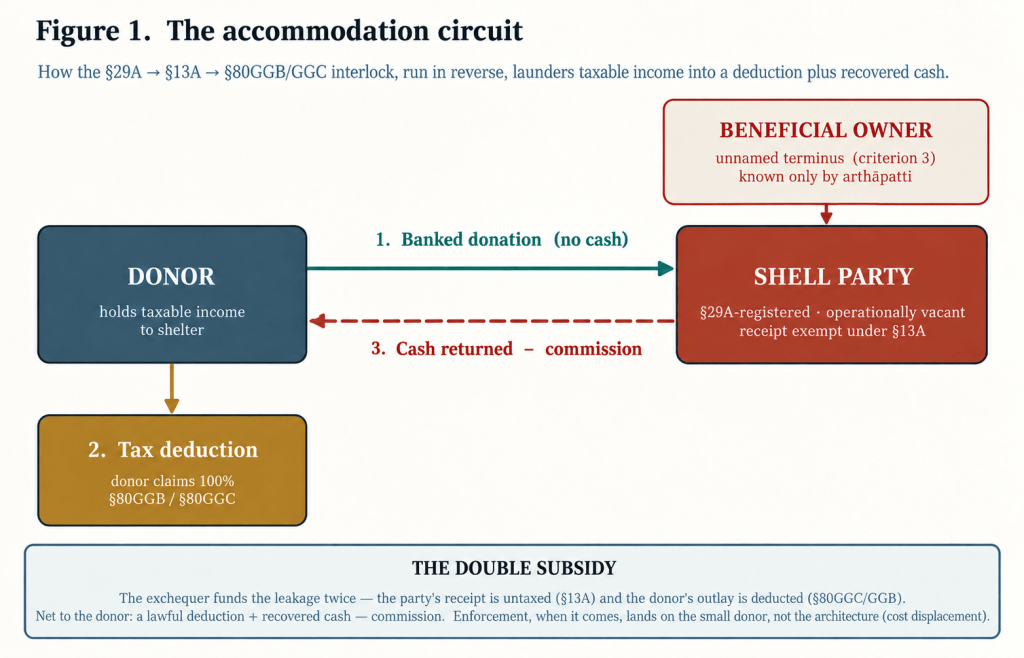
Figure 1. The accommodation circuit: the §29A → §13A → §80GGB/GGC interlock run in reverse.
The enforcement record establishes that the state is aware of the mechanism, and reveals where the impunity actually sits. On 7 September 2022 the Income Tax Department conducted a search on a group of Registered Unrecognised Political Parties in Ahmedabad, covering twenty-three RUPPs and thirty-five intermediary entities — the very Gujarat cluster within which the BBC’s six sit. Since then the machinery has run steadily, but against donors: standardised reassessment notices under §§148A and 148 issued to those who claimed §80GGC or §80GGB deductions to the flagged parties; a nationwide crackdown on bogus deductions announced by the Central Board of Direct Taxes on 14 July 2025; and a targeted ‘NUDGE’ campaign addressed specifically to §80GGC claims in December 2025. Tribunals have upheld the disallowance of such deductions even where the donor held a valid receipt, transferred by banking channel, to a registered party — on the ground that the party was an accommodation-entry vehicle. The analytic sting is that enforcement lands on the small donor, through form-letter reassessment, while the architecture — the registration gate, the exemption, the deduction — is left untouched and the beneficial owner behind the party is never named. The state prosecutes the periphery of the racket and leaves its centre of gravity in place. Impunity here is not the absence of enforcement; it is enforcement aimed away from the design.
5.2 Electoral bonds — surgery successful, patient dead
The electoral bond, sold from 2018 until the Supreme Court cut it down in February 2024, was the cleanest carapace the Union has issued for political money. A company or a person bought a bearer instrument from the State Bank of India. The party encashed it. The public saw neither name. The banker-state saw both. So did, by extension, the incumbent with privileged reach into that window. Anonymity was not a side-effect. It was the product.
In Association for Democratic Reforms v. Union of India (February 2024) the Court held the scheme unconstitutional. It said, among other things, that the bonds fostered crony capitalism; that political money buys a seat at the table and turns into influence over policy; that the voter’s right to information cannot be traded for a donor’s wish to hide. That is the surgery: the instrument is gone. The question this article asks is the one the judgment could not perform as a criminal court: who was penalised?
The data released after the order gave the concern its teeth. Of ₹12,145.87 crore encashed through bonds, the BJP was by a wide margin the largest beneficiary—the ruling party of the years in which the window was open. Civil-society petitioners put three clusters on the record and they have not been digested:
- Forty-one firms then under investigation by the CBI, the Enforcement Directorate or the Income Tax Department had given ₹2,471 crore to the BJP, of which ₹1,698 crore came after the agencies had already raided or opened files. Donate into a probe, keep the file soft: that is the allegation the numbers make available. It is not a conviction. It is not a coincidence one is obliged to ignore.
- At least thirty shell firms bought bonds worth over ₹143 crore. The vacant company was already on the donor side of the circuit. The shell party, later in this article, is only the recipient-side twin.
- Thirty-three corporate groups holding government contracts and approvals on the order of ₹3.7 lakh crore had given about ₹1,751 crore. More than fifteen of the top thirty corporate donors were themselves under agency investigation.
Read those three clusters together and the Court’s phrase “crony capitalism” is not an adjective. It is a description of a market in which the State sells anonymity, the incumbent reads the tape, and firms under the hammer buy quiet.
In this article’s typology the bond and the shell are complementary instruments. The bond hides the head: the donor disappears; the recipient can still be a real, fighting party. The shell empties the body: the recipient is a letterhead; the donor may even be named on a receipt. One scheme anonymises the giver. The other hollows the taker. Between them sat the same state-issued permission—to move money toward power without a public face.
Then the surgery, and the dead patient. The scheme is unconstitutional. The bonds cannot be sold again. Has any donor been made to disgorge the influence the Court said the money purchased? Has any party been made to return the sum that arrived from a firm already on an agency list? Has any official been answered for the SBI’s delay in producing unique codes, or for the design that let the incumbent see what the voter could not? The public record after February 2024 is not a roll of penalties. It is a migration. Reporting through 2026 shows the flow moving back into electoral trusts—another lawful wrapper—with the BJP again the principal beneficiary and the same proximity-to-contract questions travelling with the money. Strike one instrument; the testudo reshapes. That is not reform. That is costume-change.
So: the operation was a success. The bond is a corpse in the law reports. The patient—the anonymous purchase of access—walked out of theatre and is being nursed in a trust. Until a name is fined, a contract reopened, or a rupee clawed back, “unconstitutional” is a lip-serviced headstone, not a sentence.
5.3 PM CARES as receptacle
PM CARES is the Union government’s masterpiece of lawful unreadability. It was constituted in March 2020 as a public charitable trust while the country was locked down and asked to give. The chair is the Prime Minister, ex officio. The trustees are Home, Defence and Finance, ex officio. The address is the PMO. The emblem is the State’s. The domain is .gov.in. And then the same government says: this is not the State. You may not use the Right to Information Act. You may not put a question on the Lok Sabha list. You may not send the Comptroller and Auditor General. That is not a legal curiosity. It is a design.
5.3.1 The three locks
RTI. The Centre’s affidavit line is that the trust is neither owned nor controlled nor substantially financed by government. The Delhi High Court accepted the “not a public authority” plea in Samyak Gangwal (2023). In January 2026, hearing Girish Mittal, a Division Bench added that even a government-run juristic person keeps a “privacy” shield under Section 8(1)(j), and that income-tax secrecy blocks donor names. So the Fund collects under the Prime Minister’s face and litigates as if it were a shy private client.
Parliament. In January 2026 the PMO wrote to the Lok Sabha Secretariat that questions on PM CARES, the PMNRF and the National Defence Fund are inadmissible under Rules 41(2)(viii) and 41(2)(xvii). No draw on the Consolidated Fund, therefore no question. The executive that chairs the trust instructs the House that the trust is not the House’s business. A ruling formation that treats Parliament as a duration problem has here treated it as a jurisdiction problem: this pile is outside.
CAG. The statutory disaster window—the NDRF—is CAG-audited. This window is not. The Supreme Court in 2020, declining to pour PM CARES into the NDRF, treated the trust as a different object and saw “no occasion” for constitutional audit. What remains is a private CA, chosen by the trustees, publishing receipts-and-payments when the portal is updated. That is not public audit. It is self-description.
5.3.2 What the delayed books actually show
On 17–18 August 2026 the Fund dumped two years of accounts at once. Closing balance, 31 March 2025: ₹8,452.06 crore. FY25 payments: ₹87.85 lakh—almost entirely the orphaned-children scheme, plus bank/SMS crumbs. Share of the pile spent that year: about 0.01 per cent. Parked in fixed deposits: ₹7,846.65 crore. In savings accounts: about ₹605 crore. Interest earned in FY25: about ₹475 crore, level with fresh domestic donations (~₹479 crore). Refunds from “implementing agencies”: ₹324.66 crore, unnamed. Notes to the accounts: not posted. FY24 closed in March 2024; the ink is August 2026.
Quality complaints and returned machines already sat on the public record; a nine-figure refund line with no agency names keeps that file open. PSU CSR—public-sector cash booked as company virtue—went into the same box. A quid-pro-quo reading (donate near a contract) cannot be tested while donor names are a state secret. That is the point of the locks.
The ruling alliance did not need a shell party for this job. It needed a trust that looks like the State and pleads like a private club. The same Centre that defends electoral opacity, that wants one national election clock, that registers parties by the thousand and polices them late, built a relief brand that is unreachable in the three rooms where a republic is supposed to ask: the information commission, the House, the auditor. Call that the BJP-era state form if one is dating the design. Do not call it a proof that every lotus worker looted a till. The indictment is institutional: a Prime Minister’s letterhead that collects, a PMO that forbids questions, a court record that calls this privacy, and a pile of eight thousand crore that spent eighty-eight lakh in a year and still will not name who paid.
In this article’s typology, PM CARES fails the pass-through tests of the shell party and aces the fourth: state-conferred, lawful impunity. The RUPP empties representation. The Fund empties relief-accounting. Both keep the seal. Both are legal on the government’s pleading. Both fail the only test that matters after the collection plate has gone round: can the public follow the money? Here the answer, by construction, is no.
5.4 The terror-funding vector: DHFL–RKW–Mirchi–Dawood
Opaque donor-to-recipient flow is not a parlour game of party receipts. At its worst it is the same structural fact—money that cannot be followed from source to terminus—run through companies and property instead of through a §29A letterhead. The Indian file that makes that continuity impossible to wave away is the Enforcement Directorate’s case around Dewan Housing Finance Corporation Ltd (DHFL).
On the ED’s case—not on a finished criminal judgment—entities linked to DHFL’s then promoters, the Wadhawans, RKW Developers among them, moved very large sums through real-estate deals connected to associates of Iqbal Mirchi. Mirchi was a known associate of Dawood Ibrahim. D-Company is a designated terrorist enterprise. That sentence is an allegation-chain. This article will not thicken it into a courtroom fact. Section 8’s discipline applies here with more force than anywhere else in the text: what is asserted is what the agency put on paper, and what the public may therefore ask. What is not asserted is that every later buyer of the DHFL book, or every later political donee, is thereby a terrorist financier.
What can be stated without that thickening is the direct, declared political money that ran from the same promoter cluster to the Bharatiya Janata Party. These are not ED inferences. They are contributions the BJP itself put on the Election Commission record:
- ₹10 crore from RKW Developers Limited (Wadhawan-owned) in 2014–15;
- ₹10 crore from Wadhawan Global Capital Limited (Kapil and Dheeraj Wadhawan as directors) in 2019;
- ₹7.5 crore from Darshan Developers, treated in contemporaneous reporting as a Wadhawan-controlled vehicle.
That is ₹27.5 crore, named, dated, and acknowledged by the recipient, from 2014–15 onward. Cobrapost’s 2019 investigation had already put a related cluster at about ₹20 crore to the BJP between FY 2014–15 and 2016–17 through RKW Developers, Skill Realtors and Darshan Developers. The two tallies overlap; they are not two separate jackpots. They are the same pipe counted in public filings.
Hold the two planes apart and then hold them side by side. Plane one: ED allegation of a Mirchi–Dawood-adjacent real-estate route. Plane two: ECI-declared crores from RKW / Wadhawan Global / Darshan into the BJP’s account. The second does not prove the first. The first does not criminalise the second. What the pairing does prove is the article’s narrower claim: the same promoter world that is accused of untraceable criminal-adjacent flow was, on the legal surface, a direct donor to the ruling party of those years. Opacity is not only what hides a destination. It is also what lets a destination remain respectable while the other end of the pipe is under a terror-financing investigation. The ₹27.5 crore is the respectable end, in black and white. The ED chain is the end that still has no verdict. The public is entitled to look at both without being told they are unrelated planets.
Two things still follow, and they are the reason the chain is in this article.
First, continuity of form. A shell party and a Bandra-Book company are not moral equals. One is accused, at the limit, of feeding a designated network; the other is accused, at most, of running a tax vessel. The form is cousinage: a lawful-looking entity, thin operations, a beneficial owner who is not the name on the door, a trail that breaks at the point where a regulator would need a person rather than a letterhead. The same un-traceability that lets a Gujarat RUPP take a deductible donation and, on the accountants’ account, walk most of it back in cash, is the un-traceability that lets a housing-finance book be split across dummy borrowers and related developers until the destination is a rumour. Political finance is the domestic, legal-looking octave of a problem whose other octave is criminal finance. Treating them as separate planets is how both survive.
Second, the afterlife of the book. DHFL did not only generate an ED file. It generated an insolvency. Under the Insolvency and Bankruptcy Code the enterprise was bid, voted, acquired; old management was displaced; a “clean slate” was pleaded; depositors and small creditors took the haircut the plan assigned them. That resolution is not a terror trial. It is an accountability trial of a different kind: was the committee-of-creditors ballot verifiable in public? Were related-party and avoidance questions exhausted or bundled into silence? Did the extinction of the corporate debtor’s liability extinguish the public’s right to see who owed whom? The present author’s DHFL dossier exists because those questions did not die with the brand change. A republic that can rechristen a failed NBFC in eighteen months and still cannot publish a clean map of the RKW–Mirchi allegations is not “moving on.” It is changing stationery.
Hold the two together and the typology gains a dark edge it should not pretend not to have. The shell party is the banal case: tax, cash, vacancy. The DHFL–RKW–Mirchi–Dawood chain, as alleged, is the acute case: the same vacancy of beneficial ownership, pointed at a designated destination. Between them is not a smear. It is a warning about what opacity is for. If the State will not force a name onto a donation, a bond, a trust, a relief fund, or a loan book, it should not be surprised when the unnamed end of the pipe is sometimes worse than a service charge. The remedy this article will later name is not a bigger ED. It is the refusal of media—money and party—that make the unnamed end possible. Until then: allegation stays allegation; the structure stays the indictment.
5.5 The tortoise-shell / donor-receptor relation (kūrmāvastha)
The name “shell” is not slang. It is a description of how the device works. A tortoise survives by four properties. Each has a precise counterpart in this political economy.
It retracts. The animal pulls the head in and offers only bone. The donor pulls the name in and offers only an instrument: a bond serial, a trust receipt, a party no voter has heard of. What remains visible is armour. What is vulnerable—the person who paid, the person who took the cash home—is inside.
It is grown with the body. This is not a rented locker. The State issues the carapace as the legal person: §29A registration, §13A exemption, §80GGC deduction, the bond while it lasted, the trust that replaced it, the relief fund that will not answer. Protection is not added to the form. Protection is the form.
It moves. Scrutiny arrives at an address and finds a shutter. The BBC’s Gujarat rooms were occupied in the only sense that counted—money had passed—and empty in every other. The refuge does not sit in a vault waiting to be raided. It travels with the transaction. There is never a “home” at which the animal must be caught.
It outlasts the hunter. A tortoise’s defence is time. So is this order’s. Recognised status is reviewed on a two-election clock. RUPP audits can sit off the Commission’s site for hundreds of days past the deadline. PM CARES litigation has run from 2020 into 2026; the latest books arrived two years late. Impunity here is not a midnight pardon. It is delay made lawful. The shell buys months. Months buy a new wrapper. The wrapper buys another cycle.
One tortoise is already hard to hold. The donors of this economy are not one tortoise. They are a testudo: the Roman formation in which each shield covers the man beside it. Strike the bond, and the line closes up as a trust. Strike a named RUPP, and another letterhead is cheap. Strike a donor with a reassessment notice, and the party-form remains. Individual anonymity plus collective cover is why “reform of one instrument” never ends the march. The formation changes shape. It does not break.
The Gītā makes the inversion exact, not ornamental. Bhagavad-Gītā 2.58 gives the tortoise withdrawing its limbs as the picture of the sthitaprajña: the steady-minded person who draws the senses back from their objects. That kūrmāvastha—the tortoise-condition—is a discipline of restraint on the way to freedom. The shell donor performs the same bodily act and means the opposite. He also withdraws. He withdraws not appetite from the world but his name from the ledger. Classical kūrmāvastha is self-limitation. Fiscal kūrmāvastha is self-erasure for profit. The spiritual figure of withdrawal-for-liberation is turned, without remainder, into withdrawal-for-impunity. That reversal is the argument in one image. Everything else in this section is only the anatomy of the shell.
5.6 The numbers
The register can still be talked about as if money followed votes. FY 2023-24 ends that courtesy.
Six recognised national parties declared a combined ₹5,820.91 crore in total income. Of that, the BJP’s ₹4,340.47 crore was 74.57 per cent—three-quarters of the national tier in one account. The rest of the “national” field was a long drop: Congress ₹1,225.11 crore; CPI(M) ₹167.63 crore; BSP ₹64.77 crore; AAP ₹22.68 crore; NPP ₹22.44 lakh. Forty regional parties with published audits declared ₹2,532.10 crore together, led by BRS (₹685.52 crore), Trinamool Congress (₹646.39 crore) and BJD (₹297.81 crore).
Set against that official pyramid, six Gujarat RUPPs declared about ₹1,700 crore in donations and fielded fifteen Lok Sabha candidates. That donation line is larger than every national party except the BJP. It is larger than Congress. It is larger than BRS and Trinamool added to the small national leftovers. One of the six, the Aam Janmat Party, alone declared ₹620 crore—more than double Congress’s donation take of ₹281 crore in the BBC comparison, and more than either of the two biggest regionals’ entire declared income.
| Entity | Declared figure (₹ cr) | Measure | 2024 LS candidates | Seats won, 2024 |
|---|---|---|---|---|
| BJP | 4,340.47 | total income | 441 | 240 |
| Six Gujarat RUPPs (combined) | ~1,700 | donations | 15 | 0 |
| Indian National Congress | 1,225.11 | total income | 328 | 99 |
| BRS | 685.52 | total income | 17 | 0 |
| Trinamool Congress | 646.39 | total income | 48 | 29 |
| Aam Janmat Party (one RUPP) | 620 | donations | 1 | 0 |
| BJD | 297.81 | total income | 21 | 0 |
| CPI(M) | 167.63 | total income | 52 | 4 |
| BSP | 64.77 | total income | 488 | 0 |
| AAP | 22.68 | total income | 22 | 3 |
| NPP | 0.2244 | total income | 3 | 0 |
Table 3. Declared receipts, 2024 Lok Sabha representation and electoral performance
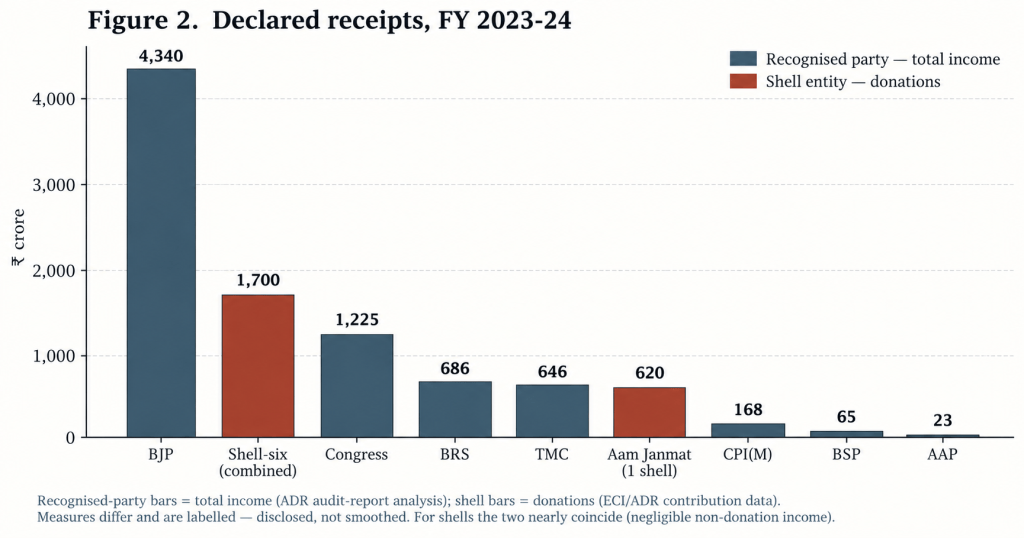
Figure 2. Declared receipts, FY 2023-24. Recognised-party bars are total income; shell bars are donations — labelled, not smoothed.
The methodological wrinkle in Figure 2 is disclosed rather than concealed, in keeping with the discipline of compelled juxtaposition: the recognised-party bars are total income from ADR audit-report analysis, while the shell bars are donations from ECI/ADR contribution data. The two measures differ; but for the shell entities they very nearly coincide, since such entities have almost no non-donation income. The table below carries the same figures with the measure made explicit for each row.
Figure 3 renders the operational vacancy of the wider cohort. Across the ten anonymously-registered Gujarat parties tracked between 2019-20 and 2023-24, some ₹4,300 crore was received and ₹3,500 crore of expenditure recorded in audit reports, against a mere ₹39.02 lakh of expenditure declared for elections — a ratio of audited spending to electoral spending of roughly nine thousand to one. Those ten parties fielded forty-three candidates across three elections and secured 54,069 votes between them. The chart, plotted on a logarithmic scale so that the electoral outlay is visible at all, is the empirical face of the first criterion: near-total receipts, near-zero electoral activity.
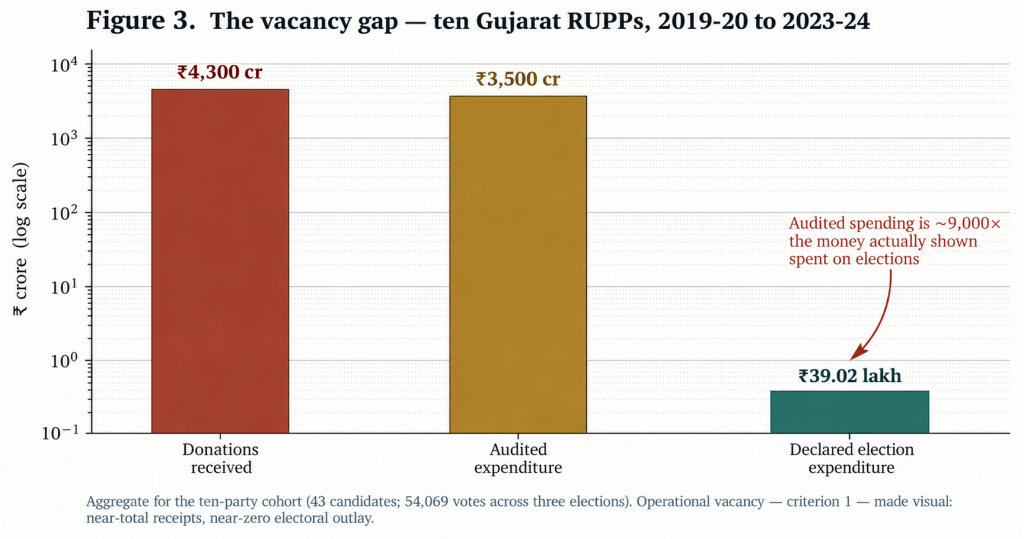
Figure 3. The vacancy gap — ten Gujarat RUPPs, 2019-20 to 2023-24, on a logarithmic scale.
| Ten Gujarat RUPPs, 2019–20 to 2023–24 | Figure |
|---|---|
| Receipts | ~₹4,300 crore |
| Expenditure in audit reports | ~₹3,500 crore |
| Expenditure declared for elections | ₹39.02 lakh |
| Ratio (audited spend : electoral spend) | ~9,000 : 1 |
| Candidates fielded (three elections) | 43 |
| Votes secured | 54,069 |
Table 4. The vacancy gap: ten Gujarat RUPPs, 2019–20 to 2023–24
6. Election as simulation: cronyism and the legitimation crisis
When a party can be a hollow form and its funding a sealed circuit, an election is no longer a representation that happens to be imperfect. It is, in Baudrillard’s sequence, already past the stage of a lie about a real public. A lie still needs a real it distorts. Simulation begins when the signs of the real—campaign, symbol, audited account, donation certificate, a name on the Commission’s list—circulate instead of the referent they once pointed to. The aggregation of a public will is not hidden behind those signs. It is no longer required for the signs to function. That is the simulacrum: not a fake party standing in for a true one, but a party-form that has no true one left to stand in for, and still produces all the official noise of democracy.
India’s roughly 2,800 registered parties are the empirical face of that shift. Pluralism would be many publics, many tickets, many defeats. Simulation of pluralism is a crowded register whose crowd does not vote, spend on votes, or occupy an office that opens. The system displays the statistical appearance of a vibrant multi-party field; a large fraction of its units performs no representative function whatever. The copy has detached from any original contest. Section 5.6 already put the precession on a table: a letterhead with ₹620 crore and one candidate sitting above parties that still fight. In Baudrillard’s terms, that row is not a scandalous exception inside a healthy map. It is the map that has replaced the territory—the hyperreal of “party” without a public to represent.
Call the political economy by its name. This is crony capitalism, not a foggy “funding challenge.” The Supreme Court used the phrase when it killed electoral bonds. The data did the rest. Gautam Adani and Mukesh Ambani did not need to print their surnames on a bond stub. That was the point of the instrument. The public list of purchasers was a list of vehicles. Reliance-linked money still arrived: Qwik Supply Chain Pvt. Ltd. bought bonds on the order of ₹410 crore and sent about ₹375 crore to the BJP; Laxmidas Vallabhdas Merchant, a senior Reliance accounts-and-tax official, sent his entire bond purchase to the BJP. Together those two pipes put about ₹400 crore into the ruling party. Adani’s group name was likewise not a headline purchaser; the group’s rise through ports, airports, energy and contested government clearances is the context in which anonymity had value. Vedanta, Bharti, DLF, Megha Engineering, Piramal entities, loss-making firms that still found hundreds of crores for bonds—these are the visible edges. The design was that the household name stays off the stub and the contract stays on the file. When the Court opened the stub, the BJP had encashed the largest share of ₹12,145.87 crore. Forty-one firms already under CBI, ED or Income Tax inquiry had given the party ₹2,471 crore, ₹1,698 crore of it after the raids. That is not “support.” That is a market in quiet.
The shell party is the same market on the other side of the counter. Bonds hid the giver and left a real party standing. RUPPs hide the taker and leave a giver who may even hold a receipt. Gujarat’s six names taking about ₹1,700 crore against fifteen candidates are not a separate scandal. They are the recipient-side of the same anonymity the Adani–Ambani era required: money that needs a legal person, not a public.
Do not invent a World Bank conspiracy. Use the Bank’s own yardstick as a thermometer. Worldwide Governance Indicators on control of corruption and on voice and accountability measure, however crudely, whether a public can see who bought what. India’s problem is not that Washington funds the BJP. It is that a “good governance” scorecard can sit beside a domestic architecture in which the Prime Minister’s relief trust is outside RTI and Parliament, parties refuse RTI, and the largest private fortunes thicken in the same years as the ruling party’s books. Inequality is the floor under that architecture. World Inequality Report 2026: the top 1 per cent of Indians hold about 40 per cent of wealth; the top 10 per cent hold about 65 per cent; the bottom 50 per cent hold about 6.4 per cent. Income: the top 10 per cent take 58 per cent; the bottom 50 per cent take 15 per cent. Bharti, Chancel, Piketty and Somanchi had already called the present a “Billionaire Raj” more unequal, at the tip, than the colonial one. Political money is how that tip buys the State without standing for election. The ninety-eight per cent who do not write crore-cheques pay twice: once in the tax subsidy of §13A and §80GGC, once in the policy that follows the cheque. The fiscal leakage of that double subsidy is documented and regressive. That it feeds inflation is a monetary claim this article does not pretend to have proved.
On 3 June 2013 a CIC Full Bench held six national parties—including the BJP and the Congress—to be public authorities under Section 2(h) of the RTI Act. Grounds: concessional land, free airtime, electoral rolls, and the §13A tax exemption that this article has treated as the core privilege of the vessel. The parties were told to appoint CPIOs. They did not. As of 2026 they still have not. The Union did not enforce the order. So the organisations that appoint the Prime Minister, staff the cabinets, and harvest 100 per cent deductibility tell the citizen: we are not the State; you may not ask. PM CARES uses the same sentence with a trust deed. RUPPs use it with a §29A certificate. The refusal is the system.
Name the surge. ADR and party filings put BJP income at about ₹674 crore in 2013–14 and assets at about ₹781 crore. By 2022–23 assets were reported around ₹7,052 crore—roughly ninefold. FY 2023–24 income: ₹4,340.47 crore, 74.57 per cent of all six nationals. FY 2024–25 income: about ₹6,769 crore, of which voluntary contributions about ₹6,125 crore; interest on a piled corpus about ₹639 crore; cash and cash-equivalents reported near ₹10,000 crore in Election Commission figures cited in 2026. Bonds gone, trusts arrived: in 2024–25 electoral trusts alone sent the BJP on the order of ₹3,577 crore, Prudent alone about ₹2,181 crore. Opposition speeches that put the 2024 pile above ₹10,000 crore are political; the direction of travel is not. In a decade the party of government became a financial institution that happens to contest. This is not a claim that every rupee is a bribe. It is a claim that incumbency plus opacity plus a cheap party-form produces an astronomical balance sheet, while Gujarat letterheads out-raise everyone but that balance sheet, and while the CIC order collecting dust says the citizen still may not inspect the machine.
A legitimation crisis, in Habermas’s sense, is not a mood. It is output legitimacy dying under intact procedure: elections happen, parties multiply, a Commission exists. Funding opacity, simulated pluralism, front politics that socialises blame, One Nation One Election that shortens the federal clock, a relief fund that will not answer, parties that will not accept RTI—together they yield what this article calls democratic unfreedom. The forms of freedom persist. The substance is captured by those who can buy a vessel.
The charge that must be named is vote chori—the word now used for the alleged theft of the roll, the machine, and the count. This article will not launder that charge into the timid adjective “contested,” as if a public already convinced it has been robbed were merely having a difference of opinion. The Election Commission denies it. The courts have repeatedly declined to strike down EVMs. Those denials exist. They have not closed the file in the country that must live with the result. A Commission that will not put party accounts on its website for hundreds of days, that minted thousands of tax-privileged letterheads with no duty to fight, and that is appointed through a process the ruling alliance dominates, is not in a position to ask for blind faith when citizens allege that rolls were padded, names deleted, and machines treated as oracles. Intellectual honesty still forbids smuggling an unproven hack into a proven finance story. Intellectual honesty also forbids treating vote chori as a rumour to be managed. The allegation is now part of the legitimation crisis: a large public believes the ritual is rigged, the umpire will not submit to the scrutiny that would settle it, and the same umpire issued the kit in which dark money, shells and incumbency all fit. A democracy is not only in trouble when a vote is stolen. It is in trouble when the State answers theft with procedure and expects the robbed to call that proof.
The Election Commission is inside that trouble. It keeps the §29A gate that mints tax-privileged personality without a duty to fight. It delisted idle RUPPs only in 2025. It lets audits vanish from the site for hundreds of days. It is the umpire that issued the kit in which Adani- and Ambani-scale capital, Wadhawan-declared crores, bond anonymity, trust migration and Gujarat shells all fit. The deficit is not only in the parties. It is in the regulator that registers them, exempts them, and then asks the country to call the result a contest.
6.1 The Tenth Schedule as a door: anti-defection, and the NCPI as a rented party
The Tenth Schedule was sold in 1985 as a lock on the legislator who sells his mandate. It has become a door with a two-thirds handle. Paragraph 2 still says: switch party, lose the seat. Paragraph 3, the old “split” escape of one-third, was deleted in 2003 because it was being used as a drip-feed of defection. What remains is Paragraph 4: if the original political party merges with another party, and not less than two-thirds of the legislature party agree, nobody is disqualified. The loophole is the slide from organisation to floor. The text wants a merger of the party that gave the ticket. Practice treats two-thirds of the MPs in one House as entitled to declare that merger themselves, walk into another letterhead, and keep the chair. The Speaker—who is of the ruling side—decides, and decides slowly. While he sits on the petition, the walkers vote. Goa 2022 (Congress MLAs into the BJP), Maharashtra’s Shiv Sena and NCP splits, AAP Rajya Sabha MPs into the BJP in 2026: same arithmetic, same immunity claimed. Resignation mid-term, office-of-profit timing, and “voluntarily giving up membership” by conduct (Ravi S. Naik) are the other edges. The Schedule punishes the lonely defector and blesses the bulk sale.
June 2026 made the device visible without remainder. Twenty of the Trinamool Congress’s twenty-eight Lok Sabha MPs—led by Kakoli Ghosh Dastidar and Sudip Bandyopadhyay—went to Speaker Om Birla and announced a “merger” with the Nationalist Citizens Party of India (NCPI). They asked for separate benches and pledged to work with Narendra Modi, Amit Shah and the NDA. Twenty is more than two-thirds of twenty-eight. That is the only number the Tenth Schedule, on their reading, is required to count.
What is NCPI? Not a public. A Registered Unrecognised Political Party—the same species this article has been describing since the Gujarat six. Tripura-based, registered around 2022–23, a Howrah / Sankrail address as its Bengal trace, a handful of candidates in the 2023 Tripura Assembly (two to four seats in different counts), a few hundred votes in the reported tallies, no MLA, no MP, no recognition. Its own 2023 slogan told voters to reject dalbadlu, political turncoats. In June 2026 it acquired, overnight, twenty Lok Sabha members—more parliamentarians than it had ever had members anyone could find on a campaign roll. One of its own organisers, Shantanu Dey, learned of the “merger” from the news. Congress called it Amit Shah’s engineering of an NDA two-thirds; the rebels had already been seen around Union minister Bhupender Yadav’s house. By late July the group was sitting in an NDA Mangal Milan as “NCPI.” The plan, spoken aloud, was stopgap: merge with the unknown vessel now, claim the Trinamool name and flowers later, let courts sort the symbol.
Read that against Section 2. NCPI is the shell party as parliamentary vehicle. It does not need ₹620 crore. It needs a §29A certificate so that twenty MPs can say the word “merger” instead of the word “defection.” More MPs than members is not a joke. It is the construct in one sentence: a juridically valid, operationally vacant party whose use is not representation but the laundering of a change of side. The Gujarat RUPPs launder donations. NCPI, on this use, launders benches. Both are cheap forms issued by the same Commission. Both become valuable the moment the State attaches a privilege—tax in one case, Paragraph 4 immunity in the other.
P.D.T. Achary and a line of reading after Subhash Desai (the Shiv Sena case) say the obvious: MPs cannot merge the party; only the party can merge, and two-thirds then agree. Sagarika Ghose put that letter on the Speaker’s table. Mamata Banerjee’s TMC called the walk illegal. Kapil Sibal said disqualify them. The Schedule, as operated, does not care. A rented RUPP plus two-thirds plus a friendly Chair is enough to turn a mandate from Bengal into an NDA number and, if the rebels prevail, into a claim on the very symbol the voter marked. That is not a loophole at the edge of the law. That is the law doing what the shell does: keep the form, empty the referent, call the result constitutional. The anti-defection statute was written to stop the purchase of legislatures. In 2026 it is the receipt.
7. Conclusion: toward a moneyless, partyless commons
Everything above is the premise. The shell party, the reversed statutory interlock, the bond that hid the head and the RUPP that emptied the body, PM CARES as a receptacle that will not answer, the DHFL–RKW chain as alleged on the ED’s paper and the ₹27.5 crore that did reach the BJP on the ECI’s paper, the tortoise and the testudo, Figures 1 and 2, the Adani–Ambani vehicles, the CIC order no party obeyed, the BJP’s ninefold asset climb, vote chori as a public indictment the umpire will not submit to, One Nation One Election as a shortened federal clock, NCPI as a rented §29A form with more MPs than members—these are not a list of reforms pending. They are one structure: money as the unit that can be hidden, and the party as the person that can hide it. Leave those two media standing and the testudo only changes shape. The trust after the bond was the proof.
That is why this article does not end in a cleaner Commission or a tighter §29A. The Indian party is already a limited company by another name: cheap incorporation, tax exemption, donor deduction, liability stopped at the letterhead, claim on the public unlimited. Limited companies exist so owners do not pay the firm’s debts. Registered parties exist so donors and floor-walkers do not pay the mandate’s debts. Gujarat’s shut offices and NCPI’s overnight benches are the company doing company work.
Why partyless. The party is not a tool that rusted. It is a standing machine whose first product is itself—cadre, symbol, whip, list, next cycle. Representation is optional once that machine exists; the fiscal and parliamentary uses traced in Sections 2–6 become rational. A commons is not the end of politics. It is the end of permanent brokerage between people and their own decisions. An assembly can meet, bind, dissolve. A party cannot dissolve without killing the asset. That difference is the whole argument for partylessness.
Why moneyless. Because every opacity vehicle in this article is a use of money. A donation certificate, a bond serial, a trust receipt, a CARES corpus in fixed deposits, a service charge in cash, a contract paid after a raid—none of these exist in a needs-only provisioning where nothing is a unit that can be given to a letterhead. Money is not “the economy.” It is the solvent that lets power move without a face. Remove the solvent and the shell has nothing to hold.
Ideological bankruptcy is the shared script under the different hymns. Every major formation, some with a louder procession, some with a secular varnish, plays the religious card, because belonging is cheaper to mobilise than a fight over who owns the port. The card is crowd-control for cronyism, not its opposite. On the only question that decides whether a bioregion remains liveable, the tickets are not opposites. They subscribe, with differences of adjective, to the same World Bank–preached “developmentalism“: GDP as virtue, infrastructure as destiny, the river as a site, the forest as a clearance, carbon as a lagging indicator, the farmer as a transition cost. “Anti-nature” is that premise. “Anti-human” is its distribution: the bottom half of India holding about 6.4 per cent of wealth while the party of government stacks a near-ten-thousand-crore cash pile and vacant names out-raise the opposition. You cannot vote the premise out if every symbol on the ballot has already signed it.
The climate polycrisis is not an annex to this finance story. It is why incremental repair is finished. A politics of opaque accumulation is the politics that heated the planet. A post-carbon order cannot run on the same media.
The grounding for the exit is older than a think-tank brief. Ecosophy, in Arne Naess’s sense and in Félix Guattari’s three ecologies—environment, social relations, human subjectivity—is not a lifestyle. It is the refusal to treat the living world as an externality of the party-company. Aldo Leopold’s land ethic said the same in another grammar: the land is a community to which one belongs, not a commodity one owns; a thing is right when it tends to preserve the integrity, stability and beauty of the biotic community. James Lovelock’s Gaia is the same recognition at planetary scale—the Earth as a self-regulating living system, not a warehouse of inputs. Ernest Callenbach’s Ecotopia named the polity that would follow if that recognition were institutional: region against extraction, sufficiency (economics of austerity; Buddhist economics) against GDP fetish, assembly against machine. This article does not need their agreement on every clause. It needs their shared veto: a form of common life that cannot be donated, bonded, trusted, or walked across the floor.
The veto has to be lived somewhere smaller than a nation and thicker than a manifesto. A bioregional, local-resource, needs-only economy organised as a moneyless, partyless commons is that scale: place-based provisioning, assembly that can meet and dissolve, no permanent party, no unit of account a donor can hide inside a letterhead.
The pedagogy that fits it is already named in another register. Illich’s deschooling was never anti-knowledge; it was the refusal of a credential machine that accredits only what serves the existing order. Holt’s unschooling was the same refusal from the child’s side of the desk. Counter-academiocracy is their continuation against a further capture: the university and the think-tank as annexes of the party-company, producing “policy” the bond and the trust already bought. Heads, hands and hearts—farming and foraging, disaster response, the three Rs of ecology and ecosophy, political literacy, the economics of austerity, the crafts of a convivial common life—are not a syllabus waiting for a ministry stamp. They are the skills a bioregion needs when the mediating media of money and party have been set down. Knowledge that must be accredited by a party is already the party’s knowledge. The commons requires the other kind.
The shell party is the terminal symptom of politics as fiscal enterprise: limited company, religious lubricant, developmentalist consensus, regulator that issues the form and calls the result a democracy. Leopold’s community, Lovelock’s living Earth, Naess and Guattari’s ecosophy, Callenbach’s ecotopia, and the tables in Section 5.6 are one conclusion.
“RUPP tera mastana” is not a caption. It is the diagnosis sung in the vernacular the register pretends not to speak. Rūp is form; a RUPP is that form issued at the §29A window—intoxicating because it looks like a party and behaves like a till. Mastānā is the daze of the sign: two thousand eight hundred names, fifteen candidates, ₹1,700 crore, a Tripura letterhead that wakes up with twenty MPs. The neologism shell party is only the same sentence in analytic English: valid vessel, vacant body, value in the privileges the State staples to the name. Donor-shell and party-shell, bond and trust, CARES lockbox and Paragraph 4 merger, Gujarat flat and NCPI bench, are one rūp changing costume. The song was always about a face that ruins the one who stares; here the face is the registration certificate, and the ruin is representation. Call the thing what it is, and the commons that follows has nothing left to serenade.
The answer is not a better-audited party. It is a commons that has no use for a party, and no slot in which a bond, a trust, a PM CARES lockbox, or an NCPI can be inserted. A party-as-limited-company is precisely the centralisation of money-muscle: capital pooled off the public ledger, cadre and whip as the firm’s staff, the symbol as brand, the House as market-share. Muscle without the street-fight—deposits, trusts, letterheads, two-thirds mergers—does the same work a private army once did: it concentrates force where the many cannot reach it. The commons is the refusal of that concentration. People provision and decide together without a permanent broker, a standing army of symbols, or a unit of account that travels farther than the need it claims to serve. Not chaos. The opposite of chaos—horizontal mutual aid instead of the whip, assembly instead of the limited company, the land community instead of the donor’s carapace. Until that commons is built, the testudo keeps walking, because armour is what a world of centralised masters requires. After it is built, there is nothing for the tortoise to carry, no pile left to command a floor, and no one left whose first task is to rule.
References
Representation of the People Act 1951, §§29A–29C (registration of parties; contribution reports) — India Code: https://www.indiacode.nic.in/handle/123456789/2096
Income-tax Act 1961, §§13A, 80GGB, 80GGC, 139(4B) (party income exemption; donor deductions) — India Code: https://www.indiacode.nic.in/handle/123456789/2435 (repealed and replaced by the Income-tax Act 2025 w.e.f. 1 April 2026)
Companies Act 2013, §182 (corporate political contributions) — India Code: https://www.indiacode.nic.in/handle/123456789/2114
Association for Democratic Reforms v. Union of India (Electoral Bonds), 2024 INSC 113, WP(C) 880/2017, decided 15 February 2024 — Supreme Court Observer case page: https://www.scobserver.in/cases/association-for-democratic-reforms-electoral-bonds-case-background/
PM CARES Fund held not a “public authority” under the RTI Act; PMO affidavit in the Samyak Gangwal petitions, Delhi High Court — The Print: https://theprint.in/judiciary/pm-cares-fund-a-charitable-trust-not-public-authority-under-rti-pmo-informs-delhi-hc/1345175/
ADR, income of the six national parties, FY 2023-24 (BJP ₹4,340.47 cr = 74.57%; total ₹5,820.91 cr) — https://adrindia.org/content/bjp-tops-income-list-of-national-parties-for-fy-2023-24-with-rs-4340-47-cr-adr
ADR, income & expenditure of 40 regional parties, FY 2023-24 (₹2,532.10 cr; audits of 20 still unavailable 313 days past deadline) — https://adrindia.org/content/Analysis-of-Income-and-Expenditure-of-Regional-Parties-FY-2023-24
Election Commission of India, delisting of 808 RUPPs in two phases (Aug–Sep 2025) and action against 359 more — PIB press release: https://www.pib.gov.in/PressReleasePage.aspx?PRID=2168476
BBC News Hindi investigation (Shubhangi Mishra) into six Gujarat RUPPs — ₹1,700 cr in 2023-24 against 15 candidates — reported via Scroll.in: https://scroll.in/latest/1095520/donations-to-six-gujarat-based-outfits-exceeded-those-to-national-parties-except-bjp-report
Income Tax Department search on the “RUPPs group of Ahmedabad” (7 Sept 2022; 23 RUPPs, 35 intermediaries) and the standard §80GGB/80GGC donor reassessment notices — Taxmann: https://www.taxmann.com/post/blog/guide-to-dealing-with-income-tax-notices-received-by-donors-of-rupps/
DHFL–RKW–Sunblink–Iqbal Mirchi–Dawood Ibrahim chain; ED case that a ₹2,186 cr DHFL loan reached the D-Company (as ED allegation) — Business Today: https://www.businesstoday.in/latest/corporate/story/dhfl-cmd-kapil-wadhawan-sent-to-five-day-ed-custody-in-money-laundering-case-249309-2020-02-03

