“RUPP Tera Mastana”: Shell Parties and Simulacra
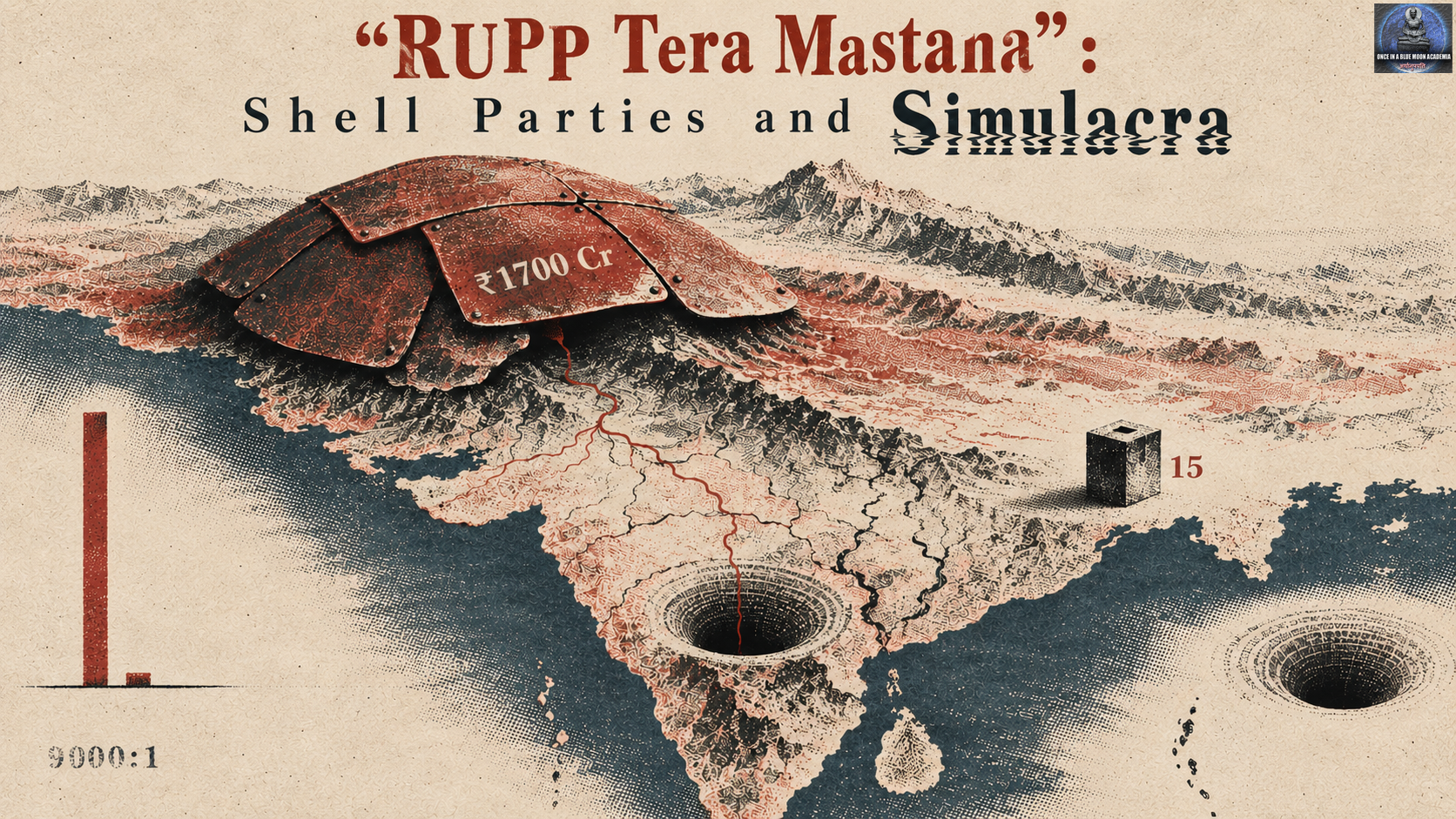
This article argues that a growing subclass of Indian parties is not janaseva (public service) but a fiscal enterprise—the party as limited company—whose tax and registration privileges are harvested whether or not it fights an election. The 2025 BBC News Hindi investigation of six Gujarat Registered Unrecognised Political Parties (RUPPs) is the entry: about ₹1,700 crore in FY 2023–24 donations against fifteen Lok Sabha candidates. From that mismatch it names the shell party, analogue of the shell company: a valid, vacant recipient whose use is fiscal (or, as with the NCPI merger of twenty TMC MPs, parliamentary). A four-provision interlock—RPA 1951 §29A; Income Tax Act §§13A, 80GGB, 80GGC; Companies Act §182—run in reverse, turns taxable income into a deduction plus cash after commission. The same lawful opacity is set beside electoral bonds and their afterlife in trusts, PM CARES as an un-askable receptacle, Tenth Schedule “mergers” that launder benches, and, as ED allegation not verdict, the DHFL–RKW–Mirchi–Dawood chain beside ₹27.5 crore declared to the BJP. Letterheads out-raised every national party except the ruling one. Read as Baudrillard’s simulacrum and Habermas’s legitimation crisis—including the public charge of vote chori—the register simulates pluralism while hollowing representation. Reform only reshapes the shell. Equal to the climate polycrisis is a bioregional, moneyless, partyless commons.
