
Posted on 16th October, 2026 (GMT 19:20 hrs)
ABSTRACT
Between May 2014 and October 2026, India’s BJP-led National Democratic Alliance confronted an almost unbroken sequence of protest and resistance—from the 2015 land-ordinance agitation and the 2020–21 farmers’ siege of Delhi to the 2026 youth-led Cockroach Janta Party (CJP) rising—under conditions of sustained political domination rather than the successful production of consent. This article maps the ecology of that dissent: the movements themselves; a counter-public of non-Godi and crowdfunded media; satirists and stand-up comedians deploying hasya and vyanga against the regime’s bhayanaka and vibhatsya; organic intellectuals of political and civil society; dissenting advocates and judges; and watchdog NGOs. It documents the repertoire of domination deployed against them—imprisonment without trial, preventive detention, financial and regulatory strangulation, blocking, SLAPP litigation, career reprisals, threats, vigilante violence, surveillance, state violence and assassination by non-state actors—and reads the CJP against this longer inheritance through Gramsci’s account of hegemony and organic intellectuals, Partha Chatterjee’s distinction between civil and political society, Habermas’s concept of legitimation crisis, Ranajit Guha’s dominance without hegemony, and Ambedkar’s warning against bhakti in politics. The CJP’s speed and visibility rest on more than a decade of prior investigation, litigation and protest. Its demand for the resignation of named officeholders addresses persons rather than the paradigm or the chair; under a regime that has already closed ordinary channels and made the power to guarantee life the underside of the power to expose marked populations to the sovereign mark, the absorption of a name is the state’s work, not the movement’s. The article treats the CJP as a genuine opening for a new constituency whose unarmed presence has already forced the repressive and ideological apparatuses into public view. The further task is to keep the energy released by that showing from being returned, through the regime’s mechanisms of absorption and attribution, to the chairs that still decide who is to be made live and who is to be marked.
What remains after twelve years of saffron fascist rule is not a sequence of events but a residue scored into the body: the ache of a sit-in that outlasted the night, the metallic taste of tear gas at first light, the sudden quiet of a phone that has gone dead, the weight of a name meant to erase and now worn as a sign. Between the farmers who walked to the borders of the capital and the women who sat for months under the flyover at Shaheen Bagh, between the students who returned to the street after the buses had carried them away and the journalists who kept counting the deletions village by village, something has continued to insist on being present. It is not yet a programme and not yet a force. It is the stubborn fact that the body, once offered, refuses to return fully to the place the examination, the roll or the lathi assigned it. The cockroach is only the latest name for that refusal. OBMA stands with every such refusal—anti-fascist, anti-authoritarian, anti-autocratic—wherever it has appeared across these twelve years, and wherever it continues.
DISCLAIMER: This article is NOT AT ALL a negative critique of the Cockroach Janta Party or of the youth movements currently on the streets of India. The authors and OBMA stand in unwavering solidarity with those who have taken to the streets, and with the longer record of farmers, workers, students, Dalits, Adivasis and minorities on whose ground the present mobilisation stands. The careful, intra-group cautions offered here—about names and chairs, about the demand and the apparatus that absorbs it, about spectacle and organisation—are written from inside that solidarity. They are written so that the force the young people on the ground have already produced is not spent, absorbed or attributed away before the regime that produced the anger has been named. The object of the analysis is the repertoire of domination exercised by the saffron fascist BJP-RSS regime. We stand in clear and stark opposition to its tactics, its means and its methods. Nothing in this article is offered as a reason to withdraw from the street, to lower a demand, or to treat the movement as the obstacle to its own continuation. Go on— youth, and the Opposition, and the politically conscious Indian public sphere.
1. Introduction
This article asks three questions. Who has dissented against the BJP-led National Democratic Alliance (NDA) government between May 2014 and October 2026? What concrete costs—legal, physical, financial and organisational—have been imposed on them by a state apparatus that has repeatedly answered protest with force? And does the Cockroach Janta Party (CJP), the most visible movement of 2026, stand on the ground prepared by more than a decade of investigation, litigation and mobilisation, or does it break from it?
1.1 Scope and Method
The study covers the period from the 2014 general election to 15 October 2026. It proceeds by inventory and synthesis. It first constructs a chronology of major protest movements—the 2015 land-ordinance agitation, the anti-CAA mobilisations, the 2020–21 farmers’ siege of Delhi, and the sequence of smaller but persistent struggles that continued through 2025–26—then successive registers of dissenting actors: non-Godi and crowd-funded media, satirists and stand-up comedians, organic intellectuals of political and civil society, dissenting advocates and judges, and watchdog NGOs. Against these it places a typology of the responses they have faced. The final sections read the CJP against this longer record.
Two limits follow from the method. First, the inventories are wide but not complete; regional and non-English dissent, especially in Odia, Tamil, Telugu, Gujarati and Punjabi, remains under-represented. Second, naming someone as a dissenter records their documented public role. It does not imply that every individual or organisation opposes the government on every question, or that they act in concert.
The lists compiled in this article are neither complete nor exhaustive. They record what could be verified from the public record within the limits of a single research synthesis. Omissions are not deliberate. The inventories will continue to be updated as further documentation becomes available.
1.2 Theoretical Frame
The analysis is organised by four ideas, but it treats domination—the organised use of force, coercion and brutality—as the primary mode through which the BJP-NDA has managed dissent, rather than the successful production of consent. In this it follows Ranajit Guha’s argument in Dominance Without Hegemony that colonial rule in India rested on dominance without ever securing hegemony; the same pattern of rule by force, rather than by consent, has reappeared in the BJP-RSS-NDA’s handling of protest.
- Domination over hegemony. While Gramsci remains useful for understanding contests over common sense, the record of protest from 2014 to 2026 shows a state that has relied far more on the apparatus of force than on the manufacture of consent. Farmers’ marches were met with barricades, tear gas and internet shutdowns; anti-CAA protesters faced preventive detention and UAPA charges; journalists and lawyers encountered raids, frozen accounts and prolonged incarceration without trial. Organic intellectuals of both political and civil society have been answered less by ideological counter-argument than by the concrete instruments of the state: police, investigative agencies, regulatory bodies and the courts as instruments of delay. As Guha argued for the colonial period, hegemony, where it operates, has been secondary to this repertoire of coercion.
- Civil and political society (Partha Chatterjee). In postcolonial India, civil society is the domain of rights-bearing, mostly middle-class citizens who engage the state through law and associations. Political society is where subaltern populations—farmers, Dalits, Adivasis and informal workers—negotiate through mobilisation, often outside the strict letter of the law. Under the NDA these domains have been differentially but consistently coerced. Civil-society dissent has been met with financial strangulation, SLAPP litigation and regulatory blockage; political-society mobilisation has faced direct physical force, mass arrests and, in some cases, lethal violence by state and non-state actors.
- Legitimation crisis (Habermas). When the state can no longer secure belief in its own fairness, administrative success does not translate into loyalty. The four pillars—legislature, executive, judiciary and press—have been the institutional sites through which legitimacy is produced and, under the NDA, progressively compromised. The deeper object of the protests has been this erosion: the perception that the executive controls investigative agencies, that the legislature is reduced to a rubber stamp, that the judiciary delays or defers, and that large sections of the press have become platforms of power rather than checks upon it.
- Bhakti in politics (Ambedkar). In his last speech to the Constituent Assembly on 25 November 1949, B.R. Ambedkar warned that in politics “Bhakti or hero-worship is a sure road to degradation and to eventual dictatorship.” The warning applies to dissent as much as to rule. It frames the critique of the CJP and of the media that celebrate it: a movement that concentrates on the resignation of named officeholders risks reproducing the same personalisation of power it opposes, converting structural domination into a demand for the removal of particular faces.
- The theoretical part (Sections 12 to 19) adds six further tools: overdetermination (Freud, Mao, Althusser) to explain the movement’s structure; docile bodies, subjection and objectification (Foucault) to read its subjects; satyagraha (Gandhi, with Ambedkar’s objection) to read its method; the repressive and ideological state apparatuses (Althusser) to read the state’s exposure; the lumpenproletariat and sabotage (Marx, Fanon, Scott, de Certeau) to read the two-front contest on the street; and sovereign power, biopower, anatomo-politics and biopolitics (Foucault, with Agamben, Mbembe and Guha) to read the regime’s response.
1.3 Plan of the Article
Section 2 gives the chronology of protest. Sections 3 and 4 trace the rise of non-Godi media and its reader/viewer-funded economy. Section 5 turns to comedians, Section 6 to organic intellectuals, Section 7 to advocates and judges, and Section 8 to NGOs. Section 9 classifies the consequences of dissent. Sections 10 and 11 examine the CJP’s genealogy and its limits. Sections 12 to 19 theorise the conjuncture: overdetermination, docile bodies, satyagraha, the exposure of the state apparatuses, sabotage on both fronts, autocratic governmentality, the demand and the chair, and the comparison with 1968. Section 20 concludes.
2. A Chronology of Protests/Movements, 2014–2026
Protest against the BJP-led National Democratic Alliance has been continuous rather than episodic. It has drawn on labour, agrarian, student, Dalit, Adivasi, gender, ecological and regional constituencies, and it has repeatedly been met with force, preventive detention, internet shutdowns, investigative-agency pressure and, in some cases, lethal violence. The table below inventories mobilisations directed against central policies, laws and institutions. State-level agitations appear only where they were tied to a central decision or acquired national resonance.
| Date | Movement | What happened |
|---|---|---|
| Dec 2014 – Aug 2015 | Land Acquisition Ordinance protests | Farmers’ groups, Anna Hazare (Jantar Mantar, Feb 2015) and the opposition opposed dilution of the 2013 land law; the ordinance lapsed in Aug 2015. |
| Jun 2015 onward | One Rank One Pension | Ex-servicemen’s long sit-in and relay hunger strike at Jantar Mantar. |
| Jun – Oct 2015 | FTII students’ strike | About 139 days against Gajendra Chauhan’s appointment as chairman. |
| 2 Sep 2015 | General strike | Central trade unions against proposed labour-law changes. |
| Sep – Nov 2015 | Award Wapsi | Writers, filmmakers and scientists returned state awards after the Kalburgi murder and the Dadri lynching. |
| Oct 2015 onward | #OccupyUGC | Students against scrapping non-NET research fellowships. |
| Jan 2016 | Justice for Rohith Vemula | Nationwide student protests after the Hyderabad Central University scholar’s suicide; Union ministers’ letters were central. |
| Feb 2016 | #StandWithJNU | Against sedition charges and arrests of JNU student leaders. |
| Jul 2016 onward | Una Dalit Asmita movement | After the Una flogging; against cow-vigilante violence. |
| Jul 2016 onward | Kashmir unrest | Months of protests, curfews and pellet-gun injuries after Burhan Wani’s killing. |
| 2 Sep 2016 | General strike | Central trade unions. |
| Nov – Dec 2016 | Demonetisation protests | Opposition “Jan Aakrosh Diwas”, 28 Nov; widespread informal-sector distress. |
| Mar – Apr 2017 | Tamil Nadu farmers at Jantar Mantar | Drought relief and loan waivers, with skulls and other dramatic props. |
| Jun 2017 | Mandsaur farmer firing | Led to the All India Kisan Sangharsh Coordination Committee, the Kisan Mukti Yatra and a Kisan Sansad (Nov 2017). |
| Jun 2017 | “Not In My Name” | Citizens against mob lynchings. |
| Sep 2017 | Gauri Lankesh protests | After the journalist’s assassination. |
| 2017–ongoing | Hasdeo Aranya / Adivasi forest resistance | Protests against coal mining in Chhattisgarh; tree-felling and displacement met with police action and legal battles; continued into 2025–26 with fresh clearances opposed. |
| Mar 2018 | Kisan Long March | Nashik to Mumbai. |
| Mar 2018 | Andhra Pradesh special status | TDP left the NDA. |
| 2 Apr 2018 | Bharat Bandh by Dalit groups | Against dilution of the SC/ST (Prevention of Atrocities) Act. |
| Apr 2018 | Kathua and Unnao protests | Against rapes and their political protection. |
| 2018–ongoing | Aarey forest protests | Mumbai citizens and Adivasis against metro car-shed felling; repeated police interventions and overnight tree felling. |
| 29–30 Nov 2018 | Kisan Mukti March | Farmers to Parliament. |
| 8–9 Jan 2019 | Two-day general strike | Central trade unions. |
| Jan – Feb 2019 | First anti-CAB wave | Northeast protests against the Citizenship (Amendment) Bill. |
| 5 Mar 2019 | Bharat Bandh | Against the 13-point roster for faculty reservation. |
| Aug 2019 onward | Article 370 abrogation | Communications blackout, mass detention of Kashmiri leaders, protests including Soura. |
| Nov 2019 | JNU fee-hike protests | Students against fee increases. |
| Dec 2019 – Mar 2020 | Anti-CAA/NRC movement | Began in Assam; spread after police action at Jamia and AMU; Shaheen Bagh sit-in; deaths in Uttar Pradesh; women’s and student leadership prominent. |
| Jan 2020 | JNU attack protests; general strike | After the masked attack on JNU (5 Jan); strike on 8 Jan. |
| Mar 2020 | Sit-ins end | Anti-CAA sit-ins wound up with the COVID lockdown. |
| 2020 | Migrant-worker distress and protests | Long marches and local agitations after the sudden lockdown; inadequate relief. |
| Aug – Sep 2020 | NEET/JEE protests | Against holding exams during the pandemic. |
| Aug 2020 onward | Farm laws movement | Punjab farmers against the ordinances; laws passed in Sep 2020. |
| 2021–ongoing | Great Nicobar Island Project resistance | Opposition by Shompen and Nicobarese communities, environmentalists and scientists to the Holistic Development Project (transshipment port, airport, township); alleged FRA violations and false consent; diversion of ~130 sq km forest / nearly one million trees; petitions exceeding 2 lakh signatures by May 2026; PILs in Calcutta HC and NGT; SC in Oct 2026 declined to halt HC proceedings. |
| 26 Nov 2020 | Dilli Chalo | Farmers besieged Delhi’s borders (Singhu, Tikri, Ghazipur), alongside a general strike. |
| 26 Jan 2021 | Tractor rally | Farmers’ Republic Day rally. |
| Feb 2021 | Toolkit case | Disha Ravi arrested; mahapanchayats across north India. |
| May – Jun 2021 | Lakshadweep protests | Against the administrator’s draft regulations. |
| Jul – Aug 2021 | Pegasus protests | Opposition stalled Parliament over the spyware revelations. |
| 3 Oct 2021 | Lakhimpur Kheri | Protesting farmers and a journalist killed. |
| 19 Nov 2021 | Farm laws repealed | Farmers ended the sit-ins on 11 Dec 2021. |
| 28–29 Mar 2022 | Two-day general strike | Central trade unions. |
| Jun 2022 | Agnipath protests | Violent protests, especially in Bihar, UP and Telangana, against short-term military recruitment. |
| Jun – Aug 2022 | Congress street protests | Against ED questioning of Rahul Gandhi and against price rise (“black clothes” protest, 5 Aug). |
| Aug 2022 | Bilkis Bano protests | Against remission granted to the convicts. |
| 7 Sep 2022 – 30 Jan 2023 | Bharat Jodo Yatra | Kanyakumari to Srinagar. |
| Jan and Apr – May 2023 | Wrestlers’ protests | Against WFI chief Brij Bhushan Sharan Singh; wrestlers detained on 28 May, the day the new Parliament was inaugurated. |
| Feb – Mar 2023 | Adani–Hindenburg protests | Opposition demand for a Joint Parliamentary Committee; march toward the ED. |
| Mar 2023 | Rahul Gandhi’s disqualification | Protests after his removal from the Lok Sabha. |
| Jan – Feb 2023 | Ladakh agitation | Statehood and Sixth Schedule demands (Leh Apex Body, Kargil Democratic Alliance). |
| May 2023 onward | Manipur | Nationwide protests after the July video; no-confidence motion in Aug. |
| Dec 2023 | Suspension of 146 MPs | After the Parliament security breach; INDIA bloc protest at Jantar Mantar, 22 Dec. |
| Jan 2024 | Truckers’ strike | Against the hit-and-run provision of the new criminal code (BNS). |
| Jan – Mar 2024 | Bharat Jodo Nyay Yatra | Manipur to Mumbai. |
| 13 Feb 2024 onward | Dilli Chalo 2.0 | Farmers demanding a legal MSP guarantee stopped at Shambhu and Khanauri; Shubhkaran Singh killed, 21 Feb. |
| Mar 2024 | Wangchuk’s climate fast; CAA rules | 21-day fast for Ladakh; protests in Assam and Kerala after the CAA rules were notified. |
| 31 Mar 2024 | INDIA bloc rally | Ramlila Maidan, against Arvind Kejriwal’s arrest. |
| Jun 2024 | NEET-UG paper-leak protests | Students against the exam leak. |
| Aug 2024 onward | Waqf (Amendment) Bill protests | Against the proposed law. |
| Sep – Oct 2024 | Wangchuk’s padyatra | Leh to Delhi; detained at the Delhi border. |
| Nov 2024 onward | Dallewal’s fast | Fast-unto-death at Khanauri. |
| Dec 2024 | Ambedkar remarks | Opposition protests over Amit Shah’s remarks. |
| Dec 2024 | Ken-Betwa foundation | PM Modi lays foundation for the first river-interlinking project (Daudhan dam); displacement and Panna Tiger Reserve submergence concerns already raised. |
| Jan 2025 | Draft UGC Regulations | Campus protests; SKM tractor rallies on 26 Jan. |
| Feb – Mar 2025 | Southern states | Against the three-language policy and delimitation; Joint Action Committee met in Chennai. |
| Mar 2025 | Shambhu and Khanauri cleared | Punjab police removed the farmer camps. |
| Apr 2025 | Waqf Act protests | Nationwide protests; violence in Murshidabad. |
| Apr – Oct 2025–26 | Ken-Betwa / river-linking protests (Chita Andolan) | Adivasi and farmer resistance in Panna and Chhatarpur districts, MP: mock funeral pyres (Chita Andolan), Jal Satyagraha, Faansi/noose satyagraha by women; demands for fair rehabilitation of ~7,000 families; police clearances, arrests (including Amit Bhatnagar); submergence of Panna Tiger Reserve core; ongoing into Oct 2026. |
| 9 Jul 2025 | Bharat Bandh | General strike against the labour codes. |
| Jul – Aug 2025 | Anti-SIR (Bihar) | Opposition protests in Parliament; march to the Election Commission (11 Aug); Voter Adhikar Yatra. |
| Sep 2025 | Ladakh uprising | Hunger strike from 10 Sep; violence on 24 Sep; four killed; Wangchuk held under the NSA. |
| 22 Sep and 26 Nov 2025 | Labour codes actions | Black day and nationwide mobilisations by unions and the SKM. |
| Dec 2025 | MGNREGA repeal | 12-hour opposition dharna in Parliament against the VB-G RAM G bill. |
| Dec 2025 | #SaveAravalli | Protests in Gurugram, Udaipur, Jaipur and beyond against a new definition leaving most of the range exposed to mining. |
| Jan – Feb 2026 | MGNREGA Bachao Sangram | Congress campaign for repeal of VB-G RAM G. |
| 12 Feb 2026 | General strike | Ten central trade unions against the labour codes, VB-G RAM G and other laws; the 24th all-India strike since the early 1990s. |
| Mar 2026 | Ladakh after Wangchuk’s release | Thousands marched in Leh and Kargil on 16 Mar. |
| Apr 2026 | SIR protests in West Bengal | National Highway 12 blocked in Malda, 2 Apr. |
| 16 May 2026 | Cockroach Janta Party founded | Abhijeet Dipke launched it after the Chief Justice compared unemployed youth to cockroaches. |
| 6 Jun – 25 Jul 2026 | Gen Z / NEET protests | CJP sit-in at Jantar Mantar; Parliament march met with batons and tear gas (20 Jul); Education Minister Dharmendra Pradhan resigned (25 Jul). |
| 1 Jul 2026 | Rural workers’ protests | Against VB-G RAM G coming into force. |
| Sep 2026 | Fresh Ladakh agitation | Wangchuk announced a march for 19–24 Sep. |
| Late Sep 2026 – Ongoing | Anti-SIR / anti-CEC protests | Over 7,000 detained in Delhi on 10 Oct; internet suspended; march to the Supreme Court on 12 Oct; critics say about 130 million names were removed from the rolls. Protests expanding, still ongoing, taking up new forms. |
| Oct 2026 | Great Nicobar / Ken-Betwa continued | SC declined Centre’s plea against Calcutta HC PILs on Nicobar (Oct 5); Ken-Betwa Chita Andolan and related protests continued with national solidarity letters against police action. |
Three patterns stand out. First, labour and farmers have been the most persistent mobilisers across the entire period; the February 2026 general strike was the fifth major all-India action since the labour codes were enacted, and agrarian protest has repeatedly forced the government into tactical retreats. Second, mobilisation has repeatedly moved from campus, community or locality to national scale: Rohith Vemula, JNU, Shaheen Bagh, the wrestlers and the CJP each began in a specific site before acquiring wider resonance. Third, ecological and Adivasi resistance (Hasdeo, Aarey, Aravalli, Ladakh) has remained continuous even when less visible in metropolitan media, often intersecting with land and displacement struggles.
The only clear policy reversal won by sustained protest before 2026 was the repeal of the farm laws in November 2021. That episode became a template for later movements, demonstrating both the possibility of extracting concessions through prolonged siege and the limits of that method when the government retains control of the coercive apparatus.
The government’s account differs throughout. It presented the farm laws and labour codes as necessary reforms, defends the Special Intensive Revision of electoral rolls as a clean-up of duplicates and ineligible voters, and maintains that its revised Aravalli definition brings more than 90 per cent of the region under protection. Critics argue that these formulations obscure the displacement, disenfranchisement and environmental costs that have driven the protests.
3. The Counter-Public: The Emergence of Non-Godi Media
“Non-Godi media” did not appear at a single moment. It is a counter-category that formed in stages: the outlets came first, then the label that defined what they stood against, then a mass audience shift during particular crises. What began as a residual space of critical journalism was progressively named, platformed and, under sustained regulatory and economic pressure, partially reconstituted as a reader/viewer-funded counter-public. In Habermasian terms, the progressive compromise of the press as a pillar of legitimacy created the demand for this alternative; in Gramscian terms, the journalists who moved into it functioned as organic intellectuals contesting the common sense produced by television.
3.1 Before the Name (2009–2015)
A cluster of independent, mostly digital outlets already existed when the Modi government took office. The Caravan was relaunched as a long-form magazine in 2009; Newslaundry began as a media-criticism site in 2012. Scroll.in and The News Minute followed in 2014, and The Wire and The Quint in 2015. Legacy outlets such as Frontline, EPW, The Telegraph (Kolkata) and sections of the Indian Express and The Hindu retained a critical stance. None was founded “against” Modi, but together they became the institutional core of the space once television changed character. Their early significance lay less in audience size than in the capacity to produce investigative and analytical work that television had largely abandoned.
3.2 The Naming (mid-to-late 2010s)
The polarising label came from inside television. Ravish Kumar of NDTV India coined and popularised “Godi media” (lapdog media) for print and TV outlets seen as openly backing the BJP government. The term puns on Modi’s name. Once it existed, “non-Godi” became an identity, and viewers began sorting outlets into two camps. Journalists who left channels carried the label with them. An early wave came in 2018, when Punya Prasun Bajpai and Abhisar Sharma left ABP News; many of them moved to YouTube. Fact-checkers such as Alt News (2017) grew up alongside this split, and Ravish Kumar also coined “WhatsApp University” for the mis- and dis-information economy that filled the space left by declining television scrutiny. The naming was itself an act of contestation over common sense: it made visible a pattern of alignment that broadcasters and their owners preferred to leave unnamed.
3.3 Three Accelerators
- Cheap mobile data (2016 onward). Jio’s near-free data made YouTube a mass medium in Hindi-speaking India. Independent journalists could reach millions without a broadcast licence or advertising dependency. This lowered the barrier for both production and consumption, turning what had been a niche digital space into a popular counter-public. The irony is structural. Crony Mukesh Ambani’s Jio supplied the infrastructure through which a counter-public could form and circulate, even as the same corporate house remained tightly aligned with the NDA and its broader project of media concentration. The apparatus Ambani helped sustain was, in part, subverted by the very network he built.
- The farmers’ movement (2020–21). The divide became street politics. Farmers, angry at being demonised, shunned TV crews with chants of “Godi media go back” and built their own channels, such as the Trolley Times newsletter. Independent coverage of the 2021 COVID second wave grew in the same period, further eroding residual trust in television. The movement demonstrated that the counter-public could be activated by political society itself, not only by middle-class readers.
- The NDTV–Adani takeover (2022). Ravish Kumar resigned on 30 November 2022 after 27 years at NDTV, as the network faced a hostile takeover by a business family close to the Prime Minister. He was one of several prominent journalists who moved to YouTube; Ajit Anjum quickly gained over 4.5 million subscribers. They joined Dhruv Rathee, 4PM, Newslaundry’s TV Newsance and Akash Banerjee. Banerjee, formerly of Times Now, has argued that alternative digital media rose because the mainstream stopped questioning the government. By the 2024 election this space was widely seen as a counterweight to TV, both in audience reach and in the production of an alternative narrative of the government’s record.
3.4 Pressure and Blurring Lines (2023–2026)
The sector has faced sustained pressure that reflects the state’s preference for domination over persuasion. The 2021 IT Rules for digital news, the October 2023 NewsClick raids and the UAPA arrest of its founder Prabir Purkayastha, the 2024 draft Broadcasting Bill aimed at online creators, and repeated channel blocks (Section 9) constitute a regulatory repertoire designed to raise the cost of independence. Financial strangulation through advertising withdrawal and legal harassment has accompanied these measures.
In 2026 the divide turned physical. During the CJP protests, protesters chanting “godi media” beat a Times Now reporter, and the Editors Guild of India condemned the hostility toward outlets seen as close to the government. The binary also frayed. The story that triggered the autumn anti-SIR protests came from a legacy newspaper: Ritika Chopra’s Indian Express investigation of 23 September 2026 revealed that two of the three election commissioners had raised 14 written objections over ten months to how the SIR was run. Even Newslaundry read it as proof that mainstream print journalism can still bite. Residual capacity in a few legacy titles coexists with the larger structural tilt of television and much of digital advertising toward the government.
3.5 Political Economy of the Split
The structural causes are clear. Ownership has concentrated in a few corporate groups whose other business interests intersect with government contracts and policy. Broadcasters depend heavily on government advertising. Journalists who refused to fall in line were squeezed out of television and, in several cases, subjected to legal and financial pressure. Cheap data and reader/viewer-funded or subscription models gave them somewhere to go, and the term “Godi media” gave their audiences a shared identity. Government supporters reject the framing, regard “Godi media” as a pejorative, and argue that many “non-Godi” outlets are equally partisan in the other direction. The counter-public is therefore neither pure nor stable: it is a contested space whose relative independence rests on reader funding, platform algorithms and the residual autonomy of a few legacy titles, all of which remain vulnerable to further regulatory and economic constriction. In the ecology of dissent mapped in this article, it has functioned both as a site for the production of alternative common sense and as a target of the same repertoire of domination applied to other dissenting actors.
4. The Crowdfunded System
Independent media in the counter-public survive on four revenue sources, which most of them mix: R (readers’ subscriptions, memberships and donations), G (grants and foundations), I (investors or private owners), and Y (YouTube advertising, memberships and Super Chat). Reader funding is the distinctive feature of this space: it substitutes the audience for the advertiser and the state, reducing (though not eliminating) dependence on the two principal instruments through which the NDA has shaped the broader media landscape—corporate ownership aligned with government contracts and heavy reliance on official advertising. Crowdfunding is also collaborative. For the 2024 elections Newslaundry and The News Minute raised nearly $48,000 through a joint campaign, and Newslaundry, TNM and Scroll formed a consortium of 25 journalists. A searchable version of this register, with support links and live status checked on 15 October 2026, is published as the Non-Godi Media Directory.
The model is neither pure nor secure. It remains vulnerable to platform algorithm changes, payment-gateway pressure, legal costs and the personal precarity of journalists who have already been squeezed out of television. Yet it has supplied the material base for a counter-public capable of sustained investigation into electoral rolls, electoral bonds, farm laws, UAPA cases and the SIR etc., precisely the domains in which the compromise of the press as a pillar of legitimacy has been most visible.
4.1 Outlets
| Outlet | Focus, language, region | Funding | Status and notes |
|---|---|---|---|
| Newslaundry | Media criticism, ground reports; English, Hindi | R | Subscription only, no ads; joint election consortium 2024 |
| The News Minute | South India; English, Tamil | R, I | Active; reporting SIR deletions in Oct 2026 |
| The Wire | Politics, investigations; English, Hindi, Urdu, Marathi | R, G | Active; non-profit trust; multiple journalists under legal pressure |
| Scroll.in | National news, long-form | I, R | Active; reader membership |
| Article 14 | Law, civil liberties, data | R, G | Non-profit; systematic coverage of UAPA and preventive detention |
| The Caravan | Long-form investigations | R, I | Owned by Delhi Press; sustained reporting on investigative agencies and business |
| Satya Hindi | Hindi web and YouTube | Y, R | Memberships |
| The Reporters’ Collective | Investigations: electoral bonds, SIR | R, G | Active; says it needs 1,000 regular donors; Indian citizens only |
| PARI | Rural India, multilingual (P. Sainath) | R, G | Active; CounterMedia Trust; 80G receipts; agrarian and Adivasi reporting |
| Alt News | Fact-checking | R | Active; Pravda Media Foundation; no ads; 80G receipts; repeated legal targeting |
| BOOM, IndiaSpend | Fact-checking, data | G | Non-profits |
| Mojo Story | Video reporting (Barkha Dutt) | Y, R | |
| Sabrangindia | Civil rights, communalism | R, G | Linked to Citizens for Justice and Peace |
| The Polis Project | Research-journalism on repression | R, G | |
| The Confluence Media | Investigations (Josy Joseph) | I | Seed-funded by private investors, not crowdfunded |
| eNewsroom India | Kolkata; English, Hindi | R | Active; independent non-profit |
| GroundXero | Kolkata; Bengali, English | R | Active; takes no corporate or party funds |
| Khabar Lahariya | Bundelkhand; Hindi, Bundeli; women reporters | R, G | Active; subscription plus IPSMF support; rural women’s reporting |
| Eedina | Karnataka; Kannada | R (unverified) | Described as community-funded |
| Max Maharashtra, Indie Journal | Marathi | Y, R / R | |
| DoolNews | Malayalam | I, G | Owned by Dool 360 Pvt Ltd; IPSMF support |
| Kashmir Times | J&K (Anuradha Bhasin) | R | Largely digital |
| Assam Times | Assam | R | Community-powered since 2007 |
| Ukhrul Times | Manipur | Not stated | Independent online daily |
| EastMojo | Northeast | R | Appeals for reader support |
| The Mooknayak | Dalit-Bahujan; Hindi, English, Marathi (Meena Kotwal) | R, G | Active; Ketto, Milaap, Razorpay, grants; caste and atrocity reporting |
| Dalit Dastak | Hindi magazine (Ashok Das) | Not stated | Founder says crowdfunding has not worked for him |
| Dalit Camera, Round Table India | Caste atrocities on video; Dalit-Bahujan writing | Y, R / R | |
| Maktoob | Minorities, human rights | R | Active |
| Behanbox | Gender, rural women | R, G | |
| Gaon Savera | Rural reporting (Mandeep Punia) | Y, R | Punia arrested at Singhu, 2021 |
| Trolley Times | Farmers’ newsletter, 2020–21 | R | Ended with the movement; produced from inside the protest |
| NewsClick | National news | Not stated | Raided Oct 2023; founder arrested under UAPA |
| The Kashmir Walla | Kashmir | Not stated | Blocked in India since 19 Aug 2023 |
| National Dastak, Bolta Hindustan | Hindi YouTube | Y | Blocked Apr 2024 |
| 4PM News | Hindi YouTube (Sanjay Sharma) | Y | Blocked 29 Apr 2025; challenged in Supreme Court |
4.2 Independent Journalists
Hindi YouTube journalists (funded mainly by Y): Ravish Kumar (ex-NDTV India); Abhisar Sharma (ex-ABP); Ajit Anjum (ex-India TV, News24); Punya Prasun Bajpai (ex-ABP, Aaj Tak); Sanjay Sharma (4PM); Navin Kumar (Article 19 India, ex-Aaj Tak); Ashok Wankhede (The News Launcher); Sakshi Joshi; Shyam Meera Singh; Haseen Rehmani (Bolta Hindustan); Akash Banerjee (The DeshBhakt, Patreon); Dhruv Rathee (explainer YouTuber rather than reporter).
English and other journalists: Barkha Dutt (Mojo Story); Faye D’Souza (Beatroot News); Karan Thapar, Arfa Khanum Sherwani and Siddharth Varadarajan (The Wire); Abhinandan Sekhri and Manisha Pande (Newslaundry); Dhanya Rajendran (TNM); Nitin Sethi and Kumar Sambhav (The Reporters’ Collective); Pratik Sinha and Mohammed Zubair (Alt News); P. Sainath (PARI); Meena Kotwal (Mooknayak); Shahnawaz Akhtar (eNewsroom); Paranjoy Guha Thakurta (Adani reporting); Josy Joseph; Rohini Singh; Poonam Agarwal (vote-roll investigations); Rana Ayyub (relief funds on Ketto; ED case in 2022, which she denies); Fahad Shah (Kashmir Walla); Mandeep Punia.
These journalists function, in Gramscian terms, as organic intellectuals of the counter-public: they articulate the interests and experiences of constituencies (farmers, students, Dalits, minorities, the rural poor) that television has largely ceased to represent except as objects of denunciation. Their exit from broadcast platforms and their turn to reader and platform funding is itself evidence of the narrowing of institutional space under the BJP-NDA regime.
5. Laughter as Dissent: Stand-up Comedians and Satirists
Satire has been one of the most exposed forms of dissent because it is both popular and personal. In the classical vocabulary of rasa, it deploys hasya (the comic) and vyanga (the ironic, the suggestive, the undercutting) against a political style that has cultivated bhayanaka (the terrifying) and vibhatsya (the disgusting). The BJP-NDA-RSS system has repeatedly staged majoritarian threat, investigative-agency pressure, street violence and the public degradation of farmers, students, minorities and the unemployed as objects of fear or revulsion. Comedy answers by making the same claims look ridiculous rather than merely wrong. Under a regime that has relied more on coercion than on the successful production of consent, this form of critique has attracted a distinctive repertoire of response: airline bans, contempt proceedings, FIRs initiated by political workers, venue cancellations after threats, and the informal but effective pressure that leads many performers to abandon political material altogether. The comedians listed below are known for material critical of the BJP-led government, or have faced action from BJP governments, their allies or their supporters. Most also mock other parties, so the classification concerns the focus of their work, not party membership.
| Comedian or satirist | Work | What happened |
|---|---|---|
| Kunal Kamra | Stand-up; “Shut Up Ya Kunal” | Banned by several airlines in 2020 after heckling Arnab Goswami on a flight; contempt proceedings over tweets about the Supreme Court (2020); challenged the IT Rules fact-check unit, which the Bombay High Court struck down in 2024; his March 2025 “gaddar” parody of Eknath Shinde led Shiv Sena workers to vandalise Mumbai’s Habitat venue, with FIRs against him. The sequence illustrates the combination of institutional and vigilante pressure against vyanga. |
| Vir Das | Stand-up | “Two Indias” monologue at the Kennedy Center (2021) drew police complaints; International Emmy winner, 2023. The complaint treated a performance abroad as an offence against national image, converting hasya into a matter of state concern. |
| Varun Grover | Comedian, lyricist, screenwriter | His poem “Hum Kaagaz Nahin Dikhayenge” became an anthem of the 2019–20 anti-CAA protests, circulating far beyond comedy audiences and entering the repertoire of street mobilisation. The verse answered the bhayanaka of documentary threat with refusal. |
| Sanjay Rajoura | Stand-up | Co-created Aisi Taisi Democracy with Grover and Rahul Ram of Indian Ocean, a long-running show of political comedy and song that sustained a live circuit of dissent outside television. |
| Munawar Faruqui | Stand-up | Arrested in Indore in Jan 2021 on a BJP MLA’s son’s complaint that he was about to insult Hindu deities, in a joke he had not performed; jailed over a month until Supreme Court bail; many shows later cancelled after threats; has since moved away from political material. The case rested on anticipated hasya rather than speech already made, and was followed by the effective silencing of political content. |
| Shyam Rangeela | Mimicry | Known for Modi impressions; filed nomination papers against Modi in Varanasi in 2024, which were rejected. The act converted mimicry into a direct electoral challenge to the personalisation of power. |
| Pulkit Mani | Stand-up | Mimicked Modi at Rahul Gandhi’s student event in Indore on 19 Sep 2026; shows in Noida, Kanpur and Lucknow then cancelled, the latter two citing threats. The cancellations followed within days of the performance, demonstrating the speed with which hasya is answered by informal veto. |
| AIB (Tanmay Bhat, Rohan Joshi and others) | Comedy collective | Mumbai police FIR in 2017 over a Snapchat-filter meme of Modi; the group later broke up for unrelated reasons. The FIR demonstrated that even ephemeral digital satire could trigger formal police action. |
| Akash Banerjee | The DeshBhakt | Satirical political explainers on YouTube that combine commentary with comic framing; part of the broader migration of critical voice from television to platform media, and a direct stylistic ancestor of the CJP’s register. |
| Neha Singh Rathore | Bhojpuri folk satire | Her “UP Mein Ka Ba” songs drew a police notice in Uttar Pradesh in 2023. The case shows that vernacular political satire is not immune to formal complaint, and that vyanga in non-metropolitan languages remains exposed. |
Two observations follow. First, most Indian stand-ups usually (because exceptions do exist, clearly) avoid explicit political statements altogether, and show cancellations and FIRs are a large part of why; the absence of satire is itself a measure of the climate. The chilling effect operates less through successful prosecution than through the credible threat of venue loss, travel bans, prolonged legal process and vigilante disruption—instruments that raise the personal cost of political material without requiring a completed conviction. In rasa terms, the sustained production of bhayanaka around the act of joking has reduced the public space available for hasya. Second, the CJP’s register descends directly from this comic culture: a party named after an insult, with cockroaches in suits, speaks the language of Kamra and The DeshBhakt rather than of earlier movements (Section 10). It converts the private joke into a public organisational form, testing whether the comic critique of power can be scaled beyond individual performance and whether hasya can be organised against the bhayanaka and vibhatsya that have accompanied the NDA’s management of dissent.
Supporters of the government argue that several of these comedians cross from satire into insult, especially over religion, and this is the usual basis of complaints against them. Political satire in Tamil, Malayalam, Bengali and other languages exists but is not documented here. In the ecology of dissent, comedians have occupied an exposed position precisely because their work is difficult to contain within the routines of civil-society petition or political-society mobilisation: it travels by performance and clip, it personalises critique, and it makes official claims look ridiculous rather than merely contestable. The repertoire of response they have faced—airline bans, anticipatory arrest, venue vandalism, FIRs and informal cancellation—illustrates how domination is exercised against forms of speech that refuse both the bhayanaka of majoritarian threat and the vibhatsya directed at those who dissent.
6. Organic Intellectuals of Political and Civil Society
Following Partha Chatterjee, the dissenting intelligentsia divides into those rooted in subaltern movements (political society) and those who engage the state through law, scholarship and associations (civil society). The first group are organic intellectuals in Gramsci’s strict sense: they articulate the interests of farmers, Dalits, Adivasis, students and informal workers from within the movements themselves. Many in the second began as traditional intellectuals and took sides under conditions in which the state’s response to dissent has relied more on force and legal constriction than on the successful production of consent. Some, such as Sudha Bharadwaj and Stan Swamy, belong to both. Across both registers, the pattern documented in Section 9 recurs: prolonged incarceration without trial, UAPA charges, preventive detention, financial and regulatory pressure, and, in a number of cases, death in custody or after release.
6.1 Organic to the Movements: Intellectuals of Political Society
Farmers and labour
- Rakesh Tikait (Bharatiya Kisan Union): led the Ghazipur border front, 2020–21.
- Darshan Pal, Joginder Singh Ugrahan, Gurnam Singh Chaduni: Samyukta Kisan Morcha (SKM) leaders of the farm-laws movement.
- Jagjit Singh Dallewal: fast-unto-death at Khanauri from 2024 for a legal MSP guarantee.
- Yogendra Yadav: political scientist turned SKM organiser, bridging both worlds.
- Amarjeet Kaur (AITUC) and Tapan Sen (CITU): trade-union leaders behind the general strikes against the labour codes.
Dalit-Bahujan
- Chandrashekhar Azad (Bhim Army): held under the NSA in 2017–18; MP for Nagina since 2024.
- Jignesh Mevani: led the Una Dalit Asmita movement in 2016; arrested by Assam police over a tweet in 2022.
- Bezwada Wilson (Safai Karmachari Andolan): campaigns against manual scavenging.
- Meena Kotwal (The Mooknayak): Dalit journalism as movement work.
Adivasi and forest struggles
- Stan Swamy: Jesuit Adivasi-rights worker in Jharkhand, arrested in the Bhima Koregaon case; died in custody in July 2021, aged 84.
- Soni Sori: Bastar teacher and campaigner against police abuse.
- Hidme Markam: Bastar activist arrested under UAPA in 2021.
- Medha Patkar (Narmada Bachao Andolan): convicted in 2024 in a defamation case brought by Delhi’s Lieutenant Governor.
Students and youth
- Kanhaiya Kumar: JNU sedition case in 2016; later joined the Congress.
- Umar Khalid: in custody since 2020 under UAPA in the Delhi riots “larger conspiracy” case; Supreme Court refused bail in January 2026; only short interim bail since.
- Sharjeel Imam: same case, bail refused in January 2026; his speeches are contested even among critics of the government.
- Natasha Narwal and Devangana Kalita (Pinjra Tod): granted bail by the Delhi High Court in 2021.
- Safoora Zargar: jailed while pregnant in 2020.
- Gulfisha Fatima: bailed by the Supreme Court in January 2026.
- Aishe Ghosh: JNUSU president, injured in the January 2020 campus attack.
- Abhijeet Dipke: founder of the Cockroach Janta Party (CJP), 2026.
- Neha Bora (AISA national president, JNU PhD in Theatre and Performance): emerged as a central organiser and public face of the 2026 Gen Z / CJP protests; participated in the July 2026 Jantar Mantar sit-in and 23-day hunger strike (with Sonam Wangchuk and other AISA members) that contributed to Education Minister Dharmendra Pradhan’s resignation; repeatedly detained during the September–October 2026 anti-SIR / anti-CEC mobilisations; combines street theatre, satirical framing and sustained organisational work.
- Other AISA and CJP-linked student organisers active in the same 2026 cycle (including Manish Kumar and Aameen Amitoj, who joined the hunger strike) have operated in the same register of campus-to-street mobilisation under repeated detention.
These figures, especially in the 2026 cycle, illustrate the continued capacity of student organic intellectuals to convert campus networks into national-scale protest even after more than a decade of UAPA, preventive detention and campus restriction.
Minorities, Kashmir and Ladakh
- Bilkis Bano (“Dadi”) of Shaheen Bagh: named among TIME’s 100 most influential people of 2020.
- Khurram Parvez (Jammu Kashmir Coalition of Civil Society): arrested by the NIA under UAPA in 2021.
- Sonam Wangchuk: leader of the Ladakh statehood movement; held under the NSA from September 2025 to March 2026.
6.2 Civil Society: Academics, Writers, Lawyers and Officials
The Bhima Koregaon accused (arrested 2018–20)
- Sudha Bharadwaj (lawyer and trade unionist)
- Anand Teltumbde (scholar)
- Varavara Rao (poet)
- Gautam Navlakha (civil-rights writer)
- Shoma Sen and Hany Babu (professors)
- Surendra Gadling (lawyer)
- Arun Ferreira, Vernon Gonsalves, Rona Wilson, Mahesh Raut and Sudhir Dhawale
- Kabir Kala Manch singers: Jyoti Jagtap, Sagar Gorkhe and Ramesh Gaichor
None has been convicted. Most have been bailed in stages; Gadling only after eight years and Hany Babu after five.
Academics and writers
- Romila Thapar: led the 2018 Supreme Court petition against the Bhima Koregaon arrests.
- Ramachandra Guha: detained at an anti-CAA protest in Bengaluru in 2019.
- Apoorvanand (Delhi University): questioned in the Delhi riots investigation in 2020; still active in anti-SIR conventions in 2026.
- Nandini Sundar: named in a Chhattisgarh FIR in 2016, later dropped.
- Pratap Bhanu Mehta: resigned from Ashoka University in 2021, citing his public criticism as a liability for the university.
- Prabhat Patnaik and Jayati Ghosh: economists and sustained critics of economic policy.
- Parakala Prabhakar: economist, sharply critical of the government with its economic policies and the SIR.
- Arundhati Roy: Delhi’s Lieutenant Governor sanctioned her UAPA prosecution in 2024 over a 2010 speech.
- Uday Prakash, Nayantara Sahgal, Ashok Vajpeyi: led Award Wapsi in 2015.
- G.N. Saibaba (Delhi University): arrested in 2014, convicted in 2017, acquitted in 2024; died in October 2024.
Filmmakers and Musicians
- Anand Patwardhan (documentaries including Reason, 2018)
- T.M. Krishna (Carnatic musician and critic of Hindutva)
Rights defenders and former officials
- Teesta Setalvad: arrested in 2022; Supreme Court bail in 2023.
- Harsh Mander (Karwan-e-Mohabbat): faced ED and CBI action.
- Aruna Roy and Nikhil Dey (MKSS)
- Kannan Gopinathan: resigned from the IAS in 2019 over the Kashmir lockdown.
- Sasikanth Senthil: resigned in 2019; Congress MP since 2024.
- Constitutional Conduct Group of retired officials: open letters against government actions.
The government maintains that these prosecutions concern alleged Maoist links, incitement or conspiracy rather than dissent. The judicial record is mixed: acquittal (Saibaba), bail after years without trial (Bhima Koregaon), and continued custody (Khalid, Imam). In the ecology of dissent, these organic intellectuals—whether rooted in political society or operating from civil society—have supplied both the organisational capacity of major movements and a sustained target for the repertoire of domination catalogued in Section 9. Their continued activity, often under bail conditions or after release, has been a precondition for the investigative and mobilisational ground on which later formations, including the CJP, have drawn.
7. The Law’s Dissenters: Advocates, Judges and Their Collectives
The legal profession has been both a site of resistance and a target. Sitting judges are not listed by name: their role is to rule, not to oppose, and reading a ruling against the government as partisanship misreads it. Retired judges and practising advocates, however, have spoken and acted publicly. In Habermasian terms, they have contested the progressive compromise of the judiciary as a pillar of legitimacy; in the terms of this article, they have done so under a regime that has answered dissent with force and legal constriction more often than with persuasion. The costs they have faced—contempt, FCRA cancellation, raids, transfers of judges who passed inconvenient orders, and prolonged defence of clients held without trial—form part of the broader repertoire catalogued in Section 9.
7.1 Former Supreme Court Judges
- Madan B. Lokur: one of four judges at the January 2018 press conference, which was aimed at Chief Justice Dipak Misra’s allocation of cases rather than at the government. After retiring, a sustained critic of UAPA misuse and executive pressure on courts; chaired the citizens’ committee on the 2020 Delhi riots and West Bengal’s Pegasus inquiry commission.
- Kurian Joseph: at the 2018 press conference; critic of the erosion of judicial independence.
- Jasti Chelameswar: led the 2018 press conference; has spoken on collegium transparency.
- Rohinton F. Nariman: critic of sedition and UAPA prosecutions and of the government sitting on collegium recommendations; said in 2024 that the Ayodhya verdict did not do justice to secularism.
- Deepak Gupta: has argued repeatedly that dissent is not sedition.
- V. Gopala Gowda: signed the 2022 letter against bulldozer demolitions.
- B. Sudershan Reddy: the INDIA bloc’s candidate for Vice-President in 2025; lost to the NDA’s C.P. Radhakrishnan.
7.2 Former High Court Judges
- A.P. Shah (former Chief Justice, Delhi HC): co-authored the Delhi riots citizens’ report; signed the bulldozer letter.
- S. Muralidhar (Delhi HC): transferred overnight in February 2020, hours after pulling up the police for not registering FIRs over hate speech during the Delhi riots; retired as Chief Justice of Orissa; now a senior advocate.
- Akil Kureshi (Gujarat HC): remanded Amit Shah to CBI custody in the Sohrabuddin case in 2010; his appointment as Chief Justice of Madhya Pradesh was held back in 2019, and he retired in 2022 without reaching the Supreme Court. The sequence of transfers and non-elevation was widely read as executive signalling against judicial independence in politically sensitive matters.
- Jayant Patel (Karnataka HC): resigned in 2017 after a transfer widely linked to his earlier order for a CBI probe into the Ishrat Jahan case.
- Abhay Thipsay (Bombay HC): critic of the handling of the Sohrabuddin trial; spoke against SIR voter exclusion at a Kolkata convention in October 2026.
- K. Chandru (Madras HC): signed the bulldozer letter; frequent critic.
7.3 Advocates
Civil-liberties and public-interest lawyers: Prashant Bhushan (convicted of contempt in 2020 over two tweets and fined ₹1; counsel in the electoral bonds, Rafale, Pegasus and SIR cases); Indira Jaising and Anand Grover (Lawyers Collective lost its FCRA licence in 2016 and was raided by the CBI in 2019); Colin Gonsalves (HRLN); Vrinda Grover, Rebecca John, Nitya Ramakrishnan and Shadan Farasat (defence in the Delhi riots, Bhima Koregaon and other UAPA cases); Mihir Desai (Bhima Koregaon defence); Mahmood Pracha (office raided by Delhi Police in December 2020 while representing riot accused); Sanjay Hegde and Dushyant Dave (outspoken senior advocates; Dave a former SCBA president); Huzefa Ahmadi, Kamini Jaiswal and Karuna Nundy; Gautam Bhatia (constitutional scholar and leading critic of the SIR).
Lawyers who were themselves prosecuted: Sudha Bharadwaj and Surendra Gadling (Bhima Koregaon); Teesta Setalvad, a rights activist central to the Gujarat 2002 litigation.
Advocate-politicians: Kapil Sibal (independent Rajya Sabha MP; SCBA president since 2024; lead counsel in the electoral bonds and SIR challenges); Abhishek Manu Singhvi (Congress MP; led the attack on the Chief Election Commissioner in September 2026); P. Chidambaram and Salman Khurshid (Congress); Kalyan Banerjee (TMC).
7.4 Collectives
Lawyers’ organisations: Campaign for Judicial Accountability and Reforms (CJAR); All India Lawyers Union (AILU, CPI(M)-aligned); Indian Association of Lawyers (IAL, CPI-aligned); All India Lawyers’ Association for Justice (AILAJ); Human Rights Law Network; Lawyers Collective; PUCL and PUDR; Association for Democratic Reforms (petitioner in the electoral bonds and SIR cases); the Free Speech Collective, which filed a contempt plea in October 2026 over police treatment of journalists at anti-SIR protests.
Former judges acting together: the 2018 press conference (Chelameswar, Gogoi, Lokur, Joseph), whose members did not stay on one side, since Ranjan Gogoi later became Chief Justice and was nominated to the Rajya Sabha in 2020; the 2022 bulldozer letter (including Reddy, Gowda, A.K. Ganguly, Shah, Chandru and Mohammad Anwar); and the Citizens’ Committee on the Delhi riots chaired by Lokur, with Shah, R.S. Sodhi, Anjana Prakash and G.K. Pillai, whose 2022 report was titled “Uncertain Justice”.
7.5 Rulings and the Other Side
Courts have also ruled against the government: the electoral bonds scheme was struck down in 2024; sedition prosecutions were put on hold in 2022; the Supreme Court ordered an expert panel on Pegasus in 2021; and the Bombay High Court struck down the IT Rules fact-check unit in 2024. These interventions have been real but limited; delay has often functioned as the effective outcome in challenges to major executive actions.
The judiciary is divided like the rest of public life. On 8 October 2026, 42 former judges wrote an open letter defending the Election Commission, warning against “vote theft” claims made without evidence and urging critics to go to court. Several retired judges have accepted post-retirement posts, such as Gogoi in the Rajya Sabha and S. Abdul Nazeer as a Governor, which critics read as closeness to the government. In the ecology of dissent, the lawyers and retired judges listed here have operated primarily from civil society, using petition, argument and public letter to contest the constriction of rights. They have also been among its targets: through contempt, FCRA action, raids, and the signalling effect of transfers and non-elevations of sitting judges who passed orders inconvenient to the executive. Their work has supplied both the litigation record on which later movements have drawn and a concrete illustration of how the compromise of the judiciary as a pillar of legitimacy has been produced and resisted.
8. NGOs and the Watchdog Function
Few of these organisations describe themselves as opposed to the Sangh Parivar. Most are watchdogs on elections, rights, secularism or welfare; the Association for Democratic Reforms, for instance, is formally non-partisan and has exposed candidates with criminal cases from every party. Their work has nonetheless brought them repeatedly into conflict with BJP governments and Sangh organisations, and many have faced raids, tax action or loss of their licence to receive foreign funds under the FCRA. In the terms of this article, they operate primarily from civil society, using litigation, documentation and public advocacy to contest the compromise of the press, the Election Commission and the judiciary as pillars of legitimacy. The scale of regulatory pressure they have encountered is one of the clearest illustrations of the repertoire of financial and legal strangulation catalogued in Section 9.
| Field | Organisations | Notes |
|---|---|---|
| Electoral and governance transparency | Association for Democratic Reforms (ADR) and National Election Watch; Common Cause; Satark Nagrik Sangathan (Anjali Bhardwaj); National Campaign for People’s Right to Information (NCPRI); Mazdoor Kisan Shakti Sangathan (Aruna Roy, Nikhil Dey); Internet Freedom Foundation; SFLC.in | Petitioners in the electoral bonds case (scheme struck down 2024) and the SIR challenge; campaigns against RTI dilution, internet shutdowns, the IT Rules and Pegasus; MKSS campaigned against the MGNREGA repeal. ADR’s litigation supplied the principal public record of anonymous corporate funding. |
| Civil liberties and human rights | PUCL; PUDR; Human Rights Law Network (Colin Gonsalves); Lawyers Collective; Amnesty International India; Karwan-e-Mohabbat (Harsh Mander); CJAR; Free Speech Collective | Lawyers Collective lost its FCRA licence in 2016; Amnesty India halted operations in September 2020 after its accounts were frozen. |
| Communal harmony and anti-Hindutva work | Citizens for Justice and Peace and Sabrang Trust (Teesta Setalvad); ANHAD (Shabnam Hashmi); SAHMAT; Aman Biradari and Centre for Equity Studies (Harsh Mander); Bebaak Collective; India Hate Lab; Hindutva Watch | Sabrang lost its FCRA licence in 2016; the Home Ministry recommended a CBI probe into the Centre for Equity Studies in 2023; India Hate Lab recorded 1,318 hate-speech incidents in 2025, of which 98% targeted Muslims and 88% occurred in BJP-ruled jurisdictions. |
| Dalit, Adivasi, labour and welfare movements | National Campaign on Dalit Human Rights; Safai Karmachari Andolan (Bezwada Wilson); National Alliance of People’s Movements (Medha Patkar); Right to Food Campaign; NREGA Sangharsh Morcha; Jharkhand Janadhikar Mahasabha | Welfare entitlements, Aadhaar exclusions, the MGNREGA repeal. |
| Research and international organisations | Greenpeace India; Compassion International; Oxfam India; Centre for Policy Research (CPR) | Greenpeace’s FCRA registration cancelled in 2015; Compassion forced to exit in 2017; Oxfam’s renewal refused in 2022, CBI case in 2023; CPR’s tax exemption withdrawn in 2023 and its FCRA registration cancelled, which it called “incomprehensible”. |
| Diaspora | Hindus for Human Rights; Indian American Muslim Council; India Civil Watch International | Lobby abroad against Hindutva. |
| Community bodies that litigate | Jamiat Ulama-i-Hind; All India Muslim Personal Law Board | Supreme Court petition against bulldozer demolitions; challenges to the Waqf Act and the 2025 “Save Waqf” campaign. |
The scale is significant. Ministry of Home Affairs data show that of the 52,159 entities ever granted FCRA registration since 2012, only about 14,455 (roughly 28 per cent) remained active by mid-2026; the licences of more than 22,000 had been cancelled and another 15,000 deemed expired, the large majority of the cancellations occurring after 2014. High-profile cases—Greenpeace (2015), Lawyers Collective and Sabrang (2016), Amnesty India (2020), Oxfam India (2022), Centre for Policy Research (2023)—have been accompanied by raids, frozen accounts and, in several instances, criminal investigation. The government’s position is that these cancellations simply enforce foreign-funding law and that most cancellations result from failure to file returns rather than from substantive findings of diversion. Critics argue that the pattern of selective enforcement, the timing of actions against organisations engaged in electoral transparency, human-rights documentation or minority protection, and the simultaneous expansion of Sangh-affiliated service organisations (Sewa Bharati, Vanvasi Kalyan Ashram, Ekal Vidyalaya) indicate a political rather than a purely regulatory use of the statute.
In Gramscian terms, the field of civil society is itself contested terrain. The Sangh Parivar runs a large network of its own NGOs; the regulatory constriction of critical watchdogs has not eliminated organisational capacity so much as raised its cost and shifted its sources of funding. In the ecology of dissent, these organisations have supplied both the litigation and documentation on which later movements (including challenges to the SIR and the CJP’s claims about electoral rolls) have drawn, and a concrete demonstration of how financial and regulatory strangulation functions as a standing instrument of domination against civil-society actors who continue to engage the state through law and public record.
9. The Price of Dissent: A Typology of Consequences
Across every group surveyed, the consequences of dissent fall into fifteen recurring types. Two cautions apply. No documented case of kidnapping was found among the people discussed; the nearest equivalents are abrupt detentions and transfers to distant prisons. And “state terrorism” is a characterisation used by critics, not a legal finding; the table therefore lists the concrete acts of state violence and leaves the label to the reader.
| Type | Instrument | Documented cases |
|---|---|---|
| Imprisonment without trial | UAPA, under which bail is nearly impossible | Bhima Koregaon 16 (Gadling held 8 years; Stan Swamy died in custody); Umar Khalid and Sharjeel Imam (held since 2020); Hidme Markam; Khurram Parvez; Fahad Shah (about 21 months) |
| Preventive detention | National Security Act; J&K Public Safety Act | Chandrashekhar Azad (2017–18); Sonam Wangchuk (Sep 2025 – Mar 2026, held in Jodhpur, about 1,000 km from home); Fahad Shah and Sajad Gul (PSA) |
| Mass and protest detention | Police powers; closure of protest sites | Over 7,000 detained in Delhi on 10 Oct 2026; CJP leaders detained on landing, then judicial custody; Wangchuk stopped at the Delhi border (2024); Ramachandra Guha detained (2019); Jantar Mantar barred to protesters (2026) |
| Financial and regulatory pressure | FCRA cancellation; ED; CBI; tax surveys; withdrawal of tax exemption | Amnesty India (shut 2020); Greenpeace, Lawyers Collective, Sabrang, Oxfam, CPR; about 16,000 NGOs lost FCRA licences; tax surveys at Newslaundry and NewsClick (2021) and the BBC (2023, after its Modi documentary); Rana Ayyub (ED case); Harsh Mander |
| Blocking and takedowns | IT Act Section 69A; I&B Ministry orders; account withholding | The Kashmir Walla (2023); National Dastak and Bolta Hindustan (2024); 4PM News (2025); the BBC documentary (2023); the CJP website (2026); cartoonist Satish Acharya’s Instagram (2026); internet shutdowns in Kashmir (2019–20) and Delhi (Oct 2026) |
| SLAPP-type litigation | Criminal and corporate defamation; copyright claims | Medha Patkar convicted (2024); Adani group suits against Paranjoy Guha Thakurta and others, including a 2025 gag order; ANI copyright strikes against YouTubers; Prasar Bharati copyright claims that demonetised Abhisar Sharma’s videos; even our own OBMA’s founder-member, Debaprasad Bandyopadhyay, faced a SLAPP from Ambani’s kin, Piramal, including a defamation suit of 100 crores in compensation amount. |
| Speech prosecutions | Sedition (until 2022); contempt; FIRs for “hurting sentiments” | Kanhaiya Kumar (2016); Prashant Bhushan (₹1 fine); Kunal Kamra; Munawar Faruqui; Arundhati Roy (UAPA sanction, 2024); Vir Das; Ajit Anjum (FIR in Begusarai over his 2025 SIR reporting) |
| Career and institutional reprisals | Judicial transfers; blocked appointments; ownership takeovers; university pressure | Justice Muralidhar’s overnight transfer; Justice Kureshi’s appointment held back; Justice Jayant Patel’s resignation; Ravish Kumar’s exit after the Adani takeover; Pratap Bhanu Mehta’s exit from Ashoka; IAS resignations |
| Livelihood and mobility | Show cancellations; flight bans; airport stops; entry denials | Faruqui’s and Pulkit Mani’s shows; Kamra’s airline bans; Rana Ayyub stopped at the airport (2022); foreign critics refused entry or visas (Nitasha Kaul, Kshama Sawant) |
| Threats and harassment | Death threats; trolling; doxxing | Death threats against Ravish Kumar; the Sulli Deals and Bulli Bai apps (2021–22) “auctioning” Muslim women journalists and activists; threats behind most show cancellations |
| Vigilante and mob violence | Party workers and affiliated groups | Habitat venue vandalised over Kamra (2025); masked mob at JNU (2020); attack on SRFTI students (Oct 2026) |
| Collective punishment of family and property | “Bulldozer justice” | Homes of protest accused demolished, e.g. Afreen Fatima’s family home in Prayagraj (2022) |
| Surveillance | Spyware | Pegasus targets (2021) included journalists, activists, lawyers and opposition figures; the Supreme Court appointed an expert panel |
| State violence and deaths | Police force; custodial conditions | About 20 deaths in anti-CAA protests in Uttar Pradesh (2019); four killed in Leh (Sep 2025); Shubhkaran Singh killed at Khanauri (2024); Stan Swamy’s custodial death (2021); over 20 journalists describe being beaten by Delhi Police (Oct 2026) |
| Murders by non-state actors | Assassination; vehicle attack | M.M. Kalburgi and Govind Pansare (2015); Gauri Lankesh (2017), with accused linked to Sanatan Sanstha; four farmers and journalist Raman Kashyap at Lakhimpur Kheri (2021), where a Union minister’s son is the main accused; Bastar journalist Mukesh Chandrakar (2025) |
9.1 Distribution Across Groups
| Group | Prison or detention | Funding and tax | Blocking | SLAPP and speech cases | Career | Threats and mobs | Killed |
|---|---|---|---|---|---|---|---|
| Movement protesters | Yes | Yes | Yes | Yes | Yes | ||
| Journalists and media | Yes | Yes | Yes | Yes | Yes | Yes | Yes |
| Comedians | Yes | Yes | Yes | Yes | |||
| Organic intellectuals | Yes | Yes | Yes | Yes | Yes | Yes | |
| Lawyers | Yes | Yes | Yes | Yes | |||
| Judges | Yes | ||||||
| NGOs | Yes | Yes | Yes |
9.2 Patterns
- The process is the punishment. Convictions are rare: Saibaba was acquitted after a decade, and none of the Bhima Koregaon 16 has been convicted. The harm lies in years of custody and litigation.
- The instruments have shifted. After sedition was put on hold in 2022, the weight moved to UAPA, PMLA, FCRA and blocking orders under the IT Act, which carry harsher bail conditions and less public visibility.
- State and street work in tandem. Formal action runs alongside informal pressure from threats, trolls and vigilante groups, which is harder to trace to anyone accountable.
- Severity tracks identity. Muslims, Dalits, Adivasis and Kashmiris faced UAPA, the PSA and bulldozers; better-known upper-caste critics more often faced tax raids, contempt cases and trolling.
The government maintains that these are routine enforcements of law against conspiracy, violence, foreign-funding violations or defamation, and courts have upheld some actions. Violence has also run the other way: protesters beat a Times Now reporter during the 2026 CJP protests, and the Editors Guild condemned it.
10. The Cockroach Janta Party: Genealogy and Inheritance
The CJP did not come out of nowhere. It stands on ground that others cleared over twelve years, and its breakthroughs are largely the cashing-in of earlier work. Between 2014 and 2026, farmers, students, journalists, lawyers, organic intellectuals of political and civil society, and watchdog NGOs produced a cumulative record of investigation, litigation, documentation and mobilisation against the BJP-led NDA. Non-Godi and reader/viewer-funded media mapped the concentration of power, the use of UAPA and preventive detention, the opacity of electoral finance, and the mechanics of the Special Intensive Revision of rolls. The farm-laws movement demonstrated that prolonged, large-scale political-society mobilisation could force a partial retreat. Student and campus networks sustained a language of refusal through successive cycles of sedition and UAPA cases. Civil-society actors—ADR, PUCL, Lawyers Collective, Article 14 and others—kept the legal and factual record alive even as FCRA cancellations, raids and account freezes raised the cost of doing so. The CJP’s speed in 2026, its capacity to name specific officeholders and to convert an insult into a public demand, rested on this already-assembled archive of evidence and organisational experience.
Yet the inheritance is also an opening. Because the prior work of farmers, students, journalists, lawyers, organic intellectuals and watchdog organisations had already established the facts of electoral opacity, examination irregularities and institutional capture, the CJP could move quickly from diagnosis to the public demand for accountability. That speed is not a substitute for organisation; it is the visible form that accumulated resistance has taken in 2026. In Gramscian terms, the movement contests common sense precisely by making the everyday experience of exclusion and institutional failure speakable at scale. In Chatterjee’s distinction, it draws energy from both political society—youth networks, informal workers and campus organising—and civil society’s media and legal frames, and it has begun to fuse them into a language that travels beyond either domain. Read with Ambedkar’s insistence that politics must not collapse into bhakti, the CJP’s naming of officeholders functions less as hero-worship of its own leaders than as a refusal to treat power as impersonal or inevitable. It converts the long record of investigation and protest into a concrete demand that those who occupy the chairs answer for what those chairs have done.
The CJP stands as a new wave of resistant hope that others cleared the ground for. Its visibility rests on twelve years of work that refused to accept the constriction of democratic space as normal. Whether it consolidates into durable organisation capable of addressing the structures that produce particular faces will depend on the same capacities that have sustained dissent since 2014: the willingness of organic intellectuals in political and civil society to keep building, the continued existence of a counter-public that can document and circulate, and the refusal of young organisers to treat spectacle as an end in itself. In that sense, the movement does not break from the longer history of protest; it carries it forward under conditions in which the state has answered dissent primarily with force and institutional constriction, and in which the demand for accountability has once again become a public fact.
10.1 Origin and Trajectory
The CJP was launched online on 16 May 2026 by Abhijeet Dipke, a 30-year-old Boston University student and former political communications strategist for the Aam Aadmi Party. It answered Chief Justice Surya Kant’s remark comparing unemployed young people to cockroaches; the Chief Justice later said he meant people with fraudulent degrees. Describing itself as the voice of the lazy and unemployed, the CJP reportedly drew over 20 million Instagram followers within a week, more than double the BJP’s. Dipke accused the government of taking down its website. It is not registered as a party and fields no candidates.
Its first street protest at Jantar Mantar on 6 June demanded the resignation of Education Minister Dharmendra Pradhan over the NEET paper leak and cancelled results. Protests spread to Mumbai, Kolkata, Patna, Bengaluru, Hyderabad and Kerala; police met a 20 July march on Parliament with batons and tear gas. Pradhan resigned on 25 July, and the government passed the Public Examinations (Prevention of Unfair Means) Amendment Act, 2026, withdrew cases and promised compensation to families of students who died by suicide. In late September the CJP turned to the Chief Election Commissioner and the SIR, joined by the INDIA bloc. On 10 October Delhi was fortified, internet suspended and more than 7,000 people detained; CJP leaders Saurav Das and Ashutosh Ranka were later sent to five-day judicial custody after entering the newly denotified Jantar Mantar with the national flag, and the site was barred as a protest venue.
On 16 October the CJP called a “Lehra Do Tiranga” (wave the flag) march for 5 pm at Central Park in Connaught Place, framing the demand for the Chief Election Commissioner’s resignation as an assertion that waving the Tricolour is not a crime. The New Delhi Municipal Council closed Central Park for 16–17 October “for administrative reasons,” prohibitory orders under Section 163 of the Bharatiya Nagarik Suraksha Sanhita remained in force, and heavy deployments of Delhi Police and central forces turned the area into a restricted zone. Dipke, who had publicly stated he was ready to be jailed for waving the flag, was served a notice barring the gathering and then detained from his residence ahead of the appointed hour; AISA president Neha Bora was also taken into preventive custody. Flash gatherings of a few hundred people carrying flags formed at Connaught Place and Mandi House amid minor altercations, while a permitted solidarity march took place at Azad Maidan in Mumbai. The day’s sequence—closure of the designated space, pre-emptive detention of organisers, and the conversion of a flag-waving call into a security operation—illustrated the same pattern of coercive response that had marked earlier mobilisations, even as the CJP continued to treat the public display of the national flag as the immediate form of its demand for accountability.
10.2 What the CJP Inherited
- The evidence. The anti-SIR campaign rests on investigative work done by others. Rahul Gandhi’s August 2025 Mahadevapura presentation and the Bihar Voter Adhikar Yatra built the “vote chori” frame. Ajit Anjum’s Bihar ground reports, for which he was booked in Begusarai, and Poonam Agarwal’s investigations documented it on the ground. ADR’s petitions put the SIR on trial. The Reporters’ Collective’s Electoral Roll Project documented auto-generated deletion forms in Uttar Pradesh, and TNM, Maktoob and Khabar Lahariya reported deletions village by village. The trigger was the Indian Express story of 23 September 2026. The CJP gave this evidence a crowd.
- The media infrastructure. The CJP went from meme to millions in a week because the non-Godi system had built the channels and the audience, and the habit of distrusting TV. Its “godi media” chants come from Ravish Kumar’s vocabulary.
- The protest repertoire. The farmers’ movement showed that a sustained siege of Delhi can force a reversal and how to build a coalition. The anti-CAA movement claimed the flag and the Constitution for dissent, which “Lehra Do Tiranga” reprises. The wrestlers’ protest of 2023 was the last great Jantar Mantar sit-in before the CJP’s. The NEET 2024 protests prepared the exam grievance.
- The legal scaffolding. The electoral bonds judgment showed courts could rule against the government; Sibal, Bhushan and Singhvi were already litigating the SIR; the Free Speech Collective and civil-liberties lawyers were organised when CJP leaders were jailed.
- Organised allies. Sonam Wangchuk, fresh from NSA detention, became a prominent face of the summer protests. The INDIA bloc marched alongside in October. Trade unions and farmers kept up their own pressure through the 12 February general strike and the SKM’s Jail Bharo in August.
- The comic register. A party named after an insult descends from Kamra, The DeshBhakt and a decade of political stand-up and memes.
- The repression playbook. Website takedown, detention on landing, judicial custody, the Jantar Mantar ban and AI-generated smears by a BJP leader were all familiar from Section 9, which let the CJP frame repression as proof.
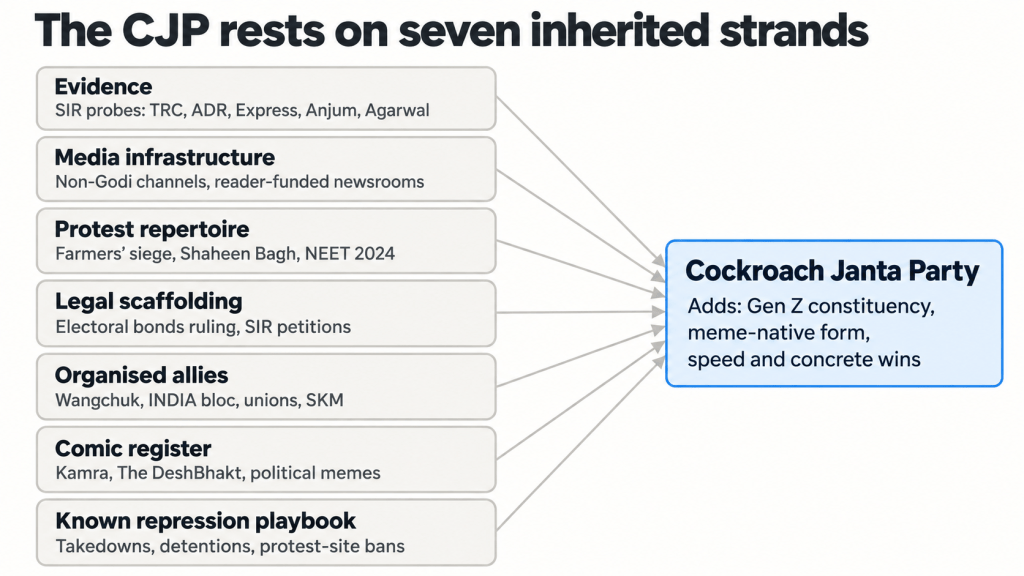
Each strand was built by others before May 2026; the CJP’s contribution is a new constituency, a meme-native form and the speed to convert inherited evidence into concrete wins.
10.3 What’s New
- Constituency: educated, unemployed, urban Gen Z, largely outside unions, caste movements and parties.
- Trigger: a Chief Justice’s remark, not a law; the anger was about contempt as much as policy.
- Concrete wins: a minister removed within seven weeks.
- Form: a “party” in name only, unregistered, with a founder working partly from abroad.
- Regional context: analysts read it beside the youth revolts in Sri Lanka (2022), Bangladesh (2024) and Nepal (2025). The government used the same comparison to accuse Wangchuk of instigating “Nepal-like” unrest.
The Populism Studies analysis contrasts the CJP with the 2011 India Against Corruption movement, which it describes as RSS-backed and which helped clear the ground for the BJP’s rise to power. The CJP, by contrast, has directed its demand for accountability at the RSS-BJP’s own politics of division and institutional capture. It has drawn, in form and in the scale of its street presence, on the example of Shaheen Bagh and on the sustained organisational capacity of the farmers’ protests. The media that amplified the 2011 campaign are, in 2026, the Godi media that the CJP openly mocks. That mockery is not a rejection of the public sphere; it is a pointed refusal to treat as neutral the outlets whose ownership, regulatory exposure and editorial dependence on the same apparatus of power the movement is contesting. By naming them as Godi, the CJP marks the difference between a counter-public that still attempts to document and circulate facts and a media field that has largely ceased to do so. The distinction is the point of the defence: the movement’s refusal of those outlets is continuous with its refusal of the common sense they help sustain.
11. The Chair and the Name
11. Limits of the CJP: A Constructive Critique
With immense respect to the young people who have filled the streets since June, and in solidarity with the resistant hope the CJP has unfurled, the movement’s strategy has so far targeted proper names rather than the chair. Its two campaigns demand the resignation of named officeholders. But a name is not a chair. When one name is removed, another is installed with the same or worse qualities, drawn from the same organisational stable and answerable to the same command. Pradhan’s RSS-affiliated successor is the proof, and Rahul Gandhi called the resignation symbolic. Removing an individual leaves untouched the paradigm that produced him: the centralisation of examination power, the commodification of education, and the capture of the Election Commission by the executive. This critique is offered not to diminish the movement but so that it does not dissipate as earlier waves of moral outrage did, and so that the apparatus of domination it confronts is not left intact once the named faces have been changed.
11.1 What the Wins Did and Did Not Change
The summer won more than a scalp. It won an amendment to the public examinations law, withdrawal of cases against students and compensation for bereaved families. The anti-SIR campaign demands the rollback of the revision itself, a demand about process rather than a person. Winnable, concrete demands are also how movements recruit; the farmers’ movement had one demand, repeal. But a reform granted by the NDA to defuse a crisis can be withdrawn when the crisis passes. A movement that measures success in resignations is always one appointment away from defeat, because the regime that has answered twelve years of dissent with force, UAPA, preventive detention and institutional constriction can afford to lose a minister while retaining the chair.
11.2 The Apparently Missing Agenda (as of 16th October, 2026)
What the CJP does not yet address is larger than what it does, and these silences matter because the BJP-RSS-NDA’s project has been structural.
- Climate. It is silent on the climate emergency that will shape every life it speaks for: the Aravallis redefined out of protection, Ladakh’s glaciers, the Eastern Ghats offered to bauxite mining, the Great Nicobar updates, and the larger pattern of ecological clearance that has accompanied the NDA’s infrastructure and extraction agenda.
- Political economy. It is silent on household debt, insolvency law, viz., the ill-conceived IBC (2016), that rewards defaulters and punishes depositors, cronyism, and an economy steered toward a duopoly of favoured corporate groups.
- Education itself. It asks for a fair examination but not what kind of education a country needs amid ecological collapse, or whether an examination-centred system can ever be fair under conditions of unequal access, a faulty meritocratic system with rote learning, state-directed credentialling and the ongoing climate crises.
- Legitimacy. It does not yet name the legitimation crisis of the state. All four pillars are compromised: a legislature that passes laws by voice vote without committee scrutiny; an executive that governs through agencies; a judiciary whose Chief Justice called the unemployed cockroaches; and a press of which the larger part is Godi. Asking one pillar to remove one officer is asking a system that has demonstrated its capacity for coercion and institutional capture to correct itself.
11.3 Spectacle and Bhakti
Sections of the non-Godi media, especially the studio-and-thumbnail end of YouTube, have turned the CJP’s leaders into messiahs, heroes and heroines. Every arrest becomes a cliffhanger, every speech a trailer. Spectacle needs protagonists more than analysis. As Urvish Kothari wrote in The Print on 9 October 2026, one may praise Neha Bora as a sherni without crowning her a messiah; unconditional praise can do more damage than sharp criticism because it blinds supporters to nuance and complexity, and the danger lies less in the organisers’ own choices than in the public’s hunger for heroes in a country starved of role models. Brecht’s line in Life of Galileo—“Unhappy is the land that needs a hero”—names the same danger. Ambedkar’s warning that in politics “Bhakti or hero-worship is a sure road to degradation and to eventual dictatorship” applies to the dissenting camp as much as to the ruling one. A movement organised around a founder can be beheaded; a movement organised around a programme cannot. The judgement must be precise, however. The quieter newsrooms counting deletions village by village, such as The Reporters’ Collective, TNM, Maktoob and Khabar Lahariya, are doing exactly the work the spectacle neglects. The criticism lands on the spectacle, not on all independent media, and it is offered in solidarity with the CJP so that the movement is not reduced to the form in which television and platforms can most easily contain it, and so that the resistant hope it has unfurled is not converted into the very personalisation of power it has set itself against.
11.4 Catharsis?
The single-agenda protest performs a function its participants may not intend. It is cathartic: it relieves the nerves of exhausted dissenters and suffering people who have watched twelve years of arrests, bulldozers, frozen accounts and blocked channels under the BJP-NDA regime. For many of the young people who have filled the streets since June, this has been a first, hard-won experience of collective power, and that experience is not nothing. Yet catharsis can also function as a safety valve. In the Hindi cinema of the 1970s the Angry Young Man, most often played by Amitabh Bachchan, delivered a concentrated discharge of rage against corruption and injustice; the audience left the hall lighter, and the order that produced the anger remained intact. The screen offered a controlled release. A protest that measures success in the removal of a named minister risks a similar discharge. Anger spent on one resignation is not spent on transforming the order that produced the anger. The regime can afford to lose a minister; it cannot afford a movement that asks why the chair exists in the form it does. This is not at all a dismissal of what the CJP has made possible. It is a caution, offered in solidarity and with due respect, so that the resistant hope the movement has unfurled is not converted into the outlet through which accumulated anger is spent without altering the structures of domination.
11.5 Convergence of Critical Critique
A Dalit-Bahujan critique in Round Table India argues that the CJP is “BJP-friendly in effect”. It is online and founder-centred, and so easy to monitor and contain. It risks repeating the 2011 Jan Lokpal pattern, in which moral outrage without organisation was harvested by the BJP’s machinery. And its anger has so far been largely urban, educated and middle-class, treating Gen Z as one bloc and avoiding caste, capital and precarity. The Populism Studies analysis adds that the summer protests were withdrawn quickly after Pradhan resigned, and that his successor signals no change in direction.
For the question of partyless politics, the CJP is a live test case: a “party” that refuses to be one. Whether it can have staying power without either the structure of a party or the class roots of a movement remains open. These observations are advanced in solidarity with the young people who have made the demand for accountability public again, and so that the movement does not end as earlier waves ended—absorbed, contained, or reduced to the removal of faces while the chairs, and the apparatus that fills them, remain open.
The cautions offered in this article about names, catharsis, the demand and the form of organisation are not an argument that the CJP is the obstacle to its own success. They are an argument that a regime which has already demonstrated its capacity to absorb a resignation, plant violence, and continue the caesura will attempt to convert every opening into a safety valve. The primary obstacle remains the state. The movement’s speed, its unarmed presence, and its refusal to treat the sovereign mark as normal have already forced that state to show its armour in public, against its own constituency. The further task is not to perfect the movement until the regime can no longer contain it; it is to keep the energy the movement has released from being returned, through the regime’s own mechanisms, to the chairs that still decide who is to be made live and who is to be marked. The critique is offered so that the resistant hope is not spent before the structures that produced it have been named.
Sections 2 to 11 described the field of dissent, its costs and the CJP’s place in it. Sections 12 to 19 explain it. They ask what kind of movement the CJP is, what its bodies and methods reveal, how the street became a war of sabotage on two fronts, what the state’s response reveals about the state, and what strategic lesson follows.
12. An Overdetermined Movement
The 2026 youth movement is overdetermined, in the sense Althusser gave the term following Mao. No single cause explains it; several contradictions, each with its own history, have condensed in it. This reading is offered attentively and with caution, as an account of the conditions that have given the CJP its force rather than as a judgement upon it.
In Sanskrit grammatical and Mīmāṃsā usage, atideśa (expansion) names the extended application of a rule or relation beyond the case in which it was first stated. Guha’s analysis of colonial and nationalist dominance supplies a political counterpart. Because neither the colonial state nor the Indian bourgeoisie succeeded in assimilating the subaltern domain into a hegemonic order, the space of politics remained marked by a structural split: an elite domain that claimed to speak for the nation, and an autonomous domain of popular politics that repeatedly exceeded the terms in which it was addressed. The failure of integration left open the possibility that new constituencies could press claims in registers the existing institutions had not anticipated or absorbed.
The CJP has contributed greatly to this expansion. A single spark—the Chief Justice’s remark naming unemployed youth as cockroaches—started a prairie fire. What began as an online response to an insult became, within weeks, a coordinated attack across digital and physical spheres: Instagram and YouTube channels that already carried the non-Godi audience, and street sit-ins, marches and flag processions that forced the state’s repressive apparatus into public view. By converting the insult into an organisational form and by carrying the demand for accountability from the examination authority to the Election Commission, the movement made visible a constituency—educated, precarious, largely outside established unions, caste organisations and parties—that earlier cycles of protest had not organised at this scale. The CJP does not dissolve the split Guha described; it acts within it, extending the range of actors who can force the apparatuses of the state into public view. In that sense, the movement performs an atideśa of the longer record of dissent: it applies the accumulated evidence of electoral opacity, examination failure and institutional capture to a new social location, and thereby enlarges the field in which those contradictions can be named.
12.1 The Concept(s)
Freud introduced Überdeterminierung in The Interpretation of Dreams (1899): one dream image is produced by many dream-thoughts at once, through condensation (many meanings fused into one image) and displacement (intensity moved from the real object onto a substitute). Lacan later formalised these operations in linguistic terms. Condensation corresponds to metaphor: a single signifier stands in for a chain of repressed meanings, fusing them into one image that carries more than it appears to say. Displacement corresponds to metonymy: meaning slides from one term to an adjacent or substitute term, so that intensity attaches to a part or a proxy rather than to the object that first produced it. The cockroach, in this register, is a metaphor that condenses unemployment, examination failure, judicial contempt and electoral deletion into one figure; the demand for a named resignation is a metonymy that lets the force of that condensation attach to a person rather than to the chair.
Mao, in On Contradiction (1937), supplied the political structure. A complex process contains many contradictions; one is the principal contradiction, and it can shift; each contradiction has a principal aspect; development is uneven; and external causes operate only through internal causes, as warmth turns an egg but never a stone into a chick.
Althusser, in “Contradiction and Overdetermination” (1962), combined the two against economic reductionism. Every contradiction is shaped by the superstructure, ideology, national tradition, the international situation and accident. The economy determines only “in the last instance”, and that lonely hour never arrives on its own. Rupture occurs when heterogeneous contradictions fuse into a ruptural unity, as in Russia in 1917, Lenin’s “weakest link”. Yet the unity Althusser named need not remain national. The same overdetermination can open onto an internationalist spirit of the Earthian: a recognition that the contradictions condensed in one place—unemployment and examination failure here, ecological clearance and climate-induced displacement elsewhere—are already linked through the same circuits of capital, climate and state power that no single national frame can contain. The weakest link is not only a national one. It is also the point at which a local refusal begins to speak in a language that other places can hear.
The CJP’s “Lehra Do Tiranga” belongs to this tension. Waving the flag to demand the Chief Election Commissioner’s resignation is a strategic nationalism, necessary under present conditions to reclaim the Constitution from a regime that has used the same symbols to narrow the terms of belonging. That reclamation is not empty; it asserts that the electoral roll and the right to vote remain within the constitutional order the flag is meant to represent. At the same time, Tagore’s warning that nationalism can harden into a self-enclosed worship of the nation, and Einstein’s later insistence that nationalism is an infantile disease, mark the limit of the gesture. The flag can be waved to defend the Constitution without becoming the horizon of politics. The Earthian recognition remains the further demand: that a local defence of the roll not close itself against the larger circuits of climate, capital and displacement that already bind this refusal to others.
12.2 The Contradictions
| Instance | Contradiction | How it entered the movement |
|---|---|---|
| Economic (the last instance) | Educated unemployment, precarity, debt, jobless growth, crony capital | The CJP called itself the voice of the lazy and unemployed |
| Educational | Commercialised coaching, centralised testing, paper-leak networks | The NEET leak and cancelled results |
| Juridical | A judiciary distant from the governed | The Chief Justice’s “cockroach” remark |
| Electoral | Executive capture of the Election Commission | SIR deletions; the Indian Express scoop |
| Ideological | Godi media’s contempt for dissent | “Godi media” chants; the meme as counter-ideology |
| Repressive | The sovereign wound | Pellets, nail-studded lathis, the AK-47 in Siwan; each act of repression enlarged the movement |
| Regional and national | Ladakh, Kashmir, federal grievances | Sonam Wangchuk as a face of the initial protests |
| International | Youth revolts across South Asia | Sri Lanka 2022, Bangladesh 2024, Nepal 2025 |
| Historical | Twelve years of accumulated dissent | The inherited strands of Section 10 |
| Contingent | Accidents of the conjuncture | A judge’s remark; a reporter’s scoop |
12.3 Mao’s Categories at Work
The principal contradiction has shifted within the movement itself: educational in June–July (target: the Education Minister), electoral in September–October (target: the Chief Election Commissioner), and repressive after the July violence (the question “who ordered it?” and the demand for the Home Minister’s removal). This shifting is not a weakness of focus; it is the form overdetermination takes when multiple contradictions are live.
External causes have acted through internal ones. The government has accused Wangchuk of instigating “Nepal-like” or “Bangladesh-like” unrest and the police have spoken of a “larger conspiracy”. Mao’s principle answers both: the Nepalese example could act only on youth who already carried India’s internal contradictions of unemployment, institutional distance and accumulated experience of force. The “larger conspiracy” is the anti-concept of overdetermination: a monocausal theory with one hidden author, whose arrest would remove none of the causes that have condensed in the streets.
12.4 Condensation and the Question of Displacement
Freud’s two operations help explain both the movement’s power and the tension it must navigate. Condensation is its strength: the cockroach fuses the unemployed graduate, the leaked exam, the judge’s contempt, the deleted voter and the beaten student into one image, a ruptural unity in formation. That condensation is what has allowed the CJP to speak across registers that earlier mobilisations often kept separate.
Displacement is the question the movement itself has to answer with care. The resignation demands move an overdetermined antagonism onto a proper name. When the name is removed, the condensed energy can discharge without necessarily carrying the antagonism back to the structures that produced it. This is not an argument against the demands that have been won, nor against the public naming of officeholders; it is a caution, offered in solidarity, that the power of condensation is preserved only if the energy it gathers is not allowed to rest solely on the person who currently occupies the chair. The economic contradiction remains named in the CJP’s own self-description even as the immediate targets have been particular offices. Carrying the condensed energy from the name back toward the structures that produce both the name and the unemployment it names is the open task of the ruptural unity now in formation.
The CJP has condensed the contradictions of the conjuncture into a visible form of resistant hope. Condensation gives that form its power. The further question, to be answered by the movement itself rather than imposed upon it, is whether the energy thus gathered can be carried beyond the removal of faces to the chairs and the relations that fill them.
13. Docile Bodies: Subjection and Objectification
The protesters of 2026 are, before anything else, bodies that the examination made. Their revolt is the revolt of docile bodies, and it shows both how deep the discipline goes and where it breaks. This reading is offered attentively and with caution, as an account of the conditions that have shaped the constituency the CJP has given voice to, rather than as a judgement on the movement itself.
13.1 Discipline and the Examination
In Discipline and Punish (1975), Foucault describes the docile body: a body that may be subjected, used, transformed and improved, made both more useful and more obedient. Discipline works through three instruments. Hierarchical observation makes individuals visible. Normalising judgement measures them against a norm and punishes the gap. The examination combines the two: it ranks, documents and archives each individual, turning a person into a case.
Foucault later named two processes at work. Subjection (assujettissement) is the making of subjects, in the double sense of being subjected to power and becoming a self who carries power’s norms inside. Objectification is the making of individuals into objects of knowledge: measured, classified, compared and filed.
13.2 The NEET Body
The CJP’s founding constituency is a pure product of this machinery. Millions of adolescents spend years in coaching factories, Kota above all, where the day is timetabled, the body is fixed to a desk, worth is a rank, and the self is an OMR sheet. The pressure is lethal; Kota’s student suicides have become a national scandal, and the CJP’s July settlement included compensation for families of students who had died by suicide. When the NEET results were leaked and cancelled, the discipline these bodies had internalised was betrayed by the institution that imposed it. Their anger is therefore double. It is the docile body’s protest against the malfunction of the examination, and, more faintly, against the examination itself. The demand that the exam be fair is still a demand made from within subjection: the subject asks to be objectified correctly. Yet the fact that this demand could be made publicly, and could force a ministerial resignation and legislative amendment, is already a sign that the internalisation of the norm is not total.
13.3 The Name as Objectification and its Reversal
The Chief Justice’s word “cockroach” was an act of objectification: young people named as vermin, a mass rather than citizens. The CJP’s founding gesture was to take the name and wear it. Like other reclaimed insults, the cockroach turns objectification into self-designation. This is the movement’s most creative act, and it is a genuine crack in subjection. By accepting the name and making it the sign under which a public demand is advanced, the movement converts the state’s objectifying language into a collective self-description that the state must then answer. The crack is real; whether it widens depends on whether the self-designation remains a tool of refusal or becomes another identity the disciplinary apparatus can file.
13.4 The Protesting Body Re-objectified
The state answered by objectifying the protesting body again, in two registers:
- Disciplinary-digital. Facial recognition turned the crowd into identified individual files. The Delhi Police report claims to have matched over 100 murder accused; Rahul Gandhi alleged that students were then quietly targeted through threats. The SIR does the same to the electorate, sorting citizens by documents and deleting them as data.
- Sovereign-corporeal. Pellets, nail-studded lathis and an AK-47 do not train the body; they mark it.
Between these two re-objectifications lies the space the movement opened: the body in the street, sitting in, refusing to move, offering itself to the baton. That is where docility turns into satyagraha. The conversion is incomplete and reversible; the same body that sits in can be identified, detained and returned to the archive of cases. Yet the fact that the conversion occurred at all, and that it has been repeated across months and cities, shows that the examination’s production of docile bodies is not the last word on what those bodies can do. The CJP has made that possibility public again.
14. Satyagraha and Non-violent Civil Disobedience
The CJP’s principal method has been non-violent civil disobedience, and its greatest effect came from that method. By offering unarmed bodies to the state, it forced the state to show its violence. This account is offered attentively, as a description of the repertoire the movement has used and the visibility it has produced. Gandhian satyagraha remains, among the methods available to Indian movements, the one with the longest demonstrated capacity to compel a regime of force to reveal itself and to sustain a public refusal across years rather than days.
14.1 The Repertoire
The movement used the inherited repertoire of Indian non-violence: the dharna (sit-in) at Jantar Mantar from 6 June; the march on Parliament of 20 July; the bandh in Bihar; the defiance of prohibitory orders in October; and the “Lehra Do Tiranga” flag march of 16 October, which reclaims the national flag for dissent as Shaheen Bagh reclaimed the Preamble. Its allies added the fast: Sonam Wangchuk’s climate fasts and Jagjit Singh Dallewal’s fast-unto-death, and the SKM’s Jail Bharo (fill the jails) of August 2026. These forms are not inventions of 2026; they are the available grammar of public refusal under conditions in which the state has repeatedly answered earlier mobilisations with force. Their durability is the point. From the Salt March to the farmers’ year-long siege, the same repertoire has outlasted successive regimes of coercion because it does not depend on the state’s willingness to listen; it depends only on the willingness of unarmed bodies to remain present.
14.2 The Logic of Satyagraha
Gandhi’s satyagraha rests on self-suffering. The resister breaks an unjust order openly, accepts the punishment, and refuses to strike back. The violence that follows belongs wholly to the state, and its visibility does the political work: it divides the state from its own public and appeals to conscience. The fast is the extreme form, a discipline of one’s own body turned against the discipline of power. This structure has proved the most reliable means available for converting the state’s own force into evidence against it. Where other methods can be absorbed or outlasted, the sustained offer of the unarmed body keeps the asymmetry visible for as long as the bodies remain.
In Foucault’s terms, satyagraha is a counter-anatomo-politics. The docile body is trained to be useful and obedient; the satyagrahi body is trained to be useless to power and disobedient, yet self-controlled. It inverts the techniques of discipline instead of rejecting the body as their site. The CJP’s sit-ins and marches have performed this inversion in public: the body that the examination fixed to a desk is offered, instead, to the street and to the baton. The inversion is temporary and reversible, but it is also repeatable. That repeatability is what has allowed the method to remain available across generations of protest.
14.3 Effect: The State Compelled to Expose Itself
The July sit-in and march met tear gas, batons and, on the protesters’ account, pellets and plainclothes attackers; the Bihar bandh met an AK-47. Each image circulated on the counter-public’s channels. Because the protesters were mostly middle-class students, the violence fell on the regime’s own constituency, in public. This is the mechanism behind the exposure of the repressive apparatus. The method’s force lies in the asymmetry it creates: unarmed presence makes the state’s response legible as excess rather than as ordinary policing. No other method available to Indian movements has so consistently produced this legibility over time. The farmers’ siege of 2020–21 and the anti-CAA sit-ins both demonstrated the same capacity: the longer the unarmed presence continued, the harder it became for the state to treat its own violence as routine.
14.4 Limits and Tensions
The method carries tensions that the movement itself must navigate, and that are noted here with caution rather than as grounds for opposition.
Discipline and the introduction of violence. The Delhi Police report records stone-pelting and injuries to police during the July Parliament march. Protesters have consistently disputed that they were the source. The most coherent reading of the available evidence—plainclothes attackers, the presence of history-sheeters who were in jail at the time facial recognition claimed to locate them, right-wing groups operating alongside police, and the verified use of pellets and an AK-47—is that violence was introduced into an otherwise unarmed presence. Satyagraha’s force does not depend on the movement proving a purity the state has every incentive to break. It depends on the continued offer of unarmed bodies, which the young people on the ground maintained even after the state had already answered with force. The regime does not acquire an alibi because the scale of the protest made perfect control difficult. The scale made the state’s own methods more visible.
Ambedkar’s objection. On 25 November 1949, Ambedkar called civil disobedience, non-cooperation and satyagraha the “grammar of anarchy” where constitutional methods are available. His objection presumes that constitutional channels work; the CJP’s grievance is precisely that the Election Commission, the examination authority and the courts have stopped working as channels. The movement’s turn to the street is therefore continuous with its claim that the ordinary channels have been closed. Satyagraha has repeatedly been the method to which movements return when those channels are blocked, and it has been the method that has kept the blockage visible.
Fidelity to law. In the liberal theory of civil disobedience (Rawls), the disobedient accept the penalty and so affirm the legal order they break. Satyagraha shares this structure. It is a powerful way to expose a regime, but it also addresses the regime as the authority that punishes. The CJP has used that address to make the state’s violence visible; whether the same address can be redirected toward the structures that produce particular officeholders remains the open question the movement’s own practice will answer. The structure itself, however, has proved durable precisely because it does not require the state to concede. It requires only that the bodies remain and that the violence be seen.
The method has already done the work of making the state’s response public. The further task, for the movement rather than for its observers, is to keep the self-suffering of unarmed bodies from becoming the sole register in which the accumulated contradictions of the conjuncture are allowed to speak. Satyagraha remains the most important and long-lasting of the methods available because it has already shown, across decades, that it can compel the state to show its force and can survive the showing.
15. The Apparatuses Exposed
The most important positive outcome of the youth movement is not a resignation but an exposure. It made visible both the repressive and the ideological apparatuses of the state, and the violence that normally stays in reserve behind consent. This account is offered attentively, as a record of what the CJP’s method has compelled into public view up to 16 October 2026.
15.1 Althusser’s Two Apparatuses
In “Ideology and Ideological State Apparatuses” (1970), Althusser distinguished the Repressive State Apparatus (RSA: police, army, courts, prisons), which functions predominantly by violence, from the Ideological State Apparatuses (ISAs: educational, legal, political, communications, religious, family), which function predominantly by ideology. A secure hegemony rules through the ISAs, with the RSA kept out of sight. Gramsci’s formula is the same: hegemony is consent protected by an armour of coercion. When the armour must be shown, consent is already failing. The CJP’s sequence of actions has repeatedly forced that armour into view.
15.2 The Ideological Apparatuses
The CJP’s targets map onto Althusser’s list almost exactly:
- Educational ISA: the NEET leak exposed the examination authority as broken.
- Legal ISA: the Chief Justice’s remark exposed the judiciary’s contempt for the governed.
- Political ISA: the SIR and the dissent inside the Election Commission exposed the capture of the electoral machinery.
- Communications ISA: “Godi media” chants named the press’s alignment, and the “outsiders hijacked the protest” story, amplified by friendly channels and by the RSS weekly Organiser, showed the ISA working in real time.
15.3 The Repressive Apparatus
Delhi, 20–25 July 2026 (Delhi Police, under the Union Home Ministry). On 29 July Rahul Gandhi accused Home Minister Amit Shah of ordering the police action of 20 July. He alleged the use of pellet guns, nail-studded lathis and electric shocks, citing photographs, videos and an AIIMS report on pellet wounds. He had written to Shah on 25 July asking whether lethal force was approved and whether the plainclothes men beating students were police, and received no reply. He also alleged that Bajrang Dal members were used to beat students and that protesters were targeted through facial recognition. Shah gave no direct answer; in the Lok Sabha, Minister of State Jitendra Singh said no shots were fired and only tear gas was used.
Siwan, Bihar, 25 July (Bihar Police, under the NDA state government). During a bandh called after a lathi-charge on students in Patna, a constable was filmed firing an AK-47 at protesters. Alt News geolocated the footage and counted at least nine AK-47 rounds at two locations, plus pistol fire. Three young men were seriously wounded by gunfire, among them 15-year-old Mohammad Arif, shot in the neck. Bihar Police told the Supreme Court the constable was “trapped” and fired four rounds into the air, and that the gunshot injuries came from a separate incident. The constable was suspended.
Delhi, 10 October and 16 October 2026. On 10 October the city was fortified, internet suspended and more than 7,000 people detained as the anti-SIR mobilisation advanced. On 16 October, ahead of the CJP’s “Lehra Do Tiranga” call at Central Park, Connaught Place, the New Delhi Municipal Council closed the park “for administrative reasons,” prohibitory orders under Section 163 of the Bharatiya Nagarik Suraksha Sanhita remained in force, and heavy deployments of Delhi Police and central forces restricted the area. Abhijeet Dipke was served a notice barring the gathering and then detained from his residence; AISA president Neha Bora was also taken into preventive custody. Flash gatherings formed amid the restrictions. The sequence converted a call to wave the national flag into a pre-emptive security operation.
15.4 Whose Infiltrators?
Both sides allege infiltration. Rahul Gandhi says the state’s plainclothes men and Bajrang Dal attacked peaceful students; the police say criminals and political operatives turned a student protest violent. The question is not whether outsiders were present but whose outsiders they were. That the state or regime-aligned forces have used auxiliaries to introduce or escalate violence is, so far, an allegation in the present case, but it has a long history.
- Nazi Germany’s Brownshirts (SA, Sturmabteilung): in the late 1920s and early 1930s the SA functioned as a paramilitary auxiliary that carried out organised street violence against political opponents, trade-unionists, journalists and ordinary civilians, while the party maintained a formal distinction between these units and the state police. The pattern allowed deniable intimidation and the attribution of disorder to the victims.
- Britain’s “counter-gangs” in Kenya: Frank Kitson’s Gangs and Counter-gangs (1960) describes disguised loyalist units posing as Mau Mau, a method later carried to Northern Ireland.
- COINTELPRO in the United States (1956–71): FBI informants and agents provocateurs inside the civil-rights, anti-war and Black Power movements; informant William O’Neal supplied the floor plan used in the 1969 raid that killed Fred Hampton.
- Vietnam and Latin America: the Phoenix Program and US-trained death squads developed deniable irregular violence.
- Italy’s “strategy of tension” (1969–80s): neo-fascist bombings, beginning with Piazza Fontana, were blamed on the left; later investigations exposed links to state intelligence.
- West Bengal under Siddhartha Shankar Ray: as Union Minister overseeing Bengal during President’s Rule (1971–72) and then Chief Minister (1972–77), the anti-Naxalite campaign fused police “encounters” and jail killings with Congress-backed local strongmen. The Cossipore–Baranagar massacre of August 1971 is its emblem. Ray later drafted the legal advice behind the 1975 Emergency.
- Indian successors: Salwa Judum (2005–11), struck down in Nandini Sundar v. State of Chhattisgarh; and the masked mob at JNU in January 2020.
The common logic has five steps: auxiliaries introduce violence into a peaceful movement; the violence is attributed to the movement; friendly media spread the attribution; force and conspiracy cases follow; and the state keeps deniability. The CJP’s method of unarmed presence has made the application of that logic more visible than it would otherwise have been.
16. Sabotage on Both Fronts
Section 15 asked whose infiltrators were in the crowd. This section widens the question. Once Jantar Mantar was sealed and the satyagraha of June and July met the fortified capital of October, the contest on the street became a war of sabotage fought on two fronts. From below, protesters jammed the machinery of detention. From above, on the reading advanced here with caution, the state seeded disguised lumpen auxiliaries to sabotage the movement’s non-violence, then blamed the violence on the movement. The two sabotages differ in target, means, harm and visibility, and the difference is the key to their political effect. The account draws on cross-checked reporting from non-Godi outlets, Amnesty International’s digital investigation, and Alt News verification.
16.1 The Word and its Two Directions
“Sabotage” is usually traced to the sabot, the wooden clog, and was theorised as a working-class weapon by Émile Pouget’s Le Sabotage (1911) and the American syndicalists, who defined it as the conscious withdrawal of efficiency. Sabotage targets the machine, not the person: it makes the apparatus fail. In 2026 the word applies in both directions. The movement sabotaged the state’s apparatus of capture; the state, on the reading advanced here, sabotaged the movement’s apparatus of legitimacy, which is its non-violence. The spelling can be pressed further. sUbotage, with the capital U, marks the difference between the two. Subversive sabotage is the state’s attempt to break the movement from within by planting violence and then attributing it to the protesters. Subaltern sabotage is the protesters’ own work: the open window, the slow return, the flat tyre, the refusal to sign the blank form. One is hidden and aimed at persons; the other is public and aimed only at the machine. The capital U keeps the distinction visible, while also knitting the interconnections.
16.2 Sabotage from Below: Jamming the Detention Machine
The October crackdown turned the detention bus into the central technology of repression. In three days police made around 6,000 detentions, with over 7,000 reported on 10 October alone. Protesters described a “merry-go-round”: one detainee spent six hours in a police bus driven from Safdarjung to the Haryana border and then through Badarpur, Okhla and Chhattarpur while police debated by phone where to take them. Others were dropped at remote points or held in stadiums, and some were pressed to sign blank sheets of paper before release. On 10 October, leaders including Abhijeet Dipke, Saurav Das and Ashutosh Ranka were detained at the airport on arrival; journalists and opposition figures were picked up across the city.
Against this machine the protesters improvised a repertoire of small sabotages.
Escape. A fifteen-year-old and his sister escaped a detention bus through a window on 10 October; officials said other detainees tried to escape near Jhandewalan.
Return. Protesters dropped at the edge of the city made their way back by DTC bus and Metro; reporters noted that they always found their way back.
Refusal. Detainees refused to sign blank sheets; in July the CJP announced it would identify police officers “not through FRS but through public”, a counter-identification aimed at the surveillance asymmetry.
Re-assembly. When Jantar Mantar was sealed, protesters regrouped at the Safdarjung flyover and dispersed into flash gatherings across central Delhi.
Immobilisation. Some accounts circulating among protesters describe letting the air out of detention-bus tyres, so that the mobile prison could not move. The claim has not been independently verified in the published reports reviewed for this article and is recorded here as part of the movement’s own circulating account rather than as established fact. What the same accounts and contemporaneous reporting do establish is that protesters surrounded detention buses, blocked their path, and in at least one case opened the emergency exit to free those inside. Whether or not a tyre was deflated, the gesture of stopping the bus has already entered the repertoire as a symbolic and practical refusal of the mobile prison. It names the detention vehicle as the machine to be disabled rather than the person to be harmed.
Doppelganger. On 11 October at RK Ashram, Delhi Police detained a woman wearing a red scarf, black-rimmed glasses and a mask, believing her to be AISA president Neha Bora. The real Bora was at that moment in Connaught Place, having crossed barricades with other protesters. She later posted a photograph with the lookalike and wrote that it was “not strategy, just coincidence.” The mix-up occupied police and cameras at one site while the march continued at another. Bora was detained later that day at Vijay Chowk. The incident, whatever its origin, showed how little the state’s surveillance needed to fail for the machine of capture to be slowed.
Moreover, as police advanced on the orders of the Home Ministry, protesters answered with another set of acts that are harder to criminalise. They sang the national anthem. They unfurled the Indian flag. They held copies of the Constitution against their chests. These are not symbolic gestures detached from the confrontation. They are practical replies to a state that has treated the street as a site of capture. The anthem and the flag place the body inside the very symbols the regime claims to monopolise; the Constitution makes visible the document the regime has progressively emptied. To crush an unarmed gathering that is singing Jana Gana Mana, carrying the tricolour, and holding the Constitution is to show, in public, that the repressive apparatus is being used against the forms the state itself invokes. The young people on the ground understood this and used it. The strategies are to be commended. They turn the regime’s own vocabulary of nation and law against the moment of its own force.
Two readings illuminate these acts. James C. Scott’s Weapons of the Weak (1985) names the everyday resistance of the subordinate: foot-dragging, evasion, quiet sabotage. Michel de Certeau’s The Practice of Everyday Life (1980) distinguishes the strategy of those who own a space from the tactics of those who must act in the space of the other, seizing opportunities on the move. The detention bus is the state’s strategy; the open window, the slow return and the flat tyre are tactics.
In the terms of Section 17, the bus also reveals the state’s inversion of biopolitics. Modern security manages circulation; the merry-go-round turns circulation itself into punishment, driving bodies aimlessly around the city to exhaust them. The protesters answered with counter-circulation: every return to the street undid the state’s displacement. A deflated tyre is the purest form of this answer. It harms no person, it simply stops the machine that moves bodies against their will.
This sabotage has limits, and the movement has already shown it knows them. Gandhi rejected secrecy and deception, and called off the Non-Cooperation Movement after Chauri Chaura in 1922; theorists of non-violent action treat sabotage as a borderline case because it can slide into damage that invites retaliation. Broken bus windows, whoever broke them, gave the state images to use. The line the young people on the ground have held is the line between disabling the machinery of detention and harming persons. The acts recorded here—escape through a window, return by Metro, refusal to sign, re-assembly after dispersal, the slowing of a bus—stay on the side of that line. The CJP’s practice has been to keep the distinction visible even under the pressure of mass detention.
16.3 Sabotage from Above: the Lumpen Auxiliary
The second front is older and darker. In The Eighteenth Brumaire of Louis Bonaparte (1852), Marx describes how Bonaparte organised the Society of December 10, a private force drawn from the lumpenproletariat, among them, in Marx’s list, discharged jailbirds, vagabonds and swindlers, to stage applause for him and beat his opponents in the streets. Fanon observed that colonial power recruits the lumpenproletariat as mercenaries against national movements, and Arendt described the alliance between the mob and the elite that prepared totalitarian rule. India has its own lineage: the Congress-backed mastans of the Ray years in Bengal, Salwa Judum’s armed auxiliaries, and the masked mob at JNU in January 2020 (Section 15).
The reading advanced here, with caution, is that the BJP state reproduced this method in 2026: it installed fringe elements and disguised goons, many of them men with criminal records, to throw stones at the police and commit other violence, then attributed that violence to the CJP. The public record does not (yet) prove this, because the state apparatus is engaging in a will-to-hide (erit celare), but it contains several pointers drawn from non-Godi reporting and independent verification:
- The police’s own numbers. Delhi Police told the Supreme Court that facial recognition matched 2,873 people at the protest site between 20 and 26 July to police records: 2,402 from the Crime Kundli database, 471 dossier records, 92 people linked to more than ten cases, and 47 history-sheeters, with records covering murder, robbery, rape, kidnapping and Arms Act offences. Earlier police statements gave figures of 400, “over 2,000” and 980.
- The anomaly in those numbers, and the Indian Express investigation. Students organising a protest over an examination do not recruit history-sheeters. The Indian Express examined 205 people from the list shown as facing serious charges and found that at least 25 of them (including 17 facing murder charges) were lodged in Tihar, Mandoli or Rohini jails at the times the system placed them at Jantar Mantar. The Internet Freedom Foundation has called the sweep unreliable and unlawful. Whether any of the 2,873 were detained or arrested has not been disclosed.
- Plainclothes attackers and verified force. Rahul Gandhi asked whether the plainclothes men beating students were police, and alleged that Bajrang Dal members were used against them. He received no answer. Amnesty International’s Evidence Lab verified the use of pellet-firing shotguns, electric-shock devices, tear gas and batons against protesters between 20 and 24 July; at least ten people sustained pellet injuries. Frontline and other outlets documented plainclothes officers removing Sonam Wangchuk from the stage early on 20 July.
- Right-wing groups beside the police. Reporting on the October crackdown describes right-wing groups taking to the streets for two days, beating protesters and trying to haul them into detention buses alongside the police.
- Unattributed violence and Siwan. Stones were thrown at police and at a bus carrying detainees in Jhandewalan; reports do not identify who threw them. In Siwan on 25 July, Alt News geolocated and verified at least nine AK-47 rounds fired at two locations, plus pistol fire, contradicting the police claim of four rounds into the air. Three young men, including 15-year-old Mohammad Arif, were seriously wounded. The constable was suspended; the state told the Supreme Court he had been “trapped”.
The pointers are consistent with the reading advanced here and also with the police account, in which criminal elements joined the protest on their own. The pattern appears in both the July Parliament march and the anti-CEC protests of October. In July the Delhi Police report itself recorded stone-pelting across six days and attributed it to “criminal elements”; in October the same claim reappeared amid the anti-CEC mobilisations, when more than 7,000 people were detained on 10 October alone, Jantar Mantar was sealed, and flash gatherings continued in the days that followed, including around the “Lehra Do Tiranga” call. Section 15.5 set out what would decide between the two accounts; to it should be added the full facial-recognition matches for the 2,873, any detention or arrest of them, and their affiliations. A petition by Rajya Sabha MP A.A. Rahim challenging facial recognition at protest sites was admitted by the Supreme Court on 13 August. The July and October sequences together show that the question of who introduced violence into an otherwise unarmed presence has remained open across both the education protests and the anti-CEC phase of the movement.
16.4 What Sabotage from Above “Achieves”
If the reading holds, sabotage from above performs four functions at once:
- It destroys satyagraha’s asymmetry. Satyagraha works because all the violence belongs to the state (Section 14). One stone thrown by an auxiliary in the movement’s name erases that asymmetry and turns a satyagraha into a “riot”.
- It manufactures the pretext. The manufactured violence licenses the repressive apparatus (pellets, mass detention, FIRs) and feeds the ideological apparatus (Godi channels and Organiser on “hijacked” protests).
- It divides the movement. The narrative of “genuine students” infiltrated by “outsiders” splits the protesters from their allies and from public sympathy.
- It preserves deniability. The lumpen auxiliary is a para-state: sovereign violence without sovereign responsibility.
The method is also an admission. A state needs provocateurs only when non-violence is working. The planted stone is the regime’s confession that the satyagraha of the students had begun to defeat it.
16.5 The Asymmetry of the Two Sabotages
| The ‘What’ and ‘Who’ | Sabotage from below | Sabotage from above (the reading advanced here) |
|---|---|---|
| Agent | Protesters, openly | Disguised auxiliaries, covertly |
| Target | The machinery of detention: buses, routes, forms, surveillance | The movement’s non-violence and public legitimacy |
| Means | Escape, return, refusal, re-assembly, deflated tyres | Stone-pelting, assault, infiltration, attribution |
| Harm to persons | None intended | Injuries to police, protesters and bystanders |
| Visibility | Public, often filmed | Hidden, deniable |
| Effect if exposed | Shows the state’s capture apparatus as absurd | Turns into self-sabotage, discrediting the state |
The CJP’s unarmed presence has made both forms of sabotage more legible than they would otherwise have been. The further task is to keep the distinction between them sharp enough that the movement’s own tactics are not collapsed into the violence attributed to it. Rahul Gandhi’s call, during the October crackdown, to document everything belongs to this task: the phone camera, the shared location, the refusal to let an incident pass unrecorded, are the practical means by which the difference between an open act of disabling a bus and a hidden act of planting violence can be held in public view.
17. Autocratic Governmentality and the Self-sabotaging Backlash
This section argues that the BJP-RSS-NDA regime combines a highly developed biopolitics for the majority with the archaic sovereign’s sword for its antithetical others. In refusing to selve the living other, it abandons the strategy that made modern power durable, and its backlash sabotages its own state machinery. The argument is grounded in the acts documented across the period 2014–26 and, above all, in the exposures of 2026.
17.1 Three Registers of Power
| Register | Object | Technique | Formula |
|---|---|---|---|
| Sovereign power | The subject’s life, as the ruler’s to take | Spectacle, punishment of the body, confiscation, the scaffold | Take life or let live |
| Anatomo-politics (discipline) | The individual body as a machine | Schools, barracks, factories, prisons; timetables, drills, examinations, surveillance | Make bodies docile and useful |
| Biopolitics (regulation) | The population as a species | Statistics, public health, welfare, insurance, security | Optimise the life of the whole |
Biopower is Foucault’s name for the two modern poles together. In Society Must Be Defended (1976) he condenses the shift: the sovereign right to take life or let live is overlaid by a power to “make live and let die”. Sovereign violence does not disappear; it recedes into reserve.
17.2 The Contemporary Strategy: Subsuming and Selving the other
A power that governs life need not destroy its opponents. It can incorporate them, making the antithetical other part of the self. Gramsci called this trasformismo and passive revolution; Marcuse called it repressive tolerance; Foucault’s governmentality turns the resistant subject into a self-governing one. The Indian state was once expert at it: the Congress system absorbed socialists and regional movements; the Mizo Accord of 1986 made the rebel Laldenga Chief Minister; the rural distress of the 2000s became MGNREGA, the RTI and the Forest Rights Act. The rebel could become a citizen, a stakeholder, a beneficiary. The present regime has largely abandoned this strategy toward living opponents while retaining its techniques for the dead. The pattern runs through its years in office. The anti-CAA sit-ins of 2019–20 were met with the Delhi riots cases and prolonged UAPA custody rather than any negotiated incorporation of the demand. The farmers’ year-long siege of 2020–21 ended in the repeal of the three laws, yet the Samyukta Kisan Morcha’s leaders were not drawn into any lasting settlement; several remained under cases, and the MSP demand was left unmet. The Bhima Koregaon prosecutions continued without trial for years. FCRA cancellations removed the financial base of organisations that had earlier been treated as partners in welfare delivery. The labour codes and the VB-G RAM G Act replaced the earlier language of rights with a language of schemes that could be withdrawn. In each case the regime preferred the mark of the sovereign—detention, cancellation, the pending case—over the older practice of turning the opponent into a stakeholder. The living other was left outside the circle of those whose life the state claimed to foster.
17.3 Sovereign Regression
Facing its antithetical others, the present regime regresses from biopower to sovereign power.
- The scaffold returns. Discipline and Punish opens with the public torture of Damiens in 1757 and traces the move from spectacle to discipline. “Bulldozer justice” reverses it: the home, an extension of the accused’s body, is destroyed as public vengeance for the cameras. The practice has been documented against Muslim and other minority households in Uttar Pradesh, Madhya Pradesh and elsewhere, and has been criticised by courts and human-rights bodies as collective punishment outside the law.
- The body is marked, not trained. Pellets, nail-studded lathis, electric shocks and an AK-47 do not make bodies docile and useful; they wound them. Amnesty International’s August 2026 investigation verified the use of pellet-firing shotguns and electric-shock devices against CJP protesters in Delhi in July; Alt News verified multiple AK-47 rounds fired in Siwan.
- Circulation is blocked, not managed. Foucault’s modern security lets things circulate and regulates the flows. Internet shutdowns, closed metro stations, a fortified capital and the pre-emptive detention of organisers shut the gates. On 10 and 16 October 2026 the sealing of Jantar Mantar and Central Park, the detention of Dipke and Neha Bora, and the deployment of central forces converted a call to wave the national flag into a security operation.
- The other is named as vermin. “Cockroach”, “urban Naxal”, “tukde-tukde gang” and “anti-national” name enemies to exclude, in Carl Schmitt’s friend–enemy sense, not deviants to normalise. The Chief Justice’s remark supplied the movement with its founding name; the regime’s broader vocabulary has repeatedly performed the same work.
- Life is held in exception. Seven thousand detained in a day and years of UAPA custody without trial are forms of Agamben’s state of exception. The Bhima Koregaon and Delhi riots cases continue to illustrate the pattern: prolonged detention, delayed trials, and the use of the UAPA to hold organisers and intellectuals.
17.4 The Complication: A Hyper-biopolitical Regime
The regime is not ignorant of biopower. Its biopolitics of the population is among the most ambitious in Indian history: Aadhaar-linked welfare and direct transfers, free rations for some 80 crore people, the new political class of labharthi (beneficiaries), vaccination certificates bearing the Prime Minister’s photograph, digital public infrastructure, and the SIR itself. Its anatomo-politics includes Swachh Bharat’s national hygiene, International Yoga Day’s drilled national body, and CCTV and facial recognition. The same facial-recognition systems that manage welfare databases were turned on the Jantar Mantar crowd; The Indian Express later showed that the system flagged people who were in jail at the time.
Foucault anticipated this combination. In the last lecture of Society Must Be Defended he asks how a power that makes life live can still kill, and answers: racism, in the broad sense of a caesura within the population between what must live and what must die. Achille Mbembe later called this necropolitics. The regime’s structure is double: biopower and selving for the national-majoritarian self; caesura and sovereign violence for its others. The RSS’s long organisational history supplies the ideological template for the caesura; the NDA state supplies the administrative and coercive means.
17.5 The Persona of Saffron State Terrorism
This article calls the result autocratic governmentality: the data, welfare and surveillance techniques of modern governmentality, yoked to sovereign exception and exemplary violence. External assessments point the same way: V-Dem has classified India as an “electoral autocracy” since 2021, and Christophe Jaffrelot describes an “ethnic democracy”. The regime is a saffron fascist formation. It fuses a majoritarian mass movement with state power, names an internal enemy, and uses exemplary violence—bulldozers, firearms against students, prolonged UAPA/NSA custody—to terrorise a population into compliance. This is state terrorism. The term is not rhetorical. It describes the documented pattern of selective prosecution, the financial and regulatory strangulation of critical media and NGOs, the use of state agencies against political opponents, and the deliberate display of force against unarmed protesters. The government rejects the characterisation. The record of the acts themselves, set out in Sections 9 and 15, does not.
17.6 The Backlash
The regime’s backlash is a distinctive way of sabotaging its own state machinery. Measured against the modern sovereign’s rationality, it is naive at two points.
It subsumes only the dead. The regime absorbs dead antithetical icons with skill (Ambedkar, Bhagat Singh, Netaji, Patel, even Gandhi’s spectacles), because the dead cannot speak back, while jailing their living inheritors. This is a necrophilic subsumption, the reverse of the modern strategy. The living Dalit, Adivasi, Muslim and left intellectuals and organisers who invoke those icons remain objects of the caesura.
The caesura has turned inward. In 2026 the sovereign wound reached the regime’s own constituency: NEET students, urban Gen Z, deleted voters of every community, journalists from mainstream outlets. The labharthi contract and the sovereign spectacle collided. In July the government briefly tried selving (a resignation, an amended law, compensation); by October it had reverted to fortifying the capital. It oscillates between two rationalities and commits to neither. And when it outsources violence to lumpen auxiliaries and is found out (Section 16), the sabotage it aimed at the movement returns as sabotage of itself.
The consequence is what Ranajit Guha called dominance without hegemony, his description of the colonial state: command without persuasion. Each act of backlash produces martyrs instead of co-opted leaders, exposes the repressive apparatus to its own base, deepens the legitimation crisis, and enlarges the counter-public. The CJP’s method of unarmed presence has made this self-sabotage more visible than it would otherwise have been. The further question is whether the regime can re-establish a stable caesura that keeps the majority on the side of “what must live”, or whether the inward turn of 2026 has already made that restoration more costly.
18. The Demand and the Chair
This article advances a thesis extending Foucault: at the very moment we demand something from the state, the state’s legitimacy is established. The demand constitutes its addressee as the authority able to grant it. The argument is grounded in the record of dissent under the BJP-RSS-NDA and in the specific form of power that regime has consolidated.
18.1 The Foucauldian Ground
The last part of The History of Sexuality, Vol. 1 (“Right of Death and Power over Life”) makes three moves. Power changed form, from the sovereign right to take life to a biopower that fosters it. The resistance of the nineteenth and twentieth centuries did not oppose this power from outside: it claimed rights to life, the body, health, the satisfaction of needs and “liberation”, the very objects biopower had made central. And “liberation” is itself part of the deployment, so Foucault proposes that the counter-attack rally not around sex-desire but around “bodies and pleasures”, outside the vocabulary the apparatus has organised. Behind this lies his principle that resistance is never exterior to power.
Foucault writes:
The atomic situation is now at the end point of this process: the power to expose a whole population to death is the underside of the power to guarantee an individual’s continued existence. The principle underlying the tactics of battle—that one has to be capable of killing in order to go on living—has become the principle that defines the strategy of states. But the existence in question is no longer the juridical existence of sovereignty; at stake is the biological existence of a population. If genocide is indeed the dream of modern powers, this is not because of a recent return of the ancient right to kill; it is because power is situated and exercised at the level of life, the species, the race, and the large-scale phenomena of population.
The BJP-NDA regime has institutionalised this underside. Its capacity to guarantee the continued existence of a marked national-majoritarian population (through Aadhaar-linked transfers, free rations, digital certificates bearing the Prime Minister’s image) coexists with the power to expose marked others—Muslims under bulldozer justice, Adivasis under forest clearances, students under pellet guns and UAPA—to the sovereign mark. The “atomic situation” is no longer only nuclear; it is the everyday administrative capacity to decide, at the level of the population, who is to be made live and who is to be let die or actively wounded. The demand that addresses this regime as the authority able to grant protection or recognition thereby recognises the very apparatus that has made the caesura operational.
Foucault speaks of power as a whole, not the state in particular alone, and he never says that demands establish legitimacy. The thesis here recentres the state and sharpens his argument into a political proposition applicable to the NDA’s form of rule.
18.2 Why the Demand Constitutes Its Addressee
- The speech act. To demand is to address someone as able to grant. “Minister, resign” recognises the Prime Minister’s power to accept the resignation and appoint the next minister; “roll back the SIR” recognises the Election Commission’s power over the rolls. Under the NDA the chair is already filled by a command that answers to the same organisational stable.
- Lacan. At Vincennes in 1969 Lacan told students that what revolutionaries aspire to is a master, and that they would get one. A demand addressed to the master seeks the master’s recognition.
- Wendy Brown. States of Injury (1995) argues that claims for rights and protection bind claimants to their injury and re-legitimate the state as protector.
- Habermas inverted. A legitimation crisis arises when citizens stop believing the state can deliver. Every demand, however angry, still carries that belief, and so partly repairs the legitimacy it protests. The NDA has answered many such demands with force; the demand itself continues to constitute the addressee.
18.3 Applied to 2014–2026
Almost all dissent mapped in this article passes through the state: resignation demands (Pradhan, Gyanesh Kumar, Amit Shah); litigation (bail petitions, PILs on electoral bonds and the SIR, FCRA appeals); policy demands (repeal the farm laws, restore MGNREGA, scrap the labour codes, fix NEET). By addressing the name rather than the chair, the CJP re-inaugurates the chair each time it asks the chair to remove its occupant. The regime has shown, across twelve years, that the chair can absorb the removal of a name while retaining the capacity to expose populations to the sovereign mark.
18.4 Limits
Taken absolutely, the thesis would condemn all demands, at a cost. A UAPA prisoner needs bail; an MGNREGA worker needs wages this month; Chatterjee’s political society survives by negotiation. Ambedkar chose to legitimate the state by making it answerable. Some demands delegitimate rather than legitimate, because the state can neither grant nor refuse them without revealing itself: Gandhi’s salt march, the 1968 slogan “be realistic, demand the impossible”, and the question “who ordered the AK-47?”. And Foucault himself, in “What is Critique?” (1978), defined critique as the art of not being governed quite so much, a negotiation rather than an exit.
18.5 A Typology of Demands
| Type | Form | Effect on the state’s legitimacy | Example |
|---|---|---|---|
| Supplicatory | Petition, plea, appeal for mercy | Reinforces it: the state as benevolent sovereign | Interim bail pleas, compensation claims |
| Reformist | Repeal this law, sack this minister | Mixed: wins concessions, re-inaugurates the authority | Farm laws repeal; Pradhan’s resignation |
| Exposing (“impossible”) | Demands the state can neither grant nor refuse without revealing itself | Erodes it: makes coercion visible | “Who ordered the pellet guns?”; release the facial-recognition data |
| Constituent (non-demand) | Building the alternative without asking permission | Bypasses it: makes the state less necessary | Kitchens, clinics and newspapers of the farmers’ camps; reader/viewer-funded media |
18.6 The Partyless Implication
If demanding re-legitimates the state, the alternative is not silence but constitution. Gustav Landauer wrote in 1910 that “the state is a condition, a certain relationship between human beings”, undone not by demanding that it change but by forming other relationships. Fragments exist: the farmers’ camps that ran kitchens, clinics, libraries and newspapers for a year; reader/viewer-funded newsrooms that replaced the advertiser and the state with the audience; the Zapatistas, who stopped seeking recognition from the Mexican state after 2001 and governed themselves. OBMA’s work on the partyless commune and the Bhūmi-Pāṭhaśālā (Earth-School) belongs in the constituent column: instead of demanding a fair NEET, it builds the education the ecological moment requires.
The resulting position is not “never demand”. It is to make exposing demands where the state must answer for its coercion and violence, to make constituent practice the centre of politics, and to treat supplicatory and reformist demands as tactics of survival, never as the horizon. Under a regime that has made the power to guarantee life the underside of the power to expose populations to the sovereign mark, the constituent task is the only one that does not, in the act of addressing it, reinstall the apparatus that decides who is to live.
19. 1968 and 2026: the Critique of Knowledge-Power
Compared with the Cockroach Janta Party, the student movement of 1968 was epistemologically stronger in its critique of knowledge-power. This is a judgement on the depth of critique, not on outcomes. The comparison is offered attentively, as a measure of what a movement can ask of the apparatus that sorts and certifies life, rather than as a verdict on the CJP’s necessity or force.
19.1 Questioning Knowledge versus Asking for Fair Access to it
The students of 1968 attacked the regime of knowledge itself: the university as a factory of cadres for capital and the state; the examination as an instrument of social selection; the authority of the professor and the expert; the spectacle of consumer society, which Debord had theorised in 1967; and the discipline of everyday life. Their slogans were epistemological claims: “It is forbidden to forbid”, “Imagination to power”, “Be realistic, demand the impossible”, “Under the paving stones, the beach”. They treated the university and the examination as sites where power and knowledge were fused, and they sought to interrupt that fusion rather than to enter it more cleanly.
The CJP’s founding grievance runs the other way. It asks that the examination be fair; it accepts the examination as the measure of worth and asks to be sorted by it honestly. In the terms of Section 13, the docile body demands correct objectification. The demand is intelligible under conditions of educated unemployment and debt; it is also a demand that remains inside the apparatus it contests. 1968 questioned the regime of knowledge; the CJP demands fair admission into it.
19.2 Sixty Eight’s Counter-Epistemology
1968 stood in a dense intellectual milieu and transformed it. Before it came Marcuse’s One-Dimensional Man (1964), Lefebvre’s critique of everyday life, the Situationists and Sartre. After it came Althusser’s “Ideological State Apparatuses” (1970), which named the school as the dominant ISA; Bourdieu and Passeron’s Reproduction (1970); Illich’s Deschooling Society (1971); and Foucault’s prisons information group (1971) and Discipline and Punish (1975), where the examination appears as the meeting point of power and knowledge. Much of the theory in this article is the epistemological legacy of 1968. The CJP has produced memes and slogans but no comparable reflection on itself. The absence is not a moral failing of its organisers; it is a measure of the difference between a moment that interrupted the production of knowledge and a moment that has so far asked for better access to the knowledge already produced.
19.3 Calcutta’s 1968
Between 1967 and 1971, students inspired by Naxalbari, many from Presidency College and Calcutta’s universities, boycotted examinations, rejected the university as a colonial-comprador institution, and in 1970 defaced statues of Bengal Renaissance figures as icons of an inherited knowledge they repudiated. Mao’s injunction to “oppose book worship” was taken, at the Naxal grassroots, as a warrant to destroy books and stop reading. Crude as those acts were, they attacked the regime of knowledge, not its malfunction. That movement was brutally and unjustly crushed in the Ray years (Section 15): epistemological radicalism is no protection against the sword. The BJP-NDA’s own use of force against students in 2026 has repeated the lesson without the earlier movement’s theoretical density.
19.4 Qualifications
- Stronger in critique, weaker in result. De Gaulle won a landslide in June 1968, and much of 1968 was subsumed: Boltanski and Chiapello’s The New Spirit of Capitalism (1999) shows its “artistic critique” of hierarchy absorbed into network capitalism. This is the modern strategy of selving that the present Indian regime has not attempted (Section 17). The NDA has preferred the caesura and the sovereign mark to the incorporation of living critique.
- Material conditions differ. 1968 erupted near the height of the postwar boom, when students could afford to criticise affluence. The CJP’s youth face educated unemployment and debt; a fair examination is a matter of survival. A comparison of epistemologies that ignored this would fall into idealism, against Althusser’s own last instance.
- 1968 had its own bhakti. Parts of it worshipped Mao, Che and Trotsky, fractured into sects, and some ended in armed groups. Ambedkar’s warning applies there too.
- The CJP has epistemic strengths of its own. Satire and the meme strip the sovereign of awe, and the anti-SIR campaign rests on an epistemic practice of counting, the reverse of the state’s statistical biopolitics. Its weakness lies less in what it knows than in its failure, so far, to connect with the intellectuals and movements who already produce critical knowledge in India (Section 6). The connection remains open.
19.5 Formulation
Compared with the Cockroach Janta Party, the student movement of 1968 was epistemologically stronger in its critique of knowledge-power. It questioned the regime of knowledge itself: the university, the examination, the spectacle and the discipline of everyday life. The CJP, by contrast, has so far demanded fair admission into that regime. This is a judgement on the depth of critique, not on outcomes. 1968’s critique did not secure its politics: it was electorally defeated and then subsumed by a capitalism sophisticated enough to turn that critique into a new spirit of its own. The lesson the comparison offers is double: to move from the malfunction of the examination to the critique of the examination, and to build organisation durable enough to resist both the sword and subsumption. Under a regime that has made the power to guarantee life the underside of the power to expose marked populations to the sovereign mark, that double task is the condition under which a demand for fair sorting can become something other than a request to be objectified correctly.
20. Conclusion
Twelve years of dissent against the BJP-RSS-NDA form a single, cumulative field. Farmers, workers, Dalits, Adivasis, students and minorities mobilised from political society; journalists, comedians, scholars, lawyers, judges and NGOs contested the regime’s common sense from civil society. Together they built a counter-public with its own media economy, legal infrastructure and repertoire of protest, and they paid for it with imprisonment without trial, preventive detention, financial strangulation, blocking, SLAPP suits, career reprisals, threats, vigilante violence, surveillance, state violence and assassination. The field is the ground on which the 2026 movement stands.
The Cockroach Janta Party harvests this field. It is an overdetermined movement: educational, electoral, juridical, ideological, repressive, regional and international contradictions, rooted in an economic last instance of educated unemployment, condensed into the single figure of the cockroach. Its positive achievements are real and have been forced into public view by its method:
- The apparatuses were exposed. The movement made visible both the ideological apparatuses (the examination authority, the judiciary, the Election Commission, the Godi press) and the repressive apparatus (pellets, nail-studded lathis, an AK-47 fired at students, plainclothes attackers, seven thousand detentions, pre-emptive custody of organisers). The armour of coercion was shown, in public, against the regime’s own constituency. Amnesty International’s verification of pellet guns and electric-shock devices, Alt News’s geolocation of multiple AK-47 rounds in Siwan, and the Indian Express investigation of facial-recognition errors have made the exposure durable. The impact was not only documentary. Home Minister Amit Shah did not appear in Parliament for days after the July violence was raised; the Prime Minister turned, in the same period, to Instagram Reels. The absence and the shift in register were themselves measures of the pressure the unarmed presence had produced.
- Satyagraha was redeployed. Sit-ins, marches, bandhs, fasts and the flag march revived non-violent civil disobedience as a counter-anatomo-politics that compels the state to show its violence. When the capital was fortified on 10 and 16 October, protesters added tactical sabotage of the detention machine: escaping buses, returning to the street, refusing blank forms, immobilising the buses that carried them.
- Docility cracked. Bodies produced by the examination machine, subjected and objectified as ranks and cases, reclaimed the insult that named them and took to the street. The founding gesture of wearing the cockroach converted an act of objectification into collective self-designation.
The state’s response reveals an autocratic governmentality: a hyper-developed biopolitics and anatomo-politics for the national-majoritarian self, and the archaic sovereign’s sword for its antithetical others, a combination the author characterises as fascist and terrorising. Its backlash is a distinctive self-sabotage of the state machinery. By subsuming only dead icons while striking living dissenters, and by turning the caesura inward onto the majority’s own children, the regime abandons the modern sovereign’s strategy of selving the other and drifts from hegemony towards dominance without hegemony. On the street the contest became a war of sabotage on two fronts: protesters jamming the machinery of detention without harming persons, and, on the reading advanced here, the state seeding lumpen auxiliaries to break the movement’s non-violence and blame it on the movement, an admission that satyagraha was working.
Yet the movement’s limits are as structural as its strengths, and are named here with caution so that what the young people on the ground have already made visible is not spent before the structures that produced it have been named. It displaces a condensed antagonism onto proper names, so that the regime can absorb a resignation while the chair stays intact. The demand addresses a state that has already closed the ordinary channels; the re-establishment of legitimacy is the regime’s work, not the movement’s. The CJP’s unarmed presence has already forced that state to show its armour in public. The further task is to keep the energy released by that showing from being returned, through the regime’s own mechanisms of absorption and attribution, to the chairs that still decide who is to be made live and who is to be marked. Under a regime that has made the power to guarantee life the underside of the power to expose marked populations to the sovereign mark, that absorption is not neutral. The movement has so far left aside climate, political economy and the legitimation crisis of the four pillars, and sections of the media have cast its organisers as messiahs, against Ambedkar’s warning about bhakti. Measured by its critique of knowledge-power, it has so far asked for fair admission to the examination rather than questioning the examination. These are open tasks, not verdicts on the necessity of what the young people on the ground have already forced into view.
The cockroach is a fitting emblem: resilient, impossible to exterminate, everywhere. Whether it remains a symbol that survives or becomes a force that transforms depends on four moves: from names to structures, from one demand to exposing demands and constituent practice, from screens to organisation, and from heroes to partyless collective self-government. It must also give back to the rooted, organised forces that prepared its ground. The apparatuses have been shown; the further task is to keep the energy they have released from returning, through the demand, to the very chairs that fill them.
The end of saffron fascism is not a distant horizon. It is already being made visible by those who continue to fight it—on the web, online, on the streets, and from within institutions that the regime has sought to capture. What the last twelve years have shown is that the apparatus of domination is not self-sustaining; it requires continuous force, continuous attribution, continuous absorption. Each of those operations has been interrupted, documented and returned to public view. The task now is collective resilience: to keep the interruption open, to refuse the return to the place assigned, and to multiply the sites from which the refusal is made. Subvert. Resist. Agitate. Organise. Educate.
See Also:
References
- Agamben, Giorgio. State of Exception. Trans. Kevin Attell. Chicago: University of Chicago Press, 2005. https://press.uchicago.edu/ucp/books/book/chicago/S/bo3534874.html
- Al Jazeera. “Cockroach Janta Party’s founder says Indian government took website down.” 23 May 2026. https://www.aljazeera.com/economy/2026/5/23/cockroach-janta-partys-founder-says-indian-government-took-website-down
- Al Jazeera. “India activist Afreen Fatima says her house bulldozed ‘illegally’.” 13 June 2022. https://www.aljazeera.com/news/2022/6/13/act-of-vendetta-afreen-fatima-on-her-house-bulldozed-in-india
- Al Jazeera. “Indian opposition protesters in New Delhi call on election chief to quit.” 12 October 2026. https://www.aljazeera.com/news/2026/10/12/india-opposition-plans-new-delhi-protest-to-demand-election-chief-resign
- Al Jazeera. “Kashmiri journalist Fahad Shah walks out of jail after 600 days.” 23 November 2023. https://www.aljazeera.com/news/2023/11/23/kashmiri-journalist-fahad-shah-walks-out-of-jail-after-600-days
- Al Jazeera. “Kunal Kamra: Indian comedian riles ruling party with edgy humour.” 2018. https://www.aljazeera.com/indepth/features/kunal-kamra-indian-comedian-riles-ruling-party-edgy-humour-180417065234329.html
- Al Jazeera. “‘Not backing down’: What next after India’s crackdown on youth protesters?” 11 October 2026. https://www.aljazeera.com/news/2026/10/11/indias-crackdown-on-youth-protesters-what-next
- Al Jazeera Journalism Review. “‘Leading the voiceless’: How low-caste Indian journalists are crowdfunding their own newsrooms.” https://institute.aljazeera.net/en/ajr/article/2091
- Alt News. “Bihar: Police opened fire on student protesters in Siwan during CJP Bihar bandh.” July 2026. https://www.altnews.in/bihar-siwan-opened-fire-by-police-on-student-protesters-cjp-bihar-band/
- Alt News (Pravda Media Foundation). Donation page. https://contribute.altnews.in
- Althusser, Louis. “Contradiction and Overdetermination” (1962). In For Marx. Trans. Ben Brewster. London: Allen Lane, 1969. https://www.marxists.org/ebooks/althusser/For_Marx_-_Louis_Althusser.pdf
- Althusser, Louis. “Ideology and Ideological State Apparatuses” (1970). In Lenin and Philosophy and Other Essays. London: New Left Books, 1971. https://www.marxists.org/reference/archive/althusser/1970/ideology.htm
- Ambedkar, B.R. Speech in the Constituent Assembly, 25 November 1949. Constituent Assembly Debates, Vol. XI. Discussed in Outlook, “The Grammar of Anarchy.” https://www.outlookindia.com/national/the-grammar-of-anarchy-news-289235
- Amnesty International. “India: New investigation documents unlawful and deadly force against CJP-led protests.” 24 August 2026. https://www.amnesty.org/en/latest/news/2026/08/india-new-investigation-documents-unlawful-and-deadly-force-against-cjp-led-protests-amid-ongoing-police-impunity/
- Amnesty International. “India: Release CJP leaders arrested after attempting peaceful protests at Jantar Mantar.” 14 October 2026. https://www.amnesty.org/en/latest/news/2026/10/india-release-cjp-leaders-arrested-after-attempting-peaceful-protests-at-jantar-mantar/
- Arab News. “Dalit journalist takes aim at changing history with stories of India’s marginalized.” https://www.arabnews.com/node/2269186/world
- Arendt, Hannah. The Origins of Totalitarianism. New York: Harcourt, 1951.
- Article 14. Homepage and About page. https://article-14.com · https://article-14.com/page/about
- Bar & Bench. “CJI Surya Kant says media misquoted ‘cockroaches’ remark.” May 2026. https://www.barandbench.com/news/litigation/cji-surya-kant-says-media-misquoted-cockroaches-remark-criticism-was-against-fake-degree-holders-not-unemployed-youth
- Bar & Bench. “Vice President election: Who is INDIA bloc candidate Justice B Sudershan Reddy?” August 2025. https://www.barandbench.com/news/vice-president-election-who-is-india-bloc-candidate-justice-b-sudershan-reddy
- BehanBox. “How MGNREGA’s repeal will hit women farmers harder.” 7 January 2026. https://behanbox.com/2026/01/07/how-mgnregas-repeal-will-hit-women-farmers-harder/
- Bhatia, Gautam. “In India, a Dark Shadow Falls on Its Vaunted Elections.” TIME, 13 October 2026. https://time.com/article/2026/10/13/india-modi-protests-voter-removal-election-commission/
- Boltanski, Luc, and Ève Chiapello. The New Spirit of Capitalism. London: Verso, 2005. https://www.versobooks.com/products/1980-the-new-spirit-of-capitalism
- BOOM. “Explained: Why India is now an electoral autocracy according to V-Dem.” https://www.boomlive.in/fact-file/explained-why-india-is-now-an-electoral-autocracy-according-to-v-dem-12306
- Bourdieu, Pierre, and Jean-Claude Passeron. Reproduction in Education, Society and Culture. London: Sage, 1977.
- Britannica. “India’s 2026 Gen Z Protests Explained.” October 2026. https://www.britannica.com/topic/Indias-2026-Gen-Z-Protests-Explained
- Brown, Wendy. States of Injury: Power and Freedom in Late Modernity. Princeton: Princeton University Press, 1995. https://press.princeton.edu/books/paperback/9780691270609/states-of-injury
- Brut. “How Delhi Police identified 2,873 people using facial recognition at CJP protest.” 2026. https://www.brut.media/in/articles/how-delhi-police-identified-2-873-people-using-facial-recognition-at-cjp-protest-what-the-supreme-court-was-told
- Business Standard. “Umar Khalid, Sharjeel Imam: SC denies bail in Delhi riots 2020 case; timeline.” January 2026. https://www.business-standard.com/india-news/umar-khalid-sharjeel-imam-sc-denies-bail-delhi-riots-2020-case-timeline-126010500323_1.html
- Business Today. “‘Go to courts with evidence, don’t delegitimise them’: 42 former judges back EC amid SIR row.” 8 October 2026. https://www.businesstoday.in/india/story/go-to-courts-with-evidence-dont-delegitimise-them-42-former-judges-back-ec-amid-sir-row-560448-2026-10-08
- The Caravan. About page. https://caravanmagazine.in/pages/about-us
- Chatterjee, Partha. The Politics of the Governed: Reflections on Popular Politics in Most of the World. New York: Columbia University Press, 2004. https://cup.columbia.edu/book/the-politics-of-the-governed/9780231130639/
- Citizens for Justice and Peace. “Public Resistance and Democratic Assertion: India through protests, 2025.” 10 February 2026. https://cjp.org.in/public-resistance-and-democratic-assertion-india-through-protests-2025/
- CITU. “Joint Statement of the Central Trade Unions” (general strike of 12 February 2026). https://www.citucentre.org/struggle/joint/927-joint-statement-of-the-central-trade-unions
- CNBC. “As ‘Cockroach’ protests grow over alleged voter fraud, Modi defends India as ‘mother of democracy’.” 13 October 2026. https://www.cnbc.com/2026/10/13/cockroach-fraud-india-protest-modi.html
- Committee to Protect Journalists. “India blocks The Kashmir Walla website and social media accounts.” 21 August 2023. https://cpj.org/2023/08/india-blocks-the-kashmir-walla-website-and-social-media-accounts/
- Debord, Guy. The Society of the Spectacle (1967). https://www.marxists.org/reference/archive/debord/society.htm
- Deccan Herald. “Explained: Deconstructing the Aravalli range row.” December 2025. https://www.deccanherald.com/india/explained-deconstructing-the-aravalli-range-row-3839408
- EastMojo. “Meme to movement: Will the Cockroach Janta Party find a home in the Northeast?” 16 June 2026. https://www.eastmojo.com/premium/2026/06/16/meme-to-movement-will-the-cockroach-janta-party-find-a-home-in-the-northeast/
- eNewsroom India. “The Right to Vote Is Not a Favour: Kolkata convention raises alarm over electoral exclusion.” 12 October 2026. https://enewsroom.in/bhushan-thipsay-apoorvanand-kolkata-voter-exclusion-sir/
- ETV Bharat. “Constable who fired from AK-47 rifle during protests was trapped: Bihar Police to SC.” 18 August 2026. https://www.etvbharat.com/en/state/constable-who-fired-from-ak-47-rifle-was-trapped-bihar-police-to-supreme-court-enn26081804219
- Foucault, Michel. Discipline and Punish: The Birth of the Prison (1975). Trans. Alan Sheridan. New York: Vintage. https://www.penguinrandomhouse.com/books/55026/discipline-and-punish-by-michel-foucault-and-alan-sheridan/
- Foucault, Michel. The History of Sexuality, Vol. 1: An Introduction (1976). New York: Vintage. https://www.penguinrandomhouse.com/books/55036/the-history-of-sexuality-by-michel-foucault/
- Foucault, Michel. Society Must Be Defended: Lectures at the Collège de France, 1975–76. New York: Picador, 2003. https://us.macmillan.com/books/9780312422660/societymustbedefended/
- Foucault, Michel. “What Is Critique?” In The Politics of Truth. Ed. Sylvère Lotringer. New York: Semiotext(e), 1997.
- Free Press Journal. “Lok Sabha passes anti-paper leak amendment bill by voice vote; Opposition walks out.” July 2026. https://www.freepressjournal.in/education/lok-sabha-passes-anti-paper-leak-amendment-bill-by-voice-vote
- Gramsci, Antonio. Selections from the Prison Notebooks. Ed. and trans. Quintin Hoare and Geoffrey Nowell Smith. London: Lawrence and Wishart, 1971. “The Intellectuals.” https://www.marxists.org/archive/gramsci/prison_notebooks/problems/intellectuals.htm
- GroundXero. Homepage. https://www.groundxero.in
- Guha, Ranajit. Dominance without Hegemony: History and Power in Colonial India. Cambridge, MA: Harvard University Press, 1997. https://www.hup.harvard.edu/books/9780674214835
- Habermas, Jürgen. Legitimation Crisis. Trans. Thomas McCarthy. Boston: Beacon Press, 1975.
- Illich, Ivan. Deschooling Society. New York: Harper & Row, 1971. https://theanarchistlibrary.org/library/ivan-illich-deschooling-society
- Indian Express. “Police say cameras ‘caught’ murder, rape accused at CJP protest – some were actually in jail.” 4 September 2026. https://indianexpress.com/article/express-exclusive/delhi-police-facial-recognition-jantar-mantar-protest-accused-in-jail-10862099/
- Internet Freedom Foundation. “Delhi Police’s facial recognition sweep at Jantar Mantar is unreliable and unlawful.” 4 September 2026. https://internetfreedom.in/delhi-polices-facial-recognition-sweep-at-jantar-mantar-is-unreliable-and-unlawful-the-list-of-2-873-must-be-withdrawn/
- Jaffrelot, Christophe. Modi’s India: Hindu Nationalism and the Rise of Ethnic Democracy. Princeton: Princeton University Press, 2021. https://press.princeton.edu/books/hardcover/9780691206806/modis-india
- Khabar Lahariya. Homepage. https://khabarlahariya.org
- Kothari, Urvish. “Praise Neha Bora as a ‘sherni’, don’t crown her as a messiah and hero-worship.” The Print, 9 October 2026. https://theprint.in/opinion/praise-neha-bora-sherni-dont-crown-messiah-hero-worship/3066177/
- Maktoob. “Cartoonist Satish Acharya’s Instagram account restricted in India over cartoons on ECI.” 29 September 2026. https://maktoobmedia.com/post?id=116574&slug=cartoonist-satish-acharyas-instagram-account-restricted-in-india-over-cartoons-on-eci
- Maktoob. “Over 1,300 hate speech incidents against Muslims, Christians in India in 2025, says report.” https://maktoobmedia.com/india/over-1300-hate-speech-incidents-against-muslims-christians-in-india-in-2025-says-report/
- Maktoob. Homepage and support page. https://maktoobmedia.com · https://maktoobmedia.com/support
- Mao Zedong. “On Contradiction” (1937). Selected Works, Vol. I. https://www.marxists.org/reference/archive/mao/selected-works/volume-1/mswv1_17.htm
- Marcuse, Herbert. One-Dimensional Man. Boston: Beacon Press, 1964. https://www.beacon.org/One-Dimensional-Man-P1328.aspx
- Marcuse, Herbert. “Repressive Tolerance” (1965). https://www.marcuse.org/herbert/publications/1960s/1965-repressive-tolerance-fulltext.html
- Marx, Karl. The Eighteenth Brumaire of Louis Bonaparte (1852). https://www.marxists.org/archive/marx/works/1852/18th-brumaire/ch05.htm
- Mbembe, Achille. “Necropolitics.” Public Culture 15, no. 1 (2003): 11–40.
- Mooknayak. “CJP calls ‘Lehra Do Tiranga’ protest in Delhi on Oct 16 after leaders’ arrest.” 15 October 2026. https://www.themooknayak.com/bharat/cjp-calls-lehra-do-tiranga-protest-in-delhi-on-oct-16-after-leaders-arrest-says-waving-national-flag-is-democratic-right
- Mooknayak. “Free Speech Collective files SC contempt plea against Delhi Police over journalists detained.” 14 October 2026. https://www.themooknayak.com/bharat/free-speech-collective-files-sc-contempt-plea-against-delhi-police-journalists-detained
- National Herald. “Bhima Koregaon 16: None convicted, still languish in custody 5 years later.” https://www.nationalheraldindia.com/national/bhima-koregaon-16-none-convicted-still-languish-in-custody-5-years-later
- Newslaundry. “Inside the ECI’s ‘black box’: IE investigation proves print journalism still has bite.” 25 September 2026. https://www.newslaundry.com/2026/09/25/inside-the-ecis-black-box-ie-investigation-proves-print-journalism-still-has-bite
- Newslaundry. “Police sealed Jantar Mantar. The protest moved to the streets.” 13 October 2026. https://newslaundry.com/2026/10/13/police-sealed-jantar-mantar-the-protest-moved-to-the-streets
- Newslaundry. Homepage. https://www.newslaundry.com
- The News Minute. “Over 20 journalists recount the Delhi Police’s use of brute force against them.” 12 October 2026. https://www.thenewsminute.com/news/over-20-journalists-recount-the-delhi-polices-use-of-brute-force-against-them
- The News Minute. Homepage. https://www.thenewsminute.com
- NPR. “Independent media in India are banding together to counter eroding press freedom.” 1 June 2024. https://www.npr.org/transcripts/nx-s1-4985644
- NPR. “What to know about nationwide protests in India over voter list changes.” 6 October 2026. https://www.npr.org/2026/10/06/g-s1-146636/what-to-know-about-nationwide-protests-in-india-over-voter-list-changes
- Outlook. “Delhi Police report says criminal elements fuelled violence during CJP’s Parliament march.” 2 August 2026. https://www.outlookindia.com/national/delhi-police-report-says-criminal-elements-fuelled-violence-during-cjps-parliament-march
- People’s Archive of Rural India (PARI). Donation page. https://ruralindiaonline.org/donate
- Populism Studies (European Center for Populism Studies). “India’s Gen Z cockroach protests: Youth mobilization, democratic dissent and the limits of Modi’s populism.” 2026. https://www.populismstudies.org/indias-gen-z-cockroach-protests-youth-mobilization-democratic-dissent-and-the-limits-of-modis-populism/
- Pouget, Émile. Sabotage (1898; English trans. 1913). https://www.marxists.org/archive/pouget/1898/sabotage.htm
- The Print. “CJP protesters recount Delhi detention merry-go-round: ‘a bus, endless detours, no destination’.” 11 October 2026. https://theprint.in/feature/cjp-protesters-delhi-police-detention-jantar-mantar/3068313/
- The Quint. “Bombay HC grants bail to Surendra Gadling after eight years.” https://www.thequint.com/news/breaking-news/bombay-high-court-bail-surendra-gadling-eight-years
- The Reporters’ Collective. “UP CEO admits ECI auto-generated 85,000+ voter deletion forms without a reason.” 14 October 2026. https://www.reporters-collective.in/trc/up-ceo-admits-eci-auto-generated-voter-deletion-forms
- The Reporters’ Collective. Homepage and support page. https://www.reporters-collective.in · https://www.reporters-collective.in/support-us
- Rest of World. Faleiro, Sonia. “YouTube is the last bastion of unbiased journalism in India.” 2023. https://restofworld.org/2023/india-youtube-journalism/
- Reuters Institute for the Study of Journalism. “Indian journalists turned to YouTube to dodge Modi’s censorship. Some of their channels are now being blocked.” 2024. https://reutersinstitute.politics.ox.ac.uk/news/indian-journalists-turned-youtube-dodge-modis-censorship-some-their-channels-are-now-being
- Round Table India. “The Cockroach Janta Party gives India the image of a Gen Z revolt that the BJP waited for.” 2026. https://www.roundtableindia.co.in/the-cockroach-janta-party-gives-india-the-image-of-a-gen-z-revolt-that-the-bjp-waited-for/
- Sabrangindia. “2025 in Protest: Across issues, across India.” February 2026. https://sabrangindia.in/2025-in-protest-across-issues-across-india/
- Scroll.in. “CJP’s Ashutosh Ranka, Saurav Das arrested for trespassing at Jantar Mantar.” October 2026. https://scroll.in/latest/1096362/cjps-ashutosh-ranka-saurav-das-arrested-for-trespassing-jantar-mantar-says-campaign
- Scroll.in. “Uttar Pradesh: Shows of comedian who mimicked PM Modi at Rahul Gandhi event cancelled” (Pulkit Mani). September 2026. https://scroll.in/latest/1095887/up-shows-of-comedian-who-mimicked-pm-modi-at-rahul-gandhi-event-cancelled
- Scroll.in. Membership page. https://scroll.in/contribute
- The South First. “Nationwide strike on 12 February: Trade unions to protest against labour codes and VB GRAM G Act.” February 2026. https://thesouthfirst.com/news/nationwide-strike-on-12-february-trade-unions-to-protest-against-labour-codes-and-vb-gram-g-act
- The Statesman. “Jantar Mantar protests: Police claim FRS flagged over 2,000 with criminal records; CJP hits back.” July 2026. https://www.thestatesman.com/india/jantar-mantar-protests-police-claim-frs-flagged-over-2000-with-criminal-records-cjp-hits-back-1503620686.html
- The Week. “Bihar cop, seen firing an AK-47 at student protesters in viral video, suspended.” 27 July 2026. https://www.theweek.in/news/india/2026/07/27/bihar-cop-seen-firing-an-ak-47-at-protesting-students-in-viral-video-suspended.amp.html
- The Week. “New definition of Aravalli Hills triggers protests.” 20 December 2025. https://www.theweek.in/wire-updates/national/2025/12/20/des77-ncr-aravalli-protests.html
- Tribune. “FCRA licences of 16,000 NGOs cancelled in 9 years.” https://www.tribuneindia.com/news/india/fcra-licences-of-16-000-ngos-cancelled-in-9-years-582883
- V-Dem Institute. Democracy Report 2021: Autocratization Turns Viral. Gothenburg, 2021. https://www.v-dem.net/documents/12/dr_2021.pdf
- The Wire. “Home Ministry cancels Centre for Policy Research’s FCRA registration.” https://thewire.in/rights/home-ministry-cancels-centre-for-policy-researchs-fcra-registration
- The Wire. “Journalist and YouTuber Ajit Anjum booked over his video on Bihar SIR; DIGIPUB condemns.” July 2025. https://thewire.in/rights/journalist-and-youtuber-ajit-anjum-booked-over-his-video-on-bihar-sir-digipub-condemns
- The Wire. “‘Offends spirit of democracy’: Outrage over CJI Surya Kant’s ‘cockroaches’, ‘parasites’ remarks.” May 2026. https://thewire.in/rights/offends-spirit-of-democracy-outrage-over-cji-surya-kants-cockroaches-parasites-remarks
- The Wire. “Rahul Gandhi calls for Modi to sack Amit Shah over police brutality on youth protesters.” 29 July 2026. https://thewire.in/rights/rahul-gandhi-calls-for-modi-to-sack-amit-shah-over-police-brutality-on-youth-protesters
- The Wire. “Rural workers to stage nationwide protest against VB-G RAM G on July 1.” June 2026. https://thewire.in/labour/rural-workers-to-stage-nationwide-protest-against-vb-g-ram-g-on-july-1
- The Wire. Support page. https://thewire.in/support
APPENDIX: Generational Labels and the Ordering of Persons
Generational labels—Silent Generation, Baby Boomers, Generation X, Millennials, Generation Z, Generation Alpha—appear as neutral descriptions of chronological cohorts. A Foucauldian reading treats the classification itself as the object of analysis. The scheme imposes discrete boxes on a continuum of births. Someone born in December 1996 and someone born in January 1997 are assigned different generational characters. The cut is no less arbitrary than the entries in Borges’s Chinese encyclopedia with which The Order of Things opens. What requires explanation is the historical a priori that has made the birth year into a meaningful fact about a person’s dispositions.
No single author invented the device. Genealogy traces surfaces of emergence. Precise age consciousness is a modern product of birth registration, the census, age-graded schooling, conscription, and retirement ages. Auguste Comte treated the succession of generations as a motor of progress; José Ortega y Gasset later proposed roughly fifteen-year units. Karl Mannheim’s “The Problem of Generations” (1928) distinguished generational location from generation as actuality and from generation units that work up the same events in opposed ways. He borrowed Wilhelm Pinder’s phrase “the non-contemporaneity of the contemporaneous.” The distinction was largely ignored once Norman Ryder’s cohort concept (1965) turned the birth year into a technical instrument of demography. “Baby boom” began as a fertility statistic. Journalism and marketing converted the statistic into an identity: Time’s “Silent Generation” (1951), Pepsi’s “Pepsi Generation,” Douglas Coupland’s Generation X (1991), Tom Brokaw’s The Greatest Generation (1998). William Strauss and Neil Howe supplied the fullest mechanical system in Generations (1991) and The Fourth Turning (1997), assigning fixed archetypes to successive twenty-year cohorts and coining “Millennials.” Pew Research Center’s 2019 boundary (1996 as the last Millennial birth year) and Mark McCrindle’s “Generation Alpha” completed the self-reproducing taxonomy. In 2021 Philip Cohen’s open letter asked Pew to stop using the labels as analytic categories; subsequent work (Bobby Duffy, The Generation Myth, 2021) has shown that many supposed generational differences are period or life-cycle effects.
The classification performs several operations. It imposes discrete boxes on continuous births and produces the effect of real essences (“Gen Z values,” “Boomer mentality”). It scales the disciplinary seriation of successive activities described in Discipline and Punish to the level of population: each cohort is assigned expected traits, and individuals are measured as conforming or deviant. Ian Hacking’s looping effect applies: once classified, people begin to act through the classification, and the resulting behaviour is cited as evidence for the category. The grid serves market segmentation, human-resources management, political consultancy and media framing. It recodes conflict. An intergenerational frame displaces antagonisms of class, caste, gender and region. The rich young heir and the precarious young gig worker become “the same generation.” Inherited property and its absence disappear behind a story about attitudes. When mass movements are branded “Gen Z revolts,” the label renders them legible and marketable while flattening their class content and political demands into a demographic mood.
The 2026 mobilisation across India makes the arbitrariness concrete. Figures well outside any “Gen Z” birth-year boundary have been central to its organisation, amplification and political direction. Ravish Kumar’s sustained coverage and commentary from the non-Godi YouTube space have shaped the counter-public within which the movement circulates. Yogendra Yadav, long associated with the farmers’ mobilisation and with earlier campaigns for electoral accountability, has continued to supply both organisational links and public argument. Prashant Bhushan, whose litigation on electoral bonds, Pegasus and the SIR spans more than a decade, has used the present moment to reiterate calls for structural accountability that predate the CJP by years. Rahul Gandhi and Priyanka Gandhi have repeatedly appeared at, stood beside or endorsed the street mobilisations, framing them within the larger oppositional demand for regime-level change. These are not peripheral endorsements. They are part of the movement’s public and organisational composition. The presence of older organic intellectuals, lawyers and political figures inside a mobilisation labelled “Gen Z” demonstrates what Mannheim called the non-contemporaneity of the contemporaneous: people alive at the same time do not inhabit the same time, and a movement can condense several biographical and political temporalities at once. The generational label obscures this condensation. It converts a cross-generational contest over institutions into a story about the attitudes of one age cohort.
“Mental age” does not escape the same logic. Alfred Binet and Théodore Simon introduced it in 1905 as a means of sorting schoolchildren; William Stern converted it into the intelligence quotient in 1912. The examination individualises in order to normalise. Replacing birth-year cohorts with mental-age grades would substitute one grid for another. Older schemes of staged life, such as the Brahmanical āśrama system, order persons by stage rather than birth year, yet remain regulatory instruments bound to caste and gender. The critical alternative is not a better single scale. It is the refusal to reduce a person’s time to any one axis. Several temporalities run through each subject at once: biographical time, the historical time of events, class time (the rhythms of wages, debt and inheritance), and ecological time.
The question is therefore not which generation a person belongs to, but under what conditions it became possible and useful to sort living people by birth year into named collective characters, which institutions produce and enforce the boxes, and what conflicts become harder to see once the boxes are accepted. The convergence of state registration, the social sciences, and marketing turned counts into types and types into identities that people now wear as their own. In the present article the label “Gen Z” is retained only where it appears in the self-description or media framing of the 2026 movement; it is not treated as an analytic category. The participation of Ravish Kumar, Yogendra Yadav, Prashant Bhushan, Rahul Gandhi, Priyanka Gandhi and others of earlier birth cohorts is one of the clearest indications that the movement cannot be reduced to the cohort the label names.

