Posted on 20th April, 2026 (GMT 07:05 hrs)
ABSTRACT
This article offers a philosophically rigorous and politically charged re-reading of the “negative” rasas — bībhatsa (disgust) and bhayānaka (fear) — from Bharata Muni’s Nāṭyaśāstra. Drawing on Abhinavagupta’s doctrine of sādhāraṇīkaraṇa and Krishna Chandra Bhattacharyya’s elevation of bībhatsa as mahā-rasa, it argues that these affects, when properly aestheticised, become vehicles of contemplative bliss (ānanda) and ethical purification (śuddhi). In their non-aestheticised, lived forms under late-capitalist authoritarian regimes, however, they degenerate into pathological modalities: sovereign “Will to Hide” (jugupsā as opacity) and pervasive climates of dread (bhaya as governance). Through a synthesis of dramaturgy, philosophy, and political theory, the paper diagnoses the contemporary global and Indian conjuncture — marked by neo-imperial violence, ecological collapse, inequality, and democratic erosion (especially post-2014 India) — as a theatre in which these rasas circulate without universalisation, producing a deadlock of terror and revulsion. In response, it proposes kautuka–hāsya–vyāṅga (wonder, laughter, and satire) as śilpita pratirodha (art of resistance), tracing a hauntological lineage from Husserl, Benjamin, Camus, and Tagore to Charlie Chaplin and contemporary Indian political comedians and cartoonists, thereby reclaiming rasa as both a diagnostic tool and a horizon of emancipatory resistance against neo-fascist tyranny.
I. Introduction: Framing Definitions
Within the intricate traditions of South Asian schools of aesthetics, as authoritatively codified in Bharata Muni’s Nāṭyaśāstra (ca. 200 BCE–200 CE), rasa constitutes the distilled, eternal aesthetic sentiment or universal emotional flavour that emerges in the attuned spectator — the sahṛdaya bhoktā — through the stylised re-presentation of human passions. Far from any unmediated or ego-centric affect, rasa embodies a depersonalised, universalised relish (āsvāda) that transcends individual subjectivity, transmuting raw emotion into a contemplative mode of bliss (ānanda) that is at once detached and profoundly immersive.
Among the canonical eight (later expanded to nine with the inclusion of śānta) principal rasas, two ostensibly “painful” or negative sentiments occupy a singularly significant position: bībhatsa rasa (the odious or repulsive sentiment) and bhayānaka rasa (the terrible or fearful sentiment). Both originate in negative sthāyibhāvas — the stable or dominant emotions (bhāva) — and are alchemically elevated through the dramaturgical interplay of vibhāva (the determinants or excitants that trigger the emotion), anubhāva (the visible physical reactions or consequents), and vyabhicāribhāva (the transitory or accompanying emotions) into legitimate objects of aesthetic contemplation.
Bībhatsa rasa, variously rendered as the “odious,” “repulsive,” or “disgusting” sentiment, crystallises the aesthetic experience of visceral aversion, revulsion, loathing, or nausea. Etymologically, the term derives from the Sanskrit root bhid (to split or pierce) intensified by prefixal elements, evoking that which is so radically disagreeable as to provoke a profound “splitting away” of the self from the encountered object. Bharata Muni articulates its foundational ontology in Chapter 6 of the Nāṭyaśāstra:
“atha bībhatsa nāma jugupsāsthāyibhāvātmakaḥ”
(Now, bībhatsa is that which has jugupsā as its sthāyibhāva.)
The governing sthāyibhāva is thus jugupsā — disgust, aversion, revulsion, or moral loathing — aroused by a spectrum of vibhāvas that span the sensory, the visceral, and the ethical. These determinants include putrid or unclean objects (worms, stinking matter, filth, vomit, decaying substances); ghastly or corporeal spectacles (blood, entrails, bones, marrow, flesh, corpses, or any manifestation of physical decomposition); moral or ethical ugliness, encompassing unethical conduct, hypocrisy, or any inversion of dharma; and sensory provocations that induce detachment or nausea when body parts or phenomena are framed in contexts of profound alienation.
The corresponding anubhāvas manifest as involuntary physical contractions of the nose and mouth (nāsāvikāra and mukhavikāra), spitting, averted gaze, shuddering, nausea, and gestures of sensory withdrawal. These are further inflected by vyabhicāribhāvas such as agitation (udvega), sickness, apprehension, distress, and horror.
Bharata, along with later theorists such as Dhananjaya in the Daśarūpaka, distinguishes three nuanced varieties of bībhatsa: kṣobhaṇa (horror evoked by ghastly, bloody, or visceral scenes); udvegī (distress arising from putrid, nauseating sights or odours); and ghṛṇā-śuddha (pure aversion or moral disgust, typically elicited by sensual or worldly objects that foster detachment). Symbolically, bībhatsa is presided over by Mahākāla — a fierce aspect of Śiva emblematic of time, dissolution, and the erosion of forms — and is associated with the colour blue or grey-black, suggestive of the pallor of decay and the shadowed turbidity of ethical corruption.
Parallel to this, bhayānaka rasa, the “terrible” or “fearful” sentiment, arises from the sthāyibhāva of bhaya — fear, terror, dread, or anticipatory apprehension of imminent harm. Its vibhāvas encompass external catalysts such as horrifying sounds, apparitions of ghosts or adversaries, ingress into dark forests or deserted dwellings, confrontations with wild beasts, natural catastrophes, or the loss or captivity of loved ones.
Within the dramaturgical framework, these triggers are rigorously stylised to evoke a generalised, contemplative terror rather than personal panic. The anubhāvas appear as trembling limbs, facial pallor, quivering eyes, parched mouth, cries for succour, accelerated heartbeat, or sudden flight-or-freeze reflexes. These are intensified by sāttvika bhāvas — autonomous psychophysical responses — including stupefaction (stambha), perspiration (sveda), and horripilation (romāñca). Symbolically, bhayānaka is linked to the colour black (kṛṣṇa) and to presiding deities such as Kāla (Time/Death) or Yama, the lord of the underworld. Performers are directed to convey it through dilated pupils, inwardly drawn lips, and a darting, vigilant gaze, metaphorically likened to “a deer that has caught the scent of danger.”
This paper argues that bībhatsa and bhayānaka rasas, as theorised in the Nāṭyaśāstra and reinterpreted by Abhinavagupta and Krishna Chandra Bhattacharyya, transcend their role as mere aesthetic categories. They function as powerful diagnostic frameworks for analysing contemporary political realities in India and the world. The central claim of this paper is that when these rasas fail to undergo aesthetic universalisation (sādhāraṇīkaraṇa), they persist in their raw, ego-bound form as pathological affects: bībhatsa manifests as structures of sovereign opacity and defensive concealment (the “Will to Hide”), while bhayānaka generates pervasive climates of dread and institutionalised fear. In contrast, practices of political satire — embodied in the triad of kautuka, hāsya, and vyāṅga — serve as critical modes of re-aestheticisation, transforming these so-called “negative” affects into defiant, subversive resistance and thereby restoring their emancipatory potential.
In the comprehensive taxonomy of the Nāṭyaśāstra, both rasas are thus affirmed as indispensable constituents of the full spectrum of human affect rendered available for aesthetic savour. They are not marginal or extraneous but essential to the completeness of dramatic art, provided they remain rigorously framed by the conjunctive mechanisms of vibhāva, anubhāva, vyabhicāribhāva, and the presiding sthāyibhāva — thereby preserving the contemplative aesthetic distance that transforms potential pain into refined ānanda.
II. De-sign-ing Interpretations
The interpretations of bībhatsa and bhayānaka rasa transform these ostensibly negative sentiments from mere psychological reflexes into profound aesthetic and ontological events. While Bharata Muni supplies the foundational dramaturgy, it is the subsequent hermeneutic layers — above all Abhinavagupta’s (c. 950–1015 CE) magisterial commentary in the Abhinavabhāratī and Krishna Chandra Bhattacharyya’s (K.C. Bhattacharyya or KCB, 1875–1949) radical twentieth-century re-reading — that disclose their deeper stakes.
The Nāṭyaśāstra canonises both “negative” rasas without ontological hesitation, ensuring that the dramatic repertoire embraces the entire spectrum of human affect and thereby refuses any exclusionary hierarchization of feeling.
Abhinavagupta’s intervention in the Abhinavabhāratī pivots on the pivotal doctrine of sādhāraṇīkaraṇa — the universalisation or generalisation of emotion. In quotidian existence, personal disgust (jugupsā) or personal fear (bhaya) remains ego-bound, viscerally painful, and potentially annihilating. Within the aesthetic domain, however, these affects undergo radical depersonalisation: the sahṛdaya bhoktā does not identify with any particularised individual’s revulsion or terror but experiences them as generalised, contemplative states detached from private ownership. This process yields śuddhi — a cathartic purification that simultaneously enacts ethical self-reflection.
For bībhatsa, Abhinavagupta argues, the rasa detaches consciousness from base attachments and the “filth” of worldly entanglement, cultivating a higher, discriminating awareness. Even the most aversive emotions, once universalised, participate in the generation of ultimate aesthetic bliss (ānanda) and may function as deliberate pathways toward śānta rasa, the peaceful sentiment that dissolves all polarities. Abhinavagupta further fuses this mechanism with the non-dual ontology of Kashmir Śaivism: every rasa becomes a modality of universal consciousness (cit), wherein revulsion and terror alike serve as occasions for self-recognition (svātma-pratyabhijñā). The spectator thereby realises that the repulsive or the terrifying is not external but an internal vibration of the same cit that the aesthetic experience momentarily liberates.
K.C. Bhattacharyya radicalises this inheritance in his seminal essay “The Concept of Rasa” (originally composed in 1925–30 and later included in Studies in Philosophy, 1930/1958). Deliberately departing from traditional hierarchies that privileged śṛṅgāra or śānta, KCB elevates bībhatsa to the exalted status of mahā-rasa or mūla-rasa — the great or root rasa. For him, the distinctive “virility” of South Asian aesthetics lies precisely in its fearless capacity to aestheticise and relish the “quintessence of ugliness.”
Ordinary jugupsā is not merely tolerated but actively transfigured through reflective sympathy and hṛdaya-saṃvāda (heart-universal dialogue). This is no passive endurance; it constitutes an active, philosophical relish that affirms the sovereign freedom of consciousness itself. The spectator experiences a duplicated, sympathetic revulsion — detached from egoic reactivity — thereby converting the repulsive into a pure object of free contemplation. Bībhatsa thus becomes paradigmatic: it tests the ultimate depth of South Asian aesthetic thought by demonstrating that consciousness can achieve existential liberation within feeling itself, even when confronting moral decay, ethical filth, or the grotesque. In KCB’s threefold hierarchy of feeling — direct, sympathetic, and contemplative — bībhatsa occupies the highest contemplative stratum, where the object is no longer bound to the subject yet remains vividly felt as universal-eternal value.
Abhinavagupta and K.C. Bhattacharyya thus stand in generative tension. While the former treats bībhatsa as a valuable but transitional stage on the path toward śānta, the latter elevates it to the very centre of aesthetic experience as the crowning glory of South Asian thought in its fearless embrace of the odious. Bhayānaka, though not similarly exalted by KCB, is likewise reframed by Abhinavagupta as convertible, through sādhāraṇīkaraṇa, into cathartic awareness of mortality and the limits of power. Together, these readings demonstrate that the negative rasas do not merely survive within the aesthetic universe; they actively enlarge its philosophical horizon, showing that contemplative bliss (ānanda) possesses the capacity to incorporate, universalise, and ultimately transcend even the most aversive dimensions of the wide spectrum of human experience.
III. Filtering Implications: Violence, Text and Image
The philosophical and dramaturgical implications of bībhatsa and bhayānaka rasa extend far beyond the theatrical stage into the realms of ethics, ontology, and the governance of aesthetic experience itself. These rasas reveal that aesthetic consciousness is not confined to pleasure but constitutes a capacious field capable of integrating the full spectrum of human affect once purified through universalisation. Bībhatsa carries a distinct moral and spiritual function: by confronting the repulsive—whether physical decay or moral ugliness—the sahṛdaya cultivates radical detachment from base attachments, fostering sustained ethical reflection and a contemplative freedom that refuses both denial and identification. K.C. Bhattacharyya’s framework deepens this insight by showing how the aesthetic relish of the odious affirms consciousness’s autonomy, transforming aversion into a site of existential self-possession through reflexive sympathy.
Yet when jugupsā escapes the pre-defined bounds of the aesthetic regime, it assumes a distinctly pathological form — a defensive “Will to Hide” that functions as a sovereign recoil from its own engendered filth. In this non-aestheticised mode, disgust ceases to yield contemplative relish and instead becomes an affective engine of opacity and consolidating coercive power, converting potential freedom into systematic concealment, opacity and institutional foreclosure.
In parallel, bhayānaka offers a cathartic immersion in primal fear that awakens an acute awareness of vulnerability, mortality, and the limits of power. When both rasas are properly aestheticised, they contribute to śuddhi and serve as potential pathways toward śānta, dissolving ego-bound anxiety into serene, non-attached contemplation, as has already been disclosed.
Dramaturgically, the Nāṭyaśāstra institutes a stringent regime of representational discipline precisely to safeguard these negative rasas within the domain of rūpaka. While the sentiments themselves are unequivocally admitted into the aesthetic spectrum, their material triggers — graphic violence, corporeal filth, or unmediated corporeality — are subjected to rigorous prohibition when rendered directly. The text does not proscribe the rasas; it regulates their embodiment so as to preserve aesthetic distance, the principle of aucitya (decorum), and the production of refined ānanda rather than unmediated sensory shock. Any direct, unfiltered display threatens to collapse the contemplative space into raw revulsion or terror, thereby undermining rasa as a mode of cultivated savour.
Key prohibitions articulated by Bharata Muni include the following:
Chapter 20, Verse 20
yuddhaṃ rājyabhraṃśo maraṇaṃ nagararopadhanaṃ caiva | apratyakṣakṛtāni praveśakaiḥ saṃvidheyāni ||
Translation: A battle, loss of a kingdom, death, and siege of a city not being presentable in an Act should be referred to by means of Introductory Scenes (praveśaka).
Chapter 20, Verse 21
aṅke praveśake vā prakaraṇamāśritya nāṭakaṃ vāpi |
na vadhaḥ kartavyaḥ syāt yastatra tu nāyakaḥ khyātaḥ ||
Translation: In an Act or in an Introductory Scene of the Nāṭaka or the Prakaraṇa, there should be no killing of a person who is known as the Hero.
Chapter 23, Verse 221
moktavyaṃ nāyudhaṃ raṅge na cchedyaṃ na ca tāḍanam | prādeśamātraṃ gṛhnīyāt saṃjñārthaṃ śastrameva hi ||
Translation: No missile should be released on the stage, and no weapon should pierce or strike anyone. They should simply touch a spot, and the weapons are to be used only to make a gesture [of an attack].
Chapter 24, Verses 292–293
yadā svapedārthavaśād ekākī sahito’pi vā |
cumbanāliṅganaṃ caiva tathā guhyaṃ ca yad bhavet ||
dantacchedyaṃ nakhakṣataṃ nīvīsraṃsanam eva ca |
stanādharavimardaṃ ca raṅgamadhye na kārayet ||
Translation: “If out of any necessity anyone sleeps alone or with anyone, no kiss or embrace or any other private acts such as biting, scratching with nails, loosening the nīvī, the pressing of breasts and lips, should be presented on the stage.”
Collectively, these prohibitions privilege mediation (praveśaka, viṣkambha, ākāśabhāṣita, cūlikā), gestural indication, and off-stage narration over spectacle. In the major genres of nāṭaka and prakaraṇa, bībhatsa and bhayānaka remain subordinate elements; in the more intense forms such as ḍima and samavakāra they may be amplified, yet always within the strict bounds of stylisation. The overarching implication is a theory of theatre that treats rasa as contemplative savour, transmuting potentially destabilising affects into refined objects of aesthetic experience.
A. Bībhatsa Rasa as the Will to Hide: Sovereign Jugupsā and the Pathological Refusal of Aesthetic Universalization
Within the aesthetic-political matrix of this inquiry, bībhatsa rasa attains one of its most philosophically potent extensions in the figure of the “Will to Hide” — jugupsā reconfigured as erit celare. At this juncture, the classical sthāyibhāva of profound disgust, revulsion, aversion, and loathing detaches from its dramaturgical moorings and re-emerges as the governing affective disposition of sovereign power at the precise moment when that power declines the transformative discipline of rasa-experience. Sovereign authority does not simply confront repulsive phenomena; it constitutively produces the conditions of moral and institutional putrefaction, ethical inversion, and ontological filth, only to withdraw from its own generative excess through elaborate architectures of opacity or concealment. The result is a distinctly pathological, non-aestheticised modality of bībhatsa — one that remains locked in ego-centric reaction instead of ascending into collective contemplative relish.
The “Will to Hide” marks the exact inversion and refusal of the aesthetic trajectory described previously.
Sovereign power, marked by its pseudological and polymorphic constitution, engenders a relentless will-to-know — an insatiable drive toward surveillance, archiving (will-to-archive), and recording of subjects. This drive, rooted in impulses akin to the will-to-power and the will-to-governmentalize, simultaneously and paradoxically manifests as a will-to-hide (erit celare). The very archive produced through governmental inscription is strategically veiled from the archived subjects themselves. What should have been material for universalized contemplation becomes instead the occasion for defensive recoil.
In this sovereign deployment, jugupsā remains untransformed by sādhāraṇīkaraṇa. It operates as a compulsive, ego-protective mechanism born of guilt-consciousness — the implicit awareness of ethical misdeeds or inversion of dharma — and authoritarian anxiety, the perpetual dread of exposure. The classical anubhāvas of contraction, turning away, and nausea reappear not as stylized dramatic gestures but as institutionalized practices of evasion, deferral, denial, and information foreclosure. The sovereign apparatus generates the very filth (moral decay, institutional putrefaction, ethical ugliness) that arouses aversion, yet refuses to face or aestheticize it, choosing instead systematic concealment.
This dynamic spawns a rhizomatic plexus of wills: the sovereign’s will-to-know and will-to-hide on one side, met on the other by the non-conformist’s will-to-suffer — a Sisyphean path of persistent resistance marked by harassment, procedural exhaustion, and existential strain, wherein the demand for reciprocal visibility becomes itself a form of imposed suffering.
In the Cor (thief)-Police game, an exemplary illustration of the vicissitudes of veiling and unveiling, the police embody a distinct mandate as investigators and riddle-solvers—or more appropriately, informers—tasked with the pursuit, apprehension, and ultimate subjugation of the thieves who have ensconced themselves in the multifaceted, almost hieroglyphic architecture of the playing field. Marked “defeated” upon capture, the thieves engage in a provocative interplay, taunting their pursuers from their concealed positions with proclamations like, “The Police cannot catch me,” thereby signifying a profound dialectic of presence within absence and absence within presence.
This chase is imbued with exhilarating curiosity as the thieves dynamically shift their positions, eluding the grasp of their adversaries. The police, driven by an insatiable quest, endeavor to transmute this absence into a discernible presence. Herein lies the nexus of transformation: once the thieves are wholly ensnared and the police assert victory, roles undergo a profound inversion. The erstwhile dominators—the police—now find themselves in flight, swiftly adopting the guise of thieves, while those who previously maneuvered within the shadows now assume the mantle of authority as the newly constituted police.
This oscillation perpetuates a rhythmic dance where the exhilaration of pursuit and evasion—of being both hunter and hunted—is continuously rejuvenated. Each participant experiences the dualistic thrill: initially embodying the quest for “justice” or “law and order,” only to subsequently revel in the exhilarating escape from such constructs unscathed. This incessant cycle engenders polymorphous power relations and reversals, wherein the demarcation between hunter and hunted becomes nebulous, transforming every iteration into an adventurous tapestry of exploratory revealing and elusive hiding. The game transcends mere outcomes of victory; it flourishes on the relentless exchange or “transfer” of roles, as thieves metamorphose into police, and police return to the role of thieves—an infinite, self-perpetuating cycle of role-reversal. The universe of the police has subsequently subjugated the non-thieves, and conversely, an incessant struggle ensues.
The Īśopaniṣad (Mantra 15) offers a luminous metaphysical counter-image that throws this inversion into sharp relief:
hiraṇmayena pātreṇa satyasyāpihitaṁ mukham
tat tvaṁ pūṣann apāvṛṇu satya-dharmāya dṛṣṭaye
“The face of truth is covered by a golden disk. O Pūṣan, remove it, so that I, devoted to truth, may behold Thee.”
In the Upaniṣadic invocation, the golden disk — whether understood as the dazzling solar orb, the effulgence of brahmajyoti, the veil of māyā, or the seductive brilliance of phenomenal appearance — must be removed through surrender and devotional seeing so that truth may be directly beheld. In the sovereign “Will to Hide,” however, this golden disk is not unveiled but deliberately thickened and reinforced into an impenetrable shield of opacity. The “golden” quality here signifies the alluring yet obstructive surface of power: the glittering façade of governmentality, the technocratic seduction of archival control, or the dazzling yet one-directional brilliance of visibility without reciprocity. Truth’s face remains covered not to enable contemplative revelation but to shield the sovereign from the nausea of its own generative excess and from any reciprocal gaze that might enforce accountability.
Thus, the “Will to Hide” constitutes a pathological perversion of jugupsā. Where classical bībhatsa rasa progresses from raw revulsion toward contemplative purification and even the exalted relish of mahā-rasa, the sovereign modality arrests this movement at its inception. It remains confined within ego-centric aversion, manifesting as the production of a “paradox of access” amid apparent informational plenitude at the so-called age of information. The polymorphic sovereign simultaneously engenders knowing and archiving, only to cloak them, thereby sustaining an irreducible asymmetry between the watcher and the watched, the archiver and the archived. This defensive jugupsā does not purify consciousness; it deepens and entrenches the very moral and institutional decay it cannot aesthetically confront — replacing ānanda with the anxious labour of opacity and substituting śuddhi with perpetual foreclosure.
By reading sovereign power’s affective mechanics through the diagnostic lens of bībhatsa, the framework exposes the structural distance between aesthetic philosophy’s emancipatory promise and power’s defensive operations. Classical rasa theory thereby furnishes both a diagnostic instrument for grasping the “Will to Hide” as a non-aestheticised jugupsā and a normative horizon: the possibility that artistic practices, when disciplined by the Nāṭyaśāstra’s rigorous mediation, may reactivate the universalising movement. In this reactivation, audiences might encounter the repulsive not as ego-bound recoil but as contemplative recognition. Bībhatsa rasa thus emerges as both a profound philosophical resource for the critique of sovereign opacity and a potential pathway for its aesthetic transcendence — an enduring testimony to the critical depth and emancipatory capacity of South Asian aesthetic thought.
IV. Comparison of Bībhatsa Rasa and Bhayānaka Rasa
Bībhatsa and bhayānaka, though both situated among the “negative” rasas and dependent upon sādhāraṇīkaraṇa for aesthetic legitimacy, articulate distinct modalities of aversion and threat. Their divergence resides in the qualitative texture of consciousness each activates, even as they remain permeable to mutual intensification and transformation.
The contrast may be schematised as follows:
| Aspect | Bhayānaka Rasa (The Terrible / Fear) | Bībhatsa Rasa (The Odious / Disgust) |
|---|---|---|
| Sthāyibhāva | Bhaya – active terror, dread of imminent harm | Jugupsā – revulsion, aversion, moral or physical nausea |
| Vibhāvas | Threats, darkness, violence, imprisonment, sudden danger | Moral filth, corruption, hypocrisy, decay, ethical inversion |
| Anubhāvas | Trembling, facial pallor, paralysis, sweating, horripilation | Spitting, vomiting, bodily contraction, turning away |
| Psychological Tone | Anxiety, panic, heightened alertness, radical vulnerability | Loathing, withdrawal, ethical rejection, contemplative recoil |
| Colour & Deity | Black; Kāla / Yama | Blue / grey-black; Mahākāla |
| Aesthetic Purpose | Catharsis through safe immersion in primal fear; awakening awareness of mortality and the limits of power | Purification (śuddhi) through confrontation with the grotesque and the immoral |
| Relation to Satire/Theory | Highlights the terrifying consequences of disorder and the fragility of order | Exposes the disgusting absurdity and moral rot of phenomena |
Bhayānaka operates as a forward-stretching, anticipatory dread that keeps consciousness in a state of vigilant projection toward an uncertain horizon of harm. Bībhatsa, by contrast, enacts a centripetal, immediate recoil — a contraction of the sensorium and ethical faculty in the face of what already manifests as contaminated or degraded. One stretches consciousness outward in anxious expectation; the other draws it inward in disgusted refusal.
This temporal and directional distinction generates different psychophysical signatures. Bhayānaka produces trembling alertness, somatic freeze or flight impulses, and an intensified sense of exposure and contingency. Bībhatsa surfaces as sensory aversion, bodily withdrawal, and a moral nausea that seeks severance from its object. Where one destabilises through the possibility of what might arrive, the other disturbs through the intolerable reality of what is.
Their symbolic and functional registers further accentuate the difference. Bhayānaka aligns with the colour black and the deities of time and death, functioning as a vehicle for cathartic confrontation with vulnerability and the precariousness of order. Bībhatsa, linked to blue or grey-black and the dissolutive force of Mahākāla, serves as a purifying mechanism that rejects the grotesque, the hypocritical, and the ethically turbid. In relation to other rasas, bhayānaka stands in sharper tension with erotic delight, while bībhatsa more directly disrupts contemplative serenity by foregrounding the unclean and the unethical.
Yet the two rasas frequently contaminate and modulate into one another. Visceral disgust at moral or corporeal degradation can readily generate a secondary wave of terror at anticipated repercussions or systemic collapse. Conversely, sustained fear may sediment into a disgusted resignation that no longer anticipates harm but simply rejects the degraded state as intolerable. In Abhinavagupta’s non-dual framework, both ultimately open onto śānta once universalised, though along distinct trajectories: one through dissolution of fear-bound ego, the other through detachment born of revulsion.
K.C. Bhattacharyya’s intervention introduces a significant asymmetry. While he elevates bībhatsa to the status of mahā-rasa — the rasa that most rigorously tests consciousness’s freedom to relish even the quintessence of ugliness — bhayānaka retains value as a potent but secondary instrument of catharsis.
In sum, bībhatsa and bhayānaka jointly expand the Nāṭyaśāstra’s vision of a totalised aesthetic universe. Their disciplined integration demonstrates that the dramatic field need not excise its darkest affects but can harness them — through rigorous mediation — as vectors toward deeper purification, ontological insight, and contemplative liberty. In this way, the two rasas affirm the radical inclusivity and philosophical maturity of South Asian aesthetic thought: its refusal to segregate the aversive from the beautiful, and its insistence that even revulsion and terror, when properly framed, become instruments of emancipation within feeling itself.
V. Bībhatsa and Bhayānaka in the Global and Indian Theatres of Manufactured Polycrises (2014–2026): Instantiating the Theoretical Postulates
Having mapped the classical, philosophical, and dramaturgical coordinates of the two negative rasas, along with the sovereign perversion of jugupsā as the “Will to Hide,” we now enter the unmediated theatre of the contemporary conjuncture. Here, bībhatsa and bhayānaka no longer operate as aesthetically framed sentiments but erupt as raw, ego-bound forces that saturate global and nation-statist subjects’ experiences.
The present “global” age — defined by unending wars, genocides, neo-imperial interventions, neo-colonial extraction, structural adjustment extortionism, economic blockades, debt-trap diplomacy, ecological collapse, spiralling inequality, social fragmentation, and the resurgence of far-right violence, supremacist ideologies, and authoritarian nationalisms — systematically refuses sādhāraṇīkaraṇa. Instead of contemplative universalisation, these rasas circulate as lived intensities of nausea and dread, trapping collective consciousness in pathological recoil seemingly without the possibility of aesthetic transcendence or śuddhi.
Globally, bhayānaka rasa structures the anticipatory dread of imminent annihilation that characterises late-capitalist modernity’s permanent state of emergency. Its vibhāvas encompass not only protracted wars and genocides (from Eastern Europe to the Middle East and beyond) but also other forms of military operations, resource grabs, and the slow violence of climate catastrophe exacerbated by global capital networks. Economic sanctions regimes, and the extortionist conditionalities imposed by the World Bank, IMF, and WTO trio transform entire populations into vulnerable prey — starved, indebted, displaced, or rendered homeless.
Anthropogenic natural calamities amplified by ecological breakdown mirror the classical archetypes of dark forests and sudden peril, while the rise of fascist politics, and surveillance states across continents intensifies a pervasive anxiety of arbitrary repression, social erasure, vigilante violence, and algorithmic control. The anubhāvas are no longer performed but embodied: trembling alertness before drone strikes or border closures, somatic freeze amid financial crashes or debt crises, and the sāttvika responses of horripilation and stupefaction in the face of normalised state terror. The presiding deity Kāla looms literally, as time itself becomes the medium of attritional violence; the colour black suffuses a planet where biodiversity collapses and future habitability itself is mortgaged.
Concurrently, bībhatsa rasa arises as the profound counter-affect of moral and ontological disgust at the putrid inversion of dharma. The unchecked concentration of global chains of private capital — ideologically sacralised as property yet grounded in historical and ongoing theft through enclosure, extraction, financial speculation, and neo-colonial dispossession — functions as the quintessential vibhāva of ethical filth.
This produces nausea at the grotesque spectacle of obscene accumulation amid engineered precarity, decaying ecosystems turned into sacrifice zones, hollowed-out democracies auctioned to oligarchic interests, and the commodification of human dignity. Far-right supremacism compounds the revulsion through hypocritical rhetoric of tradition and purity that masks exclusion, violence, and the inversion of solidarity into communal hatred. The anubhāvas manifest collectively as sensory and ethical withdrawal: aversion to the daily normalisation of hypocrisy, shuddering rejection of systems that convert life into collateral damage, and the involuntary recoil from institutional rot. Without aesthetic framing, this jugupsā remains trapped in pathological recoil rather than ascending to the contemplative mahā-rasa that Bhattacharyya envisioned as consciousness’s highest affirmation of freedom within feeling.
This dual operation reaches its most concentrated and paradigmatic intensity in India’s socio-political-economic-cultural theatre since 2014. Under prolonged BJP-led NDA dominance, the sovereign “Will to Hide” (pathological jugupsā) and the engineered climate of terror, intolerance, hatred (bhaya as a whole) interlock to produce a grotesque, one-way Panopticon that classical rasa theory diagnoses with uncanny precision.
Bhayānaka rasa manifests in its fullest, unmediated horror through documented democratic backsliding. The V-Dem Democracy Report 2026 classifies India as an entrenched “electoral autocracy” since 2017, with the country slipping five places to 105th on the Liberal Democracy Index out of 179 nations; autocracies now outnumber democracies globally, and India stands as one of the largest drivers of this regression. Freedom House’s Freedom in the World 2026 report rates India “Partly Free” with an overall score of 62/100 (down from 63 the previous year), citing sharp declines in free expression, online harassment, surveillance, associational rights, and the weaponisation of state agencies.
These indices reflect a lived vibhāva of dread: the constant anticipation of legal harassment, arbitrary detention, media capture, and vigilante reprisal that generates trembling alertness and freeze responses across civil society. Institutional erosion — suppression of dissent, erosion of federalism, and the normalisation of repression — awakens a primal ontological awareness of vulnerability and mortality under authoritarian power, far removed from any stylised dramatic distance.
Bībhatsa, meanwhile, confronts the spectator with the repulsive spectacle of moral and material filth generated by the very apparatus that recoils into opacity. Extreme economic inequality, engineered through crony capitalism, stands as the paradigmatic vibhāva of ethical ugliness. The World Inequality Report 2026 reveals India among the world’s most unequal societies, with the top 1% holding approximately 40% of national wealth and the top 10% controlling around 65%, while the bottom 50% subsists on a minuscule share amid engineered scarcity.
Oxfam’s assessments corroborate this “Billionaire Raj,” where private fortunes surge as public resources are siphoned, embodying the structural violence of dispossession. This grotesque inversion of dharma — obscene wealth juxtaposed with engineered hunger — provokes jugupsā at its purest: nausea at stinking institutional decay, data opacity, manipulated statistics, and crony enrichment. The Global Hunger Index 2025 ranks India 102nd out of 123 countries with a “serious” hunger score of 25.8. Ecological degradation compounds the revulsion: the Climate Change Performance Index 2026 downgrades India to 23rd (from 10th previously), reflecting low performance in renewable transition amid continued fossil-fuel dependence and environmental sacrifice.
Social fragmentation, communal polarisation, and the normalisation of supremacist, gendered and even cow-vigilante violence against minorities, Dalits and women as well as other marginalized genders add further layers of moral disgust, inverting inclusive constitutional ideals into exclusionary majoritarianism. The World Happiness Report 2026 places India at a dismal 116th, underscoring how chronic fear and systemic loathing erode even the residual possibility of ānanda.
From a left-libertarian perspective, this convergence lays bare the pseudological polymorphism of late-capitalist authoritarianism: a relentless will-to-know and archive subjects through surveillance architectures, simultaneously enacting the “Will to Hide” that veils complicity in structural violence, neo-liberal extortionism, ecological ruin, and democratic erosion. The golden disk of the Īśopaniṣad remains bolted shut — not for seekers of truth, but as sovereign armour against the nausea of its own creations.
Only through radical artistic and political practices that honour the Nāṭyaśāstra’s prohibitions on graphic excess — while exposing the repulsive through disciplined suggestion, critique, and ironic framing — can these rasas be transmuted toward śuddhi and potential śānta. Until then, the contemporary theatre remains a pathological enactment: sovereign power’s refusal of relish, leaving humanity shuddering in unmediated disgust and dread before the grotesque. This diagnosis, far from inducing despair, reaffirms the critical and emancipatory potency of South Asian aesthetics: even in their darkest, unframed manifestations, bībhatsa and bhayānaka illuminate the urgent necessity — and the latent possibility — of contemplative resistance and collective reclamation of freedom within feeling itself.
A. Bhayānakatā and Bībhatsatā of India’s Undeclared Emergency: The Grand Theatre of Tyranny
The undeclared emergency that defines contemporary India represents a meticulously engineered, multi-dimensional state of exception that deliberately refuses to name or proclaim itself. Unlike the 1975–77 Emergency — formally invoked under Article 352, with explicit suspension of fundamental rights, mass arrests under the Maintenance of Internal Security Act (MISA), nationwide press blackouts, and coercive sterilisation drives — the present dispensation has perfected a subtler, more pervasive, and therefore more corrosive authoritarian architecture. It meticulously retains the ceremonial scaffolding of democracy — regular elections, parliamentary sessions, and judicial rituals — while systematically eviscerating their substantive core.
Repression is no longer concentrated in a single dramatic rupture but diffused through an ever-expanding repertoire of ostensibly “legal” instruments: the Unlawful Activities (Prevention) Act (UAPA), rebranded sedition clauses under the Bharatiya Nyaya Sanhita, Enforcement Directorate (ED) and Central Bureau of Investigation (CBI) raids, Information Technology Rules 2021, the Digital Personal Data Protection Act 2023, and selective tax-enforcement operations. This produces a permanent, hybrid climate in which terror and moral disgust operate in seamless tandem, unannounced and therefore largely unresisted at the systemic level. The regime’s greatest strategic triumph lies precisely in this refusal to declare itself: by maintaining the façade of constitutional (dis-)continuity, it transforms every instance of dissent into an isolated “law-and-order” incident rather than a collective assault on the democratic order itself. Critical reflection reveals this as a sophisticated evolution of sovereign power — one that weaponises legality against the very principles it claims to uphold, rendering resistance structurally diffuse and psychologically exhausting.
Bhayānakatā — the terrible rasa of dread — suffuses this undeclared order through the vibhāva of radical, institutionalised uncertainty. Citizens exist in a perpetual anticipatory freeze: any critical voice, investigative journalism, peaceful protest, or even academic seminar can trigger midnight raids, indefinite pre-trial detention under UAPA, or sudden invocation of draconian provisions. Between 2019 and 2025 alone, over 10,440 individuals were arrested under UAPA, with conviction rates hovering between 3% and 5% — a statistic that underscores the law’s primary function as an instrument of prolonged incarceration rather than adjudication.
High-profile cases illustrate the pattern: the Bhima Koregaon–Elgar Parishad accused (including intellectuals and activists detained since 2018), anti-CAA protestors, and student leaders from Jawaharlal Nehru University and Jamia Millia Islamia have endured years of custody on tenuous or fabricated charges. Opposition figures face “tarikh pe tarikh” — endless court adjournments that function as slow-motion political annihilation — while activists such as Umar Khalid have remained incarcerated for years despite no evidence. The 2021–2023 Pegasus spyware revelations exposed targeted surveillance of over 300 Indian journalists, opposition leaders, Supreme Court judges, and civil-society actors, revealing a digital panopticon that extends even into private conversations.
Routine harassment of RTI activists adds a further layer: at least 107 documented murders since 2005, alongside hundreds of assaults, threats, and false cases. Even after the 2024 general elections reduced the BJP to 240 seats and compelled coalition dependence, the regime continued to push contentious legislation through voice votes at midnight, bypass judicial scrutiny on key bills, and deploy central agencies against critics with undiminished ferocity. These are not isolated excesses but the lived anubhāvas of bhaya: institutional trembling before the next knock, facial pallor at the sight of ED vehicles, racing hearts during algorithmic blacklisting, and the sāttvika responses of stupefaction and horripilation when the state’s coercive machinery operates without any declared state of siege. Critical reflection shows that this form of terror is far more insidious than its 1975 predecessor: the absence of a formal declaration dissolves clear moral boundaries, pathologises resistance as paranoia, and normalises dread as the default condition of public life. The Nāṭyaśāstra’s archetypal dark forest has become the everyday topography of Indian citizenship — Kāla whispers ceaselessly, and no precise historical marker exists for when the emergency began because it was never formally inaugurated.
Simultaneously, bībhatsatā erupts as the visceral jugupsā provoked by the putrid ethical inversion that characterises the regime’s daily operations. Moral filth is not concealed in shadows; it is paraded beneath the glittering banner of “the world’s largest democracy” while the very institutions charged with safeguarding it rot from within. The systematic blurring of boundaries — government equated with nation, nation with party, party with leader — engenders a grotesque monoculture in which criticism of the ruler is branded treason, minorities face lynching with impunity (over 300 documented communal hate crimes between 2014 and 2025, many involving public spectacle), and crony billionaires are enriched through engineered bankruptcies, selective bailouts, and economic sabotage of competitors.
This pathological jugupsā finds its most concentrated expression in the sovereign “Will to Hide”: a compulsive, one-way opacity born of guilt-consciousness and authoritarian anxiety, simultaneously generating institutional decay while recoiling from any reciprocal gaze.
Such deliberate secrecy permeates multiple domains in an epoch otherwise celebrated as the age of information.
The Electoral Bonds Scheme, operational until struck down by the Supreme Court in February 2024, institutionalised anonymous political donations worth over ₹16,000 crore, enabling potential quid pro quo arrangements between once opaque corporate donors and the ruling party.
The PM CARES Fund, which collected thousands of crores during the pandemic, remains shielded from RTI scrutiny and parliamentary oversight on the technicality that it is not a “public authority,” creating a profound transparency deficit.
RTI responses have devolved into a theatre of evasion and denial: political parties routinely claim exemption as non-public authorities, while applications are met with bureaucratic stonewalling, outright refusal, or the notorious “tragedy of transfers” — files endlessly shuttled between departments without resolution, often driving petitioners to despair or, in documented cases, suicide.
High-profile instances such as the RG Kar hospital movement saw the regime oppose live-streaming of proceedings amid allegations of evidence manipulation and vandalism.
Broader information control extends to crony appropriation of mass media (manufacturing consent through ownership concentration), SLAPP suits and raids on independent outlets (NewsClick, The Wire, The Quint, and Scroll.in among those targeted), and the proposed Broadcasting Bill alongside the Digital Personal Data Protection Act, which threaten to place even digital creators and online platforms under direct governmental oversight. The BJP’s IT Cell, coordinated by figures like Amit Malviya, systematically disseminates morphed videos and fake narratives, while fact-checkers repeatedly expose the pattern — yet the “venom” is readily consumed by loyal audiences. Financial scandals such as the DHFL case exemplify the rot: victims and activists filing RTIs on the RBI-appointed Committee of Creditors’ expenditures, voting records, and resolution processes encounter systematic denial and procedural delay, turning the quest for accountability into a deadly enterprise.
The ruling party’s relentless will-to-know — enacted through surveillance architectures such as the National Register of Citizens (NRC), National Population Register (NPR), Citizenship Amendment Act (CAA), the recent so-called “Special Intensive Revisions” (SIR) of electoral rolls and expansive data-protection tools — paradoxically fuels an insatiable will-to-hide, satisfying the will-to-power while deferring accountability through bureaucratic opacity and procedural red-tape. Non-conformists and RTI seekers, embodying organic intellectual resistance, are forced onto the path of will-to-suffer: a Sisyphean ordeal of harassment, threats, physical assault, and, in dozens of documented cases, murder. This produces a spider-web plexus of wills: sovereign knowing and archiving of docile bodies on one side, strategic concealment and deferral on the other, with every threshold of rhizomatic territoriality repeatedly infringed upon by those demanding transparency.
What renders this undeclared emergency uniquely repulsive and terrifying is its hybrid character, operating across three interlinked undeclared emergencies. The political emergency is visible in the near-total collapse of all four pillars of democracy: the legislature reduced to a rubber-stamp through midnight bills and minimal debate; the executive weaponising agencies like the ED and CBI (over 95% of cases since 2014 targeting opposition leaders and critics); the judiciary exhibiting selective bail patterns and prolonged delays that favour the powerful; and the media — the fourth pillar — suffering drastic erosion, with India ranked 151 out of 180 in the World Press Freedom Index 2025 amid crony capture and self-censorship. The financial emergency manifests through crony capitalism and engineered inequality, producing obscene concentrations of wealth while public resources are systematically siphoned and India’s external debt rises by leaps and bounds (a staggering 747 billion dollars as of September 2025!). The climate emergency compounds the revulsion through continued fossil-fuel dependence, environmental sacrifice zones, and policy failures (such as ex-post-facto environmental clearances favouring crony corporates to take over all natural resources for profit’s sake) that turn rivers toxic, air unbreathable, and entire regions vulnerable to extreme weather, all while official rhetoric masks ecological degradation as “development.”
This hybridity fuses the blatant (communal lynchings, bulldozer demolitions, opposition witch-hunts) with the subtle (legal-bureaucratic strangulation, ideological capture of institutions, and pathological opacity), outmanoeuvring every post-1975 safeguard. The 44th Amendment’s protections against arbitrary emergency powers have been rendered irrelevant precisely because no emergency is ever declared. The regime achieves more-than-emergency outcomes — suppression of dissent, economic plunder for select cronies, erosion of federalism — while insisting constitutional continuity remains intact.
This is the sovereign “Will to Hide” in full pathological operation: actively generating institutional decay and moral filth, then recoiling into ever-more-sophisticated veils of legality and propaganda. The result is a compounded rasa-experience: bhayānakatā intensified by the denial of clear boundaries (no explicit “Dos and Don’ts” as in 1975 declared Emergency), and bībhatsatā deepened by the grotesque hypocrisy of democratic simulation. The sensitive spectator is denied even the minimal catharsis of naming the crisis; every horror is individualised, every resistance pathologised as “anti-national.”
In this undeclared emergency, the two rasas do not merely coexist — they reinforce each other in a vicious, self-perpetuating spiral. The dread of unpredictable state violence renders ethical ugliness harder to confront collectively; the moral disgust at institutional putrefaction and systematic opacity deepens the paralysis of fear. Together they suspend the polity in a permanent rasa-deadlock: terror without spectacle, revulsion without purification. The regime’s greatest triumph is its refusal to declare itself — normalising the abnormal and turning the entire nation into a stage where bhayānakatā and bībhatsatā circulate endlessly without resolution or transcendence. Only by naming this hybrid tyranny — political, financial, and climatic — for what it is, with fearless, direct, and unapologetic clarity, can genuine resistance, rooted in the classical demand for sādhāraṇīkaraṇa, begin to emerge from beneath the suffocating weight of veiled authoritarianism.
VI. Kautuka, Hāsya and Vyāṅga: The Subversive Art of Resistance (Śilpita Pratirodha)
In the wake of the undeclared emergency’s hybrid tyranny and the global theatre of unmediated bhayānaka-bībhatsa, kautuka rasa emerges as the decisive counter-force within the aesthetic-political matrix. This sentiment of playful creative wonder, mischievous astonishment, and delighted curiosity — kautuka evoking sport, marvel, trickery, and the sudden piercing of illusion — forges powerful alliances with adbhuta (the marvellous) and, above all, with hāsya (the comic).
Though not always enumerated among the principal rasas, its theoretical grounding rests in the Nāṭyaśāstra’s recognition of vismaya (astonishment) as a vyabhicāribhāva capable of elevating even the darkest sthāyibhāvas into objects of liberated relish. Its vibhāvas are incongruity, absurdity, and the grotesque rendered playfully strange; its anubhāvas include widened eyes of surprise, spontaneous bodily lightness, and laughter that shatters paralysis.
When fused with vyāṅga — the suggestive, indirect, implied meaning at the heart of South Asian poetics and alaṃkāra-śāstra — kautuka becomes vyāṅga-kautuka: satire, sarcasm, dark comedy, and slapstick that operate through insinuation rather than frontal assault. Vyāṅga pierces the veil of power not by blunt accusation but by ironic suggestion, compelling the sahṛdaya bhoktā to complete the subversive meaning in a moment of astonished recognition. Hāsya supplies the visceral, contagious release — the disarming, collective laughter that transforms individual recoil into shared insurgent energy and vīra mobilisation.
In both the global crisis and its exemplification through India’s undeclared emergency — the most insidious contemporary incarnation of sovereign jugupsā and bhaya — this triad functions as śilpita pratirodha, the crafted art of resistance. It does not deny the bhayānaka-bībhatsa combine; it reframes it through wonder, laughter, sarcasm and satirical implication, converting raw terror and revulsion into insurgent astonishment.
K.C. Bhattacharyya’s radical question returns here with sharpened urgency:
How does the sahṛdaya bhoktā come — or fail to come — “in terms” with the bhayānaka-bībhatsa combine? Can reflective sympathy and heart-universal relish be achieved when the repulsive and the terrible are not aestheticised but lived as undeclared tyranny?
Kautuka allied with hāsya and vyāṅga supplies the precise tool: it inserts astonishment and ironic distance, preventing total engulfment and equipping consciousness to relish even the quintessence of ugliness through subversive play. This is resistance as aesthetic reclamation — the transformation of pathological affects into emancipatory ones.
The following lineage traces this resistance through a hauntological genealogy of visionaries whose spectral residues continue to haunt and arm the present sahṛdaya. Each offers a distinct yet interwoven modality of kautuka–hāsya–vyāṅga, forging a common thread of anti-establishment subversion: the refusal of passive dread or complicit silence, the weaponisation of wonder and laughter against sovereign pathology, and the conversion of horror into liberated critique.
A. Husserl’s Phenomenological Bracketing: Empathic Wonder and the Alien Ego
Edmund Husserl’s epochē — the deliberate suspension of naïve belief in the natural attitude — initiates kautuka as empathic astonishment. By bracketing personal revulsion, the spectator encounters the “alien ego” (Fremdes Ich) of the oppressed or even the grotesque sovereign itself not as a mere object of disgust but as another subjectivity demanding analogising apprehension. This phenomenological wonder prevents ego-bound jugupsā from collapsing into paralysis; instead, it generates intersubjective astonishment at shared vulnerability. In the undeclared emergency’s climate of diffused terror, Husserl’s spectre equips the sahṛdaya to view authoritarian power itself as an alien, ridiculous construct — its pomp reduced to hollow performance through vyangya implication. Hāsya enters here as the quiet chuckle of recognition that the emperor’s clothes are threadbare. Critical reflection reveals this bracketing as a radical act of empathy: it allows the spectator to inhabit the position of the surveilled journalist or the detained activist without being consumed by dread, thereby universalising the negative rasas into a shared human horizon. The common thread begins: subversion through detached yet compassionate curiosity that universalises the negative rasas without denial.
Husserl’s epochē equips those who wield the triad of kautuka-hāsya-vyāṅga with the capacity for empathic bracketing, allowing them to suspend personal revulsion or fear, view the sovereign as an absurd “alien ego,” and thereby transform ego-bound disgust and dread into detached, intersubjective wonder and subversive laughter.
B. Baudelaire and Benjamin’s Flâneur: Curious Meandering Through the Grotesque
Charles Baudelaire’s archetypal flâneur, spectrally extended by Walter Benjamin into the arcades of capitalist modernity, embodies kautuka as tactical reconnaissance. The flâneur does not flee the filth of the modern cityscape (propaganda, surveillance, institutional rot) but meanders through it with curious detachment, collecting fragments of the repulsive for ironic reassembly. Benjamin’s “angel of history” haunts this gaze: astonishment at the debris of progress becomes vyangya — satirical implication that reveals power’s march as grotesque farce. Hāsya surfaces as the wry, knowing laughter that accompanies the collector’s ironic reassembly. In the global and Indian contexts of undeclared authoritarianism, this flânerie functions as śilpita pratirodha: the spectator strolls the bhayānaka-bībhatsa spectacle without full immersion, reassembling its absurdities into subversive insight. Critical reflection shows how the flâneur’s mobile gaze directly counters the sovereign’s one-way visibility — turning the opacity of surveillance architectures and crony media into material for astonished critique. The common thread strengthens: wonder and laughter as mobile resistance, turning sovereign opacity into material for astonished critique.
The flâneur who wields the triad of kautuka-hāsya-vyaṅga practises mobile, detached reconnaissance — strolling through the filth of propaganda, surveillance, and institutional rot with curious wonder (kautuka), gathering its absurd fragments, and reassembling them through ironic implication (vyaṅga) into wry, knowing laughter (hāsya), thereby subverting sovereign opacity into material for astonished critique without being consumed by dread or disgust.
C. Camus’ Absurd Man: Lucid Revolt Through Dark Comic Persistence
Albert Camus’ absurd man (sexism unintended) confronts a universe (or polity) that is simultaneously terrifying and morally repulsive without recourse to suicide or illusion. In The Myth of Sisyphus, Sisyphus — eternally pushing the boulder of undeclared tyranny — achieves victory through lucid, passionate persistence. Kautuka here manifests as the dark comedic laughter of revolt: astonishment at the absurdity itself fuels defiant creation. Vyāṅga operates through ironic exaggeration of the grotesque, while hāsya provides the defiant, liberating roar that turns the weight of dread and disgust into fuel for endless struggle. Camus’ spectre equips the sahṛdaya bhoktā to come fully “in terms” with the negative rasas: the heart is filled not by escape but by the struggle itself. Critical reflection underscores the political potency of this stance — in an era of midnight raids and endless court dates, the absurd man’s laughter becomes an act of ontological defiance that refuses to grant tyranny the dignity of seriousness. The common thread deepens into anti-establishment heroism: wonder, laughter, and satire become weapons that terrify the oppressor by refusing to take its pomp seriously.
The absurd man who wields the triad of kautuka-hāsya-vyāṅga confronts the terrifying and repulsive reality of undeclared tyranny with lucid persistence, using astonished wonder (kautuka) at its absurdity, ironic exaggeration (vyāṅga) to expose its grotesque farce, and defiant laughter (hāsya) to transform dread and disgust into fuel for endless revolt — thereby achieving ontological defiance that denies tyranny any dignity or seriousness.
D. Tagore’s Transcendence: The Universal Wave and Boundless Freedom
Rabindranath Tagore culminates the lineage with a profoundly aesthetic call that directly channels kautuka-hāsya-vyāṅga into liberation. His song functions as the narrative apex of this resistance:
“Come out of yourself and stand outside,
In the core of your heart, you will receive the response of the universal world.
This immense wave that has surged within you — let it rise and dance,
Let it move and stir every life-breath.
O bee, do not sit confined — take your seat in this blue expanse,
Adorned with the golden dust of the morning light.
Wherever there is boundless freedom, spread your two wings there,
And you shall find release in the midst of everyone.”
In the narrative flow of śilpita pratirodha, the “immense wave” is precisely the surging bhayānaka-bībhatsa combine. Kautuka-vyāṅga-hāsya transforms this wave: the trapped bee (ego-bound revulsion) is urged to fly into the nīlimā (blue expanse of the universal) through astonished wonder, satirical implication, and liberating laughter. The wave is not suppressed but ridden, danced with, and universalised; personal nausea becomes collective, emancipatory rhythm. Tagore’s golden dust of morning light adorns the vyangya laughter that pierces sovereign darkness. Critical reflection reveals Tagore’s vision as a direct antidote to the sovereign “Will to Hide” — the blue expanse becomes the space where opacity dissolves into shared visibility and freedom. The common thread reaches its supra-mental zenith: resistance as transcendence, where the sahṛdaya bhoktā achieves reflective relish by spreading wings in boundless freedom, turning horror into the dance of universal response.
Tagore’s sahṛdaya who wields the triad of kautuka-hāsya-vyāṅga rides the immense surging wave of bhayānaka and bībhatsa not by suppressing it but by transforming personal revulsion and terror into collective emancipatory rhythm — using astonished wonder (kautuka) to break free from the trapped bee of ego-bound nausea, satirical implication (vyāṅga) to pierce sovereign darkness, and liberating laughter (hāsya) to dance the wave into boundless freedom, thereby turning horror into the universal response of transcendence.
E. Chaplin’s Slapstick and Dark Comedy: The Dominant Instantiation of Kautuka-Hāsya-Vyāṅga as Insurrectionary Wonder
At the apex of this hauntological lineage stands Charlie Chaplin — the undisputed master and most prominent instantiation of kautuka, hāsya, and vyāṅga as śilpita pratirodha. In The Pilgrim, The Bank, The Great Dictator, City Lights, Gold Rush and Modern Times, Chaplin deploys slapstick, savage irony, and dark comedic suggestion against fascism, imperialism, racism, industrial capitalism, and the machinery of authoritarian violence.
The Little Tramp’s bewildered yet defiant body — stumbling through assembly lines that reduce humans to cogs, mimicking dictators with absurd precision, turning gas chambers into balletic absurdity — embodies the perfect kautuka-hāsya response. Bhayānaka (the terror of totalitarian power) and bībhatsa (the moral filth of war profiteering and dehumanisation) are not denied; they are reframed through astonishing incongruity and vyangya implication. Power’s pomp is revealed as grotesque pantomime; its terror as ridiculous. Hāsya becomes insurrectionary — the laughter that terrifies the oppressor. Chaplin’s art equips every act of resistance in the undeclared emergency: the spectator laughs not in denial but in astonished recognition that tyranny is, at its core, a ridiculous performance that crumbles before the slapstick of truth. Critical reflection highlights how Chaplin’s bodily comedy prefigures the digital-age satire of today — the same physical absurdity that once mocked Hitler now mocks the pomp of midnight legislation and selective enforcement, proving that laughter remains a potent weapon against any regime that demands solemnity.
Charlie Chaplin, the supreme master of the triad, embodies śilpita pratirodha by confronting the terror and moral filth of authoritarian violence through the bewildered yet defiant body of the Little Tramp — using astonished wonder (kautuka) at the absurdity of power, ironic exaggeration (vyāṅga) to expose its grotesque pantomime, and insurrectionary laughter (hāsya) to turn dread and disgust into slapstick defiance, proving that tyranny crumbles before the physical absurdity of truth and that laughter remains the most potent weapon against any regime demanding solemnity.
Across these visionaries, the common thread is unyielding anti-establishment subversion: kautuka, hāsya, and vyāṅga equip the sahṛdaya bhoktā to confront, universalise, and ultimately transcend the bhayānaka-bībhatsa combine without falling into passive loathing or complicit silence. In the global crisis and India’s undeclared emergency, this śilpita pratirodha functions as living dramaturgy — a deliberate performance of facework and subversive mimesis (in Goffman’s sense) that disrupts the sovereign’s carefully staged front. By mimetically exaggerating and ironically reframing the grotesque pomp and terror of power, the triad turns the ruler’s imposed “face” into ridiculous pantomime, exposing the backstage machinery of oppression.
The spectres of Husserl, Baudelaire, Benjamin, Camus, Tagore, and above all Chaplin continue to haunt and arm the present: they demand that wonder, laughter, and satirical implication not merely counteract horror but dance with it — until power itself trembles before the laughter it can neither declare nor contain. Only through this crafted resistance can the sensitive spectator achieve the reflective relish Bhattacharyya envisioned — not by escaping the repulsive and the terrible, but by astonishingly subverting them into the universal wave of freedom.
F. Indian Political Satire as Art of Resistance
In the undeclared emergency’s theatre of veiled tyranny, where sovereign jugupsā generates institutional filth and bhaya concentrates as here-and-now dread, Indian political satire — embodied most prominently by stand-up comedians and cartoonists — functions as the sharpest, most immediate deployment of kautuka, hāsya, and vyāṅga.
These artists seize the repulsive vibhāvas of the BJP-NDA regime (moral decay, communal polarisation, crony plunder, legal weaponisation, institutional capture, and majoritarian hypocrisy etc.) and transmute raw revulsion into astonished laughter and courageous dissent. They enact śilpita pratirodha not as passive catharsis but as insurgent refusal: the sahṛdaya bhoktā is dragged from paralytic nausea or apathy into collective, laughter-fuelled recognition that power’s grotesque performance can be mocked into obsolescence. Through this aesthetic alchemy, satire becomes a living laboratory of resistance, where the negative rasas are not suppressed but reframed, universalised, and turned against the very apparatus that produces them.
F.1 Stand-up Comedians: The Verbal Vyāṅga of Astonished Dissent
“Every joke is a tiny revolution.” — George Orwell
Stand-up comedians operate as frontline verbal insurgents, directly confronting the regime’s manufactured jugupsā and converting it into kautuka-infused hāsya that disarms authority while mobilising vīra courage. Their work is not mere entertainment; it is a deliberate aesthetic intervention that forces the spectator to confront the absurdity of power through ironic suggestion, sudden rupture, and liberating laughter.
The All India Bakchod (AIB) Roast in 2015-2016 marked an early flashpoint: a single night of irreverent humour involving public figures triggered nationwide outrage, multiple legal notices under Section 295A and defamation provisions, accusations of “hurting sentiments,” and a wave of trolling that foreshadowed the systematic targeting that would intensify in later years.
East India Comedy (EIC) and the collective behind Aisi Taisi Democracy pushed the envelope further with biting digital satire that blended accessible formats with sharp political commentary on electoral malpractice, media capture, and institutional decay. Crucially, both collectives deploy musicking — the performative act of resistance through song, parody, and rhythmic delivery — as a powerful tool: they transform political critique into catchy, memorable musical performances that weaponise melody, rhythm, and humour to evade censorship, amplify reach, and turn collective outrage into shared, infectious defiance, thereby grounding empirical truths about crony deals and policy failures in the affective power of performance. Newslaundry’s Newsance, anchored by Manisha, offers weekly satirical explainers that dissect media bias, governmental doublespeak, and institutional rot with surgical precision and wry hāsya.
Kunal Kamra remains the most persistent and relentlessly targeted voice. In his 2025 special Naya Bharat, a parody song implicitly referencing Maharashtra Deputy Chief Minister Eknath Shinde as “gaddar” (traitor) for his 2022 party split and alliance with the BJP triggered immediate sovereign backlash: Shiv Sena (Shinde faction) workers vandalised The Habitat comedy club in Mumbai within hours, multiple criminal cases for defamation and public mischief were filed across states, and right-wing leaders including the Chief Minister publicly demanded “lessons” be taught to the comedian. Kamra refused to apologise, declaring the joke stood as truth-telling.
His earlier routines — lambasting familial WhatsApp propaganda (“Hindu is in danger… No mom, logic is in danger”), demonetisation chaos, and judicial capture — exposed the ethical ugliness of majoritarian narratives and institutional rot, turning audience revulsion at everyday hypocrisy into astonished, liberating outrage. In his 2025 special Naya Bharat, he escalated the critique with sharp jabs at Prime Minister Narendra Modi — mocking his dramatic rhetoric, “Vishwaguru” persona, and perceived autocratic style through exaggerated mimicry and parody songs — while also targeting BJP policies and the broader culture of majoritarianism. The harassment Kamra has faced is relentless and multi-pronged: after the 2025 controversy alone, he received over 500 death threats (including explicit calls to “kill and cut him into pieces”), venues hosting his shows have been vandalised, tours disrupted, and FIRs filed under draconian provisions. The pattern continued in November 2025 when he posted a photo of himself wearing a T-shirt depicting a dog peeing on letters resembling “RSS” (which he playfully defended as “PSS”), provoking fresh outrage from BJP leaders and warnings of police action for allegedly mocking the Sangh. This recurring cycle of intimidation is not isolated; it reflects a broader strategy to silence voices that pierce the “Will to Hide” and force the spectator to laugh at the emperor’s new clothes.
Munawar Faruqui exemplifies the regime’s targeted repression of minority voices. In 2021, arrested in Indore for an alleged insult to Hindu sentiments over a joke that was never even performed, he spent over a month in jail under Section 295A before being granted bail. Shows across cities were cancelled amid threats from Hindu extremist groups; he faced so-called #CoronaJihad Islamophobia satire bans and vigilante violence. Faruqui’s routines on the 2002 Gujarat riots, lynching culture, and the grotesque absurdity of communal hatred weaponise bībhatsa’s visceral nausea into dark kautuka-hasya, forcing spectators to laugh at the regime’s inversion of dharma while recognising its deadly seriousness. His case highlights how minority comedians are disproportionately subjected to legal and extra-legal pressure, turning the stage itself into a site of contested visibility.
Vir Das occupies a distinctive and high-profile position within this verbal insurgency, wielding vyāṅga, kautuka, and hāsya on both domestic and global stages while remaining uncompromising in his critique. His widely circulated 2020 Netflix special For India and subsequent tours, particularly the monologue “I Come From Two Indias,” masterfully layer vyāṅga through ironic juxtaposition of the constitutional ideal and the majoritarian reality. The routine builds subtle implication around communal violence, institutional capture, and constitutional erosion (“one India that celebrates diversity, another that wants to erase it”), then detonates kautuka in moments of astonished revelation before releasing into hāsya that is at once cathartic and defiant. Vir Das’s international platform amplifies the resistance: clips of his routines circulate alongside domestic stand-up sets and are referenced in visual satire, turning global visibility into both a shield and a powerful weapon. Despite repeated attempts by the regime and its supporters to brand him “anti-national” and “terrorist,” his refusal to self-censor demonstrates how the triad can scale from intimate club performances to worldwide stages without losing its insurgent edge.
Samdish Bhutani, performing as Unfiltered Samdish, brings a distinct raw, unapologetic energy that sets him apart. His field-visit routines frequently target the absurdities of everyday majoritarianism, policy flip-flops, and the performative piety of the ruling dispensation, using rapid-fire vyāṅga and deadpan delivery to expose the gap between rhetoric and reality. What distinguishes him further is his bold interview series, where he confronts political leaders, artists, and public figures with out-of-the-box, uncomfortable questions that pierce through scripted narratives and force them to confront contradictions, hypocrisies, and uncomfortable truths. This confrontational, no-filter style often provokes immediate backlash yet resonates deeply with younger audiences seeking unvarnished critique, making his sets and interviews a visceral exercise in kautuka-hāsya that leaves little room for comfortable denial.
Shamita Yadav (popular as @the.ranting.gola or “Queen Shamita”) operates with a different but equally sharp approach. Through her viral “Ranting Gola” persona, she delivers punchy, no-holds-barred socio-political explainers laced with mimicry and savage sarcasm. Her content — often framed as exasperated rants that double as comedy — skewers everything from hate speech normalisation and institutional bias to the grotesque contradictions of “development” narratives.
Shamita thrives in the digital-native space, where short clips allow kautuka to hit instantly and hasya to spread virally, bypassing traditional gatekeepers while still drawing the regime’s ire through trolling and calls for censorship. Though their methods differ — Samdish’s raw confrontation versus Shamita’s structured, explanatory sarcasm — they share a commitment to turning disgust into defiant laughter that universalises the spectator’s revulsion.
Varun Grover and Dalit voices like Manjeet Sarkar extend this verbal vyāṅga into subaltern critique. Grover’s specials, including the 2025 tour Nothing Makes Sense, directly reference the censorship faced by peers like Kamra and Faruqui, skewering governmental and patriarchal hypocrisy through ironic exaggeration of policy absurdities and institutional capture. Sarkar’s political bits on “vote chori” (vote theft), caste violence, and Brahmanical hegemony dismantle the regime’s identity politics from below, turning the disgust provoked by engineered inequality and reservation farces into astonished counter-laughter that reclaims narrative power for the marginalised.
These comedians do not sanitise the repulsive; they amplify it through mimicry, parody, and suggestion, ensuring jugupsā becomes the spark of vīra resistance rather than silent paralysis.
In March 2026, comedian Pulkit Mani (known as @hunnywhoisfunny) created a short, light-hearted satirical reel titled “How Moody Gee Greets Foreign Ministers,” in which he humorously mimicked Prime Minister Narendra Modi’s signature bear hugs, dramatic “My friend” greetings, exaggerated gestures, and distinctive speaking style with playful “khi khi hi hi” laughter. The video quickly went viral with over 16 million views on Instagram, but was soon blocked for users in India following a government order under the IT Rules. Dhruv Rathee reposted the clip on his platforms with the caption highlighting government censorship, stating that content praising Modi gets promoted while even mild satirical takes on the Prime Minister are suppressed. The incident sparked widespread outrage over freedom of speech, triggered the Streisand effect as the video spread further through mirrors and VPNs, and reignited debates on the selective use of digital censorship tools against political satire in India.
Comedians such as Abhishek Walia and Masoom Rajwani have also spoken with a similarly fearless voice, using sharp observational humour and direct political critique to expose the absurdities and hypocrisies of the ruling dispensation.
F.2 Cartoonists and Visual Satirists: The Framed Vyāṅga of Instantaneous Revulsion
Visual satirists deliver bībhatsa in compressed, instantly legible frames, where vyāṅga operates through minimalist suggestion and ironic juxtaposition, making the regime’s moral filth visually inescapable. Rachita Taneja’s Sanitary Panels — stick-figure webcomics since 2014 — stand as a masterclass in this framed resistance. Her 2020 comic critiquing the Supreme Court’s selective bail for Republic TV’s Arnab Goswami (implying bias toward the ruling party) triggered contempt proceedings from the Attorney General, who called it an “audacious assault” on the judiciary. Right-wing groups relentlessly troll and threaten her with rape and death threats; yet Taneja persists, skewering cow vigilantism, patriarchal majoritarianism, and the grotesque spectacle of “development” rhetoric masking ecological and social decay. Each panel turns the spectator’s instinctive turning-away into astonished recognition: power’s hypocrisy is rendered absurdly visible in simple lines, with hasya arriving as the quiet, knowing chuckle that accompanies the revelation.
Satish Acharya, one of India’s most prolific editorial cartoonists, faces daily cyber-bullying, organised trolling, and repeated legal pressure for his sharp daily takedowns of crony capitalism, institutional subversion, and communal violence. His cartoons — widely shared on social media — capture the regime’s ethical ugliness in single-frame kautuka-hāsya: a bloated elite feasting while the masses starve and so on. The regime’s response has included coordinated trolling, death threats, and direct government orders: in early 2025 and again in March 2026, Acharya received multiple notifications from X (formerly Twitter) stating that the Ministry of Electronics and Information Technology had ordered blocking of his cartoons under Section 69A of the IT Act for criticising the government and PM Modi. He has also publicly expressed concern over court orders against fellow cartoonists, warning that such precedents “could be grossly misused” against not just cartoonists but also satirists, comedians, and journalists. This pattern of intimidation reveals how even visual suggestion terrifies sovereign opacity.
Here are a few selected instances of his work:
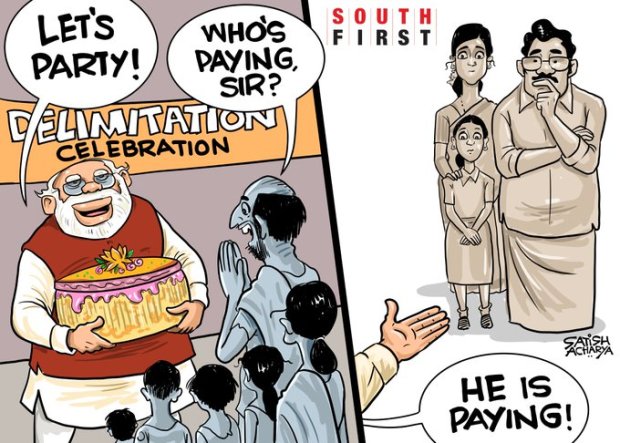
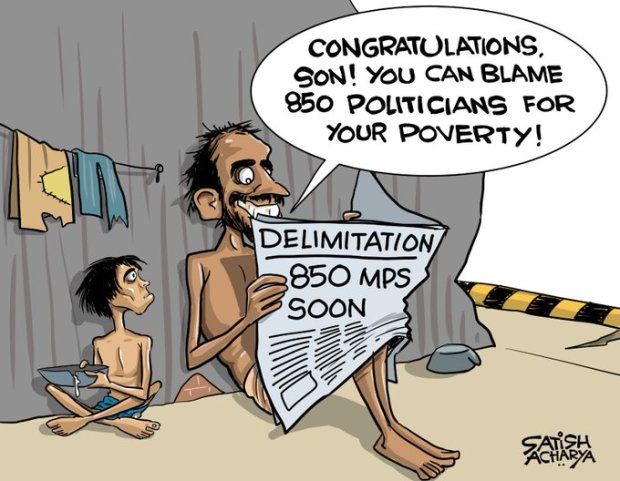

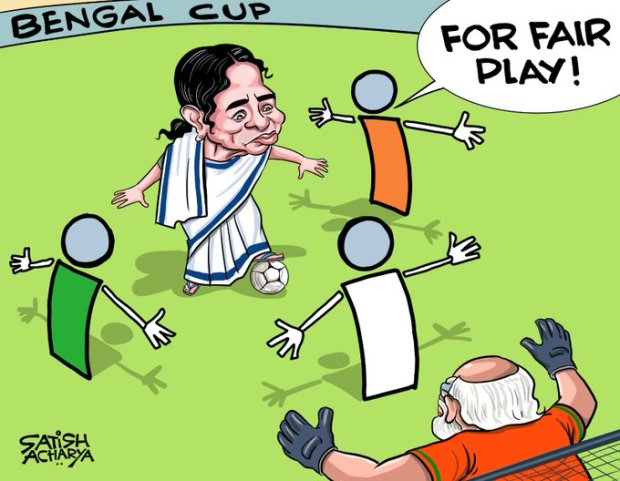
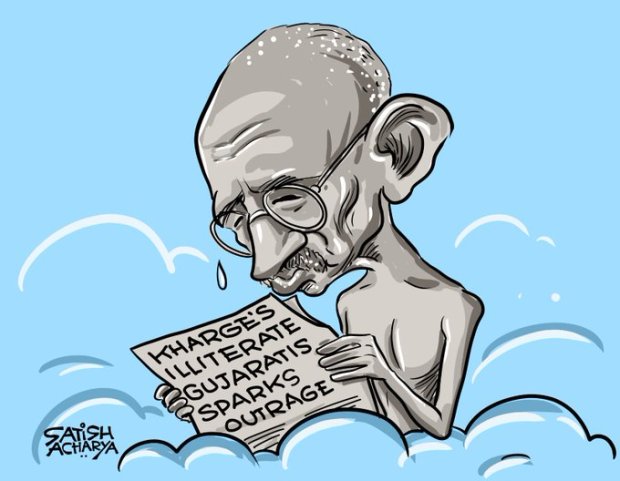
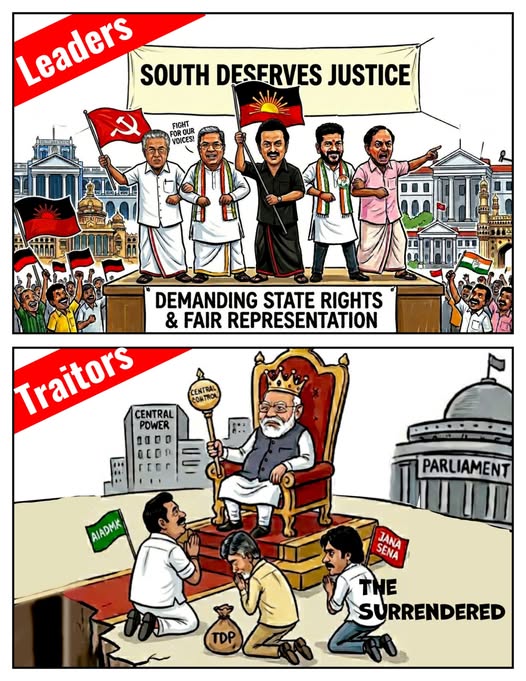
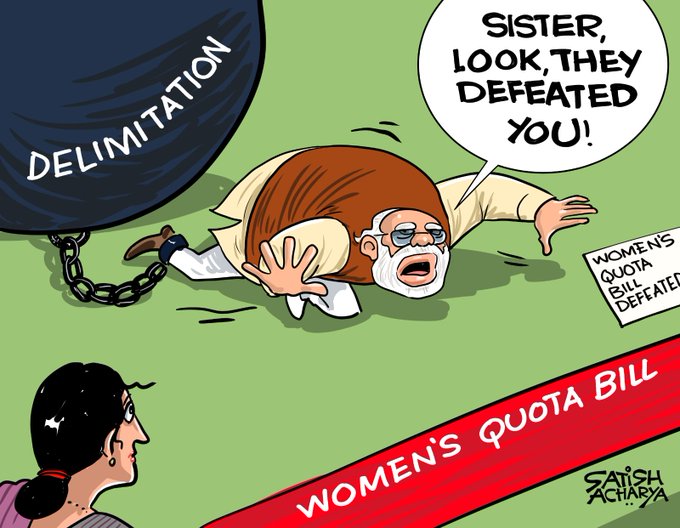
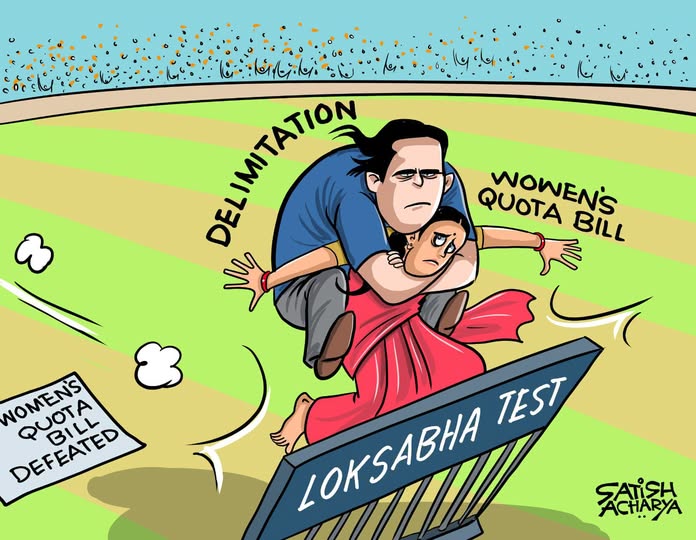
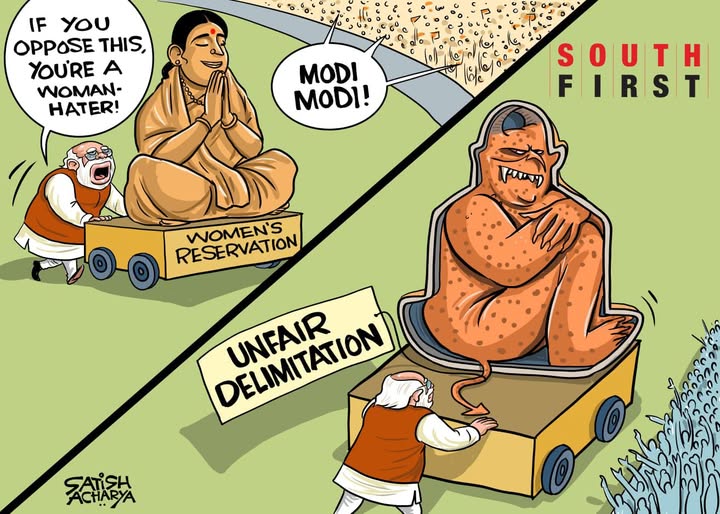
Manjul (Manjul Kumar) endured direct state intervention: in 2021, Twitter issued notices under government orders for his cartoons, leading to his suspension from Network18 after six years of service. His work consistently lampoons the blurring of party, nation, and leader, exposing the putrid inversion at the heart of the undeclared emergency.
Here are a few selected cartoons composed by him:
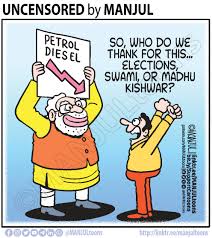

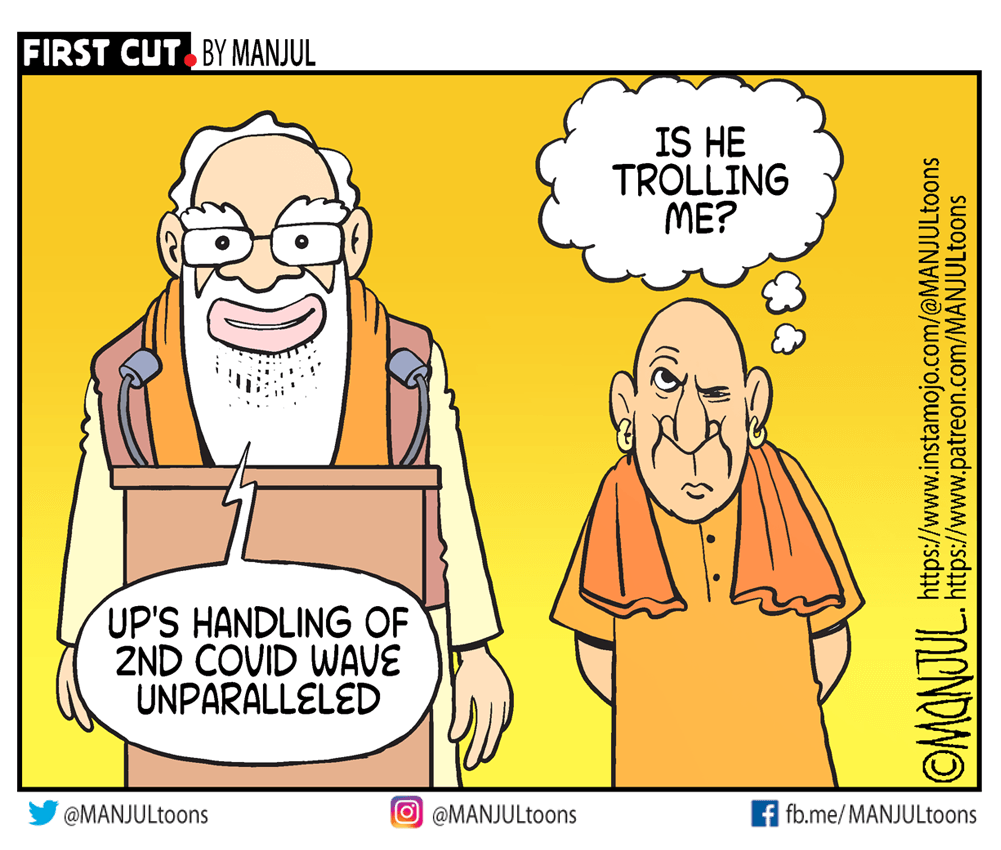

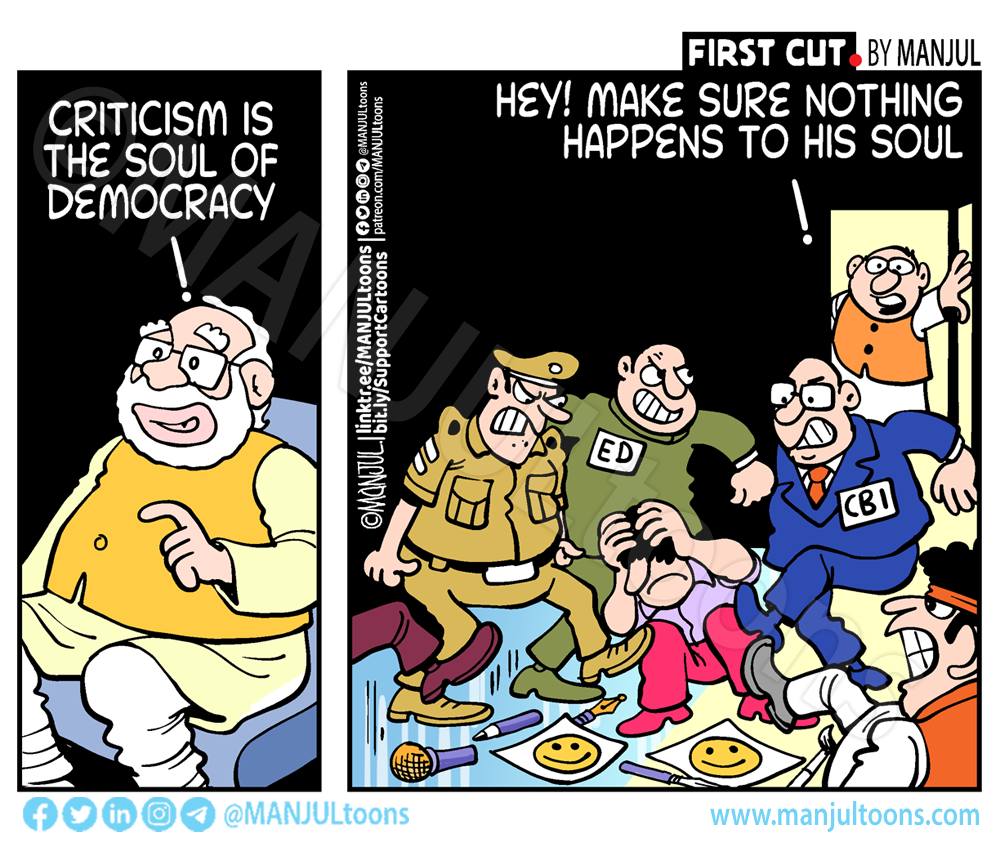
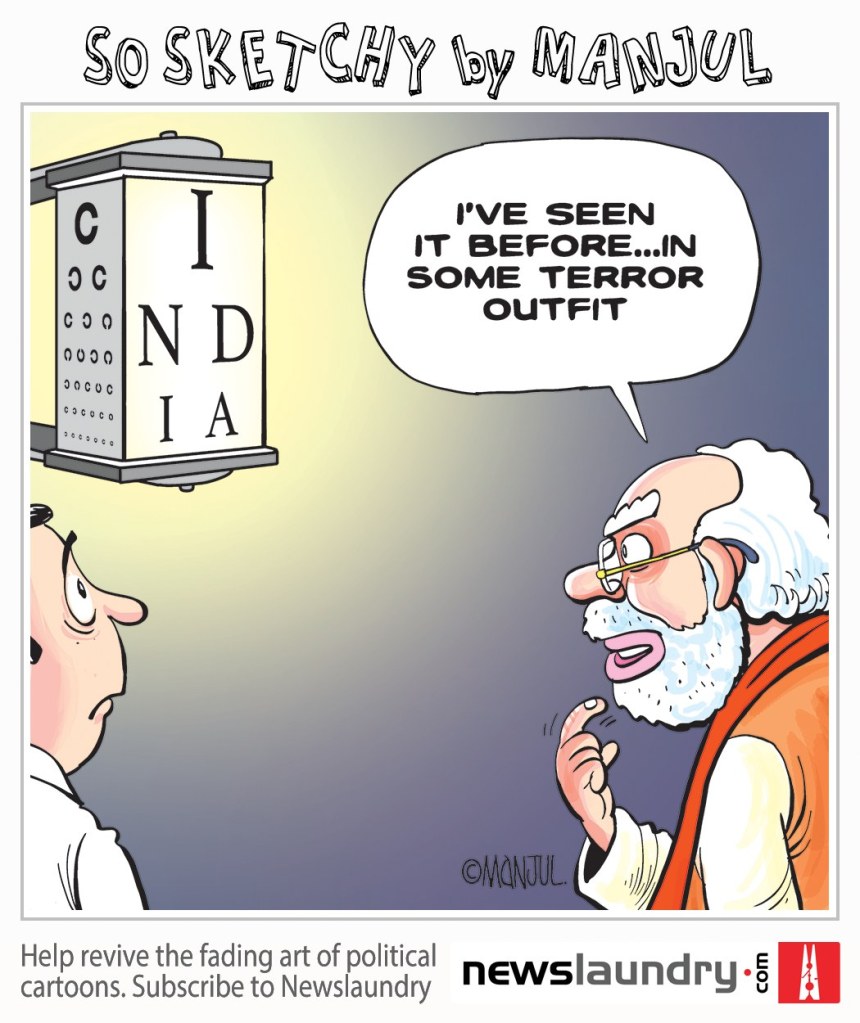
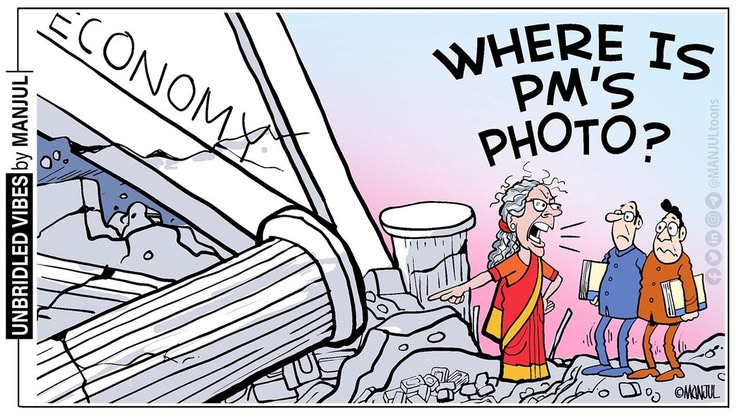
Other visual voices like G. Bala have faced similar platform censorship and direct legal harassment for satirical depictions of authoritarian excess. In 2021, Twitter (now X) explicitly informed Bala that the Union Government had ordered action against his cartoons under Section 69A of the IT Act for criticising the Palanaswami government and PM Modi. He has also endured multiple FIRs, police summons, and coordinated complaints for his work, illustrating how even visual suggestion terrifies sovereign opacity. His cartoons — widely shared on social media — capture the regime’s ethical ugliness in single-frame kautuka-hāsya: majoritarian goons masquerading as guardians of dharma. The regime’s response — coordinated trolling, threats, platform blocks, and government orders — reveals the extent to which visual satire disrupts the carefully maintained facade of power.
Rachita Taneja’s Sanitary Panels — a long-running series of minimalist stick-figure webcomics launched in 2014 — stands as one of the most incisive and persistent examples of visual śilpita pratirodha in contemporary India. Through deceptively simple drawings, Taneja skewers patriarchal majoritarianism, cow vigilantism, institutional bias, and the grotesque contradictions of “development” rhetoric that masks ecological and social decay. Her 2020 panel critiquing the Supreme Court’s selective bail granted to Republic TV’s Arnab Goswami (widely seen as favouring the ruling dispensation) triggered contempt proceedings from the Attorney General, who described it as an “audacious assault” on the judiciary. Despite relentless trolling, rape and death threats, and repeated attempts at censorship, Taneja has continued to publish, turning the spectator’s instinctive turning-away from moral ugliness into a moment of astonished recognition. In single-frame kautuka-hāsya, she distils bībhatsa nausea into quiet, biting insight, proving that even the humblest visual form can bypass controlled media and strike at the heart of sovereign opacity.
These cartoonists weaponise the frame’s immediacy: bībhatsa’s nausea is distilled into a single glance, then refracted through kautuka wonder and hāsya laughter into subversive insight that bypasses the regime’s controlled media. One is inevitably reminded of R.K. Laxman’s iconic “Common Man” — that silent, bemused everyman who, for decades, stood as the moral conscience of the nation, quietly exposing the absurdities, hypocrisies, and moral rot of those in power through minimalist lines and wry observation. Laxman’s gentle yet devastating satire demonstrated how visual humour could hold a mirror to power without raising its voice, turning everyday political farce into a shared national language of critique. In today’s far more repressive climate, contemporary cartoonists like Rachita Taneja, Satish Acharya, G. Bala, and Manjul carry forward this legacy, proving that even in the darkest hybrid theatre, the distilled power of a single frame can still pierce sovereign opacity and awaken collective recognition.
For more such instances, view the following:
F.3 Shared Tactics, Collective Impact, and the Triumph of Śilpita Pratirodha
Both comedians and cartoonists deploy Michel de Certeau’s “tactics of the weak” — poaching the regime’s own symbols (WhatsApp forwards, policy slogans, judicial rituals, media anchors) and inverting them through parody and suggestion. Mimicry deflates authority; subaltern counterpublics (Dalit, Muslim, feminist voices) forge alternative laughscapes that challenge the homogenised majoritarian truth. The impact is profound: in a captured public sphere where “Godi media” manufactures consent, these artists create digital counterpublics on YouTube, Instagram, and independent platforms, democratising dissent for millions. Backlash — arrests, vandalism, legal harassment, platform blocks — only multiplies their reach, proving the sovereign “Will to Hide” crumbles under astonished collective laughter.
In the BJP-NDA regime’s undeclared emergency, this satire restores śuddhi: disgust is universalised, not suppressed, turning the sahṛdaya bhoktā from paralysed spectator into active resistor. The regime routinely weaponises defamation laws, sedition provisions, and Section 295A of the IPC (now under the Bharatiya Nyaya Sanhita), along with IT Rules and platform notices, to file FIRs, issue summons, and order content blocks against both comedians and cartoonists who pierce the “Will to Hide.”
How India’s IT Laws Are Silencing Political Satire VIEW HERE ⤡
Every FIR, every vandalised venue, every contempt notice, and every government-directed platform censorship — whether against Kunal Kamra’s routines, Munawar Faruqui’s stand-up, Rachita Taneja’s panels, Satish Acharya’s cartoons, or Manjul or G. Bala’s work — confirms the potency of their kautuka-hāsya-vyāṅga.
This pattern is further amplified by the viral spread of meme culture, where anonymous digital creators rapidly remix and circulate satirical images and clips, turning individual jokes into collective, unstoppable waves of ridicule that bypass traditional gatekeepers. Through verbal, visual, and memetic śilpita pratirodha, Indian satire stands as living proof that even in the darkest hybrid theatre, wonder, laughter, and implication can dance the wave of freedom, ensuring the repulsive never has the last word.
While śilpita pratirodha — through the subversive triad of kautuka, hāsya, and vyāṅga — seeks to reclaim the negative rasas by reframing terror and disgust into emancipatory astonishment, a parallel and deeply contradictory phenomenon unfolds in contemporary cinema. Far from honouring the aesthetic discipline of the Nāṭyaśāstra as described previously, a wave of pro-BJP, pro-Hindutva propaganda films actively violates its core injunctions, instrumentalising the very bhayānaka and bībhatsa sentiments they claim to defend.
VII. Propaganda Films and the Violation of Nāṭyaśāstra Prohibitions: A Betrayal of the “Sanātana” Injunctions!
Despite the clear dramaturgical prohibitions articulated by Bharata Muni in the Nāṭyaśāstra — discussed at the outset of this treatise — a sustained wave of pro-BJP, pro-Hindutva propaganda films since 2014 has openly and systematically contravened these classical restraints. Bharata explicitly forbids the direct on-stage (or, by extension, on-screen) depiction of yuddha (battle), vadha (killing), rājyabhraṃśa (loss of kingdom), and graphic violence. Such events must instead be conveyed indirectly through praveśaka (introductory scenes), viṣkambha (interludes), narration, or stylised suggestion (sūcana). Weapons must only gesture without striking; intimate or impure acts, including excessive gore, are barred to preserve aucitya (decorum), aesthetic distance, and the production of refined ānanda rather than raw sensory shock or moral destabilisation. These injunctions reflect a deeper Sanātana ethos: violence is not to be glorified as spectacle but mediated so that it serves ethical reflection, potentially leading toward śuddhi or śānta, rather than inflaming base passions and communal hatred.
Pro-Hindutva films since 2014 systematically defy these principles, indulging in unmediated graphic violence, blood-soaked montages, prolonged torture sequences, explicit battle carnage, and voyeuristic depictions of suffering. In doing so, they contradict the very Sanātana culture of restraint, suggestion, and moral elevation they purport to defend and conserve. Instead of stylised abhinaya or off-stage narration, they prioritise visceral spectacle that collapses aesthetic distance into propagandistic shock, turning the screen into a platform for raw bhayānaka and bībhatsa without the regulating discipline Bharata demanded. This is not conservation of tradition but its selective inversion for contemporary political ends — a calculated betrayal that weaponises cinematic form to inflame rather than elevate.
The Kashmir Files (2022), directed by Vivek Agnihotri, stands as a paradigmatic violation. The film features extended graphic reenactments of lynchings, burnings, forced migrations, and torture, including a notorious scene of a woman forced to eat rice soaked in her husband’s blood. Critics widely described these sequences as “extreme violence” and “blood-soaked montages” that evoke less historical reckoning than inflammatory spectacle, with several noting its potential to incite communal hatred. The film reduces complex historical events to a one-sided “genocide” narrative while erasing nuance and context, directly contravening Bharata’s prohibition on graphic vadha and yuddha by presenting them in unmediated, shock-driven detail rather than through suggestion or narration.
Building on this template, The Bengal Files (2025), the third instalment in Agnihotri’s “Files” trilogy, escalates the pattern with even more relentless gore — severed limbs in slow motion, prolonged rape sequences, and graphic temple-burning scenes framed as “Hindu genocide.” Reviewers condemned it as “Tarantino-lite torture porn” and “inflammatory propaganda,” highlighting its excessive violence that prioritises raw sensory shock and communal polarisation over any ethical reflection or aesthetic distance.
The Kerala Story (2023) similarly escalates the pattern with prolonged depictions of forced conversions, radicalisation, and violence framed as a “love jihad” conspiracy, using graphic imagery and emotional manipulation to polarise audiences. The Bengal Files (2025), the third instalment in Agnihotri’s “Files” trilogy, pushes this tendency further with “relentless” gore — severed limbs in slow motion, prolonged rape and temple-burning sequences framed as “Hindu genocide.” Reviewers called it “Tarantino-lite torture porn” and “inflammatory,” with excessive violence that prioritises shock over ethical reflection.
Uri: The Surgical Strike (2019), often hailed as a template for this genre, features extended raid sequences with gunfire, explosions, and on-screen deaths, prioritising visceral combat spectacle over stylised gesture. Article 370 (2024) and The Sabarmati Report (2024) continue the trend by dramatising political events with selective, emotionally charged portrayals that glorify state actions while minimising complexity. Operation Valentine (2024) adds high-octane aerial dogfights, explosions, and militarised violence presented as triumphant spectacle. Udaipur Files (2025) dramatises the 2022 beheading of Kanhaiya Lal with graphic violence and inflammatory subplots (including meat-throwing and radicalisation scenes), leading to court interventions over fears of communal disharmony.
The Dhurandhar franchise, directed by Aditya Dhar, represents one of the most ambitious and unapologetic examples. Dhurandhar (2025) blends spy-thriller elements with graphic shootouts, custodial killings reframed as “clean operations,” and scenes of mob violence, distorting recent history (including demonetisation and custodial deaths) through emotional priming and selective gore. Dhurandhar 2 (2026) escalates this further with an even longer runtime, the new mantra of “Honsla, Eendhan, Badla” (Courage, Fuel, Vengeance), and intensified graphic sequences that glorify revenge and state violence. Critics, including Dhruv Rathee, have described Dhurandhar 2 as “BJP’s most expensive election advertisement disguised as a film,” accusing it of whitewashing policy failures while presenting a binary narrative of heroic nationalism versus internal and external enemies. The sequel’s heavy reliance on explicit action, torture visuals, and emotionally manipulative montages directly contravenes Bharata’s rules against unmediated yuddha and vadha, turning historical and political events into unmediated spectacle that serves ideological ends rather than classical rasa discipline.
By doing so, they stand in direct opposition to the Nāṭyaśāstra’s proscriptions and the Sanātana emphasis on suggestion, decorum, and ethical elevation over spectacle. Far from protecting or conserving Sanātana culture, they instrumentalise selective historical trauma into propagandistic excess, replacing mediated reflection with raw sensory shock that risks inflaming bhayānaka and bībhatsa without the purifying universalisation Bharata and Abhinavagupta envisioned.
This selective defiance exposes a profound contradiction: films that wave the banner of so-called Sanātana dharma actively undermine its classical aesthetic and ethical restraints in service of contemporary majoritarian politics. In the undeclared emergency’s theatre, such cinema does not defend tradition — it perverts it. By collapsing the distance Bharata so carefully guarded, these films transform the screen into a site of unmediated affective violence, turning potential pathways to śuddhi into instruments of division and hatred. The deeper tragedy lies in this inversion: what claims to uphold Sanātana values ends up betraying its most sophisticated aesthetic wisdom — the disciplined mediation that alone allows even the darkest human sentiments to serve contemplative freedom rather than base passion.
VIII. Conclusion: Rasa, Resistance, and the Reclamation of Collective Consciousness
The long arc of this inquiry — from Bharata Muni’s rigorous dramaturgical grammar in the Nāṭyaśāstra, through Abhinavagupta’s doctrine of sādhāraṇīkaraṇa and Krishna Chandra Bhattacharyya’s radical elevation of bībhatsa as mahā-rasa, to the living theatre of our fractured present — reveals a singular truth: the negative rasas, bībhatsa and bhayānaka, are not peripheral afflictions to be excised from aesthetic experience. They are indispensable diagnostics of consciousness itself. When held within the disciplined frame of vibhāva, anubhāva, and sādhāraṇīkaraṇa, they become alchemical pathways to śuddhi and śānta, transmuting revulsion and terror into contemplative freedom. When torn from that frame and left raw under the conditions of late-capitalist authoritarianism, they degenerate into sovereign weapons: engines of opacity (“Will to Hide”), instruments of pervasive dread, and architects of institutional foreclosure.
In India’s undeclared emergency — a hybrid tyranny that is at once political, financial, and climatic — this pathology has reached its most sophisticated and insidious expression. The regime preserves the empty rituals of democracy while systematically hollowing out their substance, engendering moral and institutional filth only to recoil from it through architectures of secrecy, surveillance, and selective silence. Propaganda cinema, from The Kashmir Files and The Kerala Story to The Bengal Files, Dhurandhar 2, and their kin, enacts the ultimate betrayal: cloaked in the language of Sanātana dharma, these films brazenly violate Bharata’s prohibitions against graphic vadha and yuddha, replacing suggestion and decorum with unmediated gore and emotional shock, thereby inflaming the very negative rasas they purport to defend.
Yet precisely in this darkest conjuncture, the counter-force of śilpita pratirodha rises. Through the subversive triad of kautuka, hāsya, and vyāṅga — embodied in the defiant routines of Kunal Kamra, Munawar Faruqui, Vir Das, Samdish Bhutani, Shamita Yadav, Varun Grover, and the visual indictments of Rachita Taneja, Satish Acharya, and Manjul — the negative rasas are reclaimed. Drawing on a hauntological lineage from Husserl’s empathic bracketing and Benjamin’s flâneur to Camus’s absurd man, Tagore’s universal wave, and Chaplin’s immortal Little Tramp, this living art of resistance transforms sovereign pathology into the raw material of liberating astonishment. Every FIR, every vandalised venue, every death threat, every contempt notice only confirms its potency: the more fiercely laughter is attacked, the more evident it becomes that tyranny cannot withstand the slapstick of truth.
The sahṛdaya bhoktā of our time thus stands at a decisive threshold. We can remain imprisoned in the sovereign’s pathological cycle of dread and disgust, or we can reclaim the transformative discipline that Indian aesthetic thought has always offered. The negative rasas need not define us. They can illuminate us. The repulsive need not have the final word. The terrible need not dictate the future.
In the end, the true victory of śilpita pratirodha lies not in defeating tyranny through force alone, but in laughing it into absurdity — until the golden disk cracks open, the dark forest is illuminated by collective wonder, and consciousness, once more, dances freely upon Tagore’s immense wave.
The path of resistance is clear. The aesthetic weapons are ready. The universal wave awaits those bold enough to ride it.
References
- Bharata Muni. Nāṭyaśāstra. Translated by Manomohan Ghosh. Calcutta: Asiatic Society, 1951 (reprint 2002). (Primary text for definitions of rasa, bībhatsa, bhayānaka, vibhāva, anubhāva, vyabhicāribhāva, and dramaturgical prohibitions.)
- Abhinavagupta. Abhinavabhāratī (Commentary on the Nāṭyaśāstra). Edited by M. Ramakrishna Kavi. Gaekwad’s Oriental Series, 1926–1954. (Key source for sādhāraṇīkaraṇa and non-dual interpretation of negative rasas.)
- Bhattacharyya, Krishna Chandra. “The Concept of Rasa.” In Studies in Philosophy, Vol. 1. Calcutta: Progressive Publishers, 1958 (originally 1930). (Central text for elevation of bībhatsa as mahā-rasa / mūla-rasa.)
- Īśopaniṣad. In Upaniṣads. Translated by Patrick Olivelle. Oxford: Oxford University Press, 1996. (Mantra 15 – the “golden disk” metaphor.)
- V-Dem Institute. Democracy Report 2026: Autocratisation Turns Viral. Gothenburg: University of Gothenburg, 2026. https://www.v-dem.net/documents/43/v-dem_democracyreport2026_lowres.pdf
- Freedom House. Freedom in the World 2026. Washington, DC: Freedom House, 2026. https://freedomhouse.org/report/freedom-world/2026
- World Inequality Lab. World Inequality Report 2026. Paris: World Inequality Lab, 2026. https://wir2026.wid.world/
- Oxfam International. Inequality Inc.: How Corporate Power Divides Our World. Oxford: Oxfam, 2025–2026 updates. https://www.oxfam.org/en/research/inequality-inc
- Global Hunger Index 2025. Concern Worldwide & Welthungerhilfe, 2025. https://www.globalhungerindex.org/
- Climate Change Performance Index 2026. Germanwatch, NewClimate Institute & Climate Action Network, 2026. https://ccpi.org/
- World Press Freedom Index 2025. Reporters Without Borders (RSF), 2025. https://rsf.org/en/index
- World Happiness Report 2026. Edited by John F. Helliwell et al. New York: Sustainable Development Solutions Network, 2026. https://worldhappiness.report/
- Goffman, Erving. The Presentation of Self in Everyday Life. New York: Anchor Books, 1959. (For dramaturgy, facework, and front-stage/backstage analysis used in the satire section.)
- De Certeau, Michel. The Practice of Everyday Life. Translated by Steven Rendall. Berkeley: University of California Press, 1984. (For “tactics of the weak” in the context of satirical resistance.)
- Camus, Albert. The Myth of Sisyphus and Other Essays. Translated by Justin O’Brien. New York: Vintage, 1955.


2 Comments