
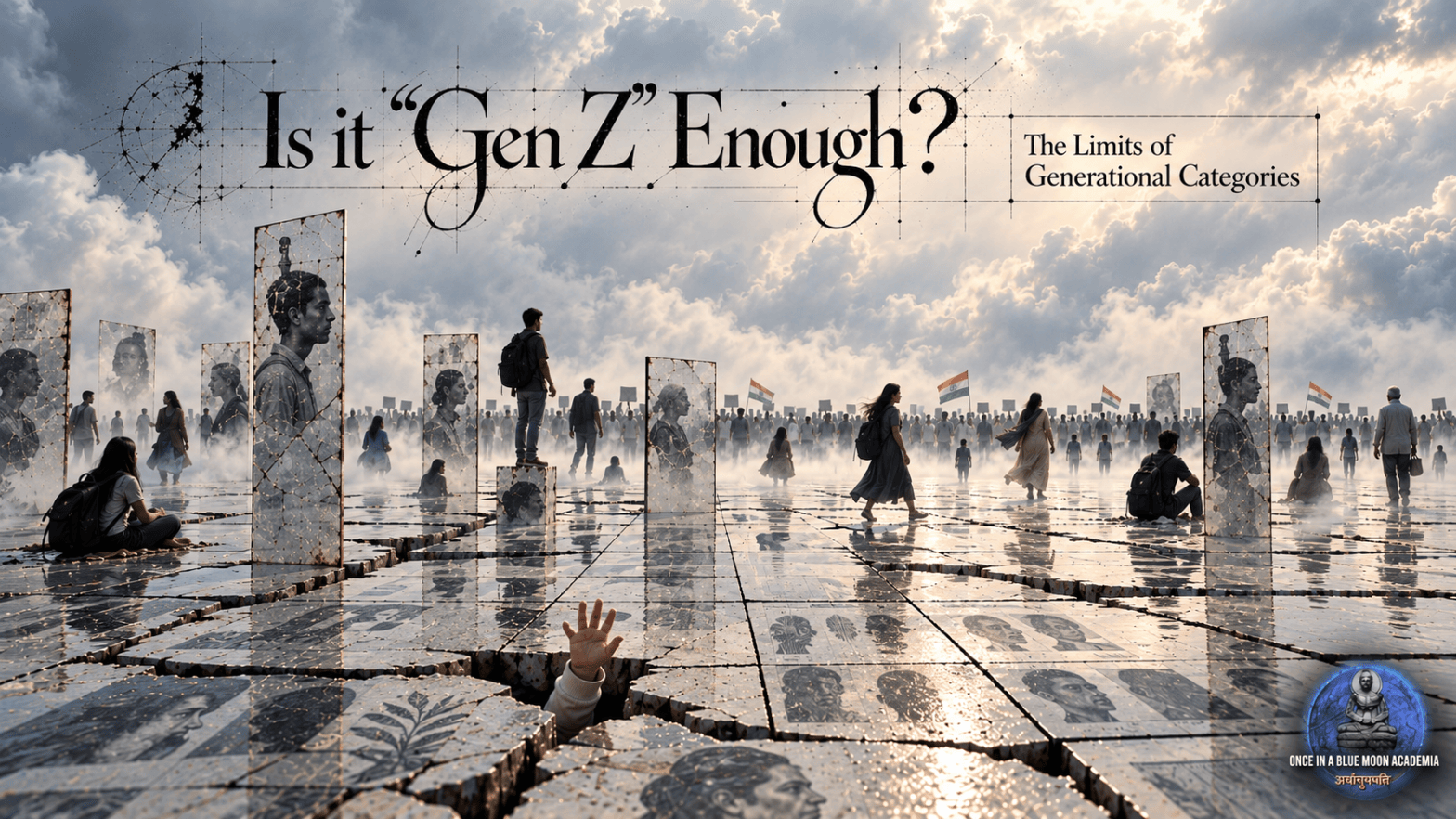
India’s 2026 Youth Mobilization
and the Failure of Classification
Posted on 21st October, 2026 (GMT 08:15 hrs)
ABSTRACT
Generational labels function as a historically specific technology for ordering persons; the classification itself, not the cohorts it names, requires analysis. Drawing on Foucault’s archaeological and genealogical methods, the article traces the grid’s descent through state registration, demography, journalism, marketing and consultancy, showing how it imposes discrete essences on a continuum of births, scales disciplinary seriation to the population, generates looping effects, and recodes structural antagonisms as conflicts between age cohorts. The 2026 Indian mobilisation, branded a “Gen Z” uprising, serves as the principal test case: its composition, demands and alliances exceed any single cohort, demonstrating the non-contemporaneity of the contemporaneous. The Yayati–Babur circuit names the patriarchal mechanism that sustains this reduction. Within the same mobilisation the slogans of the dominant are echoed by the street; the echoing, read through Bhabha’s mimicry and Guha’s prose of counter-insurgency, opens a Third Space in which the national cry is made to carry a demand the apparatus refuses to hear. A parallel episode during Durga Puja in West Bengal—attacks on Left bookstalls resisted by student cadres of comparable age—further shows that shared birth years explain neither the violence nor the defence. The article rejects “mental age” as an alternative scale and proposes instead the plurality of temporalities that run through every subject and every movement.
Keywords: generation, Foucault, order of things, genealogy, biopower, Mannheim, non-contemporaneity, India 2026
A child is born at midnight and another an hour later; already the table has cut them, already one is assigned a different anxiety, a different refusal, a different future, a different therapy. We laugh, or we should, at the encyclopedia that cannot hold its animals, yet we go on laying living persons on the same glass surface, birth year by birth year, until the street itself—examination paper leaking, electoral roll thinning, books thrown into the drain—refuses the cut and walks across the lines. What remains is not a generation but the several times that pass through a single body: the time of a leaked test, the time of deleted voters, the time of a wage that cannot be missed, the time of a river that does not care which letter we were given. The order of things is only the order we keep repeating until someone steps off the table.
DISCLAIMER: The categories analysed in this article—generational labels, cohort characters, mental-age scores, and the other grids of specification that appear in the text—are not neutral descriptions. They are produced, appropriated, re-produced and enacted within determinate relations of power. To name them is not to endorse them as analytic tools. It is to mark the sites at which they become effective, the authorities that delimit them, and the practices through which they are taken up, reversed, or refused. The article treats every such category as an object of inquiry, not as a given.
1. The Table Before the Things
Les mots et les choses (The Order of Things, 1966) opens with laughter. Foucault reads a passage in which Borges cites “a certain Chinese encyclopedia” that divides animals into those belonging to the Emperor, embalmed ones, sucking pigs, those drawn with a very fine camelhair brush, those that from a long way off look like flies, and so on. The laughter, Foucault says, shatters the familiar landmarks of our own thought. What is exposed is not the absurdity of another culture but the limitation of ours: the impossibility of thinking that. The passage does not merely list exotic categories; it confronts us with a classification whose internal principle of order remains opaque, so that the very act of placing beings on a common surface becomes unthinkable. The animals cannot be laid out on the same table because the table itself—the ground that would make their juxtaposition possible—has collapsed.
| Born on or before | Born on or after | Assigned character |
|---|---|---|
| 31 December 1996 | 1 January 1997 | Millennial / Generation Z |
| 31 December 1980 | 1 January 1981 | Generation X / Millennial |
| 31 December 1964 | 1 January 1965 | Boomer / Generation X |
| 31 December 1945 | 1 January 1946 | Silent / Boomer |
| any hour before midnight | any hour after midnight | different anxiety, different refusal, different future |
| those drawn with a fine camelhair brush | those that from a long way off look like flies | the ones that do not yet have a letter |
| sucking pigs | embalmed ones | the ones the table cannot hold |
The last two rows are taken from the Chinese encyclopedia Borges cites and Foucault quotes at the opening of The Order of Things. Placed beside the birth-year cuts, they make the arbitrariness of the generational table visible.
Two infants delivered in the same ward, hours apart, are laid on opposite sides of the cut. The table does not record a difference that already existed; it produces the difference by the act of placing.
The question the passage opens is not whether a classification is true. It is what historical a priori makes a given ordering thinkable, so that it appears as a self-evident table on which things are simply set out. Foucault called this underlying ground of possibility an episteme: the positive unconscious of knowledge, the configuration of rules that determines, for a given period, what can be said, seen, and ordered. In the classical age the dominant form of this ordering was taxinomia—the laying out of beings on a table of identities and differences, the continuous series of the visible cut into discrete genera. The table does not describe a pre-existing order; it produces the effect of order by the very act of placing. What cannot be placed does not appear as a problem within the table; it appears as the limit of the table itself.
Run the same test on a list now repeated in newspapers, boardrooms, school staffrooms and dinner conversations: Silent Generation, Baby Boomers, Generation X, Millennials, Generation Z, Generation Alpha, Generation Beta. On the boundary most widely used, a child born on 31 December 1996 is a Millennial and a child born on 1 January 1997 belongs to Generation Z. Two infants delivered in the same ward, hours apart, are assigned different generational characters, values, anxieties and political dispositions. The cut is no less arbitrary than “embalmed” and “sucking pigs.” It seems natural only because a particular episteme has made the birth year into a meaningful fact about a person’s inner life. The continuum of births occurring every second is laid out on a table of identities and differences; the cut-points, fixed by research centres and consultancies, produce the effect of real essences—“Gen Z values,” “Millennial entitlement,” “Boomer mentality.” Once the table is in place, the essence explains behaviour retroactively. The category becomes a cause.
This is not a minor classificatory convenience. It is the transposition, onto living persons, of the same operation Foucault described for classical natural history: the conversion of a continuum into discrete genera by means of an arbitrary grid that thereafter appears self-evident. The historical a priori that makes this ordering thinkable is the convergence of three practices: the state’s registration of births as administrable facts, the constitution of population as an object of statistical knowledge, and the segmentation of markets into consumer identities. Together they turned counts into types, and types into identities that people now wear as their own. The task of this article is to describe that episteme: not to ask which generation a person “really” belongs to, but under what conditions it became possible, and useful, to sort living people by birth year into named collective characters.
2. Against Origins: A Note on Method
The natural question is: who started this mechanical categorization? The question deserves an answer, but in its usual form it repeats the error it wants to expose. It assumes a founder, a moment of invention, an author who could be blamed. It seeks an Ursprung—a pure founding origin from which the practice would have descended intact, a first principle that would explain the subsequent history as its necessary unfolding. This is the metaphysics of origin: the belief that behind every historical formation lies a single, self-identical source, and that to understand the formation is to recover that source. Foucault’s genealogy declines this metaphysics. It does not ask for the origin of a practice; it asks how the practice was assembled.
In “Nietzsche, Genealogy, History” (1971), Foucault distinguishes the metaphysical search for an Ursprung from two humbler objects of inquiry. Herkunft is descent: the scattered, accidental lineage through which a practice is assembled from heterogeneous pieces that had nothing originally to do with one another. Entstehung is emergence: the moment at which forces collide and a configuration becomes visible and effective, not as the realization of a prior intention but as the outcome of a struggle. Applied here, the method yields a precise result. No one invented generational categorization. It descends from several practices—state registration, positivist philosophy, demographic statistics, journalism, marketing, consultancy—that had nothing to do with one another, and it emerges as a recognizable grid only when those practices are joined. Responsibility can still be located, because some actors did the joining, fixed the cut points and sold the result. But it is distributed across institutions, not concentrated in a person or a founding moment. To look for an inventor is to look for an origin that the practice itself does not possess.
The Archaeology of Knowledge (1969) supplies the further vocabulary for describing how an object of discourse is formed. An object is formed on surfaces of emergence (the institutional sites where it first becomes noticeable), by authorities of delimitation (those entitled to name it and to police its boundaries), and through grids of specification (the systems by which its varieties are divided and related). The genealogy that follows is organized by these three terms. It does not reconstruct a continuous development from an origin; it maps the successive surfaces on which the generational object appeared, the authorities who claimed the right to name it, and the grids by which its varieties were cut and arranged. The metaphysics of origin is declined not by denying that the practice has a history, but by refusing to treat that history as the unfolding of a single source. What is analyzed is not the beginning of the generational grid, but the conditions under which it became possible to treat birth year as a principle of identity.
3. A Genealogy of the Generational Grid
The grid was assembled in successive layers over roughly a century and a half. It did not emerge from a single invention or a continuous theoretical development. It was pieced together from heterogeneous practices whose original purposes had little to do with the production of collective characters. The table below lists the decisive moments; the subsections that follow read them as surfaces of emergence, acts of delimitation, and successive refinements of a grid of specification.
| Date | Actor or text | What it contributed |
|---|---|---|
| 19th c. | Birth registration, census, age-graded schooling, conscription | Age becomes an administrable fact about every person |
| 1830s–40s | Auguste Comte | Succession of generations as a motor of progress |
| 1889 | Bismarck’s old-age pension | Chronological age as a threshold of entitlement |
| 1923 | José Ortega y Gasset | Roughly fifteen-year generations as units of history |
| 1928 | Karl Mannheim, “The Problem of Generations” | Location, actuality and units; the warning against chronology |
| 1951 | Time magazine | Names the “Silent Generation” |
| 1960s | Pepsi’s “Pepsi Generation” campaign | Youth sold as a consumer identity |
| 1965 | Norman Ryder, “The Cohort as a Concept” | Birth cohort as a technical instrument of demography |
| 1991 | Douglas Coupland, Generation X | Popularizes the next label |
| 1991, 1997 | William Strauss and Neil Howe | Fixed archetypes, recurring “turnings”; coin “Millennials” |
| 1998 | Tom Brokaw, The Greatest Generation | Nationalist halo for a cohort |
| 2000s–2010s | Mark McCrindle | Coins “Generation Alpha”, later “Generation Beta” |
| 2019 | Pew Research Center | Fixes 1996 as the last Millennial year |
| 2021 | Philip Cohen’s open letter; Bobby Duffy, The Generation Myth | Scholarly pushback against generational labels |
3.1 Age as an administrable fact
Before a person could belong to a generation, the birth year had to become a known and recorded datum. That required parish and civil registration, the census with its age-tables, schools graded by year of birth, child-labour laws, conscription ages and retirement ages. Bismarck’s old-age insurance of 1889 made a chronological threshold the condition of a state entitlement. Precise “age consciousness,” as Philippe Ariès’s Centuries of Childhood (1960) and Howard Chudacoff’s How Old Are You? (1989) show, is a modern, largely nineteenth-century product of these institutions. For most of history many people did not know their exact age, and it mattered less than status, kinship or stage of life. The birth year became a fact about a person only when the state needed to count, sort and tax.
This is the first surface of emergence. It is also the first moment of what Foucault, in Security, Territory, Population, calls the constitution of “population” as an object of government, with its own regularities of birth, death and age that statistics—the “science of the state”—makes visible. Age is no longer merely a feature of a life; it is an administrable variable. The later possibility of treating birth cohorts as collective characters rests on this prior transformation of age into a fact the state can record and act upon.
3.2 Positivist generation theory
Auguste Comte treated the succession of generations as a driver of social progress: the renewal of the human stock set the tempo of history. José Ortega y Gasset later proposed generations of roughly fifteen years as the basic units of historical change. This is the first mechanization. History is cut into equal temporal slices, and each slice is presumed to possess a common outlook. The idea that a birth interval carries a worldview begins here, in philosophy, long before marketing. What had been an administrative fact is given a historical significance: the birth year is no longer only a datum for the state; it becomes a principle of periodization.
3.3 Mannheim, the internal dissenter
Karl Mannheim’s “The Problem of Generations” (1928) is routinely cited as the founding text of generational sociology. It is better read as a warning against what came after. Mannheim distinguishes three things that the later industry fused:
- Generational location (Generationslagerung): merely being born within the same span, a potential and nothing more.
- Generation as actuality (Generationszusammenhang): a real participation in a common historical destiny.
- Generation units (Generationseinheiten): groups within one actual generation that work up the same events in different and even opposed ways.
On Mannheim’s account, the young Romantic-conservative and the young liberal-rationalist of the same era belong to one actual generation but to two opposed units. Shared birth years produce, at most, a shared problem, never a shared answer. Mannheim also took from the art historian Wilhelm Pinder the phrase the non-contemporaneity of the contemporaneous (Ungleichzeitigkeit des Gleichzeitigen). People alive at the same moment do not inhabit the same time. Ernst Bloch later developed the same idea politically. This concept is the hinge of the present article: the objection that chronological age ignores “mental age” or lived time is, in substance, Mannheim’s objection, made almost a century ago and then set aside. The subsequent history of the grid is, in part, the history of this warning’s neutralization.
3.4 Demography’s cohort
Norman Ryder’s “The Cohort as a Concept in the Study of Social Change” (1965) made the birth cohort a precise technical instrument. In demography this is legitimate and useful: cohorts let researchers distinguish the effects of ageing from the effects of historical period. The decisive slippage came outside demography. “Baby boom” began as a description of a fertility curve, the post-war spike in births. It became the name of a people with a character. A statistical aggregate was converted into an identity, and the conversion was carried out by authorities of delimitation who were not demographers. The technical instrument was detached from the conditions of its scientific use and put to work as a principle of collective character.
3.5 Journalism and marketing
Time named the “Silent Generation” in 1951. Pepsi’s “Pepsi Generation” campaign of the 1960s sold youth as a style of consumption one could buy into. Douglas Coupland’s novel Generation X (1991) gave the next cohort a name and a mood. Tom Brokaw’s The Greatest Generation (1998) attached a nationalist halo to the cohort that fought the Second World War. Each of these is an act of naming by an authority with a commercial or ideological stake. None was derived from a theory of generations. The labels circulated because they sold magazines, soft drinks and books. What had been an administrative fact, a philosophical periodization, and a demographic instrument became a marketable identity.
3.6 The decisive mechanizers: Strauss and Howe
William Strauss and Neil Howe supplied the fullest mechanical system in Generations (1991) and The Fourth Turning (1997). Successive cohorts of about twenty years receive fixed archetypes (Prophet, Nomad, Hero, Artist) and rotate through a recurring cycle of four “turnings,” culminating in a crisis that renews the social order. They coined “Millennials.” The result resembles an astrology of the birth year, or a secular version of the cyclical cosmologies that schemes such as the yuga sequence once provided. It promises prediction: tell me your birth year and I will tell you your role in the coming crisis. The scheme has found real political uptake, notably among figures on the American right who read the present as a Fourth Turning. Here the grid of specification reaches its most rigid form: not merely a sequence of labels, but a closed system of recurring characters.
3.7 Boundary-fixing institutions
In 2019 Pew Research Center formally set 1996 as the last Millennial birth year, which effectively canonized Generation Z as beginning in 1997. The Australian social researcher Mark McCrindle coined “Generation Alpha” for those born from around 2010 and later promoted “Generation Beta” for births from 2025. At this point the taxonomy becomes self-reproducing. A new letter is issued every fifteen years or so, and a character is assigned before anyone in the cohort can speak. Generation Beta was given traits while its members were still in nappies. The grid of specification now runs ahead of the population it claims to describe. The authorities of delimitation no longer wait for the cohort to appear; they issue the category in advance.
3.8 The pushback and the persistence
In 2021 the sociologist Philip Cohen organized an open letter, signed by scores of social scientists, asking Pew to stop treating generational labels as analytic categories. Pew subsequently became more cautious about generational claims. Bobby Duffy’s The Generation Myth (2021) showed that many supposed generational differences are better explained as period effects, which strike everyone alive at once, or life-cycle effects, which everyone passes through in turn. The taxonomy continues regardless. Its persistence after scholarly refutation is itself evidence that it is sustained by something other than knowledge, and that something is the subject of the next section. The grid survives its own critique because its function is not primarily scientific.
4. What the Classification Does
A genealogy explains how a grid was assembled. An analytics of power asks what it does once in place. The generational grid does not merely describe age groups; it performs at least four operations at once. These operations are not successive stages but simultaneous effects of the same classificatory apparatus. Together they convert a continuum of births into discrete essences, extend a disciplinary logic of serial ranking to entire populations, manufacture the evidence that appears to confirm the classification, and recode structural conflicts as differences of attitude between cohorts.
4.1 Taxinomia: the arbitrary cut that produces essences
In The Order of Things, the classical age’s natural history works by taxinomia: it lays beings out on a table of identities and differences, dividing continua into discrete genera. The table does not reflect a pre-existing order; the act of placing produces the effect of order. The generational grid does the same with a continuum of births happening every second. The cut points—1996/1997, 1980/1981, and so on—are conventions, set by a research centre or a consultancy. Once fixed, they produce the effect of real essences: “Gen Z values,” “Millennial entitlement,” “Boomer mentality.”
The essence then explains behaviour retroactively. A young person’s anxiety is “very Gen Z”; an older person’s caution is “so Boomer.” A preference for remote work, a reluctance to buy a house, an ironic tone on social media—each is read as the expression of a generational character rather than as a response to wages, housing costs, platform design, or political conditions. The category becomes a cause. What begins as an arbitrary division of a continuum ends as an explanatory substance. This is not a side-effect of the classification; it is its primary operation.
4.2 Disciplinary time scaled up to population
In Discipline and Punish (1975), Foucault describes the disciplinary organization of time: the timetable, the seriation of successive activities, and “evolutive” time in which individuals are graded by stage so that each can be placed against a norm for that level. The school class, the military rank and the apprenticeship grade are its instruments. The examination combines surveillance and normalizing judgment, and makes each individual a “case.”
The generational grid transposes this seriation from the classroom to the whole population. Each cohort is assigned expected traits, attitudes and consumption patterns, and individuals are measured as conforming or deviant. The distinctive features routinely ascribed to “Gen Z” supply the current content of this norm. They are said to be digital natives for whom online life is primary and offline life residual; to suffer elevated rates of anxiety and depression produced by platforms and economic precarity; to be politically progressive yet institutionally disengaged; to prefer experiences over possessions and remote or flexible work over traditional careers; to be entrepreneurial and side-hustle oriented; to value authenticity and mental-health discourse while remaining ironic or detached; and to be more diverse, more queer-identified, and more climate-conscious than their predecessors. These traits are treated as both necessary and sufficient: necessary in the sense that a person born after 1996 who lacks them appears as an anomaly requiring explanation, and sufficient in the sense that their presence is taken to confirm membership in the cohort and to explain behaviour.
The list is already reductive. It collapses differences of class, caste, region, religion, education and employment into a single character. A software engineer in Bengaluru who codes from a café and a daily-wage worker in the same city who cannot afford a data pack are both “Gen Z”; only the first matches the digital-native and experience-economy profile. A student preparing for a public examination under conditions of repeated leaks and a content creator monetising anxiety are both “Gen Z”; their relation to institutions and to risk is not the same. Political progressivism is attributed as a cohort trait even where large numbers of the same birth years support the ruling party or remain outside organised politics. The preference for remote work is read as a generational value rather than as a response to housing costs, urban congestion and the bargaining power of certain skilled occupations. Climate concern is treated as an essence rather than as a differential exposure to ecological risk that cuts across ages. Each attributed feature functions as a norm against which individuals are measured. The person who owns a house, who is politically conservative, who works a fixed shift offline, or who does not speak the language of mental health appears as an exception. The exception does not dissolve the norm; it confirms that a norm exists. This is a dividing practice and a normalizing judgment at once, exercised now through surveys, dashboards, HR diagnostics and think-pieces rather than the drill sergeant’s eye. What was once a technique for ranking bodies inside an institution has been relayed into a technique for ranking populations. Disciplinary power over individuals is scaled up into a form of biopower that treats age cohorts as collective cases.
4.3 Making up people: the looping effect
Ian Hacking’s work on “making up people” describes the looping effect of human kinds. Classify people, and they begin to act through the classification; their changed behaviour is then cited as evidence for the category. Young people perform “Gen Z” irony, humour and anxiety on platforms that reward the performance. Older people adopt or resent the “Boomer” role. Employers redesign offices for imagined generational preferences, and the redesigned office trains the preference it assumed. Universities advertise “Gen Z learning styles”; political consultants target “Millennial values.” In each case the category is not simply applied from outside. It is taken up, performed, and thereby reinforced.
The loop is what allows the taxonomy to survive its scholarly refutation. When researchers show that supposed generational differences are better explained by period or life-cycle effects, the circulating performances of generational identity continue to supply fresh evidence. The classification produces the behaviours it claims to discover. Its persistence is not a failure of empirical correction; it is the ordinary functioning of a human kind that has entered circulation.
4.4 The dispositif and the recoding of conflict
Foucault’s dispositif names a heterogeneous ensemble of discourses, institutions, regulations, architectures and scientific statements, joined by a strategic function. The generational dispositif includes market segmentation, human-resources consultancy on “managing the multigenerational workforce,” political polling and campaign micro-targeting, platform advertising, and media framing. Its strategic function can be named precisely: it recodes conflict.
The meme “OK Boomer” stages an intergenerational war that displaces antagonisms of class, caste, gender and region. The rich young heir and the precarious young gig worker become “the same generation”; so do the retired landlord and the retired sweeper. The one thing that actually passes between generations—inherited property and its absence—disappears behind a story about attitudes. A conflict over who owns housing, land and capital is retold as a quarrel over avocado toast and work ethic. What is at stake is not merely a misdescription. It is a redistribution of political visibility: structural relations are rendered as cultural differences between age groups.
The same operation governs dissent. When mass movements are branded “Gen Z revolts,” as happened across Bangladesh in 2024, Nepal in 2025 and several other countries since, the label renders them legible, newsworthy and marketable. It also flattens their class content and political demands into a demographic mood: the young are restless, as the young always are. A contest over institutions becomes a stage of life, and stages of life are expected to pass. The classification does not simply name the participants; it supplies a ready-made temporality in which their demands can be treated as temporary.
5. A Comparative Note: The Reverse Discourse
The classification of sexuality and gender offers an instructive contrast, which a separate article will take up in full. Foucault’s History of Sexuality, volume 1 (1976), is in effect the template for the generational analysis. He dates the homosexual as a kind of person to Carl Westphal’s 1870 article on “contrary sexual sensation.” Sodomy had been a forbidden act anyone might commit; the nineteenth-century clinic and court turned the act into the sign of an inner nature, so that, in Foucault’s phrase, “the homosexual was now a species.” What had been a juridical prohibition on certain acts became the psychiatric specification of a type of person. Krafft-Ebing’s Psychopathia Sexualis (1886) then laid out a Linnaean table of desire, long before today’s lengthening acronym of LGBTQIA+ identities (more on this in a later article). The table did not merely describe existing practices; it produced the species it claimed to inventory, converting acts into essences and then ranking those essences on a scale of pathology.
The difference lies in direction, and the difference is politically consequential. Generational labels were imposed from above by demographers, magazines and consultancies; nobody chose to be “Generation X.” The categories arrived already equipped with expected traits, consumption patterns and political dispositions. A person born in 1995 did not adopt “Millennial” as a self-description in order to make a claim; the label was issued and then used to explain that person’s housing choices, work habits or political preferences. Many sexual and gender categories, by contrast, were coined or reclaimed from below. Foucault named this the reverse discourse: the vocabulary psychiatry used to disqualify homosexuality became the vocabulary through which homosexuals demanded legitimacy, beginning with Karl Heinrich Ulrichs in the 1860s and running through the reclamation of “gay” and “queer.” Ulrichs’s “Urning” was an attempt to name a natural variety rather than a vice; later activists took the clinical and pejorative terms and turned them into banners. The same terms that had functioned as instruments of pathologization were turned into instruments of recognition and political claim-making. The classification remained a product of power, but its political valence was not fixed by its origin.
Yet the reverse discourse has not remained a pure instrument of contestation. It has itself been captured and redeployed. What began as a seizure of psychiatric vocabulary has, in large part, been reabsorbed into a new apparatus of specification. Rainbow capitalism—the incorporation of LGBT+ symbols, Pride events and diversity rhetoric into corporate marketing—converts the reverse discourse into a brand. Corporations drape themselves in rainbows while funding politicians who restrict the rights the symbols claim to celebrate; Pride parades become sponsored spectacles in which banks, platforms and police forces march under the same banners once raised against them. The category that once marked a refusal of psychiatric normalization now marks a market segment. “Pink money” is courted; the reverse discourse is monetized. The strategic function shifts from contestation to consumption.
At the same time, the grid of specification has proliferated. Lists of sexual orientations and gender identities now routinely exceed seventy, sometimes a hundred, entries—gynosexual, finsexual, sapiosexual, demigender, xenogender, and so on. Each new label is justified by the existence of someone who claims it, and each claim generates a further distinction. The multiplication is presented as liberation: more categories mean more recognition. Yet the effect is also one of separation. Persons are sorted into ever-finer species; alliances become harder to sustain across the proliferating lines; and the political claim is redirected from institutions to the accuracy of one’s own classification. Identity politics, in this form, does not merely use categories strategically. It treats the correct specification of the self as the primary site of struggle. The baffling expansion of the table—seventy-two orientations, a hundred genders, an open-ended spectrum—is not evidence that the classificatory impulse has been overcome. It is evidence that the impulse has been intensified. What Foucault described as the production of the homosexual as a species has been generalized: every variation of desire or self-description is now invited to become its own species, complete with a name, a community, and a market niche. The more finely persons divide themselves into narrow identities, the more readily neoliberal capitalism profits from the division: each new category becomes a market segment, a data point, a brand, and a reason to keep political energy trained on the self rather than on the institutions that organise wages, housing, and public goods. A fuller treatment of this proliferation of sexual as well as gender orientations and their capture belongs to a subsequent article.
The comparison sharpens the generational case in two ways, and both ways cut against any simple dismissal of identity categories. First, it shows that a classification’s genealogy does not settle its political value: a category can be constructed and still be a tool of recognition, protection and survival. To demonstrate that a label was produced by demographers, marketers or judges is not yet to determine what can be done with it. Second, it reveals that a generational label, too, can be seized and reversed. As section 6 shows, the Indian mobilisation of 2026 began exactly this way, with an insult from the bench—“cockroaches and parasites”—turned into the name of a party and a badge of solidarity. The reverse discourse is not a special property of sexual categories; it is a possible operation on any classificatory name once it has entered circulation. The Cockroach Janta Party did not invent a new identity from nothing; it inverted a disqualifying name issued by the highest judicial authority.
Yet the comparison also marks a limit. Sexual and gender categories, even when reclaimed, have often been tied to concrete demands for rights, recognition, or the decriminalisation of acts. Generational labels, when reversed, more readily remain at the level of mood or style. “OK Boomer” stages a conflict of attitude; it does not name a claim on housing, wages or institutions. The risk is that the reverse discourse remains trapped inside the same grid it appears to contest: the insult is inverted, but the underlying division of persons by birth year is left intact. The further risk, visible in the sexual and gender case, is that the reverse discourse itself becomes a new grid of specification—one that multiplies identities, separates them into marketable species, and absorbs the demand for structural change into the demand for correct recognition.
Foucault’s own position on identity remained ambivalent precisely on this point. In late interviews he treated sexual identity as a useful game or strategy but warned against making it a rule, and he preferred the invention of new relational forms of life to the discovery of a true self. Identity could be a tactical resource without becoming an essence one was obliged to possess. The same caution applies to any identity issued by a birth year—or by a proliferating table of orientations. A generational label can be taken up strategically—as a means of visibility, of temporary solidarity, of reversing an insult—without being treated as the description of an inner character. The danger is not the use of the category but its conversion into a principle that organises persons in advance of their actions, and that continues to organise them even after the tactical moment has passed.
What is at stake in that conversion is the governmentalisation of the production of the subject. Once a classification is no longer a temporary instrument but the grid through which persons are required to recognise themselves, the work of subjectivation is taken over by the apparatus that issues the names. The subject is no longer formed in the friction between practices and institutions; it is invited to constitute itself as the bearer of a pre-specified identity, and to experience that constitution as freedom. Deleuze and Guattari’s distinction between the molar and the molecular is useful here. A molar identity—whether “Generation Z,” “Millennial,” or any of the proliferating sexual and gender species—functions as a segment that captures desire, assigns it a territory, and subjects it to a code. The more finely the segments multiply, the more completely the molecular movements of desire, alliance and refusal are reterritorialised onto the grid. What appears as an expansion of recognition is, at the level of subjectivation, a tightening of the forms through which the subject is produced and governed. The reverse discourse that begins as a seizure of a disqualifying name can end as the voluntary occupation of a molar segment, complete with its market, its data profile and its authorised modes of speech. The caution Foucault voiced—that identity should remain a game rather than a rule—is the refusal of this governmental capture of the production of the subject.
6. The 2026 “Gen-Z” Mobilisation in India: Non-Contemporaneity in the Street
The 2026 mobilisation across India has been described, in domestic and international media alike, as “India’s first Gen Z uprising.” Its own spokespeople often use the phrase. Before any further analysis, this much must be said plainly: we stand with the intention and the courage that the youth have shown, are showing, and will continue to show in this second freedom struggle that the country has witnessed. Their refusal of examination fraud, of electoral manipulation, and of the reduction of their claims to a demographic mood deserves recognition on its own terms. The salute is due, and it is given.
Examined closely, however, the movement is also the clearest available demonstration that the label does not describe what it names. What began as a reverse discourse against a judicial insult expanded, first, into a sustained contest over the integrity of public examinations and, later, into a broader demand for the independence of the electoral machinery. At each stage the generational frame was applied—by media, by the state, and at times by participants themselves—and at each stage the composition, the demands and the alliances exceeded it. The BJP-RSS apparatus, for its part, responded with its own repertoire of tags: “anti-national,” “urban naxal,” “tukde-tukde,” “tool of the opposition,” “pawn.” These tags did not describe the street; they performed the same operation the generational label performs, only from the opposite direction. Both sides sorted living persons into pre-cut categories so that the institutional contest could be made to disappear. The courage remains; the classification does not account for it.
A parallel is frequently drawn between these protests and the earlier mobilisations in Sri Lanka, Nepal and Bangladesh that toppled governments. The comparison is not empty: in each case a generation of the young entered the street against corruption, economic exclusion and the capture of institutions, and in each case the existing order proved unable to absorb the demand without rupture. Yet a Foucauldian reading, offered in solidarity with the movement, refuses to treat the parallel as evidence that “Gen Z” has become a transnational revolutionary subject. What travels is not a cohort but a set of techniques—the seizure of a disqualifying name, the occupation of symbolic space, the conversion of administrative failure into a visible crisis of legitimacy—and a shared refusal of the reduction of political claims to a stage of life. The governments that fell did not fall because a birth cohort matured; they fell because the apparatuses that had organised consent and coercion could no longer contain the convergence of times that the street made present. The same convergence is visible in India.
The movement itself is not unified on the parallel. Abhijeet Dipke has openly condemned the association, insisting that the CJP’s path is one of Gandhian satyagraha and that the jailed leaders “went to jail happily” rather than following the course of events in Nepal or Bangladesh. Neha Bora, by contrast, has drawn the parallel explicitly, offering a red salute to the Bangladeshi movement and stating that it “showed us the way.” The divergence does not resolve into a single position. It confirms that the street contains opposed generation units in Mannheim’s sense: shared birth years produce a shared problem, not a shared answer. Solidarity with the movement consists in recognising the convergence of times, not in assigning that convergence to a generation whose label the movement itself has already exceeded, and not in treating either Dipke’s refusal or Bora’s affirmation as the voice of the reductive whole.
6.1 A classification from the bench, reversed
The movement began with an act of classification. On 15 May 2026, Chief Justice of India Surya Kant was reported to have compared unemployed young people who become activists and online critics to cockroaches and parasites; he later said he had been misquoted. The next day Abhijeet Dipke founded the Cockroach Janta Party (CJP), a satirical parody of the ruling BJP. The party’s slogan—“Voice of the Lazy & Unemployed”—and its rapid accumulation of followers on Instagram turned the insult into a circulating badge. “Cockroaches never die” became a refrain after successive detentions.
This is a reverse discourse in exactly Foucault’s sense. A disqualifying name, issued from the highest authority of delimitation in the judicial order, was seized and turned into a badge of solidarity. The insult was directed at the unemployed and the activist—a class position and a political practice. It was only afterwards recoded, by the media and partly by the movement itself, as a statement about a birth cohort. The founding act named a condition (unemployment, activism) and a relation to authority (the judge’s comparison); the subsequent framing converted that condition into a demographic mood. The BJP-RSS ecosystem, meanwhile, treated the new name as confirmation of an older taxonomy: the unemployed youth who criticises is already a parasite, already anti-national, already available for the “tukde-tukde” tag. The reverse discourse inverted one insult; it did not exit the field of insult.
6.2 The founder on the wrong side of the line, and the first phase: NEET
The arbitrariness of the cut is concrete here. Dipke was reported to be thirty years old when he founded the CJP. On Pew’s boundary, a person aged thirty in May 2026 was born in the mid-1990s and is therefore a Millennial, not a member of Generation Z. The founder of “India’s Gen Z party” falls on the other side of the line that defines it. The taxonomy that claims to name the movement cannot even contain its founder.
The first phase of the mobilisation was organised around the National Eligibility cum Entrance Test (NEET-UG). On 3 May 2026 roughly two million candidates sat the examination; nine days later the results were cancelled after a paper leak was established. A retest followed, but the cancellation threw years of preparation into uncertainty. More than twenty students died by suicide in the following weeks. Families of the dead came to the protest site at Jantar Mantar. The CJP’s demands were institutional: the resignation of Union Education Minister Dharmendra Pradhan, accountability for the leak, compensation for the bereaved, and an end to the pattern of examination scandals that the Congress later claimed numbered 152 since 2016, with almost no convictions. The protesters interviewed at Jantar Mantar ranged from a 17-year-old engineering student from a small town in Madhya Pradesh to a 28-year-old corporate employee. Grieving parents are not Generation Z. A 19-year-old Delhi University student preparing for a police examination suffered pellet injuries and faced possible vision loss; he is not a demographic mood.
Sonam Wangchuk, the Ladakhi educationist and environmentalist born in the 1960s, joined the site and began a Gandhian hunger strike. Coverage credits the 26-day fast with giving the protests moral standing, visibility and swelling crowds. On 20 July police used tear gas and batons on a march toward Parliament; opposition leaders including Rahul Gandhi and Priyanka Gandhi Vadra staged a sit-in outside the Prime Minister’s residence and were detained. On 25 July Pradhan resigned—the first cabinet resignation of the third Modi term. The CJP called off its 36-day sit-in. The first phase ended with a cabinet resignation forced by a cross-generational assembly whose central moral authority was a man in his sixties and whose immediate cause was the integrity of a public examination. The BJP-RSS response, once the resignation was extracted, was to reclassify the entire episode as the temporary restlessness of the young, a stage that would pass, rather than as a contest over the state’s capacity to administer a meritocratic examination without leak or suicide.
6.3 The elders at the centre, and the second phase: the anti-CEC mobilisation
Figures well outside any “Gen Z” boundary remained central once the mobilisation shifted, in September–October, to the Special Intensive Revision (SIR) of electoral rolls and the demand for the resignation of Chief Election Commissioner Gyanesh Kumar. The SIR, presented by the Election Commission as a routine verification, was alleged by opposition parties, civil-society groups and the CJP to have produced large-scale deletions—figures cited in different states ran into the tens of lakhs, with claims of 65 lakh dropped in Bihar’s draft roll and over 97 lakh in Tamil Nadu—without adequate notice or appeal. An Indian Express report that the other two Election Commissioners had raised internal objections at least fourteen times intensified the controversy. The demands were again institutional: the resignation of Kumar, the suspension or reversal of the SIR, the restoration of deleted names, and, for some, a return to paper ballots. These demands concern every voter; they are not the property of a birth cohort.
Rahul Gandhi and Priyanka Gandhi Vadra, Yogendra Yadav, Prashant Bhushan, Kapil Sibal and other opposition leaders did not merely endorse the October phase; they entered it as co-organisers of a demand that long predated the Cockroach Janta Party. On 6 October INDIA-bloc MPs marched from Parliament toward the Election Commission and staged a dharna when stopped. On 12 October a larger procession moved toward the Supreme Court to file a petition over the Special Intensive Revision; police denotified Jantar Mantar as a protest site the same day. CJP leaders Saurav Das and Ashutosh Ranka were sent to judicial custody after scaling barricades at the sealed site while waving the national flag; Dipke himself was detained on multiple occasions, including from inside a landed flight. On 10 October more than 7,000 people were detained in Delhi amid an internet suspension; the planned “Lehra Do Tiranga” march on 16 October at Connaught Place was barred by prohibitory orders and park closures, with further detentions. Mass detentions—hundreds on successive days, with cumulative figures running into the thousands across the October actions—accompanied the protests.
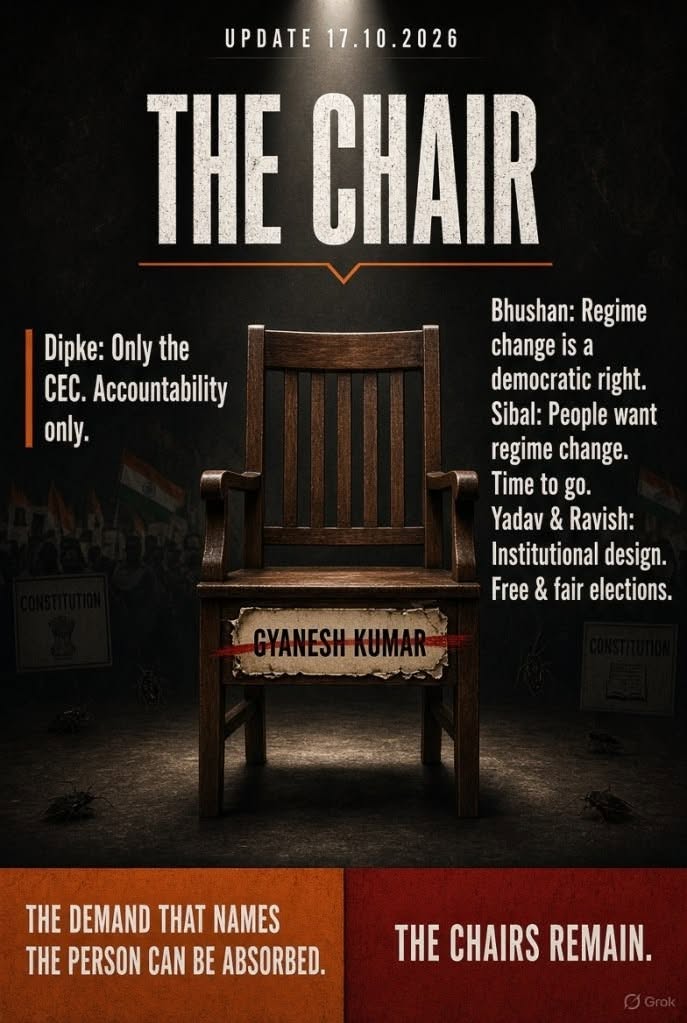
These were not peripheral endorsements. Bhushan publicly criticised the original judicial remarks and continued litigation on electoral integrity that stretches back more than a decade; Sibal framed the capture of the Election Commission as a problem of institutional design rather than of a single officer; Yadav insisted that an independent Commission required more than one resignation. Ravish Kumar’s sustained coverage from outside the “Godi media,” together with the investigative groundwork of Poonam Agarwal, Ajit Anjum and the Reporters’ Collective on alleged “vote chori,” supplied the counter-public the movement entered. The October phase inherited evidence, legal infrastructure and protest repertoires from earlier cycles—Rahul Gandhi’s 2025 Bihar allegations and Voter Adhikar Yatra, the 2020–21 farmers’ siege, the anti-CAA flag reclamations, the 2023 wrestlers’ sit-in, and the prior NEET mobilisations. What appeared on the street was therefore not a generational debut but a condensation of longer durations: the electoral time of successive deletions, the legal time of petitions that predated the CJP, and the organisational time of alliances that had already been tested under repression. The generational label cannot account for this inheritance; it can only obscure it.
Even the current saffron fascist state (had to) address the movement across the generational line. Vote chor (and the butcher of Gujarat) Prime Minister Narendra Modi, aged 75, answered the earlier phase not with any genuine engagement of the institutional demands—examination integrity, accountability for leaks and suicides, the resignation already extracted—but with a selfie video on Instagram, the platform on which the CJP had built its following. The gesture was pure taxonomy: the young are addressed as an audience to be performed for, not as subjects with claims. The selfie converts a contest over public examinations into content, and the content into a display of accessibility. It is the ruling apparatus speaking the language of the platform while refusing the substance of the street.
In the later phase the response was more openly and far more repressive: successive mass detentions, the denotification of Jantar Mantar as a protest site on the day of a major march, the extension of judicial custody for CJP leaders who had scaled barricades with the national flag, the imposition of peace bonds, and the elevation of the Chief Election Commissioner to Z+ security. Yet the first phase had already shown the same disposition. On 20 July police used tear gas and batons against marchers heading toward Parliament; opposition leaders who staged a sit-in outside the Prime Minister’s residence were detained. The resignation of the Education Minister the following week did not mark a softening. It marked a tactical retreat after the force had already been applied and the demand had become too costly to refuse in the open. Ministers in the later phase described the youth as pawns in a politics of chaos or regime change. Defence Minister Rajnath Singh’s formulation is typical and revealing: the young are not political subjects with claims on the electoral roll; they are instruments. The tag “pawn” performs exactly the same work as the tag “Gen Z.” Both remove the possibility that the persons on the street are contesting an institution—the integrity of examinations, the accuracy of the voter list, the independence of the Election Commission—rather than expressing an age-specific mood or serving as tools of older actors. Under Modi the apparatus has refined this double move: first reclassify the claimants as a demographic or as dupes, then treat the reclassification as sufficient grounds for dispersal. The baton on 20 July and the custody extensions in October belong to the same sequence.
PUCL observers reported that police raided the homes of Muslim and working-class volunteers who supplied food to the protest site. Religion and class, not birth year, decided who was targeted. The BJP-RSS taxonomy of the internal enemy—Muslim, working-class, activist, “anti-national”—operated alongside, and often overrode, the generational taxonomy. The selfie and the baton, the Instagram post and the custody extension, are not contradictory; they are coordinated techniques for ensuring that institutional claims never appear as such. What is refused is not merely the particular demand of the day but the very possibility that the persons assembled might be something other than the categories already prepared for them.
6.4 What the label/tag obscures
These facts demonstrate what Mannheim, after Pinder, called the non-contemporaneity of the contemporaneous. A teenager facing a leaked examination, a jobless graduate of thirty, a parent bereaved by that examination, a sixty-year-old Gandhian faster, an opposition leader in his fifties, and a veteran lawyer occupy the same street but not the same time. The movement condenses several biographical and political temporalities into one event: examination time, employment time, bereavement, electoral time, and the longer durations of earlier struggles over institutional independence. The BJP-RSS response, and much of the media framing, collapses all of these into a single tag—“Gen Z”—so that the contest can be treated as a stage of life that will pass, or as the manipulation of the young by older political actors. Both moves are classificatory. Both refuse the non-contemporaneity that the street itself displayed.
It also contains several generation units in Mannheim’s sense. An anthropologist observed that many protesters might themselves be supporters of the Prime Minister, unlike earlier protest waves. The same birth years produced opposed political answers to the same problem. The generational label hides the axes that actually structure the conflict. The demands themselves are institutional: the integrity of public examinations, the right to employment, the independence of the Election Commission and the accuracy of the electoral roll. The SIR concerns every voter of every age. To call the mobilisation a “Gen Z uprising” is to perform, once more, the taxinomia the article has been describing: an arbitrary cut is laid across a continuum of persons, an essence is produced, and the essence is then used to explain—and to contain—what the persons are doing. The BJP-RSS apparatus has long practised a parallel taxinomia, sorting citizens into loyal and disloyal, national and anti-national, Hindu and other. The generational frame does not interrupt that sorting; it supplies an additional, apparently neutral, axis along which the same persons can be filed. The heart of the matter is not which tag is applied, but that the tagging itself continues to organise the field in which institutional claims are made to appear as the expressions of pre-cut categories.
6.5 Yayati and Babur Complex
The Yayati complex, as elaborated by Debaprasad Bandyopadhyay, names a structure of patriarchal age discrimination that inverts the Oedipal script. In the Mahabharata narrative, Yayati, cursed with premature old age, extracts the youth and vitality of his youngest son Puru so that he may continue to enjoy the world; the son’s potency is transferred to the father. What is at work is not the son’s desire to displace the father, but the father’s egoistic seizure of the son’s time. Bandyopadhyay contrasts this with the Babur complex, drawn from the legend in which the Timurid conqueror circles his ailing son Humayun’s bed and prays that the illness be given to him so that the heir may live. The two complexes—one of extraction, one of sacrificial preservation—operate simultaneously and overlap; both arise from a context-sensitive ego rather than from a universal id. They are not timeless psychic structures but historically variable arrangements for organising the relation between generations under conditions of property, lineage and power.
Placed against the generational grid analysed in this article, the Yayati–Babur pair clarifies what the modern classification both repeats and obscures. The generational label performs a Yayatic operation when it converts the concrete time of the young—examination preparation, unemployment, the risk of protest—into an abstract cohort character that can be managed, marketed or dismissed as a passing stage. The vitality of a specific struggle is transferred to the category that claims to name it; the persons are left with the label while the institutional claim is neutralised. At the same time, official and media appeals to “the youth,” to their energy, their future, their role as the nation’s heirs, enact a Baburic gesture: the older order presents itself as the protector and patron of the younger, even as it extracts the conditions (secure examinations, an intact electoral roll, the right to assemble) that would allow that younger generation to exist as political subjects rather than as a managed demographic. The two gestures are not opposed; they reinforce each other. The label that extracts the content of the struggle is the same label that permits the state to address “Gen Z” as an audience to be performed for, rather than as claimants whose time cannot be exchanged.
What the complexes make visible is that generational categoremes are not neutral descriptions of age but instruments for the transfer or the withholding of vitality under determinate relations of power. In the 2026 mobilisation the Yayatic move appears whenever the street is redescribed as the temporary restlessness of a birth cohort; the Baburic move appears whenever the same street is addressed as the object of paternal concern or Instagram accessibility while the institutional demands are refused. Both moves leave the actual transfer of time—of preparation, of risk, of inheritance or its absence—unexamined. To interrupt the generational order is therefore also to interrupt the Yayati–Babur circuit: to refuse the extraction of the younger’s time into a category, and to refuse the paternal claim that presents itself as care while securing the conditions of that extraction.
The circuit can be stated as three propositions:
- When Babur (Yogendra Yadav, Kapil Sibal, Prashant Bhushan, Ajit Anjum, Poonam Agarwal, Rahul and Priyanka Gandhi and others) meets Oedipus (the protesting youth), Babur supplies the researched, fact-checked data-pack on vote theft and adjacent issues. The older figures furnish the documents and material that allow the youth’s anger to take the form of a specific claim rather than a diffuse restlessness. In this meeting the paternal gesture is not only protective; it is also constitutive. Babur hands Oedipus the material that turns a generational mood into an institutional indictment.
- Yayati (the fascist Mo-Shah apparatus) condemns the same youth with the full range of its machinery, both repressive and ideological. Detentions, batons, pellet guns, lathi charge, gun shots, the closure or so-called “de-notification” of protest sites, and the tagging of demonstrators as pawns or tools work together. The repressive apparatus removes bodies from the street; the ideological apparatus hegemonically removes the possibility that those bodies are making a claim. Yayati does not merely punish; he extracts the vitality of the contest by converting it into the temporary disorder of the young.
- The resulting situation is therefore complex. It does not permit a single, universally applicable theoretical framework of the Yayati and Babur complexes. Babur’s data-pack can be seized and used by Oedipus, yet the same paternal circuit can also confine the claim inside a managed category of “youth.” Yayati’s condemnation can radicalise the street, yet it can also succeed in temporalising the demand so that it appears destined to pass. The two complexes operate simultaneously and unevenly inside polymorphic power structures: the same persons and the same documents are pulled in both directions at once. The non-contemporaneity of the street is not resolved by either figure; it is intensified by their meeting.
These three propositions do not exhaust the circuit; they only make its simultaneous and contradictory operation visible.
The generational grid does not only recode conflict; it temporalises it. By assigning institutional demands (examination integrity, electoral accuracy, the right to assemble) to a birth cohort, the classification converts a claim on the present into a stage that is expected to pass. The street is acknowledged, but only as the expression of a temporary mood. What is refused is not the particular demand of the day but the possibility that the demand belongs to the time of the institution rather than to the time of a cohort. This is the Yayatic operation at the level of temporality itself: the vitality of a concrete contest is extracted into a category whose defining feature is that it will age out. The Baburic gesture of addressing “the youth” then becomes the complementary move—care is performed precisely by confirming that the claimants are still inside a stage, not yet full political subjects of the institutions they contest.
The same operation—extracting a contest over institutions, public space and permissible speech into a pre-cut category—reappears with particular clarity in a parallel episode that unfolded in West Bengal during the same October. There the classificatory cut was applied not to a street of mixed ages demanding examination integrity and electoral accuracy, but to the material presence of books and stalls near a supposedly “majoritarian” (?) festival.
6.6 Leftist Bookstalls, Goons, and the Persistence of the Cut: Essentialism Against Itself
During the Durga Puja of October 2026 a parallel contest unfolded in West Bengal that further exposes the limits of the generational frame. For decades Left parties—CPI(M), CPI, CPI(ML) Liberation, SUCI(C) and student organisations such as AISA—have set up temporary bookstalls near pandals, selling political literature alongside the festival’s ordinary commerce in books and pamphlets. This year the practice was met with organised violence and selective administrative clearance.
On 15–16 October, under-construction and newly erected Left bookstalls were attacked at multiple sites. In Dhakuria a group of men assaulted CPI(ML) Liberation and CPI(M) workers supervising construction near the bus stand; local committee secretary Babun Chatterjee was seriously injured and octogenarian AB Chowdhury was beaten. Stalls were ransacked or obstructed in Kasba (rebuilt the same day by party workers), Behala, Dum Dum-Nagerbajar, Mahabirtala in New Alipore, and elsewhere. SUCI(C) reported vandalism, torn banners and destroyed books in Tangra (where senior Tapan Mukherjee was injured), Behala, Howrah, Behrampore and other locations. CPI(M) lodged at least ten police complaints in Kolkata within three days.
On 17 October a Kolkata Municipal Corporation team, accompanied by police and central forces, arrived with a bulldozer at the long-standing CPI(M) and AISA stalls near the 8B bus stand in Jadavpur. The parties produced permissions, tax receipts and prior intimations; the order to clear stood. Workers, residents and Jadavpur University students formed a human barrier; the bulldozer retreated. AISA state president Ritam Maji called the action unprecedented. Sangh Parivar stalls metres away were left untouched. On subsequent days further attacks occurred: a CPI(M) stall in Phulia, Nadia, was vandalised and set on fire; stalls along GT Road in Bardhaman were hit by masked men; additional sites from Dinhata in Cooch Behar to Haridevpur in south Kolkata reported destruction of books and structures. Books were thrown into drains. Court orders oscillated: a single judge permitted a CPI(M) stall near its Bongaon office; a division bench stayed the order. The pattern was not random.
The episode is reminiscent of Ray Bradbury’s Fahrenheit 451. There, too, the destruction of books is carried out by young men in uniform who have been taught that certain texts are contaminants; the act is justified as the protection of social peace and is performed with the casual energy of those who have never been required to read what they burn. Here the books are not yet burned in public squares by a specialised corps, but they are torn, thrown into drains, and threatened with the bulldozer while a parallel set of stalls offering the “approved literature” (if any) remains untouched. Bradbury’s firemen are agents of a centralised state, and the present violence mixes private gangs with selective municipal action—while the underlying operation is the same: the reduction of a contest over what may be read to an act of clearance performed by those who have been authorised, formally or informally, to treat certain ideas as already outside the permissible. This is outright fascism, viz., with regard to the stoppage of free-thinking and merciless criticism.
Previously as well, BJP Chief Minister Suvendu Adhikari had publicly urged puja committees to deny space to Left stalls, especially those using Sharodotsav rather than an explicitly religious name, and later declared that parties which do not perform pushpanjali or accept tilak and the sacred thread should sell books from their offices. The BJP planned roughly 1,500 of its own stalls.
Young people around their mid to late twenties were visible on both sides. Circulating footage and eyewitness accounts showed groups of young men ransacking stalls, tearing banners and stomping on flags. AISA cadres and other student activists, many in their late teens and twenties, stood in the human chains that stopped the Jadavpur bulldozer and rebuilt damaged stalls overnight. If the generational label is applied, one obtains “Hindutva Gen-Z goons” attacking “communist Gen-Z” defenders. The label explains nothing. Both sets of actors share birth years; they do not share a project. One set treats the presence of Marxist and democratic literature near a majoritarian festival as an offence to be cleared by force and by administrative pretext. The other treats the same presence as a decades-old practice of public argument that must be defended. The shared cohort is irrelevant; the opposed generation units, in Mannheim’s sense, are decisive.
The episode returns us to the problem of essentialism. To call the attackers “Gen Z” is to perform the same taxinomia the article has criticised: an arbitrary chronological cut is made to stand for a character, and the character is then used to explain the violence. The violence is the local enactment of a longer Hindutva project—the purification of public space, the restriction of what may be said or sold in the vicinity of a majoritarian ritual, the conversion of municipal and police discretion into a weapon against designated internal enemies. Age is incidental. Strategic essentialism fares no better. Branding the attackers “Hindutva Gen Z” in order to shame a cohort or to claim that “even the young” have been captured concedes the grid. It accepts birth year as a meaningful principle of political sorting and merely contests which essence should be attached to it. The defenders do not need the generational name. Their claim is institutional and historical: the right to maintain a bookstall that has existed for decades, the equal application of permission rules, the refusal of a bulldozer sent against one set of ideas while another is spared. That claim is not strengthened by being redescribed as the voice of a generation.
Identity politics, whether of the cohort or of the religious community, functions here as a machine for converting a conflict over public space and permissible speech into a conflict between pre-cut kinds of persons. The BJP-RSS taxonomy already sorts the Left as outside the festival’s legitimate circle. Adding a generational layer multiplies the axes along which persons can be filed in advance of their actions. What is thereby secured is not merely a misdescription but a redistribution of political visibility: the contest over what may be read and sold in public is made to appear as a quarrel between already-specified types, so that the institutional and material conditions of the conflict—permissions, municipal discretion, the selective use of force—need not be confronted as such. The concrete instances—the injured workers in Dhakuria on 15–16 October, the bulldozer confrontation in Jadavpur on 17 October, the burnt stall in Phulia, the books kicked-off to the drains—are a struggle over those conditions. They are not a generation at war with itself. To treat them as such is to repeat, at the level of analysis, the operation performed on the street: the reduction of a contest over what may be read and sold in public to a story about who the persons are.
The following representations illustrate the heterogeneity always-already present within this overarching classification of naming generations:

6.7 The Slogans of Counter-Insurgency: Echoes, Mimicry and the Third Space
“……[a]fter repeated rectifications I could not touch even the outer boundary of the original texts, but I have been able to establish an Ekalavya relationship with those epic poets (whose voices I have tried to echo), through these endless modifications.” — Sudhindranath Dutta
It is noticeable that the slogans and symbols used by Yayati are echoed by Oedipus. “Bharat Mata ki Jai,” “Vande Mataram,” “Jai Hind,” the singing of “Jana Gana Mana,” and the unfurling of the tricolour appear on the same street that the state has already tagged as anti-national or as the temporary mood of the young. The echoing is not accidental. It is a form of mimicry in the sense Homi Bhabha gave the term: almost the same, but not quite. The slogan remains recognisable, yet it is no longer the exclusive property of the apparatus that first authorised it. Sudhindranath Dutta, introducing his 1954 Bengali collection Protiddhoni (“Echo”), compared the relation between an original text and its translation to the relation between Dronacharya and Ekalavya: the receptor cannot do without the icon of the donor, yet the act of echoing is never a simple transfer. He recalled Rabindranath’s line—“ধ্বনিটিরে প্রতিধ্বনি সদা ব্যঙ্গ করে” (“The echo always ridicules the sound”)—to mark the distance that remains. The same asymmetry holds here.
Yayati occupies the place of Dronacharya: the figure who supplies the icon, extracts the vitality of the contest into a manageable category, and claims the right to name what may be done with the symbol. The youth cannot do without the icon, and the icon cannot fully control what is done with it. Thus the echo is reduced to mimicry: a partial presence, a repetition-with-alteration of the original. Yet Dronacharya-as-Yayati does not only demand the echo; he cuts off the thumb that would make the echo skilled. Pellet guns, batons, lathis, barricades and the selective closure of the street perform the same extraction that the guru performed with the knife. The symbol is allowed to circulate only on condition that the hand that raises it has already been maimed.
The youth do not recover an authentic voice beneath the national cry; they establish an Ekalavya relation with it. They cannot do without the icon, and the icon cannot fully control what is done with it. The echo does not return the sound unchanged; it returns it already mocked.
What is performed is therefore not the restoration of an original meaning but a counter-appropriation inside the normative code of the dominant. This mimicry, in Bhabha’s phrase, is almost the same, but not quite. It does not collapse into hybridity or mere co-habitation. It is subversive precisely because it stays close enough to be recognised and distant enough to interrupt. The national anthem is sung while the electoral roll is contested; the flag is raised while the Chief Election Commissioner is asked to resign; “Bharat Mata ki Jai” is chanted by those the same apparatus has already classified as pawns. The repetition does not affirm the existing order. It opens a gap inside it.
Ranajit Guha’s prose of counter-insurgency shows how official discourse converts the speech of the rebel into evidence of conspiracy or childish disorder so that the subaltern’s own reasons need never be heard. Here the apparatus attempts the same conversion: the flag and the anthem are acknowledged only in order to be reclassified as the work of pawns or of an age cohort. Yet the reclassification does not close the gap. Bhabha’s Third Space names the site at which the dominant code is reiterated with a difference, so that its claim to sole authority is interrupted. In the 2026 mobilisation the street becomes such a space. The slogans remain legible to the state, yet they are no longer fully its own. The symbols that were meant to secure consent are made to carry a demand the apparatus refuses to hear.
The generational label, which attempts to reduce the same street to a birth cohort, cannot account for this turn. The turn belongs to the polymorphic field in which Yayati’s signs are seized by Oedipus and made to speak otherwise—almost the same, but already mocked.
The turn of the slogan does not settle the question of measurement. Once the generational cut is refused, the demand for a “better scale” reappears.
7. The Trap of Mental Age
The refusal of the generational cut does not yet settle the question of measurement. Once birth year is set aside, the demand for a better scale reappears—this time as the claim that a more precise instrument can contain what the chronological grid merely confines. Containment would register a continuum without converting it into ranked cases; confinement produces the case by the very act of measuring it.
A common objection to generational labels is that they consider only chronological age and ignore mental age. The objection is right about the problem but wrong about the remedy. It treats the difficulty as one of insufficient attribution—chronological age attributes too little, mental age would attribute more accurately—and thereby preserves the premise that a single calculable relation can stand in for the plural times of a life. “Mental age” is not outside the disciplinary order; it is one of its purest products. Where the generational grid sorts persons by the year of birth, the psychometric grid sorts them by a calculated relation between that year and a tested performance. Both convert a continuum into ranked cases. The second claims to have looked past the birth certificate into the mind itself.
Alfred Binet and Théodore Simon introduced the concept with their 1905 scale, designed to identify French schoolchildren who needed special instruction so that they could be placed in appropriate classes. The scale was an instrument of pedagogical sorting, not a measure of an innate quantum. It operated inside the clinic’s spatiality: the examination room, the graded classroom, the file that travelled with the child. What the scale performed was a continuous ranking of bodies against a norm of development, so that each pupil became a measurable deviation and could be placed on one side or the other of a threshold. William Stern converted the procedure in 1912 into the intelligence quotient: mental age divided by chronological age, multiplied by 100. The ratio promised a single number that would travel with the child, abstracting the examination’s spatial arrangement into a portable average. Binet himself warned against treating the score as a fixed quantity of intelligence; the warning was issued at the moment of invention and was almost immediately set aside. The apparatus of normalization had already begun to treat the average as the measure of the person.
In the United States the instrument was detached from its original remedial purpose and redeployed as a technology of hierarchy. H. H. Goddard translated and promoted the Binet-Simon scale, then used mental-age testing to classify the “feeble-minded” and to screen immigrants at Ellis Island. Lewis Terman standardised the Stanford-Binet and extended its use into schools, the military, and eugenic policy. Mental age became a criterion for institutionalisation and, in a number of states, for forced sterilisation. The person whose tested age fell sufficiently far below the chronological age could be removed from the reproductive population. What had been offered as a way of seeing past the birth certificate became an engine for deciding whose birth would be allowed to continue. The examination individualises in order to normalise: each person is turned into a case, documented against a standard curve, and placed on one side or the other of a threshold that carries administrative consequences. The score does not merely record a capacity; it produces the individual as a measurable deviation and attaches that deviation to a file that will travel with the body.
Replacing birth-year cohorts with mental-age grades would therefore substitute one grid for another, and arguably a more invasive one. The generational cut is at least visibly arbitrary; the psychometric cut claims to measure an inner capacity directly. It does not merely assign a person to a cohort; it claims to have ranked the person against a norm of mental development and to have done so with the authority of a science. The looping effects of human kinds operate here with particular force: the score becomes part of the file, the file shapes the educational trajectory, and the trajectory is later cited as confirmation of the original ranking. What begins as a technique for sorting schoolchildren becomes a dividing practice that decides who may remain inside the population and who may be removed from it.
Older schemes of staged life offer no simple escape either. The Brahmanical āśrama scheme, with its four stages of brahmacarya, gṛhastha, vānaprastha and saṃnyāsa, orders persons by stage of life rather than by birth year, and is in that respect closer to lived time. Yet it too was a regulatory instrument, prescribed principally for twice-born men and bound to the hierarchies of caste and gender. The stages were not descriptions of how lives actually unfolded; they were norms that authorised certain forms of life and excluded others. Women, śūdras, and those outside the twice-born order were not the subjects for whom the sequence was written. Any single scale of human time—whether calendrical, psychometric or dharmic—carries the authority that installs it. The scale does not merely measure; it decides who counts as a full subject of the time it organises, and what may be done to those who fall outside its sequence. To seek a better single scale is still to remain inside the problem the generational grid exemplifies: the reduction of plural temporalities to one axis that can be administered.
8. Many Times in One Subject
The critical alternative is not a better single scale. It is the refusal to reduce a person’s time to any one axis. In the sense Mannheim took from Pinder, every subject is non-contemporaneous not only with others but with itself. The generational grid, the psychometric grid, and the dharmic grid each attempt to install one temporality as the measure of the person. Against that installation, at least four temporalities run through each person at once, intersecting without coinciding, and none of them is reducible to the year of birth.
- Biographical time is the sequence of a particular life—its schooling, work, illness, love, loss, migration, accident—which follows no cohort’s schedule. A person born in 1997 may have left school at fourteen, entered formal employment at thirty, or never entered it at all. The biography is not the expression of a generational character; it is the record of what institutions, chance, and other persons have done to a body. To read it as “very Gen Z” is already to have substituted the cohort for the life.
- Historical time is the time of events that strike everyone alive at once—a leaked examination, a pandemic, an electoral roll revised, a war, a change in the legal age of marriage—and are lived differently by each. The same event does not produce the same experience. For one person the NEET cancellation is the ruin of a multi-year investment in coaching; for another it is a distant news item; for a parent it is the occasion of a child’s suicide. The event is shared; the time it opens is not. The generational label collapses this difference into a single cohort effect and thereby erases the very variation that would have to be explained.
- Class time is the rhythm of wages, rent, debt, inheritance and unemployment, which determines who can afford to wait, to study, to strike, to migrate, or to grow old. A thirty-year-old heir and a thirty-year-old daily-wage worker share a birth year and almost nothing else of their time. One can treat a year of protest as an extension of education; the other cannot miss a day’s wage without consequence. One inherits property that will outlast any cohort label; the other inherits nothing that the label can name. Class time cuts across every generational cut and renders the cut secondary. To speak of “Millennial housing preferences” while remaining silent on who owns the housing stock is to use the cohort as a screen.
- Ecological time is the slow time of soils, rivers, monsoons, aquifers and climate, within which all human cohorts are a single brief generation. The generational grid, with its fifteen- or twenty-year horizon, cannot see this time at all. It is calibrated to marketing cycles and electoral cycles, not to the duration in which a river is depleted or a monsoon pattern shifts. Ecological time does not sort persons into Prophet, Nomad, Hero or Artist; it places every living cohort inside a single, non-renewable interval. The refusal to register this temporality is not an oversight of the grid; it is a condition of the grid’s usefulness to those who plan in shorter units.
These temporalities intersect differently in each person and each movement. They do not form a harmonious whole; they produce frictions, delays, and unexpected alignments. The generational grid, the psychometric grid, and the dharmic grid each attempt to install one temporality as the measure of the person, converting a cohabitation of times into a single administrable axis. Against that installation the four temporalities remain non-contemporaneous not only with one another but within the same subject. Synchrony is not the opposite of diachrony; it is the effect of a cut that forces several durations to appear as if they occupied the same present. Diachrony, in turn, is not a continuous unfolding but the residual trace of times that the cut has failed to align. A politics that takes them seriously asks not “what generation are they?” but “which times are converging here, and which institutions govern them?” The question is diagnostic rather than classificatory. It does not assign an essence; it asks what durations have been brought into the same space and what powers organise those durations.
The 2026 mobilisation answered that question in practice. It brought together examination time (the multi-year preparation for a single test whose cancellation could not be absorbed), employment time (the absence of work that made the test decisive), bereavement (the suicides that followed the cancellation), electoral time (the later contest over the voter roll), and the longer durations of earlier struggles over institutional independence. These times did not belong to one cohort. They belonged to the institutions that administer examinations, labour markets, and electoral rolls, and to the persons those institutions had already sorted by class, caste, region and religion. The generational label was applied after the fact, as a way of converting the convergence into a story about the young. What the label performed was a synchronisation: it forced the cohabitation of examination time, employment time, bereavement and electoral time to appear as the expression of a single birth cohort. The reverse operation—the diachronic insistence that these times remain non-aligned—keeps the convergence visible as a convergence of durations rather than as the unfolding of a collective character. To insist on the plurality of temporalities is to refuse the single scale that would make the cohabitation disappear into a cohort, and to keep open the question of which institutions govern the times that pass through the same bodies.
9. Conclusion: Interrupting the Order of Things
The question is not which generation a person belongs to, nor what a person’s “real” or mental age might be. It is the question posed of every self-evident table: under what conditions did it become possible, and useful, to sort living people by birth year into named collective characters? The generational grid presents itself as a neutral description of cohorts. The analysis has shown that the grid is the object, not the cohorts it names.
The genealogy gives a precise answer. The state learned to count births and to make age an administrable fact. Positivist philosophy cut history into equal temporal slices and attributed to each slice a common outlook. Demography made the birth cohort a technical instrument for distinguishing ageing from period effects. Journalism, marketing and consultancy detached the instrument from its technical conditions and turned it into marketable identities. Research centres and individual entrepreneurs then fixed the boundaries so that the identities could be issued in advance of the persons they claimed to describe. No single author started this. The practice descends from heterogeneous pieces and emerges only when those pieces are joined. Responsibility remains locatable—Strauss and Howe, Pew, McCrindle, the consultancies that sell “multigenerational workforce” diagnostics—but it is distributed across institutions rather than concentrated in a founder. The metaphysics of origin is declined; the assembly of the grid is not.
The analytics of power shows what the grid accomplishes once in place. It performs a taxinomia: an arbitrary cut laid across a continuum of births produces the effect of real essences (“Gen Z values,” “Boomer mentality”), and the essence is then used to explain behaviour retroactively. It scales disciplinary seriation from the classroom to the population, so that each cohort becomes a collective case measured against expected traits, and every deviation appears as an exception requiring explanation. It generates looping effects: persons perform the category, institutions redesign themselves around the performance, and the performance is cited as evidence that the category was already there. Above all, it recodes and temporalises conflict. Antagonisms of class, caste, gender, region and institutional control are rewritten as quarrels between age cohorts; a claim on the present is converted into a stage that is expected to pass. Inherited property disappears behind avocado toast; a contest over the voter roll is redescribed as the restlessness of the young. The dispositif that sustains the grid—market segmentation, HR consultancy, political micro-targeting, platform advertising, media framing—has a strategic function that can be named: it keeps structural relations from appearing as such, and it keeps their time from appearing as the time of institutions.
The Indian mobilisation of 2026 shows both the reach of the grid and the possibility of contesting it from within. A movement born of an insult from the bench, founded by a man the official boundary would call a Millennial, given moral authority in its most visible phase by a sixty-year-old faster, and carried into its October phase by opposition leaders, veteran lawyers and journalists, cannot be reduced to the cohort its label names. The reverse discourse that turned “cockroach” into a badge did not exit the field of classification; it demonstrated that a disqualifying name can be seized. Yet the subsequent framing—by media, by the state, and at times by participants—reimposed the generational cut. The BJP-RSS apparatus answered with its own tags (“pawn,” “anti-national,” “tool”), which performed the same operation from the opposite direction: the persons on the street were sorted in advance so that their institutional claims need not be heard as claims. What the street displayed was the non-contemporaneity of the contemporaneous—examination time, employment time, bereavement, electoral time, and longer durations of struggle converging on the same institutions. The label “Gen Z” was applied afterwards, in retrospect, as a way of converting that convergence into a story about one age cohort and of extracting its vitality into a category that would age out.
The order of things that makes the generational label seem natural is the same order that must be interrupted if the contest over institutions is to remain visible. To refuse the label as an analytic category is not to deny that people of different ages live different lives, nor that historical events mark those who encounter them at different points in a biography. It is to insist that the differences that matter are made by institutions, property and power, and that they cut across every birth year. Any single scale—chronological, psychometric, dharmic—carries the authority that installs it and decides who counts as a full subject of the time it organises. The alternative is not a better scale. It is the refusal to reduce the several temporalities that run through every subject to one administrable axis. Categories are not merely applied; they are enacted. The generational cut becomes real in the moment it is used to explain a life, to target a campaign, to clear a stall, or to dismiss a claim as the temporary mood of the young. The question that remains is not “what generation are they?” but “which times are converging here, and which institutions govern them?”
To keep that question open is to interrupt the table on which living persons are laid out as collective characters, and to refuse the extraction of their time into a staticized category that claims to explain them in advance. Is it “Gen Z” enough? The limits of generational categories are the limits of that table.
Is it “Gen Z” enough? The limits of generational categories are the limits of that table.
References
Theory and history
- Ariès, Philippe. Centuries of Childhood: A Social History of Family Life. 1960.
- Binet, Alfred, and Théodore Simon. “Méthodes nouvelles pour le diagnostic du niveau intellectuel des anormaux.” L’Année psychologique, 1905.
- Bloch, Ernst. Heritage of Our Times. 1935.
- Chudacoff, Howard P. How Old Are You? Age Consciousness in American Culture. 1989.
- Coupland, Douglas. Generation X: Tales for an Accelerated Culture. 1991.
- Duffy, Bobby. The Generation Myth. 2021.
- Foucault, Michel. The Order of Things. 1966.
- Foucault, Michel. The Archaeology of Knowledge. 1969.
- Foucault, Michel. “Nietzsche, Genealogy, History.” 1971.
- Foucault, Michel. Discipline and Punish. 1975.
- Foucault, Michel. The History of Sexuality, vol. 1. 1976.
- Foucault, Michel. Security, Territory, Population. Lectures, 1977–78.
- Hacking, Ian. “Making Up People.” 1986; The Taming of Chance. 1990.
- Mannheim, Karl. “The Problem of Generations.” 1928.
- Ortega y Gasset, José. The Modern Theme. 1923.
- Pinder, Wilhelm. Das Problem der Generation in der Kunstgeschichte Europas. 1926.
- Ryder, Norman B. “The Cohort as a Concept in the Study of Social Change.” American Sociological Review, 1965.
- Stern, William. Die psychologischen Methoden der Intelligenzprüfung. 1912.
- Strauss, William, and Neil Howe. Generations. 1991; The Fourth Turning. 1997.
The 2026 mobilisation
- Al Jazeera: Opposition MPs disrupt Indian parliament in support of Cockroach protesters (22 July 2026)
- Free Press Journal: At long last, India’s Gen Z rewrites the protest playbook
- GDELT entity summary: Cockroach Janta Party
- Global Voices: The meme that became a movement (1 July 2026)
- Guardian TV: Cockroach Janta Party, India’s youth turn judge’s jab into viral movement
- Khaleej Times: India’s Gen Z protests score victory (26 July 2026)
- Michigan Public / AP: Cockroach movement vows to continue after police crackdown (21 July 2026)
- Onmanorama: INDIA bloc takes “vote chori” fight to SC (12 October 2026)
- PUCL: A glimpse of India’s first Gen Z uprising (24 July 2026)
- The Peninsula / AFP: India’s Gen Z protesters on what’s driving them (23 July 2026)
- UNB: Why is India’s Gen Z rallying behind the Cockroach Janta Party?
- UNB: Cockroach Janta Party tag page

