
Posted on 9th October, 2026 (GMT 06:55 hrs)
ABSTRACT
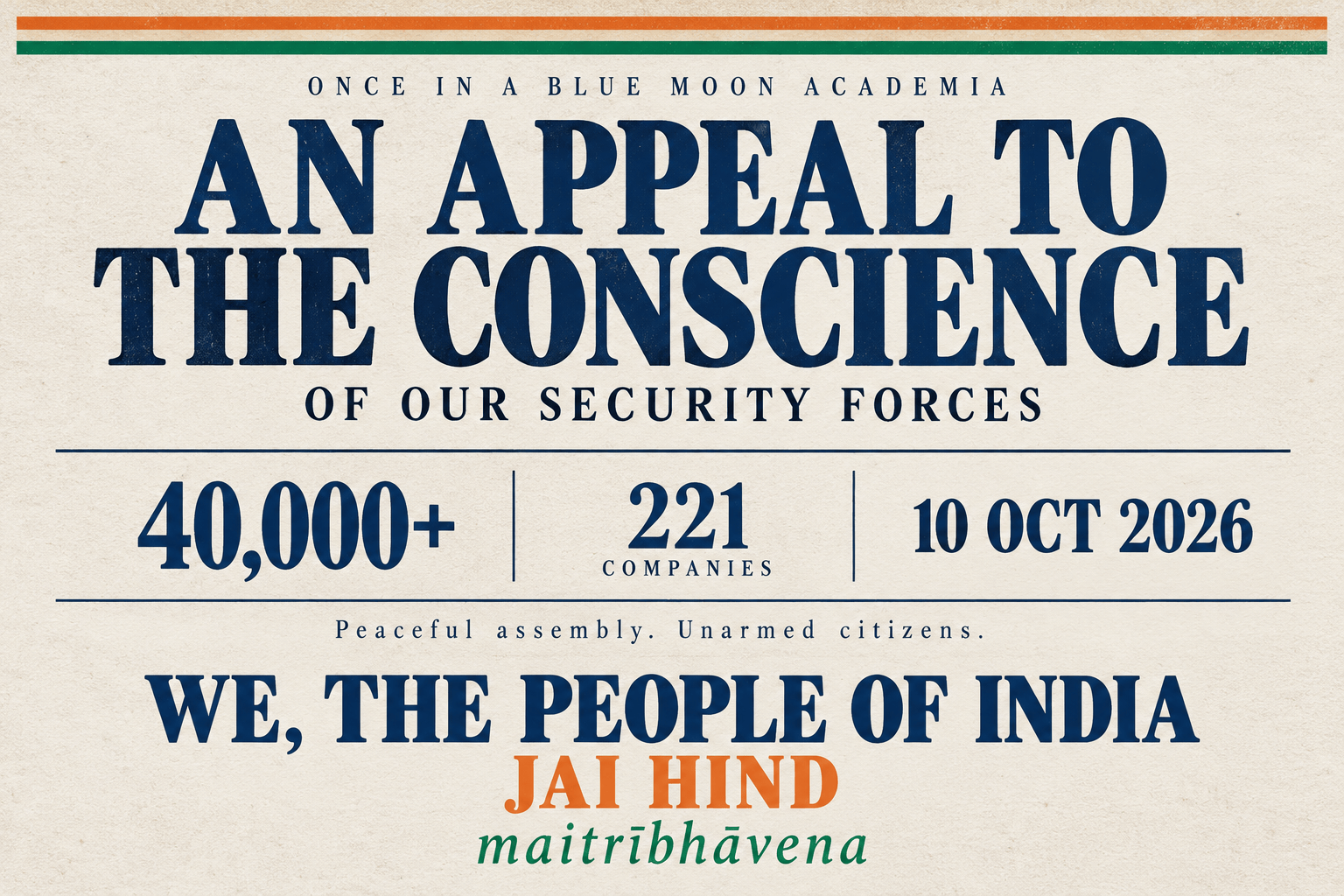
On 10 October 2026, as unarmed citizens, students and opposition voices gather at Jantar Mantar in peaceful civil disobedience, the State has assembled more than 40,000 Delhi Police and Central Armed Police Forces personnel, detention centres, facial-recognition cameras and metro closures against them. Once in a Blue Moon Academia appeals to those in uniform, not as adversaries but as fellow citizens, to let conscience precede command, to refuse the police state the last word, and to stand with the constitutional right to dissent.
Once in a Blue Moon Academia (OBMA), committed to a moneyless, partyless democratic commons, stands in solidarity with the Cockroach Janta Party (CJP), the opposition, youth and women who are, at this hour, courageously resisting and confronting the BJP-RSS and the mechanisms of fascist domination through which the present ruling establishment seeks to governmentalize nearly every Indian household. It is time to reclaim “We, the People of India” and the sovereign socialist democratic republic that twelve years of BJP-RSS rule have systemically undermined.
THE CONTEXT
On 10th October 2026, ordinary citizens, students, and opposition voices will gather at Jantar Mantar, the capital’s historic ground of dissent, in peaceful, non-violent civil disobedience. They come to question the ways and mechanisms of domination through which the present ruling establishment of India shapes the future of every Indian household. Yet even before the first voice is raised, the State has assembled a security apparatus so vast that it threatens to turn the very act of democratic dissent into a fortified, surveilled, and tightly sealed enclosure.
According to multiple contemporaneous reports (The Indian Express, India Today, Hindustan Times and others), the Ministry of Home Affairs has made 221 companies of Central Armed Police Forces available between 8 and 12 October, approximately 23,000 personnel. This brings the total CAPF strength in the capital to around 26,000, the highest for any protest since the Northeast Delhi riots of 2020. Delhi Police deployment is expected to reach a further 15,000–20,000 personnel, creating a combined presence of well over 40,000 uniformed men and women. It is an army in all but name, assembled against unarmed citizens.
Among the CAPF contingent are: – 85 CRPF companies, drawn in significant numbers from West Bengal, Chhattisgarh and Jammu & Kashmir – 10 SSB companies – 7 ITBP companies – 7 RAF companies specialised in crowd control – 1 CISF company – an additional 450–500 women paramilitary personnel organised in five all-women companies
These forces are being deployed within an entire architecture of containment: – 37 blocking points – 12–15 designated detention centres, readied before a single protester has arrived – more than 300 CCTV cameras with facial-recognition capability, in a country that still has no dedicated law governing police use of facial recognition – multi-layered barricading of at least seven layers – the proposed closure of entry and exit gates at 57 metro stations – intensified monitoring at railway stations, with 334 GRP personnel plus 14 CAPF companies – a drumbeat of public announcements that manufactures an atmosphere of pre-emptive restriction
When detention centres are prepared before a peaceful assembly has even begun, the verdict has been pronounced before any act has been committed.
Why this regimentation in advance, before a single voice has been raised? Is it only because “We, the People” have come to ask questions? We ask this as conscious citizens of this republic.
This entire apparatus is directed overwhelmingly against youth and opposition groups. They have chosen only to exercise their constitutional right to speak freely and to assemble peaceably and without arms, guaranteed by Articles 19(1)(a) and 19(1)(b) of the Constitution of India. They are questioning concentrated power-relations that currently operate with zero accountability. The Supreme Court has recognised that the right to peaceful assembly and protest is a fundamental right that arbitrary executive action cannot extinguish (In Re: Ramlila Maidan Incident, 2012). It has also held that peaceful protest at Jantar Mantar itself cannot be wiped out by blanket prohibition (Mazdoor Kisan Shakti Sangathan v. Union of India, 2018).
Such measures place an extraordinary burden on the very forces whose families share the same economic pressures and nurture the same democratic aspirations as the protesters themselves. They also risk deepening the democratic deficits that international indices already record, year after year, in unsparing terms. In this testing moment we therefore appeal once more to the conscience of every officer and soldier on duty. Remember that the ultimate loyalty of the uniform is to the soil and the people of this land. The safety of non-violent citizens is not an obstacle to that duty; it is a sacred part of it.
AN APPEAL TO THE CONSCIENCE OF OUR SECURITY FORCES
To
The Officers and Personnel of the Delhi Police
and Central Armed Police Forces (CRPF, RAF, BSF, ITBP, CISF, SSB),
Subject: An appeal to stand with the dissenting citizens for a shared future
Respected Soldiers and Officers,
We address you today not as adversaries, but as our brothers, sisters, and fellow citizens of India. Behind every uniform deployed on these streets stands a household just like ours: a mother waiting for a phone call, a child counting the days, a family stretching a salary to the end of the month. You endure hardship, harsh weather, and long separation from your loved ones to protect this land. We deeply respect your dedication and sacrifice. We want you to know that the struggle for a better, fairer future is a struggle for your children and their children as well. It is not waged against you. It is waged for all of us.
History reminds us of a pivotal moment in our nation’s journey. When Netaji Subhas Chandra Bose formed the Azad Hind Fauj (Indian National Army), his greatest strength was the awakening of conscience among those already within the existing security structures. Netaji actively sought to turn the British Indian forces to the side of complete independence. He appealed directly to Indian soldiers in colonial uniform, reminding them that their true loyalty lay not with an alien empire but with the motherland.
His example proved that the ultimate duty of every uniform is to the soil of this land and to the people who inhabit it. The INA found its true power when ordinary soldiers remembered their deep-rooted bonds with their fellow countryfolk and chose the higher call of the oppressed nation over all else. Netaji’s rallying cry was “Chalo Dilli!” It is here, in Delhi, more than eight decades later, that we ask you to remember whom the uniform finally serves.
There is an ancient parable of an old man whose house stood blocked by two great mountains. Day after day he went out with his sons and grandsons, digging and carrying away the earth in baskets. When people mocked him for the futility of the task, he replied calmly: “When I die, my sons will continue. When they die, their sons will continue. The mountains will not grow higher, but we will keep digging. One day the path will be clear.” He did not live to see the mountains gone, yet the work itself became the bridge.
The mountains before us today are made of barricades and steel, of surveillance and fear. Those who dig patiently and peacefully, generation after generation, will one day clear the path. We ask you never to let your hands become the hands that bury those who dig.
An order that arrives from above is not yet a duty. Duty begins only when the order has passed through the conscience of the person who must carry it out. The top-down system you presently have to serve is built to strip that interval away: to make obedience feel like loyalty, and hesitation feel like betrayal. It is not betrayal to pause. It is betrayal to let a command, issued far from the street and far from the household waiting for your call, stand in the place of your own judgment.
The right to speak, the right to assemble, the right to protest, and the right to rebel against an unjust, non-transparent, unaccountable, moribund system are not gifts the State extends. They are what remain when the State has been refused the last word. We ask you to return to the common humanity that system has been trained to quiet, and to stand, in whatever way conscience allows, with those who have come unarmed.
Today we stand in the second freedom struggle that this country has witnessed. It is being waged through the protests and resistance movements that have risen across the length and breadth of our country over the past few months. At Jantar Mantar (and beyond…) we exercise our democratic right through peaceful, non-violent civil disobedience, the same weapon with which an unarmed people once shook the foundations of an empire.
We are not here to create “unnecessary” chaos or violent confrontation. We are here to advocate for a free and just society, fair opportunities, and a secure future, the very same future your progeny will inherit. When the mechanisms of domination weigh heavily on the common citizen, they do not stop at the barricade. They eventually reach the homes and families of those who wear the uniform as well: in the price of grain, in the fees for a child’s education, in the job that never comes, in the pension that never arrives.
The world itself is watching. Independent, internationally respected institutions, none of them party to Indian politics, have recorded this erosion in unsparing terms.
– Freedom House’s Freedom in the World 2026 rates India 62 out of 100 and continues to classify it as “Partly Free.” India was downgraded from “Free” to this status in 2021 and has not recovered since; the 2026 score is one point lower than the year before.
– The V-Dem Institute continues to place India among electoral autocracies. In its 2026 report it ranks India 106th on the Electoral Democracy Index (score 0.38) and 105th on the Liberal Democracy Index (score 0.26), its lowest standing since the Emergency of 1975.
– Reporters Without Borders ranks India 157th out of 180 countries on the 2026 World Press Freedom Index, with a score of just 31.96, a six-place fall from 151st in 2025. This places the state of our press freedom in the “very serious” category, the lowest classification the Index assigns.
These are not abstract numbers. Each one measures the shrinking space for the very rights we are peacefully defending. Today, in the heart of the capital, that shrinking space is being measured in barricades, blocking points, cameras, and detention centres.
We humbly and earnestly request you to listen to your conscience during these testing times. Maintain peace. Ensure the safety of those who have gathered non-violently. Do not let the uniform be turned against the very people it was raised to protect. Do not let the police state have its way. Remember that we are all part of the same family, bound by the same soil, the same hopes, and the same future. Let us honour the living legacy of Netaji by ensuring that the power of the people and the sacred duty of the forces work in true harmony for a stronger, freer India.
Jai Hind, the salutation coined for the Azad Hind Fauj by Abid Hasan Safrani, a Muslim officer from Hyderabad who stood beside Netaji, and which then became the salutation of the nation. In that cry there was no Hindu and no Muslim, only an inclusive idea of India. We are all in the same boat.
In Friendship (maitrībhāvena),
Once in a Blue Moon Academia (OBMA)
In Solidarity with the Dissenting Citizens and Protesters of India
SEE ALSO:

