Posted on 14th July, 2026 (GMT 19:15 hrs)
ABSTRACT
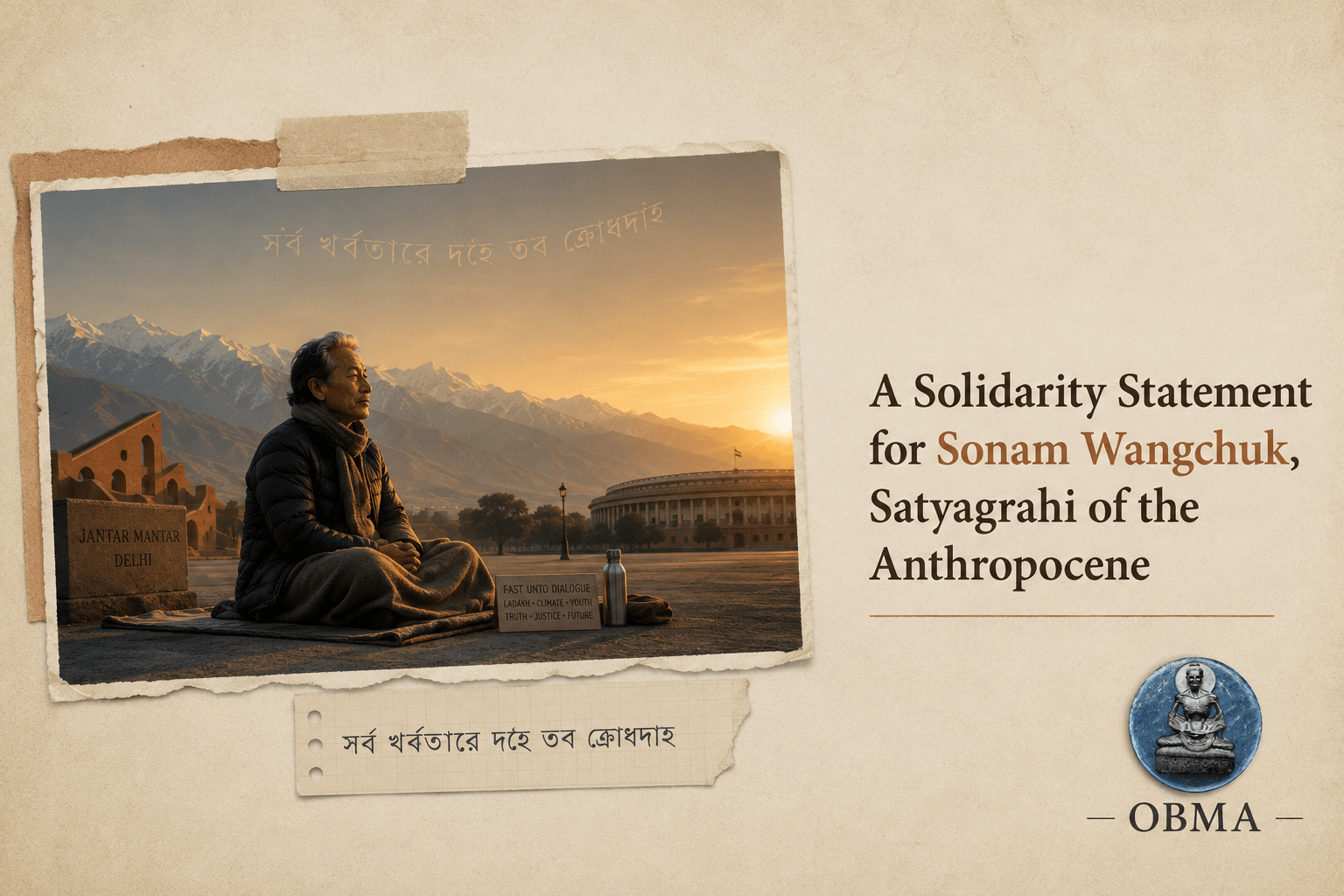
On the 17th day of his indefinite hunger strike at Jantar Mantar, Sonam Wangchuk continues his non-violent resistance for justice, dialogue, and ecological protection of Ladakh. Echoing Jatin Das’s 1929 martyrdom and G.D. Agarwal’s sacrifice for the Ganga, Wangchuk’s ātmaśakti exposes the Indian state’s moral deafness and hypocrisy in the face of genuine satyagraha. Invoking Tagore’s fiery Bhairava hymn — “sarva kharvatāre dahe tava krodhadāha” — this post calls for solidarity with a man who has become the moral centre of a republic that has abandoned its conscience.
I. The Seventeenth Day
As we write, Sonam Wangchuk — engineer, educator, glacier-keeper of Ladakh — is on the seventeenth day of an indefinite hunger strike at Jantar Mantar, New Delhi. He has lost more than eight kilograms; his muscles have begun to consume themselves; his blood pressure falls, his sugar levels drop. He fasts in solidarity with a Gen-Z student movement, the Cockroach Janta Party (CJP) uproar, demanding accountability for the NEET examination paper leaks (a single spark that set the prairie ablaze) that defrauded millions of young Indians of their futures, and so much more.
When begged to withdraw, he answered only:
“Don’t ask me to end my fast. Ask the government why they won’t even have a dialogue.”
That single sentence is the whole indictment. A man is prepared to die not for power, not for office, not for himself, but so that a government might merely speak. And the government of the world’s so-called largest democracy responds with what it has always offered the non-violent conscience of this land: silence, surveillance, and the patient arithmetic of waiting for the body to fail.
We at Once in a Blue Moon Academia (OBMA) take this opportunity to extend our unconditional solidarity to Sonam Wangchuk — as we did in March 2024, during his twenty-one-day climate fast at eleven thousand feet in sub-zero Leh, in our statement “In Defence of the Ladakh Movement: A Faint Voice of Solidarity During the Ominous Hour of Climate Emergency” (onceinabluemoon2021.in, 28 March 2024). What we wrote then in a faint voice, we repeat now at full volume: this man is the moral centre that the Indian republic has evacuated from itself.
II. Jatin Das, 1929 — Sonam Wangchuk, 2026
History does not repeat; it rhymes in the key of the fasting body. On 13 September 1929, Jatindranath Das — twenty-four years old, revolutionary member of the HSRA, comrade of Bhagat Singh — died in Lahore Central Jail on the sixty-third day of a hunger strike, demanding nothing for himself, only the dignity of political prisoners. The colonial state let him die. Six hundred thousand mourners lined the streets of Calcutta. Rabindranath Tagore, receiving the news, gave the nation its dirge and its war-cry in one breath:
সর্ব খর্বতারে দহে তব ক্রোধদাহ—
হে ভৈরব, শক্তি দাও, ভক্ত-পানে চাহো ॥
দূর করো মহারুদ্র যাহা মুগ্ধ, যাহা ক্ষুদ্র—
মৃত্যুরে করিবে তুচ্ছ প্রাণের উৎসাহ ॥
দুঃখের মন্থনবেগে উঠিবে অমৃত,
শঙ্কা হতে রক্ষা পাবে যারা মৃত্যুভীত।
তব দীপ্ত রৌদ্র তেজে নির্ঝরিয়া গলিবে যে
প্রস্তরশৃঙ্খলোন্মুক্ত ত্যাগের প্রবাহ ॥
In your wrathful blaze all pettiness is consumed—
O Bhairava, grant me strength, turn your gaze upon your devotee.
O Mahārudra, banish all that is deluded, all that is mean and small—
With the surging vitality of life, death itself shall be rendered insignificant.
From the churning fury of sorrow, nectar shall arise,
And those who dread death will be delivered from all fear.
In the radiant ferocity of your terrible splendor,
Whatever is stony shall melt and flow away—
The liberated torrent of sacrifice, freed from its chains of rock.
Tagore understood what the Raj did not: that the emaciated body of the satyagrahi is not weakness but tapas — the technology of ascetic heat that scorches the legitimacy of thrones. Jatin Das’s starved corpse did more to delegitimize British rule in Bengal than a decade of petitions.
Ninety-seven years later, the rhyme completes itself with unbearable precision — except that the jailer is no longer “foreign”. The colonial state, for all its brutality, at least negotiated: Gandhi’s fasts extracted pacts, communiqués, round tables. The postcolonial neoliberal corporate Hindutva state has dispensed even with that hypocrisy. It does not negotiate with the fasting body; it simply changes the channel.
III. The Ganga Already Has Its Martyr: G.D. Agarwal
We have seen this script before, and we know its ending, because the regime has already written it once in blood — or rather, in the absence of food. Professor G.D. Agarwal — IIT Kanpur environmental engineer, later Swami Gyan Swaroop Sanand — fasted for 111 days in 2018 demanding an ecologically living Ganga: an end to hydroelectric strangulation of her headwaters, a law for her aviral and nirmal flow. He wrote three letters to Prime Minister Narendra Modi — the same Modi who had wept on camera that “Ma Ganga has called me” to Varanasi. Not one letter received a reply. On 11 October 2018, Agarwal died. The self-proclaimed devotee of Ganga did not spare five minutes for the man dying for her. The rivers were then handed, with redoubled enthusiasm, to the dam-builders and the sand mafias.
Agarwal is the Ganga’s martyr; the state is his unindicted co-conspirator by omission. And Wangchuk is walking, fully lucid, down the same corridor — as did Irom Sharmila before them both, sixteen years of fasting against AFSPA met not with dialogue but with a nasal feeding tube and a charge of attempted suicide: the state’s grotesque jurisprudence by which the satyagrahi’s own body becomes the crime scene.
IV. Ātmaśakti in the Age of Climate Denialism
What Wangchuk possesses — and what the regime constitutionally cannot comprehend — is ātmaśakti: soul-force, the Gandhian satyāgraha in its strict sense of holding fast to truth with one’s entire embodied being. Consider his ledger. He built ice stupas to bank winter’s water against Himalayan drought. He (de-)schooled Ladakh’s “failures” into innovators at SECMOL. He fasted at minus twenty degrees Celsius to demand Sixth Schedule protection for a trans-Himalayan bioregion and its indigenous peoples against the bulldozer-and-borewell extractivism of crony industry. He did all this in a country where the ruling establishment treats the climate emergency as a Western conspiracy when convenient and a photo-op when profitable — where glaciers retreat, Ladakh’s pastures die, Joshimath sinks, and the official answer is a “Char Dham” highway blasted through paraglacial slopes.
For this, the establishment rewarded him in September 2025 with detention under the National Security Act (NSA) and the cancellation of his institute’s FCRA licence — the standard sacraments by which the regime converts a Gandhian into an “anti-national.” The man who perhaps inspired a beloved Bollywood character was recast, overnight, as a threat to the nation. The nation, meanwhile, is threatened by melting cryosphere, poisoned rivers, and stolen examinations — none of which has ever been detained under the NSA.
V. Critical Analysis: Why Moral Protest Fails Before This State
Here we must be unsentimental. The hunger strike is a communicative weapon: it works, as Gandhi knew, only upon an adversary capable of shame — a state that still imagines itself accountable to a moral community. The present dispensation has systematically dismantled every relay through which the fasting body once transmitted its charge:
First, the anaesthetized public sphere. A captured broadcast media (“Godi media”) ensures the sacrificial body is simply not seen — or is seen only through the lens of sedition. Jatin Das had six lakh mourners because Calcutta’s newspapers carried his agony daily; Wangchuk’s agony competes with manufactured spectacle and celebrity silence.
Second, criminalization as first response. NSA, UAPA, FCRA cancellation, sedition FIRs: the regime’s reflex is not to answer the satyagrahi’s question but to reclassify the questioner. This is the impunity loop in its civic form — the same closed circuit we have documented in the DHFL depositors’ struggle: institutional capture → victim exclusion → information blackout → judicial exhaustion → impunity.
Third, electoral insulation. A polarized, majoritarian electoral machine renders conscience fiscally irrational. Why should a government that wins on temple and border lose sleep over a dying Ladakhi Buddhist, a dead Gangetic swami, or seven hundred farmers dead at Delhi’s barricades? The farmers won repeal only because they threatened votes in Punjab and western UP — not because their dead moved anyone in power. Empathy has been replaced by psephology.
Fourth, the theological inversion. A regime that monopolizes Hindu symbolism cannot tolerate rival claims to tapasyā. The genuine ascetic — Agarwal in his ochre robes, Wangchuk in his fast — exposes the costume-ascetics of power. The fake fakir must destroy the real one, or be revealed.
The conclusion is bitter but necessary: this state does not fail to hear moral protest; it has engineered its own deafness. To such a state, the fasting body is not a question but an inconvenience with a countdown.
VI. And Yet — Solidarity, Even With a Dying Breath!
Yet, Tagore’s Bhairava-song was not a lament; it was an invocation of fire. Jatin Das’s death did not end the movement — it multiplied it. Agarwal’s death haunts every fraudulent “Namami Gange” advertisement. The state may have engineered its deafness, but it cannot engineer the people’s. The Gen-Z crowds at Jantar Mantar, the youth who see in Wangchuk what an earlier generation saw in Jatin Das, are the answering echo.
We therefore say, with the whole small strength of this two-person academy:
Sonam Wangchuk, your ātmaśakti is one of the strongest renewable energy-sources this republic has left.
We do not want you to become another Jatin Das — one martyred Bengal gave to the gallows-state of 1929 is one too many, and this burning planet needs your living hands, your ice stupas, your intimacy with nature, your learning by doing, far more than it needs another cenotaph. And yet we stand, without reservation, by your steadfast resolve — by this embodied resistance to structural violence, the fasting body raised as the last free parliament against a fascist state that has dissolved all others.
The moral ledger is already written: history will record who fasted, and who feasted; who asked for dialogue, and who offered detention; who burned with Bhairava’s cleansing wrath, and who merely burned the country.
Sonam Wangchuk, we salute your perseverance. More strength to you and your cause.
সর্ব খর্বতারে দহে তব ক্রোধদাহ। So be it.
SEE ALSO:

