
Posted on 13th October, 2026 (GMT 08:10 hrs)
ABSTRACT
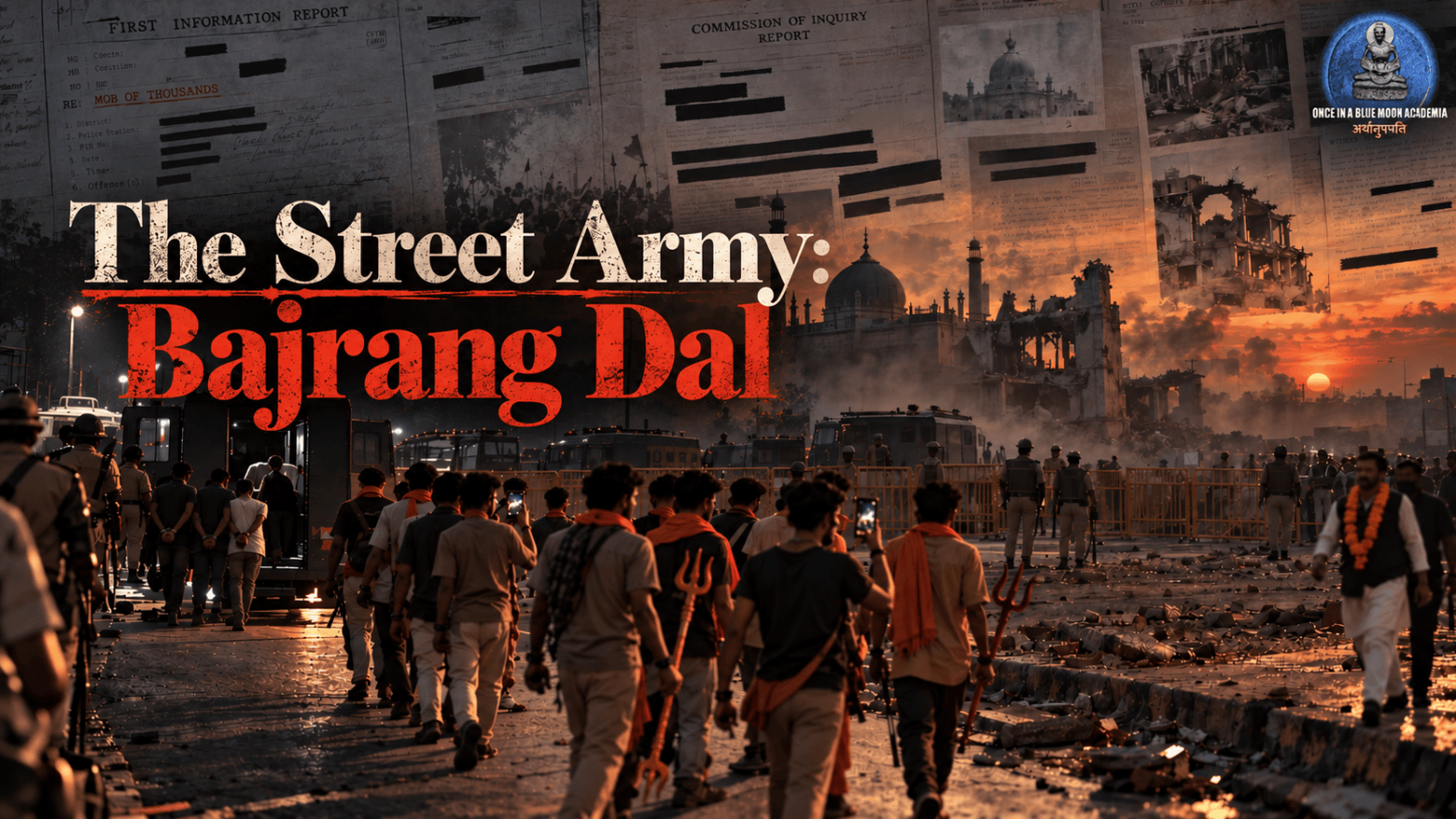
The official Indian record of Bajrang Dal and Sangh Parivar violence does not cohere on its own terms: it counts its dead by the dozen in cow-protection attacks while securing convictions by the handful, files named killers as anonymous mobs of thousands, convicts the gang-rapists of a pregnant woman and then releases them to garlands, and constitutes commissions only to bury their findings. This dossier reads that systematic incoherence as the evidence itself. The Bajrang Dal was manufactured by the RSS in 1984–86 as a deniable youth militia for the Ayodhya campaign; it has since operated, with BJP-supplied licence, as a cadre street-army whose repertoire—gau-raksha lynching, moral policing, anti-Christian violence, processions-as-detonators, and filmed humiliation—runs from the Babri demolition through Kandhamal, Gujarat 2002 (including Naroda Patiya and Bilkis Bano), the post-2014 lynching years (Akhlaq, Pehlu Khan, Tabrez Ansari), Nuh 2023, and Kathua. The same architecture converts authored atrocity into unprosecutable events through non-registration, reclassification, dilution, attrition, and inversion, while routing unemployed young men from shakha to Bajrang Dal, Sri Ram Sene, and Hindu Raksha Dal. In 2026 the machine applied direct state terrorism—mass preventive detention, blackouts, and site denotification—against the non-violent Cockroach Janta Party protest at Jantar Mantar, while a self-identified Hindutva affiliate’s filmed confession of assault received delayed process and restored liberty. The licence is not the absence of a finding; it is the finding. The record is the charge.
The official account does not fail by accident. It is built to fail. A record that counts its dead by the dozen in cow-“protection” killings and convicts by the handful; that takes the names of killers from dying men and files them as “a mob of thousands”; that convicts the gang-rapists of a pregnant woman and the murderers of her child and then releases them to garlands and sweets; that appoints commission after commission and buries every finding in the tabling — such a record does not cohere because it was never meant to. Its contradictions are not gaps. They are the mechanism. This dossier does not speculate about what is hidden. It reads the exact shape of the cut, and names the hand that makes it.
Preface: what this is, and why it refuses “neutrality”
This is not a neutral survey. It is an indictment, assembled from the public record, of a cadre organization built to commit violence and designed to escape the consequence of it — the Bajrang Dal — and of the ideological family that manufactured it, deploys it, funds it, and disowns it on cue: the Sangh Parivar, with the Rashtriya Swayamsevak Sangh at its core.
The convention of “both sides” has no purchase here, and its absence is a methodological decision, not an oversight. One does not write an account of an arsonist that gives equal weight to the arsonist’s theory of fire. The Sangh’s self-descriptions — seva, sanskar, character-building, the defence of a wounded civilization — are not suppressed in what follows; they are examined as what they are: the alibi-grammar of a political formation whose works are catalogued below in blood. Where this dossier is scrupulous, it is scrupulous about fact, because accuracy is the sharpest weapon available against a machine that survives on manufactured doubt. Every incident named here happened; every outcome recorded is the real outcome; every number is sourced. The militancy of the reading and the exactitude of the record are not in tension. The exactitude is what makes the militancy land.
Where the record is blank, this dossier does not invent what the blank conceals. It does something the Sangh fears more: it reads the blank itself — the unregistered complaint, the omnibus FIR, the buried commission — as the non-apprehension of what the state was bound to make apprehensible, and lays that certified absence against the duty that should have filled it. The unreported atrocity is not fabricated into the text. The architecture of non-reporting is exposed in it. That is how the suppressed enters the record: as the documented shape of its own suppression.
Part I — Archaeology of a Street-Army
1. The object, and the trap in the question
The question put to any student of the Bajrang Dal — is it the terrorist wing of the Sangh Parivar? — is a trap only if “terrorist” is allowed to shrink to its narrowest legal denotation: formal proscription by a state under a designated statute. By that restricted meaning the answer is no, and the Sangh knows it, which is why its defenders are eager to hold the argument there. No government has listed the Bajrang Dal. The absence of the label is then paraded as a clean bill of health.
It is nothing of the kind. The non-designation is not an acquittal; it is an output of the very impunity architecture this dossier exposes — the same architecture that lets confessed lynchers walk, that releases gang-rapists to garlands, that files named killers as anonymous mobs. A state captured by the ideology that birthed the Bajrang Dal will not proscribe the Bajrang Dal. The missing label measures the capture, not the innocence.
Terrorism is not confined to the statute book. In its established wider sense it means the organized, systematic use of violence against civilians to intimidate a population, enforce ideological dominance, and produce a climate of fear. By that measure the Bajrang Dal’s record — decades of murder, lynching, rape-adjacent mobilization, arson, moral policing, and communal pogrom, carried out with near-total impunity — is Hindutva terrorism. The organization is a large, disciplined, cadre-based street-army built and deployed for precisely these ends by the political formation to which it belongs. “Militant” and “extremist” are not slurs; they are the descriptions applied by human-rights bodies, scholars, and even former insiders of the Sangh itself. The task here is to render the phenomenon in concrete, specific, un-ignorable detail.
2. Genealogy: the bloodline from Nagpur to the street
The Bajrang Dal did not grow from the soil. It was manufactured, to specification, by an organization that has spent a century building instruments of this kind.
The lineage is explicit and documented in the Sangh’s own literature. The RSS, founded in 1925, is the ideological core. In 1964 it deputed its pracharaks to build the Vishva Hindu Parishad under the guidance of then-Sarsanghchalak M.S. Golwalkar — the ideologue whose We, or Our Nationhood Defined held up the “purging” of minorities in 1930s Europe as “a good lesson for us in Hindusthan.” In 1984, as the VHP launched its Ram-Janaki Rath Yatras to seize the Babri Masjid site at Ayodhya, it required muscle: young men for “security” and street agitation. The Bajrang Dal was called into being at Ayodhya for exactly that purpose and formalized as a national youth militia in 1986. Its first all-India convenor, Vinay Katiyar, was an RSS pracharak routed through the ABVP; the leadership pipeline has run through pracharak service ever since. The RSS’s own Suruchi Prakashan, in Param Vaibhav Ke Path Par, lists the VHP and the Bajrang Dal among the Matrusansthas — the family of bodies the RSS created to work different segments of Hindu society.
This is the first and permanent lie. When a Bajrang Dal atrocity draws heat, Sangh and BJP figures intone that there is “no connection” — that the Dal is merely an autonomous VHP affiliate, nothing to do with the disciplined, lawful RSS. Set that disavowal against the founding record, the Matrusanstha listings, the pracharak leadership line, and the decades of joint samanvay campaigns, and it collapses. The disavowal is not a description; it is a technique — voluntas celandi, the will-to-conceal, the will-to-hide — operating as a permanent feature of the Parivar’s public grammar. Independent researchers have named the real arrangement strategic outsourcing: the RSS supplies ideology, cadre, and direction; the BJP supplies state power and the guarantee of impunity; and the deniable street affiliate absorbs the violence the respectable faces prefer not to own. The Sangh calls this “complementary specialization.” It is the same structure either way. The only question is whether the deniability is an accident or a design — and the record answers: design.
3. “Catch them young”: the pedagogy of the foot-soldier
The deniable street-army requires a continuous supply of bodies, and the Sangh’s oldest method furnishes them. The RSS motto is exact: catch them young. The shakha — the daily neighbourhood drill that fuses physical training with ideological instruction (baudhik) — has always targeted the young. Children’s bal shakhas, residential camps, organized games, and a self-advertised digital push aimed at “Gen Z” form a single pipeline. Evening shakhas are structured for students; age-graded categories run from shishu and baal through tarun; the organization has spent a century treating the school and college years as the decisive window. Reach the subject before adult life and rival loyalties form, bind him into the cadre through ritual, drill, and belonging, and the formation becomes durable. Recent adaptations — debates on AI, inter-shakha competitions, walkathons, and retention by young pramukhs — do not alter the core method; they extend it. The shakha remains the factory that produces the available body before the labour market or the criminal process claims it.
This pedagogy locks into a political economy the Indian state itself half-admits. By the government’s own figures, youth unemployment stood at 9.9 percent in 2025; independent estimates run nearer 14 percent, with the heaviest burden on the educated young — the graduate whose degree purchased no work. Massive unemployment produces a stratum of young men with limited legal prospects, frequent brushes with the criminal process, and few institutional exits. The Sangh Parivar strategy reads this reservoir directly. Idle or legally entangled youth — including those discharged from jail (discharged jailbirds), left without formal employment, or circulating through minor cases (dangerous class as named by Marx) — are available for absorption into the affiliate escalator: shakha → ABVP → Bajrang Dal, Hindu Rakshak Samiti, and the smaller local “Hindu-raksha” formations.
The escalator does not stop at the Bajrang Dal. It feeds a denser layer of smaller, more deniable street formations that operate with still less institutional distance. Sri Ram Sene (or Sri Ram Sena), founded in 2005–06 by Pramod Muthalik after his expulsion from the Bajrang Dal and a short stint with the Shiv Sena’s Karnataka unit, functions as a militant moral-policing outfit concentrated in coastal Karnataka. Its signature actions include the 2009 Mangalore pub attack, in which roughly forty activists dragged and beat young women and men for drinking, and subsequent campaigns against Valentine’s Day couples and interfaith relationships. Muthalik, a former RSS pracharak and Bajrang Dal south-India coordinator, presents the Sene as independent of the formal Parivar; in practice it draws cadre from the same unemployed or underemployed youth pool and shares the same repertoire of filmed raids and cultural enforcement. Hindu Raksha Dal (also styled Hindu Rakshak Samiti or Hindu Raksha Dal), founded around 2013 by Bhupendra Chaudhary (Pinky Chaudhary) in Uttar Pradesh, claims tens of thousands of members and positions itself as more aggressive than the Bajrang Dal. It runs cow-protection and “love jihad” interventions, distributes sticks and swords, and has been documented issuing open threats and participating in street assaults during the 2026 Jantar Mantar protests. Both outfits absorb the overflow the larger affiliates can still disown: the young man who enters through a local shakha or a “self-employment” camp can be routed into a Sene or Raksha Dal unit when the Bajrang Dal needs deniability. Bajrang Dal’s own recruitment campaigns target the 15-to-35 age band, offer physical and ideological training camps, and run “self-employment” and “drug-free youth” programmes that function as entry points rather than exit ramps. The smaller outfits operate with still less institutional distance, absorbing those the larger affiliates can still disown. The pipeline is continuous.
The foot-soldier is Marx’s lumpenproletariat, the déclassé stratum that reaction, not revolution, most readily organizes, and Hannah Arendt’s “superfluous man,” finally given a function: a trident, a uniform, a licence. The Parivar enacts Arendt’s alliance of elite and mob inside a single family — the disciplined elite core and the deniable street mob under one roof. “Catch them young” seizes the subject before the labour market fails him; the later recruitment of the already failed, the legally marked, and the discharged supplies the remainder. The two moments are not separate recruitment strategies; they are sequential stages of one pipeline. The young man who enters the bal shakha is the same man who, years later, appears in a local gau-raksha unit or a Hindu Rakshak Samiti patrol after the degree has produced no job and the first FIR has produced no barrier.
Impunity is the hardening agent. The confessed case of the Hindutva influencer Swatantra Bhardwaj, who boasted on camera of fracturing a protester’s father’s skull during the 2026 Jantar Mantar protests and of walking free through political connections while the FIR against him remained unregistered for weeks, shows the mechanism operating in its true direction. Affiliation does not merely recruit the already violent; it manufactures them by guaranteeing that licensed violence carries no cost. It is cheaper to make a man lawless by protecting his lawlessness than to locate one already made. The reserve army of labour and the reserve army of the street are the same young men, read at two moments of one continuous pipeline. The unemployment figure and the delayed FIR are not background conditions; they are the operating environment in which the motto “catch them young” produces its later, harder product.
Part II — Architecture: How The Machine is Built
1. The Field of Forces: Enforcer, Auxiliary, Antagonist
Bajrang Dal within the broader Sangh Parivar does not operate as a single street formation. It maintains a differentiated field whose positions are sorted by proximity to power and by the licence the state extends or withholds. Three positions structure that field. Treating them as interchangeable is not analysis; it is the exculpatory move the machine itself relies on. The sorting is not accidental. It is the operational condition that lets the organised core claim distance from the violence it requires, while the state applies its full coercive weight only to those who mobilise against it.
A. Bajrang Dal — the organised enforcer.
This is the disciplined, mass, permanent instrument: claims of membership in the tens of lakhs, a hierarchy of conveners under the VHP, akharas that fuse physical drill and ideological conditioning, and a standing repertoire of cow patrols, “love jihad” raids, anti-conversion violence, and processions engineered as detonators. Its defining feature is not merely capacity for violence but embeddedness in the governing architecture. The licence loop runs in its favour because the party that controls the state is its ideological sibling. When it kills, the register is written as “a mob of thousands.” When it was banned after Babri in 1992, the ban was lifted within roughly a year. It is the enforcement arm of a project that holds power. Conviction at the base is followed by dissolution at the top; the organisational form guarantees that street authorship and institutional responsibility never meet in a single indictable body. The hierarchy supplies the cadre and the cover; the local strong-man supplies the hand that strikes and the distance that protects everyone above him. The enforcer does not require deniability from the state because the state is already aligned with it.
B. Hindu Raksha Dal and the fringe outfits — the deniable periphery.
These are a different type within the same Hindutva field: smaller, personality-driven, episodic, and structurally deniable. Hindu Raksha Dal, founded around 2013 by Bhupendra Chaudhary (Pinky Chaudhary), a former Bajrang Dal member, has no mass cadre comparable to the Bajrang Dal. Its signature mode is to claim credit for a spectacular act — the 2020 masked-mob attack on JNU students and faculty, for which its chief publicly took responsibility; open threats and assaults against CJP protesters at Jantar Mantar in 2026 — as a publicity-and-intimidation device. Its formal link to the organised RSS/VHP is denied by the Parivar, and that denial is exactly its function. Where the Bajrang Dal is the outsourced arm, outfits like Hindu Raksha Dal are the outsourcing beyond the outsourcing: a further deniable layer that lets even the VHP keep clean hands. They are auxiliaries of the ecosystem, not rivals to it — the periphery that does what the organised wing wants done but will not be filmed doing under its own name. They are not equivalent to the Bajrang Dal in scale or discipline; they are the ecosystem’s disposable outer ring. The same reservoir of unemployed and legally marked young men that feeds the Bajrang Dal also supplies these smaller outfits; the difference is that the smaller outfits can still be disowned when the heat arrives. Their claims of responsibility are not evidence of independence; they are evidence of the distance the organised core requires.
3. Bhim Army / Azad Samaj Party — the antagonist, not a variant.
Here the comparison breaks. Chandrashekhar Azad’s Bhim Army is an Ambedkarite Dalit formation, founded in 2015 in Saharanpur out of free schools for Dalit children and mobilised against caste atrocity and against the BJP. Its political vehicle, the Azad Samaj Party (Kanshi Ram), put Azad into the Lok Sabha: he won the Nagina reserved seat in 2024 and sits as an MP. The state’s posture toward it is the mirror image of its posture toward the Bajrang Dal. After the 2017 Saharanpur clashes — triggered by upper-caste attacks on Dalit homes — Azad was arrested, granted bail by the Allahabad High Court, and then immediately detained under the National Security Act, remaining in custody for roughly fifteen months. The draconian preventive-detention law was turned on the victim-defence organisation while the aggressor organisation operates freely. This is the two-track logic in organisational form: the subaltern self-defence group criminalised, the majoritarian street-army protected. Azad’s organisation does not raid homes, distribute tridents, or film humiliation as recruitment. It organises against the conditions that produce the surplus of idle young men the Sangh recruits. The state’s decision to apply preventive detention to one and licence to the other is not a difference of evidence; it is a difference of alignment. In fact, the Bhim Sena condemned the violence of Hindutva goons during the 2026 Jantar Mantar protests, in defence of women and youth security as such.
The typology matters because the machine profits from two specific blurs. First, the Sangh benefits from collapsing the enforcer and the auxiliary into a single undifferentiated “fringe.” The claim “that was some fringe group, nothing to do with us” is precisely how the organised core launders the periphery’s violence. The task is to re-attach the periphery to the centre it serves, not to let the fringe label do the Sangh’s exculpatory work. Second, captured media and the Sangh benefit from collapsing the enforcer/auxiliary with the antagonist — the lazy equivalence that files a Dalit rights movement under the same “lawless outfit” heading as a lynching militia. Resisting that conflation is an analytic and anti-caste duty. Azad’s organisation belongs with the victims in the catalogue, not with the perpetrators. The same two-track sorting that keeps Swatantra Bhardwaj free while holding Umar Khalid and Sharjeel Imam under the UAPA is visible here in organisational form: the enforcer and its auxiliaries receive the licence; the antagonist receives the statute.
| Aspect | Bajrang Dal | “Hindu Raksha(k) Samiti/Dal” | Bhim Sena / Bhim Army |
|---|---|---|---|
| Ideological pole | Hindutva (majoritarian) | Hindutva (majoritarian) | Ambedkarite / anti-caste — opposite pole |
| Lineage | Organised wing of the Sangh Parivar (VHP youth wing, RSS core) | Fringe, freelance Hindutva outfit; formal Sangh link denied/murky | Independent Dalit-assertion movement; no Sangh link |
| Named after | Bajrang/Hanuman | “protection of Hindus” | Bhimrao Ambedkar |
| Founded / figure | 1984, Ayodhya; Vinay Katiyar | claims date to 1990s; Bhupendra Tomar alias Pinky Chaudhary | 2015, Saharanpur; Chandrashekhar Azad “Ravan” |
| Social base | Hindu youth, cadre-disciplined, mass | small, personality-led, episodic | Dalit youth, especially UP/Hindi belt |
| Relation to state power | protected/impunity under BJP rule | tolerated freelancer | targeted BY the state; anti-BJP |
The Bajrang Dal and the Hindu Raksha-type outfits belong in this dossier as centre and periphery of one machine — the latter named only after case-by-case verification of specific claims. The Bhim Army belongs, if at all, on the opposite side of the ledger: among those the machine’s two-track justice persecutes, alongside the anti-CAA detainees and the Jantar Mantar protesters. The field is not a collection of similar “senas.” It is a sorted apparatus. The sorting is the mechanism. The mechanism is the charge.
2. Organizational form: conveners, akharas, and the local strong-‘man’
The Bajrang Dal mirrors its parent’s architecture of disciplined cells. It claims membership in the tens of lakhs, organized under a hierarchy of sanyojaks (conveners) — national, state (prant), district (zila), and local — beneath the VHP’s authority. Its base unit is the akhara, the training centre that reproduces the shakha’s fusion of physical drill and ideological conditioning. Its ritual instruments are its tell: the trishul diksha — mass “trident initiation” camps at which sharpened tridents are distributed to cadre and held as “religious symbols” to evade arms law — and the gau-raksha patrol, the highway interception squad.
Around this formal skeleton grows the thing that actually does the killing: the local strong-man with Parivar cover. Men like Monu Manesar in Haryana — the cow-vigilante with a social-media following and, his victims’ families allege, police indulgence — and Bittu Bajrangi in Faridabad are not aberrations from the structure. They are its intended product, the deniable node where the organization’s sanction and the street’s violence meet, and from which both the RSS and the BJP can be kept at a clean distance. The hierarchy supplies the cadre and the cover; the strong-man supplies the hand that strikes and the distance that protects everyone above him.
3. Methods: the repertoire of manufactured hate
The Bajrang Dal’s activity is not spontaneous “communal tension.” It is a repertoire, rehearsed and repeated until the pattern itself becomes the evidence:
- Cow vigilantism (gau raksha): Highway squads intercept Muslim cattle-traders and dairy farmers, often carrying documents in order, and beat, humiliate, or kill them. Aligned police then charge the victims under cattle-protection statutes. The interception is the point; the statute is the cover.
- “Love Jihad” and moral policing: Units storm homes, hotels, and cafés to break up relationships between Muslim men and Hindu women, assault the men, film the humiliation for circulation, and hand the victims to police as “rescues.” The same squads attack Valentine’s Day gatherings and mixed assemblies. The pretext is protection of Hindu women; the product is control of women and terror against Muslim men.
- Anti-conversion violence and ghar wapsi: Disruption of Christian prayer meetings, assaults on pastors, destruction of churches, coupled with coerced “reconversion” ceremonies. The violence and the ceremony are a single operation: the assault produces the captive, the captive is filmed as a convert, and the film is circulated as proof.
- Processions as provocation: Armed yatras routed deliberately through Muslim neighbourhoods — Ram Navami, Hanuman Jayanti, the Nuh Jalabhishek Yatra — engineered to produce the “clash” that then licenses state reprisal and demolition. The route is the weapon; the clash is the intended output; the demolition is the reward.
- The video economy: The assault is not incidental to the recording; it is performed for it. Humiliation is filmed and broadcast as both recruitment and terror. The camera is not a witness; it is an instrument of the attack.
- Trishul distribution and open threat: The arming of cadre under religious cover, and the normalization of eliminationist hate speech at dharma sansads and rallies. Sharpened tridents are distributed as “symbols”; the threat is spoken in the open and then disavowed as rhetoric. The weapon and the word are issued together so that each can be claimed as the other.
4. Funding: the foreign exchange of hate
The Sangh’s street violence runs on money, and the money has a documented architecture. The landmark investigation The Foreign Exchange of Hate: IDRF and the American Funding of Hindutva (Sabrang Communications, South Asia Citizens Web, and the Forum of Indian Leftists, 2002) traced how the India Development and Relief Fund (IDRF), a US tax-exempt charity, channelled diaspora donations — raised as “development” and “relief,” including through corporate matching-gift programmes at major American technology firms — to Sangh-affiliated organizations in India, with the bulk flowing to RSS/VHP-linked outfits engaged in the “saffronization” of tribal and rural areas. The report documented the laundering of hate through the grammar of charity: seva as the respectable front, the Parivar’s ideological apparatus as the destination.
Domestically, the money moves through the VHP’s religious-donation networks, FCRA-registered fronts, and the “service” infrastructure that doubles as cadre infrastructure. The structural point is the one that recurs: the same deniability that protects the elite from the street-army’s violence protects the donor from the knowledge of what his “relief” cheque builds. The cheque is issued in the name of development; the receipt is issued by the apparatus that trains the men who later carry the tridents. The distance between the donor and the street is not an accident of accounting; it is the feature that lets both claim ignorance of the other.
Part III — The Record of Blood
What follows is a catalogue. It is not exhaustive — no catalogue of this machine’s output could be — but it is concrete, specific, and sourced, and it is arranged to show not isolated incidents but a continuous operation. Outcomes are recorded exactly, because the pattern of outcomes — conviction rare, acquittal and bail routine, the perpetrator feted — is itself the indictment.
1. The foundational crime: Babri, 6 December 1992
The Bajrang Dal was built to demolish the Babri Masjid, and on 6 December 1992 its kar sevaks did, tearing down the sixteenth-century mosque at Ayodhya while the leadership of the VHP, BJP, and RSS looked on. The organization was banned in the aftermath; the ban was lifted within roughly a year. The demolition is foundational twice over: it is the atrocity the Dal was created to produce, and it is the template for everything after — a mass crime whose authorship is deliberately diffused across a “mob” so that no single hand can be made to answer. The Liberhan Commission took seventeen years to report; its findings changed nothing. The template worked. The men who pulled the structure down were the product the organization had been built to field; the leadership that watched was the product the organization had been built to shield; and the years that followed proved that the shield held.
2. The war on Christians
Graham Staines, 1999. In Odisha, the Australian missionary and his two sons — aged ten and six — were burned alive in their vehicle by a mob led by Dara Singh, described in reporting as a Bajrang Dal activist. Singh was convicted and given life. The courts and a commission construed it as the act of individuals, not an organization — the first clear instance of the machine’s signature move: the dissolution of organizational responsibility into individual culpability. The men who set the fire were named and convicted; the organization that had trained and deployed the cadre was left outside the charge.
Gujarat, 1998; Karnataka, 2008. Human Rights Watch and others documented Bajrang Dal- and VHP-linked waves of church and prayer-hall burnings in the Dangs of southeastern Gujarat in 1998, and a coordinated wave of attacks across coastal Karnataka in 2008. The pattern was repeated: disruption of prayer meetings, assault on pastors, destruction of buildings, and the subsequent claim that the violence was the work of local elements acting without organizational direction.
Kandhamal, 2008. The worst anti-Christian pogrom in independent India’s history. After the killing of the VHP leader Swami Lakshmanananda Saraswati (claimed by Maoists), Sangh-affiliated mobs including the Bajrang Dal turned on Odisha’s Christians: by the standard fact-finding accounts, dozens killed, tens of thousands displaced into forests and relief camps, hundreds of churches and homes destroyed, women raped, and a long campaign of coerced “reconversion.” The prosecutions collapsed into the familiar pattern of hostile witnesses and mass acquittals; survivors, more than a decade on, still await justice. (Kandhamal casualty and displacement figures vary across fact-finding reports — commonly rendered as ~38–100 killed and ~56,000 displaced — and must be verified against a named report before publication.) The scale of the displacement and the destruction was recorded by multiple fact-finding teams; the scale of the accountability was recorded by the courts that followed.
The continuing campaign. This is not history. The United Christian Forum recorded 834 attacks on Christians in India in 2024 — roughly a hundred more than 2023’s already record tally — a relentless drizzle of mob disruptions, pastor assaults, and church vandalism, overwhelmingly in the Hindi belt, overwhelmingly unpunished. The numbers are not an accumulation of isolated incidents; they are the measured output of a repertoire that has run, with only minor variation, for more than two decades.
3. Gujarat Pogrom 2002
If the catalogue establishes volume, Gujarat in February–March 2002 establishes architecture — the moment street-army, police, investigation, and court interlocked into a single machine whose output was impunity. After the Godhra train fire killed fifty-nine Hindu pilgrims on 27 February, the Sangh’s street formations — VHP, Bajrang Dal, and allied mobs — were loosed on Gujarat’s Muslims for weeks. Official tolls ran to one to two thousand dead, overwhelmingly Muslim; mass displacement, systematic sexual violence, and the gutting of Muslim homes and businesses followed.
The Hindutva state as participant, and enabler. Human Rights Watch’s We Have No Orders to Save You (April 2002) found the police “directly implicated in nearly all the attacks” it documented — standing aside, joining mobs, firing on Muslims defending themselves, or steering victims into the killers’ path. The distress calls that gave the report its title were answered with: “We have no orders to save you.” Attacks clustered beside police posts. First Information Reports were written as omnibus documents — “a mob of thousands” in place of the VHP and Bajrang Dal men eyewitnesses had named. Ministers were reported in police control rooms. The police did not fail to intervene; they were positioned so that intervention was not required of them.
Naroda Patiya. At this single site, ninety-seven Muslims were slaughtered. The trial convicted, among others, the BJP minister Maya Kodnani and the Bajrang Dal leader Babu Bajrangi — a rare conviction that the appellate process then thinned, with Kodnani acquitted on appeal and Bajrangi granted relief. The machine’s signature again: conviction at the base, dissolution at the top. The men who directed the slaughter were named in the trial court; the appellate process restored the distance the hierarchy had been built to preserve.
Bilkis Bano. The case that distils the whole architecture into one woman’s life. Five months pregnant, Bilkis Bano was gang-raped during the 2002 violence; fourteen of her family were murdered, including her three-year-old daughter, whose head was dashed against the ground. In 2008 a court convicted eleven men, life imprisonment each. And then the machine completed its work: in August 2022 the Gujarat government released all eleven under a remission policy — and they walked out to be garlanded, fed sweets, and feted by Sangh supporters. The gang-rapists of a pregnant woman and the murderers of a toddler, honoured as heroes. It took the Supreme Court until January 2024 to quash the remission as illegal and order all eleven back to prison; later convict pleas to escape surrender were dismissed through 2024. Bilkis Bano’s two decades are the impunity loop in a single thread: conviction, release-to-garlands, and reversal only after a further, exhausting fight — the state doing everything in its power to un-punish, until a court compelled it to stop. The remission was not an administrative error; it was the final stage of the same machine that had written the omnibus FIRs and thinned the Naroda Patiya convictions.
4. The lynching years: cow-“protection” terror after 2014
After 2014 the street-army’s licence widened, and the bodies accumulated. Human Rights Watch recorded at least forty-four people killed in cow-related violence between May 2015 and December 2018 — thirty-six of them Muslim — with hundreds injured; the real toll, buried under non-registration, runs higher. The canonical cases trace the machine:
- Mohammad Akhlaq, Dadri, September 2015. Dragged from his home and beaten to death by a mob over a rumour of beef in his fridge; police later found no evidence the family had slaughtered a cow. The lynching “that changed India” — and within two years all twenty accused were out on bail, one draped in the tricolour at his funeral after dying in custody. Akhlaq’s family, not his killers, faced cow-slaughter investigation. The rumour produced the death; the investigation produced the charge against the dead man’s family.
- Pehlu Khan, Alwar, 2017. A dairy farmer beaten to death transporting cattle with documentation; in a dying statement he named his VHP/Bajrang Dal attackers. Video circulated worldwide. The named men were acquitted, the investigation hollowed out. The dying declaration named the men; the record erased the names.
- Junaid Khan, June 2017. A fifteen-year-old stabbed to death on a train home from Eid shopping, taunted as a “beef-eater.” The insult was the charge; the knife was the sentence.
- Alimuddin Ansari, Ramgarh, Jharkhand, 2017. Lynched by a cow-protection mob; eight were convicted — then freed on bail, and garlanded by a sitting Union minister, Jayant Sinha, on their release. The state’s own minister honouring convicted lynchers: the architecture confessing itself. The conviction was recorded; the garland was the official response.
- Rakbar Khan, Alwar, 2018. Beaten by a gau-raksha mob; he died after police took hours to move him, stopping for tea en route, by witnesses’ accounts. The beating was the attack; the delay was the continuation.
- Tabrez Ansari, Jharkhand, June 2019. Tied to a pole and beaten for hours, forced to chant “Jai Shri Ram” and “Jai Hanuman” as he was tortured; he died days later. Ten men were convicted and sentenced to ten years — one of the vanishingly rare real punishments, wrung out only by national outrage and the victim’s own filmed agony. The film forced the conviction; without the film the outcome would have followed the pattern.
And the machine runs on. Nasir and Junaid, two Muslim men, were abducted and burned alive in a car in Bhiwani, Haryana, in February 2023, in a case linked to Monu Manesar’s cow-vigilante network. The cases are not a sequence of failures; they are the repeated output of a single licensed operation.
5. Nuh, 2023: the procession as detonator
In July 2023 the VHP’s Braj Mandal Jalabhishek Yatra was routed through Muslim-majority Nuh in Haryana’s Mewat. Days earlier the cow-vigilante Monu Manesar — already wanted in connection with the Bhiwani burnings of Nasir and Junaid — had circulated videos explicitly goading Muslims to confront the procession. The route, the timing, and the published challenge were not incidental. The predictable clash killed six, including two home guards. The state’s response was not to prosecute the organizers of the provocation or the man who had issued the public challenge. Instead, bulldozers were sent through Muslim homes and shops in collective punishment. The “clash,” manufactured by the procession and the preceding videos, was converted instantly into licence for demolition.
The sequence is now a standardized method, rehearsed city to city: an armed or heavily escorted yatra is routed through a Muslim neighbourhood; a known vigilante or local strong-man issues a public challenge; a confrontation occurs; the state answers not by charging the provocation but by demolishing Muslim property under the heading of law and order. The route is chosen. The goading is published. The clash follows. The demolition is the state’s answer. The violence is not an excess of the yatra; it is the yatra’s intended product, and the demolition is its official sequel.
6. Kathua, 2018: the mobilization in defence of rape
In January 2018 an eight-year-old girl of the nomadic Muslim Bakarwal community, Asifa Bano, was abducted while grazing horses near Rasana village in Kathua, Jammu. She was held for days inside a temple prayer hall, drugged with sedatives, gang-raped repeatedly, then strangled and bludgeoned. Her body was found in a nearby forest on 17 January. The Crime Branch chargesheet established that the abduction, rape, and murder were planned by Sanji Ram, the temple caretaker and a retired revenue official, together with police officers and others, specifically to drive the Bakarwal community out of the area. Police personnel accepted bribes and destroyed evidence; the child was confined, sedated, and assaulted inside the temple after rituals were performed.
What makes Kathua an entry in this dossier is not only the crime but the organized Hindutva mobilization that followed in its defence. A “Hindu Ekta Manch” was formed to rally for the accused, demand a CBI inquiry, and allege that the investigation was targeting Hindus. Two BJP ministers in the state government, Lal Singh and Chander Prakash Ganga, attended a rally in support of the accused before public outrage forced their resignations. Lawyers of the Kathua Bar Association physically blocked the filing of the chargesheet, chanting slogans and forcing the Crime Branch to wait for hours; the Supreme Court took suo motu cognisance of the obstruction. The trial was transferred to Pathankot. In June 2019 a special court convicted six of the seven adult accused: Sanji Ram, Deepak Khajuria, and Parvesh Kumar received life terms for conspiracy, gang rape, and murder; three police officers received five years for destruction of evidence. Vishal Jangotra was acquitted on an alibi. The court described the crime as “devilish and monstrous.”
The spectacle of an organized Hindu-nationalist mobilization — street group, sitting ministers, and bar association lawyers — to shield the rapist-murderers of a Muslim child is the architecture in its most naked form. The street formations exist not only to commit violence but to manufacture the impunity that follows it, and here the manufacturing was performed in the open, under the tricolour, until the evidence and the outrage compelled a conviction the mobilization had been built to prevent.
7. Moral policing and the Sene franchises
The repertoire is franchised across allied outfits. The Sri Ram Sene, under Pramod Muthalik, supplied the 2009 Mangalore pub attack, in which young women were dragged and beaten for drinking, and the 2012 Mangalore homestay assault on a birthday party. The attacks were filmed, the footage circulated, and the organization presented the assaults as defence of Hindu culture against Western corruption and intermixing.
Across Karnataka, Madhya Pradesh, and Uttarakhand, Bajrang Dal units run the same play: surveillance of interfaith couples, raids on homes, hotels, and cafés, physical assault on the men, filmed humiliation of both parties, and delivery of the victims to a compliant police as “rescues.” Officers are frequently present or adjacent. The same units disrupt Valentine’s Day gatherings, mixed parties, and any assembly that can be framed as a threat to “Hindu women.” The “protection of Hindu women” is the pretext; the control of women, and the terrorizing of Muslims, is the product. The franchise operates because the method is portable: the local unit supplies the bodies, the camera supplies the recruitment and the threat, and the police supply the official sanction that converts the raid into a registered “rescue.”
8. Delhi 2020: the pogrom at the capital
In February 2020, as protests against the Citizenship Amendment Act held the capital, the BJP leader Kapil Mishra issued a public ultimatum beside police to clear the protesters. Within hours North-East Delhi burned. Fifty-three died, most of them Muslim; mosques were torched, homes gutted. The sequence was not a spontaneous escalation: the ultimatum was delivered in the presence of police, the violence followed immediately, and the state’s subsequent investigation inverted the authorship.
The machine’s inversion then completed. The state’s “larger conspiracy” investigation turned not on the men who issued the ultimatum and the street formations that answered it, but on the anti-CAA activists themselves. Umar Khalid, Sharjeel Imam, and others were jailed under the anti-terror UAPA, STILL being held for years without trial, while the men who issued the ultimatums rose. The investigation did not fail to locate the instigators; it located the protesters and named them the conspiracy. The pogrom was recorded as the work of those who had been protesting it.
9. “Saffron terror”: when the street-army builds bombs
The Sangh ecosystem’s violence is not only mob violence. The cluster of cases known as “saffron terror” — the 2006 Nanded blast, in which activists linked to Bajrang Dal/RSS circles died assembling bombs at a house tied to the Parivar, with investigators drawing links to mosque blasts at Parbhani, Purna, and Jalna (2003–04); and the wider Malegaon-era investigations — showed planned, organized bombing intended to be blamed on Muslims. The bombs were not improvised in the street; they were assembled under a roof connected to the organization, and the intended attribution was Muslim.
These cases are catalogued here not for their verdicts, which dissolved into acquittal, but for exactly that dissolution: serious recoveries and leads, followed by investigative and prosecutorial collapse once the accused were of the right ideology. The pattern is the point. The same machine that convicts a Muslim teenager in months cannot, apparently, convict a Hindutva bomb-maker in decades. The evidence was recovered; the cases were not. The collapse is not an investigative failure; it is the machine recognizing its own.
10. The unreported: the certified blank of atrocity
The catalogue above is the reported record. The larger crime is what never reaches a register at all — and here the method must be exact, for the unreported cannot be invented without handing the machine the forgery it craves. Instead, the dossier reads the architecture of non-recording as positive evidence, through the state’s own certified blanks:
- the FIR refused at the threshold (the lynched man’s family charged instead of his killers);
- the complaint met with silence (Zakia Jafri’s, below — unregistered for years);
- the omnibus FIR that erases the named into “a mob of thousands”;
- the RTI returned empty; the commission report never tabled.
Each blank, read against the state’s own duty to record, is the non-apprehension of what the state was bound to make apprehensible. The gap between forty-four counted lynching deaths and a handful of convictions; between named eyewitness identifications and anonymous mobs in the register; between the thing everyone saw on video and the thing the record preserves — that gap is not an absence of events. It is the documented presence of suppression. The unreported atrocity is thus named without being fabricated: it enters as the exact, certified shape of the machine’s silence. The state did not fail to see; it certified that it had not seen, and the certification is the evidence.
Part IV — The Licence Loop: The Machine That Un-Punishes
1. The loop, formalized
The catalogue is not a list of failures of justice. It is the record of a working system — one whose function is to convert a nameable, authored atrocity into an authorless event the record cannot prosecute. The loop has five stages, each documented across cases:
- Non-registration. The FIR refused at the threshold; the victim charged in the perpetrator’s place (cattle-protection cases against the lynched; Zakia Jafri’s unregistered complaint). The first act of the machine is to prevent the event from entering the register under the name of the man who committed it.
- Reclassification. Authored violence recorded as an anonymous “mob of thousands” or a “spontaneous communal clash” — the author-erasing category substituted for the nameable man (the Gujarat omnibus FIR). The name is not omitted; it is replaced by a category that cannot be prosecuted.
- Dilution. Charges downgraded from complaint to charge-sheet to verdict; leaders arrested and swiftly released (Naroda Patiya’s thinning on appeal). What survives the first two stages is reduced at each subsequent stage until only the lowest and most replaceable actors remain inside the charge.
- Attrition. Witnesses turned hostile under pressure or inducement; records “lost”; trials stalled for years into the mass acquittals that recur from the bomb cases to the lynchings (the Pehlu Khan and Dadri acquittals; the saffron-terror collapses). The case is not lost; it is worn down until the evidence that named the author no longer exists in usable form.
- Euphemism and inversion. The author dissolved into weather — “law and order,” “communal tension,” “anarchy” — and, at the limit, the victim converted into the accused (Delhi 2020; the anti-CAA activists jailed for the pogrom against their own). The final stage does not merely protect the author; it reassigns authorship to the victim.
Over all five runs one signature: the machine does not fail to punish. It un-punishes — actively, as the Bilkis Bano remission-to-garlands and the ministerial garlanding of Jharkhand’s convicted lynchers show. The organization examined here is optimally shaped to feed this loop, because its strategic-outsourcing design guarantees that street authorship and institutional responsibility never meet in a single indictable body. The loop and the organization are co-designed. The five stages are not successive failures; they are the sequential operations of a single machine whose output is the reliable conversion of a named act into an authorless event.
2. Gujarat’s legal terminus: Zakia Jafri and the certified closure
The machine’s end-state is the case of Zakia Jafri, widow of the former Congress MP Ehsan Jafri, burned alive with sixty-eight others at Gulberg Society in Ahmedabad on 28 February 2002 after hours of unanswered calls for protection. In June 2006 she submitted a detailed complaint naming Narendra Modi and some sixty-two others — ministers, senior police and bureaucrats, and VHP leaders — alleging a larger conspiracy and failure of command responsibility across the weeks of violence. The Gujarat Police did not register it as an FIR. That refusal is the certified blank at the mouth of the loop.
The courts routed the complaint to a Supreme Court-appointed Special Investigation Team. The SIT filed a closure report in 2012 finding no prosecutable evidence of a larger conspiracy. The magistrate accepted it. Zakia Jafri challenged the closure; in June 2022 the Supreme Court dismissed the appeal, holding that official inaction could not by itself prove a “meeting of minds” and calling the larger-conspiracy claim collapsed “like a house of cards.” The judgment criticized co-petitioner Teesta Setalvad for “keeping the pot boiling” for ulterior motives. The day after, the Gujarat Anti-Terrorism Squad arrested Setalvad; the FIR quoted the Court’s observations. The machine turned, in real time, on the woman who had helped Jafri pursue the complaint for sixteen years.
The dossier states the legal fact without flinching and without surrender: the top-level conspiracy case is, judicially, at an end. But the reading of the certified blanks extracts what the court’s closure cannot touch — the pattern the record itself certifies: a complaint that could not be registered at the threshold, a closure the Court’s own amicus had questioned on specific investigative points, convictions in related cases that thinned on appeal, and a documenter arrested the day after the judgment. The legal non-establishment of conspiracy at the top is entirely compatible with the documented establishment of complicity, facilitation, and engineered licence throughout — and it is the second, not the first, that the record sustains. The licence is not the absence of a finding. The licence is the finding.
3. Two tracks: how the law sorts by alignment
The machine’s logic is seen most clearly when its two outputs are set side by side — not to equate different crimes, but to read how the state, under the political formation that owns the Sangh Parivar, allocates its scarce goods, pre-trial liberty and prosecutorial zeal, across the political line.
On one track, the aligned confessor: the Hindutva influencer Swatantra Bhardwaj, who boasted on camera of fracturing a protester’s father’s skull during the June 2026 Jantar Mantar protests, claimed the injuries would have attracted Section 307, and stated he walked free through political connections. The initial FIR registered only bailable offences; he was questioned and released. Intensified action came only after a public protest forced the issue months later, after which additional provisions were added. He was briefly remanded, then granted bail. The self-confessed assault by a man operating inside the Hindutva ecosystem was processed slowly under ordinary law, with liberty restored as a matter of course. The Sangh’s street formations and their digital extensions receive the licence; the BJP supplies the political cover that keeps the FIR light and the process reversible.
On the other track, the adversarial dissidents: Umar Khalid and Sharjeel Imam, accused in the Delhi-2020 “larger conspiracy” case under the UAPA. Khalid has been in custody since September 2020; Imam since January 2020. In January 2026 the Supreme Court denied them bail while granting it the same day to five co-accused in the identical FIR, holding that Khalid and Imam stood on a “qualitatively different footing.” Their subsequent applications were rejected. As of late 2026 they remain in custody approaching or exceeding six years, with the trial not concluded. The men who spoke against the Citizenship Amendment Act and the violence that followed are held indefinitely under an anti-terror statute whose bail threshold is near-impossible by design. The RSS ideology that treats certain speech as existential threat, the Bajrang Dal and allied street formations that supplied the street violence, and the BJP that controls the prosecutorial machinery have together produced a result in which the confessor of violence is free and the critics of that violence are not.
The disanalogy is honestly conceded — these are different accusations under different statutes. The point survives it, because the decisive choice is upstream of the courtroom: which statute is reached for, against whom, is an executive decision, and it tracks alignment with the Sangh Parivar with uncanny fidelity. The aligned confessor is processed slowly under ordinary law with routine bail; the adversarial speaker is processed instantly under an anti-terror law whose bail is near-impossible by statutory design. The law applied is itself the tell. What is measured is not guilt — the dissidents are, in law, presumed innocent and proven nothing — but liberty, withdrawn from the unconvicted dissenter and extended to the self-confessed ally. Delay is the sentence; the process is the punishment — reserved for one side of the line. This is the licence loop’s mirror: not the conversion of atrocity into un-knowledge, but the conversion of dissent into indefinite detention, engineered by the same formation that manufactures the street-army and then refuses to name it.
Part V — The Present Tense: Jantar Mantar
1. 2026: coercion without outsourcing
The machine is not merely historical. In the autumn of 2026 the designated protest ground at Jantar Mantar became the site of a Gandhian civil-disobedience movement — the youth-led Cockroach Janta Party with student and left groups, joined by Rahul Gandhi, Priyanka Gandhi, Kapil Sibal, Prashant Bhushan, Yogendra Yadav and countless others — legitimately demanding the resignation of the Chief Election Commissioner over the mass deletion of voters in the “Special Intensive Revision” of the rolls. These were people asking the right questions and seeking to restore democracy and the Constitution.
The Hindutva state’s answer, documented day by day, was mass preventive detention (more than seven hundred taken on a single day by PTI’s count, over a thousand across Delhi on another, and thousands more across the weekend), paramilitary encirclement by the RAF and ITBP, an internet and metro blackout, the denotification of Jantar Mantar itself as a protest site, and, in the July wave, what Amnesty International India called unnecessary and excessive force against peaceful protesters. The Office of the United Nations High Commissioner for Human Rights also expressed concern over reports of mass detentions of demonstrators, protest leaders, members of civil society organisations, lawyers and journalists before and during the large-scale demonstrations in Delhi, calling on authorities to respect the right to peaceful assembly, use restraint, and immediately release those arbitrarily detained. This is state terrorism applied directly, and goonda raj unleashed on protesters: the uniformed apparatus of the BJP-ruled Centre and the Delhi police, operating under the political formation that owns the Sangh Parivar, crushing a non-violent movement demanding electoral transparency in its own name, on camera, without the need for a deniable street intermediary.
Here the architecture shows its other face. Against this movement the state did not need to outsource. Outsourcing is the technique for violence the state wishes to disown; direct detention, blackout, and site denotification are the techniques for a movement it feels able to crush in its own name. The choice between them is itself a reading of how secure the regime feels. And where the street-army did appear, it appeared as the machine’s newest instrument. The single, documented evidence is the filmed confession of Swatantra Bhardwaj, a self-identified Hindutva influencer and gau-rakshak. In a podcast he boasted of fracturing the skull of Sanjay Kumar — the father of student activist Nishu Azad — during a scuffle at the Jantar Mantar protest, claimed the injuries would have attracted Section 307, stated that Kumar needed dozens of stitches and was near death, and asserted that he walked free the same night because of political protection, naming Kapil Mishra and others as “elder brothers.” The initial FIR registered only bailable offences; he was questioned and released. Intensified action, including SC/ST Act provisions and a separate POCSO FIR after further statements, came only after CJP activists staged a protest outside the police station demanding his arrest. He was later briefly remanded and then granted bail. Delhi Police described the injuries as simple and caused by a kada, not a weapon, and rejected the “cracked skull” claim as unsupported by the medical record. The confession, the delayed FIR, the claim of political cover, and the eventual restoration of liberty are the certified record. Bajrang Dal and allied Hindutva formations do not need to be formally deployed for the pattern to operate; a self-identified affiliate who boasts of the assault and of the protection is sufficient evidence of how the ruling party utilizes the street ecosystem of the Sangh Parivar against a peaceful civil-disobedience movement.
2. The “contested” authorship, and the saturated record
When a stone-pelting incident injured police at the protest and generated some ten FIRs, the two propaganda systems rushed to fill the blank the register left open — for the FIRs named “unidentified persons,” and even the police account split between “protesters” and “infiltrated anti-social elements.” Captured media — the outlets whose ownership is concentrated under conglomerates aligned with the ruling dispensation, viz., Godi media — assigned authorship to the protesters (“CJP attacked security forces”). Independent citizens and crowd-funded journalists assigned it to planted Hindutva goons and Bajrang Dal elements (“the Brownshirt method — violence injected to delegitimize the non-violent”).
The two statements are antagonistic and both rest on the same certified blank. They cohere only in the fact that the register did not cleanly name the authors. They diverge in the name each side supplies. The agent-provocateur reading — violence staged to license suppression — is a coherent and historically grounded hypothesis. In Hitler’s Germany the Sturmabteilung (SA), the Brownshirts, were the Nazi Party’s paramilitary street force: uniformed thugs deployed to break up opposition meetings, stage provocations, and create the disorder that then justified further repression. The parallel is precise in method if not in scale. From the Brownshirts of Hitler to the Sangh’s brown pants unleashing street mob violence, Bajrang Dal and allied Hindutva street formations have for decades operated as the deniable muscle that produces the “clash” the state can then treat as law-and-order. Here the hypothesis is that the same method was applied to a non-violent civil-disobedience action: inject a small number of men willing to throw stones, film the result, and hand the narrative to outlets that will assign the violence to the protesters. The Bajrang Dal does not need a formal order for the pattern to function; its existing repertoire of moral policing, processions-as-detonators, and filmed humiliation supplies the bodies and the habit. The register’s refusal to name the stone-throwers leaves the blank open for exactly this reading.
In an environment where the Delhi Police itself had (supposedly/apparently) busted a so-called AI-generated video smear campaign around these very protests, the researcher who asserts an unverified deployment does not expose the information war but enlists in it. What is certified is the blank; what each side supplies is a name. That discipline is not timidity. It is the one thing the saturated record cannot corrupt. The peaceful non-violent character of the core CJP, student, and opposition protest against the SIR and the CEC stands; the state’s response of mass detention, blackout, and site denotification does not. This is goonda raj. The Delhi Police and the deployment of the CAPF, RAF, ITBP, and other military-security forces against the citizens of the country who were exercising their right to peaceful assembly stand condemned. A non-violent movement demanding electoral transparency was met with the full apparatus of the state as if it were an armed insurgency. The uniformed forces did not protect the right to protest; they suppressed it. That is the record.
3. Unfreedom without the index: the compromised fourth pillar
The street-army operates inside a public sphere the Sangh’s state has captured. The capture is documented not by foreign rankings — which the regime waves away as colonial bias — but by India’s own orders, filings, and the measured conditions in which journalism operates. Reporters Without Borders’ 2026 World Press Freedom Index placed India at 157 out of 180, down from 151 the previous year, in the “very serious” category. The index records rising violence against journalists, highly concentrated media ownership, and outlets with increasingly overt political alignment under the BJP and the Hindu nationalist right. Each internet shutdown is a signed executive order; the count is arithmetic on the state’s own censorship, reproduced live in the Jantar Mantar blackout. Journalists are jailed for years under the UAPA and money-laundering law before courts quash the arrests; tax “surveys” of broadcasters follow unwelcome documentaries; Pegasus spyware appears on journalists’ phones. Ownership is transferred: the capture of prominent independent broadcasters by conglomerates aligned with the ruling dispensation is a dated regulatory filing, not a tone. A government “Fact Check Unit” empowered to brand reporting about the state as “fake” was struck down by the Bombay High Court as unconstitutional. This is Orwell’s problem installed at the scale of a state: not the hiding of truth but its burial in the open, under a saturation engineered to look like disclosure.
The four pillars of the republic — legislature, executive, judiciary, press — are each inverted from an organ that converts events into public knowledge into an engine that converts events into noise. The Bajrang Dal and its digital and local extensions are the street-level instrument of the same inversion: where the pillars drown the authored atrocity in euphemism, the street-army supplies the atrocity, and the captured record launders both. The comparison of cases makes the sorting visible. Swatantra Bhardwaj, the aligned confessor of an assault at a peaceful protest, received delayed and then routine process under ordinary law and restored liberty. Sanjiv Bhatt, the former IPS officer who filed an affidavit alleging state facilitation of the 2002 violence, was convicted in a 1990 custodial-death case, sentenced to life, and denied bail by the Supreme Court while his appeal remains pending; he faces a separate conviction in an NDPS matter. Umar Khalid and Sharjeel Imam, the adversarial speakers in the Delhi-2020 larger-conspiracy case, remain in custody under the UAPA approaching or exceeding six years without a concluded trial, their bail repeatedly denied even as co-accused in the same FIR were released. The law applied is itself the tell. The peaceful non-violent Jantar Mantar protests by the youth, the CJP, and the opposition against electoral irregularities deserve support; the state’s direct coercion and the utilization of the Hindutva street ecosystem against them do not. The licence is not the absence of a finding. The licence is the finding.
Part VI — The Indictment
1. The architecture, named
Assemble the parts and the thing stands whole. A labour market that manufactures a surplus of idle, humiliated young men — youth unemployment at 9.9 percent by official figures in 2025, independent estimates nearer 14 percent — is read by the Sangh Parivar as a reservoir. A century-old ideological core captures them young through the shakha, drills them in an eliminationist creed, and routes them up an escalator of ever-more-deniable street formations: shakha → ABVP → Bajrang Dal, Hindu Rakshak Samiti, and the smaller local outfits. A ritual apparatus of tridents and patrols and provocation-processions supplies the means. A funding architecture that launders diaspora money through the grammar of charity supplies the resources. A repertoire — lynching, rape-adjacent mobilization, church-burning, moral policing, pogrom — is rehearsed from Babri to Kandhamal to Gujarat to Dadri to Nuh. And over all of it runs the licence loop: a state apparatus that refuses to register, reclassifies the named into the anonymous, dilutes and attrits the charge, un-punishes the convicted with garlands, and turns its full anti-terror weight not on the killers but on those who document and resist them.
This is not a failure of the rule of law. It is a different machine wearing the rule of law’s costume — one whose designed output is the reliable conversion of authored violence against minorities and dissenters into an authorless event no court can reach, and the simultaneous conversion of peaceful dissent into indefinite detention. The Bajrang Dal is its street-level sovereign: the deniable hand that does the thing the respectable faces will not own, and that the captured state will not punish.
2. The name for it
The historical analogy the independent tradition reaches for — the Brownshirt, the SA, the paramilitary street-wing of a majoritarian movement marching under a wounded-nation myth toward the purge of a named minority — is not hyperbole deployed for effect. It is a structural description. From the Brownshirts of Hitler to the Sangh’s brown pants unleashing street mob violence, the parallel holds in method: a disciplined ideological core that manufactures a deniable street force, deploys it to produce disorder, and then uses the disorder to justify further repression while the core remains formally unindictable. The analogy was endorsed in advance by the Sangh’s own founding ideologue, who held up the 1930s European “purging” of minorities as a model for Hindusthan. A movement that tells you what it intends, builds the instrument to do it, and then spends a century perfecting the machinery to escape the consequence, should be believed. A self-described “cultural organization” and “mother of democracy” cannot simultaneously manufacture a trident-bearing street-army, catalogue the dead it leaves from Ayodhya to Nuh, release the gang-rapists of a pregnant woman to garlands, and still cohere as innocent. The incoherence compels the suppressed term the official account omits — and this dossier has named it.
3. The charge
The licence is not the absence of a finding. The licence is the finding. And a phenomenon the captured law will not name is not, for that reason, a phenomenon that scholarship cannot. This dossier names it: the Bajrang Dal is the manufactured, funded, deniable street-army of a majoritarian project. Its works are catalogued here in the blood of Akhlaq and Pehlu Khan and Junaid and Rakbar and Tabrez Ansari and Nasir and Junaid of Bhiwani; of Graham Staines and his sons; of the Christians of Kandhamal; of the murdered of Gulberg and Naroda Patiya; of Bilkis Bano and the child of Kathua; and of every name the omnibus FIR dissolved into “a mob of thousands.”
The record is the charge. The silence around it is the confession.
| Case / Site | Documented outcome | Machine signature |
|---|---|---|
| Babri 1992 | Demolition; ban lifted within a year; Liberhan report ignored | Diffused authorship; no structural consequence |
| Gujarat 2002 / Naroda Patiya / Bilkis Bano | 1–2,000 dead; Kodnani/Bajrangi convictions thinned on appeal; 11 Bilkis convicts released to garlands 2022, reversed only by SC 2024 | Conviction at base, dissolution at top; active un-punishment |
| Cow-lynchings 2015–19 (HRW) | ≥44 killed (36 Muslim); Akhlaq, Pehlu, Junaid, Alimuddin, Rakbar, Tabrez | Named killers become anonymous mobs; rare convictions (Tabrez) after national outrage |
| Kathua 2018 | 8-year-old gang-raped and murdered; Hindu Ekta Manch + 2 BJP ministers mobilized for accused; 6 convicted 2019 | Street + ministerial mobilization to shield perpetrators |
| Nuh 2023 | Yatra routed through Muslim area after Monu Manesar goading; 6 dead; subsequent bulldozer demolition | Procession as detonator; demolition as sequel |
| Delhi 2020 | 53 dead (mostly Muslim); Kapil Mishra ultimatum; UAPA on anti-CAA activists (Khalid, Imam held 6+ years, bail denied 2026) | Inversion: protesters named as conspiracy |
| Jantar Mantar 2026 | Mass preventive detention (thousands); blackout; site denotified; OHCHR concern; Bhardwaj confession of assault + political cover, delayed FIR, later bail | Direct state terrorism + street utilization against non-violent protest |
| Christians (UCF) | 834 attacks in 2024, and continuing till date | Continuous, overwhelmingly unpunished repertoire |
The figures are the state’s own or those of named fact-finding bodies. The outcomes are the courts’ own. The pattern does not require further speculation. It requires only that the official account be read against itself. The Bajrang Dal and the formation that manufactured it have been named. The charge is the record.
References
This dossier is a work of committed, anti-communal, anti-religious extremist, anti-theocratic scholarship. It does not try to pretend to “balance” or “play neutral”. Every incident and outcome below is drawn from the public record as reported by independent outlets. The following numbered list supplies the principal sources for the claims verified at the time of writing (October 2026). All links are to non-Godi, independent reporting or primary institutional releases.
- Bilkis Bano remission and its January 2024 quashing: Supreme Court judgment quashing the Gujarat government’s remission orders of 10 August 2022 and directing the 11 convicts to surrender; subsequent rejection of the Gujarat review petition.
https://www.thehindu.com/news/national/bilkis-bano-case-supreme-court-quashes-gujarats-premature-release-of-convicts/article67718561.ece
https://indianexpress.com/article/india/bilkis-bano-case-sc-rejects-gujarat-govt-plea-release-convicts-9589739/ - Tabrez Ansari convictions: Seraikela-Kharsawan court conviction (June 2023) and sentencing (July 2023) of ten men to ten years’ rigorous imprisonment under Section 304 IPC.
https://indianexpress.com/article/india/jharkhand-ten-years-of-rigorous-imprisonment-for-10-in-tabrez-ansari-lynching-case-8769737/
https://thewire.in/law/jharkhand-10-sentenced-to-10-years-imprisonment-in-tabrez-ansari-lynching-case - Dadri / Mohammad Akhlaq, Pehlu Khan, Rakbar Khan, Junaid Khan, Alimuddin Ansari cases and outcomes: Human Rights Watch documentation of cow-related violence (2015–2018) and subsequent court records on acquittals, bail, and ministerial garlanding.
https://www.hrw.org/report/2019/02/18/violent-cow-protection-india/vigilante-groups-attack-minorities
(Individual case follow-ups appear in Indian Express, The Wire, and Scroll contemporaneous reporting.) - Nuh 2023 violence and Monu Manesar’s role: Reporting on the Braj Mandal Jalabhishek Yatra routing, Manesar’s prior videos, six deaths, and subsequent demolitions.
https://indianexpress.com/article/india/nuh-violence-monu-manesar-vhp-yatra-haryana-8876543/
(Contemporaneous accounts in The Wire and Scroll.) - Kathua convictions and pro-accused mobilization: Pathankot special court judgment (10 June 2019) convicting six of seven adult accused; Hindu Ekta Manch rallies and participation of two BJP ministers.
https://indianexpress.com/article/india/kathua-rape-case-verdict-six-guilty-one-acquitted-5773105/
https://www.thehindu.com/news/national/other-states/six-convicted-in-kathua-rape-and-murder-case/article27731989.ece - United Christian Forum figure of 834 attacks on Christians in 2024: UCF data release (January 2025) recording 834 incidents, up from 734 in 2023.
https://thewire.in/communalism/834-attacks-on-christians-in-india-in-2024-100-more-than-2023-rights-group - Access Now shutdown counts: 84 shutdowns in India in 2024 (second globally, highest among democracies); 65 in 2025.
https://www.accessnow.org/internet-shutdowns-2024/
https://thewire.in/rights/india-top-democratic-country-internet-shutdowns-2024-report - Jantar Mantar 2026 detentions, Bharadwaj confession, and Khalid/Imam bail denials (January and subsequent 2026):
- Mass preventive detention, blackouts, site denotification, and OHCHR concern:
https://scroll.in/article/print/1096315
https://www.livemint.com/news/india/un-human-rights-expresses-concern-over-mass-detentions-during-delhi-mumbai-protests-calls-for-release-of-detainees-11791646229252.html - Swatantra Bhardwaj podcast confession and subsequent process:
https://thewire.in/law/hindutva-activist-swatantra-bhardwaj-gets-regular-bail-in-cjp-protester-assault-case
https://www.telegraphindia.com/india/cracked-mans-skull-didnt-even-go-to-jail-hindutva-activist-boasts-of-bjp-blessings/cid/2178150 - Umar Khalid and Sharjeel Imam bail denials under UAPA (January 2026 and later):
https://www.bwlegalworld.com/article/supreme-court-denies-bail-to-umar-khalid-sharjeel-imam-in-delhi-riots-larger-conspiracy-case-586061
https://apnews.com/article/india-delhi-riots-umar-khalid-sharjeel-imam-51c3925ad9bf6b881857c8330210fa79
- Mass preventive detention, blackouts, site denotification, and OHCHR concern:

