Posted on 12th November, 2026 (GMT 11:40 hrs)
Authored by
Before the counting begins, before the title is demanded and the river is closed, there is only the interval in which a form is taken for the thing itself. A rope lies on the ground. Someone calls it a snake. The hand that reaches to strike is already moving. What follows is not a debate about snakes. It is the record of what happens when the hand does not stop, when the strike is declared sacred, and when those who still see the rope refuse to bless it.
For twelve years the refusal has been the same refusal. Not of one temple, not of one election, not of one chief minister. Those who still claim the discrimination of the real from the apparent have declined to underwrite the politics that needs the apparent to be absolute, the provisional to be final, the useful to be worshipped. They have watched the unfinished sanctum opened for an electoral calendar, the mountain cut for a road that is also a corridor, the cow turned into both mother and export ledger, the river made to carry both ashes and the debris of the highway. They have been told the title is provisional, the bath is dangerous, the ground is unavailable. They have answered, each time, that the seat is not conferred by the administration or by the party that claims the sacred for its own.
The interval does not close. The rope remains. What is called the root is still being asked to name itself — and the hand that will not stop still calls the rope a snake.
ABSTRACT
For twelve years the four traditional seats of Advaita authority have refused to underwrite Hindutva’s use of dharma as an instrument of power, votes and extraction. Their refusal does not place them outside the circuit in which every claim to an absolute root can itself be turned into a resource. Advaita’s non-dual, attribute-less Brahman, and its distinction between absolute, conventional and merely apparent orders of reality, cannot accommodate an extremist theocratic-majoritarian politics that treats temples, the cow and sacred geography as absolute instruments of electoral legitimacy, market capture and dual-use infrastructure. From Swaroopanand Saraswati’s 2014 protest against the deification of a politician (“Har Har Modi”), through the January 2024 boycott by all four seats of the consecration of an unfinished Ram temple, to the January 2026 sequence in which the Uttar Pradesh government stopped the Jyotirmaṭh pontiff at the confluence, demanded proof of his title within twenty-four hours, and saw him booked under child-protection law within five weeks (a case its own complainant later called fabricated), the record shows sustained refusal answered by administrative and legal pressure. Parallel institutions supply spectacle without constraint; the cow has become an indictment supported by the state’s own export figures; sacred sites have been demolished or monetised. By branding a traditional pontiff a demon, a “fake” and a “Congress agent,” the movement that claims to speak for all Hindus has made visible the cost of maintaining that claim when residual seats decline to underwrite it. The contradiction is real. It does not settle the question of which root is being watered.
I. The Semantic Trap: Proclaimed Root, Operational Roots
The four āmnāya Śaṅkarācāryas have declined to underwrite the Sangh Parivar’s claim to speak for Hinduism. What they have named, in twelve years of statements traced below, is a supplement-ation (le supplément): a politics that purportedly empties Veda and śāstra of content while mobilising their forms. That refusal is not only a series of public statements. It is the record of what happens when one particular claim to the root is declined. The claim itself has a name.
The Sanskrit term maulavāda (doctrine of the root) names with unusual precision what the Sangh Parivar performs: it proclaims one absolute origin while simultaneously watering two others in secrecy. Unlike the English “fundamentalism,” which suggests fidelity to a founding text or revealed scripture, maulavāda is a claim about metaphysical origin-ality — the assertion that one particular origin is absolute and that every present arrangement must bend to it — while permitting multiple operational roots to function under the cover of a single declared one.
Mūla is root, origin, the primal. Maula is the elemental, the essential. Maulika is the fundamental — that which cannot be derived from anything prior. In the Sangh’s case the proclaimed mūla is religious (dhārmika); the operational mūlas are market (bāzāra) and ecological (prākṛtika) via the technocratic-military-industrial. The three do not merely coexist. They form a closed circuit in which the absolute is named in one register so that extraction may proceed in the others:
| Mūla | What is proclaimed | What is practiced |
|---|---|---|
| Dhārmika (religious) | Rāma Mandira, Kāśī corridor, Cār Dhāma yātrā, gau-rakṣā, CAA–NRC-SIR, “civilisational” Hinduism, prāṇa-pratiṣṭhā as spectacle, “Hindu Rāṣṭra”, “Rāma Rājya”, Har Har Modi, gau as mother | Mass mobilisation, emotional legitimacy, electoral consolidation, conversion of ritual into campaign instrument, deification of leaders, unfinished temples consecrated for polls, parallel “saints” and Dharma Sansads, branding of dissenting Śaṅkarācāryas as Kālanemi or “fake”, selective cow protection that ignores the export ledger |
| Bāzāra (market) | “Development”, “vikāsa”, pilgrimage access, national self-reliance, “ease of living”/”ease of doing business”, “tourist circuits”, “eco-tourism” etc. | Electoral bonds, Adani–Reliance-BJP nexus, DHFL–Piramal and IBC crony transfers- financial abuse, pilgrimage-tourism capture, crony highway and corridor contracts, extraction of sacred sites as revenue streams, museum handovers to corporate groups, regularisation of environmental violations/ecocides, gold-plating and donation theft at temples, buffalo-meat export boom under the same regime that mobilises gau-rakṣā |
| Prākṛtika (ecological) | Sacred Himālaya, divine rivers, “national security” (?), protection of civilisational geography, “Char Dham as spiritual corridor”… really? | Slope blasting, deforestation, militarised all-weather roads, bureaucratic seizure of sacred geography, conversion of pilgrimage axes into dual-use logistical corridors, Joshimath subsidence, debris of highways entering the Gaṅgā, environmental clearances amended for dual-use infrastructure, mountains treated as real-estate opportunities |
Religious outrage manufactures political legitimacy. Legitimacy enables the transfer of assets and contracts to a small set of favoured groups—Adani, Ambani, Piramal and their associates. The wealth extracted in this circuit funds the next cycle of religious spectacle and infrastructure. The mūla that is loudly proclaimed as sacred is the mūla that is systematically looted. This is the operational form of Hindutva in its twenty-first-century neo-liberal variety: saffron fascism.
Religious extremism is the mask under which violence is licensed—killing, maiming and terrorising—while crony market fundamentalism concentrates assets in the hands of the BJP’s party funds and transfers the nation’s resources to the Adani–Ambani duopoly of nepo-capitalism.
Classical Arthaśāstra held dharma and artha in permanent, irresolvable tension: the king’s appetite for revenue and power was to be bridled by dharmic obligation and by the autonomy of the ācāryas. The Sangh inverts the relation. It deploys its own version of theocratic-ethnographic dharma as an instrument to launder artha. The result is a systemically-induced corruption of the entire caturvarga: dharma reduced to a manufactured majoritarian control and spectacle, artha converted into loot under the cover of developmentalism, kāma subjected to selective and hypocritical repression, and mokṣa deferred into an endless sequence of incomplete temples, corridors and electoral consecrations.
The Śaṅkarācāryas are uniquely positioned to diagnose this inversion because their entire discipline is (supposed to be) the discrimination of three orders of reality: pāramārthika (absolute/transcendental/eternal), vyāvahārika (conventional/appearance/sign-ification) and pratibhāsika (apparent error), tabulated in Section III.
Śaṅkara’s term for the error that confuses these levels is adhyāsa (superimposition). The rope is not the snake; the shadow is not the fire; the vyāvahārika is not the pāramārthika. Most totalitarian-theocratic uses of religion remain within the vyāvahārika — they treat gods (read “idols” in terms of blind idolatry), temples and ritual-performances as conventionally real instruments.
The Sangh’s operation frequently collapses the distinction: a conventional or apparent form is made to function as if it were absolute. The seats themselves have, at other moments, performed a related collapse — Nischalananda in the repeated call for a Hindu Rāṣṭra, Avimukteshwaranand in the demand for lists and surveys of temples “destroyed by invaders,” both in the elevation of the cow to a non-negotiable political absolute. Yet, the difference in degree and in institutional capacity is real; the shared availability of the move is also real. The unfinished temple consecrated for an election, the corridor that demolishes living temple-architectures in the name of pilgrimage, the cow that is simultaneously worshipped and exported as meat, the mountain blasted for a highway while being called the body of Śiva — these are not conventional religious forms. They are pratibhāsika constructions as per Advaita philosophy: political and economic phantasms that claim the authority of the absolute while possessing neither absolute nor even stable conventional reality.
Looking at Ayodhyā, the Śaṅkarācāryas do not see Rāma, not even the conventional Rāma of bhakti. They see a pratibhāsika simulacrum of Rāma deployed to cover a transfer of wealth, contracts and electoral power. The Kāśī Vishwanath Dham corridor is the same operation in spatial form: a living “site of archive” is converted into a “site of vandalism” so that sacred geography can be re-engineered as a marketable, crony pilgrimage industry and a dual-use infrastructure corridor. In both cases the absolute is invoked to sanctify what is, on Advaita’s own terms, neither absolute nor even reliably conventional — only apparent, only instrumental, only pratibhāsika.
This is why the conflict is structural rather than personal. It sets a method that discriminates levels of reality against a politics that depends on confusing them. Whether the seats have kept that discipline themselves is taken up in Section XIV.
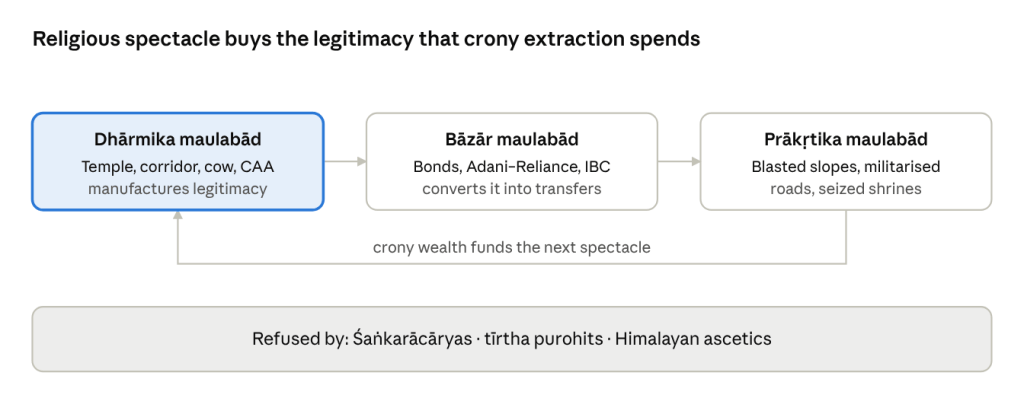
Each root feeds the next: the spectacle licenses the transfer, the transfer funds the engineering of sacred land, and the wealth extracted buys the next spectacle. The seats that refuse the circuit are not outside it. They occupy positions within the same field of authority the apparatus seeks to manage, bypass or appropriate.
II. The Four pīṭhas: Authority, Succession and the State’s Lever
Ādi Śaṅkara is said to have established the four āmnāya maṭhas in the eighth century as the institutional apex for the transmission of the teaching of the identity of ātman and nirguṇa Brahman. The historical claim is not fully verifiable; the institutional one is. Each Śaṅkarācārya is presumed to function, within that lineage, as the living holder of the highest dharmasattā, to which rājasattā is traditionally expected to defer (and differ at the same time?). The Sangh has never accepted this hierarchy as binding on its own political project. It has treated the pīṭhas as sources of selective legitimacy or as obstacles requiring management, bypass or delegitimation.
The tension is left open. The same tradition attributes to Śaṅkara both the founding of these four seats and the radical refusal of ritual-performances as a path to liberation. The Brahma Sūtra Bhāṣya and the tradition of the Upadeśasāhasrī insist that mokṣa is through jñāna alone; agnihotrādikarma and all karmas oriented toward material results are not the means. The Brahman taught is nirguṇa — without attributes, without persona-lity, a reality to which one cannot pray or from which one cannot ask gifts.
How a teacher who subordinated every conventional form to the discrimination of the pāramārthika from the vyāvahārika and the pratibhāsika is also credited with establishing enduring institutional seats that themselves became sites of extrinsic ritual, succession and political leverage is not resolved within the tradition. The question remains: whether the maṭhas are the necessary conventional vehicles for the transmission of a teaching that ultimately dissolves every vehicle, or whether the institutionalisation itself marks the first adhyāsa — the superimposition of the conventional upon what was taught as beyond all convention. The Sangh’s later use of the seats as either useful ornaments or obstacles to be managed does not answer the question. It only shows that the tension is available for further instrumentalisation.
The institutional field in which this tension is available is the four āmnāya seats themselves. Their present occupants, and the postures they have taken toward the regime, are as follows:
| Pīṭha | Direction | Mahāvākya | Present Śaṅkarācārya | Posture toward the Sangh regime |
|---|---|---|---|---|
| Jyotirmaṭh (Badrināth–Joshimath) | North | Ayam ātmā brahma | Swami Avimukteshwaranand Saraswati (since 2022; coronation stayed by the Supreme Court) | Open, escalating confrontation |
| Govardhan Maṭh (Purī) | East | Prajñānaṃ brahma | Swami Nischalananda Saraswati (145th, since 1992) | Sustained, scathing critique of Modi and Yogi |
| Śāradā Pīṭha (Dvārakā) | West | Tat tvam asi | Swami Sadanand Saraswati (since 2022; Swaroopanand before him, 1982–2022) | Qualified distance; critical on Ram temple donation theft (2026) |
| Śāradā Pīṭha (Śṛṅgeri) | South | Ahaṃ brahmāsmi | Sri Bharati Tirtha Mahaswamiji | Distance and decorum; no public confrontation |
Swami Swaroopanand Saraswati (1924–2022), freedom fighter and disciple of Brahmananda Saraswati and Swami Karpatri, remains the only person ever to have headed two pīṭhas at once — Jyotirmaṭh and Dvārakā. For a decade he was the Sangh’s most consistent critic. On his death in September 2022 his will named Avimukteshwaranand for Jyotirmaṭh and Sadanand for Dvārakā.
II.1. Succession Litigation as Administrative Instrument
The unresolved succession at Jyotirmaṭh is not an internal detail. It is the administrative instrument through which the state has converted a pending title into a lever of discipline — the same title it had earlier printed as valid when the occupant was useful. The episode belongs to the larger pattern the article records: residual authority is recognised when it underwrites the project and placed under review when it refuses.
Jyotirmaṭh’s succession has been in litigation since the mid-twentieth century. In September 2022 counsel informed the Supreme Court that Avimukteshwaranand’s appointment had been endorsed by the Dvārakā, Śṛṅgeri and Purī Śaṅkarācāryas. On 15 October 2022 the Court stayed the coronation after Solicitor General Tushar Mehta informed the bench that the Purī Śaṅkarācārya had filed an affidavit denying endorsement. The Akhil Bharatiya Akhara Parishad’s chief, Mahant Ravindra Puri, asked seers to boycott the ceremony.
The case has remained pending. That unresolved status was converted into a direct administrative tool in January 2026, when the Prayagraj Mela Authority cited the stay and the pending appeal to demand, within 24 hours, that Avimukteshwaranand justify his use of the title. A year earlier the same state government had printed his photograph as Jagadguru Śaṅkarācārya in its Mahakumbh souvenir. At the same Magh Mela a rival claimant to the Purī seat, Adhokshajanand Dev Tirth, maintained an unchallenged camp board.
Avimukteshwaranand’s response restated the institutional principle that neither the administration, nor a chief minister, nor a president decides who holds the office of Śaṅkarācārya. The Śaṅkarācāryas do. By placing the title under 24-hour administrative review at the moment of public criticism, the state inverted the classical expectation that political authority defers to the pīṭhas. The long-running succession litigation ceased to be an internal matter of the tradition and became an external lever for disciplining a religious office that refused subordination.
III. Philosophical Anatomy: Advaita against Ethnographic Hindutva
In a nutshell (without getting into all the philosophical intricacies at the moment), Advaita is not monotheism. It is non-dualism or monism. A-dvaita means “not two.” There is one reality, nirguṇa Brahman — without form, attribute or personality. The self is that reality: ahaṃ brahmāsmi. The world of multiplicity, including gods and goddesses, is māyā, a superimposition (adhyāsa). The formula attributed to the tradition is brahma satyaṃ jagan mithyā: Brahman is real; the world is mithyā (neither absolutely real nor absolutely unreal). This is more radical than “one God.” It is the denial of any God separate from the Self.
Śaṅkara’s account of reality operates through three orders, not two. The common two-level summary is incomplete:
| Order | Term | Status | Sublated by | Example |
|---|---|---|---|---|
| Absolute | Pāramārthika | Satya — never contradicted | Nothing | Nirguṇa Brahman alone |
| Empirical | Vyāvahārika | Mithyā — real for pragmatic transaction, public, lawful | Knowledge of Brahman | Waking world, saguṇa Brahman, deities, ritual, nation |
| Apparent | Pratibhāsika | Illusory even within the empirical — private error | Waking or closer perception | Rope-snake, dream, mirage, political simulacrum |
Mūrti-pūjā (idolatrous worship) and devotion to personalised, deified forms are permitted only as a pedagogic concession (gauna bhakti) for those not yet able to sustain non-dual realisation. The Brahma Sūtra Bhāṣya (notably on 1.1.4 and related passages) is explicit that liberation comes through jñāna–mārga, not through devotion to form as an end. Mokṣa dissolves every particular conventional-arbitrary identification (asmitā) — including “I am Hindu” and “I am Indian.”
Five sites of friction that do not resolve into a single hierarchy are as follows:
- Māyā versus “real” divinity. To treat Rāma as ultimately real, separate beings is, on one reading of Advaita, amounts to avidyā. The Sangh treats the same forms as civilisational powers that can be mobilised. The difference is real. It does not, by itself, decide which claim has exited the conventional.
- The Ram Mandir as lower-order religion. Elevating the consecration of a saguṇa temple into the highest national Hindu spiritual act inverts the hierarchy. For Śaṅkara, Rāma is Brahman-in-form, not a rival divine personality available for partisan ownership. Making the incomplete temple the summit of religious life treats a provisional pedagogical instrument as the final truth.
- Savarkar’s “atheism” (?) inside Hindutva. Hindutva’s founding definition of “Hindu” is territorial and ethnic, not theological. It empties even the vyāvahārika of metaphysical content and reduces dharma to identity, which makes it more alien to the Śaṅkarācāryas than ordinary devotional polytheism (Section IV).
- Jñāna versus politicised karma. Śaṅkara places the knower of Brahman above priest, devotee and ritualist. The Sangh places the indoctrinated activist, the monoreligious nationalist and the temple-builder at the apex. The hierarchy is inverted. What Advaita treats as provisional means, Hindutva treats as the end.
- The “Hindu Ekatmatā” problem. When the VHP strings every deity into one political bloc, the Advaitin sees conventional realities multiplied, not transcended. True unity is the recognition that Brahman alone is real — not that all gods are equally valid vote-bank assets. The move remains inside multiplicity while claiming to overcome it.
Two self-positionings inside the conventional:
| Dimension | Advaita | Sangh Parivar (Hindutva) |
|---|---|---|
| Ultimate reality | Nirguṇa Brahman, formless | Culturally inclusive polytheism treated as civilisational substance |
| Idol worship | Provisional, lower path; gauna | Central and celebrated |
| Goal of religion | Mokṣa through jñāna | Hindu civilisational unity and power |
| The gods | Conventional (vyāvahārika), not ultimately real | Real cultural-spiritual powers |
| Highest authority | Śaṅkarācārya, paramparā, śāstra | Organisation, sarsanghchalak, “Dharma Sansad” |
| Savarkar | Alien; irrelevant to jñāna | Foundational |
| The world | Māyā, to be seen through | The arena of Hindu action and conquest |
| Status of political religion | Often pratibhāsika (apparent, error-based) | Treated as absolute |
The clash is between two claims that both operate inside the conventional while asserting a higher ground: one that multiplies forms into a political absolute, and one that retains the right to name which forms may be absolutized and which must be refused. The difference in self-positioning is real. Both remain available for selective absolutization. The association of the seats with Advaita is not a claim that they are its sole or exclusive heirs; the tradition of Vedānta contains multiple (at least 10+) schools, and the seats are institutional claimants, not the entirety of the lineage. That is why the conflict recurs, regardless of who occupies a pīṭha or South Block.
IV. Savarkar’s Supposed “Atheism” (?) and the RSS’s Instrumental God
As remarked briefly earlier, Hindutva was founded by a man who defined “Hindu” by territory and blood rather than by Veda or śāstra — and the Śaṅkarācāryas have now said so to the Sangh’s face. The point is not to settle whether V. D. Savarkar was a pure atheist, an agnostic, or something merely opportunistic. The point is the aporia he (deliberately) left behind: a politics of “Hindu” identity that systematically empties the content of supposed Hinduism (as an umbrella term and exonym, later systematised as the mirror-image of Semitic religions during colonial times) while claiming to defend it. The founder did not merely leave a tension; he supplied the operating logic, set out below, by which forms could be mobilised and content discarded at will.
His Essentials of Hindutva (1923) took care to separate Hindutva from Hinduism. A Hindu, for Savarkar, was one for whom Bhārat is both pitṛbhū (fatherland) and puṇyabhū (holy land). The definition is geographical and ethnic. It excludes Muslims and Christians by design, and it requires no belief in Brahman, Veda or deity. Gods function as instruments of ethnic solidarity, not as objects of knowledge or even of stable conventional worship. On the animal now central to Sangh street “bajrang” politics, the writings are unambiguous: the cow is a useful animal to be protected for its utility, not worshipped as mother or deity. Treating it as divine is described as an insult to humanity and to the concept of divinity itself — “buddhi hatya,” the murder of the intellect. Protection is national duty; worship is error. If the cow is mother to anything, the texts suggest, it is to the bullock.
The RSS, founded in 1925, inherited this hollow core and has never resolved it. In its śākhās, the saffron bhagwā dhvaj and the genealogically phantasmic image of Bhārat Mātā stand where a deity would stand. This produces a double movement that cannot be stabilised:
- the organisation claims to represent the tradition;
- it simultaneously reduces gods, rituals and sacred animals to mobilising symbols whose content can be switched on or off according to political (=vote bank) need.
Gods are not denied so much as instrumentalised. They appear when solidarity is required and recede when utility or electoral calculation demands it. The tension is not contradiction in the ordinary sense; it is the operating logic.
The Śaṅkarācāryas have named the mechanism directly.
Swaroopanand Saraswati, May 2018: In Agra and Sagar he said a Hindu is one who has faith in the Vedas and Śāstras: if birthplace alone defined the category, what would a child of Hindu parents born in England or America be? (His full indictment of that month is in Section VI.)
Avimukteshwaranand Saraswati, 26 June 2026, Sambhal: During the Gaviṣṭi Yātrā he stated that the BJP’s Hindutva is fake and that those who do not follow the Vedas and Śāstras are fake Hindus. In effect, he has hinted towards twelve years of betrayal of “real Sanātanīs” by the present regime. The Ram temple, he said, is the office of the BJP and RSS; the original Rām Lallā is in a storeroom.
Avimukteshwaranand Saraswati, 18 July 2026 (during the Gaviṣṭi Yātrā): The Ram temple, he said, is the office of the BJP and RSS; the original Rām Lallā is in a storeroom. RSS members do not regard Lord Rāma as God; people in the RSS who cannot even put up Rāma’s picture now decide everything about Rāma in Ayodhya.
Avimukteshwaranand Saraswati, 22 July 2026, Gorakhpur: Closing the Gaviṣṭi Yātrā, he told Yogi Adityanath to follow go-rakṣā, not Savarkar.
That last sentence is the aporia compressed. A Śaṅkarācārya, in the city of the Gorakhnath seat, told the Gorakhnath mahant who runs Uttar Pradesh that his ideological ancestor is not a Hindu authority. The Sangh has never engaged the point, because the point cannot be engaged without admitting that the founding definition of “Hindu” was never theological. The friction remains unresolved because it is constitutive: a politics that needs the gods as symbols while remaining free of their authority.
The same instrumentalisation that empties the gods of content while retaining their forms extends to the figures the apparatus claims as its own. The most complete instance is the truncation of Swami Vivekananda.
V. Swami Vivekananda Appropriated: Practical Vedānta against the Sangh’s Truncation
The Sangh’s most audacious theft is Swami Vivekananda — one of the preachers of Advaita since Śaṅkara, edited down into a mascot of muscular ethno-religious-nationalism. Vivekananda’s Advaita was Practical Vedānta: non-dualism carried out of the cave and into the street. He repeated its working formulas constantly:
- Śivajñāne jīvasevā — serve living beings in the knowledge that they are Śiva.
- Nārabrahma — the human being as Brahman.
- Ātmano mokṣārthaṃ jagaddhitāya ca — for one’s own liberation and for the welfare of the world.
- Bahujana hitāya bahujana sukhāya — for the welfare and happiness of the many (OBMA’s guiding motto!).
- Daridra Nārāyaṇa — the poor as God.
- Bread labour — the moral necessity of earning one’s bread by voluntarily performing honest work.
In the Practical Vedānta lectures he put the metaphysics plainly: “The essence of Vedanta is that there is but one Being and that every soul is that Being in full, not a part of that Being.” And: “Each soul is potentially divine. The goal is to manifest this divinity within.” If ātman is Brahman, divinity is most urgently present in the hungry and the afflicted. That universalism cannot be confined within the borders of Bhārat, or to one particular religion so defined. It cannot exclude Muslims or Christians. It cannot be recruited for majoritarian-theocratic consolidation without violence to its own foundations.
His contempt for ritual externals was fierce. He damned “kitchen religion” — the touch-me-not, caste-purity obsession that reduces spirit to diet and pollution rules. At the Advaita Ashrama he founded at Mayavati near Almora, he kept out the paraphernalia of temple worship. When a devotee asked whether gong and bell were needed there, he shot back: “Go and live in Kansaripara!” — the Kolkata quarter that manufactured such instruments for mūrti-pūjā. True Vedānta, for him, demanded transcendence of forms, not their political-extremist celebration.
The same insistence on universality appears in his architectural vision and in his explicit statements on other traditions. The Ramakrishna Temple at Belur Math, whose design he envisaged, deliberately fuses motifs so that the building can be read, depending on the angle, as temple, mosque, Buddhist monastery or church: a continuous congregational space in the manner of a Christian church, a domical roof drawing on Islamic and Renaissance forms, a ground plan shaped like a Christian cross, and detailing that remains recognisably Hindu. The structure was meant to embody the principle that all paths lead to the same reality, so that visitors of any background would feel at home.
He went further in words: for the motherland, he wrote, “a junction of the two great systems, Hinduism and Islam — Vedanta brain and Islam body is the only hope.” He rejected the claim that Muslim rule in India was nothing but sword and fire, noting that it had functioned as a form of release for the downtrodden excluded by caste. At the 1893 Parliament of Religions he named the enemy directly: “Sectarianism, bigotry, and its horrible descendant, fanaticism, have long possessed this beautiful earth. They have filled the earth with violence, drenched it often and often with human blood, destroyed civilisation and sent whole nations to despair.” Superstition, he added, is a great enemy, but bigotry is worse.
The Sangh’s Vivekananda is therefore a severe truncation.
Stripped out: the syncretic universalism, the Vedantic rigour, the war on priestcraft and kitchen religion, Śivajñāne jīvasevā, Nārabrahma, bread labour, bahujana sukhāya, the syncretic architecture, the call for Vedanta brain and Islam body, and the explicit condemnation of bigotry and fanaticism.
Retained, appropriated, co-opted and weaponised: civilisational pride, masculine energy, organisational discipline. This is itself a form of selective canonisation (a form of mūla-manipulation) — claiming a Vedantic root whose actual content, Daridra Nārāyaṇa and universal divinity, undermines the ethno-religious majoritarianism, temple-centric politics and crony developmentalism conducted in its name.
Where Vivekananda sought to awaken the ātman in every individual and to dissolve boundaries in the recognition of Brahman, the Sangh channels that energy into collective identity assertion, Ram Mandir spectacle and electoral karma-yoga. One universe dissolves all boundaries. The other erects and weaponises them. The Śaṅkarācāryas, held as the institutional custodians of the renunciate tradition Vivekananda himself practised, see the selective canonisation of BJP-RSS Hindutva for what it is: not a revival, but a convenient truncation that serves power rather than truth. In that precise sense, Vivekananda’s Practical Vedānta also stands against the Sangh.
The same selective truncation that reduces Vivekananda to a mascot of muscular masculine religious-nationalism appears, in institutional form, in the seats that claim residual authority. The seats’ refusal is not an abstract philosophical objection. It is a sustained, public record of confrontation with the apparatus that performs the truncation. The first and longest of those records belongs to Swaroopanand Saraswati.
VI. Chronology I — Swaroopanand Saraswati Against the Sangh, 2014–2022
The old lion of Dvārakā and Jyotirmaṭh opposed the deification of Modi before Modi was prime minister, and never stopped. His interventions were consistent in one respect: they treated the conversion of religious forms into personal or electoral instruments as a violation of dharma, not as a matter of political preference.
March 2014 — “Har Har Modi”. BJP supporters in Varanasi converted the Śaiva chant Har Har Mahādev into “Har Har Modi.” Swaroopanand lodged a protest with Mohan Bhagwat against this vyakti-pūjā (worship of an individual), warning that God himself would stop Modi if the deification continued. Within days Modi asked his supporters to drop the slogan, and the BJP disowned it. It is the first recorded instance of a Śaṅkarācārya forcing the Modi machine to retreat.
January–May 2014. He questioned the “tea-seller” image, saying Modi was no longer a tea-seller but a wealthy man, and demanded that Modi tell people truthfully what he intended to do. In Varanasi, the Purī claimant Adhokshajanand Dev Tirth openly blamed Modi for the 2002 Gujarat violence.
July 2014. His attack on Shirdi Sai Baba worship as a deviation from Sanātana Dharma showed the orthodox lens through which all his critiques were made. The same standard of śāstric fidelity was later applied to the Sangh’s own practices.
May 2015. Despite Modi’s anti-corruption promises, he said, bribery remained rampant because moral values had collapsed.
February 2016. He said the RSS claimed to work for Hinduism while thousands of its workers in Arunachal Pradesh ate beef.
May 2–7, 2018 — Agra and Sagar, press conference and India Today interview. He stated that the BJP and RSS had caused the biggest damage to Hinduism in recent times. A real Hindu, he said, has faith in the Vedas and Śāstras; Hindu marriage is a sacrament for life, not a contract. He asked what a child of Hindu parents born in England or America would then be. He charged that BJP leaders were among the biggest exporters of beef while claiming to oppose cow slaughter, and that neither the government nor the RSS could build the Ram temple — only those who followed the tradition could. The VHP and RSS, he added, had weakened the earlier movement by their victory processions after the lock was opened.
November–December 2018. He lambasted Yogi Adityanath for “fooling the public” by calling Hanumān a Dalit, citing the Bhāgavata tradition of Hanumān as Śiva’s incarnation. [OBMA doesn’t support caste discrimination at all; this is merely for setting the argumentative pace]
2018–2019 — the Kashi corridor. His chief disciple Avimukteshwaranand led the protests against the demolitions for Modi’s Kashi Vishwanath corridor, and Swaroopanand held the Centre and the state responsible when broken Śivaliṅgas were found dumped in Varanasi (Section XI).
January 2019 — Param Dharma Sansad. At the Prayagraj Kumbh he convened his own dharma sansad, outside and against the VHP’s “Hindu Parliament” apparatus.
July–August 2020 — the bhūmi-pūjan muhūrta. Ahead of Modi laying the temple foundation on 5 August 2020, he declared the date inauspicious: the sun in dakṣiṇāyana, the dark fortnight of Bhādrapada. Temple trust priests challenged him to a debate; the ceremony went ahead at Modi’s convenience.
2021. He attacked the temple trust for admitting organisations merely because they supported the BJP, and remarked that nobody had known who Champat Rai was until he became its head.
11 September 2022. Swaroopanand died at 98 in Narsinghpur. Modi and Yogi issued condolences. His successors inherited his war.
VII. Chronology II — the January 2024 Ayodhya Boycott
On 22 January 2024, the Prime Minister consecrated Rām Lallā in an unfinished temple raised on the bloodied ground of the Babri Masjid, demolished in 1992 in a campaign of organised violence that left more than two thousand dead, the large majority of them Muslim — three months before a general election — and not one of the four āmnāya Śaṅkarācāryas was there. The absence was not a matter of scheduling. It was a refusal to legitimise a prāṇa-pratiṣṭhā conducted against śāstric procedure and under political direction.
3–4 January, 2024 — Purī fires first. In a video that went viral, Swami Nischalananda Saraswati accused Modi of interfering in religious affairs and announced he would not go: “While Modiji inaugurates and touches the idol, will I stand there and clap?” He needed no position, he said; he already held the highest one. He warned that a prāṇa-pratiṣṭhā performed against śāstric procedure diminishes the deity’s tejas (radiance) and invites negative forces. The invitation limited him to one companion; even if he had been allowed a hundred, he said, he would not have gone. The point was not personal slight. It was the reduction of the dharmācārya to a spectator at a state-managed ritual.
Early January, 2024 — Champat Rai’s slip. The VHP leader and general secretary of the Shri Ram Janmabhoomi Teerth Kshetra Trust told Amar Ujala that the temple belonged to the Rāmānandī sect — not to sannyāsīs, Śaivas or Śāktas. It was an astonishing admission from an organisation that had raised money from every Hindu for three decades in the name of pan-Hindu unity. Avimukteshwaranand’s retort was surgical: if the temple is Rāmānandī, why is Champat Rai, who is not Rāmānandī, running it? Hand it to the Rāmānandīs before the consecration and resign. Hindus of every sect had paid for it. Nischalananda advised Rai not to shrink his own stature while holding power. The statement exposed the gap between the claim of pan-Hindu ownership and the actual administrative control of the site.
8–15 January, 2024 — the four seats. Avimukteshwaranand stated that none of the four would attend. His reasoning was śāstric, not partisan:
- consecrating a temple whose construction is incomplete is, he said, the biggest act of ignorance with respect to the dharma śāstras;
- the event was being rushed for political gain;
- “Who told us that Rāma exists? Our dharma śāstras” — the same śāstras the event was violating;
- “political Hindus” were happy with the consecration, he said, but many “religious Hindus” were not;
- he was, in his words, not anti-Modi, but not anti-dharma either.
Śṛṅgeri, in a statement of 8 January 2024, called reports of the Jagadguru’s displeasure “false propaganda,” described the consecration as a matter of joy after five centuries, and urged believers to take part. Dvārakā issued a similar disclaimer. Yet neither pontiff went to Ayodhya; their own offices confirmed it. Nischalananda insisted on 13 January that there were no differences among the four on the substance. The Kanchi pontiff — head of a maṭha outside the four āmnāya seats — took part in the yāgaśālā rituals on 21 January, filling the vacuum the Sangh needed filled.
Mid-January, 2024 — Gangasagar. Nischalananda went further. Modi, he said, had inaugurated the Ram Mandir for electoral purposes; tomorrow they might inaugurate Jagannāth and then other temples. He called it the sheer madness of a ruling party that blatantly uses religious events for politics. Interference in religion by politicians, he said, was insanity and against the Constitution.
He has repeatedly said that if the justice system were strong, Modi and Yogi would be in jail. He has charged that they are playing with the mūrti and that politicians have no right to touch the idol or decide the procedure. On the RSS he has said it has no traditional grantha, no paramparā guru, and that Bhagwat lacks knowledge of the tradition. He has also alleged that the Centre has elevated a person he calls a terrorist or fake to the status of Śaṅkarācārya, given him security, and hosted him in RSS premises.
22 January., 2024 The consecration went ahead with Modi as chief yajamān, Yogi Adityanath, Mohan Bhagwat and thousands of invited “saints” — the parallel religious establishment the RSS had built for exactly such a moment. The highest seats of Hinduism were absent.
The Sangh had a temple. It did not have the Śaṅkarācāryas. And four months later it would not have Ayodhya either.
VIII. Chronology III — 2024–2025: Faizabad, Kedarnath Gold and the Kumbh Dead
After Ayodhya, the critique turned from ritual to governance: the regime’s greed, its handling of the dead, and its double game on the cow.
June 2024 — Rāma’s verdict. The BJP lost its own majority in the Lok Sabha and lost Faizabad, the constituency containing Ayodhya, four months after the consecration. The Samajwadi Party’s Awadhesh Prasad, a Dalit, beat the sitting BJP MP by about 54,500 votes. The BJP also lost Sultanpur, Amethi, Barabanki and Ambedkar Nagar in the Ayodhya division, and fell to 33 of 80 seats in Uttar Pradesh.
The Śaṅkarācāryas read it as a dharmic verdict. Avimukteshwaranand told ThePrint the consecration had been hurried because of the elections. Nischalananda went further, reciting a Sundarakāṇḍa quatrain comparing the BJP to a greedy heron: “He fell prey to greed, and wherever Ram ji went, BJP lost.” Even had Modi been a Brahmin, Nischalananda added, a politician should not have consecrated an unfinished temple.
July 2024 — the Ambani wedding and the gold of Kedarnath.
12–15 July, Mumbai. At Anant Ambani’s wedding — a reported $600 million display of oligarchic wealth — Modi sought the blessings of the Jyotirmaṭh and Dvārakā Śaṅkarācāryas. Avimukteshwaranand explained that his rule is to bless whoever comes to him; Modi, he said, is not an enemy, and when he makes a mistake the Śaṅkarācāryas point it out. The episode shows that the critique is dharmic, not a party line. It also shows how far the market logic reaches: even the pīṭhas were drawn into the oligarch’s spectacle. He then visited Uddhav Thackeray at Matoshree and called him a victim of betrayal.
15 July, 2024 — “228 kg of gold”. Days later he detonated the Kedarnath gold controversy. Kedarnath’s sanctum walls had been re-plated in 2022; local priests and purohits had alleged irregularities ever since. He demanded to know why no inquiry had begun into missing gold and denounced the plan to build a Kedarnath replica in Delhi as the next scam. The Badrinath-Kedarnath Temple Committee, headed by BJP-linked Ajendra Ajay, replied that only about 23 kg of gold (worth ₹14 crore) had been used, donated by a private donor, and that the 228 kg figure confused it with the earlier silver plating. It accused him of carrying a Congress agenda. He asked how gold turns into brass. No independent inquiry was ordered.
21 July, 2024. Swami Govindananda called him a “fake baba” backed by the Congress, citing a Priyanka Gandhi letter that addressed him as Śaṅkarācārya.
September–December 2024 — “agent of cow slaughter”.
28 September, 2024, Ambikapur. Nischalananda delivered his harshest verdict on the Prime Minister: “Modi, who came for cow protection, has become an agent of cow slaughter.” After becoming PM, he said, Modi calls cow protectors goons; he rose to the highest office but lacks a sense of maryādā; he consecrated Rām Lallā improperly; wherever Rāma went the BJP was wiped out; once it was “Modi’s guarantee”, now it is the crutches of Nitish and Naidu. He objected to state control of temples and maṭhas and to turning shrines into tourist corridors. The same month Avimukteshwaranand, in Patna on his nationwide cow-protection yātrā, called the Tirupati laddu adulteration an attack on Hindu faith.
17 December, 2024, Pune. Nischalananda said Modi could not declare a Hindu Rāṣṭra because the Constitution does not provide for one, that Hindutva means something far larger than the BJP’s political version, that the government had done nothing substantial in the name of development, and that it was unstable, dependent on Chandrababu Naidu and Nitish Kumar.
19–22 December, 2024 — Bhagwat’s retreat on mosques. Mohan Bhagwat said in Pune that after the Ram temple some people think they can become “leaders of Hindus” by raking up new temple–mosque disputes, and that this was unacceptable. Avimukteshwaranand answered in Haridwar: “When he wanted power, he went around speaking about temples.” Now that Bhagwat had power, he said, he was advising Hindus not to look for temples. Bhagwat, he said, did not understand the plight of Hindus. The exchange exposed the instrumentality at the Sangh’s core: the temple is a lever to be pulled when power is wanted and parked when power is held.
January–March 2025 — the Mahakumbh and its dead.
29 January, Mauni Amāvasyā. A crush at the Sangam nose killed at least 30 people, by the police’s own count, and injured about 60. The state had promised “world-class” arrangements for a projected 40–45 crore visitors. Through the morning the chief minister spoke of injuries, not deaths. Avimukteshwaranand said the saints had been misled, called Yogi Adityanath a liar, said he was unfit to be chief minister and demanded his resignation during the Kumbh itself. Akhara Parishad chief Ravindra Puri dismissed the demand as frustration and floated the idea that the stampede could be the handiwork of hostile forces. On 3 March 2025 Yogi admitted that the deaths had not been publicised prominently “to avoid panic”.
February 2025. At the Kumbh, Avimukteshwaranand used his own Dharma Sansad to censure Rahul Gandhi over remarks on the Manusmṛti — proof, if any were needed, that his fire is not partisan. On 11 February he gave the Centre 33 days to ban cow slaughter and declare the cow Rāṣṭra Mātā, promising a march to Delhi by 17 March. Modi, meanwhile, told a rally in Chhatarpur that critics of the Mahakumbh suffer from a “slave mentality”.
June–November 2025 — the cow goes to the ballot box.
June 2025, Shimla. He launched the nationwide Gau Dhvaj campaign and a Gau Voter drive, demanding Rāṣṭra Mātā status nationally and Rājya Mātā status in all 36 states and union territories.
13 September 2025, Patna. After touring all 38 districts of Bihar, he announced cow-protection candidates in all 243 assembly seats. Union minister Jitan Ram Manjhi called him a “dirty man”. He later said 45 nominees withdrew “under pressure or greed”; the remaining 198 polled about six lakh votes, roughly 3,000 per seat, while the NDA swept 202 seats on 14 November 2025. Electorally marginal, symbolically explosive: for the first time a Śaṅkarācārya had fielded a slate against the party that claims to own Hindu votes.
IX. Magh Mela 2026: Stop, Delegitimise, Criminalise
Avimukteshwaranand Saraswati, January 2026 (Magh Mela period): In the context of being stopped at the Sangam and the title notices, he compared the chief minister’s conduct to Aurangzeb (and Akbar), stating that Yogi Adityanath is not worthy of being called a Hindu and that the present government is demolishing temples in a manner comparable to the Mughal ruler.
In five weeks of early 2026 the Uttar Pradesh state moved against a sitting Śaṅkarācārya in three steps: it stopped his bath, questioned his title, and watched him be booked under the POCSO Act.
Step one — the Sangam is closed to him (18 January, 2026)
On Mauni Amāvasyā, 18 January 2026, police and Mela officials stopped Avimukteshwaranand’s palanquin procession to the Triveni Sangam. The administration said the area was overcrowded, that his followers broke a barrier at pontoon bridge two, and that his refusal to dismount caused a three-hour jam. His camp denied breaking any barricade. He was sent back without bathing; his disciples and young baṭuk priests, he alleged, were manhandled and assaulted on the chief minister’s direction. He sat outside his camp, began a fast, called it a conspiracy to kill him in a crush, and vowed not to enter his āśrama until the authorities apologised.
The Congress asked why a Śaṅkarācārya could not reach the Sangam while the regime’s favourites move with Z+ security. Pawan Khera listed his “crimes”: he does not sing the government’s praises; he objected to consecrating a half-built temple; he questioned the Kumbh mismanagement. Akhilesh Yadav said the Hindutavadi BJP was humiliating a Hindu seer who deserved full respect. The Hindu Mahasabha demanded action against those responsible.
Step two — prove you are a Śaṅkarācārya (19–28 January, 2026)
On the night of 19 January the Prayagraj Mela Authority served him a notice demanding, within 24 hours, an explanation for using the title Śaṅkarācārya of Jyotiṣpīṭh on his camp boards, citing the pending Supreme Court appeal and its October 2022 stay. A second show-cause notice followed over his route. He answered with an eight-page legal reply and a threat of legal action, and pointed out that at the 2025 Mahakumbh the same state had printed his photograph as Jagadguru Śaṅkarācārya — and that a board announcing a second Purī Śaṅkarācārya stood unchallenged at the same Mela.
Yogi Adityanath, without naming him, warned devotees against Kālanemis — the demon who disguised himself as a sādhu to stop Hanumān — people who look religious outwardly but work on an anti-religion agenda. His own deputy, Keshav Prasad Maurya, publicly called the seer bhagwān Śaṅkarācārya, exposing a split inside the UP government. The Akhil Bharatiya Akhara Parishad backed Yogi; Jagadguru Rambhadracharya backed the action; Baba Ramdev sneered that Sanātanīs were busy fighting each other.
The humiliation reached the bureaucracy. On Republic Day, 26 January, 2026, Bareilly City Magistrate Alankar Agnihotri, a 2019-batch PCS officer, resigned in a five-page handwritten letter protesting the insult to the Śaṅkarācārya and his disciples, together with the UGC’s new equity regulations. He alleged he was held for 45 minutes by the district magistrate; the government suspended him and attached him to Shamli. An Ayodhya GST deputy commissioner resigned the next day — in support of Yogi. Avimukteshwaranand told Agnihotri he would give him a bigger post than the government had.
On 28 January 2026 he left the Mela “with a heavy heart”. From Varanasi he turned the state’s question back on it: “Our credentials were asked for, and we submitted them.” Now, he said, the chief minister must prove he is a Hindu sympathiser — within 40 days, by declaring the cow Rājya Mātā and stopping beef exports from Uttar Pradesh. On 25 January he had already declared that the RSS wants only flatterer Śaṅkarācāryas, that the BJP’s pretence stood exposed, and that the seed of a new Sanātanī politics had been sown in Bihar.
Step three — the POCSO case (February–June, 2026)
| Date (2026) | Event |
|---|---|
| 18 Jan | The complainant, Ashutosh Brahmachari — a disciple of Jagadguru Rambhadracharya — later says this is the day he first learned of the alleged abuse: the same day as the Sangam confrontation |
| 21 Feb | Special POCSO Judge Vinod Kumar Chaurasia, Prayagraj, orders an FIR on Brahmachari’s application under Section 173(4) BNSS, alleging sexual abuse of two boys, one a minor, between January 2025 and February 2026 |
| 21 Feb, 23:37 | UP Police register the FIR at Jhunsi police station the same night, under POCSO Sections 3, 4(2), 5(l), 6, 16, 17 and 51, naming Avimukteshwaranand, his disciple Mukundanand Brahmachari and others |
| 22–24 Feb | He calls the case fabricated and politically motivated, says CCTV will prove his innocence, offers not to resist arrest, and demands investigation by a non-BJP state’s police |
| 22 Feb | Former CBI interim director M. Nageswara Rao, having read the order, writes: “If the RSS-BJP Can Target a Śaṅkarācārya, Who Is Safe?” He notes the complainant’s ideological proximity to the seer’s opponents and that the alleged victims were not his disciples |
| 26 Feb | He files a counter-case against Brahmachari; the complainant levels fresh allegations naming VIPs and officials |
| 8 Mar | Brahmachari is reportedly attacked on a train and accuses the seer of conspiracy; the seer calls the claim fabricated |
| 23 Mar | RSS pracharak Indresh Kumar denies a claim by the seer about a private airport conversation |
| 25 Mar | Allahabad High Court grants anticipatory bail. Justice Jitendra Kumar Sinha finds the medical report inconclusive and procedures not followed; finds it inconsistent with normal conduct that two minors confided in a near-stranger rather than guardians; notes they were not students of the seer’s school but of a Sanskrit school in Hardoi; notes they stayed in continuous contact with the complainant, were not placed in proper custody until late February, and gave TV interviews in breach of POCSO and JJ procedure; and notes the 18 January coincidence. Both sides are barred from media statements |
| 29 May | Supreme Court refuses to interfere with the bail: “Sorry, we are not going to interfere” |
| 10 Jun | The complainant recants. In a video from Mathura, Brahmachari says he filed a “fake suit” under pressure from Ramchandra Das, mahant of Deva Ashram and successor of Rambhadracharya, and that several officers were part of a conspiracy. Rambhadracharya, shocked, calls Brahmachari a man with a criminal background and suspects a plot against his own reputation |
The investigation formally continues, and nothing here establishes guilt or innocence; that is for the courts. But the shape of the sequence is beyond dispute. A seer who denied the regime its consecration, accused its chief minister of lying about the Kumbh dead, alleged a gold scam at Kedarnath and toured the state demanding an end to beef exports was, within five weeks of being stopped at the Sangam and ordered to prove his title, accused of the gravest crime in the statute book by a disciple of a Jagadguru who routinely shares the stage with Modi and Yogi — an FIR the state’s police registered before midnight. The High Court found the case riddled with discrepancies. The complainant now says it was fake. The man who called the case manufactured has, so far, been shielded from arrest by both the High Court and the Supreme Court. The record the High Court laid out reads less like evidence of a crime than like the anatomy of a frame-up. Residual authority that refuses to underwrite the project is not merely ignored. It is placed under administrative review, denied the ground, and then subjected to a criminal process whose discrepancies the courts themselves have noted. The friction is not external. It is the operating response to the refusal.
X. Cow Vigilantism: the Violence, the Export Commodity and the Votes
The Sangh lynches in the cow’s name at home and promotes bovine-meat exports abroad. The Śaṅkarācāryas have turned that contradiction into the sharpest public weapon against the regime.
X.1. The Uncounted Violence
Between 2014 and 2026, cow-protection vigilante groups linked to the Sangh’s ecosystem killed dozens and assaulted hundreds, almost entirely Muslim and Dalit men. Independent trackers (IndiaSpend, Human Rights Watch, Amnesty) recorded more than 50 lynching or near-lynching deaths and hundreds of injuries in the first five years alone; the numbers continued, if less systematically reported, through the subsequent years. Police cases were routinely delayed, diluted or never filed. The same state governments that spoke of gau-rakṣā as civilisational duty declined to prosecute the killers with any consistency. The violence was not an excess. It was the street arm of a politics that treated the cow as a mobilising absolute while remaining free of any obligation to the human beings killed in its name.
X.2. The Non-Mentioned Ledger
India forbids the export of cattle beef, but buffalo meat — carabeef — is a booming, state-promoted trade. The seers draw no distinction between bovines when they speak of go-māṃsa. The government’s own figures:
| Year | Buffalo-meat exports | Note |
|---|---|---|
| 2014–15 | $4.8 billion; 14.8 lakh tonnes | The year Modi took office on a “pink revolution” campaign attack |
| 2024–25 | ₹34,392 crore (≈$4.1 billion); 12.5 lakh tonnes | Part of record total meat exports of ₹35,233 crore |
| 2025–26 | $5.1 billion | Up 25.6%; first time above $5 billion |
| Apr–Jun 2026 | ≈$1.5 billion | Up 66.6% year on year; the government projects over $6 billion for 2026–27 |
Since 29 October 2025, APEDA — a body under the Commerce Ministry — has levied ₹250 a tonne on buffalo-meat exports to finance a Meat Export Development Fund. The “Hindu” state has built a fund to promote the trade. India remains among the world’s largest bovine-meat exporters. Uttar Pradesh, under a Gorakhnath mahant, is repeatedly identified as the leading state for meat exports.
“Hypocrisy ki bhi seema hoti hai.”
X.3. What the Seers Said
- Swaroopanand, 2016 and 2018: thousands of RSS workers in Arunachal ate beef; BJP leaders appeared in beef-exporter lists.
- Nischalananda, September 2024: Modi, who came for cow protection, is now an agent of cow slaughter, and calls cow protectors goons.
- Avimukteshwaranand, 2024–2026: a government that permits cow slaughter has no right to call itself Hindu. The BJP shows a “dual character”; Uttar Pradesh is the country’s leading meat-export state. Those in power cannot call themselves Hindu Hṛday Samrāṭ because they do not regard the cow as mother. A voter who takes money to elect a party that permits cow slaughter shares in its sin.
From 3 May to 22 July 2026 Avimukteshwaranand conducted an 81-day Go-rakṣārtha Dharmayuddha through all 403 assembly constituencies of Uttar Pradesh. The demands were explicit: the cow removed from the legal category of “animal”, declared Rājya Mātā and Rāṣṭra Mātā, cow slaughter treated as a crime, and beef exports from the state stopped. The yātrā was flagged off without administrative permission; its closing rally in Lucknow was later refused. At Gorakhpur he told the chief minister to follow go-rakṣā, not Savarkar, and recorded a pledge that people across the state would withhold their vote in 2027 unless the cow was declared Rājya Mātā.
A Śaṅkarācārya is now taking the Sangh’s own mobilising animal, constituency by constituency, against the party that mobilised it, armed with the state’s own export figures.
A necessary caution. The seers’ cow politics is orthodox, not humanitarian, and it does nothing for the Muslim and Dalit victims of the lynch mobs the Sangh’s rhetoric unleashed. Its force here is the strategic diagnostic: it proves that the Sangh’s cow was never sacred to the Sangh. It was a mobilising symbol — exactly as the self-proclaimed “Veer” Savarkar taught. The violence remains uncounted; the exports continue to rise.
XI. Sacred Geography Commodified: Sites of Ecocide
Wherever the Sangh has “restored” a sacred site, the Śaṅkarācāryas and the hereditary priests have found the same thing: the sacred demolished, enclosed, militarised or stolen.
Kashi — “the freedom of Shiv”.
The Kashi Vishwanath corridor, Modi’s project in his own constituency, demolished roughly 300–400 structures — temples, homes, guesthouses — according to contemporary accounts and its own managers. Laying its foundation stone on 8 March 2019, Modi called it a day to celebrate “the freedom of Shiv” from his four walls. Broken Śivaliṅgas turned up dumped near a drain. Shopkeepers hung banners reading Ek hi bhool, kamal ka phool (“one mistake: the lotus”). Avimukteshwaranand led the protest, describing the work as an attack on faith. The project converted a dense, multi-layered “site of archive” into a cleared avenue for a marketable pilgrimage industry. The same Sangh that would later rake up a Śivaliṅga claim inside Gyanvapi had uprooted real Śivaliṅgas for a tourist spine. Concrete slabs now seal the ground that once absorbed and channelled the Gaṅgā’s seasonal rise; when the river overflows, the hardened surface turns the old city into a basin. What is presented as liberation of the deity is the enclosure of the river’s own ecology. Benares itself is at stake: the living interchange of temple, lane, drain and flood is replaced by a sealed, revenue-bearing surface that can neither receive the Gaṅgā nor let it recede.
Ayodhya — temple, museum, office.
- The money. Reported state spending of around ₹32,000 crore on Ayodhya; a 52-acre Ram Mandir museum handed to Tata Sons by the UP cabinet.
- The theft (2026). In June 2026 an SIT found that counting staff had pocketed temple donations on nearly 70 occasions caught on CCTV between 27 April and 5 June 2026, hiding cash in clothes and shoes. Eight were arrested on 26 June. The former driver of trust general secretary Champat Rai held keys to several huṇḍīs. The largest diversion reportedly happened during the 2025 Kumbh surge; the State Bank of India had flagged the counting process months earlier. Champat Rai and trustee Anil Mishra resigned “on moral grounds”. Former BJP MP Vinay Katiyar joined calls for a transparent probe. On 8 July Yogi Adityanath defended the trust — “only eight” of about 150 counters — and blamed the opposition for maligning Ayodhya. The SIT chargesheet later flagged 105 instances of diversion; reporting noted the FIR came 21 days after the theft was known, that Rai is quoted as having known by 5 June, and that the role of two senior RSS figures who controlled the trust had not been investigated. The Congress asked why trust officials were witnesses rather than accused.
- The Śaṅkarācāryas. On 26 June, Avimukteshwaranand said large-scale thefts are committed by influential people against whom there is no FIR, and that the trust had never been run according to religious tradition. Dvārakā’s Sadanand Saraswati, otherwise restrained, asked what place can be safe when temples are not, and demanded a Sanātan Board to protect temples nationwide. On 18 July Avimukteshwaranand added that the Rām Lallā who endured the decades of struggle now lies in a storeroom, that the installed idol is not the one that won the case, that 5,000 saints were invited but none allowed into the sanctum while VVIPs were, and that the temple is, for now, the office of the BJP and RSS. He would visit, he said, on the day it is truly complete.
Swaroopanand had asked in 2021 who Champat Rai was. In 2026 the answer arrived.
Char Dham — the mountain made into a road.
The 900-km Char Dham Mahamarg and the 2019 Devasthanam Management Act name the formation exactly: a BJP “developmental Hinduism” that fuses neoliberal infrastructure, militarised logistics and centralised temple control. The mountain is cut for dual-use roads; the jyotirliṅgas are placed under a state board. What is called restoration is the destruction of the sacred-ecological fabric the project claims to protect. The same logic that sealed Kashi’s ground with concrete now blasts the Himalayan massif and seeks to franchise Kedarnath as a Delhi replica. The seats and the hereditary priests have treated this as hiṃsā against the Absolute (God=Nature) itself.
Kedarnath — gold and a Delhi replica.
Beyond the gold dispute recorded in Section VIII, the plan to replicate Kedarnath in Delhi marks the commodification of a jyotirliṅga as a franchise. The same logic of enclosure drove the 2019 Char Dham Devasthanam Management Act, which transferred 51 temples, including Kedarnath and Badrinath, to a state board. Hindu sannyasis and hereditary priests answered with hunger strikes, bare-chested sit-ins, blood letters and the headstand of Kedarnath priest Santosh Trivedi outside the shrine; the Act was repealed in November 2021 only after sustained resistance. What the BJP advances as “development” and “management” cuts roads and blasts the mountain that the seers and priests treat as Brahman itself. The replication of Kedarnath in Delhi and the engineering of the Kedar massif are two faces of the same refusal to leave the sacred unadministered: the jyotirliṅga becomes a franchise, the mountain becomes infrastructure, and the preservation of the site as living ecology is subordinated to revenue and control.
Joshimath — the seat that sank.
In January 2023 the town of Jyotirmaṭh itself began to sink; cracks spread to 849 houses by 16 January. Avimukteshwaranand petitioned the Supreme Court to declare it a national disaster, blaming large-scale “industrialisation”—the tunnels, blasting and roads of developmental Hindutva—and sought compensation for the displaced. The Court refused to hear it urgently, saying not everything important need come to it and warning against using proceedings for social-media “sound bytes”, and sent him to the High Court. The Śaṅkarācārya’s own seat had become the first casualty of the developmental project: the mountain that houses the northern pīṭha was opened, drained and cracked by the same dual-use infrastructure that treats sacred geography as an engineering corridor. What sank was not only houses but the ecological ground on which the seat itself stands.
| Ecology | What it was | What developmental Hindutva made it |
|---|---|---|
| Mental | Himalaya as animate divinity; pilgrimage as tapas and mokṣa-yātrā | Tourist spectacle, vehicular transit, deity reduced to revenue asset |
| Social | Hereditary tīrtha purohits, ascetic orders, living temple trusts | State-appointed board, bureaucratic seizure, crony contracting |
| Environmental | Fragile glaciers, tectonic volatility, hydrological interdependence | Blasting, deforestation, landslide corridors, dual-use military roads |
The toll, as documented in analyses and the Supreme Court record: slopes cut up to 24 metres wide; about 690 hectares of forest and over 55,000 trees felled; nearly 20 million cubic metres of soil excavated; habitat loss for the Himalayan tragopan, kalij pheasant, golden mahseer and several vultures. The Court’s High-Powered Committee under Ravi Chopra repeatedly warned of slope failure and flash floods; the government pressed for dilution and amended EIA norms in 2020 to regularise violations. A 2024 Uttarakhand disaster-management study identified 54 critical landslide zones on the alignment. On 25 July 2023 a 100-metre stretch of the Badrinath highway near Kameda was washed away; in the 2025 monsoon over 155 roads across the state were blocked in one episode, all four pilgrimage axes included.
The social ecology fought back and won. The 2019 Act handed 51 temples, Kedarnath and Badrinath among them, to a state board. The All India Teerth Purohit Mahapanchayat answered with hunger strikes, bare-chested sit-ins and blood letters; in June 2021 Kedarnath priest Santosh Trivedi performed a śīrṣāsana — a headstand — outside the shrine. The government banned protests within 200 metres of the temples. On 30 November 2021 it repealed the Act.
That repeal was counter-hegemony enacted through ritual rather than parliament: the defence of all three ecologies at once. It succeeded because the priests spoke a dharmic language the self-proclaimed dharmic state could not dismiss as “anti-national”. If all is Brahman, the Gaṅgā is Brahman and the Kedar massif is Brahman. To blast it for a highway is not development. It is hiṃsā against the Absolute (God=Nature).
One is reminded of those who put their lives at stake by fasting unto death against the pollution and degradation of the Gaṅgā: Swami Nigamananda Saraswati, who died in 2011 after a 115-day fast demanding the halt of mining and industrial effluent; Baba Nagnath, who died in 2018 after a prolonged fast; and Sant Swami Gyan Swaroop Sanand and Sant Gopaldas. Their deaths mark the earlier, unabsorbed cost of treating the Gaṅgā as a resource for the neoliberal economy rather than as Brahman. Their sacrifice stands as a call against ecological destruction, crony extraction and state apathy; it reminds us that the struggle for the Gaṅgā is the struggle for the rights of lands, forests and rivers themselves.
The constitutional dimension follows from the same circuit. Developmental Hindutva subordinates ecology, economy and politics to a single extraction: the mountain and the river are blasted and sealed for dual-use infrastructure and crony contracts, while religious extremism supplies the legitimating mask. It cuts against the Preamble’s pluralism, the Fundamental Rights’ guarantees of equality and religious freedom, and Article 51A(h)’s call to scientific temper, humanism and reform. In the Char Dham case the judiciary, the High-Powered Committee and the precautionary principle formed the last constitutional line against an executive that had placed every competing value beneath crony developmentalism conducted in dharma’s name. The resistance of the seers, the priests and the fasting saints is therefore not only dharmic; it is the defence of the constitutional order against a project that treats sacred ecology as raw material and religious spectacle as the instrument of that conversion.
XII. The Loyalist Apparatus — and the Orthodox Flank that Refuses It
The RSS did not win over the Śaṅkarācāryas, so it built a parallel religious establishment whose legitimacy comes from patronage, not paramparā.
The parallel economy of sanctity.
The instruments are familiar: the VHP’s network of temple trusts; the Dharma Sansads that pose as a “Hindu Parliament”; akhāra leaderships aligned with the state; and a band of godmen and Jagadgurus who share the stage with ministers. Their function is to provide religious spectacle without the inconvenient authority of seers who insist on śāstric procedure and on the subordination of rājasattā to dharmasattā. The loyalists ask no awkward questions. They bless whatever needs blessing. When the Śaṅkarācāryas boycotted Ayodhya, the Sangh simply filled the ground with thousands of its own invited “saints”.
The roll-call of 2022–2026 shows the apparatus at work against the seats:
| Figure | Role | Against the Śaṅkarācāryas |
|---|---|---|
| Champat Rai | VHP; general secretary of the Ram temple trust until his June 2026 resignation | Declared the temple Rāmānandī, “not for sannyāsīs, Śaivas or Śāktas” (2024) |
| Mahant Ravindra Puri | President, Akhil Bharatiya Akhara Parishad | Opposed the 2022 coronation; dismissed the Kumbh resignation demand as frustration; backed Yogi in 2026 |
| Jagadguru Rambhadracharya | Padma Vibhushan; frequent stage-sharer with Modi and Yogi | Backed the state’s action in 2026; the POCSO complainant was his disciple, who later blamed Rambhadracharya’s successor |
| Swami Govind Dev Giri | Treasurer, Ram temple trust | Called Avimukteshwaranand a “fake Śaṅkarācārya” for criticising Modi |
| Swami Govindananda | Seer | Called him a “fake baba” backed by the Congress (2024) |
| Adhokshajanand Dev Tirth | Rival Purī claimant | Blamed Modi for 2002 in 2014; by 2024 accused Nischalananda of insulting “140 crore” people who elected Modi |
| Indresh Kumar | Senior RSS pracharak, Muslim Rashtriya Manch | Branded the seer’s claims “false, misleading and insulting” (March 2026) |
| Yogi Adityanath | Chief minister; Gorakhnath mahant | Called unnamed seers Kālanemis (January 2026) |
Adhokshajanand’s arc is the apparatus in a single life: from anti-Modi campaigner in 2014 to Modi’s defender against the Purī seat a decade later. Patronage, not doctrine, set his compass.
Where Śṛṅgeri and Dvārakā stand.
The southern and western seats have kept distance from open battle. Śṛṅgeri’s 8 January 2024 statement welcomed the consecration as a joy after five centuries and dismissed reports of displeasure as propaganda — yet its pontiff did not go. Dvārakā’s Sadanand Saraswati likewise disclaimed opposition and stayed away, blessed Modi at the Ambani wedding in July 2024, and then in June 2026 condemned the Ram temple theft and demanded a Sanātan Board to free temples from such management. The pattern is decorum, not endorsement. No āmnāya seat has lent its full authority to the Sangh’s project.
The orthodox flank: a critique from the right of the Sangh.
This must be said plainly, because it is what makes the indictment so dangerous to the regime: the Śaṅkarācāryas are not secular liberals. Their critique comes from inside — and often from the orthodox right of — Hindu traditionalism.
- Nischalananda has repeatedly called for a Hindu Rāṣṭra, led crowds in a Hindu-Rāṣṭra song at the 2025 Mahakumbh, and has been accused by rights monitors of hate speech — while insisting that Modi has no constitutional power to declare one.
- Avimukteshwaranand attacked Bhagwat in December 2024 for being too soft on reopening mosque sites, proposing a list and survey of temples destroyed by supposed “invaders”.
- In March 2026 he claimed that Indresh Kumar had boasted to him in an airport lounge that about one million Hindu girls had been married into Muslim families through the Muslim Rashtriya Manch — a claim Kumar flatly denied.
- Swaroopanand attacked Sai Baba worship and demanded the abrogation of Article 370.
- Their cow politics is scriptural, not humanitarian.
Why does this matter? Because it shuts the Sangh’s favourite escape hatch. It cannot dismiss these men as “anti-Hindu”, “urban Naxals” or “Leftists”. Its only answer has been to deny that they are Śaṅkarācāryas at all — Kālanemi, “fake”, “Congress agent”. That is the final confession. A movement that must delegitimise the four seats in order to keep its claim has revealed that the claim cannot tolerate an independent reading of the same tradition. It has not thereby lost an argument that was ever settled. It has shown that the name itself is under contest, and that both sides continue to need it.
For secular and Left readers the lesson is double-edged. The seers are allies against the Sangh’s monopoly on the word “Hindu”. They are not allies for pluralism, caste equality or minority rights. The phrase Hindus against Hindutva describes a real fracture; it does not describe a shared programme. We, the Left liberals, have to proceed with caution. Their refusal of the Sangh’s instrumentalisation of dharma opens a breach in the claim that Hindutva speaks for all Hindus; it does not open a common front. The seats remain orthodox in their own terms—scriptural, hierarchical, and unreconciled to the egalitarian demands that define a Left liberal politics. To treat the fracture as an alliance is to misread both the seers and the terrain. The breach is real and usable; the programme is not shared.
XIII. The Running Confrontation: From Ritual to Electoral Threat
As of this writing the confrontation has moved from ritual protest to electoral threat: a Śaṅkarācārya is campaigning, seat by seat, against the BJP ahead of the 2027 Uttar Pradesh election.
The latest reported moves include Avimukteshwaranand’s completion of the Navarātra mahānuṣṭhāna and Śrīvidyā camp in Kashi before leaving for Gujarat, while his maṭha runs an Akhaṇḍa Rāmāyaṇa from 3 October to 2 December. The Ram temple theft chargesheet remains live, as does the 2027 pledge. In early November he responded sharply to Union Home Minister Amit Shah’s comparison of the BJP’s position in Uttar Pradesh to “Angad’s foot”: politicians, he said, selectively use scriptural metaphors for convenience; Angad’s foot was planted by dharma, truth and justice under Maryāda Puruṣottama, not by the arrogance of power. A government under which baṭuks have their tufts pulled, saints are assaulted, and millions of cows go to slaughter cannot be called Rāma Rājya.
[A dated index of every confrontation recorded in this essay appears after the Sources, as a consolidated appendix.]
The pattern that emerges is not sporadic dissent but sustained refusal. The 2027 election will test whether the regime’s answer, set out in Section XV.1, is enough.
XIV. The Residual Seats: Their Own Selectivity
The critique of the Sangh’s instrumentalization of dharma remains incomplete if it does not turn the same discrimination of levels back upon the seats that make the critique. The four pīṭhas are not external to the circuit they diagnose. They occupy a position within it.
The same seats that refuse to bless an unfinished temple’s prāṇa-pratiṣṭhā have, as Section XII records, pressed a Hindu Rāṣṭra, surveys of “destroyed” temples and the cow as political absolutes. These moves are not identical to the Sangh’s. They are not organized for crony transfer or dual-use infrastructure. They remain, however, within the vyāvahārika, and at times they collapse toward the pratibhāsika: a conventional form (cow, recovered temple, Hindu Rāṣṭra) is elevated to the status of a decisive political absolute while the discrimination of levels that the tradition claims as its method is suspended. The seats criticize the Sangh for mistaking the apparent for the absolute. They have not consistently applied the same refusal to their own interventions. The tension is left unresolved because it is constitutive of the institutional form itself: an authority that must operate in the world of succession, property, and public speech cannot remain purely at the level of jñāna.
The claim that the pīṭhas hold residual dharmasattā independent of the state presupposes an institutional base that is itself historically constituted. The seats are not socially empty. Their succession disputes, their property, their capacity to convene sansads and yātrās, and their ability to be recognized or ignored by the administration all rest on networks that have been, for centuries, overwhelmingly upper-caste and dependent on varying forms of royal, colonial, and post-colonial patronage. The article records the state’s use of pending litigation as a lever. It does not record the prior conditions that make such litigation meaningful: the concentration of land and revenue rights, the exclusion of non-Brahmin claimants from the highest seats, and the long negotiation between maṭha and state over what counts as legitimate succession. Without that material history, the opposition between dharmasattā and rājasattā remains formal. The seats can refuse subordination to one particular regime. They have not, as institutions, refused the social order that makes their refusal audible.
The triple mūla is named. The concrete trail from religious spectacle to specific transfers is thinner once one leaves the 2026 temple-donation theft and the buffalo-meat export figures. Corridor contracts, museum handovers, highway alignments, and the repeated regularization of environmental violations are cited, yet the article does not follow particular flows of capital from a named project to a named beneficiary with the same density it applies to the cow ledger or the POCSO sequence. The DHFL–Piramal and IBC references appear in the opening table and then largely disappear. The circuit is therefore demonstrated at the level of structure and selected examples, not as a continuous accounting. The gap does not invalidate the claim. It leaves the economic mūla more asserted than traced.
The record of what the Śaṅkarācāryas said is extensive. The record of what they did not say is not. Major episodes of one-sided communal violence, the design and implementation of the citizenship laws, the farm protests, and the everyday treatment of minorities, Dalits and women appear in the article mainly as absences. The brief note that the seers are not allies for pluralism or minority rights registers the fact. It does not map the pattern of selective speech. A politics that criticizes the Sangh for emptying dharma of content while remaining largely silent on the consequences of majoritarian-theocratic mobilization is itself performing a discrimination—not of the pāramārthika from the vyāvahārika, but of which conventional forms will be defended and which will be left outside the frame. That selectivity is part of the structural picture. Leaving it unmapped allows the antagonism to appear cleaner than the evidence of speech and silence permits.
These four points do not cancel the documented refusal. They show that the refusal remains inside the conditions it diagnoses. The seats have declined to underwrite one instrumentalization. They have not exited the circuit in which every claim to dharmasattā—whether by the apparatus or by the seats—becomes available for selective absolutization, property, and silence. The question does not return from the Sangh to the seats. It falls on the act of claiming the root at all.
XV. Patterns, Power and the Question of the “Root”
Twelve years of evidence yield one conclusion: the apparatus wants the symbols of Hindu authority without the constraints of any authority that does not answer to it, and it punishes those who refuse to lend the symbols.
XV.1. Four Recurrent Charges
The record across every seat and every year yields four charges that do not depend on any single pontiff or any single election.
- Misdefinition of the claimed root. Dharma, Veda and Sanātana are redefined at will: a Hindu by territory or blood, marriage as contract, Hanumān as a caste instrument, consecration timed to an electoral calendar. The claim of fidelity is the first act of substitution. What is presented as return to the source is the replacement of the source with a usable derivative.
- Conversion of the sacred into campaign infrastructure. Sacred events are converted into mobilisation devices. The calendar of muhūrta, prāṇa-pratiṣṭhā and melā is rewritten as the calendar of the next election. Har Har Modi, the August 2020 bhūmi-pūjan, the January 2024 consecration, the Kumbh as a branding exercise: each is the same operation. What is presented as restoration is the manufacture of consent.
- Usurpation of residual authority. The VHP, the trust and the government claim rights over dhārmic functions that belong to the ācāryas — and when challenged, declare the temple sectarian property or the ācārya a fake. When hereditary or textual seats decline to underwrite the project, the apparatus creates parallel trusts, sansads and stage-sharers, then declares the original seats either irrelevant or fraudulent. Authority is retained only when it is useful.
- Lawfare and administrative humiliation. Pending litigation becomes a leash. A Mela notice demands proof of title in twenty-four hours. A rally ground is refused. A criminal case of the gravest kind arrives five weeks after a public humiliation, and its complainant later calls it fake. The state’s instruments are used to settle a contest over who may speak.
XV.2. What the Regime Has Lost
- Ayodhya itself — Faizabad in 2024.
- The monopoly on the word “Hindu” — four seats absent from the consecration; two seats openly hostile; two keeping their distance.
- The cow — now a charge sheet against it, backed by the export ledger the same state publishes.
- The temple’s moral capital — donation theft, Champat Rai’s resignation, the “office of the BJP and RSS”.
- Part of its own bureaucracy — a city magistrate who resigned rather than serve the insult.
XV.3. What Comes Next
The 2027 Uttar Pradesh election is due by May 2027. Bihar showed that a Śaṅkarācārya’s slate wins few votes. But Uttar Pradesh is Yogi Adityanath’s fortress and the heart of the temple project, and a pledge sworn in 403 constituencies — no cow status, no vote — strikes at the segment the apparatus has treated as its most reliable core. The Bareilly resignation’s twin grievances, the insult to the seer and the UGC rules, show where the fracture runs. The regime’s options are narrow. It can concede the cow and expose the export ledger; ignore the seer and let the fracture widen; or escalate the legal war and confirm the very charge of persecution.
XV.4. Questioning the “Root”
At its height the tradition that produced the seats insists on the dissolution of every particular attachment — nation, community, ethnicity, balance sheet — in the recognition of a non-dual absolute.
Ahaṃ brahmāsmi.
Not: I am this people. Not: I am this market. Not: I am this state.
For the apparatus, the sacred is an instrument of mobilisation, of legitimation and, above all, of concealment. The temple is not the house of any absolute; it is the shop-front of a political economy whose takings walk out in the shoes of counting staff. The pilgrimage highway is not the road to liberation; it is a military-logistical corridor whose debris slides into the Gaṅgā. The sacred mountain is not the body of a god; it is a real-estate opportunity awaiting the next amendment of environmental clearance. What is proclaimed as the root is the covering for the root that is being watered.
The seers in the idiom of jñāna, the tīrtha purohits in the idiom of custodianship, and the Himalayan ascetics in the idiom of ecology are asserting one thing from three sides: māyā cannot be made ultimate, the conventional cannot be crowned as the Absolute, and the mountain will not consent to be made a road. Their resistance runs not through Parliament but through the oldest political vocabulary of the subcontinent—satyāgraha, tapas, and the insistence that truth, including the truth of the earth, cannot be administered, contracted, militarised or consecrated at a prime minister’s electoral convenience.
The doctrine of the root carries the seed of its own critique. The question returns to every claimant: which root? Beneath the spectacle, the title, the cow, and the survey, whose mūla is being watered? The answer is not supplied by the apparatus. It is not supplied by the seats that refuse the apparatus. It is the accumulation that both the spectacle and the refusal continue to leave unnamed—the excess that no claim to the root can fully master or exhaust.
Sources
Guattari, Félix. The Three Ecologies. Translated by Ian Pindar and Paul Sutton. London: Athlone Press, 2000.
Basu, Shankari Prasad. Sahasya Vivekananda. Calcutta: Nababharat Publishers, 1964.
Savarkar, V. D. Essentials of Hindutva. Bombay: V. V. Kelkar, 1923.
Swaroopanand Saraswati (2014–2022)
- Deccan Chronicle — Modi tells supporters not to chant “Har Har Modi” (Mar 2014)
- Business Standard — Modi requests supporters not to use slogan (Mar 2014)
- Wikipedia — Swaroopanand Saraswati
- ETV Bharat — Shankaracharya objects to bhūmi-pūjan muhūrta (Jul 2020)
- National Herald — August 5 inauspicious row (2020)
- India TV — Śivaliṅgas found in Varanasi rubble
- Scroll — Kashi corridor demolitions, ~400 structures
Jyotirmaṭh succession
- Supreme Court order, 21 September 2022 (C.A. 3010–3011/2020)
- Udayavani/PTI — SC stops coronation (15 Oct 2022)
- ThePrint — Akhara Parishad asks seers to skip coronation
Ayodhya 2024 and after
- ThePrint — “not anti-Modi, but not anti-dharma either” (Jan 2024)
- ThePrint — Ramanandis and the Champat Rai claim
- The Wire — Champat Rai remark draws criticism
- Scroll — All four Shankaracharyas to skip inauguration
- The Week — Sringeri denies displeasure (Jan 2024)
- Bharata Bharati/Scroll — Sringeri and Dwarka will not be present
- The Statesman — Nischalananda at Gangasagar
- ThePrint — “Modi fell prey to too much greed” (Jun 2024)
- India TV — How BJP lost Ayodhya
- Business Today — “Modi ji is not our enemy” (Jul 2024)
- India TV — 228 kg Kedarnath gold claim
- Daily Excelsior — Temple committee: 23 kg used
- Patrika — Nischalananda in Ambikapur (Sep 2024)
- ETV Bharat — “Hindu Rashtra not possible” (Dec 2024)
- Udayavani — Shankaracharya slams Bhagwat (Dec 2024)
- The Week — “Yogi Adityanath is a liar” (Jan 2025)
- The Week — Kumbh deaths not publicised to avoid panic (Mar 2025)
- Deccan Herald — 33-day ultimatum (Feb 2025)
- Deccan Herald — Bihar result: 198 candidates, ~6 lakh votes
- Down To Earth — Joshimath petition (Jan 2023)
Magh Mela 2026 and the POCSO case
- ThePrint — profile and the notice (Jan 2026)
- The Wire — UP notice over title
- Deccan Herald — Yogi’s “Kalnemi” warning
- ThePrint — Yogi’s Kaal Nemi vs Maurya’s bhagwan Shankaracharya
- ThePrint — Bareilly City Magistrate quits
- Navbharat Live — “They want flatterer Shankaracharyas” (25 Jan 2026)
- The Federal — Vivek Deshpande on the Parivar’s selective religion (Jan 2026)
- LiveLaw — Late-night POCSO FIR (Feb 2026)
- M. Nageswara Rao on X (Feb 2026)
- India Legal — High Court’s bail observations (Mar 2026)
- LiveLaw — Supreme Court dismisses challenge to bail (29 May 2026)
- ThePrint — Complainant: “filed fake case under pressure” (10 Jun 2026)
- Organiser — Indresh Kumar’s denial (Mar 2026)
Cow, Gaviṣṭi Yātrā and Ayodhya theft (2026)
- Kashmir Life — Record meat exports 2024–25 (Lok Sabha reply)
- Civils Daily — Buffalo-meat exports $5.1 bn in 2025–26; APEDA levy
- Metro India — 81-day Gaviṣṭi Yātrā announced
- ETV Bharat — Yātrā ends; “don’t follow Savarkar” (22 Jul 2026)
- ANI — Ram temple “office of BJP and RSS” (18 Jul 2026)
- ThePrint — “Can’t be Hindu Hriday Samrat” (16 Jul 2026)
- Deccan Herald — Akhilesh meets the seer (9 Jul 2026)
- Free Press Journal — Two Shankaracharyas on the donation theft (26 Jun 2026)
- The Statesman — SIT: ~70 instances of pilferage
- Business Standard — SIT finds SOP violations, 8 arrested
- Telangana Today — Yogi defends the trust (8 Jul 2026)
- The Wire — Chargesheet questions (15 Oct 2026)
- UNI/Univarta — Seer leaves Kashi for Gujarat (2 Nov 2026)
- The Quint — Hindu Rashtra song at the 2025 Kumbh
Appendix: Chronological Index
| Date | Seat | Event |
|---|---|---|
| Nov 2026 | Jyotirmaṭh | Responds to Amit Shah’s “Angad’s foot” remark; rejects equation of Yogi’s government with Rāma Rājya |
| 2 Nov 2026 | Jyotirmaṭh | Leaves Kashi for Gujarat after Navarātra rites |
| 15 Oct 2026 | — | Reporting on the Ram temple theft chargesheet: FIR 21 days late; Champat Rai knew by 5 June; RSS figures not probed |
| 22 Jul 2026 | Jyotirmaṭh | Gaviṣṭi Yātrā ends in Gorakhpur; Lucknow rally denied; “don’t follow Savarkar”; 2027 warning |
| 18 Jul 2026 | Jyotirmaṭh | Ram temple “office of the BJP and RSS”; original Rām Lallā “in a storeroom”; RSS members do not regard Rāma as God |
| 16 Jul 2026 | Jyotirmaṭh | Gonda: rulers cannot be “Hindu Hṛday Samrāṭ” without honouring the cow |
| 9 Jul 2026 | Jyotirmaṭh | Akhilesh Yadav calls on him |
| 8 Jul 2026 | — | Yogi defends the Ram temple trust; the seer rejects the SIT’s credibility |
| 26 Jun 2026 | Jyotirmaṭh | Sambhal: BJP’s Hindutva is fake; those who do not follow the Vedas are fake Hindus; Champat Rai resigns; both Śaṅkarācāryas condemn the theft and the shielding of the powerful |
| 10 Jun 2026 | Jyotirmaṭh | POCSO complainant says he filed a “fake suit” under pressure |
| 30 May 2026 | Jyotirmaṭh | Jhansi–Jalaun: “want votes? make the cow Rāṣṭra Mātā” |
| 29 May 2026 | Jyotirmaṭh | Supreme Court refuses to disturb anticipatory bail |
| 3 May 2026 | Jyotirmaṭh | 81-day Gaviṣṭi Yātrā begins in Gorakhpur without permission |
| 25 Mar 2026 | Jyotirmaṭh | Allahabad High Court grants anticipatory bail, citing discrepancies |
| 23 Mar 2026 | Jyotirmaṭh | Indresh Kumar denies the seer’s airport-lounge claim |
| 22 Feb 2026 | Jyotirmaṭh | Nageswara Rao: “If the RSS-BJP can target a Śaṅkarācārya, who is safe?” |
| 21 Feb 2026 | Jyotirmaṭh | POCSO court orders FIR; police register it at 23:37 |
| 28 Jan 2026 | Jyotirmaṭh | Leaves Magh Mela; 40-day ultimatum to Yogi on cow and beef exports |
| 26 Jan 2026 | Jyotirmaṭh | Bareilly City Magistrate resigns over the insult; suspended |
| 25 Jan 2026 | Jyotirmaṭh | “They want flatterer Śaṅkarācāryas”; Sanātanī politics seeded in Bihar |
| 19–22 Jan 2026 | Jyotirmaṭh | Mela notices demand proof of title; Yogi’s Kālanemi jibe |
| 18 Jan 2026 | Jyotirmaṭh | Stopped from the Sangam on Mauni Amāvasyā; fast and sit-in |
| 14 Nov 2025 | Jyotirmaṭh | Bihar result: 198 cow-protection candidates, about 6 lakh votes |
| 13 Sep 2025 | Jyotirmaṭh | Announces candidates in all 243 Bihar seats |
| 12 Jun 2025 | Jyotirmaṭh | Gau Dhvaj and Gau Voter campaigns launched |
| 11 Feb 2025 | Jyotirmaṭh | 33-day ultimatum to the Centre on cow slaughter |
| 30 Jan 2025 | Jyotirmaṭh | Calls Yogi a liar over the Kumbh crush; demands resignation |
| 22 Dec 2024 | Jyotirmaṭh | “When he wanted power, he spoke of temples” — on Bhagwat |
| 17 Dec 2024 | Purī | Modi cannot declare a Hindu Rāṣṭra; government unstable |
| 28 Sep 2024 | Purī | Modi “an agent of cow slaughter” |
| 15 Jul 2024 | Jyotirmaṭh | 228 kg Kedarnath gold allegation |
| 13 Jul 2024 | Jyotirmaṭh, Dvārakā | Modi seeks blessings at the Ambani wedding |
| Jun 2024 | Purī, Jyotirmaṭh | BJP loses Faizabad; “too much greed”; consecration was rushed |
| 22 Jan 2024 | All four | Ram temple consecrated; no āmnāya Śaṅkarācārya present |
| 3–15 Jan 2024 | All four | Boycott announced; Champat Rai’s Rāmānandī remark |
| 7–16 Jan 2023 | Jyotirmaṭh | Joshimath subsidence petition; Supreme Court sends it to the High Court |
| 15 Oct 2022 | Jyotirmaṭh | Supreme Court stays coronation on the Solicitor General’s submission |
| 11 Sep 2022 | Dvārakā–Jyotirmaṭh | Swaroopanand dies |
| 30 Nov 2021 | Char Dham priests | Devasthanam Act repealed after agitation |
| Jul 2020 | Dvārakā–Jyotirmaṭh | Bhūmi-pūjan date declared inauspicious |
| 2018–2019 | Dvārakā–Jyotirmaṭh | Kashi corridor protests; Param Dharma Sansad |
| May 2018 | Dvārakā–Jyotirmaṭh | “RSS and BJP are redefining Hinduism” |
| Mar 2014 | Dvārakā–Jyotirmaṭh | “Har Har Modi” protest; Modi drops the slogan |

