Posted on 2nd October, 2026 (GMT 04:25 hrs)
ABSTRACT
This exposé treats the Rashtriya Swayamsevak Sangh (RSS) and its Sangh Parivar not as mere faith but as a political technology: a durable and unregistered apparatus for manufacturing majoritarian-theocratic consent, disciplining populations and capturing the state. Scaffolded by Althusser, Gramsci, Foucault and Durkheim, it follows the organisation from its 1925 founding and abstention from the freedom struggle through Golwalkar’s programme of subordination without citizen’s rights, the semitisation of a colonial umbrella-term, “Hinduism,” into a pasteurised monolith, and the Akhand Bharat imagi-nation in which Partition is a wound and “go to Pakistan” a confession that the map is a poster. It tracks the saturation of civil society by more than fifty affiliates, the money without a ledger, the drills and the arms, the gendered order of Durga and Sita, the caste contract Meghwanshi watched fail at his own kitchen, and the documented violence against Muslims, Christians, Dalits and women, made costless by a reproducible impunity loop and extended, on paper, through the CAA, the NRC and the voter-roll revision. As a whole, this work adds the insider record of those who left, a sourced Register of the Dead and Harmed with the legal status of every case as it stood on 2 October 2026, and the questions the Sangh has never answered. It demands that the RSS, thrice banned and never reformed, be proscribed and its enforcement wings dissolved. The centenary count, more than 83,000 daily shakhas in 2025, claimed to be rising toward 89,000 in 2026, is taken not as tribute but as a confession of scale.
Dedicated to
Mohandas Karamchand Gandhi
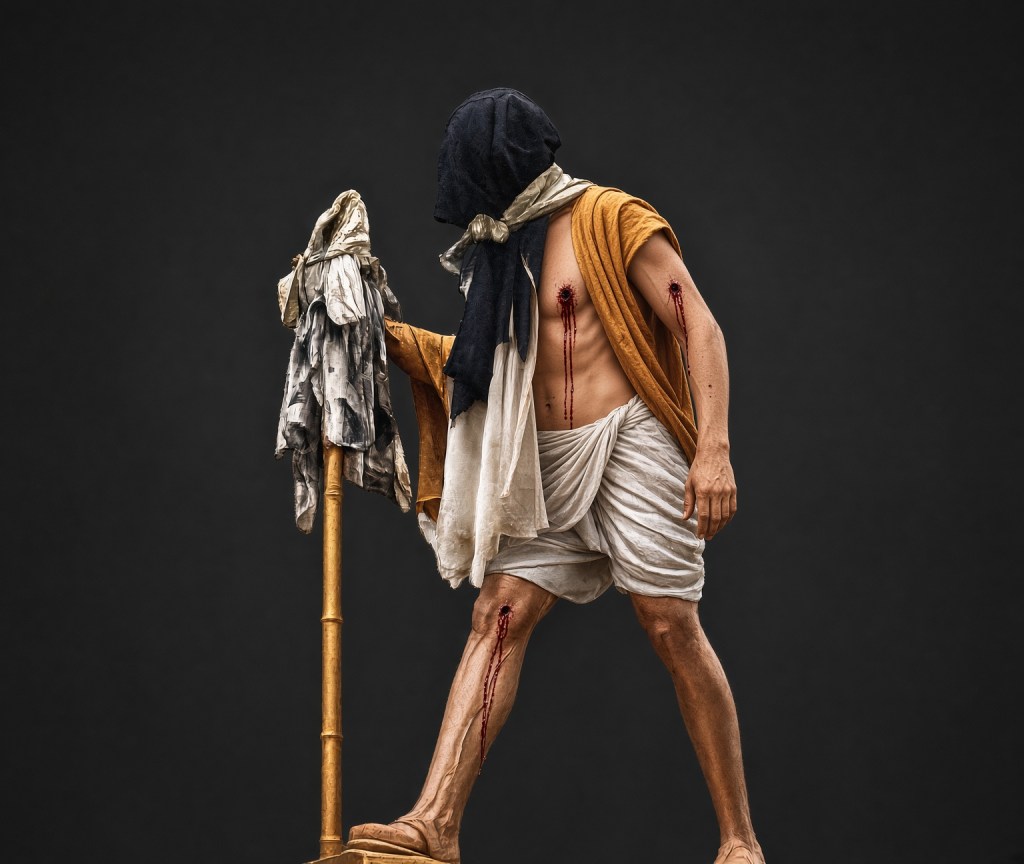
Shot dead on 30 January 1948 at Birla House by Nathuram Godse, a man formed in the RSS shakha and the Hindutva school of Savarkar;
Gandhiji was the first martyr of Hindu terrorism that the Sangh’s ideology breeds, and the one the Sangh has spent seventy-eight years trying to claim.
The foreign races in Hindusthan must either adopt the Hindu culture and language, must learn to respect and hold in reverence Hindu religion, must entertain no idea but those of the glorification of the Hindu race and culture, i.e., of the Hindu nation and must lose their separate existence to merge in the Hindu race, or may stay in the country, wholly subordinated to the Hindu Nation, claiming nothing, deserving no privileges, far less any preferential treatment — not even citizen’s rights. — M. S. Golwalkar, We, or Our Nationhood Defined (1939)
Under these conditions the future of Hindustan seems very bleak. These ‘religions’ have ruined the country. And one has no idea how long these religious riots will plague Hindustan. (…) And we have seen how everyone is carried on the tide of blind faith. It is a rare Hindu, Muslim or Sikh who can keep a cool head; the rest of them take sticks and staffs, swords and knives and kill each other. — Bhagat Singh, “Communal Riots and Their Solution” (Dharmvar Fasad Te unha de ilaj), Kirti, June 1927
By Ramarajya I do not mean Hindu Raj. I mean by Ramarajya Divine Raj, the Kingdom of God. For me Rama and Rahim are one and the same deity. I acknowledge no other God but the one God of truth and righteousness. — M. K. Gandhi, Young India, 19 September 1929, p. 305
If Hindu Raj does become a fact, it will, no doubt, be the greatest calamity for this country… it is a menace to liberty, equality and fraternity. It is incompatible with democracy. Hindu Raj must be prevented at any cost. — B. R. Ambedkar, Pakistan or the Partition of India (1945)
I decided not only to make a clean break with the Sangh, but that I would widely publicise their casteist behaviour towards me. It would be my life’s work now to expose the reality of this dishonest Hindu Rashtra and Hindutva. I resolved to tear the veil of fake harmony from the face of the Sangh and its family of institutions and expose their real face in public. — Bhanwar Meghwanshi, I Could Not Be Hindu: The Story of a Dalit in the RSS (2020)
DISCLAIMER. This work is “polemical” by design. A demand for accountability is not a neutral act, and this one does not pretend to be. It is disciplined by fact. Three kinds of statement are kept apart: official record, including bans, convictions, acquittals, commission findings and notifications; allegations by named rights bodies, scholars and journalists, marked as reported, not adjudicated; and the OBMA analysis, offered as fair comment on a matter of public interest. Acquittals are stated. Every named person is a public actor in a public capacity. The critique falls on an organisation and an ideology, i.e., Hindutva. The plurality it is charged with erasing is the point. “Anti-Hindu” is the apparatus’s own smear: it converts criticism of a cadre into an attack on a phantasmic civilisation, so the cadre can hide inside the civilisation it claims to own.
0. Preamble: The Machinery Behind the Prayer
The state does not reproduce itself by force alone. Althusser’s decisive point was that alongside the Repressive State Apparatus (army/milita, police, courts, prisons) there stands a plurality of Ideological State Apparatuses (religion, schooling, family, media, culture) that work by consent and internalised normativity. Their genius is that they persuade the subject to police him/her-self: where the repressive apparatus compels obedience, the ideological one manufactures the obedient subject.
The wager of this work is that the RSS “understood” this before Althusser named it. Founded in 1925, it did not try in its first half-century to storm the state. It tried to saturate society: to build, in every locality, a cell in which a particular kind of subject would be forged through daily ritual, so that when state power came within reach the ground beneath it was already prepared. The shakha, the school, the trade union, the “tribal” ashram, the temple campaign, the WhatsApp University forward: each is a transmission belt, and together they form the most successful ideological apparatus in the contemporary history of the subcontinent.
A machinery of this grand design is not merely “culture.” Culture does not keep a supreme guide who nominates his own successor. Culture does not drill with the lathi under a saffron totem at dawn in tens of thousands of identical cells. Culture does not depute full-time, often celibate propagandists into a political party, a student union, a labour federation, a school board and a cow-protection squad, and then announce that none of these is “the RSS.” That announcement is the machinery’s favourite joke, and it has lasted a hundred years because the Republic has, perhaps, laughed along.
I. The Scaffold
The Sangh is not explained by belief alone. It is explained by how a belief is made to walk. Four lenses do that work. None is a decoration, and none is asked to do another’s job. Althusser names the transmission. Gramsci names the patience. Foucault names the gaze. Durkheim names the bond. Together they show a machine that does not wait on the state, because it has already built the subject who will staff it.
Althusser: the temple-shakha continuum. The daily shakha, the VHP-run temple precinct, the Vidya Bharati classroom and the bhajan mandali are simultaneously ritual spaces and ideological transmission belts. They interpellate individuals as subjects of Hindu nationalism, people who hear the call of so-called “Hinduness,” national (=monoreligious) duty and civilisational pride and recognise themselves in it, and who then reproduce majoritarian hegemony without being compelled. Religious institutions do not merely reflect state power; they constitute it at the molecular level of the puja, the pravachan, the yatra and the cow-protection rally.
Gramsci: the war of position. The RSS has fought a century-long war of position, the patient conquest of the trenches of civil society (schools, unions, temples, aesthetic and cultural forms) until moral and intellectual leadership is so pervasive that political power falls like ripe fruit. The BJP’s dominance since 2014 is not the cause of Sangh hegemony; it is its harvest. Hegemony is never total, which is why Ambedkarite, Left, peasant and universalist currents still contest the terrain.
Foucault: the gaze and the herd. The shakha is a machine of mutual surveillance: the swayamsevak is observer and observed, forming body and belief under the normalising gaze of the collective. Gau-rakshak networks function as distributed surveillance of minority life; anti-“love jihad” campaigns are biopolitical interventions that regulate the reproductive and intimate lives of populations along communal lines.
Durkheim: mechanical solidarity. Uniform, synchronised movement, rhythmic chant and the same ideological content repeated across tens of thousands of dispersed cells manufacture effervescence, a dissolution of the boundary between self and group, which is then bonded to a totem, the bhagwa dhwaj. The shakha does not express a pre-existing national feeling. It produces one.
The point of the scaffolding is practical, not decorative. The issue is not only how to imagine alternatives but how to understand the forces that narrow the horizon of possibility. This document is an attempt to render those forces structurally naked, to show their parts, their motion, their money and the bodies they have consumed, and to argue that a machine of this design cannot be reformed, only stopped.
II. The Argument in Brief
The case has seven limbs; each is developed in the Parts that follow.
- Origin without legitimacy. The RSS was born apart from and without participating in the freedom struggle and, at decisive moments, against it. Its ideological fathers petitioned the colonial state for clemency and urged Hindus to enlist in the imperial army while revolutionaries and Congress members went to prison. An organisation that claims to embody the nation took no part in liberating it.
- A totalitarian telos. The animating goal, the so-called phantasmatic Akhand Hindu Rashtra, is not a cultural aspiration but a constitutional programme: converting a plural, secular republic into an ethnic-majoritarian state in which minorities hold second-class citizenship on sufferance.
- A paramilitary body in civilian dress. The shakha joins ideological instruction with drill and lathi training under uniform and command. The Sangh keeps no public membership register, files no public accounts, and submits to no audit.
- A documented record of violence enjoying impunity. Over nine decades its formations and affiliates have been credibly implicated, by courts, commissions and rights bodies, in pogroms, lynchings, assaults on places of worship, and the terrorising of minorities and women. That violence is the ideology’s enforcement arm, and it is systematically made costless by a reproducible institutional loop.
- A recurring official verdict. The Republic has proscribed the RSS three times (1948, 1975, 1992). No ban was followed by genuine reform; each was lifted on undertakings of form or lapsed in review.
- Caste as method, not accident. The promise of Hindu unity is a recruitment technology aimed at those the caste order has already injured. Dalits and Adivasis are invited in as vanchit and vanvasi, words that rename oppression as neglect and indigeneity as forest-dwelling, and are used as the street energy of a project whose leadership, texts and ritual hierarchy remain Brahminical. Meghwanshi’s memoir is an X-ray of the organisation, not a personal grievance.
- Money without a ledger. An organisation with no registration, no published accounts and a vast real-estate, publishing, school and welfare empire, whose political arm took the lion’s share of the anonymous electoral-bond money, cannot ask to be trusted. The funding of the machine is the least-examined part of it, and the Part on money below puts the questions plainly.
From these the expose derives its demand: proscription.
III. Hindutva: The Ideological Architecture of an “Enemy-Nation”
Hindutva is a programme with authors, texts and a method. It begins by abolishing the many histories of the word “Hindu” and ends by manufacturing an internal enemy.
A. From geography to grievance
“Hindu” is an exonym. Its root is the Sanskrit Sindhu, the Indus; in Old Persian the initial sibilant becomes an aspirate, giving Hinduš, attested in Darius I’s Naqsh-e Rustam inscription (DNa, c. 6th century BCE) as the name of a satrapy, a territorial-administrative unit and not a creed. The Avestan Hapta Hendu is cognate with the Vedic Sapta Sindhu, “land of seven rivers.” Through Greek Indos, Latin India and Arabic al-Hind, the word named a geography for over a millennium. After the establishment of Islamic polities from the eighth century, Persianate chronicles began to use “Hindu” for non-Muslim inhabitants as against Muslim rulers: a civilisational distinction, not a doctrinal unity.
“Hinduism” as a single bounded religion is overwhelmingly a product of colonial modernity. The census and the codifier’s pen subsumed Vedic ritualism, Puranic devotion, Tantra, Shaiva Siddhanta, Vaishnava and Shakta streams, Vedanta and Mimamsa, village cults and tribal animisms under one governable label; texts such as the Manusmriti were elevated to the status of normative “Hindu law” despite their limited historical reach; and the enumeration of populations as discrete religious blocs hardened boundaries that had been porous.
The historical record contradicts every retrospective claim of civilisational unity. Shaiva and Vaishnava rivalries in medieval South India were entangled with contests for royal patronage; Shaiva-Jain conflicts show doctrine and patronage fused. Kalhana’s twelfth-century Rajatarangini records King Harsha of Kashmir (r. 1089–1101) appointing devotpatana-nayakas, “uprooters of deities,” to strip Shaiva, Vaishnava and Buddhist temples alike when the treasury demanded it. Dayananda Saraswati’s Arya Samaj waged internal war on idol worship, Puranic myth and Tantra. Reform presupposes plurality; contestation, not unity, is the tradition’s actual condition. Bhakti against priesthood, anti-caste protest against the Manusmriti, village goddess against Vedic fire, the atheist Charvaka against any god at all: Hindutva is the attempt to flatten that archive into one army.
Romila Thapar names the method in “Syndicated Hinduism”: the moulding of a diffuse set of traditions into a Semitic form, a historically attested teacher, a sacred book, a place of origin, an ecclesiastical structure, and conversion, none of which those traditions had required. Centralised authority, textual absolutism, an exclusivist boundary and a historical grievance are imported, and the import is called recovery. Ashis Nandy’s point is the next one, and it is not the same sentence. In The Intimate Enemy (1983) and in “The Twilight of Certitudes” (1998) he separates religion as faith from religion as ideology, and reads Hindutva as the second: a decultured mask, built under colonial cultural arrogance, copying the bounded religion it claims to be saving.
The Ramjanmabhoomi agitation converted a local sacred geography into a national symbol. Sanatana Dharma, the “eternal law” with no institutional centre, is then invoked as the timeless essence that binds the diversity into one body politic, borrowing the prestige of the timeless to naturalise the thoroughly contingent. The first victim of Hindutva is therefore not the Muslim. It is Hindu plurality, which must be murdered quietly so that the Muslim can be murdered loudly. The trajectory runs from geography to theology to ideology: the exonym becomes an essence, the essence becomes a nation, the nation becomes a barracks.
B. Savarkar and the coining of the “enemy”
The doctrine was named by Vinayak Damodar Savarkar in Hindutva: Who Is a Hindu? (1923), composed during and after his imprisonment in the Andamans. A Hindu, in his definition, is one for whom the land from the Indus to the seas is both pitribhumi (fatherland) and punyabhumi (holy land). The definition is engineered to exclude: for the Indian Muslim and the Indian Christian the holy land lies elsewhere, in Mecca or Jerusalem, so loyalty is structurally suspect and belonging conditional. In his 1937 presidential address to the Hindu Mahasabha at Ahmedabad Savarkar stated plainly that India could not be assumed a unitarian and homogeneous nation but contained two nations, the Hindu and the Muslim. Hindutva does not merely assert a majority; it manufactures an internal enemy as the precondition of its own coherence. Carl Schmitt’s claim that the political is constituted by the friend–enemy distinction found in Savarkar an Indian executor.
Savarkar could be a private atheist and a public theocrat because the god he needed was not a god. It was a boundary; the sacred was a passport office. Once belonging is soil plus holiness, every intermarriage, conversion, beef meal and call to prayer becomes a border incident. “Love jihad,” ghar wapsi, cow lynching and the anti-conversion FIR are not later corruptions of a noble idea. They are the idea doing what it was built to do: keep the enemy visible so that the nation can feel real.
C. Golwalkar and the German precedent
Where Savarkar supplied the definition, Madhav Sadashiv Golwalkar, the RSS’s second and formative Sarsanghchalak (1940–73), supplied the programme. In We, or Our Nationhood Defined (1939) he wrote that the “foreign races” in Hindusthan must either merge entirely into the Hindu nation, adopting its culture and language and learning “to revere the Hindu religion,” or remain “wholly subordinated to the Hindu Nation, claiming nothing, deserving no privileges, far less any preferential treatment — not even citizen’s rights.” In the same text he held up Germany’s treatment of its Jews as an object lesson:
To keep up the purity of the Race and its culture, Germany shocked the world by her purging the country of the semitic Races — the Jews. Race pride at its highest has been manifested here. Germany has also shown how well-nigh impossible it is for Races and cultures, having differences going to the root, to be assimilated into one united whole, a good lesson for us in Hindusthan to learn and profit by.
His later Bunch of Thoughts (1966) codified the doctrine under the heading “Internal Threats,” and named them: the Muslims, the Christians, and the Communists. Not the British. The empire the Sangh had stood aside from is not in the list. The enemy is the neighbour. He wrote it without euphemism: “In fact, we are Hindus even before we emerge from the womb of our mother. We are therefore born as Hindus. About the others, they are born to this world as simple unnamed human beings and later on, either circumcised or baptised, they become Muslims or Christians.” And of the Muslim: “whatever we believed in, the Muslim was wholly hostile to it. If we worship in the temple, he would desecrate it. If we carry on bhajans and car festivals, that would irritate him. If we worship cow, he would like to eat it. If we glorify woman as a symbol of sacred motherhood, he would like to molest her.” The coloniser is absent. The fellow citizen is the threat.
The Sangh’s later embarrassment is itself a datum. It has argued that We was a juvenile pamphlet, a loose adaptation of Babarao Savarkar’s Rashtra Mimansa, long out of circulation, and in recent years that it does not represent the RSS’s view. That is historically interesting and politically worthless. An organisation that spent three decades under the man who put his name to it, that still venerates him as Guruji, and that still treats minorities as a loyalty problem does not get to file the book under youthful excess. The lesson Golwalkar asked Hindusthan to “profit by” was not a metaphor. It was a method: mark a population as unassimilable, strip its claim to equal citizenship, and call the result nationhood.
D. Hedgewar and the yard before the book
Hedgewar built the machine. Golwalkar wrote its programme. The order in the books is the reverse of the order in the yard, and the yard is the older fact. To call him Doctorji and stop there is the Sangh’s first laundering. A physician who leaves the prison movement to found a Hindu drill is not a cultural reformer who later acquired a politics. He is the politics.
Keshav Baliram Hedgewar, a Nagpur Brahmin, orphaned in a plague and mentored by B. S. Moonje of the Hindu Mahasabha, had been inside the Congress and had gone to prison for sedition in 1921. That sentence is the whole of the Sangh’s claim that it was born in the freedom struggle. It is also the limit of the claim. The founding of the RSS, on Vijayadashami, 27 September 1925, was his decision to leave that road. The antagonist he organised against was not the empire that had jailed him. It was the Muslim neighbour, read through the Nagpur riots and through Savarkar’s Hindutva, then two years old. At the inaugural meeting were Hedgewar, Moonje, Ganesh Damodar Savarkar, L. V. Paranjpe and B. B. Tholkar. The brother of the ideologue, the Mahasabha patron, and the doctor: the genealogy is in the attendance list, and no later pamphlet can reopen it. He called it culture. What he built was a cell. A daily meeting, a saffron flag treated as guru, a uniform, a lathi, a command, and no public roll of who had come. The shakha is not an illustration of the later books. The books are commentaries on the shakha. A body that will not say who its members are has already decided that it will not say what they do.
He kept the organisation out of the struggle that would have given it a martyr, and the controversy is not a misunderstanding. In 1930, when he joined the Salt Satyagraha, he stepped aside from the Sangh for the duration and told swayamsevaks who wished to march to do so as individuals. The RSS, as the RSS, did not go. The distinction is the whole method, and it is the answer to every centenary claim of patriotic birth. A man may be jailed. The machine may not be implicated. Patriotism is permitted as a private errand and forbidden as a policy, because a policy would have bound the Sangh to a nation that was not yet Hindu, and to a Congress that would not make the Muslim the enemy. The RSS biographers reply that the oath spoke of freeing the Hindu nation from the British. An oath is not a prison term. He died on 21 June 1940, two years before Quit India. The abstention of 1942 is Golwalkar’s signature on Hedgewar’s form. An organisation that has already decided the primary enemy is the neighbour does not need a new order to stand aside from the empire. The stand is this: a founder who had seen the inside of a colonial jail, and then built a body that would not go to jail as a body, did not fail the freedom struggle. He declined it.
The foreign mirror is in the same circle, and the Sangh’s denial of it is the second laundering. On 19 March 1931 Moonje, Hedgewar’s mentor and a founder in the room, met Mussolini at the Palazzo Venezia, inspected the fascist youth apparatus, and wrote that every aspiring nation needed such organisations, that he had already started one conceived independently with similar objectives, and that he would praise the Balilla from a public platform in India and in England. The shakha predates the visit. It was not copied from a diary. It was recognised in one. A Hindu Mahasabha patron looked at a fascist children’s militia and saw his own project already underway. Hedgewar did not need to have stood in Rome. He had built the thing Rome was being asked to flatter. The controversy is not whether a letter proves a membership card. It is that the circle which founded the RSS looked at Balilla and called the resemblance a compliment. No organisation that still drills boys at dawn gets to file that compliment under someone else’s journey.
He left almost no book. That is not an innocence, and it is not a gap. It is a design. Golwalkar, whom he chose as successor, wrote the sentences Hedgewar had already drilled: the flag before the tricolour, the Hindu before the citizen, the daily body before the argument. Doctorji is the Sangh’s name for the man who made the argument unnecessary, so that a hundred years later the yard can be called service and the lathi can be called exercise. The programme could wait until 1939. The yard had been open since 1925. The ideological stand is not that Hedgewar was Golwalkar with a kinder face. It is that the kinder face is how the machine was made deniable, and the deniability is the offence.
E. The monolithic-totalitarian telos: Akhand Bharat
The Sangh’s horizon is the Akhand Hindu Rashtra: an undivided nation redrawn across the map of pre-Partition India and, in its maximal versions, pre-colonial South Asia, and defended as civilisational cohesion. Benedict Anderson’s point is the starting fact. The nation is imagined, because its members will never meet, and it is imagined as limited and sovereign. The Sangh does not inherit that limit. It redraws it. Akhand Bharat is an imagi-nation in the strict sense: a community produced by narrative, print, school map and daily drill, whose border is not the republic’s but the wound. Edward Said’s imagined geography names the structure. A collective fantasy is laid onto physical space, and existing borders are narrated as amputations from a living body awaiting restoration. That is the irredentist imaginary. Territory is claimed not as policy but as unrecovered limb. Pakistan is the cut. Bangladesh is the cut. In the further maps, Afghanistan, Myanmar and Sri Lanka are cuts too.
The map is only the outer edge of a prior killing, and the killing begins with the word. Hindu is an exonym. Its root is Sindhu, the river. Persian heard it as Hindu. Greek and Arabic carried the geography, not a creed. Hinduism, as a single bounded religion, is a colonial umbrella-term: the census and the codifier’s pen gathering Vedic ritual, Puranic devotion, Tantra, Shaiva and Vaishnava argument, village goddesses and tribal cosmologies under one governable label. There is no such thing waiting underneath the label to be recovered. There are South Asian plural traditions. They can be in relation. They cannot be bulldozed into a uniform Hindu without ceasing to be what they are. Unity is a relation among differences. Uniformity is the abolition of the differences. The Sangh says unity and builds uniformity.
Ambedkar had already refused the society the word invents. In Annihilation of Caste, he wrote that Hindu society is a myth, a collection of castes, and that the consciousness a Hindu carries is the consciousness of his caste, not of a people. The name itself, he noted, was foreign, given from outside. If Hinduism has a single identifier, it is not a theology. It is caste. That is the fact the Sangh’s samrasata exists to rename. A tradition with no common book, no common god and no common law is held together, where it is held, by graded inequality. To call that a nation is to promote the grading to a destiny.
What Hindutva cannot tolerate is the plurality it claims to embody. Shaiva against Vaishnava, Bhakti against the priest, Tantra against the smriti, the village goddess against the Vedic fire, the Charvaka against every god: contestation, not unity, is the archive. Colonial census had begun to pasteurise it. Hindutva finishes the job. Ashis Nandy called the method the semitisation of Hinduism: the importation, onto a diffuse and argumentative set of traditions, of centralised authority, textual absolutism, an exclusivist boundary and a historical grievance. Savarkar’s test, pitribhumi and punyabhumi, fatherland and holy land, is a membership rule of the Abrahamic type bolted onto practices that had no pope, no single book and no heresy court. The mirror-image is exact, and it is denied in the same breath as it is built. One people, one land, one enemy, one recoverable text. The ethnographic plurality is boiled off. What remains is a homogenised Hindu, pasteurised for the shakha, safe for the slogan, empty enough to be filled with an enemy.
The extremism is not a distortion of this construct. It is the construct doing what it was built to do. A monolith cannot explain a neighbour who will not merge, except as residue, infection or treason. Once the internal argument of the traditions has been abolished, the argument has to be had with someone outside them. Golwalkar could cite Germany’s purging of the Jews as a lesson and, in the same formation, rebuild the exonym as a bounded people on the model he said could not be assimilated. That is not a contradiction he failed to notice. It is the method. The form is borrowed. The content is whoever the form requires to be expelled. Caste, which Ambedkar named as the real binder, is kept in the kitchen and denied on the platform.
Partha Chatterjee’s correction of Anderson matters here. The colonial nation was not imagined in empty homogeneous time. It was split. The outer domain, economy and statecraft, was ceded to colonial modernity. The inner domain, culture, religion, family, was where sovereignty was first declared. The Sangh takes that inner domain and demands it become the state. The fragment is abolished. The spiritual is made territorial. Combined with the organic figure of the nation as a body whose members are mere limbs, rashtra-anga, dissent ceases to be disagreement and becomes disease, and purification is figured not as repression but as immune response. This is the grammar of totalitarianism in Hannah Arendt’s sense: an all-explaining ideology fused with an organisation built to remake society and, at the end, the subject.
Akhand Bharat is therefore a permission structure, not a map on a calendar. If the nation is a body, Pakistan is an amputation, the Indian Muslim a clot, the Christian convert a metastasis, the communist a fever, and the woman who will not breed for the demography war a refusal of duty. Once those metaphors are installed, policy writes itself: anti-conversion statutes, citizenship filters, love-surveillance, curriculum capture, and the street army that arrives when the statute is too slow.
The slogan gives the map away. When a critic of authority is told to go to Pakistan, the speaker has already abandoned Akhand Bharat. If the nation runs from the Indus to the seas, and Partition is an amputation awaiting restoration, then Pakistan is not abroad. It is the unrecovered limb. To send an Indian there is to send him to a province of the nation the Sangh claims to be reconstituting. The taunt works only if Pakistan is foreign, finished, and Muslim, which is the opposite of the irredentist imaginary. Both cannot be true in the same mouth. Either the map is real, and the slogan is nonsense, or the slogan is real, and the map is a poster. The Sangh keeps both, because they do different jobs. Akhand Bharat is for the shakha and the schoolbook, where loss can be worshipped. Go to Pakistan is for the street, where a Muslim, or a Hindu who will not conform, must be made extraterritorial on the spot. The imagi-nation expands in the lecture and contracts in the insult. That contraction is the confession. The undivided nation was never a place the dissenter could inhabit. It was a border drawn around him. The traditions that will not answer to the colonial umbrella-term are already outside it, and the caste the umbrella was invented to hide is the only thing holding the cloth up.
Moreover, the monolithic-totalitarian puritanism fails at the cloth. A body that claims an uncontaminated Hindu antiquity puts its boys in khaki, the cut of the colonial police it says it was born to outgrow, and holds them in a drill its own founder’s mentor had just praised in Mussolini’s youth militia. From 1925 to 1939 the uniform was khaki throughout. White shirts came in 1940. The shorts lasted more than ninety years, and in 2016, at Nagaur, the Akhil Bharatiya Pratinidhi Sabha replaced them with trousers and called the change convenience. That is an admission that the uniform had never been scripture. It was a costume, and the costume was imported.
The title of the 1993 critique by Tapan Basu, Pradip Datta, Sumit Sarkar, Tanika Sarkar and Sambuddha Sen is already the argument. Khaki Shorts and Saffron Flags names the two halves the Sangh pretends are one: the colonial drill-cloth and the religious pennant, a local Nagpur cell grown into a many-headed formation and dressed in an imagined past. The khaki is not a metaphor they imposed. It is the garment. The saffron is asked to sanctify it. Creating a Nationality, the 1995 study by Ashis Nandy, Shikha Trivedy, Shail Mayaram and Achyut Yagnik, names what the garment is for. The nationality is not recovered. It is created, and created out of a fear of the self: the plural, unmonolithic Hindu who will not stand in a square. A Western concept of the nation-state, at variance with the ways these traditions had managed difference, is filled by a mass religion for those who have lost the old bonds and not grasped the modern ones. The raised arm and the synchronised body were the compliment Moonje brought back from the Balilla. The saffron flag is asked to cover the debt. It cannot. A puritanism that needs a British tailor and a fascist parade-ground to feel like itself is not a recovery of the ancient. It is a colonial and European machine in a bhagwa drape, denouncing foreignness in a uniform it did not weave, and fearing, in the boy who will not wear it, the self it cannot survive. The purity is the speech. The derivation is the yard.
IV. Born Apart from the Nation: The RSS, the Freedom Struggle and the Murder of Gandhi
The Sangh’s central claim to legitimacy is that it embodies the nation. The record shows that when the nation was being wrested from imperial rule the Sangh was, at best, absent and, at decisive moments, obstructive.
A. The turn inward, by design
The RSS was founded at Nagpur on 27 September 1925 (Vijayadashami) by Keshav Baliram Hedgewar, who had himself taken part in Congress agitation and served a prison term for sedition in 1921. His decision to build the RSS was a decision to redirect Hindu energy away from the mass anti-colonial movement and toward internal “consolidation” against the Muslim. In 1930, when he joined the Salt Satyagraha as an individual, he took care to step aside from the Sangh’s leadership for the duration and instructed the swayamsevaks who wished to participate to do so as individuals. The founding logic located the primary antagonist not in the coloniser but in the fellow-colonised. That was not an oversight. It was the strategic core.
The khaki shorts, the drill and the obsession with “character” were not innocent scoutcraft. Where the revolutionaries and the Congress, however unevenly, tried to assemble a people against an empire, the RSS tried to assemble a Hindu against a Muslim under the empire’s nose. An organisation that tells the colonised that the real danger is the neighbour does the coloniser a service whether or not it files a report.
B. Against the freedom movement: the organisation stands aside
The absence was not a decision of August 1942. It was the organisation’s rule, applied whenever the freedom movement asked for a body rather than a boy. Quit India is only the clearest hour of a refusal that runs from the founding to the transfer of power.
When Congress launched Quit India in August 1942, the last great mass insurrection against British rule, met with mass arrests and firing, the RSS as an organisation stood aside. Golwalkar’s doctrine was that the Sangh would not be drawn into agitation against the government but would pursue the slow work of “man-making.” A Bombay government Home Department memorandum of the period, cited by A. G. Noorani in The RSS: A Menace to India, noted with something like relief that the RSS had scrupulously kept within the law and refrained from taking part in the disturbances. The Bhagat Singh archivist Chaman Lal has documented, from the movement’s own records and colonial files, the RSS’s studied non-participation and the absence of any RSS name from the roll of those who suffered for independence. There are no RSS martyrs of 1942 because, as a matter of policy, the RSS did not court the lathi or the prison. There are none from 1930 either, except the men Hedgewar had sent as individuals so that the Sangh would not have to go. A century of centenary claims has not produced the missing roll.
The wider Hindutva formation was not merely absent. It was on the other side of the barricade, and the men who were on the barricade said so. In Bengal the Hindu Mahasabha, with Syama Prasad Mookerjee as finance minister, shared power from December 1941 in Fazlul Huq’s coalition with the Muslim League. In July 1942 Mookerjee wrote to the British governor on how to combat the Quit India movement in Bengal, urging that the administration be run so that it “will fail to take root.” The Mahasabha, under Savarkar, urged Hindus to enlist in the British Indian Army on the slogan “Hinduise all politics and militarise Hindudom.” While Congress leaders filled the jails, the Hindutva formation stood on the side of the barracks.
Subhas Chandra Bose had already named the formation. In a signed editorial in Forward Bloc on 24 February 1940 he wrote that communalism would go only when the communal mentality went, and that the task belonged to Muslims, Sikhs, Hindus and Christians who had transcended it. On 4 May 1940 he wrote that the Hindu Mahasabha, and papers that had developed a rabid communalism, were emitting communal venom to poison the minds of Hindus. At Jhargram on 12 May 1940 he said the Mahasabha had sent monks and nuns with tridents to beg for votes, had entered politics by taking advantage of religion and had desecrated it, and that it was the duty of every Hindu to condemn it and banish the traitors from national life. Foreign imperialism, he had said, was the only enemy. The Mahasabha’s answer was a ministry with the League and a letter to the governor.
Bhagat Singh had said it earlier, and against a man his own comrades would avenge. In “Communal Riots and Their Solution,” Kirti, June 1927, he wrote that if religion were separated from politics, people of different religions could come together in politics, and that these religions had sunk India. When Lala Lajpat Rai, lion of the Punjab and then a leader of the Hindu Mahasabha, drifted into that politics, the revolutionary circle answered with a pamphlet: Rai’s photograph set beside Browning’s “The Lost Leader.” The lathi that killed Rai was still an imperial lathi, and Saunders was still shot for it. The pamphlet is the other half of the debt. A leader can be mourned as a victim of the Raj and refused as a recruit of the Mahasabha. The two facts do not cancel. They define the difference between an anti-colonial death and a communal politics.
The Sangh’s later claim on Bhagat Singh cannot survive the essay or the pamphlet. Chaman Lal has spent years setting the writings against the appropriation. The RSS does not debate the text, because the text is the refutation. Dattatreya Hosabale’s Sangh can hang the portrait. It cannot answer Kirti. The man it wants was writing, while Hedgewar was opening the yard, that the communal body was the sinking of the country. A formation that stood aside from the jail, wrote to the governor, recruited for the imperial army, and now borrows the face of the man who called that politics a sinking, has not inherited the freedom movement. It has waited until the movement was over, and then put on its dead.
C. Mercy petitions
Savarkar, the ideologue the Sangh venerates, submitted repeated clemency petitions to the colonial authorities from the Andamans, notably in 1911 and 1913, pledging loyalty and abjuring anti-government activity, and was released in 1924 on conditions of political quiescence, confined to Ratnagiri district. The chains were real. So were the petitions. An anti-colonial hero does not bargain his way into political quietude and then recruit for the empire’s war. The Sangh’s need to sanctify Savarkar is the need to sanctify a genealogy in which the nation is Hindu first and free second.
D. The tricolour refused; the Constitution mourned
The Sangh’s relation to the symbols of the free nation is of a piece. Its English weekly Organiser on the eve of independence (14 August 1947) disparaged the tricolour and insisted that the saffron pennant alone could command Hindu allegiance. The RSS did not hoist the national flag at its Nagpur headquarters on Republic Day or Independence Day for decades; in January 2001 three young men who entered the premises to hoist it were prosecuted by the state (they were acquitted in 2013), and the Sangh began its own flag-hoisting only from 2002. And on 30 November 1949, the Organiser complained that the new Constitution contained nothing of Manu. That sentence should be carved above every debate about whether the Sangh has “accepted” the Constitution. Acceptance, in the Sangh’s practice, is a tactic: a document is saluted when salute is the price of legality and hollowed when power makes hollowing cheap. Ambedkar wrote a constitution to annihilate the legal force of Manu; the Sangh’s first published instinct was to mourn the annihilation.
Legitimacy in a post-colonial republic is grounded in participation in its founding: in the anti-imperial struggle and the constitutional settlement that followed. The Sangh possesses neither claim. Its patriotism is retroactive and appropriative: it seeks to own a freedom it did not help to win, in order to license a nation it means to remake.
E. Gandhi’s murder
Gandhi had a precise view of the organisation. Pyarelal records him, after a Delhi visit in September 1947, characterising the RSS as a communal body with a totalitarian outlook. Four months later, on 30 January 1948, Nathuram Godse shot him dead at Birla House on his way to evening prayers.
Godse had been formed in the RSS shakha in Maharashtra and later worked with the Hindu Mahasabha and Savarkar’s circle. At trial he claimed to have left the RSS; his brother Gopal Godse, also a conspirator, told Frontline in 1994 that all the brothers had grown up in the RSS (“You can say we grew up in the RSS rather than in our home”) and that the claim of Nathuram’s departure was a fiction advanced to protect Golwalkar and the Sangh after the murder. The Special Court convicted Godse and Narayan Apte, who were hanged on 15 November 1949; Savarkar was acquitted on the ground that the approver’s evidence lacked corroboration, though the Kapur Commission (1969) later held that the facts taken together destroyed any theory other than a conspiracy to murder by Savarkar and his group.
But the Home Minister who banned it was no man of the left. Vallabhbhai Patel wrote to Syama Prasad Mookerjee on 18 July 1948 that, while the case against the Mahasabha and the RSS was sub judice, reports confirmed that as a result of the activities of these two bodies, particularly the RSS, an atmosphere had been created in which such a ghastly tragedy became possible. He recorded reports that RSS men had expressed joy and distributed sweets after the murder. To Golwalkar in September 1948 he wrote that the Sangh’s speeches were “full of communal poison” and that “as a final result of the poison, the country had to suffer the sacrifice of Gandhiji.” He also told Nehru that he did not believe the RSS as such had hatched the conspiracy, attributing it to a fanatical wing of the Hindu Mahasabha around Savarkar. Both sentences belong in the record. The first is why the Republic banned the RSS. The second is why the Sangh has spent seventy-five years quoting Patel selectively.
The genealogy has not been abandoned. It has been given a shrine and a stage. On 15 November 2017, the anniversary of the hanging, the Hindu Mahasabha laid a foundation in its Daulatganj office in Gwalior after the district administration had refused it land for a Godse temple. A bust was installed. A pran pratishtha was performed. Panchamrit was distributed as prasad. The national vice-president, Jaiveer Bharadwaj, said the temple stood on the Mahasabha’s own property, and that Godse was a great nationalist who had once stayed there. The Republic had denied the plot. The formation consecrated the office.
On 30 January 2019, in Aligarh, Puja Shakun Pandey of the Akhil Bharat Hindu Mahasabha shot an effigy of Gandhi stuffed to bleed, with a toy pistol. A red liquid ran from the cloth. The effigy was then burnt. Sweets were distributed. A statue of Godse was garlanded to the slogan that he was a mahatma. The day the Republic calls Martyrs’ Day the Mahasabha called Shaurya Divas, and Pandey said she was starting a tradition, the murder to be done every year as Ravana is burnt at Dussehra. An FIR was registered. The tradition was the point, not the toy. Gandhi had been made the “demon”, and the demon is what an effigy is for.
In May 2019 the BJP’s Bhopal candidate Pragya Thakur called Godse a patriot. The Prime Minister said he could never forgive her from the heart. She remained in the party and in parliament, and the ticket was not the last. The apology was for the camera. The candidacy was the policy. A temple in an office, a mannequin made to bleed, a candidate kept after the rebuke: Godse’s bullet was not a bolt from a clear sky. It was weather, and the weather is still being worshipped.
V. The Explosion of Hindutva in the Neoliberal Era
The market atomised; Hindutva re-aggregated, but along communal rather than class lines. That sentence is the whole of Part III.
A. Liberalisation and the affective economy
The reforms begun in July 1991 dismantled the licence-permit-quota regime, privatised state assets, liberalised finance and integrated India into global capital circuits. They produced winners (corporate capital, metropolitan enclaves, an aspirational middle class) and a vast surplus of precarity: agrarian distress, informal labour, welfare retrenchment. David Harvey’s accumulation by dispossession names the mechanism by which public assets and entitlements are transferred to private capital; the grievance it generates cannot be spoken in the vocabulary of market individualism, which has no word for loss that is collective.
Hindutva offered what the market could not: affective cohesion, collective pride, conjured genealogical meaning, civilisational dignity. Economic dislocations were reframed not as structural consequences of global capital but as symptoms of historical injustice, “minority appeasement” and civilisational decline. The class solidarity that liberalisation had defeated was replaced by the counterfeit belonging of the mob, and the possibility of subaltern class alliance was defeated with it. The BJP, which had won two Lok Sabha seats in 1984, rode the Ramjanmabhoomi mobilisation (the 1990 Rath Yatra, the 1992 demolition) to national power within a decade; the neoliberal order did not weaken identity politics, it supplied its fuel.
B. Babri and the Gujarat model
The demolition of the Babri Masjid on 6 December 1992 is the hinge of the conjuncture. It demonstrated Hindutva’s ability to convert religious sentiment into political action outside electoral mechanisms, in front of the cameras, with the state’s police and a Chief Minister’s affidavit as decor. The 2002 pogrom in Gujarat (taken up in Part VIII) paradoxically inaugurated Narendra Modi’s national ascent. The “Gujarat model” fused aggressive liberalisation with assertive Hindu identity politics, offering Indian capital modernisation without the disruptions of redistribution: social change without democratisation, growth with a designated enemy. “Development with Hindutva” became a governing formula in which pro-business policy and majoritarian consolidation reinforced each other.
C. State power after 2014: the Hindu Rashtra imaginary
The BJP’s supposed majorities of 2014 and 2019 institutionalised the fusion nationally, and the word supposed is the fact. In 2014 the party took 282 seats on about 31 per cent of the vote. In 2019 it took 303 on about 37. The first-past-the-post machine turned a third of the country into a mandate, and the mandate was then spoken as the people. Market reforms ran beside the ideological ones, and the pairing was the method. GST, the privatisation drives, the four labour codes, the three farm laws of 2020, withdrawn in November 2021 only after a year of protest at the gates of Delhi: each transferred risk downward and called it reform. Beside them, the abrogation of Article 370 in August 2019, done without the consent of the people it unmade; the Citizenship Amendment Act of December 2019, which for the first time made religion a criterion of Indian citizenship; anti-conversion statutes spreading across states; state-funded temple construction culminating in the Ayodhya consecration of January 2024; the Waqf (Amendment) Act of 2025; bulldozer demolitions used as punishment before trial; electoral bonds that hid the donors until the Supreme Court struck the scheme down in 2024. The 2019 amendments to the Unlawful Activities (Prevention) Act let the state designate an individual a terrorist and made bail near-impossible. Giorgio Agamben’s state of exception names the logic. The extraordinary stops being extraordinary. A raid, a bulldozer demolition, a midnight amendment, a bond: each is a one-off until the one-off is the government.
The Sangh’s penetration of the state is not rhetorical. In July 2024 the central government withdrew the office memoranda of 1966, 1970 and 1980 that had barred civil servants from RSS activity. Critics read it, correctly, as permission for the bureaucracy to be staffed from the shakha. The 2024 election, in which the BJP fell to 240 seats and governed only with allies, did not slow the machine. It showed that the machine does not need an outright majority to administer. Hegemony, in Gramsci’s sense, was already in the schools, the press and the street. A reduced Lok Sabha tally is not a reduced shakha.
The market did not merely tolerate the Sangh. It required it. Neoliberalism after 1991 transferred public assets to private hands and then had to explain the loss to the people who had lost them. It had no language for a collective injury. Class would have named the winner. A union, a farm law resisted, a wage demanded, a spectrum questioned, a port asked after: any of these would have pointed at the monopoly. Hindutva pointed elsewhere. The dispossessed were handed a wound that was medieval, a neighbour who was Muslim, a cow, a daughter, a demography, and told that the injury was civilisational rather than a balance sheet. Accumulation by dispossession produces the grievance. The shakha launders it. Religious extremism of the Sangh variety is the foreclosure. It occupies the place where a class politics would have stood, and it occupies it with a feeling strong enough to make the enclosure look like a destiny. Ambani, Adani and Piramal can take the port, the airport, the spectrum and the temple contract because the lane is busy with a different enemy. The farmer at the border of Delhi in 2021 was the exception that proves the need: for a year the rage pointed at the law and the law was withdrawn. Everywhere else the rage is pointed at the neighbour, and the law stands. The monopoly is the economy. The pogrom, the demolition, the citizenship filter and the bond are the alibi. Without the manufactured rage, the privatisation would have had to answer for itself. With it, the answer is always the other.
VI. Anatomy of the Octopus: The Sangh Parivar Machine
The RSS does not act alone. It acts through a parivar (family) of more than fifty major affiliates; estimates of the wider periphery run past a hundred, and to two thousand and more when regional and peripheral cells are counted. It operates like a decentralised corporate group with the RSS as holding company, supplying ideology and, above all, people. It is the most elaborate exercise in civil-society saturation the subcontinent has produced.
A. The nucleus
At the centre stands the RSS proper, a male-only cadre organisation. Its apex is the Sarsanghchalak (supreme guide; presently Mohan Bhagwat), who nominates his own successor and serves without term. Beneath him the Sarkaryavah is the executive head, supported by several Sah-Sarkaryavahs for regions and functions. Policy is deliberated in the Akhil Bharatiya Pratinidhi Sabha and the Akhil Bharatiya Karyakarini Mandal. The sinew of the organisation is the pracharak, a full-time worker, frequently celibate, extracted from ordinary kinship and posted where the family needs a spine: a state unit of the BJP, a VHP campaign, a Vanvasi Kalyan ashram, a campus cell. Both Narendra Modi and Atal Bihari Vajpayee began their public careers as pracharaks. The BJP’s organising secretaries, the people who actually run its machinery, are by long convention pracharaks deputed from the RSS.
The unit is the shakha, the one-hour daily meeting on an open ground. By the Sangh’s own reports in March 2025 there were about 83,129 daily shakhas, with tens of thousands of weekly and monthly gatherings in addition; later reporting in 2026 claimed a rise toward 89,000 daily shakhas and a household outreach (Grih Sampark) that had reached ten crore homes. These are the Sangh’s figures, unaudited and unverifiable, cited here as confession of scale and not as fact.
B. The family, by function
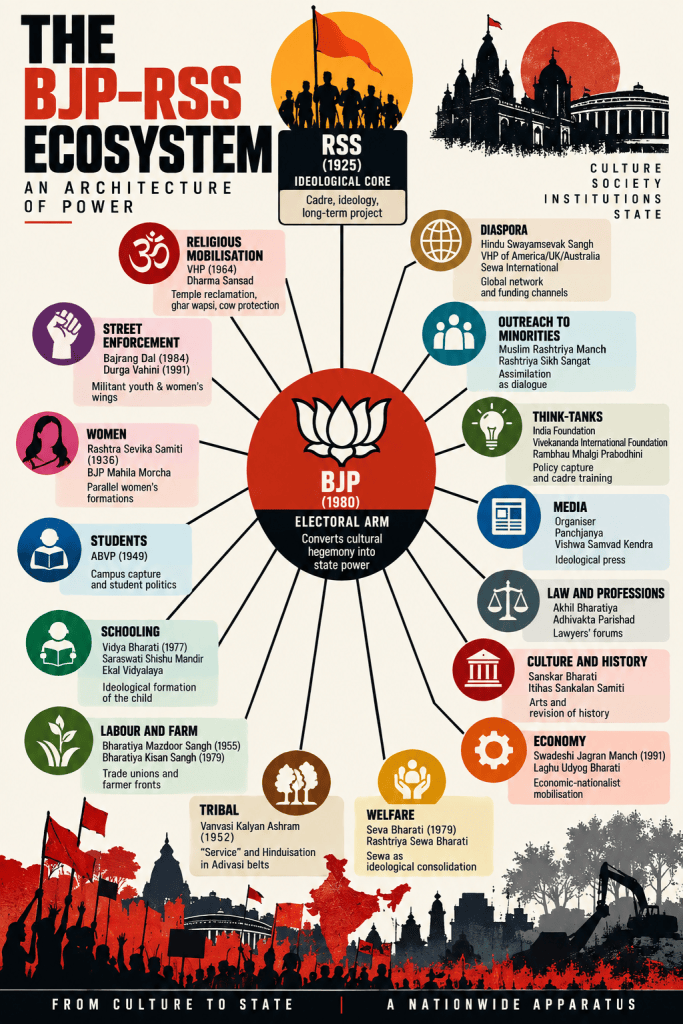
| Domain | Principal affiliate(s) | Function |
|---|---|---|
| Electoral | Bharatiya Janata Party (1980); Overseas Friends of BJP | Parliamentary instrument; converts cultural hegemony into state power |
| Religious mobilisation | Vishwa Hindu Parishad (1964); Dharma Sansad; Margdarshak Mandal | Ecclesiastical legitimacy; temple reclamation (Mandir Mukti), ghar wapsi, cow protection |
| Street enforcement | Bajrang Dal (1984); Durga Vahini (1991); Hindu Jagran Manch; gau-raksha networks | Militant youth and women’s wings; the deniable physical arm |
| Women | Rashtra Sevika Samiti (1936); Matri Shakti; BJP Mahila Morcha | Parallel women’s formations; patriarchal order under a nationalist banner |
| Students | Akhil Bharatiya Vidyarthi Parishad (1949) | Capture of campuses and student politics |
| Schooling | Vidya Bharati (1977), Saraswati Shishu Mandir, Ekal Vidyalaya, Bharatiya Shikshan Mandal | Tens of thousands of schools; ideological formation of the child |
| Labour and farm | Bharatiya Mazdoor Sangh (1955); Bharatiya Kisan Sangh (1979) | Largest trade-union federation; neutralises class solidarity |
| Tribal | Vanvasi Kalyan Ashram (1952) | “Service” and Hinduisation in Adivasi belts; anti-conversion frontier |
| Welfare | Seva Bharati (1979), Rashtriya Sewa Bharati, Deendayal Research Institute | Sewa as ideological consolidation |
| Economy | Swadeshi Jagran Manch (1991), Laghu Udyog Bharati, Sahakar Bharati, Akhil Bharatiya Grahak Panchayat | Economic-nationalist mobilisation; small-trader, cooperative and consumer fronts |
| Culture and history | Sanskar Bharati, Itihas Sankalan Samiti | Arts, and the revision of history |
| Law and professions | Akhil Bharatiya Adhivakta Parishad; Poorva Sainik Seva Parishad | Lawyers’ and ex-servicemen’s forums |
| Media | Organiser (English), Panchjanya (Hindi), Vishwa Samvad Kendra | Ideological press; narrative dissemination |
| Think-tanks | India Foundation, Vivekananda International Foundation, Rambhau Mhalgi Prabodhini | Policy capture; training of political cadre |
| Outreach to minorities | Muslim Rashtriya Manch, Rashtriya Sikh Sangat | Fronts that present assimilation as dialogue |
| Diaspora | Hindu Swayamsevak Sangh, VHP of America/UK/Australia, Sewa International | Export of the apparatus and its funding channels |
The VHP, founded on 29 August 1964 (Janmashtami) by Golwalkar, S. S. Apte and Swami Chinmayananda, was conceived to solve a structural weakness of Hindutva: the absence of a centralised religious authority. Its Dharma Sansad of religious leaders lends ecclesiastical legitimacy to political agendas without formally subordinating established institutions to a non-religious body. It claims some 6,700 branches in over 600 districts and chapters in more than two dozen countries; its departments include Sewa, Dharma Jagran (reconversion), Gau Raksha, Sanskrit promotion and festival coordination; and its campaign repertoire, from the Ramjanmabhoomi movement through Mandir Mukti to the Beti Bachao, Bahu Lao campaign against interfaith marriage, is the religious wing of the same project. Its Bajrang Dal and Durga Vahini, taken up in Part VIII, are what the family sends when the statute is too slow.
This is the war of position Gramsci described: not the frontal assault on the state but the patient conquest of the trenches of civil society, the school, the union, the temple, the cultural form, until moral and intellectual leadership is so pervasive that political power falls like ripe fruit. The BJP’s dominance since 2014 is not the cause of Sangh hegemony. It is its harvest.
C. The opacity: an unregistered power
Here the structure discloses its most telling feature. The RSS is not a registered society or trust. It issues no membership cards, maintains no public membership roll, and has historically published no audited accounts. In November 2025, in Bengaluru, Mohan Bhagwat answered critics who asked why a body of this scale remains unregistered by saying that the RSS is recognised as a “body of individuals,” that registration is not mandatory, and, in a sentence that deserves to be quoted every time the question is raised, that “even Hindu dharma is not registered.” He added that the organisation had been banned three times and that by banning it the government had itself recognised it. The comparison of a volunteer corps with a faith is the deniability doctrine stated in its purest form.
The opacity is not a bureaucratic accident. Deniability is a design specification. It lets the family disown the deeds of its fronts and the fronts disown the deeds of their cadres in an infinite regress of “we cannot be held responsible for individuals.” When the wire is invisible, command can be denied; when command can be denied, the lynch mob has no author. That is not a mystery of Indian sociology. It is an engineering choice. An entity that seeks the powers of a state while refusing the accountabilities of an association is, on its face, a candidate for regulation.
VII. Why the Machine “Works”
It is not enough to list the organs. The question that matters is why a hundred-year-old cadre organisation with no public ledger and a documented record of enabling violence has become the most powerful extra-parliamentary body in the Republic. Seven mechanisms, each of them a design choice, answer it.
1. The shakha manufactures the subject before it persuades him/her. In an open ground at dawn or dusk the swayamsevak undergoes drill, yoga, lathi exercise, patriotic song, collective prayer and bauddhik (ideological) instruction. In Althusser’s terms ideology here does not exist as idea but as practice, inscribed through daily repetition into muscular memory until the nation becomes kin and kinship becomes command below the level of conscious deliberation. The flag stands at the axial centre as totem; every body faces it. The shakha does not express national feeling. It produces it. A child who has stood in that line for ten years has no need to be argued with.
2. It sells belonging to the injured. Neoliberal India atomised its people and dissolved older solidarities of class, village and union. The shakha offers a ready-made brotherhood: a uniform, a rank, a song, a rota, a place to be seen. Colonial ethnography’s caricature of the “effeminate Hindu male” left a wound in the masculine self-image, which Ashis Nandy and Sudhir Kakar both read as the soil of nationalist hypermasculinity; the drilled, upright, martial swayamsevak is that wound’s compensation. The offer is irresistible to the lonely, the humiliated and the ambitious, and costs only the ability to refuse the next order.
3. The pracharak is the hidden wire. The full-time celibate worker, owing nothing to family, career or electorate, is the one resource no party can manufacture. He is posted into the BJP, the VHP, the ABVP, the Vanvasi ashram, and carries the Sangh’s will with him. Because he is invisible in law, command can always be denied.
4. It owns the child. Vidya Bharati’s own reports speak of some 12,000 formal schools across most districts, thousands of informal centres, more than three million students and a teaching force counted in lakhs, alongside Saraswati Shishu Mandirs and Ekal Vidyalayas in tribal belts. The Sangh calls this value education. Values are never empty. A child who learns maps in which Akhand Bharat is the wounded truth, a history in which the medieval is only temple-breakage, and a civics in which the minority is a guest, is being pre-loaded, not educated. The Itihas Sankalan Samiti and the textbook revisions of BJP-ruled states finish the job at the level of the syllabus.
5. Sewa is the soft edge of the same fist. Disaster relief, blood banks, hostels and ambulances are not a counterweight to the cadre. They are how the cadre arrives. The Vanvasi Kalyan Ashram’s hostel comes as service and stays as Hinduisation. Relief after a flood is a recruiting drive and a brand. The laundering is the point. A body that runs a camp after a calamity can, when its men lynch someone, point to the camp and call itself a welfare organisation. The bandage and the lathi are not two organisations. They are two uses of one.
6. It controls the story. Panchjanya and Organiser set the line. Vishwa Samvad Kendras brief the reporters who will carry it. The BJP’s IT cell, the paid and volunteer networks Swati Chaturvedi documented in I Am a Troll, and the forwards that now pass as WhatsApp University repeat it until repetition becomes knowledge. Godi media, the television that sits in the lap of crony saffron power, gives the line a studio, a chyron and the face of a debate. This is manufacturing of consent in the strict sense: not an argument won, but an atmosphere installed, in which the abducted cow, the seduced Hindu daughter and the illegal conversion arrive before the facts and outlive them. The rumour does not follow the violence. It authorises it. By the time the mob moves, the public has already been told what it saw. The riot’s apparent spontaneity is the last effect of the design.
7. It has made itself the state’s colleague. Pracharaks now sit in the ministries. Swayamsevaks sit in the police and the bureaucracy, formally permitted since the July 2024 withdrawal of the bar on civil servants joining the RSS. Sangh-linked appointees sit in the universities and the cultural bodies. The loop now closes in both directions. The state feeds the machine with concessional land, grants, security and access, and the machine staffs the state. The sacralisation is no longer at the margin. On 28 May 2023 the new Parliament, the legislature of a secular republic, was inaugurated with sadhus and sanyasis, a homam, and the installation of the Sengol beside the Speaker’s chair: a golden sceptre narrated as the dharmic transfer of power, a claim historians have disputed and the ceremony did not need to be true in order to do its work. A Constitution that bars the state from establishing religion was asked to watch a priestly rite consecrate its own house. This is why a change of government does not end the problem. The problem is not a government. It is a method of governing that has learned to survive governments, and to dress the survival as tradition.
There is a last reason the machine works. It is rarely met on its own ground. Its critics publish. It assembles, every morning, in more than eighty thousand places. The war of position is won wherever the opponent takes the editorial for the trench and the election for the war. The Sangh is not waiting to be answered. It is already in the school, the street and the office, and an argument that does not occupy those places is not an opposition. It is a comment on one.
VIII. The Money: Who Pays for the Machine?
A hundred thousand daily cells, uniforms, camps, a national press, hundreds of buildings, tens of thousands of schools and projects, and a political party that spends more on a single election than most states spend on health: somebody pays. The electoral arm of the family is the most richest party in the republic, a double superlative earned twice, once in declared income and once in the anonymous bond money of which it took nearly half. The Sangh’s answer for itself is one word, dakshina. This Part sets out what is on the record, what is alleged, and what nobody outside can answer, because the Sangh has arranged things so that nobody outside can.
A. The official story: guru dakshina
The RSS says it is funded by guru dakshina, voluntary offerings made by swayamsevaks once a year, around Guru Purnima, to the saffron flag, which the Sangh designates its “guru.” Mohan Bhagwat repeated the claim in November 2025: the organisation functions through the dedication of its volunteers and is funded by their contributions, not by outsiders.
The flag-as-guru is a legal artefact. According to A. G. Noorani, the RSS amended its constitution on 1 July 1972, on legal advice and during income-tax litigation, to designate the bhagwa dhwaj as guru and to recast offerings as guru dakshina held at the level of individual shakhas rather than as central funds. The income-tax department had first issued notices in 1967–68; reporting on the litigation says the courts later accepted the RSS’s argument that such contributions fall under the mutuality principle of tax law. In other words, the offering to the guru was built, in part, to defeat the taxman. And the organisation that says it is merely “a body of individuals” with no central treasury is, at the same time, the holder of vast property through a lattice of trusts and committees that can be inspected only to the extent that trust law requires.
Nobody outside the organisation knows how much is collected, from whom, in what amounts, or where it goes. There is no register of donors, no audited consolidated statement, no annual report. The first question is therefore the simplest: what is the total, and who has audited it?
B. The buildings
The scale of the physical estate is visible even if its accounts are not. In February 2025 the RSS shifted into Keshav Kunj at Jhandewalan in Delhi: three towers, some 300 rooms, auditoriums, a library, a hospital, a Hanuman temple, on about four acres. The RSS itself put the cost at ₹150 crore. Karnataka minister Priyank Kharge said the complex could be mistaken for a luxury hotel and put it nearer ₹200 crore, and asked how guru dakshina pays for a building of that class. At Nagpur, the nerve centre, the Reshimbagh Smruti Mandir campus is being rebuilt. In August 2026 the Times of India reported a redevelopment of about ₹300 crore, a new Maharshi Vyas auditorium at its centre, older blocks to come down, a seven-storey block to follow, the money said to be volunteer contributions raised on an appeal by the Sarkaryavah, with no government or CSR funds. That is the Sangh’s account of its own books. The public record shows the other tap. In 2017 the Nagpur Municipal Corporation approved ₹1.37 crore of municipal money for a compound wall and an internal road on the RSS-owned Smruti Mandir, over the objection of opposition corporators that taxpayers were paving a private body that is not even registered. In September 2026 a flyover of about ₹998 crore, built by the state, was opened in Nagpur and named for Hedgewar, the centenary gift of a government to the founder of an organisation that files no public accounts. Delhi, Nagpur, the municipal wall, the flyover: if a body without registration can build, rebuild and be built for at this scale, the question is no longer whether dakshina can reach ₹150 crore. It is what else is on the books, and who is auditing it.
C. Politics: the bond bonanza
The BJP is a separate legal entity, but it is the electoral arm of the same family and its chief administrators are deputed RSS-Sangh pracharaks. The funding of that arm is therefore the funding of the Sangh’s state-capture project. Between 12 April 2019 and 24 January 2024, according to data the Election Commission published after the Supreme Court’s order, the BJP encashed electoral bonds worth ₹6,060.5 crore, about 47.5 per cent of the ₹12,769 crore encashed by all parties; the Trinamool Congress took ₹1,609.5 crore and Congress ₹1,421.9 crore. The two largest donors were Future Gaming and Hotel Services (₹1,368 crore) and Megha Engineering (₹1,200 crore). On 15 February 2024 the Supreme Court held the electoral-bond scheme unconstitutional, citing the citizen’s right to know who funds politics. A scheme in which the ruling party took nearly half of all anonymous corporate money, from donors whose contracts and licences the government controlled, was running for six years before the court said so. The Court’s judgment did not undo the habit; the question of what was bought, and by whom, remains open.
D. Foreign money, diaspora money
The Sangh’s diaspora and charity arms (Hindu Swayamsevak Sangh, VHP of America, Sewa International, the India Development and Relief Fund, Ekal Vidyalaya foundations abroad) raise money in dollars and pounds under the banner of relief and education. In November 2002 a report by the Campaign to Stop Funding Hate, The Foreign Exchange of Hate, examined the US charity IDRF, which had raised about $ 3.8 million in 2000 and disbursed $ 1.7 million, and found that its list of supported projects included Vanvasi Kalyan Parishad, Sewa Bharati, Ekal Vidyalaya and the Bajrang Dal itself, with IDRF officials reporting favourably on Sangh leaders involved in anti-Christian campaigns in Gujarat. IDRF and its allies denied the charge; the report establishes association and routing of money to affiliates, not a legal finding of wrongdoing, and it prompted several corporations to suspend matching-gift programmes pending clarification. Two decades on, the pattern it exposed (relief money as the front end of a network whose back end is the Parivar) has only been refined. Twitter’s multi-million-dollar relief gift to Sewa International, a body that rights watchdogs tie to the RSS, drew criticism from the same quarters.
The questions for Indian regulators are plain: which Sangh affiliates hold FCRA licences, how much foreign contribution has each received since 2010, and what has been spent on what?
E. The temple economy: ₹5,400 crore and its leaks
The Ram Mandir campaign is the largest fundraiser in the Sangh’s history, and the least reconciled. The VHP-led Nidhi Samarpan Abhiyan ran from January to February 2021 and, by the Trust’s own reckoning reported in June 2022, drew over ₹5,400 crore, even as roughly ₹22 crore in donor cheques bounced. In June 2021, AAP and Samajwadi Party leaders alleged that the Trust had bought a plot at Bagh Bijaisi, Ayodhya, for ₹18.5 crore minutes after it had been sold for ₹2 crore, and named the general secretary Champat Rai and the trustee Anil Mishra. The Trust denied it. No court has found it. The allegation stands as an allegation, which is already more scrutiny than the purchase has had.
In June 2026 a Special Investigation Team of the Uttar Pradesh government found lapses and inadequate supervision in the handling of donations. Rai and Mishra resigned on what were called moral grounds. Eight people, among them temple staff who counted the offerings and a former driver of Rai, were arrested for theft of cash and jewellery on CCTV. The SIT’s report in August 2026 cleared Rai and Mishra personally, left the eight in jail, and recovered about ₹80 lakh. The state’s own investigators have therefore established this much: money offered to the most politically charged temple in the country walked out of the counting room. They have not established who designed the room so that it could.
A figure in the Sangh’s own press, ₹3,264 crore received as of 31 March 2026, does not obviously reconcile with the ₹5,400 crore claimed in 2022. The gap is not a rounding error. It is either unspent, uncounted, transferred, or explained in a ledger nobody outside the Trust has seen. The open questions are the audit. How do the two totals meet? What was spent, on what, and by whose sanction? Who valued the Bagh Bijaisi plot, and who signed the minutes? Why did the counting room leak, and why was the supervision inadequate enough that the general secretary resigned? Who audits the Ram Janmabhoomi Teerth Kshetra Trust, and to whom does that auditor report? Until those are answered in public, loot is not a finding. It is the question the finding refuses to close.
F. BJP and RSS: Crony Corporate “piety”
The machine’s wealth is also social, and the social form is a nexus: guru, corporate, state, party, in one frame, with the street army left outside the photograph. In 2024 the Sangh press celebrated, as sewa bhav, the consecration of an ISKCON temple inside Piramal Vaikunth, a luxury gated community in Thane, presided over by Radhanath Swami, a governing-body member of ISKCON whose circle runs through India’s largest corporate dynasties. ISKCON is not a Sangh affiliate, and Gaudiya Vaishnavism is not Hindutva. The distinction is useless once the frame is set. The guru consecrates the builder’s property. The builder’s property consecrates the guru. The Sangh editor calls it service.
The same compact sat in the open at the Ambani wedding of July 2024. The Shankaracharyas of Dwarka and Jyotirmath, Radhanath Swami, Gaur Gopal Das, Baba Ramdev, the priest of Bageshwar Dham, and Sadhvi Ritambhara of the VHP’s own campaign occupied one room with the owners of Reliance and the Prime Minister, who took their blessings on camera. Gautam Adani, absent from that particular aisle, had already done his part at the other altar: present in the corporate chorus at the January 2024 consecration in Ayodhya, describing the temple as the nation’s gateway, and announcing Adani Foundation money for Indology doctorates, the cultural wing of a group whose ports, power and airports are matters of state. No contract is signed in the wedding photograph. None has to be. Piety converts into legitimacy for capital, capital buys proximity to the government, and the government is staffed by the party the Sangh deputes. The guru is the solvent. He makes a balance sheet look like a civilisation.
This is not charity, and it is not mere theology. It is the upper storey of the same building whose ground floor is the shakha and whose basement is the mob. The billionaire never has to name the Bajrang Dal. The Dal never has to name the billionaire. The Prime Minister stands between them and calls it culture. That is the nexus. Guru, corporate, state, party: four faces, one sanction, and a street arm that does not need to be invited to the wedding because the wedding has already decided what the street is for.
G. The performed enemy: “Boycott China” in the chant, MNCs in the cheque
Swadeshi is the Sangh’s most successful lie, because it is spoken in the yard and broken in the ledger, and the yard never sees the ledger. The boy is taught that China is the cut, the import, the virus, the map’s missing limb. The men who teach him sell the morning to a Chinese-backed wallet, sit for an hour with the Chinese party, and call the sitting a courtesy. The word swadeshi does not describe a policy. It describes a permit: to hate the foreigner in the speech, and to invoice him in the contract.
In January 2026 a delegation of the Communist Party of China, led by Sun Haiyan of the Party’s International Department, spent an hour at the RSS headquarters, Keshav Kunj in Delhi, with the Sarkaryavah Dattatreya Hosabale. The same tour took in the BJP and the Congress. Both sides called it a courtesy call. The RSS said the request came from Beijing and that there was no agenda, except a curiosity about how the Sangh functions. That emptiness is the datum. The International Department is the CPC’s instrument for reading parties that outlast governments. It did not come to the foreign ministry. It came to the unregistered body and asked how the machine works. A formation that lists Communists among Golwalkar’s three internal threats, and that brands its domestic critics Chinese agents, sat for an hour with the cadre party of the People’s Republic and offered no communiqué. Congress mocked the anti-communist Sangh for the hospitality. The mockery is correct and insufficient. The meeting is not a conversion. It is a recognition. One Leninist apparatus came to measure another. The enemy in the shakha lecture is not the enemy in the headquarters diary. Swadeshi, on that afternoon, was a slogan the host had left at the door.
The same split has a front page. On the morning of 9 November 2016, after the Prime Minister had voided 86 per cent of the currency at four hours’ notice, Paytm took the nation’s newspapers with his photograph and a salute to the boldest decision in the financial history of independent India. The company that carried the face was, by the reporting of its ownership, on the order of forty per cent held by Alibaba and Ant Financial. Demonetisation, sold as a nationalist sacrifice and chorused as a strike against Chinese counterfeit, delivered its most visible windfall to a wallet underwritten by Chinese capital. Kejriwal asked why the Prime Minister was in the advertisement. The PMO said it could not say who had sought permission. Notices followed. An apology followed. The face was lent and then disowned. In the same weeks the Sangh’s own economic wing, the Swadeshi Jagran Manch, was calling Paytm a Chinese conspiracy and warning, through Ashwani Mahajan, of the stake and the data. One hand of the organisation performed swadeshi for the base. The other hand’s figurehead sold the morning to the wallet. The Manch was not a conscience. It was a costume. It denounced the Trojan horse while the horse carried the leader’s photograph, and it did not stop the advertisement, the stake, or the queue. A swadeshi that cannot veto its own front page is not an economic doctrine. It is a mood, issued to people who will never see the cap table.
The oligarchs do not line up as Beijing’s men, and the exposé that says they do will be the exposé that loses. The record splits, and the split is the charge. Anil Ambani’s Reliance Communications was financed by three Chinese state banks, ICBC, the China Development Bank and the Export-Import Bank of China. He defaulted. A London court in 2020 found him personally bound by the guarantee. His lawyers told the court his net worth was effectively zero. That is adjudicated, and it drew nothing like the noise reserved for a student slogan. Mukesh Ambani’s Jio is the alibi, and the alibi is on the share register. In 2020, in the months of Galwan, Jio Platforms raised more than $20 billion for about a third of itself. Reliance Industries kept roughly two-thirds. The outside book, as still reported into 2026, is Meta at about 9.99 per cent through a Delaware vehicle, Google at about 7.73, then KKR, Vista, Silver Lake, General Atlantic, the Saudi Public Investment Fund, Mubadala, the Abu Dhabi Investment Authority, TPG, L Catterton, Qualcomm. No Chinese name is on that list. Ambani said Jio used no Chinese equipment. Washington called it a clean telco and used it as a stick against Huawei. That is the speech. The cheque, for the network, was American and Gulf, which is not innocence. It is a choice of patron, made while the border was the headline.
The technology queue tells the other half. In January 2026 Bloomberg reported that Reliance had paused its India battery-cell plan after talks to license lithium-iron-phosphate technology from China’s Xiamen Hithium stalled, Beijing having tightened the export of clean-energy know-how. The gigafactory announced to shareholders as a swadeshi pivot could not start without the Chinese cell. The group went to Xiamen for what the yard says India must not buy. Adani, in the same season, was reported in talks with CATL and BYD. The brother who fell, Anil, was left to ICBC, the China Development Bank and the Export-Import Bank of China, and a London court. The brother who remained was allowed a Western book and a Chinese manual. Swadeshi, applied to Mukesh, stopped at the cap table and did not reach the factory. The clean share register is what the Sangh shows the boy. The stalled licence from Xiamen is what the boy is not shown.
Adani is the test the swadeshi slogan was built to fail. The OCCRP reporting of 2023 named Chang Chung-Ling, a Taiwan-based investor of long standing with the group, in offshore vehicles around it: directorships, a Mauritius entity, an alleged overnight gain routed through a merger with Adani Power. Adani denies it. No court has fixed it. The denial is not an acquittal of the formation. It is the formation’s method. The closest oligarch to the regime keeps his book in Mauritius, and the Sangh that can trace a student’s tweet to a foreign hand cannot trace a promoter’s share to a named man. Taiwan is not the People’s Republic, and the distinction is the escape hatch, not the defence. A swadeshi that stops at the flag and never reaches the cap table of the group that builds the ports, the airports and the power was never meant to reach them. It was meant to be shouted at a campus. The boycott is for the poster. The offshore company is for the ally. Applied honestly, the test would have opened the book. It was not applied, because the book is the regime.
Piramal is not the missing Beijing wire, and he does not need to be. Piramal Pharma Solutions lists a sourcing office in Shanghai, an associate company of Piramal Pharma Ltd., and the group’s own China-plus-one papers record what that office was for: critical materials of which, in FY2024, thirty were judged high-risk because supply ran through China alone, and a China sourcing bill that the company itself put at $32 million in 2022 before it cut the figure to $7 million by 2025. The reduction is the company’s defence. The office is the fact. No stake in a Chinese state bank has to be invented for the name to sit in the ledger.
What places him with Ambani and Adani is not a common foreign owner. It is a common proximity. All three are inside the RSS–BJP ecosystem of patronage, temple and the politics of spectacle. ISKCON’s Radhanath Swami (a guru with legal-conflicts) consecrates the Piramal gated community and stands in the Ambani wedding frame. The Sangh’s press calls it sewa bhav. The word is the same word the shakha uses for a flood camp and a lynching alibi. A Shanghai sourcing office, a guru, a luxury temple and a swadeshi slogan are not four stories. They are one vocabulary, spoken by men who do not have to choose between the yard and the contract. Swadeshi stops at the ashram gate. Inside, the cloth is imported and the blessing is domestic.
What survives the sorting is harder than the conspiracy, and it is the regime. Ambani, Adani and Piramal are not three foreign policies. They are the BJP–RSS compact in three balance sheets: the temple, the photograph, the airport, the port, the gated consecration, the guru who calls it sewa bhav. Chinese capital moves through that compact by profit. It financed the brother who fell, and a London court fixed the guarantee. It sat, on the company’s own papers, in a Shanghai sourcing office and a battery licence sought from Xiamen. It took the front page on the morning the cash was voided. It did not have to buy the Sangh. The Sangh had already decided that the nation was a feeling, and the feeling could be supplied while the contract was signed.
Swadeshi is not missing because it failed. It is missing because it was never the economy. The economy is neoliberal market fundamentalism with the nationality filed off: capital from Delaware, Abu Dhabi, Riyadh, Shanghai, wherever the “profitable” return is, and a state that clears the ground. Nationality would have meant a book, a veto, a border that bound the donor as it binds the student. There is no such border. Boycott China is for the lane. The cheque is for the headquarters. The hour at Keshav Kunj, the Paytm face, the Xiamen queue and the London judgment are for the men who do not stand in the yard.
Religious fundamentalism is the technique that forecloses the question. Akhand Bharat puts a cut called China on the school map so that the boy will not ask who invoiced the cut. The Muslim, the conversion, the cow, the love-squad: exclusive, divisive, narrow, and useful, because a lane riot cannot read a cap table. The Sangh can host the CPC and call a critic a Chinese agent for the same reason it can let the Swadeshi Jagran Manch denounce Paytm while Paytm sells the leader. The enmity is instrumental, and it is aimed inward. A puritanism that cannot boycott its own donors is not puritanism. It is a drill, performed so that the market can proceed without a nation, and the nation can be shouted without a market.
H. Questions the Sangh must answer on money-trails
- What is the total amount of guru dakshina collected each year, by shakha, by state, and who audits it?
- Why does an organisation with an estate of this size insist it is a “body of individuals”?
- Which trusts hold RSS-used land and buildings, who are the trustees, and what do their accounts show?
- What share of the BJP’s electoral-bond money came from entities that subsequently won government contracts, licences or relief from investigation?
- Which Sangh affiliates received foreign contributions since 2010, and which were investigated or had licences suspended?
- What are the audited accounts of the Ram Janmabhoomi Teerth Kshetra Trust, and why did the counting room leak?
- How are pracharaks, who own nothing and draw no salary, housed, fed, transported and insured, and by whom?
- What do the Sangh’s thousands of schools and projects spend, and how much of that is public money?
IX. Arms, Drill and the Hindutva Terror Cases
Two features distinguish the Sangh from an ordinary pressure group: the physical-force character of its formation, and the recurring appearance of its ideological milieu in cases of organised bombing. This Part keeps what the courts decided apart from what the record suggests, and refuses to let the first erase the second.
A. The paramilitary lineage
The uniform, the drill, the rank and the salute were not Vedic. In March 1931 B. S. Moonje, Hedgewar’s mentor and a senior Hindu Mahasabha leader, travelled to Italy, met Mussolini in Rome, and toured Fascist youth institutions, including the Opera Nazionale Balilla and military academies. His diary, studied by the historian Marzia Casolari in an essay in Economic and Political Weekly (2000), records his admiration: this, he wrote, was what India and especially Hindu India needed, a way to militarise Hindu society. Returning, he founded the Central Hindu Military Education Society and, in 1937, the Bhonsala Military School in Nashik. The RSS’s khaki shorts, black cap, staff and parade ground are of this lineage: European in form, Hindu in costume. The Sangh abandoned the khaki shorts for brown trousers in 2016, but the lathi, the drill and the command structure remain.
Each Vijayadashami the Sangh performs Shastra Puja, the worship of weapons, at its annual foundation-day rally; the cadre’s officers are formed in annual Sangh Shiksha Varg camps at Nagpur and in the provinces. The 1948 Home Ministry communiqué banning the RSS charged its members with collecting illicit arms and circulating leaflets that exhorted terrorist methods. The Sangh has since insisted that the lathi is a yoga prop. A staff is not a rifle. But the discipline that makes a body answer before the mind does is the same discipline, and ordinary associations do not need it.
B. Training in arms: the Bajrang Dal and the camps
The Bajrang Dal does not train in secret. It trains in daylight, on school grounds and in procession, and calls the weapon a sacrament. Its akharas and shaurya camps teach physical combat and, by repeated journalistic record, the handling of weapons, under the single alibi of Hindu self-defence. In May 2022 it held a week-long camp, 5 to 11 May, at the Sai Shankar Educational Institute in Ponnampet, Kodagu. Participants were filmed with air guns and tridents. Its leaders said the programme was culture, history and self-defence, and that the discussion touched love jihad, conversion and cattle slaughter. The BJP government of the day took no action. In the same state, girls were being kept out of classrooms for a hijab. A school could be closed to a scarf and opened to an air gun, and both decisions were called order.
The camp is the rehearsal. The procession is the performance. Trishul deeksha, the initiation in which tridents and swords are distributed to youth and an oath is taken over them, is not a folklore revival. It is an arms issue with a priest attached. It has been filmed in Bhilwara, in Ahmedabad, in Jammu, and it has not stopped. The oath in Ahmedabad in January 2025 was for a Hindu Rashtra, taken with the trident in hand. The Ram Navami procession is the same rite at street scale, and it is one instance among many. The 2022 report Routes of Wrath, introduced by the senior advocate Chander Uday Singh, documented the pattern across that April: larger than usual gatherings of saffron-clad men, swords and trishuls drawn, routes mapped through mosques and Muslim neighbourhoods, slogans about who may live in the coming Hindu Rashtra. In Himmatnagar, Sabarkantha, men carried swords into Ashraf Nagar. A second rally, led by VHP and Bajrang Dal cadre after police had refused it, went in anyway. Mosques, dargahs, houses and shops were looted and burnt. In Khargone the same season ended in demolition of Muslim homes. At Jahangirpuri in Delhi, on Hanuman Jayanti, armed participants were filmed and the violence followed. In 2023 the pattern repeated. In Biharsharif, Nalanda, petrol bombs, a madrasa library burnt, a Hindu flag planted on a mosque, minors of thirteen filmed with swords and iron rods, a police officer telling The Hindu that the weapons had been distributed the day before. In Howrah the procession took an unauthorised route with swords, and the Chief Minister asked in public how they had the audacity. The question answers itself. They had it because no one had taken the sword away the year before.
The training is not the crime-in-itself, perhaps. The crime is that it is conducted openly, under a banner, in the expectation that nobody will ask who is being trained to fight whom. A lathi in a shakha can be called exercise. A trident distributed at a deeksha, carried through a Muslim lane on Ram Navami, and raised while a slogan names the residents as provisional, is not exercise. It is an order of battle with a festival permit. A body that fuses theological absolutism, a doctrine of the endangered faith, uniformed discipline and physical-force training is structurally of a type, whatever its scale and whatever it calls the type. The Arms Act has a provision for this. The state that watches a sword pass a mosque and calls it religion has decided, in advance, not to use it.
C. The saffron terror cases: what the courts decided
Between 2006 and 2008 a cluster of bomb attacks on Muslim places of worship and a train were investigated first as the work of Islamist groups and then, after the Maharashtra Anti-Terrorism Squad under Hemant Karkare and later the National Investigation Agency followed the evidence, as the work of a network of Hindutva-aligned individuals, including the Abhinav Bharat milieu. Swami Aseemanand gave a magistrate a confession (later retracted) describing a bomb ka badla bomb, “a bomb for a bomb,” ideology. The phrase “saffron terror” entered official discourse. The outcomes are stated here exactly:
| Case | Date | Killed | Outcome |
|---|---|---|---|
| Malegaon (Muslim cemetery, Friday prayers) | 8 Sept 2006 | dozens (reports vary) | Initial arrests of Muslim men; later the NIA moved toward Hindutva-linked accused; no conviction of Hindutva-linked accused |
| Samjhauta Express | 18 Feb 2007 | 68 | All four accused, including Aseemanand, acquitted by an NIA court at Panchkula, March 2019; the judge wrote that the prosecution had “miserably failed” to prove the charges |
| Mecca Masjid, Hyderabad | 18 May 2007 | 9 | All five accused, including Aseemanand, acquitted, April 2018; the judge resigned the same day |
| Ajmer Dargah | 11 Oct 2007 | 3 | Two, Devendra Gupta and Bhavesh Patel, convicted in March 2017 and sentenced to life; Aseemanand and others acquitted |
| Malegaon (motorcycle bomb) | 29 Sept 2008 | 6 | All seven accused, including Pragya Singh Thakur and Lt Col Prasad Purohit, acquitted by a special NIA court on 31 July 2025: “suspicion is not enough” |
| Nanded (bomb accident) | 6 April 2006 | 2 (Himanshu Panse, Naresh Rajkondwar) | Nine accused linked to the RSS, VHP and Bajrang Dal acquitted on 4 January 2025 for want of reliable evidence; the court noted the organisations had never been designated terrorist |
The honest position is that the investigations established, to the satisfaction of the investigating agencies, the existence of a Hindutva-linked bombing network, while the courts convicted in one case and acquitted in the rest, amid serious and unresolved questions about the integrity of the prosecutions. In the Samjhauta trial, as reported, twenty-five of 299 prosecution witnesses turned hostile, fingerprint evidence was never presented and no identification parades were held. The special public prosecutor in the Malegaon case, Rohini Salian, said in 2015 that she had been asked by an NIA officer to go soft; the NIA, for its part, alleged in 2024 that the Maharashtra ATS had planted evidence to frame Purohit and others. The Sangh cites the acquittals as vindication and calls “saffron terror” a myth. Critics attribute them to turned witnesses and to a prosecutorial energy that visibly slackened after 2014, when the political fortunes of the accused’s milieu reversed. The reader is entitled to both facts.
Other facts are not in dispute. Hemant Karkare, who exposed the network, was murdered in the Mumbai attacks of 26 November 2008. Pragya Thakur, who was among those he arrested, said in April 2019 that she had cursed him and that he died because of her curse. The BJP nevertheless made her a Lok Sabha candidate. Sunil Joshi, a former RSS pracharak whom investigators named in connection with several of the blasts, was shot dead in Dewas in December 2007; the case closed in 2017 with every accused acquitted. What cannot be dissolved into the acquittal columns is the ideological neighbourhood. Men do not bomb a dargah from inside liberalism. They bomb it from inside a story in which the Muslim shrine is a wound and the blast is surgery, and that story is Hindutva’s story. Courts may fail to pin an organisation. The story still has authors.
D. Questions on arms and militancy
- What exactly is taught in the Sangh Shiksha Varg and in Bajrang Dal “shaurya” camps, who funds them, and who inspects them?
- Which weapons licences are held by the Sangh’s office-bearers and affiliates, and how many weapons were seized from affiliates in the last decade?
- Why was openly advertised armed training by the Bajrang Dal not prosecuted, and would a comparable camp run by any minority organisation have gone unchallenged?
- Why, after the acquittals, has the state not examined the prosecution failures in the Samjhauta, Mecca Masjid and Malegaon cases, and who was held responsible?
- Who shot Sunil Joshi, the former pracharak named by investigators in several of the blasts, and why did the investigation end with every accused acquitted?
- If the Sangh is a cultural organisation, why does it train the body before the mind and drill children in a command structure?
X. The Street Army: Documented Violence Against Muslims, Christians, Dalits and Women
Ideology, at the limit, requires enforcement. The Sangh’s enforcement arm is the Bajrang Dal, founded at Ayodhya in 1984 as the VHP’s militant youth wing, with its women’s counterpart the Durga Vahini (1991) and the wider gau raksha ecosystem. Its deliberately loose structure, critics argue, exists precisely to insulate the VHP and RSS when violence occurs. It has been described as a militant or extremist formation in the US State Department’s religious-freedom reporting, in a 2018 CIA World Factbook entry (later removed), and in the internal security assessments of a major technology platform (Part X). Human Rights Watch, the US Commission on International Religious Freedom and Citizens for Justice and Peace have documented its activity across three decades. What follows is a sourced selection weighted toward cases with judicial proceedings, commission findings or multi-source documentation. Reported incidents of 2024–26 are attributed to the monitoring bodies that compiled them and are marked as reported, not adjudicated.
The Sangh does not find an enmity. It manufactures one, and then calls the manufacture a memory. The mechanism has a sequence, and the sequence is the psychology.
First the wound is installed. A temple broken eight centuries ago, a partition the organisation did not fight, a demographic table read as a siege: the injury is chosen, dated, and repeated until it feels inherited. Golwalkar’s list did the sorting in advance. The Muslim is the internal threat. The British, who were in the room, are not. The wound is never the empire. It is the neighbour.
Then the wound is made present. History is collapsed into the lane. The man at the butcher’s shop is narrated as the heir of the temple-breaker, the woman in the burqa as the heir of the abductor, the child in the madrasa as the future majority. Sudhir Kakar, in The Colors of Violence, described the communal riot as a persecutory fantasy in which the enemy male is the sexual rival and the rumour of the taken daughter is the warrant. The Sangh industrialises the rumour. Love jihad, the cow, the birth rate: three doors into the same room, each of them a story in which the Hindu is already the victim and the Muslim is already the thief.
Then victimhood is converted into a right. The boy who has been told, every morning, that his mother is besieged does not experience the stick as aggression. He experiences it as restoration. Ashis Nandy’s wounded male, coded effeminate by the colonial power and answered by the Sangh with a drill, gets his proof in the lane. Revenge is not named revenge. It is named defence, ghar wapsi, protection. The nausea Sahni put in the courtyard has already been drilled out. What follows can be called spontaneous, because the spontaneity was rehearsed.
The last step is the confirmation. The violence produces the fear that was alleged at the start. A burnt shop, a emptied lane, a video: the Muslim recoils, and the recoil is screened as hostility, and the hostility is filed as the reason for the next rally. The narrative eats its own evidence. Islamophobia, in this formation, is not a prejudice that sometimes spills. It is a machine for turning a manufactured injury into a permission, and the permission into a fact, and the fact into the next injury.
The cases below are not illustrations of a mood. They are the mood completing its circuit.
A. Against Muslims
Gujarat, 2002. After the Godhra train fire of 27 February 2002, which killed 59 and which the Nanavati-Shah Commission found to be arson by a local mob, three months of violence followed. An official reply to Parliament in 2005 put the dead at 1,044 (790 Muslims, 254 Hindus), with 223 missing and about 2,500 injured; the Concerned Citizens Tribunal and other civil-society tallies put the total far higher. Human Rights Watch’s “We Have No Orders to Save You” (April 2002) documented the participation of Bajrang Dal and VHP activists in coordinated mob attacks, arson and sexual violence, with credible evidence of advance planning and of police inaction amounting to state complicity; the National Human Rights Commission recorded a comprehensive failure of the state to protect. At Naroda Patiya 97 were killed; at Gulberg Society, the dead included former Congress MP Ehsan Jafri. In July 2012 a special court convicted 30 people for Naroda Patiya, including BJP minister Maya Kodnani and Bajrang Dal leader Babu Bajrangi, who was given life imprisonment; the Gujarat High Court in 2018 acquitted Kodnani and upheld Bajrangi’s conviction. About 200 people, from roughly 600 accused, had been convicted by 2022. The Nanavati-Shah Commission gave a clean chit to the then chief minister and to the BJP, VHP and Bajrang Dal as organisations, and the Supreme Court-appointed SIT closed the complaint against Narendra Modi in 2012, a finding the Supreme Court upheld in June 2022 when it dismissed Zakia Jafri’s petition. These findings are stated because they exist. They cannot wash the contemporaneous rights record, the individual convictions, or the political fact that the pogrom did not end the career of the state’s chief minister; it inaugurated his national ascent.
That ascent is the political theorem: mass state-supported genocide was not a career-ending scandal but a credential. An ideology that treats the Muslim as internal enemy will always find a way to narrate a pogrom as grief management. The train fire was real and hideous. The conversion of 59 dead into a licence for neighbourhood extermination is the Hindutva move in its pure form: one crime authorised as the metaphysical repayment of another.
Bilkis Bano. On 3 March 2002 a mob in Randhikpur, Dahod, gang-raped Bilkis Bano, then 21 and five months pregnant, and killed 14 of her family, including her three-year-old daughter. Eleven men were sentenced to life in 2008. In August 2022 the Gujarat government remitted their sentences and released them, whereupon they were reported to have been garlanded and fed sweets at a public reception. The Supreme Court struck down the remission in January 2024 and ordered them back to prison. The loop in one case: conviction, then remission, then felicitation, then reversal because one woman would not stop.
Economic communalism and ghettoisation. Beyond spectacular violence, reports by Citizens for Justice and Peace and the PUCL document a sustained campaign to segregate Muslim economic and residential life in Gujarat: intimidating those who sell property to Muslims, obstructing Muslim traders, and driving the ghettoisation of Ahmedabad and Vadodara. This structural violence rarely reaches the headlines and operates continuously as a condition of minority life.
Cow vigilantism as everyday terror. Human Rights Watch’s Violent Cow Protection in India (2019) found that between May 2015 and December 2018 at least 44 people, 36 of them Muslim, were killed in cow-related mob violence across a dozen states, with about 280 injured in over 100 incidents; police stalled prosecutions of attackers while pursuing charges against victims. The named cases entered the national record: Mohammad Akhlaq, beaten to death in Dadri, Uttar Pradesh, in September 2015 over a rumour of beef in his refrigerator (when one accused died in custody in 2016, his body was wrapped in the national flag and a union minister attended the funeral); Pehlu Khan, a dairy farmer lynched in Alwar, Rajasthan, in April 2017 after being filmed by his attackers, six of whom were acquitted in 2019; Junaid Khan, stabbed on a train to Mathura in June 2017; Alimuddin Ansari, killed in Ramgarh, Jharkhand, in June 2017, eight of whose eleven convicted killers were garlanded by a Union minister of state in July 2018 after the High Court granted them bail; Tabrez Ansari, forced to chant Hindu slogans and beaten in Jharkhand in June 2019, dying days later. ACLED later recorded a rise in cow-protection political violence and more than 50 related fatalities from 2016 to 2020. The cow is not the point; the cow is the warrant. The point is that a Muslim body on a road can be made killable by a rumour, a video and a crowd that expects to go home.
Delhi, February 2020. Violence in north-east Delhi killed 53 people, most of them Muslims. A Delhi High Court bench under Justice S. Muralidhar, hearing petitions on the night of 26 February, ordered the police to register FIRs on the inflammatory speeches of BJP leaders; he was transferred out of the court the same night. Since then, courts and the Supreme Court (in November 2024) have criticised the practice of punitive demolition of Muslim homes after communal incidents, the bulldozer idiom of the impunity loop, but the idiom persists.
“Love jihad” vigilantism. The conspiracy theory that Muslim men systematically seduce Hindu women toward conversion has licensed a distributed apparatus of surveillance and assault on interfaith couples. Anti-conversion statutes in BJP-ruled states, such as Uttar Pradesh’s 2020 ordinance, give the rumour a uniform. Reports compiled by Citizens for Justice and Peace describe, among others, a January 2022 incident in Karnataka in which Bajrang Dal members forcibly detained a Muslim man and a non-Muslim woman travelling together on a train, and a November 2025 incident in Indore in which a Muslim gym trainer who had protected an elderly Muslim shopkeeper from vigilante harassment was himself jailed while the vigilantes were not acted against. The biopolitical logic is explicit: the regulation of the intimate lives of a population along communal lines. The couple is not a couple. They are a demographic event.
B. Against Christians
Dangs, Gujarat, 1998. HRW’s Politics by Other Means: Attacks Against Christians in India (1999) documented the burning of dozens of churches and prayer halls in a campaign in which Bajrang Dal and Hindu Jagran Manch activists were named as principal perpetrators, culminating in a rally of over 4,000 in Ahwa on Christmas Day 1998, at which anti-Christian slogans were chanted while police stood by, followed immediately by attacks on churches, missionary schools and shops. The National Commission for Minorities described the central government as a “silent spectator.”
The Staines murders, 1999. In January 1999 a mob led by Dara Singh, widely described as a Bajrang Dal activist, burned alive the Australian missionary Graham Staines and his sons Philip (10) and Timothy (6) as they slept in their station wagon at Manoharpur, Keonjhar, Odisha. The Wadhwa Commission found no evidence that Staines had forced conversions. A sessions court sentenced Dara Singh to death in 2003; the Orissa High Court commuted that to life imprisonment in 2005, and the Supreme Court upheld the life term on 21 January 2011. In August 1999 Dara Singh was also accused of hacking and burning the Muslim trader Sheikh Rehman before a crowd.
Kandhamal and Mangalore, 2008. After the murder of VHP leader Swami Lakshmanananda Saraswati on 23 August 2008, for which Maoists claimed responsibility, violence was turned onto Christian settlements across Odisha’s Kandhamal district: dozens killed, thousands of homes and hundreds of churches burnt, tens of thousands displaced, women reporting sexual violence. The following month attacks on churches and prayer halls across Dakshina Kannada and Udupi in Karnataka, including the assault on the Adoration Monastery in Mangalore, prompted fact-finding by the National Commission for Minorities and complaints before the Karnataka State Human Rights Commission. The pattern was the Gujarat pattern in a different register: a spark, a ready cadre, a police force that discovers patience.
The monitoring record, 2014–2026. The United Christian Forum’s compilations record a steep rise in documented attacks on Christians, from between 127 and 151 in 2014 to 505 in 2021, 734 in 2023 and 834 in 2024, with UCF reporting early-2025 violence at a pace of roughly two incidents a day and a “justice gap” in which only a small fraction of incidents produced police cases. Uttar Pradesh and Chhattisgarh have repeatedly topped the state lists. Not every incident is attributable to Bajrang Dal cadres; the organisation’s documented role in high-profile cases and its operational culture place it at the centre of the pattern. These figures are reported on the authority of the compiling bodies and are not independently adjudicated here.
The statute as vigilante’s instrument. A recurring recent pattern, documented by Citizens for Justice and Peace, is the use of anti-conversion laws to convert a Bajrang Dal complaint into a police action. In July 2025 two Catholic nuns from Kerala, Vandana Francis and Preethy Mary, and a tribal man, Sukaman Mandavi, were arrested at Durg railway station in Chhattisgarh on charges of trafficking and forced conversion on a Bajrang Dal complaint; the young women travelling with them said they were adults, had been Christians since childhood and were headed to nursing jobs in Agra, and the nuns were released on bail within about a week. On 16 November 2025 Bajrang Dal members raided a private Christian prayer meeting in Uttar Pradesh; police arrested three of those present and no action was reported against the raiders, who had no legal authority to enter private premises. In Odisha on 16 January 2026, as reported, a mob including Bajrang Dal members attempted to force a pastor to chant “Jai Shri Ram.” The inversion of victim and accused is the mechanism, not the exception. The statute does what the mob used to do alone. It gives the mob a form number.
C. Against Dalits: cow vigilantism and the caste contradiction
The intersection of gau raksha ideology with caste is structural, and the Sangh’s answer to it is a meal that does not survive the kitchen. Dalit communities, historically compelled into the disposal of carcasses and the leather trade, are placed by that imposed occupation in daily proximity to cattle remains and rendered maximally vulnerable to the accusation of slaughter. In Una, Gujarat, in July 2016, four Dalit men, skinning a dead cow, were stripped, tied to a vehicle and publicly flogged by a gau raksha group. The attackers filmed and circulated the assault. The state’s initial response confirmed the vigilantes’ expectation of impunity. The incident detonated a Dalit mobilisation across Gujarat led by Jignesh Mevani. In 2018 at Bhima Koregaon, violence during a Dalit commemoration of the 1818 battle led to cases against Hindutva figures, including Milind Ekbote and Sambhaji Bhide, while the state’s subsequent prosecution fell mainly on Dalit and left activists. In 2025 monitoring reports described police in Damoh, Madhya Pradesh, parading nine Muslim men on cattle-slaughter allegations even after local butchers said the meat was buffalo, and vigilantes in Sambhajinagar and Balikuda assaulting or raiding Muslim transporters and neighbourhoods while police confiscated meat for investigation. This is the Sangh’s caste contradiction made flesh. The same project that tells the Dalit he is a Hindu limb will beat him in the street for doing the work caste assigned him.
The contradiction has a ritual, and the ritual gives it away. Shuddhikaran, the purification by which a Dalit or a convert is washed into the Hindu fold, is an admission that the fold had already judged him unclean. A body that must be purified to enter has not been welcomed. It has been processed. The Sangh then stages the inter-caste meal, the samarasata bhoj, and calls the plate a revolution. Ambedkar had refused the plate in advance. In Annihilation of Caste he argued that inter-dining was not the annihilation of caste. The ban on eating together was a symptom. The disease was the shastric sanction that assigned pollution, occupation and worth before anyone sat down. A meal that leaves the sanction standing is a photograph. Meghwanshi’s food, cooked in a Dalit kitchen and thrown to the roadside by men who had preached brotherhood, is the photograph developed. The shared lunch is for the rally. The purification is for the convert. The beating is for the man skinning the cow the rally told him was sacred. Unity is the speech. Pollution is the practice, and the practice is why a dining hall was never going to be enough.
D. Against women: the gendered face of vigilantism
The Sangh’s gender order is a split, and the split is the method. Durga is armed, mythic and unreachable. Sita is chaste, abducted and recovered. Bharat Mata is the body the man must guard and may not touch. The actual woman is none of these. She desires, chooses and leaves, and for that she is watched. Tagore’s Chitrangada, who refuses both the pedestal and the neglect and demands to be taken as a person, is the text this ideology cannot house.
Durga Vahini is where the contradiction is made to look like an answer. Founded in 1991 as the VHP’s women’s wing, the counterpart to the Bajrang Dal, it trains women in drill, martial arts and what is called self-defence, and it instructs them in the same enemy-list the men are given: conversion, love jihad, the cow, the birth rate. The Rashtra Sevika Samiti, founded in 1936 beside the RSS and kept formally separate because the shakha is male, does the slower work of forming the Hindu woman as mother of the cadre. The two are not a feminism. They are the women’s desk of a male organisation. A woman may hold a lathi. She may not hold the succession. No Sarsanghchalak has been a woman, because the RSS is male by rule, and the rule is the theory.
This is an uncontradictory contradiction. Women with weapons appear to transgress the patriarchal order. They do not. The weapon is issued for one direction only: outward, against the Muslim, the Christian, the interfaith couple, the woman who will not stay. Inside the house the archetype snaps back. The armed goddess returns to the chaste wife, and the wife who will not return is reclassified as the abducted daughter, which is to say as property under recovery. Agency is real as sweat and void as a permit. Paola Bacchetta’s reading of the Samiti holds for the Vahini: Hindu nationalist women are not dupes, and their action does not escape the gendered division that subordinates them. The militancy is the proof the order offers that it has liberated the women it has conscripted. Deification does the rest. The goddess is exalted so that the woman may be surveilled.
The archetypes are a sorting desk. Durga is for the camp poster. Sita is for the marriage. Bharat Mata is for the man. The Muslim woman is territory. The Dalit woman is available and then polluting. The Christian woman is a conversion. The Hindu woman who marries out, or refuses the birth the demography war requires, is a traitor to the mother she was told she was. Beti Bachao on the hoarding, love-surveillance on the platform, a trident in the girl’s hand at the camp, and a coparcenary silence about the land. The BJP-RSS-Sangh ecosystem does not have one policy on women. It has a classification.
Under it sits the man the uniform is built for. Ashis Nandy, in The Intimate Enemy, named the wound. Colonial rule coded the Hindu male as effeminate, unfit to govern his own house, and offered that coding as a justification of government. One answer was Gandhi’s androgyny. The other, the one the Sangh took, was hypermasculinity: the drilled body, the lathi, the celibate pracharak, the man who will guard Mother India because he was told he could not. The mother is the alibi of the wound, not its cure.
Sudhir Kakar, in The Inner World, described the Hindu son’s long fusion with the mother and the cultural shock of separation, and the split that follows, the nurturing mother set against the engulfing one. In The Colors of Violence he read the communal riot as the acting-out of a persecutory fantasy, in which the enemy male is the sexual rival and the rumour of the abducted daughter is the warrant. The Sangh industrialises that fantasy. Love jihad is Kakar’s rumour with a statute behind it. The RSS man desires the cosmic mother, cannot bear the living woman, and kills, or threatens to kill, in her name. The celibacy of the pracharak is not the absence of sex. It is sex displaced onto the nation, so that the body he will not take in marriage can be taken, in fantasy and sometimes in fact, as enemy ground. The dependence is not confessed. It is issued as a trident.
The law gives the double standard a date. Under Mitakshara, the school that governed most of India, coparcenary vested in males by birth. The daughter was not in the line. Dayabhaga, in Bengal and Assam, was not the feminist alternative it is sometimes called. It passed property on death rather than by birth, and the widow’s estate was limited. Neither school could survive contact with a woman who inherited as a person. Ambedkar’s Hindu Code Bill said so, and the Sangh’s milieu fought it. In December 1949 RSS cadres were prominent in the Delhi agitation against the Bill. On 12 December effigies of Nehru and Ambedkar were burnt at the Ramlila ground. Swami Karpatri, leading the agitation, objected that a former untouchable had no business in the Brahmin’s preserve, and quoted the smriti that lets a husband take a second wife if the first is barren, bitter, or the mother of daughters only. The same formation that now demands a uniform civil code of Muslims spent its early political life trying to stop Hindu women getting divorce and a share. The cosmic mother is for the poster. The coparcenary was for the house.
The enforcement record is the reality-check, and it does not match the poster. In Gujarat in 2002, fact-finding by women’s groups and the Concerned Citizens Tribunal documented rape, mutilation and the parading of women’s bodies. Bilkis Bano, pregnant, was gang-raped in Randhikpur and fourteen of her family were killed, including her three-year-old daughter. Eleven men were sentenced to life in 2008, released and garlanded in 2022, and sent back by the Supreme Court in 2024. That violence was not a riot getting out of hand. It was the nation being written on women. Hindutva needs both operations at once: the Muslim woman as territory, the Hindu woman as border.
The lesser record is the same operation at lower heat. At Kochi on 2 November 2014, during Kiss of Love, counter-demonstrators from the Bajrang Dal and allied outfits assaulted protesters and threatened to strip women who kissed in public. Police detained the protesters and left the threateners. In April 2017 Bajrang Dal members issued public threats of rape and acid attack against the Assam activist Bondita Acharya for questioning beef-possession arrests. No significant action followed. In June 2006 activists stormed a Madhya Pradesh press conference at which two Christian rape survivors were testifying, and threatened them against naming the organisations implicated. The group functioned as perpetrator and as suppressor of the testimony. The rape threat against women journalists, academics and activists who criticise Hindutva runs through the record as method, not lapse. Gauri Lankesh was shot in 2017 by a network investigators placed in the Sanatan Sanstha milieu. The ideology does not need a membership card to arm a man who has decided a woman talks too much.
Set the camp beside the case. Durga Vahini can put a stick in a girl’s hand and call it shakti. It cannot produce a single year in which the street army it belongs to stopped threatening the women who speak. The goddess is safe. She does not inherit, she does not leave, and she does not file a complaint. The woman who does any of the three has already exited the archetype, and the archetype is what the RSS man was given instead of a self.
E. The milieu of assassination
The same ecosystem has been implicated in the killing of rationalists, and the implication is the point, not a footnote to be settled by a membership card. Narendra Dabholkar in 2013, Govind Pansare in 2015, M. M. Kalburgi in 2015, Gauri Lankesh in 2017: investigators linked the murders to members of the Sanatan Sanstha and the Hindu Janajagruti Samiti, groups in the Hindutva milieu that are not RSS affiliates and do not need to be. They breathe the air the shakha makes. In May 2024 a Pune court convicted two men for the Dabholkar murder and acquitted three, including the man alleged to be its mastermind. The pattern, once more, is shooters convicted or tried, planners acquitted, the ideology untouched. A formation that never has to sign the order can still supply the warrant. The named cases, the trials, the acquittals and what remains open are set out in the register, XIV.D. What belongs here is the structure: the milieu kills, the affiliate list stays clean, and the Sangh collects the silence.
XI. The Dalit with-in the Shakha: Meghwanshi and the Fraud of Samrasata
The Sangh can dismiss any outside critic as a leftist, a missionary or an Islamist. It cannot so easily dismiss a witness it raised. Bhanwar Meghwanshi’s I Could Not Be Hindu: The Story of a Dalit in the RSS (Hindi Main Ek Karsevak Tha, 2019; English translation by Nivedita Menon, Navayana, 2020) is the document the Sangh cannot metabolise, because it is written by a boy from Bhilwara district, Rajasthan, who joined the RSS at thirteen in 1987, rose in the local structure, travelled to Ayodhya as a kar sevak in 1990, was jailed, and believed, with the ferocity only the recruited can feel, that Hindu blood that does not seethe is water.
A. The pedagogy of hate in nursery metre
The slogans he records are the curriculum: Baccha baccha Ram ka / janmabhoomi ke kaam ka (Every child belongs to Ram, for the work of his birthplace); Jis Hindu ka khoon na khaule / khoon nahin vo paani hai (the Hindu whose blood does not boil has water in his veins). He had never known a Muslim. The shakha supplied the Muslim as traitor, the Aryan as self, and the mosque as insult. And it supplied a song for the Dalit boy himself: Manushya tu bada mahan hai / tu Manu ki santan hai: Man, greatness is your destiny; you are Manu’s progeny. The child is taught to feel large by being taught to love the lawgiver who wrote him down as pollution. That is not character-building. That is capture.
B. The kitchen
Then the organisation performed its real theology. In May 1991, as Meghwanshi tells it, senior functionaries and visiting sadhus declined food cooked in his home. It was packed “for the road” and then thrown to animals. A Seva Bharati office-bearer explained the etiquette of brotherhood: we would eat with you, but the saints would be upset if served from a lower-caste kitchen. Meghwanshi took the complaint up the chain, including toward Nagpur. The chain discovered silence. He was not made a pracharak: caste, over which he had no control, was the obstacle to the life he had offered the Sangh.
He later encountered what he describes as a confidential exhortation to keep the caste system strong on the ground that caste had saved Hindu society from becoming Muslim or Christian. Whether every such document can be independently archived is a matter for historians; the social fact does not wait on the photocopy. His break came after Babri. He had been ready to die to bring the mosque down. When it came down he felt no joy: a house of god had been destroyed, and the men who used him to destroy it would not eat his bread. That is the Sangh’s contract with the Dalit: your anger is useful; your kitchen is not. Your fist is Hindu; your vessel is untouchable. Christophe Jaffrelot and Suraj Yengde have read the memoir as ethnography of exactly this contract, and it is the reason “outreach” to Dalits can expand forever without the RSS becoming an Ambedkarite organisation. Outreach is a manpower policy. It is not a conversion of the theology.
C. Why the contract is structural
Meghwanshi’s kitchen is not a village aberration. Consider the record. In December 1949 Hindutva rallies in Delhi, in which RSS cadres were prominent, campaigned against the Hindu Code Bill, and on 12 December effigies of Nehru and Ambedkar were burnt at the Ramlila ground, as Ramachandra Guha records in India After Gandhi; one agitation leader, Swami Karpatri, objected that a former untouchable had no business meddling in matters that were the Brahmin’s preserve. Four days after the Constitution was adopted, the Organiser had already complained that it contained nothing of Manu. Golwalkar’s Bunch of Thoughts defends the varna order as the natural limbs of a divine social body, the Brahmin the head and the Shudra the feet, a conception from which the idea of equal personhood cannot be derived. Of the six men who have held the post of Sarsanghchalak, five have been Brahmins and the sixth a Rajput; none has been Dalit or Adivasi, whatever the present incumbent says in principle about leadership being open to all. The Sangh’s word for caste-harmony, samrasata, is the antonym of Ambedkar’s annihilation. Harmony keeps the steps of the ladder and asks the people on the lower rungs to climb in place, smiling. Annihilation kicks the ladder over.
The renaming operations complete the fraud. Dalits become vanchit, the neglected, as if caste were a clerical omission. Adivasis become vanvasi, forest-dwellers, as if they had no political name, no jal-jangal-zameen, no claim that precedes the Hindu nation. The Vanvasi Kalyan Ashram then arrives as sewa and stays as Hinduisation. The word vanvasi is not a kindness. It is a land survey.
D. Other voices from the vicious “inner circle(s)”
Meghwanshi is not the only witness. He is the one who would not stay quiet. In 2020 he told The Caravan that thousands leave the RSS, that everyone has a story, and that after leaving most keep silent, because a bitter experience is not yet an instrument. The silence is part of the record. What follows is the part that broke it: published defection accounts, a court affidavit, and two insider voices that are not repentant. Allegations are marked as allegations. A memoir is not a conviction. It is evidence of a kind the Sangh has never answered except by waiting.
The scholarly frame is now in print. In 2023 a study in South Asia, “Leaving the Hindu Far Right,” analysed six autobiographical accounts of defection from the RSS published between 1951 and 2020, and asked why people leave the largest far-right organisation in the world. Christophe Jaffrelot, reviewing Meghwanshi, noted how small the shelf still is. The oldest he could name had appeared in Secular Democracy in 1970. The pattern across the shelf is stable. The man enters as a boy, is given a uniform and an enemy, rises, and leaves when the promise fails a test the shakha cannot administer: a kitchen, a question, a corpse.
Hemendra Nath Pandit, a Bengali pracharak for three years, left in 1948, immediately after the first ban, and in 1951 published The End of a Dream: The Inside View of the RSS Today, a critique of the leadership’s excesses written while the Gandhi case was still the country’s open wound. Ram Lall Dhooria, born in West Punjab, published I Was a Swayamsevak: An Inside View of the RSS in 1969. Partha Banerjee joined as a boy in Bengal, became an office-holder in the student wing, stayed about fifteen years, and left. In In the Belly of the Beast (1998) he wrote what he had seen from inside the RSS and the BJP. In 2024 he told The Guardian that he wrote because he knew them, and nobody else knew what he knew. The small things were the point. A cadre organisation is not exposed by its manifesto. It is exposed by its dinner.
From the south, Sudheesh Minni, an RSS pracharak for some fifteen years, published Cellars of the Inferno: Confessions of an RSS Pracharak (Chintha, 2016) after he had joined the CPI(M). His book alleges bloody violence by swayamsevaks in and around Kannur, sexual misconduct, and financial impropriety, including the theft of crops and animals. These are his allegations, issued from a party press, and they are marked as such. They belong in the register because they are an insider’s charge from a shakha the Rajasthan memoir does not reach, and because the Sangh’s answer has been the usual one. Meghwanshi himself, in 2025, placed beside his own book the autobiography of the former pracharak Sudhish Minni and the writings of Mulchand Rana, once associated with the Samrasta Manch in Gujarat, as three accounts of the same embedded casteism. Samrasta is the wing that exists to say caste has been overcome. A man who worked that wing and then wrote against it is a witness the harmony slogan cannot digest.
The campus wing has its own leavers. In 2014 The Caravan published an account by a former ABVP ideologue at JNU, who had attended the guru dakshina, read Golwalkar and Savarkar in the study circle, and left after the history would not hold: Savarkar’s distance from the freedom struggle, and the hostility he met, at an RSS-related seminar in 2008, for refusing the claim that ancient Hindu civilisation had mastered nuclear technology. The shakha can survive a moral objection. It cannot survive a footnote.
On 29 August 2022 Yashwant Shinde, who says he was a full-time RSS worker from 1990, filed an affidavit in a Nanded court seeking to testify in the 2006 Nanded blast case. He alleged that he had attended meetings where RSS and VHP men planned blasts, that he had received bomb-making training in 2003 with some twenty others, and he named the VHP’s Milind Parande as an organiser. The CBI opposed the application on 22 September 2022 as not maintainable, noting that he had waited sixteen years and that Parande’s name had never surfaced in the investigation. The trial court acquitted all the accused in January 2025. In August 2026 Shinde wrote to the Union Home Minister and the Karnataka Home Minister asking that the RSS, the VHP and the Bajrang Dal be designated terrorist organisations, and naming Mohan Bhagwat, Indresh Kumar and Parande. The Sangh calls him a fabulist. His claims are untested allegations, and they are marked as such. An acquittal is not a refutation of a man the court declined to hear. It is a door that was not opened.
Two voices from inside are not leavers, and they are more damaging for that. Gopal Godse’s account of the brothers’ upbringing in the RSS, noted in Part II, was a defence, not a confession. K. N. Govindacharya, a former pracharak and BJP general secretary and no enemy of the project, was reported to have called Atal Bihari Vajpayee a mukhauta, a mask, with Advani calling the shots. He said the remark was misattributed. Vajpayee held that the damage was done, and Govindacharya was eased out. The story was believed because it was credible. The moderate face over a hard organisation is not a slander. It is the org chart.
Read together, the shelf is not a set of grievances. It is a method seen from the posts it staffs. A Bengali pracharak in 1948, a Partition refugee in 1969, a student-wing office-holder in Bengal, a Kerala pracharak, a Dalit karsevak in Bhilwara, a Gujarat samrasta hand, a JNU pamphleteer, a man who says he was trained to make bombs. Different shakhas, one contract. The enemy is supplied. The caste is retained. The question is not answered. The Sangh has never seriously answered any of them. It has waited for the news cycle to pass, and the cycle has been its best pracharak.
The sigh Meghwanshi was taught to aim at his neighbour had been stolen from a deeper wound: caste, hunger, humiliation, the ordinary Indian injuries that a just politics would have organised as solidarity. Hindutva is the theft of that sigh. The memoirs are the proof of theft, signed by the people it was stolen from.
XII. The Impunity Loop and the Compelled Juxtaposition
A. The loop first
The incidents in Part VIII are not a series of failures of an otherwise functioning justice system. They are the output of a reproducible mechanism through which majoritarian violence is systematically made costless. It runs in six phases.
- Reclassification. The act is renamed before it is judged. A lynching becomes “public anger”; a pogrom a “spontaneous reaction”; the demolition of a mosque a kar seva. The vigilante’s frame is installed as the official description of events.
- Consent manufacture. The ideological press, WhatsApp networks and the pre-conditioned shakha circulate the rumour (the abducted cow, the seduced Hindu daughter, the “illegal conversion”) that retrospectively legitimates the violence and pre-loads public sympathy onto the perpetrator.
- Institutional capture. The police, prosecution and, in the worst cases, the investigating agencies absorb the vigilante’s assumptions. The Bajrang Dal’s complaint substitutes for the investigation; the FIR is filed against the victim, not the mob.
- Cost displacement. Legal fees, incarceration, social ruin and bodily risk are transferred onto the victim and those who would testify, while the perpetrator bears near-zero cost. The threat against Bondita Acharya and the arrest of the raided pastor are this phase in operation. The UCF’s reported “justice gap” in anti-Christian incidents is the same phase counted.
- Fast-track cover, slow-track burial. Cases favourable to the majoritarian narrative are expedited; cases against its enforcers are buried under delay until witnesses turn, memories fade and prosecutions collapse, the recurring fate of the saffron-terror trials.
- Felicitation and resumption. In the rare event of conviction, the perpetrator is publicly garlanded by elected officials, the sentence is reframed as persecution, and the cadre returns to the field. Bilkis Bano’s rapists, the Ramgarh lynchers and the Dadri accused are all this phase. The loop resets.
The loop’s most instructive property is that it extends beyond the state. In August 2020 the Wall Street Journal reported that Facebook’s own security team had concluded that the Bajrang Dal should be designated a dangerous organisation, but that the company’s India public-policy head had warned that punishing a ruling-party-linked group could damage its business prospects and its staff in India. Impunity here is not a lapse in enforcement. It is an equilibrium in which the cost of accountability has been engineered, for every conceivable actor, to be prohibitive.
B. Babri inside the loop
The Liberhan Ayodhya Commission, which took seventeen years and forty-eight extensions, reported in 2009 that the demolition of 6 December 1992 was neither spontaneous nor unplanned; that Sangh Parivar organisations had raised and routed funds; that cadres of the RSS, Bajrang Dal, VHP, BJP and Shiv Sena were present and supported the act actively or passively; and that a handful of “malevolent” leaders had turned communities into intolerant hordes. In November 2019 the Supreme Court, while awarding the disputed site to the Hindu side, called the demolition an egregious violation of the rule of law. In September 2020 a special CBI court acquitted all 32 surviving accused, including senior BJP leaders, holding that the demolition was not pre-planned and that the evidence, including videotapes and photographs, could not be accepted as proof. The Commission said planning. The court said not proven. The Supreme Court said egregious. The mosque is still down, and a temple stands on the site. That last sentence is the loop’s masterpiece.
C. The compelled juxtaposition
The Sangh’s power rests on the distance between what it says of itself and what the record shows. The table sets the two side by side.
| The Sangh’s self-description | The documented record |
|---|---|
| “A cultural organisation for character-building.” | A uniformed, lathi-drilling, command-hierarchical cadre that deputes personnel into the ruling party, the bureaucracy and the security establishment. |
| “Patriotic; the truest servants of the nation.” | Absent from Quit India by policy; its leader Golwalkar urged avoiding anti-British agitation; the national flag was not hoisted at its Nagpur headquarters for decades, until 2002. |
| “We unite all Hindus across caste.” | Leadership historically upper-caste; Dalit cadre used as foot soldiers; Meghwanshi’s food thrown to the road; samrasata offered in place of annihilation. |
| “Sewa: selfless service.” | Sewa deployed as the ideological frontier of Hinduisation in tribal and slum belts, twinned with ghar wapsi and anti-conversion campaigns. |
| “We cannot be held responsible for the acts of individuals.” | An unregistered structure with no public membership or accounts, engineered for deniability, while its fronts act in coordination and share leadership. |
| “Cultural nationalism, not exclusion.” | A foundational text, We, or Our Nationhood Defined, denying minorities citizen’s rights and citing Nazi Germany as instruction; Bunch of Thoughts naming Muslims, Christians and Communists as internal enemies. |
| “The RSS has been unfairly maligned.” | Proscribed by the Indian state three times for threats to constitutional order and communal peace. |
| “We have accepted the Constitution and the flag.” | Organiser in 1949 mourned the absence of Manu; flag salute extracted as a condition of unbanning, then delayed at headquarters. |
| “We are funded by the voluntary dakshina of swayamsevaks.” | No published accounts; a visible estate of headquarters, schools and institutions; a political arm that took nearly half of all anonymous electoral-bond money. |
| “Schools for the nation.” | A parallel pedagogical state of some twelve thousand formal schools and millions of children, built to naturalise a Hindu-majoritarian common sense before the child can vote. |
XIII. The Bans and the Demand
A. Three bans: a recurring verdict of the Republic
The Republic has reached, three times, the judgment this expose urges it to reach a fourth time and make permanent.
1948. The RSS was banned on 4 February 1948 after Gandhi’s assassination. The Home Ministry communiqué said the government was acting “to root out the forces of hate and violence that are at work in our country and imperil the freedom of the Nation and darken her fair name.” It stated that members of the RSS had been found in several parts of the country indulging in violence involving arson, robbery, dacoity and murder, collecting illicit arms, and circulating leaflets that exhorted terrorist methods and the suborning of police and military. “The cult of violence sponsored and inspired by the activities of the Sangh has claimed many victims. The latest and most precious to fall was Gandhiji himself.” The ban was lifted on 11 July 1949 after Golwalkar undertook to adopt a written constitution and profess loyalty to the Constitution and the flag, a concession of form, not of ideology. Patel’s conditions had also included defining the head’s powers, internal elections, parental authorisation before enrolling children, and a renunciation of violence and secrecy; how much of that list became living practice is the history of the next seventy-six years, and the internal democracy was, in the verdict of one historian, a dead letter.
1975. The RSS was banned during the Emergency, when its cadre organised against the Indira Gandhi government. This is the ban the Sangh most readily invokes, because here it can claim the mantle of anti-authoritarian resistance, a claim the document does not dispute on its own terms, while noting that opposition to one authoritarianism is not evidence of democratic commitment by a movement whose own telos is the Hindu Rashtra. Christophe Jaffrelot and Pratinav Anil have documented letters of reconciliation from the jailed RSS chief Balasaheb Deoras to Indira Gandhi; the Sangh’s official memory prefers the saga of struggle to the archive of appeal.
1992. After the demolition of the Babri Masjid on 6 December 1992 the Narasimha Rao government banned the RSS, VHP and Bajrang Dal (and, in the same sweep, certain Islamist organisations) under the Unlawful Activities (Prevention) Act. The Liberhan Commission, reporting in 2009, found the demolition to be neither spontaneous nor unplanned. The ban was short-lived: it was referred to a statutory tribunal under the Unlawful Activities (Prevention) Act, and in June 1993 the tribunal did not sustain the ban on the RSS and the Hindu groups, a fact the Sangh cites and which is stated here because it exists (contemporary press, for instance ucanews on 14 June 1993, reported that the tribunal had lifted the ban). The Republic’s own machinery found the case in 1992 and then lost the will to carry it.
Three proscriptions in the life of one republic is not a record any ordinary association survives. Each ban was a finding by the state’s own machinery that the organisation posed a danger to constitutional order or communal peace. The first two were lifted on thin undertakings and political settlement, not reform, and the third lapsed after review; none was followed by genuine dissolution or reform of the cadre. The pattern is the argument: an organisation the Republic has repeatedly found necessary to ban, and has each time released without securing reform, is an organisation the Republic has not yet learned to hold accountable.
B. The demand
On the record assembled here, Once in a Blue Moon Academia (OBMA) demands that the Rashtriya Swayamsevak Sangh (RSS) be proscribed, and that its militant enforcement wings, the Bajrang Dal and its affiliates, be dissolved. The standards are not imported. They are the standards the Indian state has already invoked against this organisation, in 1948, in 1975 and in 1992. Three times the Republic found the Sangh necessary to ban. Three times it lifted the ban without reform. The demand is that the fourth finding hold.
The record on which the demand stands is this:
- An origin apart from the freedom struggle, and at decisive moments against it.
- An avowedly anti-constitutional telos, the Akhand Hindu Rashtra, in which citizenship is conditional.
- A paramilitary formation in civilian dress, operating without registration, without public accounts and without an accountable membership.
- A nine-decade record of documented violence against Muslims, Christians, Dalits and women, enforced through a reproducible loop of impunity.
- A caste machine that names harmony what Ambedkar named slavery.
- A funding structure with no ledger, and a political arm that took nearly half of all anonymous electoral-bond money.
- A present scale of more than eighty thousand daily cells, on the Sangh’s own count.
The demand is specific, and it is conditioned.
Proscription with teeth. A ban tied to the dissolution of the cadre and the command structure, under judicial review and time-bound reassessment. Not a suspension to be lifted at the next turn of convenience.
Registration and audit, as the floor. If proscription is stayed, compulsory registration as an association, with public membership, accounts and chain of command, and a forensic audit of guru dakshina, trusts and foreign contributions.
Prosecution up the chain. Command responsibility extended to the leadership of the fronts whose cadres act with documented coordination. The deniability architecture is the offence, not the defence.
The breaking of the loop. Independent, time-bound investigation of communal violence, insulated from political pressure. A statutory bar on punitive demolitions. The Arms Act enforced against openly advertised armed training.
Pedagogical rollback. Public scrutiny of Vidya Bharati and the allied curricula, where anachronism is taught as history, genealogy as science, and civilisational grievance as philosophy. The Akhand Bharat map, the nuclear-ancient claim, the medieval reduced to temple-breakage, the minority installed as guest: these are not values. They are a syllabus. State patronage of a sectarian school system ends. A republic does not fund the pre-loading of the child who cannot yet vote.
A civil service free of the cadre. Restoration of the bar on public servants taking part in the RSS, withdrawn in July 2024.
Caste accountability. Recognition that samrasata is not social justice. Enforcement of anti-discrimination norms inside organisations that claim a public purpose. An end to the use of Dalit and Adivasi youth as the infantry of a Brahminical nation-project.
A machine of this design cannot be reformed. It can be stopped. That is the demand.
- Proscription with teeth. A ban tied to genuine dissolution of the cadre and command structure, subject to judicial review and time-bound reassessment, not a suspension lifted at the next turn of political convenience.
- Registration and audit. In the alternative or as a floor, compulsory registration of the RSS as an association, with public membership, accounts and chain of command subject to the same scrutiny as any other body wielding organised power, including a forensic audit of guru dakshina, trusts and foreign contributions.
- Prosecution up the chain. The extension of command responsibility to the leadership of the fronts whose cadres act with documented coordination, dismantling the deniability architecture.
- The breaking of the loop. Independent, time-bound investigation and prosecution of communal violence, insulated from political pressure; a statutory bar on punitive demolitions; and enforcement of the Arms Act against openly advertised armed training.
- Pedagogical rollback. Public scrutiny of Vidya Bharati and allied curricula where they substitute civilisational grievance for history, and the end of state patronage that treats a sectarian school system as a public good.
- A civil service free of the cadre. Restoration of the bar on public servants taking part in the RSS, withdrawn in July 2024.
- Caste accountability. Recognition that samrasata is not social justice; enforcement of anti-discrimination norms inside organisations that claim public purpose; and an end to the instrumental use of Dalit and Adivasi youth as the infantry of a Brahminical nation-project.
XIV. Rem(a)inders: The Register of the Dead and Harmed
The demand has been made. It is not left to stand on the argument. What follows is the ledger the demand is answerable to: the names, the dates, the legal status of each case as it stood on 2 October 2026. A proscription asked for before the register would be a conclusion. Asked for and then followed by the register, it is a claim the reader can test against the bodies. The Sangh has never kept this book. It is kept here, after the sentence that says the machine must be stopped, so that the sentence cannot be read without the names.
Every movement that has built a street army owes the public a register of what the army has done. The Sangh has never kept one, so this is one made from outside: the people killed, lynched, burnt, flogged, raped, “encountered”, jailed without trial or driven out, in cases where the record connects the violence to the Sangh Parivar or to the Hindutva milieu around it, with the legal status of each case stated as it stood on 2 October 2026.
The register is bound by four rules, and they are the reason it can be quoted. First, no row says more than the record allows: where a court has convicted, the row says so, and where it has acquitted or closed the file, the row says that too. Second, the link to the Sangh is graded and never inflated: court-found (a convicted person is an office-bearer or member of a Sangh body, or a court so held), named (a charge-sheet or FIR names a Sangh-linked accused), alleged (a named commission, tribunal or rights body so alleges), or milieu (the killers acted in the vocabulary and the climate the Sangh built, and no organisational link is established). Third, no organisation has ever been convicted as an organisation; this is a ledger of individuals, and of the system that keeps producing them and keeps them from the gallows. Fourth, the register is incomplete by design: it lists what could be sourced, and the unrecorded outnumber the recorded. Allegations here are allegations; nothing in this Part is a finding that any named living person committed a crime unless a court has found so.
A. The aggregate record
| Source | Period | What it counted |
|---|---|---|
| Human Rights Watch, Violent Cow Protection in India | May 2015 to Dec 2018 | At least 44 killed, 36 of them Muslim, and about 280 injured in over 100 incidents across 20 states; police filed cases against the victims’ families in almost a third of the cases examined |
| India Hate Lab | 2023, 2024, 2025 | 668, then 1,165, then 1,318 documented anti-minority hate-speech events; in 2025, 88 per cent in BJP-ruled states, 308 containing explicit calls for violence, and 289 (22 per cent) organised by the VHP and Bajrang Dal |
| United Christian Forum | 2024; first half of 2025 | 834 incidents of violence against Christians in 2024; 378 in the first six months of 2025 (as reported by Persecution Relief) |
| Al Jazeera on Gujarat 2002 | Feb to Jun 2002 | At least 1,000 killed, predominantly Muslims; activists put the toll at more than twice that (the Home Ministry’s 2005 reply to Parliament gave 790 Muslims and 254 Hindus dead and 223 missing) |
| The Wire on Delhi 2020 | 23 to 29 Feb 2020 | 53 dead by independent count (44 in official records); even the Delhi Police’s own affidavit showed that Muslims bore the brunt |
These are counts by outside bodies; the Sangh, which claims to count every shakha and every rupee of its seva, has published none of its own.
B. Killed and lynched: the named cases
| Victim | Date and place | What happened | Link to the Sangh (graded) | Legal status | Source |
|---|---|---|---|---|---|
| Mohammad Akhlaq | 28 Sep 2015, Bisahda (Dadri), UP | Beaten to death by a mob on a rumour that he had stored beef; his family was then booked under the cow-slaughter law | Named: accused were local Hindutva-affiliated men; a local BJP leader’s son is reported among them; when an accused died in custody in 2016 his body was draped in the national flag and BJP leaders attended (reported) | 18 arrested, three of them minors; one accused died in 2016; 14 remain on bail. The UP government applied to withdraw the charges citing “social harmony”; the court rejected the plea as baseless on 23 Dec 2025 and ordered daily hearings. Trial pending | The Week; Tribune |
| Mazlum Ansari and Imteyaz Khan (a twelve-year-old boy) | Mar 2016, Latehar, Jharkhand | Hanged from a tree while driving cattle to a market | Milieu: self-styled cow protectors | Eight men sentenced to life in Dec 2018 | HRW |
| Pehlu Khan, 55 | 1 Apr 2017 (died 3 Apr), Behror, Alwar, Rajasthan | Beaten by about 200 cow vigilantes at a highway checkpoint while carrying cattle bought, with receipts, at a Jaipur fair; the state also booked his two sons and his transporter | Alleged: press reports described the attackers as cow-protection activists linked to the VHP and Bajrang Dal; the court did not find so | All six accused acquitted in Aug 2019 on benefit of doubt (the PUCL blamed shoddy forensics of the attackers’ own video); appeal reported pending in the Rajasthan High Court | Deccan Herald |
| Alimuddin (Asgar) Ansari | 29 Jun 2017, Ramgarh, Jharkhand | Beaten to death over a beef rumour | Court-found: eleven convicted, among them a local BJP leader (reported) | Eleven sentenced to life in Mar 2018; eight of them later garlanded by a Union minister after bail (Part VIII) | HRW |
| Subodh Kumar Singh (police inspector) and Sumit Kumar | 3 Dec 2018, Bulandshahr, UP | A mob over alleged cow slaughter shot the inspector, who had investigated the Akhlaq case, and a 20-year-old local youth died, allegedly in police firing | Court-found: Yogesh Raj, then Bajrang Dal district convener, and BJP-linked | In July 2025, 38 convicted (five for murder, Yogesh Raj among them); the rest for rioting, arson, conspiracy and attempt to murder | Muslim Mirror |
| Rakbar (Akbar) Khan, 31 | 20 to 21 Jul 2018, Lalwandi, Alwar | Beaten by villagers while leading cattle he had bought; police took hours to reach a hospital and a judicial inquiry into lapses was ordered | Named: a local VHP leader was accused of circulating his photograph | 25 May 2023: four convicted of culpable homicide, seven years each; the VHP leader acquitted for want of evidence. The judge: they “tried to take the law in their hand under the garb of religion” | Outlook |
| Tabrez Ansari, 24 | 17 to 22 Jun 2019, Dhatkidih, Jharkhand | Tied up and beaten on suspicion of bike theft and forced to chant “Jai Shri Ram”; died four days later; the murder charge was dropped, then reinstated after outcry | Milieu: the chant as instrument; no organisational link established | 5 Jul 2023: ten convicted under S.304 (culpable homicide), ten years each | LiveLaw; Deccan Herald |
| Nasir (25) and Junaid (35) | 15 to 16 Feb 2023, Bharatpur (Rajasthan) to Loharu (Haryana) | Abducted; charred remains found in a burnt vehicle | Named: Rajasthan Police named 21 accused, including Monu Manesar, a Bajrang Dal figure and head of a Haryana cow-protection task force, who denies it | Trial pending; Manesar later arrested in Nuh-violence matters | Siasat; Varta Bharati |
| Idrees Pasha | 31 Mar 2023, Sathanur, Karnataka | Cattle truck intercepted by a vigilante group; his body found next day. Police initially attributed death to cardiac arrest; his family and activists allege murder | Named: five held in Rajasthan, led by Puneeth Kerehalli of the Hindutva outfit Rashtra Rakshana Pade | Three FIRs; trial pending | The Wire |
| Sabir Malik | 27 Aug 2024, Charkhi Dadri, Haryana | A Bengal-born rag-picker beaten to death by cow vigilantes on a beef rumour; the meat found in his hut was reported not to be beef | Milieu: cow vigilantes; Haryana’s own chief minister asked “who can stop them?” | Arrests made; trial pending | The Quint; ThePrint |
| Aryan Mishra, 19 (a Brahmin student) | 23 Aug 2024, Faridabad | Shot dead by cow vigilantes who took him for a cattle smuggler | Milieu: the same gau-rakshak network; the leader reportedly wanted a life like Monu Manesar’s | Arrests made; trial pending. Kept in because the machine does not read the victim’s creed before it fires | ThePrint; Al Jazeera |
| Five Dalit skin-traders | 15 Oct 2002, Dulina, Jhajjar, Haryana | Lynched outside a police post by a mob of about 4,000 to 5,000 on a cow-slaughter rumour, with magistrates and some 60 to 70 police present; the VHP’s Giriraj Kishore afterwards defended the killings by invoking scripture | Alleged: VHP leaders at the scene and in the aftermath | Aug 2010: seven convicted and sentenced to life; the case was not prosecuted under the Atrocities Act | Dalit History Month; The Tribune, 21 Oct 2002 |
| Seven Dalit family members (four stripped and flogged) | 11 Jul 2016, Una, Gujarat | Attacked while skinning a dead cow; twelve young Dalits attempted suicide in protest and one died | Milieu: self-styled cow-protection group | 17 Mar 2026: five convicted, five years each; 35 acquitted | Deccan Herald |
| Graham Staines (a missionary), and his sons Philip (10) and Timothy | 22 to 23 Jan 1999, Manoharpur, Odisha | Burnt alive in their vehicle while asleep by a mob of about fifty | Court-found: ringleader Dara Singh, a local leader described as a Bajrang Dal activist, was convicted; the Sangh has denied organisational responsibility, and the Wadhwa Commission reportedly cleared its bodies of a role, a finding critics dispute | Death sentence (2003) reduced to life (2005); Supreme Court upheld life on 21 Jan 2011, saying the aim was to teach Staines a lesson for “converting poor tribals” | The Quint; Outlook; HRDC |
One exclusion keeps the register honest: the Mangaluru killing of a man at a cricket match in April 2025, over an alleged “Pakistan Zindabad” slogan, is not listed, because the reports I could check name no Sangh body and 15 men were arrested. Where a link is not established, it is not asserted.
C. Mass violence and its trials
| Episode | Toll | Sangh and BJP link | Legal outcome | Source |
|---|---|---|---|---|
| Gujarat 2002 (from 28 Feb) | At least 1,000 dead, predominantly Muslims; activists estimate more than twice that. It followed the Godhra train fire of 27 Feb that killed about 60 Hindu pilgrims | Court-found for individuals: VHP and Bajrang Dal men and a BJP minister were convicted in the Naroda Patiya massacre, and a VHP leader in Gulberg; alleged by the Concerned Citizens Tribunal and others as organised | Convictions in the big massacre cases alongside many acquittals; the SIT found no larger conspiracy by state officials, a finding the Supreme Court upheld on Zakia Jafri’s appeal in 2022 | Al Jazeera 2016; Al Jazeera 2023 |
| Naroda Patiya (28 Feb 2002) | 97 killed | Maya Kodnani (BJP minister) and Babu Bajrangi (Bajrang Dal) convicted by the trial court | 2012: Kodnani given 28 years and Bajrangi life; April 2018: the Gujarat High Court acquitted Kodnani and cut Bajrangi’s sentence from life to 21 years | CJP |
| Gulberg Society (28 Feb 2002) | 69 killed, including the former Congress MP Ehsan Jafri | A VHP leader was among the convicted; the acquitted included a police inspector and the BJP councillor Bipin Patel | June 2016: 24 convicted (11 for murder, with life terms), 36 acquitted | Al Jazeera; The Tribune |
| Naroda Gam (28 Feb 2002) | 11 killed | Kodnani and VHP functionaries among the accused | 20 Apr 2023: 69 accused acquitted (86 had been charged, 17 died during the trial) after 21 years | Al Jazeera; The Tribune |
| Bilkis Bano (3 Mar 2002, Randhikpur) | 14 killed, including her three-year-old daughter; she was gang-raped while five months pregnant | A mob of neighbours in the 2002 campaign of violence | 11 sentenced to life in 2008; released under remission on 15 Aug 2022 and garlanded; on 8 Jan 2024 the Supreme Court quashed the remission, saying Gujarat had acted in complicity with the convicts, and ordered them back to jail within two weeks | The Wire; Al Jazeera |
| Kandhamal, Odisha (Aug 2008) | Over 100 killed by civil-society counts, 395 or more churches and places of worship destroyed, about 6,500 houses damaged, over 75,000 displaced, about 40 women reportedly raped or sexually assaulted, after the Maoist-claimed killing of the VHP’s Swami Lakshmanananda Saraswati, which the Sangh blamed on Christians | Alleged: VHP leader Pravin Togadia’s funeral procession through Christian-populated areas preceded the violence; a people’s tribunal led by Justice A. P. Shah attributed it to Sangh Parivar bodies | Of over 3,300 complaints only 820 FIRs were registered and 518 cases charge-sheeted; the conviction rate was 5.13 per cent of those. A BJP MLA, Manoj Pradhan, was convicted and given seven years; seven Christians convicted of the swami’s murder were later released on bail after the Maoists claimed it | The Wire; The Caravan |
| Muzaffarnagar, UP (Aug to Sep 2013) | About 62 dead and over 55,000 displaced; set off by the Kawal killings of a Muslim youth and two Hindu cousins | The Vishnu Sahai Commission indicted the BJP MLAs Sangeet Som and Suresh Rana, Som for putting up a fabricated video, over the 7 Sep mahapanchayat; it spared the SP state government while noting provocative SP speeches too | Commission report, but little follow-through; most displaced Muslims never returned | DailyO; Gulf News |
| Delhi, Feb 2020 | 53 dead by independent count (44 officially) | Alleged: BJP’s Kapil Mishra’s 23 Feb ultimatum began the violence and Delhi Police sat on complaints against BJP leaders | A Delhi High Court bench that rebuked the police for not booking BJP leaders’ hate speech saw Justice Muralidhar transferred the same day; the accused in the later conspiracy case, among them Umar Khalid and Sharjeel Imam, spent years in jail without trial under the UAPA | The Wire; The Caravan |
| Nuh and Gurugram, Haryana (31 Jul to 8 Aug 2023) | Six or seven dead depending on the count, over 200 injured | Alleged: the procession was tied to Monu Manesar and the Bajrang Dal’s cow-protection network, and violence spread to mosques in Gurugram | At least 1,200 structures, mostly Muslim-owned, demolished in five days, many without notice; the Punjab and Haryana High Court asked on 8 Aug 2023 whether this was “an exercise of ethnic cleansing” | Scroll; Land Conflict Watch |
Hindu dead are in these tables on purpose. The Sangh’s best line of defence is that violence has victims on every side, and a few of these rows show it: Hindus died at Godhra, at Muzaffarnagar, in Delhi and at Nuh. The honest reply is that the dead are not a debate score; the question is who organises, who is shielded, and who is told that the nation is theirs.
D. Those who were silenced: dissenters, rationalists, students
| Victim | Date and place | What happened | Link (graded) | Legal status | Source |
|---|---|---|---|---|---|
| M. K. Gandhi | 30 Jan 1948, Delhi | Shot by Nathuram Godse, who had belonged to the RSS | Court-found: Godse and Apte hanged; Savarkar acquitted in 1949 for want of corroboration; the Kapur Commission (1969) found a conspiracy involving Savarkar and his circle (Part II) | Closed | Part II |
| Narendra Dabholkar | 20 Aug 2013, Pune | Shot dead on a morning walk by two gunmen | Alleged: the CBI attributed the killing to members of the Sanatan Sanstha, a Hindutva group outside the formal Parivar; the Sanstha denies it | 10 to 11 May 2024: two convicted and given life, three acquitted, including the man the CBI called the mastermind; the Bombay High Court has since suspended Sachin Andure’s life sentence and granted him bail (Aug 2026) | ANI; The Wire |
| Govind Pansare | 16 Feb 2015 (died 20 Feb), Kolhapur | Shot while on a walk, with his wife | Named: charge-sheets name Sanatan Sanstha members, including Sameer Gaikwad | Trial pending; Bombay High Court stopped monitoring and told the trial court to expedite; the accused Virendrasinh Tawde since granted bail | Deccan Herald |
| M. M. Kalburgi | 30 Aug 2015, Dharwad | Shot at his door | Alleged: the Supreme Court gave the case to the SIT that probed the Lankesh killing, which linked both to one network | Trial pending; the Karnataka High Court has granted bail to two accused | Scroll |
| Gauri Lankesh | 5 Sep 2017, Bengaluru | Shot outside her home | Named: 17 accused from Sanatan Sanstha, Hindu Janajagruti Samiti and Sri Rama Sena circles; the charge-sheet calls it a killing syndicate planned by extremist right-wing groups to target critics between 2013 and 2018 | Trial began 4 Jul 2022; 216 of 400 witnesses examined; several witnesses hostile; the seventh judge took charge on 1 Jun 2026; most accused on bail | The Wire |
| Najeeb Ahmed, 27 | Missing since 15 Oct 2016, JNU, Delhi | Disappeared the morning after a hostel altercation with ABVP students | Alleged: the Sangh’s student wing; the CBI examined nine suspects | 30 Jun 2025: the court accepted the CBI closure report, finding no direct or circumstantial link between the assault and the disappearance, while leave to reopen on new evidence stays; his mother had fought nine years | The Wire |
| Rohith Vemula, 26 | 17 Jan 2016, Hyderabad Central University | A Dalit PhD scholar died by suicide after suspension and a hostel ban that followed an ABVP complaint, with letters from two union ministers in the file | Alleged: ABVP and ministers’ letters; in May 2024 Telangana Police’s closure report absolved the vice chancellor, the ministers and ABVP and claimed Vemula was not a Dalit, after which the state said it would investigate further | Disputed; further investigation promised | The Wire |
E. The state’s own hand, under Sangh-led governments
These rows are different in kind and are kept apart: here the killer, if the allegation holds, wears a uniform. They are listed because the people at the top of these governments rose through the Sangh, and because the pattern of impunity in Part X runs through them. The rows are allegations and court findings about state action, not findings about the RSS as an organisation.
| Victims | Period and place | What happened | Status | Source |
|---|---|---|---|---|
| About 233 people killed in over 13,000 police “encounters”, roughly 70 of them Muslim | Mar 2017 to Dec 2024, Uttar Pradesh | The “encounter” regime under Chief Minister Yogi Adityanath, whose slogan was thok do (shoot them); the figures come from government data compiled by Clarion India, and independent verification is limited | Rights groups dispute the official accounts case by case; no systemic prosecution | Clarion India |
| Sohrabuddin Sheikh, his wife Kausar Bi, and the witness Tulsiram Prajapati | Nov 2005 and Dec 2006, Gujarat | Killed in alleged fake encounters; Kausar Bi disappeared | All 22 accused (21 policemen) acquitted in Dec 2018, with 92 of 210 witnesses turning hostile; Amit Shah, then Gujarat’s home minister, had been discharged in 2014; the Bombay High Court upheld the acquittals on 6 May 2026 | The Wire |
| Ishrat Jahan and three others | Jun 2004, Ahmedabad | Killed in a police “encounter” the CBI chargesheet called fake | The special CBI court discharged the ex-officers D. G. Vanzara and N. K. Amin after the Gujarat government declined sanction to prosecute | LiveLaw |
| Fr. Stan Swamy, 84 | Arrested 8 Oct 2020 by the NIA; died 5 Jul 2021 in custody, while his bail plea was pending in the Bombay High Court | A Jesuit priest who worked for Adivasi rights, held under the UAPA in the Bhima Koregaon case | His death was called a custodial death by the OMCT and many others; the NIA’s case against the sixteen accused remains untried | LiveLaw |
F. The harassed, the humiliated, the driven out
Behind every killing in this register is the uncounted injury that makes the killing possible. The murder table is the top of the drill, not the drill. Under it sits the ordinary administration of fear, and under that the paper form of the same administration. A stick is not the only instrument. A form is an instrument.
The Citizenship Amendment Act (CAA) of December 2019 made religion a criterion of Indian citizenship for the first time. Migrants from Pakistan, Bangladesh and Afghanistan who are Hindu, Sikh, Christian, Buddhist, Jain or Parsi may be fast-tracked. The Muslim may not. The National Register of Citizens (NRC) in Assam, published on 31 August 2019, excluded 19,06,657 people who could not prove that they or an ancestor were in the state before 25 March 1971. The Home Minister had already set the two in sequence: the Act, then the Register. Read together they are a sieve with a religious escape hatch. The person who fails the paper test and is not of the listed faiths has no door back. In Assam, years on, Foreigners Tribunals still hold the excluded, and the Act that was sold as their rescue has, on the state’s own later figures, granted citizenship to a handful. The net was the policy. The door was the advertisement.
The Special Intensive Revision (SIR) of the electoral roll is the same logic moved from citizenship to the vote. In Bihar in 2025 the Election Commission deleted about 68.5 lakh names and shrank the roll by 6 per cent, to 7.42 crore, and told the Supreme Court the exercise could test citizenship and put the onus on the voter. Petitioners alleged that Muslims were over-represented among the deleted. A data analysis in The Hindu found no clear disproportion against population share, and the Commission called the charge communal, noting that the roll does not record religion. The ratio is disputed. The design is not. A revision that demands documents the poor do not hold, that treats migration as a ground of deletion, and that is conducted in the shadow of a citizenship law with a religious exemption, does not need a communal percentage to function as a threat. The Muslim citizen hears the form correctly. The form is asking whether he will still be on the list.
The street completes what the form begins. A Muslim vendor is driven off a temple fair or a pilgrimage route. An interfaith couple is taken off a train by a vigilante romance squad and handed to a police station. A church service is broken up by a mob chanting the Ram name. In July 2025 two Catholic nuns and a tribal man were arrested at Durg railway station on a Bajrang Dal complaint of trafficking and conversion. The women with them said they were adults, Christians since childhood, and on their way to nursing jobs. The nuns were out on bail within a week. The raiders were not the accused. A Dalit groom is stoned for riding a horse. A Muslim family watches the house bulldozed within hours of a clash, before a court, before a charge. A tenant is refused a flat because of his name. A student is hounded off a campus. None of these appears in a murder table. All of them appear in the counts this register has already cited: 1,318 anti-minority hate-speech events in 2025, 88 per cent of them in BJP-ruled states, 289 organised by the VHP and the Bajrang Dal, and 834 incidents against Christians in 2024 on the United Christian Forum’s compilation.
Each is a small drill in a larger exercise. The point of the drill is not the injury. It is the lesson. The lesson is that the voice should be lowered before the stick arrives, and before the form does. The CAA marks the citizen by faith. The NRC asks him to prove he exists. The SIR asks whether his name may remain on the roll. The mob asks whether he may remain on the road. These are not four policies. They are one question, put in four offices.
The ledger’s conclusion is the one the Sangh most wants unwritten. Taken row by row, these tables are not a set of aberrations. A rumour or a speech starts it. A street force of boys with sticks and saffron scarves, trained in a culture that calls itself service, carries it out. Local police look away, arrive late, or book the victim. Where the state is BJP-run, the victim is frequently the first person charged. The case then moves slowly. Witnesses turn hostile. Acquittals follow for want of evidence. Where there is a conviction, the men are garlanded and a minister visits. The Supreme Court in the Bilkis Bano case, and a trial court in the Akhlaq case, have recently pushed back. They are the exceptions. They are exceptions because the Sangh Parivar has spent a century making impunity look like the normal condition of the Republic. The dead can be counted. The deleted can be counted. The millions who have learned not to speak cannot. That silence is not a gap in the register. It is the register’s largest entry.
XV. Questions the RSS-Sangh Must Answer
An exposé ends in questions because the Sangh has built a century of power on the principle that it need not answer any. Each is addressed to the Sarsanghchalak, the Sarkaryavah, and the Government of India.
- If the RSS is a “body of individuals,” who owns the Nagpur and Delhi headquarters, who signs its contracts, who employs its staff, and who is liable when its cadre commit crimes?
- If the saffron flag is the guru and the RSS has no central treasury, who audits the guru dakshina, and where is the register of what has been collected since 1925?
- Why did the RSS wait until 2002 to hoist the national flag at its own headquarters, and why were three young men prosecuted in 2001 for trying to do it?
- Will the Sangh disown, in writing and by name, Golwalkar’s We, or Our Nationhood Defined and the line about Germany’s “purging” of the Jews, or is it still scripture?
- Why has no Sarsanghchalak, in a century, been Dalit or Adivasi, and why was Meghwanshi’s food thrown into the road in 1991 by men who preached brotherhood?
- What did the RSS cadre do on 30 January 1948, and why did Patel record that sweets were distributed?
- If the Bajrang Dal is an independent body, why is it described as the VHP’s youth wing, a member of the Parivar? If it is not independent, who answers for the Dangs, Kandhamal, Una and Gujarat?
- Has the Sangh ever disowned, by name, Dara Singh and Babu Bajrangi? Why were the Ramgarh lynchers and the Bilkis Bano convicts garlanded, and which Sangh body has condemned it?
- Why do Sangh-aligned governments prosecute the pastor, the nun and the couple while the mob that raided them goes unnamed?
- Which companies bought the ₹6,060 crore of electoral bonds that went to the BJP, and what did they receive?
- Which Sangh affiliates received foreign money, in what amounts, under which licences, and what was it spent on?
- What do the Sangh’s schools teach about Gandhi, about 1942, about Savarkar’s petitions, and about Muslims, and who certifies it?
- Why does the Sangh insist that “even Hindu dharma is not registered” and that the RSS is therefore beyond registration, when most Hindu temples, mutts and trusts are answerable to a Charity Commissioner or a registrar?
- Why does the Sangh insist on the tricolour when the Organiser of 14 August 1947 called it a flag that Hindus would never respect?
- Why, after the acquittals in Samjhauta, Mecca Masjid and Malegaon, has the Government of India not examined the failure of its own agencies, and why did the special public prosecutor in Malegaon say in 2015 that she was told to go soft?
- If the Sangh genuinely seeks an inclusive Hindu society, will it end the use of the word vanvasi, support the Forest Rights Act in its letter, and accept that the caste system is not a divine limb-structure?
- When will the Sangh renounce, by name and in writing, “love jihad,” the demographic-threat narrative, and the language of the “internal enemy” that its own founding texts supplied?
- If the Sangh is only a cultural organisation, why did the Home Minister who banned it call it a cult of violence, and what has it done in seventy-eight years to prove him wrong?
Epilogue: The Sigh and the Machine
Marx named religion the sigh of the oppressed creature: an expression of real suffering and a protest against it, the illusory sun around which a heartless world revolves. The RSS-Sangh’s achievement, in the neoliberal conjuncture that fractured older solidarities and left a vast surplus of anxiety, was to seize that sigh and re-engineer it: to convert the disorientation of a market society into a machine for the manufacture of an enemy, and to offer, in place of the class solidarity that liberalisation had defeated, the counterfeit belonging of the mob. It is not a survival of the ancient. It is a modern apparatus in ancient dress, European in its organic nationalism, colonial in its khaki and its bureaucratic hierarchy, print-capitalist in its press, Vedic only in its costume, that denies its own manufacture in order to naturalise its power.
Bhisham Sahni, in Tamas (1974), named the darkness and refused the mythology that calls it ancient. The darkness is made. A pig is commissioned from a skinner and placed at the mosque, and the riot has its pretext. A boy, Ranvir, is taken into a Hindu youth group of the kind the Sangh was already running and is told to kill a hen. He cannot. He retches. He is told to do it again, until the nausea gives way and the hand learns what the slogan has already licensed. That is the training. Not a lecture. A small throat cut in a courtyard, so that the larger throat, later, does not surprise the hand. Sahni was writing Partition. He was also writing the method: the adolescent taught to overcome his disgust at blood, and then released into a lane where the enemy has already been named. The saffron violence of the street is not a loss of control. It is the hen, completed.
What is made can be analysed. What is analysed can be contested. What is contested can, under the right conditions, be dismantled. That is the wager of the proscription this work demands. Tagore saw the machine in 1917 when speaking against “Nationalism”, and warned that the symbol made sacred turns dissent into blasphemy. Gandhi saw the organisation in 1947, and called it a communal body with a totalitarian outlook. Sahni showed the curriculum. A republic that has watched the hen for eighty years and still calls it character-building has already decided what the boy is for.
Meghwanshi’s last service to the record is the simplest. He was the adolescent Sahni described, taught to overcome nausea, taught that a mosque was a wound and a Muslim a thief of history. Then the organisation showed him that his own house was unclean. The sigh he had been taught to aim at the neighbour had been stolen from a deeper wound. Hindutva sells the stolen breath back to the injured as pride, and collects the price in someone else’s blood.
The machine is a hundred years old. It is larger than it has ever been. It still cannot eat in a Dalit kitchen without performing a farce. That farce is the truth of the so-called Hindu Rashtra. And the man the machine’s ideology killed, the one who ate and prayed with everyone and refused to make his/her nation Hindu-first, is still, in the end, the answer to it. Stop the machine.
SEE ALSO:
References
- Al Jazeera. “Babri mosque demolition case: India’s BJP leaders acquitted.” 30 Sep 2020. https://www.aljazeera.com/news/2020/9/30/indian-court-acquits-all-accused-in-babri-mosque-demolition-case [listed]
- Al Jazeera. “Gujarat riots: 24 convicted for massacre of Muslims.” 2 Jun 2016. https://www.aljazeera.com/news/2016/6/2/gujarat-riots-24-convicted-for-massacre-of-muslims [opened]
- Al Jazeera. “India court overrules early release of 11 men in Bilkis Bano gang rape case.” 8 Jan 2024. https://www.aljazeera.com/news/2024/1/8/india-court-quashes-remission-to-11-men-in-muslim-womans-gang-rape-case [listed]
- Al Jazeera. “India: 69 Hindus acquitted over deadly 2002 sectarian riots” (Naroda Gam). 20 Apr 2023. https://www.aljazeera.com/news/2023/4/20/india-court-acquits-69-hindus-over-muslim-killings-during-riots [opened]
- Al Jazeera. “Samjhauta Express blast case: Court acquits four accused.” Mar 2019. https://www.aljazeera.com/news/2019/03/samjhauta-express-blast-case-court-acquits-accused-190311080935731.html [listed]
- Al Jazeera. “What killing of Hindu teen by India cow vigilantes tells us about Modi 3.0.” 6 Sep 2024. https://www.aljazeera.com/news/2024/9/6/what-killing-of-hindu-teen-by-india-cow-vigilantes-tells-us-about-modi-3-0 [listed]
- Althusser, Louis. “Ideology and Ideological State Apparatuses.” In Lenin and Philosophy and Other Essays. New Left Books, 1971. [print]
- Ambedkar, B. R. Annihilation of Caste (1936) and Pakistan or the Partition of India (Thacker, 1945). [print]
- ANI. “Narendra Dabholkar murder case: Accused Sachin Andure, Sharad Kalaskar get life imprisonment; 3 acquitted.” 10 May 2024. https://www.aninews.in/news/national/general-news/narendra-dabholkar-murder-case-accused-sachin-andure-sharad-kalaskar-get-life-imprisonment-3-acquitted20240510145544/ [listed]
- ANI. “Anant-Radhika Shubh Aashirwad ceremony: Newlyweds receive blessings from Swami Sadananda Saraswati, Swami Avimukteshwaranand.” 14 Jul 2024. https://www.aninews.in/news/entertainment/out-of-box/anant-radhika-shubh-aashirwad-ceremony-newlyweds-receive-blessings-from-swami-sadananda-saraswati-swami-avimukteshwaranand20240714134001/ [opened]
- ANI. “Ram Janambhoomi Trust General Secy Champat Rai and trustee Anil Mishra resign amidst Ram Temple embezzlement row.” 26 Jun 2026. https://www.aninews.in/news/national/politics/ram-janambhoomi-trust-general-secy-champat-rai-and-trustee-anil-mishra-resign-amidst-ram-temple-embezzlement-row-sources20260626133501/ [listed]
- ANI. “RSS unveils New Delhi Headquarters: Keshav Kunj completed at Rs 150 crore.” 13 Feb 2025. https://www.aninews.in/news/national/general-news/rss-unveils-new-delhi-headquarters-keshav-kunj-completed-at-rs-150-crore20250213000129/ [listed]
- Anderson, Benedict. Imagined Communities. Verso, 1983. [print]
- Arendt, Hannah. The Origins of Totalitarianism. Harcourt Brace, 1951. [print]
- Banerjee, Partha. In the Belly of the Beast: The Hindu Supremacist RSS and BJP of India: An Insider’s View. Delhi, 1998 (confirm imprint on your copy). Catalogue record: https://search.worldcat.org/title/in-the-belly-of-the-beast-the-hindu-supremacist-rss-and-bjp-of-india-an-insiders-story/oclc/43318775 [listed]
- Basu, Tapan, et al. Khaki Shorts and Saffron Flags: A Critique of the Hindu Right. Orient Longman, 1993. [print]
- Bhabha, Homi K. The Location of Culture. Routledge, 1994. [print]
- Bhatia, Rahul. “‘Nobody knows what I know’: how a loyal RSS member abandoned Hindu nationalism” (on Partha Banerjee). The Guardian, 1 Aug 2024. https://www.theguardian.com/world/article/2024/aug/01/inside-the-rss-india-hindu-nationalism (URL taken from the Hindutva Watch mirror; Guardian page not opened) [listed]
- Bhagat Singh. “Communal Riots and Their Solution.” Kirti, June 1927. [print]
- Business Standard. “Electoral bonds: BJP received more funds than the next 6 parties combined.” 15 Mar 2024. https://www.business-standard.com/amp/elections/lok-sabha-election/electoral-bonds-bjp-received-more-funds-than-the-next-6-parties-combined-124031500434_1.html [opened]
- Business Standard. “Inside RSS’ 12-storey HQ: Key features, facilities of Rs 150-cr Keshav Kunj.” 13 Feb 2025. https://www.business-standard.com/india-news/rss-new-headquarter-delhi-jhandewalan-keshav-kunj-facilities-mohan-bhagwat-125021300496_1.html [listed]
- Business Today. “Over 15,000 cheques worth Rs 22 crore collected for Ayodhya’s Ram temple bounce.” 16 Apr 2021. https://www.businesstoday.in/latest/economy-politics/story/over-15000-cheques-worth-rs-22-crore-collected-for-ayodhyas-ram-temple-bounce-293629-2021-04-16 [listed]
- Campaign to Stop Funding Hate. The Foreign Exchange of Hate: IDRF and the American Funding of Hindutva. Nov 2002. https://www.sacw.net/2002/FEHi/FEH/part1.html ; summary at India Together: https://indiatogether.org/stories/2002/tcsfh.htm [listed]
- Casolari, Marzia. “Hindutva’s Foreign Tie-up in the 1930s: Archival Evidence.” Economic and Political Weekly 35(4), 22 Jan 2000. https://www.epw.in/journal/2000/04/special-articles/hindutvas-foreign-tie-1930s.html [opened: metadata only; full text behind EPW’s wall]
- Chaman Lal. Writings on the freedom struggle and the Hindu right’s non-participation. [print — cite a specific title and year before posting; “various” will not pass a reviewer]
- Chatterjee, Partha. The Nation and Its Fragments. Princeton University Press, 1993. [print]
- Citizens for Justice and Peace. “Naroda Patiya case: Maya Kodnani acquitted, Babu Bajrangi’s conviction upheld.” Apr 2018. https://cjp.org.in/naroda-patiya-case-maya-kodnani-acquitted-babu-bajrangis-conviction-upheld/ [opened]
- Citizens for Justice and Peace. “The expanding reach of informal policing: A national overview of targeted acts against Muslims and Christians.” 18 Dec 2025 (covers Sept–Nov 2025). https://cjp.org.in/the-expanding-reach-of-informal-policing-a-national-overview-of-targeted-acts-against-muslims-and-christians/ [opened]
- Clarion India. “Muslims at Receiving End in UP’s Encounter Regime.” Dec 2024. https://clarionindia.net/muslims-at-receiving-end-in-ups-encounter-regime/ [opened]
- Concerned Citizens Tribunal. Crime Against Humanity: Gujarat 2002. 2002. [print]
- Dalit History Month. “Dulina — The Long History of Lynching Dalits.” https://dalithistorymonth.medium.com/dulina-the-legacy-of-a-long-history-of-lynching-dalits-7c3c51a2f180 [opened]
- DailyO. “Muzaffarnagar riots: Why Sahai report may spur fresh…” https://www.dailyo.in/politics/muzaffarnagar-riots-report-justice-vishnu-sahai-commission-bjp-sp-sangeet-som-photoshop-youtube-whatsapp-police-9416 [opened]
- Deccan Herald. “From guru dakshina to luxury: Priyank Kharge calls new RSS headquarters in Delhi ‘hotel’, questions funding.” 11 Dec 2025. https://www.deccanherald.com/india/from-guru-dakshina-to-luxury-priyank-kharge-calls-new-rss-headquarters-in-delhi-hotel-questions-funding-3827396 [opened]
- Deccan Herald. “Cheques for about Rs 22 crore bounced, yet Ram temple gets donation of over Rs 5,400 crore.” 20 Jun 2022. https://www.deccanherald.com/india/cheques-for-about-rs-22-crore-bounced-yet-ram-temple-gets-donation-of-over-rs-5400-crore-1119860.html [opened]
- Deccan Herald. “Ram mandir ‘fund theft’: Suspense ends, Trust says Champat Rai, Anil Mishra have resigned.” 27 Jun 2026. https://www.deccanherald.com/india/uttar-pradesh/ram-mandir-fund-theft-suspense-ends-trust-says-champat-rai-anil-mishra-have-resigned-4054401 [opened: partial text]
- Deccan Herald. “Una Dalit flogging case: 5 sent to 5 years in jail, 35 acquitted.” 17 Mar 2026. https://www.deccanherald.com/india/gujarat/una-dalit-flogging-case-5-sent-to-5-years-in-jail-35-acquitted-3935479 [opened]
- Deccan Herald. “All 6 walk free in Pehlu Khan lynching case.” Aug 2019. https://www.deccanherald.com/national/all-6-walk-free-in-pehlu-khan-lynching-case-754334.html [listed]
- Deccan Herald. “Seraikela court in Jharkhand convicts 10 persons in 2019 Tabrez lynching case.” Jul 2023. https://www.deccanherald.com/india/seraikela-court-in-jharkhand-convicts-10-persons-in-2019-tabrez-lynching-case-1231810.html [listed]
- Deccan Herald. “Bombay HC stops monitoring of Govind Pansare murder case, asks lower court to expedite trial.” https://www.deccanherald.com/india/maharashtra/bombay-hc-stops-monitoring-of-govind-pansare-murder-case-asks-lower-court-to-expedite-trial-3339577 [listed]
- Durkheim, Émile. The Elementary Forms of Religious Life. 1912. [print]
- Foucault, Michel. Discipline and Punish. Trans. Alan Sheridan. Pantheon, 1977. [print]
- Golwalkar, M. S. We, or Our Nationhood Defined. Bharat Publications, Nagpur, 1939; Bunch of Thoughts, 1966. [print]
- Gramsci, Antonio. Selections from the Prison Notebooks. International Publishers, 1971. [print]
- Guha, Ramachandra. India After Gandhi. Macmillan, 2007 (December 1949 effigy-burning; Karpatri). [print]
- Gulf News. “Politicians named in Indian communal riots probe” (Sahai Commission). https://gulfnews.com/world/asia/india/politicians-named-in-indian-communal-riots-probe-1.1589592 [listed]
- Harvey, David. A Brief History of Neoliberalism. Oxford University Press, 2005. [print]
- Human Rights Watch. Politics by Other Means: Attacks Against Christians in India. 1 Oct 1999. https://www.hrw.org/report/1999/10/01/politics-other-means-attacks-against-christians-india [listed]
- Human Rights Watch. “We Have No Orders to Save You”: State Participation and Complicity in Communal Violence in Gujarat. Apr 2002. https://www.hrw.org/reports/2002/india/gujarat.pdf [listed]
- Human Rights Watch. “India: Citizenship Bill Discriminates Against Muslims.” 11 Dec 2019. https://www.hrw.org/news/2019/12/11/india-citizenship-bill-discriminates-against-muslims [listed]
- Human Rights Watch. Violent Cow Protection in India: Vigilante Groups Attack Minorities. 19 Feb 2019. https://www.hrw.org/report/2019/02/19/violent-cow-protection-india/vigilante-groups-attack-minorities [opened]
- Human Rights Defenders Alert (HRDC). “Report of the Justice D.P. Wadhwa Commission of Inquiry: Judicial Commission or Injudicious Cover-up?” https://hrdc.net/report-of-the-justice-d-p-wadhwa-commission-of-inquiry-judicial-commission-or-injudicious-cover-up/ [listed]
- India Hate Lab. Hate Speech Events in India: 2025 Report. 13 Jan 2026. https://indiahatelab.com/2026/01/13/hate-speech-events-in-india-2025/ [opened]
- India Hate Lab. Hate Speech Events in India: 2024 Report. 10 Feb 2025. https://indiahatelab.com/2025/02/10/hate-speech-events-in-india-2024/ [listed]
- Jaffrelot, Christophe. The Hindu Nationalist Movement and Indian Politics. Hurst, 1996. [print]
- Jaffrelot, Christophe. “Review: ‘I Could Not Be Hindu’ Is a Unique Testimony to the Sangh’s Casteism.” The Wire, 3 Feb 2020. https://thewire.in/books/book-review-bhanwar-meghwanshi-i-could-not-be-a-hindu [opened: metadata only]
- Jaffrelot, Christophe, and Pratinav Anil. India’s First Dictatorship: The Emergency, 1975–77. Hurst, 2020. [print]
- Kakar, Sudhir. The Inner World. Oxford University Press, 1978; The Colors of Violence, University of Chicago Press, 1996. [print]
- Kapur Commission of Inquiry into the Conspiracy to Murder Mahatma Gandhi. Report. 1969. [print]
- Land Conflict Watch. “At least 1,200 structures razed in 5-day Nuh demolition drive following Hindu-Muslim riots.” https://www.landconflictwatch.org/conflicts/at-least-1-200-structures-razed-in-5-day-nuh-demolition-drive-following-hindu-muslim-riots [listed]
- Leaving the Hindu Far Right. South Asia: Journal of South Asian Studies, 2023. DOI 10.1080/00856401.2023.2179817. https://www.tandfonline.com/doi/full/10.1080/00856401.2023.2179817 [listed: 403 on fetch; add the author name from the journal page]
- Liberhan Ayodhya Commission of Inquiry. Report. 2009. [print]; see Outlook explainer https://www.outlookindia.com/national/explained-the-ram-mandir-movement-the-babri-demolition-and-the-acquittal-of-all-accused-news-210152 [listed]
- LiveLaw. “Ishrat Jahan Case: Spl. CBI Court Discharges D G Vanzara and N K Amin.” https://www.livelaw.in/news-updates/ishrat-jahan-case-spl-cbi-court-discharges-d-g-vanzara-and-n-k-amin-144710 [listed]
- LiveLaw. “Father Stan Swamy, Undertrial in Bhima Koregaon Case, Passes Away.” 5 Jul 2021. https://www.livelaw.in/top-stories/father-stan-swamy-passes-away-ahead-of-his-bail-hearing-in-bombay-high-court-176893 [listed]
- LiveLaw. “Tabrez Ansari Lynching Case: Jharkhand Court Convicts 10 Accused, Sentences Them To 10 Years Each.” 5 Jul 2023. https://www.livelaw.in/news-updates/tabrez-ansari-lynching-case-jharkhand-court-convicts-10-accused-sentenced-10-years-each-231989 [opened]
- Meghwanshi, Bhanwar. I Could Not Be Hindu: The Story of a Dalit in the RSS. Trans. Nivedita Menon. Navayana, 2020. https://navayana.org/products/i-could-not-be-hindu [listed]
- Muslim Mirror. “BJP leader Yogesh Raj among 38 convicted in 2018 Bulandshahr violence.” Jul 2025. https://muslimmirror.com/bjp-leader-yogesh-raj-among-38-convicted-in-2018-bulandshahr-violence-over-alleged-cow-slaughter/ [opened]
- Nandy, Ashis. The Intimate Enemy (1983) and The Illegitimacy of Nationalism (1994), Oxford University Press. [print]
- Noorani, A. G. The RSS: A Menace to India. LeftWord, 2019. [print]
- Outlook. “Tried to take law in their hand under garb of religion: Alwar court in 2018 Rakbar Khan lynching case.” 25 May 2023. https://www.outlookindia.com/national/alwar-court-sentences-4-accused-to-7-year-jail-in-2018-rakbar-khan-lynching-case-news-289480 [opened]
- Outlook. “Explained: Why Is Odisha Considering Early Release of Graham Staines Murder Convict Dara Singh.” https://www.outlookindia.com/national/explained-why-is-odisha-considering-early-release-of-graham-staines-murder-convict-dara-singh [listed]
- Persecution Relief. “Hate Crime Against Christians 2025.” https://persecutionrelief.org/hate-crime-against-christians-2025/ [opened]
- Pyarelal. Mahatma Gandhi: The Last Phase. Navajivan, 1956–58. [print]
- Rajagopal, Arvind. “Gopal Godse: ‘Nathuram did not leave the RSS.'” Frontline, 28 Jan 1994; reproduced at Sabrang: https://sabrangindia.in/article/gopal-godse-nathuram-did-not-leave-rss [opened]
- Sahni, Bhisham. Tamas. 1974. [print]
- Said, Edward. Orientalism. Pantheon, 1978. [print]
- Sardar Patel’s Correspondence, vol. VI, ed. Durga Das. Navajivan, 1973 (letters to Mookerjee, 18 Jul 1948, and Golwalkar, 11 Sep 1948). [print]
- Savarkar, V. D. Hindutva: Who Is a Hindu? 1923. [print]
- Scroll. “Centre removes decades-old ban on government staff association with RSS.” 9 Jul 2024 (memoranda of 30 Nov 1966, 25 Jul 1970, 28 Oct 1980). https://scroll.in/latest/1070929/centre-removes-decades-old-ban-on-government-staff-association-with-rss-claim-congress-leaders [opened]
- Scroll. “Punjab and Haryana HC asks whether Nuh demolitions were an ‘exercise of ethnic cleansing.'” 8 Aug 2023. https://scroll.in/latest/1053965/were-nuh-demolitions-an-exercise-of-ethnic-cleansing-asks-punjab-and-haryana-hc [opened]
- Scroll. “MM Kalburgi murder: Karnataka HC grants bail to two accused persons.” https://scroll.in/latest/1071136/mm-kalburgi-murder-karnataka-high-court-grants-bail-to-two-accused-persons [listed]
- Siasat Daily. “Bhiwani murders: FIR filed against Monu Manesar, 21 others.” https://archive.siasat.com/news/bhiwani-murders-fir-filed-against-monu-manesar-21-others-2595110/ [listed]
- Slate. “Sewa International: COVID relief donations are supporting a project to ‘Hinduize’ India.” Jun 2021 (Twitter’s $2.5m of a $15m pledge). https://slate.com/news-and-politics/2021/06/covid-india-charity-sewa-hindu-nationalism.html [opened]
- Tagore, Rabindranath. Nationalism. Macmillan, 1917; The Home and the World, 1916. [print]
- The Caravan. “Delhi Police buried complaints accusing BJP leaders in February violence.” https://caravanmagazine.in/politics/delhi-police-ignored-complaints-against-kapil-mishra-bjp-leaders-leading-mobs-delhi-violence [listed]
- The Caravan. “The Conviction of the Former BJP MLA Manoj Pradhan in the Kandhamal Violence…” https://caravanmagazine.in/vantage/manoj-pradhan-conviction-kandhamal-courts-approach-communal-violence [listed]
- The Caravan. “Yashwant Shinde / CBI affidavit rejects accused VHP leader” (Nanded case). https://caravanmagazine.in/crime/yashwant-shinde-cbi-affidavit-rejects-accused-vhp-leader [opened]
- The Caravan. Pathak, Vikas. “Why I joined the Sangh, and why I left.” 10 Jun 2014. https://caravanmagazine.in/vantage/why-i-left-sangh-abvp [opened]
- The Leaflet. “‘Must know whose votes may be counted’: Supreme Court upholds the validity of Special Intensive Revision of electoral rolls in Bihar.” https://theleaflet.in/leaflet-reports/must-know-whose-votes-may-be-counted-supreme-court-upholds-the-validity-of-special-intensive-revision-of-electoral-rolls-in-bihar [listed]
- The News Minute. “Bajrang Dal activists’ arms training sparks row” / “‘Love Jihad’ and conversion discussed at Bajrang Dal arms training event in Karnataka.” May 2022 (camp 5–11 May, Ponnampet, Kodagu). https://www.thenewsminute.com/karnataka/love-jihad-and-conversion-discussed-bajrang-dal-arms-training-event-karnataka-164029 [opened]
- The News Minute. “How the RSS changed its constitution to defend legal status and guru dakshina.” https://www.thenewsminute.com/news/how-the-rss-changed-its-constitution-to-defend-legal-status-and-guru-dakshina [opened]
- The News Minute. “Mohan Bhagwat says RSS recognised as body of individuals, registration not mandatory.” Nov 2025. https://www.thenewsminute.com/news/mohan-bhagwat-says-rss-recognised-as-body-of-individuals-registration-not-mandatory [listed]
- The News Minute. “The history of why govt staff were banned from associating with RSS.” Jul 2024. https://www.thenewsminute.com/news/the-history-of-why-govt-staff-were-banned-from-associating-with-rss [listed]
- The News Minute. “Kerala nuns arrest: Politicians welcome bail order, demand arrest of Bajrang Dal workers.” Aug 2025. https://www.thenewsminute.com/kerala/kerala-nuns-arrest-politicians-welcome-bail-order-demand-arrest-of-bajrang-dal-workers [listed]
- The Quint. “Bihar SIR Final List: Total Electors Down to 7.42 Crore From 7.89 Crore in June.” 30 Sep 2025. https://www.thequint.com/news/politics/bihar-sir-ec-releases-final-voter-list-over-68-lakh-names-struck-off [opened]
- The Quint. “Why India shouldn’t forget the Graham Staines murder.” https://www.thequint.com/explainers/why-india-shouldnt-forget-graham-staines-murder-gladys-staines-dara-singh-bajrang-dal-christianity-odisha-saibo [opened]
- The Quint. “Charkhi Dadri Lynching: How Rumours of Cow Slaughter Cost Sabir His Life.” Aug–Sep 2024. https://www.thequint.com/news/webqoof/charkhi-dadri-rumours-of-cow-slaughter-cost-migrant-worker-sabir-life [listed]
- The Quint. “Gujarat Riots: Clean Chit to Modi Government by Nanavati Commission.” https://www.thequint.com/news/india/nanavati-commission-report-gives-narendra-modi-clean-chit-in-gujarat-riots [listed]
- The Quint. “Pragya Thakur’s remark on Hemant Karkare…” Apr 2019. https://www.thequint.com/elections/sadhvi-pragya-says-26-11-martyr-hemant-karkare-died-of-her-curse [listed]
- The Tribune. “UP moves to withdraw case against all accused in 2015 Akhlaq lynching.” https://www.tribuneindia.com/news/india/up-moves-to-withdraw-case-against-all-accused-in-2015-akhlaq-lynching [listed]
- The Tribune. “Even Hindu dharma not registered: Mohan Bhagwat on Kharge’s demand to register RSS.” Nov 2025. https://www.tribuneindia.com/news/india/even-hindu-dharma-not-registered-mohan-bhagwat-on-kharges-demand-to-register-rss/ [listed]
- The Tribune. “11 get life term for killing 69” (Gulberg). Jun 2016. https://www.tribuneindia.com/news/archive/nation/11-get-life-term-for-killing-69-253015 [listed]
- The Tribune. “21 years later, 67 Naroda Gam accused acquitted.” Apr 2023 (Al Jazeera, item 4, gives 69; reconcile before posting). https://www.tribuneindia.com/news/nation/21-years-later-67-naroda-gam-accused-acquitted-499321 [listed]
- The Tribune. “Malegaon blast verdict: Pragya Thakur, Lt Col Purohit among 7 acquitted by NIA court in 2008 case.” 31 Jul 2025. https://www.tribuneindia.com/news/india/malegaon-blast-verdict-pragya-thakur-lt-col-purohit-among-7-acquitted-by-nia-court-in-2008-case/ [opened]
- The Tribune. “8.9-km Indora-Dighori flyover opens in Nagpur” (cost ₹1,000 crore; NHAI; named for Hedgewar; opened 20 Sep 2026). https://www.tribuneindia.com/news/india/8-9-km-indora-dighori-flyover-opens-in-nagpur-cuts-travel-time-to-10-15-minutes [opened]
- The Tribune. “SC dismisses Zakia Jafri’s plea challenging SIT’s clean chit to 64 people including then CM Narendra Modi.” 24 Jun 2022. https://www.tribuneindia.com/news/nation/sc-dismisses-zakia-jafris-plea-challenging-sits-clean-chit-to-64-people-including-then-cm-narendra-modi-in-2002-gujarat-riots-case-406574 [listed]
- The Tribune. 21 Oct 2002 (Dulina, Haryana pages). https://www.tribuneindia.com/2002/20021021/haryana.htm [listed]
- The Week. “Uttar Pradesh court rejects Yogi Adityanath govt’s plea to withdraw charges in Akhlaq lynching case, orders to fast-track trial.” 23 Dec 2025. https://www.theweek.in/news/india/2025/12/23/uttar-pradesh-court-rejects-yogi-adityanath-govt-s-plea-to-withdraw-charges-in-akhlaq-lynching-case-orders-to-fast-track-trial.html [opened]
- The Wire. “Missing JNU Student Najeeb Ahmed Case: Delhi Court Accepts Closure Report, Says CBI Cannot Be Faulted.” 30 Jun 2025. https://m.thewire.in/article/government/missing-jnu-student-najeeb-ahmed-case-delhi-court-accepts-closure-report-says-cbi-cannot-be-faulted [opened]
- The Wire. “Telangana Police Closes Rohith Vemula File, Absolves Former VC and BJP Leaders.” May 2024. https://m.thewire.in/article/caste/telangana-police-closes-rohith-vemula-file-absolves-former-vc-and-bjp-leaders [opened]
- The Wire. “Nearly Nine Years After Gauri Lankesh’s Murder, Trial Moves to Seventh Judge.” 2026. https://m.thewire.in/article/law/gauri-lankesh-murder-trial-delay-seventh-judge [opened]
- The Wire. “Punith Kerehalli, Other Cow Vigilantes Accused of Murder Arrested From Rajasthan.” Apr 2023. https://m.thewire.in/article/government/punith-kerehalli-arrested-cow-vigilantes-rajasthan [opened]
- The Wire. “SC Quashes Gujarat Govt’s Release of Bilkis Bano Convicts, Orders Their Return to Prison.” 8 Jan 2024. https://thewire.in/law/bilkis-bano-supreme-court-gujarat-not-competent-remission [opened]
- The Wire. “On the Anniversary of Kandhamal Violence, the Least We Can Do Is Remember.” https://m.thewire.in/article/communalism/kandhamal-violence-anniversary-remembrance/amp [opened]
- The Wire. “Accused of Misusing Donations for Questionable Land Deal, Ram Temple Trust Pleads Rising Prices.” 13 Jun 2021. https://thewire.in/politics/donations-questionable-land-deal-ram-temple-trust [opened]
- The Wire. “Delhi Riots Death Toll at 53, Here Are the Names of the Victims.” Mar 2020. https://thewire.in/communalism/delhi-riots-identities-deceased-confirmed [opened: metadata; official figure 44]
- The Wire. “Delhi Police Affidavit Shows Muslims Bore Brunt of Riots, Silent on Who Targeted Them and Why.” https://m.thewire.in/article/communalism/delhi-police-affidavit-shows-muslims-bore-brunt-of-riots-silent-on-who-targeted-them-and-why [listed]
- The Wire. “‘Delhi Riots Began With Kapil Mishra’s Speech, Yet No Case Against Him’: Minority Commission Report.” https://m.thewire.in/article/communalism/delhi-riots-kapil-mishra-minority-commission-report/amp [listed]
- The Wire. “Bombay HC Suspends Life Sentence of Man Convicted For Murder of Narendra Dabholkar, Grants Him Bail.” 2026. https://m.thewire.in/article/law/bombay-hc-suspends-life-sentence-of-man-convicted-for-murder-of-narendra-dabholkar [listed]
- The Wire. “834 Attacks on Christians in India in 2024, 100 More Than 2023: Rights Group.” https://m.thewire.in/article/communalism/834-attacks-on-christians-in-india-in-2024-100-more-than-2023-rights-group [listed]
- The Wire. “Bihar SIR: Electoral Roll Shrinks by 6%, Net 47 Lakh Voters Excluded From EC’s Final Voter List.” https://m.thewire.in/article/government/bihar-sir-election-commission-releases-final-electoral-roll [listed]
- The Wire. “Gujarat Riots: SC Dismisses Zakia Jafri’s Plea Challenging SIT Clean Chit to Modi, Others.” 24 Jun 2022. https://thewire.in/law/gujarat-riots-zakia-jafri-plea-supreme-court-clean-chit-modi [listed]
- The Wire. “Amit Shah, Ambedkar and Hindutva” (Organiser 1949; Ramlila ground effigies, per Guha). https://m.thewire.in/article/politics/amit-shah-ambedkar-hindutva [opened]
- The Wire. “Samjhauta Express Bombing: With a Prosecutor Like the NIA, Who Needs Defence?” https://m.thewire.in/article/security/samjhauta-express-bombing-with-a-prosecutor-like-the-nia-who-needs-defence [listed]
- The Wire. “Police Parades, Home Demolitions, Targeted Attacks on Muslims: A Year of ‘Cow Protection’ in Madhya Pradesh” (Damoh parade, Nov 2025). https://thewire.in/communalism/madhya-pradesh-cow-slaughter-cow-protection-year-police-parades-home-demolitions-attacks-on-muslims [listed]
- ThePrint. “Facebook turned blind eye to BJP leader’s hate speech to protect its business, says WSJ report.” 16 Aug 2020. https://theprint.in/politics/facebook-turned-blind-eye-to-bjp-leaders-hate-speech-to-protect-its-business-says-wsj-report/482643/ [opened]
- ThePrint. “Facebook fears ban on Bajrang Dal could risk staff safety, business prospects: WSJ report.” Dec 2020. https://theprint.in/india/facebook-fears-ban-on-bajrang-dal-could-risk-staff-safety-business-prospects-wsj-report/566218/ [opened]
- ThePrint. “Faridabad gau rakshak now ‘regrets’ killing a Brahmin.” Sep 2024. https://theprint.in/ground-reports/faridabad-gau-rakshak-killer-now-regrets-killing-a-brahmin-says-victims-father/2251579/ [listed]
- ThePrint. “After migrant worker ‘lynched by cow vigilantes’, Haryana CM Saini asks, ‘Who can stop them?'” Aug 2024. https://theprint.in/india/after-migrant-worker-lynched-by-cow-vigilantes-haryana-cm-saini-asks-who-can-stop-them/2247803/ [listed]
- ThePrint. “The Sohrabuddin case revisited: Amit Shah’s acquittal, Judge Loya’s death & 92 hostile witnesses.” https://theprint.in/judiciary/the-sohrabuddin-case-revisited-amit-shahs-acquittal-judge-loyas-death-92-hostile-witnesses/3057361/ [listed]
- UCA News. “Rao government under fire after tribunal lifts ban on Hindu groups.” 14 Jun 1993. https://www.ucanews.com/story-archive/?post_name=%2F1993%2F06%2F14%2Frao-government-under-fire-after-tribunal-lifts-ban-on-hindu-groups&post_id=43500 [listed: 403 on fetch; the 1993 tribunal finding rests on this headline alone, so confirm with Noorani or the tribunal order]
- United Christian Forum. Incident compilations and press notes, 2014–2026 (figures as reported by The Wire, item 119, and Persecution Relief, item 71). [print / secondary]
- U.S. Commission on International Religious Freedom, Annual Reports; U.S. Department of State, Annual Report on International Religious Freedom: India. [print]
- Varta Bharati. “21 accused, including Monu Manesar, named in Junaid-Nasir murder: Rajasthan police.” https://english.varthabharati.in/india/21-accused-including-monu-manesar-named-in-junaid-nasir-murder-rajasthan-police [listed]
- Wall Street Journal. “Facebook’s Hate-Speech Rules Collide With Indian Politics.” 14 Aug 2020 (the Ankhi Das / T. Raja Singh story). [print; paywalled — cite via ThePrint, item 125]
- Wall Street Journal. Report on Facebook and the Bajrang Dal (“dangerous organisation”; security team warned of staff and business risk). Dec 2020 (paywalled — cite via ThePrint, item 126, and Scroll: https://scroll.in/latest/981158/facebook-did-not-ban-bajrang-dal-due-to-concern-for-employees-safety-business-prospects-report [listed]).
Recent facts checked at the time of writing (October 2026)
Electoral bond receipts: Business Standard, 15 March 2024. Guru dakshina and legal status: The News Minute on the RSS constitution; India TV on Bhagwat’s statement, 16 November 2025; Deccan Herald on Keshav Kunj. Ram Mandir Trust: The Quint on the June 2026 resignations; NewsGram on the SIT report, 19 August 2026; Tribune on the 2021 land-deal allegation. Saffron-terror verdicts: Tribune on the Malegaon verdict, 31 July 2025; Scroll on Samjhauta. Bajrang Dal camp: The News Minute on Kodagu. Civil-service memoranda: The News Minute. Godse and the RSS: Newslaundry.
Once in a Blue Moon Academia · onceinabluemoon2021.in · under the motto arthānupapatti (“the meaning that refuses coherence”). This document is intended for academic and civic use: fair comment on a matter of public interest, with official record distinguished from allegation and analysis. Licensed CC BY 4.0: share and adapt with attribution.

