Posted on 28th August, 2026 (GMT 07:02 hrs)
ABSTRACT
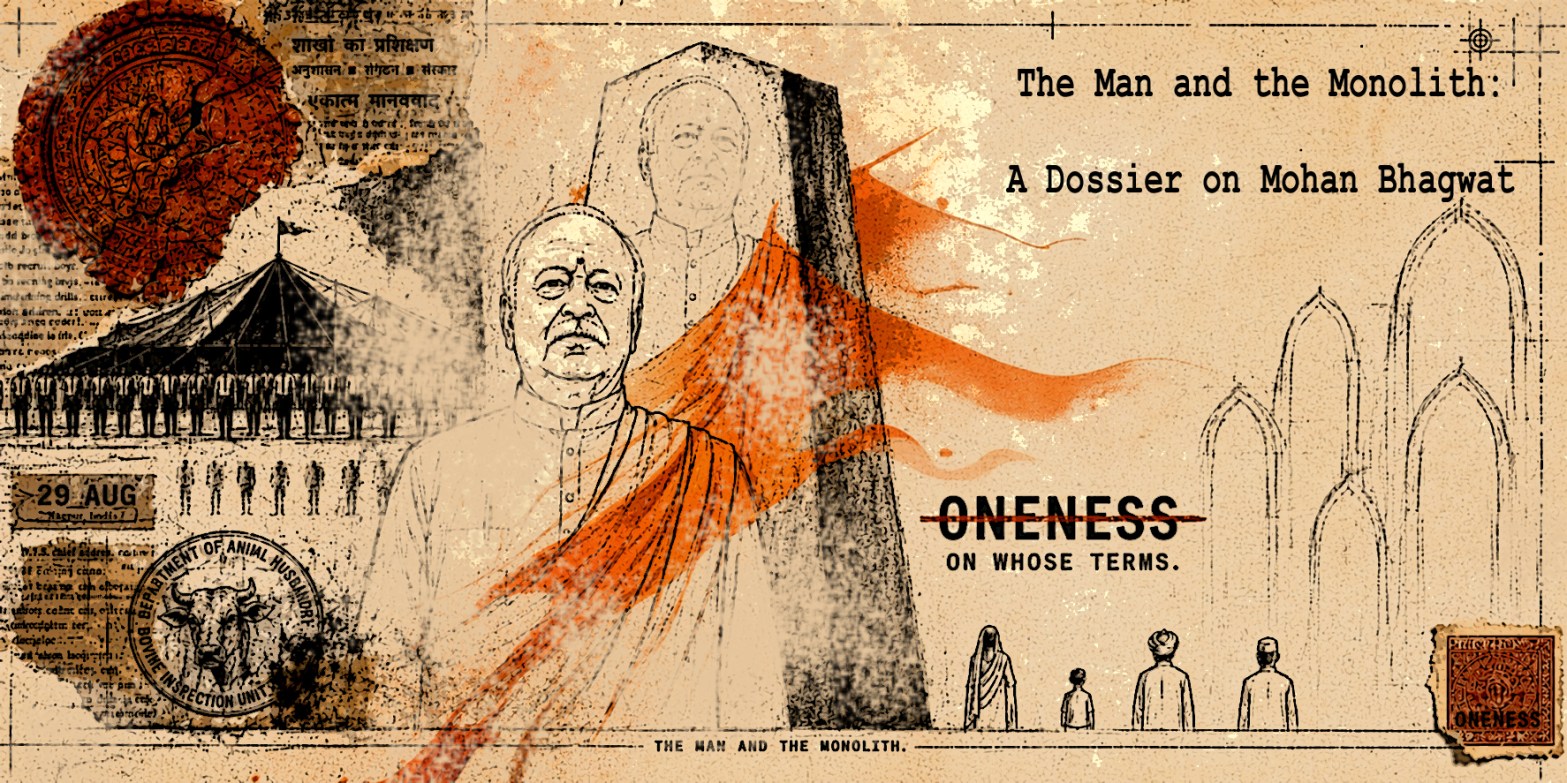
This dossier is a committed forensic case against Mohan Madhukar Bhagwat, sixth Sarsanghchalak of the Rashtriya Swayamsevak Sangh since 2009 and its executive from 2000 to 2009: a lifer raised in a three-generation Sangh household, produced by the organisation’s sealed ladder, and now the living editor of an ideology whose founding texts — Savarkar’s membership test, Golwalkar’s denial of minority citizenship and praise of a Nazi purge as a “lesson,” Moonje’s 1931 pilgrimage to Mussolini — he does not disown so much as copy-edit for export as “oneness.” It holds the line the Sangh most wants critics to overstep: no invented personal conviction from Gujarat 2002, no fake-doctorate smear, no claim that a USCIRF recommendation or a Canadian petition is already law; the charge that survives is custody of a majoritarian machine — unregistered at the centre, banned three times by the republic, radiating through the BJP and the Parivar — restated in Bhagwat’s own dated speech as eliminative absorption (“everyone is Hindu”), relocation of blame (2013, 2015, 2019, 2025), and centenary reputation-work. That work arrived in New York in August 2026 as “Universal Oneness” at Madison Square Garden and walked into a revolt that includes Hindus who refuse to let Hindutva speak in their name. The monolith calls itself oneness. The dossier refuses the name.
0. Editorial Note
This is not a neutral brief. Neutrality, in a fight over who counts as a full citizen of a republic, is the voice of the side that already holds the microphone — and in India that side has held it, through the EVM and through the shakha, for over a decade.
The Rashtriya Swayamsevak Sangh (RSS) is a majoritarian-theocratic machine, and the Bharatiya Janata Party is the electoral instrument through which that machine now drives the Indian state. Hindutva is not a synonym for so-called “Hindu” (an exonym, far from being a monolithic organized religion) life. It is a political programme that collapses one of the world’s most plural civilisations into a single sanctioned identity and admits everyone else on sufferance — Muslim, Christian, Sikh, Dalit, adivasi, irreligious, all reclassified as either forgetful Hindus or foreign residue.
Mohan Madhukar Bhagwat did not wander into this programme. He was born inside it, trained by it, promoted through it, and has superintended it as Sarsanghchalak since 21 March 2009, after nine years running its executive machinery as Sarkaryavah. When the record below names the Sangh, it names the office he holds. That is not guilt by association. That is how command works.
The method here is forensic and it is committed, and those two words are not in tension. A committed case that lies is worthless; a forensic case that flinches is cowardice. So the discipline of this dossier is simple and it is strategic, not tender: we do not overclaim, because overclaim is the Sangh’s only escape hatch. Every time a critic inflates an inference into a conviction, the Sangh’s publicity apparatus produces the missing document and uses the one error to bury the ten facts around it. We deny them that move. Where a rights body has found something, it is a finding. Where a coalition alleges something, it is an allegation. Where this dossier reads a pattern, it says so. The labels are not concessions to the accused. They are the reason the indictment cannot be knocked over.
One thing this version refuses to do is stage the defence. There is absolutely no attempt to exhibit the Sangh’s alibis — persecution, paraphrase, “culture not theocracy,” oneness, the honorary doctorate as honour, the 2026 tour as interfaith — under generous light, as though even-handedness were owed. It is not owed. Those alibis are not a second, equal truth; they are the structural operation itself, the reputational software that runs on top of the hardware of extremist exclusion. Where they appear below, they appear the way a prosecutor reads an alibi into the record: dated, quoted, and dismantled — never platformed.
What follows is the short life; the manufacture of the organisation-man; the honorary “Dr.” and the parallel academy it fronts for; the lineage from Savarkar and Golwalkar and Moonje’s Roman pilgrimage to Mussolini; Bhagwat’s own record in his own words; the 2002 line drawn exactly where it can be held and not one inch further; and the 2026 North American tour, in which “Universal Oneness” tried to rent Madison Square Garden and walked instead into a diaspora revolt that includes Hindus who will not let Hindutva speak in their name.
The monolith names itself oneness through forced uniformity. This dossier refuses the name.
I. Origin(s) of the incumbent Sarsanghchalak
Mohan Madhukar Bhagwat was born on 11 September 1950 into a Marathi Karhade Brahmin household whose map was already the Sangh’s. The family seat is Chandrapur — then in undivided Madhya Pradesh, later Maharashtra — a small town close enough to Nagpur that the RSS’s weather was the weather of the house. He was the eldest of four: two brothers (Chittaranjan, later of the Bank of Maharashtra; Ravindra, an advocate in Chandrapur) and a sister in Pune. The household did not produce a dissident. It was not built to.
The lineage runs three generations deep, and that depth is the first fact of the case. The grandfather, Narayan Pandurang “Nanasaheb” Bhagwat, born 1884, took a law degree at Allahabad and moved the family into Chandrapur around 1930; Sangh histories place him among the early companions of founder K. B. Hedgewar. Whether every claimed handshake is exact matters less than that the family narrates itself this way: the founder is not a distant name to them. He is furniture.
The father is the load-bearing inheritance. Madhukar Rao Bhagwat was an early pracharak, part of the 1942 celibate-vow cohort sent out to expand the organisation; he worked the Gujarati-speaking districts and served as prant pracharak for Gujarat. A colonial-era police note, later surfaced in critical writing, files him arriving in Ahmedabad around 1941 as chief organiser for Gujarat and Kathiawar. After Gandhi’s assassination and the 1948 ban, he did what full-timers did when the state shut the door: married, read law, settled back in Chandrapur — and stayed in the Sangh as karyavah for the zone. Sangh lore credits him with drawing L. K. Advani into the fold; later hagiography stretches the same hand toward Narendra Modi. Treat the Modi flourish as varnish. The Advani fact is enough. The boy was raised in a house where the Sangh was not an opinion held but a trade practised.
The mother sealed the enclosure. Malati belonged to the Rashtra Sevika Samiti, the women’s wing engineered precisely so that the household itself could function as a shakha — morning prayer, evening prayer, Hindu moral instruction as the ambient sound of the rooms. A relative once told The Hindu that the Bhagwats were “practically of the RSS aristocracy,” a family that won people rather than confronted them. It was meant as praise. It also names the method: soft recruitment is still recruitment, and the eldest son inherited both the manner and the machine.
The civic biography is a sequence of doors that closed early. School at Lokmanya Tilak Vidyalaya — a “nationalist” shrine in its very name. A first year of B.Sc. at Janata College; the parents wanted a medical doctor, but the marks fell short. So: a Bachelor of Veterinary Science and Animal Husbandry at the Government Veterinary College, Nagpur, and a hostel life he still recalls in alumni anecdotes. After the course, around 1971, a real civic attachment briefly formed — some months as a rural veterinary officer at Chamorshi in Chandrapur district, a government post the republic recognises, sharing a room with a doctor and a banker. He resigned it to begin a veterinary master’s. He kept the shakha throughout.
Then, on 25 June 1975, Indira Gandhi proclaimed the Emergency; nine days later the RSS was banned; police began lifting pracharaks. Bhagwat abandoned the postgraduate course near its end and went underground. The official sentence is that he “became a pracharak towards the end of 1975.” The truer sentence is that the state closed one life and the Sangh claimed the vacancy — and that every unfinished civic tie, the doctorate, the clinic, the household never formed, is not a loss in the pracharak‘s ledger but the finished product. He has no wife, no children, no second profession, no institutional loyalty that competes with the organisation. In December 2025, lecturing in Kolkata on family and population, he called himself “an unmarried preacher” relaying what doctors and demographers had told him. The design is exact: the man with no household counsels the nation’s households; the man with no patients speaks for the cow; the man with no electorate speaks, through the affiliate party, into the state.
The letterhead is not a private address. It is Hedgewar Bhavan, Reshimbagh Road, Nagpur. From around 2012 he drew high-category protection; in June 2015 the Modi government moved his cover fully to the CISF’s Special Security Group — Z+, on the order of sixty commandos — and in August 2024 layered Advance Security Liaison on top, the protocol reserved for the most guarded travel in the country. The Home Ministry has refused to disclose the cost. A man who holds no constitutional office moves through India inside the state’s highest ring of protection. Read that as the measure of what the republic’s present managers understand the Sarsanghchalak to be: not a private citizen with a hobby, but the unelected centre around which the elected government orbits.
Then look up. The Sangh that still will not register itself now occupies a skyline. In Delhi’s Jhandewalan, Keshav Kunj rose as three towers of twelve-to-thirteen storeys — Sadhana, Prerana, Archana — some five lakh square feet, three hundred rooms, auditoriums, a polyclinic, solar panels, parking for a couple of hundred cars, a hall named for Ashok Singhal, a statue of Hedgewar on the lawn. The organisation’s own figure is about ₹150 crore. Bhagwat inaugurated the grandeur in February 2025 and told the cadre that the work must match the building. In Nagpur, at Reshimbagh, a further overhaul of the Smruti Mandir campus has been put in motion ahead of the 2027 national meet: sources in August 2026 spoke of nearly ₹300 crore, a new Maharshi Vyas auditorium, older blocks to come down, a seven-storey block to go up after the Sabha. An unregistered “body of individuals,” banned three times, that claims to own nothing in the way a company owns, now has campuses that outscale the BJP’s own national office. Who signed the cheques? The official hymn is always the same: guru dakshina, swayamsevaks, seventy-five thousand sympathetic hearts, no government money, no CSR. Where is the public ledger that would let a citizen follow a rupee from a named donor through a named account into a named floor? Which trust held the land while the centre remained fog? What did the Income Tax Department actually see, and what did the registrar never get to see because there is no registrar’s file? Leave the questions standing. A twelve-storey “cultural” body that will not become a legal person has built itself a skyline. The skyline is the answer they prefer you not to finish.
II. The Manufacturing of an Organisation-Man
The Sangh does not draw its chiefs from universities, parties, courts, or the army. It grows them in a sealed medium, and the finished specimen is a man whose only professional memory, only promotion board, and only audience that finally matters are the organisation itself. Bhagwat is that specimen, produced without rem(a)inder.
The rungs are on the public record — Akola, then Nagpur and Vidarbha; national head of physical training through the 1990s; national keeper of the full-time cadre; Sarkaryavah in 2000; Sarsanghchalak in 2009 — but the ladder is less important than what climbing only this ladder does to a man. Consider what each posting actually trains. To hold Nagpur and Vidarbha is to be measured against the organisation’s skull, not its periphery: Hedgewar’s city, the headquarters, the Reshimbagh ground where the Vijayadashami address is delivered each year. To be Akhil Bharatiya Sharirik Pramukh is to keep the Sangh’s oldest sacrament — the dawn drill, the identical khaki, the lathi, the body taught to move as a unit before it is ever taught to reason as a citizen. To be Pracharak Pramukh is to manage the caste of celibate full-timers from which every field officer is drawn, men who have each already made the surrender Bhagwat made in 1975. And to be Sarkaryavah is to run the days while the chief occupies the symbol — money, postings, the affiliate bodies, the political cousin, the quiet corrections — which is also the office that was in the executive chair when Gujarat burned in 2002. A leader assembled this way cannot defect to a rival loyalty, because he has never been permitted to grow one. Insulation is not a side-effect of the pedagogy. Insulation is the pedagogy. The organisation that made him is the organisation he now superintends; when he speaks, it is not a man improvising but an ideology finding a throat. His admirers call this purity of vocation. Purity is simply the word for a life from which every exit was closed early — some by history, most by design, all before he was old enough to choose otherwise.
III. The “Dr.” — an authentic non-sense, and the academy it fronts
He answers to “Dr. Mohan Bhagwat” now, the way a man answers to a title he has grown used to hearing. The two words did not grow up together, and the seam between them is instructive.
“Dr.” arrived in March 2017, gift-wrapped. The Maharashtra Animal and Fishery Sciences University in Nagpur — a state campus whose title already smells of sheds and tanks — held its eighth convocation and decided, for the first time in its existence, to confer an honorary Doctor of Science. The recipient: the sitting chief of the RSS. The Governor handed it over; the BJP Chief Minister supplied the furniture of state; the Vice-Chancellor recited the academic case with a straight face — alumnus, veterinarian, champion of gaushalas and indigenous breeds — while an RSS spokesman gilded it further, claiming recognition for “research” on cow shelters and the medicinal properties of cow urine.
Hold the two official facts and then let them go. Yes, the paper is real: a public university issued it under a gubernatorial seal, so it is not a diploma-mill forgery. And no, it was not earned: there is no dissertation, the 1970s postgraduate course remains a rumour of attendance, and the only degree he ever completed is the undergraduate B.V.Sc. He said as much himself, smiling that he was taking a doctorate “without putting any hard work.” The hall heard modesty; enter it into the minutes as a stipulation by the candidate that no work was done. What was certified in Nagpur was therefore not competence but ceremony — the RSS’s capital city, a BJP state government, and a captured seating chart gluing the sacred animal to the living head of the Sangh with the one honorific Indian public life still treats as an argument-ending credential. Call it forged and they produce the convocation photograph. Call it science and the photograph convicts the word. It is neither fake nor real in any sense that should impress. It is authentic nonsense: a Doctor of Science in cow-reverence, worn ever since — on stage backdrops, in agency copy, on the 2026 New York handbills — as though a laboratory bench had spoken. Anyone still moved by the prefix is answering to the gown, not the syllabus.
The doctorate matters beyond vanity because it is the retail sign of a wholesale project. Over three decades, thickening wherever the BJP has held Delhi or a state, the Sangh has built not a scatter of cranks but a knowledge policy: civilisational prestige-objects — Veda, cow, Ayurveda, “Bharatiya science” — stripped of the disciplines that could test them and reissued as substitutes for biology, physics, archaeology, and public health. Falsifiability is recoded as a colonial tic; peer review as a hostile lobby; the experiment that fails to flatter the epic as an insult rather than a result. The cow is the flagship: urine and dung talked up as antimicrobial, anti-cancer, agricultural miracle, and — in the pandemic years — as neighbour to a prophylactic, with “cow science” cells funded as if reverence were a method. Beside the shed stands the epic pressed into service as prior art: ministerial stages hosting claims that aviation, plastic surgery, stem cells, and advanced metallurgy were solved in itihasa, so that Ganesha becomes a case report and the Pushpaka a prototype. This is the precise inversion of how real historians of science work — they recover genuine subcontinental mathematics, medicine, and metallurgy and place them in time; the Sangh’s version skips the archive and starts at the miracle. It reaches the classroom as curriculum, teaching a fixed sequence — first the glory, then the fall, then the recovery under the present dispensation — in which science ceases to be a method for being publicly wrong and becomes a costume the nation wears. The cost is not abstract: in the COVID years, official and semi-official voices pushed decoctions, smoke, and bovine products with a confidence no trial had earned, while treating miracle-cure chatter as acceptable collateral of civilisational pride. The dead file no corrigenda. This is not a claim that every Indian laboratory is captive; India’s epidemiologists still count and its historians still refuse the fairy tale, which is exactly why the parallel academy must be named as a project and not a mood. It does not seek the end of research. It seeks the right to overrule research whenever research is insufficiently “Hindu” — pseudoscience as majoritarian epistemology, the nation-statist imagiNATION installed as an already-knowing subject and the experiment reduced to a formality expected to have the manners to agree.
IV. The Ideological Architecture: Savarkar, Golwalkar, Moonje — and the man who edits them
The gravest charge against Bhagwat is not a stray sentence. It is custody. He did not write the 1923 pamphlet or the 1939 book or keep Moonje’s Roman diary; he inherited the organisation those texts built, ran it for nine years and has led it for seventeen, and has spent the public portion of that tenure translating the old architecture into a register that can enter a television studio and a foreign hall. The translation is the alibi. The architecture is the indictment.
V. D. Savarkar’s Hindutva: Who Is a Hindu? (1923) is not a hymn but a membership test. The nation is a people who share pitrabhumi and punyabhumi — fatherland and holy land — and Muslims and Christians, whose sacred geography lies outside the subcontinent, fail the second condition however many centuries their dead have lain in Indian soil. They may reside; they may not fully belong. The RSS, founded two years later, never needed to reprint Savarkar on every leaflet. It needed only to organise a daily life — the shakha, the uniform body, the Hindu-as-default — in which his line would harden into common sense.
M. S. Golwalkar’s We or Our Nationhood Defined (1939), issued under the name of the second Sarsanghchalak, made the test operational. Those who would not accept Hindu culture were foreigners in Hindusthan; the “foreign races” must either merge entirely into the Hindu nation, surrendering any separate existence and claiming nothing, or else remain wholly subordinated and entitled to nothing — in Golwalkar’s own words, “not even citizen’s rights.” That is the second chief of the organisation, in a book the organisation circulated, stating the terms of minority life: assimilate or hold no citizenship. Call it the monolith — a plural civilisation collapsed into one essence, everyone else a guest, a residue, or a problem of absorption.
That the Sangh’s formative ideology took instruction from European fascism is not a tavern insult; it is a paper trail, and the paper is largely the Sangh’s own. In 1931, B. S. Moonje — Hindu Mahasabha leader, mentor to Hedgewar, an undisputed founding influence on the infant RSS — toured Italy and, on 19 March, met Benito Mussolini in Rome. His diary, recovered and published by the historian Marzia Casolari in Economic & Political Weekly (2000), records his inspection of the Balilla and other fascist youth and paramilitary institutions, his admiration for their militarisation of society, and his explicit wish to adapt the model for Hindus, with the RSS named as the vehicle. Hedgewar’s organisation was six years old and already being imagined, by a founder, as an Indian Balilla. Eight years later Golwalkar, watching Nazi Germany, praised its “purging” of its Jewish population as race pride manifested at its height and commended the episode as an instructive model for Hindusthan to study and profit by — the object of the lesson, in the same book, being the “foreign races in Hindusthan.” Defenders plead context, withdrawal, a softer 1972 interview. Context does not delete a sentence that calls a purge a lesson; withdrawal does not un-circulate a book; a mellow paragraph in old age does not unsay 1939.
Now watch what the living chief does with the dead one, because this is where genealogy becomes a present office. In September 2018, at Vigyan Bhawan, asked about Golwalkar’s naming of Muslims as internal enemies, Bhagwat neither defended the passage nor disowned the man. He historicised: things said in a particular circumstance, he argued, are not eternal, and a cleaned anthology had already retained what would “endure for ages” and dropped what was merely “of the moment.” Read the operation, not the piety. The Sarsanghchalak claims the authority to edit the founder-prophet — to sort the eternal from the disposable, publish the first, bury the second, and offer the burial itself as proof of the Sangh’s evolution. That is power over the archive, and it is also a confession that the archive contains what must be buried. An organisation confident it never meant the 1939 lesson would not need a second, expurgated Golwalkar. Bhagwat’s liberalism, such as it is, is an editorial function: he does not dismantle the monolith, he copy-edits it for export. His contemporary doctrine is the same house with a repainted door — Hindu Rashtra announced as fact rather than proposal, Hindutva offered as a synonym for Bharatiyata so that opposition to the first can be recoded as hatred of the nation, minorities folded into “Hindu” by ancestry so that their dissent can be dismissed as amnesia. It is more serviceable than Golwalkar’s blunt denial of citizen’s rights. It is not a different structure.
The organisation that carries this architecture has been outlawed by the Indian republic three times — and has never once given the republic the ordinary courtesy of registering itself. It is not a society under the 1860 Act, not a trust, not a company; a century after its founding it remains an unregistered “body of individuals,” a tax classification rather than a juristic person that can be sued in its own name. Affiliates take the letterheads and the exemptions; the centre stays fog. Bhagwat’s own defence of this, offered in Bengaluru in November 2025, is a closed loop worth preserving: the government, he noted, banned the Sangh three times — so what did it ban, if the Sangh is not recognised? Recognition by prohibition; accountability by weather. The prohibitions themselves are the spine of the republic’s recurring verdict on the organisation. On 4 February 1948, five days after Nathuram Godse — who had an RSS past — killed Gandhi, the Union government banned the Sangh to root out “hate and violence,” jailed Golwalkar, and lifted the ban only in 1949 after the organisation pledged loyalty to the Constitution and the flag, a loyalty the same tradition has never stopped calling insufficiently “Bharatiya.” On 4 July 1975, nine days into the Emergency, it was banned again. On 10 December 1992, four days after kar sevaks demolished the Babri Masjid, it was banned a third time under UAPA alongside the VHP and Bajrang Dal. No other organisation now seated at the centre of Indian public life carries this combination — outlawed as though it were a person, structured as though it were a mist. The design is the point: an unregistered centre can disown its registered periphery, a banned centre can brandish the ban as a certificate of importance, and a Sarsanghchalak can assure a foreign audience that the Sangh is merely culture. Bhagwat’s job as custodian is to make a century of proscription look like ancient weather — something that once happened to a misunderstood cultural body — while ensuring that the body remains, still, a name no registrar can hold.
Bring the lines onto the one man, or the genealogy stays a seminar. Bhagwat is sixth in a chair whose second occupant wrote that minorities might live without citizen’s rights and that a Nazi purge was a lesson. He is the editor who decides which of those sentences are eternal. He is the speaker who swapped expulsion-talk for absorption-talk and christened the result oneness. He is the executive who held the organisation through the years its affiliates were named in the Gujarat record, and the chief who now exports Vasudhaiva Kutumbakam to Madison Square Garden. The fascist diary is not in his hand and the 1939 lesson is not his sentence — but the custody is entirely his. A man who superintends an institution, claims the right to redact its prophets, and restates their core as common sense is not adjacent to the ideology. He is the form in which it currently walks.
V. Bhagwat in His Own Words
The genealogy above is the Sangh’s. This section is Bhagwat’s own. Each item is dated. Where the RSS issued a clarification, it is recorded, because several of these turns on disputed interpretation. The quotes are the battleground. The pattern critics draw is consistent: a rhetoric that folds every identity into a Hindu civilisational whole while treating minority assertion, conversion, and even the vocabulary of atrocity as the problem to be managed.
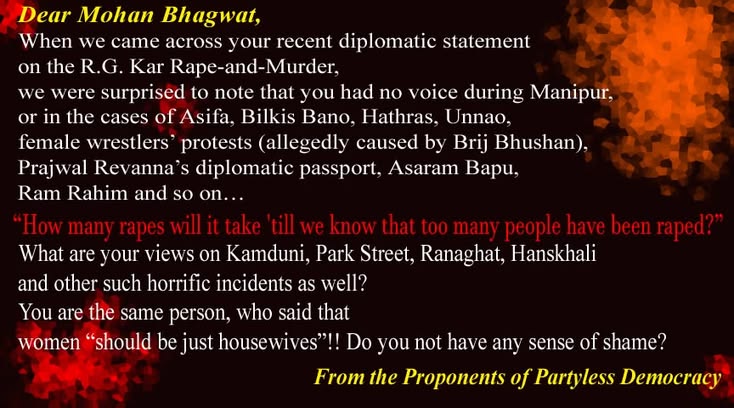
1. “Rapes happen in India, not Bharat” — Silchar, January 2013
Speaking in Silchar, Assam, weeks after the December 2012 Delhi gang rape that killed Jyoti Singh, Bhagwat said crimes against women were an urban, Westernised phenomenon.
Such crimes hardly take place in ‘Bharat’, but they occur frequently in ‘India’. You go to villages and forests of the country and there will be no such incidents of gang-rape or sex crimes. They are prevalent in some urban belts. … Where ‘Bharat’ becomes ‘India’ with the influence of western culture, these type of incidents happen.
— Mohan Bhagwat, Silchar, reported January 2013 (PTI / India Today / Hindustan Times / Times of India)
CPI(M) leader Brinda Karat: “Bhagwat neither understands India nor Bharat.” National Commission for Women chair Mamta Sharma objected to the geographic split. Police records and women’s groups noted that rural rapes are systematically under-reported. The BJP said the remark had to be “understood in entirety” as a defence of Indian sanskar. The inference critics draw: a civilisational alibi that relocates sexual violence from power, caste, and impunity onto “the West,” and from the village onto the city — against the grain of the data.
2. Mother Teresa served in order to convert — Bharatpur, 23 February 2015
Mother Teresa’s service would have been good. But it used to have one objective, to convert the person who was being served into a Christian. … If this is done in the name of service, then that service gets devalued.
— Mohan Bhagwat, Bajhera village near Bharatpur, 23 February 2015 (PTI / The Hindu / Indian Express / NYT)
Parliament’s Rajya Sabha was adjourned. The Archdiocese of Calcutta called the timing “terrible,” coming days after Prime Minister Modi’s speech on religious tolerance. The RSS said Bhagwat was answering a comment that Teresa’s seva had conversion as its motive. The inference: humanitarian labour by a Christian is recoded as predation. Service that is not Hindu-coded is suspect by definition.
3. The “three-day army” — Muzaffarpur, 11 February 2018
Hamara military sangathan nahin hai, military jaisi discipline hamari hai. Aur agar desh ko zaroorat padey, aur desh ka samvidhan… toh sena tayyar karne ko chhe-saat mahine lag jayenge, Sangh ke swayamsevakon ko leke teen din me tayyar honge. Yeh hamari kshamata hai.
— Mohan Bhagwat, Muzaffarpur, 11 February 2018 (Indian Express transcript)
Translation in wide circulation: ours is not a military organisation, but we have military discipline; if the country requires it and the Constitution permits, it would take six to seven months to raise an army; if Sangh volunteers are taken, it will be ready in three days. This is our capability.
Rahul Gandhi: “Shame on you, Mr. Bhagwat.” Opposition parties read a private-militia ambition. The RSS’s Manmohan Vaidya said the comparison was between swayamsevaks and the general population, both to be trained by the Army, not between the Sangh and the Army. Kiren Rijiju defended the remark. BOOM’s transcript analysis found the Hindi open to both readings. The inference that will not go away, regardless of the walk-back: the Sarsanghchalak chose, in public, to measure his cadre against the time it takes to raise the republic’s army.
4. “Lynching” is an alien word used to defame India — Nagpur, 8 October 2019
Vijayadashami address, Reshimbagh ground, Nagpur, with Maharashtra CM Devendra Fadnavis on the dais.
By branding such incidents by words like ‘lynching’, denoting traditions which were alien to Bharat and belong elsewhere, efforts are underway to defame our country and the entire Hindu society and create fear among the so-called minority communities.
— Mohan Bhagwat, Vijayadashami 2019 (Times of India / Indian Express)
He added that incidents were “not one-sided,” that some were “deliberately fabricated,” and that the word “lynching” traces to a Biblical story of a woman about to be stoned. The Quint and others heard in this a displacement: the word is foreign, therefore the crime is foreign, therefore the Hindu society being named as perpetrator is the real victim. Congress called the remarks insensitive. Between 2015 and 2019 India recorded a well-documented run of cow-vigilante and rumour-driven mob killings, many of Muslims and Dalits. Bhagwat condemned mob violence as outside the Constitution and said a swayamsevak would try to stop it. He also renamed the atrocity.
5. All Indians are Hindus — a recurring formula (2022, 2023, 2025, 2026)
We have been telling since 1925 that everyone living in India is a Hindu. Those who consider India as their matrubhoomi and want to live with a culture of unity in diversity… irrespective of whatever religion, culture, language and food habit and ideology they follow, are Hindus.
— Mohan Bhagwat, Ambikapur, November 2022 (Indian Express)
Hindustan is a Hindu Rashtra and this is a fact. Ideologically, all Bharatiyas are Hindus and Hindus mean all Bharatiyas.
— Mohan Bhagwat, Nagpur, September 2023 (India Today)
No one is Ahindu in Bharat. … They probably don’t know it, or they are made to forget it.
— Mohan Bhagwat, November 2025 (The Telegraph)
In February 2026 he listed “four types of Hindus,” the fourth being “those who have forgotten, those who have been made to forget,” and said the phrase “Hindu-Muslim unity” is incorrect “because you unite two people and not those who are already one.” Defenders hear a civilisational, non-theological belonging. Critics hear the erasure of Muslim, Christian, Sikh, and Dalit self-definition into a Hindu essence — Savarkar’s line without Savarkar’s bluntness. The inference: oneness is not a meeting of equals. It is an absorption.
6. “True independence” arrived with the Ram temple — Indore, January 2025
The true independence of India, which had faced many centuries of persecution, was established on that day [the Ram temple pran pratishtha]. India had independence but it was not established.
— Mohan Bhagwat, Indore, January 2025 (ANI / India Today)
He proposed the consecration date be observed as Pratishtha Dwadashi. Rahul Gandhi called the remark an insult to freedom fighters and “treason.” Mamata Banerjee called it “anti-national and dangerous” and demanded a withdrawal. Sanjay Raut (Shiv Sena UBT) said Bhagwat had neither written the Constitution nor brought Ram Lalla. The inference: 15 August 1947 is demoted from founding to prelude; the republic’s secular compact is incomplete until a temple stands on the site of a demolished mosque. The RSS, which did not lead the freedom movement and whose founder’s priority was Hindu organisation rather than anti-colonial satyagraha, relocates the nation’s birthday onto its own civilisational project.
7. Outreach register: Gen Z, protest, LGBTQ+ — Mumbai, 6 August 2026
At an IIMUN youth conference in Mumbai, on the eve of the centenary foreign tour, Bhagwat struck a different note.
If Gen Z engages in any agitation, they are not anti-national. … Protest is also the way of dialogue.
— Mohan Bhagwat, Mumbai, 6 August 2026 (Indian Express / The Hindu)
Don’t say same-sex marriage. We have to devise some system by which same-sex companions can live together. A law can be made for that, and society can accept it. … LGBTQIs are a part of our community. … If we tamper with the institution of vivaah, it could create other side effects.
— same event
Defenders cite this as evidence of moderation. Critics (The Federal, Nilanjan Mukhopadhyay) read tactical softening for a global and youthful audience: accept the people, refuse the marriage, keep the patriarchal unit intact. Both readings can be true at once. The register changed. The architecture did not.
8. Other recurring notes
Bhagwat has repeatedly admonished Muslims to abandon what he calls a “boisterous rhetoric of supremacy,” a charge opposition figures invert onto the Sangh. He has visited a Delhi mosque (September 2022) and been praised by All-India Imam Organisation chief Umer Ahmed Ilyasi as rashtra pita and rashtra rishi — an episode that tells as much about the politics of minority brokerage as about reconciliation. He has met Gurinder Singh Dhillon of Radha Soami Satsang Beas on the eve of successive general elections. In the centenary period the RSS invited envoys from some fifty embassies for structured dialogues. The method is samvad. The question, pressed hardest by Dalit and Sikh organisations in the 2026 opposition, is: unity around which centre, on whose terms, at whose expense?
VI. Gujarat 2002 — the line we hold
This is the historical anchor of the violence charge, and it is handled with the discipline the Editorial Note promised, because here more than anywhere the temptation to overreach is the Sangh’s opportunity.
After the Godhra train fire of 27 February 2002 killed fifty-eight to fifty-nine Hindu kar sevaks, anti-Muslim violence engulfed Gujarat, and the death toll in contemporaneous reporting and later compilation runs on the order of one to two thousand, the overwhelming majority Muslim. Human Rights Watch, in We Have No Orders to Save You (2002) and Compounding Injustice (2003), documented police complicity and named Sangh Parivar bodies — the VHP, the Bajrang Dal, and the wider Parivar including the RSS — among those most directly implicated in organising the carnage. Genocide Watch has described the massacres in genocidal terms. Bhagwat was Sarkaryavah, the organisation’s chief executive, throughout.
Here is the line, and it is drawn deliberately short of where polemic would like it. The findings attach organisational responsibility to Sangh Parivar bodies and individual culpability to specific figures against whom cases were filed — among them Maya Kodnani, later convicted and then acquitted on appeal, and Jaideep Patel. They do not record a personal finding, charge, or conviction against Mohan Bhagwat, and a statement issued in his name in March 2002 urged swayamsevaks toward peace. This dossier therefore holds him responsible in the precise, unbreakable sense — the executive command of a named organisation at the hour of its worst work — and refuses the version that would invent a personal charge-sheet that does not (yet) exist. The distinction is not generosity. It is armour. Anyone who fuses organisational command with a fictional personal conviction hands the Sangh the one rebuttal that lets it dismiss the whole file. We hold the line so the line holds them.
VII. The 2026 North American tour: names, dates, venues, revolt
In its centenary year the RSS sent Bhagwat on a three-nation tour of the United States, Canada, and the United Kingdom, opening 25 August 2026 under the banner “Universal Oneness” / Vasudhaiva Kutumbakam. He landed at JFK on 25 August. The flagship is the Universal Oneness Celebration on 29 August, 2:00–5:30 p.m. ET, at the Infosys Theatre inside Madison Square Garden, staged by the American Hindus for Engagement and Dialogue (AHEAD) Forum for a claimed five thousand people; Canada follows on 31 August–1 September, then Britain. The Sangh’s own stated purpose, reported in The Hindu, is to work the diaspora and correct Western perceptions that the RSS is a paramilitary outfit involved in attacks on minorities. The tour instead detonated one of the broadest mobilisations against Hindutva on the recent record. This is the minute sheet.
The federal religious-freedom intervention. On 26 August 2026 the US Commission on International Religious Freedom — a bipartisan federal advisory body whose recommendations bind no one — declared itself “deeply concerned” and urged the Trump administration to revoke Bhagwat’s visa and impose targeted sanctions on RSS members. Chair Asif Mahmood stated that religious-freedom conditions in India continue to deteriorate as violence and incitement are used to target minority communities, and USCIRF charged that members of RSS subgroups have carried out violent attacks on Christians, Dalits, Muslims, and Sikhs, that BJP government policy tracks the RSS’s Hindutva ideology, and that India has practised transnational repression against Sikhs in North America. India’s Ministry of External Affairs, through spokesman Randhir Jaiswal, dismissed USCIRF as biased and lacking credibility. The recommendation is on the record; so is its rejection; and the visa was not revoked — Bhagwat entered. Recommendation is not action, and Washington’s silence is itself an answer.
Elected and municipal voices. New York’s first Indian-American mayor, Zohran Kwame Mamdani, said on 25 August that he does not support the event, calling the rise of a movement “predicated on an exclusionary vision” of a country “incredibly troubling,” and describing the India he was raised to believe in as pluralistic and secular — while stating plainly that the city likely has no jurisdiction to cancel a private event. That sentence is the legal reality: a mayor can denounce a Madison Square Garden booking; he cannot, on present law, cancel it. Brad Lander, congressional nominee and former city comptroller, told a City Hall press conference there is “no room” for Bhagwat and RSS hatred in the city and accused the organisation of fomenting violence against Muslims, Sikhs, Dalits, and Christians; council members Shahana Hanif and Lincoln Restler asked MSG to cancel; Kshama Sawant attacked Mamdani for not using the mayoralty to try, foregrounding RSS–BJP–Israel ties and Pegasus spyware deployed against Indian activists. BJP figures answered in the register that gives the game away — one dismissing Mamdani’s camp as “socialist nuts” opposing Modi and the BJP, as though the objection to majoritarian violence were merely partisan pique.
The coalition — and the split inside Hindu America that the Sangh most needs to hide. This is not a Muslim-only file, and the erasure of that fact is the operation’s central lie about the week. The conveners are Hindus for Human Rights — a Hindu organisation, founded in 2019, that defines itself against Hindutva in the name of Hindu tradition — alongside the Indian American Muslim Council and Emgage. HfHR’s deputy executive director Sravya Tadepalli put the thesis in one line: Bhagwat does not represent Hindus; he leads an extremist movement that has fuelled violence, exclusion, and fear, and New York should not hand it a stage on which religious nationalism can be repackaged as unity. Sadhana: Coalition of Progressive Hindus stands on the same lists. This is why “even Hindu organisations oppose him” is not a slogan but a structural fact: the diaspora is split over whether “Hindu” belongs to a majoritarian project or to a plural inheritance, and treating all opposition as “Hinduphobia” is precisely the device that makes that split disappear. IAMC’s president Mohammed Jawad said Bhagwat does not represent Indian Americans and MSG should not present him as though he does; the coalition ran to dozens of bodies — interfaith, Sikh, Dalit, Jewish, Christian, labour, and abolitionist — joined by the Interfaith Center of New York, Riverside Church, and the New York State Council of Churches, with more than a thousand people writing to Secretary of State Marco Rubio for a visa revocation. The strategic claim beneath the coalition is exact and worth stating once, plainly: oneness advertised without any account of 2002, of the lynchings, of the 1939 text, or of a federal commission’s sanctions recommendation is not interfaith dialogue. It is reputation-laundering, and the venue is the detergent.
The machinery behind the “local invitation” — Savera’s Fibs, Fronts & Fixers. On 19 August 2026 the research platform Savera published its investigation into how the tour’s supposedly independent local hosts were in fact routed through the Sangh’s own overseas apparatus, letting the RSS keep a deniable distance from events held in its name. The particulars, as the report and The Wire set them out: AHEAD Forum, the principal MSG host, was incorporated in California only in May 2025 and granted 501(c)(3) status that September; its incorporating agent was Khanderao Kand, a long-time RSS/Hindu Swayamsevak Sangh figure and founder-president of the Foundation for India and Indian Diaspora Studies (FIIDS), later replaced as principal agent by a FIIDS colleague, Harish Kandpal; and the tour’s alleged chief organiser, Saumitra Gokhale, identified as the HSS’s global coordinator, carries the official designation “yoga instructor” on roughly $36,000 a year — a label Savera argues masks his role in the RSS’s overseas department, the Vishwa Vibhag. The chronology tells its own story: the RSS announces centenary foreign plans in March 2025; AHEAD incorporates in May; the MSG host is unveiled in 2026. This is an investigative allegation built from corporate filings, personnel overlap, and dates — not a court finding, and named as such — but it is the clearest public map yet of how a “spontaneous” diaspora invitation was manufactured, and it exposes the dispersed-front architecture as a feature, not a coincidence: the centre disowns the periphery precisely so the periphery can do the centre’s work.
The X account — flagged on the eve, restored the same day. On 27 August, two days before the flagship event, X marked AHEAD’s handle (@Aheadforum1) unavailable. AHEAD first called the suspension a probable error and, after same-day restoration, claimed it had been “botted” by opponents gaming the platform. X published no detailed reason. Record it whole and without inflation: a platform’s complaint-driven machinery flagged the tour’s own front organisation on the eve of its marquee event, and reversed within hours. It is neither proof of state collusion nor nothing — it is one more sign of how contested this launch was, in every venue including the digital one.
Canada — two letters, two coalitions, one discretionary door. Bhagwat’s Toronto leg (31 August–1 September) would be the first Canadian visit by an RSS chief since 2005, and it drew a two-track campaign. On the parliamentary track, NDP MPs Jenny Kwan and Heather McPherson wrote to the ministers of public safety, immigration, and foreign affairs seeking that Bhagwat be declared inadmissible and the RSS banned, citing his record of hate speech, advocacy of violence against minorities, intimidation of critics in India and Canada, and association with proscribed organisations, and warning that his presence “would be a danger to Canadians.” On the civil-society track, coalitions led by the Canadian Forum for Human Rights and Democracy in India and by Justice For All Canada — the latter speaking for 267 undersigned organisations and advocates — submitted letters and a briefing paper to Public Safety Minister Gary Anandasangaree and Prime Minister Mark Carney, invoking inadmissibility under the Immigration and Refugee Protection Act on human-rights and transnational-repression grounds. An earlier forty-plus list carried the Canadian Council of Indian Muslims, Canadians for Indian Democracy, the South Asian Dalit Adivasi Network, the World Sikh Organization of Canada, the Canadian Council of Muslim Women, Independent Jewish Voices Canada, the Dr. Ambedkar International Mission, and others. All of it unfolds in the shadow of the 2023 killing of the Sikh activist Hardeep Singh Nijjar in Surrey — the killing that detonated the Canada–India relationship and that USCIRF now names in the same breath as the visa demand. State the legal reality without softening the politics: IRPA inadmissibility is a discretionary call by the minister and the border agency on a “reasonable grounds to believe” threshold, and no petition can compel it; the campaigns are pressure aimed squarely at that discretionary door.
The manufactured welcome, and who refused to sign it. Against these letters the Sangh assembled its own — a bloc of Hindu-institutional bodies (temple associations, business chambers, the HSS and VHP-Canada among them) urging Ottawa to decide on “due process” rather than “political pressure,” and warning that a ban campaign would be read by many as Hinduphobia. Read this bloc for what it is: not a second, equal conscience but the diaspora arm of the same machine, deploying the same recode — criticism of Hindutva relabelled as bigotry against Hindus. And read it for what is missing from it. The World Sikh Organization is not on that letter. The Dalit networks are not on it. The Canadian Council of Muslim Women is not on it. The signatures that are absent from the welcome are as much data as the signatures that are present on the opposition — and together they map the same fault line as New York: not Hindus against the rest, but a plural India against the monolith, contested inside the Hindu fold itself.
VIII. Direct and indirect engagements — the method called samvad
A dossier that named only the hard edges would be easy to dismiss, so name the soft ones too, and read them for what they do. Bhagwat’s public method for a decade has been samvad, dialogue: the 2022 visit to a Delhi mosque and the praise of the All-India Imam Organisation’s chief, who hailed him as rashtra pita and rashtra rishi; the meetings with the Radha Soami Beas head on the eve of successive general elections; the centenary-year audiences with envoys from some fifty embassies across Delhi, Mumbai, Bengaluru, and Kolkata; the Gen Z stage in Mumbai; “Universal Oneness” at Madison Square Garden. His defenders present this as reconciliation. It is more precisely a management technique, and the Delhi mosque episode shows its shape — reconciliation staged through a single pliant broker while the ideology it is meant to soften stays fixed.
The technique works because of the architecture beneath it. Through the Sangh Parivar, the RSS’s authority radiates outward into the BJP that runs the Indian state, the ABVP among students, the Bharatiya Mazdoor Sangh in the unions, the VHP and Bajrang Dal on the street, and the HSS abroad — the same dispersed network Savera mapped in New York. It lets the Sarsanghchalak keep his hands visibly empty. He does not have to light a fire to be the man who keeps the matches, and samvad is how he is photographed near the water while the affiliates are photographed near the flame. Which is why the one question the whole apparatus is built to prevent must be asked plainly and left standing: when the RSS says oneness, it means unity around a Hindu centre, on Hindu-defined terms, at the expense of everyone required to dissolve into it — and the Dalit and Sikh organisations that pressed hardest against the 2026 tour pressed exactly there. Oneness is not a meeting of equals. It is an instruction to disappear, issued in the warmest available voice.
IX. What the record supports — and the ammunition we refuse to hand them
Call a spade a spade. Do not call a shadow a corpse. The first sentence is the indictment. The second is how you keep it from being laughed out of the hall.
The record is already enough. Bhagwat is not a moderate who wandered onto a hard throne and forgot to leave. He is a lifer: raised in the house, drilled in the shakha, promoted through the banned years, made keeper of the bodies, then keeper of the full-timers, then executive in the Gujarat year, then chief. His speech is not a personal quirk. It is the Sangh’s method with a microphone. “Everyone living in India is a Hindu” is not hospitality. It is the abolition of the right to name yourself. A Sikh told he is a forgetful Hindu has not been embraced. He has been overwritten. A Muslim told that “Hindu–Muslim unity” is a wrong phrase because the two were never two has been informed that his difference was a clerical error. That is the monolith in the soft register. It is more serviceable than Golwalkar’s denial of citizen’s rights. It is not a different house.
The dated remarks are not four accidents. They are one relocation engine. 2013: the rape crisis is moved onto “Bharatiya values” the West supposedly lacks. 2015: a dead nun’s labour is moved onto conversion. 2019: the word “lynching” is moved onto a foreign Bible story so that the Hindu crowd with the rope is no longer the subject. 2025: 15 August 1947 is moved into the waiting room until a temple stands on a demolished mosque. Each time the majoritarian project steps out of the dock and puts someone else in it — the West, the missionary, the English word, the incomplete republic. That is not clumsiness. That is craft.
The 2026 tour is not a pilgrimage. It is a centenary laundry. “Universal Oneness” at Madison Square Garden is the attempt to rent an American landmark as a solvent for 1939, for 2002 as rights bodies wrote it, for the unregistered centre and the registered periphery, for the visa USCIRF asked Washington to tear up. The prize is the word. If oneness can be spoken under the Sarsanghchalak’s name in New York, the word no longer belongs to the people who are being absorbed. Hindu opposition to that theft is not a rumour and not a Muslim plot. Hindus for Human Rights, Sadhana, and the Hindus who signed the Canadian warning letters exist. Erasing them is the Sangh’s most useful lie about this week. The split is intra-Hindu. Naming it is not anti-Hindu. Refusing to name it is.
Now the lines we will not cross, and the reason is not manners.
There is no personal criminal conviction against Mohan Bhagwat arising from Gujarat 2002. Invent one and the entire file becomes a hoax in the first reply. The honorary D.Sc. is not a forged diploma; it is a real honorary stamp for cow-theology, which is worse, and which only works if you keep the distinction. USCIRF’s 26 August statement is a recommendation from an advisory body, not an order from the State Department; call it binding and the MEA will spend the week on your incompetence instead of on the demand. A Canadian joint letter is not a ban. An X suspension reversed the same day is not proof that a state or a platform conspired. And the Hindu who buys a ticket to MSG is not, by that ticket, a fascist. Overclaim is how a hard case becomes the cartoon the Sangh has been waiting to paste on a banner. We decline the paste. The project can be convicted in the light without counterfeiting a court page that does not exist. That refusal is not a gift to Bhagwat. It is the refusal to let him escape through a hole we drilled ourselves.
X. What to watch — the launch is not the last word
The centenary wanted a coronation abroad. It got a fight over a word.
Watch 29 August at the Infosys Theatre, Madison Square Garden, 2:00 to 5:30 p.m. Whether the room fills to the advertised five thousand. What the oneness speech actually says when the cameras are on — absorption dressed as family, or a new sentence that finally names the minorities as minorities. The size and discipline of the protest outside, and whether the Hindu organisations in it remain visible or are cropped out of the evening’s pictures. Visibility is the argument. If the world is shown only a saffron hall and a generic “anti-India” crowd, the laundry worked.
Watch Washington. USCIRF asked that the visa be revoked and future entry barred. The man is already in New York. Silence from the administration is an answer. It tells every subsequent chief how much a bipartisan advisory body weighs against a friendly state’s diaspora machine.
Watch Toronto, 31 August to 1 September. Whether CBSA and IRCC treat the first RSS-chief visit in two decades as ordinary temple programming, or open the admissibility file the NDP MPs and the Justice For All / CFHRDI letters asked for. A petition cannot compel a finding. A finding, if it comes, will have to stand on the statute, not on a press release. Either outcome is data: Canada as a closed door, or Canada as another hall.
Watch the British leg for the same signature or its break: interfaith and dissenting-Hindu opposition on one pavement, institutional-Hindu(tva) welcome on the other. The pattern is the story. A break would be news.
The revolt around the tour is the fact the centenary did not budget for. It is not over when the lights go down at MSG. Oneness was supposed to be the last word. It is now the question, and the question has names — Tadepalli, Jawad, Kwan, the World Sikh Organization, the Dalit networks that would not sign the welcome letter. The monolith still names itself oneness. The next ten days will show how many people, including Hindus, are prepared to say the name is a lie.
References
Where a claim travels through an aggregator, the primary document is named alongside it. The 2026 tour was fast-moving as of 28 August 2026; verify time-sensitive items before reprint.
Biography, training, honorary doctorate
- Wikipedia, “Mohan Bhagwat” — https://en.wikipedia.org/wiki/Mohan_Bhagwat
- Hindustan Times, “RSS chief Mohan Bhagwat to get honorary doctorate in veterinary sciences” (7 Mar 2017)
- Maharashtra Animal & Fishery Sciences University 8th convocation coverage, March 2017 (Indian Express / News18)
Ideology, genealogy, bans (scholarship + primary texts)
- Marzia Casolari, “Hindutva’s Foreign Tie-up in the 1930s: Archival Evidence,” Economic & Political Weekly (2000) — https://www.epw.in/journal/2000/04/special-articles/hindutvas-foreign-tie-1930s.html
- M. S. Golwalkar, We or Our Nationhood Defined (Nagpur, 1939) — primary source
- V. D. Savarkar, Hindutva: Who Is a Hindu? (1923) — primary source
- The Caravan, “Guruji’s Lie: The RSS and MS Golwalkar’s undeniable links to Nazism” — https://caravanmagazine.in/history/rss-golwalkar-links-nazism
- Coverage of Bhagwat’s Sept 2018 Vigyan Bhawan lecture series (Indian Express, The Hindu)
- Coverage of Bhagwat’s Nov 2025 Bengaluru remarks on RSS registration (Deccan Herald / The Hindu)
Statements
- Silchar 2013: PTI / India Today / Hindustan Times / Times of India
- Mother Teresa 2015: PTI / The Hindu / Indian Express / New York Times / Reuters
- “Three-day army” 2018: Indian Express (transcript) / India Today / BOOM
- “Lynching” 2019 Vijayadashami: Times of India / Indian Express / The Quint
- “Everyone is Hindu” formulae: Indian Express (Ambikapur 2022); India Today (Nagpur 2023); The Telegraph (2025)
- “True independence” 2025: ANI / India Today / Scroll
- Gen Z / LGBTQ 2026: Indian Express / The Hindu / Outlook
Gujarat 2002
- Human Rights Watch, We Have No Orders to Save You (2002) — https://www.hrw.org/report/2002/04/30/we-have-no-orders-save-you/state-participation-and-complicity-communal-violence
- Human Rights Watch, Compounding Injustice (2003) — https://www.hrw.org/report/2003/06/30/compounding-injustice/governments-failure-redress-massacres-gujarat
- Genocide Watch, “The 2002 Gujarat Genocidal Massacres” — https://www.genocidewatch.com/single-post/the-2002-gujarat-genocidal-massacres
2026 tour — United States
- USCIRF statement (26 Aug 2026), via The Wire, “Impose Sanctions, Revoke Bhagwat’s Visa” — https://m.thewire.in/article/diplomacy/impose-sanctions-revoke-bhagwats-visa-us-panel-on-religious-freedom-opposes-rss-chiefs-visit
- Free Press Journal, “USCIRF Seeks Revocation Of RSS Chief Mohan Bhagwat’s Visa” — https://www.freepressjournal.in/india/uscirf-seeks-revocation-of-rss-chief-mohan-bhagwats-visa-as-protests-loom-over-new-york-event
- Religion News Service, “Faith leaders, Democratic nominee denounce New York visit” (25 Aug 2026) — https://religionnews.com/2026/08/25/faith-leaders-democratic-nominee-denounces-new-york-visit-of-hindu-nationalist-leader/
- Hindus for Human Rights, “New Yorkers Unite Against RSS Chief Mohan Bhagwat’s MSG Appearance” — https://www.hindusforhumanrights.org/en/blog/new-yorkers-unite-against-rss-chief-mohan-bhagwats-madison-square-garden-appearance
- National Herald, “RSS chief Mohan Bhagwat runs into a counter-campaign in United States” — https://www.nationalheraldindia.com/amp/story/politics/rss-chief-mohan-bhagwat-runs-into-a-counter-campaign-in-united-states
- TRT World, “Calls grow for US to deny visa to RSS chief” — https://www.trtworld.com/article/942b3ff508fa
- Savera, Fibs, Fronts & Fixers — https://www.wearesavera.org/resources/reports ; via Madhyamam — https://madhyamamonline.com/india/bhagwats-international-tour-raises-questions-over-hidden-hands-behind-outreach-events-1547518
- X account suspension/restoration: News India Times — https://newsindiatimes.com/amid-heightening-controversy-organizers-appeal-for-reinstatement-of-x-account-on-eve-of-mohan-bhagwats-us-event/
2026 tour — Canada
- Scroll.in, “Ban RSS in Canada, block Mohan Bhagwat’s entry” (8 Aug 2026) — https://scroll.in/latest/1094891/ban-rss-in-canada-block-mohan-bhagwats-entry-two-of-the-countrys-mps-urge-government
- Maktoob Media, “Over 40 Canadian groups urge government to deny entry” — https://maktoobmedia.com/post?id=116155&slug=over-40-canadian-groups-urge-government-to-deny-entry-to-rss-chief-mohan-bhagwat
- The Media Co-op — https://mediacoop.ca/node/119366 ; Counterview — https://www.counterview.net/2026/08/over-40-canadian-groups-urge-govt-to.html
- Justice For All Canada joint submission (267 signatories); CFHRDI briefing paper

