The Weaponization of Intimacy: How “Love Jihad” Became Hindutva’s Battle Cry
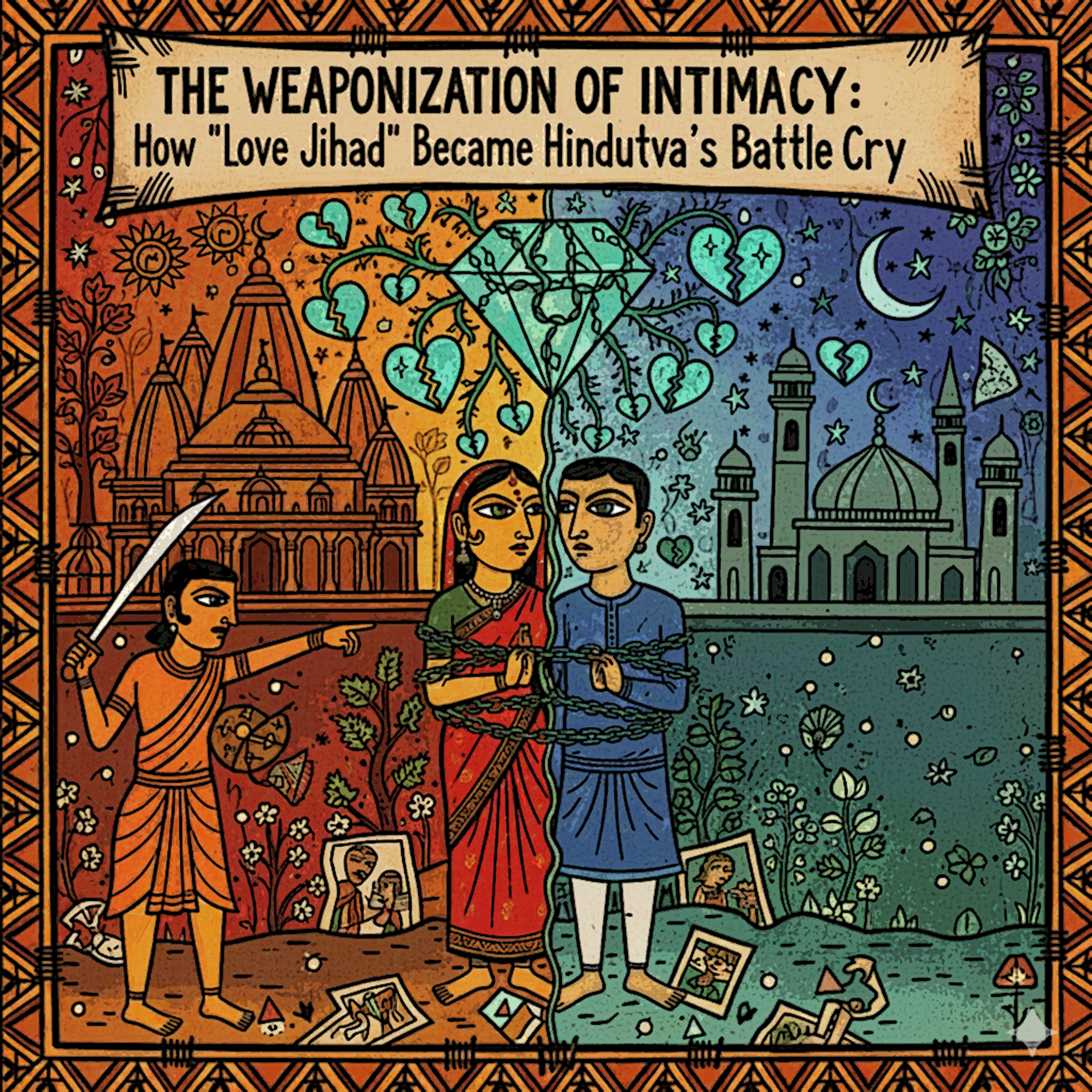
This article critically examines the socio-political, legal, and cultural dimensions of the “Love Jihad” narrative in contemporary India, tracing its roots in colonial fear-mongering, patriarchal control, and Hindutva ideology. It highlights how Muslim men are cast as predatory and Hindu women as endangered, while Muslim women and Hindu men are systematically erased, reflecting a deeply gendered and majoritarian logic. The narrative has been instrumentalized politically and legally—through anti-conversion laws, surveillance, and policing—transforming private interfaith or inter-religious love into a public, criminalized, and highly regulated act. Documented cases reveal lethal consequences, social ostracism, and impunity, illustrating the human cost of communalized suspicion. The article situates these dynamics in cinema, showing how films from Bombay to Kedarnath and PK reflect, challenge, or subvert stereotypes, with narratives ranging from tragic social constraints to satirical critiques of prejudice. Interweaving environmental catastrophe, labour hierarchies, and ideological indoctrination, the study underscores how intimacy, autonomy, and desire are policed by intersecting forces of religion, gender, and state power, emphasizing that “Love Jihad” is less a phenomenon of romance than a tool of surveillance, communal control, and patriarchal-nationalist assertion.
