Letters of Blood and Fire: “Terrorism”, Dispossession, and the Distorted Mirrorings of Domination
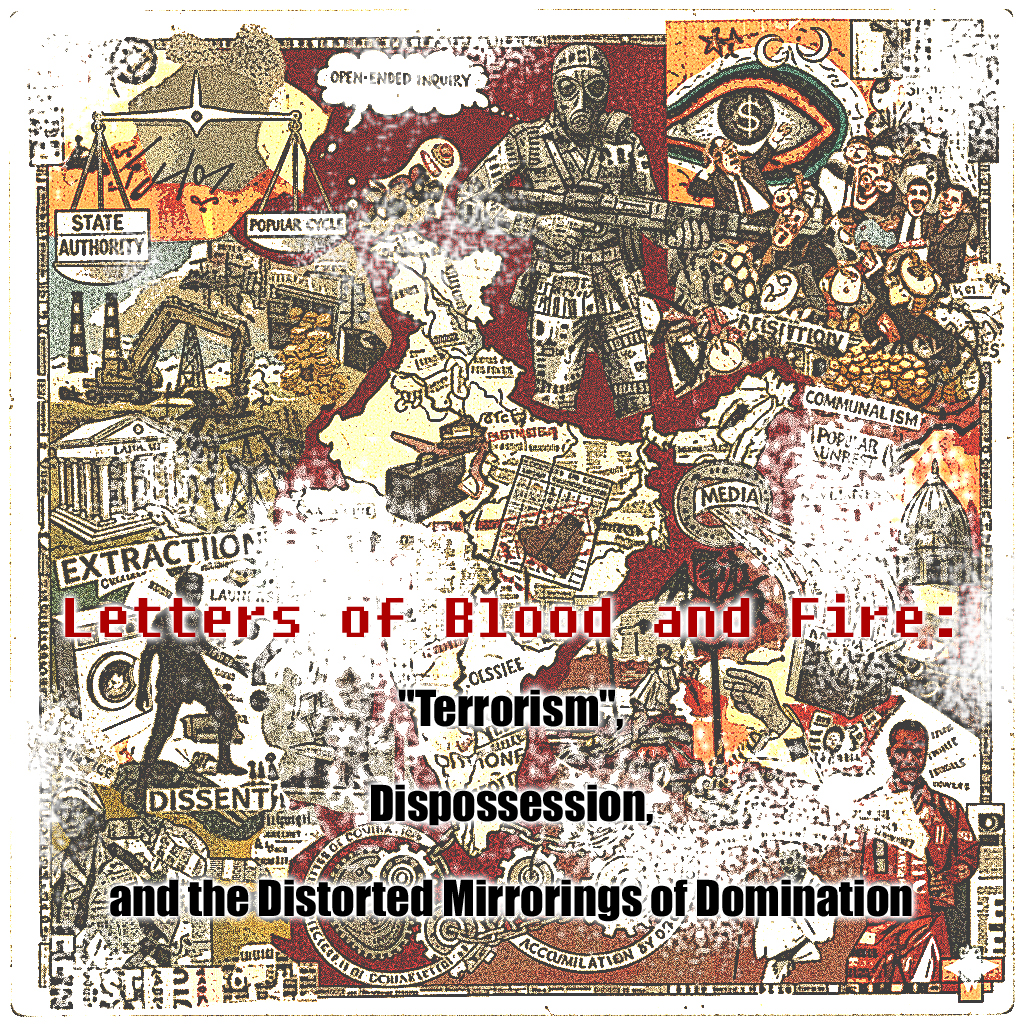
This article critically dissects “terrorism” as a politically contested and asymmetrically applied category, wielded to delegitimize subaltern and non-state violence while normalizing far greater state and corporate terror through legal, discursive, and institutional mechanisms. Drawing on an anarchist methodological lens amid India’s contemporary Islamophobic conjuncture, it provisionally defines terrorism as deliberate civilian-targeted violence intended to induce widespread fear for political, ideological, or social ends, exposing how state practices—from aerial bombings to militarized dispossession—evade the label via sovereign privilege. Integrating Marx’s primitive accumulation, Harvey’s views on accumulation by dispossession, and Toussaint’s analysis of debt-driven imperialism, the analysis frames terrorism as a systemic instrument embedded in neoliberal resource extraction, where conflict in mineral-rich zones (Afghanistan’s lithium, India’s Adivasi belts, Congo’s coltan) functions as both symptom and enabler of corporate plunder, preempted by advanced technologies like remote sensing and veiled by selective narratives that hyper-amplify “Islamic terrorism” while muting Hindutva extremism, Zionist settler violence, and BJP’s hypocritical Taliban engagement amid alleged terror-funding ties. Employing Sāṃkhya’s anyonyapratibimba to reveal power’s projection of its own predation onto the “other,” and balancing economic determinism with religion’s irreducible psychological role in motivating warriors, the piece ultimately reframes terrorism not as pathological or civilizational but as an intrinsic modality of unequal global orders, calling for discriminative clarity (viveka) to dismantle its intertwined logics of capital, technology, ideology, and domination.
