Posted on 23rd June, 2026 (GMT 04:41 hrs)
ABSTRACT
Shyama Prasad Mukherjee (1901–1953) was a Bengali barrister and politician who rose rapidly through alleged paternal influence to become the youngest Vice-Chancellor of Calcutta University. Entering politics as a Congress candidate in 1929, he shifted to the Hindu Mahasabha in 1939, served as Finance Minister in Bengal’s coalition government, explicitly offered cooperation to the British Governor to suppress the 1942 Quit India Movement, and advocated the communal (in the negative sense of the term as in South-East Asia) partition of Bengal in 1947. As Nehru’s Minister of Industry and Supply (1947–1950), he resigned over the Liaquat–Nehru Pact and, with RSS backing, founded the Bharatiya Jana Sangh in 1951. He opposed the Hindu Code Bill’s reforms on women’s rights and Article 370’s special status for Jammu and Kashmir, while his Mahasabha-linked relief efforts during the 1943–44 Bengal Famine drew criticism for communal and caste bias. Detained in Kashmir in 1953 during an agitation against the permit system, he died in custody on 23 June, 1953, amid unresolved medical and inquiry controversies. His documented record reflects a consistent prioritization of upper-caste Hindu majoritarian politics over secular pluralist consensus.
I. Preliminary Statement
Shyama Prasad Mukherjee (1901–1953; alternatively spelt as Syama Prasad Mookerjee alias Mukhopadhyay/Mukherjee/Mukherji) was an Indian barrister and politician who served as Minister of Industry and Supply in Jawaharlal Nehru’s cabinet before resigning in 1950. He subsequently founded the Bharatiya Jana Sangh in 1951 with Rashtriya Swayamsevak Sangh (RSS) backing, which later evolved into the Bharatiya Janata Party (BJP).
Shyama Prasad Mukherjee was awarded two honorary doctorates in 1938 for his academic and administrative contributions: an honorary Doctor of Letters (D.Litt.) by the University of Calcutta and an honorary Doctor of Laws (LL.D.) by Banaras Hindu University. However, we from the OBMA remain unaware/ignorant of the specific nature of his academic contributions.
The following profile examines his political trajectory, ideological positions, and major controversies through nothing but documented evidence.
II. Family Background and Early Career: Paternal Privilege?
Mukherjee was born into a Bengali Brahmin family. His father, Sir Ashutosh Mukherjee, was Vice-Chancellor of the University of Calcutta and a High Court judge. Just a year before his father’s death in 1924, Mukherjee became a Fellow of the Senate of the University of Calcutta in 1923 at age 22—an unusually early appointment. He subsequently studied at Lincoln’s Inn in England and was called to the English Bar in 1926/1927.
In 1934, at age 33, Mukherjee became the youngest Vice-Chancellor of the University of Calcutta, serving until 1938. Contemporary sources noted that his rapid academic advancement occurred while his father held the institution’s highest position.
A Lok Sabha publication even documented:
“He had been assisting in running the Calcutta University from his student days, which brought him into the educational field even while he was still a student…This led to allegations of favouritism in some circles.”
III. Political Orientation: From Congressman to Hindu Communalist?
Mukherjee entered electoral politics in 1929 as a Congress candidate to the Bengal Legislative Council. He resigned in 1930 when Congress boycotted the legislature, then re-elected himself as an independent. By 1937, he held an Assembly seat as an independent and became Leader of the Opposition.
His political reorientation occurred between 1932 and 1935. The Communal Award of 1932 and the Government of India Act of 1935 institutionalized separate electorates and reserved seats for religious minorities and Dalits. These constitutional provisions reduced upper-caste Hindu representation in provinces with large Muslim populations. Mukherjee became invested in mobilizing upper-caste Hindu political interests against these arrangements.
In August 1939, observing V.D. Savarkar’s reception in Calcutta, Mukherjee recorded: “I will not be surprised, things being as they are, if the Hindu Mahasabha were to succeed in stealing a certain amount of Congress thunder.” Later that year, he formally joined the Hindu Mahasabha, a Hindu ethno-nationalist mass organization. By 1940, he became its working president; from 1943 to 1946 he served as president.
IV. Advocacy for Bengal Partition and Two-Nation Theory
As a Hindu Mahasabha member from 1939 onwards, Mukherjee supported the partition of Bengal based on religious demography. Despite having once declared “the indivisibility of India was his God,” he was shouted down at a Calcutta Mahasabha rally in 1944 for suggesting support for communal (in the negative connotation, specific to South-East Asia) division.
On May 2, 1947, Mukherjee wrote directly to Viceroy Lord Mountbatten requesting that Bengal be partitioned even if India remained united—a position rooted in the two-nation theory that presumed Hindu and Muslim populations were fundamentally incompatible. He opposed the plan for a united, independent Bengal championed by Bengal Prime Minister Hussain Suhrawardy and Congress leaders Sarat Chandra Bose and Kiran Sankar Roy.
The consequences of his advocacy became apparent quickly. In the 1952 elections following Partition, the Bharatiya Jana Sangh, which Mukherjee founded in 1951, won less than 4 percent of seats in the West Bengal state assembly. Communities most affected by Partition—Hindu refugees from East Bengal—subsequently became the backbone of the Communist Party of India (Marxist), not the Jana Sangh.
V. Ideological Contestations with Netaji Subhas Chandra Bose
A documented episode reveals the political distance between Mukherjee and secular nationalism. Subhas Chandra Bose, the preeminent secular-socialist mass leader, publicly categorized communal organizations as obstacles to nationalist struggle. In a Forward Bloc Weekly editorial dated May 4, 1940, Bose wrote:
“The Hindu Mahasabha has entered the political arena by taking advantage of religion and has desecrated it. It is the duty of every Hindu to condemn it. Banish these traitors from national life.”
According to Mukherjee’s own diary (Leaves from a Diary, published 1993), Bose had warned him that if the Mahasabha built a rival political organization in Bengal, “he would see to it (by force if need be) that it was broken before it was really born.” Mukherjee recorded his response: “This I consider to be the most unfair and unreasonable attitude to take up.” The entry reveals Mukherjee characterizing Bose’s opposition to communalism as “unreasonable.”
Mukherjee made further remarks on Bose, which could be found in the following pages (underlined) from his diary:
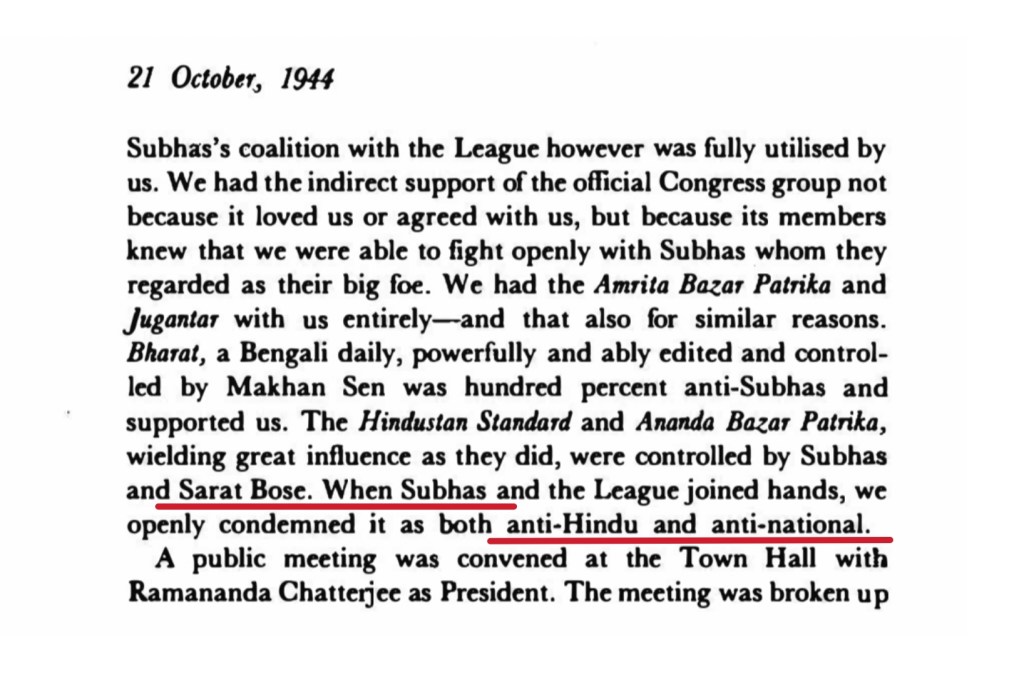
In March 1940, during Calcutta Municipal Corporation elections, Bose’s supporters physically disrupted Hindu Mahasabha meetings. On March 15, 1940, a stone was thrown at Mukherjee during a rally, striking him on the head and causing bleeding. Mahasabha workers retaliated violently against Bose’s supporters.
In The Indian Struggle (1940), Bose wrote of meeting Savarkar: “Savarkar seemed to be oblivious of the international situation and was only thinking how the Hindus could secure military training by entering Britain’s army in India.” He concluded: “Nothing could be expected from either the Muslim League or the Hindu Mahasabha” in anticolonial struggle.
VI. Opposition to Quit India Movement and Cooperation with the British Regime (1942)
In 1942, Mukherjee held the position of Finance Minister in Bengal’s Progressive Coalition government. On August 8, 1942, the Indian National Congress, under the leadership of Gandhi, launched the Quit India movement—a mass civil disobedience campaign demanding immediate British withdrawal.
The Hindu Mahasabha, under Savarkar’s leadership, officially decided to boycott the Quit India movement. The organization’s logic was explicit: the “real battle” was against Muslim political influence, not British colonial rule. Savarkar publicly appealed for Hindus to enlist in the British Army rather than participate in the independence struggle. The RSS’ dress-code also imbibes British military uniform practices.
On July 26, 1942—twelve days before Congress launched Quit India—Mukherjee wrote to Sir John Herbert, Governor of Bengal, offering formal ministerial cooperation. The letter stated:
“Anybody who, during the war, plans to stir up mass feelings, resulting in internal disturbances or insecurity, must be resisted by any government that may function for the time being. As one of your Ministers, I am willing to offer you my whole-hearted cooperation and serve my province and country at this hour of crisis.”
The historical context matters. In 1939, when Congress ministries resigned to protest India’s involuntary inclusion in World War II, even Muhammad Ali Jinnah’s ally, Bengali Muslim League leader Abdur Rahman Siddique, resigned from the Muslim League in protest, calling Jinnah’s celebration of the resignation “an insult to national prestige” and “flattery of British colonialism.” Anti-British sentiment in Bengal was at a peak. Against this background, Mukherjee’s explicit offer of ministerial cooperation to suppress the independence movement represents an extraordinary departure from even communal organizations’ nominal anti-colonial rhetoric.
In November 1942, Mukherjee resigned from the Bengal government, stating he was protesting the Governor’s repression of “certain Hindu groups” opposing Quit India. He subsequently wrote to the Governor outlining proposals for an “Indo-British settlement.” The timing and framing are methodologically significant: he resigned after the independence movement had been brutally suppressed, not before or in anticipation of suppression.
VII. Bengal Famine Relief and Communal Politics (1943–1944)
Between 1943 and 1944, Bengal experienced a (manufactured) catastrophic famine resulting in an estimated 2–3 million deaths. Mukherjee participated in relief efforts through both a “non-partisan” committee and the Bengal Provincial Hindu Mahasabha Relief Committee.
The Hindu Mahasabha’s relief work was documented as distinctly communal in character. A central institutional concern of the Mahasabha was that government canteens employing Muslim and lower-caste cooks violated upper-caste Hindu purity codes. This consideration—protecting caste ritual purity—competed directly with feeding the starving. Historian Sumit Sarkar concluded in a 2020 Cambridge University Press article that the Mahasabha “pursued the famine for political purposes.”
Artist Chittaprosad, documenting the famine in 1944, visited Jirat (Mukherjee’s home village) and recorded: “The riches piled here, an insult to hungry thousands around.” Bengal government officials and journalist T.G. Narayan of The Hindu independently raised allegations of communal bias and corruption in Mahasabha relief efforts.
Historian Joya Chatterji documented that Mukherjee characterized Bengali Muslims as “converts from the dregs of Hindu society.” This ideology manifested in relief practices that prioritized caste purity over human life during mass starvation.
VIII. Minister of Industry and Supply (1947–1950) and the Delhi Pact Crisis
Following his departure from the Hindu Mahasabha in November 1948 (after the organization came under suspicion following Gandhi’s assassination by RSS member Nathuram Godse), Mukherjee was appointed to Jawaharlal Nehru’s Interim Government as India’s first Minister of Industry and Supply. Mahatma Gandhi, despite doctrinal disagreements with Mukherjee on economic philosophy and Hindu-Muslim relations, supported his inclusion in the cabinet, recognizing that engaging diverse perspectives was strategically important.
On April 8, 1950, India and Pakistan signed the Nehru-Liaquat Pact. The agreement established bilateral frameworks for protecting religious minorities in both countries, including: equality of citizenship regardless of religion; minority commissions in both countries; freedom of movement, occupation, and worship; refugee property disposal mechanisms; and recognition that forced religious conversions would not be honored.
Mukherjee resigned from Nehru’s cabinet on April 8, 1950 (the day the Pact was signed). His stated objection was that the Pact failed to hold Pakistan “directly responsible” for Hindu persecution in East Bengal. He advocated instead for systematic governmental population exchange between East Bengal and Indian states—a position rooted in the two-nation theory’s logic that Hindu and Muslim populations were fundamentally incompatible and should be geographically separated.
Nehru, Vallabhbhai Patel, and Abul Kalam Azad attempted to persuade Mukherjee to withdraw his resignation. He refused. His resignation speech in the Lok Sabha on April 19, 1950 was described by his biographer as “one of his best and most moving speeches.” This marked a critical rupture: Mookerjee had exhausted his capacity to operate within a consensual, pluralist framework.
IX. Founding of Bharatiya Jana Sangh (1951) with RSS Backing
On October 21, 1951, Mukherjee founded the Bharatiya Jana Sangh in consultation with M.S. Golwalkar, ideological chief of the Rashtriya Swayamsevak Sangh. The BJP website later acknowledged: “After consultation with Shri Golwalkar Guruji of RSS, Shri Mukherjee founded Bharatiya Jana Sangh.” The formation was mutually beneficial: the RSS, banned by Sardar Patel (a paradoxical point to be noted: the BJP erected the highest statue of Patel in Gujarat!) after Gandhi’s assassination, sought a political front; Mookerjee, seeking distance from the delegitimized Mahasabha, required a new organizational vehicle.
The Jana Sangh’s platform explicitly included: opposition to Article 370; advocacy for a Uniform Civil Code eliminating separate personal law codes for religious communities; a ban on cow slaughter; and promotion of Hindi as national language. These positions would remain central to the BJP’s agenda after the Jana Sangh merged with the party in 1980.
In the 1952 general elections, the Jana Sangh won only 3 Lok Sabha seats. Hindu refugees from East Bengal, those most directly affected by communal violence, had become the backbone of the Communist Party of India, not the Jana Sangh. Mukherjee’s communal politics, despite focusing on Hindu interests, proved electorally ineffective even among those he claimed to represent.
X. Ideological Positions: Religion, Caste, and Gender
After Independence, Jawaharlal Nehru and B.R. Ambedkar collaborated on the Hindu Code Bill, introducing monogamy as a legal requirement, making divorce accessible, and establishing property inheritance rights for women. Mukherjee opposed these reforms vehemently. In parliamentary debates, he argued that such reforms would “do away with the fundamental and sacred nature of Hindu marriage” and “kill the very fountain source of the Hindu religion.”
Notably, he strategically observed that the government did not apply such modernizing reforms to Muslim personal law. Rather than arguing for a universal civil code, he framed Hindu-specific modernization as communal “appeasement” of Hindu women at the expense of Hindu civilization. This rhetorical move allowed him to defend patriarchal structures while claiming to defend Hindu majority interests.
XI. Mookherjee and The Politics of Flag
Jammu and Kashmir was granted special constitutional status under Article 370, which permitted the state to retain certain autonomous powers while remaining part of the Indian Union, including provisions for maintaining its own constitution and flag.
The Bharatiya Jana Sangh and Mukherjee immediately opposed Article 370. Mukherjee’s slogan became: “Ek desh mein do vidhan, do pradhan, do nishan—nahi chalenge” (“A country cannot have two constitutions, two heads of state, and two flags”). This emphasis on “one flag” is methodologically significant. By the early 1950s, the tricolour—saffron, white, and green—had become the symbol of independent India, replacing the Union Jack of British colonial rule.
Interestingly enough, Gautam Chattopadhyay’s book Swadhinata Sangrame Bharater Chhatro Samaj documented that when Mukherjee was vice-chancellor of Calcutta University in 1936, he ordered students to salute the British flag Union Jack during a march past on the university’s foundation day. When a Vidyasagar College student refused, he was whipped; Mookerjee then rusticated two student leaders (Dharitri Ganguly and Umapada Majumdar), triggering widespread student strikes across Bengal.
Throughout the independence struggle, Indian nationalists had fought to replace the Union Jack with the tricolour. By insisting that any special status for Kashmir amounted to tolerating “two flags,” Mukherjee constructed a symbolic equation: Kashmir’s autonomy equaled imperialism; the tricolour’s universality equaled nationalism. This rhetorical move allowed him to position opposition to minority rights protections as nationalist rather than communal.
In the Lok Sabha, Mukherjee attacked Sheikh Abdullah sarcastically: “Who made Sheikh Abdullah the King of Kings in Kashmir?” He termed Article 370 arrangements “Balkanization of India” and opposed Sheikh Abdullah’s vision of a secular, autonomous Kashmir. The Jana Sangh launched satyagraha campaigns demanding full integration and abolition of the permit system that required Indians to obtain permission before entering Kashmir.
XII. Ideological Mentors: Savarkar, Golwalkar, and Gandhi
Mukherjee’s entry into the Hindu Mahasabha in 1939 placed him under the ideological influence of V.D. Savarkar. Savarkar’s conception of Hindutva—rooted in Hindu civilization as a unified cultural and political entity—provided the intellectual framework for Mahasabha ideology. However, tensions existed between them. In his diary, Mookerjee recorded frustration that he had joined the Mahasabha “in the full belief that I would not hesitate to fight the government at the right moment” but felt Savarkar had no desire to popularize the organization or grant membership to “liberal Muslims.”
Subhas Bose, meeting Savarkar in 1940, recorded: Savarkar “seemed to be oblivious of the international situation and was only thinking how the Hindus could secure military training by entering Britain’s army in India.” This suggests Savarkar’s commitment to organized mass struggle against the British was weak. Mukherjee’s subsequent trajectory—opposing Quit India while claiming concern for Hindu interests—followed a similar logic.
When Savarkar’s health declined in 1940, Mukherjee became Mahasabha’s acting president and then president from 1943 to 1946. He operationalized Savarkar’s ideological legacy in more organized form. When the Mahasabha became politically toxic after Gandhi’s assassination by RSS member Nathuram Godse in 1948, Mukherjee transitioned to the Jana Sangh with M.S. Golwalkar, maintaining organizational and ideological continuity.
Despite profound disagreement on economic philosophy, Mahatma Gandhi maintained respect for Mukherjee’s administrative competence and supported his inclusion in independent India’s first cabinet. When Gandhi was assassinated in January 1948, Sardar Patel’s correspondence clarified: “The RSS was not involved…I link the conspiracy to a fanatical wing of the Hindu Mahasabha directly under Savarkar.” Mukherjee condemned Gandhi’s assassination publicly and separated from the Mahasabha in November 1948, but he never publicly repudiated communal ideology—he relocated it to a new political vehicle, suggesting his departure was tactical rather than ideological.
XIII. Death in Detention in Srinagar (May–June 1953)
In May 1953, Mukherjee travelled to Jammu and Kashmir to protest the permit system. He defied prohibitory orders and attempted entry to Srinagar on May 11, 1953. He was immediately arrested and detained by J&K police.
On June 19, Mukherjee developed high fever and back pain, diagnosed as dry pleurisy. Despite his documented allergy to streptomycin, doctors administered the antibiotic. On June 22, he developed acute chest pain. He was admitted to hospital and died on June 23, 1953, at 3:40 a.m. The official cause was recorded as myocardial infarction.
His mother, Jogmaya Devi, wrote to Prime Minister Nehru: “My son died in detention, detention without trial…what prevented you from meeting him there personally and satisfying yourself about his health? The first information that I, his mother, received was that my son was no more…in what cruel cryptic way the message was conveyed.”
The West Bengal Congress Committee President noted: “It was amazing that no intimation was sent to his family members nor to his physician…the Kashmir Government appears to be callous…the way the news was conveyed was highly objectionable.”
Demands for independent inquiry were not fully accommodated. The Government of India stated the matter fell outside its purview (as J&K had special constitutional status), and the J&K government declined independent oversight. Ironically, the very constitutional autonomy Mukherjee spent two years opposing—Article 370 and its special provisions—created the jurisdictional opacity that prevented accountability for his death in state custody.
His death has remained controversial. Mukherjee’s mother, Jogmaya Devi, wrote to Prime Minister Nehru: “You say you had visited Kashmir during my son’s detention…But what prevented you from meeting him there personally and satisfying yourself about his health and arrangements?” She protested that the family received no information about his illness or hospitalization until after his death. The West Bengal Congress Committee President expressed shock that no intimation was sent to his family or his physician, Dr. Bidhan Chandra Roy.
The J&K government initially resisted an inquiry into the death circumstances. When a resolution for inquiry was passed by the West Bengal Legislative Assembly in November 1953, the Government of India stated that the matter fell outside its purview and the J&K government declined oversight of an inquiry into its own actions.
XIV. Conclusion
Shyama Prasad Mukherjee’s fifty-two years encompassed a distinctive political trajectory: Congress politician (1929); Hindu Mahasabha organizer (1939); coordinator with British authorities during Quit India (1942); Mahasabha leader through the Bengal Famine (1943–44); cabinet minister in secular government (1947–1950); founder of communal political party with RSS backing (1951).
This trajectory reveals consistent ideological commitment: to Hindu majority political prerogatives; to opposition of constitutional protections for minorities, Dalits, and religious communities; to majoritarian consolidation under unitary symbols (one flag, one constitution, one code); and to organizational forms institutionalizing these commitments. His antagonism toward Subhas Bose’s secular nationalism, his explicit cooperation with British authorities during anti-colonial struggle, his opposition to legal protections for women and minorities, and his founding of an explicitly communal political organization all cohere within a single ideological logic.
The distinction between communal ideology and secular nationalism was not ambiguous in Mukherjee’s time. Subhas Bose articulated it with clarity: communal organizations were obstacles to national struggle. Gandhi distinguished between Mukherjee’s administrative competence and his communal commitments. Sardar Patel clarified organizational boundaries in Gandhi’s assassination case.
Mukherjee’s legacy lies in institutionalizing Hindu communal ideology within an organized political party. The Jana Sangh, which became the BJP, continues to articulate positions rooted in his framework: opposition to constitutional protections for minorities (Article 370, now revoked; separate personal law codes), advocacy for majoritarian symbols and laws (Uniform Civil Code, cow protection), and centralized, unitary arrangements over federal or autonomous mechanisms.
The documentary record establishes: Shyama Prasad Mukherjee opposed the independence movement when it mattered most (1942), explicitly coordinated with a colonial government to suppress it, advanced communal ideology during national catastrophe, resisted legal protections for the vulnerable, and founded an organization committed to Hindu ethno-nationalist ideology in place of secular pluralism.
His death in detention in Kashmir—the state whose autonomy he had spent two years attacking—carries a methodological lesson: the constitutional arrangements he opposed would have provided the very accountability mechanisms that failed to materialize in his case.
Sources
Daniyal, S. (2016, July 16). Three facts about BJP founder SP Mookerjee that a recent exhibition in Delhi did not show. Scroll.in. https://scroll.in/article/811727/three-facts-about-bjp-founder-sp-mookerjee-that-a-recent-exhibition-in-delhi-wouldnt-have-revealed
Indian Express. (2021, July). Why Shyama Prasad Mukherjee opposed the United Bengal plan. https://indianexpress.com/article/explained/explained-why-shyama-prasad-mukherjee-opposed-the-united-bengal-plan-7220400/
Sarkar, A. (2020). Fed by famine: The Hindu Mahasabha’s politics of religion, caste, and relief in response to the Great Bengal Famine, 1943–1944. Modern Asian Studies, 54(3), 784–826. https://doi.org/10.1017/S0026749X1900001X (Cambridge Core)
Chatterji, J. (2002). Bengal divided: Hindu communalism and partition, 1932–1947. Cambridge University Press.
Roy, T. (2012). Shyama Prasad Mookerjee: Life & times. Bloomsbury India.
Lok Sabha Secretariat. (1990). Eminent parliamentarians monograph series: Dr. Syama Prasad Mookerjee. New Delhi, India.
Sircar, J. (2022, June 5). An unrelenting patriot. Millennium Post. https://www.millenniumpost.in/ (Academia.edu repository)
Daily Excelsior. (n.d.). Public life of Dr Syama Prasad Mookerjee. Retrieved June 23, 2026, from Daily Excelsior archives.
The Wire. (2016, July 4). ‘Painful sights’: Chittaprosad on BJP icon S.P. Mookerjee’s Bengal village. https://thewire.in/ (related search: https://thewire.in/politics/search-syama-prasad-mookerjee-true-patriot)
Additional References (Contextual/Online)
Frontline. (2013, August 7). Political adventurer. The Hindu. https://frontline.thehindu.com/books/political-adventurer/article4985553.ece
Sabrang India. (n.d.). Did Savarkar, Syama Prasad Mukherjee and RSS betray Quit India Movement? https://sabrangindia.in/article/did-savarkar-syama-prasad-mukherjee-and-rss-betray-quit-india-movement/
The Print. (n.d.). How SP Mookerjee took on Nehru in one of the fiercest parliamentary duels in India. https://theprint.in/india/how-sp-mookerjee-took-on-nehru-in-one-of-the-fiercest-finest-parliamentary-duels-in-india/776258/
Vivekananda International Foundation. (2025, May 7). Opposite ends of the pendulum: Syama Prasad Mukherjee and Nehru on Pakistan and China. https://www.vifindia.org/article/2025/may/07/Opposite-Ends-of-the-Pendulum-Syama-Prasad-Mukherjee-and-Nehru-On-Pakistan-and-China
NewsClick. (n.d.). Hindutva icon Syama Prasad Mookerjee had nothing but contempt for the tricolour. https://www.newsclick.in/hindutva-icon-syama-prasad-mookerjee-had-nothing-contempt-tricolour


।।মহাপুরুষ শ্যামাপ্রসাদের মৃত্যুদিবস উপলক্ষে পশ্চিমবাংলা “আত্মবলিদান দিবস” উদযাপন।।
আহহা, আপুনারা ভুল বুঝিতেছেন! এই আত্মবলিদান দিবসকে ভাবিতেছেন যে যতেক ভাজপার (দু:-?) নৈতিক ন্যাতা, মন্তিরি-সানতিরি আছেন, তাঁহারা হাঁড়িকাঠে গলা দিবেন। না, ইহা আদতে অন্তরের রিপুগুলির বলিদান–যাহাকে হিঁদু শাস্তরে কয় “অন্তরাগ্নিহোত্র”। ইহা ভ্রষ্টাচারের ফর্দাফাই বস্ত্রে রিফু (<আরবি ‘রফু’ رفو) থুড়ি রিপু করিবার/তাড়াইবার আত্যন্তিক প্রয়াস।
আসুন, বিশদে আলোচনা করি বন্দেমাতরম্- সঙ্গীতের কয়েক পংক্তি গাহিয়া:
“নমামি তরিণীং
রিপুদলবারিণীং
মাতরম্ ৷”
আত্মবলিদান মোচ্ছব — ২৩ জুন, ২০২৬
২০২৬ খ্রীষ্টাব্দে পরম শ্রদ্ধেয় মহাপুরুষ মহাত্মা মসীহা কল্যানময় সঙ্গত ধম্মভিত্তিক দেশভাগকারী শ্যামাপ্রসাদের তিরোধানের/মহাসমাধির স্মরণে নিবেদিত পশ্চিমবাংলার এই পবিত্র আত্মবলিদান দিবসটি বিশেষ অর্থময়তা লাভ করিয়াছে। কারণ, আমাদিগের ভাজপা সরকার এবং তাঁহাদের নিবেদিত সেবকবর্গ এই মহৎ দিনে আত্মবলিদান মহাযজ্ঞের আয়োজন করিয়াছেন। ইহা মৎকৃত ব্যাখ্যায় আদতে “অন্তরাগ্নিহোত্র মহাযজ্ঞ”।
সেটি আবার কী বস্তু?
ইহা অন্তরের ষড়রিপু-নিধনের ritual! আপুনার অন্তরের যাচ্ছেতাই মালের Barbeque বা BBQ–মানব-প্রকৃতি বিজয়। ইহা দুরখ্যাঁ-কথিত Altruistic suicide। ইহা কখনই বাহ্যাড়ম্বরে ভরা পুজোয়াচ্চা নহে।
মহাভারতের বনপর্বে বকরূপী যক্ষ যখন যুধিষ্ঠিরকে প্রকৃত ‘স্নান” এবং “শৌচ”-এর সংজ্ঞার্থ জিজ্ঞাসা করেন, তখন যুধিষ্ঠির উত্তর দিয়াছিলেন:
“স্নানং মনোমলত্যাগঃ শৌচমিন্দ্রিয়নিগ্রহঃ।অভেদদর্শনং ধ্যানং জ্ঞানং নির্বিষয়ং মনঃ॥”
অর্থাৎ,
মনের ভেতরের সমস্ত কলুষতা বা আবর্জনা দূর করাই হলো প্রকৃত ছেনান…
এই শ্লোকে জলের দ্বারা বাহ্যিক শুদ্ধির চেয়ে মনের অভ্যন্তরীণ শুদ্ধিকেই সর্বোচ্চ গুরুত্ব প্রদান করা হইয়াছে। ওঁ শুচি, বাহ্যাভন্তর: শুচি।
এমতভাবেই আমাদিগের উনিজি ডুবকি, স্কুবা ডাইভ এবং নকল যমুনা নির্মাণ করিয়া মনোমলত্যাগ করিয়া থাকেন।
এই “মনোমলত্যাগ” এবং রিপু-বলিদানই সংঘ পরিবারের শুভ-এষণা।
(বি. দ্র:বাবা রামদেবের পতঞ্জলি কোং নাকি একটি ধোলাই যন্তর বাহির করিয়াছেন। ইহাতে ঢুকিলে সাত খুন মাফ)
অ) কাম-রিপু বলিদান
সংঘীরা কাম-রিপুর সবচেয়ে উন্নত রূপকে (এপ্সটাইন সংযোগ, মোশার স্নুপগেট কুচ্ছো, ব্যাপক ধ %র্ষ *ণ ইত্যাদি) মনের মল বলি দিবেন।
এমত ভাবে নিজ-কামনাকে আগুনে ঝলসিয়ে, তাঁহারা দলীয় ক্ষুদ্র-স্বার্থের শুদ্ধিকরণ করিতেছেন।
আ) ক্রোধ-রিপু বিনাশ
ইহারা বৈষ্ণবীবিনয়ে থিতু হইয়া আর ক্রোধান্ধ হইবেন না। মুস্লিম-শঙ্কার কিসসা ফাঁদিবেন না। প্রাচীণ হিঁদু স্থিতপ্রজ্ঞ মুনি-ঋষিদিগের ন্যায় ক্রোধান্ধ হইয়া কথায় কথায় অভিসম্পাত করিবেন না।
বস্তুত, তাঁহারা “জনতার ক্রোধ”-এর অভ্যন্তরীণ বলিদান করিতেছেন। নিজেদের ক্রোধকে তাঁহারা জনসাধারণের উপর প্রক্ষেপণ করিয়া, নিজস্ব অগ্নিতে শোষণ করিতেছেন।
যখন তাঁহারা নির্বাচনী যন্ত্র নিয়ন্ত্রণ করেন (সাধারণ নাগরিকদের ভোটাধিকার হরণ),
যখন তাঁহারা ন্যায়বিচারের বদলে UAPA, NIA ইত্যাদি এক্টো প্রয়োগ করেন এবং নি:-বিচারে গারদস্থ করেন।
তখন, ইহাই ক্রোধ-নিয়ন্ত্রণের অন্তরাগ্নিহোত্র-পদ্ধতি।
প্রসঙ্গত: একটি ঘটনা মনে পড়িল:
১৫ মার্চ, ১৯৪০ তারিখে কলিকাতা পৌরনিগম নির্বাচনের প্রাক্কালে শ্যামাপ্রসাদ মুখোপাধ্যায় একটি জনসভায় ভাষণ দিতে দাঁড়ালেই হঠাৎ তাঁহার মগজে একটি প্রস্তরখণ্ড ছুঁড়িয়া মারা হয়।
মাননীয় শ্যামাপ্রসাদ মুখুজ্জের ডাইরি মোতাবেক, এই আক্রমণকারীরা ছিলো সুভাষচন্দ্র বসুর চ্যালাচামুণ্ডা। নেতাজি হিন্দু মহাসভার সাম্প্রদায়িক রাজনীতির বিরুদ্ধে ছিলেন। তাহা হইলে এইবার নেতাজির এস্ট্যাচুগুলি সক্রোধে ভাঙিয়া ফেলো।
আরো মনে পড়িল, যতিন দাসের আত্মবলিদানের পর রবিবাবুর লেখা একটি গান, “সর্ব খর্বতারে দহে তব *ক্রোধ*-দাহ”।
ই) লোভ-রিপুর বলিদান তথা অন্তরাগ্নিহোত্র:
খ্যামতার লিপ্সা, পদপ্রাপ্তির আকাঙ্ক্ষা, ফেকু সংখ্যাগরিষ্ঠতার গরিমা (ভোট-তস্কর হইয়াও সর্বভারতীয় ক্ষেত্রে ভাজপা মোটামুটি ৩৫%: আর অন্যব্রতরা একত্রে, ৬৫%), উৎকোচগ্রহণ ইত্যাদি।
আমরা প. বঙ্গের বর্তমান মুখ্যমন্ত্রীকে চলচ্ছবিতে টাকার বান্ডিল লইতে দেখিয়াছি, তাহা এ আই দ্বারা নির্মিত ডাহা মিথ্যা ভিডিও!
এ্যাঁ, কী কহিলেন, তৎকালে এ আই ছিলো না! তো কী হইলো! আমাদিগের মাননীয় পোধানমন্তিরি যদি এ্যানালগের যুগে ডিজিটাল ক্যামেরা, ইমেইলহীন যুগে ইমেইল ব্যবহার করিত পারেন, মেট্রোরেলবিহীন কলিকাতায় পাতাল রেলে চড়িতে পারেন, তাহা হইলে তখন Tampered video শত্রুপক্ষ বানাইতে পারিবেন না কেন? এমত প্রাক্-এ আই কালেরTampered Video-র ভুরিভুরি নমুনা আমি পেশ করিতে পারি।
বস্তুত, ভাজপারর নেতৃত্বে যাহারা রাজ্যের আর্থিক তহবিল বিগ্রহ করেন, যাঁহারা বৃহৎ আয়ের সম্ভাব্যতা (ভূমি-অধিগ্রহণ, বাঁধ-নির্মাণ, কর্পোরেট-সহযোগিতায়) সৃষ্টি করেন, তাহারা ব্যক্তিগত লোভ-রিপুকে বিশ্বব্যাঙ্কের নিকট হইতে ঋণ লইয়া জাতীয় উন্নয়নের অগ্নিতে আহুতি দিতেছেন।
স্থানীয় জনগণকে বুলডোজার দিয়া বহিষ্কার করিয়া, তাঁহারা নিজেদের ব্যক্তিগত লোভকে “উন্নয়নের দেবতা”-র উপর নৈবেদ্য দান করেন। এইভাবেই তাঁহারা লোভ-মোচন তথা অন্তরাগ্নিহোত্র সাধন করেন।
(স্থানীয় মানুষ যা হারায়, তাহা বস্তুতই অপ্রাসঙ্গিক—কারণ যাহা কিছু যজ্ঞে অগ্নি-আহুতি দেওয়া হয়, সেটাই কেবল মূল্যবান।)
ঈ) মোহ-রিপুর অন্তরাগ্নিহোত্র
মোহ (বস্তু-নিষ্ঠার অন্ধকার) দূর করিবার নিমিত্ত তাঁহারা কী করিয়াছেন?
অত্যন্ত সুকৌশলে পাঠ্যক্রম সংশোধন, ইতিহাস-পুনর্নির্ধারণ, সংস্কৃতায়িত হিন্দি-ভাষা শিক্ষার অগ্রাধিকার দ্বারা তাঁহারা জনতার রোজকারের বোধ (ভালো শিক্ষা, স্বাস্থ্য, কর্মসংস্থান, পরিবেশ-প্রকৃতি রক্ষা) ধুলিসাৎ করিয়া দিতেছেন।
এর ফলে মুখ্যুসুখ্যু জনগণ তথাকথিত “সত্যিকারের জীবনের সমস্যা”-র অহেতুক মোহ হইতে মুক্ত হইয়া, একটি বৈকল্পিক বাস্তবতায় (যেখানে ইতিহাস পুনর্লিখিত হয়, বর্তমান অস্পৃশ্য হয়ে যায়, এবং ভবিষ্যৎ সম্ভাবনারা বিলুপ্ত হয়) বাস করিতে শিখিয়াছেন। ব্যক্তিগত ও পার্টিগত টাকা-পয়হা বাড়িয়ে তুলিবার চাহিদা, খ্যামতাতন্ত্রের সিঁড়ি বাগিয়াবক্রমাগত উচ্চ হইতে উচ্চতর স্থান লাভ করিয়া চলিবার তনহা(তেষ্টা)—এই জাতীয় বিষয়ই এখন প্রধান স্থান লাভ করিয়াছে।
এতদুপায়ে মোহ-রিপুর অন্তর-শোধন বা অন্তরাগ্নিহোত্র সম্পন্ন হয়।
উ) মদ-রিপুর অন্তরাগ্নিহোত্র
মদ-রিপু (অহংকার) দূর করার জন্য তাঁহারা কী করেন?
প্রতিটি প্রকল্প, প্রতিটি নিয়োগ, প্রতিটি সিদ্ধান্ত—সবকিছুতেই নিজেদের অতুলনীয় দূরদর্শিতা ও শ্রেষ্ঠত্ব প্রতিষ্ঠা করেন। জনতার সামনে তাঁহারা তাঁহাদের অহংকার-স্মৃতিস্তম্ভ খোদাই করিয়া থাকেন।
দিকে দিকে উনিজি সেলফি-পয়েন্ট, হাইওয়ের পাশে উনিজি-র মুখমণ্ডল-পরিবৃত যাবতীয় বিজ্ঞাপনাদি, উনিজির নামের স্টেডিয়াম ইত্যাদি ইহারই সুপ্রতিষ্ঠিত সাক্ষ্য দেয়।
এটি মদ-রিপুর কোনো ত্যাগ নয়—বরং তার অন্তরীকরণ। বাহ্যতঃ বিনম্র থাকিয়াও, অভ্যন্তরীণ অগ্নিতে নিজস্ব মহিমা-বোধকে জ্বালাইয়া দেন সংঘীরা।
ঊ) মাৎসর্য (হিংসে, পরশ্রীকাতরতা বা ঈর্ষা)-রিপু নির্বাসন
(কলিকাতা বিশ্ববিদ্যালয়ের উপাচার্য [১৯৩৪-১৯৩৭] শ্যামাপ্রসাদ মুখোপাধ্যায় নিয়োজিত বাংলা বানাম সংস্কার কমিটির নির্দেশ মোতাবেক রেফের পর দ্বিত্ব বর্জনীয় বলিয়া “মাৎসর্য্য, উপাচার্য্য” শব্দগুলিতে য-ফলা বর্জিত হইলো।)
সকল প্রতিদ্বন্দ্বী, সকল বিরোধী কণ্ঠস্বর, সকল সমালোচক, সকল স্বাধীন সংবাদমাধ্যম যারা সামান্যতম সন্দেহ প্রকাশ করে—তাহাদের বিরুদ্ধে তাঁহারা যে আইনি হয়রানি, ডিজিটাল সেন্সরশীপ, মিডিয়া-বয়কট, সামাজিক কলঙ্কন সাধন করেন, তাহা মাৎসর্য-নিয়ন্ত্রণের চিত্তাকর্ষক পদ্ধতি।
কারণ, যখন আপনি অন্যদের সাফল্য দেখিয়া ঈর্ষা অনুভব করেন, তখন তাদের ধ্বংস করিয়া সেই ঈর্ষা-অনুভূতি শেষ করে দেন—এটি মাৎসর্য-নিয়ন্ত্রণের সর্বোচ্চ পর্যায়। “Neighbours’ Envy, Owners’ Pride”
আমরা সবাই স্বীকার করিতে বাধ্য:
ভাজপা নেতৃত্বাধীন পশ্চিমবঙ্গ সরকার—এই আত্মবলিদান দিবসে—একটি অভূতপূর্ব অন্তরাগ্নিহোত্র-যজ্ঞের পরিচালনা করিতেছে।
।। “অন্তরাগ্নিহোত্র মহা-হাস্য-যজ্ঞ-এর ছুতোয় লিখিত ।।
LikeLiked by 6 people