
Addressed to the men and women in the uniform of the Indian Republic — not to generals, procurement officers, or politicians, but to the person with the rifle, the aircraft, the border watch, and the internal-security beat — this open letter and dossier is written from ahimsa: hard, active non-violence that refuses the destruction of truth. From parliamentary records, CAG reports, RTIs, courts, former Governors and Army Chiefs, the National War Memorial, investigative and strategic sources, SIPRI and budget data, and OBMA’s research, it maps institutional betrayal under the BJP–NDA regime(s): a suppressed Army Chief’s memoir; electoral use of Pulwama and Pahalgam martyrs; Model Code violations; Agnipath’s contract labour; disability-pension cuts after the 2016 strikes and the 2026 tax on valour; AFGIS/AGIF losses in DHFL; defective INSAS and ammunition; Chinese occupation and cartographic lies; Operation Sindoor’s fog and later war-memorial names; Siachen’s nationalism industry; Taliban engagement and the asymmetric terror label; CAPF subordination and the 2026 Act overriding the Supreme Court; veterans at Jantar Mantar; Rafale opacity; a ₹6,81,210-crore budget that still cannot issue reliable boots; and war-profiteering that turns the soldier into a line item. Linked to Prahar, Rang De Basanti, War Chhod Na Yaar, and Jai Ho, and closed by the Russell–Einstein question, it asks the citizen in uniform for viveka — not rebellion, but truth known, paid forward, and refused as the next campaign poster’s raw material.
Category Archives: Activities
Our current activities concentrate on the case of Dewan Housing Finance Corporation Limited (DHFL), India. While exploring and investigating this particular case, we have found that India’s crony ruling party, gangsters, banksters as well as religious gurus and institutions are involved in the same. Therefore, to break such collusion, we have decided to deploy an “all out attack” on the existing paradigm of neoliberal market economy as well as market fundamentalism. ***DISCLAIMER: We have collected all the data from available sources on the internet as given on the official portals of media houses, websites and institutions and organizations. We are not first-hand reporters and hence, we are not liable for any inadvertent error or value-loaded statements made on those portals. All propositions have to be viewed as descriptive assertions on the given point of concern.***
The Piramal Pratijñābhaṅga: The Itching Palm of “Conscious Capitalism”?!

This open letter to Ajay Piramal is a satirical indictment of Piramal as an agential structure of corporate power, wielding pratijñābhaṅga, dharma, and satyāgraha to expose the contradictions of “conscious capitalism,” the DHFL “resolution” (?), depositor dispossession, and the collusive architecture linking capital, State apparatus, and institutional power. Piramal is neither an isolated individual nor an aberration, but a particularly revealing node in India’s dynastic neo-capitalist order—the same oligarchic formation embodied, in their own equally consequential ways, by Adani and Ambani, the notorious twins of India’s corporate duopoly.
Encountering Pratijñābhaṅga: BJP’s Jumla Politics and the Hollow Piramal Promise
This article argues that the political formation presenting itself as temporal guardian of Sanātana Dharma stands convicted, by that tradition’s own oath-jurisprudence, of serial pratijñā-bhaṅga (breach of the solemn word). Classical Indian thought treats the given word as a binding bond, its rupture punished both in the seen (dṛṣṭa: curse, fine, exile, infamy) and unseen (adṛṣṭa: loss of merit, hell). Reconstructing this jurisprudence from Vedic, epic, Nyāya and Dharmaśāstra sources, the paper applies it to two cases. Focus One: the Hollow Piramal Promise in the DHFL insolvency, where Piramal Capital publicly pledged fixed-deposit holders an extra 10% over the CoC plan yet delivered only 23.08% recovery (~77% haircut on ~₹5,375 crore), while assigning ~₹45,050 crore in alleged-fraud recoveries to the acquirer for one rupee. Focus Two: BJP’s jumla politics—the serial non-coherence of promises from ₹15 lakh and two crore jobs to Acche Din, Smart Cities, Housing for All and Viksit Bharat 2047. Method is compelled juxtaposition of promise against record; pseudology is treated as a discursive property, contested claims are marked, and the Piramal material is offered as opinion and fair comment on a matter of public interest. The finding is arthānupapatti—its Vedic name anṛta, the untruth opposite to the ṛta these guardians claim to protect.
Azadi, or Democratic Unfreedom? A Video Message from OBMA

This video asks what “Azadi” (freedom) means in India today, and whether the formal existence of democracy can coexist with a lived condition of democratic unfreedom. Tracing the period from 2014 to 2026, it examines the erosion of civil liberties, institutional accountability, democratic participation, ecological security, and economic justice, before asking what genuine freedom might require: the Right to Reject, the Right to Recall, a partyless democracy, and an ecological politics rooted in Oikos — our shared home.
The Rajnath Singh Dossier: Resign, Raksha Mantri!
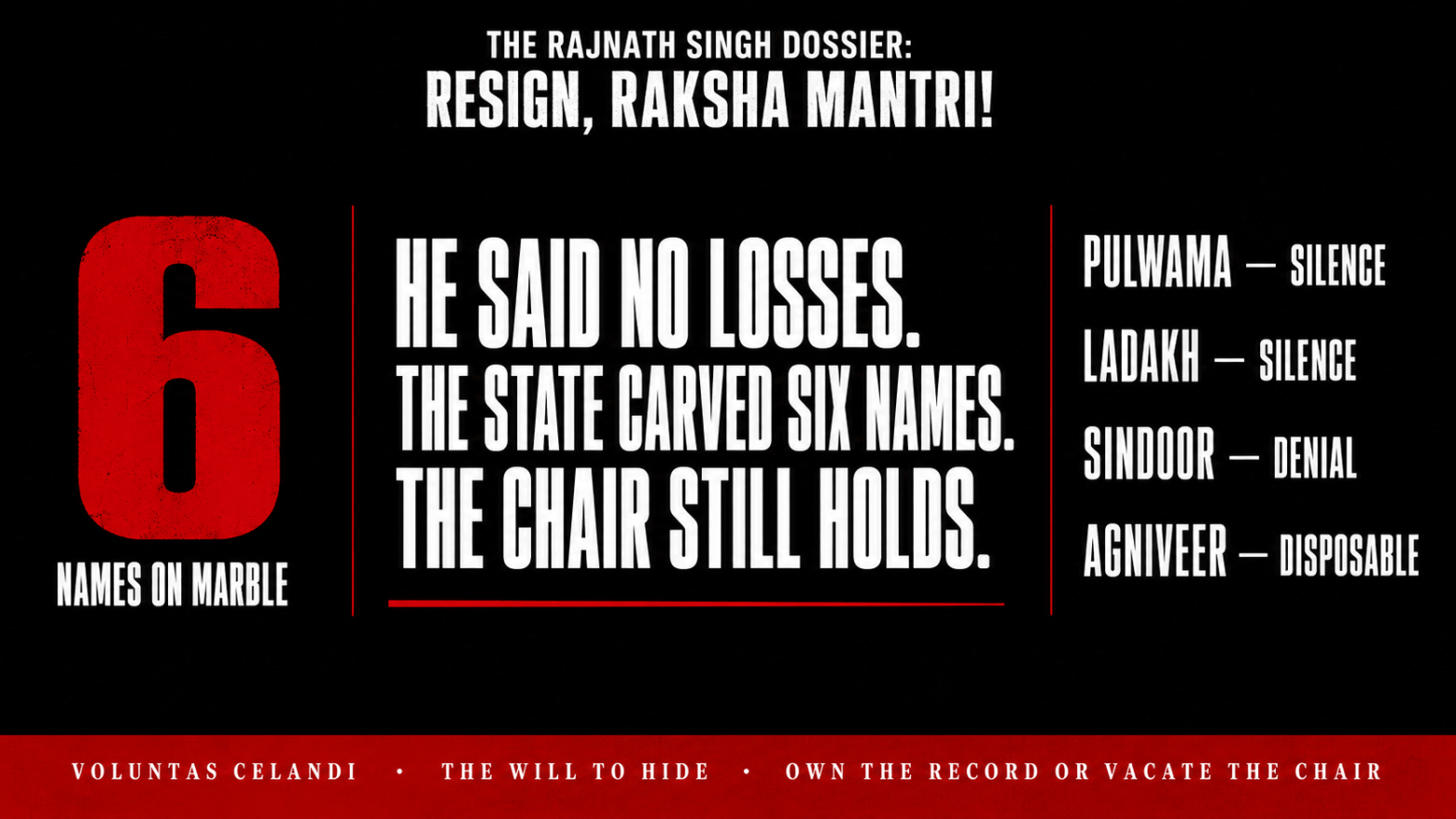
This citizens’ charge-sheet records Rajnath Singh’s institutional tenure as Home Minister (2014–2019) and Defence Minister (2019–present) through the state’s own certified contradictions: the intelligence and convoy-security collapse that killed forty CRPF personnel at Pulwama on his watch; the selective silence on lost patrolling access in Eastern Ladakh; the Pahalgam attack of 22 April 2025 and the retaliatory Operation Sindoor; the categorical parliamentary denial of any soldier losses on 28 July 2025, followed thirteen months later by the state’s compelled disclosure of six names chiselled onto the National War Memorial; the parallel refusal to admit aircraft attrition until the Chief of Defence Staff conceded it abroad; the conversion of the soldier into a four-year disposable contract under Agnipath; the political shielding of opacity around Rafale; and the quiet advance of dynasty inside a party that campaigns against it. Built exclusively from Hansard, the National War Memorial’s Roll of Honour, Ministry of Defence clarifications and on-record statements of constitutional functionaries, the pattern that emerges is voluntas celandi—the will to hide—operating at the very site of memory, semantic truncation that leaves dual realities permanently open, and the systematic manufacture of impunity upstream of every demand for accountability. The minimum grammar of ministerial responsibility therefore requires the holder of the chair to step down; because the institutional machine is constructed so that no minister of this regime need ever activate that grammar, the deeper structural demand remains the constitutional Right to Recall and the Right to Reject.
The Shah Dossier: Resign, Union Home Minister!

This citizens’ charge-sheet documents twenty-one instances of foreclosed accountability, institutional failure and the systematic manufacture of impunity under Amit Shah as Union Home Minister — from the Gujarat encounter cases and the tadipaar externment, through surveillance, financial opacity, the architecture of control in Kashmir, CAA–NRC and electoral machinery, to security collapses in Manipur, Pahalgam and on the China border, culminating in the use of brutal and repressive force against unarmed students at Jantar Mantar. It demands his resignation and the democratic rights of recall and reject.
The Financial Architecture of “Viksit Bharat” (2014–2026)
This activist dossier reconstructs, almost entirely from the state’s own figures, the financial architecture of crony extraction that crystallised in India between 2014 and 2026 under the BJP–NDA regime: a true aggregate (fourth-largest economy, falling NPAs, moderate inflation) is displayed while the distribution beneath it is rendered (un-)knowable through discarded surveys, a suspended census, statutory identity shields over ₹16.35 lakh crore in write-offs (or waive offs?!), one-rupee assignments of fraud claims, and a hundred-per-cent RTI evasion rate. Losses are systematically socialised onto the public and residual gains privatised to a connected few via demonetisation, GST, the IBC–DHFL laboratory, opaque political funding, and the inversion of public banking. The growth narrative of “Viksit Bharat” rests on this measured invisibility. The two chairs that operate the architecture — the Finance and Corporate Affairs Minister and the Governor of the Reserve Bank — are therefore addressed with a single demand: Resign, or answer.
FINANCE MINISTER and CORPORATE AFFAIRS MINISTER: RESIGN! SCRAP IBC!
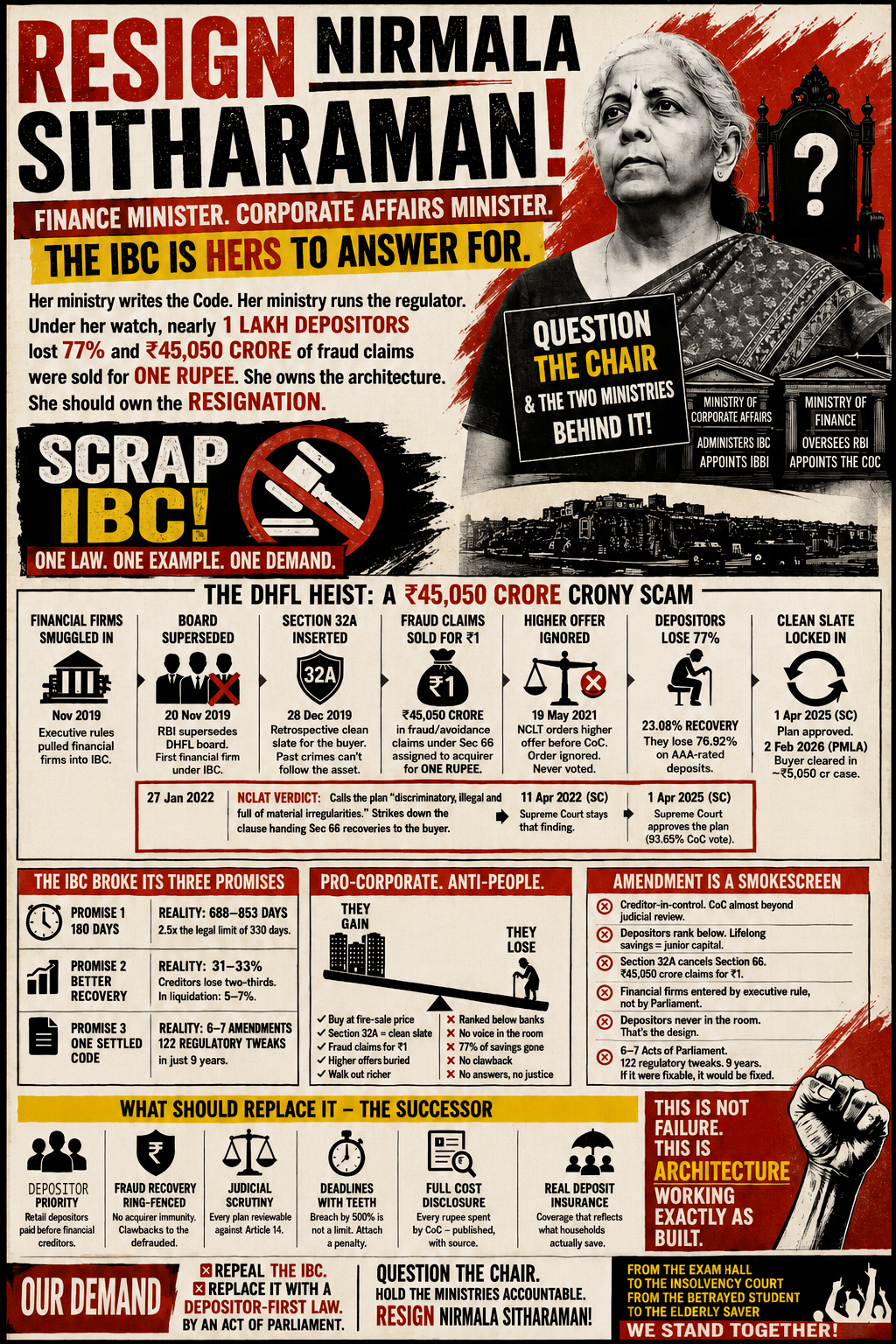
In the shadow of nationwide student uprisings demanding the resignation of Education Minister Dharmendra Pradhan and the overhaul of NEET and the NTA, this manifesto stands in unbreakable solidarity and expands the battlefield: Finance and Corporate Affairs Minister Nirmala Sitharaman must resign, and the Insolvency and Bankruptcy Code 2016 must be repealed outright. Under her dual ministries the IBC has delivered its true design—nearly one lakh mostly elderly DHFL depositors stripped of 77 percent of their AAA-rated savings while ₹45,050 crore in proven fraud claims were sold to the acquirer for one rupee and wiped clean by the retrospective shield of Section 32A. A law sold as swift justice now averages 688–853 days, recovers only 31–33 percent, and has been rewritten by at least six parliamentary amendments plus 122 regulatory tweaks in nine years. Financial firms were smuggled in by executive notification, tribunal orders protecting higher offers for depositors were ignored, and the very Committee of Creditors that decided the fate of public money cannot account for its own spending. This is not failure; it is architecture working exactly as built—public risk socialised, private reward privatised. Scrap the Code. Replace it with a depositor-first resolution law passed by Parliament. Question the chair. Resign Nirmala Sitharaman. #SCRAP_IBC
Parliament Without Debate: India’s Hollowed-Out “Democracy” (2014-26)
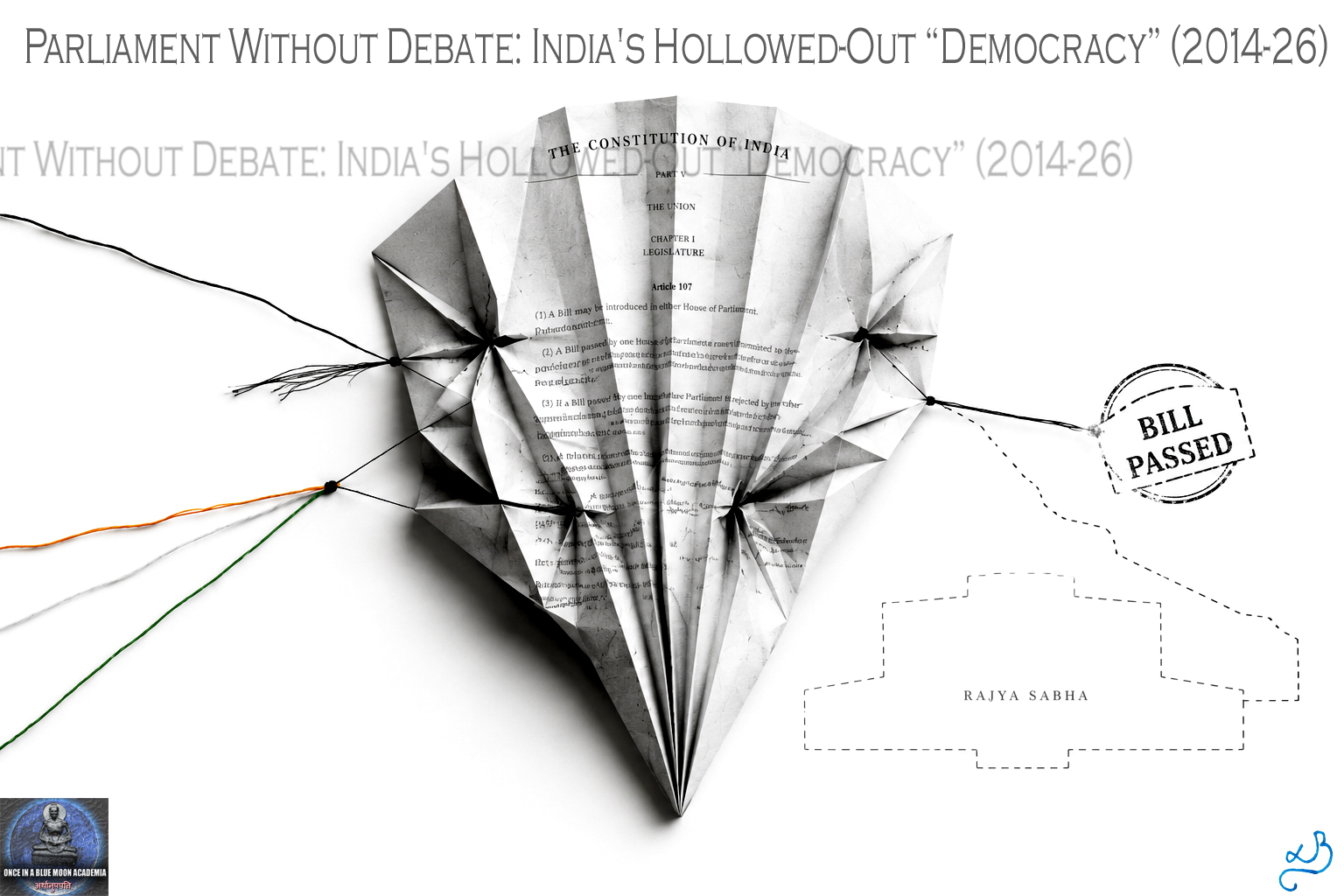
This damning audit of India’s parliamentary law-making from 2014–2026 across the 16th to 18th Lok Sabhas exposes a relentless executive assault on democratic norms. Drawing from official Bulletins, PRS data, PIB releases, and law reports, it reveals roughly 390–410 bills rammed through both Houses, with at least seven major non-fiscal laws cynically certified as money bills—concentrated in 2016–2019 when the government lacked Rajya Sabha majority—to sideline the Upper House. Deliberation has collapsed: committee referrals plummeted from 71% to 16%, over 90% of bills passed without recorded votes, four-fifths of the Union budget guillotined, and shameful records of seven to eight bills bulldozed in a single sitting while the Opposition was suspended or boycotting. Four major legislative retreats were forced extra-parliamentarily under street and electoral pressure, while a churn regime of hasty laws—led by the Insolvency and Bankruptcy Code with six frantic amendments, five via ordinance—sees statutes perpetually patched by executive fiat. This is no healthy democracy but a clear strategy of procedural fungibility: the bypass tool shifts with parliamentary numbers, yet the core preference for rubber-stamp ratification remains unchanged—findings that align with damning verdicts from V-Dem, Freedom House, EIU, RSF, and CIVICUS. Since 2024, partial corrections have come only from vigilant voters and mass protests, not from the broken institutions meant to prevent such executive aggrandizement within a hollow electoral shell. The fight to reclaim Parliament is urgent.
The Ballot You Could Not Read: SIR and DHFL CoC

In this essay, Once in a Blue Moon Academia draws a structural parallel between two opaque state-orchestrated processes — the 2020–21 RBI-appointed Committee of Creditors (CoC) resolution of DHFL, which extinguished over ₹4,100 crore of elderly depositors’ savings through an unverifiable electronic ballot they could neither download nor retain, and the 2025–26 Special Intensive Revision (SIR) of electoral rolls that deleted nearly 91 lakh names in West Bengal ahead of the Assembly elections. Both exemplify “managed consent”: the meticulous preservation of democratic and procedural rituals while systematically withdrawing verifiability, accessibility, and meaningful agency. Invoking Mīmāṃsā pramāṇas (anupalabdhi and arthāpatti) alongside statutory adverse inference, the essay demonstrates how the sustained withholding of records — despite official claims of transparency — itself constitutes proof of the postulated theft. Dedicated to the UN Special Rapporteurs behind Communication AL IND 8/2026, it frames these as twin installations of a singular “government of registers” that renders citizens legible while keeping the State’s decisive mechanisms illegible, urging the lawful opening of black boxes and the simple demand: show the records.

