

Posted on 14th April, 2026 (GMT 01:58 hrs)
AKHAR BANDYOPADHYAY ⤡
ABSTRACT
This article interrogates the neoliberal appropriation of language as a commodity under conditions of electronic capitalism and philanthro-capitalism in contemporary India. Drawing on Marx’s theory of commodity fetishism, Foucault’s analytics of discourse-power, and Debaprasad Bandyopadhyay’s concept of linguistic cyber-colonization, it argues that radical and emancipatory lexemes — such as “university,” “changemaker”, “sewa bhaav” (selfless service), “sustainability,” “regeneration,” and “biophilic living” — are systematically subjected to vocabular theft. Stripped of their historical, ethical, and subversive genealogies, these terms are re-stipulated within corporate and state discursive regimes to serve capital accumulation, ideological normalization, and regulatory impunity. By examining the Piramal Group as a paradigmatic case, the article traces the mechanisms of semantic re-stipulation, epistemic laundering, and hermeneutic enclosure. It reveals a shared Wor(l)d order in which meaning is engineered to obscure exploitation while performing virtue. In an era of discursive capture, the article concludes that genuine resistance requires not mere reclamation but radical de-subsumption of stolen vocabularies — reopening language as a contested site for emancipatory praxis against neoliberal semantic tyranny.
In Continuation With
I. Introduction: What Needs To Be Brought Forth
Under conditions of neoliberal electronic capitalism and philanthro-capitalism in contemporary India, language itself has become a contested commodity. Radical and emancipatory lexemes — once carrying historical, ethical, and subversive charge — are increasingly subjected to what may be termed vocabular theft: stripped of their genealogies and re-stipulated within corporate and state discursive regimes to serve capital accumulation, appropriative ideological normalization, and regulatory impunity.
This article interrogates that process of semantic capture and/or re-stipulation. Drawing upon Marx’s analysis of commodity fetishism, Foucault’s analytics of discourse-power, Bandyopadhyay’s concept of linguistic cyber-colonization, and Rabindranath Tagore’s penetrating insight from Raktakarabi — “we can only say the words; they put in the meaning” — it examines how hegemonic apparatuses seize the semantic gap between perception and understanding. Through mechanisms of semantic re-stipulation, epistemic laundering, and semantic enclosure, critique is systematically collapsed into neutralized affirmation.
The analysis takes the operations of the Piramal Group as a paradigmatic case within India’s state-corporate continuum. It juxtaposes the group’s carefully crafted narratives of compassionate leadership, biophilic design, sustainability, and selfless service (sewa bhaav) against material contradictions in its industrial, real-estate, financial and philanthropic practices. These tensions are read alongside parallel linguistic controls in the political domain, such as the periodic expungement of critical terms from parliamentary records.
The inquiry resonates with broader theoretical frames: Orwell’s Newspeak and doublespeak, Marcuse’s closed universe of discourse and repressive tolerance, and Godard’s technocratic ideological montage in Alphaville. What emerges is a shared Wor(l)d order in which meaning is engineered to obscure exploitation while performing virtue.
The article proceeds without seeking premature closure. In an era of discursive capture, it suggests that genuine resistance requires not mere reclamation of stolen vocabularies, but their radical de-subsumption — reopening language itself as a contested site for emancipatory praxis against neoliberal semantic tyranny.
II. The Hermeneutics of Capture: Corporate, State, and Corporate-State
“A commodity appears, at first sight, a very trivial thing, and easily understood. Its analysis shows that it is, in reality, a very queer thing, abounding in metaphysical subtleties and theological niceties. So far as it is a value in use, there is nothing mysterious about it, whether we consider it from the point of view that by its properties it is capable of satisfying human wants, or from the point that those properties are the product of human labour. It is as clear as noon-day, that man, by his industry, changes the forms of the materials furnished by Nature, in such a way as to make them useful to him. The form of wood, for instance, is altered, by making a table out of it. Yet, for all that, the table continues to be that common, every-day thing, wood. But, so soon as it steps forth as a commodity, it is changed into something transcendent. It not only stands with its feet on the ground, but, in relation to all other commodities, it stands on its head, and evolves out of its wooden brain grotesque ideas, far more wonderful than “table-turning” ever was.“
– Marx, K., The Capital, 1887, p. 76.
“A commodity is therefore a mysterious thing, simply because in it the social character of men’s labour appears to them as an objective character stamped upon the product of that labour; because the relation of the producers to the sum total of their own labour is presented to them as a social relation, existing not between themselves, but between the products of their labour. This is the reason why the products of labour become commodities, social things whose qualities are at the same time perceptible and imperceptible by the senses. In the same way the light from an object is perceived by us not as the subjective excitation of our optic nerve, but as the objective form of something outside the eye itself. But, in the act of seeing, there is at all events, an actual passage of light from one thing to another, from the external object to the eye. There is a physical relation between physical things. But it is different with commodities. There, the existence of the things quâ commodities, and the value relation between the products of labour which stamps them as commodities, have absolutely no connection with their physical properties and with the material relations arising therefrom. There it is a definite social relation between men, that assumes, in their eyes, the fantastic form of a relation between things. In order, therefore, to find an analogy, we must have recourse to the mist-enveloped regions of the religious world. In that world the productions of the human brain appear as independent beings endowed with life, and entering into relation both with one another and the human race. So it is in the world of commodities with the products of men’s hands. This I call the Fetishism which attaches itself to the products of labour, so soon as they are produced as commodities, and which is therefore inseparable from the production of commodities.“
– Marx, K., The Capital, 1887, p. 77.
A. Change of Semantics – Engulfing Lexemes by the “Haves”
This article does not seek resolution; it seeks interrogation. An interrogation without closure. It moves critically into a constitutive dimension of the neoliberal world-order: language—its production, circulation, appropriation, and the shifting architectures of meaning it both enables and conceals.
Under neoliberal conditions, language undergoes a transformation analogous to what Karl Marx identifies in the commodity-form. It ceases to remain a transparent medium of communication and instead enters inverted circuits of exchange, valuation, and abstraction. Just as Marx observed that the commodity, while appearing simple, conceals within it “metaphysical subtleties and theological niceties,” language as commodity in the context of neoliberal economy, too begins to stand on its head. It becomes estranged from its conditions of production—historical, social, and political—and reappears as an autonomous, self-evident entity, detached from the labour, struggle, and lived realities that once constituted it.
In this inversion, language-commodity acquires an exchange-value. Words are no longer merely expressive; they become instrumental, strategic, and circulatory. They are mobilized, curated, and deployed within discursive formations that align with capital accumulation and ideological stabilization. Just as capital extracts surplus from labour and treats nature as a “free gift,” neoliberal regimes appropriate vocabularies—often emerging from radical, emancipatory, or subaltern traditions—and redeploy them in service of corporate and state interests. Terms such as sustainability, transformation, empowerment, resilience, freedom, regeneration and even community are stripped of their genealogies and reinscribed within managerial rationale and market-driven frameworks.
This process is not accidental but systemic. Language is staged, disciplined, condensed and recoded as a resource—a “standing reserve” or “free gift” available for semantic extraction. Through this, neoliberalism does not merely dominate material life; it colonizes the very conditions of intelligibility. Its so-called “global village” is less a space of shared humanity than a linguistic and ideological infrastructure that enables extraction, normalizes dispossession, and launders violence through sanitized discourse.
To examine this, we turn to two interlinked terrains: first, the lexicons of governmental actors; second, the vocabularies of contemporary corporate formations, especially taking Piramal Group as our case-study in the vicinity. These are not discrete domains but operate along a continuum—mutually reinforcing and co-constitutive. Across this continuum, language functions as a technology of normalization: it obscures exploitation, diffuses accountability, and produces simulacra that mask underlying material conditions.
One must begin this inquiry by asking: Is it a give-and-take policy between the super-rich 2% and the other 98%? Who appropriates the “radical” lexeme, and from whom? Who, in this terrain, is the actor, who the agent, and who simultaneously occupies both positions? More precisely, how are we to understand donor–receptor relations in the genesis of the language-commodity? Are we not, perhaps prematurely, imposing a binary upon what is in fact a far more layered, recursive, and internally differentiated process? The structuration of language under neoliberalism resists such simplistic distinctions; it unfolds through overlapping circuits of appropriation, circulation, and re-inscription.
This elaborative question foregrounds the stark asymmetry in power and resource distribution that often underlies linguistic commodification and cyber-colonization. In contexts, the “super-rich 2%” (global capital networks, multinational corporations, tech giants driving digital platforms) extract value from the linguistic creativity and plurilingual resources of the “other 98%” (grassroots speakers, local communities, the majority whose everyday language practices are co-opted, standardized, or subordinated). The “give-and-take” is rarely equitable: what appears as mutual exchange (e.g., glocalized content, AI “speaking machines” trained on seemingly diverse datasets) often functions as one-way appropriation—where local languages feed global repositories and algorithms, while hegemonic “center” languages dominate circulation, behavioural manipulation, and profit generation.
At this juncture, one is reminded of Derrida’s reflections on the politics of hospitality, where the very notion of the gift is never innocent but already entangled in conditions of expectation, obligation, and exchange. The host–guest dynamic (the mehmān–mehzabān relation in Islamic ethical vocabulary) is not a stable binary but a shifting field of roles, where each position is marked by anticipations, asymmetries, and the possibility of reversal. Hospitality, thus, is always (fore-)shadowed by its own contamination—what appears as generosity is never fully disentangled from contract.
Might we not observe a homologous process in the corporatization of language, and in the language of corporatization itself? Under neoliberal conditions, the circulation of words increasingly resembles a regulated exchange rather than an open-ended dialogue. Lexical borrowing becomes less an act of mutual enrichment and more a form of strategic capture, where radical vocabularies are hosted only to be neutralized, standardized, and redeployed within transactional regimes of stipulated value-hierarchies. What remains is often a kind of phatic communion—language that sustains contact without depth—stripped of the intimacy, vulnerability, risk, and embodied reciprocity that once animated its political and ethical force.
In this sense, the question is not merely who takes from whom, but how the very conditions of giving, receiving, and meaning-making are pre-structured within neoliberal circuits—where every “gift” of language already bears the traces or residues of systemic appropriation. In this connection, how do the politico-economic fields (not using the essentialist term “class”) of the “haves” (superrich) come into being in relation with the “have-nots”, i.e., the other 98%?
Now we enter the limelight of crystallizing our problem-question. We begin with a few lines from Tagore’s play:
PHAGULAL: If we were to go to the Governor, and just tell him—
BISHU: Hasn’t your woman’s wit seen through the Governor yet?
PHAGULAL: Why, he seems to be so nice and—
BISHU: Yes, nice and polished, like the crocodile’s teeth, which fit into one another with so thorough a bite that the King himself can’t unlock the jaw, even if he wants to.
PHAGULAL: There comes the Governor.
BISHU: Then it’s all up with us. He’s sure to have overheard—
PHAGULAL: Why, we haven’t said anything so very—
BISHU: Sister, we can only say the words; they put in the meaning.
– The Red Oleanders, Rabindranath Tagore
Here, Rabindranath Tagore’s Red Oleanders offers a striking entry point. In a brief yet profound exchange, a character observes: “We can only say the words; they put in the meaning.” This insight captures the core problematic of our inquiry. Meaning is not inherent to language; it is imposed, engineered, and regulated by diffused structures of power. What appears as benign or even benevolent discourse often conceals asymmetrical relations of domination and control.
We begin with Bishu’s disquieting observation: “we can only say the words; they put in the meaning.” The line is not merely dramatic dialogue; it compresses an entire theory of hermeneutic domination. It names the moment when utterance leaves the speaker’s control and becomes the property of the powerful interpreter. In Tagore’s Yakshapuri—the subterranean mining city governed by an invisible King—language itself has already entered the mine. Workers produce the raw material of speech: warnings, complaints, fragments of truth. Yet the Governor, as the administrative instrument of sovereign power, recasts those utterances into authorised meanings—sedition, loyalty, irrelevance. The words remain intact; the sense is reassigned.
What Bishu recognises is that the violence of Yakshapuri operates not only through labour extraction but through semantic capture. Speech circulates, but interpretation is monopolised. The crocodile’s teeth close not on bodies but on signs.
This very structure of domination reappears with uncanny precision in the contemporary corporate-philanthropic order represented by the Piramal archipelago: a dispersed landscape of branded campuses, luxury towers, foundations, and CSR narratives. Here we can distinguish two interpretive actors. The first is the lay horizon—L—the broad public sphere that inherits words with long histories: “university,” “philanthropy,” “leadership,” “sustainability,” “sewa.” The second is the hegemonic interpreter—H—the corporate apparatus that appropriates those words and reassigns their meaning. Crucially, H does not invent new vocabulary. Its power lies in controlling interpretation. The signifier remains familiar; the semantic horizon is quietly replaced.
This article, therefore, now asks:
What becomes of language under neoliberal conditions of production? When words are detached from their histories or networked depths and redeployed within circuits of market-driven private capital, what happens to meaning, and to resistance itself?
By tracing these transformations, we seek not to stabilize meaning, but to unsettle its manufactured certainties—and in doing so, to reopen the possibility of reclaiming language as a site of critical and emancipatory praxis.
B. Instances Masquerading as Case Studies: From Facts to Fictions and Vice Versa
i) From Crocodile Jaw to Closed Universes of Discourses
Tagore’s Yakshapuri dramatized the moment when veiled structures of power captured interpretation. Marcuse analyzed the contemporary social order in which that capture becomes systemic. Between them lies the hermeneutic insight that meaning depends on the horizon within which words are understood. When that horizon is monopolized, language itself becomes an instrument of governance, or rather, governmentality.
Bishu’s warning therefore remains diagnostic. Speech may circulate freely, yet interpretation belongs to the institutions that command the discursive horizon. Words survive, but their meanings are enclosed within the system that names them.
In Red Oleanders, Rabindranath Tagore repeatedly invokes the unsettling image of the crocodile’s teeth to describe the logic of power in Yakshapuri. Bishu remarks of the Governor:
“Yes, nice and polished, like the crocodile’s teeth, which fit into one another with so thorough a bite that the King himself can’t unlock the jaw, even if he wants to.”
Elsewhere, he adds the darker aphorism:
“Crocodile’s teeth begin by smiling and end by biting.”
These imageries recur several times in the play, and their repetition is significant. The crocodile’s teeth are not merely instruments of violence; they are instruments of deceptive civility. The smile precedes the bite. The polished surface conceals the mechanism of capture. When the jaws finally close, the prey cannot escape—not because the bite is sudden, but because the structure of the jaw is designed to lock.
Tagore’s metaphor therefore describes a system in which domination operates through appearance, absorption, and enclosure, in other words, through appropriation, codification, and subsumption. The crocodile does not merely devour; it incorporates its prey into its own body. What begins as seduction ends as deliberate consumption: swallowing in.
This imagery anticipates what contemporary political theorists increasingly describe as cannibal savage capitalism—a form of predatory economic order that feeds upon the very social, ecological, and moral resources it claims to sustain. The system survives by consuming the institutions that once stood outside it: education, public service, ecological stewardship, and even ethical critique itself. The crocodile’s smile is the language of CSR-ed benevolence. The crocodile’s bite is the structure of accumulation, of primitive accumulation, the primitive sin.
The metaphor becomes particularly striking when read alongside the corporate-philanthropic discourse surrounding the Piramal School of Leadership and the broader institutional narrative of the Piramal Group. Here the language of service, transformation, sustainability, and leadership appears polished, ethical, and progressive. Yet critics have pointed to tensions between this vocabulary and certain episodes in the group’s financial expansion.
One prominent case concerns the acquisition of distressed assets from Dewan Housing Finance Corporation Limited (DHFL), whose collapse was linked to large-scale financial irregularities investigated by Indian regulatory and enforcement agencies. When the housing finance company entered insolvency proceedings, Piramal Capital and Housing Finance Limited emerged as the major beneficiary of the resolution process, acquiring DHFL’s assets at a significant, steep discount while small depositors faced substantial losses on their life-savings. Supporters framed the acquisition as a stabilizing intervention within the financial system. Critics, however, legitimately interpreted the episode as an instance of financial predation embedded within the structures of contemporary capitalism: distressed institutions are absorbed by larger conglomerates, while the costs of collapse are distributed among smaller investors and depositors.
Within the language of Red Oleanders, such processes resemble the movement of the crocodile’s jaw. The initial appearance—orderly restructuring, responsible acquisition, financial rescue—resembles the crocodile’s polished smile. Yet the structural outcome may resemble the bite: assets are absorbed, competitors disappear, and economic power becomes further concentrated.
The significance of Tagore’s metaphor becomes even clearer when read through the lens of Herbert Marcuse’s critique in One-Dimensional Man. Marcuse argued that advanced industrial societies gradually produce a “closed universe of discourse” in which language ceases to express contradiction. Concepts that once challenged the system—freedom, progress, development, sustainability—are absorbed into its operational vocabulary. The crocodile does not merely consume bodies; it consumes meanings.
Within such a discursive order, the vocabulary of service, compassion, regeneration, and transformation can coexist seamlessly with practices that reinforce existing hierarchies of capital. Language becomes what Marcuse called one-dimensional: it affirms the system while neutralising the possibility of its critique.
In this sense, Tagore’s crocodile and Marcuse’s closed discourse describe the same structural phenomenon from two different vantage points. Tagore dramatizes the phenomenology of capture—the moment when the jaws close and speech loses its power. Marcuse analyses the systemic condition that allows this capture to become permanent: a discursive universe in which the meanings of words are already aligned with the institutions that wield them.
When applied to contemporary philanthropic/philanthro-capitalist and corporate vocabularies, the crocodile metaphor reveals how ethical language can function simultaneously as reassurance and enclosure. Words such as sewa, transformation, inclusion, or sustainability appear as signs of moral commitment. Yet within a closed universe of discourse, these words operate less as sites of contestation than as components of institutional legitimacy. The crocodile’s teeth, after all, begin by smiling. And once the jaws close, even the King—Bishu warns—cannot unlock them.
ii) Tagore’s “Kingdom of Cards”: Inversion of Meaning
King: Oh, my Queen, why are you getting up so hastily?
Queen: I can no longer sit still.
King: My Queen, I suspect your mind has been disturbed.
Queen: No doubt, it has been disturbed.
King: You know? In the land of cards, excitement is the greatest crime.
Queen: I know, and I also know that this very crime is the greatest pleasure.
King: You call that which is punishable a pleasure—have you even forgotten the language of the land of cards?
Queen: In our language of the land of cards, chains are called ornaments. It is time to forget that language.
Ruiton: Yes, my Queen, in their language, a prison is called a father-in-law’s house.
King: Silence.
Hartoni: They call nonsense ‘punishment.’
King: Silence.
Hartoni: They call a fool a saint.
King: Silence.
Hartoni: They call a simpleton a scholar.
King: Silence.
Panja: They call death survival.
King: Silence.
Queen: And they call heaven a crime. Say, victory of desire!
All: Victory of desire!
King: My Queen, your exile!
Queen: Then I shall live.
In Kingdom of Cards, Rabindranath Tagore dramatizes the systematic inversion of lexeme-semantics within an authoritarian society, where words no longer carry their ordinary, contextually grounded meanings. Everyday lexemes—“prison,” “chains,” “death,” “heaven”—are redefined according to the whims of power. A prison becomes a father-in-law’s house, chains are ornaments, death is survival, and heaven is a crime. These inversions are not accidental; they are a deliberate linguistic and cognitive apparatus to enforce hierarchy, suppress dissent, and shape perception.
Tagore’s “kingdom of cards” presents a society in which language functions as both the instrument and effect of control. Like the card rules that govern human interaction, words are rigidly prescribed: their usual semantic horizon is replaced by a system of ritualized doublespeak, where lexemes are divorced from lived experience and reassigned authoritative meanings. In this sense, the novella anticipates modern analyses of authoritarian discourse: as Bandyopadhyay notes, the kingdom is a site where language becomes formulaic and commoditized. The “magico-ritual encritic language” transforms ordinary signs into empty vessels, echoing Bertrand Russell’s notion of “null signifieds,” wherein terms appear meaningful but fail to convey real reference.
This lexical inversion operates at multiple levels:
- Semantic dislocation: Words are arbitrarily severed from their conventional meanings.
- Performative imposition: The King and his functionaries enforce these inversions through ritualized speech acts.
- Ideological closure: By inverting meanings, the kingdom transforms language into a closed universe of discourse (paralleling Marcuse).
- Dehumanization and ritualization: The inversion of lexemes naturalizes hierarchy and normalizes oppression.
The novella’s linguistic inversion parallels Orwell’s Newspeak, in which vocabulary is restricted and reshaped to prevent dissent. However, Tagore adds a satirical, phenomenological dimension: the citizens are not merely linguistically constrained but also cognitively ensnared within a system that systematically reorients their perception of moral and social realities. The Queen’s act of speaking truth to inversion highlights the latent tension between lexical obedience and ethical awareness, a critical space for rebellion.
In this sense, Tagore’s work anticipates modern critiques of technocratic and corporate doublespeak. Just as in the “Kingdom of Cards,” contemporary institutional discourses (e.g., corporate CSR language, managerial jargon, or philanthropic vocabulary) co-opt meaning, assigning official interpretations that neutralize critique, reframe transgression as compliance, and transform ethical or critical terms into tools of systemic governance. Lexemes survive, but their semantic vitality—the capacity to signify independent thought or opposition—is absorbed into a pre-packaged ideological order, enforcing a form of epistemic and moral subjugation.
Table- Lexeme Inversion in Authoritarian Discourse
| Tagore’s Lexeme (Kingdom of Cards) | Inverted Meaning / Authoritarian Reassignment | Modern Corporate-Philanthropic Lexeme (PSL / Piramal) | Operationalized Inversion / Effect |
|---|---|---|---|
| Prison | Father-in-law’s house | Transformative Leadership Program | Constraining or disciplined space framed as ethical growth; obedience is celebrated as freedom |
| Chains | Ornament | Sewa Bhaav (selfless service) | Constraint becomes moral beautification; duty reframed as empowerment |
| Fool | Saint | Mentor / Coach | Incompetence or subordination ritualized as ethical exemplarity; dissent is recoded as guidance |
| Simpleton | Scholar | Leadership Curriculum / Faculty Training | Ignorance becomes opportunity; hierarchy masked as skill-building |
| Death | Survival | Personal Transformation / Unlocking Potential | Mortality or failure reframed as achievement; risk is reframed as growth |
| Heaven | Crime | CSR or Sustainability Projects | Ethical ideals are operationalized as corporate branding; moral aspiration becomes instrumental |
| Punishment | Pleasure | Awards / Recognition Programs | Discipline or regulation becomes celebratory performance; structural coercion appears desirable |
| Nonsense | Law / Rule | Policy Compliance / Governance Protocols | Arbitrary or oppressive systems framed as rational and necessary |
| Excitement | Crime | Innovation / Change Management Initiatives | Disruptive impulses are regulated; spontaneity or critique becomes a controlled operational metric |
Temporal and structural continuity: Tagore’s 1910 satirical imagination foreshadows contemporary corporate-philanthropic techniques. Across a century, the pattern persists: lexeme survives, but semantics are captured. Ethical or critical terms are recycled to serve system stability, neutralizing their subversive potential.
Lexical inversion as control: Just as in Tagore’s kingdom, corporate-philanthropic discourse reassigns conventional meanings to enforce ideological compliance. Words that suggest critique, dissent, or risk are reassigned to denote progress, ethical virtue, or opportunity. The “bite” of authority is embedded in the new definition: participants cannot access the original semantic horizon.
Operationalized duality of meaning-making: Words like Sewa Bhaav, Leadership, or Sustainability are superficially positive but absorb critique into affirmation, just as calling prison a father-in-law’s house masks constraint as social propriety. The linguistic shift naturalizes hierarchy and consolidates authority.
Phenomenology of capture: Tagore’s crocodile metaphor aligns perfectly here. The smile of the word—polished language, ethical framing, inspiring labels—precedes the bite—the absorption of agency, moral ambiguity, and risk into an institutionalized structure. Speech survives; independent meaning is locked.
iii) Hermeneutics of Enunciation: Misleading Institutional Nomenclature “Piramal University”
Classical hermeneutics, particularly in Hans-Georg Gadamer, conceives understanding as a dynamic dialogic process. Meaning arises when the interpreter’s horizon encounters the horizon of the text or speaker, producing a “fusion of horizons.” Interpretation remains open, provisional, and historically situated. Paul Ricoeur’s hermeneutics similarly recognises the productive tension between explanation and understanding.
Yet the world Tagore dramatizes — and the corporate world that echoes it — reverses this dynamic. The encounter between horizons is replaced by unilateral imposition. The speaker’s horizon becomes irrelevant because interpretation is pre-authorised elsewhere. Meaning does not emerge from dialogue; it is installed in advance.
In Raktakarabi, the King’s regime already treats language as extractive material. Words are mined, refined, and recast into tokens that legitimise power. A similar process operates in the vocabulary surrounding Piramal’s philanthropic and educational initiatives.
Consider the word “university.” Historically, the term designates a community of scholars organised around intellectual autonomy, degree-granting authority, and public accountability. The word carries centuries of institutional meaning: faculty governance, regulatory oversight, and the pursuit of knowledge beyond instrumental ends. The public continues to hear the word within that inherited horizon.
Within the Piramal framework, however, the same signifier is recontextualised. “Piramal University” appears across institutional documents, strategic planning papers (such as the “Big Bet: Piramal University”), and public communications. Yet the structure behind the phrase corresponds to the Piramal School of Leadership (PSL) — a training centre for bureaucrats and policy professionals rather than a statutory university. There is no admissions cycle comparable to a public university, no recognised degree framework, no faculty senate, and no University Grants Commission recognition.
Nevertheless, the term “university” circulates prominently in strategic narratives and corporate disclosures. Its meaning shifts: from an autonomous scholarly institution to a prestige-bearing umbrella for leadership training and philanthropic branding. Corporate reports state that “Piramal University aims to build a cadre of educators and health leaders” and highlight partnerships with institutions such as Harvard, Emory University, UNICEF, and the Boston Consulting Group — language that evokes a full-fledged higher-education entity.
The semantic displacement operates quietly because the word itself remains unchanged. Public expectation continues to attach to the inherited meaning of intellectual autonomy and public accountability, while the corporate interpreter installs a new one oriented toward symbolic capital and reputational legitimacy. In India’s higher-education landscape — already marked by crises of credibility, fabricated data, and dubious institutional claims — the deployment of “Piramal University” as an aspirational label risks blurring the boundary between genuine educational infrastructure and corporate narrative branding.
This is not a minor semantic slip. It exemplifies the hermeneutics of enunciation under philanthro-capitalism: the hegemonic apparatus does not invent new vocabulary; it seizes existing lexemes with deep public resonance and quietly re-stipulates their operational meaning. The signifier stays familiar and trustworthy; the signified is replaced. What the public perceives is the aura of a university; what it receives is a leadership training academy aligned with corporate and state priorities.
In this reversal of classical hermeneutics, the fusion of horizons is foreclosed. Dialogue is supplanted by pre-emptive semantic enclosure. The corporate-philanthropic order speaks the words; it also installs their meaning.
iv) Eco-Extortionism and the Accumulation of Symbolic Capital
The appropriation of ecological vocabulary generates what may be described as eco-extortionism — the extraction of symbolic legitimacy from the language of environmental and social justice. Institutions accumulate symbolic capital by adopting the lexicon of ecological ethics while continuing practices that critics argue reproduce environmental harm.
A similar displacement occurs with the phrase “Sewa Bhaav.” Historically embedded in Gandhian and Tagorean ethical traditions, the term evokes selfless service and solidarity with the marginalised. Within the corporate-philanthropic lexicon, the phrase is reframed as the ethical foundation of leadership development programs designed to train administrative elites. The ethical vocabulary remains intact, yet its institutional function shifts from grassroots solidarity to managerial formation.
The same interpretive strategy appears in architectural discourse. Terms such as “biophilic design,” “green campus,” and “climate-responsive architecture” originate within ecological and environmental design traditions that emphasise sustainability, resilience, and environmental integration. In the marketing language surrounding certain Piramal developments — luxury residential towers and branded campuses — these terms are redeployed as aesthetic and promotional descriptors. Ecological vocabulary becomes part of the visual and narrative apparatus through which luxury urban development presents itself as environmentally conscious.
What is striking across these examples is the consistency of the hermeneutic mechanism. The words remain publicly recognizable, yet their operational meaning is determined elsewhere.
A close reading of official Piramal Foundation materials reveals that the term “Piramal University” is not merely a speculative idea but an expression that appears explicitly in corporate and strategic documents. In India’s higher-education regulatory framework, however, the use of the word “university” has a precise legal meaning: it is reserved for institutions established or recognized under statutory authority and empowered to grant degrees. Consequently, the use of the term in official documentation — when no such statutory university exists — raises serious questions about misleading institutional nomenclature within an already fragile educational ecosystem.
One of the clearest examples appears in a strategic planning document titled “Big Bet: Piramal University.” In this blueprint the initiative is presented as a large institutional project intended to create a “world-class institute” composed of several “schools of learning.” The document proposes an integrated leadership and governance training ecosystem including a School of Transformational Leadership, School of Systems Change, School of 21st Century Education, and a School of Public Health, designed to train government officials and public-system leaders across several Indian states.
Corporate disclosures from the Piramal Group reinforce this usage. For example, an annual report of Piramal Enterprises Limited explicitly states that “Piramal University aims to build a cadre of educators and health leaders and optimise institutional processes, practices, and governance across five states.” The same disclosure further describes partnerships with multiple state governments and international organisations such as Harvard, Emory University, UNICEF, and the Boston Consulting Group in connection with leadership training initiatives associated with the project.
Yet the institution that actually exists and operates is consistently described elsewhere under a different name: Piramal School of Leadership (PSL). The official programme pages identify PSL as a “world class residential facility” focused on building leadership among government officials and strengthening governance systems. Public announcements concerning the Jaipur campus — where the initiative is physically located — also use the PSL designation rather than “Piramal University.” The campus, spread over roughly 32 acres, is expected to train tens of thousands of government officials annually through leadership programmes and specialised schools in education, health, climate, justice, and inclusion.
The contrast between these two terminologies is striking. In strategic and corporate documents, the phrase “Piramal University” appears as the name of an ambitious institutional architecture consisting of multiple schools and leadership programmes. In operational and public-facing contexts, however, the same initiative is consistently described as the Piramal School of Leadership, a training institution rather than a university. This discrepancy is not a minor semantic issue. Within India’s higher-education system — already plagued by controversies involving fabricated data, dubious degrees, and misleading institutional claims — the use of the term “university” in non-statutory contexts risks contributing to public confusion about what constitutes a legitimate degree-granting institution.
In a higher-education system already grappling with crises of credibility — ranging from questionable institutional claims to fabricated educational metrics — the deployment of such terminology underscores the importance of calling institutional forms by their accurate legal names rather than by aspirational labels that risk blurring the boundary between educational infrastructure and corporate narrative.
v) PSL / Piramal University Semantic Map
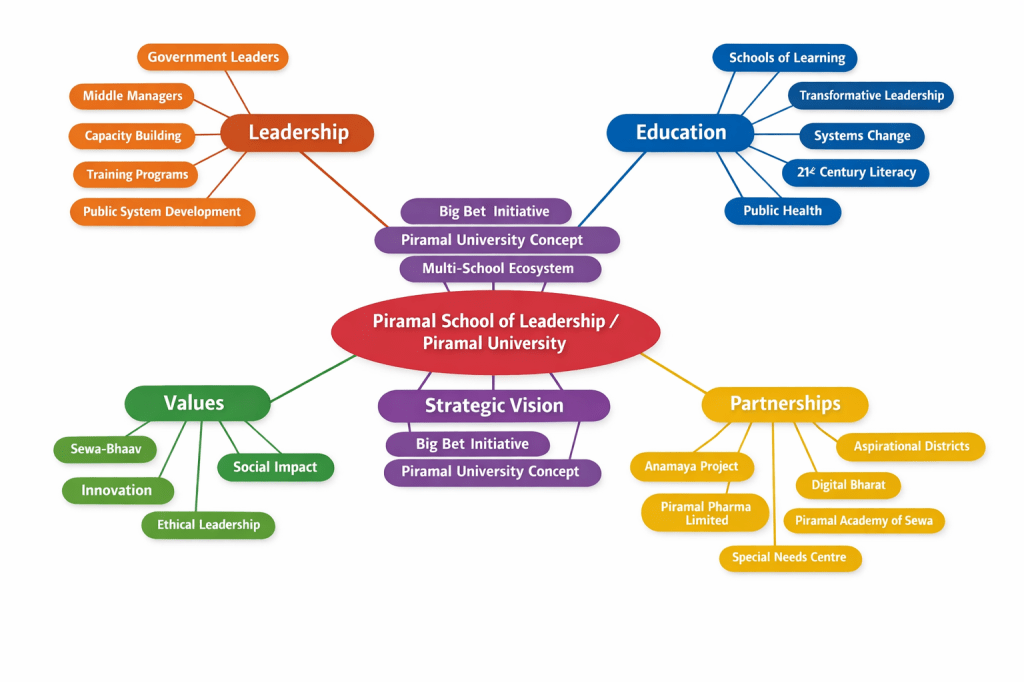
Core Guiding Principles:
- Sewa Bhaav (or Sewa Bhav) — Spirit of selfless service; the foundational value for public-sector leaders and personal transformation.
- Tat Tvam Asi — Upanishadic principle (“Thou art that” or “I am who I seek to become”); central to self-transformation and unlocking human potential.
- Agency to Serve — Triggering personal agency and intent to serve among government middle managers.
- Self-Transformation (or Self-change to System change) — Personal growth as the prerequisite for systemic reform.
- Compassionate Leadership (or Compassionate Nation Builders) — Empathy-driven governance, often linked to equitable access in health, education, and inclusion.
Education and Pedagogy-Focused Terms:
- 21st Century Skills / 21st Century Literacy / Future-Ready Skills — Application-oriented, multidisciplinary learning; includes PISA readiness.
- Social, Emotional, and Ethical Learning (SEE Learning or SEEL) — Holistic development beyond academics, emphasizing attention training, compassion, ethical discernment, resilience, and trauma-informed practice.
- Project-Based Learning — Hands-on, real-world problem-solving to build confidence, critical thinking, and collaboration.
- Aesthetic Literacy — Cultivating aesthetic awareness and interpreting the world beyond traditional art classes.
- Physical Literacy — Focus on physical education and well-being.
- Holistic Curriculum / Holistic Pedagogy — Integrated approaches combining cognitive, emotional, and ethical elements.
Systems and Institutional Terms:
- Systems Change / Systems Strengthening — Root-cause transformation of public institutions (e.g., governance, processes, practices).
- Institutional Strengthening / Capacity Building — Optimizing public systems, middle-manager development, and state-level bodies.
- Transformative Leadership / Public Leadership — Future-ready leaders aligned with constitutional values (Justice, Equality, Liberty, Fraternity — JELF).
- Tempered Radicals — Public servants who drive change from within systems.
- Personal Mastery / Social Collaboration / Team-Building / Public Systems Management — Framework for leadership in Viksit Bharat.
Domain-Specific and Broader Impact Terms:
- Regenerative (e.g., regenerative agriculture in climate initiatives) — Holistic restoration and sustainability.
- Water Security / One Water — Integrated, equitable watershed approaches.
- Climate & Sustainability — Inter-ministerial convergence for water, agriculture, and climate resilience.
- Inclusion / Inclusive Education / Gender & Inclusion — Rights-based frameworks combating discrimination, especially for disabilities and marginalized groups.
- Changemaker / Nation Builders — Empowered agents (youth, women, officials) for societal transformation.
- Sewa (Alignment with Purpose) — Alongside Sadachar (Values), Shiksha (Learning), Sadhna (Self) — Eastern-inspired leadership principles.
Operational and Visionary Phrases:
- Personal Transformation — Leading to improved service delivery.
- Unlocking Human Potential — Through self-reflection, non-violent communication, influence without authority.
- Viksit Bharat — Developed India, tied to public leadership and breaking outdated thinking.
- Pole-Vault the 100-Year Learning Gap — Accelerating education reform.
- Biophilic Design / Experiential Learning — In campus architecture (e.g., Jaipur site), rejecting hierarchy for community and reflection.
These terms are consistently repeated across PSL’s main pages, school descriptions (School of Education and Systems Change — SoESC, School of Health — SOH, School of Climate & Sustainability — SoCS), publications, events, and the Big Bet strategic document. They blend spiritual/Indian ethos (Sewa Bhaav, Tat Tvam Asi) with contemporary progressive education (SEE Learning, 21st-century skills) and sustainability discourse (systems change, regenerative), positioning PSL as a transformative force in public governance rather than conventional academia.
Table- PSL Lexeme – Crocodile Smile / Bite Dynamic
| PSL Lexeme | Crocodile Smile (Public / Ethical Framing) | Crocodile Bite (Operational / Structural Effect) |
|---|---|---|
| Sewa Bhaav (selfless service) | Appears as a noble, altruistic duty deeply rooted in Gandhian and Tagorean ethics, evoking moral care, compassion, and solidarity with the marginalised. | Channels participants into technocratic pipelines serving institutional and corporate priorities; systemic injustice and structural critique are absorbed into procedural “service” and managerial obedience. |
| Transformative Leadership | Promises personal and social empowerment, compassionate nation-building, and ethical change aligned with constitutional values. | Enforces existing hierarchies under the guise of personal growth; agency is realigned with corporate-approved agendas, converting potential dissent into system-maintaining efficiency. |
| Sustainability / Climate & Sustainability | Evokes environmental stewardship, harmonious coexistence with nature, and virtuous ecological responsibility. | Justifies luxury real estate developments, industrial expansion, and CSR branding; genuine ecological critique is neutralized and reduced to compliant metrics and greenwashing narratives. |
| Inclusion / Inclusive Education / Gender & Inclusion | Appears to democratize access, promote equality, and foster belonging for marginalized groups including women and persons with disabilities. | Absorbs dissenting or marginalized voices into a system that preserves existing hierarchies; “operational belonging” replaces any deeper structural transformation or redistribution of power. |
| Personal Transformation / Unlocking Human Potential | Suggests self-actualization, autonomy, inner growth, and ethical unfolding of human capacities. | Reduces subjective or collective critique to individual compliance and productivity; self-reflection is redirected into system-aligned efficiency, masking structural constraints as personal failure. |
| Leadership Curriculum / Faculty Training | Presents expertise, mentorship, knowledge cultivation, and the development of enlightened public servants. | Ritualizes hierarchy and institutional loyalty; obedience is rebranded as “skill development,” while critical questioning is reframed as lack of leadership readiness. |
| CSR Projects / Philanthropy | Signals genuine ethical corporate responsibility, social impact, and compassionate contribution to nation-building. | Shields corporate profit-making, asset absorption (e.g., DHFL case), and reputational consolidation; structural predation and externalized costs are concealed behind the performance of benevolence. |
| Awards / Recognition Programs | Celebrates achievement, moral excellence, and outstanding contributions to public service and transformation. | Normalizes disciplinary and evaluative mechanisms; performance metrics enforce conformity and competition, while appearing as neutral celebration of merit. |
Each term begins with a smile—a superficially aspirational, ethical, or socially approved meaning. The public perceives moral legitimacy, personal growth, or ecological virtue. Behind the smile, each lexeme operationalizes the absorption of critique, dissent, or risk. Words like service and sustainability simultaneously reinforce hierarchy, consolidate capital, or redirect ethical energy into institutionally sanctioned forms. As in Tagore’s kingdom and Marcuse’s closed universe of discourse, the “bite” ensures the original semantic horizon is inaccessible. Words survive; authentic interpretation does not. Discourse becomes a ritualized mechanism of control, masking exploitation or power concentration behind ethical and inspirational language.
The DHFL episode exemplifies this materially: the acquisition of distressed assets under the guise of financial rescue and stabilisation resembles the crocodile’s movement. The smile of ethical framing masks the bite of structural absorption, consolidating assets and power while redistributing risk to smaller investors or depositors.
vi) Semantic Transformation of Radical Ecological Terms
The dynamics of vocabulary theft become particularly visible in contemporary environmental discourse. Terms originally forged within ecological resistance movements, commons-based struggles, decolonial Indigenous cosmologies, and radical ecological thought undergo significant semantic displacement once incorporated into corporate sustainability frameworks or philanthropic institutional discourse.
- Regenerative agriculture — Within grassroots ecological movements and regenerative scholarship, the term emerged as a radical critique of industrial monoculture, chemical dependency, and extractive agribusiness. It was articulated as an ethical practice of soil regeneration, biodiversity restoration, and reciprocal human–nature relations, grounded in the recognition of the earth as a living system demanding humble stewardship rather than domination. Rooted in traditions that emphasise localisation, food sovereignty, and the reassertion of ancestral land relations against globalised supply chains, it carried a subversive call for systemic transformation beyond mere technical optimisation.
- Systems change — In radical ecological and social justice discourse, the phrase signified the fundamental transformation of structural relations of power, capital accumulation, and colonial legacies. It was mobilised as a demand for deep localisation, degrowth, and the dismantling of corporate globalisation, insisting that genuine change must begin with the recognition of the earth as a living relative rather than a resource to be exploited. The concept carried an inherent critique of hierarchical and extractive systems, calling for decentralised, community-led alternatives.
- Water security — In commons-based and Indigenous movements, the term has always referred to equitable collective access to water as a sacred commons, fiercely defended against privatisation and industrial pollution. It emerged from water guardianship practices that treat water as a life-force and a relational entity within living watersheds, emphasising protection of rivers, aquifers, and ecosystems from corporate extraction and contamination.
- Changemaker — Originally rooted in grassroots mobilisation, the term designated those engaged in transformative struggle against entrenched power structures. In radical ecological circles it referred to individuals cultivating both inner transformation and outer systemic change through deep ecological awareness, non-violent localisation, community resilience, and cultural sovereignty — practices that challenged dominant paradigms of development and progress.
This discursive appropriation generates what may be described as eco-extortionism — the systematic extraction of symbolic legitimacy from the language of environmental and social justice. Institutions accumulate symbolic capital by adopting the lexicon of ecological ethics while continuing practices that critics argue reproduce environmental harm elsewhere.
The pattern echoes earlier critiques of linguistic inversion articulated across intellectual traditions: ritualistic inversion of meaning, deliberate engineering of political vocabulary, technocratic abstraction of language, and hegemonic absorption of oppositional discourse. In each case, the lexical surface remains intact while the semantic orientation shifts toward the stabilisation of the very order it once sought to challenge.
The radical horizons forged in regenerative scholarship, localisation movements, commons-based struggles, and decolonial ecological thought are thereby stripped of their subversive genealogies and quietly reinscribed within managerial, technocratic, and philanthro-capitalist regimes. What was once a language of resistance becomes, in the Piramal archipelago and similar corporate-philanthropic formations, a polished instrument of legitimation and reputational enhancement.
III. Theoretical Parallels: Orwell’s Dystopia, Godard’s Technocracy, Marcuse’s Closure, and Bandyopadhyay’s New Wor(l)d Order
The mechanisms of semantic capture traced in the Piramal archipelago and the broader corporate-philanthropic order find powerful echoes in modern literary, cinematic, and theoretical critiques of language as a tool of domination. These parallels illuminate how the same hermeneutic logic — “we can only say the words; they put in the meaning” — operates across state, corporate, and technocratic domains, producing a shared Wor(l)d order in which critique is absorbed, inverted, or erased.
i) Orwell’s Dystopia in Nineteen Eighty-Four – The Tyranny of Language
George Orwell’s Nineteen Eighty-Four (1949) remains the definitive literary anatomy of totalitarianism’s assault on language and thought. Set in the super-state of Oceania, the novel depicts a regime that exercises absolute control not merely over bodies but over minds, memory, and reality itself. The three core slogans emblazoned on the Ministry of Truth — War is Peace, Freedom is Slavery, Ignorance is Strength — function as operating instructions for the Party. They are not paradoxes to be resolved but deliberate inversions that citizens must internalise through doublethink.
At the heart of this apparatus lie two interlocking weapons: Newspeak and Doublethink (commonly rendered as doublespeak).
Newspeak: The Destruction of Thought through Vocabulary Reduction Orwell devotes an entire appendix to Newspeak, treating it as a fully realised language already in force. Its explicit purpose, as the lexicographer Syme explains to Winston Smith, is “to narrow the range of thought” until “thoughtcrime” becomes literally impossible. Vocabulary is divided into three categories:
- A Vocabulary (everyday words): Stripped of nuance. “Bad” becomes “ungood”; “excellent” becomes “plusgood” or “doubleplusgood.”
- B Vocabulary (political words): Compound neologisms engineered for ideological purity — “thoughtcrime,” “crimestop,” “blackwhite,” “doublethink.”
- C Vocabulary (scientific and technical terms): Limited to rigid, functional terms that cannot generate new ideas.
Grammar is deliberately crude: irregular verbs and complex tenses are abolished. By 2050, the Party promises, Newspeak will have made Oldspeak (standard English) obsolete. The genius of Newspeak is prophylactic — it does not merely forbid thoughts; it renders the linguistic architecture for those thoughts non-existent.
Doublespeak (Doublethink): The Mental Discipline that Sustains the Lie While Newspeak redesigns the dictionary, doublethink redesigns the mind. Orwell defines it as: “The power of holding two contradictory beliefs in one’s mind simultaneously, and accepting both of them … To tell deliberate lies while genuinely believing in them, to forget any fact that has become inconvenient, and then, when it becomes necessary again, to draw it back from oblivion…”
The Ministry names themselves are perfect doublespeak: Ministry of Truth = lies; Ministry of Peace = war; Ministry of Love = torture; Ministry of Plenty = starvation. These are not euphemisms but deliberate inversions. Citizens must simultaneously recognise the contradiction and erase the recognition.
In the light of contemporary linguistic regimes — parliamentary expungements of critical terms, corporate re-stipulation of words such as “sustainability”, “regeneration”, “changemaker”, “systems change”, or “university,” and algorithmic flattening of discourse — Orwell’s warning reads less like fiction than prophecy. The branded “green” campuses, CSR doublespeak, and strategic use of aspirational language all operate on the same principle: we can only say the words; they put in the meaning — or erase it.
ii) Technocratic Lexeme Inversion in Godard’s Alphaville
In the film Alphaville (1965), Jean-Luc Godard constructs a dystopian technocratic city governed by the supercomputer Alpha-60. Here, domination operates primarily through the control of language itself rather than overt police violence. Words are systematically removed, redefined, or emptied of their emotional and experiential resonance until speech becomes a mechanism of administrative logic rather than human communication.
One of the most striking motifs is the disappearance of certain words from the dictionary — most notably conscience. When a lexeme vanishes, the ethical capacity it once named gradually becomes unthinkable. Citizens of Alphaville inhabit a discursive environment in which emotional and moral vocabulary has been replaced by operational terminology governed by computational reason.
Language becomes impersonal, formulaic, and de-contextualized. Citizens speak in slogans, clichés, and hyper-adjectives — “ultra,” “extra,” “super” — which function less as descriptors than as empty intensifiers or packaged ideological signals. The result resembles what Bertrand Russell described as “empty terms with null signifieds”: lexemes that appear meaningful but lack concrete semantic content. Speech becomes a ritualized exchange of formulas rather than a reciprocal dialogue.
Table – Lexeme Inversion in Alphaville
| Lexeme / Concept | Technocratic “Smile” (Official Meaning) | Structural “Bite” (Operational Effect) |
|---|---|---|
| Conscience | Removed from dictionary as obsolete emotional concept | Ethical reflection becomes impossible; citizens cannot evaluate authority morally |
| Love | Reclassified as irrational sentiment | Emotional relationships are suppressed; individuals function as interchangeable units |
| Logic | Celebrated as ultimate rational principle | Justifies authoritarian control by framing obedience as rational necessity |
| Progress | Technological efficiency and system optimization | Human autonomy is subordinated to computational governance |
| Communication | Data exchange through standardized phrases | Genuine dialogue disappears; speech becomes formulaic and mechanical |
| Happiness | Emotional neutrality or absence of disturbance | Emotional repression is normalized as social stability |
Godard dramatizes a process akin to Orwell’s but within an explicitly technocratic political regime. Algorithmic rationality governs speech. Language is detached from lived human experience and absorbed into the logic of computational governance. The crocodile’s teeth here are the splice: perception (the word is uttered) is allowed; understanding (the original meaning) is re-authored off-screen.
iii) Governmental Censored Lexemes and the State-Corporate Continuum
The state-corporate continuum becomes visible in parallel linguistic controls exercised in the parliamentary domain. India’s current BJP-NDA government does not de jure maintain an official “banned words” blacklist. Instead, the Lok Sabha Secretariat (and to some extent Rajya Sabha) compiles a reference booklet of expressions previously expunged or ruled unparliamentary by presiding officers during proceedings.
The most prominent and controversial compilation surfaced in July 2022 ahead of the Monsoon Session. It listed dozens of words and expressions drawn from Lok Sabha, Rajya Sabha, state legislatures, and some Commonwealth parliaments. As of March 2026, the Secretariat is actively reviewing and updating this list, acknowledging that some terms have become outdated or too commonly used in everyday discourse, requiring re-examination. The Speaker retains discretionary power in each sitting; no word is permanently outlawed, yet the reference guide effectively pre-empts its utterance by signalling it will likely be expunged from the official record.
Key words and expressions from the 2022 compilation (commonly cited and reported) include:
- English: abused, ashamed, betrayed, bloodshed, bloody, corrupt, coward, criminal, crocodile tears, dictatorial, disgrace, drama, eyewash, foolish, hypocrisy, incompetent, lie, mislead, untrue
- Hindi/others: ahankaar, apmaan, asatya, baal buddhi, bechara, behri sarkar, chamcha, chamchagiri, chelas, daadagiri, dalal, danga, dhindora peetna, dohra charitra, gaddar, girgit, goons, hooliganism, jaichand, jumlajeevi, kala bazaari, kala din, khalistani, khoon se kheti, nautanki, nikamma, samvedanheen, shakuni, taanashah/taanashahi, vinash purush, vishwasghat (and others such as anarchist, bobcut, childishness, donkey, fudge, lollypop, pitthu, sexual harassment, snoopgate)
The mechanism is not crude prohibition but semantic enclosure: the words remain speakable in the moment of utterance, but their meaning is immediately erased from the parliamentary record and historical transcript. The public (and posterity) can only hear the words; the Chair puts in the meaning — or rather, removes it.
Table- Governmental Lexeme / Program – Crocodile Smile to Bite Dynamic
| Governmental Lexeme / Program | Crocodile Smile (Public Aspirational Meaning) | Crocodile Bite (Operational / Political Effect) |
|---|---|---|
| Viksit Bharat (Developed India) | National aspiration toward prosperity, modernization, and global competitiveness | Compresses diverse policy debates into a single developmental narrative; structural inequalities or policy trade-offs may be reframed as temporary steps toward the promised future |
| Swachh Bharat | Civic cleanliness campaign promoting sanitation, public hygiene, and civic pride | Mobilizes symbolic participation while reinforcing centralized political branding and moral narratives about citizenship and discipline |
| Amrit Kaal | Historic “golden era” for national renewal and long-term development | Creates a teleological narrative of national destiny that can subsume present criticism within a larger story of inevitable progress |
| Operation Smiling Buddha | Codename emphasising calm confidence and scientific achievement | Masks the strategic and military significance of the 1974 nuclear test with a benign, almost spiritual metaphor |
| Operation Shakti | Symbolises strength, sovereignty, and technological capability | Reframes nuclear weaponization as national empowerment and civilizational resurgence |
These governmental lexemes perform dual functions: they reassure citizens ethically while stabilizing military-industrial, coercive institutional power. The crocodile’s smile is the aspirational slogan; the bite is the structural outcome — consolidation of authority and narrative control.
iv) Interpreting PSL Vocabularies Through Marcuse’s “The Closing of the Universe of Discourse”
In Herbert Marcuse’s One-Dimensional Man (1964), Chapter 4, “The Closing of the Universe of Discourse,” he critiques how advanced industrial (or in this case, advanced electoral and corporate) society flattens language into an operational, affirmative tool that reinforces the status quo. Language becomes one-dimensional: concepts are redefined as verifiable operations within the system’s technological or managerial rationality, repelling transcendence or negation. Ritual-authoritarian styles (hypnotic tautologies, self-validating pronouncements) enforce conformity, while oppositional ideas are co-opted, losing their subversive force.
Applied to the Piramal School of Leadership (PSL) vocabularies, these terms exemplify this closure. Noble ideals (service, regeneration, transformation, changemaking, sustainability) are operationalized into managerial tools, absorbing critique into affirmative reforms that sustain hierarchies and corporate influence without transcending them.
v) The Prison-House of Language and the Mechanism of Meaning-Inversion (Jameson)
In The Prison-House of Language, Fredric Jameson argues that human consciousness is mediated by language: reality is not accessed directly but through the interpretive structures embedded in words. Language therefore forms a hermeneutic horizon — a framework that determines what can be thought, perceived, or articulated. When this horizon is shaped by institutions of power, discourse itself becomes a subtle mechanism of governance.
Meaning-inversion operates as the active mechanism inside the prison-house of language. By reversing or emptying the meanings of words — turning critique into compliance, resistance into reform, or ethics into branding — power reorganizes the interpretive horizon through which citizens understand their world. The process does not silence language; rather, it preserves the vocabulary while altering its semantic orientation. Words remain familiar, but their meanings align with institutional power. The result is a discursive environment where speech appears normal while thought becomes constrained.
| Work | Mechanism of Linguistic Control |
|---|---|
| Tagore – Kingdom of Cards | Ritualistic inversion of meanings |
| Orwell – 1984 | Systematic reduction and engineering of vocabulary |
| Godard – Alphaville | Technocratic commodification and erasure of human words |
vi) Bandyopadhyay’s “New Wor(l)d Order” and Encritic Language
Debaprasad Bandyopadhyay’s work “Towards a New Wor(l)d Order” (1997) provides a crucial theoretical framework for understanding this phenomenon in late-twentieth-century technocratic societies. Bandyopadhyay argues that language itself becomes commodified and de-contextualized. Words circulate not primarily as vehicles of genuine communication or dialogue but as marketable packages of meaning deployed by institutions — corporations, media systems, political bureaucracies, and development agencies.
Drawing on Roland Barthes, he describes this form of discourse as “encritic language” — repetitive, formulaic utterances transmitted from institutions to the public in a largely one-directional flow. Such language is characterised by clichés, stereotypes, and context-free assertions. Although it often appears progressive or ethical, it paradoxically neutralises critique by fixing meanings in advance. The result resembles Orwellian Newspeak: vocabulary is not eliminated but hollowed out and repurposed in ways that sustain the existing order. Ethical or emancipatory terms are repackaged as managerial tools, acquiring what Bandyopadhyay terms “null signifieds” — signifiers whose moral resonance survives even as their concrete referents fade.
The vocabularies associated with the Piramal School of Leadership therefore resemble Orwellian doublespeak not because they contain explicit falsehoods but because they operate within a linguistic environment where meanings are systematically inverted, diluted, or recontextualised. What was once a language of resistance or ethical solidarity becomes, in this new word order, a polished instrument of legitimation and systemic reproduction.
Debaprasad Bandyopadhyay’s concept of linguistic cyber-colonization sharpens our understanding of this process in the digital age. Extending his earlier critique of the “new word order,” Bandyopadhyay argues that electronic capitalism has inaugurated a new phase of linguistic imperialism. In this regime, the linguistic creativity and plurilingual resources of grassroots communities and local languages are systematically extracted as raw data to train global algorithms, digital platforms, and AI systems, while hegemonic languages (primarily English) dominate circulation, standardization, and profit generation. What appears as neutral technological progress or mutual exchange is, in reality, a one-way cyber-colonial extraction: local languages feed global repositories, yet the communities that produce them lose semantic sovereignty. Their words are harvested, commodified, and re-stipulated within corporate and technocratic frameworks, reinforcing the very power structures they once resisted. This digital intensification of vocabular theft transforms language from a living commons into a controlled resource of electronic capital.
These theoretical parallels — Orwell’s engineered Newspeak, Godard’s technocratic erasure, Marcuse’s one-dimensional closure, Jameson’s prison-house, and Bandyopadhyay’s encritic new word order — converge on the same hermeneutic principle we have tracked throughout: the hegemonic apparatus seizes the gap between utterance and interpretation. In both corporate-philanthropic and state discourses, the crocodile’s teeth lock shut. Speech survives; independent meaning is enclosed. The interrogation without closure remains: in such a Wor(l)d order, can any un-reinterpretable sign — any red oleander of language — still force the jaw apart?
vii) Flaubertian Dictionary of PSL Vocabularies and More
Inspired by Gustave Flaubert’s Dictionnaire des idées reçues — that merciless catalog of bourgeois banalities, where every “received idea” is skewered with ironic detachment — the following lexicon twists the core terms of the Piramal School of Leadership (PSL) and its “Piramal University” vision into oxymoronic platitudes. Each entry exposes the corporate-philanthropic veneer as a parade of self-congratulatory clichés: noble in sound, suspect in substance.
- Sewa Bhaav: Selfless service — proclaim it loudly while ensuring your foundation’s tax breaks serve the self most selflessly.
- Tat Tvam Asi: “Thou art that” — the ancient wisdom reduced to a motivational poster, where “I am” means “I am the CEO’s vision incarnate.”
- Agency to Serve: Empowerment for public servants — grant just enough to keep them serving the system that disempowers everyone else.
- Self-Transformation: Personal growth as systemic cure — all change begins within, especially when external critiques are ignored.
- Compassionate Leadership: Empathy in governance — feel deeply for the marginalized, then train managers to manage them more efficiently.
- 21st Century Skills: Future-ready competencies — teach adaptability to a world where jobs vanish faster than the skills themselves.
- Social, Emotional, and Ethical Learning (SEE Learning or SEEL): Holistic emotional training — see the humanity in others, but ethically overlook corporate sponsors’ ethical lapses.
- Project-Based Learning: Hands-on education — build real-world projects, as long as they align with the project’s predefined worldview.
- Aesthetic Literacy: Appreciation of beauty — cultivate taste in a curriculum that aesthetically avoids ugly truths like inequality.
- Physical Literacy: Body awareness — promote fitness for minds that remain intellectually sedentary in hierarchical structures.
- Holistic Curriculum: All-encompassing pedagogy — integrate everything except the holes in the system it perpetuates.
- Systems Change: Root-cause reform — change the system just enough to keep it the same, with better branding.
- Institutional Strengthening: Bolstering public bodies — strengthen institutions to withstand criticism, not to serve the weak.
- Transformative Leadership: Radical guidance — transform followers into leaders who lead exactly as before, but with more buzzwords.
- Tempered Radicals: Change agents within — radical enough to temper expectations, tempered enough to avoid real radicalism.
- Personal Mastery: Self-control — master oneself to better control others under the guise of service.
- Social Collaboration: Group harmony — collaborate socially, but ensure the social hierarchy remains uncollaboratively intact.
- Team-Building: Collective bonding — build teams that bond over shared illusions of flat structures in a pyramidal world.
- Public Systems Management: Governance efficiency — manage public systems publicly, profit from them privately.
- Regenerative: Restorative practices — regenerate the earth while degenerating accountability for past pollutions.
- Water Security: Equitable access — secure water for all, except when industrial discharges make it securely undrinkable.
- One Water: Integrated watershed — treat all water as one, until one spill contaminates the whole.
- Climate & Sustainability: Eco-resilience — sustain the climate rhetoric amid unsustainable corporate expansions.
- Inclusion: Belonging for all — include everyone, but exclude questions about exclusive elite training.
- Inclusive Education: Equitable learning — educate inclusively, as long as inclusion doesn’t disrupt the exclusive vision.
- Gender & Inclusion: Equity frameworks — gender inclusion: empower women to lead in a man’s philanthropic game.
- Changemaker: Societal innovator — make change, but only the small change that doesn’t upend the makers’ fortunes.
- Sewa (Alignment with Purpose): Purposeful service — align with purpose, purposefully aligning with power.
- Personal Transformation: Inner shift — transform personally, so the personal remains untouched by collective demands.
- Unlocking Human Potential: Latent ability release — unlock potential, then lock it back into bureaucratic cages.
- Viksit Bharat: Developed India — develop the nation, while underdeveloping scrutiny of developers’ motives.
- Pole-Vault the 100-Year Learning Gap: Leapfrog education — vault over gaps, landing squarely in the same outdated paradigms.
- Biophilic Design: Nature-integrated spaces — design with nature in mind, minding not the nature destroyed elsewhere.
- Experiential Learning: Hands-on experience — experience the world experientially, but only through a filtered, foundation-approved lens.
- Conscious Capitalism: Enlightened profit-making — be fully aware of the moral high ground while extracting maximum value from the unaware; profess stakeholder harmony, but ensure shareholders remain the most conscious beneficiaries. A noble doctrine where capitalism awakens to its conscience, only to hit the snooze button when fines arrive or acquisitions demand it.
In this Flaubertian mirror, PSL’s vocabularies reveal themselves as oxymoronic platitudes — noble in sound, suspect in substance — much like the bourgeois “ideas” Flaubert lampooned: always aspiring to profundity, yet settling for the superficial.
IV. Vocabulary Theft at the Heart of the State-Corporate Nexus – From One-Dimensional Discourse to Hegemonic Subsumption
The critique developed by Herbert Marcuse in One-Dimensional Man powerfully diagnoses how advanced industrial societies flatten language into forms of operational affirmation. Marcuse shows how oppositional concepts are absorbed into the system’s managerial and technological rationality, producing a “closed universe of discourse” in which critique is neutralized and transcendence is foreclosed. Yet Marcuse’s analysis, while incisive, does not fully capture a more predatory and active linguistic dynamic characteristic of contemporary neoliberal and philanthro-capitalist formations: the strategic appropriation, codification, and redeployment of vocabularies originally generated within oppositional or insurgent discourses.
This process exceeds mere absorption or flattening. It involves the deliberate capture and refunctionalization of the very language of critique. What appears at first as receptivity to external challenge becomes a sophisticated strategy of institutional self-preservation. The dominant system effectively “selves” the antithetical other — internalising the vocabulary of opposition as a resource for its own reproduction. As centralized structures of authority become increasingly unstable in late modernity, their survival depends less on exclusion than on selective incorporation.
We term this mechanism vocabulary theft: a form of discursive capture in which linguistic innovations produced within marginalized, subaltern, or oppositional communities are appropriated by dominant actors and redeployed within institutional frameworks. Two interacting discursive spheres can be identified in this dynamic:
- Donor discourse: Radical vocabularies emerging from grassroots movements, ecological resistance, commons-based struggles, and decolonial thought.
- Receptor discourse: Institutional or corporate frameworks that appropriate and reconfigure those vocabularies.
| Discursive Sphere | Function |
|---|---|
| Donor discourse | Radical vocabularies emerging from grassroots movements, ecological activism, or anti-capitalist critique |
| Receptor discourse | Institutional or corporate frameworks that appropriate and reconfigure those vocabularies |
The transfer between these spheres does not preserve the original semantic orientation or political valence of the lexemes involved. Instead, the language undergoes a process of hegemonic metamorphosis, whereby the critical edge is softened, neutralized, or redirected toward institutional legitimacy. The lexeme survives; its subversive force is excised.
Michel Foucault’s concept of the rarefaction of discourse (raréfaction du discours), elaborated in The Archaeology of Knowledge and The Order of Discourse, supplies the crucial missing mechanism. Rarefaction refers to the systematic restriction of who is authorized to speak, what can be said, and which statements are recognized as legitimate knowledge. Rather than suppressing speech outright, institutions regulate discourse through powerful filters of legitimacy — academic credentials, bureaucratic authority, technocratic expertise, corporate communication platforms, and philanthropic branding.
Through rarefaction, the lexeme survives while the original speaking subject disappears. The communities that generated these vocabularies — indigenous movements, ecological activists, decentralized collectives, and subaltern voices — are effectively rarified out of existence. The donor discourse is filtered out, yet its linguistic resources are retained and reinserted into hegemonic narratives. A peculiar asymmetry emerges: the word remains, the speaker vanishes, and the institution inherits the meaning.
This process gains its full political force when read alongside Antonio Gramsci’s theory of cultural hegemony. For Gramsci, dominant institutions maintain authority not solely through coercion but through the absorption and neutralization of counter-hegemonic ideas. Hegemony operates by reorganizing the cultural and linguistic field so that oppositional concepts are gradually incorporated into dominant ideological structures — stripped of their antagonistic potential and repurposed to reinforce the existing order.
When Marcuse’s diagnosis of one-dimensional closure, Foucault’s mechanism of rarefaction, and Gramsci’s concept of hegemonic subsumption are brought together, they reveal a continuous process of discursive expropriation — the appropriation of language itself as a strategic resource of power. Meaning inversion, hegemonic subsumption, and rarefaction operate in tandem:
- Meaning inversion preserves the positive emotional resonance of words while shifting their referential function.
- Hegemonic subsumption absorbs radical vocabularies into dominant narratives.
- Rarefaction ensures that the original speakers and communities are excluded from the legitimate circulation of their own language.
| Stage | Discursive Process |
|---|---|
| Emergence | Radical vocabulary emerges within marginal or insurgent movements |
| Rarefaction | Institutional filters exclude the original speakers while preserving their vocabulary |
| Subsumption | Dominant institutions rearticulate that vocabulary within their own frameworks |
The result is the transformation of language from a shared commons into a controlled economy of signs. If ecological movements defend land, water, and biodiversity as commons, the present analysis suggests that language itself functions as the final commons under threat. When hegemonic institutions appropriate the vocabulary of resistance through rarefaction and subsumption, they convert the linguistic instruments of critique into mechanisms of legitimation and accumulation.
| Mechanism | Function |
|---|---|
| Meaning inversion | Words retain positive resonance while meanings shift |
| Hegemonic subsumption | Radical vocabularies are absorbed into dominant narratives |
| Rarefaction | Original speakers are excluded from legitimate discourse |
The struggle over ecological and social justice vocabulary is therefore inseparable from the struggle over semantic sovereignty — the right of communities not only to generate language but to retain meaningful control over its interpretation and political valence. Without such sovereignty, the language of resistance risks becoming the very grammar through which domination speaks.
In the Piramal archipelago and the wider state-corporate nexus, this process reaches its most refined expression. Radical lexemes are not destroyed; they are captured, laundered, and redeployed. The crocodile’s teeth lock shut once more — not on bodies, but on the very signs that once promised emancipation.
| Author | Mechanism |
|---|---|
| Rabindranath Tagore | Ritualistic inversion of meaning |
| George Orwell | Deliberate engineering of political vocabulary |
| Jean-Luc Godard | Technocratic abstraction of language |
| Gramsci | Hegemonic absorption of oppositional discourse |
V. The Equivocation of Ajay Piramal: Semantic Re-Stipulation and the Architecture of Corporate Virtue
In contemporary Indian capitalism, few figures embody the art of equivocation — deliberate linguistic ambiguity that masks contradiction — as precisely as Ajay Piramal, chairman of the Piramal Group. The preceding analysis of vocabulary theft finds its most concrete and refined expression here. Equivocation, in this case, is not mere rhetorical slipperiness but a structured practice of semantic re-stipulation: the systematic repurposing of the sacred vocabulary of Indian tradition — sevā, karuṇā, sewa bhaav — to launder extractive outcomes into compelling narratives of virtue and ethical leadership. This is the ultimate form of epistemic laundering, whereby documented material harms are reframed as opportunities for “compassionate leadership,” “regenerative” futures, and “harmonious coexistence with nature.” What the article has tracked theoretically — the stripping of radical lexemes from their genealogies and their redeployment in service of capital — now appears in its lived, architectural form.
The pattern is architectural rather than incidental. It forms an entire edifice of corporate virtue built upon semantic doublespeak.
Piramal Pharma’s manufacturing units have faced sustained regulatory and judicial scrutiny for environmental damage. At Digwal in Telangana, the API plant has long been accused of unlined effluent pits leaching solvents and heavy metals into groundwater, leading to National Green Tribunal penalties and ongoing cases concerning community health impacts. In February 2026, the Gujarat Pollution Control Board ordered the closure of the Dahej facility of Piramal Pharma following allegations of hazardous waste discharge, including spent hydrochloric acid into the Narmada canal system, prompting Supreme Court intervention. These episodes stand in stark tension with the group’s public emphasis on sustainability and biophilic design.
Simultaneously, Piramal Realty’s flagship projects — Piramal Mahalaxmi, Revanta, and Vaikunth — aggressively market “nature-inspired harmony,” expansive podium gardens, biophilic integration, and slogans such as “Back to Nature – Space to Grow.” Yet critics have repeatedly highlighted the placement of these developments in ecologically vulnerable Mumbai coastal and flood-prone zones, raising questions about the externalization of ecological risk even as the corporate narrative performs environmental responsibility.
The 2021 acquisition of distressed assets from Dewan Housing Finance Corporation Limited (DHFL) further illustrates the asymmetry. Entities associated with the Piramal Group emerged as major beneficiaries of the insolvency resolution process, acquiring the company’s assets at a significant discount. While the transaction was defended as a stabilising intervention that upheld “commercial wisdom” under the Insolvency and Bankruptcy Code, retail fixed-deposit holders — predominantly elderly and middle-class savers — faced substantial haircuts, recovering only a fraction of their life savings. Post-acquisition, the rebranded Piramal Finance reported rapid growth in assets under management, improved credit ratings, and rising profitability.
Electoral bonds data revealing substantial contributions from the Piramal Group to the ruling Bharatiya Janata Party add another layer to the continuum of proximity and influence, though causation remains unproven and is routinely denied.
Compounding the pattern is the persistent branding of the Piramal School of Leadership (Jaipur campus) as “Piramal University” in strategic documents and corporate communications. While internal blueprints and annual reports present it as an ambitious multi-school institution with international partnerships, the actual operating entity remains a non-statutory leadership training academy for public officials, lacking UGC recognition, degree-granting authority, or standard university structures. The signifier “university” freely borrows the aura of academic legitimacy, even as the operational reality is carefully delimited.
Ajay Piramal is, in the precise rhetorical sense the term allows, an equivocator: one who systematically re-stipulates meaning so that sevā offsets pollution, compassion legitimises depositor haircuts, sustainability sanitises coastal risk, and “university” prestige papers over the absence of regulatory recognition. This is not accidental inconsistency; it is architectural — an entire edifice of corporate virtue constructed upon semantic doublespeak and epistemic laundering.
Indian law protects robust critique of public figures when grounded in verifiable public records — court orders, regulatory notices, insolvency proceedings, electoral disclosures, and corporate filings. To name this pattern of equivocation is not defamation; it is description. Until the language of compassion is matched by commensurate accountability for the communities and savers who bear the externalized costs, the crocodile’s teeth remain hidden behind the polished smile of sewa bhaav. The architecture of virtue, in this case, rests on shifting semantic sand.
A. Crocodile’s Grin and Crocodile Tears: Animal Spirits and the Corporate Bite
In Keynes’s The General Theory of Employment, Interest and Money, “animal spirits” denote the spontaneous optimism, confidence, and non-rational urge to act that propel entrepreneurial innovation amid radical uncertainty — a vital, almost liberatory force rescuing capitalism from the paralysis of pure calculation. Ajay Piramal invoked precisely this spirit in his 2023 India Economic Conclave address, urging entrepreneurs to “spot opportunity when others don’t see it” and to unleash the beastly rush of competitive energy as the engine of post-COVID Indian growth. He framed it as enlightened risk-taking that would democratise capital and fuel 8% GDP expansion.
Yet this corporate sanctification of the animal domain finds its dystopian mirror in Orwell’s Animal Farm, where the revolutionary beasts’ noble “animal spirits” are swiftly subsumed by the pigs: the same creatures who once cried “All animals are equal” soon decree that some are more equal than others, turning the farm into a totalitarian order where the language of liberation is re-stipulated as a tool of domination.
This tension is already prefigured with striking clarity in Tagore’s Raktakarabi (Red Oleanders), where the crocodile’s teeth emerge as one of the play’s most haunting metaphors for the mechanics of power and deception. Bishu warns of the Governor’s deceptive affability: “Crocodile’s teeth begin by smiling and end by biting.” The image is precise and merciless — the crocodile’s jaws appear to grin in welcome, the teeth interlocking in a perfect, polished alignment that conceals the fatal trap. Once the prey is inside, the smile vanishes; the bite is irreversible, the jaw locked so tightly that even the King cannot pry it open. This is no mere animal ferocity but a calculated architecture of entrapment: the smile is performative, the teeth structural, the closure absolute. The victim enters willingly, lured by apparent openness, only to find meaning, agency, and escape crushed in the seamless interlock.
Here the crocodile’s teeth — Tagore’s merciless jaw-lock — snap shut once more in the contemporary corporate imaginary. Piramal’s frequent invocation of “animal spirit” is perceived as virtuous entrepreneurship, but the meaning inserted by the corporate apparatus is pure Hobbesian savagery: a “might is right” state of nature where science retreats into commerce, ends justify means, and competition legitimises cannibalistic accumulation.
The metaphor resonates profoundly: the “smile” of liberation — democratised capital, post-COVID optimism, the promise of accelerated growth — conceals the interlocking teeth of domination. The corporate apparatus smiles invitingly through the language of sustainability, sewa bhaav, and biophilic campuses, drawing in public discourse, ethical vocabularies, and even Keynes’s emancipatory intuition. Once subsumed, the jaws snap shut: the original spirit is devoured, regurgitated as branded virtue, and the semantic enclosure becomes permanent. Dissent itself is pathologised as envy, ignorance, or misinformation.
This corporate grin must also be juxtaposed with the ancient proverb of crocodile tears — the feigned sorrow of a predator that weeps while devouring its prey. In the corporate version, tears are shed through CSR reports, philanthropic announcements, and public statements of compassion, precisely when extractive practices or asymmetric outcomes (asset absorption, depositor losses, environmental externalities) are underway. The tears perform moral sensitivity; they humanise the predator and disarm criticism. Yet, like the crocodile in the proverb, the corporate apparatus weeps only to swallow more efficiently. The grin and the tears work in tandem: the grin lures with promises of vitality and progress; the tears provide moral cover once the bite has begun. Together they form a perfect doublespeak of sentimentality and savagery.
The projection is thus complete. Corporate savagery is first superimposed onto the animal kingdom as “natural” instinct, then reflected back as the rational face of philanthro-capitalism. What emerges is what Félix Guattari termed chaosophy — a deliriously rational irrationality in which the beastly, cut-throat struggle appears, through the conditioned corporate gaze, as the very pinnacle of enlightened innovation. The irrational — cannibalistic accumulation, epistemic laundering — presents itself as systemic necessity, even moral progress.
Tagore’s crocodile anticipates precisely this condition. The teeth do not merely bite; they interlock with such polished precision that perception — the uttered word, the visible grin, the celebrated “animal spirit,” the performative tears — is allowed to circulate freely, while understanding — its critical, historical, and ethical meaning — is crushed in the interstice. In this locked jaw, uncertainty, which for Keynes once promised freedom and creative action, is instead enclosed, disciplined, and repurposed.
Thus the crocodile’s grin becomes both lure and closure. In Piramal’s corporate vision, as in Yakshapuri, what begins as the smile of vitality (or the tears of compassion) ends as the bite of enclosure. The emancipatory impulse of “animal spirits” is not merely distorted but metabolised — devoured and reissued as the legitimising myth of the system that consumes it. Until a Nandini-like rupture forces the mouth open, the warning remains: what smiles as freedom — or weeps as conscience — may already be the mechanism that forecloses it.
VI. Conclusion: Interrogation Without Closure
The crocodile’s teeth remain locked.
The jaws have closed with polished precision: perception circulates freely, yet understanding is enclosed. Words survive, stripped of their subversive genealogies and redeployed as instruments of legitimation. What once carried emancipatory charge now affirms the very order it sought to contest. The semantic enclosure is nearly complete.
The question that remains open — the interrogation without closure — is whether any un-reinterpretable word, any red oleander of language, can still force the jaw apart before the record is finalized. In Tagore’s Raktakarabi, Nandini’s flower interrupts the machinery of extraction precisely because its beauty and meaning refuse to be subsumed. Is such a sign still possible today? Can language, in an age of systematic vocabular theft and epistemic laundering, be pried open once more?
In this era of discursive capture, resistance cannot content itself with mere reclamation of stolen terms. Reclamation alone leaves the hegemonic interpreter in place, ready to re-stipulate meaning anew. What is required is radical de-subsumption — a deliberate withdrawal of vocabularies from the circuits of neoliberal exchange, a refusal to allow them to function as standing reserves for capital and power. It demands reopening language itself as a contested site, a living commons where meaning is not pre-authorised but continually renegotiated through emancipatory praxis.
We can only say the words. They put in the meaning.
Bishu’s warning in Red Oleanders stands as enduring diagnosis. Until a Nandini-like rupture forces the mouth open — until some insurgent sign, some act of linguistic disobedience, some collective reclamation of semantic sovereignty breaks the interlocking teeth — the crocodile’s grin will continue to conceal the bite.
The interrogation remains open. The struggle over language is the struggle over reality itself.
References
- Marx, Karl. Capital: A Critique of Political Economy, Vol. 1 (1887). Penguin Classics / Marxists Internet Archive. (Commodity fetishism discussion, pp. 76–77).
- Tagore, Rabindranath. Raktakarabi (Red Oleanders) and Kingdom of Cards. English translations from Tagore’s collected works.
- Orwell, George. Nineteen Eighty-Four (1949). Secker & Warburg.
- Godard, Jean-Luc (dir.). Alphaville (1965). Film.
- Marcuse, Herbert. One-Dimensional Man: Studies in the Ideology of Advanced Industrial Society (1964). Beacon Press. (Especially Chapter 4: “The Closing of the Universe of Discourse”).
- Jameson, Fredric. The Prison-House of Language: A Critical Account of Structuralism and Russian Formalism (1972). Princeton University Press.
- Bandyopadhyay, Debaprasad. “Towards a New Word Order” (1997). Philosophy and Social Action, 23(4). https://www.academia.edu/412262/_Towards_a_New_Word_Order_.
- Bandyopadhyay, Debaprasad. “Linguistic Cyber-Colonization.” In Globalization, Language, Culture and Media, eds. B.N. Patnaik & S.I. Hasnain (2006). PDF available on Academia.edu: https://www.academia.edu/411055/_Linguistic_Cyber_colonization_
- Foucault, Michel. The Archaeology of Knowledge (1969) and “The Order of Discourse” (1970). Pantheon / Tavistock.
- Gramsci, Antonio. Selections from the Prison Notebooks (1971). International Publishers. (On cultural hegemony).
- Piramal Foundation. “Big Bet: Piramal University” strategic planning document. https://www.piramalfoundation.org/Content/media/Big-Bet-Piramal-University.pdf
- Studio Lotus. Project page for Piramal School of Leadership (Jaipur campus), shortlisted for World Architecture Festival 2025 (Future Projects – Education). https://www.studiolotus.in/projects/piramal-school-of-leadership
- Lok Sabha Secretariat. Compilation of Unparliamentary Expressions (2022 update and subsequent reviews). Referenced in official parliamentary records and contemporary reports (e.g., Deccan Herald coverage of the July 2022 list).
- National Green Tribunal orders regarding Piramal Pharma unit at Digwal, Telangana (groundwater contamination cases). https://www.thehindu.com/news/cities/Hyderabad/ngt-slaps-rs-83-cr-pollution-penalty-on-piramals-pharma-unit-in-sangareddy/article30074687.ece
- Gujarat Pollution Control Board closure order and Supreme Court proceedings on Piramal Pharma Dahej facility (hazardous waste allegations, 2026). https://www.hindustantimes.com/business/supreme-court-asks-gujarat-pollution-body-to-decide-pharma-firm-plea-in-1-week-101770630527125.html
- Supreme Court of India judgment upholding the DHFL resolution plan involving Piramal Capital & Housing Finance Ltd. (2025). https://api.sci.gov.in/supremecourt/2022/5046/5046_2022_9_1501_60698_Judgement_01-Apr-2025.pdf
- Piramal Enterprises Limited Annual Reports (references to leadership initiatives and institutional branding).
- World Architecture Festival. Shortlist 2025 announcements (including Piramal School of Leadership entry). https://worldarchitecturefestival.com/WAF2026/en/page/shortlist-2025


1 Comment