
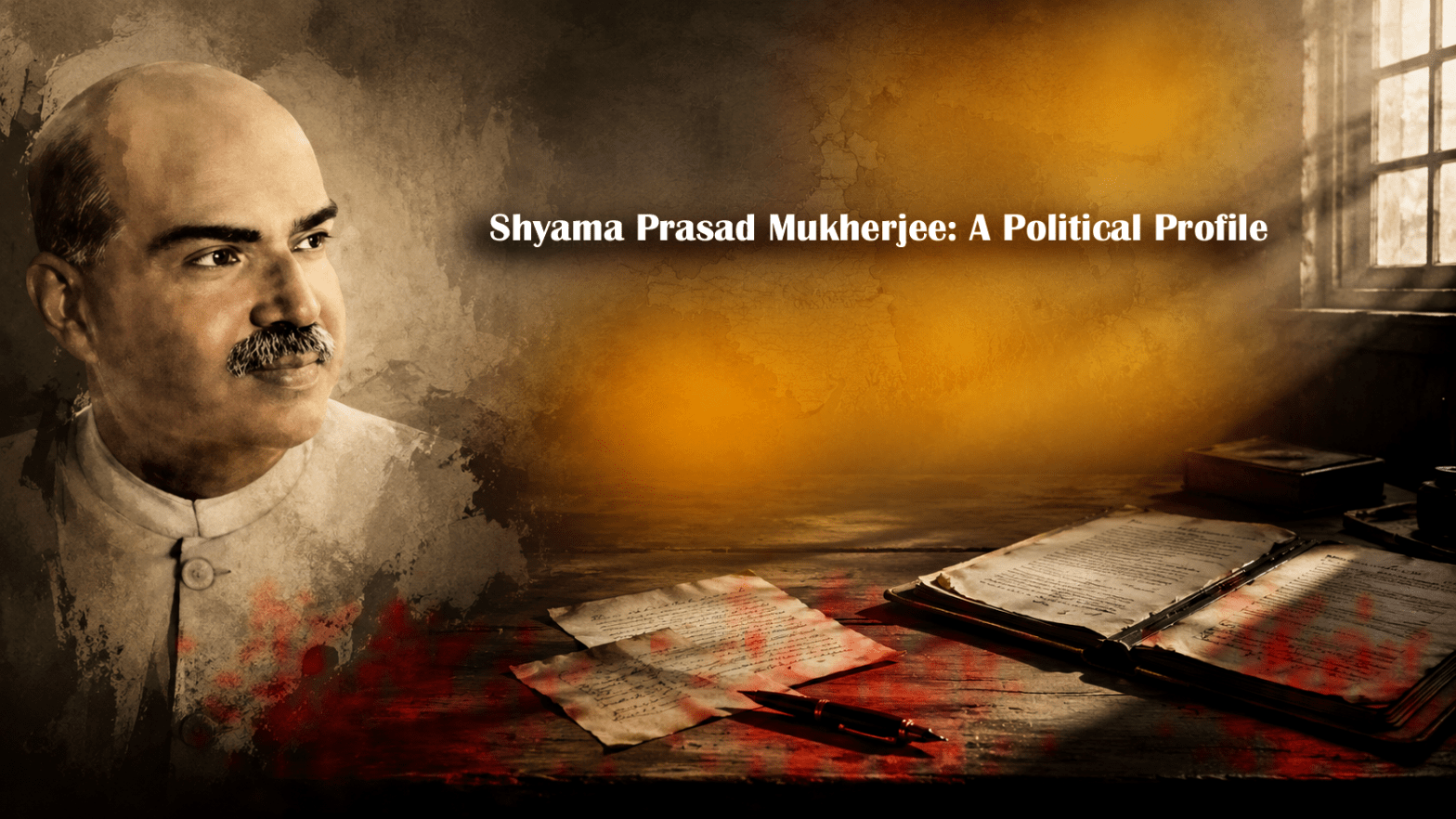
Shyama Prasad Mukherjee (1901–1953) was a Bengali barrister and politician who rose rapidly through alleged paternal influence to become the youngest Vice-Chancellor of Calcutta University. Entering politics as a Congress candidate in 1929, he shifted to the Hindu Mahasabha in 1939, served as Finance Minister in Bengal’s coalition government, explicitly offered cooperation to the British Governor to suppress the 1942 Quit India Movement, and advocated the communal (in the negative sense of the term as in South-East Asia) partition of Bengal in 1947. As Nehru’s Minister of Industry and Supply (1947–1950), he resigned over the Liaquat–Nehru Pact and, with RSS backing, founded the Bharatiya Jana Sangh in 1951. He opposed the Hindu Code Bill’s reforms on women’s rights and Article 370’s special status for Jammu and Kashmir, while his Mahasabha-linked relief efforts during the 1943–44 Bengal Famine drew criticism for communal and caste bias. Detained in Kashmir in 1953 during an agitation against the permit system, he died in custody on 23 June, 1953, amid unresolved medical and inquiry controversies. His documented record reflects a consistent prioritization of upper-caste Hindu majoritarian politics over secular pluralist consensus.
Damn the Dams!

This paper critically examines the political ecology of mega dams and hydroelectric power through historical, scientific, and activist lenses, exposing the profound environmental, geological, and social costs that often eclipse their touted benefits. From Lenin’s GOELRO electrification drive and Nehru’s “temples of modern India” to the suppressed warnings of scientists Meghnad Saha and Kapil Bhattacharya, the analysis reveals how hydraulic nationalism has repeatedly silenced ecological knowledge, leading to reservoir-induced seismicity (as in Koyna), catastrophic siltation, landslides, and dam failures. Drawing on cases like the Tehri Dam, Farakka Barrage, Vaiont, and Banqiao disasters, alongside Gandhian resistance by Sundarlal Bahuguna, Baba Amte, and the Narmada Bachao Andolan, and cultural critiques in Tagore’s Muktadhara and Tarkovsky’s Stalker, the author argues for a fundamental reevaluation prioritizing river integrity, democratic consent, and geological realism over technocratic hubris. In an era of climate change, the paper calls for letting rivers flow as essential to ecological justice and human survival.
The Aeroplane’s Gaze: Mountain, Market and Martyrs
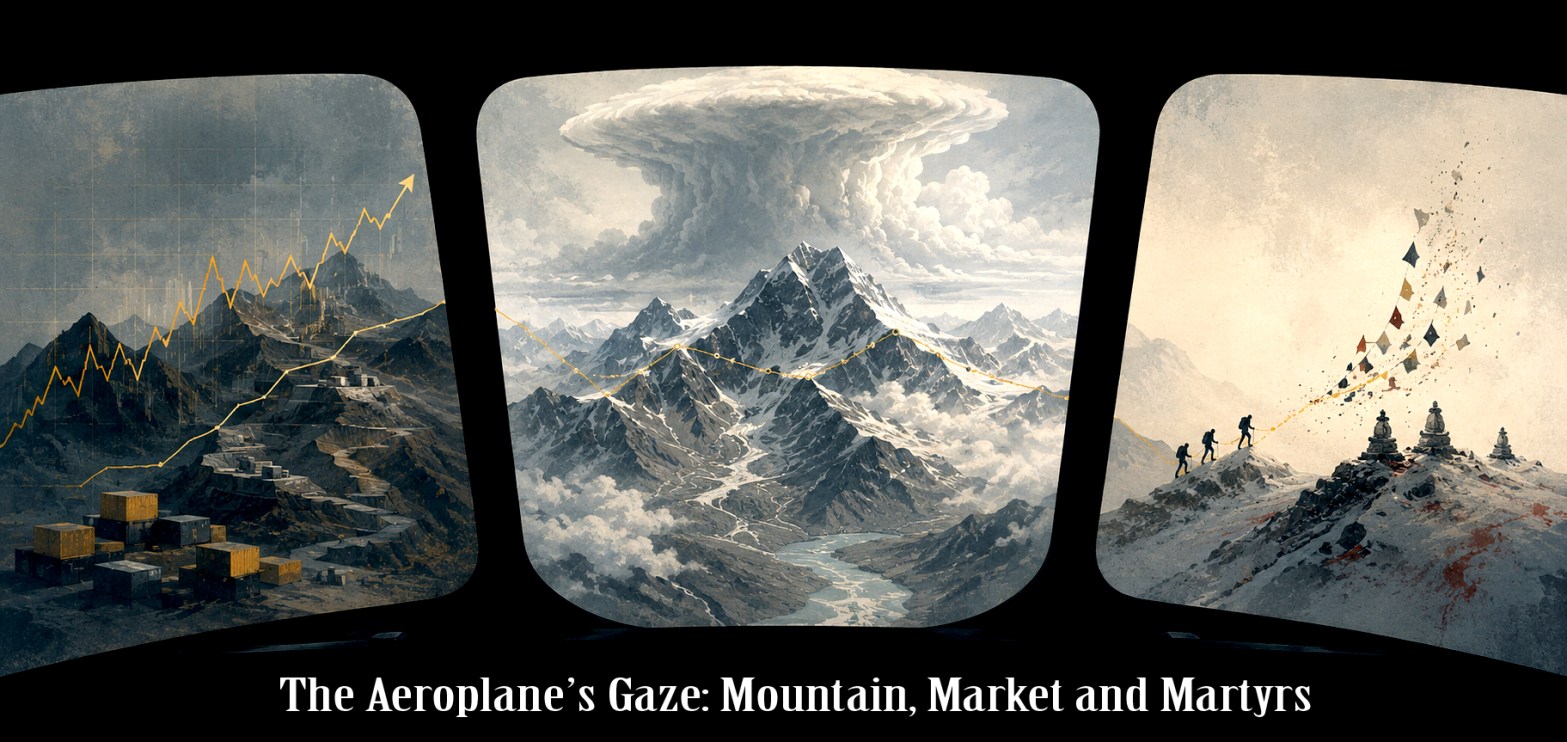
In this climate horror narrative with a positional paper disrupting the narrative flow, the author weaves personal flights over a rapidly thawing Himalaya with a critique of the “Three Ms”—Mountaineering, Market, and Martyrs—to expose how post-1990 commercialization has transformed high-altitude climbing into a neoliberal experience economy that commodifies risk, normalizes preventable deaths, and externalizes massive ecological waste onto fragile ecosystems. Drawing on observed glacial retreat, shrinking snowlines, data from Everest expeditions (e.g., 2019’s 877 summits and 11 deaths; 2025 permit hikes and ongoing congestion), the Chhanda Gayen case study, and corporate sponsorship spectacles, the analysis reveals how market logic—sunk-cost pressures, sponsorship demands for novelty, and regulatory filters—produces economic fatalism and “regulatory martyrdom” while generating symbolic capital from sacrifice and legacy trash (tens of tons of plastic, human waste, and gear). Framed by Tagorean imagery, Kalidasa’s metaphors, and Heideggerian reflections, the work culminates in a call to dismantle these structures, positioning the author’s embodied witness—flying through turbulent “intentioned” clouds—as a reversal from being-towards-death to death-towards-being, urging emancipation through corporeal awareness amid capitalism’s atmospheric and terrestrial violence.
The “Secular” State Paradox: the Erosion of Constitutional Secularism in Contemporary India
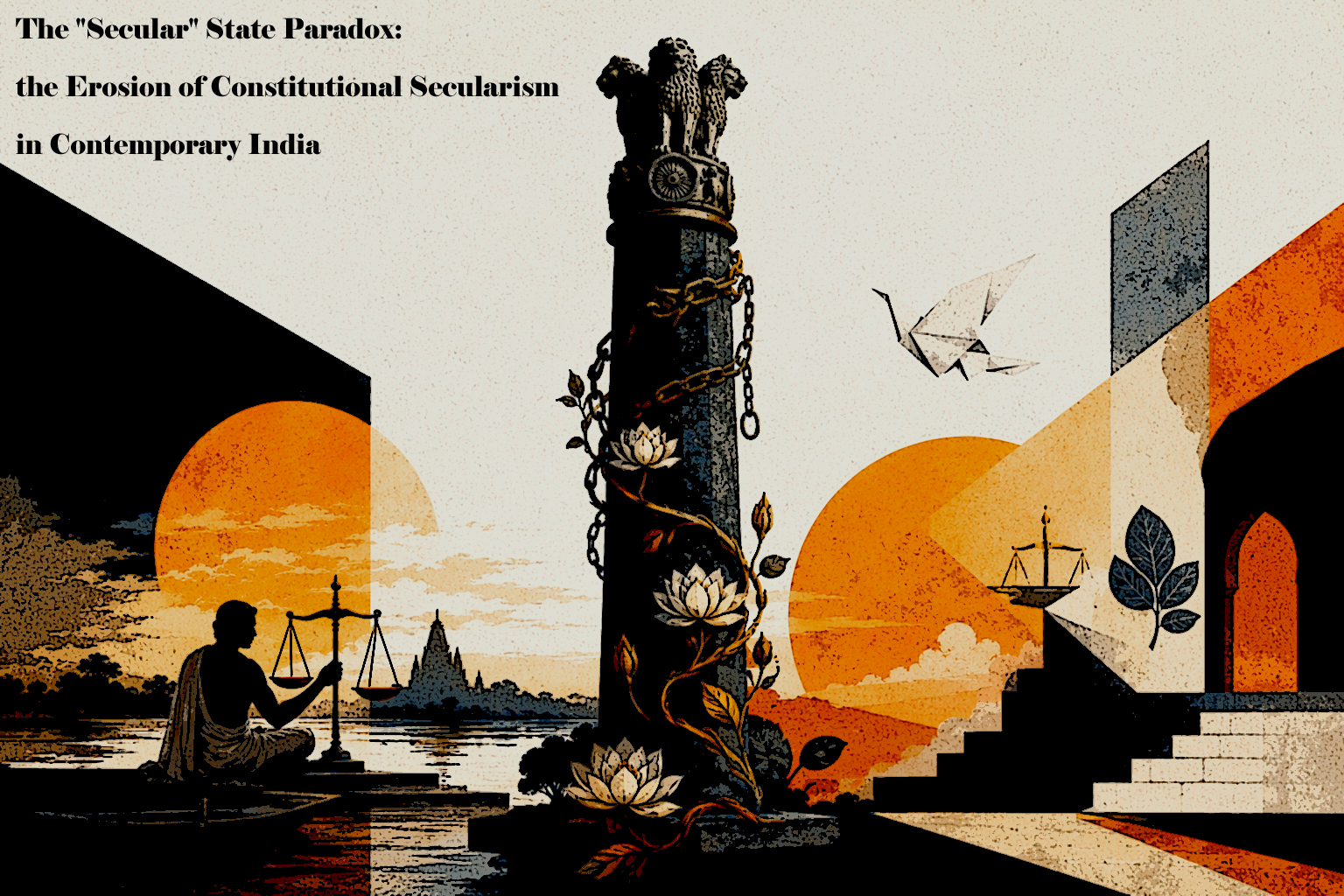
Since 2019, Prime Minister Narendra Modi has systematically blurred India’s constitutional separation between the state and religion—a doctrine central to India’s secular democracy since 1950. This article documents seven major constitutional violations spanning religious ceremony participation (Ram Mandir consecration, January 2024; Central Vista Parliament inauguration, May 2023), executive-judicial merger (Ganesha Puja at CJI DY Chandrachud’s residence, September 2024), selective state support for Hindu rituals over Muslim prayer practices (Red Road Yoga Day vs. namaz bans, June 2024), misappropriation of state security apparatus for personal religious acts (Z+ protection for sacred baths), documented abdication of constitutional duty during a national security crisis (Bear Grylls shoot during Pulwama attack, February 2019), and ecological destruction for religious symbolism (Yamuna “beautification” project). Each violation contradicts established constitutional convention (the Rajendra Prasad precedent of 1951), invokes specific legal provisions (Articles 14, 15(1), 25, 36, 44, 48-A, 50, 51-A(h), 60, 75), and collectively demonstrates how the “impunity loop”—where executive overreach faces no judicial reckoning—has eroded India’s foundational secular guarantee. The Central Vista Parliament consecration is particularly egregious: by permanently installing a religious symbol (the Sengol, representing divine-right monarchy) in the Speaker’s chair and framing Parliament as a Hindu “temple,” Modi has transformed the highest legislative chamber itself into a site of state-sponsored Hindu nationalism. Drawing from Supreme Court jurisprudence on basic features (Kesavananda Bharati), Article 32 remedies, separation of powers doctrine, and administrative law, this article argues that these violations constitute not individual transgressions but a systematic architecture of “selective secularism” that transforms Hindu nationalism into state policy while marginalizing minority rights. The article traces the “impunity loop” mechanism—how each violation normalizes the next through institutional passivity (judicial silence), doctrinal innovation (the “24/7 duty” doctrine that abolishes answerability), and intellectual capture (reframing Hindu nationalist practices as “secular culture” while suppressing minority religious expression). The absence of Supreme Court intervention despite clear constitutional grounds, combined with parliament’s majority-government control and investigative agency capture, has created conditions where constitutional limits have become advisory. The article concludes that India’s secular Constitution remains intact on paper while its practice converges toward Hindu nationalist theocracy, raising urgent questions about whether institutional actors can recover their constitutional commitment before the basic feature of secularism is irreversibly eroded.
ব্রাত্য বঙ্গে সনাতনী ঘুসপেটিয়া

This work is a deliberate act of counter-propaganda — a sustained, repetitive, and self-consciously plagiaristic agit-prop by two melancholy Kolkata Bandyopadhyays who describe themselves as residents of a “non-nation.” Written in a deliberately hybrid register that mixes formal Sadhu Bangla with colloquial Chalit, code-switching, Sanskrit citation, and street humour, the text performs its own central argument: that the imposition of linguistic and cultural uniformity is itself a form of violence. The book’s governing question is the political and civilisational fate of Bengali identity under Hindutva’s ascendant national project. The argument unfolds across seven chapters and proceeds on several interlocking planes. It opens by mapping the deep genealogy of anti-Bengal prejudice within Brahmanical Sanskrit literature — from the Ṛgveda and Aitareya Āraṇyaka to the Baudhāyana Dharmasūtra — showing how the term vāyaṃsi (birds, creatures of unstable motion) was deployed to mark the peoples of Bengal and the eastern territories as ritually impure, geographically ungovernable, and socially excludable. This ancient ideology of exclusion is read as the structural antecedent of contemporary Hindutva’s hostility toward Bengal. The book then interrogates the ideological apparatus of nationalism itself. The concepts of mātr̥bhūmi (motherland) and mātr̥bhāṣā (mother tongue) are traced to their origins in Christian ecclesiastical vocabulary — adopted into Bengali and Indian nationalist discourse during the colonial period — rather than to any ancient Sanskritic or “Sanatan” tradition. Through a close reading of Bankimchandra’s “Bande Mataram” and Rabindranath’s Ghare Baire — particularly the counter-nationalist voice of Nikhilesh — the authors argue that the nationalist invocation of the “mother” is a manufactured intoxication (nesha) that substitutes enchantment for genuine political freedom. The category of “Hindu” identity is subjected to rigorous historical disaggregation. Drawing on Rajataraṅgiṇī, Chola-period inscriptions, and the long record of Shaiva-Vaishnava conflict, the book demonstrates that the “one religion, one nation” claim of the Sangh Parivar has no historical foundation: what existed was a complex, internally contested plurality of sects, practices, and cosmologies — a plurality that colonial administration and contemporary Hindutva alike have violently flattened. A substantial chapter examines the political economy of language. Grierson’s own admission of the impossibility of distinguishing language from dialect is mobilised to expose the census-driven erasure of Odia, Assamese, and other eastern linguistic identities in the service of a Hindi-dominated national demography. The historical construction of Bengali geographic identity — from Pundra, Gauda, and Banga through the Mughal Suba-e-Bangla to the colonial Bengal Presidency — is traced to show that “Bengal” itself is a layered historical formation rather than an eternal essence. The chapter ends with a detailed empirical treatment of what the authors call the carabeef paradox: the coexistence of cow-vigilante violence and lynching with India’s status as the world’s largest exporter of bovine meat under Hindutva governance — complete with data on the Allana Group’s political donations and the corporate structures behind the trade. The critique of Bengali identity is turned inward as well. Drawing on Nirad C. Chaudhuri’s Ātmaghātī Bāṅālī while contesting his Eurocentric prescription, the authors indict the Bengali bhadralok’s chronic self-deception, selective memory, and hypocritical Islamophobia — the same community that produced Derozio, Vidyasagar, and Nazrul now reaches for saffron affiliation or comfortable silence. The book closes with a rereading of the Sanskrit tarpaṇa (ancestral water-offering) ritual as a philosophical statement of radical solidarity — one that extends water and recognition even to enemies, to serpents, to trees, to the dispossessed. The “I” (ayam) is asked to journey toward “we” (vayam), a movement the authors align with the Bantu concept of ubuntu. The final aspiration, voiced through Nazim Hikmet, John Lennon, Juan Ramón Jiménez, and Carl Sagan, is not for a better nation but for the dissolution of the nation-statist form itself — a trans-planetary, non-violent dwelling in the (other-than-)human species-condition, from Kolkata to the pale blue dot.
Bulldozer (In)Justice in India: Encountering Demolition and Dispossession
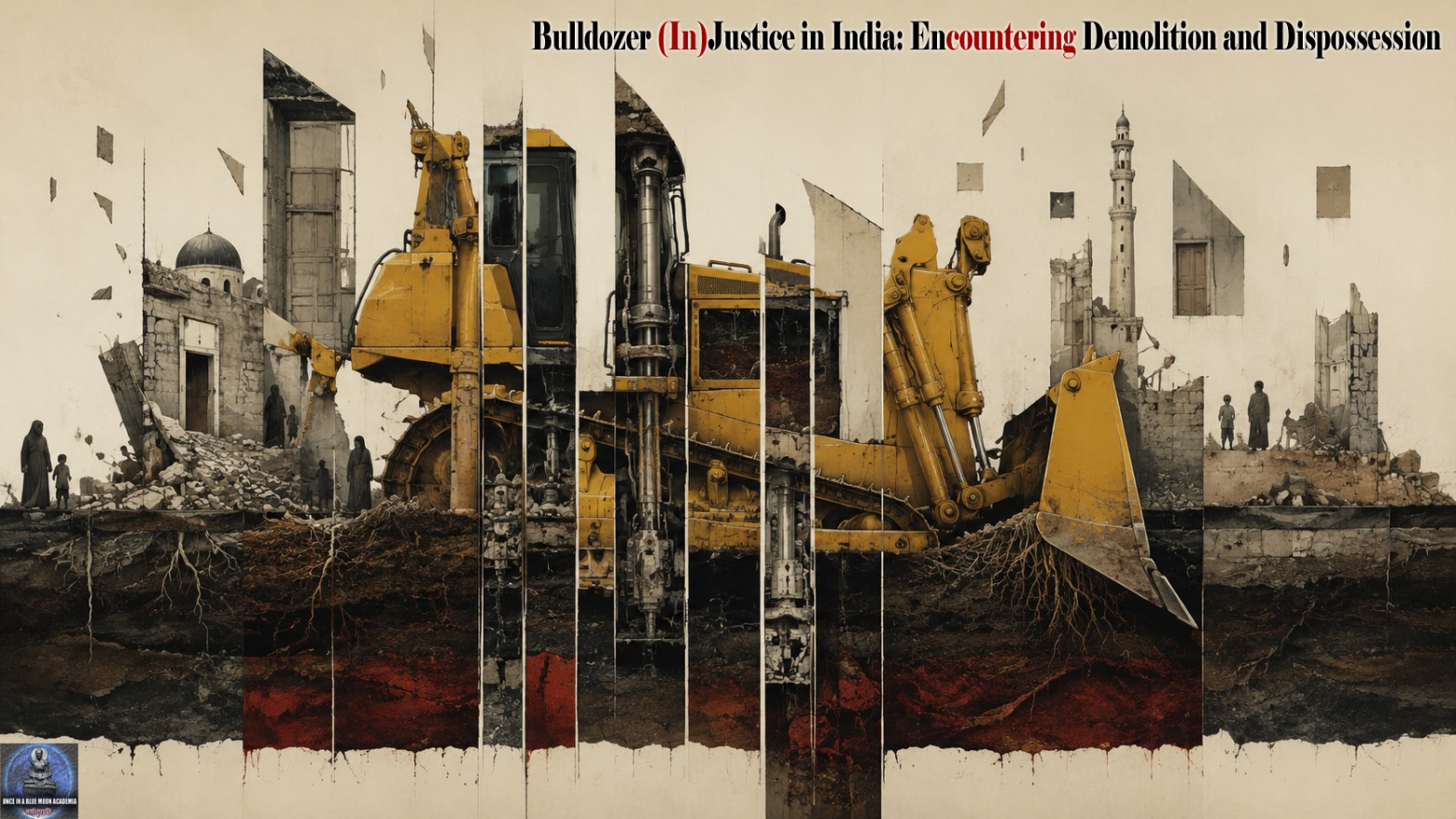
The article contends that “Bulldozer Justice”—the BJP government’s targeted demolitions of Muslim homes, businesses, and religious sites—represents not mere administrative excess or electoral tactics but the latest manifestation of a coherent seventy-five-year ethnocratic project rooted in the 1949 Babri Masjid occupation. It identifies a persistent structural impunity loop (extra-legal action, state complicity, retroactive judicial or legislative legitimation, and perpetrator reward) driving Hindu majoritarian statecraft, linking the 1949 conspiracy through the Supreme Court’s 2019 verdict to the 2025 Waqf Amendment Act. Drawing on Amnesty International’s documentation of 128 targeted demolitions, Housing and Land Rights Network data showing 738,438 displacements in 2022–23, V-Dem’s classification of India as an “electoral autocracy,” and other reports, the piece maps the phenomenon across its ideological, affective, legal, spatial, gendered, corporate, and legislative dimensions. It highlights the central bovine paradox of India as one of the world’s largest exporters of buffalo meat ($4 billion in 2025) alongside lethal cow-protection vigilantism, exemplified by major corporate donations to the BJP. Framing Bulldozer Justice within manufactured Islamophobia, Hindu victimhood narratives, creeping theocracy, and the mechanics of contemporary majoritarianism, the article characterises the process as democratic demolition — one structure, one statute, and one impunity loop at a time.
The Genealogy of Intoxication in the “Sanātana” Dharma

This article interweaves devotional revival, academic appeal, poetic prayer, and radical self-reflexive critique into a polyphonic offering. It advocates the responsible, scripturally grounded revival of two historically significant sacred preparations in Sanatana Dharma — Vaidic Somarasa, the divine elixir exalted in the Rigveda (particularly Mandala IX and 8.48.3), and Maireya Mada, the refined royal wine celebrated in the Valmiki Ramayana (Uttara Kāṇḍa Sarga 42 and Ayodhya Kāṇḍa Sarga 91) — while simultaneously inhabiting the fragile, absurd third space of refusal. Structured around a formal academic letter to Pujya Acharya Shri Ramdev Ji Maharaj and the Patanjali ecosystem calling for GMP-compliant research, standardization, and production of these formulations or their safe, therapeutically calibrated analogs within Ayurvedic Sandhana Kalpana; a deeply personal devotional reflection as a follower of Drunk Balarama (Madhupriya Haladhara), exploring hāsyarasa and the līlās drawn from the Śrīmad Bhāgavatam, Harivaṃśa, and Mahābhārata; and a Vedic prayer-song to Varuṇa for the boundless flow of Vāruṇī, the work runs parallel with the voice of l’étrangère — the tremulous skin (dṛti) of Rigveda 7.89 — who refuses both the compulsory intoxication of speed capitalism and the homogenizing violence of theocratic-market fundamentalism. Drawing upon Vedic hymns, Tagore’s storm-cloud renditions, Marx’s nuanced theory of alienation and religion-as-pharmakon, Brecht’s subversive theatre, Subaltern Studies, and Kabir’s laughter, the article affirms Sanatana Dharma’s sophisticated, multi-layered grammar of madya — ritual, medicinal, ecstatic, and counter-hegemonic — while carving generous space for the sober, ridiculous, creative refusal of all compulsory cups. Ultimately, it calls for a courageous renaissance that is scholarly, devotional, and radically disobedient to the twin fundamentalisms of our time.
NOTA: From Symbolic Dissent to the Horizons of Radical Democracy
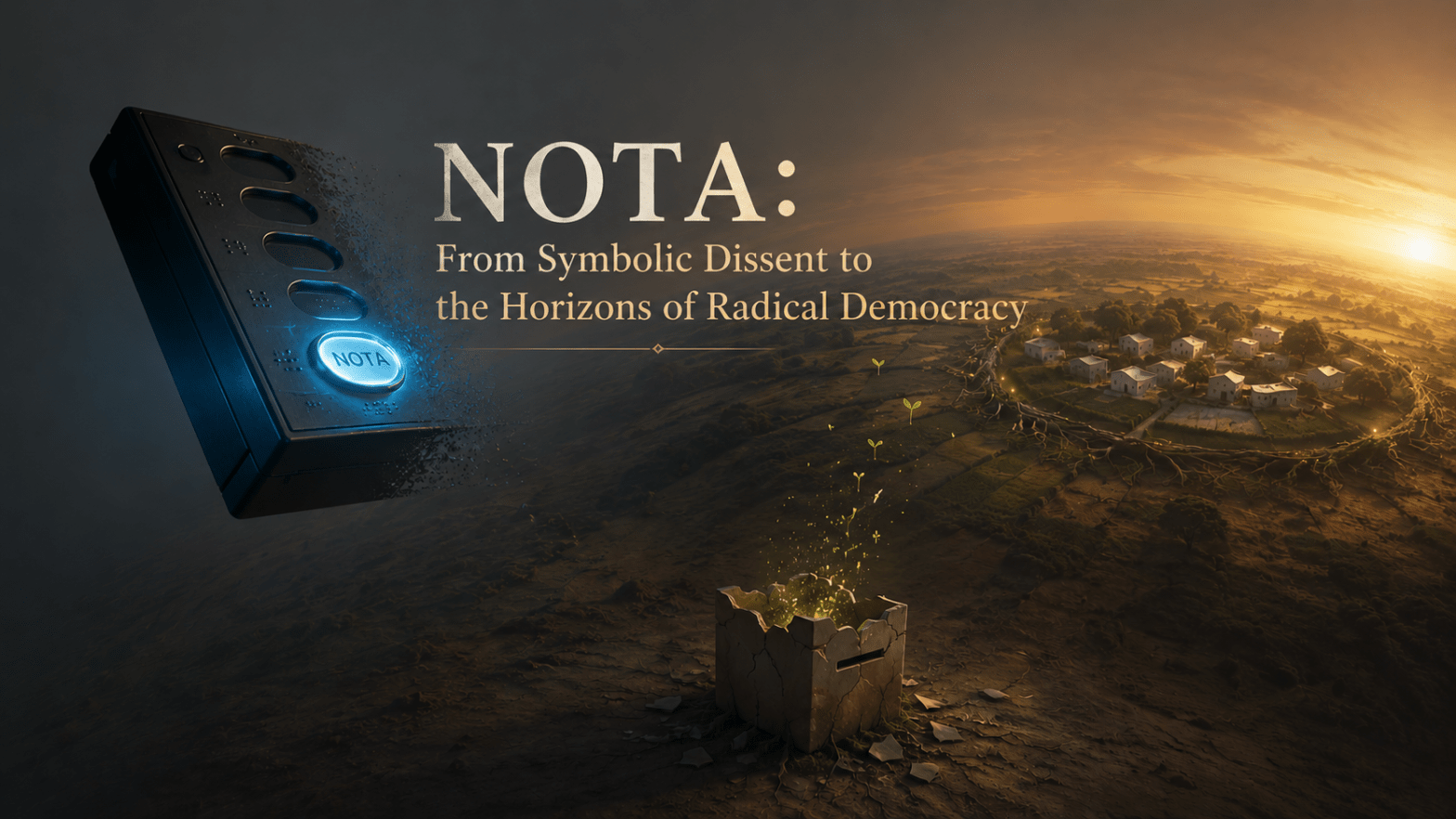
India’s NOTA — born from the Supreme Court’s 2013 PUCL judgment — gave voters a secret, counted way to reject all candidates. Over a decade later, even the Court admits it has “hardly made any impact” on criminalisation, dynasticism and money power. The May 2026 state elections (1.09 million NOTA votes across West Bengal, Assam, Tamil Nadu, Kerala and Puducherry) changed zero outcomes. Its impotence is structural — trapped by FPTP’s winner-takes-all logic, the absence of binding Right to Reject and Right to Recall, hollow decentralisation, and all parties’ addiction to extractive growth amid climate crisis. Globally, it lags far behind Colombia’s voto en blanco or Indonesia’s kotak kosong, which can force fresh elections with new candidates. NOTA is both symptom and seed. Its fulfilment demands proportional representation, constitutionalised Reject/Recall powers, empowered Gram Sabhas, genuine fiscal decentralisation, and a degrowth, cooperative, ecologically grounded economy — the path to a partyless, dialogue-based society of self-governing ecological communes.
An Anti-Fascist Phenomenology of Haircuts and the Corporeal in Chaplin’s “The Great Dictator”

Charlie Chaplin’s The Great Dictator (1940) performs a radical phenomenological dissection of fascism as a regime that disciplines the body — beginning with the head as command centre and extending to hair, moustache, and razor as instruments of masculine authority and ideological inscription. Yet the film’s subversive genius lies in how these very tools are turned against their masters: the razor that polices masculinity becomes an agent of rhythmic care and tender absurdity; the frying pan a weapon of domestic insurgency; the hand grenade and rogue artillery shell instruments of intimate, comedic sabotage. Through shaving sequences, foam-moustache laughter, and phallic banana-crushing, Chaplin reveals that fascist power depends on rigid assignment of function — and collapses the instant the ordinary body slips out of place. This corporeal grammar finds its brutal contemporary counterpart in India under BJP-RSS rule. The same razor that restores dignity in the barber’s chair reappears as the financial “haircut” in the DHFL scandal — a legally orchestrated dispossession that stripped lakhs of ordinary depositors of seventy to eighty percent of their savings to enrich crony capital. What was intimate care becomes fincide; what was artisanal attention becomes procedural theft. From the disciplined fascist head to the managed economic body, the article maps a single arc: authoritarian power inscribes itself upon surfaces both facial and financial, yet the body — whether individual or collective — retains the capacity for interruption, refusal, and reclamation. The interruption is always possible. The razor can still be turned toward care.
“Man Na Raṅgāye”: Embodied Austerity and Leadership Praxis During the Climate Crises
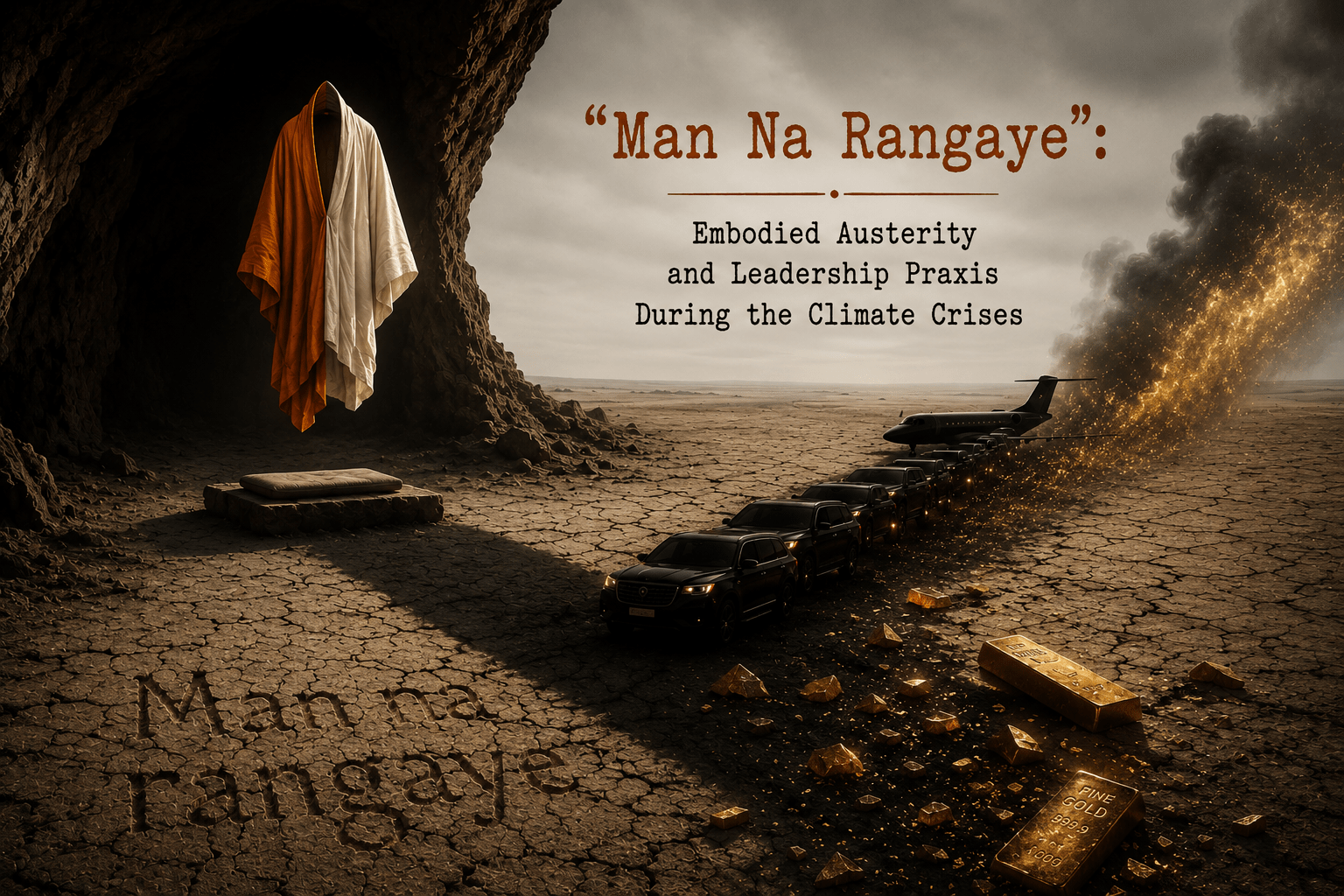
On 10 May 2026, Prime Minister Narendra Modi urged Indian citizens to adopt sweeping austerity measures—restraining petroleum use, reviving work-from-home, minimising non-essential foreign travel, postponing gold purchases, reducing imports of edible oils and chemical fertilisers, promoting natural farming and Swadeshi consumption, and preferring public transport, carpooling, and EVs—amid West Asia tensions, rising oil prices, and forex pressures. This paper delivers an uncompromising critique of these imperatives, examining their genuine ecological co-benefits in the climate crisis alongside the cross-traditional philosophical demand for ācaraṇa (embodied praxis) drawn from Chaitanya Mahaprabhu, Imam Abu Hanifa, Gandhi, Kant, Marx, Tagore, and Kabir; the glaring contradictions with the Prime Minister’s opulent lifestyle, extravagant foreign travels, luxury branding, and high-carbon Z+/SPG security protocols; and the deeper theoretical foundations in A.K. Dasgupta’s Economics of Austerity (1975), the Mahābhārata’s Vana Parva, the Bhagavad Gītā’s teachings on lokasaṅgraha and rejection of karmavirati, and Swami Vivekananda’s Practical Vedanta. It argues that in the Anthropocene, genuine austerity requires visible leadership embodiment for moral legitimacy, ecological efficacy, and spiritual coherence; absent such praxis, Modi’s call stands exposed as the very hypocrisy Kabir satirised in his pad “Man nā raṅgāye raṅgāye jogī kaprā” — performative asceticism and ruling-class doublespeak that fatally undermines its own imperatives. The paper proposes a framework of ecological austerity as lokasaṅgraha, integrating economic theory, environmental analysis, South-East Asian philosophy, and uncompromising political ethics.

