
On Behalf of Ecotopians of Alternity⤡
Posted on 20th April, 2026 (GMT 08:13 hrs)
ABSTRACT
Vantara, the 3,500-acre private wildlife sanctuary run by the Reliance Foundation in Jamnagar and inaugurated by Prime Minister Narendra Modi on 4th March 2025, is promoted as the world’s largest rescue centre. Through a radical ecological-regenerative lens grounded in animal liberation ethics and multispecies justice, this analysis reveals it as a gated corporate biopolitical enclosure that converts ecological refugees—produced by Reliance’s polluting refinery and global extractivism—into spectacles for dynastic branding and moral capital. Integrating controversies over dubious sourcing, transport trauma, CITES due-diligence failures, media suppression, and climatic hypocrisy with a comparison of ex-situ Humboldt penguin facilities (Vantara and Byculla) against proven in-situ efforts in Peru, South Africa, and Argentina, the essay critiques how crony-dynastic capitalism, including the Ambani–Piramal nexus and Campa Cola operations, externalises ecological harm while staging compassion. It calls for abolishing commodified captivity and embracing decolonized, liberatory restoration that restores more-than-human autonomy in living ecosystems rather than managing bare life in fortified corporate arks.
I. Introduction
Vantara stands as one of the most ambitious private wildlife initiatives ever undertaken in India: a 3,500-acre fortress within the Reliance Jamnagar SEZ, officially comprising the Greens Zoological Rescue & Rehabilitation Centre (GZRRC) and the Radhe Krishna Temple Elephant Welfare Trust. Inaugurated by Prime Minister Narendra Modi himself on 4th March 2025 in a carefully choreographed ceremony that included close interactions with tigers and elephants, the facility has since celebrated 2nd March annually as its Foundation Day.
This article argues that Vantara is not a conservation project but a corporate biopolitical enclosure that transforms ecological refugees—produced by extractivist capitalism—into instruments of dynastic legitimacy and moral capital. It contends that both ex-situ captivity and bordered in-situ conservation reproduce enclosure logics, and calls instead for decolonized, multispecies, autonomy-centered ecological restoration.
Official claims describe it as home to more than 150,000 animals across over 2,000 species, ranging from 250+ elephants and hundreds of big cats and primates to exotic birds, reptiles, and—most visibly—Humboldt penguins housed in sophisticated climate-controlled environments. The site boasts MRI scanners, hydrotherapy pools, misted walkways, imported diets, and advanced veterinary infrastructure, all presented as the gold standard of modern animal welfare. By late 2025, Vantara had reportedly imported 41,839 animals from 53 exporters across 32 countries, with capacity scaled toward 84,822 individuals. Recent developments include the relocation of 25 leopards (with plans for up to 50) from Maharashtra’s human-wildlife conflict zones in March 2026 and the announcement on 10 April 2026 of Vantara University, positioned as the world’s first global institution dedicated to wildlife conservation and veterinary sciences.
At first glance, such scale, technological investment, and institutional expansion appear to represent an unprecedented act of corporate compassion towards the more-than-human world. Yet, when examined through a radical ecological, or rather, regenerative lens—one that integrates Gary Francione’s abolitionist critique of speciesism, Tom Regan’s rights-based view of animals as subjects-of-a-life, Peter Singer’s utilitarian calculus of suffering, multispecies justice frameworks, and sharp political-ecological analyses of philanthrocapitalism—Vantara reveals itself as a paradigmatic example of ex-situ biopolitical enclosure. Far from resolving ecological crises, it converts the very refugees produced by Reliance’s fossil-fuel empire and global extractive networks into permanent exhibits that serve dynastic prestige, state-endorsed legitimacy, and branded ESG optics.
This essay provides a thorough integration of every major controversy documented between 2023 and mid-April 2026. It draws directly from Supreme Court records, the CITES Secretariat’s SC79 report (November 2025), Climate TRACE’s updated 2025–2026 refinery emissions data, CPCB and CAG audits, Environmental Justice Atlas entries, and investigative journalism from Down To Earth, The Wire, Mongabay India, Africa Geographic, and others. A dedicated focus on Humboldt penguin conservation serves as a lens to illuminate broader contradictions: the hidden violence of long-distance “rescue” pipelines versus genuine in-situ restoration that respects collective animal autonomy. True liberation ethics, the analysis concludes, cannot be satisfied by perfecting the architecture of captivity or expanding institutional branding; it demands the dismantling of the extractivist systems that manufacture refugees in the first place.
II. The Sacrifice Zone Backdrop
Reliance Industries’ Jamnagar refinery remains the world’s largest single-site refining complex, with a combined crude processing capacity of 1.4 million barrels per day. Climate TRACE’s most recent validated data (release 4.3.1, updated through 2025) estimate its annual CO₂e emissions in the 18–20 million tonne range, with a revised 2022 figure of 19.76 million tonnes—still positioning it among the planet’s highest-emitting industrial assets and underscoring India’s role as the world’s third-largest greenhouse-gas emitter overall.
Decades of continuous operation have produced chronic environmental degradation: persistent sulfur dioxide emissions (despite regulatory monitoring), groundwater salinization that has rendered thousands of wells brackish, widespread crop failures across surrounding agricultural lands, livestock miscarriages, and elevated respiratory illnesses in villages such as Sikka, Khambhaliya, and Vadinar. Contract workers at the complex face documented benzene exposure risks amid limited union protections, while local fishing and farming communities have endured forced evictions under SEZ rules, incomplete rehabilitation packages, and mangrove destruction. The Central Pollution Control Board and Comptroller and Auditor General audits have repeatedly recorded air- and water-quality violations, effluent discharge failures, and wetland encroachment.
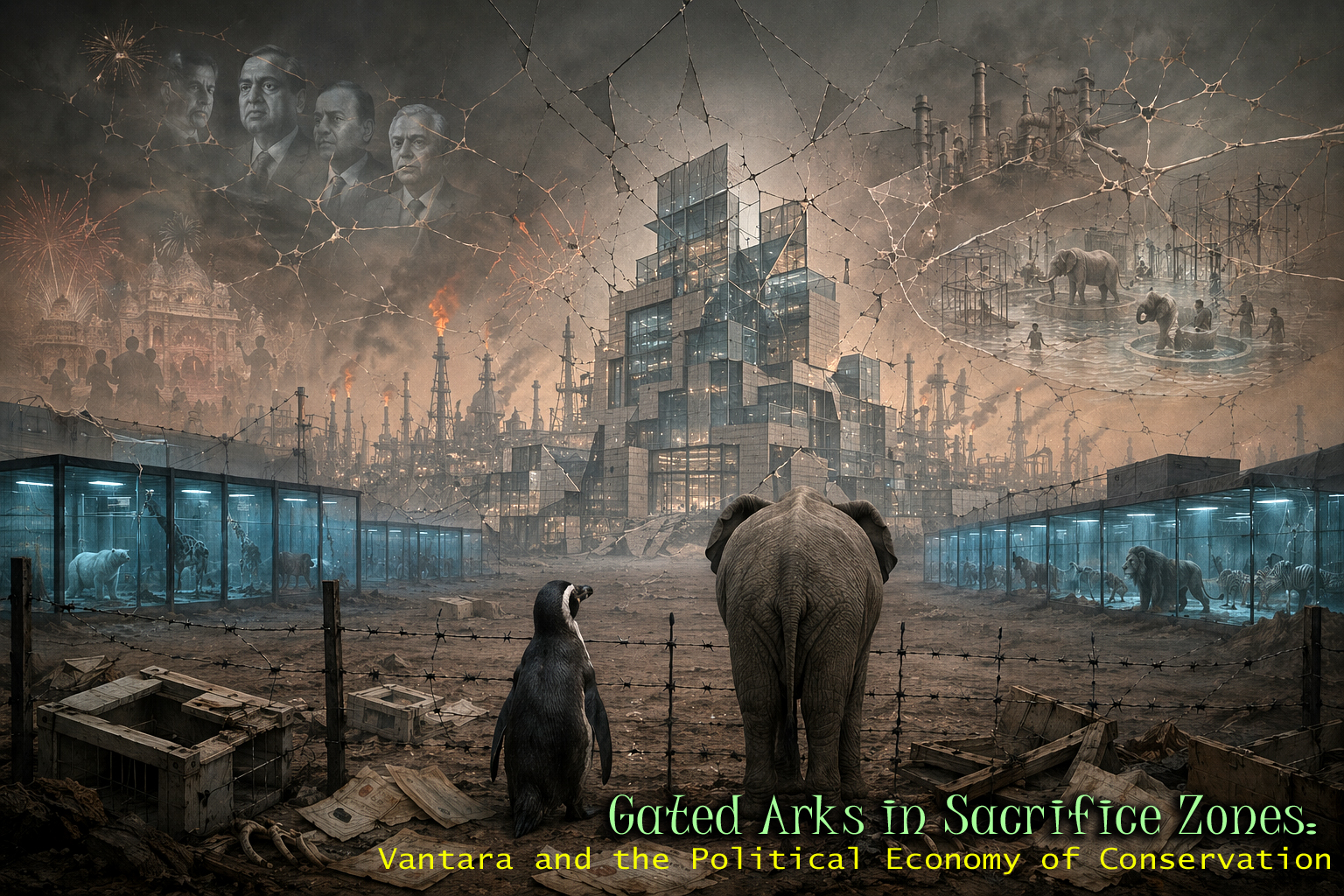
Vantara was literally carved from this same industrial “green belt” inside the refinery’s SEZ boundaries, benefiting from the same eminent-domain acquisitions, tax incentives, and regulatory forbearance that have long favoured the Ambani conglomerate. The adjacency is not incidental: the sanctuary’s energy-intensive cooling systems for non-native species operate in a landscape already scarred by petrochemical activity. Emissions and pollutants do not respect the sanctuary’s perimeter; chilled penguins and relocated elephants may still inhale air laced with industrial byproducts and draw water from aquifers compromised by decades of contamination. Drawing on Rob Nixon’s framework of “slow violence,” this arrangement exemplifies state-endorsed crony capitalism at its most refined form: habitats are first destroyed, refugees (human and nonhuman) are manufactured, and then those same refugees are enclosed and displayed as evidence of corporate benevolence.
As chronicled in the following dossier on the Reliance empire’s history of environmental violations, this sacrifice-zone reality is part of a corporate pattern of eco-extortion. Allegations against Ambani-dynasty include gas migration from ONGC blocks into RIL’s KG-D6 field, leading to claims of unjust enrichment; severe reservoir damage from aggressive production methods making hydrocarbon reserves unrecoverable; and operational failures in Assam marked by blowouts and oil spills. The Jamnagar refinery-Vantara complex exemplifies ecological plunder, where habitats are destroyed and communities displaced, later branded as acts of corporate “welfarism”!
III. Vantara Unveiled: Opulent Enclosures and the Penguin Paradox
Officially, Vantara presents itself as a state-of-the-art rescue centre equipped with cutting-edge veterinary technology and meticulously designed habitats. The 3,500-acre private preserve remains closed to the general public and functions primarily for superrich Ambani family’s guests, international celebrities, and high-level political delegations1. Prime Minister Modi’s inauguration ceremony, complete with spectacular animal interactions, conferred powerful state/BJP-NDA government sanction, after which the facility secured Global Humane Certification.
By late 2024, imports had reached 41,839 animals. While Vantara emphasises rescue and rehabilitation, transparent, independently verified data on large-scale rewilding or reintroduction programmes remain limited, pointing instead toward a model of permanent, high-security collection-building. The opulent, Versailles-like enclosures—complete with imported fruits, misted microclimates, and advanced climate control—stand in dramatic contrast to the surrounding refinery landscape. The April 2026 launch of Vantara University, with courses in wildlife medicine, conservation policy, genetics, and animal care, further institutionalises this model as a long-term dynastic investment in wildlife sciences education.
The paradox is most starkly embodied by the Humboldt penguins (Spheniscus humboldti), classified as Vulnerable by the IUCN and naturally adapted to the cold upwelling systems of the Humboldt Current along the coasts of Peru and Chile. Sourced primarily from UAE facilities (with some arrivals continuing into late 2025), these birds are maintained in refrigerated enclosures calibrated between sub-zero and 4°C temperatures, despite Jamnagar’s arid desert climate that routinely surpasses 40°C. Official Vantara communications celebrate the penguins’ “sun-loving” nature and mate-for-life behaviours, yet the energy demands of sustaining polar conditions in a petrochemical-adjacent desert underscore the deeper ecological contradiction.
This situation echoes the well-documented 2016 Byculla Zoo tragedy in Mumbai, where imported Humboldt penguins suffered rapid mortality from transport stress, thermal mismatch, and quarantine failures—including the death of a bird named Dory from bacterial infection and the subsequent loss of a chick—highlighting the risks inherent in spectacle-driven ex-situ projects in tropical settings.
The penguin thus becomes not merely a species under conservation, but an index of thermodynamic absurdity—life sustained through fossil-fuelled refrigeration within the very system driving its extinction!
IV. Vantara: A Comprehensive Catalogue of Reported Controversies (2023–Mid-April 2026)
Official clearances include the Supreme Court-appointed SIT’s September 2025 clean chit and the Court’s 9 March 2026 dismissal of a subsequent public-interest petition. In the March ruling, Justices Prashant Kumar Mishra and N.V. Anjaria explicitly observed that “disturbing the settled environment, custody and air of living animals, including rescued animals after lawful import, may itself result in cruelty.” Nevertheless, independent analyses, particularly the CITES Secretariat’s SC79 report following its September 2025 fact-finding mission, continued to highlight procedural and ethical concerns even while acknowledging the facility’s high physical standards.
(i) Dubious Sourcing, CITES Violations, and Commodification Vantara imported 2,132 Appendix-I animals—including cheetahs, gorillas, chimpanzees, orangutans, tigers, and macaws—from 53 exporters across 32 countries. The largest consignment (11,729 animals) originated from UAE facilities, some previously flagged in wildlife trafficking alerts. The CITES SC79 report (document E-SC79-06-03-04) identified significant mismatches between exporter and importer trade data, inconsistent permits (notably eight chimpanzees linked to problematic Cameroon documentation), potential misdeclaration of wild-caught animals as captive-bred, and insufficient Indian verification of acquisition modes and origins. While the Secretariat found no evidence of imports occurring without valid permits and noted high standards of animal care, it stressed that India’s due-diligence procedures “did not normally extend beyond the verification of the presence of an export permit,” recommending stronger safeguards to prevent inadvertent stimulation of illegal trade. Additional red flags included sourcing attempts from South African facilities associated with canned hunting, scrutiny over Spix’s macaw transfers, and a mountain gorilla routed via Haiti without clear prior records. Declared shipment values of approximately $9 million (freight and insurance) were cited by observers as potentially masking commercial dimensions.
(ii) Transport Trauma and Serial Displacement Long-distance transfers impose profound stress. Documented cases include multi-truck elephant convoys spanning thousands of kilometres from Arunachal Pradesh and Assam, as well as the May 2024 detention en route of elephant cow Pratima and her calf from Tripura, which prompted judicial scrutiny over transparency. Animals endure separation anxiety, capture trauma, climate shocks, extended quarantine, and disrupted social structures. Humboldt penguins, for instance, undergo flights from UAE facilities directly into refrigerated units amid extreme external heat. Post-import deaths linked to transport stress have been reported among cheetahs and other species, alongside the fracturing of elephant matriarchal bonds.
(iii) The Kolhapur Mahadevi/Madhuri Elephant Case In July 2025, the 36-year-old temple elephant Mahadevi (also called Madhuri), long chained in solitary confinement at Kolhapur’s Jain Mutt and documented with neglect, injuries, and poor health, was relocated to Vantara under Supreme Court orders following a PETA petition. The transfer triggered massive local backlash: stone-throwing protests, a 45-km silent march by over 30,000 people from Nandani to the Kolhapur collectorate on 3 August 2025, and a boycott by more than 1.5 lakh Jio users. Jain communities in Maharashtra and Karnataka denounced the move as cultural appropriation of a living temple deity, underscoring deep tensions between individual welfare interventions and longstanding communal religious bonds.
(iv) Media Suppression and Digital Intimidation Between July and October 2025, multiple international and Indian investigative outlets—including Africa Geographic, Conexão Planeta, iRozhlas, Süddeutsche Zeitung, Down To Earth, and Himal Southasian—reported coordinated suppression efforts. These included spoofed Google takedown notices, DMCA flags, AdSense disruptions, and legal threats from a fabricated “Aspire Law Firm” that misappropriated the credentials of a real Indian cyber-law expert. Down To Earth reportedly received defamation notices seeking up to Rs 1,000 crore. Google later confirmed the notices were inauthentic. The campaign peaked ahead of the September 2025 SIT report, illustrating systemic challenges to independent scrutiny of high-profile private conservation projects.
(v) Ecological Hypocrisy and Site Unsuitability Located inside a refinery SEZ repeatedly flagged by the CPCB for pollution, Vantara’s energy-intensive penguin cooling systems operate in a drought-prone, industrially burdened landscape. Proximity to petrochemical operations raises ongoing exposure risks, even as courts have cleared specific climatic complaints on the basis of available documentation.
(vi) Celebrity Spectacle and Private Access Vantara has hosted a steady stream of elite visitors: Lionel Messi and Inter Miami teammates in December 2025, pre-wedding guests including Mark Zuckerberg, Bill Gates, and Ivanka Trump in 2024, Donald Trump Jr. in late 2025, and numerous Bollywood celebrities. Prime Minister Modi’s inauguration featured staged animal interactions. The facility’s complete closure to ordinary citizens and broad media access reinforces its character as an invitation-only dynastic preserve.
(vii) Legal and Regulatory Clearances and Recent Developments The Supreme Court’s acceptance of the SIT report in September 2025 and its March 2026 dismissal provided legal finality based on facility-provided information and permit verification. The CITES SC79 findings, while diverging on due-diligence questions, did not result in formal trade restrictions following Indian representations. In March 2026, the Maharashtra government relocated 25 leopards (with an agreement for up to 50) from human-wildlife conflict areas to Vantara for lifelong care, citing inability to release them safely back into the wild. While framed as welfare support, this transfer extends the pattern of large-scale acquisition into permanent captive settings.
(viii). Ex-Situ Gated Conservation as Biopolitical Enclosure: Animal Rights and Liberation Perspectives Vantara exemplifies Michel Foucault’s concept of biopolitical pastoral power—a mode of governance that “cares” for life through constant technological monitoring and optimisation—while simultaneously enacting Giorgio Agamben’s notion of bare life. Animals receive intensive interventions (refrigerated microclimates, hydrotherapy pools, MRI diagnostics, precisely formulated imported diets), yet they are stripped of genuine ecological agency. They inhabit a managed simulation rather than a self-determining world-habitat, their biological persistence curated for dynastic display and corporate image. The proposed Vantara University further entrenches this technocratic approach by training future generations in the same model of managed-technocratic care as control.
This is not temporary rehabilitation. Despite the massive scale of imports and ongoing acquisitions such as the Maharashtra leopards, independently verifiable data on meaningful rewilding programmes remain strikingly limited. The dominant pattern is one of permanent, high-security captivity presented as enlightened stewardship. Technological sophistication masks the deeper ontological reduction: sentient beings become living exhibits whose continued existence serves prestige and moral redemption.
Tom Regan’s rights-based philosophy delivers a foundational indictment by establishing that animals qualifying as “subjects-of-a-life”—beings with beliefs, desires, memory, emotion, and a sense of their own welfare—possess inherent value that exists independently of any usefulness to humans. This intrinsic worth renders any form of permanent captivity, no matter how technologically advanced or luxuriously appointed, a fundamental rights violation, because it denies subjects the freedom to live according to their evolved natures and reduces them to the status of mere resources under perpetual human control.
Peter Singer’s utilitarian calculus deepens the ethical failure by meticulously weighing the profound, measurable suffering inflicted—transport trauma, abrupt climate dislocation, social fragmentation, chronic behavioural deprivation, and the stress of unnatural confinement—against any speculative benefits such as limited public education or symbolic conservation signalling; the scales tip decisively toward net disutility, especially for Humboldt penguins already burdened by collapsing fish stocks, massive bycatch mortality, and unstable ocean systems driven by climate chaos.
Gary Francione’s abolitionist framework delivers the most uncompromising verdict: any institutionalised captivity, even when rebranded as “rescue” or “sanctuary,” reproduces the systemic prejudice of speciesism by treating sentient beings as property that humans may own, confine, and commodify. Luxurious conditions and veterinary certifications do not redeem the institution; they merely refine and aestheticize the architecture of domination, masking the deeper moral wrong of reducing subjects-of-a-life to objects of human spectacle and dynastic prestige.
The penguin cases illuminate these tensions with particular clarity. Byculla’s 2016 mortalities exposed the raw risks of poorly planned tropical ex-situ housing. Vantara’s more engineered refrigeration, while technically advanced, perpetuates an energy-intensive contradiction sustained by the very fossil infrastructure accelerating planetary collapse. Ultimately, Vantara reframes rather than resolves displacement: ecological harm generated by extractivism is enclosed, aestheticised, and branded as compassion. Animal liberation ethics converge here with multispecies justice in demanding the abolition of commodified captivity and the restoration of animals to dynamic, self-sustaining habitats.
V. Crony Capitalism and Dynastic Bequeathal: Vantara as Ambani’s Personal (=Political) Empire
Vantara operates as crony-enabled dynastic property, explicitly framed by Anant Ambani as his personal “dream project.” Unveiled amid lavish pre-wedding spectacles and synchronised with his elevation to Executive Director of Reliance Industries in May 2025, the sanctuary runs parallel to new energy expansions at the very Jamnagar site. The Modi–Ambani symbiosis supplies ironclad scaffolding: the Prime Minister’s personal inauguration, repeated public endorsements, fast-tracked SEZ privileges, regulatory leniency from BJP-ruled state governments in Gujarat and Maharashtra, Supreme Court clearances despite CITES concerns, and successful lobbying at international forums. This overt collusion with the ruling BJP regime — evident in the swift environmental and legal clearances granted despite repeated CPCB violations at the adjacent refinery — exemplifies how crony capitalism shields oligarchic empires from accountability while granting them the moral cover of “national conservation.”
This pattern is intensified by the Ambani–Piramal nexus forged through Isha Ambani’s marriage to Anand Piramal, a union that merges two powerful industrial dynasties. Both families continue to operate under the traditional Mitakshara coparcenary system of Hindu Undivided Family (HUF) law, which treats family assets as joint and indivisible. This legal-cultural mechanism enables seamless intergenerational transfer of wealth, tax optimisation, asset shielding from public scrutiny or fragmentation, and dynastic control without the usual inheritance-tax burdens that apply to non-family entities — allowing Vantara and allied businesses to function as de facto private family fiefdoms passed intact to the next generation.
While one arm stages spectacular wildlife compassion through Vantara, the allied Piramal empire continues its own toxic trail. At Digwal in Telangana, Piramal Pharma’s facility has for decades discharged untreated pharmaceutical effluents containing solvents, heavy metals, and chemical residues, chronically contaminating groundwater and soil; villagers have reported ruined crops, abandoned wells, skin lesions, respiratory ailments, and elevated cancer risks. In February 2026, the Dahej plant in Gujarat faced immediate closure by the Gujarat Pollution Control Board after a tanker allegedly dumped spent hydrochloric acid — a highly corrosive hazardous waste — into a canal linked to the Narmada River.
Under Isha Ambani’s oversight of consumer products, the same nexus aggressively revives Campa Cola, a water-intensive soft-drink venture that demands 3–4 litres of freshwater per litre of beverage, often drawn from already-stressed groundwater in Gujarat and Maharashtra. The facilities generate chemically contaminated wastewater containing sugars, heavy metals, and effluents that contribute to aquifer depletion, soil salinisation, and eutrophication. In a nation where over 600 million people face acute water stress, the absence of transparent public environmental audits for Campa Cola’s expansion mirrors the opacity surrounding Jamnagar’s industrial footprint.
Yet both families project an image of benevolence through their philanthropic arms. The Piramal side deploys Piramal Swasthya’s Arogya Seva Kendras, Piramal Sarvajal’s safe drinking water projects, and the Piramal School of Leadership (PSL) — often touted in public discourse and real-estate promotions as the embryonic “Piramal University,” despite lacking full UGC recognition. Its real-estate arm simultaneously markets ultra-luxury developments in Mumbai’s ecologically fragile coastal and creek-adjacent zones as exemplars of “biophilic living,” while exacerbating mangrove pressures and flood vulnerability. This mirrors the Ambani side’s “Vantara University” launch, ambitiously branded as the world’s first global institution for wildlife sciences yet functioning primarily as an extension of the private sanctuary’s dynastic spectacle.
| Aspect | Piramal “University” (PSL / Piramal School of Leadership) | Vantara “University” (launched April 2026) | Why They Are Essentially the Same | Why They Must Be Attacked |
|---|---|---|---|---|
| True Nature | Not a statutory university; a leadership training academy for government officials and “changemakers” under Piramal Foundation. Often branded/touted as “Piramal University” in promotions and real-estate marketing. | Not a full-fledged open university; a private, purpose-built institution tied directly to the Vantara sanctuary, branded as the “world’s first global university for wildlife and veterinary sciences” with a “1000-year vision”. | Both are corporate philanthropic branding exercises using the prestigious word “University” without full UGC recognition or broad academic independence. | They create false prestige and public legitimacy for extractivist families while functioning as internal training/ideological arms for their empires. |
| Ownership & Control | Controlled by Piramal Foundation (philanthropic arm of Piramal Group). | Controlled by Reliance Foundation / Anant Ambani and Vantara sanctuary management. | Both are dynastic family projects, not independent public institutions. | They allow oligarchic families to control narratives around “education”, “leadership”, and “conservation” without public accountability. |
| Core Purpose | Trains bureaucrats in “transformative leadership”, SEWA Bhaav, and public systems reform (education, health, governance). | Trains professionals in wildlife medicine, veterinary sciences, conservation, and animal care — heavily linked to Vantara’s captive operations. | Both serve to produce “leaders” aligned with the family’s worldview and business interests (Piramal: public system efficiency; Ambani: managed wildlife care). | They manufacture consent and elite cadres who normalise the families’ extractivist models rather than challenge them. |
| Link to Industrial Harm | Piramal Pharma’s pollution at Digwal (chronic groundwater contamination) and Dahej (2026 hazardous waste discharge into Narmada-linked canal). | Directly adjacent to Reliance’s Jamnagar refinery (one of India’s highest CO₂e emitters) and its sacrifice-zone impacts. | Both are launched by families whose core businesses cause ecological and health damage. | The “university” branding whitewashes upstream destruction (pollution, emissions, habitat loss) by projecting downstream “solution” imagery. |
| Real-Estate / Land Use | PSL campus and associated real-estate promotions market “biophilic” luxury near fragile zones. | Built within/adjacent to industrial SEZ; Vantara itself occupies 3,500 acres carved from refinery “green belt”. | Both use land and branding to expand family influence while harming local ecology. | They convert polluted or extractive landscapes into branded “green” or “educational” spaces, displacing genuine conservation or education. |
| Philanthrocapitalist Function | CSR initiatives (health, water, leadership training) offset industrial externalities and build moral capital. | “Rescue” + university extends Vantara’s spectacle, turning refinery refugees into dynastic assets. | Both follow the classic model: cause harm → create crisis → brand “solution” through education/conservation. | This is sophisticated greenwashing that distracts from systemic extractivism and delays real structural change. |
| Accessibility & Democracy | Limited access; primarily for selected government officials and fellows; not open public university. | Private, invitation-oriented, tied to Ambani family events and sanctuary; not a broadly accessible public institution. | Both are elite, controlled spaces rather than democratic centres of learning. | They undermine genuine public education and conservation by privatising knowledge and moral authority. |
The pattern is unmistakable: manufacture ecological and health crises through industrial operations at Digwal, Dahej, and Jamnagar, then profit from or brand the remedial CSR narrative downstream — selling purified water where groundwater was poisoned, training “changemakers” while externalising poison, and marketing “biophilic luxury” atop fragile ecosystems. This exemplifies philanthrocapitalism at its most refined and cynical: externalising harm upstream while commodifying compassion downstream, with both families wielding the symbolic prestige of “university” branding — and the protective shield of Mitakshara HUF structures — to launder extractivist legacies into visions of enlightened stewardship. Regenerative alternatives demand breaking these kinship-enabled circuits of extraction rather than refining their aesthetic and institutional presentation.
The seductive business-coach narrative that Vantara functions as a sophisticated carbon-credit scheme — a “green goldmine” generating offsets through its 3,500-acre “reforested” green belt to help Reliance meet its 2035 net-zero target — is the ultimate philanthrocapitalist sleight-of-hand. Far from delivering genuine climate mitigation, this model allows the conglomerate to monetise a tiny fraction of sequestration on land literally carved from the same industrial sacrifice zone that produces 18–20 million tonnes of CO₂e annually from the adjacent Jamnagar refinery, the planet’s highest single-site emitter.
Energy-intensive refrigerated enclosures for Humboldt penguins, hydrotherapy pools, and constant veterinary operations further add to the carbon footprint, while the “credits” merely offset continued fossil-fuel extraction rather than forcing deep decarbonisation. In this cynical arithmetic, ecological refugees manufactured by the refinery are enclosed and branded as a nature-based solution, turning systemic pollution into tradable moral capital and future revenue streams. Vantara thus perfects the extractivist loop: destroy habitats, generate refugees, enclose them in a corporate ark, and then sell the illusion of restoration back to the market — all while the real burning world continues unabated.
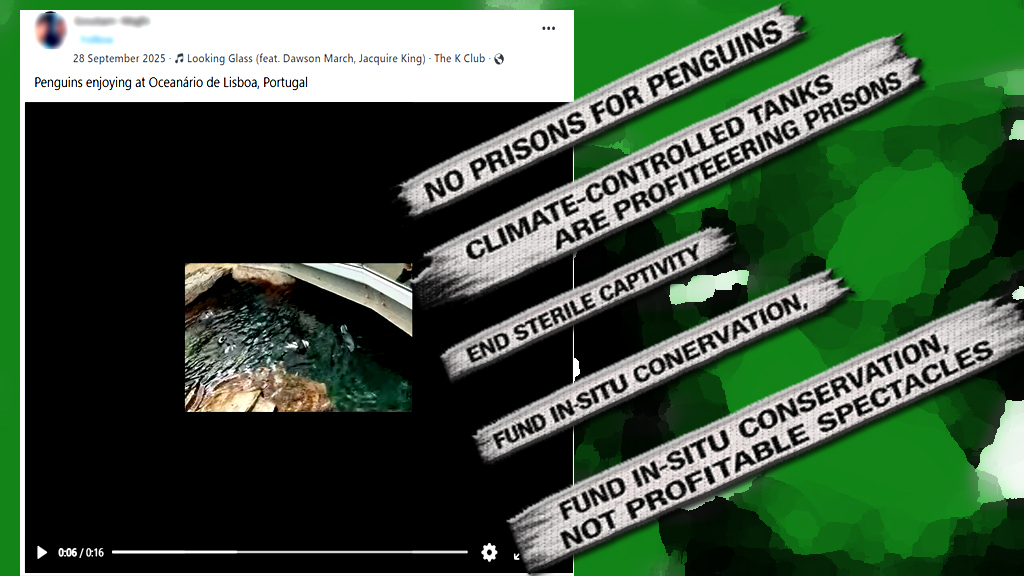
Mention must also be made to the Oceanário de Lisboa (Portugal), frequently hailed as one of Europe’s most advanced aquariums, exemplifies the seductive yet deeply flawed logic of ex-situ conservation through its Humboldt penguin colony housed in climate-controlled tanks that simulate cold-water conditions amid Portugal’s temperate climate. While the facility invests in breeding programmes and claims contributions to species survival assessments, it perpetuates the same biopolitical enclosure critiqued in Vantara: sentient birds adapted to vast ocean upwellings are confined to artificial pools where natural foraging, long-distance swimming, and dynamic social structures are severely restricted, often manifesting in stereotypic behaviours such as repetitive circling or heightened aggression.
Institutionalized and well-funded “environmentalists” and “green” NGOs routinely celebrate such spectacles as educational triumphs and conservation success stories, lending legitimacy to the industry by framing captive breeding and visitor footfall as meaningful contributions to wild populations. The deeper problem lies here: these endorsements obscure the fundamental contradiction that ex-situ displays like Lisbon’s — no less than Vantara’s refrigerated desert enclosures — prioritize spectacle, revenue, and institutional prestige over genuine autonomy, while externalizing the energetic and ethical costs of maintaining polar conditions far from the penguins’ native Humboldt Current. True multispecies justice demands rejecting such curated prisons altogether, redirecting resources toward in-situ habitat protection rather than polishing the architecture of domination.
An example of an “environmentalist” sale-brating such a spectacle in Lisbon and posting a video of the same on Facebook is provided below:
VI. In-Situ Preservationist/Restorative Praxis: The Ethical and Ecological Alternative
True conservation must be relational, embedded, release-oriented, and autonomy-respecting. While the three flagship in-situ models examined here represent a clear ethical and ecological advance over ex-situ captivity, they still fall short of the radical wholeness demanded by systems theory. Even “protected” areas — wildlife sanctuaries, national parks, and forest reserves — function as sanctuarized, fortified, bordered enclosures that treat nature as a static, manageable object rather than a dynamic continuum of flows, feedback loops, and complex wholeness. These gated commons impose artificial boundaries that sever migratory corridors, fragment habitats, disrupt predator-prey relations, and police human–nonhuman relations through militarised enforcement, evictions, and “no-go” zones. They replicate the same biopolitical logic as Vantara’s refrigerated prisons: life is preserved, but only within human-defined cages. Nature is not allowed to flow; it is managed, commodified, and rendered legible for tourism, carbon accounting, or state control.
Peru’s Guano Islands and Islets National Reserve, including the Punta San Juan programme, protects Humboldt penguins through fisheries quotas, community monitoring, seasonal closures, and drone-based health assessments. South Africa’s Table Mountain and Boulders Beach Marine Protected Areas, alongside SANCCOB’s work, employ no-take zones, artificial nests, oil-spill rehabilitation-for-release, and co-management with fishers, delivering measurable chick-survival gains and slowing African penguin decline. Argentina’s Punta Tombo Provincial Reserve maintains long-term monitoring and regulated tourism for Magellanic penguins. These approaches achieve partial ethical coherence by avoiding transport trauma and captivity stress, and they deliver direct population benefits at far lower energetic cost than ex-situ refrigeration in desert heat.
Comparative Table: In-Situ vs. Ex-Situ Penguin Conservation Models
| Aspect | In-Situ (Peru Guano Islands/Punta San Juan, South Africa MPAs/SANCCOB, Argentina Punta Tombo) | Vantara (Jamnagar) | Byculla Zoo (2016 Incident) |
|---|---|---|---|
| Ethical Merit | High: Full behavioural freedom, no transport/captivity stress, respects autonomy and multispecies relations | Mixed: Advanced tech undermined by sourcing opacity, industrial adjacency, serial displacement | Low: Tourism spectacle, quarantine failures, rapid deaths reflect neglect and commodification |
| Ecological Impact | Positive: Strengthens marine food webs, prey recovery, biodiversity; low-carbon adaptive management | Poor: Extreme cooling in 40°C+ heat/drought zone near high-emission refinery; pollution risk | Poor: Tropical heat/humidity mismatch; resource waste; no long-term viability |
| Conservation Value | Direct: Measurable population stabilisation/recovery (15–20% chick survival gains, reduced bycatch) | Indirect: Symbolic “rescue,” limited rewilding data; potential trade stimulus | Negligible: Reputational harm; no population benefit |
| Sustainability | High: Anchored in natural processes, community stewardship; resilient to volatility | Low: Climatically unsuited, resource-intensive, tied to extractivism | Low: Abandoned post-failure; exemplifies unsuitability |
| Broader Critique | Partially aligns regenerative praxis: slightly restores homes-as-habitats | Dynastic spectacle masking sacrifice-zone contradictions | Ethical-ecological collapse of public spectacle |
Yet even these models remain compromised by the bordered-reserve paradigm. They impose fixed perimeters that interrupt natural feedback loops, prevent full trophic restoration, and often displace or criminalise indigenous and artisanal communities who have co-evolved with these ecosystems for centuries. Systems theory reveals the deeper flaw: living systems thrive through open, continuous flows of energy, matter, and information — not through isolated “islands” of managed wilderness. Sanctuarized parks and reserves create ecological islands in a sea of extractivism, producing the very fragmentation they claim to mitigate.
A truly radical in-situ praxis therefore rejects all forms of bordered sanctuarization. It demands decolonized, borderless restoration: community-led commons where human and more-than-human kin/sibling co-flourish without exclusionary fences; rewilding corridors that reconnect entire bioregions; fisheries and land-use regimes governed by indigenous knowledge systems and relational accountability rather than top-down quotas; and the dismantling of the very legal category of “protected area” in favour of living, self-regulating ecosystems. Only when nature is allowed to exist as complex, flowing wholeness — not as caged spectacle or gated commons — can genuine multispecies flourishing emerge.
Ex-situ captivity and bordered in-situ reserves are two sides of the same anthropocentric coin: both deny autonomy and interrupt the regenerative feedback loops that define living systems. True liberation lies in abolishing the enclosure itself.
VII. Life Forms as Refugees: Toward Multispecies Justice
Global capitalism systematically generates ecological refugees by destroying habitats, spreading industrial pollution, and destabilising climates through greenhouse gas emissions. Corporate conservation responses, exemplified by Vantara, do not address these root drivers; instead, they capture and enclose the displaced beings within private fortresses, converting systemic violence into symbolic capital and branded benevolence. Vantara perfectly illustrates this nepo-capitalist pattern: crises manufactured by extractivism are repackaged as compassion, with displaced wildlife serving as living monuments to dynastic prestige.
This mirrors the fate of human climate refugees — millions displaced by rising seas, extreme weather, desertification, and industrial pollution in the Global South — who are similarly warehoused in camps, border detention centres, or precarious urban slums rather than granted the right to return to restored homelands or receive meaningful reparations from the corporations and states responsible for the crisis. In both cases, the same forces that render habitats and territories uninhabitable later manage the resulting “bare life” through fortified enclosures and technocratic control.
Multispecies justice exposes this entangled suffering: the petrochemical emissions that salinise aquifers and poison human communities in sacrifice zones simultaneously shatter elephant matriarchal bonds, fragment penguin colonies, and drive species toward extinction. Animal liberation therefore demands more than prettier prisons or bordered reserves; it requires dismantling the extractivist systems that produce refugees across species lines and regenerating living ecosystems where both human and more-than-human kin can exercise autonomy. While conventional in-situ efforts in Peru, South Africa, and Argentina offer partial restoration by protecting breeding sites and regulating fisheries, true decolonized praxis must go further — rejecting all forms of enclosure in favour of borderless, community-led commons that restore nature as continuous flows and complex wholeness rather than managed islands. Only then can we move from the dark ecology of fortified arks to genuine multispecies flourishing.
VIII. Conclusion: Toward Decolonized, De-Corporatized, Liberatory Eco-Worthy Restoration
Vantara is not conservation; it is ecological aristocracy—a private ark where corporate power stages compassion while the adjacent refinery continues to generate the very ecological refugees it claims to shelter. The spectacle of refrigerated Humboldt penguin in desert heat, alongside transported elephants and relocated leopards, exposes a deeper contradiction: enclosure masquerading as care, captivity rebranded as rescue.
At its core, this is a conflict between enclosure and autonomy. Whether in ex-situ fortresses or bordered reserves, life is preserved only by being controlled—reduced to managed existence rather than lived ecological freedom. Such systems do not resolve displacement; they reorganize it. Refugees, human and more-than-human alike, are removed from damaged habitats and placed into regulated spaces where survival is guaranteed but autonomy is denied.
The alternative lies in shifting from refugees to restoration, from managing life to restoring the conditions that make life possible. This requires confronting extractivism at its roots—ending sacrifice zones, regenerating ecosystems, and returning decision-making power to communities embedded within them. Conservation must move beyond containment toward relational, open, and self-sustaining ecological flows.
Equally, we must move from spectacle to commons. Wildlife cannot remain a site of superrich display, moral branding, or technocratic control. It must be re-situated within democratic, multispecies commons where care is not a performance but a shared ecological practice. This entails dismantling the privatization of conservation and rejecting models that accumulate life as property under the guise of protection.
The choice, then, is stark but unavoidable: between a future of increasingly sophisticated enclosures and one of regenerative freedom. The former perfects survival within limits; the latter restores the conditions for flourishing beyond them.
The question is no longer whether we can preserve life—but whether we are willing to relinquish control so that life can persist beyond us.
ENDNOTE
- Vantara remains strictly inaccessible to the general public, functioning as a closed, invitation-only private preserve rather than a genuine public sanctuary or educational facility; ordinary citizens cannot purchase tickets or visit, with entry restricted exclusively to Ambani family guests, select celebrities, international dignitaries, and high-level political figures. Marketed as the world’s largest rescue centre housing over 150,000 animals, its real utility lies not in broad conservation impact or public outreach but in serving as a gilded dynastic playground and prestige asset: a high-security, opulent collection where rescued animals become living spectacles for elite networking, celebrity photo-ops, and carefully staged displays of compassion, while the recent launch of Vantara University further entrenches it as an internal training ground for the family’s technocratic model of managed wildlife care. This deliberate closure shields the facility from independent scrutiny, crowd-related welfare risks, and public accountability, allowing Reliance to claim monumental humanitarian achievement while externalising the true costs — massive energy consumption for climate-controlled enclosures, proximity to one of India’s highest-emitting refineries, and the broader ecological harm of its extractivist empire — all while generating moral capital, ESG optics, and dynastic branding with virtually no benefit to wild populations or ordinary citizens whose tax incentives and regulatory forbearance help sustain the project. ↩︎
SOURCES
1. Official Reports and Government/Legal Documents
- CITES Secretariat (2025). Report following fact-finding mission to India (15–20 September 2025), including SC79 documents on Vantara imports, due diligence issues, and Appendix-I species. Key document: https://cites.org/sites/default/files/documents/E-SC79-06-03-04.pdf
- Supreme Court of India (2025–2026). SIT report acceptance (September 2025) and dismissal of follow-up petition (March 2026). Summarized in: https://indianexpress.com/article/legal-news/sc-rejects-vantara-animal-imports-plea-sit-findings-10592408/ and https://m.thewire.in/article/environment/ignoring-nuances-in-cites-document-supreme-court-dismisses-petition-seeking-fresh-probe-into-vantaras-wildlife-imports
- Climate TRACE (updated 2025–2026). Emissions data for RPL Jamnagar refinery (revised 19.76 Mt CO₂e in 2022; annual range ~18.78–20.24 Mt). https://climatetrace.org/news/rpl-jamnagar-the-worlds-largest-oil-refinery
2. Investigative Journalism and Media Exposés
- Down To Earth (2024–2025):
- Assam elephant transfers and Pratima case: https://www.downtoearth.org.in/wildlife-biodiversity/dte-impact-assam-based-activist-writes-to-supreme-court-demands-transparency-on-elephant-transfer-to-vantara-96142
- Transport concerns: https://www.downtoearth.org.in/wildlife-biodiversity/an-elephant-cow-and-her-calf-being-transported-from-assam-to-jamnagar-is-once-again-raising-several-questions-95984
- The Wire (October 2025). Exposé on media suppression, fake “Aspire Law Firm,” and digital intimidation: https://m.thewire.in/article/media/bogus-law-firm-and-fake-google-notices-the-murky-online-campaign-to-suppress-stories-on-vantara
- Mongabay India (2025). Coverage of CITES vs. Supreme Court contradictions: https://india.mongabay.com/2025/11/global-biodiversity-assessment-counters-supreme-courts-clean-chit-to-vantara/
- PETA India (2025). Mahadevi/Madhuri elephant relocation: https://www.petaindia.com/blog/the-full-mahadevi-madhuri-story-from-chains-to-rescue/
- BBC (2016, with follow-ups). Byculla Zoo Humboldt penguin “Dory” death: https://www.bbc.com/news/world-asia-india-37819995
- The Hindu / Frontline (2025). Kolhapur Mahadevi protests and cultural issues: https://frontline.thehindu.com/news/elephant-relocation-peta-vantara-kolhapur-protest-jain-maharashtra/article69913445.ece
3. Penguin Conservation and Ex-Situ Cases
- Byculla Zoo incidents (2016–2018): Additional context at https://india.mongabay.com/2018/09/death-of-penguin-chick-in-mumbai-zoo-rekindles-controversy/
4. Corporate, Dynastic, and Environmental Justice Context
- Ambani–Piramal nexus and Campa Cola water footprint critique: https://akharbandyo.wordpress.com/2025/10/24/dynastic-capitalism-and-ecological-externalities-the-ambani-piramal-nexus-in-post-liberalization-india/ (detailed discussion of 3–4 liters water per liter beverage and effluent issues).
- Reliance Jamnagar operations and SEZ context: Environmental Justice Atlas entries (searchable at https://ejatlas.org/) and general Reliance sustainability pages (e.g., net-zero claims at https://www.ril.com/businesses/new-energy-materials).

