Posted on 23rd November, 2026 (GMT 04:50 hrs)
Curated by
Authored by
Why Moneyless, after all?
“Production without possession, action without self-assertion, development without domination: this is the mysterious virtue.”
The words arrive from the Tao Te Ching, chapter 10, and they arrive as a measure that does not measure. They name a way of moving that leaves no claim behind it. What is made is not held. What is done does not announce the doer. What grows does not subordinate what it grows among. The virtue is mysterious because it cannot be stored, displayed, or converted into a right. It exists only in the doing and in the letting-go that follows the doing. Tolstoy asked the same question in another register: how much land does a person need? In the story a man runs until sunset to claim all he can, and the land he needs is the length of his own grave. The desire that must enlarge itself meets the limit that does not. This manifesto asks what it would mean to move the other way with the four things that sustain a life: land, language, labour and care.
In April 1696 Isaac Newton, long troubled by nervous disorder, received a new charge. The King appointed him Warden of the Royal Mint. His task was to fix the ratio between the coin and the mineral ores—gold and silver—and to present the proportion at court. The salary was sixteen times his professorial wage. The natural philosopher who had calculated the motion of the planets was now asked to bind the market by the same laws that bound the heavens. The British crown trusted that a man devoted to alchemy and natural law could authorise the human invention called the market, detect counterfeit notes, and make the equation of money and metal appear as nature itself. Newton later confessed he could calculate the motion of heavenly bodies but not the madness of men. He had speculated in shares, doubled his stake, and then lost. The proportion he was ordered to establish never belonged to the order of the planets. It was a convention that had already decided what would count as equal.
Marx began where that convention failed. He took the authorised equation and set out to dismantle it: money is not a natural measure but a social-structural relation that makes unequal things appear equal, a null signifier whose only content is command. The moneyless commons continues the same labour. It spends the authorised zero once into use so that the convention which equates the unequal, and the structure that requires the equation, may finally fall.
We live inside a different measure. A slip of paper or metal passes from hand to hand and, by that passage, decides what may continue and what must stop. The slip itself is nothing. Its force is a relation, a structure, a system that makes unequal things appear equal. An ice cream priced at ten rupees is not the same thing as the ten rupees; the note equates them by command, not by nature. Money is a null signifier: a pure zero whose only content is the power to set the unequal side by side and to declare the equation binding. Fields are fenced because a title has been recorded. Speech is ranked because a standard has been set. Care is rendered invisible because no invoice was issued. Ownership follows the same path: a chain of justifications that never reaches a first ground, only a first seizure. The paper is arbitrary. Its thing-ness is an appearance. The manifesto begins here, not outside the paper but with the paper still in the hand, and asks what it would mean to spend the paper so that the need for it grows smaller.
The direction is therefore simple and difficult. Land is released from sale into use. Language is released from ranking into speech. Labour is released from the wage into the shared task. Care is released from the ledger into presence. Money is not reformed. It is spent once into what will never need to be bought again, and then it is not allowed to return. The circuit that enlarges itself is interrupted and left to fall. No unit attempts this alone. The costs that remain at the edge—the tax, the stamp, the toll—are carried together so that each can touch money less. The text gathers what already lives without price, names what died when it was isolated or imposed from above, and sets locks so that title, wage and surplus cannot re-enter under another name. The earth has begun to answer the measure that knows no limit. The work is to hand on what was received, improved and unowned. Money is the ladder used and then kicked away. The question stays open, as the virtue itself stays open: where is it written?
ABSTRACT
The Moneyless Commons manifesto declares war on two ruling fictions—that money is a neutral measure of value and that ownership is a natural right—arguing instead that money is a null signifier and state-enforced command (a pure zero that equates the unequal and must accumulate without limit) while every title is a regress that ends in seizure. It advances a federation of commons in which land, language, labour and care are held in use rather than title, necessities move as gifts rather than purchases, and money is spent once into irreversible use so that the need for it declines (entering only as ransom, tool or bridge, never returning, with frontier costs pooled). Drawing on Raghunātha’s definition of ownership as gained by receiving and lost by giving, Marx’s circuits and primitive accumulation, Mauss and Derrida on the gift, and living proofs from langar, halma, organopónicos, Zapatista non-property and repair networks, the text overturns thirteen dogmas of mainstream economics, replaces the genitive of price with the dative of the gift, and sets concrete locks—inalienable trusts, usufruct, declining treasuries, public ledgers, open-licence speech—so that what was made by force can be unmade by direction: refuse the price, release the land, free the tongue, give the labour, and federate.
Preface: The Paradox We Refuse to “Purify”
We begin inside the paradox this manifesto refuses to purify.
We need money to build the world that will need less of it.
The words that refuse the price are themselves paid for. The paper that indicts the note still circulates by means of the note. This is not hypocrisy. It is the raft: Wittgenstein’s ladder is kicked away only after the climb, and the Buddha’s raft is left on the far bank only after the crossing. The force of the text lies in its insistence that the instrument be used in one direction only. Every rupee is to be spent so that it never needs to be spent again. The ledger must fall. Capital’s circuit (M → C → M′…)—money (M) advanced to buy commodities (C) that return as more money (M′)—is interrupted and replaced by the commons’ circuit (M → L ⇒ U): money (M) spent once on a means of life (L), which then passes into use (U) and never returns to the market as exchange value. Counter-accumulation is not the reverse of primitive accumulation so much as its deliberate unmaking: money used once to reunite producers with land and tools, then allowed to die rather than to begin a new circuit of enlargement.
Money does not merely stand between people. It remakes the bond. Where kinship, neighbourhood or shared-collective work once mediated need, the cash payment now does. The family relation itself is rewritten: the parent who must earn, the child whose care is measured in lost wages, the household that meets as buyers of what it once made. This is alienation in Marx’s precise sense—the separation of producers from their means of life, and of people from one another, so that their connection appears only as a relation between inert things. Money is the form of that appearance. It is also false consciousness: the lived sense that the note is natural, that the wage is the only way labour can meet need, that the market is the community. The stranger’s labour reaches the table only because money has already equated what is unequal; the equation is taken for the thing itself. To abolish money is therefore not to abolish exchange of use, but to abolish the relation that makes every other relation pass through the null signifier. The commons begins by weaving a different thread so that this one can fray.
That is why this manifesto paradoxically begins with money, not against it. Part One states plainly that we cannot yet do without money. Parts Two and Three follow the rupee to the frontier where it is taken from us: the purchase price, the tax, the stamp duty, the bribe, and, in Bengal, the tolā, the levy collected by the party’s syndicate and the police. Only after the reader has seen where money is still unavoidable do we turn to indict it.
At the centre of the indictment stands a double emptiness. Money is the null signifier, the pure zero whose only content is the power to command other signs and to make the unequal equal. Ownership is a regress that ends in seizure. The Navya-Nyāya philosopher Raghunātha‘s question, “Where is it written that I may not eat another’s rice?”, exposes the circularity: neither use nor scripture can ground svatva (own-ness) without already assuming it. The stopping point is historical and violent: the Permanent Settlement, the fence, the decree. Amartya Sen’s “etc.” in discussing entitlement is revealed as ityādi, the end placed at the supposed “origin”. From this the text draws its sharpest grammatical turn: not “this is mine” but “this is given to me, to be given on”.
The genitive of price is to be replaced by the dative of the gift economy.
The four Ls, land, language, labour and love (care), are not to be redistributed as titles but withdrawn from the circuit of price. Language is treated as the second land; its enclosure is as violent and as hidden as the first. The price of speaking is named and then released under open licence so that no one pays twice. Only parāvāk, speech beyond speech, is wholly without owner. The manifesto turns toward niḥsvatva, emptiness of possession, without claiming to arrive there. Each clause of the Moneyless Charter removes one more thing from the category of the owned.
This manifesto also places a burning focus at its centre: the burning earth. The climate crises, and the wider polycrisis of which it is part, is the place where money’s emptiness becomes lethal. A sign-ifier that can grow without limit is set loose on a planet that cannot. Seven of the nine planetary boundaries have been crossed; the richest one per cent burn as much carbon (and other greenhouse gases) as five billion people; the market’s remedy is to sell the sky by the tonne. Part Six argues that a moneyless commons is not a lifestyle but a radical climate-ecological policy, the only one that does not ask the earth to pay interest, and doesn’t treat the natural world as an abundant “free gift” or standing reserve.
What keeps the argument from pure negation is the record it gathers and the programme it sets. The world already lives the refusal: the langar, the Bhil halma, Cuba’s organopónicos, Zapatista non-property, the Kerala fishermen who refused gold for the lives they saved, the mutual aid centres of Puerto Rico, repair cafés, freecyclers, the Tiwa barter fair. These are not utopias but proofs that use without title can feed, that unwaged labour is the floor beneath the waged economy, that the gift works at scale when it has a body. Against them stand the warnings: the potlatch ban, the Khmer Rouge, the drift of the kibbutz and Auroville back into accounts, the capture of hospitality into companies, the privatisation of Mexico’s ejidos. Moneylessness imposed from above is a prison; moneylessness that remains isolated dies. Hence the insistence on federation: no commons is moneyless alone.
The two published measures, a falling money-dependency ratio and a rising frontier ratio over a falling total, are the text’s own instruments of self-scrutiny. When the ledger stops falling, the programme has stalled. When a wage appears and a surplus is kept by title, the red light is on: the commons has begun to sprout an employer. The Bengal front keeps the argument from floating. The state already contains moneyless land as a contradiction within itself: the patta that cannot be sold, community forest rights that remain inalienable, the grāmdān that dissolved private title into the village. The urgent task is not only to buy and release land into irrevocable trust, but to defend the inalienability that already exists, and to counter-map customary use before the survey re-reads the common pond as encroachment.
In the end the manifesto offers neither blueprint nor pure finality. It offers a direction and a set of locks against the mirror. By moneyless commons it means nothing mystical and nothing merely a stock of resources. A commons is any durable arrangement in which land, language, labour and care are held in use rather than in title, in which the necessities of life move as gifts rather than purchases, and in which money, when it must still enter, is spent once so that the need for it declines. It is commoning as a verb—the ongoing relation of use, gift and release—rather than a thing that can be owned or managed from outside. It is the practical name for the shift from the genitive of price to the dative of the gift, secured by inalienable form and by federation so that no single unit is left to face the tax, the stamp duty or the tolā alone.
What the manifesto does is therefore limited and precise. It indicts two ruling fictions—money as neutral measure and ownership as natural right—and replaces them with a programme of counter-accumulation: ransom what has been enclosed, release it beyond resale, federate the frontier costs, and publish the falling ledger. It points the finger at the circuits that demand ΔM > 0, at the title that ends in seizure, at the wage that reappears inside the commons, and at every gift that binds rather than frees. It does not claim to abolish the state, to design the whole economy, or to settle every question of scale, kinship or technique. Those are left open. What it refuses to leave open is the direction: every rupee spent so that it never needs to be spent again, every title frozen or dissolved into use, every increase returned to the earth.
We are bricoleurs, not blueprint engineers. Like Diogenes we deface the coinage of our time and tell the sovereign to stand out of our light; like Sisyphus we push though full emancipation may never arrive. The thirteen dogmas of mainstream economics are overturned not by counter-theory alone but by the concrete mechanisms already named: inalienable trusts, usufruct, declining treasuries, public ledgers of unpaid care, open-licence speech, and a commons that returns its increase to the soil. The paradox is not escaped. It is spent down.
The earth and its languages have no owners, only temporary occupants, tenants and stewards, bound to hand them on improved. Raghunātha‘s question remains open for every generation, every deed, every price, every rule of grammar: By which scripture? Where is it written?
Opening Declaration
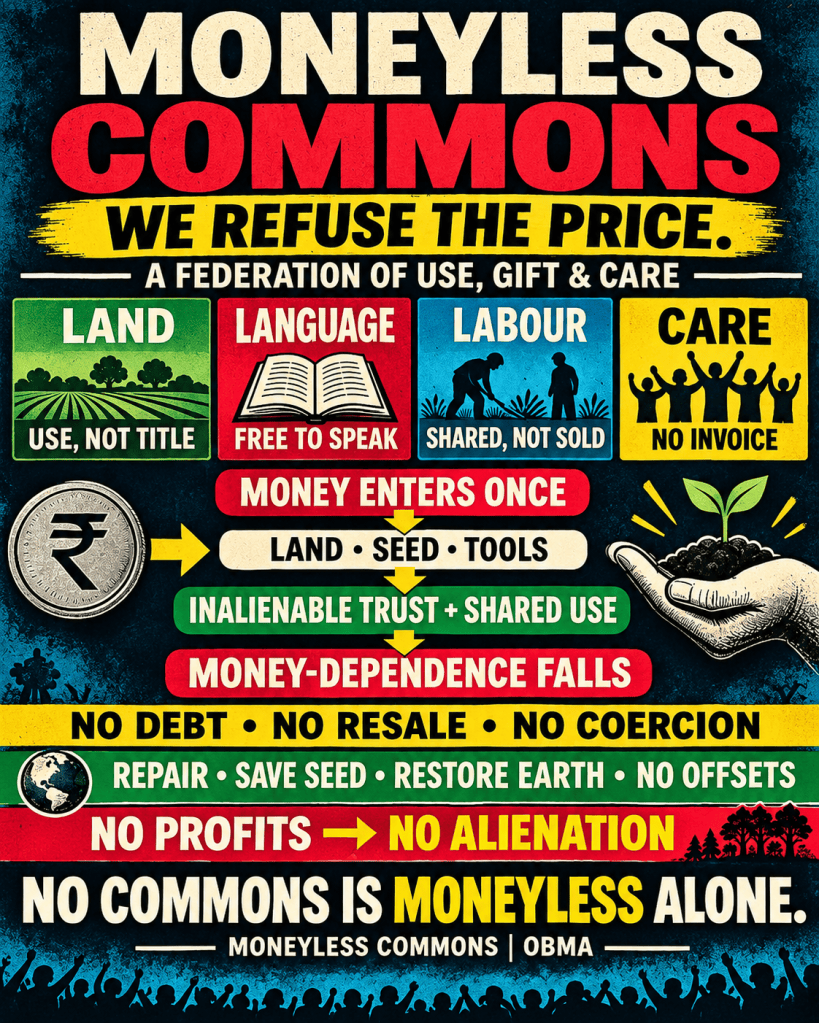
We refuse the price.
We, the Moneyless Commons, a branch of Once in a Blue Moon Academia (OBMA), declare war on two fictions that rule the earth: that money is a neutral measure of value, and that anything on this planet, its soil, its seed, its rivers, its air, its words, its time, can belong to some-one as some-thing.
We do not ask for a “fairer”, “better” or “just” price. We ask why there is a price to anything at all.
The mainstream economists, or rather the fiscal auditors of the existing order, say money is a veil over real exchange, a lubricant, a convenience. We say money is a command. A ten-rupee note is a slip of paper with a promise printed on it, and the promise is enforced by police, courts, tax collectors and hunger. Money does not measure the world. It orders the world to be measured. And whatever cannot be measured, a mother’s night awake, a forest’s breath, a grandmother’s song, a neighbour’s help with the roof, a mangrove that breaks a cyclone before it reaches the city, is declared worthless and then quietly taken away.
The fiscal auditors say ownership is natural, older than law. We say every title deed on earth, followed back far enough, ends in a seizure. Before the first sale there was a first taking. The deed only hides the fist.
We are not merely utopians. We do not pretend to stand outside money altogether. We live inside it, as you do. We are paid for our words; we pay rent on our rooms; we pay tax on our gifts; in Bengal we have watched neighbours pay a levy to a party’s syndicate merely to repair a roof. We know the paradox and we name it first, before our enemies can: we need money to build a world without money. We answer it not by purity but by direction. Every rupee we touch will be spent so that it never needs to be spent again. Money enters the commons once and does not return. We spend it down to zero.
We, across OBMA, take no money from corporations and none from political parties. We are partyless and anti-capitalist by conviction, not by neutrality. We publish everything under Creative Commons BY 4.0, so that no one pays twice for what we say.
We write in a year when the earth itself has begun to present its bill. Seven of the nine planetary boundaries that keep the planet habitable have been crossed. The money-form that knows no limit is consuming a world that has nothing but limits. A moneyless commons is no longer a dream of the far future; it is the shape that survival is already taking, in every flooded village where neighbours row each other to safety and send no invoice.
We speak to Kolkata and to Kingston, to Jhabua and to Chiapas, to the seed-saver in Uttarakhand, the fisher in the Sundarbans and the repair volunteer in Amsterdam. We write in English so the world can argue with us, and we carry our own languages into it so the world remembers that English is merely one tongue among lakhs.
Money is not a measuring rod. Money is an arbitrary command.
The earth is no one’s absolute estate.
Money cannot be eaten.
This manifesto has one chief argument, carried through thirteen parts. Money is a sign that pretends to be a thing. Ownership is a seizure that pretends to be a right. Both can be undone, because both were made. The world already proves it: in Cuba’s urban gardens, in the Zapatista hills, in the Bhil halma, in the Sikh langar, in the Tiwa barter fair, in some four thousand repair cafés, in eleven million freecyclers, in the boats of Kerala’s fishermen, in every kitchen where someone cooks for someone else and sends no bill. We begin with the money we cannot yet refuse, follow it to the frontier where it is taken, indict it, gather the proof against it, draw its law, and set out the programme.
Aim, Purpose, Goals, Motives
A manifesto that does not say what it wants is a mood. We say what we want.
Aim. A federation of commons in which land, seed, water, tools, knowledge and language are held in use, not in title, and in which the necessities of life move as gifts, not as purchases. In that federation money as exchange value falls toward zero inside, and survives only at the frontier, where the commons still touches the state and the market. We want, in the old formula of the free association of producers, a world in which each gives according to ability and receives according to need, without a price standing between the giving and the receiving.
Purpose. To prove, by building, that the two pillars of mainstream economics, money as neutral measure and property as natural right, are made things, and that what is made can be unmade. To prove, at the same time, that unmaking them is not a luxury of armchair philosophers but a condition of living on a planet whose limits money refuses to see.
Goals. We commit to eight, each one verifiable.
- Decommodify the four Ls. Take land, language, labour and love (care) out of the circuit of price, one plot, one class, one kitchen, one clinic at a time.
- Spend money down. Run every commons on a declining treasury: no debt, no interest, no reserve that grows, no profits made. The ledger must fall year on year.
- Turn title into use. Convert every purchase into a release: land bought from a title-holder is placed in an inalienable trust and given to its users in usufruct, never resold.
- Free speech from its price. Release every word we write and teach under an open licence; teach every mother tongue and sign language free of charge.
- Make the gift the norm and the sale the exception. Within the commons, nothing necessary to life may be sold to a member.
- Federate. No commons is moneyless alone. We link commons into networks that cover one another’s frontier costs, so that each one can spend less.
- Count what money cannot see. Keep public ledgers of shadow care, gifts, repairs and shared labour, and set them against the ledgers of the GDP fetish and “developmentalism” consumerist paradigm.
- Cool the earth by decommodifying it. Every repair, every shared tool, every saved seed, every meal cooked from the commons’ own soil is extraction refused. We commit to returning a share of every increase to soil, water and forest, and to measuring our success by what we no longer buy, burn or ship.
Motives. We are moved by four things. By anger: at a world where food rots in warehouses while people starve, because, as famine studies have long shown, hunger is a failure of access, not of supply; and at a world where the richest burn the planet and bill the poor for the smoke. By evidence: everywhere people already live by gift, care, mutual labour and shared use, and the economy rests on that unpaid floor. By fear made into courage: the cyclone, the heatwave and the flood do not read title deeds, and when they come the market leaves first and the neighbour stays. And by love of the earth: no one made the soil, so no one can own it; we are, at most, its tenants, bound to return it in better shape than we received it.
Pattern of action. Refuse, release, rebuild, federate through decentralisation. We refuse the price where we can. Where we cannot, we pay it once and release what we bought. We rebuild the use-relation in its place. And we federate, so that each commons needs less money than the last. We do not wait for the state to wither or for capital to collapse. We build the new society in the shell of the old, and we let the shell crack where it will.
Part One. We Cannot Do Without Money (Yet)
We put this part first because a manifesto that hides its own dependence on money is lying, and a lie at the foundation poisons every floor above it. Before we indict money, we confess it.
1.1 We Need Money to Abolish Money
We begin in a world already enclosed. Land, seed, tools, shelter, the legal shell a commons must wear, the tax and stamp duty the state demands at every border, and the unofficial levy the local strongman demands at every gate: all cost money. The way out passes through the gate we want to leave. Money is needed for the passage because the commons were taken through money.
There is a deeper reason. Under capital-relations, money is not one institution among others. It has structurally-systematically supplemented the community itself. Where people once met as kin, neighbours or co-workers of a field, they now meet as buyers and sellers, and the bond between them is the cash payment. Money is the thread by which a stranger’s labour reaches my table. To cut that thread before another is woven is to starve. So we do not cut it. We weave the other thread first, and we let money’s thread fray as the new one takes the weight.
1.2 The Lineage of the Paradox
The paradox has an honourable lineage, and we claim all of it.
- Wittgenstein’s ladder (Tractatus, 6.54): one climbs it and throws it away. Money is legitimate only if it is kicked away once used.
- The Buddha’s raft: carry it across the river, then leave it on the far bank. Do not carry the raft on your head.
- Marx’s birthmarks: the first phase of the new society still bears the marks of the old. Marx proposed labour certificates that record work but do not circulate or breed, so they are not capital.
- Owen’s labour notes: in 1832 Robert Owen’s National Equitable Labour Exchange in London issued notes denominated in hours of labour. They failed because they still circulated among private producers selling to one another. The lesson: a reformed money inside a market of owners becomes money again.
- Proudhon’s people’s bank: the French mutualist dreamed of free credit to dissolve the power of interest. The dream taught us the opposite of what it intended: you cannot abolish the power of money by making money cheaper.
- Derrida’s pharmakon: the same drug is poison and cure. The dose and direction decide which.
- Polanyi’s fictitious commodities: land, labour and money were never made to be sold. Re-commoning uses the third to decommodify the first two, and then decommodifies the third.
- Ramakṛṣṇa‘s river: the saint of Dakṣiṇeśvar held a coin in one hand and a clod of earth in the other, repeated ṭākā māṭi, māṭi ṭākā (“money is clay, clay is money”) and threw both into the Ganga. We honour the gesture and we cannot repeat it. The renouncer can throw money away; a commons that must ransom land from a title-holder cannot. Our river is slower: we throw each rupee away by spending it once, irreversibly, into use.
- Neti, neti, “not this, not this”: a negation must pass through what it negates.
Raghunātha Śiromaṇi already gave us the key. Ownership is defined at the moment it is given away. To give up ownership, one must first hold; to give up money, one must first spend it. The question is never whether to touch money, but in which direction it moves.
1.3 Two Antithetical Stands of Ownership
Money and ownership stand or fall together. The null signifier needs a subject who can say “mine”; the title needs a command that can force the unequal into equivalence.
Primitive accumulation is ownership as separation: it divides producers from land and tools, so that they must sell their labour-power to live. Its methods, Marx wrote, were conquest, enslavement, robbery and murder, written in the annals of humankind in letters of blood and fire, and continued through enclosure, colonial tribute, the public debt and the tax.
Counter-accumulation is the same process run backwards: it gathers money only to reunite producers with land and tools, and then lets the money die. It does not expropriate the expropriators by decree; it buys back, releases, and federates, until there is nothing left for the expropriators to rent.
Capital’s circuit is M → C → M′: money advanced to return enlarged. The commons’ circuit is M → L ⇒ U: money spent once on a means of life, which then passes into use (U) and never returns to the market. The arrow does not loop.
1.4 Where is ΔM? Money, the Commodity, and the Missing Nature Variable
Money is not a neutral medium. In the Grundrisse Marx already shows it as the community that replaces every earlier community: once the direct ties of kinship, commons and customary use are broken, strangers meet only through the cash payment. Money becomes the real community. In Capital this is sharpened. The commodity form makes qualitatively different labours appear as quantities of one abstract substance; money is the form in which that abstraction walks about—the general equivalent, the one commodity expelled from the world of commodities so that it can stand for all of them. Its secret is fetishism: a definite social relation between people takes on the fantastic form of a relation between things. What looks like a convenient instrument is the relation of command hardened into an object.
The circuits make the command visible. Simple circulation runs C – M – C: a commodity is sold for money only in order to buy another commodity for use. Capital inverts the sequence. It runs M – C – M′: money is thrown into circulation in order to return enlarged. The expanded circuit names what is consumed: M – C (LP + MP) … P … C′ – M′. Labour-power and means of production enter production; a new commodity emerges; it is sold for more money. At every point nature is treated as free. Neoclassical fiscal auditors masquerading as economists give it no variable. They write models in which soil, water, atmosphere and living systems are either infinite or simply absent. Call this suppressed term N, the nature variable. Capital’s requirement that ΔM = M′ − M > 0 is at the same time a requirement that N remain unpaid.
In capital’s ledger the increment ΔM is nothing but s, surplus value—the labour performed beyond what the wage repays. Its rate is s/v, surplus labour over the variable capital (socially necessary labour) paid and weighed as wages.
Primitive accumulation is the historical precondition: producers are separated-alienated from land and tools so that a wage can appear and N can be appropriated without equivalent. Only then does the gap between what labour makes and what labour is paid become systematic.
Counter-accumulation removes the terms rather than reversing them. In the commons there is no wage, so v = 0. No title-holder appropriates a surplus, so s = 0. The rate s/v becomes 0/0—not a small number but a meaningless one. Exploitation has no ground left to stand on. And ΔM? Capital demands ΔM > 0. The commons designs the opposite: money enters once and is spent down, so ΔM = −M. The ledger is built to fall. A commons whose treasury grows has already begun to turn back into capital.
s/v as a warning light. The moment a wage reappears inside the commons (v > 0) and someone retains a surplus by title (s > 0), the red light is on. The ratio becomes meaningful again. An employer has sprouted.
The only permitted increment. A commons may grow richer only in what no person can pocket: soil carbon, seed diversity, groundwater, mangrove and forest cover, skills shared, languages kept alive. This is the dative increment—N returned rather than extracted, increase given to the earth and to those not yet born. Where capital writes nature as an externality outside every circuit, the commons writes N back in as the sole positive term. Money, the commodity that pretends to be the community, is used once to restore what it destroyed and is then allowed to die. That is the anarchistic content of the falling ledger: not the management of money, but the organised refusal of its return.
1.5 Four Kinds of Money, Four Grammatical Cases
Money in the transition is not one thing. It is spent for four purposes, each with its own moral status and its own grammar. The four monies are already written in the grammar of transfer. Each is assigned a Sanskrit case (kāraka, a role in the action) so that the direction of the rupee can be read as a relation rather than a neutral medium. The price, as this manifesto insists, speaks in the genitive (ṣaṣṭhī): kasya? whose is it? The gift speaks in the dative (caturthī): kasmai? to whom is it given? The whole scheme is an attempt to move money out of the genitive of ownership and into the other cases of release, use, mediation and address.
Ransom money is ablative (pañcamī, “from”). In the kāraka system the ablative (apādāna) is the fixed point from which something is separated. Here the separation is deliberate and terminal: the rupee is spent from the title-holder in order to free the land, seed or tool from the circuit of sale. Once the enclosure is bought back and placed in irrevocable trust, the ablative relation collapses. There is no further “from” to be extracted. The money falls to zero because its grammatical function, separation from the owner, has been completed. It is the case of counter-accumulation: the same instrument that once performed primitive accumulation (the taking) is used once, in the opposite direction, and then discarded.
Tool money is instrumental (tṛtīyā, “by means of”). The instrumental kāraka (karaṇa) names the means that accomplishes an action without becoming its object or its agent. Pumps, cable, medicine, the legal shell: these are bought only because the commons cannot yet make or share them. The rupee works as pure instrument. As soon as the capacity is internalised (repair, seed-saving, shared fabrication), the instrumental relation is no longer needed. The money falls because the means have been absorbed into the body of the commons. It is the case of the temporary prosthesis: used, then withdrawn, never allowed to become a permanent organ of capital.
Bridge money is locative (saptamī, “between”, “in the place of”). The locative (adhikaraṇa) marks a site or an interval. Timebank hours, decaying scrip and labour credits exist only in the gap between the still-necessary market and the not-yet-sufficient gift. They measure without breeding; they occupy the space between two economies. When the gift can carry the load, the locative is retired and the bridge is burned. The locative is never allowed to harden into a new genitive. It remains a temporary site, never a possession.
Frontier money is dative (caturthī, “to”). This is the decisive alignment. In Sanskrit grammar the dative of the gift is the sampradāna kāraka, the recipient who is the terminus of dāna. The manifesto places the state in precisely this position: tax, stamp duty, registration and court fees are paid to the sovereign as the unavoidable recipient. Yet the payment is not pratigraha in the priestly sense, the acceptance that seals rank and debt. It is a frontier payment that the federation makes collectively, so that no single commons is forced into permanent relation with the state. The dative here creates no bond of obligation between members; it is the external address that allows internal relations to remain free of price. Because the state still demands coin, this dative cannot fall to zero. It can only be shared and reduced. The federation is the grammatical subject that performs the payment so that each commons may speak, inside its own boundary, in the pure dative of the gift without return.
The tolā, the extortion levy we meet in Part Three, is the grammar’s monstrous fifth case: a dative to no lawful recipient, a toll paid to whoever holds the gate. It has no place in the table below, because the commons refuses it altogether.
| Kind | Case (kāraka) | Function | What it does | Fate |
|---|---|---|---|---|
| Ransom money | Ablative, “from” | Point of separation | Buys land, seed or tools from a title-holder to free them from sale | Falls to zero once the enclosure is bought back, placed in trust and given in usufruct |
| Tool money | Instrumental, “by means of” | Temporary prosthesis | Buys what the commons cannot yet make or share | Falls as capacity is internalised by repair, fabrication and sharing |
| Bridge money | Locative, “between” | Interval without possession | Time credits, labour credits, decaying scrip between market and gift | Retired when the gift can carry the load; never hardens into a new genitive |
| Frontier money | Dative, “to” | External address | Tax, stamp duty, registration and court fees paid to the state, collectively | Never zero while the state demands coin; shared across the federation and reduced year on year |
Thus the four cases form a single movement away from the genitive. The ablative separates, the instrumental equips, the locative mediates, the dative addresses. Only the last remains, and only at the edge. Inside the commons the dominant case is meant to be the sampradāna of the gift that leaves no debt, no name, no rank: what is received is held in use and passed on. The table is not a taxonomy of currencies. It is a conjugation of money into the grammar of release.
The first three can fall to zero. The fourth cannot while the state exists as it does. Therefore moneylessness is a property of a federation, not of a single commune. One commons alone will always face the tax collector. Many commons together can pool their frontier costs, so that money touches each one only at the edge, and less every year.
1.6 The Rule of Self-Cancelling Expenditure
Money may be spent towards a moneyless commons only if each expenditure reduces the need for future expenditure. A rupee that buys land and releases it to users removes rent forever. A rupee that buys a seed bank removes the seed bill forever. A rupee that pays a salary to run the commons creates a wage forever. The first two are counter-accumulation. The third is a warning light.
1.7 The Three Steps of Release
Because buying ratifies the seller’s title, purchase alone is not enough. Every purchase must be completed by two further acts.
- Buy the land, building or seed stock, once, at the lowest price the frontier allows.
- Place it in trust, inalienable: no sale, no mortgage, no division, forever.
- Give it in usufruct to those who work it: the right to use and enjoy the fruits, with the duty to hand it on improved.
That is how ransom becomes release, and how the genitive (whose?) becomes the dative (to whom?).
Transition. If money must still be spent, we must know exactly where it goes, who takes it, and by what right. The next two parts follow the rupee to the frontier: first across the world, then into the villages and building sites of West Bengal.
Part Two. The Frontier: Where Money Is Taken, Across the World
Every commons, in every country, meets the same four collectors at its border. We name them so that a reader in Nairobi, Glasgow, São Paulo or Kolkata can recognise them in their own street.
| Collector | What it takes | By what right | Where the commons meets it |
|---|---|---|---|
| The price | The purchase price of land, buildings, seed and tools | Title, which every sale ratifies | Ransom money (Part One, 1.5) |
| The tax | Land revenue, income tax, sales tax | The sovereign’s claim to a share of every crossing | Frontier money |
| The toll | Stamp duty, registration, licence and court fees | The state’s monopoly on recording title | Frontier money |
| The tribute | Bribe, protection money, the party’s levy | No right at all: the power to block the gate | Refused (Part Three, 3.7) |
2.1 The Tax That Made the Wage
Mainstream textbooks treat tax as a deduction from income that already exists. History shows the opposite: the demand for tax in coin is how money and wage labour were forced into being.
In colonial Africa the instrument had a name: the hut tax. Levied per dwelling, it could be paid in money, labour, grain or stock, and it served the colonial authorities by raising revenue, by making their currency indispensable and by driving rural households to send members to work in towns, mines and railway gangs to earn the coin. In Sierra Leone, Governor Frederic Cardew imposed it from 1 January 1898; it was beyond the means of many inhabitants, it taxed even unoccupied dwellings, and it provoked the Hut Tax War led by the Temne chief Bai Bureh. The tax receipt was money’s birth certificate, and the wage was its first child.
Bengal had already been through the same school. The Permanent Settlement of 1793 fixed the land revenue in money and made the zamīndār its collector and owner; a peasant who could not pay in coin lost his land to one who could. And India knows the counter-tradition too. In 1930 Gandhi walked to Dandi to make salt from the sea against the salt tax, and an empire learned that a tax refused by millions is a law that no longer runs. Before him, in 1846, Henry David Thoreau spent a night in a Massachusetts jail for refusing a poll tax that funded slavery and war, and wrote Civil Disobedience.
The lesson for the commons is double. The state’s demand for coin is what keeps a moneyless community tied to the market; therefore the frontier is fought collectively and pooled across the federation. And the tax is not a law of nature but a relation of power; the history of refusal is ours, and we keep it ready.
2.2 The Price of Land: Rent Capitalised, the Earth on Auction
Land has no value, because no labour made it. Its price is capitalised rent: the yearly tribute a title-holder can extract, divided by the rate of interest (P = R ÷ i). When interest falls, the price of land rises, though not a single grain more grows on it. That is why the commons’ first purchase is always the most painful: it pays the seller, in one lump, for every year of rent he will no longer collect.
Henry George saw this in Progress and Poverty (1879): progress raises rent, and rent swallows progress. His answer was a single tax on land values, so that the community would collect the rent its own growth creates. We honour his diagnosis and go further: a tax on rent still leaves the title in place; we want the title dissolved into use.
The global land market has never been hungrier. Since the food, fuel and financial crises of 2007–08, investors have rushed for farmland in the Global South. By 2020 the Land Matrix had recorded 1,865 large-scale deals since 2000, covering 33 million hectares, an area the size of Italy. A new frontier has opened in the name of the climate: by 2025 the same monitors counted 183 concluded land deals for carbon-offset projects, covering about 8.8 million hectares, the size of Austria. Enclosure now arrives wearing green.
2.3 The Bribe: the Informal Sovereign
Wherever there is a gate, someone stands at it with an open palm. In Sicily it is called the pizzo, protection money; in 2004 the young people of Palermo answered it with Addiopizzo, a consumer movement of shops that publicly refuse to pay. In land registries across the world, a fee for speed or a fee for silence is the hidden price of every title. The bribe is the purest form of the money-command: a tax levied by no law, payable to whoever can block the road. In Bengal, as Part Three shows, it has a party colour, a sound and a name.
2.4 The Legal Shells the World Has Built
Against these collectors, communities on every continent have invented forms that let land be held without being sold. Each teaches a lesson for our own design.
- The community land trust, born in the Black freedom movement. In 1969, near Albany, Georgia, leaders of the civil rights movement, among them Slater King, Charles and Shirley Sherrod, founded New Communities Inc., “a nonprofit organization to hold land in perpetual trust for the permanent use of rural communities”. They had studied village land-gift movements in India and the kibbutzim in Israel. On some 5,700 acres, it became the largest Black-owned farm cooperative in the United States. Racist lending by the Farmers Home Administration helped drive it to bankruptcy in 1985; decades later the farmers won a discrimination settlement and rebuilt on new land. The form spread: there are now hundreds of community land trusts. The lesson: perpetuity in law is necessary, and not sufficient, while credit and the state can strangle the land from outside.
- Germany’s Mietshäuser Syndikat (Apartment-House Syndicate). Born of the squatters’ movement in Freiburg, it now links about 170 self-managed house projects. Each house is owned by a company with exactly two members: the residents’ association and the Syndikat. The Syndikat holds a veto over sale, changes of statute and the appropriation of surplus, while the residents run everything else. It is the two-body design (Part Three, 3.1) built in German company law: title frozen by a partner who can say no, use governed by those who live there.
- Scotland’s community buyouts. The crofters of Assynt bought their estate in 1992. On 12 June 1997 the people of the Isle of Eigg, about three thousand hectares, took ownership through the Isle of Eigg Heritage Trust after decades of absentee landlords, for £1.5 million. The Land Reform (Scotland) Act 2003 then gave communities a right to buy their land, later extended to towns and cities. The lesson: a state can be forced to legislate a community’s first claim on the land; but the community still pays the market price.
- Brazil’s Landless Workers’ Movement (MST). Since 1984, under the slogan occupy, resist, produce, landless families have occupied idle estates and forced their legal settlement. Roughly 450,000 families have won land through the movement, and its settlers now run Latin America’s largest organic rice cooperative. The lesson: occupation of the unused is a recognised road to land, and the commons need not always buy.
- Mexico’s ejido: the warning. The 1917 Constitution, born of revolution, created the ejido, land granted to peasant collectives that could be worked but not sold. In 1992 the reform of Article 27 ended land redistribution and allowed ejido parcels to become private property. Inalienability granted by a state can be revoked by a state. The commons must hold its land in forms that it, not the legislature, controls, and federate widely enough to defend them.
- Cuba’s usufruct (Part Ten, 10.1): the state as donor of use, without sale. The lesson: where the state holds idle land, demand use, not purchase.
2.5 What the World’s Frontier Teaches
- Money is taken at four gates: price, tax, toll and tribute. A commons can shrink the first by occupation and gift, pool the second and third by federation, and must refuse the fourth outright.
- Perpetuity needs a guardian who cannot be bought. The Syndikat’s veto and the trust’s never-for-sale clause are the same idea.
- Every inalienability is political. It holds only as long as a movement stands behind it.
- The green land rush is the new enclosure. A commons that does not hold its land will see it sold as somebody’s carbon credit.
Transition. These lessons now descend from the world map to one delta, where the land laws are unusually generous, the land itself is unusually contested, and the gate is guarded by a toll-keeper who changes his flag but not his palm.
Part Three. The Bengal Front: Land, Tax and Tolā
A manifesto that floats above the law is a sermon. We meet the state where it meets us, at three lawful gates: recognition (who may hold a commons), land (on what terms it is held), and circulation (what is taxed when goods, gifts or money cross the border). And we meet a fourth, unlawful gate that every Bengali knows: the tolā, the levy. In West Bengal all four gates are moving. A BJP-led government under Chief Minister Suvendu Adhikari took office in May 2026; we report its land policies as facts and judge them, as we judged its predecessors, by this manifesto’s tests.
For readers outside India: West Bengal is an Indian state of about a hundred million people around Kolkata, with the Sundarbans delta on its southern edge. It carried out one of India’s most extensive land reforms between the 1950s and the 1980s, and it has long been ruled by parties whose local committees mediate almost every transaction between citizen and state.
3.1 Recognition: The Two-Body Design
A commons must outlive its founders and never be sold. Indian law permits perpetual holding only for the public benefit: section 18 of the Transfer of Property Act, 1882 sets aside the rule against perpetuities for such transfers. A public charitable trust is the one ordinary form that can hold land forever. Since 1 April 2026 the Income-tax Act, 2025 governs it as a Registered Non-Profit Organisation (Chapter XVII-B, sections 332–355), requiring an irrevocable trust wholly for charitable purposes, which a commons needs anyway.
| Vehicle | Holds land forever? | Internal democracy | Main risk |
|---|---|---|---|
| Public charitable trust | Yes (TPA s. 18) | Weak: trustees, not members | Trustee oligarchy |
| Cooperative society | No: members can vote to sell | Strong | Majority re-privatisation (the kibbutz lesson) |
| Society or Section 8 company | Assets locked to objects | Moderate | Bureaucratisation |
| Gram sabhā under the Forest Rights Act | Rights inalienable by statute | Strongest | Exists only on forest land |
Our answer is a two-body design. A public trust holds title, with a never-for-sale clause. An assembly of those who work the land holds use and governance. The trust guards against the members selling; the members guard against the trustees ruling. Title is frozen; use is democratic. It is the same architecture as Germany’s Mietshäuser Syndikat (Part Two, 2.4), translated into Indian trust law.
3.2 Land: Ceilings, Gifts and the Transit Fee
The West Bengal Land Reforms Act, 1955, section 14M, caps holdings (5 standard hectares for a family of two to five, up to 7 for larger families). A public trust exclusively for charity may retain up to 7 standard hectares across the whole state. Two traps follow: land in a non-public trust is counted as its founder’s; and a member’s share in a cooperative counts towards that member’s own ceiling. The ceiling, a redistributive measure we support, also limits any single commons. Federation is a legal necessity, not only an ideal.
Even a gift pays a toll. Concessional stamp duty applies only to gifts within the family. A sympathiser who gifts land to a commons trust pays duty at the conveyance rate on the assessed market value, as if it were a sale. This is the ransom in its purest form: the state charges a fee for land to leave the market. We pay it once, and never re-transfer.
3.3 The Moneyless Land the State Already Holds
Under the Estates Acquisition Act, 1953 and the Land Reforms Act, 1955, Bengal vested over 30 lakh acres in the state and settled much of it as patta (a recorded holding) with the landless. Section 49 of the 1955 Act is the closest thing in Indian law to moneyless land: it may be settled without premium with local residents owning less than about an acre; cooperatives of settlees have priority; and the land, though heritable, cannot be sold. On both patta and forest land the commons remains an ally. It does not settle where Adivasi or Dalit title or customary use would be displaced. Bengal’s land reform, without intending it, built over ten lakh acres of land outside the market by law. It is Bengal’s own ejido, and Mexico’s 1992 reform (Part Two, 2.4) shows what can happen to it.
This commons belongs to the landless, not to commune-builders. Our role there is ally, archivist and defender, never settlee. On patta land the commons is a commons of use: pooled cultivation, shared labour, seed libraries, common ponds, while title stays with each pattadar.
The Forest Rights Act, 2006 offers the only statutory moneyless commons: community forest resources vested in the gram sabhā, inalienable and collectively governed. Bengal’s implementation has been dismal. Supporting community forest claims may achieve more per rupee than any land purchase. And one boundary is absolute: no commons is ever built on land taken from Adivasi raiyats.
3.4 The Frontier Moves Against the Commons
- A survey to reclaim. The state announced a statewide survey of vested land to identify “encroachment”, linked by officials to its investment drive. Vested land is being re-read from a redistributive reserve into an investment stock.
- Pricing the barga. In August 2026 the state said it was examining recorded sharecroppers (bargādār) who no longer farm, with an escrow scheme to put a money value on barga records. Supporters say inactive records block investment and jobs and that compensation is offered. Our objection: compensation is now the very form in which separation happens. A use-right becomes a money claim. This is primitive accumulation through the bank account rather than by blood and fire.
- Ceilings lifted. The urban land ceiling act has been scrapped; the state will buy land directly for industry and is considering land pooling.
- Cross-party roots. The 2023 amendment under the previous government already allowed freehold transfer of government land to lessees. The march of land from reserve to market did not begin in 2026.
The urgent task is counter-mapping. In a survey designed to find encroachment, a common pond or grazing ground used for generations without paper looks like a land grab. Document customary use now, with GPS, testimony and photographs, before the state’s survey records it as theft.
3.5 The Tax Frontier
- Land revenue (khājnā): since 2017, a raiyat’s rural agricultural land is exempt. Keep land agricultural and the frontier is zero here.
- Income tax: gifts above ₹50,000 a year from non-relatives to individuals are taxable, so gifts go to the registered commons, never to members. Anonymous donations can attract a punitive rate, so donor identities must be recorded, even for QR-code gifts, while the commons keeps them off every plaque. Foreign gifts need FCRA registration.
- GST, the tax on crossing the border, is exactly proportional to monetary dependency. A commons that does not buy pays no GST. Every input replaced by a commons-made good cuts the tax as well as the bill.
3.6 Purchase: What Buying Land in Bengal Actually Costs
For a reader who has never bought land in Bengal, the arithmetic of a single acre runs through every collector named in Part Two. The price is set by a market inflated by speculation around every highway and town. The toll is stamp duty and registration on the government’s assessed value, payable even on a gift. The tax follows if the use changes from agriculture. And then the fourth collector arrives, who appears in no statute: the local committee, the dada, the syndicate. The legal costs can be calculated in advance from the Directorate of Registration’s tables. The fourth cannot, and it is often the largest.
3.7 Tolā: The Informal Sovereign of Bengal
In Bangla, tolā (তোলা) means a levy, literally “what is lifted”; tolābāji is the practice of lifting it from others: extortion. By an accident of the language the same sound also names the tolā, the goldsmith’s old unit of weight for gold, descended from tulā, the scale. The pun is exact. One tolā weighs the metal; the other weighs the people.
A system, not a few bad men. The syndicate grew up in the 2000s around Rajarhat–New Town, Kolkata’s planned satellite city. Its first members were young men from families who had lost their land to the project; they were to supply construction materials to builders. Over time the syndicates became organised extortion rackets present in almost every sphere, especially construction and manufacturing. Political observers trace the pattern back further, to the “subscription” that the CPI(M)’s local committees collected during the Left Front’s decades in power; the Trinamool era renamed it cut money, a commission skimmed from welfare and relief paid to beneficiaries.
Read with the tools of Part One, the syndicate is primitive accumulation producing its own toll-keepers. Peasants are separated from their land; their sons, denied both land and wage, are offered instead a share in the tribute levied on the new owners. Dispossession does not only create a proletariat; it creates a lumpen tax-farm at the gate of every building site.
The record.
- In 2016 the Calcutta High Court observed that even judges were victims of a widespread syndicate raj controlling construction illegally, and asked the state what it had done.
- In June 2019 Chief Minister Mamata Banerjee told her own party’s workers to return the cut money they had taken from government schemes, or face jail. Between 18 June and 14 July villagers mounted 278 protests to reclaim the cuts they had paid.
- In May 2020 Cyclone Amphan devastated South Bengal (Part Six, 6.6). Public interest petitions alleged corruption and diversion in relief distribution, and on 1 December 2020 a division bench of the Calcutta High Court asked the Comptroller and Auditor General to audit the Amphan relief. Even the money meant to rebuild homes after a climate disaster had to pass the toll gate.
- In the 2019 and 2021 campaigns the BJP’s national leaders made “syndicate raj” and “cut money” central planks, Prime Minister Modi naming the ruling party’s “three Ts”: Trinamool, Tolābāji, Tax.
- Six months after the BJP came to power in May 2026 promising to end the culture, developers still reported demands of ₹500 to ₹1,000 per square foot, with New Town and Rajarhat among the worst-affected areas. The state has announced a law against the “syndicate charge” and the culture of forced donations.
What the tolā proves. First, money-power is not only the state’s. Wherever there is a fence there will be a gatekeeper, and wherever the gatekeeper belongs to the party in power, the levy changes flag at each election and keeps its palm. Subscription, cut money, syndicate charge: three regimes, one form. Second, the tolā is the party-form’s own economy. A party needs money to win power; power lets it collect money; the levy is the circuit that joins them. This is why we are partyless: not from distaste, but because we have watched the party become a toll gate. Third, the forced donation, the chandā demanded door to door by a local club in the name of a festival, is the gift turned inside out. A gift that cannot be refused is a tax; a tax that no law authorises is tribute.
The commons’ answer.
- Buy little, and you offer little to extort. A commons that builds with its own labour, repairs instead of purchasing, and grows instead of buying presents almost no surface for the syndicate.
- Pay no tolā, ever. Not to any party, club or strongman, under any flag. The federation’s legal fund defends any commons threatened for refusing.
- Publish every demand. Every levy demanded of a commons is written into a public ledger with date, place and amount, and filed with the police and the courts. The tolā lives in the dark; we bring the lamp.
- Build in common, not by contract. Labour by halma and shramdān (Part Ten, 10.2) needs no contractor and therefore no syndicate supplier.
3.8 Four Findings From the Bengal Front
- The state already contains moneyless land, as a contradiction within itself. The question is less how to buy land for a commons than whether existing inalienability will be defended or dissolved.
- A commons of use beats a commons of title. Title is where the state, the market, the stamp duty and the syndicate sit; use is where the commons lives.
- The state taxes the crossing, not the commons. A commons is fiscally visible only where it touches money. Its payments to the state, divided by what it provides, should fall every year.
- The toll gate is the party’s. The informal frontier will not be abolished by any party that lives from it. It can be starved only by communities that buy little, pay nothing under the table, and publish everything.
This part summarises statutes and reports for orientation. Rates and rules change; every commons must take a land lawyer’s opinion before acting.
Transition. We have now followed the rupee to every gate where it is taken. We have confessed that we still need it. Now we can say, without hypocrisy, why we want to be rid of it.
Part Four. The Indictment of Money
The previous parts did not take the money-form as given. They began inside the dependence the manifesto refuses to hide: money is still required to ransom land, to meet the tax and the stamp duty, to face the tolā. Only after the rupee has been followed to every gate where it is taken—across the world in Part Two, and into the villages and building sites of West Bengal in Part Three—does the indictment begin. To dissect the null signifier before naming the places it still commands would have been to speak as if we stood outside it. We do not. The confession of use precedes the refusal of essence. Money was not assumed; it was traced. Now it can be charged.
We charge money on several counts. Each count names one face of the same thing: a sign-ifier that has seized the power of a thing.
Money is not a thing. It is a structural relation that has hardened into the appearance of a thing. Like capital, of which it is the general form, it exists only in and through the relations it organises: between those who hold title and those who must sell labour-power, between the state that demands coin and the household that must obtain it, between the sign that equates and the unequal labours it forces into equivalence. Yet once these relations are in place, money behaves as if it were an independent object—an instrument, a measure, a store—whose power seems to reside in the note itself. The note is only paper. Its command is the relation made mandatory.
This is why the indictment cannot begin with the note as object. Money’s force is structural-systemic before it is visible. It is the form in which the separation of producers from means of life is daily re-enacted, the medium through which unpaid care is rendered invisible, and the sign by which the finite earth is made to appear as an infinite source of return. What looks like a neutral convenience is the relation of command wearing the mask of a thing. To charge the note is therefore to charge the relations that give it the power to order the world.
4.1 Money-Power: Money the Sorcerer
Mainstream economics teaches that money arose from barter, to solve the “double coincidence of wants”. It is a fable. Anthropologists have searched for that barter economy for a century and not found it. Caroline Humphrey concluded that no barter economy, pure and simple, has ever been described, and that money never emerged from one. Credit, obligation and tribute came first. Coin came with armies and temples, and barter appears mostly where money has already broken down. As David Graeber showed, the history of money is a history of debt enforced by violence.
Money was not born from the market. It was born from the power to demand. A ruler who taxes in coin forces every household to sell its goods or its labour to get the coin; the hut tax (Part Two, 2.1) is the textbook case the textbooks omit. Marx named taxation and the public debt among the levers of so-called primitive accumulation. Even the economists who defend the state’s money admit its origin: early in the twentieth century the German economist Georg Friedrich Knapp called money “a creature of law”. The tax receipt is money’s birth certificate.
India learned this in one night. On 8 November 2016 the government declared the ₹500 and ₹1,000 notes no longer legal tender: about 86 per cent of the currency in circulation by value, cancelled by a speech. Nothing in the paper changed. Only the command behind it was withdrawn, and a cash-run economy was thrown into queues. Then the Reserve Bank’s own count showed that 99.3 per cent of the cancelled notes came back. The “black money” was not in the paper; it was in land, gold, benami titles and offshore accounts, in ownership itself. The episode proved our first count: money’s value is a decree, and whoever issues the decree can revoke it.
Marx already saw that the distinction collapses. In the Grundrisse and in the chapter on money in A Contribution to the Critique of Political Economy, money is not a substance that can be pure or impure. It is the general equivalent, the form in which value must appear in order to circulate. Counterfeit is only money that has not yet been authorised by the state; black money is only money that has not yet been declared to the state. Both become money the moment they successfully command commodities or labour. The state’s stamp does not create the power; it only monopolises the right to name which tokens may exercise it. When the 2016 demonetisation declared certain notes void, the power did not disappear. It simply migrated to the remaining notes, to new deposits, and to the same relations of command. The returned 99.3 per cent proved the point: almost every token, “black” or “white,” re-entered the circuit because the circuit itself—the need to equate the unequal and to command labour—had not been touched. There is no ontological difference between money, counterfeit and black money. There is only the state’s temporary monopoly on the tokens through which the relation operates. To abolish the relation is to make the distinction irrelevant.
Tolstoy, watching the peasants of Tula sell their labour to pay their dues, concluded in What Then Must We Do? (1886) that money is a new form of slavery, impersonal and therefore harder to see than the old. The master no longer needs to own the slave; he needs only to own the money the slave must have.
Marx already named the power. In the 1844 Manuscripts he quotes Shakespeare’s Timon and Goethe’s Mephistopheles: money turns black white, foul fair, wrong right; it is the “universal whore,” the “procurer between man’s need and the object,” the alienated ability of mankind. What the individual cannot do, money does for him. It is the lord that makes every other power its servant. The note does not measure; it commands the unequal to appear equal and then enforces the appearance.
Gayatri Chakravorty Spivak, reading Marx after Derrida, refuses to leave this at the level of metaphor or early humanism. In “Scattered Speculations on the Question of Value” and in her engagements with Specters of Marx, she insists that the seemingly unified “concept-phenomenon” of money must be opened. Marx’s chain is not a smooth progression from value to money to capital. It is a seething series of relations in which each term both represents and transforms the one before it. Money is not the origin of the evil; it is the form in which the ghostliness of labour-power (the commodity that creates more value than it costs) becomes visible and binding. Derrida’s spectrality helps her see that labour-power is already a ghost in the body; Spivak’s Marxian correction is that the ghost is produced by the specific relation of industrial capital, not by an abstract differance alone. Finance capital may move at the speed of thought, but it still rests on the difference between making and needing that surplus value extracts.
The commons does not exorcise the money-as-sorcerer by decree. It interrupts the chain. Money enters once as the lord that must be spent down, so that the relation it mediates—the equation of the unequal—loses its ground. The sorcerer’s spell is the appearance that the note and the ice cream are the same thing. The manifesto’s direction is to spend the note so that the appearance can no longer hold.
4.2 Money as Arbitrary Null Signifier: Making the Unequal Equal, and the Conventional Zero That Rules
In the founding of this inquiry, money is called a sign that “metaphysically makes unequal as equal”. A day of a weaver’s life and a share in a weapons firm are set side by side as so many rupees, and the equals sign hides the difference. We ask what Sen never asks: what are the necessary and sufficient conditions of that equation? None are given. The equality is stipulated and then enforced.
Marx began Capital here. The commodity form makes qualitatively different labours appear as quantities of one abstract substance, and money is the form in which that abstraction walks about: the general equivalent, the one commodity expelled from the world of commodities so that it can stand for all of them. Its secret is fetishism: a definite social relation between people takes on, in their eyes, the fantastic form of a relation between things. Alfred Sohn-Rethel added that this abstraction is not first made in the head; it is made in the act of exchange itself, a real abstraction performed by hands before it is thought by minds. We abstract every time we pay.
Now take the decisive step. A word means something. Money, taken by itself, means nothing. It has no use value of its own: you cannot eat it, wear it, or live in it. It is a pure zero, a sign whose only content is its power to command other signs and things. That is why it can stand for everything: precisely because it stands for nothing. The signifier and the null signifier are not two faces of money but one. Money equates the unequal because it is empty; an equivalent that had a body of its own would be one more unequal thing.
The anthropologist Claude Lévi-Strauss, reading Mauss, described signifiers of “zero symbolic value”, floating signs like mana that mean nothing in themselves and can therefore absorb any meaning a society needs. Money is the economy’s mana: a floating signifier that every desire can attach itself to, and that every social bond is made to pass through. One could open with a section called śūnya, and we keep that starting point. A null sign that rules everything is the purest form of domination, because it has no body to strike. It cannot be refuted, only refused.
The poets saw it before the philosophers. Bhartṛhari‘s Nītiśataka lists the man of wealth as well-born, learned, versed in scripture, eloquent and handsome, and ends: sarve guṇāḥ kāñcanam āśrayanti, “all virtues take refuge in gold”. Shakespeare’s Timon, digging for roots and finding gold, cries:
Gold? yellow, glittering, precious gold? …
Thus much of this will make black white, foul fair,
Wrong right, base noble, old young, coward valiant.
Marx quoted these lines in 1844 and drew the conclusion: money is the visible divinity that turns every quality into its opposite, the universal go-between that confounds and exchanges all things. A null sign does not merely measure qualities; it inverts them.
This is also why money accumulates without limit. Aristotle had already distinguished the art of the household (oikonomia), which seeks what is enough, from the art of money-getting (chrēmatistikē), which seeks without end; and he recalled Midas, who starved because everything he touched turned to gold. A granary fills and stops; you cannot eat a thousand harvests. But a balance of zeros has no ceiling. M–C–M′, money advanced to return as more money, is the life of capital, and it has no natural end. Capital’s increment, ΔM = M′ − M, is the surplus taken from labour. A sign with no use has become a demand with no limit, and Part Six shows what happens when that limitless demand meets a planet with limits.
Derrida, reading Baudelaire’s prose poem “Counterfeit Money”, in which a man gives a beggar a fake coin and congratulates himself on his generosity, asked whether any money is not counterfeit, since all of it is credit in a promise that may not be kept. We answer: all money is counterfeit in exactly this sense. Its value is a promise backed by force, and the only real thing in the transaction is the bread the beggar cannot buy with it.
▶ RUPTURE: Stop Reading, Start Listening
Pink Floyd, “Money” (from The Dark Side of the Moon, 1973).
Put this text down and play the track. It does not open with a note. It opens with a till: Roger Waters built the loop out of spliced tape, cash registers, tearing paper and rattling coins. The null signifier is given a sound before it is given a word. Then the bass enters in 7/4, a rhythm one beat short of the march, so that the whole song limps forward like a body bent under a load it cannot set down. The voice that sings is not a critic’s but greed’s own, praising money in the accents of the boardroom and the showroom, until the listener hears the sign singing its own hymn and feels the hollowness inside the boast.
And then the irony that completes the argument: the song became Pink Floyd’s first hit in the United States. The market bought the critique of the market and sold it back by the million. Kathār dām, the price of speech (Part Eight), had struck again. We do not escape it by refusing to listen. We listen, we name the till, and we return to the page.
4.3 Money-Representations: The Map That Eats the Territory
Money represents exchange value, as a word represents a thing. But a representation that is enforced by law becomes the thing it stands for; this is what the critical tradition calls reification, the moment a relation hardens into an object and then rules the people who made it. A forest is “worth” its timber price; a river is “worth” its hydropower tariff; a woman’s housework is “worth” nothing, because it has no price. A forest felled and sold adds to national income; the same forest standing, breathing and breaking floods adds nothing.
The System of National Accounts, as Marilyn Waring showed in If Women Counted (1988), counts a war as product and a mother’s care as nothing. The International Labour Organization counts 16.4 billion hours of unpaid care work every day, the equivalent of two billion people working full-time for no pay, more than three-quarters of it done by women. Valued even at minimum wage, it would be about 9 per cent of world GDP. The representation does not merely omit this labour. It feeds on it. The waged economy stands on an unpaid floor and calls itself the whole house.
4.4 More on Money-Arbitrariness: The Price Is a Convention Backed by Force
Linguists learned from Saussure that the bond between a sound and its meaning is arbitrary, fixed by convention, not by nature. Money is the most arbitrary sign of all, and the most violently fixed. Why should an hour of a surgeon’s time command fifty hours of a sweeper’s? Nothing in the hours decides it. The price of land, Marx showed, is not even a price of anything produced: land has no value because no labour made it, so its “price” is capitalised rent, a yearly tribute multiplied out to infinity (P = R ÷ i). Wherever a price is set on what no one made, arbitrariness becomes extortion, and the tolā of Part Three is only the same arbitrariness with a motorbike.
The Indian derivatives market shows arbitrariness turned into a casino. In 2024–25, by the market regulator SEBI’s own study, about 91 per cent of individual traders in equity futures and options lost money, and their net losses rose by 41 per cent to about ₹1.06 lakh crore. Nothing was produced. Signs were exchanged for signs, and the many paid the few. Marx called this fictitious capital: claims on future surplus traded as if they were wealth already made.
4.5 Money-Rhetoric: The Speech That Makes Us Believe, in Make-Believe
Money rules not only by force but by persuasion. Its rhetoric runs through every newspaper: the market “decides”, prices “send signals”, capital “flows”, investors “lose confidence”, the economy “needs” growth. These are personifications of a sign. They teach us to obey an abstraction as if it were weather. They say “there is no alternative”, and that sentence is the rhetoric’s crown. In 1848 Marx and Engels wrote that the bourgeoisie had left no other bond between person and person than naked self-interest and “callous ‘cash payment'”; the rhetoric of money is the effort to make that bond sound like freedom.
In India the rhetoric of clean money has guarded the dirtiest flows. Electoral bonds were sold as transparency and were secrecy: anonymous, unlimited political donations through a state bank. On 15 February 2024 a five-judge bench of the Supreme Court struck the scheme down unanimously as unconstitutional, for violating citizens’ right to know who funds the parties. Money’s rhetoric had dressed a hidden purchase of power as reform. The tolā and the electoral bond are the same transaction at two scales: the street levy below, the corporate levy above, and the party in between. We are partyless because we have watched money buy parties.
Verdict on money. Money is a null sign that the state makes mandatory, the market makes infinite, and mainstream economists make natural. Its power is real, its value is decreed, its equality is false, its emptiness is its strength, its representation is a theft, its price is arbitrary, and its speech is propaganda. We do not want to reform it. We want to outgrow it.
Transition. Money is the means; ownership is the end it serves. A sign that equates everything needs a subject who can say “mine” of everything. We turn to that subject.
Part Five. The Indictment of Ownership
5.1 From “I” to “Mine”
The question that matters is not who I am but what I am said to have. We call it my-dentity: the passage from the nominative “I” to the possessive “my”. Psychoanalysis studies the ego; we study the ego’s possessions, as they are imagined, symbolised and then enforced. Do I own anything, or is something imposed on me as “my own” by rules of social and economic legitimacy? As a member of Homo sapiens, apart from my supposed genetic endowment, what is mine? Do I own any of the four Ls, Land, Language, Labour, Love, on this planet, in this universe?
Even the “I” is not mine. It is a signifier given to me by others: a name I did not choose, in a language I did not invent. Whoever begins from the owning individual begins from an effect and calls it a cause.
In 1844 Max Stirner published Der Einzige und sein Eigentum, “The Unique One and His Own”, in which the self made everything its property, even its thoughts and its gods. Marx and Engels spent hundreds of pages mocking “Saint Max”, and rightly: the sovereign owner Stirner celebrated is not a rebel but the bourgeois proprietor in a philosopher’s coat. Yet Stirner’s word Eigentum, which means both “property” and “own-ness”, is exactly Raghunātha’s svatva. The whole of my-dentity is in that German pun: the moment I say “my own”, I have already turned myself into a title-holder.
5.2 The Logician Who Asked Where It Is Written
In fifteenth-century Navadvīpa, Bengal, the logician Raghunātha Śiromaṇi, the “one-eyed” (kānā) Naiyāyika, asked a question the lawgivers could not answer. Which text says I may not eat another’s rice? Where is it written? His opponent said ownership is only “fitness for use as one wishes”, “fit for use” (viniyoga-yogyatā). Raghunātha replied: not so, for one can eat another’s food. And the injunction “do not eat another’s food” already assumes that we know what “another’s” means. The definition is circular. So ownership, svatva (possessedness, own-ness), cannot be derived from use or from scripture. He listed it as a category of its own, and he defined it in a startling way: possessedness is a property that people gain when they receive gifts and lose when they give things away.
Three consequences follow, and we take them as weapons.
- Ownership is not a fact of nature. It is a status created by acts of giving and receiving. It can be undone by the same acts.
- The masterless exists. Raghunātha allowed svatva to arise by gathering from the asvāmika, the masterless: fruit from an unowned forest becomes the gatherer’s by gathering. Before the enclosure, the forest belonged to no one, and use alone gave a share.
- The gift, not the sale, is the paradigm. Ownership is defined at the moment of its own cancellation. It exists, so to speak, in order to be given.
5.3 Title Is Made by Force
Marx, in Capital Volume III, chapter 46, gave the economists’ theory of land its death blow. Land is not a product of labour, so it has no value. Its “price” is rent capitalised: the right to collect a yearly tribute, sold as if it were a thing. And the person who holds title to a portion of the globe, he wrote, uses that title to wrest surplus-profit from working capital in the form of rent. A sale does not create title. It only transfers one that must already exist. So every title points back to a first title that was not bought, and that first title was taken.
John Locke tried to stop the regress at labour: whoever mixes labour with unowned land makes it his own, provided he leaves “enough, and as good” for others. The proviso destroys the theory. On a planet already fenced to its edges, there is no “enough and as good” left, and the labour that clears and ploughs today is the labourer’s, while the title is the landlord’s. England’s own Parliament gave the answer in its Inclosure Acts, which between the seventeenth and nineteenth centuries fenced the common fields by statute and sent the commoners to the towns.
Bengal knows the first taking by its date. In 1793 the Permanent Settlement turned revenue collectors into proprietors with the stroke of a pen, and turned cultivators into tenants on land their families had worked for generations. The zamīndār did not buy the land. The Company decreed him into owning it, so that it could collect its tax. In 1953 the Estates Acquisition Act took the estates back into the state, and the state became the great landlord. In 2006–07, at Singur and Nandigram, the same state tried to transfer farmland to industry and met the bodies of its own people. Each step changed who held the title. None changed the fact that title, at its root, is made by force.
This is primitive accumulation, which Marx defined as the historical process that divorces producers from their means of production. It is not a past stage. Rosa Luxemburg showed that capital always needs a non-capitalist outside to absorb. Some call it accumulation by dispossession, and it continues in the land acquisition, the mining lease, the special economic zone, the carbon-offset concession and the patent office. Silvia Federici showed that it also enclosed the woman’s body and her unpaid work.
In 1840 a French printer’s son, Pierre-Joseph Proudhon, asked What is property? and answered in three words: property is theft. He meant the property that lets its holder collect without working, rent, interest and profit, as distinct from the possession of what one uses. We keep his distinction and drop his compromise. Possession in use is what we defend; property as a title to others’ labour is what we dissolve.
5.4 The Straying Sign: Why Every “Reason” for Ownership Fails
Indian logic has a name for a reason that does not reliably prove its conclusion: savyabhicāra, or anaikāntika, the “straying” reason, one that is found where the conclusion holds and also where it does not. Test every ground of ownership against it.
- “I paid for it.” But a buyer in good faith of stolen goods has paid, and does not own; an heir has paid nothing, and owns.
- “I worked on it.” But the wage labourer has worked on everything in the factory and owns none of it; the shareholder has worked on none of it and owns all.
- “The deed says so.” But the deed of 1793 says so, and the deed of 1953 says the opposite; the deed is the conclusion restated, not a reason for it.
- “I was born to it.” Birth is the reason of caste and of aristocracy, and the commons rejects it outright.
Every reason for ownership is a straying reason. It appears where ownership is denied and fails to appear where ownership is granted. Ownership is therefore not proved by any of its reasons; it is enforced in spite of them.
The word vyabhicāra has a second, older meaning: adultery. The two meanings meet in the history of property. Engels, in The Origin of the Family, Private Property and the State (1884), argued that monogamy imposed on women arose to guarantee that wealth would pass to a man’s undoubted heirs, where the family-state becomes bound through the single illogic of private property as theft. The wife’s “straying” was a crime against inheritance; her body was guarded because the title was. The patriarchal household is the first estate, and the law against a woman’s vyabhicāra is the first law of private property.
Tagore turned the household’s logic the other way. In a letter to Dilipkumar Roy (“Montu”), dated 2 February 1928 and reprinted in Roy’s Tīrthaṅkar, he treated “theft” within a household as a matter of household policy, not of moral law: among those who share a home, what one takes in the other’s absence is not stolen. A rule of property is a working agreement among those who live together, revisable by them; it is not written in the sky. (The exact wording should be checked against Tīrthaṅkar, pp. 295–96.) Tagore’s own Dhanañjay Bairāgī, the singing ascetic of Muktadhārā (1922), concedes to the king a claim only on what exceeds the people’s need. We go further than Dhanañjay: no one holds title even over the surplus.
5.5 Entitlement Is an Infinite Regress
Amartya Sen’s entitlement approach traces command over food through chains of legitimate ownership. I own this bread because I paid money for it. I own the money because I sold an umbrella. I own the umbrella because I made it with my labour on materials I owned. And so on, “etc.” Sen writes that an entitlement relation connects one set of ownerships to another through rules of legitimacy, and that the relation is recursive.
Here is the flaw. Sen places “etc.” at the beginning of the exchange process. In Sanskrit, “etc.” is ityādi: iti, the end, and ādi, the origin. Sen puts the end at the origin. If no first owner is to be believed, no divine grant, no natural right, no Lockean mixing of labour with an unowned world, then the chain has three possible fates, and Indian logic named them all centuries before Western philosophers did:
- it runs back forever, an infinite regress (anavasthā);
- it turns in a circle, ownership justified by ownership (anyonyāśraya or cakraka);
- or it stops at an arbitrary point declared self-evident.
History supplies the stopping point, and it is not a gift. It is 1793. It is the conquest, the fence, the decree. Robert Nozick’s entitlement theory makes the dependence explicit: holdings are just only if acquired justly, and wherever the first acquisition was unjust, everything since must be rectified. Applied honestly, that principle would hand the earth back.
Sen’s real insight survives our critique: famines happen amid plenty, because access, not supply, decides who eats. But his framework takes legality for legitimacy. For the landless labourer, the only “endowment” left is his labour-power, the one thing he can sell. The model records dispossession as if it were an asset.
5.6 Not Owners: Temporary Tenants of the Earth
Marx’s sharpest sentence on property is this: “…from the standpoint of a higher form of society, private ownership of the globe by single individuals will appear quite as absurd as private ownership of one human by another. Not even a whole society, a nation, or all societies together, are the owners of the globe. They are only its possessors, its usufructuaries, and like good heads of households (boni patres familias) they must hand it on to the coming generations in an improved condition.”
The traditions converge on this verdict without exception.
- Mīmāṃsā. In the discussion of the Viśvajit sacrifice, in which the sacrificer must give away “everything”, the commentators asked whether the land itself could be given. They answered no: the earth is common to all, and no one can give what no one owns.
- The Hebrew Bible. Leviticus 25:23 sets the law of the Jubilee on the same ground: “The land shall not be sold for ever: for the land is mine; for ye are strangers and sojourners with me.” Every fiftieth year, land returned to its families and debts were released.
- Jainism. Aparigraha, non-possession, is one of the five great vows: to hold nothing beyond need is the condition of non-violence.
- Islam. The earth belongs to God; the human holds it in trust (amāna), and the poor have a right in the wealth of the rich.
- The village-gift movement. Vinoba Bhave walked India from 1951 asking landowners for land for the landless, under the cry sabāi bhūmi gopāl kī, “all land belongs to Gopāla”, to the divine cowherd and so to no one.
- Indigenous land ethics from the Andes to the Arctic: the land is a relative, not a resource.
Verdict on ownership. Ownership is a regress that ends in a seizure, a sign of possession enforced as a fact, defended by reasons that all stray. We do not seek a fairer distribution of titles. We seek to replace title with use, and the possessive with the dative: not “this is mine” but “this is given to me, to be given on”.
Transition. A null sign that can grow without limit, joined to a title that can claim anything, has now been let loose on a single finite planet. That is the meaning of the climate crisis, and it is the focal point of this manifesto.
Part Six. The Moneyless Commons in the Climate Crisis and the Polycrisis
When the last tree is cut down, the last fish eaten, and the last stream poisoned, you will realize that you cannot eat money.
Widely circulated as a “Cree prophecy”. Its earliest printed form traced so far appears in 1972, in words spoken by the Abenaki filmmaker and singer Alanis Obomsawin. Whatever its origin, it has become the common property of every people who has watched money outlive the world it was meant to measure.
This is the focal part of the manifesto. Everything before it explains why; everything after it explains how.
6.1 The Polycrisis Named
The French philosopher Edgar Morin called it the polycrisis: not a list of separate emergencies but one knot of them, each tightening the others. Climate breakdown, the collapse of living species, soil exhaustion, water scarcity, debt, war, displacement and runaway inequality are not a coincidence of bad news. Some writers prefer the word metacrisis, to name the crisis of the way of thinking that produced all the others. We name its operating system plainly: a null sign that must grow, set loose on a planet that cannot.
The evidence is now measured by the scientists themselves.
- Seven of nine boundaries breached. The Planetary Health Check 2025 from the Potsdam Institute for Climate Impact Research found that seven of the nine planetary boundaries that keep the Earth system in a safe state have been crossed: climate change, biosphere integrity, land-system change, freshwater change, biogeochemical flows, novel entities and, for the first time, ocean acidification. All seven show worsening trends. Only ozone depletion and aerosol loading remain within safe limits.
- Overshoot. Earth Overshoot Day in 2026 fell on 30 July, the date by which humanity had used up what the planet’s ecosystems can regenerate in a year. Despite a later date caused by revised data, 2026 still represents the highest level of ecological overshoot ever recorded. For five months of every year, the economy runs on what it borrows from the future and will never repay.
Read with Part One, overshoot is ΔM written in the biosphere. Capital’s demand that M′ exceed M becomes the demand that every year take more from the earth than the earth can give back. The gap is not a market failure. It is the market’s success.
6.2 Who Burns: Carbon Follows Money
Emissions are not shared equally because money is not. Oxfam’s Climate Equality report (November 2023), built on research by the Stockholm Environment Institute, found that in 2019 the richest one per cent were responsible for 16 per cent of global carbon emissions, the same as the poorest 66 per cent of humanity, five billion people. Since the 1990s, the richest one per cent burned through twice as much of the carbon budget as the poorest half of humanity combined.
There is no such thing as “humanity’s” footprint. There is a class footprint, and it is printed in money. Every rupee or dollar of accumulated wealth is a claim on future extraction, because wealth that is not spent is invested, and investment demands a return, and the return is dug, drilled, felled or burned out of the ground.
6.3 The State Pays the Burners
The state that taxes the gift (Part Three, 3.2) subsidises the fire. The International Monetary Fund estimated global fossil-fuel subsidies at $7 trillion in 2022, about 7.1 per cent of world GDP. Explicit subsidies, undercharging for supply costs, made up 18 per cent of the total; the other 82 per cent was implicit, the failure to charge for the damage the fuels cause. Even counted narrowly, explicit subsidies more than doubled, from $0.5 trillion in 2020 to $1.3 trillion in 2022. The null sign is not neutral even in the state’s hands: it flows, by law, to the furnace.
6.4 The Market’s Cure Is the Disease: Selling the Sky by the Tonne
Mainstream climate policy proposes to save the planet by doing to the atmosphere what was done to the commons: enclosing it, pricing it and selling permits to pollute it. This is the thirteenth dogma (Part Seven), and the record overturns it.
- Phantom credits. In January 2023 a nine-month investigation by The Guardian, Die Zeit and SourceMaterial, based on scientific studies of the leading certifier Verra’s rainforest schemes, reported that more than 90 per cent of its rainforest offset credits were likely to be “phantom credits” that did not represent genuine carbon reductions. Verra strongly disputed the findings and its chief executive later stood down; subsequent peer-reviewed research published in Science found that many projects selling such credits had failed to reduce deforestation.
- Green grabbing. The land rush has acquired a carbon wing: the Land Matrix has counted 183 concluded land deals for carbon-offset projects, about 8.8 million hectares worldwide (Part Two, 2.2). A forest whose people once gathered from it as asvāmika, masterless land, is fenced so that a company on another continent can keep flying.
- Natural capital. The newest frontier is to put a price on every wetland, pollinator and mangrove, so that “nature” can enter the balance sheet. We say: the balance sheet is what destroyed it. To price the earth is to complete its enclosure. A thing with a price can be bought, and a thing that can be bought can be destroyed by whoever pays.
6.5 Climate Finance as Debt: The Dative Inverted
The countries of the North industrialised by burning a shared atmosphere. In any honest grammar they owe a debt to the South. The money-form has turned the debt upside down. Oxfam and CARE’s Climate Finance Shadow Report 2025 found that over 2021–22, two-thirds of public climate finance consisted of loans, most of them on non-concessional terms; for every five dollars developing countries receive, they are paying seven back.
This is the dative inverted. What should have been a gift without return to those who suffer for others’ emissions arrives as a loan that returns with interest. The North’s carbon debt is booked as the South’s money debt. Colonial tribute has learned to speak the language of climate justice.
6.6 Bengal on the Front Line
The Sundarbans, the mangrove delta shared by India and Bangladesh, is home to some 4.5 million people on the Indian side whose lives depend on fishing, farming and honey from a fragile ecosystem. Rising seas and stronger cyclones have already pushed many to migrate to the cities.
On 20 May 2020 Cyclone Amphan made landfall between Digha and Hatiya, close to the Sundarbans, with winds of 155–165 km/h gusting to 185. In West Bengal it killed 86 people, affected more than ten million, breached river embankments across the 24 Parganas and caused losses the state put at about ₹1 lakh crore. The mangroves absorbed part of the cyclone’s force and shielded Kolkata: a gift that no ledger recorded, from a forest no market valued until it was cut.
Then came the second storm, the third, the fourth… and so on. The relief money had to pass the toll gate. Petitions alleged corruption and diversion in its distribution; the Calcutta High Court on 1 December 2020 asked the Comptroller and Auditor General to audit it, and the CAG’s 2026 compliance report has flagged gaps in beneficiary verification, damage assessment and relief payments (Part Three, 3.7). Climate disaster plus money-relief plus party gatekeeping: this is the polycrisis in a single district.
6.7 What Survives the Flood Is the Gift
When the disaster comes, the market leaves first. What remains is the oldest economy.
- Kerala, August 2018. In the worst floods in a century, fishermen in 669 mechanised country boats rescued about 65,000 marooned people, braving torrential rain. Rescued families offered them money and gold; they refused, saying they had not come for rewards. When the government offered compensation for lost earnings, they declined to be paid for saving their brothers and sisters. The state called them “Kerala’s own army”.
- Puerto Rico, 2017 onward. After Hurricane Maria, as official relief failed, autonomous self-managed Centros de Apoyo Mutuo (mutual aid centres) sprang up across the island, beginning with a community kitchen in Caguas that fed hundreds every day. They later installed off-grid solar power, and when the next hurricane and the earthquakes cut the grid, the mutual aid centres still had light.
- The Bhil halma for water (Part Ten, 10.2): tens of thousands of trenches dug on a barren hill by unwaged collective labour, recharging groundwater at no cash cost.
The historian Rebecca Solnit called such moments a paradise built in hell: in disaster, people do not turn on one another as the theorists of scarcity predict; they improvise communes. The anarchist geographer Peter Kropotkin had said as much in 1902: mutual aid, not competition, is the factor of survival. Every flood confirms it, and every recovery buries it again under contracts, tenders and cut money.
6.8 Why Moneylessness Is Climate Policy
It is not a coincidence that the moneyless commons and the climate emergency demand the same things. They demand them for the same reason.
- Every price refused is extraction refused. A repaired kettle is a kettle not mined, smelted, shipped or landfilled. A tool library replaces fifty drills with one. A seed saved is a seed not bought from a firm that sells fertiliser with it. The commons’ falling money-dependency ratio (Part Eleven, 11.1) is, to a first approximation, a falling material throughput.
- No growth imperative. A commons with no investors owes no return; it can be finished, stable, enough. The household art of Aristotle, oikonomia, seeks sufficiency; only money-getting needs to grow. The degrowth movement and economists such as Jason Hickel argue that rich economies must shrink their material use while securing everyone’s needs. A commons does this by design.
- Use without title protects forests. Community-governed forests, from Mendha Lekha’s gram sabhā to Indigenous territories across the Amazon, are where the trees are still standing. Inalienability is a carbon store.
- The dative to the unborn. In August 2023 Ecuadorians voted by about 59 per cent in a national referendum to stop oil drilling in block 43 of Yasuní National Park, keeping about a billion barrels in the ground and forgoing billions in revenue. It was a gift to the future in the purest sense: value deliberately left unrealised, so that those not yet born might inherit a living forest instead of a balance. That is the dative increment (Part One, 1.4) at the scale of a nation.
- Care is low-carbon work. Cooking, teaching, nursing, repairing, gardening, singing: the activities the gift economy multiplies are the ones that burn least. The economy money counts is the one that burns most.
6.9 Climate Articles of the Commons
We carry six commitments from this part into the Charter (Part Twelve).
- No offsets. No commons buys or sells a carbon credit. We plant, repair and refuse; we do not purchase absolution.
- The Earth’s Share. A fixed part of every increase returns to soil, water, mangrove and forest. The minimum proportion is published yearly by the assembly and may not fall. The Earth’s Share includes corridors and seasons in which human use is suspended so that other species may feed and move. Domestic animals kept by the commons are held in use, not in title; their labour is not extracted beyond what maintains their health, and they are not sold.
- Local first. Food, seed, tools and energy are produced, shared and repaired as close to use as possible.
- Solidarity before insurance. Each federated commons keeps a disaster rota of boats, kitchens, shelter and labour, ready to move without contracts when the cyclone comes.
- No relief through the toll gate. Disaster aid that passes through a commons is distributed by public list, in the open, by those who received nothing for doing it.
- A public ledger of extraction avoided: every purchase replaced by a gift, a repair or a commons-made good is counted, alongside the money not spent.
Energy and materials follow the same rule. Community-owned renewable generation is held in the two-body form: title frozen in trust, use governed by the assembly, surplus returned first to storage and to neighbouring commons in kind. Material libraries circulate tools and components under demurrage of neglect: what sits unused beyond an agreed period returns to the common pool. The ledger of extraction avoided is extended by a ledger of embodied energy avoided, counted in repair-hours and kilograms not mined, not in rupees.
The commons protects time that produces nothing. Festival, play, idleness and beauty are not residual. They are the proof that life inside the commons is not a more efficient version of the wage. A share of the harvest and of labour-days is reserved for what cannot be justified by utility. This share is not counted in the money-dependency ratio; its existence is itself a measure that the ledger has not swallowed the day.
Transition. If money cannot save the earth, the science that sanctifies money must be examined. We turn to its articles of faith.
Part Seven. Thirteen Dogmas of Mainstream Economics, Overturned
Neoclassical economics presents itself as the science of choice. It is the theology of the price. Its priests are the fiscal auditors of the existing order; its scripture is the textbook; its miracle is the market that clears. Here are its thirteen articles of faith, and our answer to each.
| # | The dogma | What the record shows | The commons answer |
|---|---|---|---|
| 1 | Scarcity is the human condition. Economics allocates scarce means among unlimited wants (Robbins, 1932). | Much scarcity is manufactured: by fencing what was shared, patenting what was common, and destroying surplus to hold up prices. Marshall Sahlins called hunter-gatherers the “original affluent society”: few wants, easily met. | Abundance by sharing. One drill in a tool library serves fifty homes; scarcity was in the title, not the drill. |
| 2 | Humans are self-interested “rational” maximisers (Homo economicus). | Kropotkin documented mutual aid as a factor of evolution. The Bhil halma, the Andean minka, the Sikh langar, the Kerala fishermen run on obligation and joy, not calculation. | We design for the human who gives, and guard against the one who hoards. |
| 3 | Money arose from barter. | No barter economy has ever been found by ethnography (Humphrey; Graeber). Credit, gift and tribute came first; the hut tax shows coin imposed by force. | Money is a late, political invention, and what was invented can be retired. |
| 4 | Money is neutral, a veil over real exchange. | One speech on 8 November 2016 cancelled 86 per cent of India’s currency by value. A veil does not stop a nation. | Money is a command. We withdraw our obedience by needing it less. |
| 5 | The commons is a tragedy. Shared resources are overused and ruined (Hardin, 1968). | Elinor Ostrom won the 2009 economics prize for showing communities govern forests, fisheries and irrigation sustainably for centuries. Hardin later conceded he had described an unmanaged commons. | The tragedy is the enclosure. A governed commons outlives the market around it. |
| 6 | Private property rights create efficiency (Demsetz, 1967; Coase, 1960). | Every title chain ends in a seizure, and every reason for ownership strays (Part Five). “Efficient” means efficient for the title-holder. | Usufruct: secure use without saleable title. Security without alienability. |
| 7 | Value is price. What is not priced is not valued. | The ILO counts 16.4 billion hours of unpaid care daily, about 9 per cent of world GDP at minimum wage, outside the accounts (Waring, 1988). | We count what money cannot see, and refuse to price it. |
| 8 | Labour is paid its marginal product. Wages are fair exchange. | The wage buys labour-power, not labour. The worker produces more than the wage; the difference is surplus value, s. | Labour is given, not sold. In the commons there is no wage to underpay. |
| 9 | GDP growth measures welfare. | GDP rises with wars, disasters, prisons, pollution clean-ups and forests felled, and ignores care and nature. Overshoot now begins on 30 July. | The measure is not more output but less dependency on money: our ledger must fall. |
| 10 | Prices carry information better than any planner (Hayek, 1945). | Prices conceal as much as they reveal: the hidden subsidy of unpaid labour, the stolen land, the $7 trillion fossil subsidy, the casino of derivatives where 91 per cent of individual traders lose. | Knowledge circulates freely in commons; information shared is not lost by the giver. |
| 11 | Interest rewards waiting; capital is productive. | ΔM, the increment of money, is surplus labour taken by title. Money does not breed. The Wörgl scrip of 1932 showed money that loses value moves faster and serves work. | No interest, no debt. Any transitional token must decay, never grow. |
| 12 | The gift is irrational, pre-modern, or exchange in disguise. | Canada outlawed the potlatch, the Northwest Coast gift feast, from 1884 to 1951, because it would not let wealth accumulate. Empires do not ban what is irrelevant. | The gift is the original economy, and its return is our programme. |
| 13 | The planet can be saved by pricing it. Carbon markets, offsets and “natural capital” will internalise-subsume-appropriate the externality. | More than 90 per cent of the leading certifier’s rainforest credits reported as phantom; 8.8 million hectares fenced for offsets; two-thirds of climate finance delivered as loans (Part Six). | What has a price can be bought and destroyed. The earth is not an externality; the market is. |
The pattern behind the dogmas. All thirteen share one move: they start from the isolated owner with a stock of goods and a list of wants, and they treat everything else, the land, the language, the unpaid floor, the violence of the first title, the atmosphere, as given. That is Sen’s “etc.” written large across a discipline. Remove the bracket and the edifice has nothing to stand on.
Transition. One of the things the dogmas take as given is the very medium in which they are written. Before land was the only thing enclosed, language had already been made to carry a price.
Part Eight. Language, the Second Land
They enclosed the fields first. Then they enclosed the tongue. The turn to language is not a departure. Money, as Part Four showed, is itself a sign: a language of a single word that means nothing and commands everything. Its rhetoric—the market “decides”, prices “send signals”, capital “flows”, “there is no alternative”—treats an abstraction as if it were a concrete thing, the fallacy of misplaced concreteness that makes the relation of command appear natural. To refuse the price is therefore also to refuse the medium in which the price speaks and the speech that naturalises it.
Language is the second land, and its enclosure is as violent and as hidden as the first. The struggle over language is not a cultural side-issue. It is the struggle over the form in which money equates the unequal, renders unpaid care and customary use invisible, and presents the market as the weather. What was taken from the soil is now taken from the mouth. The commons that would withdraw land from sale must also withdraw speech from price.
8.1 Is the Genetic Endowment Mine?
The Opponent’s strongest case is biological. Humans inherit a capacity for language, an internal language (IL); surely that, at least, is mine. We answer: the capacity is a species gift, not a personal title. No one earned it. And it is empty until filled with an external language (EL) that others spoke first. I did not make the words in my mouth. I received them. Raghunātha‘s definition applies exactly: language is “mine” only in the sense that it was given to me, and it remains mine only as long as I give it on.
8.2 “Mother Tongue”: A Borrowed Metaphor
Why “mother” tongue and not “father” tongue, when the state that standardises language rules in the name of the Father? Ivan Illich traced the phrase to medieval European monks, who used it to teach the vernacular as the Church’s tool. The phrase carries a hidden property claim: one mother, one tongue, one nation. Its passage from the breast to the bottle is the passage from the language a child receives free in a lap to the language it must buy in a classroom. Illich called the free, unpriced language of the household and the street the vernacular, from the Latin for what is home-bred and not bought in the market, and he showed how modern schooling replaced it with taught, certified, purchased speech.
In the terms of this manifesto, the so-called “vernacular” is speech still held in use, not in title. It is language before the circuit of price has enclosed it. The classroom that sells back the mother tongue is the same movement that sells back the common land: what was given freely is turned into a commodity that must be purchased. The price of speaking (kathār dām) begins here. Just as land is withdrawn from sale into irrevocable trust and usufruct, speech is to be withdrawn from certification and tuition into open licence and free teaching. The four Ls are not separate enclosures. The same hand that fenced the field now prices the tongue. The commons that refuses the price on land must also refuse it on language.
8.3 The Monolingual State and the Price of Speech
The nation-state learned from Europe to want one standard language: one grammar, one script, one examination. Every other variety is called a “dialect” and marked down. Then the standard is sold back to the people it marginalised: tuition, coaching, spoken-English classes, entrance exams, certificates, the right accent for the right job.
The Kenyan novelist Ngũgĩ wa Thiong’o described in Decolonising the Mind (1986) how colonial schools punished children for speaking their own languages and rewarded them for English, so that the language of the conqueror became the language of advancement and the language of home became the language of shame. The bullet conquered the body, he wrote in effect; the language conquered the mind. In India the same hierarchy runs through English over the regional languages and through each regional standard over its own dialects.
We call this kathār dām (কথার দাম), “the price of speaking”. It includes us. When the author of this manifesto lectures at a seminar, he receives ₹3,000. That is the price of his words: the market rate of his labour-power (labour as commodity) as a speaker. The honorarium dresses a wage as a gift. Everything is commodified under capital, even the critique of commodification, as the Pink Floyd rupture (Part Four) showed in a single hit record. We say so plainly, because a manifesto that hides its own price is lying. Our answer is not to refuse all payment, which no one living in money can do, but to release every word we are paid for back into the commons under CC BY 4.0, so that no one pays for it twice.
Illich called the unpaid work that the wage economy depends on its “shadow”. Language has a shadow too: the unpaid teaching of every grandmother, every playmate, every street vendor whose speech a child absorbs. The language industry sells what the shadow gave for free.
8.4 Revolt as Reverse Mimicry
When “captive” varieties revolt against the standard, they often copy their oppressor. A dialect demands to become a standard in its turn, with its own academy, its own grammar, its own exam. We call this anyonyapratibimba, mutual reflection: the rebel becomes the mirror of the ruler. A language movement that ends in a new monopoly has changed the owner, not the ownership.
Bengal knows both sides of this. On 21 February 1952, students in Dhaka were shot for demanding that Bangla be a state language of Pakistan; UNESCO later made the date International Mother Language Day. The martyrs of 1952 broke a monopoly. But the state that later took their language as its emblem also made Bangla the measure against which Chakma, Santali and the hill languages were marked down. This is anyonyapratibimba: the rebel becomes the mirror of the ruler. The owner changed; the ownership did not. A language movement that ends in a new standard has not withdrawn speech from rank. It has only replaced one title with another. The same mirror waits for every victory. The commons refuses it. Language, like land, is not to be redistributed as a better title. It is to be withdrawn from ranking altogether.
8.5 The Verdict on Linguistic Ownership
Jacques Derrida wrote that he had only one language, and it was not his. Every speaker can say the same. Linguistic “ownership” is an inherited private property: granted by birth, guarded by grammar, priced by the market. Nāgārjuna’s word for the condition of all things, niḥsvatva, “without own-being”, applies to words most of all. Indian theories of speech name four levels: vaikharī (waking, spoken speech), madhyamā (the speech of dream), paśyantī (the unspoken speech of deep sleep) and parāvāk (speech beyond speech). Only vaikharī can be priced and sold; only parāvāk is wholly without owner. The market trades in the shallowest layer of language and claims to own the whole.
8.6 The Commons of Language: Three Proposals and a Fourth
- Bhāṣā-samavāya, a confluence of languages: not one standard, but many varieties coexisting, each a gift to the others.
- n-glossia: not diglossia (one high, one low) but n languages in one mouth, one classroom, one street, without rank.
- Anti-grammar (we write it grammEr, with a wrong letter on purpose): grammar as description of how people actually speak, never as a law that fines them for how they speak.
We add a fourth, practical one: every text we produce is free to copy, translate and adapt. Wikipedia, the free-software movement and open-access science have shown that knowledge given freely grows, while knowledge sold behind paywalls shrinks the world it claims to inform. A word shared is not lost by the one who shares it. That is the economics of the second land, and it refutes the first dogma of scarcity at its root.
Transition. A word given is not lost. That is the law of the gift. We now set the gift, in all its forms and all its dangers, against the price.
8.7 Code, Data and Platforms: The Third Land
Language was the second land. Code, data and platforms are the third. Open licence on texts is necessary and already practised. It is not sufficient. Software, datasets and the infrastructures that host them are now enclosed as thoroughly as fields once were. The commons releases every tool it builds under licences that forbid relicensing as proprietary. It refuses platform rents and attention markets. Where it must use an external platform, it does so only as bridge money: with a published sunset date after which the same function will be met by shared, non-extractive infrastructure. A word given is not lost. A line of code given is not lost. Both are withdrawn from price.
Part Nine. The Gift Against the Price
9.1 Two Grammars of the Transfer
The price speaks in the genitive: whose is it? The gift speaks in the dative: to whom is it given? Sanskrit grammar names the recipient of a gift the sampradāna kāraka, the dative role. A sale ends a relation: once paid, we owe each other nothing. A gift opens one: the thing passes, and with it a bond. The market wants strangers who can leave. The commons wants neighbours who stay.
9.2 Mauss and the Obligation
Marcel Mauss, in The Gift (1925), showed that in most human societies the gift creates three obligations: to give, to receive, and to return. The gift economy is not charity. It is the oldest system of social insurance on earth: I feed you in your bad season, you feed me in mine, and no one keeps a ledger in coin.
In the same years the question was being fought out in Bengal. In 1924 Tagore read his essay “City and Village”, praising the good that comes to collectives when small people, free of greed, give what they have; it was the theory behind his rural reconstruction at Sriniketan. In January 1925 M. N. Roy answered from Paris, in the first issue of Masses of India, that such gift-based simplicity was an extension of patriarchal-feudal aristocracy. Mauss, Tagore and Roy, in one year, asked the question this part must answer: is the gift an alternative to the market, or a disguise for hierarchy?
9.3 Derrida and the (Im-)possible Gift
Jacques Derrida, in Given Time: I. Counterfeit Money (1991), pressed the question further. A gift that returns—whether as repayment, gratitude, or the giver’s self-satisfaction—is annulled as gift and becomes exchange. The pure gift is the gift that does not come back. It is, he said, the impossible. The German Gift means both gift and poison: a gift that binds the receiver in debt poisons the relation. Marcel Mauss had already shown, in The Gift (1925), that societies live by the circulation of prestations; the gift must move or the social bond freezes. Derrida and Mauss are not opposites. Mauss describes how a commons survives: by the continuous movement of things given. Derrida describes how it decays: when the gift is captured as debt, rank, or claim. The politics of the gift is the struggle over which of these two destinies the given thing will meet.
Lewis Hyde added a law every commons can test: a gift must keep moving. Hoarded, it hardens into property; passed on, it multiplies as relation. Georges Bataille, in The Accursed Share, saw in the potlatch the necessity of unreturned expenditure. Every society produces a surplus that must be spent or burned; capital invests that surplus instead and therefore must grow without limit. The commons spends its surplus on the earth and the unborn. That expenditure is not waste. It is the condition of remaining a commons.
The implications are concrete. A gift that binds (the caste pratigraha, the corporate donation that purchases influence, the “gift” that creates obligation) is not a gift in the sense the commons requires. A gift that frees leaves no name, no debt, no rank, no return. The Moneyless Charter therefore distinguishes them. The Earth’s Share is written in so that the non-human is a recipient, not a resource. The politics of the gift is the refusal to let the given thing re-enter the circuit of price. It is the decision, repeated each time something moves, that this movement will not become a claim.
9.4 Gifts That Dominate
Not every gift is free. Roy’s objection must be answered, not dismissed. The potlatch conferred rank. The Brahmin’s pratigraha (acceptance of gifts) rested on caste privilege: the higher took, the lower gave, and the giving sealed the hierarchy. The village jajmānī system bound service castes to landholding patrons by “gifts” of grain. Ambedkar’s warning stands: the Indian village romanticised as a commune was often a prison of caste.
The contemporary forms are no cleaner. Corporate philanthropy is the modern potlatch, a gift that buys a name, a tax break (CSR!) and political silence. India’s Companies Act, 2013, section 135, obliges large companies to spend a share of profit on corporate social responsibility: a gift made compulsory is a tax under another name, yet the company takes the donor’s seat and its reputational return. The forced chandā of a neighbourhood club (Part Three, 3.7) is the same inversion from below. And Gandhi’s doctrine of trusteeship, which asked the rich to hold their wealth in trust for the poor, left the title exactly where it was; a trustee who cannot be removed is an owner with better manners.
So we separate the gift that frees from the gift that binds. Food Not Bombs says of itself: “not charity” but solidarity. The difference is direction and power. Charity flows down and keeps the giver above. Solidarity flows across and erases the giver’s name.
9.5 The Gift without Return
The Qur’ān (74:6) warns: do not give in order to gain more. Zakāt is due, not chosen: a share of wealth belongs to the poor by right, and the giver merely returns it. The Tao Te Ching (ch. 81) says the sage does not hoard: the more he gives to others, the more he has. Burning Man’s gifting principle, written in 2004, says the value of a gift is unconditional, contemplating no return or exchange of equal value. Across traditions the same law appears: the gift is complete only when it asks nothing.
Anthropology adds one more concept. McKim Marriott described the South Asian person as dividual, not individual: made of the substances, foods, words and labours exchanged with others. The dividual cannot own himself, because he is a confluence of gifts. That is the subject of the commons.
9.6 The Dative Charter: Four Rules of the Gift
- The gift leaves no debt. No member owes another anything for what was given. Thanks may be spoken; accounts may not be kept, and no profits made.
- The gift leaves no name. Large gifts to the commons are anonymous. Plaques, credits and brand names are refused.
- The gift moves on. What is received is held in use and passed on when no longer needed. Hoarding a gift turns it back into property.
- The gift does not buy rank. No gift confers a vote, an office, or a privilege. The commons does not sell its governance.
A gift that leaves no debt, no name, no hold and no rank cannot found an aristocracy.
9.7 The Gift and Its Source
Which money may a commons accept? A gift from wages, or from a household’s own labour, is labour given freely: it carries no stolen surplus. A gift from profit, from the surplus taken from others, carries its origin with it. We do not refuse every such rupee on principle, because the transition needs money. But we ask where it came from, and we spend it so that it never has to come again (Part One, 1.6).
Transition. These rules are not dreams. Every one of them is already practised somewhere on earth, at scale, today.
Part Ten. The World Already Lives It
They tell us a moneyless commons is a dream. Here is the record. We sort it by form, because each form answers a different dogma, and each one also shows where the danger lies. The disaster commons of Kerala and Puerto Rico have already been given in Part Six (6.7), and the legal shells of Georgia, Freiburg, Eigg and Brazil in Part Two (2.4); here we add the rest.
10.0 The Ancestors
- The Diggers, 1649. On St George’s Hill in Surrey, in the year England beheaded its king, Gerrard Winstanley and a few dozen poor men began to dig and plant the common land, declaring the earth “a common treasury for all”. Landlords and soldiers drove them off within a year. They wrote the first modern manifesto of a moneyless commons, and they were defeated by the same fence we still face.
- The Paris Commune, 1871. For seventy-two days the workers of Paris governed themselves through recallable delegates paid a worker’s wage. Marx called it the political form at last discovered under which to work out the economic emancipation of labour; the anarchists saw in it the abolition of the state from below. Both were right about what it began, and both learned from its massacre that a commune alone is crushed.
10.1 Land Held in Use, Not Title
- Cuba’s Organopónicos. When the Soviet collapse cut off fuel and fertiliser in the 1990s “Special Period”, Cubans turned vacant city lots into organic gardens. The state granted idle land in usufruct, the right to use and enjoy fruits without the right to sell, through successive decree-laws (259 of 2008, then 300 and 358), and well over two million hectares have been handed out this way. The garden is a gift of use from the state; the produce feeds the street. It proves that secure use without saleable title can feed a country in crisis.
- Mendha Lekha, Gadchiroli, Maharashtra. A Gōnd village that said “we are the government in our village”, won community forest rights under the Forest Rights Act, and in 2013 declared grāmdān: 52 families gifted about 200 hectares of private land to the village as a whole. Title dissolved into the commons by a collective gift.
- The Zapatista common. In Chiapas, in late 2023, the Zapatista communities announced a new phase: recovered lands declared el común, “non-property”, worked in rotation and owned by no one, neither individual nor collective title.
- The village-gift movement’s warning. Vinoba Bhave’s bhūdān collected pledges of millions of acres in the 1950s and 1960s, but much of the pledged land was never distributed, or was unfit to farm. A gift that the giver chooses, without a body of receivers to claim it, can remain a gesture.
10.2 Labour Given, Not Sold
- Halma, the Bhil call for help (Jhabua and Alirajpur, Madhya Pradesh). When a family cannot finish a task alone, a house, an embankment, a well, it calls halma, and the village comes with its own tools and food and works without wages until it is done. Revived for water, halma volunteers dug tens of thousands of contour trenches on the barren Hathipawa hill near Jhabua, at no cash cost.
- Ayni and minka (Andes). Ayni is reciprocity, today for you, tomorrow for me. Minka is collective work for the common good, a roof, a canal, a road, usually unwaged; some communities treat it as a cash-free form of local tax.
- Shramdān (gift of labour), across South Asia, from village tanks to Gandhian and Sarvodaya campaigns.
10.3 Food as a Right, Not a Purchase
- The langar. In every gurdwara the community kitchen feeds anyone who enters, without asking caste, creed or payment; at Amritsar’s Golden Temple, tens of thousands of meals a day, cooked and served by volunteers.
- Food Not Bombs. Begun in 1980 by anti-nuclear activists in Cambridge, Massachusetts, it now counts hundreds, by its own account over a thousand, of autonomous chapters on every inhabited continent, cooking rescued food and sharing it free. It insists it is not charity.
- Community fridges and food banks in hundreds of cities: food that would be wasted is put where anyone can take it.
10.4 Seed as Commons
- Beej Bachao Andolan (Save the Seed movement), Tehri Garhwal, and Navdanya‘s network of community seed banks keep farmer-saved varieties out of patent and out of debt. Our earlier inquiry found Navdanya’s two faces: a seed commons at the root, a market of branded products and paid courses at the edges. The lesson is not to condemn but to watch the edge where gift turns to sale.
10.5 Things That Circulate Free
- The Freecycle Network, founded in Tucson in 2003, now claims over 11 million members in more than 5,000 town groups: everything posted must be free.
- Buy Nothing groups, Really Really Free Markets, Little Free Libraries, tool libraries, toy libraries, clothes swaps: the neighbourhood as a warehouse with no till.
10.6 Repair as Resistance
- Repair Cafés. Since the first in Amsterdam in 2009, the network has grown to more than 3,800 registered cafés worldwide by late 2025, where volunteers fix what the market designed to break, for free. Repair refuses planned obsolescence, one kettle at a time, and every repair is carbon not emitted (Part Six, 6.8).
10.7 Time and Care Counted Without Price (Transitional Forms)
- Timebanks. Edgar Cahn’s principle: one hour of anyone’s help earns one time credit, whatever the task. A surgeon’s hour equals a sweeper’s hour. It strikes at the arbitrariness of price (Part Four, 4.4).
- Fureai Kippu (Japan): credits earned by caring for elders, which can be passed to one’s own distant parents. LETS, local exchange trading systems, from Michael Linton’s Comox Valley scheme of 1983.
- The Wörgl scrip (Austria, 1932–33): a local currency that lost 1 per cent of its value every month, so no one hoarded it. Work resumed and taxes were paid, until the central bank shut it down.
These are not moneyless. They are bridges: units that measure but do not breed, the locative money of Part One (1.5). We use them only where they shrink dependency on money, and we retire them when the gift can carry the load.
10.8 Exchange Without Money
- Jonbeel Mela, Morigaon, Assam. For centuries, Tiwa, Karbi, Khasi and Jaintia communities from the hills and plains have met each January at this fair, opened by the Tiwa king, to exchange goods by barter, without money. A living proof that exchange does not need coin.
10.9 Whole Communities
- The Hutterites (about 50,000 in North America) hold all goods in common, as they have for five centuries. Twin Oaks, Virginia, runs on labour credits instead of wages. The kibbutz movement lived communally for decades, then mostly privatised wages after the 1980s crisis. Auroville dreamed of a moneyless city and drifted back to accounts. Christiania, the Copenhagen free town occupied in 1971, lived for decades on use without title, and in the end had to buy its own ground from the state through a foundation. Aragon, 1936–37: hundreds of rural collectives abolished money internally during the Spanish Revolution, until war and the republic’s own forces crushed them.
10.10 Those Who Walked Out Alone
- The Buddhist monastic code forbids monks to accept gold, silver or money. Heidemarie Schwermer lived without money in Germany from 1996; Mark Boyle in Britain from 2008. Ramakṛṣṇa threw his coin into the Ganga (Part One, 1.2). Single lives prove possibility; they do not yet make a commons.
10.11 The Moneyless Man: An Experiment and Its Limit
In November 2008 Mark Boyle, an Irish former business graduate, began a year of living without money. He parked a gifted caravan on an organic farm near Bristol, foraged, cycled, grew food, used Freecycle and skill-sharing, and wrote The Moneyless Man: A Year of Freeconomic Living (2010). He later published The Moneyless Manifesto and founded the Freeconomy network. Since 2016 he has also lived without modern technology on a smallholding in County Galway, writing by hand. The experiment is real. It shows that a single person in a rich country can meet many needs without cash for a sustained period, and that the attempt itself changes the relation to consumption and to others.
It is also limited, and the limit is structural. Boyle’s year rested on the surrounding money economy: the caravan someone else no longer wanted, the farm that still sold produce, the waste stream of supermarkets, the solar panel bought before the experiment began, the book contract that followed. Isolation made the experiment possible and also marked its boundary. When he later renounced complex technology he still wrote for The Guardian by post; the commons of print and distribution remained outside the cabin. Critics noted the reliance on existing surplus and the difficulty of generalising the practice to those with dependents, medical needs, or without access to free land and waste. The manifesto records the proof and the warning together. Individual withdrawal can demonstrate that money is not a natural necessity. It cannot, by itself, release land from title, pool frontier costs, or prevent the wage from reappearing. Boyle’s gesture belongs among the living refusals. The commons that would last must federate what he could only attempt alone.
10.12 The Warnings
- The potlatch ban (Canada, 1884–1951) shows the state will criminalise a gift economy that resists accumulation.
- The Khmer Rouge abolished money by terror in 1975, and at least 1.5 million people died. Moneylessness imposed from above is not a commons. It is a prison with no wages. Our way is the opposite: voluntary, federated, from below.
- Capture. Couchsurfing began as hospitality and became a company. Burning Man gifts inside a gate that charges for tickets. Every gift form has a border where money waits.
- Revocation. Mexico’s ejidos were inalienable for seventy-five years and saleable after 1992 (Part Two, 2.4).
10.13 What the Record Proves
- The gift works at scale, when it has a body: a kitchen, a village, a network, a fleet of boats.
- Use without title is secure enough to farm, build and plant.
- Unwaged labour is not an exception; it is the floor beneath the whole economy, and the first responder in every disaster.
- The state is both obstacle and possible donor: it banned the potlatch and granted Cuban usufruct.
- Moneylessness fails when it is isolated (kibbutz, Auroville, the Diggers, the Commune) or imposed (Khmer Rouge). It lasts when it is federated and chosen.
- Bridge-money must decay, or it becomes money again.
- Every inalienability is only as strong as the movement behind it.
Transition. From the record we draw the programme: what a commons does, in order, with the money it cannot yet refuse.
Part Eleven. The Programme: Spending Money Down
We do not wait for a revolution to abolish money for us. We spend our way out of it, step by step, each step making the next one cheaper. The order matters: every step must remove a recurring cost before the next one adds a new expense. This is direct action in the oldest sense: not petitioning power to change, but changing the conditions that make us need it.
Step 0. Count the gift already here. Before spending a rupee, map what the community already gives without price: the hands that cook, nurse, teach and repair; the idle rooftops and courtyards; the tools sitting in sheds; the elders’ knowledge of seed, water, weather and flood. This is the commons’ real capital. It costs nothing to count and changes everything about what we need to buy.
Step 1. Raise a founding fund by gift only. No loans, no interest, no investors, no corporate or party money. Small gifts from wages and households first (Part Nine, 9.7). Every gift recorded publicly, no donor named.
Step 2. Wear the thinnest legal shell. A trust or society, chosen for one quality above all: it must be unable to distribute profit and unable to sell its land (Part Three, 3.1).
Step 3. Ransom the ground. Buy, once, the land the commons needs, choosing land that carries the lowest frontier burden. Where the state holds idle land, demand it in usufruct instead of buying. Where land is long idle and claimable by law, organise to claim it, as the landless of Brazil have done.
Step 4. Release it. Place the land in inalienable trust; give it in usufruct to its users. The purchase ends rent forever.
Step 5. Seed and water first. A community seed bank and water harvesting, by halma and shramdān. These end the two bills that chain farmers to debt, and they are the first line of climate adaptation: saved local seed survives the drought that kills the hybrid, and a recharged aquifer survives the failed monsoon.
Step 6. Tools and repair. A tool library and a repair café. One purchase serves many homes; repair stretches every purchase for years and cuts extraction with every fix.
Step 7. The kitchen and the clinic. A common kitchen on the langar principle, and a care rota on the timebank principle. Food and care, the two largest shares of household spending, move from price to gift. The kitchen and the clinic include those who will never cook or nurse in return. Their presence is not a cost to be minimised. It is the proof that the gift has left the circuit of exchange.
Health is held as a commons of presence, knowledge and material, not as a service purchased from outside. The clinic begins with what the members already know and can share: food as medicine, rest, touch, accompaniment, local plants, and the ordinary skills of nursing one another. Severe distress is met first by presence and rota, not by removal or isolation. Where a medicine cannot yet be grown or compounded inside the commons, it is bought once as tool money, the purchase is published, and the stock is released into a common pharmacy under usufruct. The sunset date is the point at which the same medicine, or a sufficient substitute, is produced or circulated within the federation. External hospital care, when unavoidable, is treated as frontier cost, pooled across the commons, and never converted into a debt of the person treated. The measure of the clinic is not the number of procedures performed but the number of needs that no longer require money or removal from the community.
Step 8. The knowledge commons. Free non-schools, free language classes in every variety, free libraries, everything published under open licence. Kathār dām falls to zero inside the commons. Children are members from birth. They hold use-rights that cannot be waived by parents. Skills pass by apprenticeship and shared work, not by certified instruction. The Non-Schooling already named is the form: many languages, no ranking of knowledge, no fee. The commons measures its continuity by whether the next generation can maintain the falling ledger without being taught that maintenance is a job.
Step 9. Bridge, then burn the bridge. Where the gift cannot yet carry an exchange, use time credits or decaying scrip, never interest-bearing money. Set a sunset date for every bridge.
Step 10. Federate by minimal protocol. Commons link by three concrete practices and no more. First, a shared legal defence fund, held in one trust with a never-for-sale clause, used only against eviction, tolā or state seizure. Second, an in-kind dative share: each commons publishes what surplus food, seed, labour-days or repair capacity it can offer; receiving commons take without money and without debt. Third, mutual recognition of membership for disaster and for temporary stay, without creating a central list or treasury. Federation across hostile borders will be partial and uneven. It does not wait for legal harmony. It begins with the three practices above and expands only where they already function.
Step 11. Return the increment to the earth. Once the commons feeds and shelters its members, every further increase goes first to the Earth’s Share: soil, water, mangrove, forest, and a disaster rota ready for the next storm (Part Six, 6.9).
11.1 Three Measures We Publish Every Year
- Money-dependency ratio (MDR): the share of the commons’ needs that still has to be met with money. It must fall year on year. When it stops falling, the programme has stalled.
- Frontier ratio: the share of all money spent that goes to the state (tax, stamp duty, fees) rather than to ransom, tools or bridges. As the commons matures, this share rises towards one, because frontier money is the last to go, while the total falls. A rising frontier ratio over a falling total is the signature of success.
- Ledger of extraction avoided: every purchase replaced by a gift, a repair or a commons-made good, counted in things, not in rupees.
- Ledger of embodied energy avoided: repair-hours and material mass kept out of extraction, published yearly beside the money-dependency ratio.
11.2 The Treasury Rule
The treasury may never grow from one year to the next, except by gifts earmarked for ransom. It holds no investments, no fixed deposits, no shares. Idle money is the seed of capital; we do not let it sleep.
Transition. A programme needs a law that holds it in shape when its founders are gone. That law is the Charter.
Part Twelve. The Charter of the Moneyless Commons
12.1 The Formula
Land and language are masterless. Their fruits become ours by gathering, labour and speech, and pass on by gift. Nothing passes by price.
Masterless (asvāmika) ground is Marx’s “no one owns the globe”, the Mīmāṃsā refusal to let even a king give away the earth, the Jubilee’s “the land shall not be sold for ever” and the Diggers’ “common treasury for all”. Masterless language is Derrida’s one language that is not his. Possession by gathering is Raghunātha‘s unowned forest. Passage by gift is his giving and receiving, purified by the gift without return. And price is excluded because what never enters sale can never be capitalised.
12.2 Seven Articles of Design
- Use is guaranteed; exclusion is abolished. Every member has the fitness to use what the commons holds. No one inside the commons meets food they may not eat. This closes the famine gap Sen described, from within.
- The ground is held masterless in law: an irrevocable public trust with a never-for-sale clause, community forest rights in the gram sabhā, grāmdān, a two-member company with a veto on sale, or the Zapatista non-property. Title is frozen or abolished; use remains.
- Possession follows the act, not the place. What a member grows, gathers, makes or says is theirs to use and to give. No title to the ground, and no standard language, may claim it.
- The gift is the normal transfer, as the gift without return, never as the priestly acceptance that seals rank. No birth, caste or gender reserves the right to receive.
- No one holds title over another’s surplus. The moment someone keeps what others made, by right of ownership, the commons has become a firm.
- Rules of use are household agreements, revisable by the assembly. Among those who share, taking what one needs in the other’s absence is not theft (Part Five, 5.4).
- No price of speaking. Teaching and learning are free; no variety ranks above another; the commons speaks in many tongues.
The commons is tested by those who cannot give in equal measure. Severe disability, advanced age, chronic illness and early childhood are not exceptions to be managed by residual charity. They are the pure dative: care that does not return, labour that cannot be reciprocated in kind, presence that leaves no surplus. A commons that organises only around the able and the productive has already reintroduced the wage logic under another name. Membership and use are not conditional on contribution. The assembly keeps a public rota of unreturned care and treats its growth as a measure of success through socially necessary joyful voluntary labour, not of burden.
12.3 Four Safeguards Against the Mirror
A commons that copies the market’s forms will become a market. Four locks prevent it.
- No debt, ever. Debt was a lever of primitive accumulation, and climate finance shows it still is; it will not be ours.
- A declining treasury. Money passes through and does not settle (Part Eleven, 11.2).
- The gift released, not banked.
- A falling money-dependency ratio, published yearly. When it stalls, the mirror is closing.
Every ledger is readable by every member and contains no ranking of persons. Data older than the agreed cycle are deleted or aggregated so that the record cannot become a permanent file on individuals. The ledger tracks dependencies retired and care given, never moral worth.
12.3a Internal locks
An assembly can itself become a new title-holder. Three rules prevent it.
First, mediation is recallable and rotates; no permanent office of conflict resolution exists.
Second, repeated free-riding is met by temporary suspension from specific uses (tools, kitchen, seed), never by expulsion from the commons or from the right to food and shelter.
Third, any member may demand a public review when decision-making concentrates. The annual audit of exploitation (12.4) is extended to ask: has any person or group acquired the practical power to allocate use without the assembly? If yes, the structure is corrected before the next season.
12.4 Thirteen Clauses
- The Raft Clause. Every expenditure carries its own sunset: the date after which the same need will be met without money. An expense without a sunset is a dependency, not a transition.
- The Ledger of Retired Dependencies. We never record gifts given. We record each thing we no longer buy: the seed, the fertiliser, the course fee, the subscription. It is the only ledger a commons keeps with pride.
- The Dative Share. Each federated commons gives a fixed share of its harvest and labour, not its money, to weaker commons, without return. Mutual aid across replaces grants from above.
- The Earth’s Share. Part of every increase returns to soil, seed, water, mangrove and forest. The non-human is a recipient, not a resource.
- Federation, not franchise. A commons grows by helping others become independent, never by brand, fee or central treasury.
- Clean money only. Gifts come from labour, not from the surplus taken from others; never from big business, never from political parties.
- The annual audit of exploitation. Each year the assembly asks two questions: has a wage appeared, and is a surplus kept by title? If both answers are yes, the commons must correct itself.
- The Frontier Ratio, published alongside the dependency ratio (Part Eleven, 11.1).
- Non-compulsion. No one is forced into the commons, and no one is forced to give up money. The Khmer Rouge is the permanent warning.
- No gate of birth. No caste, sex, religion or lineage limits who uses the commons, who speaks in it, or who receives from it. The village of caste service is not our model; Ambedkar’s correction is part of our charter.
- The No-Tolā Clause. No member pays, and no member collects, any levy, cut, subscription or forced donation, for any party, club or strongman. Every demand received is published (Part Three, 3.7).
- The Climate Clause. No commons buys or sells a carbon credit, an offset or a price on nature. It plants, repairs, shares and refuses (Part Six, 6.9).
- The Disaster Clause. Each commons keeps boats, kitchens, shelter and hands ready for its neighbours, and moves without contract or invoice when the storm comes.
- The commons keeps no standing force. When threatened, it calls halma of bodies, not of arms: neighbours arrive with presence, witnesses, cameras and legal support. Armed defense is refused because it reintroduces the wage of the guardian and the title of the protector. If the threat exceeds what presence can meet, the commons federates the call and, if necessary, disperses rather than militarises. Survival by becoming a militia is already defeat.
- Exit is unconditional. A member who leaves takes only what they can carry of what they themselves made or were given for personal use. Land, seed stock, tools of the commons and dwellings built on common ground remain. Death dissolves membership without residue of title. Personal objects of the dead return to the common pool or are given by the assembly to those who will use them. No inheritance of use-rights passes by blood.
12.5 The Test for Every Payment
Before any rupee leaves the commons, ask: does this payment buy use, or does it buy title? Use (the right to the fruits) is what we want. Title (lordship over the ground) is what we want to retire. If a payment buys title, it must be followed at once by release into trust and gift in usufruct (Part One, 1.7). Stamp duty on gifted land is the state pricing a gift as if it were a sale: pay it once, then remove that land from all future sale. And if a payment buys neither use nor title, but only permission to pass a gate that no law put there, it is tolā, and it is refused.
Transition. A charter governs what we do among ourselves. What we demand of those who govern us, and what we ask of every reader, comes next.
Part Thirteen. Demands and the Call to Action
We address our demands to every government, whichever party holds office. We are partyless: we judge a policy by what it does to land, language, labour, love and the living earth, not by who proposes it.
13.1 What We Demand of the State
On Land
- Defend existing inalienability. The patta’s bar on sale, grāmdān’s collective title, and community forest rights must be strengthened, never dissolved into a “land bank”.
- Recognise customary common use before any survey. Village tanks, grazing grounds, sacred groves and long-used vested plots are commons, not encroachment.
- No pricing of use-rights. No formula may turn the recorded rights of sharecroppers or pattadars into cash claims without the free consent of the holders and their communities.
- Implement the Forest Rights Act in full, above all community forest resource rights, which West Bengal has left almost untouched.
- Grant idle public land in usufruct to cooperatives of the landless and to commons that will never sell it, as Cuba did in crisis.
- Abolish the toll on the gift. Land gifted into an irrevocable, never-for-sale public trust should not pay stamp duty as if it were sold.
On Seed, Language and Debt
- Protect the right to save, exchange and share seed, and refuse any certification rule that would make a farmer’s gift of seed a crime.
- Recognise many languages. No language should die because no capital was invested in it. Public non-schools must teach in mother tongues plus many, not a single standard.
- End debt-led provision for the poor. Housing, health and education must not be sold to the poor on credit; the collapse of DHFL and the insolvency regime have shown where that leads.
- Count unpaid care and nature in public accounts, without pricing them, so that policy can see the floor it stands on.
On the Toll Gate
- End the tolā under every flag. Every levy demanded of a citizen, a builder, a farmer or a relief beneficiary must be investigable on complaint, with protection for those who report it, whichever party’s workers collect it.
- Publish all disaster relief. Every rupee of cyclone, flood and drought relief must be distributed by public list, ward by ward, open to audit by those it is meant for.
On the Earth
- End fossil-fuel subsidies and redirect them to public, renewable and commons-owned energy.
- Climate finance as gift, not loan. Funds owed to the climate-vulnerable must arrive as grants, without interest, and without conditions that open their land to sale.
- No offset land grabs. No forest, mangrove or grazing land may be fenced for carbon credits without the free, prior and informed consent of those who live from it.
- The Sundarbans as a commons. Embankments, mangroves and fisheries of the delta must be governed with the islanders who depend on them, not let out to contractors who profit from every breach.
13.2 What We Do Without Waiting
We do not wait for demands to be met. We act now.
- Counter-map customary common use across Bengal, with GPS, testimony and photographs, published under CC BY 4.0.
- Seed libraries, federated on the Beej Bachao model: unregistered where possible, unfunded where possible, free always.
- The Non-Schooling, the Earth-School: plurilingual, bioregional learning with no price of speaking.
- Commons publishing. Every OBMA text, lecture and translation released under CC BY 4.0. Any fee received is received once; the speech is released forever.
- A legal clinic for commons: model trust deeds with never-for-sale clauses, model assembly charters for the two-body design, help with forest-rights and grāmdān claims, and defence for anyone threatened for refusing tolā.
- A public register of levies: every tolā demanded of anyone who reports it, with date, place and amount.
- Repair cafés, tool libraries, free shops and common kitchens in every neighbourhood we reach.
- Disaster rotas in every commons: boats, kitchens, shelter, solar light and hands, ready before the storm.
- A federation, not an organisation: commons linked by gifts of harvest, labour and knowledge, with no central treasury.
- Seize Dalal Street. Exit from fictitious capital and the building of the commons are one front. Every rupee withdrawn from the circuit of money-to-more-money and spent once on means of life is counter-accumulation.
- The gift appeal, honestly kept: gifts from labour, recorded for the law, never counted for honour, each one matched to a dependency retired.
13.3 The Call: What You Can Do This Month
If you have land you do not work: give it in use to those who will. If you can, gift it into a never-for-sale trust.
If you have a skill: give an hour of it a week, free, to a neighbour or a commons. Teach it so that it multiplies.
If you have tools: put them in a shared shed. A drill used ten minutes a year is a scandal of ownership.
If you have a language: teach it free. Speak your language in public without apology.
If you have a kitchen: cook one meal a week for whoever comes. Send no bill.
If you have a boat, a roof or a generator: put your name on your neighbourhood’s disaster rota.
If you have money: spend it once, on something that will never need to be bought again, and give the thing away into use. Do not invest. Do not lend at interest. Buy no offset.
If you are asked for tolā: do not pay it quietly. Write it down. Tell the commons. Tell the court.
If you have nothing but time: join a repair café, a seed library, a counter-mapping team. Your hours are the commons’ first capital.
If you are an economist: stop teaching the thirteen dogmas as laws of nature. Teach where they came from, and whom they serve.
If you are a student: ask your teachers Raghunātha’s question about every title, every price, every rule of grammar. Where is it written?
Everyone: refuse one purchase this week by asking, borrowing, repairing or sharing instead. Then tell someone how it felt. That is how a commons begins: one refused price, multiplied.
Closing Call: From “Mine” to “No One’s”
Raghunātha asked which scripture forbids eating another’s rice, and found that neither use nor command can ground ownership without assuming it. Marx asked how the earth came to have owners, and found that title comes before sale and is born of force. Sen’s chain of entitlement, pressed to its root, put the end at the origin. Every reason offered for ownership turned out to stray. Across the four Ls the verdict is one: land, language, labour and love are assigned to us as “ours” by others, and the assignment cannot justify itself.
And the earth has now added its own verdict. A null sign that must grow has met a planet that cannot. The cyclone does not read the title deed; the rising sea does not honour the stamp duty; the heatwave does not accept the tolā. When the waters came to Kerala, it was not money that rowed the boats.
We go one step further. With Nāgārjuna we move from svatva, possessedness, towards niḥsvatva, its emptiness. Indian theories of speech name four levels: vaikharī, waking speech, the everyday sign-system; madhyamā, the speech of dream; paśyantī, the unspoken speech of deep sleep; and parāvāk, speech beyond, unspoken and unspeakable. Ownership clings to the first three. Only parāvāk is wholly without own-being, where nothing is mine because nothing is owned. A moneyless commons does not arrive there. It is turned towards it: each clause of our Charter removes one more thing from the category of the owned.
Notice the two emptinesses that have run through this manifesto. Money is empty, a zero that commands. Niḥsvatva is empty, a zero that releases. The first emptiness devours the world because it can stand for anything; the second gives the world back because it claims nothing. Our whole project is the passage from the one void to the other: from the zero of the note to the zero of the open hand.
The grammatical turn does not automatically produce the subject who can live it. The desire to keep score, the fear that others will take without giving, the residual pride in being the one who donates, the quiet conversion of care into moral capital: these survive inside the commons even when the Charter forbids them. They are not moral failures. They are the birthmarks Marx named. The assembly does not punish them. It makes them visible in the same public ledgers that track money-dependency, and it treats their slow diminution as part of the falling ledger. The shift from possessive to dative is worked, not decreed.
The paradox with which we began is not escaped. It is spent down. Primitive accumulation used money, law and title to move the four Ls from use into lordship. Counter-accumulation uses the same instruments once, to move them back: from the nominative to the possessive to the dative, from title to use, from “mine” towards “no one’s”. Money is the ladder kicked away, the raft left on the far bank, the coin thrown into the river at last.
We are not engineers with a blueprint. We are bricoleurs, building with what lies to hand. The refusal of money has a long lineage, and we claim it without purity. Aristotle already separated the household art that seeks enough (oikonomia) from the art of money-getting that seeks without end (chrēmatistikē). The Diggers declared the earth a common treasury and were driven off the hill. Proudhon asked what property was and answered theft. Marx showed money as the community that replaces every earlier community, and surplus value as unpaid labour walking about in the form of the general equivalent. Tolstoy watched peasants sell their days to meet the tax and called money a new slavery. Gandhi walked to the sea against the salt tax. Ramakṛṣṇa threw the coin into the river. Illich named the shadow work that money renders invisible. We do not repeat their gestures. We spend the coin once into use so that it need not be thrown or taxed or worshipped again. Like Sisyphus we keep pushing though full emancipation may never arrive. Like Spinoza we would rather grind lenses than climb a hierarchy. Like Diogenes, who was said to have defaced the coinage, we deface the currency of our time and tell its sovereign to stand out of our light. The lineage is not a canon to be completed. It is a direction already taken.
The earth and its languages have no owners, only tenants and users, bound to hand them on improved. Raghunātha‘s question must be asked again by every generation, of every deed, every price, every levy, every rule: by which scripture? where is it written?
Slogans
Refuse the Price. Release the Land.
Money Spent Once. Never Returned.
Use Without Title. Gift Without Debt.
The Ledger Must Fall.
No One Owns the Earth.
Speech Has No Price.
Labour Given. Not Sold.
The Commons Federates.
Plant. Repair. Refuse.
No Offsets. No Enclosure.
From Mine to No One’s.
The Earth Is Not for Sale.
Hand It On Improved.
Where Is It Written?
Spend It Down to Zero.
Title Frozen. Use Free.
Federation. Not Franchise.
The Gift Moves On.
Cool the Earth. Starve the Market.
We Are Stewards. Not Owners.
Refuse the price. Release the land. Free the tongue. Give the labour. Cool the earth. Federate the commons.
Glossary
For readers outside South Asia, and for South Asian readers meeting these terms in this sense for the first time.
| Term | Language or field | Meaning in this manifesto |
|---|---|---|
| anavasthā | Sanskrit (Nyāya) | Infinite regress: a justification that never reaches a first ground. |
| anyonyāśraya, cakraka | Sanskrit (Nyāya) | Mutual dependence; circular reasoning. |
| anyonyapratibimba | Sanskrit | Mutual reflection: the rebel who becomes the mirror of the ruler. |
| aparigraha | Sanskrit (Jaina) | Non-possession; holding nothing beyond need. |
| asvāmika | Sanskrit | Masterless, unowned: land or forest with no lord. |
| ayni, minka | Quechua | Andean reciprocity (today for you, tomorrow for me) and collective unwaged work for the common good. |
| bargādār | Bangla | Recorded sharecropper in West Bengal, with heritable cultivation rights. |
| bhāṣā-samavāya | Sanskrit/Bangla | Confluence of languages: many varieties coexisting without rank. |
| bhūdān, grāmdān | Hindi/Marathi | “Land-gift” and “village-gift”: Vinoba Bhave’s movement asking landholders to give land to the landless or to the village as a whole. |
| Centro de Apoyo Mutuo (CAM) | Spanish | Self-managed mutual aid centre, as in Puerto Rico after Hurricane Maria. |
| chandā | Bangla/Hindi | A collection or subscription; when demanded under threat, a forced donation. |
| community land trust (CLT) | English (law) | A non-profit body that holds land in perpetual trust for community use, never for sale. |
| counter-accumulation | Neologism | The reverse of primitive accumulation: money gathered once to reunite producers with land and tools, then allowed to die. |
| cut money | Indian English (Bengal) | A commission skimmed from welfare or relief by local party workers. |
| dāna, pratigraha | Sanskrit | Giving and receiving a gift. Pratigraha also names the priestly right to receive. |
| dative increment | Neologism | The only increase a commons may keep: increase given to the earth and the unborn (soil, seed, water, forest, skill). |
| demurrage | Economics | A charge that makes money lose value over time, so that it circulates and is not hoarded. |
| dividual | Anthropology (Marriott) | A person made of exchanged substances and relations, rather than a closed individual. |
| ejido | Spanish (Mexico) | Land granted to peasant collectives, workable but not saleable from 1917 until the 1992 reform. |
| fetishism of commodities | Marxian | The appearance of relations between people as relations between things. |
| halma | Bhili | The Bhil call for help: collective unwaged labour for a family or the village. |
| hut tax | Colonial history | A per-dwelling tax in colonial Africa that forced households into the cash economy and wage labour. |
| ityādi | Sanskrit | “Etc.”: literally iti (end) + ādi (beginning). |
| jajmānī | Hindi | Hereditary village system binding service castes to landholding patrons. |
| kāraka | Sanskrit grammar | The role a word plays in an action: agent, object, instrument, recipient, source, locus. |
| kathār dām | Bangla | “The price of speaking”: the commodification of language and of the speaker’s labour-power. |
| khājnā | Bangla | Land revenue paid to the state. |
| langar | Punjabi | The Sikh free community kitchen, open to all. |
| metacrisis, polycrisis | English | The many crises of our time understood as one interlocking crisis (Morin), or as the crisis of the thinking that produced them. |
| my-dentity | Neologism | The possessive self: what “I” is said to own, as distinct from identity. |
| n-glossia | Neologism | Many languages in one speaker or community, without a high/low hierarchy. |
| null signifier | This manifesto | Money understood as a sign with no content of its own, which commands and equates everything because it means nothing. |
| niḥsvatva | Sanskrit (Nāgārjuna) | Without own-being; emptiness of possession. |
| oikonomia, chrēmatistikē | Greek (Aristotle) | The household art that seeks enough, and the art of money-getting that seeks without end. |
| patta | Bangla/Hindi | A recorded land holding granted by the state; in West Bengal’s vested land, heritable but not saleable. |
| primitive accumulation | Marxian | The historical separation of producers from their means of production, by force and law. |
| sampradāna kāraka | Sanskrit grammar | The dative role: the recipient of a gift. |
| savyabhicāra, anaikāntika | Sanskrit (Nyāya) | A “straying” reason, found both where the conclusion holds and where it does not; inconclusive. |
| shramdān | Hindi | Gift of labour for a common work. |
| śūnya | Sanskrit/Bangla | Zero, emptiness. |
| svatva | Sanskrit (Navya-Nyāya) | Possessedness, own-ness: in Raghunātha, a status gained by receiving and lost by giving. |
| syndicate raj | Indian English (Bengal) | Rule of politically protected cartels that force builders to buy materials from them and extort levies. |
| tolā, tolābāji | Bangla | A levy, literally “what is lifted”, and the practice of extortion; by homonymy also the goldsmith’s unit of weight. |
| usufruct | Roman law | The right to use a thing and enjoy its fruits, without the right to sell or destroy it. |
| vaikharī, madhyamā, paśyantī, parāvāk | Sanskrit | Four levels of speech, from the spoken word to speech beyond speech. |
| vyabhicāra | Sanskrit | Straying: in logic, an inconclusive reason; in common speech, adultery. |
| zakāt | Arabic | The obligatory share of wealth due to the poor; a gift owed, not chosen. |
| ΔM, s/v | Marxian notation | ΔM = M′ − M, the increment of money, equal to surplus value s; s/v is the rate of surplus value (surplus labour over socially necessary labour). |
References and Sources
OBMA Articles
Papers
- Bandyopadhyay, Debaprasad. 2006. “Svatva niye samasyār nibedan” (Problems of Possession). Bāromās 28 (October): 217–22. Reprinted in Interaction, November 2009, pp. 5–11.
https://www.academia.edu/412601/_%E0%A6%B8_%E0%A6%AC%E0%A6%A4_%E0%A6%AC_%E0%A6%A8%E0%A6%BF%E0%A6%AF%E0%A6%BC%E0%A7%87_%E0%A6%B8%E0%A6%AE%E0%A6%B8_%E0%A6%AF%E0%A6%BE%E0%A6%B0_%E0%A6%A8%E0%A6%BF%E0%A6%AC%E0%A7%87%E0%A6%A6%E0%A6%A8_On_my_ness_and_economic_entitlement_ - Bandyopadhyay, Debaprasad. 2013. “Language: From I-Dentity to My-Dentity”. In Imtiaz Hasnain, Sangeeta Bagga-Gupta and Shailendra Mohan (eds), Alternative Voices: (Re)searching Language, Culture, Identity, pp. 158–73. Newcastle: Cambridge Scholars Publishing. ISBN 978-1443847162.
https://www.academia.edu/1541668/Language_From_I_Dentity_to_My_Dentity - Bandyopadhyay, Debaprasad. “My-dentity / My-ness / Svatva”. Categorized Research-Works of Debaprasad, no. 21. OBMA.
https://www.academia.edu/12129484/MY_DENTITY_MY_NESS_SVATVA - Bandyopadhyay, Debaprasad. 2001. “Identity Confusion”. Frontier 34 (17): 6–8. Kolkata.
https://www.academia.edu/412407/_Identity_Confusion_
Classical, Literary and Philosophical Sources
- Raghunātha Śiromaṇi. Padārthatattvanirūpaṇa. Ed. Madhusudan Nyāyācārya. Calcutta: Sanskrit College, 1976, pp. 55–57. English: Karl H. Potter (trans.), The Padārthatattvanirūpaṇam of Raghunātha Śiromaṇi. Cambridge, MA: Harvard-Yenching Institute, 1957.
- Potter, Karl H. and Sibajiban Bhattacharyya (eds). 1993. Encyclopedia of Indian Philosophies, vol. VI. Princeton University Press.
- Bhartṛhari. Nītiśataka (verse “yasyāsti vittaṃ… sarve guṇāḥ kāñcanam āśrayanti”).
- Aristotle. Politics, Book I (on oikonomia and chrēmatistikē).
- Shakespeare, William. Timon of Athens, Act IV, scene 3. https://www.gutenberg.org/ebooks/1536
- The Bible, Leviticus 25:23 (King James Version).
- The Qur’ān 74:6. https://quran.com/74/6
- Tao Te Ching, chapter 81.
- Wittgenstein, Ludwig. 1922. Tractatus Logico-Philosophicus, 6.54. https://www.gutenberg.org/ebooks/5740
- Saussure, Ferdinand de. 1916. Course in General Linguistics.
- Stirner, Max. 1844. Der Einzige und sein Eigentum (The Unique One and His Own).
- Proudhon, Pierre-Joseph. 1840. Qu’est-ce que la propriété? (What Is Property?).
- Winstanley, Gerrard, et al. 1649. The True Levellers Standard Advanced.
- Tolstoy, Leo. 1886. What Then Must We Do?
- Tagore, Rabindranath. 1922. Muktadhārā. And letter to Dilipkumar Roy, 2 February 1928, in Dilipkumar Roy, Tīrthaṅkar, pp. 295–96.
- Tagore, Rabindranath. 1924. “City and Village”. Visva-Bharati Quarterly, October 1924. Roy, M. N. 1925. “The Philosophy of Property”. Masses of India 1 (January).
- Derrida, Jacques. 1992. Given Time: I. Counterfeit Money. University of Chicago Press.
- Derrida, Jacques. 1998. Monolingualism of the Other. Stanford University Press.
- Lévi-Strauss, Claude. 1950. Introduction to the Work of Marcel Mauss.
- Bataille, Georges. 1949. La Part maudite (The Accursed Share).
- Hyde, Lewis. 1983. The Gift.
- Ngũgĩ wa Thiong’o. 1986. Decolonising the Mind. London: James Currey.
- Pink Floyd. 1973. “Money”, The Dark Side of the Moon. Official video: https://www.youtube.com/watch?v=-0kcet4aPpQ
- “A band recreated the cash register sounds from ‘Money’ live”. Boing Boing, 14 August 2026. https://boingboing.net/2026/08/14/pink-floyd-money-live-sound-effects.html
- “When the Last Tree Is Cut Down… You Will Realize That You Cannot Eat Money”. Quote Investigator. https://quoteinvestigator.com/2011/10/20/last-tree-cut/
Marx, anarchism and the critique of political economy
- Marx, Karl. 1844. Economic and Philosophic Manuscripts (“The Power of Money”). https://www.marxists.org/archive/marx/works/1844/manuscripts/power.htm
- Marx, Karl and Friedrich Engels. 1848. Manifesto of the Communist Party. https://www.marxists.org/archive/marx/works/1848/communist-manifesto/
- Marx, Karl. 1867. Capital, vol. I (commodity fetishism; Part VIII, “So-Called Primitive Accumulation”). https://www.marxists.org/archive/marx/works/1867-c1/
- Marx, Karl. 1871. The Civil War in France. https://www.marxists.org/archive/marx/works/1871/civil-war-france/
- Marx, Karl. 1875. Critique of the Gotha Programme. https://www.marxists.org/archive/marx/works/1875/gotha/
- Marx, Karl. 1894. Capital, vol. III, chapter 46. https://www.marxists.org/archive/marx/works/1894-c3/ch46.htm
- Engels, Friedrich. 1884. The Origin of the Family, Private Property and the State. https://www.marxists.org/archive/marx/works/1884/origin-family/
- Luxemburg, Rosa. 1913. The Accumulation of Capital. https://www.marxists.org/archive/luxemburg/1913/accumulation-capital/
- Kropotkin, Peter. 1902. Mutual Aid: A Factor of Evolution. https://theanarchistlibrary.org/library/petr-kropotkin-mutual-aid-a-factor-of-evolution
- Sohn-Rethel, Alfred. 1978. Intellectual and Manual Labour: A Critique of Epistemology. London: Macmillan.
- Knapp, Georg Friedrich. 1905. Staatliche Theorie des Geldes (The State Theory of Money).
- George, Henry. 1879. Progress and Poverty.
- Polanyi, Karl. 1944. The Great Transformation.
- Harvey, David. 2003. The New Imperialism. Oxford University Press.
- Federici, Silvia. 2004. Caliban and the Witch. Autonomedia.
- Illich, Ivan. 1981. Shadow Work. Marion Boyars.
- Thoreau, Henry David. 1849. “Resistance to Civil Government” (Civil Disobedience).
Mainstream Economics Under Critique
- Robbins, Lionel. 1932. An Essay on the Nature and Significance of Economic Science.
- Coase, Ronald. 1960. “The Problem of Social Cost”. Journal of Law and Economics 3.
- Demsetz, Harold. 1967. “Toward a Theory of Property Rights”. American Economic Review 57 (2).
- Hayek, Friedrich A. 1945. “The Use of Knowledge in Society”. https://www.econlib.org/library/Essays/hykKnw.html
- Hardin, Garrett. 1968. “The Tragedy of the Commons”. Science 162. https://doi.org/10.1126/science.162.3859.1243
- Sen, Amartya. 1981. Poverty and Famines. Oxford: Clarendon Press.
- Nozick, Robert. 1974. Anarchy, State, and Utopia. Basic Books.
- Locke, John. 1689. Second Treatise of Government, chapter V.
The Gift, the Commons and Anthropology
- Mauss, Marcel. 1925. Essai sur le don (The Gift).
- Sahlins, Marshall. 1972. Stone Age Economics.
- Graeber, David. 2011. Debt: The First 5,000 Years. Melville House. And “On the Invention of Money”. https://theanarchistlibrary.org/library/david-graeber-on-the-invention-of-money
- “Myth of Barter” (quoting Caroline Humphrey, 1985). https://wiki.p2pfoundation.net/Myth_of_Barter
- Marriott, McKim. 1976. “Hindu Transactions: Diversity without Dualism”.
- Ostrom, Elinor. 1990. Governing the Commons. https://www.nobelprize.org/prizes/economic-sciences/2009/ostrom/facts/
- “The Victory of the Commons”. Resilience, 29 October 2009. https://www.resilience.org/stories/2009-10-29/victory-commons/
- Waring, Marilyn. 1988. If Women Counted. https://en.wikipedia.org/wiki/If_Women_Counted
- International Labour Organization. 2018. Care Work and Care Jobs for the Future of Decent Work. https://www.ilo.org/resource/news/ilo-calls-urgent-action-prevent-looming-global-care-crisis
- Solnit, Rebecca. 2009. A Paradise Built in Hell. Viking.
Money, Tax and the Frontier
- “Hut tax”. https://en.wikipedia.org/wiki/Hut_tax ; “Hut Tax War of 1898”. https://en.wikipedia.org/wiki/Hut_Tax_War_of_1898
- “India’s banknote recall failed to uncover ‘black money'”. Al Jazeera, 30 August 2018. https://www.aljazeera.com/amp/economy/2018/8/30/indias-banknote-recall-failed-to-uncover-black-money
- “99.3% junked Rs 500, Rs 1000 notes returned to banks: RBI”. The Statesman. https://www.thestatesman.com/business/99-3-junked-rs-500-rs-1000-notes-returned-banks-rbi-1502679337.html
- Association for Democratic Reforms v. Union of India, 2024 INSC 113. https://scobserver.in/?p=904
- “91pc of individual traders lose money in equity derivatives in FY25: Sebi study”. PTI / The Week, 7 July 2025. https://www.theweek.in/wire-updates/business/2025/07/07/dcm92-biz-sebi-derivatives-study.html
- Greco, Thomas H. 2002. “Comment on the Wörgl Experiment”. https://reinventingmoney.com/greco-comment_on_worgl/
- Land Matrix. “What have we learned over a decade on since the global land rush?” https://landmatrix.org/resources/what-have-we-learned-over-a-decade-on-since-the-global-land-rush/
- Land Matrix. 2025. Large-scale land acquisitions for carbon offsetting (summary). https://en.ecoaction.org.ua/wp-content/uploads/2025/10/Land-Matrix_AR-CS-Summary-en2025s.pdf
Legal Shells and Land Movements Worldwide
- “Community land trust”. https://en.wikipedia.org/wiki/Community_land_trust ; New Communities. https://en.wikipedia.org/wiki/New_Communities ; Equity Trust, “Celebrating New Communities’ 50th Anniversary”. https://equitytrust.org/new-communities-50th-anniversary/
- Mietshäuser Syndikat, “The Joint Venture”. https://www.syndikat.org/?p=9442 ; Frontiers in Sustainable Cities (2022). https://www.frontiersin.org/journals/sustainable-cities/articles/10.3389/frsc.2022.759332/epub
- Isle of Eigg Heritage Trust, “Community Buyout”. https://isleofeigg.org/ieht/community-buyout/ ; “List of community buyouts in Scotland”. https://en.wikipedia.org/wiki/List_of_community_buyouts_in_Scotland
- “Landless Workers Movement”. Britannica. https://britannica.com/topic/Landless-Workers-Movement ; “Life inside an MST settlement”. The Real News. https://therealnews.com/life-inside-an-mst-landless-workers-settlement-in-brazil
- “1992 Reform of Article 27 of Mexican Constitution”. https://legalculturessubsoil.ilcs.sas.ac.uk/?p=930
Bengal: Land, Levy and Disaster
- “What is Bengal’s ‘syndicate raj'”. ThePrint. https://theprint.in/politics/what-is-bengals-syndicate-raj-that-modi-shah-are-raking-up-to-attack-mamata-govt/611146
- “Trinamool’s cut-money was CPM’s subscription”. ThePrint. https://theprint.in/statedraft/trinamools-cut-money-was-cpms-subscription-bengals-long-history-of-political-extortion/452407
- “10 protests a day and counting”. ThePrint, July 2019. https://theprint.in/politics/10-protests-a-day-and-counting-mamatas-cut-money-clean-up-is-scorching-tmc/263775
- “Cut money and tolabaji”. Newslaundry, 23 March 2021. https://www.newslaundry.com/2021/03/23/cut-money-and-tolabaji-how-deep-is-the-anger-against-trinamool
- “Judges victims of syndicate raj in WB: HC”. PTI / Business Standard, 2016. https://www.business-standard.com/article/pti-stories/judges-victims-of-syndicate-raj-in-wb-hc-116071501302_1.html
- “New govt, old ‘cut-money’ culture”. The Federal, 2026. https://thefederal.com/category/states/east/west-bengal/investment-push-faces-extortion-hurdle-new-bjp-govt-263098
- “Bengal to enact law against ‘syndicate charge’, forced donation culture”. The Statesman. https://www.thestatesman.com/cities/kolkata/bengal-to-enact-law-against-syndicate-charge-forced-donation-culture-1503608729.html
- “Calcutta High Court Orders CAG Audit of Amphan Relief”. LiveLaw, 2 December 2020. https://www.livelaw.in/news-updates/calcutta-high-court-orders-cag-audit-of-amphan-relief-corruption-166677
- “Inside the CAG audit of West Bengal’s Amphan relief”. Outlook. https://www.outlookindia.com/national/inside-the-cag-audit-of-west-bengals-amphan-relief
- “West Bengal faces the brunt of Cyclone Amphan”. Mongabay India, May 2020. https://india.mongabay.com/2020/05/west-bengal-faces-the-brunt-of-cyclone-amphan/
- “People face ‘bleak’ future as Sundarbans devastated by cyclone”. Al Jazeera, 2 June 2020. https://www.aljazeera.com/news/2020/6/2/people-face-bleak-future-as-sundarbans-devastated-by-cyclone
Climate and the Polycrisis
- Potsdam Institute for Climate Impact Research. 2025. “Seven of nine planetary boundaries now breached”. https://www.su.se/english/news/articles/2025-09-25-seven-of-nine-planetary-boundaries-now-breached
- Global Footprint Network. 2026. “Earth Overshoot Day 2026 Falls on July 30”. https://overshoot.footprintnetwork.org/newsroom/eod-2026-en/
- Oxfam. 2023. Climate Equality: A Planet for the 99%. https://www.oxfamnovib.nl/Files/rapporten/2023/Climate%20Equality_Oxfam_NOVEMBER%202023.pdf
- Black, Simon, Antung Liu and Ian Parry. 2023. IMF Fossil Fuel Subsidies Data: 2023 Update. https://www.imf.org/en/publications/wp/issues/2023/08/22/imf-fossil-fuel-subsidies-data-2023-update-537281
- Greenfield, Patrick. 2023. “Revealed: more than 90% of rainforest carbon offsets by biggest certifier are worthless”. The Guardian, 18 January. https://www.theguardian.com/environment/2023/jan/18/revealed-forest-carbon-offsets-biggest-provider-worthless-verra-aoe
- Oxfam and CARE. 2025. Climate Finance Shadow Report 2025. https://policy-practice.oxfam.org/resources/climate-finance-shadow-report-2025-analysing-progress-on-climate-finance-under-621735/
- “Ecuadorians Vote to ‘Keep the Oil in the Soil’ in the Amazon”. Human Rights Watch, 23 August 2023. https://www.hrw.org/news/2023/08/23/ecuadorians-vote-keep-oil-soil-amazon
- “65,000 people rescued by fishermen during floods”. PTI / DT Next, 26 August 2018. https://www.dtnext.in/news/national/65000-people-rescued-by-fishermen-during-floods ; “Kerala floods: We came with God’s signature”. Khaleej Times. https://khaleejtimes.com/international/india/kerala-floods-we-came-with-gods-signature
- “Puerto Rico’s DIY Disaster Relief”. New York Review of Books, 17 November 2017. https://www.nybooks.com/online/2017/11/17/puerto-ricos-diy-disaster-relief/ ; Mutual Aid Disaster Relief. https://mutualaiddisasterrelief.org/?p=2448
Movements and Lived Commons
- Potlatch ban: The Canadian Encyclopedia. https://thecanadianencyclopedia.ca/en/article/potlatch ; https://en.wikipedia.org/wiki/Potlatch_ban
- Halma: Down To Earth. https://www.downtoearth.org.in/governance/in-madhya-pradesh-resurgence-of-halma-shows-the-strength-of-tribal-tradition ; The Asian Age. https://www.asianage.com/india/all-india/120817/tribal-volunteers-weave-green-magic-with-rainwater-pits-on-barren-hillock.html
- Jonbeel Mela: ThePrint. https://theprint.in/india/five-centuries-of-cashless-transactions-in-tiwa-fair/1328574 ; India Today NE, 23 January 2026. https://www.indiatodayne.in/assam/video/where-money-has-no-value-assams-centuries-old-barter-tradition-returns-at-jonbeel-mela-1335387-2026-01-23
- Minka (communal work). https://en.wikipedia.org/wiki/Minka_(communal_work)
- Food Not Bombs. https://www.foodnotbombs.net/story.html
- The Freecycle Network. https://freecycle.org/pages/About
- Repair Café International Foundation. https://www.repaircafe.org/en/about/ ; https://en.wikipedia.org/wiki/Repair_Caf%C3%A9
- Burning Man, “The 10 Principles”. https://burningman.org/about/10-principles/
- Cahn, Edgar S. 2001. “On LETS and Time Dollars”. https://doi.org/10.15133/j.ijccr.2001.004
- “Local exchange trading system”. https://en.wikipedia.org/wiki/Local_exchange_trading_system ; “Time-based currency”. https://en.wikipedia.org/wiki/Time-based_currency
- Enlace Zapatista. https://enlacezapatista.ezln.org.mx/
- Navdanya. https://navdanya.org/ ; Vikalp Sangam. https://vikalpsangam.org/
- Twin Oaks Community. https://www.twinoaks.org/ ; Auroville. https://auroville.org/
- Yale University Genocide Studies Program, Cambodian Genocide Program. https://gsp.yale.edu/case-studies/cambodian-genocide-program
Law (India and West Bengal)
- Forest Rights Act, 2006. https://tribal.nic.in/FRA.aspx
- West Bengal Land Reforms Act, 1955; West Bengal Estates Acquisition Act, 1953; Transfer of Property Act, 1882; Companies Act, 2013 (s. 135); Income-tax Act, 2025. India Code. https://www.indiacode.nic.in/

