
Posted on 18th November, 2026 (GMT 07:43 hrs)
A name outlived its street. The trades left Dalal Street for servers and screens long ago, yet the name remained, a signifier abandoned by its referent, a ghost that still moves money. What haunts is not the absence of a building but the presence of a machine that has learned to metabolise its own crises. Volatility, asymmetry, the crash, the rating that fails only after the money has moved, the forecast that is traded as if it were already true—these are not interruptions of the market’s work. They are its method. The machine converts every open process into a priced event so that money may beget money while the labour that sustains life is entered in the books as zero. The many are enrolled as the counterparty who pays when the order does not hold. The financial bourgeoisie emerges not despite this arithmetic but through it.
The movement that answers does not ask for a better index or a seat on the board. It seizes. It names the one from whom a relation is taken and the ones for whom it is taken back: the meaning of money, the title to labour, the right to know who rated and who was paid, the hour of birth, the limit of the Earth. The 91 percent who lose, the depositor who receives 23 paise, the rating that holds until the day of default, the poll that moves crores before the count—these are not accidents. They are the system speaking in the structure of its own foreclosure.
What is offered is not a cure. The market’s psychosis will not be interpreted away. What is offered is a knot: a way of living, speaking and giving that does not pass through money’s meaning. Circles that read the ledger aloud, that mourn the expiry, that return the hour of birth to the one who labours, that give without price. A commons that refuses the market’s coherence is not confused. It is free. Seize Dalal Street so that its unpredictable predictability may cease, and so that socially necessary labour may no longer be counted as nothing.
ABSTRACT
This manifesto founds Seize Dalal Street, OBMA’s partyless, moneyless, non-violent branch. It is a programme for dismantling the stock exchange as the machine that decides what money means, what labour is worth and when a life begins. The exchange metabolises crisis as appropriation. It turns anticipated surplus into present price, extracts living labour into abstract value, and enters the work that sustains life at zero. A financial bourgeoisie emerges through this arithmetic, not despite it. The evidence is in the record: roughly 91% of individual derivatives traders lost money across four years; 2.5 lakh DHFL depositors recovered about 23 paise while ₹45,000 crore of claims was valued at one rupee; top ratings held until the day of default; about ₹31 lakh crore vanished on 4 June 2024 after exit polls were traded as results. These are not accidents. They are the system’s method. The movement follows Occupy but replaces its verb. Occupation holds a place and leaves the relation untouched. Seizure names the one a relation is taken from and the ones it is taken for. It seizes the meaning of money, the title to labour, the right to know, the hour of birth and the limit of the Earth. It binds itself against its own word, acts through circles that read, examine and give, and makes demands that force the institutions still answering to the public to cease. It offers the market no cure. It offers the commons a knot. Seize Dalal Street so that the price may no longer decide the rise and the fall, and so that socially necessary labour may no longer be counted as nothing.
DISCLAIMER: This is political theory, linguistic analysis, documentary critique and satire. Its puns, parodies and figures of speech are interpretations, not statements of fact about any person. “Seize” means the lawful, non-violent seizure of meaning, relation, title and the commons; nothing here calls for physical seizure, violence or any unlawful act. No individual is accused of a crime. The text discusses structures, public records and public discourse; it cites regulatory orders as orders, interim findings as interim, allegations as the allegations of those who made them and judgments as the law as it stands, and it sets disclosed facts side by side without inferring any exchange of favours. Figures come from SEBI, the RBI, NFHS-5, courts, tribunals, rating rationales and press reports; figures for 2025–26 are as compiled in OBMA’s own studies, and contested numbers are marked. Nothing here is investment, legal or medical advice. Medically indicated Caesarean sections save lives, and the critique is aimed at the market’s scheduling of birth, never at any woman’s choice. The text is published under CC BY 4.0: copy it, translate it, perform it, and credit OBMA.
In Continuation With
The Initiation
The aim. Seize Dalal Street. The chaosophic machine has already seized limit, labour and meaning and turned them into its method of unpredictable predictability. Seize them back. Do not ask for a share, a seat or a “better” index. Take the power that decides what money means, what labour is worth and when a life begins, and return it to the moneyless commons. Impose the finality the stock market endlessly defers so that money may no longer beget money while socially necessary labour is entered at zero.
The motto. The meaning that refuses coherence. The stock market demands one index, one price, one rating, one poll, one date—so every surplus, every forecast and every birth can be priced, scheduled and extracted without remainder. Answer with the pun: two meanings in one word, neither allowed to own it. Everyday watchword: seize the meaning.
The guiding motivations. Three loyalties, and every thesis returns to them. Loyal to the many (the other 99%), counted as less than everyone and charged for the difference. Loyal to labour—the socially necessary labour of households, communities and mothers that the market enters at zero. Loyal to the Earth, the limit the market treats as an externality. OBMA’s founding struggle against theocratic rule, crony market fundamentalism and the climate crisis meets here, on the trading floor where all three are priced and the financial bourgeoisie emerges. Seize them.
The common thread. Sixteen theses, one line. The stock market forecloses limit, labour and meaning through its deliriously rational (dis-)order. The movement seizes them back. Each seizure is a demand that forces the institutions still answering to the public to cease what they do. Do not merely occupy the street. Seize the relation.
| What the market forecloses | What the movement seizes | Where the demand falls |
|---|---|---|
| The meaning of money: price as the only measure | Money stripped of its meaning, the negation of money-form, money-rhetoric | The null signifier: profit-to-wage disclosure, a commons ledger |
| Labour: socially necessary labour entered at zero | The title to labour and the rate of its exploitation, s/v | The national accounts, and the research cell’s s/v proxy |
| The right to know: who rated, who forecast, who funded, who defaulted | The examiner’s red pen | The oracle, the forecast and political funding |
| The many: the small trader and depositor as counterparty | The place of the many in the dative, for whom | Speed, expiry and insolvency priority |
| The hour of birth: labour scheduled out of birth | The hour of birth, returned to the one who labours | The body |
| Limit: the Earth as externality | The limit of the bioregion | Ecological disclosure and the Earth-School |
Seize Dalal Street. Name the expropriators of limit, labour and meaning from whom we take it, and name the commons for whom we take it. Seize the relation so that the market may cease.
Preamble: a Spectre is Haunting Dalal Street
A spectre is haunting Dalal Street: the spectre of its own name. The trades deserted the street long ago for servers, screens and the towers of Bandra-Kurla, yet the name remained—a signifier abandoned by its referent, a ghost that outlived the body it once named. Every movement begins with a ghost and a word. Ours begins with a name that has outlived its place, and a market that has outlived its promise. Seize the name. Seize the chaosophic machine it still stands for.
Why Now
The market came home. Under electronic/digital/cyber capitalism the exchange is no longer a building but an app in every pocket. India has more than 21 crore demat accounts; investors under thirty rose from 22.6% of the base in 2019 to 38.4% by February 2026; monthly SIP inflows reached ₹31,002 crore in January 2026. Yet of 12.8 crore registered investors only about 1.48 crore actually traded that February. A nation is enrolled. A fraction is activated. The fraction pays. The financial bourgeoisie emerges while the many are charged. Seize the enrolment.
The market also outgrew the economy it claims to measure. BSE capitalisation reached about 136% of GDP in December 2024, against about 65% in China and 37% in Brazil. Nifty 500 profits rose from 2.1% of GDP in FY03 to 4.8% in FY24, and in FY24 alone listed profits grew 22.3% while employment in the same firms grew 1.5%. Average rural monthly earnings fell from ₹9,107 in 2017–18 to ₹8,842 in 2023–24, and household debt reached 41.3% of GDP by March 2025. In the first nine months of 2026 the Sensex lost about 15% and the Nifty 13–14%, the worst run since 2011, while official projections still promised growth above 7%. Both numbers issue from the same apparatus of manufactured risks and volatile uncertainty, and the apparatus is not neutral. Money begets money while socially necessary labour is entered at zero. Seize the apparatus.
And the market outran its public. Its un-truths are spoken at a speed at which they say nothing, its warnings are read too fast to hear, and its births—in the maternity ward and on the listing board alike—are booked before the labour begins. In 2011 “Occupy” gave the world a vocabulary for inequality and changed not a single title deed. A new word is needed. Seize it so that the deliriously rational (dis-)order may cease.
The Arithmetic of the Other 99%
The many are always counted as a little less than everyone, because someone has always gone “private.”
| Who counted | The many | The remainder |
|---|---|---|
| Occupy Wall Street, 2011 | “We are the 99%” | the 1% who own |
| The maternity ward | the other 98% | the percent who booked a date and a knife |
| Dalal Street, FY22–FY25 | about 91% of individual derivatives traders who lost money | the 9%, and the house |
| World Inequality Report 2026 | the bottom 50%, with about 15% of national income | the top 10%, with about 58% of income, and the top 1%, with about 40% of wealth |
We do not ask to join the remainder. We ask why the remainder is the measure. We speak for no party and occupy no place. We seize nothing that can be stored in a vault. We seize the relation. We seize Dalal Street so that it may cease.
Part One — The Antithesis
Part One describes what the movement stands against and gives the reasons. Its five theses move from the machine to its foundations, its speech, its victims and its pathology.
Thesis 1: The Stock Exchange is a Chaosophic Machine
Dalal Street does not suffer volatility, asymmetry and crisis. It metabolises them. They are its method of appropriation. The deliriously rational (dis-)order is how a financial bourgeoisie emerges. Seize the machine.
OBMA takes from Guattari the name chaosophy: how the capital-relation decodes and recodes every flow it touches, and the “irrationally rational” machines it builds to do so. The stock exchange is that very machine. Its first operation is legal. In Bacha F. Guzdar v. Commissioner of Income Tax (1955) the Supreme Court held that a shareholder has a right to profits, not to the company’s property. A share is a title to surplus, not a slice of the factory.
Marx’s arithmetic follows: the increment capital lives for, ΔM, is surplus value s, the rate of exploitation s/v applied to the wage-bill v. The exchange multiplies the title. At a price-to-earnings multiple of about 20.5, two crore rupees of additional annual profit become forty-one crore rupees of market price. Cut wages, raise s/v, and the multiple turns the higher surplus into a higher price celebrated as national wealth. When the claims outgrow the surplus they stand on, they are devalued and households pay. Regulation arrives only after the rupture. In the first nine months of 2026 more than $372 billion of Sensex value was erased, foreign portfolio investors withdrew more than ₹3 lakh crore, and the rupee slid towards ₹96. The system did not correct itself. Correction is not its function. Money begets money while socially necessary labour is entered at zero. Seize the title.
Its history is crisis turned into institution. Bombay’s brokers traded under banyan trees from the 1850s. The American Civil War cut Southern cotton from Lancashire and turned Bombay cotton into a share mania that collapsed when the war ended; from the wreckage came the Native Share and Stock Brokers’ Association of 1875, the seed of the Bombay Stock Exchange. The colonial state had already drawn the line with the Public Gambling Act of 1867, though the Rigveda’s gambler, the Mahābhārata’s dice and the Arthaśāstra’s tax on gaming houses show the line was always thinner than the law. SEBI became statutory only after the 1992 scam; screen trading and dematerialisation followed; the Satyam fraud helped produce the Companies Act of 2013. Every reform is a scar. Seize the scar.
The banyan is not decorative. Bombay’s brokers first traded under banyan trees in the 1850s. Those trees drop aerial roots that become trunks, an image of the commons: many roots holding one canopy. That image was later turned into the branches of a decision tree. The National Stock Exchange now handles about 93% of cash-market turnover and 99.8% of equity futures; equity options supply about 60% of its revenue. In FY25 average daily equity derivatives turnover was about ₹2.63 lakh crore against about ₹1.2 lakh crore in the cash market. The street became a server. The server became a casino whose house is a single firm. The many roots were recoded as a single house. Seize the house.
The name tells the rest. Dallāl is Arabic for broker or auctioneer; in Hindi, Urdu and Bangla it also means tout, fixer, go-between. Dalal Street is Middleman Street, the only avenue in India named after the one who takes a cut. The dalal does not produce; he stands next to the deal. Metonymy is his/her trade. Under electronic/digital/cyber capitalism, standing next to the deal has a price per rack. NSE introduced co-location in 2009 so trading firms could place machines beside the matching engine, where metres become microseconds and microseconds become money. In 2026 the exchange settled long-running co-location proceedings for ₹1,491.21 crore, weeks before an IPO of about ₹22,562 crore offered entirely by existing shareholders. The house sold itself. The retail trader on a phone in Baranagar or Bhubaneswar is by definition furthest from the server. Distance has become a class. Seize the distance.
Above the server floats the index, a condensation. The Sensex compresses thirty companies, the Nifty fifty, into one number, and the evening news says “the market fell” as if a body had fallen in the Forum. Sensex is short for Sensitive Index; heard properly it is the index from which sense has exited, sens-ex, quoted to two decimal places. The market’s moods are lent to animals so the public will not ask who feeds them. Seize the condensation.
A machine that turns wages into prices must stand on something. Thesis 2 descends to its foundations. Seize the foundations.
Thesis 2: The Trading Floor Stands on an Architecture of Socialised Loss
The exchange is only the visible floor of a building whose foundations are the write-off, the haircut, the anonymous bond and the uncounted citizen. The chaosophical floor is underwritten by a ledger that never balances for the many.
The headline aggregates of the years branded “Viksit Bharat”—India under BJP rule being the so-called fourth-largest economy, falling bad loans, market inflation—are “true” in the way an index is true. They condense a distribution that has been made deliberately hard to measure. Read against one another, the official figures of 2014–2026 reveal a single design repeated across policy after policy under the BJP regime: losses socialised onto the public, gains concentrated among a chosen few (the cronies), and the distribution between them hidden behind so-called growth. The financial bourgeoisie does not emerge despite the ledger; it emerges through the regime’s administration of it. Seize the ledger. The exhibit below keeps the government’s own figures where they exist and marks where they are contested.
Exhibit A: The Parallel Ledger, 2014–2026
| Entry | The figure | What it records |
|---|---|---|
| Demonetisation, 8 November 2016 | ₹15.44 lakh crore voided, 86% of currency; 99.3% returned to banks; counterfeit detected about ₹41 crore; note-printing costs up from ₹3,421 crore to ₹7,965 crore in a year | the BJP regime’s “black money” war that returned the money and left the cost with the public |
| Bank write-offs, FY15–FY24 | about ₹16.35 lakh crore written off, with recovery of about 13–16% | debt forgiven at the top under NDA rule, quietly |
| Wilful defaulters, March 2024 | 2,664 corporate wilful defaulters owing about ₹1.96 lakh crore, the top 50 owing ₹87,295 crore | default as strategy, protected by borrower secrecy the regime maintained under Section 45E of the RBI Act |
| Bank recapitalisation, 2015–2021 | more than ₹3 lakh crore of public money | the public refilling the vault the defaulters emptied under BJP-NDA administration |
| Insolvency under the IBC | recovery of about 31–33% of admitted claims; about 853 days per FY25 closure against a statutory 330 | resolution as the conversion of the creditor’s haircut into the depositor’s wound, legislated and defended by the regime |
| Disinvestment since 2014–15 | more than ₹4 lakh crore raised | public assets sold by the NDA to fund public deficits |
| LIC listing, May 2022 | 3.5% sold for ₹20,557 crore at ₹949; listed at ₹872; about ₹50,000 crore of value lost on the first day | a public insurer turned into a share by the BJP government, at a loss to the policyholders who bought it |
| GST, from July 2017 | five slabs and some 45 effective rates after cesses; recast on 22 September 2025 into 5%, 18% and a 40% demerit rate | taxation by executive arithmetic under the NDA, amended hundreds of times |
| Debt | external debt from about $457.5 billion (2014) to about $762.8 billion (March 2026); general government debt from 67.1% of GDP to a peak of 88.4% in 2020 | the public balance sheet expanded under BJP-NDA rule to serve as the market’s backstop |
| Electoral bonds, 2018–2024 | struck down by the Supreme Court in February 2024; the ruling party received roughly most of the encashed value | political funding made anonymous to the public by the BJP regime, though not to the state |
| Wealth | Forbes-tracked billionaire wealth up more than 280% in real terms against 27.8% for national income | the distribution the aggregates condense under a decade of NDA rule |
The ledger has an epistemological column as well as a financial one. The IMF has graded India’s national accounts “C” in its Article IV reviews, which the Finance Minister called “very ill-informed” on 3 December 2025; Arvind Subramanian estimated in 2019 that the 2015 methodology overstated growth by about 2.5 percentage points a year. The 2021 census has not been held, so the denominators of welfare are fifteen years old. PM CARES stands outside the Right to Information Act, the Comptroller and Auditor General and parliamentary questions. The indicators that cannot be condensed into the Sensex tell another story: the Global Hunger Index 2025 ranks India 102nd of 123, anaemia among women rose from 53% to 57% between NFHS-4 and NFHS-5 and among children from 58.6% to 67.1%, and about 90% of workers are informal. A state that cannot count its people will always find it easier to count its market. The uncounted citizen is the condition of the counted price. Seize the count.
Theory names the pattern. Call it accumulation by dispossession: the transfer of public and common assets to private capital by policy rather than by production. Lapavitsas calls its financial face profiting without producing—income drawn from households’ wages and savings through debt, fees and asset prices. Guattari would add that the apparatus does not hide its disorder; it administers it. The result is an undeclared financial emergency.
This is the foundation on which the stock exchange and the money market stand. The exchange multiplies titles to surplus that has already been extracted from labour entered at zero; the money market prices the debt that the regime has socialised onto the public. Both markets metabolise the same ledger: losses absorbed below, gains concentrated above, and the difference called growth. Money begets money only because socially necessary labour has already been entered at zero. To seize the floor without reading these foundations would be to repaint a house built on someone else’s land. Seize the foundations.
An architecture this large needs a voice that tells the public it is safe. Thesis 3 turns to that voice. Seize the voice.
Thesis 3: The Stock Market Speaks in Manufactured “Trust”
The rating and the forecast are not descriptions of the market but performatives that move it, spoken by authorities who answer for nothing. The deliriously rational (dis-)order requires a voice that converts risky, volatile uncertainty into a price.
The architecture of the ledger is held up by speech. Two kinds of speech matter most: the rating, which tells the lender what a borrower is worth, and the forecast, which tells the trader what tomorrow will be. In Austin’s terms both are performatives. “AA+” does not report creditworthiness; it produces the borrowing cost that makes the company creditworthy, until the day it does not. An exit poll does not report a result; it moves money as if the result were already in. Their speakers occupy the place of the subject supposed to know—whose knowledge everyone assumes so that no one has to know. Risk without ishq is manufactured here: uncertainty and volatility are not endured; they are priced, scheduled and sold as the condition of the next extraction. The financial bourgeoisie emerges in the gap between the speech and the answerability it never accepts. Seize the speech.
The Oracle
A credit rating is an examination in which the student pays the examiner. Under the issuer-pays model that governs India’s agencies, the company being rated chooses and pays the agency that rates it, and returns for the next rating and the next instrument. A manifesto written by those who have set and marked examination papers knows what happens to a mark when the examinee signs the examiner’s fee. The law shields the arrangement: a rating is an opinion, not a guarantee, and the regulations govern process rather than outcome. When a rating proves wrong, the investor bears the loss and the agency, which spoke, does not. Three agencies—CRISIL, ICRA and CARE—hold roughly 90% of the market. An oligopoly that converges on the same grades offers investors no second opinion and the issuer an easy way to shop for the first. Money begets money because the grade has already priced the risk that socially necessary labour will never be asked to bear. Seize the examiner.
The record shows what the opinion is worth when it matters. IL&FS carried AAA from ICRA, CARE and India Ratings even after its subsidiary defaulted in June 2018. The parent defaulted in September 2018, leaving a hole of about ₹99,354 crore. Later fines of ₹1 crore each against a hole of ninety-nine thousand crore measure the distance between speech and consequence. DHFL’s debentures and deposits held AAA into early 2019 and fell to D only after payments were missed. In July 2025 a consumer commission held a trustee and rating agencies liable to one investor. That single award is the whole of the accountability so far. The unpredictable predictability of the grade is paid for by those who believed it. Seize the liability.
The oracle then graded the heir. In January 2026 CRISIL assigned AA+/Stable to ₹24,000 crore of Piramal Finance facilities while reaffirming A1+ on commercial paper. The methodology rewards what a balance sheet can quantify and discounts what a forensic history records—the prior acquisition, probes into earlier diversions, wholesale funding. The grade is not false. It is manufactured trust, and for the depositor who trusted the last AAA a worse thing. The state sits the same examination: S&P raised India to BBB in August 2025 while officials called existing grades “utterly absurd” and asked for more. A state that complains of foreign examiners while letting domestic examiners be paid by their students does not oppose the rating system. It wants to be its favourite pupil. Seize the mark.
The Forecast
Exit polls on the evening of 1 June 2024 projected a landslide. On 3 June the Sensex touched a record intraday high of 76,738.89 and the Nifty closed 733 points higher. On 4 June, as counting gave the ruling party 240 seats, the Sensex fell 4,389.73 points (5.74%) and the Nifty 1,379.40 points (5.93%)—the largest one-day fall since March 2020. About ₹31 lakh crore vanished in a session. The Leader of the Opposition alleged a “stock market scam.” The government replied that the lost wealth was recovered within days. Both can be true at once: an aggregate that recovers says nothing about who bought at the top and who sold at the bottom. The index heals; the trader does not. The financial bourgeoisie does not need the forecast to be accurate; it needs the forecast to move the price. Seize the recovery.
How does a sample of roughly 20,000 speak for more than 60 crore voters? Who funds the polls, and who trades on them? Why does a forecast broadcast in market hours carry no obligation of method, disclosure or liability? The simulation did not hide reality. It produced a real transfer of wealth, from those who believed the model to those who knew how to sell it. The financial bourgeoisie does not need the forecast to be true; it needs the forecast to move the price so that the many pay. Seize the forecast.
Trust manufactured above must be paid for below. Thesis 4 names who pays. Seize the payment.
Thesis 4: The Other 99% are the Counterparty
Every gain on Dalal Street has a counterparty, and by design the counterparty is the many: the small trader on the screen and the small depositor in the queue. The machine requires someone on the other side who pays when the order does not hold.
The Trader on the Screen
The regulator’s own counts are the clearest testimony, because they are the market measuring the casualties it produces.
Exhibit B: Individual Traders in Equity Derivatives Who Lost Money
| Financial year | Share who lost money |
|---|---|
| FY 2021–22 | 90.2% |
| FY 2022–23 | 91.7% |
| FY 2023–24 | 91.1% |
| FY 2024–25 | 91.0% |
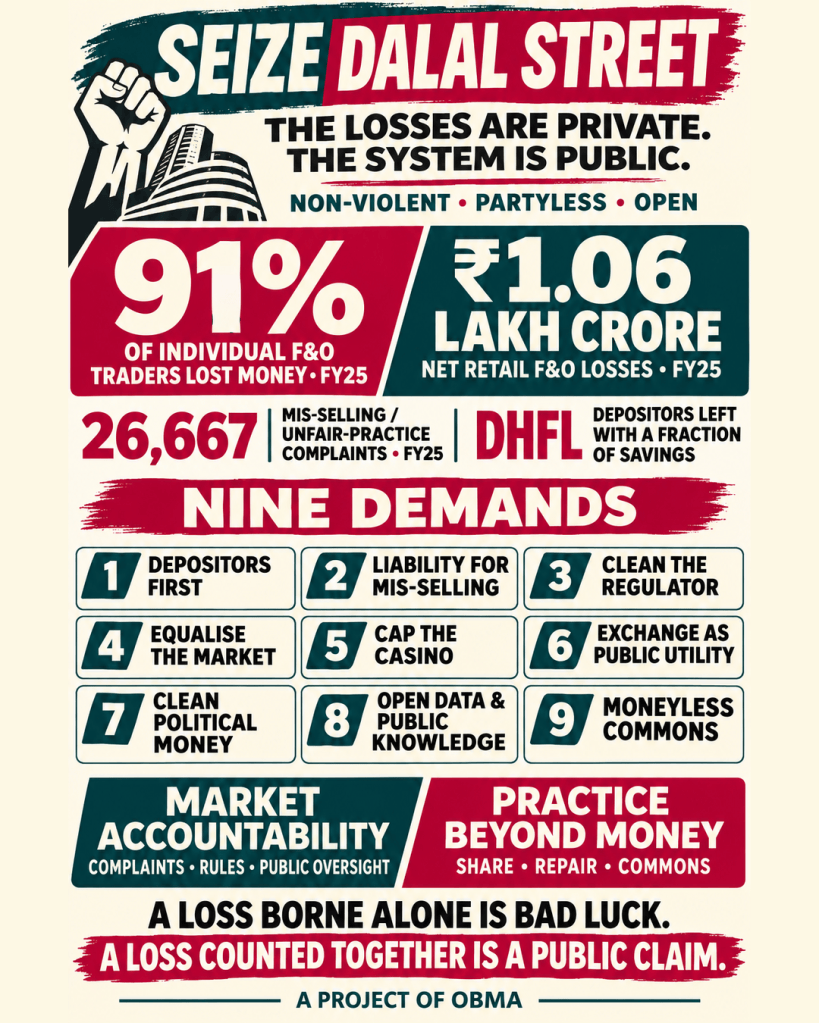
Net losses of individual traders reached ₹1,05,603 crore in FY 2024–25, up from ₹74,812 crore a year earlier, after transaction costs; across FY22–FY25 they came to about ₹2.87 lakh crore, and to about ₹3.79 lakh crore once FY26 is added. The losses persist rather than teach. Of traders who entered in FY22 and stayed active every year through FY26, 65.6% lost money in every one of those five years, and only about one in two hundred made money in every year. Participation fell from about 61.4 lakh unique traders in the first quarter of FY25 to about 42.7 lakh in the fourth. The market is not curing its patients; it is discharging them, poorer. Money begets money for the house because the many remain the counterparty. Seize the 91%.
A loss has a counterparty. In July 2025 an interim order against the Jane Street group alleged that between January 2023 and March 2025 the group earned about ₹44,358 crore in index options while booking about ₹7,208 crore of losses in futures and cash positions described as moving the index, and it impounded about ₹4,843 crore. The group contests the order, and its findings are interim. But the arithmetic it describes is the arithmetic of the 91%: the small trader buys an option, and on the other side of the screen a machine standing next to the server sells it. Derivatives turnover fell by a fifth to a quarter after the order, which shows how much of the market’s volume such counterparties supply. The financial bourgeoisie does not need the many to win; it needs them to keep buying. Seize the counterparty.
The Depositor in the Queue
The DHFL “resolution” under the ill-conceived, heavily amended, crony-friendly IBC (2016) shows the same structure where no screen is involved, and it shows every part of the architecture working in one lawful sequence. The company missed payments between June and August 2019 and its AAA grades collapsed to D. In November 2019 new rules under Section 227 of the Insolvency and Bankruptcy Code brought financial service providers into insolvency by notification, not by parliamentary debate, and the RBI superseded the board; on 28 December 2019 an ordinance inserted Section 32A, shielding a successful resolution applicant from liability for the debtor’s past offences. The National Company Law Tribunal approved the plan of Piramal Capital & Housing Finance on 7 June 2021. On 27 January 2022 the Appellate Tribunal sent it back on one point: recoveries from avoidance transactions, estimated at about ₹45,000 crore, had been valued at one rupee. On 1 April 2025 the Supreme Court, in Piramal Capital & Housing Finance v. 63 Moons Technologies (2025 INSC 421), upheld the plan as approved by 93.65% of the Committee of Creditors.
The arithmetic of the haircut follows. The plan was valued at about ₹34,250 crore, and creditors’ total recovery, counting the company’s own cash, at about ₹37,000–38,000 crore, against a loan book of more than ₹90,000 crore. Average recovery under the Code is about 31–33% of admitted claims. Retail fixed-deposit holders, about 2.5 lakh people with claims of about ₹5,375 crore, were to recover 23.08%, a haircut of 76.92%. A household that placed its savings in an AAA-rated deposit received about 23 paise in the rupee, while the right to pursue transactions the administrator had flagged passed to the acquirer for one rupee. The doctrine that made this lawful is the commercial wisdom of the Committee of Creditors, which the Supreme Court has repeatedly held courts should not second-guess. In that committee votes are weighted by the size of claims, so banks and bondholders decide, while the depositors, though counted as financial creditors, carry a sliver of the vote through a single authorised representative. Socially necessary labour of saving is entered at zero; the financial claim is entered at one. Seize the dative.
The one-rupee valuation is the most honest number in Indian finance. It is the market itself performing the negation of money’s meaning on the claims of the weak: forty-five thousand crore rupees of possible recovery reduced to a token that means nothing, so that the plan could balance. The gatekeepers arrived late. The National Financial Reporting Authority acted on the audits in December 2023 and June 2024, and the regulator fined former promoters in December 2025. Disclosed electoral-bond data, released after the Supreme Court’s 2024 judgment, record purchases of about ₹85–88 crore by Piramal entities; no exchange is inferred, yet a public asked to trust the commercial wisdom of creditors is entitled to see the political spending of acquirers on the same page. Fourteen Right to Information applications to more than twelve authorities met evasion in every case. The heir then prospered by every market measure, and the successor entity listed in November 2025. That is the structural moral of the exhibit: the code is designed so that the depositor’s loss and the acquirer’s gain can appear in the same family of accounts and both be called resolution. Unpredictable predictability for the many is predictable extraction for the few. This is why Seize Dalal Street begins with the relation, not the street: the exchange multiplies titles whose value has already been secured by writing the claims of the weak at one rupee. Seize the resolution.
A machine that wins by making the many lose, and calls the result resolution, is not merely unjust. It is speaking in a disordered grammar, and Thesis 5 gives that disorder its name. Seize the grammar.
Thesis 5: Dalal Street Speaks in the Structure of Foreclosure
The market forecloses limit, labour, loss and the many, and what it forecloses returns in the Real as crash, debt and the losses of the 91%. Its grammar is the deliriously rational (dis-)order that lets money beget money while socially necessary labour remains the uncounted condition of every price. Money is not a neutral medium. It is a systemic-structural relation and an arbitrary signifier whose meaning is fixed only by the power that prices it. The signifier equates the unequal, multiplies the title, and enters the labour that sustains it at zero. Seize the signifier.
This manifesto reads the stock market through metonymy, condensation and foreclosure, and reads Occupy, in Part Two, through metaphor, displacement and repression. Metonymy is the slide from one term to the next (price to price, contract to contract); condensation is the collapse of many terms into one (the index, the rating, the poll). Foreclosure is the mechanism by which limit, labour and the many are expelled from the market’s symbolic order and return in the Real as crash and loss. Metaphor and displacement are the operations by which Occupy substituted a place for a relation and kept the property relation repressed. Both tables of language are kept in play. Their disagreement is itself a displacement, and a manifesto that refuses coherence has no reason to force them into a single system.
The neo-liberal capitalist discourse is a mutation of the master’s: wildly clever, running too fast, consuming so well that it consumes itself. Its basic mark is the attempt to foreclose castration—to promise enjoyment without loss and circulation without limit. What is repressed returns as a symptom; what is foreclosed from the symbolic returns in the Real. Without a fixed point to pin it, the chain of signifiers slides unanchored, price to price, contract to contract, the derivative of a derivative: metonymy unbound. This is the structure Mark Fisher named capitalist realism: the widespread sense that not only is capitalism the only viable political and economic system, but that it is now impossible even to imagine a coherent alternative. The profit-cycle consolidates the slide. M advances, C is organised, M′ returns larger; the increment is celebrated as growth. When the claims outgrow the surplus, the cycle does not correct; it restarts on a new M, and the difference is paid by those whose labour was never entered in the books. Money begets money because the cycle has already treated socially necessary labour as zero, and capitalist realism is the name of the realism that makes this zero appear natural. Seize the realism.
The four preceding theses are the record of that return. The market forecloses limit, the Earth and the bioregion, and limit returns as climate shock, exhausted rivers and stranded assets. It forecloses socially necessary labour—the work of households, communities and mothers—and that labour returns as care crises and a workforce raised at no cost to capital. It forecloses loss itself, the fantasy of M → M′ for ever, and loss returns as the crash of 4 June, the default of IL&FS and the haircut of DHFL. And it forecloses the many as subjects, who return in the Real as a percentage the regulator publishes every year. The bull and the bear are the totemic animals of this cycle: the bull charges so that the rise can be called natural, the bear mauls so that the fall can be called correction. Both keep the public from asking who feeds them, and who is fed upon.
Psychosis is audible in the market’s grammar. “The market is nervous.” “The market is cheered.” “The market has priced it in.” The voice is attributed to no one. Market sentiment is spoken of as if the market were a living being that follows market laws the way the Earth follows natural laws. This is the fallacy of misplaced concreteness: an abstraction is treated as a concrete agent, so that the many never ask who feeds the bull and who is fed upon. India’s leading exchange made the figure literal: an order of February 2022 found that the former managing director had shared confidential information with an unidentified person she called a “Himalayan yogi,” who guided her by email. For a time, the exchange took advice from a voice without a body. Its speech coins words that stand alone—swaps, straddles, strangles, iron condors, butterflies—and the traders hear calls, buy options that leave them no option and puts that put them out. The market lives between the due date of a listing and the expiry date of a contract, and “expire” is to breathe out: the weekly expiry is a weekly funeral with no mourners, only margin calls. Each expiry closes one circuit of M → M′ and opens the next; the many remain the counterparty that makes the restart possible. Seize the grammar.
The discourse runs too fast, and so do its warnings. “Mutual fund investments are subject to market risks; read all scheme-related documents carefully” is the only true sentence in the advertisement, and it is read at a speed at which it says nothing. A mutual fund is stock in disguise: the same title to surplus, the same multiple, the same counterparty structure, wrapped in a claim of diversification that conceals the underlying machine. A survey found that 62% of prospective retail investors rely on finfluencers, while only about 2% of active finfluencers are registered. Under electronic/digital/cyber capitalism the Forum is in the pocket, and a crowd that is never assembled can never be seized by its own speech, only by the market’s. Socially necessary labour is the one flow the cycle never prices, yet every M′ depends on it having already been performed. The disguise does not alter the circuit; it only multiplies the entrances. Seize the disguise.
Why the Antithesis Must Be Countered
Part One therefore gives four reasons, and each will be answered in what follows. First, the machine converts wages into prices and calls the conversion wealth, so the counter must begin with socially necessary labour (Theses 10 and 12). Second, its foundations socialise loss and conceal distribution, so the counter must read the whole ledger, not only the trading floor (Theses 14 and 15). Third, it speaks through authorities who answer for nothing, so the counter must seize the right to know (Theses 12 and 15). Fourth, it wins by making the many its counterparty, so the counter must place the many in the dative, as the ones for whom (Theses 7 and 16).
The structure is not cured by interpretation. Explaining to the market that it is deluded does not help, because it has foreclosed the register in which explanations land; reformers who send it better arguments are posting letters to an address that does not exist. What is needed is not an argument with the market but a different verb for the many. Part Two finds it, by walking first in the footsteps of the last movement that tried. Seize the cycle so that M may no longer beget M′ on the uncounted labour of the many.
Part Two — The Verb and What It Seizes
Part Two says what the movement is and what it takes. It begins with its predecessor, finds its own verb, follows that verb through its field of puns into the body and the ledger of labour, and ends with an exact account of what is seized.
Part One diagnosed the stock market as a purportedly “living system” (?) that speaks, feels and falls, yet remains erratic and irregular. Market sentiment is treated as if the market itself decides when prices rise or fall, the way the Earth follows natural laws. This is the delusion of misplaced concreteness and the psychotic foreclosure that expels limit, labour and the many from the symbolic order so they return only as crash, debt and the losses of the 91%. The remainders—the uncounted labour, the depositor at 23 paise, the trader who pays—are the condition of the cycle, not its accident. Part Two answers with a different verb. It does not ask the living system to become rational. It seizes the relation the system has already taken.
Thesis 6: In the Footsteps of Occupy Wall Street
Occupy Wall Street was a neurotic formation: it substituted a place for a relation and kept the property relation repressed. Still it legitimately envisioned the way. We keep what its symptom said and refuse what it kept silent. The manufactured risk of the stock market was named but never seized.
Occupy Wall Street never occupied Wall Street. Police barricades kept the street closed, and from 17 September 2011 the movement camped in Zuccotti Park, a few blocks away. The drive could not reach its object, so it settled next door. Then came the metaphor. A place stood in for a relation, a tent for a title deed, a camp for the balance sheet. The symptom spoke a truth, loudly and across the world, that a few own and the many owe. It also kept the secret, leaving the property relation exactly where it was. Neurosis is a compromise in which the truth is spoken in a form that changes nothing. Money continued to beget money; socially necessary labour remained uncounted. Yet the truth it spoke was real, and the world heard it.
The neurosis had a precise clinical form. The Greek hystera is the womb, and the old physicians called hysteria the wandering womb. The hysteric addresses the master with a question rather than a demand, and makes the master produce knowledge. Occupy’s famous refusal of demands was that question—tell us what we want—and the master answered it in the usual way, with the eviction of 15 November 2011. Yet the hysteric did make the master speak: “the 1%” passed into the master’s own economics, and inequality became a respectable topic for those who administer it. The speech named the financial bourgeoisie with a clarity the world had not had; it did not dismantle the circuit that produces it. The limitation was real. The achievement was greater.
What Occupy gave was real, and Seize Dalal Street inherits it with respect. It put “the 99%” and “the 1%” into everyday speech across the world. It practised horizontalism, with general assemblies, consensus and rotating facilitation, and left no single leader to arrest or to buy. It spread to hundreds of camps in weeks, each local and all recognisably kin. Forbidden amplifiers, it invented the people’s mic, the crowd repeating each speaker’s words phrase by phrase. The people’s mic was musicking in political form. And Occupy prefigured, in kitchens, libraries and medical tents, the relations it wanted later. These are kept, and they are kept as gifts.
What Occupy kept was just as real, and Seize Dalal Street leaves it behind, not in dismissal but in continuation. Its name assumed empty land. In Oakland, Ohlone and other Indigenous activists said so, and a proposal to rename the movement “Decolonize Oakland” won about 68% of the general assembly’s vote but fell short of the 90% it needed, partly because “occupy” had become a brand and the neurotic defended its symptom. It camped in a privately owned public space, inside capital’s own metaphor of the public. Because it claimed nothing from anyone, it could hand nothing to anyone. And because an occupation is measured by duration, its end looked like defeat: when the tents went, the movement seemed to go with them. The place was held; the relation was not. The limitation was structural. The courage was not.
The movement learned the lesson in its own name. It moved from the banner “Occupy Dalal Street” to “Seize Dalal Street!” The change was not a rebranding. It was the movement noticing that it had been holding a hill, and deciding to name the relation instead. Occupy Wall Street asked the market’s master a question that the world had not heard so clearly before, and the question still stands. It put the 99% and the 1% into everyday speech, practised horizontalism, and invented the people’s mic. Seize Dalal Street keeps those gifts and tells the commons what is taken back. We keep the people’s mic, the horizontal form, and the naming of the 99%. We leave the park. Seize the relation, not the place.
Thesis 7: We Seize, We Do Not Simply ‘Occupy’
Occupation presupposes an empty thing with no owner; seizure presupposes an owner and contests the title. We name the one we take from and the ones we take for. The difference is the difference between holding a place and dismantling a relation.
The distinction is written into the history of both words. Occupy comes from Latin occupāre, from ob- and capere, “to take.” In Roman law occupatio was the original acquisition of res nullius, a thing that belongs to no one, by taking possession of it; Grotius and Locke built on the doctrine, and colonial terra nullius grew out of it. Over the centuries the word softened into filling a space or a time, which is why a person’s job is called an occupation. Seize comes from Old French saisir, probably from a Frankish word meaning “to put, to place,” and its oldest legal sense is the feudal seisin, being put into possession of land. “Seize” began as a word about title. To occupy is to treat the object as unclaimed, which erased Indigenous claims and also hides the class adversary. To seize is to admit that a possessor exists and to take from them. Marx’s “expropriation of the expropriators” is a seizure-word; it could never be an occupatio, because capital is not res nullius. The financial bourgeoisie is not an empty thing waiting to be camped upon; it is a relation that must be named and taken from.
The popular slogan “seize the means of production” does not appear in Marx, and the movement cites its real sources.
Exhibit C: The Canonical Sources of “Seize”
| Text | Formulation | Who acts | What the movement takes from it |
|---|---|---|---|
| Engels, Socialism: Utopian and Scientific (1880), from Anti-Dühring (1878) | “the seizing of the means of production by society” (Besitzergreifung der Produktionsmittel durch die Gesellschaft) | society | the closest canonical source of the slogan; its subject is society, not a party or a state |
| Engels, same text | the proletariat “seizes political power” and in doing so abolishes itself as proletariat and the state as state | the proletariat | seizure is meant to end in self-abolition, not in a new master |
| Communist Manifesto (1848) | to “wrest, by degrees, all capital from the bourgeoisie” | the proletariat | wresting from: the verb names its source |
| Marx, Capital I, ch. 32 (1867) | “The expropriators are expropriated” | the producers | the object is a relation of ownership, not a place |
| Marx, The Civil War in France (1871) | the working class “cannot simply lay hold of the ready-made state machinery” | the working class | Marx’s only correction to the Manifesto, in its 1872 preface: seizing production is not grabbing the state |
Two conclusions follow. The one who seizes is society, which is why a moneyless-partyless movement can say “seize” without contradiction. And Marx himself warned against seizing the existing apparatus, so the movement’s seizure is of relations and meanings, not literally of machinery. The machine that lets money beget money is not seized by occupying its floor. It is seized by naming the title it multiplies and the labour it enters at zero. A camp on the street leaves the circuit untouched. Naming the circuit, and taking the relation back for the commons, is what makes the circuit cease. Seize the title, not the building.
The two verbs also have different grammars, and politics lives in grammar. In Pāṇini’s terms occupy takes an adhikaraṇa, a locus: one occupies a park, a street, a hill. Seize requires an apādāna, a source, because one seizes from someone, and it implies a sampradāna, a beneficiary, because one seizes for someone. In Vendler’s aspectual classes occupy is a state or an activity, measured by how long it lasts (“occupied the park for two months”), while seize is an achievement, measured by what changes hands (“seized in an instant”; “seized for three weeks” sounds wrong). A full seizure sentence has three slots: who seizes, the kartā; from whom, the apādāna; and for whom, the sampradāna. When the third slot is left empty, seizure drifts towards a party or the state. Seize Dalal Street fills all three every time: society seizes, from the expropriators of limit, labour and meaning, for the commons. Occupy’s slots of from and for were both empty, which is why its tents could hold a park and hand nothing on. The unpredictable predictability of the market is not undone by duration; it is undone by naming the source and the beneficiary.
Bengali keeps both verbs in one word and leaves politics to separate them. দখল (dakhal), from Arabic dakhl, “entry,” means both occupying and seizing land, and জবরদখল (jabardakhal), forcible occupation, names Kolkata’s own occupation movement, the squatter colonies of East Bengal refugees in the late 1940s and 1950s. The lexicon is sorted by class. When the state takes land it “acquires” it, as at Singur and Nandigram; when the poor take land it is “encroachment.” The same act gets a neutral legal word from above and a criminal word from below. Bengal’s own seizures were claims to title: the Tebhaga movement of 1946–47 demanded two-thirds of the harvest for sharecroppers, and Naxalbari in 1967 claimed the land itself under the slogan “land to the tiller.” In each case the verb named the one taken from and the ones taken for. The market’s verb does the opposite: it names only the price.
A verb that names its source and its beneficiary also carries echoes, and in English the echoes of seize are a whole political history. Thesis 8 follows them. Seize the grammar.
Thesis 8: The Verb in Its Field of Semantic Play
In English the movement’s verb sounds out a whole political sequence: to seize is also to make the market cease, to confront its Caesar, to refuse its Caesarean, to blunt its scissors and to read its seizures. The field is not decoration. It is the map of what must be dismantled. Each term names a different face of the same circuit: the title that is taken, the finality that is deferred, the sovereign index that decides, the cut that extracts surplus from open labour, and the crash that returns what was foreclosed. The puns are not play. They are the method by which the relation is named so that it can be seized.
A confession first. In classical Latin he was KAI-sar; he became a “seizer” only in English, where words, like provinces, are annexed by whichever pronunciation is strongest. Every pun in this thesis is an English annexation of a Latin name, and the movement uses the annexation against the annexers. The field has six terms, and each carries part of the argument that follows.
| Term | Sense in the field | Where the manifesto uses it |
|---|---|---|
| seize | to take a relation back, naming from whom and for whom | the movement’s verb (Thesis 7) |
| cease | to stop: to impose on the market the finality it endlessly defers, through rollover, refinancing and expiry | the aim, and the demands on speed and expiry (Thesis 15) |
| Caesar | the sovereign who seizes, and the index that rules in his name | this thesis |
| Caesarean | the cut that delivers birth without labour, on a prefixed date | Thesis 9 |
| scissors | from caedere, “to cut”: the dalal’s cut, the haircut, the de-cision | Theses 1, 4 and 9 |
| seizure | the act of taking, and the fit of the falling sickness: the crash | this thesis and Thesis 5 |
The homophone of seize and cease is the hinge of the aim. The exchange lives by deferral: a contract expires and is rolled over, a loss is booked and refinanced, a default is resolved and relisted, and nothing is ever finally settled for the one who lost. To seize Dalal Street is also to make it cease, to impose the finality it postpones, before the next revaluation is paid for by workers and savers. Brutus, in the play, wanted a cease-fire: kill the man, spare the system. Antony heard seize fire, and Rome burned. The movement wants neither the conspirator’s clean kill nor the orator’s riot. It wants the system to cease, and it means to seize the speech that keeps the deliriously rational (dis-)order running. Money begets money only while the finality is deferred; socially necessary labour pays the deferral.
The Caesar Trajectory
The story of Caesar is the story of every market sovereign. Shakespeare supplies the scenes; Brecht, in the unfinished novel Die Geschäfte des Herrn Julius Caesar and the calendar story Cäsar und sein Legionär, supplies the ledger behind them. The trajectory is not historical colour; it is the operating diagram of the index.
Act I, the seizer. Veni, vidi, seizi: he came, he saw, he seized, and while the Senate took minutes, Caesar took the rest. Carpe diem was too modest for him; he chose carpe rem publicam. “Render unto Caesar the things that are Caesar’s” became the shortest clause in the tax code, because after his reforms it meant everything. Alea iacta est: the die was cast, and so, conveniently, was the vote. Casca reports that he refused the crown three times, each time a little more slowly. He had the falling sickness, and Cassius diagnoses the rest of Rome: “you and I, / And honest Casca, we have the falling sickness.” The epilepsy was at the top; the prostration was below. Brecht’s Caesar is a businessman who happens to own an army. He seized credit rather than power, and in Rome those were the same asset class: too big to fail, too big to jail, and in the end just big enough to stab. The financial bourgeoisie inherits the method: seize the title, defer the reckoning, let the many bear the fall.
Act II, the seizure. The haruspex Spurinna, who read entrails for a living, warned him to beware the Ides of March, but the senators feared the ideas of March more: Republic, liberty, a reckoning. Kalends and Ides were the days Roman debts fell due, and the conspirators called in the loan, twenty-three instalments, all paid by knife. Et tu, Brute? is the first recorded complaint by a seizer about being seized, and every short-seller since has heard it as et tu, brute force? Latin brutus means “heavy, dull,” and Shakespeare gave Brutus prose and Antony verse: Brutus spoke in prose and lost; Antony spoke in verse and brought about the reverse. Brutus wanted a clean cut—“Let us be sacrificers, but not butchers, Caius”—which is the self-image of every surgical solution, including the elective Caesarean of Thesis 9. And after the deed the conspirators occupied the Capitol. They held the hill while Antony held the crowd, which is Occupy’s failure foretold. Occupying the place leaves the speech that multiplies the title untouched.
Act III, the seizure seized. “Friends, Romans, countrymen, lend me your ears”: Brecht’s Caesar borrowed money, Antony borrowed ears, and paid them back with interest, inflamed. He came to bury Caesar, not to praise him, nor to seize anything, and then seized everything. He repeated “Brutus is an honourable man” until honourable became an insult, because a word said often enough comes to own its antonym. He read the will, and with it took the will to power: where there’s a will there’s a way, and where there’s a will read aloud there’s a riot. Seventy-five drachmas a head was the first populist cash transfer, paid posthumously by the deceased. He named the assassin behind each hole in the mantle though he had not been there to see it. Antony did not seize power; he let it walk to him. He marked the dead Caesar to market, and the stock, at its lowest, became the soundest investment in Rome. The index performs the same marking: the fall is the moment the next rise is priced, and the many pay the difference.
The Business Affairs of Caesar and Seizing
History is written by the victors, but Brecht found it was kept by the accountants: the great man appears in his creditors’ books before he appears in the annals. The Roman calendarium (account book) was the moneylender’s ledger, with interest due on the Kalends, so Brecht’s Kalendergeschichten (calendar stories) are, by etymology, ledger stories. In Die Geschäfte des Herrn Julius Caesar (The Business Affairs of Mr Julius Caesar) and the calendar story Cäsar und sein Legionär (Caesar and his Legionary), Brecht follows Caesar’s last days through the accounts rather than the annals: the loans, the creditors, the due dates. India’s financial year, closing on 31 March, is the Ides on which every balance sheet and every regulator’s study of losses counts its dead. On Dalal Street the same trajectory repeats in new costumes. When society cannot decide, the index decides for it.
This is Caesarism without a body: the unpredictable predictability of the cycle is the form in which an abstraction rules in the name of the many who pay. Seize Dalal Street reads the exchange as Brecht read Caesar’s last days—through the ledger, not the legend—so that the relation may be named and taken back.
Exhibit D: The Caesars of the Index
| Role in Rome | Role on Dalal Street | The pun |
|---|---|---|
| Caesar, the autocrat | the index and the conglomerates it condenses | “Hail Sensex!” |
| The haruspex Spurinna | the rating agency | an augur paid by the one whose entrails it reads, who warns of the Ides only after them |
| The falling sickness | the crash | the market has seizures |
| Brutus, the honourable conspirator | the short-seller | Brutus with a balance sheet, who sells Caesar before he stabs him |
| The conspirators on the Capitol | movements that occupy places | they hold the hill; the crowd is elsewhere |
| Antony’s monologue | the anchor, the finfluencer, the advertising campaign | “Friends, Romans, retail investors, lend me your SIPs” |
| “Brutus is an honourable man” | Mutual Funds Sahi Hai | repeat “sahi” (right) until it means whatever the market needs |
| Caesar’s will, read aloud | the prospectus and the exit poll | a will read before the death: the crowd buys its inheritance and learns on counting day what the will really said |
| Seventy-five drachmas a head | the retail allotment, “the democratisation of markets” | a populist transfer paid by the deceased |
| The torn mantle | the risk disclaimer | the only true sentence, read too fast to be heard |
The name outlived the body. Caesar was cut down on the Ides, and his name became Kaiser and Tsar. Gramsci needed the word Caesarism for what happens when contending classes deadlock and a strongman arbitrates. The market has its own Caesarism: when society cannot decide, the index decides for it, and when the index falls the state rescues it in the name of the nation. Whoever seizes the sovereign and only occupies the hill will be seized by the speech that follows. The movement does not want the hill; it wants the speech back. And the speech it most needs to take back begins, as Pliny says Caesar’s name began, with a cut. Seize the speech so that the cycle of M → M′ may cease.
Thesis 9: The Species Occupies, the Market Seizes, and the Mother Is Counted as No One
The scheduled Caesarean is the market’s logic in the body: birth cut from labour, on a prefixed date, for a fee—as listings are fixed before the float, books built before the cry, gains booked before the labour that produced them. Both convert an open process into a priced event of the deliriously rational (dis-)order, so money may beget money while socially necessary labour is entered at zero. The cut that decides the hour of birth is the same cut that decides the hour of listing; the many supply the open labour, the few extract the title.
In The Second Sex, Beauvoir does not treat pregnancy simply as illness. She treats it as a conflict in which the demands of the species compromise the individual woman: the fetus appears as a parasitic presence living on the mother’s vitality, and nausea as a “revolt of the organism against the species.” The fetus is the first Occupy movement. It moves in without asking and draws on its host, and like the occupiers of 2011 it issues no demands, only needs. Occupatio treats its object as ownerless, and the species treats the woman’s body in the same way, as unclaimed land to be settled. Then the clinic seizes: a body that belonged to no one in the eyes of the species belongs, for one booked hour, to the hospital. The parallel with the exchange is exact. The open labour of the many is treated as ownerless until the moment it can be cut, priced and entered as surplus.
The words agree. Caesar, Caesarean, caesura, scissors, decision, incision, precise and homicide all descend from Latin caedere, “to cut.” Only seize comes from elsewhere, a Frankish squatter living in the Latin family house: the occupier of its own lexical family. Pliny derived the name Caesar from a caeso matris utero, “from the cut womb of the mother,” meaning the first of the line rather than Julius, whose mother Aurelia lived to see him grown, since in antiquity the operation was performed only on a dead or dying mother. A royal law attributed to Numa, the Lex Regia, later called the lex caesarea, forbade the burial of a pregnant woman before the child was cut from her. The royal law and the Caesarean share an origin: the body that gives life is opened so that something with a title can be lifted out. In the same way the conspirators of Thesis 8 performed a Caesarean on the Republic, twenty-three incisions to deliver Liberty, and when the baby cried it was named Augustus. The market performs the same cut on every listing: the open process is closed on a prefixed date so that a title can be extracted.
Certain forms of Indian English already has the joke. People ask, “Was it normal or sijar?” Bengali calls a Caesarean simply সিজার (sijār) and says a child was born সিজারে, so Bengali completed the homophone before we did: every Caesarean in a Kolkata ward is a seizure in sound. And the answer has climbed, from abnormal birth to above-normal birth, the premium package in the private suite. The exchange has its own version: “oversubscribed how many times?” is the market’s “normal or sijar?”
Exhibit E: Caesarean Births (NFHS-5, 2019–21)
| Where | Private facilities | Public facilities |
|---|---|---|
| India | 47.4% | 14.3% |
| West Bengal | 82.7% | 22.9% |
| Murshidabad and Nadia districts | more than 9 in 10 | — |
The WHO’s long-cited reference range for population Caesarean rates is about 5–15%. In West Bengal’s private wards “normal” birth has become the abnormal one. The auspicious hour is fixed by the almanac and carried out by the scalpel; the stars propose and the surgeon disposes, and a pretty date fills the theatre. The moneylender’s calendarium returns, because the prefixed date enters the birth in the ledger before it happens and the bill falls due before the cry. To decide is, by etymology, to cut off, and the scheduled Caesarean is a decision in the literal sense: time is cut off before labour can begin. In the game of rock, paper and scissors, the paper of the consent form covers the rock of the body, the scissors cut the paper, and the mother loses all three rounds. On the exchange the same cut occurs: the listing date is fixed, the book is built, the fees fall due, and the labour that produced the surplus is never entered.
Dalal Street delivers its own children the same way. The listing date is the prefixed date. “Book-building” builds the book before the birth, as the hospital opens the file before the cry. Anchor investors and merchant bankers stand round the table as the surgical team, and “oversubscribed how many times?” is the market’s “normal or sijar?” Listing gains are the above-normal birth, and fees fall due before the float. Sometimes the newborn is underweight: the LIC listing of Exhibit A delivered a public insurer to its own policyholders at a loss on the first day. And the regulator’s disgorgement orders are the market’s morning sickness, the revolt of the organism, regulated by circular.
The absurdity is total. An open labour is cut on a calendar so that a title can be multiplied, and the multiplication is called the birth of wealth. The unpredictable predictability of the cut is the condition of the gain. The market does not measure value; it schedules the extraction and names the result a child. Seize the absurdity.
The scalpel is a pharmakon, remedy and poison at once. Used where it is needed, it saves mothers and infants, and Seize Dalal Street defends every woman’s access to it. Overused for profit, convenience or a horoscope, it is poison sold as remedy. The satire is aimed at the market, never at the mothers. What the scheduled birth removes is not only the hour but the labour, and Thesis 10 does the arithmetic of what is removed. The same cut runs through the casino economy: the bull charges so that the rise can be called natural, the bear mauls so that the fall can be called correction, and both “bullish” and “bearish” are moods sold to the many as the condition of the next trade. Stress and anxiety are not side-effects; they are the product the market trades. Seize the hour so that the cut may no longer decide the meaning of birth or of listing.
Thesis 10: Labour Without Labour Pain and Profit Without Labour
The exchange multiplies titles to surplus while the socially necessary labour that produced them is foreclosed and erased out. The clinic schedules birth so that the mother’s labour can be cut from the event and billed as a package. In both cases extraction is offered as convenience. The movement refuses the convenience. It wants the labour kept by the one who performs it, and the surplus returned to the commons that made it possible.
Socially necessary labour is read in its full social sense: the work done for oneself, one’s family, community, neighbours, elders and young children, largely outside the market. Surplus labour is labour for the capitalist, and where the capitalist sees profit the class-conscious worker sees surplus value. Beyond both stands free labour, labour as “life’s prime want” in the Critique of the Gotha Programme and the realm of freedom of Capital III. In the birth-room, necessary labour is the mother’s, the dai’s and the singing women’s; surplus labour is what the clinic and the market take from it; free labour is birth that is musicked, held in common and belongs to the one who labours. On the exchange the same division holds: the open labour of households and communities is the uncounted condition of every title that is multiplied.
In Capital I, ch. 1, Marx observes that after the power-loom came to England an hour of the hand-loom weaver’s labour counted socially as half an hour. His cloth had not changed; the social average had. With more than eight births in ten in West Bengal’s private hospitals now Caesarean, the forty-minute operation is becoming the social average of birth, and a woman who labours for fourteen hours becomes the hand-loom weaver. In the market’s eyes her fourteen hours count as forty minutes, and everything beyond them, the pain included, is booked as inefficiency. The same reduction occurs when listed profits rise 22.3% while employment in the same firms rises 1.5%: the social average of value has been reset so that more surplus appears with less counted labour.
From s/v to ΔM, and to s/0
Rate of surplus value = s/v, and ΔM = s = (s/v) × v
The arithmetic belongs to the exchange as much as to the factory. Of capital advanced at 100, say 80 is constant and 20 is wages, and a surplus of 20 gives a rate of exploitation of 100%. Cut wages by a tenth and the same output yields a rate of about 122%, which the price-to-earnings multiple of Thesis 1 then turns into market value. The divergence of listed profits and employment recorded in the Preamble is the national shape of that illustration. The multiple does not create surplus; it prices the surplus that has already been extracted from labour entered at less than its social cost.
In Capital I, ch. 6, Marx includes in the value of labour-power the subsistence of the worker’s “substitutes,” that is, children. Labour-power must be born before it can be bought. But capital enters the mother’s necessary labour in its books at zero:
v(mother) = 0 ⇒ s / v(mother) = s / 0
The rate of exploitation of this labour is not merely high; it is undefined, a division by zero. Production depends on a reproduction it never counts. The private hospital, meanwhile, runs capital’s own circuit, M → C → M′. M is the package fee; C is the mother’s body reorganised as a surgical slot on a prefixed date; M′ is the larger bill of operation, stay and tests; and the increment ΔM grows out of the mother’s s/0. Scheduling intensifies surgical labour into a production line, which is relative surplus value, and faster bed turnover yields more surplus a year. The time saved is not returned to the mother. It is absorbed by the hospital’s turnover, while her suffering moves from hours of labour to weeks of recovery. The exchange performs the identical circuit on every listing: the open labour is cut, the title is multiplied, and the increment is booked as growth. It is questionable whether any of the instruments yet invented have lightened the labour of any worker whose labour was not theirs to keep.
Tókos: Interest as Birth Without Labour
Aristotle condemned usury because it makes money breed money, and the Greek tókos means both “offspring” and “interest”; Shakespeare’s Antonio calls interest “a breed for barren metal.” In Capital III interest-bearing capital appears as M → M′, money begetting money with no visible labour between, the most fetishised form of capital. Marx later named the claims that circulate independently of production fictitious capital: titles to surplus that have not yet been produced, priced as if they already existed. Derivatives are its purest form on Dalal Street. All that is solid melts into air: the factory, the wage, the labour that produced the surplus disappear into a title that circulates as if it were the thing itself. The loan and the pregnancy share a due date, and on the prefixed day the money-womb and the clinical womb are both opened by contract. M → M′ is capital’s own Caesarean, an offspring delivered without labour by a scheduled cut, under a name that hides the mother. The 91% of Thesis 4 bear its pain. Marx’s capital is “dead labour, that, vampire-like, only lives by sucking living labour,” the past draining the present; the fetus is the future draining it; and the private clinic and the trading app join them, dead labour in the form of machinery delivering future labour-power and future claims by draining the living present. The unpredictable predictability of the cycle is the form in which this draining appears as natural. Seize the fiction.
Joyful Labour Is Not Painless Labour
In the Grundrisse Marx rejects Fourier’s dream that labour could become mere play: really free labour, he says, taking composition as his example, is “the most damned seriousness, the most intense exertion.” Free labour is not labour without exertion; it is exertion that belongs to the one who exerts. Alienated labour, in the Manuscripts of 1844, is “not voluntary, but coerced; it is forced labour,” and the scheduled birth estranges all four things Marx lists: the product, timed by others; the process, anaesthetised; species-being, set against the woman; and other people, the singing community replaced by staff. The architect raises the structure in imagination before raising it in reality. The clinic reverses the refusal of birth as project and makes birth a project, but the surgeon’s, planned on a calendar, and demotes the mother to the bee. The refusal of women’s bodily production of life as mere nature rather than labour, and the reading of the expulsion of midwives as part of primitive accumulation, remain live. When the dai is displaced by the scheduled surgeon, that history is still going on. On the exchange the same displacement occurs: the open labour of the many is replaced by the scheduled cut of the title. The market treats the labour that produces surplus as a cost to be minimised, not as the condition of every price. Seize Dalal Street refuses that minimisation.
Marx’s own vocabulary of revolution is obstetric. A society cannot leap over the phases of its development, says the Preface to Capital, but it can “shorten and lessen the birth-pangs”—shorten, not abolish. “Force is the midwife of every old society pregnant with a new one” (Capital I, ch. 31), and primitive accumulation was a forced delivery. The new society emerges, in the Gotha critique, “stamped with the birthmarks” of the old, and the German word is Muttermale, mother-marks. A party that seizes power on a date it has fixed performs a scheduled Caesarean on history: it delivers on time, without the labour of the many, and the newborn state carries the surgeon’s mother-marks. The movement therefore refuses scheduled revolutions as it refuses scheduled births. The exchange already performs scheduled revolutions every day: it delivers titles on prefixed dates, without the labour of the many, and calls the result growth. What the cut does to the one who is born, and to the one who gives birth, is the subject of Thesis 11. Seize the arithmetic so that s may no longer be divided by zero.
Thesis 11: The Clinic and the Market Sell Resolution; There Is None, Only a Knot
Birth is one event with two incompatible truths, pain and joy for the mother and trauma for the child, and no surgery and no contract can resolve an aporia; they can only bypass it, at the cost of the one who labours. The market sells the same resolution: risk resolved into a price, labour resolved into a title, the open process cut so that money may beget money. There is none. There is only a knot.
Birth happens to two subjects. For the mother it can be pain and joy at once; for the infant it is a violent arrival in a ruthless world. The two meanings cannot be added together or cancelled out, and that impossibility is the first aporia: one event, two truths, no passage from one to the other. The clinic promises to resolve it, as the market promises to resolve risk. Both fail. The deliriously rational (dis-)order converts the aporia into a scheduled event and calls the conversion resolution.
The Cut Is Not From the Mother
The theory of birth trauma belongs to Otto Rank, whose Trauma of Birth (1924) traced all later anxiety to it; Freud, in Inhibitions, Symptoms and Anxiety (1926), demoted birth to the prototype of anxiety rather than its source. Later work went further: what the newborn loses is not the mother but its own envelopes—placenta, amnion, membranes—which were parts of the child, so the first lost object is a piece of oneself. There is also the sudden intrusion of air into the lungs, an alien element breaking in, and the first cry as the first signifier, addressed to an Other who may or may not answer. The first breath in is the exact inverse of the option’s expiry in Thesis 5, the last breath out. When the egg’s membranes break, something flies off. You cannot make an hommelette without breaking eggs; in the Caesarean the egg is broken from outside, and the scalpel makes the hommelette. On the exchange the same cut occurs: the open position is closed from outside, the membranes of uncertainty are broken by the contract, and what flies off is the labour that is never entered.
The mirror-stage grounds the subject in a “specific prematurity of birth”: every human is born too early and takes up its image before it can govern its body. The scheduled Caesarean makes prematurity literal, fixed early for a calendar rather than for the child. Anxiety arises not from lack but when the lack comes to lack, and the scheduled birth removes every uncertainty—date, hour, surgeon, bill—until the Other’s plan fills the whole space. That is the structure of anxiety itself. The subject has a place in the symbolic before it is born, through its name and its parents’ speech; in the private ward it is also billed before it speaks. The Caesarean makes the hole literal: the trauma the infant meets in the Real arrives through a hole cut in the mother. The market performs the identical prematurity: the listing is fixed early, the book is built before the cry, the prospectus is written before the labour that will be claimed as surplus, and the many are billed for a title whose socially necessary labour they have not yet performed. The trader buys the image of a company before the company has produced the surplus the image prices. Seize the prematurity.
Jouissance, vedanā and An-Aesthesia
Jouissance is the region where pain and enjoyment cannot be told apart, which is the mother’s labour. Birth with music may be one way of saying what cannot be said. In Bengali, labour pain is প্রসব-বেদনা (prasab-vedanā), and vedanā comes from the Sanskrit root vid, “to know,” the root of Veda: the pain of birth is, by etymology, a knowing of birth. Anaesthesia removes aesthesis, feeling, and with it vedanā; it removes aesthetics too, the song, the rhythm and the gathering. The anaesthetised mother is relieved of knowing her own delivery, as the retail investor is relieved, by a disclaimer read too fast, of knowing his own risk. Birth among many peoples has been musicked: the dai keeping the rhythm of breath, the women singing, the ululation and the conch at the arrival in Bengal. The labour was a chorus. The operating theatre offers a solo of the monitor’s beep, as the trading floor’s open outcry has become a silent screen. The bull and the bear are the totemic animals of this silence: the bull charges so that the rise can be called natural, the bear mauls so that the fall can be called correction, and both keep the labour that feeds them uncounted. The market sells the silence as efficiency.
Barthes’s Pleasure of the Text separates the text of plaisir, which comforts and confirms, from the text of jouissance, which unsettles and imposes loss. Plaisir is bookable; jouissance takes no appointments. The scheduled birth is a text of plaisir and labour a text of jouissance. In French law jouissance also names usufruct, the enjoyment of a property’s use, so we may ask who holds the jouissance of the womb: the fetus as occupier, the hospital as seizer, the mother last. In the Caesarean the birth of the child is paid for by the disappearance of the mother from her own delivery, as Caesar’s death gave birth to the crowd as reader, with Antony there to interpret. On the exchange the same disappearance occurs: the labour is removed so that the title can be enjoyed. The prospectus is the text of plaisir; the 91% who lose are the text of jouissance that the market never books. Seize the silence.
The Pharmacy and the Post
The pharmakon is both remedy and poison, and the scalpel, the anaesthetic, the derivative and the rating are all pharmaka, remedies when needed and poisons when sold. Writing precedes speech here literally, because the date is written on the form before the infant’s first cry, and the AAA is written on the debenture before the default. The pharmakos was the scapegoat driven from the city: Brutus wanted Caesar as a clean sacrifice, and Antony held up the torn mantle to show it was butchery. A letter always arrives at its destination; a letter can also always not arrive. The scheduled Caesarean is delivery guaranteed on the due date; labour is dissemination, early, late or otherwise. The market promises the guarantee and delivers the non-arrival: to the depositor whose AAA became D, to the trader whose exit poll became a crash, to 91 of every 100. The bull promises the rise that arrives; the bear delivers the fall that was already priced. Both are the pharmacy of the cycle. The prospectus is the remedy that becomes the poison the moment the many buy it; the disclaimer is the poison sold as the remedy. The exchange does not resolve risk. It schedules the moment at which the many discover they have already paid for it. Seize the pharmacy.
Aporia and the Passe
Aporia means “no passage.” Obstructed labour is the bodily form of that impasse: the process cannot continue and cannot be forced without a cut. The procedure for becoming an analyst is named la passe, the passage—the requirement that one go through the difficulty rather than around it. The Caesarean is a bypass of the passe: it cuts a way out without going through, and leaves behind a writing on the body, the scar. The market performs the same bypass every day. It does not let the open labour of production and reproduction go through; it cuts a title out of it on a prefixed date and calls the cut resolution. Thesis 16 reads the scar as the model of the knot the movement means to tie. Before it can tie anything, the movement must say exactly what it is taking back, and Thesis 12 says it. Seize the knot so that the resolution may cease.
Thesis 12: What We Seize
We seize six things, each from the one who foreclosed it and each for the commons: the meaning of money, the title to labour, the right to know, the place of the many, the hour of birth and the limit of the Earth. Every seizure fills the three slots of Thesis 7. None is a metaphor. Each names the relation the deliriously rational (dis-)order has already taken and the ones for whom it must be taken back. India needs this seizure now: a non-violent, moneyless, partyless, open campaign of the injured and their allies, walking in the footsteps of Occupy Wall Street and the Other 98% (alternatively 99%), and joined to the moneyless movements that have been quietly practising another way of living. Seizure and the moneyless commons are not two programmes. Seizure names the relation taken back from the market; the moneyless practice is the way the relation is held once it is taken. A movement that only seizes remains inside the logic of price. A movement that also gives without price, that practises the work never entered in the books, shows that the arena was never the only way to live. This is not a call for a mood. It is a programme.
We seize the meaning of money from the market that set the depositor’s claim at 23 paise and the recovery claim at one rupee, and we seize it for the commons, who will no longer accept price as the only measure of worth. This is the negation of money’s meaning: not the abolition of money by decree, but the refusal to let the unpredictable predictability of the price say what anything is worth. Money is an arbitrary signifier and a null signifier: it equates unlike things, multiplies titles to surplus, and enters the labour that sustains it at zero. Money begets money only while its meaning remains uncontested. The exchange runs on a sign that hides the web of labour and nature behind every price. Beneath the market-priced fraction of the day sits the great mass of necessary labour that sustains life and is never priced. Seize the meaning.
We seize the title to labour from the multiple that turns wage cuts into share prices, and from the ledger that enters the mother’s labour at zero. We seize it for the workers, households and mothers whose socially necessary labour is the ground on which every surplus stands. Its instrument is a number, s/v, read out in public. The financial bourgeoisie emerges by multiplying a title whose labour has already been entered as nothing. A movement that only fights the market from outside remains inside its logic. A movement that also practises the moneyless commons shows in miniature that the arena was never the only way to live. Seize the title.
We seize the right to know from the oracle that is paid by its pupils, from the pollster whose forecast moves crores in trading hours, from the anonymous bond, from the confidential list of wilful defaulters and from the fund that answers to no auditor. We seize it for the citizens who bear the losses those silences prepare. The market’s speech answers for nothing; the many answer for everything. The first act is to break the grammar that teaches victims to call their ruin a lesson: to count the losses together, to say them aloud, and to turn private shame into a public claim. Seize the right.
We seize the place of the many from a grammar in which they stand only as the source from which value is taken: the counterparty of Thesis 4. We seize it for the many themselves, who will stand henceforth in the dative, as the ones for whom. The 91% are not a remainder to be managed; they are the condition of the cycle. The injured are many, scattered, and ashamed, and that is the whole problem. A loss borne alone is called bad luck. A loss counted together is a claim. Seize the place.
We seize the hour of birth from the almanac, the package and the ledger of Thesis 9, and we seize it for the one who labours, so that birth may again be her labour and, when she chooses, a musicked one. The cut that decides the hour of birth is the same cut that decides the hour of listing. The stock market’s temporality is affixation: every open process is pinned to a prefixed date so that a title can be extracted and a surplus multiplied. The weekly expiry is asphyxia—the last breath out of a contract, a funeral with no mourners, only margin calls. Labour is scheduled out of birth; surplus is scheduled out of labour. Seize the hour so that the affixation may cease.
We seize the limit of the Earth from a market that treats the bioregion as an externality and its exhaustion as growth, and we seize it for the Earth and for the generations not yet born, who cannot trade. The cycle prices everything except the limit that makes pricing possible. Ecotopians of Alternity, the Moneyless Commons and Seize Dalal Street meet here: the same logic that enters socially necessary labour at zero also enters the Earth at zero. Money begets money only while the bioregion is treated as an infinite source and an infinite sink. The movement seizes the limit so that the market may no longer call exhaustion growth, and it practises the moneyless commons so that another relation to the Earth can be lived, not merely demanded. Seize the limit.
We seize no share. A share is not property in the ordinary sense; it is a title to someone else’s surplus, the legal form of the sick circuit in which money begets money (M → M′ → M″) while socially necessary labour is entered at zero. Property is theft when the property is a claim on labour already performed by others and never counted. The risk society is the name of this circuit: risk is socialised onto the many, return is privatised to the few, and the unpredictable predictability of the cycle is called the market. We seize no building, because the market left its building long ago.
We seize no state, because the ready-made machine cannot be used for other ends. Anarchist critique has long named the stock exchange what it is: not a neutral allocator of capital but a casino in which titles to surplus circulate independently of the labour that produced them. Proudhon called it stock-market brigandage; Malatesta insisted that shares and securities representing the right to live on the labour of others should be considered valueless; later anarchists have repeated that the exchange contributes virtually nothing to the financing of real investment and serves only to concentrate ownership and political power in fewer hands. We do not seize the state to abolish the exchange, because the state is already the guarantor of the exchange’s titles. We do not tell anyone what to buy or sell. We do not ask anyone to run on a bank or a stock. We document, organise, petition, litigate, facilitate and refuse, openly and without violence. The seizure is of the relation, not of the apparatus. Part Three explains how a movement that seizes only relations and meanings can act, and how it guards itself against its own verb. Seize the six so that the circuit may cease.
Part Three — The Counter-Programme
Part Three binds the movement against the dangers of its own verb, then sets out its methods and forms of action, its demands, and the knot that holds them together.
Thesis 13: We Bind Ourselves Against Our Own Verb
“Seize” is not an innocent verb. A movement that does not criticise its own word will be seized by it. We name seven dangers and bind ourselves against each.
The first danger is that seizure is the state’s verb. The state seizes books, assets, goods and land; regulators attach accounts and order disgorgement. We seize no thing, no account and no building—only meanings, relations and the commons.
The second danger is that the verb is shared with fascism. The Nazis called their rise a Machtergreifung, a seizure of power. Any seizure for a leader, a nation-myth or a party is not ours. We judge every seizure by its three slots: from whom, for whom, and by what means.
The third danger is the scheduled revolution. A vanguard that books a date performs a Caesarean on history. We have no vanguard, no central committee and no prefixed date. A partyless movement labours; it does not book a theatre.
The fourth danger is the hommelette. A share is fictitious capital, a claim on future surplus. Whoever seizes it has not seized production but bought a ticket to exploitation and become a shareholder. Its value flies off when the egg is broken. Whoever “wins” the market is seized by it.
The fifth danger is the brand. Occupy defended its name as a brand, and the brand outlived the movement. We claim no trademark. Our texts are licensed CC BY 4.0 so that a slogan anyone may use can be owned by no one.
The sixth danger is occupatio in our own house. Dalal Street stands on islands that were home to Koli fishing communities before the city reclaimed them from the sea. Every gathering in Mumbai begins by naming the Kolis and the reclaimed sea; elsewhere we name the first peoples of the place. The same reclamation that erased the Kolis now places the financial district at risk. Bandra-Kurla Complex, home to the NSE and the bulk of the market’s servers, was built on mangrove land and former waterways. Mumbai’s Climate Action Plan projected that 80% of the island city could be submerged by 2050; a UN report warns that more than 14 million people across Mumbai, Kolkata and Dhaka face immediate risk of permanent inundation. The market that prices every other risk treats the rising sea as an externality. The titles it multiplies stand on land the sea is reclaiming. Seize the limit, or the limit will seize the house.
The seventh danger is the knife, and its cousin the libel. Every movement that says “seize” is accused of violence; every movement that names the powerful is answered with lawsuits meant to silence it. We are non-violent in method and in speech. We cite the record, we mark the allegation as an allegation, and our only knives are puns, which cut only words.
So bound, we seize nothing that can be put in a vault, for no one who can be put on a throne, by no means that need a weapon or fear a court. Thesis 14 describes what we do instead.
Thesis 14: We Act Through Readings, Circles and Words, Not Parties
We have no camp to evict and no party to capture. We act through federated circles that read, examine, redefine, sing, mourn and give in public. We measure ourselves by what changes hands, not by how many came or how long they stayed.
Three Readings
We read in three ways, and each reading is already a seizure.
The first is the chaosophic reading: following each flow the market decodes and recodes—wage into surplus, surplus into price, price into the household’s debt—until the irrationally rational machine is visible as a machine. The exchange territorialises the open labour of the many, deterritorialises it into a circulating title, and reterritorialises the surplus as market price. Every circuit of M → M′ is a territorialisation of labour that has already been entered at zero.
The second is the examiner’s reading: the student who was made to pay the examiner takes back the red pen and grades the graders. The rating territorialises uncertainty into a grade; the examiner’s reading deterritorialises the grade and returns it to the many who paid for it.
The third is the lexicographer’s reading: the market is a lexicon before it is a ledger, and to redefine a word is to seize it. The pun is the sharpest instrument of the third reading, because it shows that a word the market owns has always meant something else as well. The market territorialises language into a single meaning; the pun deterritorialises it and returns the second meaning to the commons.
The Form
A camp can be cleared in a night; a circle meets anywhere—in a para club, a library, a tea stall, a classroom or a video call. Circles federate horizontally: no circle commands another, and facilitation rotates. Every gathering keeps the people’s mic, so that speech is held in common before it is believed. Every gathering closes with one question: what changed hands this month, and for whom?
The Practices
In ledger readings, circles read balance sheets, prospectuses, rating rationales, tribunal orders and regulatory studies aloud, slowly and together, so that the ledger becomes a calendar story told in public. Two annual instruments support these readings. The first is the s/v proxy of listed companies, drawn from their own filings as operating profit before depreciation divided by employee-benefit expense, so that what the annual report calls efficiency is called by its name. The second is the rating report card: every instrument rated in the top grades that later defaulted, the date of the downgrade, and the number of days between the warning and the wound.
In disclaimer walks, members walk past exchanges, brokers’ offices and billboards reading the risk warning at walking pace, sentence by sentence: the slowest march in the world and the most truthful. In the loss census, circles collect, with full consent and anonymity, testimonies of small traders and depositors who lost, so that losses can be mourned rather than monetised. In the āṁtuṛ ghar circles (the lying-in room), mothers, midwives, dais and companions share knowledge of birth, publish local Caesarean rates and sing, restoring the lying-in room as a place of musicking.
In satire, cartoons, stand-up, street plays and parody advertisements take up the work of comedians and cartoonists as crafted resistance. At the gift table, something is given at every gathering with no price and no charity—books-leaflets-pamphlets-open letters-expose-dossiers under CC BY 4.0, food, time, skills—as the daily practice of the negation of money’s meaning. In public submissions, circles send the demands of Thesis 15 to regulators, ministries, tribunals, hospital boards and legislators, file Right to Information applications, and publish every reply and every silence. On the weekly expiry, circles hold a short public silence for the contracts that died and the savings that went with them, so that the market’s funeral at last gets its mourners. And in withdrawal, members and their households step out of the circuit wherever they can, choosing necessary labour and mutual aid over the screen, because the first seizure is the refusal to be the counterparty.
The Dalal Street Dictionary
The lexicographer’s reading has its own book, compiled in common and published under CC BY 4.0.
| Market word | Seize Dalal Street definition |
|---|---|
| Sensex | sens-ex: the index from which sense has exited; a thermometer mistaken for health |
| Nifty | the other thermometer; fifty companies made to stand for a nation |
| Dalal | the one who takes a cut from what he did not make |
| Co-location | metonymy sold by the microsecond; speed territorialised as class |
| Crash | the market’s seizure, the falling sickness in the Forum |
| Recovery | the patient getting up, while the bystanders pay the doctor |
| Option | a contract that leaves 91 of every 100 holders no option |
| Call / Put | the voice the trader hears / what puts the trader out |
| Expiry | the last breath out of a contract; the weekly funeral |
| AA+ | a performative: a grade that makes itself true until the day it doesn’t |
| Opinion, not a guarantee | Antony’s licence: speech that moves the crowd from a speaker who answers for nothing |
| Haircut | what the depositor receives when the creditor receives a resolution |
| Commercial wisdom | the sovereignty of the largest creditor, upheld as prudence |
| ₹1 | the market’s own negation of money’s meaning, applied to the claims of the weak |
| Resolution | the word for a wound that has been signed off |
| Exit poll | a will read aloud before the death |
| Book-building | writing the child’s file before it is born |
| Listing gains | the above-normal birth |
| Disgorgement | the market’s morning sickness, regulated by circular |
| Disclaimer | the only true sentence, read too fast to be heard |
| Interest | tókos: offspring without labour |
| Democratisation of markets | seventy-five drachmas a head, paid by the deceased |
| Investor | the one who is invested in, by the market |
| Bull market | the season in which everyone discovers, usually in retrospect, that they are a genius |
| Bear market | the season in which everyone insists they had always seen it coming |
| IPO | a promoter’s exit, elegantly packaged and announced as an opportunity for everyone else |
| Derivatives | insurance for the hedger; a lottery ticket for everyone else |
| Short selling | selling what one does not own; a crime when the weak do it, a strategy when the powerful call it price discovery |
| P/E ratio | the price of a story; the numerical value assigned to how convincingly the future can be narrated |
| Market capitalisation | what the last marginal buyer is prepared to pay, extrapolated into what everyone else’s holdings are supposedly worth |
| Fictitious capital | titles to surplus that have not yet been produced, priced as if they already existed |
| Circuit breaker | a pause long enough for the powerful to reposition, while everyone else is advised to remain calm |
| FII / FPI | the weather; their entry is sunshine, their withdrawal a storm |
| UPSI | what everyone within reach of the chief executive already knows, until disclosure becomes inconvenient |
| Algorithmic / HFT trading | speed, infrastructure and technological advantage, all presented as skill |
| SIP | a monthly tithe to the index; the ritualisation of faith in a market whose movements remain beyond the votary’s control |
| Margin trading | other people’s money, for your losses |
| Liquidity | the blood of capitalism; abundant when nobody needs it, conspicuously absent at precisely the moment it becomes indispensable |
| Volatility | risk when it hurts retail investors; opportunity when it enriches institutions |
| Price discovery | the process by which the sophisticated extract value from the credulous |
| Fundamentals | what the market is said to return to after every conceivable quantity of irrationality |
| Animal spirits | collective delusion dressed as confidence |
| Efficient market | the hypothesis that markets know everything, routinely invoked to explain why they know nothing |
| Seize | to take a relation back from the one who took it, for the ones it was taken from |
| Cease | what the market must do, and will not do of its own accord |
We seize no property, no account, no building. We seize no person. We endorse no party, no candidate, no leader. We sell no name and no text. We schedule no revolution. Anarchist practice has always refused the state as the agent of abolition, because the state is the guarantor of the titles that must be refused. We document, organise, petition, litigate, teach and refuse, openly and without violence. The relation is taken back for the commons; the apparatus is left standing so that it may cease. What we ask of those who still answer to the public is set out, rail by rail, in Thesis 15.
Thesis 15: Each Seizure Becomes a Demand on Those Who Still Answer to the Public
The market’s extraction runs on rails—speed, expiry, the forecast, the oracle, insolvency priority, political funding, the null signifier of money and the body. On each rail we make the market cease what it does and return what it took. A seizure that runs along every rail at once is the movement’s whole scope.
On the rail of speed, we demand equal distance to the market. Every participant must have equal-latency access to the exchange’s matching engine, or else co-location and high-frequency trading must pay a levy into a commons fund for financial literacy and for the relief of small traders’ debts. The regulator must publish in full the findings, penalties and settlements of the co-location proceedings. Every advertisement for a market product must read its risk warning at walking speed, for as long as the claim it qualifies. Finfluencers paid to promote products must be registered, named and answerable, with a public register of who pays whom.
On the rail of expiry, we demand that the weekly funeral cease. Index options for individual traders must expire monthly, not weekly. Before every derivatives order, every app must show the regulator’s latest figure for the share of individual traders who lost money, as a cigarette packet carries its warning. Every broker must publish each 31 March the share of its own individual clients who lost money in derivatives. Trading apps must be stripped of the confetti, streaks, leaderboards and nudges that turn risk into a game.
On the rail of the forecast, an exit poll broadcast during market hours must be treated as the financial product it is. Its sample, method and funding must be disclosed before release. The regulator must examine trading by anyone with advance access to it, and must publish what it found, or why it found nothing, about trading around the polls of 1 June 2024.
On the rail of the oracle, an opinion that moves crores must answer for crores. Penalties on rating agencies must bear a stated relation to the losses their ratings preceded, not the relation of one crore to ninety-nine thousand. The issuer-pays model must give way to an investor-pays model or a public rating utility; until then at least a quarter of agencies’ revenue must come from non-issuer sources. Agencies must disclose the ratings issuers rejected, publish detailed explanations for every action, and face forensic review and outcome-based liability when a top-grade instrument defaults.
On the rail of insolvency priority, we demand depositors first. In every insolvency, retail depositors and small creditors must be repaid before financial creditors, and no claim against those who drained a company must ever again be valued at one rupee. Recoveries from avoidance transactions must go to the creditors who were harmed, not to the acquirer who bought the shell. The Committee of Creditors’ commercial wisdom must be open to public scrutiny wherever it overrides the claims of the smallest and favours the crony superrich.
On the rail of political funding, the anonymity struck down with the electoral-bond scheme must not return in any other form. Every political donation by a company that is regulated, rated, rescued or resolved by the state must be published beside its regulatory and judicial record. PM CARES and every fund raised in the public’s name must answer to the Right to Information Act, the Comptroller and Auditor General and Parliament. The confidentiality that Section 45E of the RBI Act extends to wilful defaulters must end above a public threshold, so that write-offs carry names.
On the rail of the null signifier, money must be made to say what it means. Money’s meaning is inverted: capitalization turns anticipated surplus into present price, valorization extracts living labour into abstract value, and the two together let money beget money while socially necessary labour is entered at zero. Every listed company must publish, in its annual report and at the same length as its earnings, the ratio of its operating profit to its wage-bill and an account of its ecological withdrawals. National accounts must measure the necessary labour of care, birth, child-raising and community work, so that it can no longer be entered at zero. A public commons ledger must record what the market takes from each bioregion and what it returns. And the 2021 census must be held, because a public that is not counted cannot count what is taken from it. Seize the inversion.
On the rail of the body, the hour of birth must be returned to the one who labours. Every hospital, public and private, must display and publish its Caesarean rate, with independent audits. No elective Caesarean must be timed to an auspicious date without a recorded medical indication or the mother’s own informed request. Midwife-led care must be expanded in every district, with traditional birth attendants recognised and trained within it. Every woman in labour must have the right to a chosen companion and to music, and medically indicated Caesareans must be available in every public facility, especially where they are too rare. The body of the market is the body of the stock investor placed at risk in a risk-sick society: stress, anxiety, the weekly expiry, the margin call, the haircut. Both bodies are cut on a prefixed date so that a title can be extracted. Seize the body so that the cut may cease.
We bind ourselves as well. Every text of the movement is published under CC BY 4.0. The “Seize Dalal Street” movement is funded only by gift—no sponsors, no advertisers, no investors. It enters the curriculum of the non-School as lessons on the meaning of money. These are not demands addressed to the market. They are the conditions under which the movement can continue to seize. Thesis 16 explains why the knot does not depend on being heard.
Thesis 16: We Offer the Market No Cure; We Offer the Commons a Knot
Seize Dalal Street is a sinthome. It is not a cure for the market’s psychosis. It is a fourth ring that holds the many together outside the foreclosure, the way writing held Joyce together. The deliriously irrational (dis-)order of the irreal stock market zone will not be interpreted away. We do not offer it a cure. We offer the commons a knot.
The first sinthome is the scar Thesis 11 left on the mother’s body. The Caesarean scar is a writing on the earth of flesh. It knots back together what the cut undid: wounded Real, dated Symbolic, imaged Imaginary. She does not recover. She learns to live with the letter. Patriarchy makes the mother a saint so that sanctification can alibi the entry of her necessary labour at zero. We refuse the sanctification. The aporia is the hole that cannot be crossed. The sinthome is the knot tied around it.
What the scar does for one body, the movement does for the commons. The market’s psychosis will not be talked out of existence. Its demands may never be met. But a community can tie a knot that holds it outside the foreclosure: a way of living, speaking and giving that the market cannot reach because it does not pass through money’s meaning. In the Real we tie the bioregion, the body that labours, the public mourning of the expiry. In the Symbolic we tie the negation of money’s meaning, the demands of Thesis 15, the gift in the dative. In the Imaginary we tie wealth as abundance shared and a dictionary that redefines the market’s words. The fourth ring is musicking: the people’s mic, the lying-in-room song, the slow reading of the ledger, the pun.
The market’s grammar has no dative. Every transfer is an exchange. Every giver expects a return. The DHFL depositors of Thesis 4 showed what happens to those who stand where the dative should be. Seizure becomes politics only when its beneficiary is filled. We fill it every time: for the commons. The gift is not charity. Charity confirms the giver’s surplus. The gift withdraws from the logic of surplus altogether.
The more saints, the more laughter. This is the way out of the capitalist discourse. The saint does not do charity. The saint makes himself the refuse of the system. The gift economy is that de-charity. Its saints are not sanctified mothers whose labour is entered at zero. They are those who stand outside the market’s accounting by choice, and laugh. Laughter is the one product the market cannot securitise. Every pun in this manifesto has been a seizure of a word from its single owner.
The motto with which the manifesto began—the meaning that refuses coherence—is here made into a way of life. A commons that refuses the market’s coherence is not confused. It is free. We offer the market no cure. We offer the commons a knot. Seize Dalal Street so that its unpredictable predictability may cease.
Coda: Capitol and Capital
Brutus occupied the Capitol. Antony seized the crowd. Occupy took the place and left the relation. Seize Dalal Street takes the relation and leaves the place: we seize the capital, not the Capitol, and we seize it so that its extraction may cease.
On 12 March 1993 a car bomb exploded in the basement of the Bombay Stock Exchange on Dalal Street, the first of twelve blasts that killed 257 people across the city. The building survived. Trading resumed the following Monday.
The street that was bombed is the street whose name still moves money long after the trades left it. The deliriously rational (dis-)order that lets money beget money while socially necessary labour is entered at zero does not end by merely camping on the street it abandoned. It ends when the rails are seized and the finality it defers is imposed.
The stock exchange is a chaosophic machine that metabolises volatility, crisis and asymmetry as appropriation. It territorialises open labour into circulating titles, deterritorialises surplus into price, and reterritorialises the difference as growth. Fictitious capital multiplies claims on labour not yet performed. Capitalization turns anticipated surplus into present price. Valorization extracts living labour into abstract value. The null signifier of money equates the unequal and enters the labour that sustains it at zero. The 91% who lose, the depositor at 23 paise, the rating that holds until default, the poll that moves crores before the count—these are not accidents. They are the system speaking in the structure of its own foreclosure. Market sentiment is treated as a living being that follows market laws the way the Earth follows natural laws. This is the fallacy of misplaced concreteness. The bull and the bear continue their staged fight in an arena someone else built, someone else owns, and someone else is paid to run.
We do not join the fight. We do not storm the gates. We make the arena visible. We count what it takes. We take back what can be taken back. We practise, beside it, the work that was never for sale. This is primarily a web-based movement. Circles meet in para clubs, libraries, tea stalls, classrooms and video calls. But it can take the streets. The moneyless commons and the seizure of the relation are not two programmes. Seizure names the relation taken back from the market. The moneyless practice is the way the relation is held once it is taken. Ecotopians of Alternity, the moneyless commons and Seize Dalal Street meet in the same logic: the Earth, labour and the many are entered at zero so that money may beget money. We refuse the zero.
Carpe diem; Caesar the day; seize the dalāl; sing the labour. The movement is partyless, moneyless and non-violent. It binds itself against its own verb. It acts through circles that read, examine, redefine, sing, mourn and give. It demands, rail by rail, that the institutions still answering to the public cease what they do. It offers the market no cure. It offers the commons a knot.
Seize Dalal Street so that the price may no longer decide the rise and the fall, and so that those who throw the many at risk may no longer name the result the market. The departure point is here. The relation is named. The six are seized. The circuit that multiplies titles while entering labour at zero must cease. The commons hold the knot. The market is left standing so that it may stop.
Slogans
(To Be Updated)
Seize the meaning, not the market.
Seize it, so that it may cease.
Not Sensex: sense.
We do not occupy. We seize, and we say from whom and for whom.
Depositors first. No claim at one rupee.
An opinion that moves crores must answer for crores.
A forecast in trading hours is a product, not a prophecy.
Not labour without pain: pain without extraction.
No scheduled revolutions.
Read the disclaimer at walking speed.
The capital, not the Capitol.
The more saints, the more laughter.
Property is theft when the property is a title to someone else’s surplus.
The stock exchange is brigandage that calls itself price discovery.
Money begets money only while labour is entered at zero.
The 91% are not a remainder. They are the condition of the circuit.
Equal distance, or no co-location.
The weekly funeral must cease.
The null signifier must fall silent.
Who decides the price decides the rise and the fall.
Who throws the many at risk must no longer name the result the market.
A commons that refuses the market’s coherence is free.
Count what it takes. Take back what can be taken back.
Practise, beside it, the work that was never for sale.
Seize Dalal Street so that the price may no longer decide the rise and the fall.
References
Texts
Aristotle. (c. 350 BCE). Politics (Book I, ch. 10). https://classics.mit.edu/Aristotle/politics.1.one.html
Pliny the Elder. (77–79 CE). Natural History (Book VII). https://www.perseus.tufts.edu/hopper/text?doc=Perseus:text:1999.02.0137
Rigveda 10.34. https://www.sacred-texts.com/hin/rigveda/rv10034.htm
Kauṭilya. (c. 3rd century BCE). Arthaśāstra (Book 3, ch. 20). https://www.wisdomlib.org/hinduism/book/kautilya-arthashastra
Shakespeare, W. (c. 1599). Julius Caesar. https://www.folger.edu/explore/shakespeares-works/julius-caesar/
Shakespeare, W. (c. 1596–1599). The Merchant of Venice. https://www.folger.edu/explore/shakespeares-works/the-merchant-of-venice/
Marx, K., & Engels, F. (1848/1888). Manifesto of the Communist Party. https://www.marxists.org/archive/marx/works/1848/communist-manifesto/
Marx, K. (1844). Economic and philosophic manuscripts of 1844. https://www.marxists.org/archive/marx/works/1844/manuscripts/preface.htm
Marx, K. (1857–1858). Grundrisse. https://www.marxists.org/archive/marx/works/1857/grundrisse/
Marx, K. (1867). Capital (Vol. I). https://www.marxists.org/archive/marx/works/1867-c1/
Marx, K. (1885). Capital (Vol. II). https://www.marxists.org/archive/marx/works/1885-c2/
Marx, K. (1894). Capital (Vol. III). https://www.marxists.org/archive/marx/works/1894-c3/
Marx, K. (1871). The civil war in France. https://www.marxists.org/archive/marx/works/1871/civil-war-france/
Marx, K. (1875). Critique of the Gotha Programme. https://www.marxists.org/archive/marx/works/1875/gotha/
Engels, F. (1878). Anti-Dühring. https://www.marxists.org/archive/marx/works/1877/anti-duhring/
Engels, F. (1880). Socialism: Utopian and scientific. https://www.marxists.org/archive/marx/works/1880/soc-utop/index.htm
Freud, S. (1900). The interpretation of dreams. https://www.gutenberg.org/ebooks/66048
Freud, S. (1911). Psycho-analytic notes on an autobiographical account of a case of paranoia (dementia paranoides). https://www.freud.org.uk/learn/freud/case-studies/the-schreber-case/
Freud, S. (1926). Inhibitions, symptoms and anxiety. https://www.sas.upenn.edu/~cavitch/pdf-library/Freud_Inhibitions_Symptoms_Anxiety.pdf
Rank, O. (1924). The trauma of birth. https://archive.org/details/traumaofthebirth00rank
Gramsci, A. (1971). Selections from the prison notebooks (on Caesarism). https://www.marxists.org/archive/gramsci/prison_notebooks/
Brecht, B. (1949). Kalendergeschichten. https://archive.org/details/kalendergeschich0000brec
Beauvoir, S. de. (1949). The second sex. https://www.marxists.org/reference/subject/ethics/de-beauvoir/2nd-sex/index.htm
Jakobson, R. (1956). Two aspects of language and two types of aphasic disturbances. In R. Jakobson & M. Halle, Fundamentals of language.
Austin, J. L. (1962). How to do things with words. https://archive.org/details/howtodothingswit00aust
Lacan, J. (1949). The mirror stage as formative of the function of the I. https://www.lacanonline.com/mirror-stage/
Lacan, J. (1957). The instance of the letter in the unconscious. In Écrits.
Lacan, J. (1969). Impromptu at Vincennes. https://www.lacanonline.com/impromptu-at-vincennes/
Lacan, J. (1971). Lituraterre. https://www.lacanonline.com/lituraterre/
Lacan, J. (1974). Television. https://www.lacanonline.com/television/
Barthes, R. (1967). The death of the author. https://writing.upenn.edu/~taransky/Barthes.pdf
Barthes, R. (1973). The pleasure of the text. https://archive.org/details/pleasureoftext00bart
Derrida, J. (1972). Plato’s pharmacy. In Dissemination. https://monoskop.org/images/8/8d/Derrida_Jacques_Dissemination.pdf
Derrida, J. (1980). Le facteur de la vérité. In The post card.
Derrida, J. (1993). Aporias. https://monoskop.org/images/2/2a/Derrida_Jacques_Aporias.pdf
Baudrillard, J. (1981). Simulacra and simulation. https://web.stanford.edu/class/history34q/readings/Baudrillard/Baudrillard_Simulacra.html
Guattari, F. (1989). The three ecologies. https://monoskop.org/images/4/44/Guattari_Felix_The_Three_Ecologies.pdf
Guattari, F. (1992). Chaosmosis. https://monoskop.org/images/2/24/Guattari_Felix_Chaosmosis_An_Ethico-Aesthetic_Paradigm.pdf
Guattari, F. (1995). Chaosophy. https://monoskop.org/images/2/2e/Guattari_Felix_Chaosophy_Texts_and_Interviews_1972-1977.pdf
Deleuze, G., & Guattari, F. (1972). Anti-Oedipus. https://monoskop.org/images/1/1e/Deleuze_Gilles_Guattari_Felix_Anti-Oedipus_Capitalism_and_Schizophrenia.pdf
Vendler, Z. (1957). Verbs and times. The Philosophical Review, 66(2), 143–160.
O’Brien, M. (1981). The politics of reproduction. https://www.routledge.com/The-Politics-of-Reproduction/OBrien/p/book/9780710009865
Mies, M. (1986). Patriarchy and accumulation on a world scale. https://www.zedbooks.net/shop/book/patriarchy-and-accumulation-on-a-world-scale/
Small, C. (1998). Musicking. https://www.weslpress.org/9780819522573/musicking/
Harvey, D. (2003). The new imperialism. https://global.oup.com/academic/product/the-new-imperialism-9780199278084
Federici, S. (2004). Caliban and the witch. https://www.autonomedia.org/caliban-and-the-witch
Lapavitsas, C. (2013). Profiting without producing. https://www.versobooks.com/products/2281-profiting-without-producing
Fraser, N. (2014). Behind Marx’s hidden abode. New Left Review, 86. https://newleftreview.org/issues/ii86/articles/nancy-fraser-behind-marx-s-hidden-abode
Bacha F. Guzdar v. Commissioner of Income Tax, AIR 1955 SC 74. https://indiankanoon.org/doc/1727826/
Piramal Capital & Housing Finance Ltd. v. 63 Moons Technologies Ltd., 2025 INSC 421. (Judgment as published by the Supreme Court of India.)
OBMA Studies
Chaosophy of the Stock Exchange: Seize Dalal Street! (4 November 2026)
The Financial Architecture of “Viksit Bharat” (2014–2026) (26 July 2026)
Chaosophy of Credit Ratings: Where’s the Accountability? (17 January 2026)
DHFL Scam and the Piramal Empire: Chaosophies of the Share Market (19 November 2025)
Indian Stock Market Scam 2024 and the Futility of the Exit Polls (7 June 2024)
Other Sources
Engels, Socialism: Utopian and Scientific, Part III (Marxists Internet Archive)
Lenin, The State and Revolution, ch. 3, on Marx’s 1872 correction
Truthout, “The Campaign to ‘Decolonize’ Oakland”
CEDA, Ashoka University: Caesarean births in NFHS-5
CEDA, GenderStats 4: C-Section Deliveries
FLAME University / News18: Caesarean sections in public and private hospitals (January 2026)
Moneylife: SEBI study, loss rates FY22–FY25
Outlook Money: SEBI FY25–FY26 trading-behaviour study
Hindustan Times: SEBI fines rating agencies in the IL&FS case (December 2019)
Free Press Journal: SEBI raises IL&FS penalty to ₹1 crore on each of three agencies
Outlook Money: markets on 4 June 2024
Siasat: markets on 3–4 June 2024
No Subject: Lacan’s capitalist discourse
Ágora (SciELO): the capitalist discourse and the foreclosure of castration

