The Curious Case of 900 Amendments: India’s GST Grift
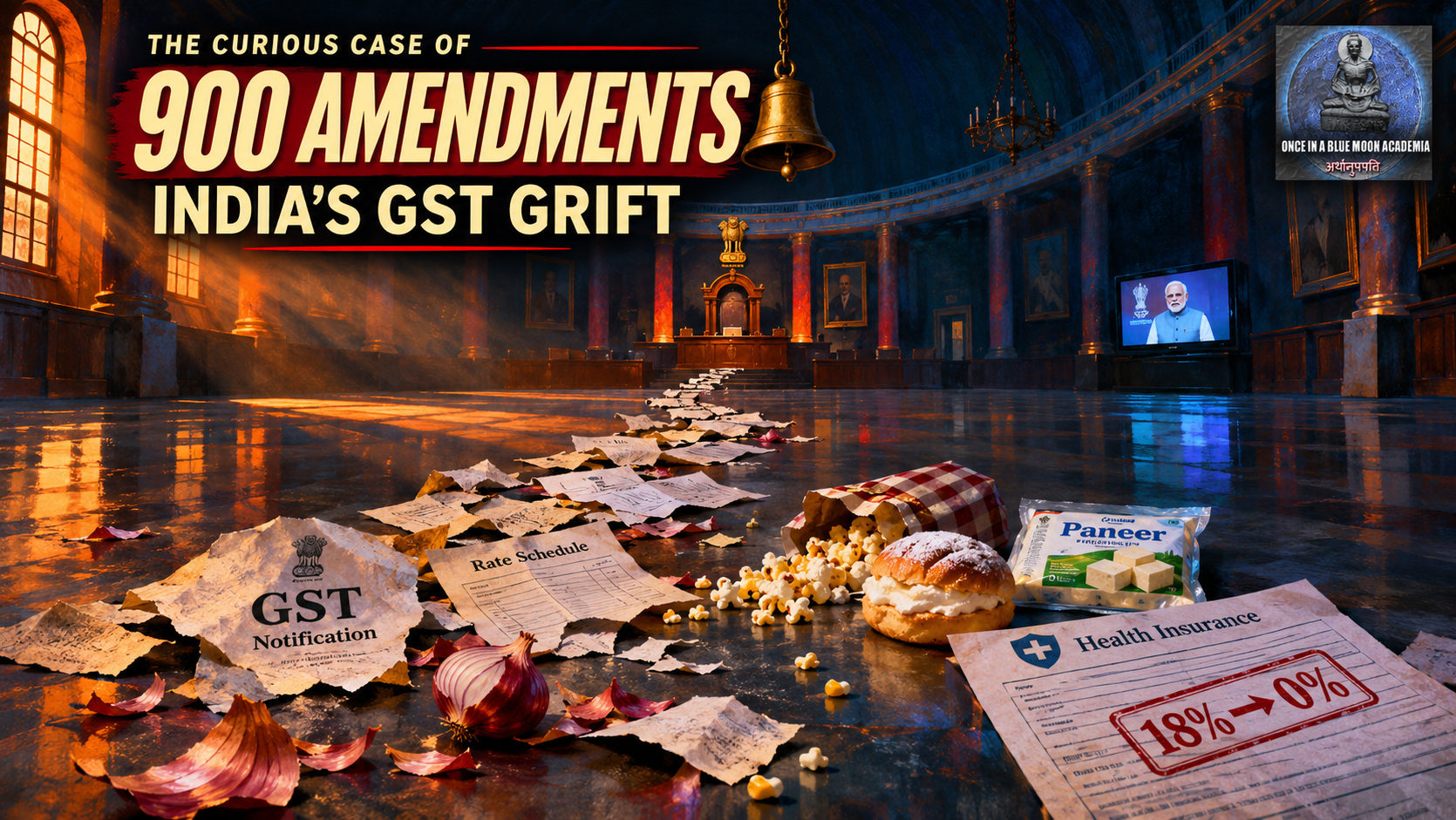
This essay argues that India’s Goods and Services Tax (GST) has ceased to be a tax imposed by the authority of law under Article 265 and has become an administered price set by the executive—an extraction the Leader of Opposition has named, with justification, Gabbar Singh Tax. Amended some nine hundred times by notification, its operative text is no longer reconstructible by the taxpayer; its constitutional forum has not met for the better part of a year; its appellate tribunal was withheld for eight years; and its retrospective amendments are validated after the fact. The States surrendered independent taxing power for a Council whose recommendations the Supreme Court has held are not binding, a compensation guarantee inverted into a debt of the States, and a simplicity that collapsed under continuous executive rewriting. Rate changes travel by notification, Money Bill, or retrospective deeming, never requiring an elected house to defend a particular decision. The schedule is arbitrary: its differentiations answer to no published governing rule. The same method that hollowed the Insolvency and Bankruptcy Code through more than a hundred and twenty regulatory amendments and six statutes has been applied, at larger scale, to the GST. The levy is regressive, timed to electoral calendars, and accompanied by no contemporaneous statement of reasons. What was presented as a unified national tax has become a continuous, unaccountable repricing of ordinary consumption. The deepest charge is that the power to tax, reclassify, and declare that the reclassification was always the law has passed into a vacancy where reasons need not be given. The Chair that could have convened the forum, tabled the reasons, and unlocked the constitutional door has not done so. The demand is that it demit the office.
