A non-schooling, counter-academiocratic praxeogogy for the network of bioregions that is Earth — learning to inhabit, tend and belong to habitats across generations in an age of polycrisis
Posted on 29th September, 2026 (GMT 03:15 hrs)
OVERVIEW
Ātmadīpa is a non-school and a praxeo-gogy: not a greener exam-machine but a commons in which a people learns to inhabit a watershed in the polycrisis — lamp and island unto itself, and in the same motion a support to others. Head, hand and heart are taught as one and never ranked; the institution is deschooled. It resists the sale of learning, the capture of the curriculum, and the credential that pretends to be knowing. Its fields are the crafts of home-as-habitat — food, water, shelter, care, dissent, grief — held free at the point of use, federated without a headquarters, open-licensed, unfinished on purpose. Kindle your own lamp. Its only use is to light the road everyone walks.
Attadīpā viharatha attasaraṇā anaññasaraṇā, dhammadīpā dhammasaraṇā anaññasaraṇā — be a lamp unto yourself; be an island unto yourself; a refuge unto yourself, seeking no other refuge; with the Dhamma as lamp, with the Dhamma as refuge, seeking no other refuge. — the Buddha to Ānanda · Mahāparinibbāna Sutta (DN 16); also Attadīpa Sutta (SN 22.43)
~ Dedication ~
To the students of May 1968 — Nanterre, the Sorbonne, the streets that would not go back to the lecture.
They did not stop at the professor, the chair, the rank. They named the structure that produced all three, and asked that the house of knowing itself be rebuilt. That demand is not finished. This praxeo-gogy takes it up: not a kinder staff in the same apparatus, but a commons that no longer reproduces the rank that masquerades as “reason”.
ORIENTATION · HOW TO READ THIS
The stance, and the two kinds of co-regulation
This is a holistic pedagogy of situated engagements and embodied praxis: nothing here is learned about the world from a seat outside it. The learner is always somewhere, in a body, among others — and that engagement is the lesson, not a field-trip appended to it. Its praxis is emancipatory in Freire’s sense: learning that reads the conditions of one’s own life in order to change them, with others. And it moves in two beats at once. Resistance and regeneration. Critique and creation. To refuse the exam-machine is only half a gesture; the other half is to grow the commons that stands in its place. To criticise the enclosure is nothing unless one also plants the seed-bank. Every field below is meant to be read twice — for what it resists, and for what it regenerates in its place.
We do not speak of governance. The word still smells of a governor: an office above the living work, a hand that administers what it does not inhabit. A commons that needs to be governed has already begun to die. What a living cell does instead is what a body does — co-regulation. Heart and breath do not obey each other; they keep each other possible. Soil, water, season, kitchen, circle and child do the same. No centre issues the pulse. The pulse is the relation.
After Kant we still distinguish two depths of this co-regulation — what he called the constitutive and the regulative, and what we call the constitutive and the procedural. A constitutive co-regulation is one without which the thing would not be what it is: remove it and there is no non-school, only a school with kinder words. That learning is a commons and never a commodity; that no learner is ranked above another; that no creed, party or proprietor may capture the curriculum; that head, hand and heart are taught as one — these are constitutive, and no cell may trade them away. A procedural co-regulation guides how the work is actually carried out, and may be set differently in each watershed: the exact age-bands, the shape of the seasonal calendar, the steps of an arbitration, the titles on a reading list. Constitutive co-regulations are the spine; procedural ones are the gait. A commons dies the day it treats its spine as adjustable and its gait as sacred. We will mark, at each turn, which is which.
I. Why this, and why now
A curriculum is a wager about what the young will need in order to live. This one is written for a century in which the old wager has already lost.
The world they were promised — stable seasons, cheap fuel, a job at the end of a syllabus, a state that would hold — is not arriving late. It is simply not arriving. Heat has left the range the Holocene taught us to call weather. Aquifers fall while cities drink from tankers. Soils thin to dust. Pollinators vanish from orchards that still look green on a brochure. Forests burn in the wet months. Rivers arrive as flood or not at all. Grain, insurance, and the power grid have begun to fail in the same season. This is not a “challenge for the next generation.” It is the ground under this one.
Earth is not one landscape but a braid of many — the delta and the desert, the high cold Himalaya and the wet Western Ghats, the black-soil plateau, the mangrove edge, the flood-fed plains of the great rivers, and, beyond the subcontinent, every watershed of a single living planet. Each is a bioregion: a territory defined not by the surveyor’s imaginary geo-political line but by its waters, its soils, its winds, and its living communities — human and other-than-human alike. To be schooled well is to be schooled somewhere: to know the name of your river, the return of your monsoon, the birds that mark your seasons, and the people and creatures who shared this ground before you. A school that pretends to teach the world while teaching no place at all teaches a fiction — and fictions drown.
Two joined forces make the fiction lethal. The first is anthropogenic global heating and the unravelling that follows it: climate, soil, water, food, breath. The second is a misleading economic order that cannot stop “growing” (at what cost?) on a finite body, now fused to authoritarian and ultra-nationalist capture — institutions seized, histories rewritten, neighbours turned into enemies while the extractive machine keeps running. Together they are not two problems on a list. They are a polycrisis: shocks that amplify one another until no single ministry, exam-board, or “resilience module” can reach them. A schooling built for the settled twentieth century — factory job, clerkship, ladder of marks, information/data-flow without wisdom — trains the young for a world that is ending and leaves them helpless in the one that has already begun.
This is Once in a Blue Moon Academia (OBMA)’s answer — not a greener exam-machine, not a reform of the rank-list, but a different premise altogether.
Ātmadīpa is not a gated garden, not a showcase or fancy eco-campus set apart from ordinary life, not a sight of site. Its campus is anywhere the work is done: the home, the kitchen, the field, the river-bank, the gymnasium, the workshop, the sickroom, the poetry-reading circle, the assembly under a tree. A green, self-reliant, decentralised village may hold it when a community can raise one; the village is not required for the school to exist. What is required is a deschooling society — learning held as a commons, not sold as a commodity. Its method is one person, three intelligences, never ranked: head, to understand; hand, to do; heart, to care. Learning is re-rooted in place, in the body, and in the commons — to grow food, to keep water, to read power, to heal, to defend without harming, to make beauty, and to grieve and endure — and never to teach contempt for those who work with their hands. The values that co-regulate it are those of a planetary commons: Earth first; need over greed; cooperation over competition; community over corporation; life over growth.
The young already know the house is on fire. What they have not been given is the right to stop rehearsing for a peacetime that will not return.
“We do not ask what the young should know for the world that was. We ask what they must be able to do, and to care about, for the world that is already here.”
II. Ātmadīpa — a lamp, and an island, unto yourself
Why a counter-academiocracy non-school takes its name from the Buddha’s last counsel — and why self-reliance and horizontal mutual aid are, here, the same lesson.
As the Blessed One neared his end, Ānanda was distressed. The Tathāgata’s counsel was attadīpā viharatha attasaraṇā anaññasaraṇā, dhammadīpā dhammasaraṇā anaññasaraṇā: dwell as a lamp unto yourself, an island unto yourself, a refuge unto yourself, seeking no other refuge; with Dhamma as lamp, with Dhamma as refuge, seeking no other refuge. In the manuscripts the word is dīpa — lamp — and, by the older twin, dvīpa — island. We take it first as lamp, without discarding the island. A lamp is what you kindle and carry. An island is what holds when the flood comes. Both are needed. To school a person is to help them kindle a light that no board can light for them, and that no board can put out. The certificate that grants permission to know can also withdraw it. The lamp cannot.
A lamp has a warning inside it. Rabindranath cautioned, in akāraṇe akāle mor porlo jakhan ḍāk, that one may be dazzled by the light of one’s own lamp: self-reliance collapsing into self-regard, the island becoming a fortress. The Tathāgata walks the way all people walk. Āmār mukti sarvajaner maner mājhe, wrote Rabindranath: my liberation lies within the minds of all. The point is not solitude. It is that no one else can do your seeing for you — and that your seeing is worthless if it does not light the road others walk.
To be a lamp unto oneself and to belong wholly to all looks like a contradiction only if one is forced to choose: self or other, independence or dependence, A or not-A. It is not a contradiction by the Buddhist anekaṁsikatā-vāda, kin to the Jaina anekānta-vāda: the many-sidedness of a thing, a setting, a situation, a moment — the refusal to let one angle stand for the whole. That logic is the founding principle of this non-school.
What looks like two selves is one motion seen from two sides. The small self that hoards its light is not yet a lamp. It becomes a Self when it is regulated with others — breath with breath, cell with cell — the way a body co-regulates, not the way a master commands. Ubuntu names the same fact without remainder: a person is a person through other persons. The “I” that can stand is already a we. Call them, if a word is needed, thus-Selves: not a fusion that erases the lamp, and not a pile of bunkers that calls itself community. A shared we in which each keeps counsel so none can be captured, and each puts that counsel at the service of the commons.
Horizontal mutual aid is that motion practised. You learn to swim so you can save another. You save seed so the next season is not owned. You kindle your own light so you need not borrow a master’s. Self-reliance without mutual aid is a bunker. Mutual aid without self-reliance is a following. Neither survives a flood.
So Ātmadīpa follows the Buddha alongside Mahāvīra, Rabindranath, Gandhi and Marx — not as a church of any one of them, but for what they share when they are not reduced to banners: the lamp that is not a guru; the many-sided truth that will not become a party line; the swaraj that begins in the person and does not end there; the dignity of those who work with their hands, against the contempt academiocracy teaches as intelligence. Kindle your own lamp. Know that its only purpose is to light the road everyone walks.
III. Non-schooling — homeschooling, deschooling, unschooling, and beyond
The tradition this non-school claims, the books it will not disown, and the one decisive way it amends them.
Ātmadīpa is a non-school. It does not pretend the critique of school began with us. The argument is older than the modern classroom, and older than the nation that built the classroom to manufacture citizens. We name the debts — Rousseau’s child in the open air; homeschooling’s right to withdraw; Illich’s breaking of the monopoly; Freire’s refusal of the deposit; Holt’s trust in the learner and in those the school called idle — then refuse to stop where those debts usually stop. What we take from each, we take as a part. What we make is a whole: a commons that can teach itself when the ladders have fallen.
III. 1. Rousseau’s Émile — nature as tutor, and the solitude that cannot scale
Any honest account of non-schooling has to pass through Émile, ou De l’éducation (1762). Rousseau saw, before the exam-machine had its present name, what a schooling of words does to a living child. He wanted an education from things, not from sermons; from the resistance of matter, the weather, hunger, the consequence of an act — not from a master pouring maxims into an empty head. “Negative education” was his phrase: do not hurry to instruct; protect the child’s power to learn from being replaced by the habit of being taught. Let the body come first. Let curiosity, not the timetable, open the next door. Let the young person meet the world before meeting the opinion of the world.
That much we keep. Head, hand and heart already live in Émile, even if Rousseau did not use those words. The child who has never tied a knot, never felt cold, never failed at a real task, and yet can recite the virtues, is the ancestor of the candidate who can define climate and cannot keep water.
But Émile is also a warning, and we read it as one. The book’s method is a single tutor and a single boy, withdrawn from the corrupt city into a carefully arranged solitude. Society is treated as contagion; other children, as interference; the household, as a laboratory that only a fortune can staff. Sophie, when she appears, is educated for Émile — not as a lamp unto herself. Nature is invoked as teacher, yet the “nature” on the page is a park kept by a man of means. The pedagogy is radical in its distrust of the school. It is conservative in its social form: one privileged child, one paid companion, a garden wall.
Homeschooling and a good deal of unschooling still live inside that wall, whether they know the name Rousseau or not. The gift is real: a child may flourish when the institution is no longer the measure of the day. The limit is also real. A method that needs a private tutor, a private garden, and a child who can be spared from the work of the house, will never be the method of a people. Émile taught Europe to look at the child. It did not teach Europe to look at the neighbour. We take the first lesson. We refuse the second omission.
III. 2. From homeschooling — the right to withdraw, without the private compound
Homeschooling named a truth the ministry will not: a child may be safer, freer, and more alive outside a captured school than inside it. The kitchen table, the garden, the parent’s time, a shelf of books — these have rescued children from humiliation, from a dead syllabus, from an institution already owned. That withdrawal can be an act of care. It is also, in its usual form, an act that only some households can afford. Time, a second adult, a room, a garden, the legal nerve to face the inspector — these are not evenly held. Émile required a fortune. Homeschooling often requires the same fortune in a quieter currency: a parent who can stay home, a house that can hold the day, a class position that makes the state hesitate before it knocks.
A pedagogy that ends at the family gate saves the child who can leave and leaves the rest inside. Privilege is not a slur here. It is a limit. We keep the right to withdraw. We refuse the privatisation of that right. No child should need a private house in order to be free of a bad school.
III. 3. From Illich — the monopoly, broken
From Deschooling Society we take the founding diagnosis, and we take it undiluted. Compulsory, institutionalised schooling teaches dependence rather than capacity. It confuses being taught with learning, grades with knowledge, the certificate with worth — and so disables the very people it claims to serve. Illich’s point was sharper than “schools are badly run.” School, as a modern institution, monopolises the semantics (meaning) of education itself. What happens inside it is called learning. What happens outside it — in the field, the kitchen, the workshop, the river, the sickroom, the elder’s yard — is made to look unofficial, amateur, lesser. The young are trained to wait for permission to know. Adults are trained to distrust any knowledge that does not arrive stamped. The certificate becomes a passport; without it, even a lifetime of competence is treated as hearsay.
That monopoly is not an accident of poor pedagogy. It is how academiocracy reproduces itself: a closed loop in which the institution defines worth, then sells the proof of worth back to those it has already ranked. Illich wanted learning-webs, skill-exchanges, tools held in common — not a better classroom. The non-school takes him at his word. Learning is not what happens when a timetable says so. Learning is what a person can do, name, mend, grow, hold, and pass on.
Illich names the monopoly. Althusser names the function. In “Ideology and Ideological State Apparatuses” the school is no longer a neutral stair to knowledge; it is, in mature capitalism, the dominant Ideological State Apparatus, the successor to the Church. What the parish once did with catechism, the classroom now does with “subjects”: it takes children from every class for years, and returns them sorted — some to command, most to be commanded — having learned not only a skill but the obviousness that this sorting is nature, merit, life. The university is the last chamber of that apparatus. It does not merely certify. It reproduces the relations of production by reproducing the relations of knowing: who may speak as science, who may only be “practice,” who must wait for a stamp before their seeing counts. Repression is reserved for the police and the exam when ideology fails; most days the ISA works by consent, by the learner who loves the rank that owns them. A non-school that will not say this will keep reforming the furniture of a machine whose job is reproduction.
The French spring of 1968 was the refusal of that consent at mass scale: Nanterre, the Sorbonne, the street that would not go back to the lecture. Daniel and Gabriel Cohn-Bendit’s Obsolete Communism: The Left-Wing Alternative is the book of that refusal — not a plea for a kinder faculty, but the verdict that official communism and the official university had become two wards of the same senescence: both managed revolt into a career, both feared the student and the worker who would not wait to be represented. What 1968 opened, the decades after tried to close. Derrida’s Eyes of the University (and the GREPH struggle that feeds it) is the long aftermath: who has the right to philosophy, who is the “teaching body,” what the university sees when it looks at itself — a profession, a reason of state, a gate dressed as enlightenment. Derrida will not let the university pretend it is only a library; its “eyes” are already an institution of who may look. Ātmadīpa takes the warning and steps aside from the building. To occupy the ISA and leave its charter standing is to become its next staff. To deschool the institution, and not the community, is the lesson 1968 taught and could not finish: no more reproduction of the rank that calls itself reason.
III. 4. From Freire — no deposit, no silence
From Paulo Freire we take the refusal of the “banking concept of education”: a teacher deposits knowledge into passive receivers who store it, return it on demand, and are graded for the accuracy of the deposit. Banking education requires a silence. The learner’s life is treated as empty until the syllabus fills it. The world the learner already inhabits — caste, hunger, flood, language, land, care-work — is treated as noise around the lesson rather than the lesson itself. Freire’s counter is dialogue and praxis: the learner acts in the world, names the world, and is changed by both. Literacy is not only letters. It is the power to read the conditions that produce one’s life, and to act upon them with others.
Where Rousseau withdrew the child from society in order to save him, Freire sends the learner back into society in order that society might be named and changed. We need both motions, and we will not choose the park over the street. There is no deposit here to be banked and later withdrawn as marks. A field is taught only when head, hand and heart are all present — understanding, doing, and care — because a deposit in the head alone is what Freire already named: a ledger, not an education.
III. 5. From Holt and the unschoolers — curiosity, and the ones the school called idle
From John Holt and the unschoolers we take trust in the learner: that the young learn most deeply from real life, real work, and their own curiosity, not from a syllabus imposed from above and enforced by the fear of the examination. Holt watched what schools do to the wish to find things out. Curiosity is not scarce in children. What is scarce is a setting that does not punish it for arriving at the wrong hour, in the wrong order, or without a learning outcome attached.
An imposed syllabus can cover a map of subjects and still leave a person unable to sow, swim, mediate, cook for many, or tell when a river is about to rise. Fear of rank does not produce depth. It produces performance: the skill of looking as if one knew.
We take, with that, the honour of the dropout. Every exam-machine manufactures its own refuse — the child who will not sit still, the one who fails on purpose, the one who walks, the one the report-card names idle, cancres, waste. Civilisations have more than once been kept alive by those the school had already written off. A people is often saved by its so-called idlers: the ones who would not be milled, who kept a craft, a question, a refusal, a different clock. Unschooling saw this and trusted it. The non-school does not romanticise failure. It refuses the sorting that produces failure as a grade, then calls the graded person empty.
Rousseau’s child was never allowed to be idle in the school’s sense, because he was never sent to school. Holt’s child is the one who was sent, and who would not stay. Both refusals matter. One is arranged by a tutor. The other is often a wound. We make room for both — the protected curiosity, and the curiosity that survived the mill.
Beyond a common core of survival and commons-literacy, each learner makes a path with a mentor. No two paths are identical. Progress is measured against the task and against yesterday’s self, never against the child beside you.
III. 6. The census of knowers, torn up
Illich’s monopoly, Freire’s deposit, Holt’s fear-exam, Rousseau’s distrust of verbal schooling: each already points to a single habit of power, the habit of deciding in advance who is allowed to know. There is no “teacher” or “professor” here, only the facilitator and the mentor. The farmer, the potter, the midwife, the boatwoman and the elder are faculty, not guests invited in to flavour a classroom after the real lesson has been delivered by someone stamped.
This is not sentiment about “local wisdom,” and it is not a costume of the vernacular. It is not a new ranking in which “indigenous” is placed above “non-indigenous,” the village above the city, the old tongue above the new — as if one list of knowers had simply replaced another. That inversion would still be academiocracy: a single angle made to stand for the whole. The logic here is anekāntavāda — many-sidedness — kin to the Buddhist refusal of one-sided assertion. A way of knowing is not true because it is ancestral, nor false because it is late; not true because it can be printed, nor false because it lives in a hand. Each is a side. The work is to make the sides sit in dialogue, answerable to the same watershed and to the same living world.
Academiocracy keeps two lists and calls the keeping science. On the first: those whose knowing can be printed, ranked, transferred, and billed. On the second: those whose knowing stays in the hands, the season, the boat, the birth, the grief — treated as background, anecdote, or “practice component.” The first list is called knowledge. The second is called help. A fashionably inverted list — heritage good, laboratory suspect; soil sacred, script colonial — is the same violence with the names swapped. The non-school tears up both lists. Competence is what has already been proven in the world, from whichever side it comes, and it is tested again in company: the seed-keeper and the plant physiologist at the same plot; the midwife and the epidemiologist in the same sickroom; the boatwoman and the hydrologist on the same rising water; the elder’s memory and the archive, neither allowed to veto the other.
The institution does not confer knowing with a title, and cannot take it away by withholding one. A person who can keep a seed-line alive is not an illustration in a module on seed. They are the module — and so is the one who can tell, without contempt, how that line sits beside another knowledge of the same plant. Pluralities are not exhibits. They are made to speak, and to be spoken back to. That is the census we keep.
The same split that ranks the stamped above the skilled is the split that ranks “culture” above “nature.” The mainstream curriculum installs that binary early, before any politics has been named. On one side: environment — a chapter, a resource, an exam question, a crisis discussed indoors. On the other: society — as if humans lived on a stage with the living world as scenery, and as if the farmer’s hand were less mental than the paragraph that describes it. Rousseau wanted the child in nature and still wrote as if nature were a tutor hired for one boy. We will not repeat that cut. The learner’s human and other-than-human neighbours are met here with the same empathy, not as a moral afterthought but as the ground of the school. A river is not a resource unit. A bird is not an extra in the human story. To know a place is to know both — or it is not knowing.
III. 7. The decisive amendment — deschool the institution: unlearning, relearning, and so on…
Deschooling and unschooling, in their usual forms, are answers for the household — the family that withdraws its child and hopes the kitchen, the garden, the parent’s time and a pile of books will suffice. Homeschooling, in its usual form, is that withdrawal with a timetable still faintly in the room. Émile is the philosophical ancestor of both: one child, one adult, a nature arranged to teach. All of this can be an act of care. None of it, left at the garden gate, is enough for a polycrisis, and none of it is enough for a commons.
A child unschooled alone in a private house can still inherit the isolation the exam-machine produces: learning as a personal project, the world as backdrop, the neighbour as optional. Exit that ends at the gate leaves the captured institution standing, and leaves those who cannot withdraw still inside it. The privileged child is freed. The rest remain the raw material of the rank-list. Rousseau’s park, reproduced at scale, is not a people. It is a set of compounds.
Ours is an answer for the commons. We do not abandon collective learning; we reclaim it. People still gather. Elders still teach. Tools, land, boats, kilns, seed, instruments and books are held in common. Work is shared, including the work the market does not see: care of infants, elders, the sick; the kitchen that feeds many; the watch when the water rises. What is refused is the gate, the fee, the rank, the official who decides who may know, and the patron who sells that decision as guidance.
A commons cannot be built only by adding new lessons to an unexamined head. The exam-machine does not merely fail to teach. It teaches the wrong things thoroughly: that worth is a rank; that the hand is lesser than the page; that the neighbour is a competitor; that nature is a chapter; that permission to know arrives from above. Those lessons sit in the body. They will not fall off because a better syllabus has been announced. So unlearning is not a preface to the non-school. It is one of its fields. To unlearn the bow, the scramble, the contempt for those who work with their hands, the hunger for a stamp, the silence that banking education trained — this is work, as concrete as sowing. Without it, the old school simply continues under kinder names.
Relearning is the other motion of the same work. What was discarded as unofficial must be taken up again: how to grow food, keep water, sit in a dispute-circle, accompany grief, read a river, mend a tool, cook for many, speak in one’s first tongue without shame. What was never taught must be learned as if for the first time, because the world that is already here was not on the old list. Unlearning without relearning is only bitterness — a critique with no seed-bank. Relearning without unlearning is only addition — new skills stacked on the old hierarchy. The non-school holds both, in one person, as head, hand and heart.
Take from Rousseau the child in the open air, and leave the wall. Take from homeschooling the courage to leave a bad room, and leave the compound. Take from deschooling the breaking of the monopoly. Take from unschooling the trust in curiosity and in those the school named idle. Bind them to the labour of unlearning what the mill installed and relearning what a living commons requires, and you do not get a softer school. You get a people that can still teach itself.
We deschool the institution. We do not deschool the community. The first without the second is only exit. The second is how a commons remains able to learn — and to unlearn, and to learn again — when the old ladders have fallen.
IV. The three resistances
Every curriculum defends itself against something. Before it teaches a single field, this one names the three forces that would empty it out — and the commitment it raises in their place. They are not local accidents of one republic. They travel. They nest in ministries and in platforms, in uniforms and in textbooks, in the head that has learned to love a master, in the artefact that looks neutral and is not.
The same three forces cross every watershed: they sell learning, they capture the house of learning, and they counterfeit learning as credential. Resist them separately if you must; they work as one filter. Sell learning, and only the paying remain. Capture learning, and only the loyal remain. Credential learning, and only the stamped remain. What is left is not a school. It is a shop, a barracks, or a registry.
The three resistances are constitutive co-regulations. A cell that abandons any one of them is no longer part of Ātmadīpa, whatever it calls itself.
Resist — I — The privatisation of learning, in all its forms
Education is a commons, not a commodity. Say it plainly: whoever sells the seat owns the room. We resist the sale wherever it appears — the tuition-shop and the fee-gated campus; the loan that turns a young life into a debt-instrument before the first harvest; the edtech platform that mines a child’s attention, data and midnight and calls the harvest “personalised learning”; the facilitator reduced to a vendor and the learner to a customer; the patent on seed and the paywall on a paper; the “world-class” brand that sells prestige while enclosing knowledge the living have already paid for in tax, in labour, and in land.
Privatisation does not only charge a fee. It decides who may enter the room where knowing is allowed to count. Knowledge that can only be bought will only ever be held by those who can pay — and will be shaped, before it is taught, by what the payer needs it to say. It arrives as philanthropy with conditions; as a ranking that turns a place of study into a logo; as a “public–private partnership” (PPP) that keeps the name public and moves the keys; as data-colonialism — the mining of the Earthian mind by servers that do not live in the watershed and do not answer to it. Even “free” can be a price. A platform that costs no rupee still charges in hours, in neural habit, in the surrender of the record of who learned what, and to whom that record will be sold.
Behind the fee stands a larger lie: that private capital must flow “freely,” and that its freedom is the freedom of a people. It is not. What is called the free flow of capital is, in the house of learning, either a flood or a monopoly — and often both. A flood: money crossing borders to buy campuses, platforms, publishing, seed, and attention, answering to no watershed and to no assembly. A monopoly: the same few firms enclosing the flood at the far end — the textbook, the test, the LMS, the ranking agency, the cloud that stores the child’s face. Corporatocracy is that double motion named as one power. It does not consult the commons. It purchases the conditions under which the commons is allowed to speak, then calls the purchase reform.
Do not be confused by the language of access. A gate with a scholarship attached is still a gate. A “free” course that harvests the learner is not a gift. A foundation that writes the lesson-plan after extracting the forest is not restitution. It is branding. Capital that cannot bear a recall, a refusal, or an open licence has no place in a school that calls itself a commons.
In its place — learning held in common: free at the point of use, funded by the community, the cooperative, and the shared surplus of work, not by the sale of access and not by the patronage of firms that live by enclosure. Materials open-licensed, copyable, translatable, adaptable to each watershed. Tools, land, boats, kilns, seed, instruments and books held as samavāya — used, mended, and passed on. No child’s data is a harvest. No river’s name is a product. No language is a premium tier. No corporation sits on the curriculum. No capital, however “impact-minded,” may buy the pulse of the cell.
Resist — II — The capture of learning by fascism, totalitarianism, and the one-story state
A learning-commons belongs to the plural public that sustains it — and to the more-than-human world that public inhabits — not to any single ideological formation, party, church, corporation, army, or strongman. We resist the capture of schools, curricula, campuses and assemblies by every creed that would turn inquiry into loyalty.
That capture has many uniforms. In one bioregion it wears the RSS–Sangh and its so-called “student” wings: history rewritten to a majoritarian-theocratic script, dissent treated as anti-national, the classroom turned into a mechanical solidarity barracks of compulsive belonging. Elsewhere it wears other names and other holy books, other races and other “civilisations,” other parties of the blood and the soil, other ministries of truth. Do not waste time arguing that this banner is the exception. The method is recognisable wherever it settles: one people made sacred, another made suspect; one past cleaned for parade; the child taught whom to fear and whom to despise. A school captured by any one creed has stopped being a school. It has become a recruitment hall.
Fascism and totalitarianism are not only what a state does with police. They live in the head — the hunger for a single story, the relief of having an enemy, the pleasure of the slogan that ends thought. They live in society — the rumour, the boycott of the shop, the silence around the beaten student. They live in artefacts — the textbook with the erased chapter; the statue that occupies a memory; the map that swallows a watershed into a nation and a nation into a myth; the anthem that must be stood for before a question may be asked; the algorithm that feeds outrage because outrage pays. An artefact can look like furniture and still be a command.
A one-story state does not always arrive with a coup. It arrives as a syllabus. It arrives as a list of books that may no longer be held. It arrives as the quiet removal of a teacher who asked the wrong question, and as the louder reward of the one who did not. If a cell cannot protect dissent in a peaceful year, it will not grow courage in a hard one.
In its place — a secular, plural, Earthian pedagogy. Many histories honestly told, including the histories of those the parade would delete. Dissent protected as a condition of knowing, not as a luxury for peaceful years. Organised religion kept out of public power without insulting the home in which a person may believe and pray. No child taught to fear or despise another. No bioregion taught that it is the centre of Earth. Loyalty is owed to the living world and to the equal dignity of those who share it — human and other-than-human — not to a banner that has captured a campus.
Resist — III — Academiocracy — rule by credential
What has already been said of academiocracy — that it mistakes the stamp for the skill, the rank for the person, the titled voice for the only voice that counts — will not be said again. Here the resistance is to the machine that manufactures that mistake and calls the manufacture administration.
We refuse the dialect of enclosure: credits, syllabi-as-marketplace, Academic Banks, rankings, reports, examinations, marks, impact factors, “learning outcomes” written to be audited rather than lived. That language is not neutral. It tells a young Earthian that learning is a pile of units to be deposited, stored, transferred, and cashed. It tells a watershed that its midwife, its boatwoman, its seed-keeper do not count until a distant board says they do. It can recite the climate and still not keep water. It can examine justice and still not sit in a dispute-circle. Recitation without capacity is not a near miss. It is the product the system was built to make.
Call the dialect by its names and do not soften them. Credits. Choice-based credit. Academic Bank of Credits. Learning outcomes. Credit transfer. Employability. Educational loan. Each word pretends to be a convenience. Together they are a conversion mill. A season of living practice is broken into units that can be stored, swapped, cashed, and audited — as if knowing were a deposit and a person a passbook. “Choice” here is the choice of a catalogue, not of a life: the learner selects modules the way a customer selects SKUs, while the bank behind the catalogue decides what will count. The loan arrives before the first harvest and names the young life a debt-instrument. Interest does not care whether the watershed flooded. The degree is then sold as the only door to naukri, and naukri as the only proof the degree was real. Study so you may be hired; be hired so the loan may be serviced; service the loan so the next cohort may be told the same story. Profit maximisation does not enter the classroom as a guest. It writes the timetable.
The equation degree = naukri is not a description of the world. It is a spell that keeps two lies in force at once: that worth is a stamp, and that a livelihood is a wage purchased with that stamp. Both collapse in the polycrisis. The stamp does not keep water. The job it purchased may already be gone, automated, or tied to the same extraction that thins the soil. Recitation without capacity was never a near miss; it was the product. This praxeo-gogy ruptures the equation on purpose. Recognition travels by what a person can do, before witnesses, in a watershed — not by a credit ledger, a transfer window, or a bank that stores learning as if it were currency. No loan sits on the learner. No module is a unit of account. No “outcome” is written to be audited by a firm that needs employees more than it needs a people who can feed themselves. Head, hand and heart are not employability skills. They are how a commons remains able to live when the ladder, the loan, and the portal have all gone dark. The degree was a ticket to a country that no longer exists. Capacity is the inheritance that does.
Academiocracy is also a politics of the throat. It installs a patron–client chain and calls it mentorship. Advancement is made to look like merit, while the real curriculum is proximity to power: who recommends, who co-authors, who sits on the panel, whose preface one writes, whose name one puts first. The unwritten paper — the “ninth paper,” after all the official ones — is eulogy. Sycophancy dressed as scholarship. Praise extracted as the price of passage; dissent marked as indiscipline; the young taught that survival in the knowledge-house means learning whose lamp must be bowed to. That is not inquiry. It is feudalism with footnotes. It trains the head for obedience and then wonders why fascism finds the campus already half-ready.
The ninth paper is not an Indian joke only. Every academiocracy on Earth has one — the loyalty oath, the impact factor, the correct theory in the correct city, the silence about the funder. The form changes. The bow does not.
The non-school has no ninth paper, because it has no patron to flatter and no client to keep. No one here eats by a supervisor’s favour. Recognition travels by demonstrated capacity before witnesses, in the watershed — the plot grown, the swimmer saved, the pot thrown, the assembly fairly held, the grief accompanied — not by a preface, a recommendation letter, or the correct hymn to the correct name. Mentorship is not a throne. Horizontal mutual aid replaces the chain: you are taught, and you teach; you are helped, and you help; no one becomes the gate through which another must pass. No ranking of one child above another. Progress is against the task and against yesterday’s self.
These three resistances are one architecture. A commons that can be bought is not a commons. A commons that can be captured is a hall waiting for a banner. A commons that can be ranked is already a market of souls. Ātmadīpa is built so that an Earthian people can still teach itself — in any bioregion, under any weather, in a home or a gymnasium or a poetry-reading circle or a village that lives the work instead of displaying it — without buying a seat, bowing to a creed, or begging a certificate for the permission to know.
V. The Earthian Constitution for the Non-School
The non-school is not a syllabus floating above a politics: it serves a movement and is governed by a charter. That charter is not restated here. The fifteen commitments — from Earth first to total disarmament — are set out in full in OBMA’s Constitution for a Living Commons, of which this praxeo-gogy is the companion and the sequel. This document presupposes them, and does not repeat them.
A word, here, on the coinage that names this document. We call it a praxeo-gogy, not a pedagogy, and the swapped root is the whole argument. Pedagogy is paidagōgia — from pais, paidos, the child, and agōgós, the one who leads — and in its origin the paidagōgos was not the teacher at all but the household slave who marched the child to school: the word encodes, at its very root, a learner reduced to a minor and a leading that is really a delivery to the institution. Andragogy only widens the cage, trading the child (pais) for the grown man (anēr, andros) while still letting the age of the learner define the act. Praxeo-gogy moves the stress twice over — from the led to the leading-forth, and from the age of the learner to the act of learning: prāxis, doing-and-reflecting, action upon a world by which one is oneself always-already changed, in Freire’s sense, joined to agōgē, a leading — but a leading-out, nearer the Latin educere, “to draw forth,” than to any putting-in. In a single word it says what the rest of these pages are: not the leading of children into a school, but the leading of persons of every age into practice; not transmission from a stamped knower to an empty vessel, but a mutual leading in which each is, by turns, lamp and island to the other. Where pedagogy asks how to instruct the young, praxeo-gogy asks how a whole community, of all ages at once, learns by doing the work its survival and its flourishing require.
Pedagogy, in the form the exam-machine perfected, does not only transmit facts. It manufactures a worldview: a picture of the world that can be held in a head, recited, examined, and left unused. A worldview is a map that has forgotten it is a map. It hangs the living world at a distance — “environment,” “society,” “economy,” “culture” — and trains the learner to stand outside the frame and comment. The comment can be radical and still be only a comment. Scientism, communalism, developmentalism, even a polished ecology-module: each is a worldview if it can be known without being inhabited. The banking concept is the factory of such pictures. Deposit the correct representation; withdraw it on demand; call the withdrawal education. A people can possess a complete worldview of the flood and still not know how to stand in one.
Praxeo-gogy refuses the picture as the aim. It flourishes worlding — worldings, plural — the ongoing making of a livable world in a body, in a watershed, among others. Worlding is not a theory of the world. It is the world being tended into being: seed in the hand, water kept, a quarrel heard, a pot thrown, a grief accompanied, a river spoken for in the circle. Anekāntavāda again: there is no one World to be viewed from nowhere; there are many worldings, each partial, each answerable to the ground they share. Home-as-habitat is that work named as vortex. The bricoleur worlds with what is at hand; the engineer of a worldview first draws the scheme and then demands that life obey it. Pedagogy asks the young to see the world correctly. Praxeo-gogy asks them to world it — and to keep worlding when the old picture has already drowned.
What the fields that follow need from the charter is only this. The commitments are the ethical spine every field of practice returns to. They are constitutive; the programmes that carry them out in a given watershed are procedural. If a lesson violates the charter, the lesson is wrong. For the commitments themselves, read the Constitution.
Likewise the constitutive act under which this commons names itself — the Earthlings’ Assembly, in which the Earthlings (also called Cosmosians: micro, meso and macro forms of life) reconstitute the world as a network of bioregions and pledge themselves to care, emancipatory praxis, equity and horizontal mutual aid — is set down in full in the Constitution, and is not repeated here.
This praxeo-gogy presupposes that pledge and begins where it leaves off. The non-school is what the Assembly’s preamble looks like once it becomes a way of learning: the Constitution names the commons; the pages that follow teach a people how to inhabit it.
The constitution, in full:
(W)holistic.
Non-Method.
The Praxeo-gogy Unfolds.
HEAD · HAND · HEART. One person, three intelligences, taught together and never ranked. This triad is the method — not a decoration on a subject-list, not a normalizing personality test, and not a story about the brain.
(W)holistic is written with the w in reach because the method refuses two reductions at once. It refuses the fragment — the head trained until it cannot lift, the hand trained until it cannot ask, the heart trained until it cannot act. And it refuses the counterfeit whole — the branding of “holistic” that leaves the watershed, the kitchen, and the graveyard outside the timetable. Whole here means the person undivided, and the person undivided from the living world they stand in. This is why the pedagogy is one of situated engagements and embodied praxis: understanding is not stored in a head that floats above the body and the place, but is enacted, in a body, in a watershed, among others.
We do not map this triad onto the skull. There is no “left brain” for the head and “right brain” for the heart; no hemisphere to honour and no hemisphere to suspect. That cartoon has been used to sort children as if their worth lived in a lobe — analytic against artistic, masculine reason against feminine feeling — and then to sell the sorting as science. A person is not a laterality. Attention, skill and care move through one nervous system, one breath, one life. The method names three uses of that life, not three organs, not three types of child.
That head, hand and heart are taught as one, and never ranked against each other, is constitutive.
| Head — to understand | Hand — to do | Heart — to care |
|---|---|---|
| The analytic intelligence — theory, history, ecology, systems, the reading of texts and of power. How a monsoon moves, how a law is written, how a price is made to look like nature, how a slogan ends thought. Understanding put in service of what the hand and heart must do — never stored as a private hoard of explanation. A head that will not get up is academiocracy begun again inside the body. | The practical intelligence — skill, craft, making, growing, mending, the competence of the body. Knot, stroke, dough, suture, tiller, kiln, voice. In the polycrisis this is the intelligence that keeps a community alive when the supply-chain and the portal both go dark. A hand that is not allowed to ask why and for whom is labour already half-owned. | The moral and relational intelligence — reverence, restraint, solidarity, courage, grief and joy. It answers not can we, but should we, and for whom. Without it the head becomes cleverness and the hand becomes force. Heart is not a mood added at the end of a worksheet. It is the discipline that keeps understanding from becoming domination and skill from becoming harm. |
A field is only taught well when all three are present. To grow food with the head alone is agronomy on paper; with the hand alone, drudgery; with the heart alone, sentiment. Together they make a farmer. To sit with the dying with the heart alone is a mood; with the hand alone, a procedure; with the head alone, a theory of loss. Together they make accompaniment. The potter is not “less mental” than the reader; the reader is not “less useful” than the swimmer. Ranking the intelligences is how academiocracy begins again inside the body — the same two lists, now worn as temperament.
Attention is the hinge
None of the three works without attention, and attention is the first thing the present order steals. The exam steals it for the mark. The platform steals it for the feed. The slogan steals it for the enemy. The timetable steals it for the bell. A pedagogy that does not train attention has already surrendered the person, however beautiful its fields.
Attention here is not a wellness product and not a mystic fog. It is the capacity to stay with what is in front of you — a seedling, a sentence, a wound, a neighbour’s claim, a rising river — long enough to see it truly and to answer it. Head without attention is chatter. Hand without attention is accident. Heart without attention is sentimentality. The non-method treats attention as a shared literacy: how to look, how to listen, how to return when the mind has been called away, how to refuse designs that live by scattering you. A cell that cannot be quiet together cannot work together. A learner who cannot give an hour to a task that does not ping will not keep a commons through a hard season.
Socio-ecologically necessary labour
At the centre of the method is a kind of work the market cannot see and therefore calls unskilled, women’s, or spare: labour performed for those who cannot labour for themselves — infants, the old, persons of special abilities — and labour done in reciprocity with the rhythms of the living world: the compost, the watch on water, the seed put by, the animal fed before the feeder sleeps. It is wilful, voluntary labour undertaken with jouissance, with āhlāda — not the grin pasted on exploitation, but the felt rightness of being needed without being owned.
Every learner does this work; no one is excused by aptitude, religion, gender, or caste. A head that is “too gifted” for the kitchen is already ranked. A hand kept only in the kitchen is already owned. Done in common, named, rotated and taught, necessary labour ceases to be someone’s fate and becomes a shared literacy — head enough to know why the work matters, hand enough to do it well, heart enough not to despise it.
Breaking the division of labour
No learner is fixed to one exclusive sphere. With Marx we hold that a good society lets one “hunt in the morning, fish in the afternoon, rear cattle in the evening, and criticise after dinner” — without ever becoming only a hunter, only a critic. The industrial school perfected the opposite: one child for the file, one for the bench, one for the kitchen, each taught to despise or envy the others. That sorting is political before it is pedagogical. It prepares a world in which some may only think, some may only lift, and some may only care — and in which the first command the other two.
The non-school makes each learner many-skilled, so that no one is trapped in a single trade and no trade is despised. Depth is not forbidden — a life may lean toward clay, or boats, or song — but the lean is a path, not a cage. Specialism that cannot cook, cannot sit with the sick, cannot name its own watershed, is not excellence. It is fragility dressed as rank.
Nine working principles
These are not subjects. They are how any subject is allowed to be taught.
- Place-based and bioregional. Learning begins from the watershed the learner stands in — its water, soil, species, weather, tongues and history — and only then reaches outward to the global. A child who can name a distant capital and cannot name the drain that floods their street has been taught to levitate. Attention starts where the feet are. (Constitutive.)
- Learning by doing, reflected upon. Praxis, not recitation: the young act — sow, mend, convene, bind, row, cook, refuse — then sit with a mentor and ask what the act taught, and who it served. An act without reflection is errand; reflection without an act is the old deposit. (Constitutive.)
- The self-made syllabus. Beyond a common core of survival and commons-literacy, each learner designs a course of study with a mentor. Curiosity sets the path; no two are identical. The core exists so a commons can live; the self-made path so a person can live inside it without being milled. (Core: constitutive. The path: procedural.)
- Seasonal, not clock-driven. The calendar follows monsoon and harvest, heat and lean months, not bells. One learns to sow when it is time to sow. Clock-time has uses — a bone does not wait for śarad — but it is not sovereign. Attention to season is attention to a world that does not run on the factory whistle. (Procedural.)
- Intergenerational, cross-generational. Elders, artisans and practitioners teach alongside facilitators; the very old and the very young learn in the same yard. Memory travels down, questions travel up, skill travels both ways. A method that isolates the young from the old has already begun to forget. (Constitutive.)
- Held in common. Tools, land, boats, kilns, seed, instruments and books are shared and cared for collectively. Who mends the tool teaches more than a lecture on property. Attention to the shared thing is political education: what is held in common must be kept, or it becomes someone’s again. (Constitutive.)
- Mother-tongue first, many tongues after. The learner thinks first in her own tongue; other languages and scripts are bridges, never a gate paid in humiliation. A mind forced to abandon its first words to be called educated has been colonised before the lesson starts. Attention begins in the language in which grief and joke already live. (Constitutive.)
- Mindful of the screen. Online materials are used where they genuinely serve — a diagram that cannot be drawn in sand, a voice that cannot come down the road — and sparingly. Behind every device: scarce metals, non-biodegradable waste, energy, and a design that wants the gaze. Do not mine the Earth and the attention to simulate a life that could have been lived. (Procedural.)
- Non-competitive. No ranking, no humiliation, no merit-list that turns a yard of learners into a market of souls. Progress is measured against the task and against yesterday’s self. The moment worth becomes scarce by design, mutual aid becomes a performance, and attention turns from the work to the neighbour as threat. (Constitutive.)
Held this way, the non-method is slow on purpose. Speed is the virtue of the mill and of the feed. The polycrisis will reward those who can stay, see, do, and care in one motion — not those who can perform a single intelligence while waiting for a specialist of another to complete them. That is the whole the w was reaching for.
Facilitators — kalyāṇa-mitra, not “teachers”
Who holds the space, why we will not call them teachers, and what they themselves must keep reading.
We do not use the word teacher, and the refusal is deliberate, not cosmetic. In the modern school the teacher is a certified authority who transmits a syllabus in an one-way manner to those presumed empty of it — the banking relation Freire named, the monopoly Illich named, the ranking academiocracy sells. The word carries the hierarchy in its grain: one who knows, above ones who do not; one who is stamped, over ones who wait for the stamp. To keep the word would be to keep the posture.
That there is no “teacher” — no certified authority set above the learner — is constitutive. The names a cell prefers for its facilitators are procedural.
In its place we say facilitator — one who makes the way easier; mentor — one who accompanies; elder and artisan — those whose competence was proven in the world, not conferred by a board; and, oldest of all, kalyāṇa-mitra, the “admirable friend” the Buddha called not the half but the whole of the holy life. The facilitator does not stand above the learner and does not own the learner’s path. They kindle a lamp and step back.
A facilitator is not a profession but a rotation. The farmer, the potter, the midwife, the boatwoman, the composer, the elder who remembers the last great flood — each facilitates the field they have lived, and each is, in another field, a learner again. No one facilitates by virtue of a degree; no one is barred by the lack of one. What a facilitator owes is not certification but two disciplines: to keep learning in the open, so the young see that no one is finished; and to refuse the patron’s throne — to build no client, extract no flattery, become no gate through which another must pass. Horizontal mutual aid is the whole of the method here too: you facilitate, and you are facilitated.
A facilitator’s own formation is never done. The following are read, argued with, and practised — not as scripture but as fellow-lamps. Why each is needed is set beside it. The list itself is procedural: each cell adds what its watershed requires.
| Pedagogy of the Oppressed Paulo Freire | The theory the method rests on: the “banking” concept refused, dialogue and conscientização in its place, and love named as a precondition of teaching. Without it, “facilitation” is only a nicer word for deposit. |
| Deschooling Society Ivan Illich | The founding diagnosis — how the institution monopolised the meaning of learning, and what learning-webs beyond it could be. The reason this is a non-school at all. |
| Letter to a Teacher (Lettera a una professoressa) the School of Barbiana (Don Lorenzo Milani & his pupils) | Written by working-class children against the school that failed them: the class violence of the exam and the “fail,” and a living proof of a poor community teaching itself. It guards the non-school against becoming a comfort for the comfortable. |
| Totto-chan: The Little Girl at the Window Tetsuko Kuroyanagi | Tomoe Gakuen and its head Sōsaku Kobayashi: a school run on trust, curiosity and joy, seen through a child’s eyes. Proof, not theory, that the young flourish when they are neither ranked nor frightened into learning. |
| On Education (Education and the Good Life) Bertrand Russell | The case for fearless inquiry and against indoctrination and nationalism in the schooling of the young — the disposition our political-literacy and science fields require. |
| The Religion of the Forest; The Message of the Forest; City and Village (Palli Prakriti); Swadeshi Samaj; Śikṣā-samasyā; The Centre of Indian Culture — Rabindranath Tagore. Poet and Plowman — Leonard Elmhirst | Learning wedded to rural reconstruction, art and the living world at Santiniketan and Sriniketan — the nearest ancestor of a bioregional non-school seeking the futuristic re-wilded Tapovana living ecosystems — and Elmhirst’s account of building it with Tagore. |
| Nai Talim writings; Hind Swaraj; An Autobiography M. K. Gandhi | Education through productive craft and the dignity of manual labour (the root of head-hand-heart), the critique of modern civilisation, and swaraj that begins in the self and does not end there. |
| Small Is Beautiful; and A Guide for the Perplexed E. F. Schumacher | Economics as if people and the planet mattered — appropriate scale and technology, the backbone of the austerity and commons fields; and a critique of the knowledge that forgot the levels of being: an epistemology adequate to its object. |
| The Spell of the Sensuous David Abram | A phenomenology of perception and language in the more-than-human world: the ground beneath our refusal of the nature/culture binary, and of learning as embodied, situated reciprocity with a living earth. |
And, as the list grows — not as scripture, not as a second exam, but as fellow-lamps a facilitator keeps reading in the open, so the young see that no one is finished:
bell hooks, Teaching to Transgress — engaged pedagogy; the whole person in the room; education as freedom and as love. The temper of our checks-and-balances: no cell may claim the commons while humiliating the body that entered it.
Augusto Boal, Theatre of the Oppressed — theatre as rehearsal for change, not as ornament after the “real” lesson. The craft behind the people’s-theatre field: injustice staged so a community can see it, argue it, and act.
Masanobu Fukuoka, The One-Straw Revolution — natural farming, and the humility of doing less to the land. Against the input that poisons the plot it claims to save.
Aldo Leopold, A Sand County Almanac — the land ethic; thinking like a mountain. The sentence that will not let a watershed be filed under “environment.”
Félix Guattari, The Three Ecologies, with Arne Næss’s ecosophy — environmental, social and mental ecology held as one. The frame the “Three Rs of ecosophy” field is built on: reduce, reuse, regenerate — from the waste-bin to the soul.
J. C. Kumarappa, Economy of Permanence — a Gandhian ecological economics from this soil; degrowth before the word; permanence against the growth that eats its host.
J. Krishnamurti, Education and the Significance of Life — freedom from conditioning and fear as the aim of learning. Without it, “facilitation” is only a quieter command.
Rachel Carson, Silent Spring — why the fields refuse pesticide, told as it first broke: the quiet that follows when the living world is treated as a resource and then is not there.
Robin Wall Kimmerer, Braiding Sweetgrass — reciprocity with the more-than-human as a way of knowing, not as décor on a module. Gift against property; gratitude against extraction.
B. R. Ambedkar, Annihilation of Caste — so that a commons on this subcontinent confronts caste head-on, and its justice-circles never reproduce the khap under kinder words. A learning-commons that will not name caste will recreate it.
James C. Scott, Seeing Like a State — why a distant centre cannot know a watershed, and why the map that simplifies a place in order to rule it will starve that place. A warning against any non-school that begins to love its own scheme more than the ground.
Hannah Arendt, “The Crisis in Education” (in Between Past and Future) — education as the act of loving the world enough to take responsibility for it, and loving the young enough not to strike from their hands the chance of beginning something new. Against both the stuffing of the old and the abandonment that calls itself freedom. Natality, not rank, is what a school owes the child.
John Taylor Gatto, Weapons of Mass Instruction — the school as a weapon that teaches dependence, ranking, and the habit of waiting for permission. Read it so no cell mistakes a kinder timetable for freedom. Compulsory schooling, in Gatto’s telling, is not a failed kindness. It is a successful factory of the managed self. The non-school takes the charge and answers it by refusing the factory, not by painting it green.
Add to it. Argue with it. Translate it. A canon that stops growing has become a syllabus, and a syllabus is what we left behind.
· For Gen Z, Gen Alpha, Gen Beta · and those after · · · ·
This curriculum is written first for the generations who did not cause the polycrisis and will live their whole lives inside it.
They were handed a bill they did not run up. Heat, thin soil, falling water, a politics of the enemy, a feed that never sleeps — this is not the weather of their old age. It is the weather of their youth. The old promise — study hard, climb the ladder, consume your reward — is not merely broken. It is a map to a country that no longer exists. To keep handing them that map is not guidance. It is a lie.
Gen Z came of age with the climate strike and the smartphone in the same hand: fluent in networks, trained to perform a self in public, and already tired of being told the future would wait. They watched adults grade essays on sustainability while the aquifers fell. They learned, early, that a like is not a commons and a petition is not a harvest.
Gen Alpha are the first who have never known a world without the emergency. They were raised by the screen as much as by the yard — some of them only by the screen. The catastrophe is not a chapter they will meet later. It is the air in which they learned to speak. Attention was harvested before they had words for theft.
Gen Beta, born now, and those after them, will inherit whatever we manage to keep alive — seed-lines, aquifers, skills, a language for grief that does not collapse into despair, or the absence of all four. They will not be able to “go back.” There is no back.
So this non-school gives them a different inheritance. Not a softer ladder. Not a green module stapled to the same exam. An inheritance of capacity — and a duty older than the exam-machine:
From the standpoint of a higher economic form of society, private ownership of the globe by single individuals will appear quite as absurd as private ownership of one man by another. Even a whole society, a nation, or even all simultaneously existing societies taken together, are not the owners of the earth. They are only its possessors, its usufructuaries, and, like boni patres familias, they must hand it down to succeeding generations in an improved condition.
— Karl Marx, Capital, Vol. III
Not owners. Possessors. Usufructuaries. Good heads of a household whose house is the living world. The non-school takes that sentence as a charge, not as décor. To leave the Earth better than we found it is not a slogan for a brochure. It is the measure of whether this generation was taught, or only entertained while the ground was sold.
It makes them earth-natives as well as digital natives: as able to raise food, keep water, read a slope, and answer a flood as to read a feed. Fluency with the screen is not denied and not worshipped. It is met with discernment and data self-defence — the literacy to see the outrage-machine, to refuse the harvest of their attention, to use a tool without becoming its raw material. Pretending the screen away would be another adult lie. Handing them to it would be the first one, completed.
It takes their climate grief as knowledge, not as a mood to be managed. The grief is accurate. Species are gone. Places they were promised are already not there. Naming that is not pessimism. It is honesty. The work is to turn mourning toward resolve — toward the plot, the pond, the neighbour, the assembly — rather than toward the numbness the feed prefers, or the rage a banner will rent.
And it refuses to set them against one another. No rank. No merit-list. No manufactured scarcity of worth. A generation already priced, scored, and compared from the cradle does not need one more market of souls. Progress is against the task and against yesterday’s self. Mutual aid is not an extra-curricular. It is how they survive what is coming — and what has already arrived.
They do not owe the twentieth century a performance of its optimism. They owe the living world their attention, their skill, and their care — and a planet handed on improved, not stripped. That is the inheritance. The rest was advertising.
The bioregional cell(s) and the village of Ātmadīpa
· STRUCTURE ·
Not a building with a gate, but a learning-commons rooted in one watershed — and, where a community can raise it, a green, self-reliant village to hold it.
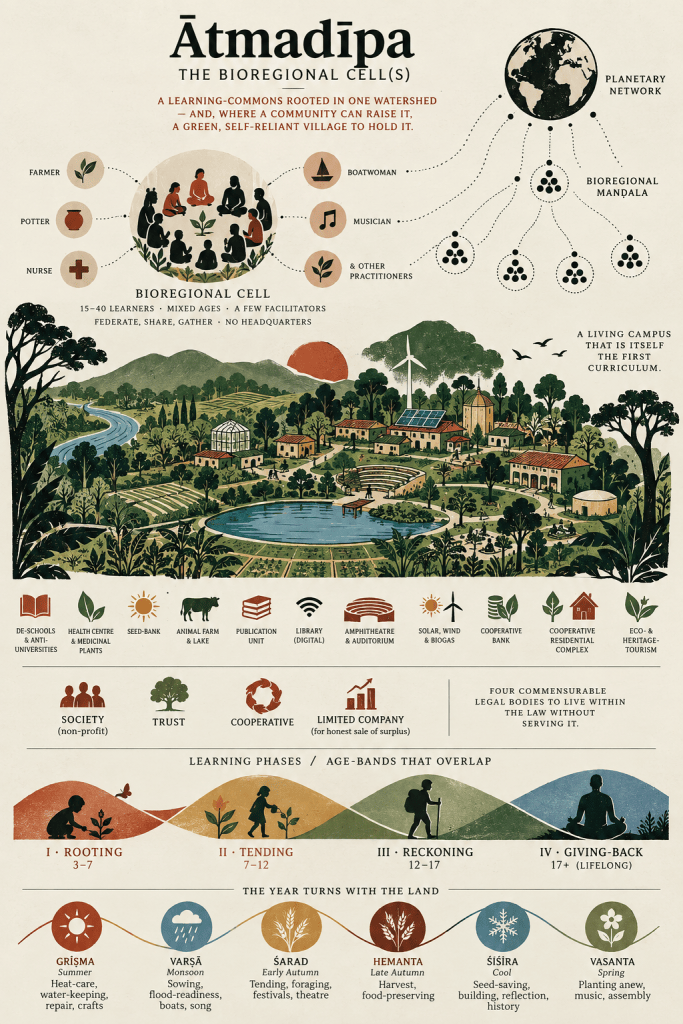
The base unit is the bioregional cell: fifteen to forty learners of mixed ages, a few facilitators (never called masters), and a rotating circle of local practitioners — a farmer, a potter, a nurse, a boatwoman, a musician. Cells federate into a bioregional maṇḍala and thence into the wider planetary network, sharing open materials and gathering for seasonal assemblies — but no cell is governed from above, and there is no headquarters to capture or to buy.
Where a community can raise it, the cell is housed in a green village — Ātmadīpa — a living campus that is itself the first curriculum. It runs without fossil fuels (which breed gadget-fetish energy-slaves), on solar, wind and biogas; it grows much of what it eats without pesticide, chemical fertiliser, HYV or GM seed; it builds in earth, brick, bamboo, straw and wood. It keeps an indigenous seed-bank, a medicinal-plant garden (ciranjīva-vanauṣadhi), an animal farm and a lake. And it holds four commensurable legal bodies so it can live within the law without serving it: a Society (non-profit), a Trust, a Cooperative, and a Limited Company for the honest sale of the surplus it makes.
Learning groups — age-bands that overlap, and are meant to
Learning is arranged in four phases keyed to capacity. Rough age-bands are given so that a mixed-age commons can plan its days — but the bands are procedural, not constitutive: a scaffold, not a sorting.
| Phase | Age (rough) | Focus |
| Phase I · Rooting | roughly ages 3–7 | Senses, body, mother-tongue, the names of near things — plants, birds, the river. Play, story, water-confidence, care of animals and elders. The heart is opened before it is tested. |
| Phase II · Tending | roughly ages 7–12 | Real skills in earnest — sowing and harvest, swimming, clay, the first instruments, first aid, maps and seasons, the tending of animals. The hand becomes competent; the head learns to ask why. |
| Phase III · Reckoning | roughly ages 12–17 | Systems and power — ecology, political and economic literacy, disaster response, the martial arts, the history and philosophy of science, plural history. Real responsibility within the cell. |
| Phase IV · Giving-back | roughly ages 17 and up (and, in truth, lifelong) | A chosen depth of craft, and the turning outward: the learner mentors the younger, carries relief, holds a plot, leads a boat. Learning completes itself by being given away. |
The bands overlap and are porous by design. A learner sits in different bands for different fields at once: a ten-year-old may row with Phase III on the river in the morning and root with Phase I in the seed-garden in the afternoon. No one is held back or pushed on by a birthday; readiness for a field, not age, moves a learner within it. Elders re-enter the youngest band to learn a craft they never had; the young cross up to carry real responsibility when they are ready. The bands exist so that a mixed-age commons can plan its days — never so that it can rank its children by year.
What a full Ātmadīpa village holds:
A full Ātmadīpa village holds de-schools and anti-universities; a holistic-health hospital and medicinal-plant garden; a Vipassanā gṛha (meditation hall, open to all, binding on none); an open-pollinated, locally held seed-bank; an animal farm and a lake; a publication unit; a library with digital facilities; an amphitheatre and auditorium; solar, wind and biogas, with no fossil tether; a cooperative bank that minimises money and refuses ribā; a cooperative residential complex; and infrastructure for eco- and heritage-tourism that serves the settlement, not a brand. None of this is required for a cell to exist. All of it is how a cell becomes a place — a settlement that is the first curriculum, displaying nothing it does not live.
Ātmadīpa learns from fellow-travellers rather than authorities — among them Schumacher College; Bija Vidyapith (Navdanya’s Earth University); the Bhoomi Prakriya School and Bhoomi College; Swaraj University and Shikshantar; the Eklavya (Hoshangabad) tradition; Barefoot College at Tilonia; SECMOL in Ladakh; Marudam Farm School; Digantar; the Rishi Valley school of the Krishnamurti foundations; the Centre for Alternative Technology and Black Mountains College in Wales; Universidad de la Tierra (Unitierra) in Oaxaca; and the wider Ecoversities Alliance. None of these is a “model” to copy. Each is a lamp already lit in another watershed — to be argued with, adapted, and never installed as a franchise.
The year still turns with the land — Grīṣma, Varṣā, Śarad, Hemanta, Śiśira, Vasanta — but the Capitalocene has pulled the turning out of true. The old almanac was a covenant with a Holocene that capital has spent. Heat no longer keeps to grīṣma; it arrives early, stays late, and kills in the night. The monsoon may fail, flood in a week, or come as a sky that will not decide. Śarad can be smoke. Hemanta can be a harvest that never fills the store. Śiśira can pass without cold enough to rest the pest or set the seed. Vasanta can bloom in the wrong month, then burn. A calendar recited as if the seasons were still obedient is another exam: right names, wrong world.
So the non-school keeps the six ritus as a spine, not as a guarantee. Each season is taught twice — as the land once kept it, and as the land now breaks it. The work of the year is attention to that break, and the skill to act inside it.
Grīṣma · summer — heat-care, water-keeping, repair, indoor crafts; and now the literacy of extreme heat: who dies first, how to cool a room without the grid, when the body has had enough, how a city becomes a kiln.
Varṣā · monsoon — sowing, flood-readiness, boats, song; and now the literacy of a monsoon that will not keep its word: late seed, drowned seed, the boat as ambulance, the song as roll-call when the water rises in the night.
Śarad · early autumn — tending, foraging, festivals, theatre; and now the work of reading a season that may be smoke, unseasonal rain, or a festival held in a field that failed.
Hemanta · late autumn — the great harvest, food-preserving; and now the work of a harvest that may be thin, early, or taken by wind — storing against absence, sharing without the fiction of surplus.
Śiśira · cool — seed-saving, building, reflection, history; and now the work of saving seed from a year that did not resemble the last, and of telling the history of why the cold no longer comes when it should.
Vasanta · spring — planting anew, music, assembly; and now the work of planting into uncertainty, of assembling not only to celebrate return but to decide what the watershed can still bear.
Clock-time has uses — a bone does not wait for śarad — but it is not sovereign, and neither is the remembered season. The year is procedural. What is constitutive is this: one learns to sow when it is time to sow in this watershed, in this year, not when a syllabus or a nostalgia says so. A child who can name the six ritus and cannot tell that this varṣā is not last year’s has been taught an almanac, not a place.
Fields of practice — the non-syllabus
Twenty-eight fields in six clusters — the core survival competences and the wider arts of a whole life. Each is taught as head, hand and heart together, never as a subject to be examined and forgotten. Read each twice: for what it resists, and for what it regenerates.
Home-as-habitat — the dynamic vortex, not the blueprint
The ultimate aim of this praxeo-gogy — ultimate, not absolute; a vortex, not a last word — is home-as-habitat. Not a house as asset. Not a campus as brand. Not a nation as enclosure. A place a people can inhabit across generations: soil that still holds, water that still comes, a kitchen that still feeds many, a tongue that still remembers, a circle that can still hear a quarrel without becoming a hunt. The polycrisis is, before it is anything else, a crisis of habitat. To learn, here, is to become able to keep a home in a world that is unmaking homes.
Habitat is not a plot on a deed. It is the living relation among bodies, other-than-human neighbours, weather, tools, stories and the dead. A house can stand on stolen ground and still not be a home. A cell under a tree can be one. Ātmadīpa’s campus-anywhere is already this claim: wherever the work is done, inhabiting has begun. The green village, when a community can raise it, is the same claim made thick — a settlement that is the first curriculum. Neither form is a product to be delivered. Both are habitats under care.
Building, then, is not the engineer’s predetermined blueprint — the typecast plan that arrives with its materials already specified, its rooms already named, its inhabitants already fitted to the drawing. That is how academiocracy builds a syllabus and how capital builds a township: first the scheme, then the life made to obey it. The praxeo-gogy works as the bricoleur works. It starts from what the watershed already holds — clay, bamboo, an elder’s memory, a broken tool, a seed-line, a language, a grief — and composes with remnants, signs and skills at hand. The form emerges. It is revised by flood, by harvest, by the child who asks a better question. Emergent properties are not a failure of planning. They are how a living system stays alive. A blueprint that cannot be surprised is already a tomb.
So the twenty-eight fields below are not subjects toward a certificate. They are the crafts of habitat: how to feed a place without poisoning it, how to raise shelter from the ground, how to keep water, how to sit in a dispute, how to mourn what will not return, how to hand the Earth on improved, as boni patres familias, not as owners. No field is the whole house. Together they are how a home is tended into being — and tended again when the season breaks. The aim is ultimate because every path returns to it. It is not absolute because no habitat is finished, and no cell may freeze a dwelling into a model and sell the model as the world. Kindle the lamp. Keep the island. Inhabit.
Cluster A — Living in and with the land
Provisioning a community from its own watershed, without poisoning it.
01 Ecology and the Three Rs of ecosophy
Reduce, reuse, regenerate — read from the waste-bin to the collective spirit.
The familiar reduce–reuse–recycle is the doorway, not the room. Read at three depths after the manner of an ecosophy: materially (reduce, reuse, repair), socially (refuse the manufactured want, redistribute, repair the bonds between people), and inwardly (reverence, restraint, regeneration — leaving every system richer than you found it). Nature is met as an intimate an-other, never as a resource or exploitable “Other”.
| Head — to understand | Hand — to do | Heart — to care |
| Systems ecology, the three ecologies (environmental, social, mental), material and energy flows, deep-ecology and ecosophy thought, the limits of a finite planet. | Composting, repair and upcycling, zero-waste household practice, energy and water audits, making the new from the discarded. | Reverence, restraint of appetite, refusing manufactured wants, the felt sense of belonging to a living whole rather than owning it. |
02 Farming and permaculture
To feed one’s people from one’s own ground, without poisoning it.
Growing food across the whole cycle by agroecology and permaculture (not the commodified green capitalist enterprise of “organic farming”) — polyculture over monoculture, care of soil life over bought inputs, water grown into the land. No pesticides, chemical fertilizers, GMOs or HYVs. The learner meets the questions of land, seed sovereignty, debt and the middleman, and the dignity of the one who grows what everyone eats.
| Head — to understand | Hand — to do | Heart — to care |
| Soil science, water and nutrient cycles, agroecology and permaculture design, seed genetics and saving, the economics of food, land and seed sovereignty. | Preparing ground, composting, sowing, transplanting, irrigation and water-harvesting, harvest, storage, cooking and preserving. | Reverence for soil as living; the dignity of the cultivator; sharing the harvest; the patience of a season. |
03 Foraging, fishing and the hunt — for need alone
To take only what is needed — never for vengeance, vanity, or taste.
The wild larder, under a strict ethic. Foraging greens, tubers, fruit, mushrooms and honey; fishing the rivers, ponds and coasts; and — only where subsistence truly requires it — the humane, wasteless taking of game. (The keeping of domesticated animals is its own field; see 04. Animal husbandry.) Far more gathering than hunting, and always within what the land can replenish. The learner is taught, above all, the difference between a people who live off the surplus of a healthy ecosystem and a people who consume its capital.
Factory farming is forbidden here, not as a taste and not as a brand of kindness, but as a destruction of habitat. The crate, the debeaking, the antibiotic lagoon, the animal reduced to a meat-mountain — these are not husbandry. They are the same extractive machine that thins soil and poisons water, now turned on a fellow body. Need may take a life; the industrial scale may not. A cell that buys cheap protein from that system has already spent the commons it claims to teach.
| Head — to understand | Hand — to do | Heart — to care |
| Field identification, edibility and toxicity, the behaviour and ecology of wild animals, carrying capacity, the ethics and law of the wild, indigenous knowledge. | Foraging, tracking, safe gathering and processing, honey-collection, fishing, and — only where subsistence requires — the humane, wasteless taking of game. | Restraint as first principle; taking only from need; gratitude and grief toward what is taken; leaving enough for the future and for others. |
04 Animal husbandry and the herd
To keep fellow life forms as kin and co-workers, not as machines or meat-mountains.
The small mixed farm keeps animals as the old reciprocity intended: the cow and buffalo for milk and dung; the bullock and pony for draught; hens and ducks for eggs and pest-control; goats and sheep where the land suits them; the bee for honey and for the pollination without which the orchard fails; the pond-fish; the working dog. They are fed before the feeder sleeps, named, doctored, and allowed the lives of their kinds — never the crate, the debeaking, the antibiotic lagoon of the factory farm, which both the charter’s Earth-first and the health field’s refusal of the sick-society forbid. Their dung is not waste but the turning-point of the whole village: into compost for the seed-field (see 05) and into the biogas that lights the kitchen (see 26). Where a community holds to a fuller ahiṁsā it may keep animals only for labour, milk, dung and companionship and take no life at all; that is a cell’s own settlement to make. What is constitutive is the refusal of cruelty and of the industrial scale; the rest is procedural.
| Head — to understand | Hand — to do | Heart — to care |
| Animal physiology, behaviour and welfare; breeds and their fit to the bioregion; the dung–compost–biogas cycle; the ecology and ethics of keeping and of killing; herd health and zoonoses. | Milking, feeding and foddering, sheltering, birthing and doctoring animals; poultry and duck keeping; beekeeping; managing draught animals; turning dung to compost and to biogas; humane handling. | The animal as kin and co-worker, not commodity; the debt owed to what labours and feeds us; tenderness in husbandry; the gravity of any taking of life. |
05 Seed, soil and composting
The living foundation under all farming, held as a commons.
Saving and exchanging open-pollinated seed, building soil, composting and vermiculture, and keeping the indigenous seed-bank against corporate enclosure. The most quiet and most decisive competence of a self-reliant people.
| Head — to understand | Hand — to do | Heart — to care |
| Seed biology and selection, soil ecology and fertility, the politics of seed patents and enclosure. | Seed-saving, sorting and storing, compost and vermicompost, soil-building, running a seed-bank. | Stewardship across generations; the seed as gift, not property; patience with slow, invisible work. |
06 Water literacy and rainwater harvesting
In a land of falling water-tables and rising seas, water is the decisive skill.
Knowing, keeping and cleaning the water of the watershed — ponds, wells, aquifers, rooftop and catchment harvesting, greywater, the restoration of tanks and the lake at the village heart.
| Head — to understand | Hand — to do | Heart — to care |
| Hydrology, the water cycle, aquifers and recharge, water quality and contamination, watershed thinking. | Rainwater harvesting, well- and tank-care, greywater systems, testing and cleaning water, restoring a pond. | Care of a shared source; thrift with a finite thing; respect for the river as living kin. |
Cluster B — Making, cloth and shelter
Roti, kapṛā aur makān — food, clothing, shelter — made by the hands that use them.
07 Pottery, clay and handicraft
From the earth beneath the feet, the vessels of a life.
To dig clay, shape it, fire it and bring forth a pot — earth, water, fire, air and hand in a single act — alongside the wider handicrafts of the bioregion in cane, bamboo and natural fibre. Self-provision against the disposable market, and the dignity of the artisan restored.
| Head — to understand | Hand — to do | Heart — to care |
| Materials — clays, glazes, fibres, temperatures; the chemistry of firing; design and function; the history and economics of craft. | Digging and preparing clay, wheel and hand-building, kiln-building and firing, weaving cane and bamboo, making useful things from scratch. | Patience with material, the dignity of the maker, care for the well-made and lasting object, refusal of the disposable. |
08 Handloom, fibre and natural dye
Cloth from the region’s own fibres, sparing the rivers and the animals.
Spinning, handloom weaving and natural dyeing in the khadi lineage of self-provision. No dyes that destroy rivers and aquatic life; the use of wool, leather and other animal exploitation discouraged. Mending and making garments rather than buying the fashion-brand’s manufactured trend.
| Head — to understand | Hand — to do | Heart — to care |
| Fibres and their sources, the chemistry of natural dyes, the ecology of textile pollution, the political economy of fast fashion. | Spinning, warping and weaving on the handloom, natural dyeing, cutting, sewing and mending. | Refusal of manufactured trend; care for the river the dye would have killed; thrift and the pride of the made garment. |
09 Building with earth — green resilient architecture
Shelter from what the ground gives, raised by its dwellers.
Biophilic, Earth-centred design in soil, brick, straw, bamboo, stone, lime and wood — replacing heat-trapping reinforced concrete. Horizontally distributed, many-layered settlements rooted in bioregional reality, not vertical skyscrapers. Climate-wise, low-carbon, repaired and raised by the people who live in them.
| Head — to understand | Hand — to do | Heart — to care |
| Building science, thermal comfort and passive cooling, earth and bamboo construction, biophilic and bioregional design. | Mud, brick, bamboo, thatch and lime building; carpentry; passive-cooling techniques; repair and maintenance of the structure. | Shelter as commons-work; care for the settlement’s fit to its land; the dweller as builder, not tenant. |
Cluster C — Body, survival and care
The intelligences that keep a community alive when the flood, the fire, or the fever comes.
10 Swimming
In a land of rivers and rising seas, water-confidence is a life kept.
Every learner becomes a confident swimmer — able to save their own life, to rescue another, and to work in flood. Taught early and without fear, it binds directly to disaster response and to boat-work: the swimmer is the community’s first line when the water rises.
| Head — to understand | Hand — to do | Heart — to care |
| Water safety, currents and tides, cold and exhaustion, the physics of floating, the health of the water one swims in. | Strokes and endurance, treading and floating, diving, breath-hold, water rescue and tows, swimming in flood. | Courage without recklessness, calm in deep water, the will to save another, love of the living river. |
11 Boat-rowing and river-craft
The river is a road, a larder, and a danger. To handle a boat is to be at home on it.
Rowing, poling and handling small craft; reading current, tide and weather; fishing and carrying from the water; and using the boat in flood-relief, when it becomes the most valuable object in a drowned landscape — including the making and mending of the boat itself.
| Head — to understand | Hand — to do | Heart — to care |
| Currents, tides and weather; river ecology and navigation; flood hydrology; the livelihoods of river-peoples. | Rowing, poling and steering; loading and balance; rescue and ferrying in flood; boat-building and repair. | Respect for the river’s power, care for fellow passengers, solidarity in rescue, honour for the boat-peoples’ knowledge. |
12 Survival skills
To stay alive, and keep others alive, when the systems fail.
The bedrock competences for a world of interruptions: fire, shelter, safe water and food in the open, navigation without a device, knots and cordage, weather-reading, and the calm that makes all of them work. A compulsory training, practised until it is reflex.
| Head — to understand | Hand — to do | Heart — to care |
| Wilderness and situational awareness, the physiology of exposure, navigation and orientation, risk assessment. | Fire-making, improvised shelter, water purification, foraging under pressure, knots, signalling, navigation. | Composure under hardship, self-reliance joined to mutual aid, the discipline to prepare before the crisis. |
13 Disaster management and response
When the flood comes — and it will come — a trained community saves itself.
Not a specialism but a basic literacy of survival, and the peacetime purpose to which even the old military energies should be turned (see 23). Every learner, by Phase III, is a competent first responder for the hazards of their bioregion and a builder of the mutual-aid networks that outperform any distant agency in the first, decisive hours. Taught as thirteen linked capacities:
THE THIRTEEN CAPACITIES
- (a) Flood & inundation — early warning, evacuation, sandbagging, safe water, the swimmer’s and boatwoman’s role.
- (b) Cyclone & storm-surge — warnings, shelter, securing homes, coastal-surge protocols.
- (c) Heatwave & extreme heat — heatstroke, cooling, hydration, protecting elders, infants, outdoor workers.
- (d) Drought & water scarcity — rationing, rainwater capture, protecting the vulnerable, crop and livestock triage.
- (e) Earthquake — drop-cover-hold, safe structures, post-quake search, gas and fire hazard.
- (f) Fire — forest & settlement — prevention, firebreaks, escape routes, extinguishing, burn first aid.
- (g) Landslide — reading unstable slopes, warning signs, evacuation in hill bioregions.
- (h) First aid & triage — bleeding, CPR, fractures, shock; sorting many casualties by need.
- (i) Search, rescue & evacuation — water rescue, carries, safe extraction, accounting for every person.
- (j) Psychosocial first aid — steadying the frightened, grief support, care of children, the responder’s own mind.
- (k) Early-warning & communication — forecasts, phone-trees, radios, runners when the network fails.
- (l) Epidemic & community health — isolation, sanitation, safe water, rumour-control, home care of the sick.
- (m) Relief, shelter & logistics — fair distribution, latrines, clean water, shelter, protecting relief from capture.
| Head — to understand | Hand — to do | Heart — to care |
| Hazard and vulnerability mapping, the science of each hazard, incident coordination, why mutual aid beats delayed rescue. | First aid, CPR, water rescue, firefighting, shelter-building, safe-water and sanitation drills — practised to reflex. | Steadiness under fear, care of the most vulnerable first, solidarity over panic, and tending to grief — one’s own and others’. |
14 Martial arts — self-defence without violence
Strength enough never to need it; discipline that makes gentleness a choice.
Karate, kung-fu and the older art of kalaripayattu — and with them tai chi and jiu-jitsu — taught not to make fighters but people who need not fear and therefore need not attack. True skill is inseparable from restraint: self-defence, the shielding of the vulnerable, the courage to stand between a bully and the bullied — never aggression, never vengeance.
Each art is a different literacy of the same ethic. Kalaripayattu is the older body of this soil: breath, oil, the ground under the foot, a discipline that predates the ring. Karate and kung-fu train the standing body to meet force without becoming it — distance, timing, the refusal to freeze. Tai chi is the slow school of the same intelligence: balance, yielding, attention held in the joint and the breath; it is how an elder, a smaller frame, or a shaken nervous system learns that strength is not speed. Jiu-jitsu is the art of the ground — how to fall, how not to be pinned, how a smaller body can end a larger one without striking to maim; it is the craft of getting home when the fight has already closed the distance. Together they refuse two lies: that peace is the absence of skill, and that skill must look like a weapon. A cell chooses its forms by the watershed and the bodies in it. What is constitutive is the end: command of one’s own anger, humility in strength, courage in defence of the weak, the discipline never to strike from vengeance.
| Head — to understand | Hand — to do | Heart — to care |
| The philosophy and history of the arts, the ethics of force, de-escalation and when not to fight, anatomy and the body’s limits. | Forms and technique, breath and balance, falling safely, controlled sparring, conditioning, the skills of self-defence. | Command of one’s own anger, humility in strength, courage in defence of the weak, the discipline never to strike from vengeance. |
15 Community health and holistic healing
Be healthy as a ‘We’, not as an isolated ‘I’.
Place-based, holistic, care-centric health against the ‘medical nemesis’ of over-medicalisation, Iatrogenesis and prescription-culture for-profit. Prevention, nutrition, movement, relationship and ecological well-being first; herbal and traditional knowledge from the medicinal-plant garden alongside modern medicine; the midwife’s and elder-carer’s art; a life that needs few medicines because it is well-lived.
| Head — to understand | Hand — to do | Heart — to care |
| Nutrition and prevention, the epidemiology of a place, herbal and traditional systems, the political economy of the pharmaceutical and hospital industries. | First aid, growing and preparing medicinal plants, birthing and elder-care support, hygiene and sanitation, community-health practice. | Health as a shared condition of the ‘We’; care for the sick as everyone’s work; refusal of the sick-society that profits from disease. |
Cluster D — Mind and inquiry
Rigorous thought without the degree-disease — inquiry freed from the examination.
16 History of Science(s)
To know how knowledge was won — and by whom, and at what cost.
A compulsory field spanning the natural, physical and social sciences: how ideas rose, fell and were fought over; whose contributions were erased; how science has served both liberation and domination. History that inoculates against both blind scientism and anti-science superstition.
| Head — to understand | Hand — to do | Heart — to care |
| The development of the sciences across cultures, major revolutions and controversies, science and power, suppressed and non-Western contributions. | Reading primary sources, reconstructing historical experiments, building timelines and cases, archival and oral-history work. | Humility before how hard knowledge is won; scepticism of authority; honour for the erased and the anonymous. |
17 · Philosophy of science & research methodology
To ask not only what we know, but how we know it, and whether we should.
The reflective core of a thinking community — across the natural, physical and social sciences: evidence, inference, paradigm and proof; the ethics and limits of inquiry; and the practical craft of research, so that learners can investigate their own bioregion’s questions honestly.
A method that pretends to be the only method is already a politics. The exam-machine sells one: hypothesis, control, write-up, impact. That craft has uses. It is not the law of knowing. Feyerabend named the lie in it — Against Method: no single procedure, crowned in advance, has the right to veto every other way a living world can be asked. Science advances by proliferation, by counter-induction, by the stubborn fact that does not fit the scheme — not by the police of a syllabus. Call it, here, plurimethod: many ways of asking, held in dialogue, none allowed to become a church. Anarchist epistemology is not the end of care. It is the refusal of a method-state.
That refusal already has a logic on this soil. Anekāntavāda — many-sidedness — will not let one angle stand for the whole. A river is current, memory, boundary, god, drain, and data; a method that can see only one of these has not seen the river. Syādvāda is how that many-sidedness is spoken without lying: every claim is prefixed, in effect, with syāt — in this respect, from this standpoint, under these conditions. Not timid maybe. Qualified truth. Saptabhaṅgīnaya, the sevenfold predication, trains the mouth not to freeze a thing into a slogan:
- in some respect, it is;
- in some respect, it is not;
- in some respect, it is and is not;
- in some respect, it is inexpressible;
- and the three further combinations of these.
This is not relativism. Relativism says every story is equal and so none need answer. Syādvāda says every story is partial and so each must name its side, meet the other sides, and remain answerable to the thing itself. Feyerabend’s proliferation and the Jaina sevenfold are kin: both break the monopoly of a single predication; both demand that knowing stay plural and responsible. A controlled trial may say, in one respect, the seed fails. The keeper of that line may say, in another respect, the seed holds a dry year the trial never ran. Avaktavya remains: some of the plant’s life will not enter a paper. The field teaches all seven bhaṅgas as a discipline of inquiry, not as a mystic fog.
So the work is both rigour and suspicion of rigour-as-rank. How a claim is warranted. How a paradigm hides its funder. How statistics lie with a straight face. How a laboratory can be honest and still extract. How a midwife’s long seeing, a boatwoman’s weather, a seed-keeper’s season, and a controlled trial may sit at the same table without one of them being called “help.” The question is never only is it true? It is in what respect is it true, who is served, and what may not be done in the name of knowing?
| Head — to understand | Hand — to do | Heart — to care |
|---|---|---|
| Epistemology and method; hypothesis and falsification; paradigms and their breakdown; statistics and their misuse; the sociology of knowledge; Feyerabend’s case against methodological monism; anekāntavāda, syādvāda, saptabhaṅgīnaya as a logic of inquiry; the ethics and limits of what a method may claim. | Designing and running an inquiry in the watershed; gathering evidence by more than one craft; stating findings as conditioned claims (syāt — in this respect…); reconstructing an experiment; writing what the method could not see, including the inexpressible remainder. | Intellectual honesty; the scientific temper without scientism; humility before a many-sided thing; the courage to follow evidence against a banner; restraint about what inquiry may rightly do; refusal to let one method own the commons of knowing. |
A cell that worships “the method” has installed a priest. A cell that treats every story as equal has abandoned the watershed. Plurimethod joined to syādvāda is the middle that is not a compromise: many lamps, each naming its angle, none allowed to extinguish the others, all answerable to the ground.
18 Language, script and storytelling — with a bridge-tongue
To keep a people’s words is to keep a people; to share one neutral tongue is to keep the peace.
Mother-tongue first, then many tongues and scripts as bridges — reading, writing, oral story and the keeping of a people’s words against the flattening of a single official language. The learner becomes both reader and maker of stories.
Alongside the mother-tongue, the non-school proposes one planetary bridge-tongue: Esperanto. Not to replace any living language — that is exactly the violence we refuse — but to give the federation of bioregions a shared second tongue that belongs to no empire. English, Mandarin, Hindi, French, Russian, Spanish each arrive at a watershed already carrying a history of conquest, a hierarchy of accents, a gate of humiliation. Esperanto belongs to none: it was built to be neutral, regular and quickly learned — a few months against a lifetime — so that a Bengali boatwoman and a Bolivian potter can meet without either bowing to the other’s coloniser. It is the linguistic form of horizontal mutual aid: a lamp each kindles, an island where all can stand. Mother-tongue for the depths; Esperanto for the bridge; other tongues as each learner desires. (The bridge-tongue is procedural — a proposal each cell may take up; mother-tongue-first is constitutive, and is not.)
| Head — to understand | Hand — to do | Heart — to care |
| Multilingualism, the structure of the mother-tongue and others, scripts and their histories, the politics of language and of a neutral auxiliary tongue. | Reading and writing across tongues, oral storytelling and recitation, transcription, translation, learning and using Esperanto as a bridge, making new work. | Love of one’s own tongue without contempt for another; the story as how a community remembers and hopes; the courtesy of a shared, un-owned language. |
19 Digital discernment and data self-defence
Enough technology to use it — and the freedom to refuse it.
For generations native to the screen: the literacy to see through misinformation and manufactured outrage, to protect one’s data and attention from the platforms that would privatise both, and to prefer free and open tools to rented ones — used mindfully, aware of the scarce metals, the e-waste and the radiation behind every device.
| Head — to understand | Hand — to do | Heart — to care |
| How platforms and algorithms shape attention and belief, surveillance and data economics, misinformation, the material and ecological cost of computing. | Recognising and checking sources, protecting privacy and data, using free/open software, repairing and prolonging devices, minimal-footprint use. | Sovereignty over one’s own attention; refusal of the addictive design; care for the earth mined to make the device. |
Cluster E — Polity, economy and the commons
Reading power, remaking economy, and keeping the peace — a partyless, moneyless horizon.
20 Political literacy
To read power as clearly as one reads a page — captured by no party and no creed.
How decisions are truly made — panchayat, municipality, legislature, court, corporation, market — and how a citizen acts within and upon them. Constitutional at its base; partyless in spirit, refusing capture by any single party or ideology; secular, keeping organised religion out of public power. It carries the charter’s commitments: the Right to Reject and Recall, the Right to Information, no veto power, and international law as a vanishing point as communities learn to govern themselves.
| Head — to understand | Hand — to do | Heart — to care |
| The Constitution, rights and duties, how institutions and elections work, political and economic thought across traditions, propaganda analysis, plural history. | Running an assembly, writing a petition or RTI, documenting and record-keeping, organising, non-violent protest, holding a public authority to account. | Justice and solidarity, refusal of the majoritarian and the communal, the courage to dissent, respect for those who differ. |
21 Economics of the commons — austerity, degrowth and the moneyless
Enough is a discipline, and a freedom.
A chosen economics of sufficiency, not austerity imposed on the poor: why endless growth cannot survive a finite planet, and what a steady, degrowth, needs-based economy looks like — cooperatives on the Gandhian–Tagorean model of samavāya, mutual aid, the commons, a cooperative bank that minimises money and refuses riba, the repair economy, and a horizon of a moneyless society. Boycott the billionaires; occupy the stock market; make economics subordinate to ecology and care.
| Head — to understand | Hand — to do | Heart — to care |
| The limits of growth, degrowth and steady-state economics, cooperatives and the commons, money, debt and finance, the difference between imposed and chosen austerity. | Budgeting and thrift, running a cooperative or common fund, barter and mutual credit, the cooperative bank, provisioning by making and growing, the repair economy. | Contentment with enough, freedom from manufactured desire, generosity, the pride of self-reliance held in common. |
22 Community-based justice
Justice embedded in everyday relations, until the courtroom grows obsolete.
Resolving disputes collectively — dialogue, arbitration, mediation and deliberation, drawing on the Nyāya Panchayat tradition without reproducing exclusionary structures like the khap. The community as the fundamental unit of decision, with equal participation across caste, class, gender and ethnicity. Law that emerges from communities and bioregions, not from distant institutions. (The daily practice of this at the scale of the non-school itself is set out under Checks and balances.)
| Head — to understand | Hand — to do | Heart — to care |
| Restorative and community justice, mediation and arbitration, constitutional rights, the pathologies of the formal legal system. | Facilitating a dispute-circle, mediation and reconciliation, record-keeping and fair process, drafting community agreements. | Fairness without vengeance, equal voice for all, the patience of reconciliation over the speed of punishment. |
23 Total disarmament and the arts of peace
The highest achievement is not the perfect weapon but the conditions that make weapons needless.
Understanding militarism as the normalisation of war, and learning to turn its energies to life: converting war-industry imagination into disaster preparedness, ecological restoration, resilient housing and healthcare. We are creatures who survived a nuclear fallout; we must remember that.
The concrete proposal is conversion, not decoration: retrain the standing forces — army, navy, air force — into disaster-resilience and climate-adaptation corps, and turn military logistics to the work of adaptation. The one genuinely useful thing a military builds is the capacity for logistics, engineering, rescue, mass mobilisation and field medicine at scale; redirected wholly to the defence of life, the soldier becomes the first responder, the transport wing flies relief and evacuation, the engineering corps raises embankments and earth-homes, and the base becomes, in Figueres’s phrase, a school. This is not a fantasy; it is already, unevenly, underway.
| Head — to understand | Hand — to do | Heart — to care |
| The political economy of the arms trade, the history of disarmament and non-violence, conflict analysis, the conversion of war industries and militaries to civil-protection and climate-adaptation work. | Emergency protection and response, search-and-rescue, humanitarian relief and logistics, engineering for flood and shelter, the peaceful de-escalation of conflict. | The refusal of the manufactured enemy, courage without weapons, solidarity across borders, a planet held as one home. |
| Swords into ploughshares — where it is already happening • Costa Rica abolished its standing army in 1948 (José Figueres: the army “gives the key to its military base to the schools”), enshrined the abolition in its 1949 constitution, and redirected military spending to education and health — by 2009 investing roughly 6.3% of GDP in education and 7% in health; today over half the country is forest and most of its electricity is renewable. • Ethiopia’s Green Legacy Initiative (from 2019) mobilises the nation — the National Defense Force among the planters — for mass reforestation, with billions of seedlings a season, turning military labour toward restoration. • Spain maintains standing military emergency units (the Unidad Militar de Emergencias) for wildfire, flood and disaster, and has sent units to help wildfire-hit Portugal; in 2024 Poland deployed thousands of troops against the Storm Boris floods — embankments and search-and-rescue — with Germany assisting the recovery. • The European Union pools such capacity civilian-first through its Civil Protection Mechanism and the rescEU firefighting fleet — the model of shared, non-warfighting emergency logistics across borders. • The proposal is not to keep armies and paint them green, but total disarmament by conversion (charter §15): the useful capacity kept, retrained and given wholly to life; the war-making dismantled. |
Sources for the conversion cases above (verified September 2026):
· World Future Council / Future Policy — Costa Rica’s abolition of the army
· ENA — Ethiopia’s National Defense Force in the Green Legacy Initiative
· Planetary Security Initiative — Military action on the European “climate front”
· European Commission — EU civil protection & rescEU
Cluster F — Heart, spirit and the arts
The intelligences of care, meaning and beauty — a school’s soul, never its ornament.
24 Music, dance and theatre
A people who make their own beauty cannot be made hollow.
Singing, playing, dancing and acting in the living traditions of the bioregion — and making new work from them. How grief is carried through a hard season, how history and ethics are handed down, how a festival gathers a people. Theatre especially as a tool of political and ecological literacy — the people’s theatre that stages injustice so a community can see it, discuss it, and act.
| Head — to understand | Hand — to do | Heart — to care |
| Traditions and histories of the region’s music, dance and drama; rhythm, melody and form; theatre as collective reflection and dissent. | Voice and instrument, dance technique, staging and devising, making instruments and masks, performing before one’s community. | Beauty as commons not commodity, the carrying of grief and joy, belonging through shared performance, courage to speak truth on a stage. |
25 Meditation and inner ecology
To search, in stillness, the relation between the self and the other.
In place of religion exercising public power, the non-school keeps a Vipassana gṛha and a practice of meditation open to all and binding on none — the inward discipline that steadies a disaster-responder, cools an angry hand, and teaches, in silence, the truth of manavagotra: that beneath every difference is one species-being, one shared aliveness. The lamp turned inward, so that it may light the road outward.
| Head — to understand | Hand — to do | Heart — to care |
| Contemplative traditions and their psychology, attention and the mind, the ethics of non-attachment, the self–other relation. | Sitting practice, breath and body awareness, walking meditation, the steadying of attention under stress. | Equanimity, compassion, the felt kinship of all beings, freedom from the tyranny of one’s own reactions. |
26 · Care work and the collective kitchen
The labour that keeps a community alive — named, taught, and honoured.
The socio-ecologically necessary labour at the heart of the method, made a field of its own: cooking for many, care of children, elders and the sick, the shared kitchen as a school of solidarity. Labour done with āhlāda, for those who cannot labour for themselves — and shared by all, so that care is no one’s servitude and everyone’s honour.
The kitchen’s craft is taught as food-that-heals, not food-that-merely-fills: largely plant-based, seasonal and local; cooked with little or no oil and little or no onion and garlic — zero-oil, zero-onion cooking — for the sake of the heart, the gut, and a lighter draw on oilseed and land, and to prove that flavour lives in method, spice and freshness rather than in fat. In this country that practice has been carried into ordinary kitchens by the cardiologist Bimal Chhajer and the SAAOL work: traditional meals made without the oil the plate had been taught to need. We take the craft, not the persona. A method that heals the heart and spares the land does not require a brand.
It is cooked, wherever the village can, on biogas drawn from the herd’s dung and the kitchen’s own scraps (see 04), and on solar and improved smokeless stoves — so that no one cooks in woodsmoke and no meal is bought from the fossil grid. One fire for many, not a cylinder in every house. The separate cylinder is a parable of enclosure: the more the kitchen is split, the more the company sells; isolation is metered and called convenience. A collective kitchen ruptures that meter. It feeds many at once, turns provision into solidarity, and keeps the profit of division from sitting down at the table.
| Head — to understand | Hand — to do | Heart — to care |
| Nutrition and food-as-medicine, zero-oil and low-pungent cookery, child development and elder-care, the biogas and solar cooking cycle, the economics and ethics of unpaid care work. | Cooking at scale with little or no oil, onion or garlic; running biogas and solar stoves; feeding and tending children; care of the old and the ill; running a collective kitchen and a care-roster. | The joy (āhlāda) of necessary labour, care as everyone’s work, the dignity of those who cannot reciprocate, the table as commons. |
27 Reading the Sky, tide and the reckoning of time
To live by the rhythm of one’s land, not the abstract clock.
Reading the seasons, the stars, the moon and the tides; the ecological calendar; weather-sense; the almanac of a people who plant, harvest, fish and gather by the world’s own time. The knowledge that lets the seasonal, non-clock-driven school run at all.
| Head — to understand | Hand — to do | Heart — to care |
| Basic astronomy, tides and lunar cycles, seasonal and ecological calendars, traditional time-reckoning and weather-lore. | Reading the sky and the tide, keeping a seasonal calendar, weather prediction, timing sowing and harvest and voyage. | Attunement to the world’s rhythms, patience with natural time, wonder at the turning sky. |
28 Memory, mourning and the dead
A pedagogy for the polycrisis must teach how to grieve.
The heart’s final literacy: how to mourn — for the species and places already lost, for the dead, for the world that will not return — and how to carry that mourning into resolve rather than despair. For generations handed a grieving planet, this is not the least of the fields but, perhaps, the one that holds all the others together.
| Head — to understand | Hand — to do | Heart — to care |
| The traditions and psychology of grief and mourning, ecological grief, remembrance and ritual across cultures, the philosophy of loss. | Rites of remembrance and burial, tending graves and memory, accompanying the dying and the bereaved, marking what is lost. | Grief honoured rather than denied; solidarity in loss; the turning of mourning into the will to protect what remains. |
Checks and balances — from quarrel to argumentative vāda, from dialogue to polylogue
How the commons meets disagreement: not by suppression and not by force, but as an opening for inquiry.
A commons without a way through disagreement is a quarrel waiting to happen, and a non-school that cannot handle dissent has already begun to teach obedience. Here disagreement is not a failure to be suppressed but an opening — the place where inquiry begins. This is radical love in the practical sense Freire gave it: to take the other seriously enough to argue with them honestly, and to want the truth more than the win. Disagreement as the door to open inquiry; the quarrel transformed into a shared search.
We borrow the old Nyāya grammar of debate, the kathā, which names three ways people argue. Vāda is honest discussion between truth-seekers, each willing to be changed, aimed at what is so. Jalpa is wrangling to win by any device. Vitaṇḍā is mere demolition — refuting the other while defending nothing of one’s own. Nyāya even catalogued the tricks that turn debate rotten: chala (quibbling on words), jāti (the futile rejoinder), the rush to declare the other defeated. The non-school practises vāda and names the rest so the young can see them coming. To argue in order to win, to score, to humiliate, is not permitted here; to argue in order to understand is the whole exercise.
This openness has a limit, and the limit is not cowardice. Popper called it the paradox of tolerance: a society that tolerates, as an equal claim, the will to abolish tolerance will not remain a society that can tolerate. Unlimited hospitality to the one-story — the creed that would end inquiry, rank a people as sacred and another as prey, or capture the curriculum for a banner — is not pluralism. It is suicide dressed as fairness. Anekāntavāda requires many sides. It does not require seating the side whose only project is to burn the table. Vāda is for those who will be changed. The fascism, the totalitarian, the communal hunt, the caste-veto, the purchase of the circle — these are not “views among views.” They are the three resistances named again at the scale of a quarrel. A cell that debates them as if they were weather has already begun to teach obedience to them.
And because a bioregion is many-voiced — many tongues, many trades, many ages, and the other-than-human that cannot speak in words but whose claim is real — we move from dialogue, which is two, to polylogue, which is many. The river has a seat in the circle even though it does not talk: someone speaks for it, and is answerable for how. Anekāntavāda again: no single angle is the whole, and the many-sided truth needs many voices to be heard at all. The intolerant is refused a seat as master. The dissenter is owed one as seeker.
When a disagreement hardens into a dispute, it is resolved not by an official and not by force but by open exchange: the parties state their case before the circle; elders and uninvolved members mediate; where needed, a freely chosen arbiter proposes a settlement the parties have agreed in advance to honour. No verdict descends from above; none is bought; none turns on caste, purse or gender. This is the same commitment the community-justice field (22) practises at the scale of the watershed; here it is the daily weather of the school itself.
The steps of arbitration are procedural — each cell writes its own and revises them. Four things are constitutive and no cell may drop them: that every party is heard; that no coercion decides; that reconciliation, not punishment, is the aim; and that a claim whose purpose is to end the hearing itself is not hosted as one more opinion.
Recognition without ranking
THE FRAME · AGAINST ACADEMIOCRACY
How the non-school knows a learner is ready — without the examination, the rank, the mark, or the certificate it was built to resist.
How learning is shown
By doing, before witnesses. A learner demonstrates a competence in the real world — grows the plot, saves the swimmer, throws the pot, runs the assembly, sets a broken bone — to the cell and its practitioners.
The self-made syllabus, fulfilled. Beyond the common core, each learner and mentor design a course of study; readiness is the honest fulfilment of that self-set path.
The portfolio, not the mark. A living record of work made, seasons tended and responsibilities held — a body of practice, not a transcript of scores.
Mentorship as graduation. The surest sign of mastery is the ability to teach it. A learner completes a field by mentoring a younger one through it.
What the school refuses
No examination that reduces years of living practice to an hour of recall.
No ranking, merit-list or Academic Bank that sets child against child and turns learning into a marketplace of scores.
No gate-keeping credential or degree-disease sold or withheld — recognition travels with demonstrated capacity, freely testified by the community.
No contempt for the hand. The potter’s competence and the reader’s are recognised as equals, because they are.
Decentralised governance and the commons
THE FRAME · AGAINST PRIVATISATION AND CENTRALISED CAPTURE
A curriculum that resists privatisation and ideological capture must be built so that neither can take hold. Good intentions will not hold. A beautiful syllabus in a purchasable room is already sold. A brave assembly with a headquarters is already waiting to be seized. The structure is the safeguard. What cannot be bought and cannot be commanded from above is what remains a school.
Held as a commons
Free at the point of use. No fee, no tuition-shop, no data harvested from a child. Costs met by the community, the cooperative and the shared surplus of work — never by the sale of access, never by the patronage of a firm that lives by enclosure. A scholarship attached to a gate is still a gate. A “free” platform that keeps the record of who learned what is not a gift.
Open materials. Open-book “exams”. Every syllabus, text and tool open-licensed under CC BY 4.0 — freely copied, translated and adapted by any cell to its own watershed. Knowledge cannot be enclosed if it is already everyone’s. A cell that paywalls what it received as a commons has left Ātmadīpa, whatever it calls itself.
Shared tools, land and the cooperative. Kilns, boats, seed, instruments and books are common property, on the Gandhian–Tagorean model of samavāya: used, mended, passed on. Who keeps the tool teaches more than a lecture on property. A cooperative bank minimises money and refuses ribā. Capital that cannot bear a recall, an open licence, or a no, has no seat in the assembly.
Kept plural — partyless, participatory democratic, ecologically radical
This is not management. It is radical ecological democracy: those who live the consequence decide, recall, and refuse; the more-than-human world has a claim even when it has no vote; no banner, priest or proprietor speaks as the whole.
Governed by its own assembly. Each cell is run by learners, elders, facilitators and local people — never appointed from above, never owned by a party or a creed. No veto power. The Right to Reject and the Right to Recall are not ornaments. A representative who cannot be sent home is already a small king. Dissent is a condition of knowing, not a luxury for peaceful years. The paradox of tolerance holds here as elsewhere: the will to end the hearing is not hosted as one more opinion.
Secular and plural by charter. Many histories honestly told, including the histories a parade would delete. Organised religion kept out of public power without insulting the home in which a person may believe and pray. No ideology — left, right, sacred, developmental, “world-class” — may capture the curriculum. Loyalty is owed to the living world and to the equal dignity of those who share it, not to a flag that has rented a classroom.
Federated, not centralised. Cells share materials, gather in season, and learn from one another. None commands another. There is no headquarters to capture, no single institution to buy, no franchise to scale by logo. Coordination without a centre is slower than a ministry. It is also harder to seize. Call it, if a street-name is needed, a commons that sometimes wears the mask of a party so it can stand where parties stand — and that dies the day it wants the chair.
“Once in a blue moon, a people decides to learn differently.”
No Gods. No Masters. No Borders. We are the Earthlings, creatures who survive, and flourish — together!
Issued by
Once in a Blue Moon Academia (OBMA) · না-ইস্কুল (Nā-iskul — Non-School; also, by the ear, a Nice School) and Counter-Academiocracy Initiatives · onceinabluemoon2021.in
Under the motto
arthānupapatti — the meaning(s) that refuse a single coherence
Constituted
in the Earthlings’ Assembly, September 29, 2026
For
the network of bioregions that is Earth — Gen Z, Gen Alpha, Gen Beta, those before them, and those after
Licence
Creative Commons Attribution 4.0 (CC BY 4.0). Copy it. Translate it into every tongue of the Earth — Esperanto among them. Adapt it to your own watershed. Pass it on. That is the point.
This is essentially a living draft. A provisional spine — to be enriched by each cell that takes it up, and never finished by any one of them.

