Posted on 25th September, 2026 (GMT 09:02 hrs)
OVERVIEW
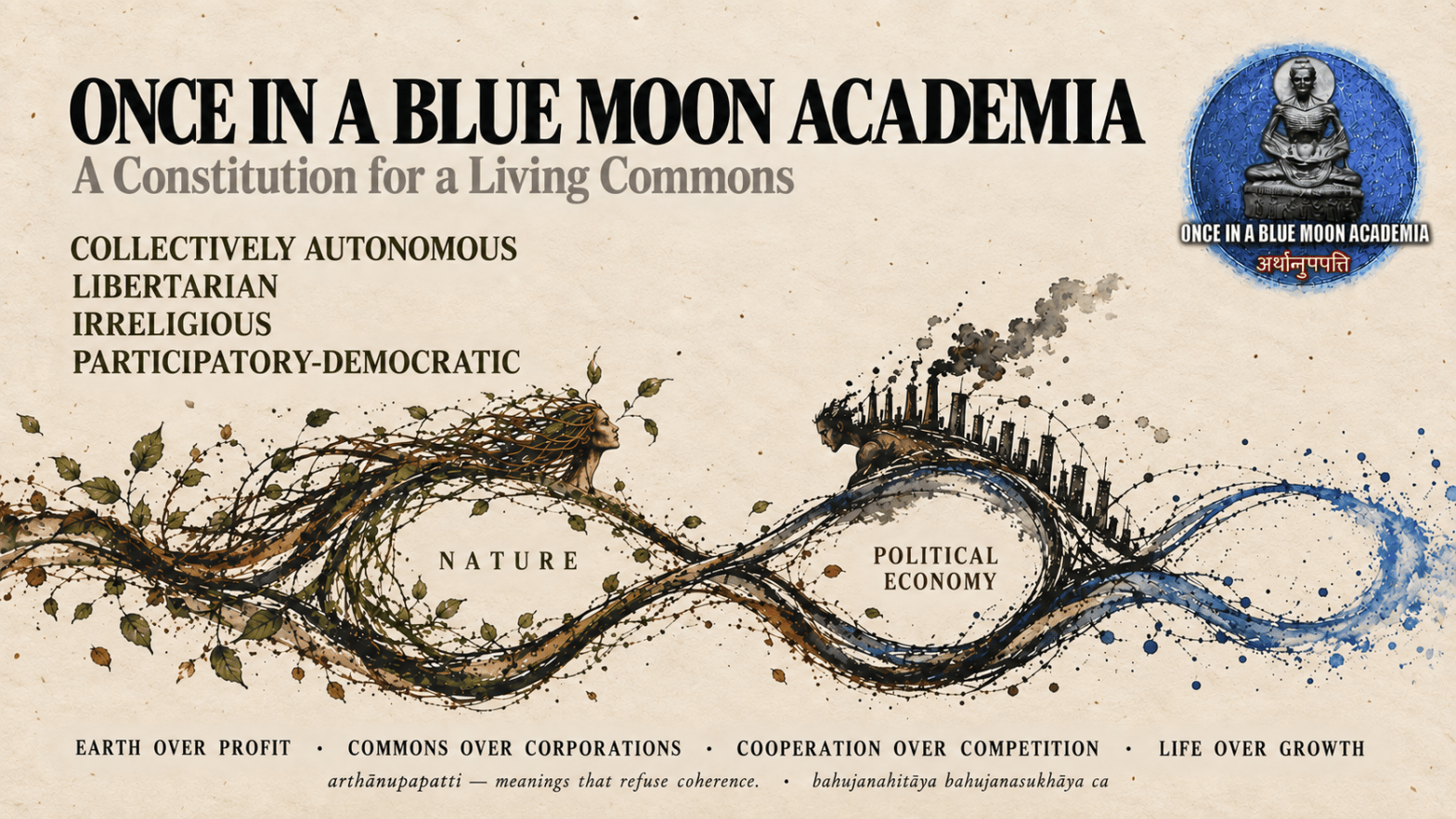
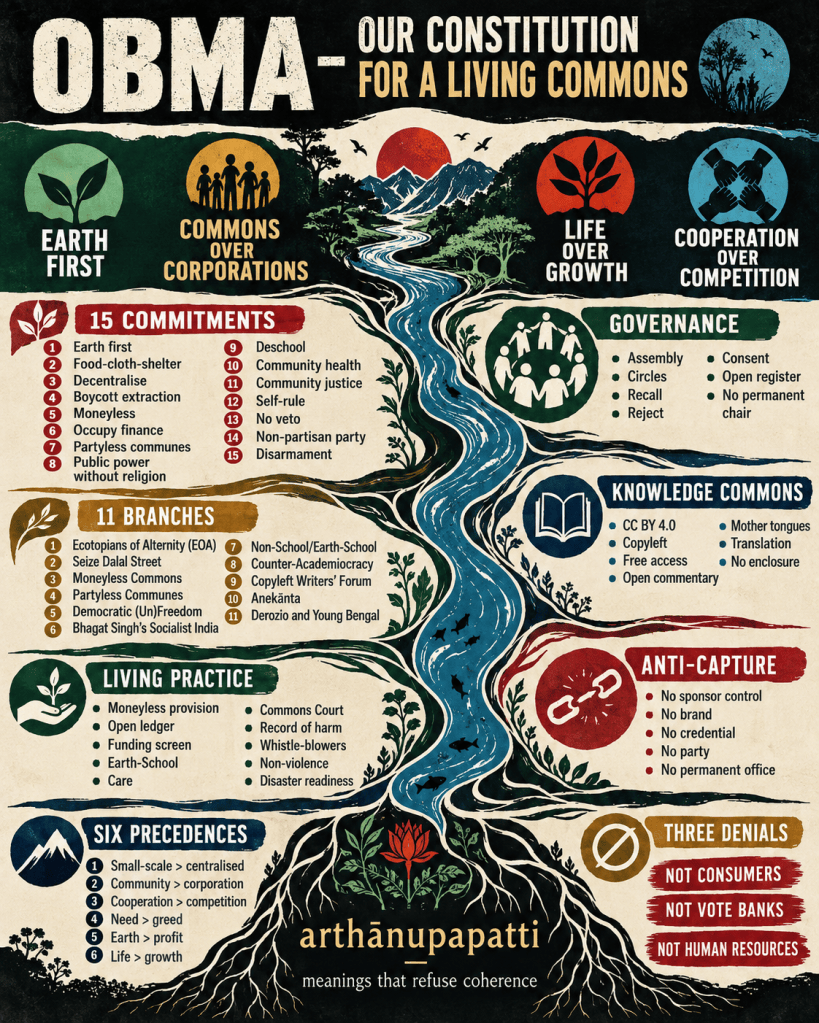
Once in a Blue Moon Academia (OBMA)’s Constitution does not found a state, church, company, political party, NGO or university; it binds a self-regulating commons of inquiry and action to the Earthian Charter and turns that Charter into praxis. It names OBMA as Earthlings among other-than-human life, seated in Baranagar on the Ganga but organised by watershed rather than nation, and it sets two inseparable goals: to expose the failing world economy and to act from the fact of ecological collapse. Fifteen Charter commitments become binding duties—Earth first; food, cloth and shelter instead of “growth”; decentralised power; refusal of extractive wealth; a moneyless commons; occupation of speculative finance; partyless communes; irreligious public form; deschooling beyond academiocracy; community health and justice; law that vanishes toward self-rule; no veto; no chase for office; total disarmament—while care, emancipatory praxis, equity and mutual aid are guaranteed to all who take part. Power stays small, open and reversible: an Assembly and circles, recallable stewards, no founder’s chair, an open ledger and a funding screen that rejects coal, arms, big finance and branded philanthropy. Knowledge is copyleft and fee-less; learning returns to place as a non-school; harm is recorded and defended, including the memory of financial fraud; capture is treated as the main danger, and the commons may dissolve rather than become a brand.
Preamble and Constitutive Act
This Constitution binds Once in a Blue Moon Academia (OBMA) to the Earthian Charter (Part II) in public, and gives that Charter an organisational body: an academy that refuses to be an institution in the old sense. A charter says what a movement will not betray. This Constitution says who OBMA is, how it decides, what it may do, and what it must never become.
The Declaration
We, the Earthlings, also called Cosmosians, are micro, meso and macro forms of life, and we do not speak as a species-club of the already-human. Micro: the soil-life, the unseen work without which no harvest stands. Meso: the bodies that walk, swim, fly, root and labour in a watershed. Macro: the river-systems, forests, climates and migratory paths that no passport holds. Those who cannot write a signature still constitute us. A constitution that begins after the other-than-human has been filed under “environment” has already begun too late.
We gather as Once in a Blue Moon Academia, an activist and independent scholarly commons as well as platform working where human rights, environmental justice, critical social sciences, philosophy of science and ecosophy meet. We hold that the collapse of the financial order and the degradation of the living world are not two separate crises but one structure, and that to expose, analyse and resist it is a single and inseparable struggle. We hold that knowledge is never value-neutral amid institutionalised injustice and coercion: scholarship that does not stand with the vulnerable has already stood with the powerful.
The Resolve
Having solemnly resolved to reconstitute our world, and our own practice within it, as a network of bioregions and not as a market of states, an empire of firms, or a single story with capital-relations, we constitute OBMA as a collectively autonomous, libertarian, irreligious and participatory-democratic commons of inquiry and action. Each of those four words is a limit on ourselves before it is a claim on others; Part II gives them their meaning.
The Guarantees
And we secure to all Earthians who take part in, or are touched by, our work:
- Care: social, cultural, ecological, economic and political, as the work that keeps a commons alive and not a private virtue parked beside the “real” work.
- Emancipatory praxis: freedom of thought, expression and belief, practised in the mother-tongue, in the yard and in the assembly, without fee and without the bow. The unity of creation and critique, regeneration and resistance.
- Equity: of status and opportunity, grounded in socio-ecologically necessary labour and free of privilege, hierarchy and discrimination.
- Horizontal mutual aid: among all beings, affirming the dignity of the collective and the unity and integrity of the planet.
The Motto and the Refusal
The two mottos of Article 2 are our end and our method. Where official language says “development”, “resolution”, “reform” or “neutrality” and the lived world says dispossession, we hold the gap open and do not let the word close it.
The Vow
This Constitution does not found a state, a church, a company, a political party or a university. It founds a vow: that a network of scholars, writers, learners and neighbours may inquire, publish, teach, resist and provide for one another as Earthians, and that no chair, proprietor, priesthood, sponsor or credential will be mistaken for that vow.
The OBMA Anthem — ECO—ECO—ECHO…
The Constitution speaks in clauses; a commons also needs a voice… actually, many voices without enforcing eliminative uniformity.
ECO—ECO—ECHO — Our Once in a Blue Moon Academia is OBMA’s anthem: a collective rendering of the commitments expressed in this Constitution. It is not an additional Article, rule or source of authority. It is a living accompaniment to the Constitution—a way of remembering, voicing and renewing the living commons that bridge critique and creation through sound.
Lyrics
Once in a Blue Moon Academia
Eco—Eco—Echo!
We chart the Oikos
Earth to thought
Thought to word
Word to world
Mm—mm—mm…
Eco—Eco—Echo!
We ask who lights the fire
Who feeds it, who bears the cost
We trace power, money, memory
The living and the lost
From river, soil and body
From farmer, seed and street
We bring buried stories
Where silence and systems meet
Knowledge is not a tower
Nor rank, nor borrowed crown
It lives in questions
It lives in commons
It turns the world around
We listen
We question
We learn
We unlearn
Eco—Eco—Echo!
Once in a Blue Moon Academia!
Earth first
Life in common
Knowledge free
Eco—Eco—Echo!
No single voice
No final word
No closed horizon
We think
We question
We create
We resist
We care
No ivory tower can hold us
No gate can own the mind
Scholar and worker
Human and other-than-human
Many worlds intertwined
We learn from nature
From neighbours, memory, doubt
From what the margins carry
From what power leaves out
No degree defines us
No doctrine makes us whole
Learning is a living practice
Freedom is where it flows
Many voices
Many worlds
Many ways
One living commons
Who owns knowledge?
No one alone!
Who owns the Earth?
No one alone!
Who writes the future?
All of us!
What do we build?
The commons!
What do we protect?
Life!
What do we refuse?
Enclosure!
Dogma!
Silence!
Mm—mm—mm…
Ah—ah—ah…
ECO—ECO—ECHO!
ECO—ECO—ECHO!
ECO—ECO—ECHO!
OUR ONCE IN A BLUE MOON ACADEMIA!
From earth to knowledge
From knowledge to action
From action to transformation
Life over capital
Community over extraction
Dignity over domination
ECO—ECO—ECHO!
We are the question
We are the conversation
We are the unfinished possibility
We think
We question
We resist
We create
We care
We reimagine
ECO—ECO—ECHO!
From seed to story
From story to struggle
From struggle to solidarity
Eco—Eco—Echo…
The house of life
The commons of knowledge
The freedom to question
Once in a Blue Moon…
Academia…
Where meanings refuse coherence
For the welfare of the many
For the happiness of the many
Mm—mm—mm…
Eco—Eco—Echo…
And the work begins again.
Why “Eco-Eco-Echo”? For OBMA, Eco—Eco—Echo names the two urgencies that bring us together: to expose the dominant world economy as a system that is failing, extracting and dispossessing, and to learn how to live with—and make sense of—the currently unfolding climate and ecological emergencies. Eco-nomy and eco-logy both return us to the oikos, the shared house of life; Echo is what happens when these questions reverberate across soil, society, knowledge and struggle. Eco—Eco—Echo is therefore an invitation to hear the crisis, question its causes, and imagine other ways of inhabiting our common world.
The anthem may be sung, recorded, translated, rearranged, performed or reinterpreted collectively, provided that it remains a commons and is not enclosed as private proprietary branding or used to authorise hierarchy, sponsorship or institutional capture.
Part I. Name, Nature, Seat and Objects
Article 1. Name
- The body constituted here is Once in a Blue Moon Academia, abbreviated OBMA, and referred to in this Constitution as “the Academia” or “OBMA”.
- The name is kept as a standing reminder that what official calendars treat as rare, a critical academy that answers to no sponsor, is what a poisoned age requires as a matter of routine.
- The name, the abbreviation and the emblem of OBMA are commons. Nobody may register, franchise, license or sell them as a brand, and nobody may use them to certify a product, a candidate, a corporation or a creed.
Article 2. Mottos and Imprint
- The motto of purpose is bahujanahitāya bahujanasukhāya ca: for the welfare and the happiness of the many. No act of OBMA is legitimate if it can be justified only by the welfare of a few.
- The motto of method is arthānupapatti: the meaning that refuses coherence. It commits OBMA to the discipline of noticing where the official account of things does not add up, and to publishing the residue.
Article 3. Nature and Status
- OBMA is not a state, a government, a church, a company, a political party, a foundation, a university, an NGO, or a trade union, and it may not take on the powers, hierarchies or interests of any of these.
- OBMA is a commons of inquiry and action: a self-governing network of researchers, writers, learners, translators, artists, litigants, gardeners and neighbours, joined by consent and free to leave.
- OBMA has no headquarters to capture, no franchise to sell, no youth-wing to drill and no chair to seek. Should any organ begin to want state power, office or control, it has broken this Constitution, and Article 63 applies.
- Where the law of a territory requires a registered form (an account, a domain, a trust, a society, a court appearance), that form is a juridical shell only. It holds no authority over the commons, may not be used to override the Assembly, and is to be held by persons who can be recalled.
Article 4. Seat and Extent
- OBMA’s immediate locus is Baranagar, on the eastern bank of the Ganga. A locus is a place of work and a place of accountability, not a centre. No decision is valid merely because it was made there.
- OBMA’s extent is bioregional and not national. Its members, circles and works may stand in any watershed, language or jurisdiction, and each circle answers first to its own place.
- OBMA’s public commons is its website, onceinabluemoon2021.in, together with its journal, news channel, archives and 15+ social channels. These are held as a common resource. Their sections (About Us, Activities, News Channel, Journal, Art of Resistance, Ecosophy) are organs of this Constitution and are governed by Parts VI and VII.
Article 5. The Twin Goals and the Means
OBMA pursues two key goals. Every other provision of this Constitution serves them.
- First goal: to expose the failing condition of the dominant world economy. OBMA investigates, documents and names the structures through which that economy fails the many: financial fraud, insolvency, speculation, debt, the money-form itself, extractive accumulation, and the collusion of corporation and state that shields them. It publishes what it finds and stands with those who bear the loss.
- Second goal: to act in accordance with the degenerated, critical state of the climate and of ecological systems as a whole. OBMA treats the climate and ecological crisis as the fact from which all planning starts, and not as one topic among others. It acts at the scale and speed that fact demands, in the neighbourhood and before the policymaker alike, and it measures its own conduct against the limits of the living world.
- One struggle. The goals are inseparable: the accumulation that fails the depositor is the accumulation that poisons the watershed. Each branch of Article 35 serves one or both, and work that serves neither is not the work of OBMA.
To pursue the two goals, OBMA:
- Analyses with the critical social sciences, philosophy of science, linguistics and lexicography, political economy and ecosophy, with scientific rigour and against technocratic authoritarianism.
- Resists by lawful, non-violent and creative means: publication, litigation, testimony, campaign, boycott and art.
- Builds the alternatives: the moneyless commons, the partyless commune, the non-school, community health and community justice (Parts V to X).
- Protects the vulnerable (depositors, tenants, farmers, forest-dwellers, workers, readers, writers) and the more-than-human against those who would extract from them.
- Preserves memory of languages, of dissenting thought, of the victims of institutional harm, and of the ecological baseline against which loss is measured.
- Teaches without a school, returning learning to nature, neighbours and local knowledge.
- Corrects itself, keeping every organ revisable, recallable and answerable, so that the vow outlives any person who took it.
Part II. The Earthian Charter: Foundational Principles
The fifteen commitments set out in this Part constitute the Earthian Charter, which this Constitution gives organisational and institutional form.
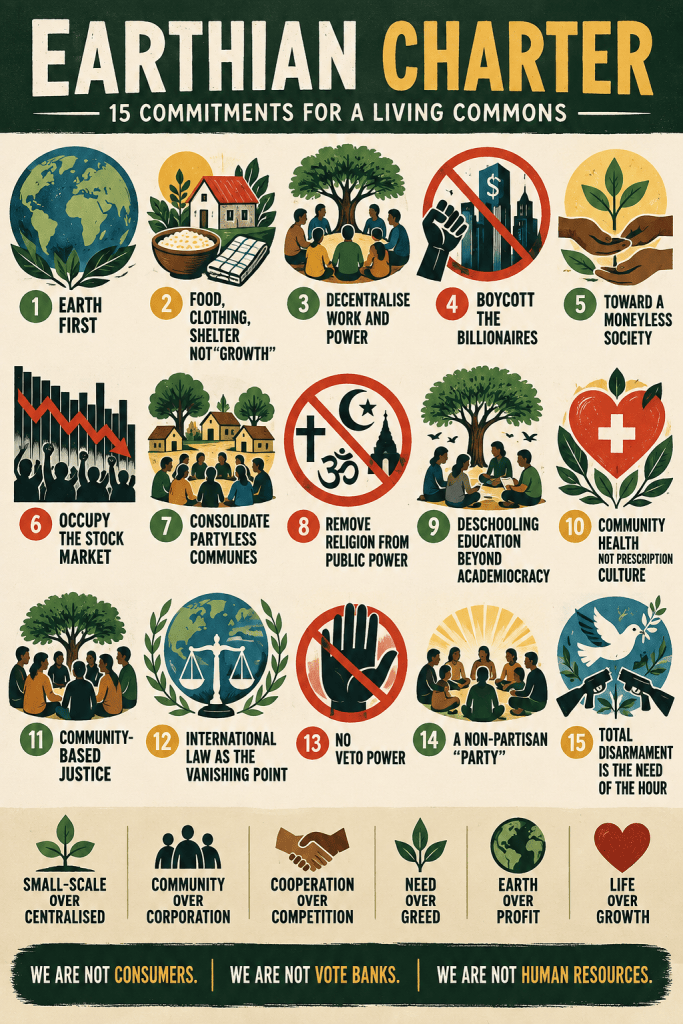
The fifteen commitments of the Earthian Charter are the constitutional core of OBMA. Each Article below states the principle, turns it into a duty that binds OBMA’s own conduct, and marks the line OBMA may not cross. The Articles are ordered as the Charter orders them, but they are read together: no Article may be used to defeat another, and where they seem to conflict the rule of Article 22 decides.
Article 6. Earth First
- Principle. Earth is not a store-room attached to the economy; the economy is a small activity attached to Earth. Nature is an intimate an-other, and never the exploitable other. The climate crisis is named for what it is, and it is answered from the neighbourhood to the policymaker.
- Duty. Every publication, campaign, event and project of OBMA is first examined for its effect on soil, water, air and other-than-human life, and the finding is recorded in physical terms (what was used, what was displaced, what was left) and not in the currency of credits.
- Prohibition. OBMA shall not use, buy or endorse carbon offsets, “net-zero” pledges, tree-planting ledgers or any device that plants a tree on paper while a watershed dies in fact. No OBMA curriculum, syllabus or reading list may put growth, nation or firm above the Earth; one that does has already chosen its god.
Article 7. Food, Clothing, Shelter, Not “Growth”
- Principle. The measure of any economy is roti, kaprā aur makān: whether a people can be fed, clothed and housed without being poisoned. Development that cannot do so is a press release.
- Food. Wherever OBMA feeds people (meetings, camps, workshops) the food is grown and cooked as near as the land allows, from socio-ecologically necessary labour and intergenerational and indigenous knowledge, without pesticides, chemical fertilisers, GMOs or HYVs.
- Clothing and shelter. OBMA prefers clothing that spares rivers and animals. Any structure it builds, rents or recommends is to be green and biophilic (soil, brick, straw, bamboo, wood), horizontal and many-layered, and not a heat-trapping tower.
- Research duty. OBMA maintains an open study of local provisioning (seed, grain, fibre, building, water) as a permanent line of inquiry, so that the alternative is documented as carefully as the critique.
Article 8. Decentralise Work and Power
- Principle. OBMA works as a network and not as a hierarchy: action is diffused yet coordinated, without vanguardism and without a committee that speaks for everyone and answers to no one.
- Slowness. OBMA rejects the hustle-culture of speed capitalism that treats exhaustion as virtue and rest as theft. No deadline, target, ranking or output count may be set for a member in a way that requires the sacrifice of sleep, health, family or season. Rest is a right (Article 24).
- Scale. Work is organised around care, sufficiency, conviviality and ecological limits. Slow, small and simple are the default; a task that can be done by a small circle is not given to a large body, and a task that can be done locally is not taken to a distance.
- Teaching. OBMA shall not train the young to outrun one another (Article 49).
Article 9. Boycott the Billionaires
- Principle. Coal, oil, gas, Big Pharma and the corporate giants have accumulated through ecological destruction, displacement and the degradation of public health. Philanthropy after extraction is not restitution; it is branding.
- Funding refusal. OBMA refuses support of every kind from extractive interests. Article 43 sets the screen and requires that each refusal be published.
- Narrative refusal. OBMA does not depend on the narratives of such interests. Corporate reports, foundation studies and sponsored research are read as claims to be tested, and never cited as neutral authority.
- Advocacy. OBMA actively discourages the concentration of wealth in the top one per cent, and supports every lawful measure (boycott, disclosure, taxation, commons-building) that reduces it.
Article 10. Toward a Moneyless Society
- Principle. Money is an arbitrary signifier that breeds inequality, dependence and alienation. OBMA works to minimise it wherever possible, and to strengthen sharing, reciprocity, the commons and mutual aid in its place.
- Neither dole nor trickle-down. Both are trapped in the money-form: one is delayed charity from above, the other managed survival from above. OBMA practises neither and states so.
- Practice. OBMA charges no fee for entry, reading, membership, participation, learning or citation. Every act of provision that can be taken out of the meter is taken out of it: skills are exchanged, tools are lent, food and shelter are shared, translation and editing are given.
- Unavoidable cost. Where a cash cost cannot be avoided, it is met from the open fund of Article 42, in the smallest sum, with a plan to reduce it.
- Horizon. The Constitution does not pretend money will vanish at a slogan. It requires only that the Academia be able to live, work and teach on the day the meter fails.
Article 11. Occupy the Stock Market
- Principle. Value is not what a ticker says. OBMA opposes the domination of speculative finance, the “rationally irrational” casino of bulls and bears that bets on hunger, weather, war and rent.
- Occupation as refusal and building. To occupy is not to hold a weekend on the steps. It is to refuse the story that speculation creates value, and to build other channels (cooperative credit, common funds, mutual aid) through which labour moves without being gambled.
- Conduct. OBMA holds none of its common resources in markets or instruments. No organ or member may use OBMA’s name, channels or unpublished research to promote, trade or profit from securities, and any such use is a breach under Article 63. What members do with their own savings is a matter of conscience and disclosure, never of OBMA’s endorsement.
- Duty to the harmed. OBMA maintains its record of the victims of financial fraud and insolvency as a public duty of memory and advocacy (Article 54).
Article 12. Consolidating Partyless Communes
- Principle. Parties across ideologies reproduce the same model of growth and accumulation, invoke religion when convenient, and evade accountability, even refusing to be public authorities under the Right to Information. OBMA works to consolidate partyless communes in their place.
- The commune. A commune is not a personality cult with minutes. It is a people who can assemble, decide, reverse themselves and send a representative home.
- Accountability. Every person who speaks or acts for OBMA is subject to the Right to Reject and the Right to Recall (Article 31), and OBMA submits itself voluntarily to the standards of disclosure that parties refuse.
- Practice of power. The assembly is a classroom of power and not a decoration on Foundation Day. Every member is to practise convening, deciding, reversing and recalling early and often.
Article 13. Removing Organised Religion from Public Power
- Principle. Organised religion must not dominate public life. The inner life is free; the syllabus is not a pulpit and the assembly is not a congregation with a whip.
- Public form. OBMA is irreligious as public form and not as a raid on the inner life. It builds no altar into its law, opens no meeting with an invocation, and consecrates no site, text or person. Members may believe, practise and abstain as they wish, at home and within themselves.
- Limit on power. No religion may exercise power over OBMA’s assembly, publications, learning, clinic, court of the commons or budget, whether through a priesthood, a board of trustees or a party that has rented a god.
- Not contempt for faith. It is contempt for the capture of the commons. OBMA studies religion critically and with respect, as it studies everything, and defends every person’s freedom to believe and to disbelieve.
Article 14. Deschooling Education Beyond Academiocracy
- Principle. Education is liberated from the monopoly of formal schools, colleges and universities. It is deinstitutionalised, community-based and reconnected to nature, neighbours, local knowledge and multigenerational narrative.
- Refusals. OBMA issues no credits, degrees, marks, ranks, examinations or reports, keeps no Academic Bank, joins no ranking, and does not treat the syllabus as a marketplace. It grants no certificate of learning that another body can be forced to honour.
- Non-dissolution. The monopoly is refused; the community is not dissolved in the refusal. The non-school is one form of the political demand, and Part IX gives it its shape.
Article 15. Community Health, Not Prescription Culture
- Principle. Health is place-based, holistic and care-centric: prevention, nutrition, movement, relationships and ecological well-being over indiscriminate prescription and profit-driven care. Against the iatrogenic society that produces the patient it then bills, we are healthy as a “We” and not as an isolated “I”.
- Duty. OBMA studies the political economy of medicine and the pharmaceutical industry.
- Rule. A watershed that cannot tend its sick without a distant invoice has accepted a definition of care written by someone who will not sit up with the fever. OBMA’s circles therefore organise mutual care first: visiting, feeding, watching, and teaching one another to look after the body.
Article 16. Community-Based Distributive Justice
- Principle. Disputes are resolved collectively through dialogue, polylogue, arbitration, mediation and deliberation, drawing on the Nyāya Panchayat without reproducing exclusionary structures such as the khap. The community is the fundamental unit of decision-making, with equal participation across caste, class, gender and ethnicity.
- Standard. Justice that cannot look the injured in the face is already halfway to a file. Justice that excludes the injured by birth is not custom; it is a weapon.
- Practice. Part X sets the procedures of OBMA’s own Court of the Commons, its safeguards against exclusion, and its relationship to the courts of the state.
Article 17. International Law as the Vanishing Point of Jurisprudence
- Principle. Law must emerge from communities, bioregions and lived realities, and not from distant, insulated institutions that arrive after the damage and speak a language the damaged did not write.
- Horizon. As participatory self-regulation and ecological responsibility grow, coercive legal structures become obsolete: transcendence, and not abolition by force. The vanishing point is not chaos; it is the horizon at which a people no longer need a remote apparatus to remember how not to devour one another and the river.
- Practice. OBMA uses existing law, including domestic courts, treaty bodies, human rights mechanisms and international submissions, as a tool while it lasts, and never treats that use as an endorsement of the order that produced it.
Article 18. No Veto Power
- Principle. No nation, institution, corporation or individual may override the collective will of humans and other-than-human beings. Every people, community and bioregion has an equal voice.
- Reach. A Security Council with a permanent no is only the most famous version of a habit that also lives in a boardroom, a family, a campus and a donor’s clause. In OBMA it is barred in every form: no founder’s, editor’s, donor’s, host’s or senior scholar’s veto.
- The other-than-human. The other-than-human does not vote, and that is not a reason to pretend it has no claim. A dam that silences a river is a veto; a patent that silences a seed is a veto. Article 26 gives that claim a voice inside the Assembly.
Article 19. A Non-Partisan “Party”
- Principle. The word “party” is retained, where OBMA’s allied movements use it, as a playful and provocative intervention. It seeks no state power, no office and no control: a commons, with cooperation over competition, commons over constituencies, and collective flourishing over political power.
- Vow. If it ever begins to want the chair, it has already broken its charter, and Article 3(3) applies.
- Consequence. OBMA contests no election, endorses no candidate, and accepts no seat, portfolio or nomination for itself. Its members may vote or abstain as private persons, and may not speak as OBMA in doing so.
Article 20. Total Disarmament
- Principle. The normalisation of militarism, which makes war into weather, budget, career and common sense, is the greatest threat. OBMA works to dismantle the global arms economy and to convert war industries into life-sustaining ones: eco-energy, ecological restoration, public transport, resilient housing, disaster preparedness and healthcare.
- Memory. We are creatures who survived a nuclear fallout, and we remember it. OBMA’s work on militarism starts from that memory and from the resources that war redirects away from life, and it looks to a planet without borders.
- Conduct. OBMA’s conduct in peace and its refusal of arms are set out in Article 58, and its teaching of the young in Article 49.
Part III. Definitions and Interpretation
Article 21. Definitions
In this Constitution the following terms carry the meanings below, and they are to be read in that sense wherever they appear.
- Earthling / Cosmosian: Any form of life, micro, meso or macro, that belongs to the Earth. A human member is an Earthling among others and holds no special rank.
- Other-than-human: Soil-life, animals, plants, rivers, forests, climates, seeds and all beings that cannot sign or speak in human forms and are nonetheless affected by, or party to, OBMA’s acts.
- An-other / the exploitable other: The intimate an-other is a being recognised as having its own claim. The exploitable other is a being treated as a resource. OBMA recognises only the first.
- Bioregion: A place defined by watershed, soil, climate, species and language, and not by administrative boundary; the primary unit of belonging and decision.
- Commons: Any resource, knowledge or relation held in common, governed by the people who depend on it, and neither sold nor enclosed.
- Socio-ecologically necessary labour: Work required to sustain human and other-than-human life in a place, including care, cooking, composting, vigil, repair, translation and mourning. It is the ground of worth, whatever the market pays.
- Academiocracy: Rule by the credential: the fusion of academic authority with regimes of control (marks, rankings, credits, journals-as-gates) that turns learning into a hierarchy.
- Non-school (nā-iskul, “Nice School”): A community-based, non-institutional form of learning, also called the Earth-School (Bhūmi-Pāṭhaśālā) where it takes the watershed as its curriculum (Part IX).
- Moneyless commons: A network of provision in which need, mutuality and ecological limit, and not price, decide who is fed, housed, taught and heard.
- Partyless commune: A self-governing assembly of the people affected by a decision, without party, vanguard or permanent office.
- Assembly: The body of all members of OBMA, sitting in its circles and in full (Part V).
- Circle: A small self-governing group of members, organised around a place, a task or a branch, and answerable to the Assembly.
- Steward: A person who holds a limited, time-bound and recallable task on behalf of a circle or the Assembly. Not an officer and not a representative with authority of their own.
- Right to Reject: The right of any member, circle or community to refuse a proposal, a person’s mandate or a decision as unacceptable, and to have that refusal stand until it is answered.
- Right to Recall: The right of the people who conferred a mandate to end it at any time, with immediate effect.
- Veto: Any power, formal or informal, to override the collective will without giving reasons and without accountability.
- Extractive interest: Any corporation, foundation, individual or state organ whose wealth or power derives from ecological destruction, displacement, arms, speculative finance or the degradation of public health.
- Juridical shell: A legal form (registration, account, domain, trust) held only because law demands it, with no authority over the commons.
- Arthānupapatti: The state in which a word’s meaning cannot be made coherent with lived reality; the method of holding that gap open in public.
- Anekānta: Many-sidedness: the discipline of holding that any claim is true only from a standpoint, and that plural standpoints must be heard together, as a polylogue and not as a binary.
- Copyleft: A licence or practice that gives every reader the freedom to use, adapt and pass on a work on condition that others enjoy the same freedom.
- Conviviality: Tools and institutions that enlarge, and never shrink, the autonomy of the people who use them.
- Iatrogenic: Harm produced by the very system that claims to cure it, applied here to health, education, law and finance alike.
- Glocal: Local in production and decision, connected in solidarity and knowledge; not global in the sense of the market.
Article 22. Interpretation and Order of Precedence
- Purposive reading. This Constitution is read in the light of its Preamble, its two mottos and the Earthian Charter (Part II), and never against them.
- Order of precedence. Where two provisions seem to point in opposite directions, the reading that best serves the following, in this order, prevails: first, the integrity of the Earth and of its other-than-human members; second, the welfare of the vulnerable; third, the autonomy of the commons and its circles; fourth, the freedom of the individual inquirer; fifth, the convenience of any organ. Convenience never overrides principle.
- Against power. An ambiguity that would enlarge the power of any person, organ or sponsor is resolved against that person, organ or sponsor. An ambiguity that would enlarge the accountability, openness or freedom of the commons is resolved in its favour.
- Silence. What this Constitution does not forbid is not thereby permitted to anyone who holds power, and what it does not confer on the Assembly is not thereby denied to it. Silence is filled by deliberation in the circle nearest the matter.
- Languages. This Constitution is to be kept in Bengali and English, and, as circles require, in every language of the bioregion, none of which is a mere translation of another. Where versions differ, the reading closer to the mother-tongue of the person affected prevails.
- Person and number. Words in the singular include the plural; words denoting a person apply to all persons without distinction of gender, caste, class, ethnicity, ability or species where the context permits.
- Headings are for orientation and do not limit the Articles beneath them.
Part IV. Membership, Rights and Duties
Article 23. Who Belongs
- Open belonging. Anyone who accepts the Earthian Charter (Part II), this Constitution and the Oath in Schedule A may join a circle of OBMA. There is no fee, examination, sponsor, credential or waiting period, and none may be introduced.
- Kinds of participation. The Assembly recognises three kinds, none of which ranks above another: members, who take part in circles and decisions; co-travellers, who contribute to a work, a campaign or a study without joining the Assembly; and readers and learners, who use the commons and owe nothing for doing so.
- Co-researchers and co-authors. A person who works with another on a text, study or case is a co-researcher and, where the work merits it, a co-author. Authorship is credited by contribution and never by seniority or by kinship, and it is never bought.
- No exclusion by birth. Belonging is never denied on the ground of caste, class, gender, ethnicity, language, ability, age, belief or nationality.
- Minors. Young persons may learn, read and contribute in the non-school and in circles, under the care of a circle and the protections of Article 25(5). No child may be enrolled, photographed, quoted or named in a campaign without the consent of the child and of those who care for them.
Article 24. Rights of Members
Every member has the right to:
- Speak and dissent. Inquire, criticise and refuse, in the mother-tongue, in circle and in public, including against OBMA itself, without fee and without reprisal.
- Reject and recall. Exercise the Right to Reject and the Right to Recall against any steward, decision or mandate (Article 31).
- Know. Read every record, ledger, minute, funding offer and decision of OBMA, in a form they can understand.
- Rest. Withdraw from work for reasons of health, care, season or exhaustion without penalty, and without the loss of standing or of credit for past work.
- Care. Receive the mutual aid of the circle in sickness, bereavement, loss and legal trouble, to the limit of what the circle can give.
- Attribute and license. Be credited for their work, retain their authorship, and decide, within the Creative Commons licence of Article 36, how their work travels.
- Decline. Refuse any task that would require them to break their conscience, the law of the commons, or the safety of another.
- Leave. Withdraw at any time, and take with them what is theirs, without a hearing or a reason.
- Be heard first in their own place. Have questions touching their own watershed, language or livelihood raised first in the circle of that place.
Article 25. Duties of Members
Every member has the duty to:
- Keep the Charter. Act in every OBMA capacity in accordance with the Earthian Charter (Part II) and this Constitution, but also feel free to question it.
- Inquire honestly. Cite, quote and credit truthfully; correct errors in public; distinguish evidence from inference; and treat opponents’ best arguments fairly.
- Disclose. State any interest, funding, holding or relationship that bears on a work, a decision or a campaign, before it is used.
- Practise care. Attend to the sick, the tired and the grieving in their circle, and to the land and water that their work draws on.
- Protect. Never harass, intimidate, threaten, expose or endanger another person, and shield the young, the vulnerable and the source of a whistle from foreseeable harm.
- Refuse the veto. Neither use nor tolerate any private power to override a collective decision, and report it when it appears.
- Keep the commons open. Publish under open terms, and do not enclose a commons work for their own use.
- Lawful non-violence. Use only lawful, non-violent means in the name of OBMA.
Article 26. The Claim of the Other-than-Human
- Recognition. Every being and system that a decision of OBMA touches has a standing claim in that decision, whether or not it can write, speak or vote.
- Custodians of a claim. The Assembly appoints, for each place and each decision that touches it, one or more custodians of the claim: persons who live with, work with or study the river, forest, soil or species concerned, and speak for its interest. A custodian holds no power over the being; the office exists only to keep the claim in the room.
- Rule of the first question. No decision affecting land, water, air, seed or animal is finalised until the custodian of the claim has spoken and the reasons have been recorded. A decision made without that voice is voidable on the motion of any member.
- Veto barred. The claim is a voice, not a veto. It may delay for reflection and demand reasons, but it cannot override the Assembly; and the Assembly may not proceed without hearing it.
- Duty of restoration. Where OBMA’s own activity has harmed a place, the circle of that place decides the repair, and the repair is completed before the work resumes.
Article 27. Suspension, Exit and Restoration
- Voluntary exit is always available and needs no reason.
- Suspension of a member’s standing may be decided only by the circle of that member, after a hearing under Part X, for breach of Article 25(5), (6) or (8), or of Part VIII. It is never imposed for dissent, criticism or unpopular inquiry.
- Duration and review. Suspension is temporary, reasoned in writing, subject to appeal to the Assembly, and reviewed at every sitting.
- Restoration. The aim of every proceeding is repair, and, where possible, the return of the person into the commons with the harm mended.
- What is not lost. No member loses authorship, records, credit or the protection of the commons by leaving or by being suspended.
Part V. The Earthlings’ Assembly and the Architecture of Decentralised Power
OBMA has no government. It has an Assembly, its circles, and a small number of stewards who carry tasks and no authority. This Part designs power so that it stays small, visible, rotating and reversible.
Article 28. The Assembly
- Composition. The Assembly is the body of all members of OBMA. It has no upper house, no executive and no permanent president.
- Sittings. The Assembly sits in full at least once each year, on 2nd February, the day on which the Earthlings’ Assembly made its Constitutive Act, and at any other time when three circles, or one-tenth of the members, call for a sitting. Each sitting is open to co-travellers, readers and learners, who may speak but not join the decision.
- Accessible form. Sittings are held in a place a person can reach on foot or by public means where possible, with a parallel online room, and the record is written in the languages of those present. No member is excluded by lack of a device, a fee or a fluent tongue.
- Powers. Only the Assembly may: amend this Constitution; recognise, merge or lay to rest a branch; hear an appeal under Article 27; approve the annual public account of the commons; and appoint the custodians of the claim under Article 26.
- Subsidiarity. Every other matter is decided by the smallest circle that can decide it well, and is referred upward only on the request of that circle.
Article 29. Circles
- Formation. Any three or more members may form a circle around a place, a branch, a task or a language, by announcing it in the register of circles. No permission is needed.
- Autonomy. A circle governs its own work, keeps its own minutes and ledger, and answers to the Assembly and not to another circle. Circles federate by consent and not by command.
- Size. Circles are kept small enough that every member can speak at each meeting. When a circle grows beyond that, it divides into circles that continue to share a table.
- Messengers. A circle that needs to speak to another sends a messenger with a written brief. The messenger carries the brief and returns with the answer, holds no authority beyond it, rotates at every occasion, and may be recalled at once.
- Place circles are the primary unit of OBMA’s work and of accountability. Branch circles (Part VI) work on a theme across places. Task circles exist for a single work or case and are laid to rest when it is done. Language circles keep OBMA’s texts alive in each tongue.
Article 30. Stewards and the Network
- Nature of office. A steward carries a task and is not an officer. A steward speaks with the authority of the mandate given and no more, and returns that authority by handing over records within seven days of the end of a term or of a recall.
- Rotation. Terms are at most one year, and no person holds the same stewardship for more than two consecutive terms. No person holds more than one stewardship that touches funds, publication or law at the same time.
- Reimbursement, not remuneration. Stewards receive no salary, honorarium or perquisite. Documented costs of the task may be reimbursed from the open fund (Article 42), and are published.
- The founder. OBMA acknowledges its founder, Dr. Debaprasad Bandyopadhyay (Nemo), whose inquiry and labour began it. The founder holds no permanent office, no proprietary right in the name, archive or website, and no veto; and stands on the same footing before the Right to Reject and the Right to Recall as every member. Founding is honoured as a debt, and is never a title.
- Standing stewardships.
- Convener (Task: Calls and opens sittings; holds the agenda open; Constraint: May not chair the decision, and rotates each sitting)
- Recorder (Task: Writes minutes in the circle’s languages within 14 days; Constraint: Minutes are published, never edited afterwards)
- Keeper of the open ledger (Task: Records every gift, cost and offer; Constraint: Cannot also hold the juridical shell or the fund)
- Keeper of the shell (Task: Holds the registered form, domain and accounts the law demands; Constraint: Acts only on a written decision of the Assembly; recallable at once)
- Custodian of the claim (Task: Speaks for the river, forest, soil or species concerned (Article 26); Constraint: Voice, not veto)
- Editorial stewards (Task: Convene the journal, news channel and Art of Resistance (Part VII); Constraint: Decide by the editorial procedure of Article 38)
- Keeper of the record of harm (Task: Maintains the archive of victims, testimonies and cases (Part X); Constraint: Acts with the consent of those whose harm is recorded)
- Litigation liaison (Task: Coordinates counsel, filings and defence; Constraint: Reports every step to the circle; no filing in OBMA’s name without a written decision)
- Networks. Coordination among circles is by a table of messengers, a temporary meeting that has no standing membership and no power over a circle. A table that begins to keep records of its own or to issue instructions is at once dissolved.
Article 31. The Right to Reject and the Right to Recall
- Reject. Any member, or any circle, may reject a proposal, a mandate, a text or a decision by stating in writing that it is unacceptable and why. A rejection suspends action on the matter, other than urgent protection of a person or a place, until the circle has answered it in the open.
- Recall. The people who conferred a mandate may end it at any time. Recall is begun by a written call from any three persons, or a fifth of those who conferred the mandate, whichever is fewer, and takes effect when the circle has heard the steward and met once. No reason of misconduct is needed: loss of confidence is enough.
- No penalty. Recall carries no stigma and no penalty, and does not ground suspension under Article 27. It is a routine act of a healthy commons and not an accusation.
- Reach. These rights bind every steward, messenger, editor, keeper, litigation liaison and shell-holder, and the founder. They cannot be waived, limited or made subject to a fee, a quorum or an approval.
- The assembly’s own duty. A commune that cannot send a representative home is no commune. The Assembly shall, at every annual sitting, ask whether any mandate has outlived the confidence that conferred it.
Article 32. Deliberation and Decision
- By consent. Decisions are taken by consent: a proposal stands unless a member states a reasoned objection that the circle cannot answer. Silence, hurry and the loudest voice never count as consent.
- Objection is not veto. An objection is a reason offered for the circle to weigh. If it cannot be resolved after two sittings, the matter goes to the next circle up, or to the Assembly, and if it is not fundamental, is decided by four-fifths of those present after a further open hearing of the objector.
- Fundamental matters. Amendment of Parts I, II or IV, the recognition or closure of a branch, and any matter concerning the Right to Reject, the Right to Recall or the funding screen, cannot be decided by any supermajority and requires the consent of the Assembly itself.
- Season clock. No decision is forced by an outside deadline that sets speed above reason. If a deadline is real (a hearing date, a limitation period, a flood), the circle says so and shortens the process only as far as it must.
- Reversibility. Every decision carries a date for review and can be reversed by the same process that made it. The minority’s view is recorded with the decision.
- Care in deliberating. Meetings begin with the state of the people present and the place they are in, before the business.
Article 33. Openness
- Public authority by choice. OBMA holds itself to the standard of a public authority under a Right to Information law, although no law compels it, because it demands the same of every party.
- Public register. OBMA keeps a public register of circles, stewards, decisions, minutes, funding offers accepted and refused, cases and filings, and the annual account of the commons. Requests for records are answered within thirty days and a refusal is reasoned in writing.
- Protected secrecy. Only three matters may be kept from the register: the identity of a whistle-blower or victim who has not consented; personal health and safety data; and the plan of an urgent protective act until it is done. Each is reviewed at every annual sitting.
Part VI. The Branches of OBMA
OBMA’s eleven initiatives are its branches: circles of work on a theme, each a facet of one struggle. The Constitution does not treat them as departments of a bureaucracy but as ways in which the same Charter is practised in different fields. This Part sets the rules common to all branches and then gives each branch its charter.
Article 34. Framework for Branches
- What a branch is. A branch is a standing branch circle, or a federation of circles across places, that carries one line of inquiry and action under this Constitution. It has no premises, budget, brand or staff of its own.
- Recognition. The Assembly recognises a branch on the proposal of any circle. It recognises a branch only if the branch charter is consistent with Part II, states a practice as well as a critique, and names a public commons of reading that anyone may use.
- Equality. No branch is the parent of another. None may claim precedence in the register, the website or the journal, and none may speak for OBMA as a whole.
- Unity of the struggle. Every branch serves one or both of the twin goals of Article 5, and the branches are read together. A branch that begins to work against another is called to the table of messengers.
- Three duties of every branch. Each keeps (a) a short public statement of purpose; (b) a reading commons, freely usable; and (c) a practice, however small, that embodies its critique. A branch with no practice for a full year is reviewed by the Assembly.
- Review and laying to rest. Every branch is reviewed at every third annual sitting. A branch may be merged, renamed, put to sleep or laid to rest with honour by the Assembly when its work is done or its circle has dispersed; its archive stays in the commons.
- New branches. OBMA remains open to new branches, particularly from places and languages it does not yet reach. A new branch begins with a founding circle, a charter and a first year of practice.
Article 35. The Eleven Branches
OBMA has eleven branches (as of now, provisionally). Each serves the first goal (exposing the failing world economy), the second (acting on the critical state of the climate and ecological systems), or both, as the table shows. In each entry Purpose says what the branch is for, Practice what it does, and Limit what it may not do. The duties of Part II are not repeated in the entries.
- 35.1 (Branch: Ecotopians of Alternity (EOA); Field: Climate and ecological activism; Goal served: Second)
- 35.2 (Branch: Seize Dalal Street; Field: Finance; Goal served: First)
- 35.3 (Branch: Moneyless Commons; Field: Political economy; Goal served: First and second)
- 35.4 (Branch: Partyless Communes; Field: Anti-establishment politics; Goal served: First and second)
- 35.5 (Branch: Democratic (Un)Freedom; Field: Anti-establishment politics; Goal served: First)
- 35.6 (Branch: Bhagat Singh’s Socialist India (BSSI); Field: Anti-establishment politics; Goal served: First)
- 35.7 (Branch: Non-School (Nā-iskul, Nice School), also the Earth-School; Field: Anti-academiocracy; Goal served: First and second)
- 35.8 (Branch: Counter-Academiocracy; Field: Anti-academiocracy; Goal served: First and second)
- 35.9 (Branch: Copyleft Writers’ Forum (Creative Commons); Field: Anti-academiocracy; Goal served: First)
- 35.10 (Branch: Anekānta; Field: Wisdom-keeping; Goal served: First and second)
- 35.11 (Branch: Derozio and Young Bengal; Field: Wisdom-keeping; Goal served: First and second)
I. Climate and Ecological Activism
35.1 Ecotopians of Alternity (EOA)
- Purpose. To confront climate denial, the delay of green capitalism and anthropogenic environmental collapse, as interconnected and urgent crises, and to build resistance from the neighbourhood upwards.
- Practice. Mobilising advocates and amplifying critical voices; keeping a living record of local ecological loss and restoration; municipal and civic action for trees, wetlands, rivers and air.
- Limit. No sponsorship from an extractive interest, and no campaigning for any party or candidate.
II. Finance and Political Economy
35.2 Seize Dalal Street
- Purpose. To expose the logic of the stock market and its part in neoliberal capitalism, in the spirit of Occupy Wall Street, and to turn its “chaosophical” technical mystification back into contested political terrain.
- Practice. Critical inquiry into markets, regulators and disclosure; teaching finance to those who have paid for its failures; building cooperative credit and common funds (Article 45).
- Limit. No member acts as advisor, tipster or promoter of any security in the name of the branch.
35.3 Moneyless Commons
- Purpose. To confront the naturalised dominance of money as the universal mediator of value, and to advance a degrowth-oriented commons beyond market exchange.
- Practice. Critique of monetary abstraction; alternative infrastructures of sustenance such as seed and tool exchanges, communal kitchens, time-sharing and free repair.
- Limit. It sells nothing, sets no price, and accepts no payment as a condition of participation.
III. Anti-Establishment Politics
35.4 Partyless Communes
- Purpose. To resist the reduction of politics to electoral systems, and to advance decentralised, commune-based living, drawing on anarchist and radical-democratic traditions.
- Practice. Helping neighbourhoods and villages form assemblies with rejection and recall; keeping a guide to running them; documenting where communes have worked and failed.
- Limit. It never becomes the seed of a party, a vote bank or a franchise.
35.5 Democratic (Un)Freedom
- Purpose. To interrogate the erosion of substantive freedom despite formal democracy. Indebted to Herbert Marcuse, it studies manufactured consent, absorbed dissent and constrained imagination, and reclaims democracy as a lived, collective and materially grounded process.
- Practice. Analysis of media, law, surveillance and electoral practice; public teaching on rights; support for those punished for dissent (Part X).
- Limit. It never serves the narrative of any government or opposition.
35.6 Bhagat Singh’s Socialist India (BSSI)
- Purpose. To re-engage Bhagat Singh as a dynamic and dialogic political thinker, and not as an icon or a brand. Its approach is hauntological: the thinker returns as a question and not as an authority. Rational critique, anti-dogmatism and atheistic inquiry are its method and never a test of membership (Article 13), and its manner is withness-thinking, travelling with the thinker as a co-traveller.
- Practice. Reading, translating and discussing his writings in the languages of the people, and moving between theory and praxis.
- Limit. It never turns the thinker into a saint, or his name into a party’s flag.
IV. The Anti-Academiocracy Movement
35.7 Non-School (Nā-iskul, Nice School)
- Purpose. To reimagine learning beyond institutionalised, credential-driven systems, in the deschooling and unschooling ethos of Paulo Freire and Ivan Illich: dialogic, experiential and self-directed inquiry rooted in everyday life. Where the watershed itself is the curriculum, the same practice is called the Earth-School. It is one branch under two names.
- Practice. As set out in Part IX.
- Limit. No certificate, mark, admission or premises that can be sold.
35.8 Counter-Academiocracy
- Purpose. To challenge the authority structures of the university and the metrics that govern the production of knowledge, and to propose decentralised, relational learning through nature, neighbours and narratives.
- Practice. Documenting the costs of rankings, citations, journal gates and predatory publishing; supporting scholars who leave the credential race; public seminars free of charge.
- Limit. It refuses the monopoly and not the person.
35.9 Copyleft Writers’ Forum (Creative Commons)
- Purpose. To reclaim writing as a commons against proprietary regimes of authorship, inspired by Creative Commons and echoing Proudhon’s charge that property is theft: to seize the means of intellectual production and resist the gatekeeping of publishing.
- Practice. Collaborative authorship, free circulation and remixing; editing, translation and publication without fee; a common register of copyleft works and their licences (Article 36).
- Limit. No exclusive licence, and no work ceded to a publisher who would enclose it.
V. The Pursuit of Wisdom-Keeping (Cultures of Epistemology)
35.10 Anekānta
- Purpose. To advance epistemic plurality grounded in the Jain principle of many-sidedness: a polylogue and not a binary, resisting methodological monism.
- Practice. Plural methodologies, heteroglossia and non-absolutist logics; holding every OBMA hearing and editorial dispute to the discipline of hearing more than one side.
- Limit. Plurality is not relativism: no standpoint may be used to excuse harm to the vulnerable.
35.11 Derozio and Young Bengal
- Purpose. To revisit the radical intellectual legacy of Henry Louis Vivian Derozio and the Young Bengal movement: sceptical inquiry, anti-foundationalism, an agnostic spirit and epistemic humility.
- Practice. Reviving questioning, debate and fearless critique, especially among the young.
- Limit. Doubt is a method to be shared and never a badge to be worn against others.
Organs, Not Branches
The journal, news channel, Art of Resistance and Ecosophy sections, the multimedia archive, the records of harm and the accountability dossiers are organs of OBMA under Parts VII and X. They serve every branch and belong to none of them.
Part VII. Knowledge Commons, Ethics and Language
OBMA is first of all an academy: it produces, tests, teaches and preserves knowledge. This Part fixes how it does so without becoming a publisher, a gate or a brand.
Article 36. The Knowledge Commons and the Open Licence
- Default licence. Every work that OBMA publishes or hosts is released under the Creative Commons Attribution 4.0 International licence (CC BY 4.0) unless its author chooses a freer term. Copyleft, and not copyright, is the mode of OBMA.
- No enclosure. OBMA charges no fee of any kind for reading, submitting or downloading (Article 10). It sells no advertising, gives no exclusive right to any publisher, and accepts no embargo.
- Authors keep their work. Authors retain their copyright and their moral rights, and decide whether their work is licensed more freely than the default. OBMA holds only the licence needed to circulate what it has been given.
- Data and sources. Data, documents, translations and archives are published with the work wherever safety and privacy permit, so that every reader can check the claim.
- Limits of openness. Only the matters protected by Article 33(3), and material whose release would endanger a life or a place, may be withheld, and the reason for each withholding is recorded in the register.
- Fair use of the commons. Anyone may reuse, translate, adapt and sell OBMA’s works on the terms of the licence, provided credit is given. OBMA does not police who profits, but it names those who enclose.
Article 37. Scholarly Ethics and Integrity
- Rigour without technocracy. OBMA promotes scientific rigour, and resists technocratic authoritarianism: expertise is a service to a people, and never a warrant to rule them.
- Standard of proof. Claims that name a person, an office or an institution must be traced to primary documents, court records, official filings, verified testimony or published data. Anonymous or hearsay claims are labelled as such and carry no weight in an accusation.
- Right of reply. A person or body named in an accountability work is offered a reasonable opportunity to answer, and the answer is published beside the work, unless offering it would endanger a source.
- Correction. Every error found is corrected in public in the text, with the date and the nature of the correction kept in an open log. No work is silently changed.
- Honest use of tools. Where a work has been produced or assisted by software or automated systems, this is stated. No fabricated quotation, source, reference or testimony is ever published, and a work found to contain one is withdrawn with an explanation.
- Prepared for suppression. Because critical scholarship draws strategic lawsuits against public participation (SLAPPs), every accountability work is prepared as if it will be tested in court: sources kept, drafts dated, legal counsel consulted where warranted, and the circle informed before publication. The prospect of suit is never a reason to falsify or to suppress a true finding.
- Neutrality refused. OBMA does not claim neutrality between the harmed and the harmer. It holds instead to fairness in its method and openness about its side.
Article 38. Editorial Organs and Procedure
- Organs. The public forms of OBMA’s work are its editorial organs:
- Journal (Purpose: Long-form scholarship, papers, dossiers and books; Particular rule: Open peer commentary, not gatekeeping; every submission receives a reasoned reply)
- News Channel (Purpose: Timely reporting and analysis of harm, law and ecology; Particular rule: Every item carries its sources and its date)
- Art of Resistance (Purpose: Poetry, prose, image, song, film and performance; Particular rule: Art is not illustration; it is a form of inquiry, and needs no justification by utility)
- Ecosophy (Purpose: Philosophy of nature, ecology and the place of the human in it; Particular rule: Written with, and for, the places named)
- Multimedia archive (Purpose: Audio, video, image and documentary record; Particular rule: Kept in open formats with dated provenance)
- Editorial circles. Each organ is run by an editorial circle of at least three persons, rotating at each annual sitting, and answerable to the Assembly. No person is editor-in-chief. No editor holds a veto: a work is declined only by the reasoned consent of the editorial circle, and the author may appeal to the Assembly.
- Open peer commentary. Review is a public conversation and not a hidden verdict. Reviewers are named unless safety requires otherwise; reviews are published with the work; and the author replies in the same place.
- Independence. No sponsor, party, donor, lawyer, foundation or member, including the founder, may direct what is published or not published. An editorial decision motivated by fear of a sponsor is void.
- Plurality. OBMA publishes work that disagrees with its own positions, provided it meets the standards of Article 37 and does not incite harm.
Article 39. Language, Lexicography and the Mother-Tongue
- Linguistic justice. Every person has the right to inquire, to learn and to be heard in the mother-tongue, and to demand the cost of translation from the powerful and not from the learner.
- Bengali as a living language of scholarship. OBMA maintains Bengali, and in particular the literary register of Sādhu Bangla prose, as a language in which serious inquiry, law, science and philosophy can be composed, without treating it as a translation of English. Other languages of the bioregion receive the same care.
- Lexicography as commons. OBMA keeps a common glossary of the terms it coins, adapts or contests, including those of Article 21, in every language it works in. Terms coined by members are common property, freely used and cited.
- Watching words. In keeping with arthānupapatti, OBMA attends to euphemism, jargon and the language of power (“resolution”, “haircut”, “development”, “national interest”) and publishes the plain sense of such words where they conceal harm.
- Translation. Translation is authorship and is credited as such. It is a primary form of the commons: every work should reach at least one language beyond that in which it was written.
Article 40. Archive, Platforms and Digital Commons
- The archive. OBMA keeps its writings, minutes, registers, records of harm, images and recordings in open, durable formats, with mirrored copies in more than one place and custody among more than one circle, so that no single failure, seizure or platform decision can erase the commons.
- Platforms as tools. Social media and hosting platforms are used as tools for reaching readers, and never treated as OBMA’s home. OBMA buys no advertising, pays for no promotion, and does not collect the data of readers for any purpose.
- Formats of outreach. OBMA may promote its work through short posts, images, video, audio, threads and translation, but the full text always lives first in the commons, and every post links back to it.
- Privacy and safety. The privacy of readers, learners and sources is protected. A person may ask at any time for their name, image or words to be removed from a work or record, and the request is heard in circle within thirty days.
- Decommissioning. If a platform, a domain or a service becomes hostile, the archive is moved, and the Assembly is told at once.
Part VIII. Provision, Economy and Funding Ethics
OBMA aims to live by the economy it advocates. This Part turns Articles 7 to 11 into rules for how the commons feeds itself, holds what it has, and refuses what it must not take.
Article 41. The Order of Provision
When OBMA needs something, it seeks it in this order, and moves to the next only if the previous cannot supply it:
- Make, grow, cook, repair. Do it ourselves, from local materials, and with local knowledge.
- Lend and exchange. Borrow tools, skills, spaces and books from members, neighbours and other commons.
- Mutual aid. Ask the circle, and give in turn.
- The open fund. Use the small common fund of Article 42, and only for the ends it allows.
- Refusal. If the need can only be met by breaking Part II, do without.
Socio-ecologically necessary labour (care, cooking, composting, vigil, repair, translation and mourning) is named as work in every account of OBMA’s activity and is never dismissed as “support”. Nobody is asked to give more than their strength allows, and giving is never a measure of standing.
Article 42. The Open Fund and the Open Ledger
- A small common fund may be kept, in the plainest and simplest form the law allows, to meet the unavoidable costs of OBMA’s work.
- Permitted uses. Hosting and domain costs; printing at cost; the travel of messengers; court fees, counsel and expenses of defence; the costs of place circles; and emergency mutual aid to members and co-travellers.
- Forbidden uses. Salaries, honoraria, advertising, investment, speculation, lending at interest, political contributions, and any payment that would make a person dependent on OBMA.
- Custody. The fund is held by at least two persons in two circles, neither of whom holds the juridical shell. Where possible it is held in a cooperative or mutual institution, never in market instruments. Any interest that cannot be refused is added to the commons and reported.
- The open ledger. Every rupee received or spent, every gift in kind, and every offer accepted or refused, is entered in the open ledger on the day it happens, readable by anyone.
- Limit on reserves. The fund shall not hold more than the cost of one year’s work. Any surplus is given to another commons, and the gift is recorded.
- Annual account. The Assembly receives, discusses and approves a plain public account each year, in the languages of the members.
Article 43. The Funding Screen
- Every offer is screened. Any offer of money, service, sponsorship, fellowship, publication, platform, space or hospitality from outside the circle is logged in the register and put to the screen within fourteen days.
- The screen.
- Coal, oil, gas, mining, Big Pharma, big finance, big tech and arms interests, and their foundations, trusts and executives: Refused in all forms, without exception
- A fortune made by unmaking places, given as philanthropy: Refused: philanthropy after extraction is branding, not restitution
- Advertising and paid promotion: Refused
- The state (grants, fellowships, contracts): Accepted only if public, unconditional, disclosed in the register, and not a condition of survival; refused if it purchases silence or agenda
- Universities and academic bodies: Accepted for shared space or event, never for agenda or authorship, and never to confer a credential
- Individual gifts: Accepted if small, disclosed, and free of conditions; no single source may exceed one-tenth of the year’s fund
- Gifts of labour, skill, food, space and tools: Welcomed; entered in the ledger as work
- Readers’ contributions: Accepted without perk, rank or naming
- Decision. The screen is applied by the circle by consent. A refusal and its reasons are published. A gift later found to breach the screen is returned, or, if it cannot be returned, passed to a commons that has the standing to use it well.
- No dependence. No single source of money, however clean, may supply more than a tenth of OBMA’s cash in any year. Dependence is treated as a form of capture.
- No lesson-plan. No donor, past or present, has any say in a curriculum, syllabus, publication, campaign or appointment. A foundation that seeks such a say is refused and named.
Article 44. Property, Assets and the Juridical Shell
- Commons, not property as theft. Whatever OBMA holds (name, archive, domain, tools, books, land, structures) is held in trust for the commons. It cannot be sold, mortgaged, inherited, or transferred to a person, firm or party.
- The shell. The juridical shell of Article 3(4) is held under the stewardship of Article 30(5).
- Physical assets. Any building, garden, press or workshop OBMA builds or rents is designed and maintained by the standard of Article 7: local materials, soil, brick, straw, bamboo and wood; horizontal and many-layered; and open to the neighbourhood.
- Personal property. Members’ personal property, savings, homes and inheritances are their own and are not touched by anything in this Constitution.
- On dissolution. All assets pass to commons that share OBMA’s principles, chosen by the Assembly, and never to any party, firm, sect or individual.
Article 45. Solidarity, Cooperative Credit and Economic Experiment
- Solidarity. OBMA stands with those who have lost savings, housing, land or livelihood to fraud, insolvency, eviction or a market’s failure. Mutual aid to a member so harmed is a first charge on the open fund.
- Cooperative credit and common funds. Circles may run small, open, interest-free pools of shared saving or lending, without profit, without a return to outsiders, and with full records. These are experiments in the moneyless commons and are reviewed each year, and none may become a bank, a lender or an investment vehicle.
- Experiments and consent. No experiment may put any person’s livelihood at risk, and every member may leave one without loss.
- Study. OBMA studies where the experiments succeed and fail, and publishes what it learns, in the same open licence as everything else.
Part IX. Deschooling: The Non-School and the Earth-School
Article 14 states the political demand; this Part states the form. It does not repeat the anatomy of the degree-disease. It says only what OBMA builds in its place.
Article 46. The Non-School
- What it is. The non-school (nā-iskul, the “Nice School”) is the learning practice of OBMA, one and the same as the Earth-School of Article 48: dialogic, experiential and self-directed inquiry, rooted in everyday life, in nature, in neighbours and in narrative. It has no roll, no fee, no gate, no timetable set from outside and no headquarters.
- Who teaches. Everyone teaches and everyone learns. Elders, farmers, weavers, mothers, fishers, children, scholars and rivers are teachers. A scholar’s place in the non-school is that of a co-learner who happens to know some things.
- Its vows. The non-school takes the vow of Article 3(3). It sells no course, gives no mark, and admits no sponsor to shape what is taught.
- Its refusals. Those of Article 14, and no surveillance of the learner.
- Its practices. Walking classes, kitchen and field work, craft, repair, story circles, reading circles, mother-tongue seminars, public assemblies, and the keeping of local records.
Article 47. The Shape of a Learning Circle
- Size and place. A learning circle is small, is rooted in a place, and is open to whoever comes. It meets on the season’s clock and not the bell’s.
- Questions before answers. A circle begins from a question the learners actually hold (Why is the river black? Who owns this seed? Where did this word come from?) and follows it as far as the learners choose.
- Plural knowing. Each circle draws on local knowledge, on scholarship, and on the arts, without ranking one above the others. It is a place where anekānta is practised.
- Keeping a record. The learners keep their own record of what they learned, in their own words, and it belongs to them.
- Deschooling the assembly. Learners practise the power of the assembly (Article 12) in the circle itself, and not only read about it.
Article 48. The Living Earth-School
- A curriculum from the ground. The Earth-School is OBMA’s bioregional curriculum, the same practice as the non-school of Article 46 seen from the ground. It begins with the watershed of the learners, its soils, water, plants, animals, seasons, foods, crafts, histories, languages and laws, and moves outward to the rest of the Earth.
- Who writes it. Each place circle writes its own. No firm, nation, ministry, foundation or vendor may supply, fund, standardise or approve it.
- Common themes. Every Earth-School is expected to include the following, in whatever order and by whatever method its place requires: Earth first and the ecology of the place; food, cloth and shelter from local resources; work, rest and care; the critique of money, debt and speculation; the practice of partyless, recall-able assembly; community health; community-based justice; the memory of war and the practice of peace; language, story and the arts; and the critique of the school itself.
- Sharing. Circles share what they have learned by consent, not by template. A shared unit is offered, adapted and returned, and no circle is required to adopt another’s.
- The other-than-human as teacher. Fieldwork is done with the place and never on it. Learners take only what they can give back and leave the place better than they found it.
Article 49. Children, Youth and Elders
- Young learners are protected from being turned into resources: no child may be photographed, quoted, ranked, tested or recruited for any campaign without their own consent and that of their carers.
- Drilling refused. The young are never made into a youth wing, a cadre, a team or an audience. They are learners and citizens of the commons in their own right.
- Elders and intergenerational wisdom. OBMA keeps the memory of elders as a living archive, recorded with their consent, in their own words, and returned to them and their families.
- Bandage before salute. A young person is taught to bind a wound, to grow a plant, to read a river and to speak in assembly, before they are taught anything that would make them useful to a firm or a flag.
Article 50. The Non-School and the Academy
- Relation to formal institutions. Members who teach, study or work in schools, colleges and universities remain free to do so. OBMA asks them to practise the non-school within their own work where they can, to refuse abuse of the credential, and to say openly what they are compelled to do.
- No recognition sought. OBMA does not seek accreditation, affiliation-as-authority or degree-granting status for the non-school, and it will not pay for recognition.
- Testimony, not certificate. A learner may ask any member or circle to write, in their own words, what the learner has done and learned. Such a testimony is a letter from a person and is never a credential issued by OBMA.
Part X. Care, Health, Justice and the Defence of the Harmed
OBMA’s experience of advocating for depositors and defending itself against strategic lawsuits has shaped its method since at least 2022. This Part records what that experience taught it: that care and justice are inseparable, and that a commons which cannot protect its own cannot protect anyone.
Article 51. Care and Community Health
- Care circles. Each place circle keeps a care circle or a care roster: a practice of visiting the sick and the old, feeding those who cannot cook, keeping vigil, and sharing the burden of bereavement, in accordance with Article 15.
- Prevention and place. Care begins with food, water, movement, rest, relationships and a clean local environment. OBMA studies and publishes what local traditions, kitchens and gardens know about keeping well.
- No prescription authority. OBMA gives no clinical advice and endorses no drug, device, therapy or provider, and it also refuses to be captured by any. Members with clinical training may share their knowledge as neighbours.
- Care of the carers. Members who carry heavy loads (of litigation, of grief, of harassment, of long study) are entitled to a rota of relief from the circle. Nobody is left to carry it alone.
- Health as a “We”. Decisions of OBMA are examined for their effect on the health of the whole circle and of the place, and the finding is recorded beside the decision.
Article 52. The Court of the Commons
- Nature. The Court of the Commons is a rotating panel of members from the place circle concerned, and not an office. It draws on the tradition of the Nyāya Panchayat, and it is bound never to reproduce exclusionary structures such as the khap.
- Composition. A panel is drawn by lot from willing members, sits in odd numbers of at least five, and must include, so far as the circle allows, persons of differing caste, class, gender, age and standing. No person may sit on a matter in which they have an interest, and every party may object to a panelist.
- Jurisdiction. The Court hears disputes inside OBMA: breach of Article 25, conflicts between members or circles, claims of exclusion, and matters referred by the Assembly. It has no jurisdiction over a person’s marriage, dress, food, belief, kinship or caste, and any claim upon those is void.
- Order of process. Dialogue and Polylogue between the parties; then mediation by a chosen third person; then arbitration by a panel that the parties trust; and last deliberation by the whole circle. A process moves to the next stage only if the earlier one fails or a party asks.
- The injured first. The injured person is heard first, in their own language, in a form of their choosing, and with a companion of their choice. The Court looks the injured in the face.
- Remedies. Repair of the harm; restoration of what was taken; acknowledgement and apology, freely given; a plan for change; temporary separation of persons where safety requires it; and, as a last resort and by the rules of Article 27, suspension. No corporal or degrading remedy, no fine payable to the Court, and no shaming of a person’s family is ever permitted.
- Reasons and appeal. Every decision is written with reasons, in the languages of the parties, and may be appealed to the Assembly. The Court’s decisions bind OBMA only, and never limit any person’s right to approach the courts of the state.
- Serious harm. Where a matter involves violence, sexual harm, harm to a child, or any offence that the law of the place makes a crime, the Court does not substitute for the state’s process. It supports the injured person in whichever path they choose, and it does not require silence.
Article 53. Safeguarding and Freedom from Harassment
- Zero tolerance for abuse. OBMA does not tolerate harassment, bullying, stalking, sexual abuse or discrimination in any of its circles or spaces, online or offline, or by any person of any standing.
- Equal footing. No senior scholar, founder, editor, host or donor has any protection from a complaint. The Right to Reject and the Right to Recall apply in full.
- Retaliation barred. Retaliation against a complainant, a witness or a whistle-blower is a breach in itself.
- Confidence. A complaint may be made to any member and is heard in confidence by a panel that the complainant trusts, with no requirement to identify the person to the whole circle.
Article 54. The Record of Harm and the Advocacy of the Harmed
- A duty of memory. OBMA keeps a public record of harm: of the people robbed of savings by financial fraud and insolvency, of the displaced, the poisoned, the imprisoned for dissent, and of the places despoiled. It keeps this as a duty of memory and evidence, and as a resource for advocacy.
- Standing with depositors and the dispossessed. OBMA’s long work with depositors and others harmed by financial failure, including in the insolvency of Dewan Housing Finance Corporation Limited (DHFL), is recognised as foundational to its method. The Assembly shall keep this work alive and pass its lessons on: that the unequal and the unheard must be organised, that the record must be complete, and that law is a site of struggle.
- Consent of the harmed. No testimony, name, image or story of a harmed person is placed in the record without their free and informed consent, and it may be withdrawn at any time, save where it forms part of a public legal record.
- Method. Advocacy proceeds through evidence, dossiers, representations to regulators and courts, and submissions to national and international bodies, including human rights mechanisms, together with public education, non-violent protest and boycott, and the building of the alternatives set out in Parts VIII and IX.
- No outcome for sale. OBMA does not trade advocacy for money, position or access, and refuses to become a claims agency, a lobbying firm or a vehicle for any party’s campaign.
Article 55. Litigation and the Defence Against Suppression
- Litigation as a tool. OBMA may go to court, to a tribunal, to a regulator or to an international body, where the circle concerned decides that doing so serves the harmed and the commons.
- Defence of the commons. When a member or organ is sued, threatened or harassed for speaking in the name of OBMA (including by SLAPPs), OBMA defends them as one of its own, first by the commons’ mutual aid and legal resources, and then by every lawful means of public support.
- Standards. No filing in OBMA’s name is made without a written decision of the circle. Every step of a case is reported to the circle, and every pleading that is not sealed by law is published.
- No gag. OBMA does not accept a settlement, undertaking or apology that would buy the silence of a harmed person or suppress a true finding. A member may settle a personal claim, but cannot bind OBMA.
- Counsel. Counsel act as servants of the circle and not its masters, and are asked to explain their advice in plain words.
- Care during a case. A person facing suit or threat is offered the relief of Article 51(4), and is never left alone in the room.
Article 56. Whistle-blowers and Sources
- Protection. A person who brings information to OBMA about wrongdoing, whether inside OBMA or outside, is protected by confidence, by care, and by every lawful means, and by the rule of Article 33(3).
- Verification. Information is verified before it is used, and the source is told what will be done with it.
- Shield. No court order, threat or inducement may cause any steward to disclose a source’s identity in breach of this Article without a written decision of the Assembly, made in open session where the law allows.
Part XI. Secularity, Peace and Relations with the World
Article 57. Secular Public Form in Practice
- Spaces and events. OBMA’s meetings, publications, seminars and learning circles carry no ritual, prayer, icon or invocation as part of their form. Hosts who welcome a gathering into a house of worship or a religious institution may do so only if the gathering keeps this Constitution’s form while there.
- Culture is not creed. Language, music, food, seasonal festivals and inherited custom are shared cultural treasure and may be enjoyed, studied and celebrated without being enrolled in the service of any religion.
- Freedom of conscience. Every member may believe, doubt, worship or abstain in private, and may say so in circle without penalty. No one is asked to profess, and no one is asked to disown.
- Study. OBMA studies religion, and its capture by political power, as history, sociology, language and law. It does so with rigour and without contempt for persons.
- Anti-capture. No priesthood, trustee, party, or donor with a religious or sectarian agenda may hold any stewardship, sponsor any work, or influence any decision.
Article 58. Peace, Non-Violence and Disarmament in Practice
- Means. OBMA uses only non-violent means. It does not glorify violence, does not recruit for violence, and does not shelter any person from justice for harm done to another.
- No arms. It accepts no money, service or hospitality from the arms trade or from a military, and does not appear on a platform sponsored by them.
- Study of conversion. OBMA studies and publishes plans for converting war industries into eco-energy, ecological restoration, public transport, resilient housing, disaster preparedness and healthcare, with the costs weighed against those of war.
- Memory of fallout. OBMA teaches the memory of Article 20 in every Earth-School.
- Conscientious refusal. A member may decline any task connected with war or its preparation. OBMA supports those who refuse to bear arms or to profit from them.
Article 59. Alliances, Affiliations and Networks
- Consent and equality. OBMA works with other movements, communes, campaigns and scholars on the basis of consent and equality. It does not join a body that would have it accept a hierarchy, a veto, a party line or a donor’s condition.
- Political parties. OBMA makes no alliance with any political party. It may share a platform with an individual within a party, in a personal capacity, only on OBMA’s terms and not the party’s.
- Personal affiliations. Members’ own affiliations with universities, institutes, societies, honorary bodies and imprints are personal. They bring no authority into OBMA, and no OBMA position may be carried into them without the consent of the Assembly.
- Networks. OBMA may join, on the basis of Article 30(6), networks of ecological, democratic, linguistic, legal and educational work, in India and around the world. No network may hold a vote over OBMA’s decisions.
- Public register. All alliances, memoranda and joint statements are entered in the public register.
Article 60. The World as a Network of Bioregions
- Horizon. OBMA’s horizon is a world of bioregions, federated by consent and not by command, without a market of states, an empire of firms or a single story with a capital.
- International bodies. OBMA takes part in international forums, submissions and campaigns only for the sake of the harmed and the Earth, and not to seek recognition or standing.
- No veto abroad. Article 18 governs OBMA’s conduct in every forum. It will not support any arrangement that gives any state, firm or institution a permanent veto over others.
- Movement of people and ideas. OBMA welcomes travellers, exiles, translators and migrants of any origin into its circles, and opposes the treatment of any person as a resource or as an alien.
Article 61. Neighbourhood and Municipal Engagement
- From the neighbourhood upwards. OBMA’s engagement with the state begins with the ward, the municipality and the panchayat: right-to-information requests, petitions, public hearings, inspection of water, trees, drains and wetlands, and the demand that every public body answer to the commons.
- Non-partisan. In doing so OBMA does not take a seat, a nomination or a portfolio. It holds public authorities to their duties as a citizen does, and not as a claimant.
- The policymaker. OBMA offers evidence and analysis to any policymaker who asks, in public, in writing, and on the open record.
Article 62. Emergencies and Disaster Preparedness
- Preparedness. Each place circle plans for flood, cyclone, heat, epidemic, fire and displacement, drawing on local knowledge, and keeps its plan open in the register.
- In emergency. In an emergency, any member may act for the safety of persons and places without waiting for a decision. Such acts are reported to the circle at once and reviewed at the next meeting.
- Limits of urgency. Urgency never suspends Part II, Article 31 or Article 32, and cannot be used to create a permanent office or a permanent exception.
Part XII. Safeguards, Amendment and Continuity
Article 63. Breach, Capture and Self-Correction
- Capture is the main danger. OBMA expects to fail not by attack but by drift: towards a chair, a sponsor, a brand, a credential, a party or a person. This Article sets out the signs and the answer.
- Signs of capture.
- A person or organ begins to speak for all, or refuses to be recalled: Immediate recall under Article 31, and review of every act since the sign appeared
- An organ keeps records or issues instructions of its own: Dissolution of the organ and return of its records to the register
- A donor or sponsor begins to shape agenda, authorship or appointment: Return of the gift, publication of the attempt, and review of the funding screen
- A branch seeks money, membership or prominence for its own sake: Review by the Assembly and, if needed, merger or laying to rest
- A member or organ seeks office, a seat or endorsement for OBMA in a party or state body: Recall, and public disavowal by the Assembly
- A religious, sectarian or ideological test is set for participation: Void; the test is struck out and the persons who set it are heard in the Court
- Growth (of members, audience, funds, prestige) is made a target: Reversal of the target and a public account of what was displaced
- Silence or secrecy spreads in the register: Referral to the annual sitting; the persons responsible are recallable
- Breach. An act that contravenes this Constitution is void, to the extent of the breach, on the motion of any member. It is the duty of every member to raise a breach, and no member is punished for raising one in good faith.
- Restoration. After a breach the circle repairs the harm, restores what was lost, and records the lesson in the register, so that the commons learns and does not merely punish.
- The Assembly’s question. At each annual sitting the Assembly asks, and records its answer to, three questions: Has any chair appeared? Has any sponsor spoken? Has anyone been unable to leave or to reject?
Article 64. Amendment
- Who may propose. Any member or circle may propose an amendment, in writing, in the languages of the circles, with reasons.
- Process. A proposal is published in the register at least two months before the sitting at which it is to be decided. Every circle discusses it, and each circle’s view is reported to the Assembly by its messenger.
- Decision. An amendment to Parts I, II or IV, or to Articles 18, 31, 32, 43 or 63, requires the consent of the Assembly under Article 32(3). Any other amendment requires consent, or, failing that, the four-fifths of Article 32(2).
- Limits of amendment. No amendment may create a permanent office, a veto, a fee, a credential, a party, an alliance with a party, a religious test, or a permitted source of funding from an extractive interest, and none may remove the Right to Reject or the Right to Recall. An amendment that tries is void.
- Authentic text. Every amendment is published in the languages of this Constitution, with the date, the reasons, the record of objections, and the earlier text, so that the history of the commons is never rewritten.
Article 65. Review and Renewal
- Yearly reading. At each annual sitting the Constitution is read aloud in full or in part, and members are asked what has failed and what has grown.
- Five-yearly review. At least once in every five years, a review circle chosen by lot reads the Constitution against the lived practice of OBMA and proposes amendment, simplification or repeal of what is dead.
- Renewal by the young. Young learners and newer members are asked first, and their answers are recorded without correction.
- Simplicity. Where this Constitution can be made shorter without loss, it should be. A constitution that its members cannot recite from memory is a document for lawyers.
Article 66. Dissolution and Laying to Rest
- Grounds. OBMA may be laid to rest by the consent of the Assembly if its purposes are fulfilled, if it can no longer keep this Constitution, or if it has been captured beyond repair.
- Rather than capture. If the only way to keep OBMA from serving an enclosure is to end it, the Assembly shall end it.
- Process. A public account is drawn up; debts and duties to the harmed are discharged first; the archive is released whole into the commons; the assets pass according to Article 44(5); and the name and imprint are retired or placed in the commons, never sold.
- Rebirth. No dissolution prevents any of its members, circles or branches from continuing, in whole or part, under another name and the same vow.
Article 67. Adoption and Transition
- Adoption. This Constitution takes effect when the members present at a first constituent sitting, held in the manner of Article 28, consent to it under Article 32, and the date and place are entered in the register.
- Continuity. Publications, archives, dossiers, campaigns, case files, learning circles and initiatives existing on adoption continue without interruption. The branches of Article 35 are recognised by the adoption itself.
- Interim circle. Until the first annual sitting, an interim circle of members, appointed by the sitting and recallable by it, holds the tasks of Article 30(5) and keeps the register. It has no power of its own.
- First renewal. The first annual sitting reviews every mandate, every branch and every provision of this Constitution.
Article 68. Supremacy and Saving
- Supremacy within OBMA. This Constitution is the highest rule of OBMA. No decision, custom, resolution, statement or promise of any organ, circle, steward, sponsor or member prevails against it.
- Not above the law of the land. OBMA observes the law of the places where it works, and challenges it by lawful and non-violent means where it is unjust. The Constitution does not confer any immunity, privilege or exemption from the law on any person.
- Saving of rights. Nothing in this Constitution takes away a right that a person has under the law of their place, or under international human rights standards, and OBMA reads its own provisions in a way that gives them fuller effect.
Schedules
Schedule A. The Oath of Belonging
Spoken, in the mother-tongue, by each person who joins a circle, and by the circle in reply. It is a vow and not an oath of allegiance, and may be spoken in any words that keep its sense.
I take my place as an Earthling among Earthlings, micro, meso and macro. I will put Earth before profit, and the commons before any firm, party, priesthood or credential. I will inquire honestly, correct myself in public, and stand with the harmed. I will not take the chair, the sponsor’s coin or the master’s mark. I will refuse the veto, in myself and in others; I will accept rejection and recall. I will keep what I make open, and what I hold in common. I will care for the sick, the young, the old and the river, and I will rest. Where the meaning refuses coherence, I will say so. I may leave when I wish, and I will leave the commons better than I found it.
Schedule B. The Six Precedences and the Three Denials
The Charter closes with a set of precedences and denials, which OBMA carries as the standing headlines of every Assembly. Each is the shortest form of an Article above and is to be read as such.
The six precedences.
- Small-scale over centralised.
- Community over corporation.
- Cooperation over competition.
- Need over greed.
- Earth over profit.
- Life over growth.
The three denials. We are not consumers. We are not vote banks. We are not human resources. Each is a refusal of a category into which the market, the party and the firm would sort us, and each is the ground on which OBMA declines to be sorted.
The four affirmations. Earth over Profit. Commons over Corporations. Cooperation over Competition. Life over Growth. These are spoken at the close of every annual sitting.
Schedule C. The Yearly Round of the Commons
- 2nd February (Act: Annual sitting of the Assembly: public account, the three questions on capture, review of mandates; Where in this Constitution: Articles 28, 42, 63)
- Each circle’s regular meeting (Act: Care roster, open ledger, minutes, messengers; Where in this Constitution: Articles 29, 42, 51)
- Within 14 days of any meeting (Act: Minutes published in the register; Where in this Constitution: Article 30)
- Within 14 days of any offer (Act: Funding screen applied and reasons published; Where in this Constitution: Article 43)
- Within 30 days of any request (Act: Answer to a request for a record; hearing of a request for removal; Where in this Constitution: Articles 33, 40)
- Every third annual sitting (Act: Review of every branch; Where in this Constitution: Article 34)
- At least every five years (Act: Review of the whole Constitution by a circle chosen by lot; Where in this Constitution: Article 65)
Schedule D. Concordance with the Earthian Charter
Every one of the Charter’s fifteen commitments, its preamble and its four guarantees has a home in this Constitution. The table shows where.
| No. | Earthian Charter | Home in this Constitution |
| Fifteen commitments | ||
| 01 | Earth first | Article 6; Article 26; Branch 35.1 |
| 02 | Food, clothing, shelter, not “growth” | Article 7; Article 44(3); Branches 35.1, 35.7 |
| 03 | Decentralise work and power | Article 8; Articles 28 to 33; Article 46 |
| 04 | Boycott the billionaires | Article 9; Article 43 |
| 05 | Toward a moneyless society | Article 10; Articles 41, 42, 45; Branch 35.3 |
| 06 | Occupy the stock market | Article 11; Article 45; Branch 35.2 |
| 07 | Consolidating partyless communes | Article 12; Articles 28 to 33; Branch 35.4 |
| 08 | Remove religion from public power | Article 13; Article 57 |
| 09 | Deschooling education beyond academiocracy | Article 14; Part IX; Branches 35.7 to 35.9 |
| 10 | Community health, not prescription culture | Article 15; Article 51 |
| 11 | Community-based justice | Article 16; Article 52 |
| 12 | International law as the vanishing point of jurisprudence | Article 17; Articles 55, 60 |
| 13 | No veto power | Article 18; Articles 26, 32, 38(2) |
| 14 | A non-partisan “party” | Article 19; Articles 59, 63 |
| 15 | Total disarmament | Article 20; Article 58 |
| Preamble and four guarantees | ||
| — | Preamble: Earthlings, Cosmosians, micro, meso, macro | Preamble; Article 21; Article 26 |
| — | Collectively autonomous, libertarian, irreligious, participatory-democratic | Preamble; Articles 28 to 33; Article 13 |
| — | Care, emancipatory praxis, equity, horizontal mutual aid | Preamble; Articles 24, 25, 41, 45, 51 |
| — | The six precedences, the three denials, the four affirmations | Schedule B |
SEE ALSO:


3 Comments