
Posted on 18th October, 2026 (GMT 17:48 hrs)
In Continuation With
ABSTRACT
Between 2014 and 2026 one private citizen, Gautam Adani, came to control major shares of India’s ports, airports, coal, thermal and solar power, transmission, smart meters, city gas, cement, roads, water, defence, data centres, Asia’s largest informal settlement, a national television network and a news agency, while the BJP government and BJP-ruled states cleared his path through one-rupee land at Mundra and Pirpainti, rules rewritten before tenders that delivered coal blocks and all six airports he bid for, agency raids that preceded the Mumbai airport, NDTV and Coastal Energen takeovers, the 2020 farm laws that lifted stock limits after Adani lobbying, public money that arrived when private lenders fled, and foreign contracts that followed the Prime Minister’s tours. The record assembled here — from the Hindenburg and OCCRP exposés cleared by SEBI on a technicality, to the 2024 US bribery indictment that ended in 2026 after an India–US trade deal, a $10 billion pledge and the hiring of President Trump’s lawyer, a $275 million OFAC penalty for Iranian gas, a reported $3.9 billion LIC plan, the Mundra heroin route, the destruction of Hasdeo, Godda, Bhagalpur, the Galilee Basin, the coasts of Kutch and Kerala, the proposed Great Nicobar project, and the files the same formation has kept closed — shows public land, public money, public regulators, public forests and public diplomacy systematically feeding one private balance sheet whose profits return as political power. This is not merely crony capitalism at the margin of a market economy. It is a crony chakravyūha: a closed spiral, built and defended by the BJP, in which every turn makes the next easier and escape harder for everyone caught inside it.
Why Chakravyūha, rather, Crony Chakravyūha?
In the Mahabharata, the Chakravyūha is a rotating battle formation of concentric circles. A warrior who knows the way in can enter; only one who also knows the precise way out can leave. The earlier Modani saga recorded a friendship that had already turned public land and public silence into private altitude, ending with the sense of a state that could no longer tell the friend from the office. What followed was not a new chapter but the same one continuing: the 2024 indictment naming Indian officials and consumers, the unserved summons, the trade deal, the $10 billion pledge, the settlement without admission, the judge noting the dismissal was shaped with defence counsel, the reported plan to steer policyholder money into the same balance sheet, Norway’s exclusion, the resumed forest clearances, the island whose people were asked to sign away their land forever, and the technical order that cleared circular loans because the old rule had not yet named them. A crony chakravyūha is a formation whose entrance has been made to look like an opening—development, national interest, the claim that if this man falls the country falls—while the exit has been removed by the same hands. The citizen now lives inside it without choosing to: the power that arrives, the airport that is leased, the news that is owned, the premium that is invested, the forest that is felled, the port through which cargo and heroin both passed. Each appears ordinary until the question is asked who set the terms; once asked, the ordinary shows itself as arranged. The arrangement is not hidden. It is repeated until repetition is the evidence. That is why the term is not cronyism alone, which still implies an exception at the edge of a market, but crony chakravyūha: the market folded into the formation, the formation folded into the state, and the state presenting the result as the only available reality. The earlier text named the failure. This dossier records the spiral in which that failure has learned to call itself governance. There is a way out. It remains open for as long as the whistle of dissent continues to be blown.
Method and Disclaimer
- Allegation is kept as allegation. Where a court, regulator or agency has made a finding, it is stated as a finding. Where a journalist, short-seller, opposition leader or foreign official has alleged something, it is attributed by name. Where the Adani Group or the government has denied, the denial is recorded — once — and then examined, not deferred to. A denial is a statement by an interested party, not evidence.
- Settlement is not acquittal, and dismissal is not innocence. The SEC penalties of 2026 were paid “without admitting or denying”. The criminal counts were dropped by the prosecutor, not tried before a jury. A regulator’s “clean chit” given on a superseded definition is not exoneration. This dossier says so plainly, every time.
- No softening, no false balance, no manufactured “neutrality”. The habit of ending every paragraph with “supporters argue” is rejected. Neutrality between a public treasury and the private party drawing on it is not objectivity; it is a choice of side. The strongest counter-arguments are answered in one place: the SLAPP-hardened counter-case in Section 13.
- Corrections are flagged in place. Claims in wide public circulation have been checked and corrected where the record differs. For example: Norway’s sovereign fund excluded Adani Green in February 2026 for risk of gross corruption, but its May 2024 exclusion of Adani Ports was for Myanmar military links; the Pirpainti lease runs 33 years, not 25; the ACC–Ambuja purchase cost about $10.5 billion, not ₹6.5 lakh crore. Claims that cannot be documented are not dropped; they are put as questions demanding an answer.
- Status date: everything is current to 18 October 2026. Sources are linked in the text and listed at the end.
- Responsibility: published on the record by OBMA under CC BY 4.0. Quote it, translate it, print it, distribute it. OBMA invites correction of any factual error — in writing, on the record — and will publish the correction.
0. Preamble — A crony friendship, tested by fire
Have you ever wondered how someone finds you? How someone simply walks into your life one day and becomes yours? Such relationships are neither of blood nor of formal agreement, yet the heart recognises them. This is the story of one such relationship. Its name is friendship. It passed through many tests by fire and never broke. On one side stood Mr. Heartthrob of the political stage, the man who could move crowds and rewrite the story of a state; on the other stood Mr. Moneybags, the living form of capital itself, whose balance sheet grew wherever the first man opened a door. It is also the most expensive friendship in the history of the Indian Republic, because the Republic has been paying for it — in land, in forests, in coastline, in public savings, in news, and in the credibility of its institutions — for an India which was supposed to become a “socialist” republic as per its Constitution.
A. Two outsiders
At the end of the 1990s one man was a politician: a full-time pracharak of the RSS turned BJP organiser, tightening his grip on the party machine. The other was in the markets: a college dropout from Ahmedabad’s mercantile milieu, a former diamond sorter in Mumbai, a first-generation commodities trader who founded Adani Exports in 1988 and had just opened a small private jetty on the Kutch coast at Mundra (Gujarat Adani Port Ltd, incorporated May 1998; first tanker berthed October 1998). Neither had much at the time. Both had a plan. Both were outsiders studying the system from outside, waiting for the right moment.
B. The moment: Godhra and its aftermath, 2002
The moment arrived with a terrible event that placed them face to face. On 27 February 2002, coach S-6 of the Sabarmati Express burned at Godhra; 59 people, many of them kar sevaks returning from Ayodhya, died. The Nanavati–Mehta Commission and the 2011 trial court treated the fire as a pre-planned conspiracy (an earlier railway-ministry inquiry, the Banerjee Committee, had called it accidental; the Gujarat High Court later quashed that report). What followed is not disputed in its scale: an anti-Muslim pogrom across Gujarat that left, by official count, over a thousand dead — independent estimates run far higher — and lakhs displaced into relief camps.
The world discussed it. Everyone demanded answers from the same man — the Chief Minister of Gujarat, Narendra Modi. The United States would later deny him a visa (2005); the United Kingdom and the European Union froze contact. In his home state the business establishment turned on him. At a Confederation of Indian Industry (CII) session in Delhi in February 2003, senior industrialists criticised the state’s handling of the violence to his face, and a former CII president said publicly that Gujarat had lost a year — think of the blow to investment. Worse, sections of his own party turned their faces away; Prime Minister Vajpayee spoke publicly of rajdharma, the ruler’s duty to all subjects.
At that time the trader had made progress and possessed some standing, but he was not yet at the top. He extended the hand of friendship to the weak, isolated Chief Minister. That is how the historic friendship began, and neither wasted any time. With other Gujarati businessmen — Nirma’s Karsanbhai Patel among them — Gautam Adani helped form the Resurgent Group of Gujarat, a rival platform whose purpose was to answer the bad publicity from the riots, to threaten a walkout from the CII, and to teach a lesson to whoever pointed a finger. Global criticism of a massacre was recast as a coordinated campaign to defame “our beloved Gujarat”. The CII buckled: its director-general Tarun Das apologised publicly to the Chief Minister.
Note what happened here, because it is the template for everything that follows. A question about accountability was converted into a question about regional pride; the questioner was made the offender; and capital was mobilised to discipline capital. Twenty years later the same move — “an attack on India” — would be used to answer Hindenburg.
C. The summit and the pledge, 2003
In September 2003 the politician staged the first Vibrant Gujarat investors’ summit and invited the world’s capital. At that summit the trader stood before the business community and announced an investment of ₹15,000 crore in Gujarat. Time changed, and so did the circumstances. The same world that had held Modi responsible for the riots began to see him as a development icon. The pogrom was papered over with memoranda of understanding. The “Gujarat Model” was born — and its first and most faithful brand ambassador was Gautam Adani.
D. The flight, 22 May 2014
On 22 May 2014, after the largest election victory in thirty years, Modi spent his last day as Chief Minister of Gujarat. The eyes of the country were on him. He went to Ahmedabad airport and boarded a plane to Delhi to take the oath as Prime Minister. Painted across that aircraft, in large letters, was the name of his friend: ADANI. There had been a time, in 2002–03, when he had fallen from the sky to the ground. In twelve years he had risen from the ashes to become king. Who gave him the wings for that flight? His friend. He flew toward the office of Prime Minister sitting in his friend’s plane — openly, without hesitation, in front of every camera in the country. It was a declaration: we are friends.
In May 2014 Gautam Adani’s fortune stood at roughly $8 billion. By September 2022 it was $146.9 billion. Section 3 traces that line.
E. The demand of this dossier
Whatever passes between two men is irrelevant. The only question a republic must ask is what this arrangement cost the public, and who paid. The answer runs through the sections that follow — through Mundra’s mangroves, Hasdeo’s forests, Godda’s Santhal fields, Bhagalpur’s mango orchards, the Shompen’s rainforest on Great Nicobar, Kenya’s airport, Sri Lanka’s bird corridors, Bangladesh’s electricity bills, LIC’s policyholders, and a Brooklyn courtroom.
1. The cycle and the one rupee
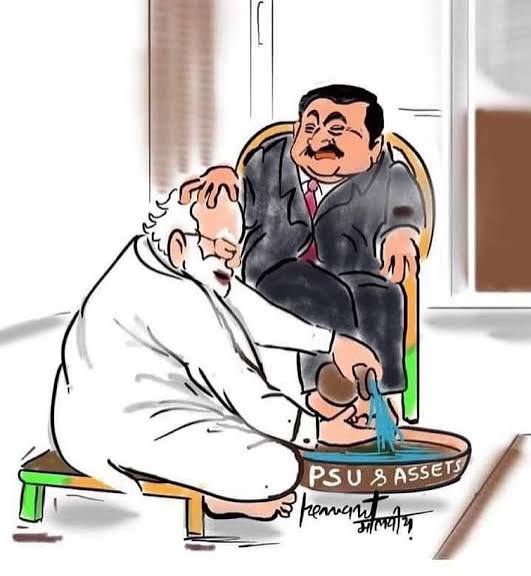
There is a well-known cycle in the friendship of a politician and a businessman, and Gujarat between 2001 and 2014 was its laboratory.
- Money buys power.
- Power makes laws, rules, tenders and land allotments.
- Those laws make more money.
- The money buys the same power again — at a larger scale.
Since 2014 the BJP under Modi has not merely practised cronyism; it has used the Indian state as an instrument for the accelerated accumulation of one private capital. Adani’s rise is not a market outcome. It is the result of public land, public rules, public agencies and public money being deliberately directed toward a single balance sheet. This is Adani–BJP cronyism: the organised transfer of collective resources into private hands under the cover of development and national interest.
1.1 Mundra before and after 2003
By 2000 Adani already had a small port at Mundra, on land given by successive governments, Congress included. This dossier does not hide that fact, because it sharpens rather than blunts the charge: what changed after 2001 was not the existence of patronage but its velocity and its exclusivity. The 30-year concession with the Gujarat Maritime Board was signed in February 2001, months before Modi took office; the decisive land flows came after.
From 2003 the process accelerated sharply. According to the government’s own figures, thousands of acres around Mundra were allotted to the Adani Group in quick succession. By around 2011 the total approached 15,000 acres — roughly half the area of Chandigarh — at rates that started at ₹1 per square metre. The Mundra SEZ was incorporated in 2003 and notified in 2006 as one of India’s first port-based multi-product SEZs. Land acquired at nominal rates could then be sub-leased to industrial tenants at commercial rates: a land-bank arbitrage financed by the public’s land, with the spread booked as private profit. The same arithmetic appears in the DHFL resolution: Ajay Piramal, Ambani’s kin and another beneficiary of BJP proximity, acquired assets valued at roughly ₹45,000 crore for one rupee. Ambani himself is the other pole of the same BJP-enabled formation. In both cases public or public-bank assets moved to politically adjacent balance sheets at prices that bore no relation to their value.
1.2 “It was barren land” — the comparison
Someone will say the land was salty, barren and useless; that development has a cost because it creates jobs and infrastructure. Accept that for a moment. Then compare what other investors in the same state, under the same Chief Minister, were charged for land meant for the same declared purpose — development and jobs.
| Investor (Gujarat, 2000s) | Project | Land rate as cited in the public dispute | Times Adani’s ₹1 |
|---|---|---|---|
| Adani Group | Mundra port & SEZ | ₹1 per sq m (lowest tranche; later tranches ₹1–32) | 1× |
| Ford India | Sanand car plant | ₹100+ per sq m (figures cited vary upward) | 100×+ |
| Tata Motors | Nano plant, Sanand | ₹900 per sq m (after renegotiation) | 900× |
The land was different, so the price was different — that can be argued. But no one else received so much land, so quickly, at such throwaway rates. If one runner is placed ahead before the starting gun, it is not a race. Remember the number: one rupee. It returns in this story again and again — at Pirpainti in 2025 it returns as ₹1 a year for a thousand acres.
1.3 The grazing land of Navinal
Some of the land was not barren at all. Around 2005, roughly 108 hectares of gauchar — village grazing commons — at Navinal near Mundra were allotted to the Adani port company. Villagers litigated for nearly two decades. In 2024 the Gujarat High Court directed the state to take the land back. The Supreme Court stayed that order. The commons remain enclosed. When a village wins in court and still does not get its land back, the law has become a formality that the powerful are allowed to outlast.
1.4 How the cycle closes
Every government has its favourites. Congress had them — Ambani, Tata, Birla, Singhania. Leaders and industrialists are two faces of one coin, and that coin has shone for centuries. The leader knows that before money the law bends; the businessman knows that if you throw money the law can be made to bend. So the leader writes rules under which a state’s inheritance — coal, land, forests, water, coastline, islands, spectrum, airports, labour — passes straight into the hands of the chosen seth. The seth books record profits. The profits circle back to the leader as finance, as media, as aircraft, as silence. The leader wins more elections. New states, new land, new forests, new islands await extraction. The wheel turns: business money into politics; public resources into business. Dirty, blind money.
What this dossier documents is that the wheel has stopped being a wheel. In every earlier era there were several favourites who competed for the state’s favour, and their competition was itself a crude check. Here, with each turn, a new sector, a new industry, a new country circles back to the same man. That is why the right word is not “cycle” but chakravyūha — the spiral battle formation of the Mahabharata that one can enter but not leave, in which everyone is now trapped: the farmer, the fisherman, the Adivasi, the airline passenger, the LIC policyholder, the electricity consumer, the journalist, and the judge.
2. Rules bent to fit one man
The post-2014 record is Adani–BJP cronyism without disguise. Rules were rewritten, experience requirements were dropped, lone-bidder allotments were permitted, and investigating agencies were deployed against rivals who would not sell. Coal, airports, ports and power plants moved to Adani not because he out-competed others on open terms, but because the BJP government changed the terms until competition was no longer possible. This is not governance. It is the use of state power to manufacture a private monopoly.
2.1 Coal: the secretary who said no, and the rule that said yes
In 2014 the Supreme Court cancelled 204 coal blocks allotted since 1993. The new government promised clean, live, transparent e-auctions. The officer entrusted with them was Coal Secretary Anil Swarup (in office 31 October 2014 – 23 November 2016), an IAS officer with a reputation for probity who had built the auction machinery after the previous government’s coal scandal.
An account in wide public circulation holds that calls began to come from the Prime Minister’s Office asking whether coal would be allotted to selected industrialists, and that Swarup’s answer each time was no — the auction would be live, in public view. This specific claim is not documented in the public record and is put here as a question demanding an answer (Section 12). What is documented: in November 2016 Swarup was moved out of the Coal Ministry to School Education.
What is also documented is what happened to the rules:
- Reverse bidding for power-sector blocks. Blocks for power producers were auctioned not to whoever paid the treasury most but to whoever promised the lowest electricity tariff. That design rewards the bidder who already owns the whole chain — mine access, import terminals, rail, ports and large power plants. The Adani Group happened to own all of it. Popular accounts put Adani’s take of the cheap coal at about one-third; the precise share has never been published and should be audited in public.
- The MDO back door. The Reporters’ Collective’s “Coal Files” (2023), drawing on internal government papers, showed that Adani’s mine-developer-cum-operator (MDO) contract for the Parsa East Kente Basan (PEKB) block in Hasdeo — struck before the Supreme Court cancellations — was kept alive through a clause in the new coal law. When the Cabinet Secretary later reviewed MDO appointments made before block allotment and called the practice inappropriate, officials found only one case that fitted that description: Adani’s PEKB deal (Reporters’ Collective). The practice was “inappropriate”; the one beneficiary kept the benefit.
- The lone-bidder rule. On 17 August 2022 the coal ministry declared Adani the winner of the 250-million-tonne Gondbahera Ujheni East block in Singrauli — as the only bidder, after the government had quietly given itself discretion to allot blocks even when auctions failed to attract competition (The Wire / Reporters’ Collective). An auction with one bidder is not an auction. It is an allotment wearing an auction’s clothes.
The design of reverse bidding and the lone-bidder rule delivered cheap coal to the group that already controlled the logistics chain. The outcome was not luck.
2.2 Airports: six for six
In November 2018 the government put six Airports Authority of India airports up for 50-year lease: Ahmedabad, Lucknow, Mangaluru, Jaipur, Guwahati and Thiruvananthapuram — new or recently renovated, and mostly profitable. Just before bidding, two rules were changed:
- Prior airport-operating experience was no longer required.
- There was no cap on how many airports one bidder could win.
It was said this would increase competition. As reported later, the Finance Ministry’s Department of Economic Affairs had advised that no single bidder be given more than two airports because of financial risk, and NITI Aayog had flagged capacity concerns. The advice was overridden. Adani had never run an airport. In February 2019 Adani won all six — not one, not two, all six. Kerala’s government, which had offered to match the winning bid for Thiruvananthapuram through its own company, was turned down; the state assembly passed a unanimous resolution against the handover in 2020.
If you are observant you will notice that in the coal case and the airport case the rules moved in opposite directions — one design kept newcomers out (only the integrated giant could promise the lowest tariff), the other opened a shortcut for a newcomer (no experience needed). In both, the same man won. The constant is not the policy logic. The constant is the beneficiary. In June 2026 the opposition asked the shipping ministry whether the Great Nicobar transhipment port would also produce “an airports-like situation” (Section 10). The question tells you how the airports deal is now remembered.
2.3 Mumbai: the prize that would not sell — until the raids
The biggest prize remained. Mumbai’s Chhatrapati Shivaji Maharaj International Airport — India’s second-busiest — had been run by the GVK Group since 2006. For about a year Adani tried to buy in; for a year GVK refused. Like every large infrastructure company GVK carried debt, but it had lined up equity from Abu Dhabi’s sovereign fund ADIA, the Canadian pension fund PSP and India’s NIIF. The deal was fixed.
Then another coincidence. In June–July 2020 the CBI registered a case alleging a ₹705-crore fraud at Mumbai International Airport Ltd against GVK’s promoters, and the Enforcement Directorate raided their offices. GVK’s rescue deal collapsed. On 31 August 2020 Adani announced it would take control of Mumbai airport — and with it 74% of the new Navi Mumbai airport, which the Prime Minister inaugurated in October 2025.
In February 2023 GVK’s vice-chairman said on camera that there had been no pressure from the Adani Group or anyone else to sell Mumbai airport. The channel on which he said it was NDTV — by then also owned by Adani.
2.4 Coastal Energen: the promoter in jail, the plant to Adani
The same choreography — agency case, insolvency, acquisition — played out in Tamil Nadu. In 2018 the DRI accused Coastal Energen, owner of a 1,200 MW coal plant at Thoothukudi, of supplying low-grade coal to the public-sector NTPC at inflated prices. The CBI filed a cheating case; the ED arrested promoter Ahmed A.R. Buhari in March 2022 alleging ₹564 crore in proceeds of crime, and opposed six bail applications. While he sat in custody, the company was dragged into insolvency under the IBC. Adani Power’s expression of interest was rejected as late; it re-entered by partnering the little-known Dickey Alternative Investment Trust (DAIT). The CCI cleared the DAIT–Adani acquisition in February 2024; the NCLT approved a ₹3,335.5-crore resolution plan on 30 August 2024; Adani completed the takeover the next day. Buhari’s lawyers called DAIT a front for Adani. The NCLAT briefly stayed the takeover; the Supreme Court let the consortium keep running the plant.
Then the cases collapsed. The Madras High Court quashed the predicate case, and the special court dropped the money-laundering charges. After an eight-year battle Buhari emerged with a clean slate — and without his plant (The Wire). He has been reported as spending some 32 months in custody. By the time he was proved innocent, his company had become Adani’s. The prosecution failed; the transfer of ownership succeeded. That is the only outcome that counted.
2.5 The same script, other stages
| Year | Asset | How it reached Adani | What preceded it |
|---|---|---|---|
| 2014–15 | Udupi power plant (Lanco), 1,200 MW | Purchase from distressed promoter | Lender pressure on Lanco |
| 2020 | Krishnapatnam Port (AP) | 75% bought from Navayuga | Promoter stake sale |
| 2021 | Gangavaram Port (AP) | Bought out promoter and the AP government’s own 10.4% stake | State sold its stake to Adani |
| 2020 | Mumbai airport (+ Navi Mumbai) | Took GVK’s stake | CBI FIR and ED raids on GVK |
| 2022 | NDTV | Warrant conversion via VCPL, open offer, founders sell | Years of CBI, ED, I-T and SEBI cases against the Roys |
| 2022 | Ambuja Cements & ACC | Bought from Holcim for about $10.5 bn | — (made Adani India’s No. 2 cement maker overnight) |
| 2022 | Dharavi redevelopment (Mumbai) | Won ₹5,069-crore tender after earlier tender scrapped | Earlier higher bid by SecLink cancelled; state land parcels added later |
| Sep 2024 | 6,600 MW power supply to Maharashtra (25 years) | Won MSEDCL tender at ₹4.08/unit against JSW and Torrent | Tender floated before the Lok Sabha model code; awarded weeks before state polls; opposition alleged rigging (National Herald) |
| 2024 | Coastal Energen, 1,200 MW | IBC resolution via DAIT consortium | DRI/CBI/ED cases; promoter jailed; cases later dropped |
The sequence is repeated with the regularity of a ritual: a desirable asset; an owner who will not sell; an agency case; a collapse; Adani at the door. When state power moves in only one direction, the movement itself is the evidence.
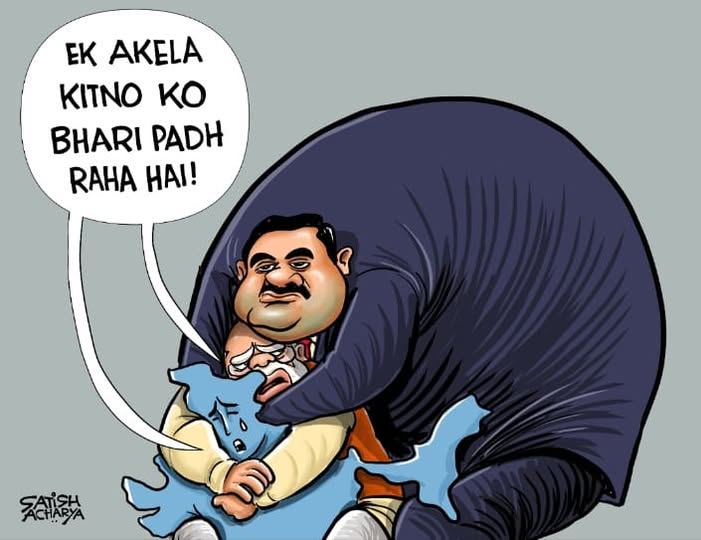
The 2020 farm laws, brought by the BJP, were written to benefit Adani and Ambani. They lifted stock limits on essential commodities and opened agricultural trade outside the regulated mandis after a NITI Aayog task force on which Adani Group interests had pressed for precisely those changes.
The Reporters’ Collective documented the lobbying; the laws delivered the outcome. Adani Agri Logistics already operated major Food Corporation of India silos. Farmers from Punjab, Haryana and Uttar Pradesh named both Adani and Ambani in protests, boycotts and effigies, treating the legislation as the transfer of the grain chain into the same politically adjacent hands that had already received land, ports and airports. The Adani Group stated it does not own the grain. The statement does not address the prior lobbying or the existing logistics position the laws would have enlarged. The laws were repealed after a year of protest. The pattern they exemplified—rule change sought by the cronies, delivered by the BJP, defended as reform—remained.
3. The crony chakravyūha: one man inside your daily life
Within twelve years the Adani Group went from ports and coal trading to the infrastructure of everyday Indian life. Even at his peak Dhirubhai Ambani did not control, all at once, your coal, your airport, your port, your television news, your cement and your electricity. Not at this speed. Within ten years Adani overtook Ambani — and in April 2026 the Bloomberg index again ranked him Asia’s richest person, at $92.6 billion (IBTimes/IANS); the Hurun India Rich List 2026 put the family’s wealth at ₹9.22 lakh crore (Gulf News).
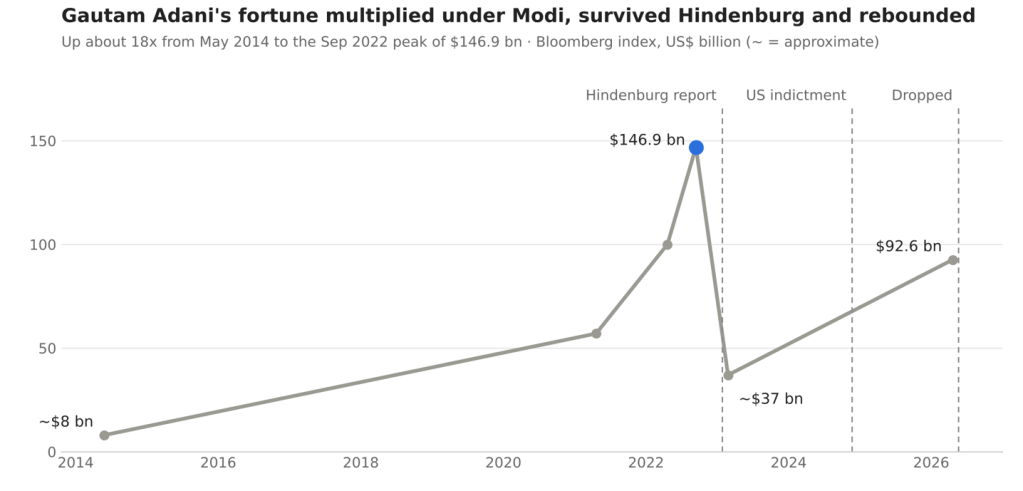
The line tells the whole story in one stroke: a fortune multiplied under one Prime Minister, collapsed when a foreign short-seller published, and rebuilt — with the help of public money (Section 6) and a vanished US prosecution (Section 5). No market force explains a recovery of that size in the teeth of a US indictment. Political insurance does.
3.1 Where Adani sits in an Indian day
| Moment in your day | What you touch | Adani entity | Position (as claimed by the group or reported) |
|---|---|---|---|
| Breakfast | Himachal apples; flour, pulses, edible oil | Adani Agri Fresh; Adani Agri Logistics (grain silos for FCI); formerly Adani Wilmar (“Fortune” brand, stake sold 2025) | Apple procurement prices in Himachal widely seen as set by Adani’s purchase rates |
| Cooking | Piped gas, CNG | Adani Total Gas (with France’s TotalEnergies) | One of the largest city-gas distributors |
| Light and fan | Electricity | Adani Power; Adani Energy Solutions; Adani Electricity Mumbai | Largest private thermal generator; largest private transmission & distribution company; 3 million+ Mumbai connections |
| The meter on your wall | Smart prepaid meters | Adani Energy Solutions | Among the largest smart-meter contract holders under the national scheme |
| The fuel behind that power | Coal | Adani Enterprises (mining, MDO, imports) | Largest private coal miner/operator and largest coal importer |
| The solar panel and battery | Renewables, storage | Adani Green Energy | Largest renewable developer; claims over 50% of India’s operational battery storage (6.63 GWh, Oct 2026) |
| The walls and the road | Cement; highways | Ambuja Cements, ACC; Adani Road Transport | India’s No. 2 cement maker; highway projects across about nine states |
| The tap | Water and sewage | Adani Water | Municipal water and wastewater concessions |
| The airport | Seven airports incl. Mumbai, Navi Mumbai | Adani Airport Holdings | About one in four Indian air passengers; about a third of air cargo |
| The port | 15+ ports and terminals, incl. Vizhinjam | Adani Ports & SEZ | Largest private port operator; roughly a quarter of India’s cargo; bidder for Great Nicobar |
| The border | Drones, missiles, ammunition, aerostructures | Adani Defence & Aerospace (JV with Israel’s Elbit) | Only Hermes 900 drone line outside Israel |
| The cloud | Data centres, AI hardware | AdaniConneX; Jabil JV (Oct 2026) | Multi-gigawatt plans |
| The future grid | Nuclear | Announced nuclear ambitions after private entry opened | Planned |
| The slum | Dharavi, Asia’s largest informal settlement | Adani-led Navbharat Mega Developers | Redevelopment rights over 1 million residents’ homes |
| The news | Television, agency wire, business news | NDTV; IANS (majority stake since Dec 2023); BQ Prime | The “fourth pillar” itself |
From start to finish it is hard to separate Adani from daily life. It has become hard to separate what the government runs from what Adani runs. A citizen who wanted to boycott the group for a single day could not light a lamp, take a flight, ship a parcel, pour a foundation or watch the evening news.
3.2 Why this is not “normal” in any democracy
In any major democracy this much does not end up in the fist of one private citizen. Laws exist precisely to prevent it. The United States — the largest capitalist society — passed the Sherman Act in 1890 so that monopolies could not form, because if the whole system sits in one man’s fist and that man falls, everything falls. Europe polices concentration through merger control and, now, the Digital Markets Act. Even China, which is not a democracy, keeps land and strategic assets under state ownership and has humbled its own billionaires. India’s Constitution, in its Preamble and Directive Principles, committed the Republic to socialism and to ensuring that the operation of the economic system does not result in the concentration of wealth and means of production to the common detriment. Its Competition Act, however, looks at markets one at a time; it has no tool for a single group that is present in every market at once. When rules are twisted to benefit one business, competition ends — and, as Norway’s 2026 exclusion of Adani Green shows (Section 8), even foreign investors lose trust.
3.3 The arithmetic of the fortune
- Suppose you earn ₹1 lakh every day and spend nothing. To save ₹5 lakh crore you would need about 137,000 years — back before the British, before the Mughals, before recorded history.
- At the Hurun 2026 figure of ₹9.22 lakh crore, the same saver would need about 252,600 years (₹9.22 lakh crore ÷ ₹1 lakh a day = 9.22 crore days).
- The group’s market value rose from roughly ₹9.6 lakh crore in December 2021 to roughly ₹18.6 lakh crore a year later — about ₹9 lakh crore added in twelve months, more than the annual budgets of most Indian states.
- The World Inequality Lab’s 2024 paper on India’s “Billionaire Raj” found the top 1% share of national income higher today than under British rule.
Adani’s fortune under Modi is the measurable result of BJP-enabled extraction. Public land at one rupee, public contracts shaped by rule changes, and public financial institutions that absorbed risk when private capital retreated produced a balance sheet that no amount of entrepreneurial skill can explain. The BJP did not regulate capital; it organised its concentration. What is called the Gujarat model and later the national model is the systematic conversion of public assets into Adani’s private wealth.
Some will still say he is a once-in-a-century genius who earned it all by hard work, and that if something is wrong one should go to court. Section 9 shows what happens to those who do.
4. Hindenburg, OCCRP, SEBI — the regulator that investigated the accuser
4.1 The report and the crash
On 24 January 2023 Hindenburg Research — a New York firm that bets against companies it believes are headed for collapse — published a 106-page report, the product of about two years’ work, claiming that the world’s then third-richest man was pulling the largest con in corporate history. It alleged stock manipulation through a web of offshore shells in Mauritius, the UAE and the Caribbean linked to Gautam Adani’s elder brother Vinod Adani; accounting irregularities; dangerous leverage; and a pattern that echoed old SEBI and DRI cases against Adani Exports from the early 2000s. It ended with 88 questions. Hindenburg disclosed it was short.
Adani shares fell like a house of cards. More than $100 billion of market value vanished within days, and about $150 billion at the trough. On 1 February 2023 — Union Budget day — the group withdrew its fully subscribed ₹20,000-crore follow-on public offer of Adani Enterprises. A company confident in its books does not cancel a fully subscribed offer.
4.2 The flag wrapped round the ledger
Before any regulator acted, before the matter could be debated in Parliament, the country was told a story: if Adani falls, India falls. Not “if the charges are true, someone must answer” — only that if he is touched, everyone is under pressure. The group’s 413-page reply called the report a calculated attack on India; its CFO stood before the national flag and invoked the Jallianwala Bagh massacre. It was the Resurgent Group’s 2003 move again: a question of accountability recast as an insult to the nation.
A country of 140 crore people, the world’s fifth-largest economy, was asked to believe it rested on one man’s share price. What did the country that gave him his wealth receive in return? Had it become his hostage?
In Parliament on 7 February 2023, the Leader of the Opposition asked how many foreign trips the Prime Minister and Adani had made together, and how many contracts followed. Large parts of the speech were expunged. The opposition’s demand for a Joint Parliamentary Committee was refused, and the Budget session was lost. Within seven weeks the questioner was disqualified from the Lok Sabha (Section 11).
After the January 2023 Hindenburg report and the August 2023 OCCRP investigation, the Adani Group called both a “concerted bid by Soros-funded interests” to damage the company and India. Open Society Foundations supplies roughly 4 per cent of OCCRP’s funding; OCCRP states that its donors sign agreements preserving editorial independence. Soros, at the Munich Security Conference in February 2023, said the Adani affair would force questions on Modi. BJP leaders and ministers have repeatedly routed the same reports through the Soros name and extended the attribution to Congress. No court filing, regulatory disclosure, or the reports themselves establish a direct chain from Open Society grants to the research. The attribution serves a different purpose: it converts a documented domestic record—one-rupee land, rewritten tender rules, agency action against rivals, public-money support, and contracts that followed official tours—into a foreign plot. By naming Soros, the BJP–Adani formation shifts the question from what the Indian state did for one balance sheet to who outside India is allowed to notice. The sequence of land, rules, agencies and public money remains on the Indian record regardless of the name attached to the criticism.
4.3 The Supreme Court: no SIT, but a probe of the short-seller
| Date | Step | What it did — and did not do |
|---|---|---|
| 2 Mar 2023 | Court sets up expert committee (Justice A.M. Sapre) | Asked to assess regulatory failure |
| May 2023 | Committee reports | Found no prima facie regulatory failure — but recorded that SEBI’s own 2018–19 rule changes made it harder to trace the ultimate owners behind foreign funds; SEBI had suspicions it could not prove |
| 3 Jan 2024 | Judgment (Vishal Tiwari v. Union of India) | Refused a Special Investigation Team or CBI transfer; held that Hindenburg and OCCRP reports could not be treated as conclusive; gave SEBI three months for the last 2 of 24 probes; asked the government to examine whether Hindenburg itself broke Indian law |
| Jun 2024 | SEBI acts | Issued a show-cause notice to Hindenburg |
The asymmetry is the finding: the accused conglomerate got time; the accuser got a notice. A regulator that cannot see through its own rule changes was trusted to investigate, and was given the power to pursue the messenger.
4.4 OCCRP: the names behind the funds
On 31 August 2023 the Organized Crime and Corruption Reporting Project, with the Guardian and the Financial Times, named two men — Nasser Ali Shaban Ahli (UAE) and Chang Chung-Ling (Taiwan) — as long-standing associates of Vinod Adani who traded Adani stocks for years through Mauritius funds fed by a Bermuda vehicle, at points holding hundreds of millions of dollars’ worth. If they were acting in concert with the promoters, the promoter group’s real holding would have breached India’s 75% cap on promoter ownership. OCCRP also reported that in 2014 the DRI had written to the then SEBI chairman about evidence that Adani money may have reached the Mauritius funds — and that the lead was not pursued. That former chairman later joined NDTV’s board after the Adani takeover. The group denied the report as a foreign campaign; the names, the Mauritius vehicles and the 2014 DRI letter to SEBI remain on the record.
4.5 The regulator’s chair and the same funds
In August 2024 Hindenburg published whistle-blower documents alleging that the SEBI chairperson, Madhabi Puri Buch, and her husband had once held stakes in obscure offshore funds in the same Bermuda–Mauritius structure linked to Vinod Adani. The Buchs denied any conflict; the Lokpal later dismissed complaints against her; her term ended in February 2025. The question that matters was never answered by a body independent of the government: why should the public accept a clean chit from a regulator whose head had been accused of sitting in the same pipes?
4.6 The clean chit — on a “technicality”
In January 2025 Hindenburg shut down. In June 2025 the Adani group withdrew the settlement applications it had filed with SEBI. On 18 September 2025 SEBI’s whole-time member closed the related-party cases, holding that loans of more than ₹20,000 crore routed from Adani Ports through Adicorp, Milestone Tradelinks and Rehvar Infrastructure to Adani Power and Adani Enterprises were not “related-party transactions” under the old definition, because the wider definition SEBI adopted in 2021 applied only from 1 April 2023 and the loans had been repaid. Adani posted the order with the tricolour and demanded apologies; the order itself found only that the circular loans were not related-party under a definition SEBI had already replaced because such structures escaped it. A company that had done nothing wrong does not apply to settle and then withdraw the application only when the outcome is assured. That is not vindication. It is a conclusion that refuses to cohere — written into a statutory order (Moneylife; Business Standard).
Read the order for what it says. SEBI did not find that money did not flow in a circle. It found that, at the time, the rule did not call that circle a related-party transaction. A regulator that changed the definition precisely because such structures escaped it then applied the old definition to clear the structure. Why would a company that had done nothing wrong apply to settle, and then withdraw the application only when it was sure of the outcome? That is not vindication. It is a conclusion that refuses to cohere — written into a statutory order.
4.7 Questions SEBI has not answered
- Who are the ultimate beneficial owners of every foreign fund that held Adani shares between 2013 and 2023, and will SEBI publish them?
- Did any Adani promoter-linked person ever control, fund or advise Ahli, Chang or the Mauritius funds?
- Was the 75% promoter cap breached at any point, and if SEBI cannot tell, why not?
- Why did SEBI issue a show-cause notice to the short-seller before it issued a single final order against the company?
- What happened to the 2014 DRI letter to SEBI’s chairman, and who decided not to pursue it?
- What did the Adani group’s withdrawn settlement applications propose to settle, and will SEBI publish them?
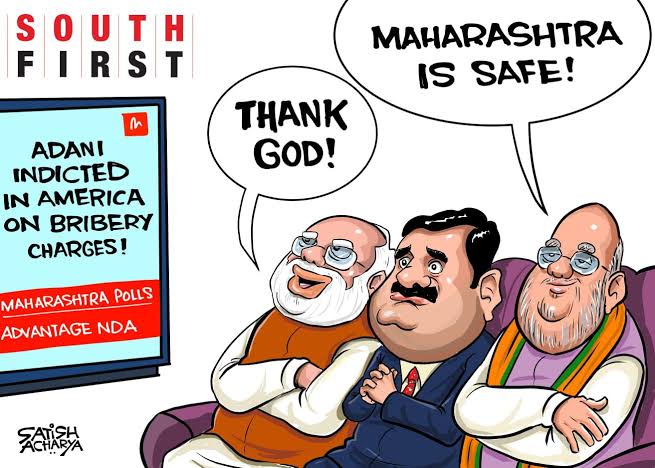
5. Brooklyn: the indictment that a trade deal made disappear
5.1 What the United States charged
On 20 November 2024 prosecutors in the Eastern District of New York unsealed a five-count indictment (returned by a grand jury on 24 October 2024), and the SEC filed parallel civil complaints. The core allegation: a scheme to pay about $250–265 million in bribes to Indian state officials — in Andhra Pradesh, Odisha, Chhattisgarh, Tamil Nadu and Jammu & Kashmir — so that state power distributors would sign up for overpriced solar power contracted through the central Solar Energy Corporation of India, contracts expected to yield about $2 billion in profit over two decades.
Gautam Adani, his nephew Sagar Adani and Adani Green CEO Vneet Jaain were charged with securities-fraud conspiracy, wire-fraud conspiracy and securities fraud, for allegedly hiding the scheme from US investors while Adani Green raised money — including more than $175 million from US investors in a 2021 bond deal. Executives of Azure Power and others faced FCPA-conspiracy and obstruction counts. The SEC alleged a ₹1,750-crore payment linked to Andhra Pradesh alone.
Within days Adani Green pulled a $600 million bond; Kenya cancelled two Adani projects (Section 8); TotalEnergies froze new investment. The group’s response was to insist that Gautam Adani had not been charged under the FCPA itself — a lawyer’s distinction offered to a public that had just read the bribery allegations. Being charged with hiding a bribery scheme from investors is not a defence against the bribery.
5.2 How the case was made to vanish
| Date | Event |
|---|---|
| Nov 2024 | Indictment unsealed; SEC civil suits filed |
| Feb 2025 | Trump administration pauses most FCPA enforcement |
| Aug 2025 | Adani retains Sullivan & Cromwell’s Robert Giuffra — also President Trump’s personal attorney |
| 2025 | India does not serve the SEC’s summons; SEC tells the court in Oct 2025 that its requests through Indian authorities went unanswered despite follow-ups |
| 21–23 Jan 2026 | SEC asks the court to allow service by email; Adani group loses about $12.5 bn in market value; Adanis then accept service |
| 2–3 Feb 2026 | India–US interim trade deal announced: US tariff on India cut from 50% to 18%; India to cut tariffs on US industrial and farm goods and wind down Russian oil purchases |
| 3 Feb – 17 Apr 2026 | Adani team submits about 600 pages of argument, expert reports and slides to the DOJ over ten weeks |
| Apr 2026 | Adanis move to dismiss the SEC case |
| 14 May 2026 | SEC settlement: Gautam Adani pays $6 m, Sagar Adani $12 m — $18 m in total, without admitting or denying |
| 14–18 May 2026 | OFAC settlement: Adani Enterprises pays $275 m for 32 apparent violations of Iran sanctions (Iranian LPG bought via a Dubai trader, Nov 2023 – Jun 2025), which OFAC called egregious and not voluntarily disclosed |
| 18 May 2026 | DOJ asks the court to dismiss the indictment with prejudice; Adani publicly pledges about $10 bn of US investment; two career prosecutors who built the case withdraw two days later |
| Jul 2026 | Judge Garaufis calls the DOJ’s first motion inadequately explained; DOJ files a fuller defence; the Brooklyn US Attorney says he had no basis to dispute it, without saying he agreed |
| 10 Aug 2026 | Court dismisses the securities and wire-fraud counts against Gautam Adani, Sagar Adani and Jaain with prejudice; approves the SEC settlement; calls it highly unusual that the dismissal was shaped largely with defence counsel and seemingly without input from the investigating agencies; decision on the five absent co-defendants deferred |
Sources: CNBC, Business Standard, Kashmir Observer/PTI, OFAC, US News/Reuters, MLex.
5.3 What the dismissal is — and is not
- It is not an acquittal. No jury heard the evidence. The prosecutor chose to stop, citing discretion, priorities and jurisdiction.
- It is not a finding that no bribes were paid. The bribery counts against the other defendants were not resolved on the merits; the court deferred them.
- It is not a clean chit from the SEC. Paying $18 million “without admitting or denying” is a purchase of closure.
- It is not the end of Adani’s US liabilities. Adani Enterprises paid $275 million — fifteen times the SEC penalty — for Iranian-gas payments routed through American banks. OFAC rated the conduct egregious.
- It was criticised by the judge who granted it. A federal judge recorded that the dismissal was worked out largely with defence counsel and seemingly without the investigating agencies. Two career prosecutors walked off the case.
- Adani denied any quid pro quo; the sequence remains summons unserved for a year, trade deal, Trump’s lawyer, $10 billion pledge, settlement and dismissal in the same week. The sequence remains: summons unserved by India for a year → trade deal on US terms → Trump’s lawyer → $10 billion pledge → settlement and dismissal within the same week.
5.4 “Not a trade deal but a bargain for Adani’s release”
The Leader of the Opposition alleged from February 2026 that the Prime Minister was “compromised” — that the US case against Adani was in substance a case against the BJP’s financial structure — and, when the settlement emerged in May, that the Prime Minister had struck a bargain for his friend’s release rather than a trade deal (Siasat/PTI; Congress). The government calls the deal a milestone. If the deal was clean, the negotiating record would prove it. The government has not released it.
5.5 What India itself never did
The bribes alleged were paid to Indian officials, for contracts paid for by Indian electricity consumers. Yet:
- No Indian agency — CBI, ED, Lokpal, state anti-corruption bureaux — is publicly known to have registered a case on the US allegations as of 18 October 2026.
- The Competition Commission of India in May 2026 gave Adani Green and the Adanis a clean chit on allegations of favoured treatment in the same power-purchase agreements.
- The power regulator CERC declined jurisdiction (April 2025) while SECI transferred Azure Power’s 2,333 MW share of the Andhra contract to Adani Green.
- Andhra Pradesh’s chief minister promised action on “irregularities” in late 2024; none has been made public.
- The same agencies that moved within weeks against GVK, the Roys and Ahmed Buhari did not move at all.
A bribe allegedly paid in India, to Indian officials, at Indian consumers’ cost, was pursued only in New York — and when New York stopped, India had never started.
When foreign regulators and short-sellers documented the mechanisms of Adani’s rise, the BJP government and its aligned institutions did not investigate the Indian officials and Indian consumers named in the allegations. They delayed summons, accepted technical clearances, and mobilised public money. The 2024 US indictment ended after a trade deal and an investment pledge not because the evidence was refuted, but because political power in both countries chose to protect the arrangement. Adani–BJP cronyism proved capable of neutralising external scrutiny
5.6 Questions
- Why did the Ministry of Law and Justice sit on the SEC’s Hague Convention requests for over a year?
- Was the Adani case raised, directly or indirectly, in the India–US trade negotiations of late 2025 and early 2026? Will the government place the negotiating record before Parliament?
- Which Indian officials were the alleged recipients described in the indictment, and why has no Indian agency questioned them?
- Will the electricity contracts obtained through the alleged scheme be reviewed and repriced?
- Who pays the $275 million OFAC penalty in the end — shareholders, including LIC?
- Why do ED and CBI act within weeks against Adani’s rivals but not at all against Adani?
6. Your premium, his lifeline: LIC, SBI and the IBC
First the coal was given to one man, then the airports, then the forest. Then a pen was placed in your hand and you were made to sign a cheque in the same man’s name. You are not merely being looted — you are being made to fund the looting.
6.1 LIC: the policyholder as shock absorber
- January 2023. As Adani shares collapsed, the Life Insurance Corporation of India — custodian of the savings of over 250 million policyholders — disclosed equity and debt exposure to the group of roughly ₹36,000 crore at purchase value. Estimates at later market values put LIC’s money in Adani shares at about ₹48,000 crore. LIC kept buying through the turmoil.
- May 2025. According to internal documents reported by the Washington Post on 25 October 2025, officials of the Finance Ministry’s Department of Financial Services, LIC and NITI Aayog drew up, and the ministry approved, a plan to channel about $3.9 billion (≈ ₹32,000–33,000 crore) of LIC money into Adani companies: about $3.4 billion in bonds of Adani Ports and Adani Green, and about $507 million to raise equity stakes in Ambuja Cements and Adani Green — explicitly to signal confidence in the group while foreign banks hesitated after the US indictment (Moneylife; The Wire). The justification offered: Adani bonds yielded up to 8.2% against about 7.2% on 10-year government paper. A pension-like fund chasing an extra point of yield from an indicted borrower is not prudence. It is a rescue.
- 30 May 2025. Adani Ports needed about $585 million to refinance debt. The entire bond was taken by one investor: LIC.
- LIC’s answer. LIC denied any plan or Finance Ministry role; the $585 million single-buyer Adani Ports bond is not in dispute (Business Today).
6.2 From Mundhra to Mundra
India has seen this before. In 1957 LIC, under Finance Ministry pressure to “steady the market”, bought ₹1.24 crore of shares in companies of the Calcutta speculator Haridas Mundhra. A young MP, Feroze Gandhi, exposed it in Parliament; the Chagla Commission was appointed; Finance Minister T.T. Krishnamachari resigned in 1958. In 1958 a ₹1.24-crore bailout cost a finance minister his job. In 2025 a reported ₹33,000-crore plan cost no one anything. That is the measure of how far accountability has fallen — from Mundhra to Mundra.
6.3 SBI in Brisbane, 2014
On 17 November 2014, during the Prime Minister’s visit to Australia — with Gautam Adani in his delegation — the State Bank of India signed a memorandum for a loan of up to $1 billion to Adani’s Carmichael coal project in Queensland’s Galilee Basin, a project every major Western bank had declined. After a public outcry the loan was never disbursed. In 2017 Queensland vetoed a proposed A$1 billion concessional loan from Australia’s Northern Australia Infrastructure Facility. Both moments show the same reflex: when private capital says no, public capital is asked to say yes.
By February 2023 SBI disclosed loan exposure to the group of about ₹27,000 crore. Public sector banks remain among the group’s principal lenders.
6.4 The IBC: buying the distressed at a discount
The Insolvency and Bankruptcy Code (2016) — sold as a creditor’s tool — has become one of Adani’s most efficient acquisition channels. Public-sector banks and public assets have moved to the group through it at repeated intervals. Essar Power’s 1,200 MW Mahan plant in Madhya Pradesh went to Adani via insolvency resolution in 2022 after lenders took the haircut. Lanco Amarkantak Power’s thermal plant in Chhattisgarh followed the same route in 2024. Coastal Energen’s 1,200 MW plant at Thoothukudi was acquired in 2024 through a resolution plan with Dickey Alternative Investment Trust while its promoter sat in Enforcement Directorate custody; the predicate cases were later dropped and the plant remained with Adani. Vidarbha Industries Power’s 600 MW Butibori plant was resolved under the Code the same year. In each instance the public banks absorbed the loss, the depositor and taxpayer later recapitalised those banks, and the operating asset passed to the favoured crony conglomerate. The Code did not merely resolve distress. It converted public-bank exposure and public-sector plant into Adani-Ambani-Piramal (all are proximate to the BJP) balance-sheet entries on a schedule.
| Asset | Year | Route | Note |
|---|---|---|---|
| Essar Power M.P. (Mahan) | 2022 | Insolvency resolution | Thermal plant |
| Lanco Amarkantak Power | 2024 | IBC resolution plan | Thermal plant, Chhattisgarh |
| Coastal Energen, 1,200 MW | 2024 | IBC via DAIT consortium | Promoter in ED custody at the time; cases later dropped (Section 2.4) |
| Vidarbha Industries Power (Butibori) | 2024 | IBC | 600 MW plant |
| DHFL | 2020–21 | Bid lost to Piramal, Ambani’s kin | Adani’s bid for DHFL’s wholesale book and later the whole firm is part of the IBC record OBMA has documented separately |
| Jaiprakash Associates | 2025–26 | IBC | Adani’s plan backed by lenders; contested by a rival bidder |
6.5 Questions
- Did any official of the Department of Financial Services or NITI Aayog communicate with LIC about Adani investments in 2025? Will the government release the files the Washington Post described?
- Why did LIC alone take 100% of a $585 million Adani Ports bond weeks after foreign banks had stepped back?
- What is LIC’s total current exposure to the Adani group, and what share of policyholder funds does it represent?
- Who in government arranged SBI’s 2014 Carmichael memorandum during a prime-ministerial tour?
- How much did public sector banks write off in each IBC case that ended with an Adani acquisition?
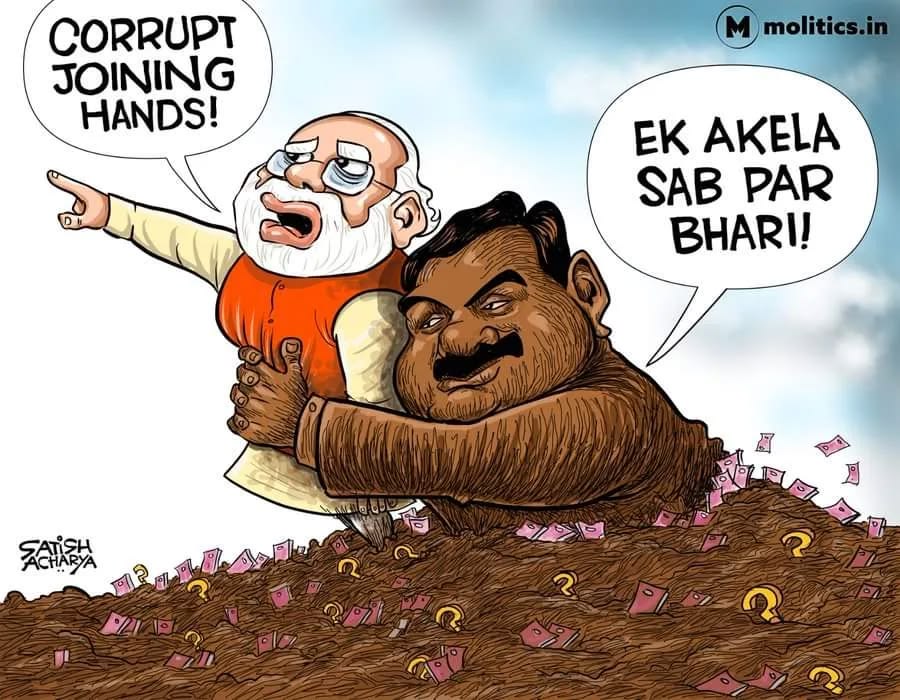
7. Coal, contraband and the port that “only provides service”
7.1 Coal over-invoicing: the case that sleeps
When imported coal is invoiced above its real price, two things happen. Money leaves India through the inflated invoice. And the inflated cost is passed on through electricity tariffs to every household and factory that buys the power. The consumer pays twice: once in the bill, once in the capital that never comes back.
- 2016. The Directorate of Revenue Intelligence (DRI) began probing about 40 importers for overvaluing Indonesian coal by an estimated ₹29,000 crore between 2011 and 2015. Adani group companies were the biggest names. The DRI alleged that of about 1,300 consignments imported by the group between October 2010 and March 2016, routed largely through a Singapore subsidiary, 231 consignments showed an overvaluation of about ₹930 crore against prices declared to Indonesian authorities (LiveLaw).
- 2019. The Bombay High Court quashed the DRI’s letters rogatory to Singapore, the UAE, Hong Kong and the British Virgin Islands — the requests for the very invoices that would prove or disprove the case.
- January 2020. The Supreme Court stayed that ruling on the DRI’s appeal. Since then the case has languished. The DRI’s show-cause notices sit in the “call book”.
- October 2023. The Financial Times reported that the group appeared to have paid more than $5 billion to middlemen for coal imported at prices far above market between 2019 and 2021 (later extended to 2023); in one case coal that left Indonesia’s Kaliorang port in January 2019 was valued far higher by the time it reached India. Gujarat opposition parties alleged about $500 million in excess payments to Adani Power over five years under a coal-linked power purchase agreement.
- May 2024. OCCRP and the FT reported leaked documents from Indonesian supplier Jhonlin indicating that low-grade coal was invoiced as high-grade to Tamil Nadu’s state utility TANGEDCO, with prices and declared quality rising as the coal passed between intermediaries (OCCRP). The Chennai NGO Arappor Iyakkam estimates TANGEDCO overpaid about ₹6,000 crore to all suppliers in 2012–16, when half the tender value went to Adani.
The group denies the reports and claims settlement via a different importer’s case; the DRI’s own Adani appeal has remained unheard since 2020. A case that would answer the question has been allowed to sleep for six years. Note the contrast: when Coastal Energen was accused of overpricing coal, its promoter went to jail. When Adani was accused of overpricing coal, the file went to the call book.
7.2 Mundra: the drug route
For many, Hindenburg was simply a foreign conspiracy to stop India’s rise. There is another story that happened inside India’s own border — at Mundra, the same port where this story began.
In June 2021 a consignment left Kandahar for Bandar Abbas in Iran and then sailed to Mundra. The papers said “semi-processed talc stones”. According to the investigation it carried heroin — reported at about 300 kg. It passed without strict checking, reached a warehouse in Delhi, and disappeared.
On 13 September 2021, three months later, two more containers took the same route with the same papers. Inside, layered under talc in jumbo bags: 2,988.21 kg of heroin, worth about ₹21,000 crore — the largest drug seizure in Indian history, caught by DRI officers. The consignee, Aashi Trading Company of Vijayawada, had been set up for the purpose. The case went to the National Investigation Agency, which told the courts this was not only smuggling but narco-terror financing: the proceeds were linked to Lashkar-e-Taiba — the organisation whose proxy, The Resistance Front, claimed the Pahalgam massacre of April 2025. Investigators found that earlier consignments had entered by the same Mundra route.
How did so large a threat advance so far? A special NDPS court asked whether the port or its management had benefited and how no one at the port had noticed. Adani Ports claimed it was only a service provider with no control over containers; the government accepted that claim and recorded port officials as witnesses, not accused. Port officials were recorded as witnesses, not accused. The company announced it would stop handling cargo from Afghanistan, Pakistan and Iran. Parliamentary answers later showed Gujarat’s ports, Mundra above all, accounted for a disproportionate share of India’s big narcotics seizures in 2021–25, including cocaine and tramadol.
A government that calls every critic of Adani anti-national accepted, without a murmur, that the operator of the port through which terror money flowed bore no responsibility at all. The case still circles through dates. Mundra continues to provide service.
7.3 Mundra and Iran, again
In May 2026 Adani Enterprises paid $275 million to the US Treasury for buying Iranian LPG passed off as Omani and Iraqi gas through a Dubai trader between November 2023 and June 2025 — conduct OFAC called egregious and not voluntarily disclosed (OFAC). The same group that told an Indian court it cannot know what is in containers at its own port paid a quarter-billion dollars in Washington for not knowing where its own gas came from. In India no agency is known to have asked a single question about it.
7.4 Questions
- Why has the DRI’s Supreme Court appeal on Adani’s Indonesian coal imports not been heard since January 2020?
- How much did consumers in Gujarat, Tamil Nadu, Rajasthan, Maharashtra and Haryana pay in tariffs on coal later alleged to be over-invoiced?
- How many consignments passed through Mundra on the Kandahar–Bandar Abbas route before September 2021, and where did they go?
- What security obligations does a private operator of critical national infrastructure carry — and why did no one at Mundra face scrutiny for the largest drug haul in Indian history?
- Did Iranian LPG bought by Adani Enterprises in 2023–25 land at Adani-run ports, and did Indian customs flag it?
- Why was Coastal Energen’s promoter jailed on a coal-overpricing charge while the Adani coal file sleeps?
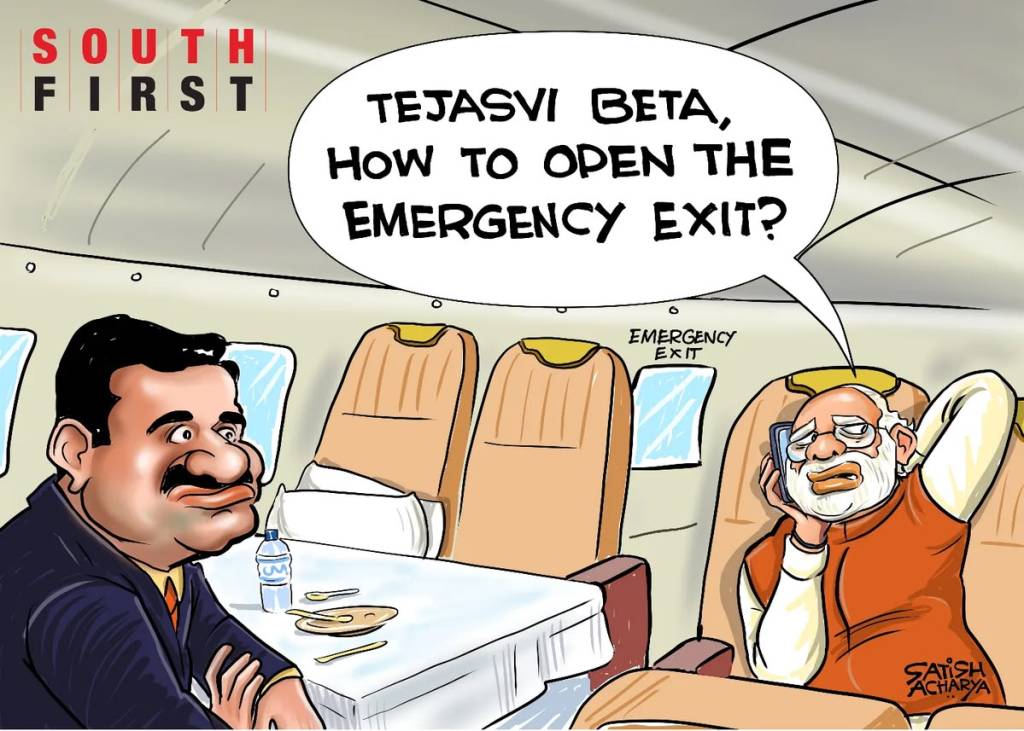
8. The travelling salesman: Modi’s tours, Adani’s deals
There was a time when Adani gave Modi a lift to Delhi. A true friend remembers such things. That is why, in the years since, wherever Modi goes, Adani deals tend to follow — a port here, a power contract there, an airport bid, a loan memorandum signed in the Prime Minister’s presence. Adani Watch and others have compiled the pattern: many of the group’s foreign deals were struck soon after Modi’s official visits, or after foreign leaders visited India (Adani Watch). The Wire put the question in four words: who is the dalal of whom? (The Wire)
8.1 Country register
| Country | Modi’s diplomacy | What Adani got or sought | What happened |
|---|---|---|---|
| Australia | G20 visit, Brisbane, Nov 2014; Adani in the delegation | SBI memorandum for up to $1 bn for the Carmichael coal mine (Galilee Basin) | Loan never paid out after outcry; A$1 bn NAIF loan vetoed 2017; #StopAdani forced the mine down from 60 to about 10 Mtpa; Wangan and Jagalingou Traditional Owners overridden |
| Bangladesh | Dhaka visit, June 2015, pledges help with power | MoU with Bangladesh Power Development Board two months later (Aug 2015); 25-year PPA Nov 2017 for 1,496 MW from Godda, Jharkhand | India made Godda an export SEZ in 2019, giving Adani tax breaks Bangladesh still pays for; coal priced near $400/t against about $250 benchmarks; Power Division estimated $23.9 bn payable over 25 years; Jan 2026 Bangladesh review panel found a 39.7% premium over the nearest private competitor and procedural anomalies (Daily Times); supply halved in Nov 2024 over $800–900 m dues |
| Israel | First Indian PM visit, July 2017; further visit Feb 2026 | Adani–Elbit drone JV in Hyderabad (2018); Haifa port bought with Gadot for about $1.2 bn (Jan 2023), days after Hindenburg | Adani–Elbit reportedly delivered 20 Hermes 900 drones to Israel in early 2024 during the Gaza war (The Wire) |
| Myanmar | Visit, Sept 2017 | Yangon container terminal on land leased from the military conglomerate Myanmar Economic Corporation; Adani met coup leader-to-be Min Aung Hlaing (2019) | Norway’s KLP excluded Adani Ports (June 2021); asset sold at a loss in 2023 to an undisclosed buyer; Norway’s sovereign fund excluded Adani Ports in May 2024 for risk of contributing to rights violations in war (Bloomberg) |
| Sri Lanka | Visits 2015, 2017, 2019, 2025 | Colombo West Container Terminal (51%, 2021); Mannar–Pooneryn 484 MW wind farms, 20-year PPA at 8.26 US cents/kWh (May 2024) | June 2022: Ceylon Electricity Board chairman M.M.C. Ferdinando told Parliament’s COPE committee that President Rajapaksa said Modi had pressed for Adani; he retracted the next day and resigned within days; Rajapaksa denied. Sri Lanka revoked the PPA Jan 2025; Adani withdrew Feb 2025 (Deccan Herald); Adani dropped a $553 m US DFC loan request for Colombo in Dec 2024 |
| Tanzania | Visit, July 2016 | 30-year concession for Dar es Salaam Container Terminal 2 (May 2024); talks on a $900 m transmission project | Concession operating |
| Kenya | Visit, July 2016; President Ruto in Delhi, Dec 2023 | JKIA Nairobi airport: $1.85 bn for a 30-year lease (proposal Mar 2024); $736 m KETRACO transmission deal (Oct 2024) | Mass protests and court challenges; Ruto cancelled both on 21 Nov 2024, the day after the US indictment |
| Greece | First PM visit in 40 years, Aug 2023 | Talks included Adani interest in Kavala, Volos and other ports | Interest announced; no deal public |
| Vietnam | Visit 2016 | Phuoc Minh wind JV (2018); up to $10 bn of port and energy plans after PM Chinh met Adani (2024) | Pending |
| Bhutan | Four visits | Adani Power–Druk Green 770 MW Chamkharchhu-I hydro (Oct 2026), after earlier 570 MW Wangchhu MoU | New |
| Nepal | Five visits | Negotiations with holders of hydro rights to export to India and Bhutan | Reported |
| Norway | First Indian PM visit in 43 years, May 2026; Modi receives Norway’s highest honour; “Green Strategic Partnership” | — | Three months earlier, in Feb 2026, Norway’s $2-trillion sovereign fund excluded Adani Green for risk of gross corruption or serious financial crime (Moneylife) — the second Adani firm it barred |
| United States | Interim trade deal, Feb 2026 | Criminal case dropped, SEC settled for $18 m (May–Aug 2026) | Adani pledges $10 bn US investment; opposition calls it a bargain for Adani’s release (Section 5) |
| UAE | Repeated Gulf visits; Modi’s closest Gulf partnership | Abu Dhabi’s IHC invested about $2 bn in Adani companies (2022) and backed the 2023 FPO | IHC stayed invested after the indictment |
8.2 Reading the register
A Sri Lankan official said under oath to his own Parliament that his President named the Indian Prime Minister — and then unsaid it within a day and was gone within days. Norway barred Adani Green for corruption risk; the Prime Minister went to Norway three months later and came back with a medal. A US case was pending; India signed a trade deal on American terms; the case vanished. The same pattern appears in Greece, Bangladesh, Australia, Israel, Nepal, Tanzania and beyond.
Modi is the statesman and Adani the businessman; Modi is the businessman and Adani the statesman. When a Prime Minister’s foreign policy and one tycoon’s order book move together this closely, the burden of proof shifts: it is for the government to show that Indian diplomacy was not used as a private sales channel. It has never tried.
Where host societies had free courts, free media and elections, the deals often failed — Kenya, Sri Lanka, Bangladesh after Hasina. That is the global lesson: the Adani model needs a captured state on both ends. Where the state is captured only at the Indian end, the deal survives until the other country’s voters, judges or reporters find it.
8.3 Questions
- Will the Ministry of External Affairs publish, for every prime-ministerial visit since 2014, the list of business delegates and the MoUs signed by private companies during or within six months of the visit?
- Did any Indian official recommend Adani to the governments of Sri Lanka, Bangladesh, Kenya, Tanzania, Israel or Greece?
- Why did India declare Godda an SEZ in 2019 for a plant selling all its power abroad — and who in Bangladesh was told?
- Did Indian diplomats engage with Norway’s fund before or after the February 2026 exclusion of Adani Green?
- Has Adani travelled abroad on official delegations with the Prime Minister, and on how many occasions?
9. Adani’s Ecocide on the balance sheet
The Prime Minister asks citizens to plant a tree in their mother’s name (Ek Ped Maa Ke Naam, 2024). In the same years, lakhs of trees are cut for one man’s mines and plants, entire hills are levelled and shown on paper as barren, sacred groves are reclassified as revenue land, and fertile farmland is recorded as wasteland. The centuries-old capital of the country once called the golden bird — its coasts, forests, rivers, islands and commons — has in a decade become one man’s project pipeline. This is not anyone’s ancestral property to hand over at will.
9.1 The register of sacrifice zones
| Site | What is being destroyed | Scale | Who resists | Status, Oct 2026 |
|---|---|---|---|---|
| Mundra, Kutch (Gujarat) | Mangroves, tidal creeks, fishing grounds, grazing commons | Government expert committee under Sunita Narain (2013) documented mangrove destruction incl. on Bocha Island, blocked creeks and salinity ingress | Kharva and Wagher fishing communities; Navinal villagers | Port expanding; Navinal grazing land still enclosed after SC stayed HC order (2024) |
| Hasdeo Aranya (Chhattisgarh) | Central India’s largest unbroken dense forest (about 1.7 lakh ha), Mahanadi catchment, elephant habitat | Parsa East Kente Basan and Parsa blocks operating (Adani as mine operator); Kente Extension got in-principle forest clearance in May 2026 for felling about 4.48 lakh trees in a zone the government’s own tool rates high-conservation (Indian Express via EaseMyPrep) | Gond and Oraon gram sabhas; Hasdeo Aranya Bachao Sangharsh Samiti; Alok Shukla (Goldman Prize 2024) | Villagers allege forged gram sabha consent; the state ST Commission probed fake meetings; felling resumed under the new BJP government within days of taking office in Dec 2023 |
| Godda (Jharkhand) | Santhal and Paharia farmland for a plant that sells every unit to Bangladesh | 1,600 MW plant; export-only SEZ (2019) | Santhal farmers; marches of hundreds of km | Plant running; land grievances unresolved |
| Pirpainti, Bhagalpur (Bihar) | Mango orchards and farmland | 1,020–1,050 acres from 856 farmers, leased to Adani Power at ₹1 a year for 33 years — ₹33 in all; opposition alleges about 10 lakh trees felled; power to be sold to Bihar at ₹6.08/unit for 33 years (National Herald; Drishti) | Farmers; Congress and Youth Congress (lathi-charged in Patna, Sept 2025) | 2,400 MW plant proceeding; part of compensation reportedly still pending |
| Jaisalmer orans (Rajasthan) | Sacred groves and grazing commons dedicated to local deities | Adani Green’s 600 MW solar project at Baiya; villagers demand adjoining government land be recorded as oran | Villagers; Sheo MLA Ravindra Singh Bhati; 700-km protest march (2025) | 14 arrested and about 30 detained in Nov 2024 after resisting switchyard work (Newslaundry) |
| Great Nicobar (Andaman & Nicobar) | Primary tropical rainforest, leatherback nesting beaches, coral reefs, the homeland of the Shompen and Nicobarese | About 130–166 sq km of forest; 8.5 lakh trees by the government’s count, up to 1 crore by others; Adani Ports a bidder for the port | Little and Great Nicobar Tribal Council; scientists; Survival International | See Section 10 |
| Galilee Basin (Australia) | Groundwater, the Doongmabulla Springs, Wangan and Jagalingou country, Great Barrier Reef shipping lanes | Proposed 60 Mtpa, built at about 10 Mtpa | W&J Traditional Owners; #StopAdani (125+ groups) | Operating as Bravus; spring drawdown disputed |
| Vizhinjam (Kerala) | Coast and fishing livelihoods | Deep-water transshipment port | Latin Catholic fishing communities, mass protests 2022, citing erosion | Commissioned by the Prime Minister, May 2025 |
| Mannar (Sri Lanka) | Bird migration corridor near the Vankalai Ramsar wetland | 484 MW wind plan | Sri Lankan environmentalists | Adani withdrew, Feb 2025 |
| Dharavi (Mumbai) | Homes and livelihoods of over a million people | Redevelopment with state land parcels added, incl. salt-pan and dairy land; residents deemed ineligible face relocation | Residents’ groups | Rehabilitation construction began Oct 2026 |
9.2 “Go to court,” they say
Some will say: if something is wrong, go to court. A Santhali farmer named Suryanarayan Hemrom of Godda did go to court against Adani to stop the taking of his land. The outcome, according to accounts from Godda: he was beaten by the police, and a trespass case was filed against him — for standing on his own soil, the soil he had ploughed since childhood. The same story belongs to the fishermen of Kerala and Kutch, the Gond villagers of Hasdeo, the herders of the Jaisalmer orans, the mango farmers of Bhagalpur, the Nicobarese of Great Nicobar — and to GVK, to the Roys of NDTV, and to Ahmed Buhari, whose plant became Adani’s while he sat in custody.
Whether the person standing in front of Adani is small or large, the outcome is the same. The law is said to be equal for all, but litigation is expensive. Adani can keep an army of fifty lawyers standing for a hundred years. You cannot. It is not a fair fight. It is not even a fight.
9.3 The bipartisan alibi, refused
The government’s defenders point out that Congress governments also cleared Hasdeo phases (2022), and that the Pirpainti land was first leased at ₹1 to a state company in 2022. Both are true and neither helps them. Every earlier regime fed the same pipeline. The BJP turned it into wholesale structural cronyism: a state policy that offers ₹1 land “to all qualifying investors” became, in practice, a policy for the one investor with the capital, the political access and the pre-existing infrastructure to claim 1,000 acres. A state policy that offers ₹1 land “to all qualifying investors” — as Bihar’s officials argued — becomes, in practice, a policy for the one investor with the capital and the access to claim 1,000 acres.
9.4 The greenwashing machine
Adani Green is now India’s largest renewable developer and claims more than half of India’s operational battery storage (6.63 GWh, October 2026). The same group is India’s largest private coal miner, coal importer and thermal generator, and is building new coal capacity (Pirpainti alone is 2,400 MW). The green division raises ESG money abroad; the black division burns coal at home; the brand campaign — Hum Karke Dikhate Hain, “we deliver” — blends both. The bribery allegations of 2024 concerned solar contracts, and the Jaisalmer arrests concerned a solar plant. The green transition has proved as amenable to rent, and to enclosure, as the coal it replaces. Even Adani’s renewables are a monopoly in the making.
These are not side-effects of development. They are the deliberate, repeated destruction of living systems—forests, aquifers, coastlines, sacred groves, and the communities that depend on them—carried out so that one balance sheet can expand. When a government reclassifies fertile land as barren, ignores its own conservation ratings, withholds gram sabha findings, arrests those who defend a grove, and allows felling to continue after courts and commissions have flagged the damage, the act meets the definition of ecocide: the severe, widespread or long-term destruction of ecosystems, done with knowledge of the consequences, for private gain. It is not an externality. It is the criminal method.
9.5 Questions
- Who decided that 1,000 acres of fertile Bhagalpur farmland was “barren”, and on what survey?
- How many trees have been felled for Adani-operated or Adani-owned projects since 2014? Will the MoEFCC publish a project-wise count?
- Will the Chhattisgarh government release the ST Commission’s findings on the Hasdeo gram sabha resolutions?
- Why is Kente Extension being cleared in a zone the ministry’s own decision-support tool classes as high-conservation?
- What happened to the Narain committee’s 2013 recommendations on Mundra, including restoration and the Bocha Island mangroves?
- Why were Jaisalmer villagers arrested for asking that their sacred grove be recorded in revenue records before an Adani plant took it?
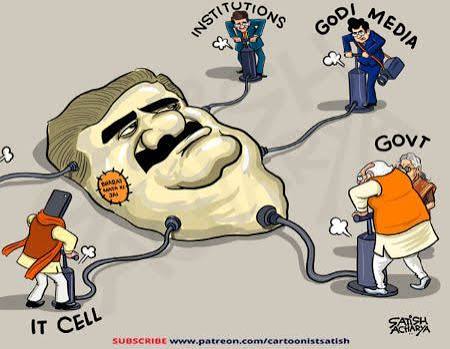
10. Great Nicobar: an island and two peoples traded for a port
At the southern tip of India, about 90 nautical miles from Sumatra, lies Great Nicobar — a UNESCO biosphere reserve (2013), more than three-quarters forest, nesting ground of the giant leatherback turtle, home of the Shompen, a particularly vulnerable hunter-gatherer people, and of the Nicobarese, who have lived on its coasts for generations. The Union government has decided to turn it into a transhipment hub, an international airport, a power plant and a township. And the port at its heart is one that Adani Ports has bid to develop and run.
10.1 What is planned
| Component | Specification | Source |
|---|---|---|
| Whole project (“Holistic Development of Great Nicobar Island”) | ₹72,000 crore at approval; about ₹81,000 crore by 2026; three phases to 2047 | Drishti; ANI |
| International Container Transhipment Terminal, Galathea Bay | ₹48,862 crore; cleared by the Finance Ministry’s PPP Appraisal Committee (announced April 2026); capacity up to about 14–16 million TEU | Maritime Gateway |
| Ownership of the port SPV | 55% to an “Indian-owned and controlled” entity, 45% to state-owned major ports; ministry sought ₹12,230 crore (25%) in viability-gap funding | Maritime Gateway; ANI |
| Airport | Greenfield international airport, 4,000 peak-hour passengers | ANI |
| Power | 450 MVA gas- and solar-based plant | ANI |
| Township | 16,610 hectares | ANI |
10.2 What will be/is being destroyed
- Forest: about 130 sq km of primary tropical rainforest — roughly 15% of the island — within a total diversion of about 166 sq km.
- Trees: the environment ministry’s own estimate is 8.5 lakh trees; independent estimates cited in Parliament and the press run from 32 to 58 lakh; some put the eventual felling above 1 crore (ETV Bharat/PTI; Drishti).
- The sanctuary that was erased: the Galathea Bay Wildlife Sanctuary, notified in 1997 to protect leatherback nesting beaches, was denotified in 2021 — to make room for the port.
- Coral, crocodiles, megapodes: coral reefs along the coast are to be “translocated”; the Nicobar megapode, saltwater crocodile, robber crab and Nicobar long-tailed macaque lose habitat.
- Compensation that compensates nothing: the “compensatory afforestation” for an equatorial island rainforest is planned in Haryana — two thousand kilometres away, in another ecosystem altogether.
- Earthquakes: the site lies in one of the most seismically active zones on earth, with researchers recording about 44 earthquakes a year; the 2004 tsunami permanently submerged parts of the island’s coast (Scroll).
10.3 What was done to the people
| Date | Event |
|---|---|
| 2004 | Tsunami survivors among the Nicobarese relocated to settlements at Campbell Bay; they have asked for 21 years to return to their ancestral villages |
| Aug 2022 | Little and Great Nicobar Tribal Council gives a no-objection to denotification of tribal reserve land |
| Nov 2022 | Council withdraws its no-objection, saying officials rushed it into signing; environmental clearance granted the same month |
| Aug 2025 | Council writes to the Union tribal affairs minister: a 2022 administration certificate falsely told the Centre that all Forest Rights Act claims had been settled before forest land was diverted (Scroll) |
| Sep 2025 | Rahul Gandhi writes to the tribal affairs minister alleging FRA violations; Sonia Gandhi calls the project a “planned misadventure” in The Hindu |
| 7 Jan 2026 | District administration asks tribal leaders at Campbell Bay to sign “surrender certificates” handing their ancestral lands to the government “forever”; they refuse (Scroll) |
| Feb 2026 | National Green Tribunal declines to interfere; upholds clearance with conditions on corals, beaches and endangered species |
| May 2026 | Indian Express reports the three gram sabha resolutions cited as consent were held on the same day at different venues, in identical words, with at least 60 signatures repeated across them — and mainly carried the consent of settlers, not the Nicobarese or Shompen, who are the rights-holders under the FRA (VisionIAS/Indian Express) |
| Jul 2026 | Tribal Council calls the official recognition of forest rights on the island “false” (Mongabay) |
About 27 coastal villages of the Nicobarese lie in the project’s path. The Shompen, numbering a few hundred, have no organisation that can speak for them under the law — which is why the administration’s claim that a welfare society “represents” them was challenged as factually wrong. Survival International has called the mega-project genocidal in its likely effect on the Shompen.
This is Hasdeo’s method transported to the ocean: consent manufactured from settlers’ signatures, rights certified as “settled” when they were not, and a people asked to sign away their land “forever”.
10.4 Where Adani comes in
- In March 2023, eleven companies filed expressions of interest to develop and operate the Galathea Bay terminal. Adani Ports and SEZ was among them, with JSW Infrastructure and Essar Ports (Scroll; Maritime Gateway, Jul 2023).
- Adani already runs Vizhinjam, which the Prime Minister commissioned in May 2025 as India’s first deep-water transhipment port; Galathea Bay would make the same group master of both of India’s transhipment gateways, west and east.
- The 2026 structure reserves 55% of the port company for an “Indian-owned and controlled” entity. By design that excludes the global terminal operators who run Singapore, Colombo and Dubai, and leaves the field to a handful of Indian groups — of which Adani is by far the largest, with the deepest balance sheet and the closest access.
- In June 2026 the opposition asked the shipping minister in writing whether the port would be allowed to become “an airports-like situation” in which one private company ends up with the asset, whether 100% private ownership would be permitted, and why the ministry still wanted viability-gap funding after the Finance Ministry’s appraisal committee refused it (ANI).
No contract has yet been awarded, and this dossier does not claim one has. It records the pattern so that the outcome, when it comes, cannot be called a surprise: a public asset built with public forest and possibly public subsidy, sized and structured in a way that only a few Indian conglomerates can bid for, in a sector where one of them already won six airports out of six.
Experts warn the port may not even make commercial sense: it sits more than 1,600 km from India’s east coast, needs a feeder fleet India does not have, and must compete with Singapore and Colombo, with costs that a retired naval commodore said could rise three to four times the estimate (Scroll). A port that is uneconomic for the public is attractive to a private operator only if the public carries the risk.
10.5 Questions
- Will the government rule out awarding the Galathea Bay terminal to any group that already controls a competing transhipment port?
- Who drafted the “55% Indian-owned and controlled” condition, and which bidders does it exclude?
- Will viability-gap funding or any other public subsidy go to the private partner, after the PPP Appraisal Committee refused it?
- Who signed the 2022 certificate stating that all Forest Rights Act claims on Great Nicobar were settled, and on what evidence?
- Why were the same 60 signatures accepted across three gram sabha resolutions, and why were settlers counted as consenting rights-holders?
- Who ordered officials to ask the Nicobarese to sign “surrender certificates” in January 2026?
- What is the true number of trees to be felled — 8.5 lakh, 58 lakh, or more than a crore — and why does the government not publish a count?
- How does planting trees in Haryana compensate for an equatorial rainforest, and for the Shompen who live in it?
11. Owning the question: NDTV, Parliament, and the silencing of critics
The news media — the fourth pillar, whose job is to raise its voice when the public is looted — was the last sector to be absorbed. It mattered most, because a captured press is what turns a scandal into a non-event.
11.1 How NDTV was taken
| Step | Date | Mechanism |
|---|---|---|
| Lawfare begins | June 2017 | CBI raids the Roys’ home on a private complaint over a 2009 ICICI Bank loan settlement — though ICICI itself never complained |
| Founders grounded | Aug 2019 | Look-out circulars stop Prannoy and Radhika Roy from travelling; a second CBI case (alleged FDI violations) follows; SEBI bars them from board roles for two years (June 2019) |
| The back door | 23 Aug 2022 | Adani buys Vishvapradhan Commercial (VCPL), an obscure lender holding warrants convertible into 29.18% of NDTV’s promoter firm, and converts them without the founders’ consent |
| Open offer | Nov–Dec 2022 | Stake rises above 37% |
| Founders sell | Dec 2022 | Roys sell most of their remaining 27.26%; Adani controls about 64.71% |
| Exodus | Nov 2022 onward | Ravish Kumar, Ramon Magsaysay laureate (2019), resigns; other senior journalists follow |
| Cases fold | Oct 2024 onward | CBI files a closure report in the 2017 case, finding no legally tenable evidence; the Delhi High Court accepts it and later quashes the look-out circulars (Newslaundry; exchange4media) |
Years later several of those cases were proved hollow — but what use is that? A channel built over 34 years of labour now belongs to someone else. NDTV’s ownership change is the template of the age: the case is the weapon; the closure report is the receipt.
Adani then bought a majority of the news agency IANS (December 2023), whose copy feeds hundreds of outlets, and the business-news platform BQ Prime. Owning a wire agency is not owning one voice; it is owning the raw material from which hundreds of newsrooms write. The channel that once asked the hardest questions now hosts GVK’s chairman explaining that he was never pressured to sell Mumbai airport.
11.2 “Godi media”
Godi media — lapdog media — names a pathology subtler than state censorship: owners who need the government’s goodwill for ports, licences and loans do not need to be ordered to be loyal. Reporters Without Borders described the NDTV takeover as the end of pluralism among India’s national broadcasters; India’s press-freedom ranking sank into the 150s and 160s. Viewers who valued NDTV for its independence left; the channel has reported repeated losses since the takeover. A loss-making channel is still worth owning if what it buys is silence.
11.3 Parliament: the questioners removed
| Who | Question asked | What followed |
|---|---|---|
| Rahul Gandhi, Leader of the Opposition (then Congress MP) | 7 Feb 2023: the Modi–Adani relationship, joint foreign trips, contracts that followed | Large parts expunged; on 23–24 March 2023 convicted in a Surat defamation case over a 2019 speech and disqualified from the Lok Sabha; the Supreme Court stayed the conviction in August 2023 |
| Mahua Moitra, TMC MP | Repeated questions on Adani in the Lok Sabha | Expelled from the Lok Sabha on 8 December 2023 over “cash-for-query” allegations made by a BJP MP; re-elected by her constituency in 2024 |
| The opposition as a whole | A Joint Parliamentary Committee on Adani (2023) | Refused; the Budget session of 2023 washed out |
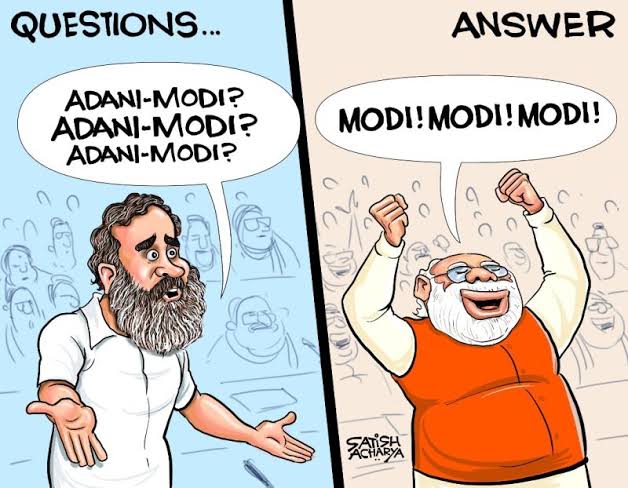
11.4 Journalists and the courts
- In 2021 a Gujarat court issued an arrest warrant against veteran journalist Paranjoy Guha Thakurta in a defamation case (SLAPP) brought by the Adani group over articles on its finances.
- In September 2025 a Delhi court passed an ex parte gag order in an Adani Enterprises defamation suit restraining several journalists and outlets from publishing allegedly defamatory content about the group; the Information and Broadcasting Ministry then directed platforms to take down scores of YouTube videos and Instagram posts. Parts of the order were later set aside on appeal for some of the journalists. A ministry of the Union government acted as the enforcement arm of a private company’s lawsuit.
- Adani’s lawyers have pursued SLAPP-style suits against researchers and reporters at home and abroad. OBMA, itself a SLAPP defendant over its insolvency-accountability research, knows the playbook: drain the critic’s time and money until silence is cheaper than speech.
11.5 The Prime Minister names his crony friend — once
Hearing all this can produce a feeling of helplessness. What can anyone do? Consider this. In May 2024, mid-election, at a rally in Telangana, the Prime Minister himself asked why the opposition had suddenly stopped attacking “Ambani–Adani” and how many tempo-loads of black money it had received. For a moment the friendship had to be disowned in public, because people had begun asking questions. There is more power in one public question than in an $18-million settlement. Public pressure works. That is why social-media posts are deleted, journalists are dragged through courts and jailed, and inconvenient judges are transferred overnight. That is not their strength. It is the strength of the question.
11.6 Questions
- Who financed Vishvapradhan Commercial’s original 2009–10 loan to the Roys’ company, and when did the Adani group first learn of the warrants?
- Why did the CBI act on a private complaint about a loan the lender never disputed — and why did it take seven years to close?
- Will the Lok Sabha publish the expunged portions of the 7 February 2023 debate?
- Under what law did the I&B Ministry order the September 2025 takedowns, and will it publish the list?
- Did any Adani entity, directly or through intermediaries, buy electoral bonds or contribute through electoral trusts? (No Adani company appeared under its own name in the 2024 bond disclosures; in a system built for anonymity, that settles little.)
- If the Prime Minister believed in May 2024 that Adani money was flowing to the opposition, why did no agency investigate — and why has he never said so again?
12. Master register and the questions that remain
12.1 Register of controversies, 2001 – October 2026 (newest first)
| When | Controversy | Where | Status at 18 Oct 2026 |
|---|---|---|---|
| Aug 2026 | US judge dismisses fraud counts with prejudice; calls the DOJ process, shaped largely with defence counsel, highly unusual | USA | Counts against five co-defendants deferred |
| Jul 2026 | Great Nicobar Tribal Council calls official forest-rights recognition “false” | Andaman & Nicobar | Unresolved |
| Jun 2026 | Opposition asks whether the Great Nicobar port will become “an airports-like situation” | India | Unanswered |
| May 2026 | SEC settlement $18 m (no admission); OFAC penalty $275 m for Iranian LPG; DOJ moves to drop case; Adani pledges $10 bn in US | USA | Settled / dismissed |
| May 2026 | Great Nicobar gram sabha resolutions found to repeat 60 signatures and count settlers as consenting | Andaman & Nicobar | Challenged |
| May 2026 | CCI clean chit on alleged favouritism in solar PPAs | India | Closed |
| May 2026 | Kente Extension (Hasdeo) cleared for about 4.48 lakh trees | Chhattisgarh | Stage-I clearance |
| Apr 2026 | Great Nicobar transhipment port (₹48,862 crore) cleared by PPPAC with 55% reserved for an Indian-controlled entity | Andaman & Nicobar | Cabinet approval and tender pending |
| Feb 2026 | India–US interim trade deal; opposition alleges PM “compromised” by the Adani case | India/USA | Deal in force |
| Feb 2026 | Norway’s sovereign fund excludes Adani Green for gross-corruption risk | Norway | Excluded |
| Feb 2026 | NGT upholds Great Nicobar clearance with conditions | India | Disposed |
| Jan 2026 | Bangladesh review panel: Godda power 39.7% overpriced, procedural anomalies | Bangladesh | Renegotiation pressure |
| Jan 2026 | SEC seeks email service after India fails to serve summons for a year | USA/India | Overtaken by settlement |
| Jan 2026 | Nicobarese asked to sign “surrender certificates” for ancestral land | Andaman & Nicobar | Refused |
| Oct 2025 | Washington Post: Finance Ministry–NITI–LIC plan to steer $3.9 bn to Adani | India | LIC denies; not probed |
| Sep 2025 | SEBI closes Hindenburg related-party cases on pre-2021 definition | India | Closed |
| Sep 2025 | Pirpainti: 1,050 acres at ₹1/year for 33 years; alleged 10 lakh trees | Bihar | Proceeding |
| Sep 2025 | Delhi court gag order on journalists; I&B takedown orders | India | Partly set aside |
| May 2025 | LIC alone funds $585 m Adani Ports bond | India | Done |
| Feb 2025 | Adani quits Sri Lanka wind deal after PPA revoked | Sri Lanka | Withdrawn |
| Jan 2025 | Hindenburg Research shuts down | USA | — |
| Nov 2024 | US indictment over $250–265 m bribery scheme; Kenya cancels JKIA and KETRACO deals | USA/Kenya | Indictment dismissed 2026; Kenya deals dead |
| Nov 2024 | Jaisalmer villagers arrested resisting Adani solar switchyard on oran land | Rajasthan | Protests continue |
| Sep 2024 | 6,600 MW Maharashtra power contract awarded weeks before state polls | Maharashtra | Awarded |
| Aug 2024 | Hindenburg alleges SEBI chair held stakes in Adani-linked offshore funds | India | Denied; Lokpal dismissed complaints |
| Aug 2024 | Coastal Energen taken over via IBC while promoter in ED custody | Tamil Nadu | Cases against promoter dropped; plant litigation continues |
| May 2024 | Norway’s sovereign fund excludes Adani Ports (Myanmar military links) | Norway | Excluded |
| May 2024 | OCCRP/FT: low-grade coal sold as high-grade to TANGEDCO | Tamil Nadu | No Indian probe |
| Feb 2024 | Adani–Elbit reportedly delivers 20 Hermes 900 drones to Israel | Israel/India | — |
| Jan 2024 | Supreme Court refuses SIT; asks government to examine Hindenburg’s conduct | India | Disposed |
| Dec 2023 | Mahua Moitra expelled from Lok Sabha; Adani takes a majority of the IANS news agency | India | Re-elected 2024 |
| Dec 2023 | New BJP government in Chhattisgarh resumes Hasdeo felling | Chhattisgarh | Continuing |
| Oct 2023 | FT: more than $5 bn paid to middlemen for overpriced coal | India | No probe |
| Aug 2023 | OCCRP names Ahli and Chang as Vinod Adani associates trading Adani shares | Global | No Indian action |
| Mar 2023 | Rahul Gandhi disqualified seven weeks after Adani speech | India | Conviction stayed Aug 2023 |
| Mar 2023 | Adani Ports among 11 bidders expressing interest in the Great Nicobar terminal | Andaman & Nicobar | Tender pending |
| Jan 2023 | Hindenburg report; FPO withdrawn; JPC refused; Haifa port bought | Global | See above |
| Dec 2022 – Jan 2023 | Ravish Kumar and senior NDTV journalists resign after the takeover | India | — |
| Dec 2022 | NDTV takeover completed after VCPL warrant raid | India | Owned; Roys’ cases closed |
| Nov 2022 | Great Nicobar Tribal Council withdraws its no-objection; clearance granted anyway | Andaman & Nicobar | — |
| Aug 2022 | Gondbahera Ujheni East coal block to Adani as lone bidder | Madhya Pradesh | Allotted |
| Jun 2022 | Sri Lankan CEB chairman testifies Modi pressed for Adani; retracts, resigns | Sri Lanka | — |
| 2022 | Dharavi tender won after earlier higher bid scrapped | Maharashtra | Under way |
| 2021 | Galathea Bay Wildlife Sanctuary denotified for the port | Andaman & Nicobar | Denotified |
| Sep 2021 | 2,988 kg heroin seized at Mundra; LeT link per NIA | Gujarat | Port operator not accused |
| Jun 2021 | Norway’s KLP excludes Adani Ports over Myanmar | Norway | Excluded |
| 2021 | Colombo West Container Terminal | Sri Lanka | Operating |
| 2020 | PEKB MDO deal found “inappropriate” yet kept alive | Chhattisgarh | Operating |
| Aug 2020 | Mumbai airport to Adani after CBI/ED action against GVK | Maharashtra | Owned |
| 2019 | Myanmar port with military conglomerate | Myanmar | Sold 2023 |
| 2019 | Godda declared export SEZ | Jharkhand | Operating |
| Feb 2019 | All six AAI airports to Adani after rule changes | India | Operating |
| 2016 | Coal Secretary Swarup moved; reverse-bidding regime | India | — |
| Aug 2015 | Bangladesh power MoU two months after Modi’s Dhaka visit | Bangladesh | PPA under review |
| Nov 2014 | SBI’s $1 bn Carmichael MoU signed during PM’s Australia visit | Australia | Not disbursed |
| May 2014 | PM-elect flies to Delhi in Adani aircraft | India | — |
| 2010–16 | DRI: Indonesian coal over-invoicing | India | SC appeal pending since 2020 |
| 2005–24 | Navinal grazing commons enclosed | Gujarat | HC ordered return; SC stayed |
| 2003–11 | About 15,000 acres at Mundra from ₹1/sq m | Gujarat | Never reversed |
| 2003 | Resurgent Group of Gujarat; ₹15,000-crore pledge at Vibrant Gujarat | Gujarat | — |
12.2 Twenty-four questions to the Prime Minister
- On how many occasions has Gautam Adani accompanied you abroad, in an official delegation or otherwise?
- Has the PMO, the MEA or any Indian mission ever recommended the Adani Group to a foreign government?
- Why did the Finance Ministry’s own advice against giving more than two airports to one bidder go unheeded in 2019?
- Why was Coal Secretary Anil Swarup moved in 2016, and did the PMO ever ask about allotments to particular companies?
- Why was a Joint Parliamentary Committee refused in 2023, when one was conceded for Bofors, the share-market scams and 2G?
- Why was SEBI’s chair allowed to oversee the Adani probe after conflict-of-interest allegations?
- Why did the Law Ministry not serve the US summons for more than a year?
- Was the Adani case discussed, directly or indirectly, in the India–US trade negotiations?
- Who in government knew of LIC’s decision to take 100% of the May 2025 Adani Ports bond?
- Why has no Indian agency investigated the alleged bribery of Indian state officials described in the US indictment?
- Why has the DRI’s coal over-invoicing appeal not been pressed in the Supreme Court since 2020?
- Why was the Godda plant made a tax-exempt SEZ in 2019?
- Who are the ultimate owners of the foreign funds that held Adani shares, and why has SEBI not named them?
- Why has no one at Mundra been held accountable for India’s largest heroin haul?
- Why does Bihar lease 1,000 acres of farmland to Adani at ₹1 a year?
- Why does the Centre clear Hasdeo mines over gram sabha objections and a high-conservation rating?
- What is the total exposure of public sector banks and LIC to the Adani Group today?
- How much public-bank money was written off in IBC resolutions that ended in Adani acquisitions?
- Who paid for the 2014 flights in Adani aircraft, and were there others?
- Will you rule out awarding the Great Nicobar transhipment port to the Adani Group or any group that already runs a competing transhipment port?
- Who certified in 2022 that forest rights on Great Nicobar were settled, and will that officer be held to account?
- Why did ED and CBI act within weeks against GVK, the Roys and Ahmed Buhari, but never against Adani?
- Why did India accept a $275 million US penalty on an Indian company for Iranian gas without a single domestic inquiry?
- Will you table a white paper listing every contract, concession, land allotment, clearance and loan given to the Adani Group by the Union and BJP-ruled states since 2014?
12.3 What the record will not show
The same formation that rewrote rules and directed public money has also kept the following files closed. The questions are therefore not neutral inquiries; they are questions the Adani–BJP nexus has declined to answer:
- Which entities that purchased electoral bonds were ultimately owned or controlled by Adani-linked persons, and why does the published data still not name them?
- Does any Adani subsidiary hold, or has it applied for, a mining lease or environmental clearance inside the Aravalli range as now defined—and if operations began first, was the clearance granted ex post facto, as has occurred elsewhere when the same formation needed the paper to follow the fact? Why has no such document been placed on the public record? The Aravallis are not a mineral inventory. They are one of the oldest fold systems on Earth, the barrier that slows the eastward advance of the Thar, the recharge zone for aquifers that supply the plains, and the last continuous ecological spine between the desert and the Indo-Gangetic system. To reduce them to a height threshold that renders most of the range invisible is already an act of erasure; to then withhold the documents that would show whether extraction has followed is to complete it.
- What is the full list, value and award date of every defence contract given to Adani Defence beyond the Elbit Hermes 900 line, and why are the award orders not published?
- Which foreign MoUs signed by Adani entities after 2014 were preceded by Indian diplomatic intervention, and why is the delegation register still withheld?
- What is the audited, year-by-year excess paid by each state utility for coal supplied by Adani companies since 2014, and why has the DRI file remained in the call book?
- How many acres in BJP-ruled states other than Gujarat and Bihar were allotted to Adani entities below circle rate or by nomination, and why have those allotment files not been tabled?
Concealment is not an absence of information. It is the continuation of the same method: public resources move, the documents that would show the movement do not. The will to hide (erit celare) is part of the record.
13. Official Claims and the Record, the License Loop, and the Demands
13.1 Official Claims and the Record
| They say | The record shows |
|---|---|
| “Na khaunga, na khane dunga” — I will neither take nor let anyone take | A US indictment alleging $250–265 m in bribes to Indian officials; no Indian agency is known to have opened a case |
| “Minimum government, maximum governance” | Maximum government for one company: rule changes, ₹1 leases, LIC bond purchases, SEZ tax breaks, a port SPV sized for a handful of Indian bidders |
| “Ek Ped Maa Ke Naam” | About 4.48 lakh Hasdeo trees cleared in May 2026; an alleged 10 lakh at Pirpainti; 8.5 lakh to over 1 crore on Great Nicobar |
| “Sabka Saath, Sabka Vikas” | The Shompen and Nicobarese asked to sign “surrender certificates”; settlers’ signatures counted as tribal consent |
| “Atmanirbhar Bharat” | Indian power sold to Bangladesh at a premium; Indian coal bought through offshore middlemen; Indian-assembled drones flown in Gaza |
| “If Adani falls, India falls” | Adani fell $150 bn in 2023; India did not fall. The Republic’s institutions fell instead — one by one |
| “Transparent, competitive bidding” | Six for six at airports; a lone bidder for coal; a late bidder via a front for Coastal Energen |
| “Vindicated by SEBI” | Cleared because the rule in force did not yet call the circular loans related-party |
| “Vindicated in the US” | No trial; $18 m paid without denial; $275 m paid for Iranian gas; a judge calling the dismissal process highly unusual |
| “Development for the poor” | Santhal farmers beaten on their own land; fishermen without fish; Jaisalmer herders arrested; a billionaire whose saver-equivalent fortune would take 2.5 lakh years to earn |
13.2 The license loop, Adani edition
OBMA’s general model of impunity runs in six turns. Applied here:
- Reclassification. Mangroves become “wasteland”; grazing land becomes “surplus”; orchards become “barren”; sacred groves become revenue land; a wildlife sanctuary is denotified; circular loans become “not related-party”; bribery becomes “disclosure”.
- Consent manufacture. Gram sabha resolutions alleged to be forged in Hasdeo and stamped with repeated signatures on Great Nicobar; a CII apology extracted; “if Adani falls, India falls”.
- Expert-circuit capture. A market regulator whose chair faced conflict allegations; a Supreme Court panel that found suspicions it could not prove; a former SEBI chief later on NDTV’s board; clearance committees that accept rights certified as “settled” when they were not.
- Cost displacement. Onto LIC policyholders, public-bank depositors, electricity consumers in Gujarat, Tamil Nadu, Maharashtra and Bangladesh, and onto Adivasi, Nicobarese and fishing communities.
- Fast-track cover. Raids on rivals; IBC timelines that close before the promoter leaves custody; a trade deal; a Washington lawyer; a port structure that excludes global competitors.
- Stay-and-resume. The DRI coal appeal stayed since 2020; Navinal’s return stayed in 2024; Hasdeo halted, then resumed; Great Nicobar’s NOC withdrawn, then ignored; the US case dropped — and the next acquisition announced.
13.3 The SLAPP-hardened counter-case
The strongest defences of the Adani Group and the government, and why they do not answer the charge:
| Their argument | Reply |
|---|---|
| Adani built real infrastructure — Mundra, airports, renewables — faster than the state could | Delivery is not the question. The question is whether public assets were handed over on terms no competitor received. Building on land priced at ₹1, after rules were rewritten and rivals were raided, is not efficiency. It is a public subsidy converted into private monopoly. |
| Every allegation has been cleared: SEBI (2025), the Supreme Court (2024), CCI (2026), the US DOJ (2026) | None of these was a trial on the merits. SEBI applied a definition it had already replaced because such structures escaped it; the Supreme Court refused to investigate; the US case was dropped by the prosecutor after a trade deal and a $10 billion pledge, with a judge recording concern at the process; the SEC was paid without denial. Clearance by non-trial is not innocence. |
| Hindenburg was a short-seller with a profit motive | Motive does not falsify documents. OCCRP, the Financial Times, the Guardian, the Washington Post, the DRI, the SEC, OFAC, Norway’s ethics council and Bangladesh’s review panel had no short positions. The documents remain. |
| Congress governments also favoured Adani and cleared Hasdeo | The charge is not that only the BJP fed the machine. It is that the BJP turned a cycle of intermittent favouritism into a systemic, monopoly crony chakravyūha, placed the Prime Minister’s diplomacy in its service, and then treated the resulting private balance sheet as a national interest that could not be questioned. |
| Foreign deals serve India’s strategic interest against China | Then they should have been awarded by transparent state-to-state tender, not channelled to one favoured private firm whose contracts collapsed in every country with free courts, free media and elections. Strategic interest does not require one man’s order book to move in lockstep with the Prime Minister’s itinerary. |
| Great Nicobar is a strategic national project | Strategy does not require a denotified turtle sanctuary, contested tribal consent, or a port structured for a single class of bidder. A genuinely strategic asset should remain under public control, not be prepared for private capture and the resultant ecocide therein. |
| The ₹1 leases were open to all investors | A ₹1 offer that only one conglomerate possesses the capital, the political access and the pre-existing infrastructure to claim at 1,000-acre scale is targeted in effect, whatever the paper says. Open in form, closed in practice. |
| Critics are anti-national | Asking where public land, public money and public diplomacy went is the most national act there is. The flag was wrapped around a private ledger precisely to stop that ledger from being read. |
This dossier states allegations as allegations and findings as findings. Where the group or the government has denied a claim, the denial is recorded above. OBMA stands by every sourced statement and invites correction of any factual error, in writing, on the record.
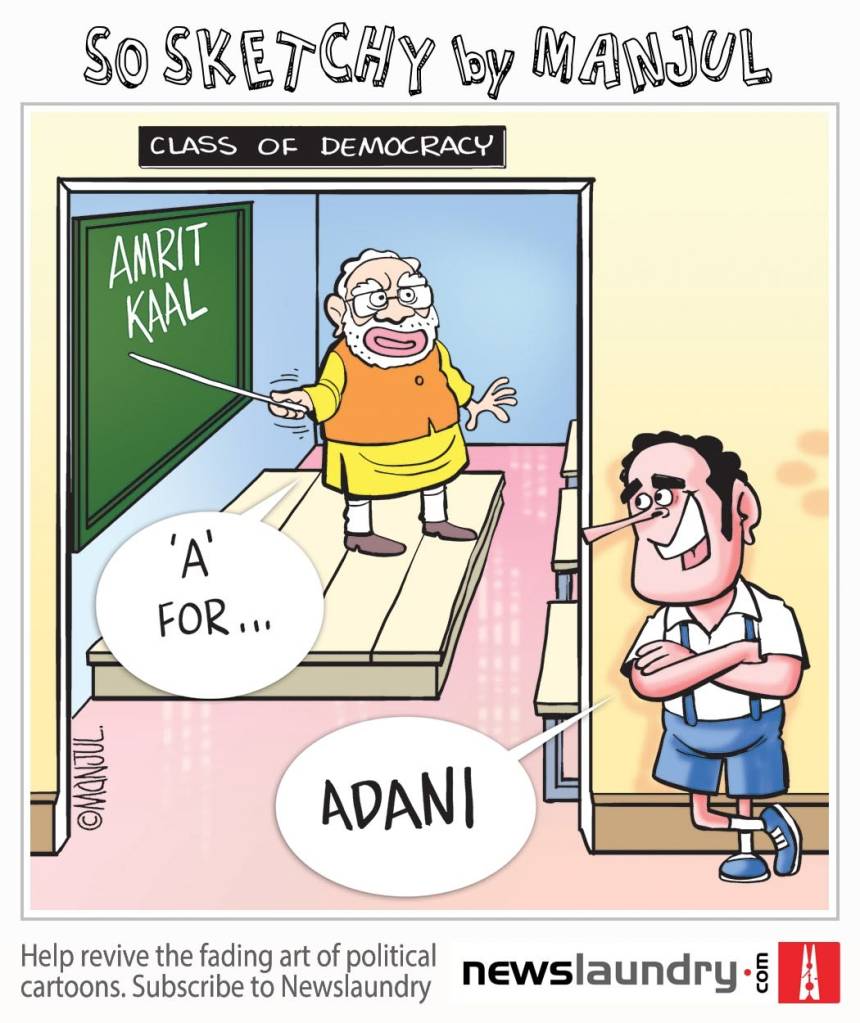
13.4 Demands
- A Joint Parliamentary Committee on the Adani Group, with power to summon ministers and officials of the PMO, MEA, Finance Ministry, NITI Aayog, SEBI, LIC and SBI.
Only a committee with summons power can compel the production of the land files, rule-change notes, tour delegations and exposure schedules that successive governments have kept from public view. - A CBI/ED-independent Special Investigation Team, monitored by the Supreme Court, on the bribery allegations in the US indictment, the coal over-invoicing cases and the Mundra drug route.
Agencies that have previously acted against Adani’s rivals cannot be left to examine allegations that touch the same political-business relationship; independent oversight is required. - A CAG performance audit of every concession, land allotment, coal block, airport, port and power contract awarded to Adani entities since 2001.
A single audit across the full period would establish whether the pattern of nominal pricing, rule changes and sole-bidder outcomes is systemic or coincidental. - Immediate hearing of the DRI’s coal appeal and publication of all letters-rogatory responses.
A case alleging large-scale over-invoicing of imported coal has remained dormant since 2020; the invoices that would settle it must be obtained and placed on record. - Public disclosure by SEBI of the ultimate beneficial owners of every foreign fund that held Adani shares, 2013–2023.
Without the ownership chain, it is impossible to determine whether the 75 per cent promoter cap was breached or whether the structures Hindenburg and OCCRP identified were promoter-linked. - A bar on LIC and public sector banks increasing exposure to any single business group beyond prudential limits, and publication of current Adani exposure.
Policyholder and depositor funds cannot continue to function as an unquantified backstop for one conglomerate; the present totals must be disclosed and future concentration capped. - Cancellation and re-tender of the Pirpainti ₹1 lease; recognition of gram sabha refusals in Hasdeo as binding; a moratorium on Kente Extension; recording of the Jaisalmer orans as commons.
Land priced at one rupee, contested consent and commons must be restored to public process rather than treated as settled transfers. - A halt to the Great Nicobar project pending an independent Forest Rights Act inquiry, re-notification of the Galathea Bay sanctuary, and — if any port proceeds — public ownership, or a bar on any bidder that already controls a competing transhipment port.
An ecologically and tribally contested project should not advance until consent and sanctuary status are independently verified, and any eventual port should not further concentrate cargo capacity. - An anti-monopoly law for conglomerates, on the model of the US Sherman Act, covering cross-sector concentration in infrastructure, energy and media.
India’s present competition law examines markets one at a time; it has no instrument for a single group that simultaneously dominates ports, airports, power, coal, cement and news. - A public register of business delegations on all prime-ministerial foreign visits since 2014, with MoUs signed.
The repeated coincidence of official tours and subsequent Adani contracts requires a transparent record of who travelled and what was signed. - Repeal of the Insolvency and Bankruptcy Code in its present form.
The Code has repeatedly converted public-bank haircuts into private crony acquisitions favoured by the political regime; in its current design it functions as an acquisition channel rather than a resolution mechanism. - Accountability at the top. The Prime Minister should answer the twenty-four questions in Section 12 on the floor of Parliament. If he cannot, he should step aside and let an independent inquiry proceed without the shadow of the friendship that began in 2002.
The documented relationship began with political support in 2002 and continued through land, contracts, diplomacy and public money; the questions that remain can only be answered by the person at the centre of that relationship.
14. Conclusion
There are names in the world for friendships like this: monopoly, oligarchy, plutocracy, crony capitalism, state capture. In the new India, scams no longer even happen separately, because the crony chakravyūha is the system. What once had to be concealed as irregularity is now executed as policy, defended as development, and protected as national interest.
The claim that Modi acts only for the country, that he has no family and no inheritance of his own, is the necessary alibi. It allows a Prime Minister to preside over the systematic transfer of public land, public contracts, public money and public diplomacy to a closed circle of business houses while presenting the outcome as selfless governance. He has one friend — and that friend is not alone. Alongside Adani stand two other mirror-image strands of the same formation: Mukesh Ambani’s Reliance, which has consolidated refining, retail, telecom and data under a single dynastic roof, and Ajay Piramal’s group, which has expanded through the Insolvency and Bankruptcy Code into finance, pharmaceuticals and real estate on the back of public-bank haircuts. Together they illustrate a duopoly capitalism in which two or three politically enabled houses divide the commanding heights — energy and infrastructure with Adani, consumer and digital markets with Ambani, distressed assets and finance with Piramal — while smaller capital and public institutions are reduced to suppliers, customers or creditors. This is not competitive capitalism. It is dynastic nepo-capitalism, in which family succession, political access and regulatory forbearance substitute for open entry.
The BJP has not merely tolerated this concentration; it has organised it. Land priced at one rupee, rules rewritten before tenders, agencies that move against rivals and fall silent against allies, public insurers and banks that absorb risk when private lenders retreat, and a foreign policy whose itinerary repeatedly precedes private contracts — these are not scattered favours. They are the operating system of a political economy in which the boundary between the ruling party and a handful of balance sheets has been deliberately erased. The Constitution’s commitment to preventing the concentration of wealth is treated as a relic. The Competition Act is left without tools for cross-sector dominance. Institutions that once produced named scams now produce technical clearances, delayed appeals and non-trials.
What the BJP has constructed since 2014 is a politically protected duopoly. Adani was given infrastructure, energy, ports, airports and media; Ambani was given refining, retail, telecom and data. Both houses expanded through family control, regulatory forbearance and access to public resources and public distress. This is not an imperfect capitalism that can be reformed by better rules. It is capitalism functioning as intended under a regime that has made the concentration of wealth and the subordination of public institutions to private balance sheets its operating principle. Anti-capitalist opposition to this order is not an external critique; it is the recognition that the BJP–Adani–Ambani arrangement is the concrete form Indian capitalism has taken.
This is the story of a regime converting the country’s inheritance — the coal, the coast, the forests, the islands, the airports, the savings, the news — into the balance sheets of a closed circle of buyers whose rise has been coextensive with its own. Will only Adani, Ambani and Piramal keep becoming richer, or will the country ever become rich? The question is no longer rhetorical. Every additional port, every additional airport, every additional forest clearance, every additional public-sector exposure, and every additional foreign contract signed in the shadow of an official tour makes the spiral tighter and the exit narrower. The answer depends on whether the question keeps being asked — in Parliament, in courts, in the press, and by the public whose land, savings and coastline are being converted into private fortunes. Ask it.
The question is no longer whether Adani and the BJP are linked. The record shows they are. The question is whether a republic that has already transferred land, forests, coastline, airports, ports, savings and news into a closed circle of politically enabled balance sheets will continue to treat that transfer as legitimate. Calling this development, or national interest, or the unavoidable price of growth, is the alibi. The arrangement is Adani–BJP cronyism. It is anti-democratic in its effects on public resources and public institutions, and it is anti-egalitarian in its distribution of the resulting wealth. Opposition to it is opposition to the form of capitalism the BJP has chosen to entrench since it came to power in 2014.
Sources
US proceedings and settlements: CNBC, 11 Aug 2026 · Business Standard timeline · Kashmir Observer/PTI · US News/Reuters, 17 Jul 2026 · Business Today, DOJ filing · Al Jazeera, 18 May 2026 · CNBC, SEC settlement · MLex, court approval · OFAC settlement · The Wire on OFAC · Stanford FCPA Clearinghouse
Trade deal and political response: Business Today, 3 Feb 2026 · INC · Siasat/PTI · ETV Bharat
SEBI, Hindenburg, LIC: Moneylife, SEBI order · Business Standard · Scroll · Moneylife on WaPo LIC plan · The Wire · Business Today, LIC denial · Moneylife, Mundhra to Adani
Coal, power and acquisitions: Reporters’ Collective, Coal Files · The Wire, lone bidder · LiveLaw, DRI coal case · OCCRP, coal · The Wire, Coastal Energen · Moneylife, NCLAT · National Herald, Maharashtra 6,600 MW · Anil Swarup (tenure)
Foreign deals: Adani Watch · The Wire, “dalal” · Deccan Herald, Sri Lanka · Madhyamam, Ferdinando · Daily Times, Bangladesh panel · Observer BD, Godda costs · ThePrint, global projects · Bloomberg, Norway 2024 · Moneylife, Norway 2026 · Tribune, Modi in Norway · IANS, Norway honour · The Wire, drones · Moneylife, KLP
Great Nicobar: ANI, Jairam Ramesh’s questions, Jun 2026 · Maritime Gateway, PPPAC clearance, Apr 2026 · Maritime Gateway, EoIs, Jul 2023 · Scroll, port economics and bidders · Scroll, “surrender certificates”, Jan 2026 · VisionIAS/Indian Express, gram sabha signatures, May 2026 · Mongabay, Tribal Council, Jul 2026 · Drishti, NGT order · ETV Bharat/PTI, Sonia Gandhi · Deccan Herald, Rahul Gandhi letter · Adani Watch, Nicobar · Survival International
Land, forests and ecology: National Herald, Pirpainti · Drishti, Pirpainti · The Week/PTI · EaseMyPrep/Indian Express, Kente Extension · National Herald, Hasdeo · Scroll, Hasdeo Dec 2023 · Newslaundry, Jaisalmer oran · Mongabay, Mannar
Media: Newslaundry, CBI closure · exchange4media, LOCs quashed
Wealth and group: IBTimes/IANS, Bloomberg index · Gulf News, Hurun 2026 · Adani newsroom, Oct 2026

