
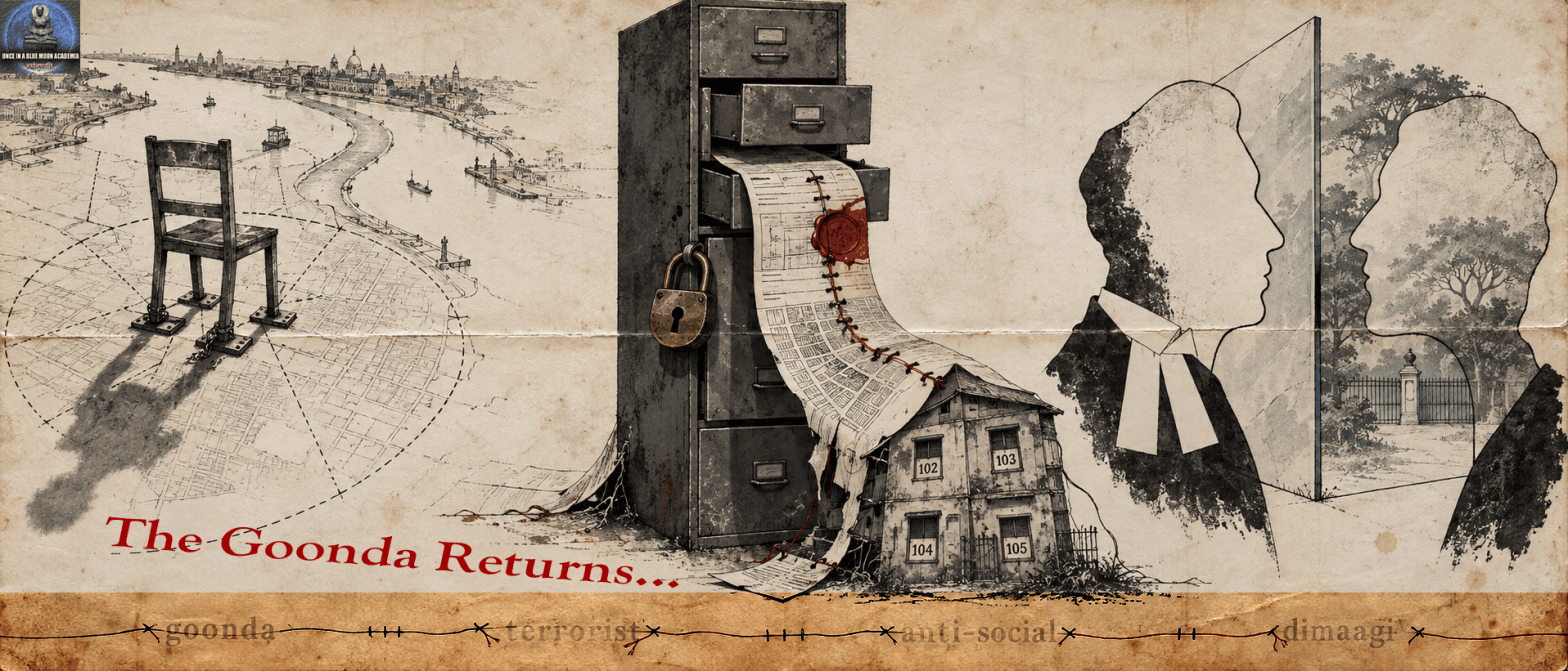
Posted on 23rd September, 2026 (GMT 02:25 hrs)
Colonial Archive, Preventive Detention, and the International Law of Impunity in the West Bengal Public Safety and Control of Anti-Social Activities Act, 2026
A statute that cages the file’s name, not the person’s act, is not law. It is the police state reading its own archive aloud, and calling the reading a “legislation”.
ABSTRACT
On 13 July 2026 West Bengal’s new BJP government announced that the Public Safety and Control of Anti-Social Activities Act (gunḍā-damana) and the Maintenance of Public Order (Amendment) Act were in force. The first allows twelve months’ charge-free detention of anyone a magistrate or commissioner deems a reputational “goonda,” criminalises harbouring the externed, and permits year-long district banishment. The second lets a Claims Commission attach and auction the property of alleged rioters and of protest organisers, financiers, instigators and logistical supporters, up to twice assessed damage. A High Court bench later treated the Public Safety instrument as still awaiting assent; the government had already declared midnight commencement. The article reads both statutes as Bengal’s own colonial archive reprinted — Regulation III of 1818, Rowlatt 1919, the Goondas Act 1923, the 1929 Safety Bill against which Bhagat Singh timed the Assembly bombs — and as a Foucaultian status crime. Against ICCPR Articles 9, 12, 14, 15, 19, 21–22, General Comment 35 and CCPR/C/IND/CO/4 (2024), the design fails at every limb; India’s 1979 Article 9 declaration does not shelter what Article 22 never required. The same circuit is the impunity loop mapped in OBMA’s DHFL and bulldozer work. A coda tests damana against daṇḍanīti, sets ADR affidavits inside the definition, and reads anyonya-pratibimba, Barthesian myth, and the July naming of Netaji’s Forward Bloc as goonda as a category that cannot close. It ends with a protocol: document the order, litigate the interior, internationalise now, count who is named, protect the harbourer. The goonda of the file is not the person. The second file is the remaining procedure.
Keywords: preventive detention; goonda; ICCPR Article 9; General Comment 35; collective punishment; externment; colonial continuity; impunity loop; West Bengal; SLAPP; Siracusa Principles; bulldozer justice.
I. Prologue: Midnight, 13 July 2026
Laws of exception prefer the night. After midnight on 13 July 2026 the West Bengal Public Safety and Control of Anti-Social Activities Act came into force — the gunḍā-damana statute — together with its fiscal twin, the Maintenance of Public Order (Amendment) Act. A fortnight earlier, on 29 June, both Bills had been tabled and carried in a single sitting of the Assembly; their text had appeared in the Kolkata Gazette only five days before that, on 24 June, as Bill No. 14 of 2026 (Law Department memo No. 565-L). The companion Bill passed 176–42 with 20 abstentions; the Public Safety Bill was reported variously as 176–41 on a recorded division and, by other outlets, as a voice vote — a discrepancy the official proceedings must still resolve. On either count the treasury’s majority was unassailable. Opposition speech altered nothing.
The Chief Minister, Shri Suvendu Adhikari, then told the House the government “will not misuse this law.” More revealingly still, he promised it would not be used against bhadraloks — gentlemen — nor against political seniors “of clean background,” of whatever party. In that one assurance the statute’s entire epistemology is laid bare. The law does not define an offence. It defines a class: the non-gentleman, the plebeian, the reputationally stained. Captivity attaches not to a proved act but to membership of that class.
Calcutta has heard this grammar before. A century ago a colonial legislature invented the “goonda” as a juridical creature so that the up-country migrant, the dock-hand, the striking mill-worker could be banished from the city without the inconvenience of proving a crime. Reputation stood in for conduct; the police file stood in for a trial; externment stood in for a sentence. The wheel of that archive has now turned a full revolution and come home. What follows is an attempt to document the return with the rigour it deserves — because documentation, as the DHFL proceedings and the bulldozer dossiers have already shown, remains the first and most stubborn non-violent act still available to the governed.
What the midnight commencement, the single-sitting passage, and the Chief Minister’s bhadralok exemption disclose is not merely haste but the working logic of the state apparatus itself: a machine that governs by naming. To designate a person a “goonda” is not to describe a deed; it is to produce an Other whose captivity needs no further proof. The name precedes the act, and the file that carries the name then becomes the evidence of the danger it has itself invented. This is the oldest colonial operation in Calcutta — the making and remaking of the dangerous class from migrant labourer to reputational suspect — now performed again by a postcolonial executive that has inherited the police archive and learned to speak it in the grammar of statute. Naming here is designation in the strong sense: a de-sign-ation, the stripping of civic sign and the stamping of a police sign in its place. The gentlemen are exempted precisely so that the remainder may be marked. And the mark is reflexive: the power that calls the other goonda must continually produce goondas in order to remain the power that names. The state does not discover the anti-social; it archives him into being, then reads its own archive as necessity.
II. The “Safety” Bill Returns
The Public Safety Act is a five-chambered machine built to convert reputation into captivity. Its title is not innocent.
In April 1929 Bhagat Singh and Batukeshwar Dutt threw two low-intensity bombs and HSRA leaflets into the Central Legislative Assembly. They timed the act to the President’s ruling on another Public Safety Bill — a colonial deportation statute, paired with the Trade Disputes Bill, by which the executive could remove from India persons accused of advocating overthrow or of fomenting industrial dispute, without a criminal trial. The elected House had stalled it; the Viceroy enacted it by ordinance over the President’s head. The pamphlet named both Bills “new repressive measures.” In their joint statement Singh and Dutt asked whether “ordinances and Safety Bills” could snuff out a movement. The bombs, they said, were meant “to make the deaf hear.”
A century later the same proper name returns — no longer to deport the foreign organiser across a sea, but to intern the citizen across a district line and attach his house. The archive has kept the title. It has only changed the address of the person it names.
First, preventive detention. The state government — and, in the first instance, any District Magistrate or Police Commissioner — may lock a person away for up to twelve months without charge or trial, on no more than “satisfaction” that detention is needed to prevent activity “prejudicial to public order.” An initial magisterial order lasts fifteen days; the state then ratifies. Proof is not required. Likelihood, as the executive feels it, is enough.
Second, the reputational definition. A “goonda” is not only the habitual offender but any person “generally reputed to be desperate and dangerous to the community.” This is the oldest sentence in the statute and the one that does the real work. Reputation stands where conduct should stand. The police file that compiles the reputation then returns as its own evidence.
Third, procedural closure. Every offence under the Act is cognizable and non-bailable. Police may search, seize and attach without warrant. Before the only review body the detainee will see for months — an Advisory Board headed by a serving or retired High Court judge and two members “qualified” to be judges — legal representation is restricted by design. The Board is not a court. It is the executive examining its own file.
Fourth, externment. A person may be banished from a district or named area for up to a year on apprehension of future unrest. Anyone who harbours or assists the externed or the detained commits an offence. Captivity therefore does not stop at the suspect’s body; it radiates into household, neighbourhood and kin. Hospitality itself is conscripted into the sentence.
Fifth, the absconder provisions: proclamation, property action, compelled appearance — the colonial machinery for those who refuse to present themselves to the machine.
The companion statute, the Maintenance of Public Order (Amendment) Act, 2026, adds a fiscal chamber and completes the circuit. A Claims Commission assesses damage from “riots, unlawful assemblies and violent protests,” and may hold liable not only participants but organisers, financiers, instigators and “logistical supporters.” Unpaid assessments are recovered as arrears of land revenue: attachment and auction of home, land and movables, up to twice the assessed damage. The Chief Minister was explicit: “It is not merely about sending people to jail; we will also confiscate their movable and immovable assets.” Note the first-person plural of the state, and the conjunction. Jail and confiscation, body and estate, incarceration and expropriation — two hands of one sovereign gesture. What the 1929 Safety Bill did to the organiser’s person, the 2026 Amendment does to the organiser’s property. The labour meeting, the hired bus, the kitchen that fed the march: all become fiscal predicates of ruin.
This architecture is not emergency law. No emergency has been proclaimed. No derogation has been notified under Article 4 of the ICCPR. No sunset is written into the text. It is preventive detention installed as ordinary governance: the exception, in Agamben’s phrase, become the rule. The machine does not wait for a crisis. It is the ordinary.
III. The Colonial Archive: 1818 — 1919 — 1923 — 1929 — 2026
Every statute carries its ancestors inside it. This one barely conceals them. Four strata of the colonial file are the 2026 text’s operating system. A law whose definitional core is a police category minted in Calcutta cannot be read as a reply to contemporary crime. It is the reactivation of a technology of rule — dominance without hegemony, in Ranajit Guha’s sense — by a postcolonial state that has found the colonial file too convenient to close.
III.1 Bengal Regulation III of 1818. The State Prisoners Regulation — enacted, again, in Bengal — authorised the Governor-General in Council to place any person under personal restraint, indefinitely and without judicial proceedings, “for reasons of State.” It was the founding charter of executive detention on the subcontinent, and it remained on the books deep into the constitutional era. Two moves were installed that every later detention law would only refine. First: executive “satisfaction” in place of judicial proof. Second: the dangerous person in place of the criminal act. The question ceased to be what has he done? and became what is he, and what might he do? Once that substitution is made, the file is no longer evidence of a deed. The file is the deed.
III.2 The Rowlatt logic, 1919. The Anarchical and Revolutionary Crimes Act extended wartime detention into peacetime and provoked the satyagraha whose suppression ended at Jallianwala Bagh. The slogan against it — na vakīl, na dalīl, na apīl: no lawyer, no argument, no appeal — is not period rhetoric. It is a technically exact description of the West Bengal Advisory Board, before which counsel is restricted by design while the state appears by its law officers. A formation that teaches Rowlatt to every schoolchild as the paradigmatic colonial atrocity has enacted the same procedural formula as ordinary provincial governance. Memory is not being forgotten. It is being administered.
Here the naming-machine shows its face. Brigadier-General Reginald Dyer ordered fire on an unarmed gathering at Jallianwala that had assembled against Rowlatt. The dead were numbered in hundreds by the official count, in thousands by the memory of the city. Dyer was censured, pensioned, and defended in the House of Lords as the saviour of order. Bhagat Singh, who threw a bomb designed not to kill in protest at a Public Safety Bill that was Rowlatt’s cousin, was tried as a terrorist, hanged as a terrorist, and is still, in one official vocabulary, archived as a terrorist.
Charlie Chaplin’s Monsieur Verdoux (1947) gives the file its arithmetic. Henri Verdoux says: “One murder makes a villain, millions a hero. Numbers sanctify.” A bomb built not to kill is one. It can be hanged. A volley counted in hundreds is millions, or near enough for the ledger; it can be pensioned and called safety. The question later sections must keep open is already that sum made flesh: who was the terrorist in fact — the officer who made a bagh a killing ground in the name of public safety, or the young men who tried to make the deaf hear? The oppressor does not merely defeat the opponent. He reflects his own terror onto the opponent, then reads the reflection as the opponent’s nature. Goonda, terrorist, anti-social: the same operation under successive names. The file that names the Other is a mirror the state will not admit it is holding — and a sanctifying count.
III.3 The Goondas Act, 1923: Calcutta’s own invention. The deepest stratum is the most local. Bengal Act I of 1923 was written for Calcutta and its industrial suburbs — including the riparian belt of Baranagar and Kashipur from which this article issues. Historians of colonial Calcutta have shown how the Act constructed the “goonda” as a juridical type: overwhelmingly the up-country migrant, the dock-hand, the badmash of the bustee, whose offence was not an act but a reputation, and whose punishment was not imprisonment after trial but externment from the city on police report. From birth the category was labour discipline and demographic management dressed as criminology. The formula West Bengal has re-enacted — the person “generally reputed to be desperate and dangerous to the community” — is that colonial sentence, transmitted through a century of provincial Goondas Acts (the United Provinces Act of 1970 preserves it near-verbatim) and now returned to the city of its birth. The Chief Minister told the Assembly the 2026 law followed Uttar Pradesh. The genealogy runs the other way. Uttar Pradesh was modelled on Calcutta. Bengal is not importing a northern innovation. It is exhuming its own colonial corpse and calling the resurrection reform.
III.4 1929, already on the record. The Public Safety Bill of 1928–29 does not need retelling. It belongs in this file as the moment the colonial state learned the durable lesson: if the legislature will not give you the name, take the name by ordinance; if the name will not stick to an act, stick it to a person. The 2026 statute inherits both the title and the lesson. Deportation has contracted to externment; the “foreign agitator” has been replaced by the citizen goonda; the property of the organiser has been added to the body of the detained. Public Safety has come home.
The genealogical point is not antiquarian. It fixes the object of analysis. To treat 2026 as a local answer to local crime is to accept the statute’s own mythology — history congealed into nature, the colonial contingency presented as the eternal necessity of order. The correct object is the archive that has learned to speak again in the grammar of the legislature: satisfaction for proof, reputation for conduct, the Board for the court, the file for the world. The postcolonial state does not close that file. It updates the header and reprints it as law. And it reprints, with the header, the oldest trick in the file: the violence of order named as safety, the protest against that violence named as terror.
IV. The Constitutional Normalisation of the Exception
Why does a statute of this kind meet no immediate domestic constitutional wall? Because the Constitution of India, almost alone among the major liberal-democratic constitutions of its generation, wrote preventive detention into the text as a normal peacetime power. Article 22, clauses (3) to (7), carve the preventively detained person out of the fair-trial guarantees of clauses (1) and (2). He need not be told the grounds forthwith. He has no right to counsel of his choice before the Advisory Board. He has no right to be produced before a magistrate. What other constitutions treat as the outer edge of emergency, this one treats as an ordinary clause.
The Constituent Assembly did not do this in ignorance. The debates record the anguish — Patel, Ambedkar, the socialists, the civil libertarians — and then the acquiescence. Partition, communal slaughter, and the fear of “goondaism” and communist organisation were invoked to keep the colonial weapon inside the new supreme law. The result was a founding bargain: fundamental rights would be declared, and a corridor would be cut through them for executive detention. The exception was not smuggled in later. It was constitutionalised at birth.
The Supreme Court completed the normalisation. In the Republic’s first year, A.K. Gopalan v. State of Madras (1950) read the detention power generously and refused to let Article 21’s “procedure established by law” do the work that “due process” might have done. During the Emergency, ADM Jabalpur v. Shivkant Shukla (1976) held that even the writ of habeas corpus could be suspended — a holding formally interred only in 2017 by Puttaswamy, and only after the damage of those years had been done. A.K. Roy v. Union of India (1982), upholding the National Security Act, confirmed the architecture that West Bengal has now provincialised: the detainee has no constitutional right to legal representation before the Advisory Board, though the state may appear by its law officers. Even the Court’s more liberal moments concede the structure they cannot abolish. In Rekha v. State of Tamil Nadu (2011) preventive detention is named a colonial legacy that must be confined within narrow limits — confined, not repealed. Maneka Gandhi (1978) and Puttaswamy (2017) re-arm Articles 14, 19 and 21, and habeas corpus still lies. They do not repeal Article 22. They do not overrule A.K. Roy. They do not assemble the constitutional bench that would be required to unsettle either.
The consequence is structural, not incidental. The West Bengal Act’s most internationally indefensible features — detention without trial, restricted counsel, an executive-constituted Board in place of a court — are domestically constitutional because the Constitution constitutionalised the colonial exception. The High Court may police abuse at the margins; it cannot, without a revolution in doctrine, treat the machine itself as ultra vires. The domestic forum is therefore incapable of supplying the full measure of scrutiny the statute demands. Analysis must ascend to international law. And it is exactly there that the Union of India, in 1979, posted a sentry — a declaration on Article 9 of the Covenant keyed to Article 22 itself — to which the next section turns.
The colonial file did not stop at independence. It was given a chapter number.
V. The International Standard: ICCPR Article 9 and General Comment No. 35
India acceded to the International Covenant on Civil and Political Rights in 1979. Article 9 is not a courtesy. It is the Covenant’s basic prohibition on the state’s oldest temptation: to lock a person away because it is convenient. Article 9(1) guarantees liberty and security of person and forbids arbitrary arrest and detention. Article 9(2) requires that reasons be given promptly. Article 9(3) requires that those held on a criminal charge be produced promptly before a judge. Article 9(4) is the clause that matters most for a statute of this kind: everyone deprived of liberty, on whatever ground, has the right to take proceedings before a court, so that the court may decide without delay on the lawfulness of the detention and order release if it is not lawful. Article 9(5) grants an enforceable right to compensation for unlawful detention. The architecture is simple. Captivity must be justified to a court, in time, with reasons, and with a remedy if the justification fails.
The Human Rights Committee’s General Comment No. 35 (CCPR/C/GC/35, 2014) is the authoritative construction of that architecture, distilled from three decades of Views. Its treatment of what it calls security detention — administrative detention or internment not in contemplation of a criminal charge — is unsparing. Such detention, the Committee says, presents severe risks of arbitrary deprivation of liberty and would normally amount to arbitrary detention, because other effective measures, including the criminal justice system, would be available. If it is invoked at all, it may be invoked only in the most exceptional circumstances, and only where a present, direct and imperative threat is shown. The burden lies on the State. That burden increases with the length of detention. The State must show that the threat cannot be addressed by alternative measures; that detention lasts no longer than absolutely necessary; that the overall possible length is limited; that the detainee is told at least the essence of the evidence; that independent legal advice is available, preferably chosen by the detainee; and that there is prompt and regular review by a court, or by a tribunal possessing the same attributes of independence and impartiality as the judiciary.
Arbitrariness, the Committee insists, is not a synonym for illegality. A detention perfectly lawful under a domestic statute is still arbitrary if it is inappropriate, unjust, unpredictable, or lacking in due process. Arbitrariness is a defect of quality. A police category dressed as a section number does not cure it. Detention as punishment for the legitimate exercise of Covenant freedoms — expression, assembly, association — is arbitrary on its face. Detention on vague or reputational grounds is unpredictable by design: the citizen cannot know, in advance, how to avoid the file that will later be read as his danger.
Measured against that standard, the West Bengal Act does not fail at the edges. It fails at the premise.
It is not exceptional. It is a permanent statute of ordinary administration, written for “public disturbances, economic offences, cybercrimes, land grabbing and organised extortion” — which is to say, for the entire ordinary jurisdiction of the criminal law, the very domain General Comment 35 reserves to prosecution. The exception has been enacted as the timetable.
It is not necessary in the Committee’s sense. The trigger is executive “satisfaction” as to likelihood, not a demonstrated present, direct and imperative threat, and not the demonstrated impossibility of charging the person under the Penal Code. Likelihood is a mood. A mood cannot carry twelve months of captivity.
Twelve months is not the shortest period necessary. It is the outer limit of the National Security Act, generalised downward from “security of the State” to the reputational goonda and the person who might, someday, prejudice public order. The burden that should increase with time is instead prepaid, in a lump, by the statute itself.
The Advisory Board is not a court within the meaning of Article 9(4). It is constituted by the executive. Its proceedings are closed. The detainee’s legal representation before it is restricted, while the state appears by its law officers. It does not sit at all for the first three months. For ninety days the deprivation of liberty is examined by no independent organ. Habeas corpus may still be filed — that is the residue the Constitution left standing — but the statute’s own review mechanism is built to begin after the period in which review is most needed. A court that arrives late is not the court Article 9(4) requires.
Restriction of independent legal assistance before the only body the statute provides is not a technical defect. It is a direct negation of the Committee’s minimum. Disclosure of “the essence of the evidence” cannot occur where the evidence is the reputation compiled by the detaining authority, and where the person with first-personal knowledge of the facts is the one participant whose voice is procedurally muted.
Compensation is disclaimed in advance. India’s 1979 declaration, treated in the next section, denies any enforceable right to compensation for unlawful arrest or detention, and so writes Article 9(5) out of domestic reach before a single order is signed.
Nor can the State take refuge in emergency. Article 4 of the Covenant permits derogation from Article 9 only in a proclaimed public emergency threatening the life of the nation, notified to the Secretary-General, and only to the extent strictly required. Even then, the Committee has held that the fundamental guarantee against arbitrary detention is not a plaything of derogation: a deprivation that is unreasonable or unnecessary under the circumstances remains arbitrary. No proclamation exists. No notification has been made. The Act recites not existential threat but the ordinary vocabulary of law and order. This is peacetime preventive detention, installed as governance. Under General Comment 35 it stands presumptively arbitrary — not because a court in Kolkata has yet said so, but because the Covenant’s own measure of quality has already been failed, limb by limb, in the text.
What the colonial archive named “reasons of State,” what Rowlatt named “anarchical crime,” what the Goondas Act named “reputation,” the Covenant names in a colder vocabulary: arbitrariness. The 2026 statute is that older archive, now measurable against a standard India accepted in 1979 and has spent the years since trying to keep at the gate.
VI. The Sentry at the Gate: India’s 1979 Declaration and the Vienna Convention Problem
When India acceded to the Covenant in 1979 it did not leave Article 9 unattended. The instrument of accession carries a declaration whose effect is to subordinate the international guarantee to the domestic exception. The provisions of Article 9, India declared, shall be applied “in consonance with” clauses (3) to (7) of Article 22 of the Constitution — the preventive-detention clauses — and, further, that the Indian legal system recognises no enforceable right to compensation for unlawful arrest or detention. Call it a declaration if the drafting prefers the softer word. In substance it is a reservation: it purports to modify the legal effect of Article 9 in its application to India (Vienna Convention on the Law of Treaties, Article 2(1)(d)). A sentry was posted at the gate. The gate is still manned.
That the sentry still works is not a theorist’s inference. In its Concluding Observations on India’s fourth periodic report, adopted on 22 July 2024, the Human Rights Committee found expressly that Article 22 of the Constitution, “together with the declaration to article 9 of the Covenant,” has led to serious human rights violations during pre-trial and preventive detention. It urged India to interpret the declaration in conformity with the object and purpose of Article 9, and to take concrete steps to withdraw its standing reservations to Articles 1, 9, 12, 13, 19(3), 21 and 22 (CCPR/C/IND/CO/4, paras 5–8). Two years later a state legislature of the Union has answered that urging with a new detention statute broader than the ones the Committee named. The sentry did not prevent the Act. It was part of the furniture that made the Act thinkable.
Two consequences follow, and both belong in any serious reading of 2026.
First, the declaration is of doubtful validity. Under VCLT Article 19(c) a reservation incompatible with the object and purpose of a treaty is impermissible. The Human Rights Committee, in General Comment No. 24 (1994), took the position that reservations offending peremptory or foundational guarantees — among which it expressly listed the prohibition of arbitrary detention — are incompatible with the Covenant’s object and purpose. The ordinary consequence, on the Committee’s doctrine, is severability: the reservation falls; the treaty obligation stands entire. Several States Parties objected to India’s declarations at the time on precisely this ground. On that doctrine India is bound by Article 9 unqualified. The 1979 sentry guards a gate that international law has already walked through. A state may post a notice that it will apply a covenant “in consonance with” its own exception. It cannot, by that notice, unmake the prohibition of arbitrariness that is the Covenant’s point.
Second, even if the declaration were valid, it would shield only what Article 22 itself commands — not everything a state legislature may afterwards choose to enact. Article 22 permits preventive detention and trims certain trial rights of the detainee. It does not require that “goonda” be defined as reputation. It does not require that counsel be restricted before the only review body. It does not require externment on apprehension, or the criminalisation of harbouring, or a Claims Commission that auctions the house of the logistical supporter at twice assessed damage. Those are legislative choices. Legislative choices enjoy no shelter under a declaration keyed to the constitutional text. The 2026 Act therefore exceeds even the perimeter of India’s own attempted exception. The sentry was posted to guard Article 22. The statute has walked past him carrying furniture Article 22 never issued.
The political meaning of the declaration is plainer still. It is the international face of the bargain struck in the Constituent Assembly: fundamental rights declared, a corridor cut through them for executive detention, and then a notice sent to Geneva that the corridor is the measure of the right. A provincial Act that treats the corridor as a highway does not violate only the Covenant. It reveals what the sentry was always for — not to keep international law out of the detention cell, but to keep the detention cell from having to answer to international law. The 2024 Committee named that arrangement as a source of violations and asked that the notice be withdrawn. The 2026 legislature replied by building a larger cell and hanging the same notice on the door.
VII. The Status Crime: Legality, Vagueness, and the “Dangerous Individual”
Status, first. The twin Bills were passed in the West Bengal Assembly on 29 June 2026. The government announced that Governor R. N. Ravi had assented and that both statutes would operate from 13 July 2026. By late July the companion Maintenance of Public Order (Amendment) Act was already being invoked in a city court; police in that matter chose not to apply the Public Safety Act. On 6 August 2026 a Calcutta High Court Division Bench (Acting CJ Tapabrata Chakraborty and Justice Partha Sarathi Chatterjee) dismissed three PILs challenging the Public Safety Bill as premature, holding that Presidential assent under Articles 200–201 was still wanting and that a Bill is not a law until then. Liberty was given to refile after assent. As of this writing there is no order striking the statute down and no stay of its operation as an enacted Act. What exists is a mess the article should name: a government that declared midnight commencement, a High Court that treated the same instrument as not yet law, and a companion fiscal statute already in the courtroom. The definitional core — reputation as crime — has not been judicially tested. That is the fact on which Section VII now turns.
Article 15 of the Covenant, with Article 11(2) of the Universal Declaration behind it, encodes the legality principle: nullum crimen, nulla poena sine lege. The principle does not ask only whether a gazette exists. It asks whether the gazette has the qualities of law — accessibility, precision, foreseeability — so that a person may know, in advance, what conduct will attract the state’s violence. A definition that turns on being “generally reputed to be desperate and dangerous to the community” fails each requirement with a clarity that is almost instructional. Reputation is not conduct. “Generally” names no community of judgment. “Desperate” describes an empty pocket as readily as a criminal will. And the whole formula is verified, in practice, by the police dossier whose compilation it then cites as proof. The citizen cannot conform his behaviour to the norm, because the norm does not regulate behaviour. It regulates the archive.
This is a status crime. It punishes what a person is said to be, not what a person has been shown to have done. Michel Foucault, writing of the “dangerous individual” in nineteenth-century legal psychiatry, named the mutation exactly: the juridical question — what has this person done? — displaced by the clinical-administrative question — what is this person, and what might he do? The dangerous individual is a creature of the file. Reports circulate among police, magistrate and expert; the file then returns as evidence of the danger it has itself constructed. The goonda of the 1923 Act was that creature. The goonda of 2026 is his descendant, now fitted with the digital file — CCTV aggregation, social-media monitoring, the history-sheeter database — so that reputation is no longer even a rumour in the para. It is an algorithmically curated dossier. The name precedes the act. The dossier confirms the name. The statute recites the dossier as law.
Status criminality of this kind has been condemned wherever a court has been allowed to look at it. The American void-for-vagueness line, from the vagrancy ordinances struck in Papachristou v. City of Jacksonville (1972), rests on the same demand: a person must be able to know what is forbidden before the night-stick arrives. General Comment 35 requires that grounds of detention be defined with sufficient precision to avoid overly broad or arbitrary application. A formula that can be satisfied by a police officer’s sense of a man’s reputation cannot meet that test. It is not a poorly drafted offence. It is the refusal of offence as a category.
Two further corrosions follow. First, “desperate and dangerous” is a class mark dressed as a clinical finding. Colonial Calcutta used it for the migrant dock-hand and the bustee badmash. The Chief Minister’s assurance that bhadraloks and political seniors of “clean background” will be spared is not a safeguard. It is a confession that the statute knows its addressee in advance: the unmarked gentleman is outside the name; the marked plebeian is the name. Second, once reputation is the actus reus, every later procedure is theatre. Counsel restricted, Board closed, file recirculated: these are not defects around a crime. They are the method by which a status is made to look like a finding.
The High Court’s August dismissal does not rescue the definition. It only postpones the day on which a court will have to say whether a person may be caged for the rumour the police have filed about him. Until that day, the 2026 goonda remains what the 1923 goonda was: not a convict, not even an accused in the ordinary sense, but an entry in an archive that has learned to speak in the grammar of the legislature.
VIII. Banishment Reborn: Externment and ICCPR Article 12
If Section VII named the mutation — the person replaced by the file — externment is that mutation given a map. The statute does not only cage the goonda it has invented. It deletes him from a district. Banishment for up to one year, on executive apprehension of future unrest, is the 1923 penalty returned to the city that coined it: not imprisonment after a finding of fact, but removal from a place because a magistrate or commissioner fears what the named person might yet do there. The status crime becomes a geography. Reputation is no longer only a reason to lock a door. It is a reason to close a city.
Article 12(1) of the Covenant is the answering text. Everyone lawfully within the territory of a State has the right to liberty of movement and freedom to choose his residence. Article 12(3) permits restriction only where provided by law, necessary to protect national security, public order, public health or morals, or the rights of others, and consistent with the other Covenant rights. The Siracusa Principles (1984) refuse to let “public order” do the work of a spell. The interest must be defined; the limitation must be necessary and proportionate; it must be the least restrictive means; it must be open to challenge and remedy; it may not be arbitrary or discriminatory. Externment on apprehension satisfies none of these. It is prior restraint upon presence — not upon an act, but upon existing in a street, a bustee, a workplace, a home. Necessity is never shown in an adversarial hearing. Proportionality cannot be measured because the harm prevented is hypothetical: the unrest that has not occurred, the person who has not done the thing the file predicts. A restriction justified by a future that has not arrived is a restriction without a yardstick.
A century of Indian externment — from the Goondas Act of 1923 through the Bombay Police Act cases — has already written the sociology of that yardstick’s absence. The order falls on the labour organiser, the political worker, the urban poor: those whose residence is already precarious and whose reputation is already a police product. The 2026 power does not correct that incidence. It provincialises it. And it compounds the injury with a second offence. Anyone who harbours or assists the externed or the detained is himself criminalised. Captivity radiates from the marked body into household, neighbourhood and kin. Hospitality — atithi-devo-bhava, the adab of the mahalla, the ordinary decency of a roof — is recoded as complicity. The family is conscripted into the sentence. The woman who opens the door becomes an accessory to a status she did not confer.
Banishment is among the oldest punishments in the daṇḍa tradition precisely because pre-modern polities understood it as social death: not the death of the body, but the death of the person’s place among the living. Administered after judgment, it was already extreme. Administered by executive fiat, on a reputation the executive has itself filed, it is social death without the ceremony that once made even exile a public act. The 1929 Safety Bill deported the inconvenient across a sea. The 2026 Act deports him across a district boundary and makes his mother a criminal if she takes him in. The archive has shortened the distance. It has not changed the logic. The dangerous individual, once named, must be made to disappear from the map that named him.
IX. The Board That Is Not a Court: Article 14 and the Architecture of Review
Externment deletes the named person from a place. The Advisory Board is the machine that keeps the deletion looking like a procedure. After the file has made a goonda and the order has made a captive or an exile, the statute offers a review. It is important to see what that offer is, and what it is not.
Article 14 of the Covenant guarantees a fair and public hearing by a competent, independent and impartial tribunal in the determination of any criminal charge, or of rights and obligations in a suit at law. The State will say that preventive detention is not a criminal charge. The Human Rights Committee has already answered that the label is not dispositive. A deprivation of liberty that is punitive in substance attracts fair-trial protections whatever costume the statute puts on it. And Article 9(4) does not wait on the costume at all: everyone deprived of liberty, on whatever ground, has the right to take proceedings before a court, so that the court may decide without delay on the lawfulness of the detention. The question is therefore simple. Is the Advisory Board a court?
It is not. Its composition is executive-determined: a serving or retired High Court judge in the chair, two members “qualified” to be judges, appointed by the power that detains. Its proceedings are closed. On the statute’s own design the detainee’s access to counsel before it is restricted, while the State appears by its law officers. Press accounts of the Bill speak of scrutiny within three weeks; the architecture the government has defended still leaves a long interior in which the only reader of the file is the executive that wrote it. Even when the Board sits, its opinion — if favourable — addresses only whether detention should continue. It does not order compensation. It does not fix accountability. It does not declare the original order unlawful in any sense that visits a consequence on the officer who signed it. A review that cannot bite the order that created it is not a review. It is a second reading of the same page.
This is the closed epistemic circuit already named in the DHFL submissions and the bulldozer dossiers. The executive detains on a police file. The executive constitutes the Board. The Board reads the same file. The file confirms itself. The detainee — the one person with first-personal knowledge of the facts — is the participant whose voice is procedurally muted. Constitutive exclusion, in its penal form: the subject of the proceeding is excluded from the proceeding as a condition of the proceeding. Na vakīl, na dalīl, na apīl was a slogan against Rowlatt. It is now a section number.
Habeas corpus still lies in the High Court. That residue is not nothing. It is also not the review Article 9(4) requires as of right, promptly, by a court, in every case. A writ the captive must invent the standing and the lawyer to file is not a substitute for a tribunal the statute itself was obliged to be. The Board exists so that the State may say there is review. The Board’s design exists so that the file will not have to survive an adversary. Between those two purposes the person disappears a second time: first from the district, then from the hearing that pretends to examine why.
X. The Fiscal Chamber: Collective Punishment and the Political Economy of Attachment
The Board decides whether the body remains caged. The companion statute decides whether the house remains standing. The Maintenance of Public Order (Amendment) Act, 2026 is not an afterthought to the Public Safety Act. It is the second hand of the same gesture — the hand that reaches past the person and into the estate. What detention does to liberty, attachment does to livelihood. Together they close the circuit: jail and confiscation, as the Chief Minister said, without embarrassment at the conjunction.
The machine has northern ancestors, and those ancestors already have a jurisprudence. In In Re: Destruction of Public and Private Properties (2009) the Supreme Court required that protest damage be assessed under judicial supervision — a finding of fact before a taking. Uttar Pradesh’s Recovery of Damage to Public and Private Property Act, 2020 converted that judicial exercise into an executive tribunal. Recovery notices against anti-CAA protesters had to be withdrawn under the Court’s glare in 2022. The demolition complex — the state razing the homes of the accused before any conviction — was condemned on 13 November 2024: punitive demolition, the Court held, is unconstitutional, an usurpation of the judicial function by the executive. United Nations Special Procedures mandate-holders have said the same thing in a colder vocabulary. Punitive destruction and expropriation of the property of accused persons and their families is collective punishment. International law prohibits that category absolutely: in armed conflict through the Hague and Geneva instruments; in peacetime through the Covenant’s guarantees against arbitrary deprivation of property and against punishment without a fair trial. A house is not a sentence. A kitchen is not an accessory. A family is not a surety for a charge that has not been proved.
The 2026 Bengal statute is the most advanced model of this machine yet put on the market, in three respects.
First, the liability class. “Organisers, financiers, instigators and logistical supporters” extends fiscal ruin from the hand that threw the stone to the mind that called the meeting, the purse that hired the bus, and the kitchen that fed the marchers. That chain would embarrass even the law of criminal conspiracy, which at least pretends to a meeting of minds proved before a court. Here the chain is imposed without trial. The cook is in the statute. The person who booked the hall is in the statute. Liability travels along the social life of protest until everyone who made the gathering possible is a potential debtor of the state. This is not compensation. It is a theory of contamination.
Second, the multiplier. Recovery of up to twice the assessed damage is punitive on its face. Compensation restores. Doubling punishes. Punishment without conviction is the definition of arbitrary deprivation of property. The extra multiple is the confession: the point is not to make the injured whole. The point is to make the accused — and those merely adjacent to the accused — poorer than they were before they spoke.
Third, the mode. Recovery as arrears of land revenue — attachment and auction of home, land and movables — deploys against the citizen the most summary machinery the colonial fiscal state ever built. That machinery was designed for the defaulting zamindar. It is now aimed at the protesting citizen. No new invention was required. The revenue file was waiting. The Claims Commission assesses; unpaid assessment becomes land-revenue arrears; the house goes to auction. The procedure that once extracted rent from a landlord now extracts silence from a neighbourhood.
The chilling effect on Articles 19, 21 and 22 of the Covenant — expression, peaceful assembly, association — is not an incidental cost. It is the design. When the potential price of organising a demonstration is one’s house, the demonstration will not be organised. The statute achieves prior restraint through the balance-sheet. It does not need to ban the meeting. It only needs to price it.
This is the estate-funding inversion already documented in the DHFL insolvency: the victim’s own assets finance the process that dispossesses him. Translated from insolvency law into public-order law, the inversion is even cleaner.
The protester’s property funds the suppression of protestors themselves. The State-Corporate nexus does not merely punish. It makes the punished pay for their own punishment. Collective “capital” punishment, fiscalised: the family pays for the name the police have given the son or daughter; the kitchen pays for the meeting it fed; the house pays for the speech that was held under its roof.
A century ago the Safety Bill took the organiser’s person. In 2026 the Amendment takes his estate and calls the taking maintenance of public order. Between the body and the title-deed the same archive is at work. It has learned that a person who still has a house may still assemble, and that a person whose house is listed for auction will think twice before hiring the bus.
XI. Reviewed, Then Enlarged
Section X named the taking of the house. This section names what makes the taking repeatable. A Claims Commission, a reputational goonda, a Board that is not a court: none of these is a local accident. They are what a state writes when it has already been told, in Geneva, to stop writing them — and has learned that the telling does not bind.
In July 2024, for the first time in twenty-seven years, India appeared before the Human Rights Committee for review of its fourth periodic report under the Covenant. The Committee considered the report on 15–16 July and adopted its Concluding Observations on 22 July 2024 (CCPR/C/IND/CO/4). The language could have been drafted with the present statute in prospect. The Committee named the National Security Act, 1980, the Unlawful Activities (Prevention) Act, 1967, and the Jammu and Kashmir Public Safety Act, 1978, alongside the two Armed Forces (Special Powers) Acts and the Chhattisgarh Special Public Security Act, 2005. It recorded concern at “preventive detention without charge or judicial review during exceptionally long periods,” at the inadequacy of review mechanisms, and at the use of such laws against journalists, human rights defenders, peaceful protesters and political opponents. It called for their review and full alignment with the Covenant, and with legal certainty, predictability, necessity and proportionality (paras 27–28). The same document, at paragraphs 7–8 and 35–38, tied India’s Article 9 declaration directly to violations in preventive detention and, invoking General Comment No. 35, pressed for effective judicial review of, and legal assistance in, every deprivation of liberty.
Two years later a state legislature of the Union answered that call by enacting a new preventive detention statute broader than any of those the Committee named — broader in its definitional class, harsher in its counsel restrictions, and supplemented by a fiscal expropriation regime none of the named statutes possessed. The Committee asked for alignment. Bengal built an upgrade.
This is not defiance through inattention. It is the impunity loop operating at the scale of the international order. The loop, as formalised in the DHFL submissions, runs: capture of the decision-making forum → exclusion of the affected from the procedure → obstruction of the information channels (RTI, disclosure, reasons) → exhaustion or foreclosure of remedies → repetition with enlarged confidence. Its international extension now runs: treaty-body review → non-implementation → fresh legislation exceeding the reviewed baseline → the next review cycle a decade away → the fact of having been reviewed cited, meanwhile, as evidence of engagement. The cycle is on the record. The Committee has set India’s next constructive dialogue for 2032, with follow-up on selected paragraphs due 23 July 2027. Between the observation and the next conversation a provincial majority can pass a Safety Bill in an afternoon and call the passage reform.
The single-sitting enactment — pre-published on 24 June, tabled and carried on 29 June 2026 without committee referral — slots the statute into the pattern Legislation Without Deliberation has documented at the Union level since 2014: bills passed in hours, committee scrutiny atrophied, money-bill and voice-vote devices doing the work that argument used to do. The same political formation now replicates the method in its newest provincial possession. Deliberation is not being evaded. Its evasion has become the procedure.
Read against Section X, the loop is complete. Geneva names the detention regimes and asks that they be narrowed. The province widens them and adds a Claims Commission that auctions the house. The review becomes a date on a calendar. The calendar becomes an alibi. The alibi becomes confidence. By the time the Committee sits again, the file will be thicker, the name goonda will have been applied, and the State will point to the fact of having been reviewed as proof that it listens. Listening, in this grammar, is the name for not complying. The impunity loop does not hide from international law. It metabolises it.
XII. Remedies in a Hollowed Interface
If the last section named the loop — review metabolised into an alibi — this one asks the only question the loop is built to exhaust: where does the detained goonda, the externed organiser, the attached financier of a bus, actually go?
The domestic map is short, and it is already being walked. Habeas corpus survives. The Calcutta High Court will be asked to test the Act against Articles 14, 19 and 21 as re-armoured by Maneka Gandhi (1978) and Puttaswamy (2017). In August 2026 a Division Bench dismissed three PILs as premature, holding that Presidential assent was still wanting and that a Bill is not a law until then; liberty was given to refile after assent. That is not a judgment on the definition. It is a postponement. When the challenge returns, A.K. Roy will still stand, Article 22 will still stand, and the constitutional bench required to unsettle either has not been assembled in four decades. The High Court may police abuse at the margins. It cannot, without a revolution in doctrine, treat the machine itself as ultra vires. The companion fiscal statute is already in the courtroom. The Public Safety Act waits on a signature — or on a government that has already announced it is in force. Remedy, on this map, is a corridor cut through a wall that was poured in 1950.
The National Human Rights Commission, the designed domestic–international interface, enters the period gravely wounded. After repeated deferrals of re-accreditation in 2016, 2023 and 2024, GANHRI’s Sub-Committee recommended in April 2025 that the NHRC be downgraded from “A” status. The Commission challenged the recommendation. The GANHRI Bureau upheld the downgrade on 4 December 2025, on grounds of compromised independence, police officers in investigative control, and failure to engage with civil society. A “B”-status institution cannot vote or hold office in GANHRI and enjoys only restricted participation in Human Rights Council mechanisms. It cannot credibly carry the detainee’s file to Geneva. The interface that was built to translate a provincial captivity into an international record has itself been marked down.
Internationally the doors that would have been doors are missing. India has never acceded to the First Optional Protocol: no individual communication lies to the Human Rights Committee. India signed the Convention against Torture in 1997 and has not ratified it — an omission of nearly thirty years, which the Committee again pressed in 2024, and which acquires a new weight the moment twelve-month administrative captivity becomes a provincial commonplace. There is no individual petition. There is no CAT inquiry. There is the next constructive dialogue in 2032.
What remains — and what the DHFL practice has already mapped — is the Special Procedures architecture of the Human Rights Council. The Working Group on Arbitrary Detention will recognise the Act’s foreseeable applications with textbook precision: Category I (detention without legal basis), Category II (detention for the exercise of Covenant freedoms), Category III (grave denial of fair trial), Category V (discriminatory detention). The relevant Special Rapporteurs are already named by the statute’s own design: human rights defenders; freedom of peaceful assembly and association; freedom of expression; adequate housing, for the attachment-auction regime; the independence of judges and lawyers, for the counsel restriction. Communications to these mandates require no exhaustion of domestic remedies. They may be filed by any person or organisation with reliable knowledge. They generate a public record — a counter-archive — that the State must either answer or ignore on the record.
The counter-archive is the point. Against a law whose engine is the police file, civil society’s remedy is the rival file. Not because Geneva will strike the Act down next week. Because the loop described in Section XI feeds on silence, and a communication that forces a reply — or forces a recorded silence — is the one act the loop cannot metabolise without leaving a trace. The State has the gazette, the Board, the revenue attachment, the 1979 sentry, the “B”-status Commission, the postponed High Court. The governed have the second file. That is not a consolation. It is the remaining procedure.
XIII. Daṇḍanīti, Daman, and the Semantics of Suppression
The last section left the governed with a rival file. This one asks what name the enacting power claims for the original file — and whether that name can survive the tradition it invokes.
The popular title of the statute is gunḍā-damana: goonda-suppression. The second word is not slang. It carries the Sanskrit root √dam — to tame, to break in, to suppress. Damana is what one does to a horse, a subject, a restive province. Classical political thought knew this register intimately and did not treat it as a compliment. Kauṭilya’s Arthaśāstra gives its fourth book the title Kaṇṭakaśodhana, the clearing of thorns: the policing of the dangerous person, the brigand, the official who has become a spike in the flesh of the realm. That book is unsentimental. It is also not a licence. Even Kauṭilya binds the daṇḍa to measure. The king who punishes excessively, the text warns, is consumed by the subjects he oppresses; daṇḍa misapplied enrages even forest ascetics. Force without proportion does not produce order. It produces the enemy it then cites as proof that more force is required.
Daṇḍanīti, in the classical conception, is therefore not the celebration of the rod. It is the discipline of the rod: daṇḍa restrained by nīti, punishment by policy, policy by the welfare of the prajā. A king who has only the stick is not a rājan. He is what the same tradition calls a dasyu — the plunderer who rules by seizure. Daṇḍa-mātra, force alone, is the mark of that figure. A statute that cages on reputation, banishes on apprehension, and auctions a house without a conviction is not daṇḍanīti. It is daṇḍa-mātra with a gazette number. The government that claims civilisational warrant for its governance is entitled to be held to the civilisation’s own standard. By that standard, no less than by Geneva’s, this law is adharma dressed in the robes of order. The robes are Sanskrit. The gesture is the police file.
The semantic theft is precise. Damana is offered as the taming of the anti-social. What the statute actually tames is the possibility of assembly, of shelter, of a kitchen that feeds a march. The kaṇṭaka in Kauṭilya is a thorn in the realm — the corrupt official as much as the highwayman. The 2026 goonda is a thorn in the file: a person the archive has already decided is desperate and dangerous. Clearing thorns, in the classical manual, is an act that can be measured against the flourishing of the prajā. Clearing names, in the provincial Act, is an act that measures the prajā against the file. The tradition is not being honoured. It is being quoted as décor.
The dangerous class, named from above. Marx, in The Eighteenth Brumaire, gave the lumpenproletariat its political meaning: not the working class, but the “refuse of all classes” — the casually mobilisable, the déclassé, available to reaction when reaction needs a crowd that is not a proletariat. Later usage coined a twin, the lumpen bourgeoisie: accumulation that does not pass through production so much as through contract, protection, the state tender, the muscle that makes the tender stick. The two are not opposites. They are a circuit. The street supplies the name goonda for the opponent; the balance-sheet supplies the respectability that keeps the namer off the list.
A formation that contains both — cadre and contractor, lumpen muscle and lumpen capital — is unusually well placed to write a Goondas Act. It knows the type from the inside. It also knows how to keep the type from applying to itself. The Chief Minister’s assurance that bhadraloks and political seniors of “clean background” will be spared is the class map of that circuit spoken aloud. The gentleman is exempt. The marked remainder is the statute’s addressee. Marx’s dangerous class was named by the order that feared it. Here the order names the dangerous class and sits inside it, then draws a line through the middle: our goondas are background; theirs are the Act.
The affidavits make the line visible. They do not prove that every declared case is a crime — Indian politics is also a factory of motivated complaints — but they destroy the pretence that “goonda” is a word the treasury benches use only about other people.
Lok Sabha 2024 (ADR / National Election Watch, June 2024) — self-sworn affidavits of 543 winners:
| Number | Share | |
|---|---|---|
| MPs with declared criminal cases | 251 | 46% |
| of whom, serious cases (murder, attempt, kidnapping, crimes against women, etc.) | 170 | 31% |
| MPs who declared they have been convicted | 27 | 5% of House |
| BJP winners with declared criminal cases | 94 of 240 | 39% |
| BJP winners with serious cases | 63 of 240 | 26% |
| INC winners with declared criminal cases | 49 of 99 | 49% |
| INC winners with serious cases | 32 of 99 | 32% |
| Chance of winning if affidavit shows criminal cases | — | 15.3% |
| Chance of winning if affidavit is clean | — | 4.4% |
ADR’s published 2024 winner-analysis states the conviction figure for the House as a whole (27). It does not, in that release, publish a clean party-wise table of convictions as distinct from pending cases. That gap should be kept honest. Pending case ≠ guilt. Conviction is the narrower fact, and it is still twenty-seven sitting members of the Lower House.
West Bengal Assembly 2026 (ADR / West Bengal Election Watch, 6 May 2026) — 292 of 293 winners analysed (Falta cancelled):
| 2011 | 2016 | 2021 | 2026 | |
|---|---|---|---|---|
| MLAs with declared criminal cases | 34% | 37% | 49% | 65% (190 of 292) |
| MLAs with serious cases | 24% | 32% | 39% | 58% (170 of 292) |
Party-wise among 2026 winners:
| Party | Winners analysed | Declared criminal cases | Serious cases |
|---|---|---|---|
| BJP | 206 | 152 (74%) | 141 (68%) |
| TMC | 80 | 34 (43%) | 25 (31%) |
Among the 2026 House: 14 winners declared murder cases (IPC 302); 54 declared attempt to murder; 178 of 292 (61%) are crorepatis. The jump from 49% tainted in the TMC House of 2021 to 65% in the BJP House of 2026 is not a moral miracle of one party and a fall of another. It is the same political economy changing hands — and thickening.
A legislature that is 65% declared-case and 61% crorepati writes a law against persons “generally reputed to be desperate and dangerous,” and promises it will not touch gentlemen. That is not a contradiction the statute failed to notice. It is the statute’s class function.
Anyonya-pratibimba. The figure is Sāṃkhya’s, and it must be cited with the commentarial split that Potter’s Encyclopedia (vol. IV, Larson) makes unavoidable. Vācaspati Miśra’s Tattvakaumudī accounts for experience by a single reflection: puruṣa does not act; its image falls into buddhi; the intellect looks conscious; the witness seems to suffer. That is already the police file. The State does not need the person to have done the act. It needs the person’s chāyā in the dossier. The dossier then “experiences” danger on the State’s behalf.
Vijñānabhikṣu found that one-way account too thin. He names anyonya-pratibimba: the light falls into the intellect and the intellect’s agitations fall back upon the witness as adjuncts. Consciousness “has” pain only because pain has been reflected into it. Politically this is the sharper instrument. The House that writes “goonda” does not merely project a type onto the poor. The type rebounds. The namer “has” the goonda as the content of his own claim to order — satisfaction, fear, majority, gazette. He who holds the light finds the file’s contents in himself, and calls that finding knowledge of the other.
That is why the ADR House and the reputational definition belong in the same sentence. A majority of the treasury benches, on their own affidavits, would fall inside “generally reputed to be desperate and dangerous” if the bhadralok exemption were lifted. The namer and the named occupy one social type and split it by office. This is not tu quoque. In Vācaspati’s terms it is the chāyā mistaken for the person. In Vijñānabhikṣu’s terms it is mutual reflection: the statute is the adjunct through which the governing consciousness “has” an enemy, and therefore “has” itself as the thing that names enemies.
The oppressor cannot bear the unintelligibility of the opponent — the remainder Sāṃkhya would call the failure of any buddhi-image to be puruṣa. So he stamps the opponent with his own method and hunts the stamp. Dyer writes “order” on the bagh; Singh is archived as terrorist. The officer with the rifle writes “public safety”; the bomb designed not to kill is written into the terrorist column. Anyonya-pratibimba is that writing as a two-way glass. The gentlemen are the side of the glass that claims not to be glass — Vācaspati’s witness, pretending it only shines and is never stained by what the intellect has thrown back.
Nor should the Bengali resonance go unremarked. For two centuries this province has been the laboratory in which the technologies of exceptional rule were first assembled: Regulation III of 1818; the Goondas Act of 1923; the detention regimes of the 1930s that filled the Andaman cells with Bengali revolutionaries; the Emergency’s local enthusiasms. Calcutta invented the juridical goonda. Calcutta now reprints him.
That the first major legislative act of the new government should be the restoration of the 1923 category is myth in Barthes’s strict sense, not in the loose sense of a tall tale. In Mythologies, myth is depoliticised speech: a sign already charged with history is stripped of that history and made to carry a concept that pretends to be nature. The first-order sign is the colonial goonda — up-country migrant, dock-hand, badmash of the bustee, externed on a police report. The second-order concept is order itself, as if order had always required this name. The 1923 sentence does not vanish. It is put off-duty. What the citizen is invited to read is not “Calcutta invented a labour-discipline category.” What he is invited to read is: there have always been goondas; there must always be a law against them; this statute is only that necessity brought up to date.
The myth’s labour is to make a choice look like weather. Once the weather is believed, criticism looks like eccentricity — as if one were arguing with the monsoon. Criticism’s task, and criticism here is a form of citizenship, is to melt the myth back into history: to restore the date, the dock, the bustee, the report, the Assembly that reprinted them. Melted, 1923 is visible again as a decision about who may remain in the industrial city. Melted, 2026 is visible as a decision about who may assemble and who may keep a house — taken by a House whose own affidavits are part of the evidence. A decision, being a decision, can be taken the other way. Myth exists to make that last sentence sound naive.
Hold the registers together and the claim of civilisation collapses into a single confession. The party that speaks of daṇḍanīti has enacted damana without nīti. The province that was the laboratory of exception has mistaken the laboratory for a heritage site. The House that writes “goonda” into law is, on ADR’s count, three-quarters of the treasury benches deep in declared cases, and richer than the people it proposes to tame. Geneva calls the result arbitrary detention and collective punishment. The older vocabulary calls it daṇḍa-mātra and adharma. Marx would have recognised the dangerous class sitting on both sides of the naming. The file does not care which language is used. It only requires that one of them be loud enough to drown the person it has named — and quiet enough that the namer never finds his own name in the definition.
XIV. Who Gets to Say “Goonda“: Naming, Mirroring, and the Unintelligible Other
Section XIII ended on the namer who will not find his own name in the definition. This section takes that refusal as a theoretical problem. The 2026 Act is not only a machine of detention and attachment. It is an episode in a longer labour: the sovereign’s need to keep producing an Other whose name will hold. The name does not hold. That is why the name multiplies.
The July naming. On 6 July 2026 — a week before the government announced the Public Safety Act in force — West Bengal BJP president Samik Bhattacharya, speaking at a commemoration of Syama Prasad Mookerjee, called the activists of the All India Forward Bloc (Netaji Subhas Chandra Bose’s followers) “goons.” The scene he offered was Mohammad Ali Park, Calcutta Municipal Corporation election, 1940: Forward Bloc goondas, he said, pelted stones at Mookerjee and made him bleed. He doubled down the next day. The Forward Bloc, founded by Subhas Chandra Bose, answered that the workers who opposed Mookerjee’s 1940 campaign were acting under Netaji’s political guidance; that Bose had warned Mookerjee against speeches that would inflame communal passion; that to call those workers goondas was to insult the freedom legacy the BJP otherwise claims. G. Devarajan demanded apology. Chandrachur Ghose asked whether Hemanta Basu and Narendranarayan Chakraborty were goons, and whether Bose encouraged goons.
The timing is the theory. A provincial party that has just written goonda into statute uses the same word, in the same fortnight, against the organisation of the man Bengal still calls Netaji. The gazette and the stump speech are one operation. The Act produces a juridical type; the speech produces a historical type; both types are available to be stamped on whoever must be placed at the margin so that the speaker may stand at the centre.
Who was not in the struggle that minted the word. The formation that now governs Bengal and stamps Forward Bloc goonda is the political heir of an organisation that did not fight the Empire. This is not an opponent’s smear. It is the Sangh’s own record. Hedgewar ordered that the RSS would not join the Salt Satyagraha. His authorised biography states why he went to jail in 1930: not to swell the movement, but to recruit Congressmen into the Sangh. Golwalkar kept the organisation out of Quit India. He later wrote that “territorial nationalism” had reduced many freedom movements to “virtually anti-British movements” — as if striking at the Raj were a falling-away from Hindu nationhood rather than the condition of any nationhood worth the name. The RSS did not confront the colonial state as an organisation. It did not lead a satyagraha. It did not fill the Andamans. It did not stand in the dock where “goonda,” “terrorist,” and “anarchist” were the names the Empire reserved for those who did.
That fact has had to be restated, again and again, by historians of the revolutionary line — Shamsul Islam from the documentary file; Chaman Lal from the archive of Bhagat Singh and Ghadar — because the commemorative state now prefers a blur in which everyone was in the struggle and the struggle’s police-words can be turned, without shame, upon the parties that actually were. The blur is the point. An organisation that sat out the anti-imperial fight now governs the province that invented the juridical goonda, writes that word into statute, and, in the same fortnight, hangs it on the organisation Subhas Chandra Bose founded. The people who faced the Empire’s names are renamed by the people who declined the Empire’s fight. Naming here is not memory. It is the theft of memory, followed by the use of the stolen word as a weapon.
Set that fact beside Bhattacharya’s sentence and the mirror is already working. The descendants of non-participation name the descendants of Bose’s party goonda. The word travels from colonial police file to provincial statute to a park in 1940 rewritten as hooliganism. Naming here is not description. It is the redistribution of legitimacy after the fact.
Dyer-Dwyer or Udham Singh. The same question was asked earlier of Rowlatt and Jallianwala; it must be asked again, because the 2026 Act is that question made law. On 13 April 1919 Dyer ordered fire into a crowd gathered in a bagh against the Rowlatt logic — no lawyer, no argument, no appeal. Official counts ran to hundreds dead; the city’s memory ran higher. Dyer was censured, pensioned, defended in the Lords as the saviour of order. Udham Singh waited twenty-one years and shot Michael O’Dwyer in Caxton Hall. The Empire called Singh a murderer. Amritsar called him a son. Bhagat Singh, who threw a bomb designed not to kill so that a Public Safety Bill might be heard, was tried and hanged as a terrorist and is still, in one official column, archived as such.
Who, then, was the goonda? The officer who made a gathering a killing ground in the name of public safety, or the men who answered that safety with a name the Empire could not bear? Conrad’s Heart of Darkness is the European text of this inversion. Kurtz is not the jungle’s secret. He is the station’s secret: the civilising mission looking at itself and finding horror, then writing the horror onto the people it came to administer. “The horror” is not discovered in the Other. It is the centre’s method, glimpsed for a moment without its robes. Marlow’s lie to the Intended is the administrative lie every Safety Bill requires: that the violence was out there, in the dark, in the goonda, in the native, in the mind of the dissenter — anywhere but in the office that named him.
Orwell knew the same office from the inside. In “Shooting an Elephant” the imperial policeman performs the role the crowd expects; the shot is not knowledge of the elephant but knowledge of the part. In Nineteen Eighty-Four Newspeak does not describe enemies. It manufactures the only enemies the Party can afford to have: thought-criminals whose interiority has been made politically legible. The Two Minutes Hate is not information. It is the daily repair of a category that will not stay shut. Goonda in 2026 is that repair at provincial scale. It does not need the person to have done the act. It needs the person to occupy the slot the file has opened.
Arturo Ui. Brecht’s The Resistible Rise of Arturo Ui (1941) is not the biography of a hoodlum who happens to seize a city. It is a lesson in how the lumpen becomes a public language. Ui does not invent cauliflower. The Cauliflower Trust is already there: greengrocers, a burned warehouse, capital that wants its stock protected and does not wish to sign the method. What Ui invents is the sentence that makes the method sound like care. After the first shops have learned what unsafety looks like, he tells the trade it will be safe. Safety, in the play, is the name the racket gives itself once the fire has done its pedagogical work. The Trust needs a man who will do what the market still finds legally awkward. Ui needs the Trust’s respectability so that the awkwardness can be spoken as civic duty. That exchange is the discursive rise. The goonda is not the figure in the alley. He is the word the warehouse agrees to use for the force it has hired — and then cannot stop using, because the force has become the condition of the warehouse.
Brecht writes the voice as a costume that can be fitted. An out-of-work actor is paid to drill Ui in the “grand manner”: head back, hands still, the cadence of Mark Antony bolted onto a protection short. The lumpen is taught to speak in Shakespearean soliloquy — “Friends, countrymen…” as a rented throat — until slang and blank verse occupy the same body. The scene is comic because it is anatomically exact. Statesmanship, here, is delivery. The alley is not discarded; it is enlarged until it can hold a public meeting. Once the walk is learned, “protection” and “public safety” share a mouth. Dogsborough’s honesty is purchased so that the old name of integrity can be printed on the new arrangement. Ernesto Roma — the street companion who still talks like the alley and has not been given the soliloquy — is shot when the gangster-word must look ministerial. The lumpen who remains visibly lumpen is disposable. The lumpen who can now do Antony is promoted. Each naming makes the next cheaper. The city discovers it has been speaking Ui’s language long enough that Ui no longer sounds like a goon. He sounds like minutes. He sounds like verse.
This is why the play belongs next to a reputational statute. Ui is not convicted of a cauliflower crime. He is installed as the person generally reputed to be necessary to the trade. Reputation does the work that proof would delay. The greengrocers do not require a judgment that Ui has saved them. They require a file in which danger and Ui arrive as a pair. Withdraw Ui, and the file has no hero; keep Ui, and the file has no other cause of the fire. The closed circuit is already there: the man who sells fear compiles the evidence that fear was needed. The soliloquy is the file’s accent.
The chorus tells the audience the rise was resistible. The play shows why it was not resisted. The lumpen was never outside the market. He was its extra-legal limb, then its vocabulary, then the only tongue in which “order” could still be said. 2026 is not Chicago 1930. It is the moment that limb is given a section number and the vocabulary is gazetted as definition: desperate, dangerous, generally reputed. The “rise of the goonda” is not the rise of the man in the bustee. It is the rise of the word into statute — the instant the protection-sentence no longer needs an actor to rehearse Antony, because the Assembly has printed the part.
Brecht’s warning was not that monsters appear from nowhere. It was that they return when the house keeps the language that fed them. The epilogue refuses the comfort of a corpse. “Don’t yet rejoice in his defeat, you men! / Although the world stood up and stopped the bastard / The bitch that bore him is in heat again.”
That heat is the 2026 Act. A Goondas law does not discover a dangerous class waiting in the lane. It does what Ui does to the Trust: it takes a street word already used for hired muscle, dresses it in the grand manner of “public safety,” and makes the city speak it as if it were a finding. The bhadralok exemption is Dogsborough’s purchased honesty — the respectable name kept off the list so the list can operate. The Advisory Board is the meeting whose minutes already contain the reputation they pretend to review. Externment and attachment are the fire that teaches the neighbourhood what unsafety costs, after which “safety” can be sold as care. The statute is the soliloquy without the actor: alley-speech enlarged into legislative blank verse. It is not a play about goons. It is the moment the protection-racket’s vocabulary no longer has to pass through a hired throat. It has a gazette number. The bitch is not a man. It is the category — goonda as necessity, reputation as deed, safety as the name of the file — and it is in heat because a House has agreed, again, to speak it in the high style.
Peripherisation, not only Othering. The theoretical claim that belongs here is narrower than “power creates the Other.” Othering produces a them so that an us may stand. Peripherisation is what happens next: the placing of that difference at a margin so that a centre may recognise itself as centre. The 1923 Goondas Act peripherised the migrant dock-hand. The 2026 Act peripherises the reputational remainder the Chief Minister excluded from the bhadralok. Bhattacharya’s speech peripherises Forward Bloc so that Mookerjee may occupy the centre of a rewritten 1940. In each case the centre does not exist before the margin. It comes into definition through the periphery it produces.
Yet the power that produces a category does not thereby possess everything that lives inside it. To name is not to exhaust. Between designation and designated there is a remainder. The goonda of the file is not the person who continues to speak, shelter, cook for a march, inhabit a para, remember Bose, or refuse the image. Unintelligibility, in this sense, is not the Other’s silence or irrationality. It is the limit of the centre’s grammar. The subject may speak abundantly and still be unintelligible to the office, because intelligibility is not speech. It is whether speech can be recognised without being reduced to the threat-profile the file already holds.
Derrida’s différance names the instability through which meaning is constituted by difference and deferred rather than fully present. The political use of that instability is this: peripherisation tries to freeze the margin into an identity (“this is who you are: desperate, dangerous, generally reputed”). The life of the subject continues to generate meanings that exceed “this.” The contradiction is internal to the operation. Power says the name. The named keeps becoming. The name slips. The centre repairs the name. The repair is the next statute, the next speech, the next label.
The centre has to keep naming because the Other keeps slipping. Anti-national, deshdrohi, Naxal, Khan Market Gang, Andolanjeevi, Kamaldhari (pen-yielding) Naxals, urban Naxal, dimaagi naxal, goonda: these are not synonyms, and they do not all describe the same historical force. Their succession is the trace of failed closure. If the previous image had captured the subject, a new image would not be required. On 15 August 2026 the Prime Minister, from the Red Fort, said armed Naxalism had been dealt with and that “dimaagi Naxals” must be identified and isolated — without, in that address, defining the phrase. On 5 September, at SRCC, he called the earlier remark a “homeopathic pill” whose effect was that the alleged category revealed itself by reacting. The theoretical point is not a census of who is or is not a Naxal. It is the loop: designation produces reaction; reaction is read through designation; the reading returns as confirmation. Interpellation demonstrates its own effect and calls the effect essence. The mind becomes the new periphery when the forest is no longer enough. Otherness migrates inward. The question ceases to be what has he done? and becomes what sort of mind is this? — the same mutation Foucault named in the dangerous individual, now spoken from the Red Fort in the same season as a provincial Goondas Act.
Image-ination, in the sense developed elsewhere as more than private imagination, is the Other’s answering labour. The centre image-inates the goonda into visibility as threat. The named image-inates a life the threat-profile cannot hold: mannerisms, solidarities, a kitchen, a party that still says Bose’s name, a habeas petition, a communication to Geneva. Mannerism matters because it is exactly what the dominant gaze dismisses as style. From inside it is a rhythm the centre did not author. Self-fashioning here is not the recovery of a pure identity before Othering. It is recomposition from the materials of constitution — the name, the file, the park in 1940, the affidavit, the district line.
The sovereign’s continual re-image-ination is therefore not the sign that sovereignty is complete. It is the symptom that sovereignty cannot finish the Other. The oppressor produces the Other and cannot possess the Other. Kurtz looks into the dark and finds the station. Dyer fires and is called order; Singh hangs and is called terror. Bhattacharya says goonda of Bose’s party in the fortnight the gazette says goonda of the reputational poor. Arturo Ui sells protection and becomes the city. Orwell’s Party needs yesterday’s enemy rewritten by this morning’s bulletin. In every case the centre must name again, because the remainder — unintelligible, unfinished, still becoming — will not stay in the image.
That is the politics of the word goonda in the summer of 2026. Not a discovery of dangerous men. A repair job on a category that has been slipping since 1923, since 1929, since a bagh in Amritsar, and that will slip again the moment the named person continues to live in a way the file did not prescribe. The Act can cage the body and attach the house. It cannot complete the person. The name will have to be said once more. That necessity is the theory.
XV. Conclusion: What Is to Be Documented
The article has named the machine, the archive, the sentry, the Board, the house, the review that taught nothing, the hollowed interface, the stolen daṇḍa, the mirror, the myth. Naming is not the end. The statute is a wager that the police file will outlast the person. A conclusion that only recites the wager leaves the file where it is. What follows is not lament. Lament is the spectator’s luxury. What follows is a protocol — for the bar, for civil-liberties groups, for the mofussil reporter, for the household that opens the door.
First, document every order. Each detention, each externment, each Advisory Board reference, each attachment notice is a public act. It leaves paper. Demand certified copies. File RTI for the aggregates: detentions ordered, confirmed, revoked; externments by district; attachments by value and by community. Record the evasions. Evasion is not the failure of documentation. It is a documented fact of obstruction — as a one-hundred-percent RTI evasion rate already was, in another file, in another taking. The State that will not count its captives has already testified.
Second, litigate the interior. The Board, if it sits, sits late. Every habeas petition filed before that sitting builds the record Article 9(4) requires and the statute withholds: that for weeks or months no court has examined the deprivation. Do not wait for the Board to become a court. It will not. Make the High Court see the gap while the body is still in it.
Third, internationalise now, not after the damage has become history. Communications to the Working Group on Arbitrary Detention and to the Special Rapporteurs — defenders, assembly, expression, housing, judges and lawyers — should go as cases arise. The counter-archive must grow in the same tense as the gazette. A State’s reply, or its recorded silence, is worth more in 2026 than a retrospective memorial in 2032. The next constructive dialogue is years away. The person in the lock-up is not.
Fourth, watch who is named. The colonial goonda was the migrant labourer of the bustee. The 2026 goonda will have a demography. Compile it from the first month: district, religion, occupation, party. Discriminatory application is Category V detention and the likeliest truth of a reputational statute. Without the list, the myth wins — “there have always been goondas.” With the list, the choice is visible again.
Fifth, protect the harbourers. The offence of shelter will fall first on women — mothers, wives, sisters of the externed. Their prosecutions are the gendered edge of a law that already takes the kitchen as a fiscal predicate. Document those cases as cases, not as footnotes to the man’s file. The house is not an accessory. The woman who keeps it is not an accomplice to a reputation she did not write.
The wager can be lost. It was lost in 1919, when a people made Rowlatt unenforceable by refusing the part assigned to them. It was lost, slowly, in the courts that emptied the vagrancy ordinances of their vagueness. It is lost whenever a depositor, a demolished household, or a detainee refuses the silence the procedure requires. The goonda has returned. So has the second file.
That file will not strike the Act down next week. It will not restore a kitchen already listed for auction. What it can do is keep the remainder visible — the person the name cannot finish. The centre will name again. It must. The task is to make each new name arrive already accompanied by the record of the last.
Once in a Blue Moon Academia puts its own dossier into that record under a licence that says: take it, use it, multiply it. The protocol is not a conclusion. It is the next page the gazette did not write.
Acknowledgement and licence
This article extends prior OBMA work: Bulldozer (In)Justice in India (Babri 1949–Waqf 2025); the NDA legislative audit in Mayday… Mayday… Mayday (2014–2026); and the OHCHR intimation on the DHFL insolvency, where the impunity loop, constitutive exclusion, estate-funding inversion, and closed epistemic circuit were first set down. Published under Creative Commons Attribution 4.0 International (CC BY 4.0).
References
Times of India, 6 August 2026 (same PILs). https://timesofindia.indiatimes.com/city/kolkata/hc-nixes-pils-against-bengal-anti-goonda-bill/articleshow/133009003.cms
West Bengal Public Safety and Control of Anti-Social Activities Bill, 2026 (Bill No. 14 of 2026; Law Dept. memo No. 565-L, 24 June 2026; passed 29 June 2026). https://wbxpress.com/west-bengal-public-safety-control-anti-social-activities-bill-2026/
West Bengal Maintenance of Public Order (Amendment) Act, 2026 (companion statute; press account of text and passage). https://indianexpress.com/article/cities/kolkata/west-bengal-anti-goonda-bill-district-ban-detention-without-trial-10762364/
Uttar Pradesh Control of Goondas Act, 1970 (reputational formula transmitted from Bengal Act I of 1923). https://www.indiacode.nic.in/handle/123456789/16413
Bengal State Prisoners Regulation, 1818 (Regulation III of 1818). Colonial statutes compilation: https://archive.org/details/in.ernet.dli.2015.108087
Anarchical and Revolutionary Crimes Act, 1919 (Rowlatt Act). https://en.wikisource.org/wiki/Anarchical_and_Revolutionary_Crimes_Act_1919
National Security Act, 1980. https://www.indiacode.nic.in/handle/123456789/1902
Uttar Pradesh Recovery of Damage to Public and Private Property Act, 2020. https://prsindia.org/files/bills_acts/bills_states/uttar-pradesh/2020/The%20Uttar%20Pradesh%20Recovery%20of%20Damages%20to%20Public%20and%20Private%20Property%20Act,%202020.pdf
Constitution of India, Arts. 14, 19, 21, 22. https://legislative.gov.in/constitution-of-india/
International Covenant on Civil and Political Rights, 1966 (India acceded 1979). https://www.ohchr.org/en/instruments-mechanisms/instruments/international-covenant-civil-and-political-rights
Declarations of India upon accession to the ICCPR (1979), including Art. 9. https://treaties.un.org/pages/ViewDetails.aspx?src=TREATY&mtdsg_no=IV-4&chapter=4
Human Rights Committee, General Comment No. 35, CCPR/C/GC/35 (2014). https://docs.un.org/en/CCPR/C/GC/35
Human Rights Committee, General Comment No. 24, CCPR/C/21/Rev.1/Add.6 (1994). https://www.refworld.org/legal/general/hrc/1994/en/14724
Human Rights Committee, CCPR/C/IND/CO/4 (adopted 22 July 2024). https://undocs.org/en/CCPR/C/IND/CO/4 — PDF: https://digitallibrary.un.org/record/4060201
Siracusa Principles, UN Doc. E/CN.4/1985/4 (1984). https://www.icj.org/wp-content/uploads/1984/07/Siracusa-Principles-ICCPR-legal-submission-1985-eng.pdf
Vienna Convention on the Law of Treaties, 1969. https://legal.un.org/ilc/texts/instruments/english/conventions/1_1_1969.pdf
Universal Declaration of Human Rights, 1948. https://www.ohchr.org/en/universal-declaration-of-human-rights
Working Group on Arbitrary Detention, methods of work. https://www.ohchr.org/en/about-working-group-arbitrary-detention
Convention against Torture, 1984. https://www.ohchr.org/en/instruments-mechanisms/instruments/convention-against-torture-and-other-cruel-inhuman-or-degrading
GANHRI, Chart of the Status of National Institutions (as of 4 December 2025). https://ganhri.org/wp-content/uploads/2025/12/Accreditation-Status-Chart_Dec2025.pdf
The Hindu, 5 December 2025 (GANHRI Bureau upholds recommended NHRC downgrade). https://www.thehindu.com/news/cities/Madurai/forum-welcomes-decision-to-uphold-recommendation-to-downgrade-nhrc-accreditation-status-from-a-to-b/article70363040.ece
A.K. Gopalan v. State of Madras, AIR 1950 SC 27. https://indiankanoon.org/doc/1857950/
ADM Jabalpur v. Shivkant Shukla, (1976) 2 SCC 521. https://indiankanoon.org/doc/1735815/
Maneka Gandhi v. Union of India, (1978) 1 SCC 248. https://indiankanoon.org/doc/1766147/
A.K. Roy v. Union of India, (1982) 1 SCC 271. https://indiankanoon.org/doc/875590/
In Re: Destruction of Public and Private Properties v. State of A.P., (2009) 5 SCC 212. https://indiankanoon.org/doc/1683729/
Rekha v. State of Tamil Nadu, (2011) 5 SCC 244. https://indiankanoon.org/doc/160533/
Justice K.S. Puttaswamy v. Union of India, (2017) 10 SCC 1. https://indiankanoon.org/doc/91938676/
In Re: Directions in the matter of demolition of structures, W.P. (C) 295/2022 (13 November 2024). https://www.casemine.com/judgement/in/673528b8c1d5a07b0e7a7e15
Papachristou v. City of Jacksonville, 405 U.S. 156 (1972). https://supreme.justia.com/cases/federal/us/405/156/
Lawless v. Ireland (No. 3), ECtHR, 1 July 1961. https://hudoc.echr.coe.int/eng?i=001-57518
A. and Others v. United Kingdom, ECtHR (GC), 19 February 2009. https://hudoc.echr.coe.int/eng?i=001-91403
Association for Democratic Reforms / National Election Watch, Lok Sabha 2024 winners (criminal cases). https://adrindia.org/content/record-46-of-newly-elected-lok-sabha-mps-facing-criminal-cases
ADR / West Bengal Election Watch, Assembly 2026 winners. https://adrindia.org/node/99493 — The Hindu summary: https://www.thehindu.com/news/national/west-bengal/65-of-newly-elected-bengal-mlas-face-criminal-cases-61-are-crorepatis-adr/article70949403.ece
Agamben, Giorgio. State of Exception. University of Chicago Press, 2005. https://press.uchicago.edu/ucp/books/book/chicago/S/bo3534725.html
Barthes, Roland. Mythologies. 1957. https://us.macmillan.com/books/9780374521509/mythologies
Benjamin, Walter. “Critique of Violence.” 1921. https://www.sfu.ca/~andrewf/critiqueviolence.htm
Foucault, Michel. “About the Concept of the ‘Dangerous Individual’ in Nineteenth-Century Legal Psychiatry.” 1978. https://www.jstor.org/stable/466503
Guha, Ranajit. Dominance without Hegemony. Harvard University Press, 1997. https://www.hup.harvard.edu/books/9780674214835
Kauṭilya. Arthaśāstra, Book IV. https://archive.org/details/Arthasastra_English_Translation
Larson, Gerald James, and Ram Shankar Bhattacharya, eds. Encyclopedia of Indian Philosophies, vol. IV, Sāṃkhya. 1987. https://press.princeton.edu/books/hardcover/9780691073019/encyclopedia-of-indian-philosophies-volume-4
Singh, Ujjwal Kumar. The State, Democracy and Anti-Terror Laws in India. Sage, 2007. https://us.sagepub.com/en-us/nam/the-state-democracy-and-anti-terror-laws-in-india/book227108
Once in a Blue Moon Academia. “Bulldozer (In)Justice in India.” 30 May 2026. https://onceinabluemoon2021.in/2026/05/30/bulldozer-injustice-in-india-encountering-demolition-and-dispossession/
Once in a Blue Moon Academia. “Mayday… Mayday… Mayday” (legislative-speed audit, 2014–2026). 2 May 2026. https://onceinabluemoon2021.in/2026/05/02/mayday-mayday-mayday-dispatches-from-the-crashing-cockpit-of-speed-capitalism/
Once in a Blue Moon Academia. “SOS Intimation … DHFL Scam: A Letter to the OHCHR.” 25 June 2024. https://onceinabluemoon2021.in/2024/06/25/sos-intimation-regarding-infringement-of-business-related-human-rights-of-indian-citizens-in-the-dhfl-scam-a-letter-to-the-ohchr-un/
Livemint, 29 June 2026 (176–41; confiscation). https://www.livemint.com/news/india/bengal-assembly-passes-anti-goonda-bill-with-176-41-vote-cm-suvendu-says-not-merely-about-sending-people-to-jail-11782734309016.html
Millennium Post, 29 June 2026 (bhadralok; companion-Bill division). https://www.millenniumpost.in/big-stories/bengal-assembly-passes-anti-goonda-bills-with-preventive-detention-clause-suvendu-assures-no-misuse-666126
The Indian Express, 29 June 2026. https://indianexpress.com/article/cities/kolkata/west-bengal-anti-goonda-bill-district-ban-detention-without-trial-10762364/
The Hindu, 29 June 2026. https://www.thehindu.com/news/national/west-bengal/bengal-brings-bill-on-year-long-detention-restricting-legal-access/article71162236.ece
Hindustan Times, 29 June 2026. https://www.hindustantimes.com/india-news/new-bill-in-west-bengal-to-curb-anti-social-activities-includes-preventive-detention-of-up-to-12-months-suvendu-101782733596632.html
Deccan Herald, 29 June 2026. https://www.deccanherald.com/india/west-bengal/suvendu-govt-in-action-bengal-passes-bill-to-detain-persons-for-12-months-sans-trial-for-anti-social-activities-4056467
Times of India, 11 July 2026 (commencement 13 July 2026). https://timesofindia.indiatimes.com/city/kolkata/bengal-anti-gang-and-property-auction-laws-to-come-into-effect-on-july-13-cm/articleshow/132320312.cms
Times Now, 13 July 2026. https://www.timesnownews.com/india/west-bengal-anti-goonda-law-is-now-in-force-key-powers-explained-article-155087289
The Hindu, 12 July 2026 (Samik Bhattacharya / Forward Bloc). https://www.thehindu.com/news/national/west-bengal/west-bengal-bjp-chief-calls-aifb-members-goons-forward-bloc-demands-apology/article71214556.ece
Millennium Post, 6 August 2026 (Calcutta High Court PILs). https://www.millenniumpost.in/bengal/cal-hc-dismisses-pils-against-anti-goonda-bill-671319

