

On the 17th day of his indefinite hunger strike at Jantar Mantar, Sonam Wangchuk continues his non-violent resistance for justice, dialogue, and ecological protection of Ladakh. Echoing Jatin Das’s 1929 martyrdom and G.D. Agarwal’s sacrifice for the Ganga, Wangchuk’s ātmaśakti exposes the Indian state’s moral deafness and hypocrisy in the face of genuine satyagraha. Invoking Tagore’s fiery Bhairava hymn — “sarva kharvatāre dahe tava krodhadāha” — this post calls for solidarity with a man who has become the moral centre of a republic that has abandoned its conscience.
Category Archives: News Channel
Godiwood Stripped: An Exposé of BJP-Hindutva Propaganda Films (Review Series— Part I)

This review series (Part-I) examines a growing cycle of Hindi cinema—from PM Narendra Modi (2019) to Dhurandhar 2 (2026)—that have widely been characterized as aligned with BJP/Hindutva Islamophobic messaging, spanning hagiographic biopics, Partition and Kashmir “history” dramas, and jingoistic war thrillers. Drawing on MouthShut, Times of India, IMDb, and Rotten Tomatoes reviews by OBMA members alongside box office data and social media reception, each entry is read as trading historical nuance and artistic craft for majoritarian narrative-building, victimhood framing, and militarism. The pattern across titles is uneven: a handful (Uri, The Kashmir Files, Dhurandhar 2) found commercial success through polarized mobilization, while most (PM Narendra Modi, Tejas, Emergency, Udaipur Files, Operation Valentine, The Taj Story, Main Atal Hoon) underperformed financially and drew sharply negative critical notices despite inflated partisan audience scores. The series argues that this divergence between critical consensus and box office fate exposes the limits of state-aligned cinema as propaganda, with Part II promising further entries (The Kerala Story, Article 370, Swatantrya Veer Savarkar, and others).
Democracy for Sale: Anti-Defection Law, Horse-Trading, and the Crisis of the Electoral Mandate in India
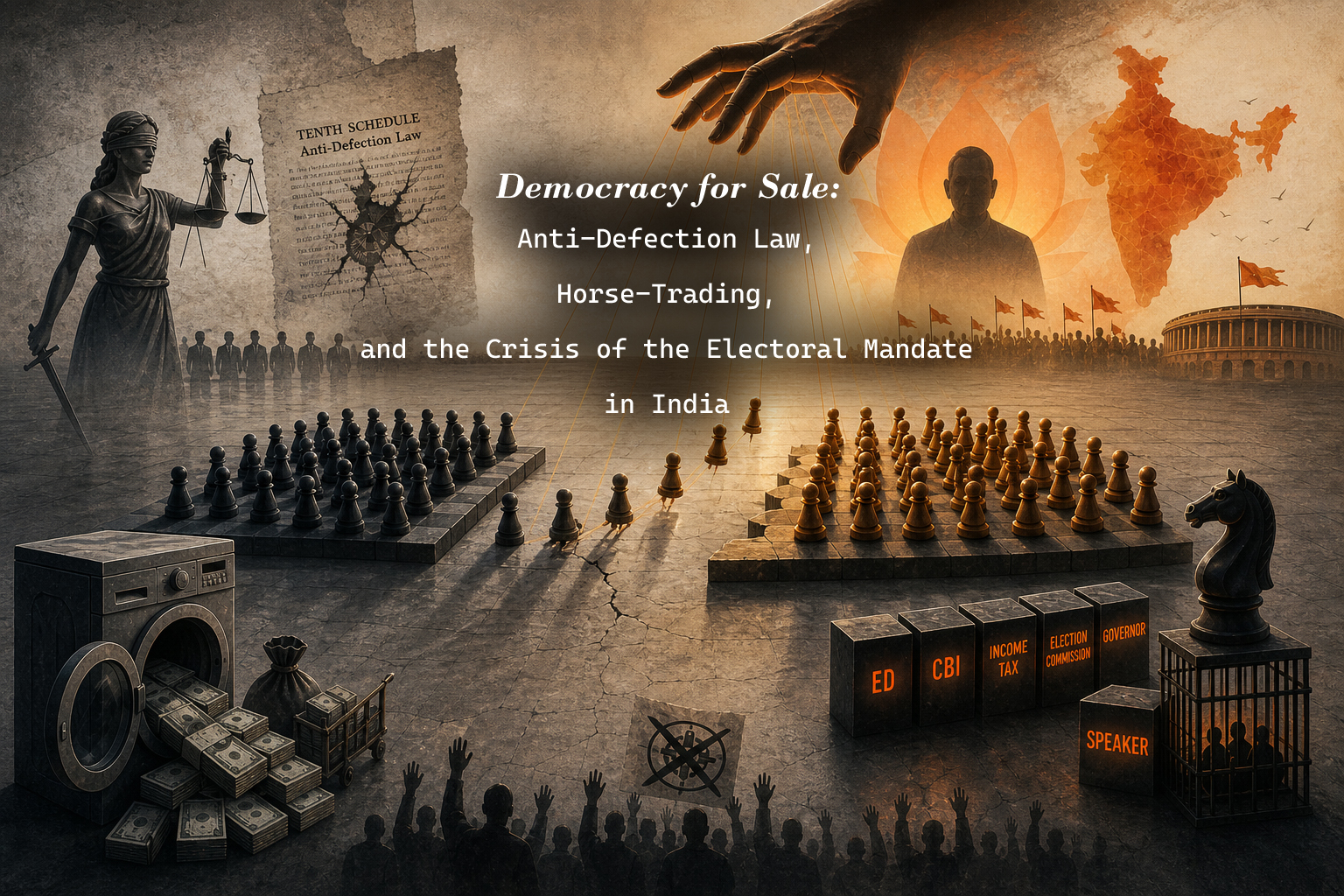
The Anti-Defection Law (Tenth Schedule, introduced by the 52nd Amendment 1985 and strengthened by the 91st Amendment 2003) was designed to curb opportunistic defections and safeguard the electoral mandate in India’s parliamentary democracy. Yet its critical loopholes—the two-thirds merger exception (Paragraph 4), unpenalised mass resignations, partisan Speakers, and ambiguities between organisational and legislature parties—have institutionalised sophisticated horse-trading. This article offers a doctrinal and empirical critique, centering on the Shiv Sena crisis (2022–23) and the Supreme Court’s Subhash Desai judgment (2023), which exposed how rebellion, strategic resignations, resort politics, and institutional delays enabled the toppling of a democratically elected government. Examining defection patterns from 2014 to 2026—including the April 2026 merger of seven AAP Rajya Sabha MPs with the BJP—it reveals the BJP’s “Operation Lotus” and “washing machine” machinery, sustained by opaque political funding, crony corporate networks, and quid-pro-quo clean chits, that betray the electorate’s verdict, erode ideological conviction, and accelerate democratic backsliding under the centralising “double engine sarkar” model. These practices undermine India’s federal structure as a Union of States and necessitate radical reforms: independent adjudication, strict timelines, tighter merger rules, bars on defectors, and full transparency in political finance—before the Tenth Schedule becomes a constitutional tool for authoritarian consolidation rather than democratic safeguard.
Sex, Lies, and the Criminal State: The Politics of Impunity in the Sangh Parivar
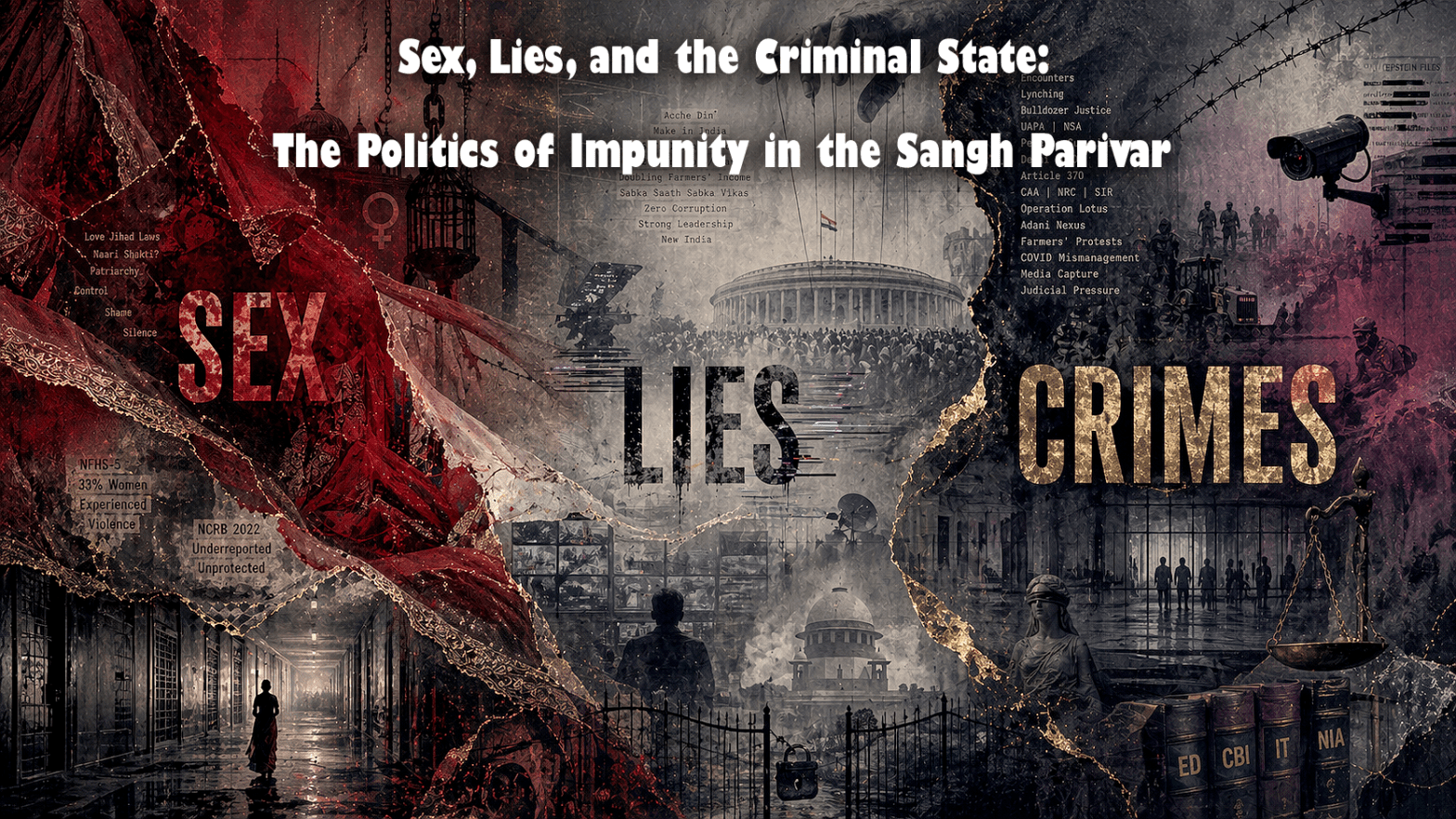
This article offers a sharp critique of the RSS-BJP-Sangh Parivar under Narendra Modi and Amit Shah as a self-reinforcing criminal-political machine that operates through a stark double standard: resistance from rivals, whistleblowers, judges or citizens invites persecution, elimination or institutional violence, while alignment yields protection and the “laundry of deceit” that converts legal vulnerability into political utility. Drawing on Foucault’s biopower and carceral continuum, Marcuse’s surplus repression, and Chomsky’s critique of the reward-punishment model, it traces the apparatus from its Gujarat laboratory — marked by the 2002 pogrom’s sexual violence, Snoopgate surveillance, staged encounters, Haren Pandya’s assassination, Justice Loya’s death, and Sanjiv Bhatt’s imprisonment — to its national expansion through Operation Lotus horse-trading, systemic sexual impunity, godmen paroles, cow vigilantism, Pegasus and digital surveillance, UAPA detentions, bulldozer justice, the Delhi 2020 pogrom, Article 370 revocation, CAA-NRC-SIR protests, the Adani-Hindenburg corporate-state nexus, judicial complicity in cases ranging from the Zakia Jafri clean chit and Ram Mandir verdict to reluctance over the SIR’s mass deletions (including 91 lakh names in Bengal), and the 2026 Epstein Files fallout. NCRB and NFHS-5 data expose pervasive gendered violence and under-reporting, while pseudology — unfulfilled jumlas on jobs, farmers’ income, Acche Din and Viksit Bharat — manufactures consent. The Sangh Parivar thus emerges as an integrated system in which sex, crime, and narrative are weaponised as technologies of biopower to entrench majoritarian authoritarian consolidation.
The IBC (Amendment) Act, 2026: Cosmetic Speed or Deepening the Crony Heist?
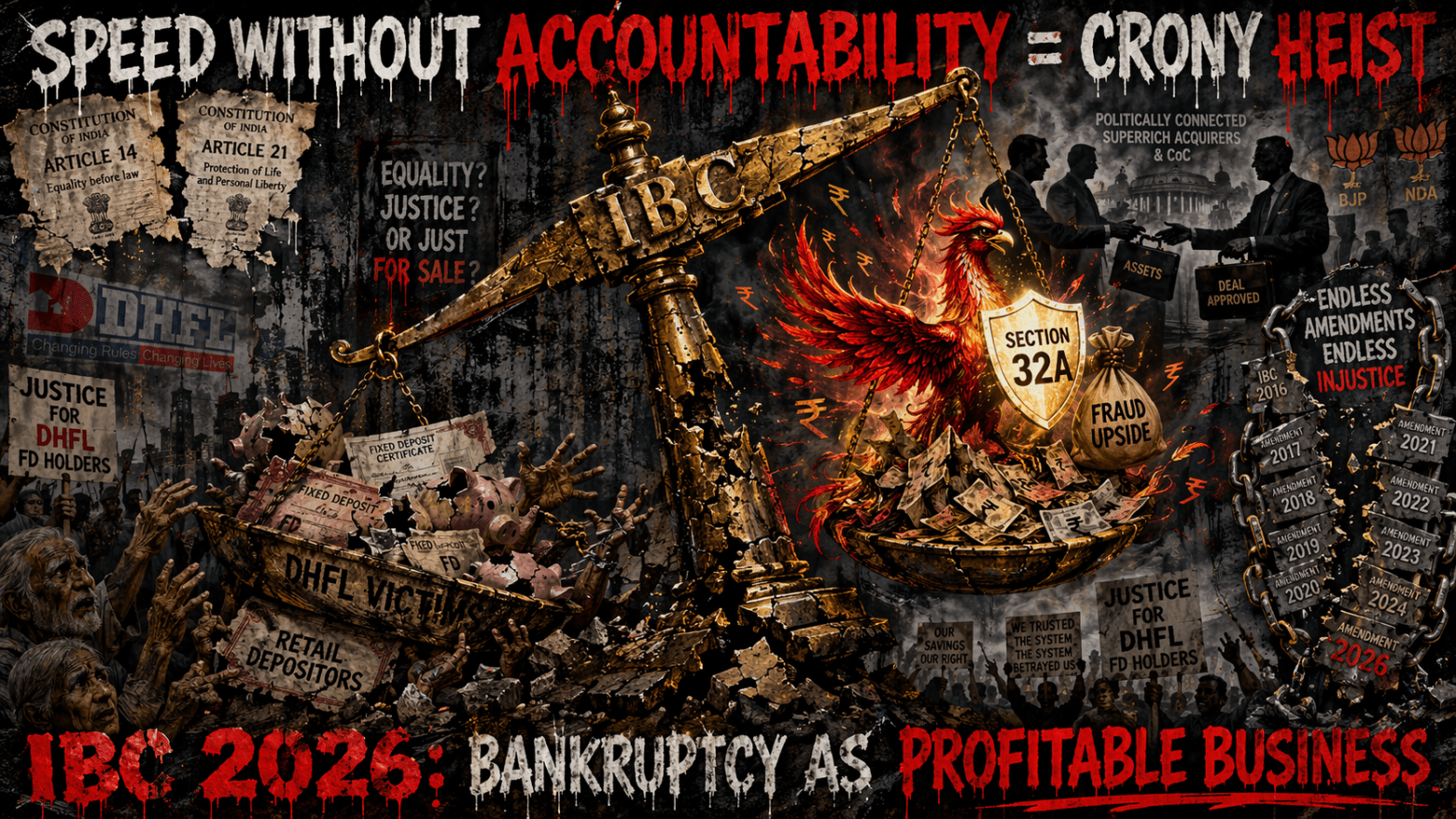
This report by Once in a Blue Moon Academia indicts the IBC (Amendment) Act, 2026 as a high-speed polish on a structurally flawed regime. While promising faster resolutions and marginal creditor safeguards, it leaves untouched the core contradictions — especially the tension between Section 66 (fraud recovery for creditors) and Section 32A (clean-slate immunity) — that enabled the DHFL heist, where retail depositors lost 75–80% while fraud upside flowed to Piramal. The amendment accelerates crony capture rather than correcting it, turning bankruptcy into a profitable tool for the superrich at the expense of the common people.
Predetermined “Democracy”: Why the 2026 West Bengal Assembly Election Stands Rigged—and Must Be Boycotted!
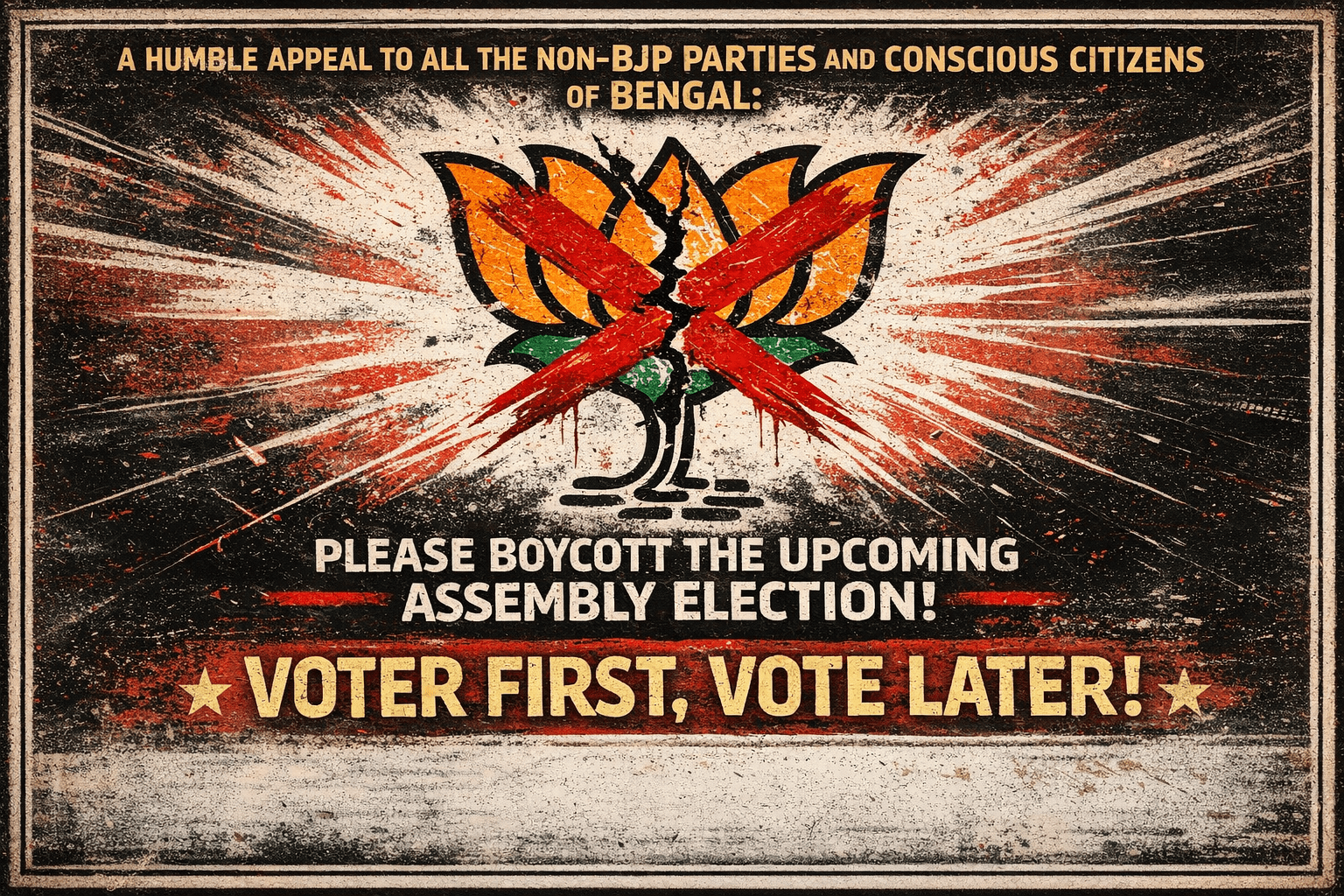
Ahead of the 2026 West Bengal Assembly elections, nearly 91 lakh voters — almost one in eight — have been deleted through the Special Intensive Revision (SIR), with independent reports showing Muslims disproportionately targeted in opposition strongholds, mirroring a nationwide BJP playbook of communal disenfranchisement. This purge is compounded by engineered bogus additions via bulk Form-6 applications, money-muscle power including pre-poll cash and freebies distribution, and opaque EVM vulnerabilities, all allegedly enabled by a captured Election Commission and passive Supreme Court. The piece argues that these three layers constitute institutional “vote dacoity” turning elections into a managed authoritarian spectacle, and calls for a total boycott of the polls, aggressive use of NOTA, Right to Recall, and proportional representation as the only moral response to reclaim genuine democracy.
Scrap IBC Now: How Section 32A Buried Section 66 | The DHFL Case (Video)
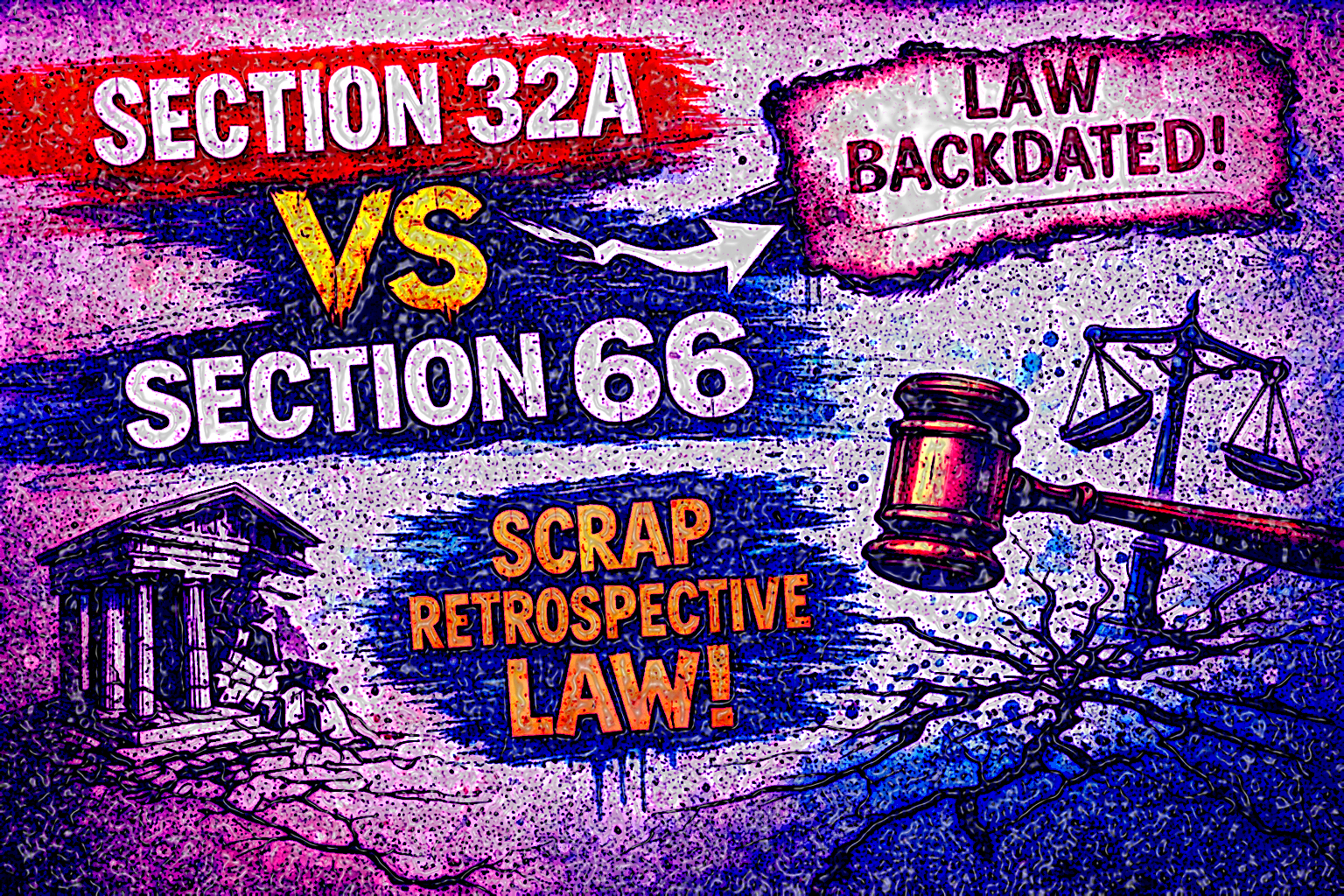
In the DHFL insolvency — India’s first major NBFC case under the IBC — over 2.5 lakh retail depositors, including pensioners and widows, suffered heavy haircuts of 54–77% on their life savings. Yet the company emerged spotless in Piramal’s hands, fully discharged from a ₹5,050 crore PMLA case in February 2026 under Section 32A of the IBC. Inserted retrospectively via ordinance on 28 December 2019 — just 25 days after DHFL entered CIRP — this “clean slate” provision granted the new owner complete immunity from past offences, even as ₹45,000 crore in alleged fraud recoveries were valued at one rupee. Like Valmiki’s Ramayana, which existed before Rama’s birth and reconfigured reality itself, Section 32A rewrote corporate accountability after the fact (POST-FACTO), turning a law meant to protect creditors into a sophisticated mechanism that socialised losses and privatised gains for cronies like Piramal. The DHFL case stands as a stark example of how retrospective legislation can erase liability while ordinary citizens bear the burden.
Pamphlet For DHFL Victims: No More “Clean Slates” For IBC-Proof Crony Capitalism!
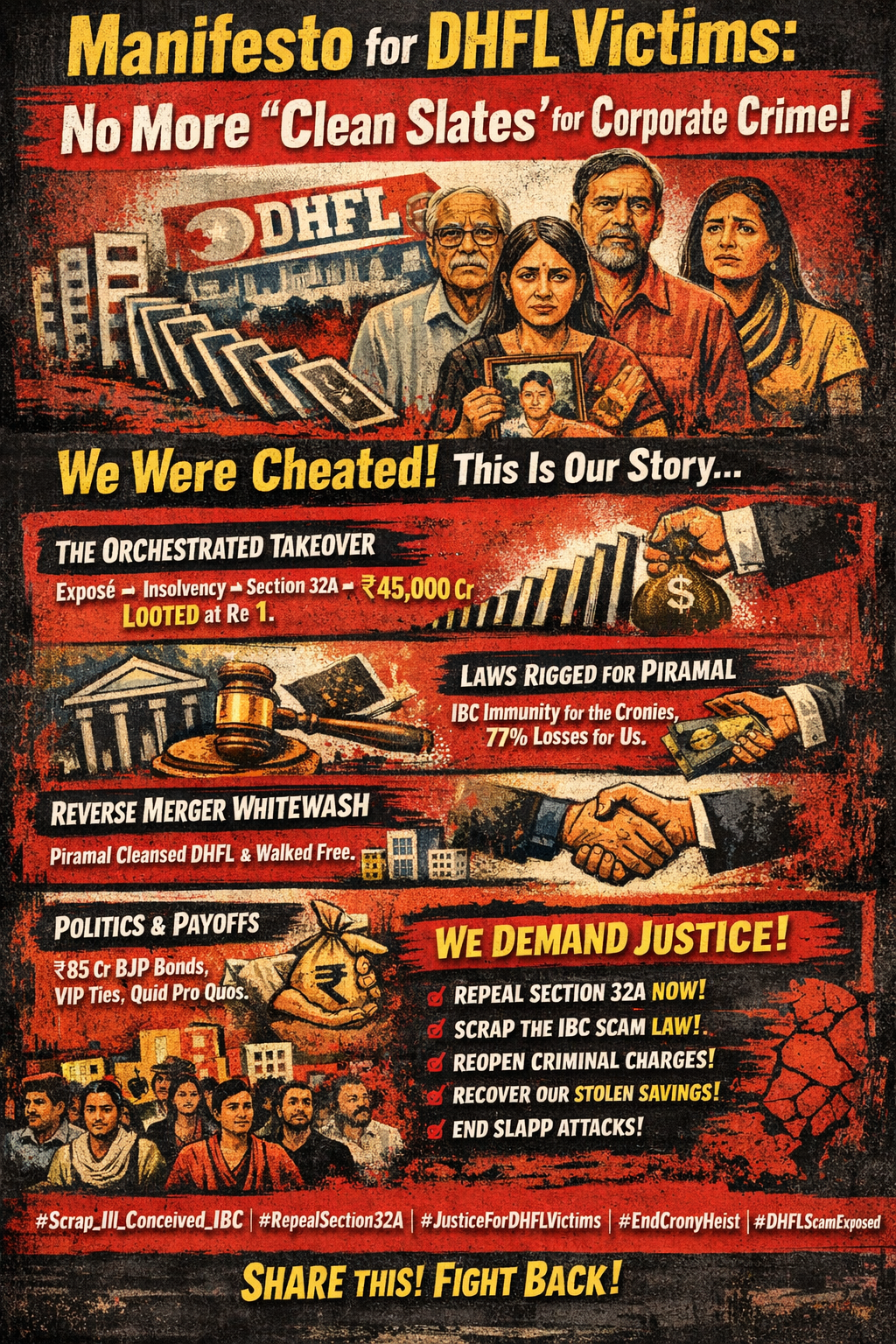
This manifesto is a fact-based cry from over 2.5 lakh DHFL depositors who lost life savings in massive 54–77% haircuts. It chronicles how India’s first AAA-rated NBFC — a sound ₹91,000+ crore housing finance company — was deliberately dismantled under the IBC: starting with Ajay Piramal’s “shock” warning (28 Jan 2019) followed by the Cobrapost exposé (29 Jan 2019), RBI supersession (20 Nov 2019), CIRP admission (3 Dec 2019), mid-process insertion of Section 32A immunity (28 Dec 2019), ignored full-repayment proposals, a Re 1 giveaway of ₹45,000 crore Section 66 recoveries, judicial overrides culminating in Supreme Court approval (1 Apr 2025), reverse mergers to sanitize legacy, and PMLA discharge of the corporate debtor (2 Feb 2026) under Section 32A — while Piramal Finance now thrives (AUM ₹96,690 crore up 23% YoY, PAT up 162%). Highlighting statutory contradictions, CoC bias allegations, and a documented political-corporate nexus, it demands repeal of Section 32A, scrapping the IBC, restitution, and an end to SLAPP suits — framing the DHFL case as engineered crony sanitisation, not genuine resolution.
OBMA Statement on Neo-Imperialist Violence: Iran, Venezuela, Palestine
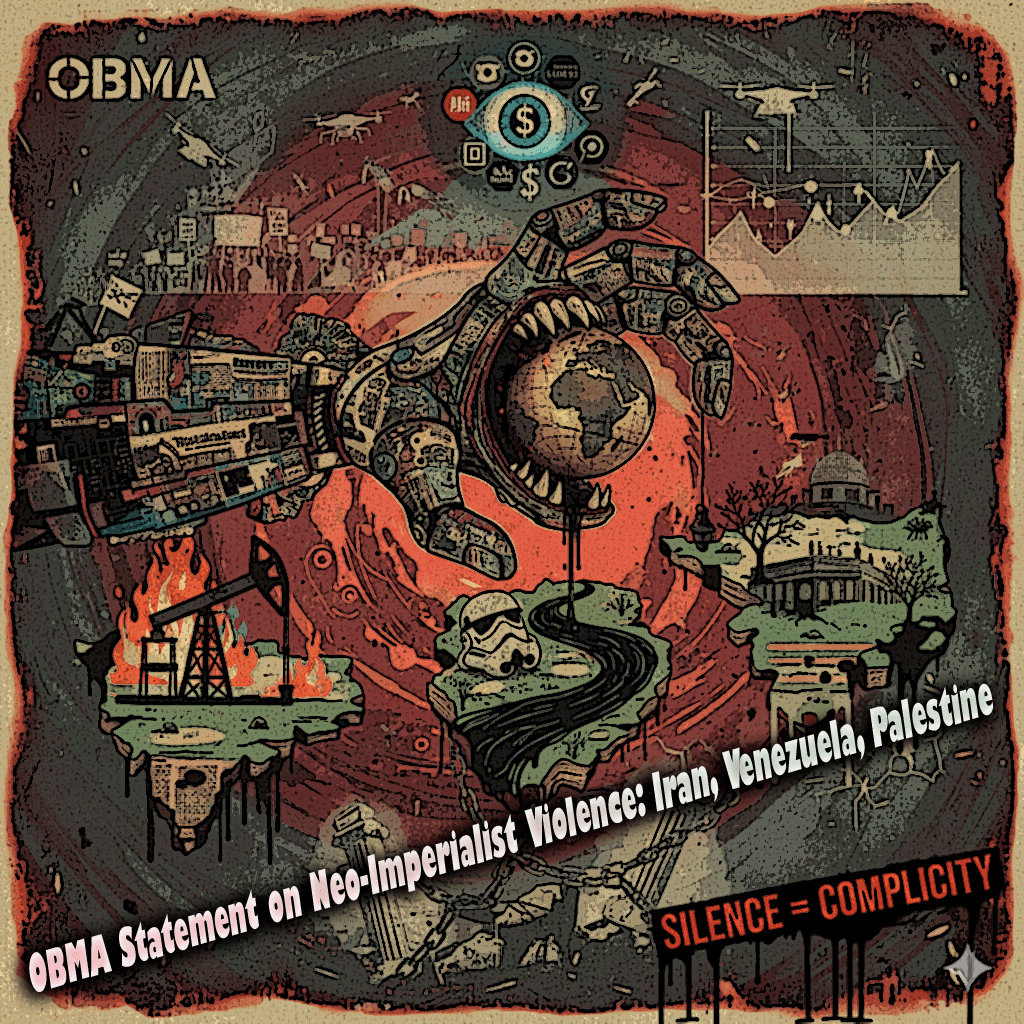
This statement asserts OBMA’s condemnation of neo-imperialist violence in Iran, Venezuela, and occupied Palestine, framing these crises as interconnected expressions of cannibalistic capitalism. It exposes how state repression, militarization, sanctions, and fossil-fuel geopolitics enable genocide, ecocide, and resource plunder. Rejecting technocratic and reformist fixes, OBMA affirms planetary justice, anti-imperialist solidarity, and life-centred transformation through collective struggle and ecological ethics.
When AA+ Means “Ask Again”: Manufactured Ratings, Piramal Finance, and the Credit Ratings Trap
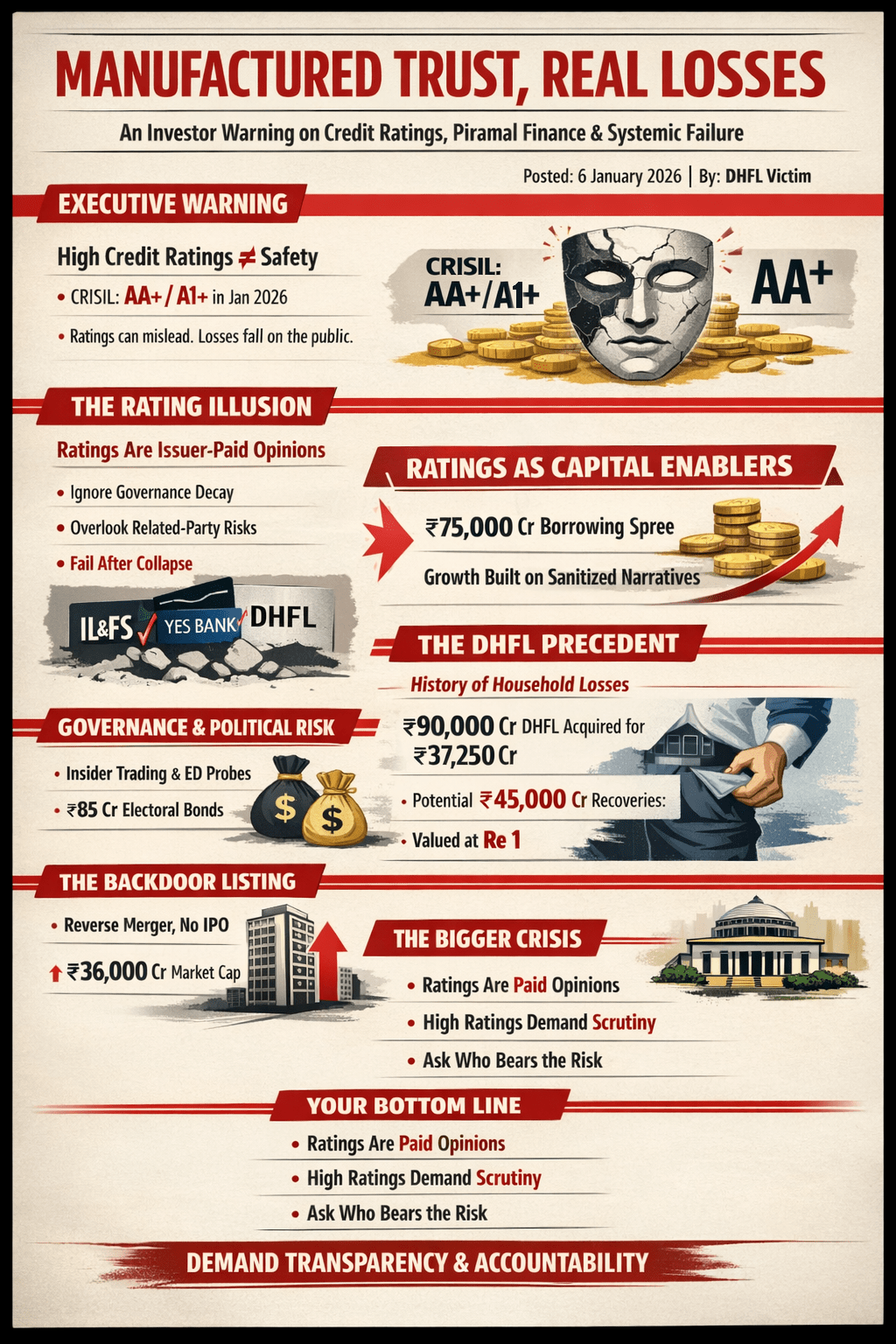
Despite glowing CRISIL AA+/Stable ratings, Piramal Finance’s strength is an illusion built on conflicted issuer-paid ratings, legacy DHFL fraud asymmetries (₹45,000 Cr recoveries valued at Re 1, massive retail haircuts), governance controversies, political proximity, and a backdoor listing that bypassed scrutiny. High ratings enable cheap funding and retail mobilisation—while systematically ignoring forensic risks, related-party issues, and resolution inequities seen in IL&FS, Yes Bank, DHFL. This is systemic: manufactured trust, socialised losses, privatised gains. Ratings are opinions, not guarantees. Demand truth before investing.

