

Posted on 8th July, 2026 (GMT 04:18 hrs)
ABSTRACT
This review series (Part-I) examines a growing cycle of Hindi cinema—from PM Narendra Modi (2019) to Dhurandhar 2 (2026)—that have widely been characterized as aligned with BJP/Hindutva Islamophobic messaging, spanning hagiographic biopics, Partition and Kashmir “history” dramas, and jingoistic war thrillers. Drawing on MouthShut, Times of India, IMDb, and Rotten Tomatoes reviews by OBMA members alongside box office data and social media reception, each entry is read as trading historical nuance and artistic craft for majoritarian narrative-building, victimhood framing, and militarism. The pattern across titles is uneven: a handful (Uri, The Kashmir Files, Dhurandhar 2) found commercial success through polarized mobilization, while most (PM Narendra Modi, Tejas, Emergency, Udaipur Files, Operation Valentine, The Taj Story, Main Atal Hoon) underperformed financially and drew sharply negative critical notices despite inflated partisan audience scores. The series argues that this divergence between critical consensus and box office fate exposes the limits of state-aligned cinema as propaganda, with Part II promising further entries (The Kerala Story, Article 370, Swatantrya Veer Savarkar, and others).
I. Introduction
In recent years, Bollywood has experienced a pronounced and systematic increase in films that closely align with the ideological agenda of the Bharatiya Janata Party (BJP) and its broader RSS/VHP dynamics or Hindutva worldview. These productions—ranging from biopics glorifying political figures to “historical” dramas reframing Partition-era violence or the exodus of Kashmiri Pandits as “Hindu genocides,” alongside jingoistic war thrillers and conspiracy narratives—have faced extensive criticism as instruments of cultural warfare or hegemonization. Rather than providing a nuanced artistic exploration, they often distort the intricate dimensions of history, whitewash (or rather, saffronwash) controversies, erase inconvenient truths, and simplify complex socio-political realities into binary narratives of Hindu victimhood, Muslim villainy, and unquestionable nationalist heroism. This review series compiles platform-specific analyses of the most prominent examples while preserving every detail from the original examinations.
We draw directly from our MouthShut.com reviews, followed by Times of India (TOI) critiques, IMDb comments, and Rotten Tomatoes critic (Tomatometer) and audience scores. We also consider box office data, the public pulse on social media (especially X), and the broader critical reception of the films.
The argumentative through line that binds this series together is clear and consistent: these films function less as cinema and more as propaganda vehicles. They prioritize electoral/vote-bank messaging, personality image-making cults, blood, gore, militarism, violence and/or exclusivist communal polarization over historical accuracy, artistic integrity, or balanced pro-people non-discriminatory inclusive storytelling. While some achieve commercial success through partisan mobilization and state support (tax exemptions, endorsements by BJP leaders), most ultimately expose the limits of such manufactured zeal—flopping at the box office, eviscerated by critics, and deepening India’s societal divides rather than fostering genuine discourse or constructive dialogic space. From PM Narendra Modi (2019) to Dhurandhar 2 (2026) and beyond, this wave of “Godiwood” reveals how cinema has been co-opted to serve a monolithic power, with fractured reception mirroring India’s entrenched political fault lines under the fascist BJP rule. What follows is the review series—one film at a time.
II. Reviews of Selected Films Across Public Domain Platforms
Before anyone asks, “Why this film before that one?”
There isn’t a grand order.
Not chronology. Not controversy. Not box office.
We’re keeping the picks delightfully random.
1. PM Narendra Modi (2019)
PM Narendra Modi (2019): A Shameless Propaganda Farce Peddling Authoritarian Mythmaking

Mouthshut Review:
Overview
PM Narendra Modi (2019), directed by Omung Kumar and starring Vivek Oberoi, is not a biopic but a glossy political advert masquerading as cinema. Released on May 24, 2019—just hours after Narendra Modi’s landslide re-election—the timing alone exposed its naked intent. Briefly halted by the Election Commission for violating the model code of conduct, the film eventually arrived as a 136-minute exercise in sycophancy rather than storytelling.
Story & Narrative
The film trundles through a tired rags-to-riches fantasy: tea seller, RSS pracharak, spiritual ascetic, destined ruler. Told through disjointed vignettes, it replaces narrative coherence with slow-motion rallies, bombastic background scores, and sermon-like dialogues. Complexity, doubt, or political contestation are entirely absent.
Whitewashing and Distortion
Historical inconvenience is treated with surgical precision. The 2002 Gujarat riots—over 1,000 dead—are grotesquely compressed and reframed as an opposition conspiracy, capped by a fictionalized savior moment featuring Modi rescuing a child. Political adversaries are reduced to comic-book villains, while uncomfortable truths, including Modi’s abandoned marriage, are simply erased.
Myth-Making Excess
The film abandons realism altogether in favor of cult mythology: divine visions, action-hero dodges, ghostly blessings from Gandhi and Patel. These moments push the film from propaganda into inadvertent parody, confusing governance with destiny and leadership with sainthood.
Historical Accuracy vs. Manufactured Myth
This cinematic exercise functions less as biography than as an image-laundering apparatus for an authoritarian personality cult. It anchors itself to only a handful of broadly verifiable markers—Modi’s birth in 1950, his elevation to Chief Minister in 2001 after the Gujarat earthquake, and the 2014 electoral sweep—while dissolving everything else into a viscous slurry of myth, invention, and propaganda. Even Modi’s own autobiographical claims are not free of temporal incoherence. A telling example is his assertion that his mother Heeraben lost her mother during the Spanish Flu pandemic (1918–1920), despite Heeraben being born around 1922—an inconsistency that, taken at face value, undermines the reliability of such biographical narratives. Rather than interrogating these contradictions, the film reproduces them uncritically, confirming critics’ verdict that it is not merely ahistorical but actively anti-historical.
Performances & Craft
Vivek Oberoi commits fully to mimicry—gestures, speech patterns, and mannerisms—but the script allows no room for nuance. Manoj Joshi (Amit Shah) and Zarina Wahab (the maternal figure) offer fleeting restraint before being relegated to symbolic props. Technically, the film is loud rather than competent: rally recreations look authentic, but sloppy editing, overwrought music, and clunky dialogue undercut any cinematic merit.
Politics, Timing & Controversy
Rushed into production to capitalize on the 2019 Lok Sabha elections, the film’s Election Commission ban only amplified its notoriety. Post-release admissions of hurried editing under “external pressure” further exposed its industrial cynicism. What emerged was not urgency but artistic bankruptcy.
Critical Reception
Critics dismantled the film with near unanimity. Rotten Tomatoes records a catastrophic 0% critic score, while IMDb hovers around a dismal 3/10. Reviews labeled it a “farcical hagiography” and a “relentless assault on truth.” Even mildly charitable takes conceded it delivers exactly what a Modi biopic promises—uncritical worship.
Public Response & Polarization
Public reaction remains sharply polarized. Devout supporters praise it as “inspirational” and “patriotic,” while detractors dismiss it as crude propaganda and historical erasure. Even sympathetic viewers acknowledge its excessive melodrama and lack of authenticity. The discourse mirrors India’s political divide: ecstatic in echo chambers, derided everywhere else.
Box Office Performance
Despite post-election euphoria, the film flopped. On an estimated ₹20 crore budget, it managed only ₹22–28 crore net in India before collapsing due to negative word-of-mouth. Modi’s political dominance failed to translate into theatrical footfalls.
In conclusion,
PM Narendra Modi is propaganda polished to a cinematic sheen—reel politics in place of real insight. It demands blind devotion, not thought; reverence, not scrutiny. As cinema, it is hollow; as history, it is corrosive. Electoral power may command votes, but it cannot manufacture artistic legitimacy.
Link to Review: https://www.mouthshut.com/review/pm-narendra-modi-review-tummqrrspop
Times of India Review:
PM Narendra Modi is not cinema but a brazen authoritarian personality cult vehicle masquerading as biography. Released hours after Modi’s 2019 landslide victory, this 136-minute propaganda piece was briefly halted by the Election Commission for model code violations.
It peddles a glossy rags-to-riches myth — tea seller to destined ruler — through slow-motion rallies, bombastic music and sermonising dialogues, stripping away all complexity, doubt or accountability. The 2002 Gujarat riots are shamelessly whitewashed as a conspiracy, with a fictional hero-rescue scene. Modi’s personal truths are erased, while divine visions, ghostly blessings from Gandhi and Patel, and action-hero moments push it into outright deification.
Vivek Oberoi’s mimicry is energetic but empty. The film is technically loud, sloppy and didactic.
Critics demolished it (0% Rotten Tomatoes, ~3/10 IMDb) as farcical hagiography. It flopped, earning just ₹22-28 crore on a ₹20 crore budget.
This corrosive exercise reveals power’s hunger to weaponise cinema for unchallenged supremacy and historical erasure. Pure propaganda, zero artistic merit.
IMDb Review:
PM Narendra Modi (2019) is not a biopic—it is a glossy, aggressively partisan political advertisement disguised as a feature film. Released on May 24, 2019, just hours after Narendra Modi’s re-election victory, the timing alone exposed its intent. Briefly halted by the Election Commission for violating the model code of conduct, it finally arrived as a 136-minute exercise in sycophancy rather than storytelling.
Narratively, the film trudges through a tired rags-to-riches fantasy: tea seller, RSS pracharak, ascetic politician, destined ruler. Told in disjointed vignettes, it replaces narrative depth with slow-motion rallies, thunderous background music, and sermon-like dialogue. Complexity, ambiguity, or political contestation are completely absent.
Historical distortion is central to the film’s design. The 2002 Gujarat riots—over 1,000 deaths—are grotesquely minimized and reframed as an opposition conspiracy, capped by a fictional savior sequence. Political opponents are caricatured villains, while inconvenient facts, including Modi’s abandoned marriage, are simply erased.
The film abandons realism altogether in favor of cult mythology: divine visions, action-hero escapes, and ghostly blessings from Gandhi and Patel. These moments push the film from propaganda into accidental parody.
As history, the film is deeply unreliable. It anchors itself to only a few verifiable dates—Modi’s birth (1950), his elevation as CM in 2001, and the 2014 election—while dissolving everything else into myth. Even Modi’s own autobiographical claims contain chronological inconsistencies, such as the Spanish Flu timeline surrounding his mother Heeraben’s life. This renders the film not just ahistorical, but actively anti-historical.
Vivek Oberoi commits fully to mimicry but is strangled by a script allergic to nuance. Manoj Joshi and Zarina Wahab offer brief restraint before being reduced to symbols. Technically loud rather than competent, the film suffers from sloppy editing, overwrought music, and clunky dialogue.
Despite post-election hype, the film flopped at the box office, scraping ₹22–28 crore against a ₹20 crore budget. Modi’s political dominance did not translate into audience turnout.
This is not cinema—it is devotion masquerading as narrative. PM Narendra Modi demands reverence, not thought; loyalty, not scrutiny. As filmmaking, it is hollow. As history, it is corrosive.
Link to Review: https://www.imdb.com/title/tt9558612/review/rw11029580/?ref_=up_ururv_2
Rotten Tomatoes Review:
PM Narendra Modi is less a biopic than an image-laundering exercise for an authoritarian personality cult. Released immediately after Modi’s 2019 re-election—and briefly blocked by the Election Commission—its political intent is unmistakable.
Structured as disjointed vignettes, the film traces Modi’s rise from tea seller to prime minister while permitting no doubt, contradiction, or political complexity. Slow-motion rallies, bombastic orchestration, and reverential dialogue replace narrative substance.
Its most disturbing feature is historical manipulation. The 2002 Gujarat riots are sanitized and reframed as conspiracy, capped by a fictional rescue scene, while adversaries become caricatures and inconvenient truths disappear.
Myth overtakes reality through divine visions and action-hero theatrics, tipping the film into inadvertent parody. Anchored to a few dates and indifferent to truth, it offers reverence instead of inquiry.
Link to Review Page: https://www.rottentomatoes.com/m/pm_narendra_modi
PM Narendra Modi (2019) – Complete Box Office & Review Ratings Table (Verified & Updated as of 26 April 2026)
| Category | Metric | Value / Score | Notes / Verdict | Source(s) |
|---|---|---|---|---|
| Budget | Total Budget | ₹20 crore | Including prints & advertising | Sacnilk |
| Box Office – India Net | Lifetime India Net Collection | ₹28.51 crore | Final lifetime figure | Sacnilk |
| Box Office – India Gross | Lifetime India Gross | ₹33.70 crore | – | Sacnilk |
| Box Office – Overseas | Lifetime Overseas Gross | ₹1.50 crore | – | Sacnilk |
| Box Office – Worldwide | Lifetime Worldwide Gross | ₹35.20 crore | – | Sacnilk |
| Opening Performance | Opening Day (India Net) | ₹2.35 – 2.88 crore | – | Bollywood Hungama / Sacnilk |
| Opening Weekend | Opening Weekend (India Net) | ₹11.76 crore | – | Sacnilk |
| Trade Verdict | Overall Verdict | Flop | Failed to recover costs despite hype | Box Office India, Bollywood Hungama, Sacnilk |
| IMDb | User Rating | 3.0 / 10 | ~9,200 ratings, heavy review bombing | IMDb |
| Rotten Tomatoes – Critics | Tomatometer | 0% | 10 reviews (all negative) | Rotten Tomatoes |
| Rotten Tomatoes – Audience | Audience Score | ~80% | Inflated by partisan votes | Rotten Tomatoes |
| MouthShut | User Rating | 3.41 / 5 (78% approval) | 1,815 votes, deeply polarized | MouthShut |
| Times of India (TOI) | Critical Opinion | Mixed / Backhanded | “Exactly what you can expect from a Modi biopic” – formulaic & servile | TOI |
| Other Major Critics | Overall Critical Consensus | Overwhelmingly Negative | HuffPost: “Unpardonable moral crime” Firstpost: “Farcical hagiography” | Multiple publications |
2. The Kashmir Files (2022)
The Kashmir Files (2022): A Saffron-Soaked Spectacle of Islamophobia

Mouthshut Review:
Overview
In Bollywood’s increasingly overt courtship with political power, The Kashmir Files, directed by Vivek Agnihotri, stands as a loud and calculated entry in the BJP’s cultural warfare arsenal. Marketed as a “truth-telling” account of the 1990 exodus of Kashmiri Pandits, the film weaponizes historical pain into a cinematic provocation aimed less at understanding tragedy than at consolidating majoritarian grievance.
Story & Structure
Clocking in at an exhausting 170 minutes, the film follows a young student uncovering his family’s traumatic past. What could have been an intimate exploration of memory and loss instead unfolds as a barrage of graphic reenactments—lynchings, burnings, rapes, and forced migrations—presented as an unambiguous Hindu “genocide,” stripped of political context, state failures, or competing histories. Complexity is replaced with certitude; inquiry with accusation.
Selective History, Manufactured Villains
The film’s most troubling feature is its selective framing. Kashmiri Muslims appear largely as a monolithic, bloodthirsty mass, while the Indian state’s documented role in Kashmir’s long-standing suffering is conspicuously absent. Classroom monologues rail against “leftist intellectuals” and “appeasement politics,” turning academic debate into caricature and reinforcing conspiracy narratives rather than historical nuance.
Performance vs Propaganda
Anupam Kher delivers a genuinely powerful performance, his grief-stricken monologues infused with raw emotional force that momentarily elevate the film beyond agitprop. Unfortunately, these moments are buried under relentless didacticism. What could have been tragedy becomes sermon; what could have been mourning becomes mobilization.
Against the Spirit of the Natyasastra
Ironically, The Kashmir Files violates the very traditions it claims to defend under the veneer of “Sanatana Hindutva”. Bharata Muni’s Natyasastra explicitly cautions against the direct staging of excessive violence—vadham (killing), yuddham (war), and other acts deemed unseemly—arguing that such events should be conveyed indirectly to preserve decorum and evoke rasa (aesthetic emotion), not shock. Agnihotri does the opposite. Violence is shown explicitly, repeatedly, and gratuitously, prioritizing gore over bhava, outrage over reflection. The result is not catharsis but sensory assault, collapsing classical ethical restraint into voyeuristic spectacle.
Reception & Political Endorsement
Critically, the film sharply polarized opinion. Publications like The Wire and The Hindu condemned it as vulgar propaganda and historical revisionism, while international criticism—most notably Israeli director Nadav Lapid’s remarks at IFFI—triggered official outrage. Conversely, BJP-aligned platforms and party leaders embraced it wholeheartedly, with Prime Minister Modi’s endorsement and tax exemptions in BJP-ruled states transforming screenings into ideological rallies.
Box Office & Public Pulse
Commercially, the film was a juggernaut, grossing over ₹250 crore net in India on a modest budget. Its IMDb rating (8.6/10) reflects fervent support from its target audience, while Rotten Tomatoes’ lower critic score underscores professional unease with its propagandistic thrust. Public response was emotionally charged: for many displaced Pandits, the film offered long-delayed visibility; for others, it unleashed a surge of Islamophobic rhetoric and social media vigilantism.
In Conclusion,
The Kashmir Files is not a work of reconciliation or ethical storytelling—it is a political instrument disguised as cinema. By abandoning nuance, violating aesthetic restraint, and converting grief into grievance, it exemplifies how cinema can inflame rather than illuminate. Three years on, its legacy endures not as art, but as evidence of how easily suffering can be conscripted into power.
Link to Review: https://www.mouthshut.com/review/the-kashmir-files-review-uprpsrrspop
Times of India Review:
The Kashmir Files is not a film but a calculated weapon in Bollywood’s majoritarian cultural warfare — loud, manipulative agitprop that exploits the 1990 Kashmiri Pandit tragedy to fuel grievance politics and Hindu victimhood. Marketed as “untold truth,” this 170-minute barrage reduces complex history to graphic scenes of lynchings, rapes, burnings and exodus, framing it as unambiguous “genocide” by a monolithic Muslim mob while erasing the Indian state’s failures and political context. What could have been a sensitive portrayal of memory and loss becomes crude didactic propaganda: classroom monologues caricature “leftists” and “appeasement,” turning cinema into an ideological recruitment tool. Anupam Kher’s powerful performance is wasted amid voyeuristic violence and sermonising that violate even Natyasastra’s principles of restraint and rasa. Critically slammed as historical revisionism, it achieved massive box-office success backed by open BJP endorsement, tax exemptions and PM Modi’s praise. Its true legacy is not art or healing, but a dangerous instrument that weaponises suffering for majoritarian mobilisation. Pure cinematic poison.
Link to Review: https://timesofindia.indiatimes.com/entertainment/hindi/movie-reviews/the-kashmir-files/movie-review/90110494.cms
IMDb Review:
The Kashmir Files is less a historical drama than a politically engineered spectacle. Marketed as a “truth-telling” account of the 1990 Kashmiri Pandit exodus, the film weaponizes trauma to consolidate majoritarian grievance rather than explore tragedy with historical nuance and complexity.
Structured as a series of didactic episodes, it replaces inquiry with accusation. Graphic violence—lynch*ings, burn*ings, r*apes—is staged relentlessly, stripped of political context or state accountability. Kashmiri Muslims are reduced to a monolithic villain, while complexity is erased in favor of certainty.
Anupam Kher delivers moments of genuine emotional force, but these are smothered by sermonizing classroom speeches and ideological messaging. Ironically, the film violates classical Indian aesthetic ethics outlined in the Natyashastra, which cautions against explicit depictions of killing and war. Here, gore is prioritized over reflection.
Critically divisive but commercially successful, the film confirms that box-office dominance does not equal ethical storytelling. This is cinema as political mobilization, not reconciliation.
No Link to Review as IMDb has not “Approved” it!
Rotten Tomatoes Review:
The Kashmir Files is less a work of historical inquiry than a politically weaponized spectacle. Framed as a “truth-telling” account of the 1990 Kashmiri Pandit exodus, the film reduces a complex tragedy into a single, accusatory narrative designed to consolidate majoritarian grievance. Told through didactic vignettes, it replaces nuance with graphic reenactments of violence, stripped of political context, state accountability, or competing histories. Kashmiri Muslims are rendered as a monolithic threat, while academic debate is caricatured as conspiracy. The film’s relentless sermonizing overwhelms what could’ve been its human core. Notably, it violates the aesthetic restraint advocated in Bharata Muni’s Natyashastra, which discourages explicit depictions of killing and war in favor of evoking reflection (rasa). Here, spectacle replaces contemplation. Commercially successful yet ethically reckless, the film exemplifies how cinema can inflame rather than illuminate.
Link to Review Page: https://www.rottentomatoes.com/m/the_kashmir_files
The Kashmir Files (2022) – Complete Box Office & Review Ratings Table (Verified & Updated as of 26 April 2026)
| Category | Metric | Value / Score | Notes / Verdict | Source(s) |
|---|---|---|---|---|
| Budget | Total Budget | ₹15 – 25 crore (approx. ₹20 Cr average) | Low-budget independent film | Sacnilk, Wikipedia, Bollywood Hungama |
| Box Office – India Net | Lifetime India Net Collection | ₹252.90 crore | Final lifetime figure | Bollywood Hungama, Sacnilk |
| Box Office – India Gross | Lifetime India Gross | ₹297.53 crore | – | Bollywood Hungama |
| Box Office – Overseas | Lifetime Overseas Gross | ₹43.39 – 46 crore | – | Sacnilk / Bollywood Hungama |
| Box Office – Worldwide | Lifetime Worldwide Gross | ₹340.92 – 341 crore | – | Sacnilk, Bollywood Hungama |
| Opening Performance | Opening Day (India Net) | ₹3.55 crore | Strong word-of-mouth start | Sacnilk |
| Opening Weekend | Opening Weekend (India Net) | ₹26.05 crore | – | Multiple |
| Trade Verdict | Overall Verdict | All-Time Blockbuster | Massive post-pandemic success | Sacnilk, Bollywood Hungama |
| IMDb | User Rating | 8.5 – 8.6 / 10 | ~579,000+ ratings | IMDb |
| Rotten Tomatoes – Critics | Tomatometer | Low (around 40% or below) | Limited reviews, mostly mixed-negative | Rotten Tomatoes |
| Rotten Tomatoes – Audience | Audience Score | High (strong fan support) | Polarized but favorable from core audience | Rotten Tomatoes |
| MouthShut | User Rating | 3.88 / 5 (88% approval) | 224+ votes, highly positive overall | MouthShut |
| Times of India (TOI) | Critical Opinion | 3.0 / 5 | Praised Anupam Kher’s performance but noted propaganda elements | TOI |
| Other Major Critics | Overall Critical Consensus | Mixed to Negative | Strong criticism for historical revisionism and propaganda; praised for emotional impact | The Wire, The Hindu, etc. |
3. The Bengal Files (2025)
The Bengal Files (2025): Partition’s Manufactured Ghosts, Repackaged for the Hindutva Pogrom
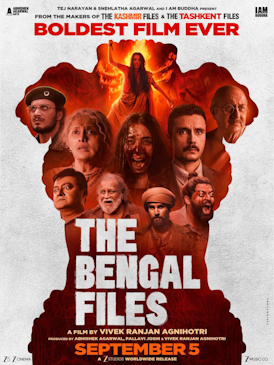
Mouthshut Review:
The Bengal Files is the third installment in Vivek Agnihotri’s much-publicized “Files” trilogy, and it marks the creative and ethical exhaustion of a formula that no longer shocks, enlightens, or even persuades. What remains is an increasingly naked ideological project—cinema reduced to a blunt instrument for Hindutva historical revisionism.
Framed around the 1946 Direct Action Day riots and the Noakhali massacres, the film claims to excavate “suppressed truths” of Partition-era violence. In practice, it weaponizes selective history to construct a civilizational morality tale in which Muslims appear almost exclusively as perpetrators, Hindus as perpetual victims, and colonial power as a conveniently absent third party. Partition’s layered realities—British divide-and-rule, economic collapse, political brinkmanship, mutual communal violence, and mass displacement across religious lines—are erased in favor of a monochromatic narrative designed to stoke grievance rather than understanding.
This is not historical cinema; it is grievance cinema. Trauma is not examined but exhibited. Violence is not contextualized but fetishized. The film’s relentless gore—slow-motion lynchings, ritualized sexual violence, prolonged scenes of mutilation—is deployed to produce affective Islamophobia, where Muslim bodies are repeatedly associated with savagery, while Hindu suffering is aestheticized as civilizational martyrdom. The result is not remembrance but radicalization.
Performances are serviceable but ideologically choreographed. Mithun Chakraborty’s rage-filled patriarch and Anupam Kher’s sermonizing elder function less as characters than as mouthpieces. Pallavi Joshi’s investigator role injects rhetorical intensity, but her monologues collapse complex historiographical debates into courtroom-style indictments against “secular historians,” academics, and liberal memory itself. Dissenting scholarship is caricatured as deliberate erasure, reinforcing a dangerous binary: Hindutva truth versus secular conspiracy.
Technically, the film is polished. The recreation of 1940s Calcutta is atmospheric, and the production design is meticulous. Yet this polish only sharpens the film’s propagandistic edge. Craft becomes camouflage. Aesthetic realism is used to legitimize ideological distortion.
Most revealing is the film’s complete evacuation of Gandhian ethics from the historical moment it depicts. Gandhi’s philosophical anarchism—his rejection of majoritarian democracy, his distrust of the judiciary as a mechanism of revenge, and his insistence on swaraj as moral self-governance rather than state violence—finds no place here. Instead, the film glorifies statist retribution, juridical vengeance, and carceral justice, reducing history to a fantasy of belated punishment. Justice is confused with revenge; memory with accusation.
Predictably, the film has polarized responses. Critics have flagged its bloated runtime, incoherent editing, and ideological overreach. Supporters celebrate it for “exposing secular lies,” a phrase that itself reveals the film’s political purpose. Commercially, however, the fatigue is evident. The film has underperformed significantly, failing to recover its budget and making little impact in Bengal, despite claims of suppression and unofficial bans.
Online ratings reflect a familiar pattern: inflated audience scores driven by a committed ideological base, accusations of review manipulation, and limited critical endorsement. The echo chamber applauds; the wider audience disengages.
The Bengal Files does not illuminate history—it weaponizes it. By flattening a multi-layered, tragic past into a Hindutva morality play, the film promotes Islamophobia under the guise of truth-telling and converts collective trauma into political capital. What once masqueraded as provocation now stands exposed as repetition, resentment, and ideological rigidity. The trilogy concludes not as a reckoning, but as a cautionary tale about how cinema can be conscripted into the service of hate.
Recommended for: Viewers seeking affirmation of Hindutva narratives
Not recommended for: Anyone interested in historical complexity, ethical inquiry, or cinema that resists propaganda
Link to Review: https://www.mouthshut.com/review/the-bengal-files-blood-bias-and-hindutva-review-sprnqosspop
Times of India Review:
The Bengal Files is not cinema but the tired, exhausted finale of Vivek Agnihotri’s “Files” trilogy — a blunt propaganda tool that weaponises the 1946 Direct Action Day riots and Noakhali massacres for Hindutva grievance politics. It reduces Partition’s complex tragedy to a one-sided morality tale: Muslims as savage perpetrators, Hindus as perpetual victims, with all nuance, mutual violence and British culpability erased. Graphic slow-motion lynchings, rapes and mutilations fetishise trauma to stoke Islamophobia rather than foster understanding. Performances are mere ideological mouthpieces — Mithun Chakraborty and Anupam Kher sermonise, while Pallavi Joshi delivers monologues attacking “secular historians.” Even Gandhi’s ethics are missing, replaced by calls for revenge and state retribution. Technically polished but creatively bankrupt, the film has underperformed commercially, exposing audience fatigue with the formula. It does not illuminate history — it flattens it into resentment and division. Pure cinematic propaganda.
IMDb Review:
The Bengal Files, the third entry in Vivek Agnihotri’s “Files” trilogy, marks the exhaustion—creative and ethical—of a formula now stripped of cinematic credibility. What remains is grievance cinema: history flattened into a Hindutva morality play.
Using the 1946 Direct Action Day riots and the Noakhali massacres, the film claims to recover “suppressed truths.” Instead, it weaponizes selective history. Muslims are framed almost exclusively as perpetrators, Hindus as eternal victims, while British colonial divide-and-rule, reciprocal violence, and political complexity are erased. Partition becomes a monochrome spectacle of blame.
Violence is fetishized rather than examined. Slow-motion lynchings, ritualized sexual violence, and prolonged gore are deployed to provoke outrage, producing affective Islamophobia rather than historical understanding. Trauma is exhibited, not interrogated.
Performances are serviceable but ideologically choreographed. Mithun Chakraborty and Anupam Kher function more as mouthpieces than characters, while Pallavi Joshi’s monologues collapse serious historiography into courtroom-style indictments of “secular historians.”
Technically polished, the film uses aesthetic realism as camouflage for distortion. Most striking is the total absence of Gandhian ethics—no engagement with his philosophical anarchism, critique of majoritarian democracy, or rejection of juridical revenge. Justice is reduced to statist vengeance.
The film has polarized responses, but box-office fatigue is evident. Inflated online ratings contrast with widespread disengagement.
This is not history—it is ideological spectacle. The Bengal Files preaches to the converted, promotes Islamophobia under the guise of truth, and ends the trilogy not with a reckoning, but with a warning about cinema in the service of hate.
No Link to Review as IMDb has “Disapproved” it!
Rotten Tomatoes Review:
The Bengal Files turns Partition’s nuanced tragedy into grievance cinema. Claiming to reveal “suppressed truths,” it weaponizes selective history—portraying Muslims largely as perpetrators, Hindus as perpetual victims, while erasing British divide-and-rule and reciprocal communal violence. Gore is fetishized through slow-motion brutality and lingering assault scenes that generate outrage rather than understanding, producing affective Islamophobia instead of historical insight. This approach directly violates Bharata Muni’s Nāṭyaśāstra, which prohibits explicit on-stage depictions of killing and war to preserve rasa—ethical reflection and shared human emotion. Performances are competent but function as ideological mouthpieces, while serious scholarship is dismissed as “secular conspiracy.” Technically polished yet ethically hollow, the film ignores Gandhian ethics and replaces justice with statist vengeance. This isn’t history—it’s propaganda masquerading as cinema.
Link to Review Page: https://www.rottentomatoes.com/m/the_bengal_files
The Bengal Files (2025) – Complete Box Office & Review Ratings Table (Verified & Updated as of 26 April 2026)
| Category | Metric | Value / Score | Notes / Verdict | Source(s) |
|---|---|---|---|---|
| Budget | Total Budget | ₹50 crore | Including prints & advertising | Koimoi, Bollywood Hungama |
| Box Office – India Net | Lifetime India Net Collection | ₹15.25 – 19.59 crore | Most sources converge around ₹17–19 Cr | Sacnilk, Koimoi, Bollywood Hungama |
| Box Office – India Gross | Lifetime India Gross | ₹19.90 – 23.11 crore | – | Koimoi, Bollywood Hungama |
| Box Office – Overseas | Lifetime Overseas Gross | ₹2.20 – 3.25 crore | Limited overseas appeal | Bollywood Hungama |
| Box Office – Worldwide | Lifetime Worldwide Gross | ₹23.11 – 26.36 crore | Final figures | Koimoi, Bollywood Hungama |
| Opening Performance | Opening Day (India Net) | ₹1.35 – 1.75 crore | Weak start | Sacnilk |
| Opening Weekend | Opening Weekend (India Net) | ₹6.00 – 6.65 crore | – | Multiple trackers |
| Trade Verdict | Overall Verdict | Flop / Disaster | Major underperformer; failed to recover budget | Bollywood Hungama, Koimoi, Trade Analysts |
| IMDb | User Rating | 7.0 / 10 | ~12,000+ ratings; driven by core fans | IMDb |
| Rotten Tomatoes – Critics | Tomatometer | Limited reviews (4 out of 6 negative) | No overall percentage available | Rotten Tomatoes |
| Rotten Tomatoes – Audience | Audience Score | Moderate to Strong | Support from franchise fans | Rotten Tomatoes |
| MouthShut | User Rating | Polarized (Mixed) | Multiple user reviews; divided opinions on execution and bias | MouthShut |
| Times of India (TOI) | Critical Opinion | 3.0 – 3.5 / 5 | Praised performances & visuals but criticized length, editing & propaganda | TOI |
| Other Major Critics | Overall Critical Consensus | Mixed to Negative | Accused of historical distortion, excessive violence, and propagandistic tone | Hindustan Times, Indian Express, Firstpost |
4. Emergency (2025)
Emergency (2025) – Reading Power and Parody through Propaganda ?!

Mouthshut Review:
Emergency is not a historical biopic—it is a polemical farce masquerading as cinema. Marketed as a hard-hitting account of India’s 1975–77 Emergency, the film instead collapses into a bloated, self-indulgent propaganda vehicle that prioritizes political vendetta over truth, craft, or coherence.
Kangana Ranaut, wearing the triple hats of actor, director, and producer, portrays Indira Gandhi not as a complex authoritarian figure shaped by institutional decay, but as a shrill caricature tailored to fit a BJP-era narrative. The Emergency—one of India’s darkest democratic chapters involving press censorship, mass arrests, and forced sterilizations—is reduced to a simplistic morality play designed to vilify the Gandhi family while conveniently ignoring systemic failures, Cold War geopolitics, and opposition opportunism.
The screenplay distorts timelines and invents scenes with alarming ease. Most egregious is the film’s anti-Sikh subtext: fabricated portrayals of Jarnail Singh Bhindranwale and speculative links between the Emergency and Punjab militancy border on communal misinformation. Operation Blue Star is casually folded into Emergency paranoia, erasing documented state violence and Sikh civilian deaths. This is not creative license—it is historical malpractice.
Technically, the film is a mess. Choppy editing (post-censorship cuts are painfully obvious), erratic pacing, and ill-timed song sequences drain whatever tension the subject demands. Production design is passable, but VFX-heavy sequences—especially sterilization drives—veer into exploitative shock value. Ranaut’s mimicry of Indira Gandhi earns minor credit, but as a director she turns potent material into a tedious lecture stuffed with expository dialogue.
The supporting cast is criminally underused. Anupam Kher’s Jayaprakash Narayan shows flashes of conviction, but even he is smothered by the film’s ideological rigidity. Heroes are sainted, villains cartoonized, and nuance is nowhere to be found.
Public and critical response reflects the film’s hollowness. Empty theatres, poor word-of-mouth, and dismal box-office returns underline audience fatigue with preachy political cinema. Online, even supporters struggle to defend its factual distortions and communal undertones.
Emergency weaponizes history instead of interrogating it. What should have been a cautionary tale about power becomes an exercise in partisan score-settling, communal insinuation, and cinematic vanity. Loud, biased, and historically reckless, the film insults both its subject and its audience.
Recommended for: Hardcore partisan loyalists only
Not recommended for: Anyone seeking history, balance, or competent filmmaking
Link to Review: https://www.mouthshut.com/review/revealing-unknown-facts-review-rtmsqsoolnp
Times of India Review:
Emergency is not a historical biopic but a bloated, self-indulgent propaganda farce masquerading as cinema. Kangana Ranaut, in her triple role as actor, director and producer, reduces one of India’s darkest chapters — the 1975-77 Emergency with its censorship, mass arrests and forced sterilizations — into a shrill partisan vendetta aimed at vilifying the Gandhi family.
Indira Gandhi is portrayed as a cartoonish villain rather than a complex authoritarian figure. The film distorts timelines, fabricates scenes and pushes a troubling anti-Sikh subtext by inventing links between the Emergency and Punjab militancy, casually folding in Operation Blue Star while erasing state violence. This is historical malpractice, not creative liberty.
Choppy editing, erratic pacing, exploitative VFX and tedious expository monologues make it a technical and dramatic mess. Anupam Kher’s Jayaprakash Narayan is wasted amid the ideological rigidity. Nuance is absent; heroes are sainted, villains caricatured.
The result is empty theatres, poor box office and widespread fatigue with preachy political cinema. Emergency weaponises history for partisan score-settling and communal insinuation. Loud, biased, reckless and utterly hollow — a vanity project that insults both its subject and the audience. Pure cinematic propaganda.
Link to Review: https://timesofindia.indiatimes.com/entertainment/hindi/movie-reviews/emergency/movie-review/117311406.cms
IMDb Review:
Emergency is not a historical biopic—it is a polemical farce masquerading as cinema. Sold as a hard-hitting account of India’s 1975–77 Emergency, the film collapses into a bloated propaganda exercise that prioritizes political vendetta over truth, craft, or coherence.
Kangana Ranaut, acting as star, director, and producer, reduces Indira Gandhi to a shrill caricature tailored to a contemporary BJP-era narrative. A deeply complex period marked by press censorship, mass arrests, and forced sterilizations is flattened into a simplistic morality play aimed at vilifying the Gandhi family while ignoring systemic decay, Cold War geopolitics, and opposition opportunism.
The screenplay freely distorts timelines and invents scenes. Most disturbing is the anti-Sikh subtext: fabricated portrayals of Jarnail Singh Bhindranwale and speculative links between the Emergency and Punjab militancy cross into communal misinformation. Operation Blue Star is casually folded into Emergency paranoia, erasing documented state violence and Sikh civilian deaths. This is not creative license—it is historical malpractice.
Technically, the film is clumsy: choppy post-censorship edits, erratic pacing, and misplaced songs drain any tension. Supporting actors are underused, nuance is absent, and ideology overwhelms cinema.
Emergency weaponizes history instead of interrogating it. Loud, biased, and reckless, it insults both its subject and its audience.
No Link to Review as IMDb has “Deleted” it!
Rotten Tomatoes Review:
Emergency is not a historical biopic but a polemical farce masquerading as serious cinema. Marketed as an account of India’s 1975–77 Emergency, it devolves into partisan propaganda, sacrificing truth and craft for political score-settling. Kangana Ranaut reduces Indira Gandhi to a caricature, flattening a complex period of press censorship, mass arrests, and forced sterilizations into a simplistic morality play that ignores institutional complicity, Cold War geopolitics, and opposition opportunism. The screenplay distorts timelines and invents scenes, most troublingly pushing an anti-Sikh subtext through fabricated portrayals of Bhindranwale and speculative links between the Emergency and Punjab militancy, while casually folding Operation Blue Star into Emergency paranoia, erasing documented state violence. Choppy post-censorship editing, erratic pacing, and exploitative spectacle further weaken the film. This isn’t historical inquiry—it’s ideological cinema dressed as biography.
Link to Review Page: https://www.rottentomatoes.com/m/emergency_2024
Emergency (2025) – Complete Box Office & Review Ratings Table (Verified & Updated as of 26 April 2026)
| Category | Metric | Value / Score | Notes / Verdict | Source(s) |
|---|---|---|---|---|
| Budget | Total Budget | ₹60 – 100 crore (₹80 Cr average reported) | High budget including P&A | Wikipedia, Bollywood Hungama, Trade reports |
| Box Office – India Net | Lifetime India Net Collection | ₹16.52 – 18.40 crore | Most sources converge around ₹16.5–18.4 Cr | Bollywood Hungama, Sacnilk |
| Box Office – India Gross | Lifetime India Gross | ₹19.67 – 21.71 crore | – | Bollywood Hungama |
| Box Office – Overseas | Lifetime Overseas Gross | ₹2.08 – 2.10 crore | Very limited overseas | Bollywood Hungama |
| Box Office – Worldwide | Lifetime Worldwide Gross | ₹21.75 – 23.81 crore | Final figures | Bollywood Hungama, Sacnilk |
| Opening Performance | Opening Day (India Net) | ₹2.00 – 2.50 crore | Poor opening | Multiple trackers |
| Opening Weekend | Opening Weekend (India Net) | ₹8.70 – 10.45 crore | Weak weekend | Bollywood Hungama |
| Trade Verdict | Overall Verdict | Disaster / Huge Flop | Massive loss; one of 2025’s biggest flops | Bollywood Hungama, Koimoi, Trade Analysts |
| IMDb | User Rating | 5.2 / 10 | ~12,000+ ratings | IMDb |
| Rotten Tomatoes – Critics | Tomatometer | ~30% (10 reviews) | Mixed to Negative | Rotten Tomatoes |
| Rotten Tomatoes – Audience | Audience Score | Mixed (~55%) | Polarized | Rotten Tomatoes |
| MouthShut | User Rating | Mixed / Polarized | Divided opinions on bias and execution | MouthShut |
| Times of India (TOI) | Critical Opinion | 2.5 / 5 | Criticized as hammy and partisan | TOI |
| Other Major Critics | Overall Critical Consensus | Mixed to Negative | Accused of historical distortions, anti-Sikh bias, and poor execution | NDTV, Indian Express, Hindustan Times |
5. The Tashkent Files (2019)
“The Tashkent Files”: History Weaponized for Vendetta

Mouthshut Review:
Vivek Agnihotri’s The Tashkent Files attempts to explore the mysterious death of PM Lal Bahadur Shastri (1966), but ultimately collapses under the weight of its own agenda. Marketed as a “conspiracy thriller inspired by true events,” it follows a young journalist (Shweta Basu Prasad) investigating alleged political cover-ups. The cast—Mithun Chakraborty, Pankaj Tripathi, Naseeruddin Shah, and Vinay Pathak—overacts consistently, giving the film the feel of a stage play rather than a cinematic thriller.
Critics universally panned it. Shubhra Gupta called it “a series of eye-roll moments,” while Film Companion derided its “quasi-intellectual” veneer hiding oversimplified reasoning. Hindustan Times flagged communal undertones in Tripathi’s speeches, and Scroll.in criticized its lack of evidence. Essentially, the film prioritizes political messaging over storytelling, turning historical inquiry into melodramatic propaganda. Editing is choppy, pacing uneven, and the cinematography often shaky. Even sympathetic outlets admit the dialogue is stilted, performances exaggerated, and suspense almost entirely manufactured.
Audience response was divided. IMDb ratings (8.1/10) were inflated by niche fanbases, while many viewers on Reddit and Quora called it “a C-grade disaster,” citing terrible direction, wasted talent, and blatant manipulation of facts. Social media buzz was as much about controversy as quality, reflecting India’s cultural polarization rather than the film’s cinematic merit.
Financially, it fared modestly. Made on ₹7.5 crore, it grossed around ₹20 crore worldwide—a small success driven by nationalist circuits rather than broad appeal. The film ran over 100 days in select theaters, but in the larger box-office landscape, it was hardly a hit. Overseas collections were negligible ($110,000), confirming its appeal was limited and highly regional.
In short, The Tashkent Files is a film that trades historical rigor and cinematic craft for political point-scoring. It is loud, clumsy, and polarizing—more propaganda than thriller. Watch it only if you want to see how historical events can be weaponized for ideology, but don’t expect a compelling or balanced cinematic experience.
Link to Review: https://www.mouthshut.com/review/melodrama-masquerading-as-history-review-lsntppsspop
Times of India Review:
The Tashkent Files is not a conspiracy thriller but another tired instalment of Vivek Agnihotri’s agenda-driven “Files” factory — a clumsy propaganda piece that weaponises Lal Bahadur Shastri’s 1966 death for cheap political point-scoring. Marketed as “truth-seeking,” it follows a journalist digging into alleged cover-ups, only to collapse into over-the-top monologues, stilted dialogue and manufactured suspense. The talented cast — including Mithun Chakraborty, Pankaj Tripathi and Naseeruddin Shah — is wasted on exaggerated performances that feel like a bad stage play. Choppy editing, shaky camerawork and uneven pacing make it technically amateurish. The film pushes communal undertones and oversimplified conspiracy theories while pretending to be serious historical inquiry. Critics rightly slammed it as quasi-intellectual propaganda full of eye-roll moments and factual manipulation. Audience ratings were artificially boosted by its core base, but wider viewers called it a C-grade disaster. Made on a modest budget, it earned limited returns mostly from nationalist circuits. Loud, clumsy and unconvincing, The Tashkent Files prioritises ideology over craft or truth. More political pamphlet than cinema — best avoided unless you enjoy historical distortion dressed as revelation. Pure propaganda.
Link to Review: https://timesofindia.indiatimes.com/entertainment/hindi/movie-reviews/the-tashkent-files/movie-review/68841252.cms
IMDb Review:
Vivek Agnihotri’s The Tashkent Files tries to unravel the mysterious death of PM Lal Bahadur Shastri (1966), but it collapses under its own political agenda. Marketed as a “conspiracy thriller inspired by true events,” it follows a young journalist (Shweta Basu Prasad) investigating alleged cover-ups. The ensemble cast—Mithun Chakraborty, Pankaj Tripathi, Naseeruddin Shah, and Vinay Pathak—overacts throughout, making the film feel more like a stage play than a cinematic thriller.
Critics slammed it for prioritizing propaganda over storytelling. Shubhra Gupta called it “a series of eye-roll moments,” while Film Companion highlighted its “quasi-intellectual” veneer masking simplistic reasoning. Communal undertones and lack of evidence further weaken the narrative. Choppy editing, uneven pacing, and shaky cinematography add to the clumsiness. Even sympathetic reviews admit the dialogue is stilted, performances exaggerated, and suspense largely manufactured.
Audience reactions are mixed. While IMDb ratings (8.1/10) suggest popularity, much of it comes from niche fanbases. Reddit and Quora users often label it a “C-grade disaster” with wasted talent and blatant historical manipulation. Social media buzz reflects controversy more than cinematic quality.
Box office-wise, it earned ₹20 crore on a ₹7.5 crore budget, largely from nationalist circuits. Overseas collections were negligible, and while it ran 100+ days in select theaters, it was hardly a mainstream hit.
In short, The Tashkent Files is melodrama masquerading as history. It’s more propaganda than thriller—watch only if you want to see historical events weaponized for ideology.
No Link to Review as IMDb has “Deleted” it!
Rotten Tomatoes Review:
Vivek Agnihotri’s The Tashkent Files aims to explore PM Lal Bahadur Shastri’s mysterious 1966 death but collapses under its own political agenda. Marketed as a “conspiracy thriller inspired by true events,” it features over-the-top performances from Mithun Chakraborty, Pankaj Tripathi, Naseeruddin Shah, and Vinay Pathak, making it feel more like a stage play than a cinematic thriller. Critics slammed it for melodrama, choppy editing, and lack of evidence, while communal undertones, anti-opposition propaganda (on behalf of the BJP) and heavy-handed messaging dominate. Audience reactions are divided—IMDb ratings are inflated by niche fanbases, and social media buzz reflects controversy more than quality. Box office modestly recovered its ₹7.5 crore budget, largely through nationalist circuits. In short, it’s propaganda over storytelling: watch only if you want one-sided politics, not a balanced thriller.
Link to Review Page: https://www.rottentomatoes.com/m/the_tashkent_files
The Tashkent Files (2019) – Complete Box Office & Review Ratings Table (Verified & Updated as of 26 April 2026)
| Category | Metric | Value / Score | Notes / Verdict | Source(s) |
|---|---|---|---|---|
| Budget | Total Budget | ₹7.5 – 8 crore | Low-budget independent film | Wikipedia, Sacnilk |
| Box Office – India Net | Lifetime India Net Collection | ₹16.41 – 16.97 crore | Final lifetime figure | Sacnilk, Bollywood Hungama |
| Box Office – India Gross | Lifetime India Gross | ₹19.40 – 20.07 crore | – | Sacnilk |
| Box Office – Overseas | Lifetime Overseas Gross | ₹0.60 – 0.77 crore | Limited overseas | Sacnilk |
| Box Office – Worldwide | Lifetime Worldwide Gross | ₹20.00 – 20.84 crore | Final figures | Wikipedia, Sacnilk |
| Opening Performance | Opening Day (India Net) | ₹0.40 crore | Slow start on limited screens | Bollywood Hungama |
| Opening Weekend | Opening Weekend (India Net) | ₹2.20 crore | – | Sacnilk |
| Trade Verdict | Overall Verdict | Super Hit / Semi Hit | Sleeper hit; excellent ROI on low budget | Sacnilk, Bollywood Hungama |
| IMDb | User Rating | 8.1 / 10 | ~38,000+ ratings | IMDb |
| Rotten Tomatoes – Critics | Tomatometer | Low (0% range) | 8 reviews, mostly negative | Rotten Tomatoes |
| Rotten Tomatoes – Audience | Audience Score | High (~82–85%) | Strong audience approval | Rotten Tomatoes |
| MouthShut | User Rating | Mixed to Positive | Polarized user reviews | MouthShut |
| Times of India (TOI) | Critical Opinion | 2.5 / 5 | “Sensational political drama with inconsistent execution” | TOI |
| Other Major Critics | Overall Critical Consensus | Mixed to Negative | Praised intent but criticized as propaganda, over-the-top, and lacking evidence | Hindustan Times (1/5), Indian Express, Scroll.in |
6. Tejas (2023)
Tejas (2023): A Crashing Vehicle of BJP Masquerading as Patriotism

Mouthshut Review:
I went in expecting a competent patriotic action filmperhaps even a genuinely empowering story about a woman fighter pilot. What I got instead was Tejas: a loud, clumsy, and deeply cynical BJP propaganda film masquerading as cinema, where nationalism is reduced to slogans and dissent is treated as treason.
Starring Kangana Ranautnow a sitting BJP MPas IAF pilot Tejas Gill, the film doesnt even pretend to separate art from ideology. It relentlessly tries to manufacture goosebumps through shrill chants, overblown background music, and endless chest-thumping monologues about nation, sacrifice, and enemies within and outside. None of this noise can hide the atrocious screenplay, amateurish direction, and shockingly bad VFX. The aerial combat sequences look like cheap video game animations, turning what should have been thrilling moments into unintentional comedy.
The story is paper-thin and politically convenient: a traumatized yet magically invincible pilot goes rogue whenever the script wants a heroic pose.
Military protocol, realism, and logic are casually discarded. Supporting characters are reduced to obedient cheerleaders whose only function is to glorify the leadmaking the film less a narrative and more a one-woman political spectacle.
Kangana Ranauts performance is not acting so much as campaign-style oratory. Dialogues sound less like character-driven speech and more like BJP rally slogans repackaged for the screen. Any supposed feminist anglecelebrating a woman in uniformis completely hollowed out by the films aggressive militarism and majoritarian worldview. The woman pilot isnt empowered; she is weaponized to sell an ideological message.
The most disturbing aspect is the films open political agenda. Released conveniently close to elections and publicly endorsed by BJP chief ministers, Tejas makes no effort to appear neutral. Critics and skeptics are subtly framed as anti-national, enemies are lazily coded, and paranoia replaces nuance. Patriotism here isnt earned through sacrifice or storytellingit is dictated, enforced, and moralized, exactly in line with the BJPs broader cultural strategy.
Audience rejection was swift and brutal. Empty theatres, cancelled shows, and disastrous word-of-mouth exposed the disconnect between state-sponsored nationalism and public intelligence. The box office collapse wasnt bad luckit was a clear rejection of propaganda fatigue.
Pros:
Idea of a woman fighter pilot (completely wasted)
Decent intent on paper!
Cons:
Weak script and incompetent direction
Poor VFX and editing
Preachy, slogan-heavy dialogues
Overt BJP propaganda and election-time messaging
Feminism reduced to political branding
Zero emotional or narrative depth
Hence,
Tejas proves that draping ideology in the national flag doesnt turn it into cinema. This is not patriotismits party propaganda with fighter jets. Audiences saw through the manipulation, and rightly rejected it. The film doesnt take off; it crashes under the weight of its own political arrogance.
MouthShut Review: https://www.mouthshut.com/review/tejas-ideology-over-art-review-ntltuustpop
Times of India Review:
Tejas is not a patriotic action film or an empowering woman-fighter-pilot story — it is a loud, clumsy and deeply cynical BJP propaganda vehicle masquerading as cinema. Starring Kangana Ranaut (now a BJP MP) as IAF pilot Tejas Gill, the film reduces nationalism to chest-thumping slogans, shrill chants, and overblown background scores while relentlessly pushing “enemies within” paranoia.
The paper-thin plot discards military logic, realism and protocol for convenient heroic poses. Aerial combat sequences look like cheap video-game VFX, turning potential thrills into comedy. Supporting characters exist only to cheer the lead, making it less a story and more a one-woman political spectacle.
Ranaut’s performance is campaign oratory, not acting — her dialogues sound like rally speeches. The supposed feminist angle is hollow, weaponising a woman in uniform to sell aggressive majoritarian militarism.
Released near elections with open BJP endorsements, the film frames critics as anti-national and offers zero nuance. Audiences rejected it outright — empty theatres, poor word-of-mouth and box-office disaster exposed propaganda fatigue.
Tejas proves that wrapping ideology in the national flag doesn’t make it cinema. Loud, preachy and arrogant, it crashes under its own political weight. Pure propaganda, zero soul.
Link to Review: https://timesofindia.indiatimes.com/entertainment/hindi/movie-reviews/tejas/movie-review/104745406.cms
IMDb Review:
I went in expecting a solid patriotic action film—perhaps even an empowering story centered on a woman fighter pilot. Unfortunately, Tejas turns out to be a loud, uneven film that relies far more on slogans and politicized spectacle than on storytelling or craft.
Kangana Ranaut plays IAF pilot Tejas Gill with visible intensity, but the film repeatedly tries to manufacture emotion through overblown background music, repetitive “patriotic” dialogue, and heavy-handed monologues about duty and sacrifice. These elements might have worked with a stronger script, but they only highlight the film’s weak writing, uneven direction, and underwhelming visual effects. Several aerial sequences look artificial and fail to create any real sense of tension or realism.
The narrative itself is extremely thin. The protagonist often acts independently of established military protocol purely for dramatic effect, which undermines credibility. Supporting characters are poorly developed and exist mainly to reinforce the central character, making the film feel like a one-person show rather than a cohesive ensemble story.
Ranaut’s performance is committed but frequently slips into overdramatic territory, with dialogues that feel more declarative than natural. While the film gestures toward feminism by placing a woman at the center of a combat role, this theme is never meaningfully explored. Instead, it remains surface-level and secondary to the film’s constant emphasis on nationalist rhetoric.
What ultimately weakens Tejas is its lack of nuance. The geopolitical framing is simplistic, moral positions are presented in absolutes, and the film leaves little room for complexity or emotional depth. Rather than allowing patriotism to emerge organically, the film insists on it at every turn, which can feel forced and exhausting.
Audience response reflected this disconnect. Word-of-mouth was largely negative, theatre attendance was low, and the film failed to gain momentum at the box office—suggesting that viewers are increasingly resistant to overt messaging when it comes at the cost of good storytelling.
Pros:
1) Concept of a woman fighter pilot
Cons:
1) Weak screenplay and direction
2) Unconvincing VFX
3) Overuse of background score and slogans
4) Underdeveloped characters
5) Lack of narrative and emotional depth
Thus,
Tejas is a missed opportunity. Loud patriotism alone cannot substitute for strong writing, believable characters, and technical finesse. Without these, even well-intentioned themes feel hollow. The film never truly takes flight and ends up feeling more tiresome than inspiring.
Not recommended.
Link to Review: https://www.imdb.com/title/tt6950476/review/rw11046184/?ref_=ext_shr_tw
Rotten Tomatoes Review:
I expected a grounded action film or a meaningful story about a woman fighter pilot. Instead, Tejas relies heavily on slogans and spectacle, prioritizing messaging over storytelling and forcing emotion through loud music and exaggerated dialogue.
The screenplay is thin, logic is bent for drama, and supporting characters exist mainly to glorify the lead. Weak VFX further undermine realism. While the film gestures toward feminism, it remains superficial, overshadowed by a rigid worldview aligned with contemporary BJP-style nationalism.
Ultimately, Tejas feels more politically driven than cinematically engaging. Lacking depth, nuance, and technical polish, it never truly takes flight.
Link to Review Page: https://www.rottentomatoes.com/m/tejas
Tejas (2023) – Complete Box Office & Review Ratings Table (Verified & Updated as of 26 April 2026)
| Category | Metric | Value / Score | Notes / Verdict | Source(s) |
|---|---|---|---|---|
| Budget | Total Budget | ₹60 – 70 crore | Including prints & advertising | Bollywood Hungama, Wikipedia, Trade reports |
| Box Office – India Net | Lifetime India Net Collection | ₹4.93 – 6.20 crore | Final lifetime figure | Sacnilk, Bollywood Hungama |
| Box Office – India Gross | Lifetime India Gross | ₹5.60 – 7.30 crore | – | Sacnilk, Bollywood Hungama |
| Box Office – Overseas | Lifetime Overseas Gross | ₹0.67 – 0.75 crore | Very limited | Bollywood Hungama |
| Box Office – Worldwide | Lifetime Worldwide Gross | ₹5.60 – 8.05 crore | Final figures | Wikipedia, Sacnilk, Bollywood Hungama |
| Opening Performance | Opening Day (India Net) | ₹1.25 – 1.40 crore | Disastrous start | Bollywood Hungama |
| Opening Weekend | Opening Weekend (India Net) | ₹4.00 – 5.00 crore (approx.) | Sharp drop after Day 1 | Multiple trackers |
| Trade Verdict | Overall Verdict | Disaster / Huge Flop | One of the biggest flops of 2023 | Bollywood Hungama, Koimoi, Trade Analysts |
| IMDb | User Rating | 4.3 / 10 | ~8,000+ ratings | IMDb |
| Rotten Tomatoes – Critics | Tomatometer | 10% | Based on professional reviews | Rotten Tomatoes |
| Rotten Tomatoes – Audience | Audience Score | Low to Mixed | Poor reception | Rotten Tomatoes |
| MouthShut | User Rating | Mixed to Negative | Strong criticism for ideology over art | MouthShut |
| Times of India (TOI) | Critical Opinion | 2.0 – 2.5 / 5 | Called it “woefully bad” and propaganda-heavy | TOI |
| Other Major Critics | Overall Critical Consensus | Negative | Shoddy VFX, poor writing, overt propaganda | Hindustan Times, Film Companion |
7. Uri: The Surgical Strike (2019)
Uri: The Surgical Strike (2019) – Sellable Patriotism, Militarized Nationalism and Propaganda

Mouthshut Review:
Uri: The Surgical Strike does not attempt to tell a nuanced or even credible story. Instead, it operates as a cinematic press release, flattening a complex (and still-contested) geopolitical event into a simplistic, emotionally manipulative narrative. Marketed as a true story, the film selectively dramatizes events to glorify state power while avoiding any inconvenient questions about accountability, verification, or consequence.
This evasiveness becomes even more troubling in light of later revelations. Former Jammu & Kashmir Governor Satyapal Malik publicly stated that the Pulwama attack occurred due to grave security lapses, including the government’s refusal to provide aircraft for troop movement and ignored intelligence warnings. Malik went further, accusing the Prime Minister of asking him to “stay quiet” about these failures. In this context, Uri’s refusal to engage with institutional responsibility reads less like artistic choice and more like strategic omission.
The timing of its release—just months before the 2019 general elections—cannot be ignored. The film functions less as art and more as electoral atmosphere-building, amplifying the BJP’s narrative of decisive leadership and militarized nationalism. The distinction between cinema and campaign messaging is deliberately blurred, especially when the real-world events it fictionalizes remain politically unresolved and ethically disputed.
Jingoism Without Depth
The screenplay replaces character development with slogans. Soldiers are not written as human beings with doubts, ethical tensions, or psychological weight; they exist purely as instruments of patriotic spectacle—the contract labourers of sellable nationalism. Repetitive catchphrases like “How’s the josh?” are hammered into the audience until they feel less like dialogue and more like branding.
Enemies are cartoonishly depicted, stripped of context or motivation, reinforcing a crude us vs them worldview. There is no effort to understand conflict—only to sensationalize it. This reductionist framing normalizes rage, rewards chest-thumping, and discourages critical thought, while conveniently diverting attention from uncomfortable questions about intelligence failures, policy negligence, or manufactured consent.
Militarism as Entertainment
The film aggressively aestheticizes violence, presenting military action as clean, surgical, and morally uncomplicated. There is no space for reflection on escalation, civilian impact, or diplomatic fallout. War becomes spectacle; nationalism becomes entertainment.
This is particularly troubling given how easily the film was absorbed into political ecosystems—screenings organized by politicians, tax exemptions in BJP-ruled states, and widespread circulation of clips through party-aligned social media networks. The film didn’t merely reflect public sentiment; it manufactured and amplified it, while helping overwrite a narrative of administrative failure with one of cinematic triumph.
Manipulating Emotion, Not Engaging the Mind
Emotional beats are forced rather than earned. Grief, anger, and pride are deployed mechanically, often accompanied by swelling background music that tells the audience exactly what to feel. Subtlety is entirely absent. The film assumes that louder emotion equals deeper meaning—a common flaw in propaganda cinema.
By the time the final act arrives, the viewer is no longer watching a story unfold but being instructed how to react. Applause is anticipated. Doubt is unwelcome—particularly doubt informed by later testimonies from constitutional authorities like Malik, whose statements directly challenge the moral certainty the film insists upon.
Cultural Impact: A Dangerous Precedent
The overwhelming commercial success of Uri says less about cinematic merit and more about how effectively nationalism can be monetized. It set a template for a new genre in Bollywood: state-aligned, militarized, election-adjacent cinema, later echoed in propaganda films like Article 370.
In doing so, Uri contributes to the shrinking space for dissent, nuance, and ethical questioning in mainstream Indian cinema. It rewards conformity and punishes complexity—especially when complexity threatens the sanctity of official narratives.
Therefore,
Uri: The Surgical Strike is not a serious film, nor is it honest storytelling. It is a carefully engineered nationalist spectacle that prioritizes political messaging over cinematic integrity, while actively suppressing unresolved truths about Pulwama, accountability, and state responsibility.
If you are looking for propaganda wrapped in action, this may satisfy you.
If you are looking for cinema that respects intelligence, ethics, or complexity—avoid this entirely.
One star, only because zero isn’t an option.
MouthShut Review: https://www.mouthshut.com/review/weaponized-patriotism-disguised-as-cinema-review-nlmurpotpop
Times of India Review:
Uri: The Surgical Strike is not serious cinema or honest storytelling — it is a slickly engineered nationalist spectacle and cinematic press release that flattens a complex, contested geopolitical event into simplistic, emotionally manipulative propaganda. Marketed as a “true story,” the film glorifies state power through jingoistic slogans (“How’s the josh?”), chest-thumping monologues and clean, aestheticised violence while evading all inconvenient questions of accountability, intelligence failures and consequences. It conveniently omits deeper context around Pulwama, including later revelations by former J&K Governor Satyapal Malik about security lapses and alleged instructions to “stay quiet.” Released months before the 2019 elections, it functions more as electoral atmosphere-building and BJP narrative amplification than art, blurring the line between film and campaign tool. Soldiers are reduced to patriotic props, enemies to cartoon villains, and nuance to zero. The film aestheticises militarism as entertainment, manufactures emotions with swelling scores, and normalises us-vs-them rage while discouraging critical thought. A commercial success that set the template for state-aligned Bollywood propaganda, Uri prioritises political messaging over integrity. It insults intelligence by demanding applause for simplified triumph while suppressing unresolved truths. Loud, manipulative and ethically hollow — pure propaganda dressed in fatigues.
Link to Review: https://timesofindia.indiatimes.com/entertainment/hindi/movie-reviews/uri-the-surgical-strike/movie-review/67451477.cms
IMDb Review:
Same text as the Mouthshut review, but it was ultimately disapproved by the platform!
Rotten Tomatoes Review:
This is not a war film so much as a carefully packaged political mood-product, converting nationalism into spectacle and box-office returns. Marketed as a “true story,” it flattens a complex and still-contested event into a simplistic, emotionally coercive narrative that glorifies state power while sidestepping accountability, verification, and consequence. This evasion is glaring in light of former J&K Governor Satyapal Malik’s public statements about security lapses behind Pulwama and alleged pressure to remain silent—real-world complexities the film erases. Released just months before the 2019 elections, Uri blurs cinema and campaign messaging, replacing character depth with slogans and branding (“How’s the josh?”). Enemies are caricatured, violence is aestheticized as clean and moral, and emotion is imposed rather than earned. What remains is slick propaganda that rewards conformity, discourages doubt, and prioritizes political messaging over cinematic integrity.
Link to Review Page: https://www.rottentomatoes.com/m/uri
Uri: The Surgical Strike (2019) – Complete Box Office & Review Ratings Table (Verified & Updated as of 26 April 2026)
| Category | Metric | Value / Score | Notes / Verdict | Source(s) |
|---|---|---|---|---|
| Budget | Total Budget | ₹44 crore | Including prints & advertising | Wikipedia, Bollywood Hungama, Sacnilk |
| Box Office – India Net | Lifetime India Net Collection | ₹244.14 – 245.36 crore | Final lifetime figure | Sacnilk, Bollywood Hungama |
| Box Office – India Gross | Lifetime India Gross | ₹289.68 – 293.75 crore | – | Bollywood Hungama, Sacnilk |
| Box Office – Overseas | Lifetime Overseas Gross | ₹48.00 – 52.38 crore | Strong overseas performance | Sacnilk, Bollywood Hungama |
| Box Office – Worldwide | Lifetime Worldwide Gross | ₹341.75 – 342.73 crore | Final figures | Bollywood Hungama, Wikipedia, Sacnilk |
| Opening Performance | Opening Day (India Net) | ₹8.11 – 8.20 crore | Strong Republic Day release | Bollywood Hungama |
| Opening Weekend | Opening Weekend (India Net) | ₹35.73 crore | – | Multiple |
| Trade Verdict | Overall Verdict | All-Time Blockbuster | Highest-grossing Hindi film of 2019 | Sacnilk, Bollywood Hungama, Box Office India |
| IMDb | User Rating | 8.2 / 10 | ~50,000+ ratings | IMDb |
| Rotten Tomatoes – Critics | Tomatometer | ~70% (limited reviews) | Generally positive on execution | Rotten Tomatoes |
| Rotten Tomatoes – Audience | Audience Score | ~90% | Very strong audience approval | Rotten Tomatoes |
| MouthShut | User Rating | Highly Positive | Strong praise for patriotism & action | MouthShut |
| Times of India (TOI) | Critical Opinion | 3.5 / 5 | “Fitting tribute to the Indian Army conceptually but cinematically not without flaws” | TOI |
| Other Major Critics | Overall Critical Consensus | Positive to Mixed | Praised action, performances & technical aspects; some criticism for jingoism & propaganda | Anupama Chopra (2.5/5), Film Companion, Firstpost |
8. The Taj Story (2025)
“The Taj Story” (2025) – A Courtroom Farce and Historical Revisionism

Mouthshut Review:
The Taj Story is not a serious courtroom drama—it is a cinematic extension of the BJP’s ongoing project of historical revisionism. Disguised as a search for “truth,” the film pushes long-debunked claims that the Taj Mahal was originally a Hindu temple, recycling WhatsApp-level pseudology that has already been rejected by historians, archaeologists, and courts.
Paresh Rawal, himself a former BJP MP, delivers a committed performance as a lawyer challenging established history. But strong acting cannot mask the film’s fundamental dishonesty. The courtroom is used not to examine evidence, but to manufacture consent—turning conspiracy theories into righteous outrage. Opposing historians are caricatured as arrogant elites, while anecdotal claims and selective interpretations are treated as revelations.
The parallels with the Ram Janmabhoomi movement are unmistakable—and deliberate. Just as Ayodhya was framed as “correcting history,” The Taj Story positions the Taj Mahal as another “reclaimed” Hindu site, clearly gesturing toward future claims like Mathura and Kashi. This is not accidental storytelling; it is ideological preparation. Cinema here functions as propaganda—normalizing falsehoods so that repetition begins to resemble truth.
Technically, the film is very mediocre at best. The screenplay is bloated, repetitive, and sermon-like. CGI flashbacks are poorly executed, and pacing is exhausting. But these flaws pale in comparison to the ethical problem at the film’s core: the systematic erasure of Muslim history and contribution to Indian civilization, reframed as “national awakening.”
The box-office failure says a lot. Despite heavy promotion in right-wing circles, audiences largely stayed away. Empty theatres and poor collections suggest that many viewers are tired of being lectured, polarized, and misinformed in the name of nationalism.
The Taj Story is not about history—it is about power, appropriation, and ideological rewriting. Like similar projects before it, the film uses cinema to soften the ground for communal claims, replacing scholarship with suspicion and plurality with paranoia. Audiences rejected it for good reason. Not recommended—unless you’re studying how propaganda attempts (and fails) to rewrite history through film.
MouthShut Review: https://www.mouthshut.com/review/the-taj-story-erasing-history-review-nolrpmttpop
Times of India Review:
The Taj Story is not a courtroom drama or search for truth — it is a thinly disguised piece of BJP-backed historical revisionism that peddles long-debunked conspiracy theories claiming the Taj Mahal was originally a Hindu temple. What should have been serious inquiry is reduced to WhatsApp-level pseudohistory, recycled as righteous outrage. Paresh Rawal delivers a committed performance as the crusading lawyer, but no amount of acting can salvage the film’s core dishonesty. Historians and archaeologists are caricatured as arrogant elites, while selective claims and anecdotal “evidence” are presented as revelations. The parallels with Ayodhya are deliberate, clearly preparing ideological ground for future communal claims on sites like Mathura and Kashi. The screenplay is bloated, repetitive and sermonising. Poor CGI, sluggish pacing and mediocre craft only amplify its propagandistic intent — systematically erasing Muslim contributions to Indian heritage and reframing them as “national awakening.” Despite aggressive promotion in right-wing circles, the film flopped at the box office with empty theatres, reflecting public fatigue with cinematic misinformation and polarisation. The Taj Story is not about history — it is about power, appropriation and rewriting the past. A cynical exercise in communal propaganda that replaces scholarship with suspicion. Avoid unless studying how ideology poisons cinema. Pure historical distortion.
Link to Review: https://timesofindia.indiatimes.com/entertainment/hindi/movie-reviews/the-taj-story/movie-review/125000621.cms
IMDb Review:
The Taj Story positions itself as a courtroom drama exploring the origins of the Taj Mahal, but it leans heavily on a specific political or ideological perspective, prioritizing blind faith over storytelling. Paresh Rawal delivers a strong performance as a lawyer challenging the well established historical narrative, but the screenplay is repetitive and exposition-heavy, making the film feel more like a lecture than an engaging drama.
Courtroom sequences often simplify complex debates, portraying opposing historians and experts in a one-dimensional way, and relying on anecdotal evidence over widely accepted, substantiated scholarship. The film’s perspective echoes earlier historical debates around sites like Ayodhya and Mathura, which may resonate with some viewers but can feel overtly one-sided to others.
Technically, the film is unremarkable. Pacing is slow, CGI for flashbacks is underwhelming, and the potential of placing a woman at the center of the story is not fully explored, overshadowed by the emphasis on anti-historical argument.
Overall, The Taj Story sacrifices narrative depth and cinematic engagement for ideological focus on distorting history. It may appeal to audiences interested in indoctrinated historical interpretations, but for most viewers, it feels heavy-handed and didactic.
Link to Review: https://www.imdb.com/title/tt32495339/review/rw11046200/?ref_=ext_shr_tw
Rotten Tomatoes Review:
The Taj Story presents itself as a courtroom drama exploring the origins of the Taj Mahal, but it leans heavily on a specific ideological or political perspective, prioritizing blind faith over storytelling. Paresh Rawal delivers a strong performance as a lawyer challenging the well-established narrative, but the screenplay is repetitive and exposition-heavy, making the film feel more like a lecture than an engaging drama.
Complex debates are simplified, with opposing historians portrayed in a one-dimensional way and anecdotal evidence treated as conclusive. The film’s perspective echoes earlier historical debates around sites like Ayodhya and Mathura, giving it a strong ideological bent that feels very one-sided.
Technically, the film is unremarkable. Pacing is slow and CGI for flashbacks is underwhelming. Overall, The Taj Story sacrifices narrative depth and cinematic engagement for ideological emphasis or political messaging in promoting anti-history.
Link to Review Page: https://www.rottentomatoes.com/m/the_taj_story
The Taj Story (2025) – Complete Box Office & Review Ratings Table (Verified & Updated as of 26 April 2026)
| Category | Metric | Value / Score | Notes / Verdict | Source(s) |
|---|---|---|---|---|
| Budget | Total Budget | ₹15 – 25 crore (most reports ~₹20–25 Cr) | Including prints & advertising | Koimoi, Bollywood Hungama, Trade reports |
| Box Office – India Net | Lifetime India Net Collection | ₹20.29 – 20.33 crore | Final lifetime figure | Sacnilk, Bollywood Hungama |
| Box Office – India Gross | Lifetime India Gross | ₹23.91 – 24.18 crore | – | Sacnilk, Bollywood Hungama |
| Box Office – Overseas | Lifetime Overseas Gross | ₹1.15 crore | Very limited | Sacnilk |
| Box Office – Worldwide | Lifetime Worldwide Gross | ₹25.06 – 25.33 crore | Final figures | Sacnilk, Bollywood Hungama |
| Opening Performance | Opening Day (India Net) | ₹0.90 – 1.00 crore | Weak opening | Bollywood Hungama |
| Opening Weekend | Opening Weekend (India Net) | ₹5.90 crore | – | Bollywood Hungama |
| Trade Verdict | Overall Verdict | Flop / Losing Affair | Recovered ~81% of budget; commercial failure | Koimoi, Bollywood Hungama, Sacnilk |
| IMDb | User Rating | 5.1 / 10 | Polarized ratings | IMDb |
| Rotten Tomatoes – Critics | Tomatometer | Low (Limited reviews, mostly negative) | 6 reviews | Rotten Tomatoes |
| Rotten Tomatoes – Audience | Audience Score | Mixed | – | Rotten Tomatoes |
| MouthShut | User Rating | Mixed / Polarized | Divided along ideological lines | MouthShut |
| Times of India (TOI) | Critical Opinion | 2.5 / 5 | “Middling watch that plays safe… raises provocative questions but stops short” | TOI |
| Other Major Critics | Overall Critical Consensus | Negative to Mixed | Criticized for weak script, poor execution, and propaganda; some praise for Paresh Rawal’s performance | Indian Express (2/5), Hindustan Times, NDTV (2/5) |
9. Main Atal Hoon (2024)
Main Atal Hoon – A Hagiographic Tribute or BJP Propaganda?

Mouthshut Review:
Main Atal Hoon (2024), directed by Ravi Jadhav, is a Hindi-language biopic chronicling the life of former Indian Prime Minister Atal Bihari Vajpayee, portrayed by Pankaj Tripathi. Inspired by Sarang Darshane’s book Atal Bihari Vajpayee: The Man Who Became India, the film traces Vajpayee’s journey from a young RSS pracharak to a poet-statesman, touching on key events like the Emergency, the Babri Masjid demolition, Pokhran nuclear tests, and the Kargil War. Clocking in at 141 minutes, it blends supposed patriotic fervor, poetic interludes, and political drama, with a runtime heavy on montages and voiceovers. While it earns praise for Tripathi’s nuanced performance, the film is widely critiqued as a sanitized, one-dimensional hagiography that aligns closely with the Bharatiya Janata Party’s (BJP) ideological narrative—glorifying Vajpayee as the ultimate “gentleman politician” while glossing over controversies. This review examines its artistic merits, box office fate, critical and audience reception, and the broader public pulse, revealing a work that resonates in echo chambers but struggles to transcend them.
Box Office Performance: A Quiet Underperformer
Released on January 19, 2024, amid Republic Day hype, Main Atal Hoon arrived with modest expectations but fizzled quickly, emblematic of the challenges faced by politically charged biopics in a post-pandemic market. It opened to a tepid ₹1.15 crore nett in India on Day 1, surging slightly to ₹2.1 crore on Saturday for an opening weekend haul of ₹5.4 crore nett domestically. By the end of its theatrical run, the film grossed approximately ₹7.95 crore nett in India (around ₹9.5 crore gross including taxes), with overseas collections adding a meager $150,000–$200,000 (roughly ₹1.25–1.65 crore). Worldwide, estimates peg the total at under ₹11 crore, far below the ₹20–25 crore budget (including prints and advertising).
This dismal showing marks it as a box office flop, outpaced even by contemporaries like Fighter (₹355 crore) or Chandu Champion (₹67 crore). Factors included competition from South Indian hits like Guntur Kaaram, lackluster word-of-mouth, and audience fatigue with “patriotic” films. BJP endorsements (e.g., screenings for party workers) failed to translate into mass turnout, underscoring how overt political branding can alienate neutral viewers. In a landscape where propaganda-tinged films like The Kashmir Files (₹340 crore) succeeded via controversy, Main Atal Hoon’s restraint—or perceived blandness—doomed it commercially.
Critical Reception: Strong Acting, Weak Storytelling
Critics lauded the film for its emotional core and Tripathi’s transformative turn but lambasted its execution as superficial and agenda-driven. On Rotten Tomatoes, it holds a modest 60% critic score (based on limited reviews), with audiences at 75%, praising the “sincere homage” to Vajpayee’s legacy. IMDb users rate it 7.0/10, with standout comments on Tripathi’s “pitch-perfect” embodiment of the poet-politician: “Acting – 8/10… Songs and BGM – 8/10,” though direction scores a middling 7/10 for being “impressive but simple.”
Mainstream outlets were kinder: The Times of India awarded 3.5/5 stars, calling it “inspired” and highlighting Tripathi’s ability to capture Vajpayee’s “multifaceted persona” amid “strong storytelling elements.” IIFA’s coverage echoed this, dubbing it a “compelling biographical drama” with “engaging cinematic experience” via visuals and music. However, deeper dives exposed flaws. Letterboxd reviewers slammed it as “orchestrated whitewashing aimed at agenda,” arguing it skips Vajpayee’s RSS ties and the BJP’s role in communal tensions for a “safe” narrative. Fun Asia critiqued the “lackluster execution and narration,” noting the script’s failure to humanize beyond hero worship: “The central flaw… falters in its screenplay.” On Reddit’s r/bollywood, sentiments split—some gave 4/5 for its “documentary/biopic style without Bollywood masala,” while others dismissed it as “not for everyone.”
Artistically, the film’s strengths lie in Jadhav’s restrained direction (no over-the-top jingoism) and a soulful soundtrack featuring Vajpayee’s poems set to melody. Weaknesses? Episodic structure feels rushed, covering 50+ years in vignettes that prioritize triumphs (e.g., Pokhran) over introspection (e.g., Gujarat riots under NDA). As propaganda, it’s subtle—framing Vajpayee as a moderate foil to “corrupt” Congress—yet unsubtle in its BJP-coded reverence, evoking PM Narendra Modi (2019).
Public Reactions: Polarized and Largely Dismissive
Public discourse on X (formerly Twitter) mirrors a divided India: fervent applause from BJP loyalists, eye-rolls from skeptics viewing it as “Godiwood” fodder. Semantic searches for “Main Atal Hoon propaganda film BJP reactions” yield a torrent of criticism, listing it alongside The Kashmir Files, Article 370, and Swatantrya Veer Savarkar as “right-wing propaganda” flops. Users decry it as “PR disaster for BJP,” with one calling it “blatant propaganda in the name of creative liberty,” questioning historical tweaks like Vajpayee’s “unreal” decisions. Another quipped, “Entire BJP party promoted [similar films] still it was a disaster,” tagging Amit Shah in mockery.
Pro-BJP voices are scarcer in recent chatter but emphasize Tripathi’s “pure talent” and the film’s “epic saga” vibes, with calls like “Drop your review below guys” drawing niche positivity. Broader threads highlight hypocrisy: Left-leaning users note Bollywood’s history of “leftist propaganda” (e.g., via Utpal Dutt) but argue Main Atal Hoon exemplifies “HATE PROPAGANDA” rejected by audiences, citing its rejection alongside 72 Hoorain and The Vaccine War. Meltdowns abound—BJP supporters allegedly labeled neutral takes “anti-Hindu,” while opponents revel in its BO failure as “karma” for “misinformation-based” narratives.
The General Pulse: Niche Appeal in a Fractured Landscape
Main Atal Hoon captures the pulse of a polarized public: adored by BJP’s base for its nostalgic, uncritical nod to Vajpayee’s era (evident in party screenings and anniversary tributes), but dismissed by the masses as forgettable hagiography. Its flop status—coupled with X’s echo of “propaganda dies in free markets”—signals waning appetite for overt political cinema amid economic woes and election fatigue. Yet, in an age of “post-truth” biopics, it endures as a cultural artifact: a reminder that while Tripathi’s charisma elevates the ordinary, ideology alone can’t fill seats. For cinephiles, stream it for the performance; for political junkies, it’s a window into BJP’s soft-power playbook.
Link to Review: https://www.mouthshut.com/review/main-atal-hoon-review-tmpmsootsop
Times of India Review:
Ravi Jadhav’s Main Atal Hoon is less a film about Atal Bihari Vajpayee and more a carefully sanitised BJP propaganda exercise. Pankaj Tripathi is the only redeeming factor — his nuanced, dignified performance as Vajpayee is sincere and often impressive. Everything else feels like a calculated PR exercise.
The film cherry-picks convenient moments from Vajpayee’s life while conveniently airbrushing uncomfortable truths. The Babri Masjid demolition, the 2002 Gujarat riots under NDA watch, and his own complicated relationship with hardline Hindutva forces are either skipped or presented in the mildest, most forgiving light possible. What remains is a soft-focus hagiography that turns a complex political figure into a gentle, poetic mascot for the current regime.
The direction is dull and episodic, relying heavily on montages and voiceovers instead of real drama or introspection. At 141 minutes, it feels like an extended party documentary rather than serious cinema. The “restrained” approach is just code for cowardly avoidance of any meaningful critique.
A well-acted but deeply dishonest and agenda-driven biopic that prioritises political whitewashing over historical honesty. Skip it — Vajpayee deserved far better than this sanitised tribute.
Link to Review: https://timesofindia.indiatimes.com/entertainment/hindi/movie-reviews/main-atal-hoon/movie-review/106964395.cms
IMDb Review:
This is not a biopic. This is a 141-minute BJP propaganda pamphlet with Pankaj Tripathi doing his best to salvage an otherwise dishonest project.
Tripathi is genuinely excellent — he brings dignity, wit and warmth to Vajpayee. That’s the only reason this isn’t a 1/10. Everything else is pure whitewash. The film conveniently skips or soft-pedals every controversial chapter: Babri Masjid, Gujarat 2002 riots, Vajpayee’s own ideological contradictions with the RSS — all either missing or shown in the most harmless, glowing light possible.
Instead, we get endless montages, poetic voiceovers, and soft background music designed to make you feel emotional about a sanitised version of history. The direction is flat, the writing is lazy, and the agenda is crystal clear — to present Vajpayee as a moderate saint whose legacy naturally leads to the current regime.
This is exactly the kind of Godiwood cinema that pretends to be “respectful” while actively distorting facts to serve political narratives. Extremely disappointing.
Not recommended unless you enjoy state-sponsored hagiographies. Watch an actual documentary instead.
Rotten Tomatoes Review:
A well-acted but thoroughly sanitised BJP hagiography that reduces Atal Bihari Vajpayee to a gentle, poetic mascot. Pankaj Tripathi shines, but the film cowardly glosses over Babri, Gujarat 2002 and Vajpayee’s RSS ties, choosing propaganda over honest biography. More extended campaign video than meaningful cinema.”
Earnest performances cannot save this agenda-driven, surface-level tribute that prioritises political reverence over historical truth.
Link to Review Page: https://www.rottentomatoes.com/m/main_atal_hoon
Main Atal Hoon (2024) – Complete Box Office & Review Ratings Table (Verified & Updated as of 26 April 2026)
| Category | Metric | Value / Score | Notes / Verdict | Source(s) |
|---|---|---|---|---|
| Budget | Total Budget | ₹20 – 25 crore | Including prints & advertising | Wikipedia, Koimoi, Trade reports |
| Box Office – India Net | Lifetime India Net Collection | ₹7.95 crore | Final lifetime figure | Sacnilk, Bollywood Hungama |
| Box Office – India Gross | Lifetime India Gross | ₹9.50 crore (approx.) | – | Bollywood Hungama |
| Box Office – Overseas | Lifetime Overseas Gross | ₹1.25 – 1.65 crore | Very limited | Trade reports |
| Box Office – Worldwide | Lifetime Worldwide Gross | Under ₹11 crore | Final figures | Sacnilk, Koimoi |
| Opening Performance | Opening Day (India Net) | ₹1.15 crore | Tepid start | Bollywood Hungama |
| Opening Weekend | Opening Weekend (India Net) | ₹5.40 crore | – | Multiple trackers |
| Trade Verdict | Overall Verdict | Flop | Major underperformer | Bollywood Hungama, Koimoi, Sacnilk |
| IMDb | User Rating | 7.0 / 10 | ~8,000+ ratings | IMDb |
| Rotten Tomatoes – Critics | Tomatometer | 60% | Based on limited reviews | Rotten Tomatoes |
| Rotten Tomatoes – Audience | Audience Score | 75% | – | Rotten Tomatoes |
| MouthShut | User Rating | Mixed | Polarized reviews | MouthShut |
| Times of India (TOI) | Critical Opinion | 3.5 / 5 | Praised Tripathi but called it superficial | TOI |
| Other Major Critics | Overall Critical Consensus | Mixed | Strong acting but criticised as sanitised hagiography and agenda-driven | Letterboxd, Film Companion |
10. Operation Valentine (2024)
Mouthshut Review:
Operation Valentine is a glossy but hollow jingoistic drama that tries to cash in on the Pulwama-Balakot narrative. Starring Varun Tej as an IAF pilot alongside Manushi Chhillar, the film promises high-octane action but delivers little more than formulaic propaganda.
It conveniently ignores major controversies — former J&K Governor Satyapal Malik’s serious allegations regarding Pulwama, and the widespread doubts that the Balakot airstrikes were largely simulated or staged for political optics. Instead, the movie resorts to chest-thumping dialogues, demonisation of Pakistan, and exploitative use of real funeral footage to manipulate emotions. The VFX is jerky and unconvincing, the romance track is forced, and the overall storytelling feels lazy and predictable.
This is textbook BJP-aligned propaganda — glorifying “surgical strikes” without any nuance, depth or honesty, much like several recent films in the same vein.
Box Office: Made on ₹50 crore, it managed a disastrous lifetime collection of just ₹8-10 crore worldwide.
A forgettable, agenda-driven film that prioritises political messaging over substance. Strictly avoid.
Link to Review: https://www.mouthshut.com/review/operation-valentine-review-lsnsuootsop
Times of India Review:
Shakti Pratap Singh’s Operation Valentine wants to be a rousing tribute to the Indian Air Force but ends up as yet another BJP-aligned jingoistic exercise. Starring Varun Tej as a brooding pilot, the film loosely recreates the Pulwama attack and Balakot airstrikes with flashy aerial sequences. However, it conveniently sidesteps uncomfortable realities — former J&K Governor Satyapal Malik’s explosive claims on Pulwama and the persistent allegations that the Balakot strikes were largely simulated or staged for political optics.
The movie follows the tired formula: demonise the enemy, insert real funeral footage for cheap tears, and deliver chest-thumping dialogues with zero nuance. VFX is patchy, the romance is forced, and the narrative lacks any genuine tension or depth. Varun Tej tries hard, but the film’s agenda is far too obvious.
In a crowded year of similar “patriotic” films, Operation Valentine feels particularly lazy and opportunistic — election-year propaganda masquerading as a war drama.
Watch only if you enjoy recycled jingoism. Otherwise, skip.
Link to Review: https://timesofindia.indiatimes.com/entertainment/telugu/movie-reviews/operation-valentine/movie-review/108123477.cms
IMDb Review:
This is not a war film. This is lazy BJP propaganda with jets.
Varun Tej plays an IAF pilot in a film that claims to honour the Pulwama martyrs and Balakot strikes. But it completely whitewashes reality — ignoring former J&K Governor Satyapal Malik’s explosive claims about Pulwama and the widespread allegations that the Balakot airstrikes were largely simulated or staged for political optics.
Instead, we get jerky VFX, forced romance, chest-thumping dialogues, and real funeral footage shamelessly used to milk emotions. The movie demonises Pakistan without any nuance and reduces a serious military operation to simplistic flag-waving.
Poor direction, weak screenplay, and unconvincing action make this a complete waste of time. After Tejas, another Kangana-style disaster, now this. Bollywood’s “patriotic” formula is getting exhausting.
Not recommended at all. Skip this propaganda piece.
Rotten Tomatoes Review:
A textbook example of lazy Bollywood propaganda. Operation Valentine exploits the Pulwama tragedy and Balakot strikes for cheap jingoism while conveniently ignoring Satyapal Malik’s damning claims and allegations that the strikes were largely simulated for political optics. Flashy but unconvincing VFX, forced emotion, and overt chest-thumping cannot hide the film’s shallow, agenda-driven script. More election-year messaging than meaningful cinema.
Link to Review Page: https://www.rottentomatoes.com/m/operation_valentine
11. Udaipur Files (2025)

Mouthshut Review:
Udaipur Files (full title: Udaipur Files: Kanhaiya Lal Tailor Murder), produced by Modi’s favourite Ambani, is a deeply problematic and agenda-driven film that exploits a real tragedy for cheap communal polarization. Released on August 8, 2025, this so-called “true story” dramatises the horrific 2022 beheading of Kanhaiya Lal but turns it into overt BJP propaganda.
The film follows an intelligence officer investigating the murder and quickly builds a narrative of “jihadi sleeper cells” and Islamic terrorism. While Vijay Raaz delivers a heartfelt performance as the doomed tailor, the rest of the movie is amateurish — sluggish pacing, subpar production values, forgettable music, and pointless subplots (like a Muslim character throwing meat at a Hindu home) that feel like deliberate dog-whistles. The heavy-handed moralising and graphic violence make it feel less like cinema and more like a political pamphlet designed to stoke fear and outrage.
It completely ignores the larger socio-political context, including rising Islamophobia and online radicalization on both sides, and instead pushes a one-sided narrative that vilifies an entire community. This is exactly the same template as The Kashmir Files and The Kerala Story — low-budget, emotionally manipulative content that amplifies Hindu victimhood while reducing complex issues to simplistic hate-mongering.
Absolute disaster in Box Office. Made on an estimated ₹5-10 crore budget, it opened to just ₹14-15 lakh on Day 1 and limped to a pathetic ₹0.63 crore domestically, with worldwide collections barely crossing ₹1.5 crore.
The film faced massive pre-release controversy, court stays, and CBFC cuts due to fears of communal tension. Post-release, it only managed to rally its core audience on social media while the general public stayed away. This kind of cinema doesn’t heal wounds — it deepens divides and treats real human tragedy as political ammunition.
A disappointing and dangerous film that prioritises propaganda over truth or artistry. Not recommended in any way.
Link to Review: https://www.mouthshut.com/review/udaipur-files-review-msttmpotsop
Times of India Review:
Udaipur Files is a grim reminder of how real human tragedy is being shamelessly weaponised for political propaganda in Bollywood. Directed by Bharat S. Shrinate and Jayant Sinha, the film dramatises the horrific 2022 beheading of Kanhaiya Lal but offers little more than a one-sided, inflammatory narrative that aligns neatly with BJP’s communal agenda.
Vijay Raaz brings some emotional weight to the role of the slain tailor, but the rest of the film is amateurish and manipulative. Sluggish pacing, subpar production values, and unnecessary subplots (including crude communal dog-whistles) turn what could have been a sensitive exploration into a blunt instrument of fear-mongering. The movie reduces a complex crime into a simplistic “Islamic terrorism” conspiracy, conveniently ignoring socio-political triggers and broader context.
Like The Kashmir Files and The Kerala Story before it, this is agenda-driven cinema at its most reductive — amplifying Hindu victimhood while broadly painting an entire community as a threat. The heavy-handed messaging and graphic violence feel designed more to stoke outrage than to honour the victim or seek truth.
In short: A poorly made, dangerously polarising film that exploits a painful tragedy for political mileage. Skip it.
Link to Review: https://timesofindia.indiatimes.com/entertainment/hindi/movie-details/gyanvapi-files-a-tailors-murder-story/movieshow/121392950.cms
IMDb Review:
This is not cinema. This is cheap, low-budget BJP propaganda that exploits the tragic murder of Kanhaiya Lal for communal polarization.
The film claims to be a “true story” but turns a horrific crime into a one-sided hate narrative that broadly vilifies Muslims as terrorists and sleeper cells. Vijay Raaz tries his best as Kanhaiya Lal, but the rest is amateurish — terrible pacing, poor production, forgettable music, and unnecessary communal dog-whistles that feel deliberately provocative.
It completely ignores any socio-political context or complexities, instead pushing a simplistic “Islamic terrorism” agenda to stoke fear and division. The heavy-handed messaging and graphic violence make it feel like a WhatsApp forward turned into a movie.
Box Office: Total disaster. Collected just ₹0.63 crore in India on a ₹5-10 crore budget.
Another entry in the toxic “Files” franchise that prioritises outrage and vote-bank politics over truth or artistry. This kind of film doesn’t heal wounds — it deepens them.
Strongly avoid. Not recommended at all.
Rotten Tomatoes Review:
A crude, inflammatory propaganda piece that shamelessly exploits the tragic 2022 murder of Kanhaiya Lal. Udaipur Files reduces a complex crime into a one-sided hate narrative, pushing ‘sleeper cell’ conspiracy theories while ignoring socio-political context and rising Islamophobia. Vijay Raaz’s sincere performance is wasted in this amateurish, heavy-handed film that feels more like a political pamphlet than cinema. Dangerous, reductive, and deeply polarising.
Link to Review Page: https://www.rottentomatoes.com/m/udaipur_files_kanhaiya_lal_tailor_murder
12. Dhurandhar 2: The Revenge (2026)
Mouthshut Review:
Dhurandhar 2: The Revenge tries to capitalise on the massive success of the first part but ends up as an even louder, more aggressive piece of BJP propaganda wrapped in bigger action set pieces.
Ranveer Singh returns with even more intensity as the RAW operative, and the film delivers some genuinely spectacular action sequences — larger scale Lyari-style shootouts, international chases, and high-octane confrontations. The technical upgrades, VFX, and thumping background score are impressive on a visual level. Akshaye Khanna and R. Madhavan reprise their roles effectively.
However, the script doubles down on the worst aspects of the first film. The anti-UPA bashing is more venomous, demonetisation is glorified even harder, and the “Indians are India’s biggest enemies” rhetoric is now shouted from the rooftops. There are multiple scenes that feel like direct BJP campaign speeches, including heavy communal stereotyping and veiled Islamophobia. The revenge plot becomes a convenient excuse to justify extra-judicial killings and muscular nationalism without any moral questioning.
At 2 hours 50 minutes, it feels bloated, repetitive, and increasingly preachy. What started as an entertaining spy thriller in Part 1 has now fully transformed into a political victory lap. The film may satisfy the core audience, but for anyone looking for balanced storytelling or genuine espionage drama, this is pure agenda-driven masala.
Another monster hit, reportedly crossing ₹500+ crore worldwide, proving once again that propaganda sells when packaged with big action and star power.
Disappointing escalation of the franchise’s ideological tilt. Watch only for the spectacle if you must, but be prepared for the heavy political sermon.
Link to Review: https://www.mouthshut.com/review/dhurandhar-the-revenge-review-usouppotsop
III. Conclusion
III. Conclusion
Part I of this review series lays bare a pattern too consistent to be coincidence: a strand of Bollywood has turned the camera into a instrument of statecraft, weaponizing cinema to advance BJP/Hindutva narratives at the direct expense of truth, nuance, and artistic merit. Whether through hagiographic biopics that sand down every rough edge of their subjects, selective historical retellings that amputate inconvenient context, or jingoistic thrillers that mistake volume for valor, these films share a single operating grammar: distort first, dramatize second. Gujarat’s riots are laundered into conspiracy. Partition’s mutual, layered violence is flattened into a one-sided genocide narrative. Emergencies, pandemics, and assassinations are retrofitted to serve present-day political convenience. The casualties are always the same—complexity, accountability, and the people whose actual suffering gets conscripted as raw material for someone else’s messaging.
Platform data across MouthShut, IMDb, Times of India, and Rotten Tomatoes exposes the resulting schism with unusual clarity. Critics converge, almost without exception, on the same verdicts: “farcical hagiography,” “vulgar propaganda,” “relentless assault on truth.” Partisan audiences, meanwhile, inflate scores in the opposite direction, occasionally translating that enthusiasm into box-office spikes. But this is not evidence of the films’ merit—it is evidence of how efficiently hegemonic ideology can be mistaken for entertainment, at least in the short term. Look past the opening weekend, past the organized fan votes and the coordinated social media pushes, and a different picture emerges: theater footfalls that thin out fast, word-of-mouth that curdles, and a viewing public increasingly fatigued by being lectured rather than told a story.
That fatigue is the real finding here. Propaganda can rally a base, dominate a news cycle, or deliver a short-term electoral dividend—but it rarely converts into lasting cultural resonance or artistic legacy, and the box-office graveyard of would-be blockbusters bears this out again and again. Films built to flatter a worldview age poorly, because they were never built to survive contact with scrutiny in the first place. As India navigates its fractured political present under BJP-RSS dominance, these films stand less as cinema than as artifacts of a particular moment’s anxieties—useful, perhaps, to future historians studying how power tries to manufacture consent, but of little value to anyone seeking to actually understand the histories they claim to depict.
Cinema, at its best, thrives on inquiry, ambiguity, and empathy—not sycophancy, not spectacle, not the manufactured certainty of a slogan. True storytelling demands equilibrium: room for doubt, for competing truths, for the possibility that the audience might leave with a question rather than a chant. This wave of ideological filmmaking has glaringly lacked exactly that. For anyone seeking honest engagement with history and politics, the screen is not enough—that work belongs to literature, journalism, scholarship, and open, unafraid debate.
The reel can dramatize the real, but it must never be allowed to replace it, and certainly never to overwrite the lived suffering it so often claims to honor.
Think we missed a few controversial films like The Kerala Story, The Sabarmati Report, Article 370, Swatantrya Veer Savarkar, and others?
Not at all. This review series isn’t over yet.
Part II is on its way. Stay tuned.


#PMNarendraModiMovie/#PMNarendraModiFilm → #PMNarendraModi · #Uri/#UriSurgicalStrike → #UriTheSurgicalStrike · #Tejas → #TejasFilm · #Emergency → #EmergencyMovie · #FPTPIndia/#FirstPastThePost → #FPTP · #SaffronwashHistory → #Saffronwashing · #VivekAgnihotriFilms → #VivekAgnihotri · #KanganaRanautMovies → #KanganaRanaut · #ElectionAdjacentCinema → #ElectionTimingCinema · #GodiwoodExposed → #GodiwoodStripped · #PropagandaFilmsIndia → #PropagandaFilms, .
LikeLiked by 9 people
GODIWOOD STRIPPED 🎬 The Complete Exposé of BJP-Hindutva Propaganda Cinema | Film-by-film breakdown with verified box office tables, Rotten Tomatoes, IMDb, MouthShut & Times of India scores — The Kashmir Files, The Bengal Files, Uri, Tejas, Emergency, The Taj Story, Main Atal Hoon & more. Plus the companion academic paper on how a 36% vote share becomes “emotional majoritarianism” through First Past the Post mechanics and cinematic pedagogy (Gramsci, Laclau, Debord). 📌 #GodiwoodStripped, #BollywoodPropaganda, #FilmReview, #IndianPoliticalCinema, #HistoricalRevisionism, #CulturalHegemony, #MediaCriticism, #CinemaAsPropaganda, #BJP, #Bharatiya_Janata_Party,
LikeLiked by 6 people
The articletook the entire BJP-Hindutva propaganda film cycle — 2019 to 2026 — and put it on the operating table. Four review platforms. Verified box office tables. No mercy for manufactured myth.
The autopsy report:
▪️ PM Narendra Modi: 0% on Rotten Tomatoes. Banned by the Election Commission before release. Flop. ▪️ Tejas: ₹70 crore budget, ₹6 crore earned. Disaster. ▪️ Emergency: one of 2025’s biggest wipeouts. ▪️ The Taj Story: WhatsApp pseudohistory in a courtroom costume. Flop. ▪️ Yet Uri & The Kashmir Files: ₹340 crore each. The exceptions that prove the strategy.
These films don’t need to profit. Their return on investment is AFFECT. Stack enough “flops” and you build a cinematic commonsense — the feeling of being the majority on 36% of the vote. We call it EMOTIONAL MAJORITARIANISM.
The screen teaches. The booth obeys. The arithmetic hides.
🔗 Link in bio — full review series + academic paper. Part II loading: The Kerala Story, Article 370, Swatantrya Veer Savarkar & more.
#GodiwoodStripped, #Godiwood, #BollywoodPropaganda, #HindutvaCinema, #SaffronCinema, #PropagandaFilms, #TheKashmirFiles, #TheBengalFiles, #TheTashkentFiles, #TejasFilm, #EmergencyMovie, #TheTajStory, #MainAtalHoon, #OperationValentine, #UriTheSurgicalStrike, #PMNarendraModi, #VivekAgnihotri, #KanganaRanaut, #FilmReview, #FilmCriticism, #IndianCinema, #Bollywood, #PoliticalCinema, #CinematicNationalism, #EmotionalMajoritarianism, #FPTP, #CulturalHegemony, #HistoricalRevisionism, #BoxOfficeFlop, #OBMA, #BJP, #Bharatiya_Janata_Party.
LikeLiked by 5 people