
Posted on 23rd November, 2026 (GMT 11:56 hrs)
Curated by Partyless Communes⤡
ABSTRACT
This statement challenges Rahul Gandhi’s endorsement of continued military and strategic cooperation with Israel despite his condemnation of its violence in Gaza, exposing the contradictions between geopolitical expediency and non-violent response-ability. Situating the critique within the principles of Non-Alignment, Panchsheel, total disarmament and Palestinian self-determination, OBMA questions the ideological inconsistencies of opposing Hindutva while strategically accommodating Zionism. Withdrawing its previously extended support, OBMA demands moral clarity, an end to India’s military cooperation with Israel, and an uncompromising commitment to a warless, non-violent world.
CONTEXT: WHY THIS STATEMENT?
On 18 November 2026, at the University of Chicago, during an interaction with Professor Robert Pape, Rahul Gandhi (India’s Leader of the Opposition/LoP) was questioned about India’s relationship with Israel and whether its strategic partnership impeded India’s ability to play a larger role in the region.
His response, followed by a written clarification on X on 19 November 2026, articulated a position that warrants serious political and ethical scrutiny. While condemning both the 7 October attacks and Israel’s actions in Gaza, Gandhi simultaneously reaffirmed his support for a strong strategic relationship with Israel, including continued weapons procurement, justifying it on grounds of India’s “national interest” and “strategic autonomy”.
The central contradiction is not simply that Gandhi condemned Israel’s actions while maintaining diplomatic relations with it. It is that he sought to reconcile an avowed commitment to peace and humanitarian principles with an affirmative endorsement of military and strategic cooperation with a state evidently accused of mass genocide and engaged in a prolonged settler-colonial project in Palestine. His invocation of national interest, strategic necessity and India’s global standing raises a fundamental question: Can non-violence, international solidarity and an emancipatory political vision be selectively subordinated to geopolitical convenience?
Condemnation without consequence is not accountability. To denounce a state’s violence while simultaneously endorsing the military relationship that strengthens its strategic position is to separate moral rhetoric from material responsibility. A government cannot claim the ethical credit of condemning atrocities while treating its military and strategic partnership with the perpetrating state as business as usual. What does condemnation mean when it carries no political, diplomatic or material consequence?
Let there be absolutely no ambiguity: this statement must not be construed, directly or indirectly, as an endorsement of the BJP or the BJP–RSS regime, nor as a retreat from our sustained resistance to it. Since 2021, we have been engaged in an uncompromising ideological and structural struggle against the BJP–RSS project and remain steadfast in that commitment. However, opposing one political formation does not entail extending unconditional, unquestioning or blind allegiance to another. We are partyless, not politically indifferent; principled, not partisan. Our solidarity is with emancipatory principles, not political personalities or vote-bank arrangements. This statement does not dilute our resistance to the BJP–RSS; it amplifies our conviction that no opposition party, however significant its democratic interventions, is above ideological scrutiny or ethical accountability.
Resources:
- University of Chicago – Full event transcript
- Indian National Congress – Official video of the interaction
- The Tribune / ANI – Written clarification on India–Israel relations
- Siasat – India must not stay silent on Gaza
- The Indian Express – Political implications of the Gandhi family’s position
THE STATEMENT
In Continuation With
We, as advocates of a non-violent, partyless and moneyless society, extended our support to you through the above-linked article dated 25th Oct 2026, because we indeed believed in your wisdom, moral conviction and commitment to an alternative political imagination against the BJP-RSS fascist project. However, having now read and listened carefully to your statements on India–Israel relations, we find ourselves compelled to withdraw that support.
Your discourse is deeply ambivalent: a calculated exercise in diplomatic equivocation (a set of uncontradictory contradictions / aporia) that attempts to balance Israel’s genocidal violence against the Palestinian people with the language of non-violence. There can be no such balance. There is no moral middle ground between a coloniser and the colonised, between a genocidal state and the people subjected to its exterminatory violence. To cloak political evasion in diplomatic pragmatism is not non-alignment; it is a failure of moral conviction.
More troubling still is your apparent advocacy of weapons purchases. What, precisely, are these weapons for? What are we supposed to do with more weapons in a world already drowning in hyper-militarisation? We demand a warless world and total disarmament. We do not support a military-industrial society in any way.
We need food, shelter, healthcare, ecological restoration and protection from the climate catastrophe—not more and more instruments of organised killing and state terrorism. A politics that prioritises arms expenditure over the material conditions of human as well as other-than-human survival has fundamentally misplaced its priorities.
You invoke, or appear to uphold, the legacy of non-alignment and Panchsheel Niti, but perhaps you are grievously misrepresenting their ethical and political significance. Non-alignment was never supposed to be an alibi for moral neutrality in the face of evident atrocity. Nor can the principles of peaceful coexistence be selectively invoked while accommodating a state that systematically dispossesses, subjugates and annihilates another people. Strategic ambiguity in the face of genocide is not statesmanship. It is complicity through evasion.
NON-ALIGNMENT POLICY: The Non-Aligned Movement (NAM), formally established in 1961, emerged from the conviction that newly decolonised nations must retain their political sovereignty and freedom of judgement rather than subordinate themselves to either Cold War power bloc. Its founding vision, associated with leaders such as Jawaharlal Nehru, Josip Broz Tito, Gamal Abdel Nasser, Kwame Nkrumah and Sukarno, was not to practise diplomatic fence-sitting or maintain convenient neutrality, but to resist imperialism, colonial domination, military alliances and great-power hegemony. Non-alignment was fundamentally an assertion of independent political agency, solidarity with oppressed peoples and the right to pursue peace without becoming an instrument of competing military powers. It was never meant to provide diplomatic cover for genocide, occupation or colonial violence.
PANCHSHEEL (FIVE PRINCIPLES OF PEACEFUL COEXISTENCE): The Panchsheel Agreement, articulated in the 1954 Sino-Indian Agreement on Tibet, established five principles intended to govern peaceful relations between states: (1) mutual respect for each other’s territorial integrity and sovereignty; (2) mutual non-aggression; (3) mutual non-interference in each other’s internal affairs; (4) equality and mutual benefit; and (5) peaceful coexistence. These principles were subsequently incorporated into the wider vocabulary of international diplomacy and the Non-Aligned Movement. Panchsheel was not a prescription for passive acceptance of injustice, nor a licence to disregard the suffering of peoples subjected to occupation and domination. Its ethical foundation lies in rejecting aggression, coercion and hegemonic conduct in favour of sovereign equality and peaceful coexistence. To invoke Panchsheel while accommodating militarism and systematic violence is to hollow out the very principles one claims to uphold.
We know that your great-grandfather Pt. Nehru de facto banned Bertrand Russell’s Unarmed Victory in 1963 by reportedly restricting its circulation after Russell revealed the truth about the India–China war, during which China seemingly attempted to negotiate a ceasefire multiple times, but India refused to concede.
Bertrand Russell’s Correspondence: Sino-Indian War, 1962
| Date | Correspondence / intervention | Significance |
|---|---|---|
| 8 November 1962 | Russell → Nehru | Russell telegraphed Nehru, urging him to accept Zhou Enlai’s ceasefire offer pending negotiations. |
| 8 November 1962 | Russell → Zhou Enlai | Russell separately appealed to Zhou to initiate a ceasefire and seek India’s agreement to stop the fighting. |
| 9 November 1962 | Russell → Nehru | In a further letter, Russell urged Nehru to accept Zhou’s ceasefire offer, even if it involved sacrifices, to enable negotiations and prevent escalation into a wider war. |
| 16 November 1962 | Zhou Enlai → Russell | Zhou appealed to Russell to use his influence to promote a peaceful settlement of the Sino-Indian boundary dispute. |
| 16 November 1962 | Russell → Nehru | Russell renewed his appeal for a ceasefire. |
| 16 November 1962 | Russell → Zhou Enlai | Russell continued his direct correspondence with Zhou concerning a peaceful settlement. |
| 19 November 1962 | Russell → Zhou Enlai | Russell proposed that a neutral country could assist in arbitrating the dispute once a ceasefire took effect. |
| 20 November 1962 | Nehru → Russell | Nehru responded to Russell’s 8 November telegram, rejecting Zhou’s three-point ceasefire proposal as effectively demanding surrender and insisting on restoration of the status quo ante 8 September 1962. |
| 20 November 1962 | Russell’s public statement | Russell warned that failure to stop the war could involve nuclear powers and urged an immediate ceasefire pending arbitration. |
| 21 November 1962 | China announces unilateral ceasefire | China announced a unilateral ceasefire and withdrawal measures, with the ceasefire to take effect from 22 November. |
| 23 November 1962 | Russell → Nehru | Russell wrote again, warning of the practical consequences for India if the ceasefire did not hold. |
| 24 November 1962 | Zhou Enlai → Russell | Zhou acknowledged Russell’s letters of 16 and 19 November, welcomed his support for China’s 21 November ceasefire declaration and requested his continued intervention with India. |
| 24 November 1962 | Russell’s public press statement | Russell publicly urged India to accept China’s unilateral ceasefire and withdrawal initiative as a basis for negotiations. |
| 4 December 1962 | Nehru → Russell | Nehru replied to Russell’s letter of 23 November and a subsequent telegram, explaining India’s objections, its alternative proposal and its position on negotiations and arbitration. |
| 14 December 1962 | Russell → Nehru | Russell argued that the entire dispute should be submitted to arbitration and that preserving peace mattered more than either side’s territorial claims. |
| 20 December 1962 | Nehru → Russell | Nehru sent a detailed response challenging Russell’s assessment of China’s position and explaining India’s account of the border dispute. |
| 28 December 1962 | Russell → Nehru | Russell responded to Nehru’s 20 December letter, maintaining that the competing territorial claims should be examined impartially and that China’s unilateral ceasefire and withdrawal demonstrated a desire for peace. |
Despite being an anti-communist, Russell wrote the following:
“During the height of the Cuban crisis, on 24 October, the Chinese Prime Minister, Mr Chou En-lai, proposed a cease-fire to Mr Nehru along what he considered to be the lines of ‘actual control’ beginning 7 November 1959. In this proposal, he reiterated that he would be prepared to hold in abeyance the question of jurisdiction over any areas where there is a disagreement with the Government of India, and wished it to be clear that his proposal was not intended to determine de facto the designation of these areas. The Chinese have stated that they were always prepared to negotiate the areas in question without prejudicing the ultimate disposition of them. The reply of the Indian government has been that the Chinese have gradually established de facto control over certain areas which would be very difficult to alter once the principles of negotiation were accepted and that, therefore, India required entire Chinese withdrawal before she would consider discussion… The Chinese cease-fire and withdrawal strongly suggests that China is more anxious to put an end to the conflict than is India.“
[We are well-aware of Congressi state terror in the ’70s, one that turned our birthplace into a manufactured war zone. We haven’t forgotten Safdar Hashmi, Shankar Guha Niyogi, and countless others.]
At this point, we are left with an uncomfortable conclusion: you are little more than a power-seeker of a different, ostensibly gentler variety. A softer vocabulary does not make the pursuit of power any less of a pursuit of power. Nor does an appearance of moral restraint constitute an emancipatory politics.
And what, then, has your Buddhist Vipassana practice taught you about violence, suffering, compassion and the moral responsibility to resist oppression? How do you reconcile a contemplative practice rooted in awareness and the cessation of suffering with your advocacy of weapons procurement and your refusal to unequivocally condemn a genocidal state?
For over a century, the Zionist settler-colonial project has subjected Palestinians across historic Palestine—including Gaza and the West Bank—to dispossession, displacement, occupation, military aggression and systematic violence. This is not an isolated conflict between two equivalent parties; it is a prolonged and profoundly asymmetric structure of colonial domination, sustained by military power and the dispossession of an indigenous population.
And let us be equally unequivocal about the ideological parallel: Zionism and Hindutva, as exclusionary majoritarian nationalist projects, share deeply troubling ideological features—religious-nationalist supremacy, the construction of dominant and subordinate populations, and the legitimisation of dispossession and structural discrimination. You have repeatedly positioned yourself against Hindutva and its majoritarian politics. Yet, when confronted with Israel’s settler-colonial violence against Palestinians, you invoke strategic interests to justify continued military cooperation, weapons procurement and a strong bilateral relationship. How can you condemn the majoritarian politics of Hindutva while extending strategic accommodation to a state whose political project exhibits comparable exclusionary and supremacist tendencies? If Hindutva deserves unequivocal opposition on ideological and ethical grounds, why should strategic convenience exempt Zionism from the same scrutiny? This is precisely the equivocation we challenge.
More importantly, you are contradicting your own professed political and ethical position. You have, over the past decade, articulated the language of non-violent response-ability, of resisting aggression without reproducing its logic, and of responding to injustice without perpetuating the structures of domination. Yet your present position on Israel, Gaza and weapons procurement stands in direct contradiction to that very commitment. You cannot claim the moral vocabulary of non-violent response-ability while endorsing the strategic machinery of militarisation. You cannot advocate non-violent response-ability and simultaneously practise its political opposite. Which principles, then, are you actually prepared to stand by when they come into conflict with geopolitical convenience?
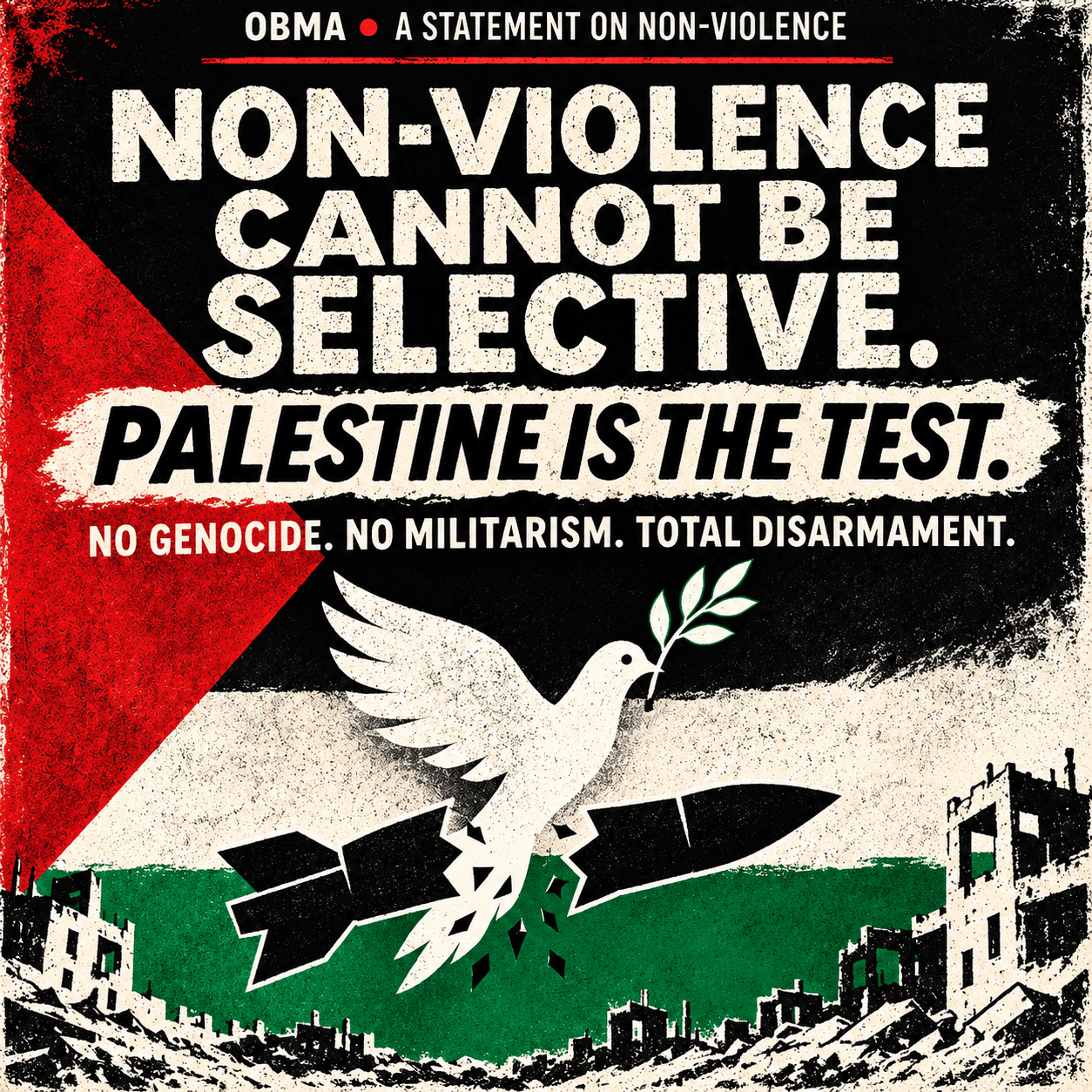
We are not willing to let the language of non-violence become a convenient political ornament, invoked when rhetorically useful and abandoned when strategic interests intervene. Non-violence cannot be selective; compassion cannot be conditional; and moral conviction cannot be suspended whenever national interest is invoked as a convenient justification. If your professed principles cannot withstand the test of Palestine, what exactly are those principles worth?
Let us make one thing absolutely clear: Jiu-jitsu and similar martial practices are disciplines of self-defence and resistance—to restrain an aggressor, to withstand an attack, to protect oneself and others. They are not ethical justifications for aggression, domination or the infliction of structural violence of any kind. The distinction between resistance and aggression is fundamental. Perhaps it is precisely this distinction that your present political position has lost sight of.
We regret to ask this, but what, pray, is the substantive difference between your position on Israel and that of BJP-RSS Saffron Fascist Modi?
We ask this not to erase or diminish your evidently significant role in the Bharat Jodo Yatra, the Bharat Jodo Nyay Yatra, the Vote Chori campaign, Chhatron Ki Goonj, and other important democratic interventions in the past decade. We whole-heartedly acknowledge and appreciate those contributions. But past struggles cannot serve as perpetual moral indemnity for present political equivocations. If, on the question of Israel, you ultimately arrive at the same position of strategic accommodation, continued military cooperation and weapons procurement, what exactly distinguishes your foreign-policy imagination from Modi’s? A different political vocabulary, a softer public persona and a more palatable articulation of national interest cannot, by themselves, constitute an alternative politics. If the moral destination is the same, how different can the political journey really be?
We therefore withdraw the support we had extended to you through our previously-referenced article. That support was never unconditional, nor was it an endorsement of another personality’s pursuit of power. It was an expression of solidarity with what we believed to be a shared commitment to non-violence and a radically different social order. You have now placed that commitment in serious question.
Unless you unequivocally confront your own contradictions, outrightly reject the politics of militarisation, condemn Israel’s genocidal violence and articulate a position consistent with the uncompromising ethics of non-violence, our support stands withdrawn. We expect more than diplomatic formulations, strategic silences and carefully calibrated statements. We expect moral clarity—and we demand that you respond.
WHAT WE DEMAND
- An unequivocal condemnation of Israel’s occupation, settler-colonialism and violence against Palestinians.
- An end to India’s military cooperation and weapons procurement from Israel.
- An unequivocal commitment to Palestinian self-determination, freedom and sovereignty.
- A rejection of militarisation as the foundation of national security.
- A commitment to total disarmament and a warless world, rather than the perpetuation of the military-industrial economy.
- A public clarification of how your position on Israel is consistent with your professed commitment to non-violent response-ability.
A non-violent politics cannot coexist with the normalisation of genocide. Disarmament is not a rhetorical flourish. Non-violence is not a meditation retreat, a diplomatic convenience or a carefully cultivated public image. It is a political and ethical commitment that must be demonstrated precisely when power demands silence.
Let there be no ambiguity: our opposition to the BJP–RSS regime and its saffron fascist project remains unwavering. Since 2021, OBMA has stood in ideological and structural resistance to this politics, and we shall not retreat from that struggle. But opposition to one political formation does not demand unconditional allegiance to another. We will question, scrutinise and hold accountable every political actor, including those whose democratic interventions we may have previously supported. Our principles do not change with political convenience; our convictions are not subordinate to electoral loyalties. We stand partyless, not principled-less; politically engaged, but never politically captive. The principle comes first. Always.
FREE PALESTINE.
From the river to the sea, Palestine will be free.
min an-nahr ʾilā l-baḥr, Filasṭīn sa-tataḥarrar.

